#Drought news October 2, 2025: Moderate drought expanded slightly in the #SanLuisValley of south-central #Colorado, where short-term precipitation deficits mounted amid poor vegetation conditions

Click on a thumbnail graphic to view a gallery of drought data from the US Drought Monitor website.
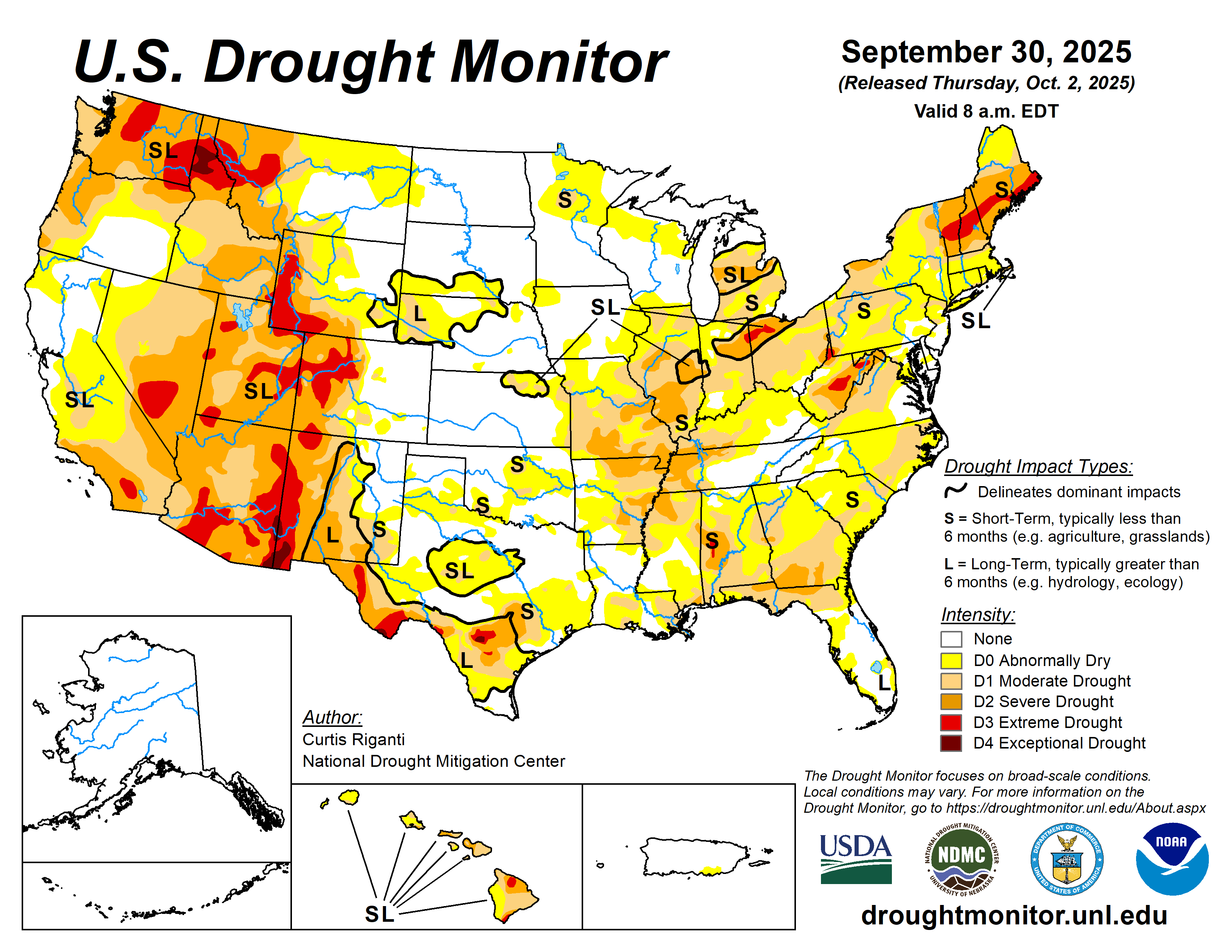
Click the link to go to the US Drought Monitor website. Here’s an excerpt:

This Week’s Drought Summary

This week, widespread rains fell from parts of southern Missouri and Arkansas northeastward into the northeast U.S. Amounts of 1-2 inches were common, and locally higher amounts fell, especially in northwest and southern Arkansas, parts of Tennessee and Kentucky and in eastern New York and southern New England. Many of the areas which received these rains were experiencing drought or abnormal dryness. For some, the rain provided enough relief to improve conditions, while for others, especially in south-central Missouri and northern Arkansas and in New England, heavier rains were only enough to halt recent worsening trends. Very dry weather continued in northern parts of Illinois, Indiana, Ohio, most of Lower Michigan and the northern Great Plains and Upper Midwest, leading to some deterioration in areas that have remained dry recently. Recent precipitation in parts of the High Plains and West led to improvements for the northern Colorado Front Range into the southeast half of Wyoming, and in portions of New Mexico, Arizona, Nevada and Oregon. Continual dry weather led to worsening conditions in northern Montana and adjacent western North Dakota, where abnormal dryness and moderate and severe drought expanded in coverage. Widespread flash drought conditions occurred this week across parts of the far south-central and Southeast U.S. Impacts were acute in portions of southern Georgia, where the peanut crop was suffering as a result of the rapid drying. While precipitation amounts varied widely, above-normal temperatures were standard across most of the U.S., except for parts of Arizona and New Mexico. In most of the rest of the U.S., temperatures were between 2-6 degrees above normal, while the northern Great Plains, Upper Midwest and Northeast baked in September heat that generally ranged from 6-10 degrees warmer than normal.

Localized degradations occurred in parts of Hawaii this week, where short-term precipitation deficits continued amid poor streamflow conditions and impacts to vegetation. Rainfall from a tropical wave reduced precipitation deficits in eastern Puerto Rico, leading to the removal of one of the ongoing areas of abnormal dryness. Alaska remained free of drought or abnormal dryness this week.

High Plains

Mostly warmer-than-normal temperatures occurred across the High Plains this week, except for central and southern parts of Colorado. The Dakotas and northern Wyoming were especially warm as September reached its end, with temperatures mostly 6-10 degrees above normal. Widespread moderate to heavy precipitation fell from southwest Nebraska and northwest Kansas into northern Colorado and southeast Wyoming, including some wintry precipitation at higher elevations. Rainfall amounts locally exceeded 2 inches in parts of northeast Colorado and adjacent parts of Nebraska and Kansas.

In northern Colorado and southeast Wyoming, recent precipitation improved soil moisture and streamflow and reduced precipitation shortfalls, leading to widespread 1-category improvements in these areas. In south-central South Dakota, recent wetter weather led to the removal of moderate drought, as conditions were re-evaluated this week in that area. Moderate drought expanded slightly in the San Luis Valley of south-central Colorado, where short-term precipitation deficits mounted amid poor vegetation conditions…

Colorado Drought Monitor one week change map ending September 30, 2025.

West

In the West this week, temperatures were mostly warmer than normal, with the exception of parts of Arizona and New Mexico. Isolated rains of 2 or more inches fell in parts of west-central New Mexico, leading to localized 1-category improvements there. More significant heavy rain, locally exceeding 2 inches, fell across parts of central Arizona this week. Unfortunately, this led to a significant and deadly flooding event. The heavy rains in central and southern Arizona also led to 1-category improvements in this week’s Drought Monitor. Isolated heavy rain fell in central and northeast Nevada (along the Utah border), leading to isolated 1-category improvements. A re-evaluation of conditions in central and north-central Oregon led to some local improvements there, where soil moisture and streamflow have improved and precipitation deficits lessened. Just to the northwest of those improvements, poor vegetation conditions, low streamflow and significant precipitation deficits led to a small expansion in severe drought. Severe drought expanded in south-central Utah where long-term precipitation deficits grew alongside soil moisture and streamflow shortages. Recent dry weather and dropping soil moisture, streamflow and groundwater levels led to expansions of severe and moderate drought and abnormal dryness across northern Montana..

South

Like most other regions this week, the South was warmer than normal for late September, with temperature anomalies mostly checking in 2-6 degrees above normal. Rainfall amounts across the region varied widely. Far northern Louisiana and southern and northwest Arkansas were quite wet, with widespread rain amounts from 2-4 inches, with locally higher amounts. Heavier rain amounts of 2-4 inches also fell in parts of southern and western Tennessee. More isolated 1-2 inch rain amounts fell in central Texas and southeast Oklahoma. The central Texas rains were sufficient for a few local improvements, though one area that remained drier saw a local expansion of moderate drought. Farther southeast in Texas, mostly drier weather led to widespread expansion in severe drought in the Austin area, along with expanding moderate drought and abnormal dryness nearby and to the east. Recent drier and warmer weather led to some local expansion of abnormal dryness and short-term moderate drought in central Oklahoma. Moderate drought and abnormal dryness expanded in southern Louisiana and southern Mississippi, with localized severe drought developing along the Mississippi Gulf Coast in response to recent very dry weather and lowering soil moisture amounts. Moderate and severe drought also expanded in east-central Mississippi amid deficits in soil moisture and short-term precipitation.

The heavier rains in parts of Tennessee and Arkansas increased soil moisture and streamflow and lessened precipitation deficits in the areas of heaviest rainfall. This led to widespread 1-category improvements and a 2-category improvement in southwest Arkansas. Despite the rainfall in northern Arkansas, short-term precipitation deficits remained significant enough that improvements in this area were mostly limited this week…
Looking Ahead

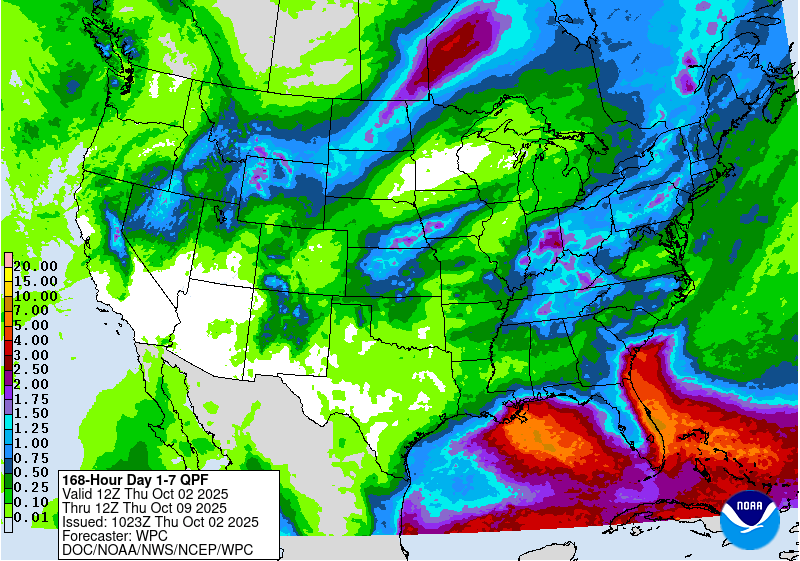
Between the evening of Wednesday, Oct. 1 and Monday, Oct. 6, the National Weather Service Weather Prediction Center is forecasting mostly dry weather across large portions of the Contiguous U.S., spanning from southern California east and northeast through the Ohio Valley, eastern Great Lakes and Northeast. Outside of the Southeast, precipitation amounts of at least 0.75 inches are confined to parts of the Sierra Nevada, northern Nevada, northern Utah, parts of Idaho, northern Wyoming, southern Montana, western South Dakota and central North Dakota. Heavier rain amounts are forecast in parts of southeast Louisiana and the Mississippi Gulf Coast, far southern South Carolina, far southeast Georgia and much of the Florida Peninsula. In the Florida Peninsula and far southeast Louisiana, rainfall amounts may exceed 4 inches.

Looking ahead to Oct. 7-11, forecasts from the National Weather Service Climate Prediction Center (CPC) strongly favor above-normal precipitation in the Southwest U.S., especially Arizona and New Mexico, while above-normal precipitation is moderately favored in parts of the central Great Plains, Upper Midwest and Florida Peninsula. The CPC forecast slightly favors below-normal precipitation in parts of the south-central U.S. and parts of the northern Pacific Coast. Most of the southwest, central and eastern U.S. are favored to see above-normal temperatures, alongside the far northwest. Portions of the West spanning California into central and eastern Montana may see near-normal temperatures.

The CPC forecast for Hawaii favors above-normal precipitation and temperatures across the entire state.

In Alaska, the CPC forecast strongly favors above-normal precipitation in the northwest part of the state and below-normal precipitation in the southeast. Warmer-than-normal temperatures are strongly favored for most of the state, except for southeast Alaska, where near-normal temperatures are more likely.

US Drought Monitor one week change map ending September 30, 2025.

Are nukes the solution to the data center problem?: Or are data centers the solution to the nuclear reactor infeasibility problem? — Jonathan P. Thompson (LandDesk.org) 

Palo Verde Nuclear Generating Station. Jonathan P. Thompson photo.

Click the link to read the article on The Land Desk website (Jonathan P. Thompson):

September 30, 2025

“America’s Data Centers Could Go Dark,” the subject line of the email read.

If only, I mused. I’m less worried about data centers going dark than about everything else going dark because of data centers. But whatever. That’s not what the PR person (or AI bot?) who sent the email was trying to say. They were there to ask, rhetorically: “Can Microreactors Save the Day?” They then offered to connect me with James Walker, CEO of a firm called NANO Nuclear Energy, who would then try to sell me on his KRONOS MMR™, described as a “compact, carbon free” way to power data centers.

There is a lot of hysteria around data centers these days. Folks like me are worried about how much energy and water they use, and the effect that might have on the grid, the climate, scarce water supplies, and other utility customers. Others are panicking over the possibility that the U.S. might fall behind in the AI race — though I have no idea what winning the race would entail or look like.


A Dog Day Diatribe on AI, cryptocurrency, energy consumption, and capitalism — Jonathan P. Thompson


And, in our capitalistic system, where there is fear, there are myriad solutions, most of which entail building or making or consuming more of something rather than just, well, you know, turning off the damned data centers. The Trump administration would solve the problem by subsidizing more coal-burning, while the petroleum industry is offering up its surplus natural gas. Tech firms are buying up all the power from new solar arrays and geothermal facilities, long before they’re even built.

Perhaps the most hype, and the loftiest promises of salvation, however, involve nuclear power and a new generation of reactors that are smaller, portable, require less up-front capital, and supposedly not weighed down with all of the baggage of the old-school conventional reactors, which not only cost a lot to build, but also tend to evoke visions of Chernobyl, Three Mile Island, or Fukushima.

Yet for all the buzz — which may be loudest in the Western U.S. — it’s far from certain that this so-called nuclear renaissance will ever come to fruition. The latest generation of reactors may go by slick, newfangled names, but they are still expensive, require dangerous and damaging mining to extract uranium for fuel, produce waste, are potentially dangerous — and are still largely unproven.

Experimental Breeder Reactor II on the Idaho National Laboratory. The reactor was shut down and decommissioned in 1994. Now Oklo is building a new reactor, using similar technology, nearby. Jonathan P. Thompson photo.

Several years ago I visited Experimental Breeder Reactor I, located west of Idaho Falls. It has been defunct since 1963 and is now a museum, and a sort of time capsule taking one back to heady times when atomic energy promised to help feed the exploding, electricity-hungry population of the post-war Western U.S. and its growing number of electric gadgets (remember electric can openers?).

The retro-futuristic facility is decked out with control panels and knobs and valves and other apparatus that possess the characteristic sleek chunkiness of mid-century high-tech design. A temperature gauge for the “rod farm” goes up to 500 degrees centigrade, and if you look closely you’ll see a red button labeled “SCRAM” that, if pushed, would have plunged the control rods into the reactor, thereby “poisoning” the reaction and shutting it down. If you have to push it, you’d best scram on out of there.

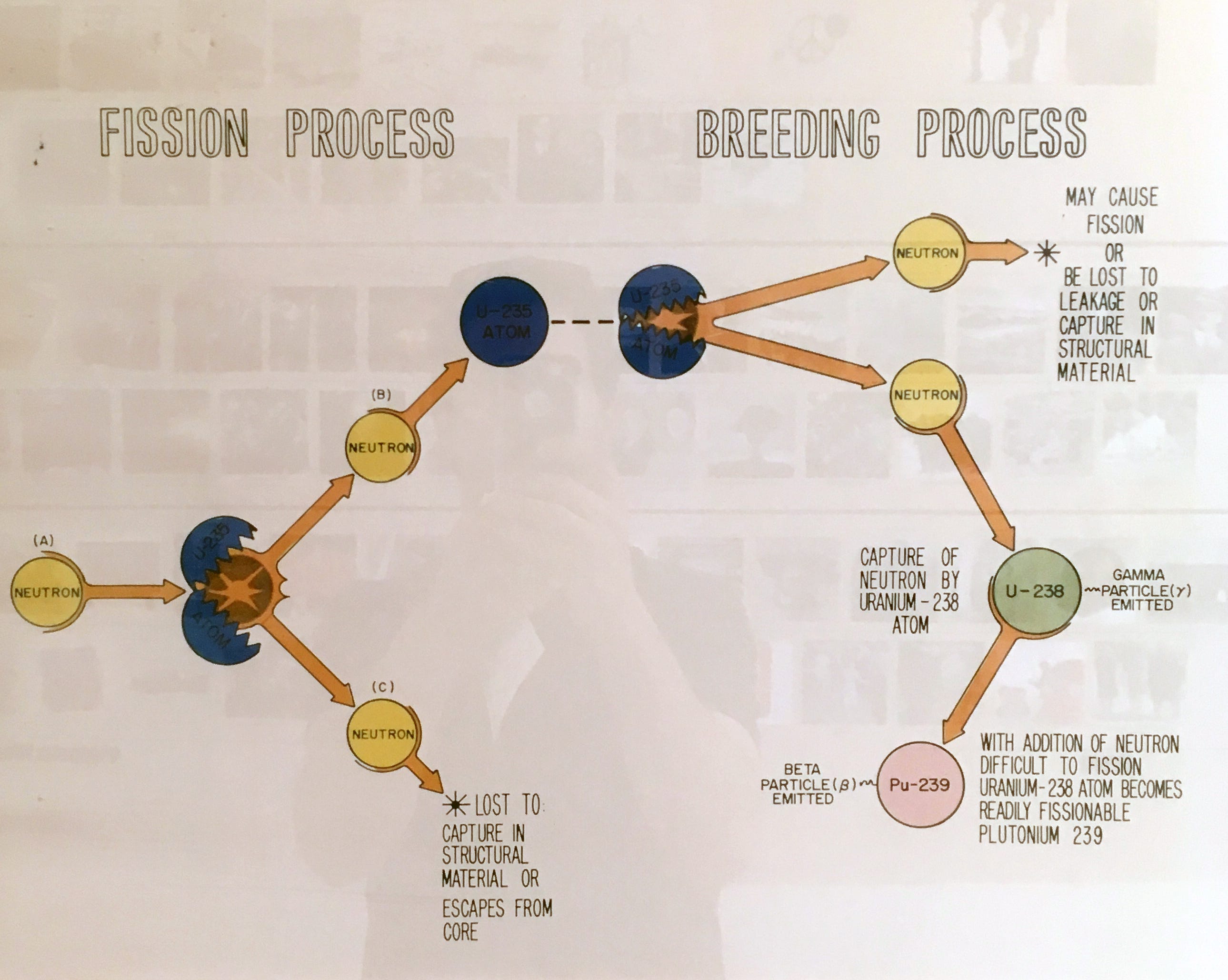
I couldn’t help but get caught up in the marvels of the technology. On a cold December day in 1951, scientists here had blasted a neutron into a uranium-235 atom and shattered it, releasing energy and yet more neutrons that split other uranium atoms, causing a frenetically energetic chain reaction identical to the one that led to the explosions that annihilated Hiroshima and Nagasaki several years earlier. Mass is destroyed, energy created. Only this time the energy was harnessed not to blow up cities, but to create steam that turned a turbine that generated electricity that illuminated a string of lightbulbs and then powered the entire facility — all without burning fossil fuels or building dams.

This particular reactor was known as a “breeder” because its fuel reproduces itself, in a way. During the reaction, loose neutrons are “captured” by uranium-238 atoms, turning them into plutonium-239, which is readily fissionable, meaning it can be used as fuel for future reactions.

A diagram of the atomic fission and breeding process at Experimental Breeder Reactor-I in Idaho. The reactor began generating electricity in 1951. Jonathan P. Thompson photo.

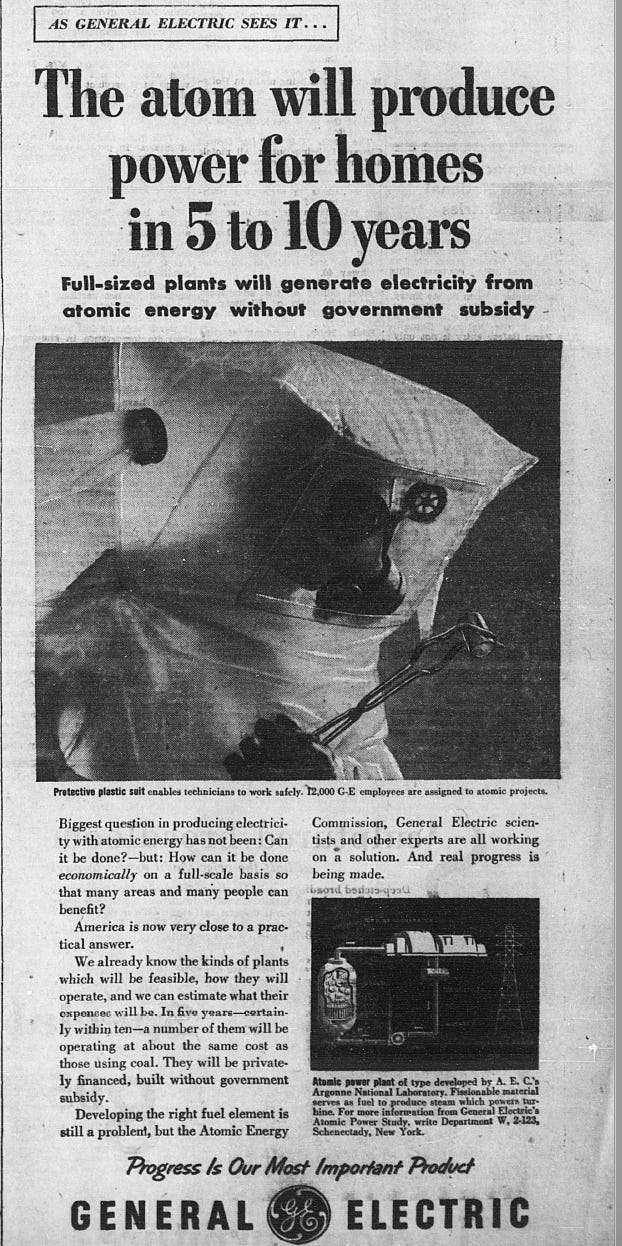
At first glance it seems like the answer to the world’s energy problems, and two years after EBR-I lit up, Dwight D. Eisenhower delivered his 1953 “Atoms for Peace” speech. Nuclear energy would help redeem the world from the terrible scourge of atomic weapons, the president said; it would be used to “serve the needs rather than the fears of the world — to make the deserts flourish, to warm the cold, to feed the hungry, to alleviate the misery of the world.”*

Now, with Arizona utilities teaming up to develop and build new reactors; with Wyoming’s, Idaho’s, and Utah’s governors collaborating on their nuclear-powered “Energy Superabundance” effort; and with Oklo looking to build a modern version of EBR-I not far from the original, it’s beginning to feel like 1953 all over again. Only now the nuclear reaction promises to serve the needs of cyberspace rather than the real world — to make AI do your homework, to cool the server banks, to feed the Instagram feeds, to send out those Tik-Toks at twice the speed.

Advertisement from 1954.

Seven decades later, Eisenhower’s hopes have yet to be fulfilled.

It turns out a lot of people aren’t comfortable with the idea nuclear reactions taking place down the road, regardless of how many safety backstops are in place to avoid a catastrophic meltdown a la Chernobyl. Nuke plants cost a lot of money and take forever to build. They need water for steam generation and for cooling, which can be a problem in water-constrained places and even in water-abundant areas: Diablo Canyon nuke plant sucks up about 2.5 billion gallons of ocean water to generate steam and to cool the reactors, before spitting it — 20 degrees warmer — back into the Pacific. This kills an estimated 5,000 adult fish each year, along with an additional 1.5 billion fish eggs and fry and messes up water temperature and the marine ecosystem. And while nukes are good at producing baseload power (meaning steady, 24/7 generation), they aren’t very flexible, meaning they can’t be ramped up or down to accommodate fluctuating demand or variable power sources like wind and solar.

And then there’s the waste. The nuclear reaction itself may seem almost miraculous in its power, simplicity, and even purity.

But the steps required to create the reaction, along with the aftermath, are hardly magical. To fuel a single reactor requires extracting hundreds of thousands of tons of ore from the earth, milling the ore to produce yellowcake (triuranium octoxide), converting the yellowcake to uranium hexafluoride gas, enriching it to concentrate the uranium-235, and fabricating the fuel pellets and rods.

Each step generates ample volumes of toxic waste products. Mining leaves behind lightly radioactive waste rock; milling produces mill tailings containing radium, thorium, radon, lead, arsenic, and other nasty stuff; and enrichment and fabrication both produce liquid and solid waste. It has been about 40 years since the Cold War uranium boom busted, and yet the abandoned mines and mills are still contaminating areas and still being cleaned up — if you can ever truly clean up this sort of pollution.

Yet the reaction, itself, generates the most dangerous form of leftovers, containing radioactive fission products such as iodine, strontium, and caesium and transuranic elements including plutonium. This “spent nuclear fuel,” or radioactive waste, is removed from the reactor during refueling and for now is typically stored on site. Efforts to create a national depository for these nasty leftovers have failed, usually because the sites aren’t deemed safe enough to contain the waste for a couple hundred thousand years, or because locals don’t want it in their back yard. If it were to fall into the wrong hands, it could be used in a “dirty bomb,” a conventional explosive that scatters radioactive material around an area.

Plus, breeder reactors, especially, produce plutonium, which can then be used in nuclear warheads (India used U.S.-supported breeder technology to acquire nuclear weapons). That’s one of the reasons folks soured on the technology and the U.S. ended its federal plutonium breeder reactor development program in the 1980s. The other reasons were high costs and sodium coolant leaks (and resulting fires). After the EBR-I shut down in 1963, because it was outdated, the Idaho National Laboratory built EBR-II nearby. It was shut down and decommissioned in 1994.

Nevertheless, Oklo — one of the rising new-nuke stars — is touting its use of similar technology as the EBR-II, i.e. liquid-metal-cooled, metal-fueled fast reactor, as a selling point for the reactor it is currently developing at the INL.

The envisioned new fleet of reactors go by many names: SMRs, or small modular reactors, and advanced, fast, micro, or nano-reactors. Most of them can be fabricated in a factory, then trucked to or assembled on-site. Some are small enough to fit in a truck. They can be used alone to power a microgrid or a data center, or clustered to create a utility-scale operation that feeds the grid.

Their main selling point is that they require less up-front capital than a conventional reactor, that you can build and install one of these things for a fraction of the cost and a fraction of the time (once the reactors are actually licensed, developed, and produced on a commercial scale, which is still not the case).

A decade ago, companies like NuScale were also promoting them as ways to power the grid in a time of increasing restraints on carbon. Now that the feds are not only declaring climate change a “hoax,” but also forbidding agencies from even uttering the term, that no longer carries as much weight. Instead, almost every new proposal now is marketed as a “solution” to the data center “problem.” Google, Switch, Amazon, Open AI, and Meta are all looking to power their facilities with nukes, if and when they are finally up and running.

The new technology is not monolithic. Some are cooled in different ways, or use different types of fuel, but they all work on the same principle as old-school conventional reactors. As such, they also require the same fuel-production process, also have potential safety issues, and also create hazardous waste.

In fact, a 2022 Stanford study found that small modular reactors could create more, and equally hazardous, waste than conventional reactors per unit of power generated. The authors wrote: “Results reveal that water-, molten salt–, and sodium-cooled SMR designs will increase the volume of nuclear waste in need of management and disposal by factors of 2 to 30 {compared to an 1,100 MW pressurized water reactor}.”

The cost thing isn’t all that clear cut, either. The smaller reactors may be cheaper to build, but because they don’t take advantage of economies of scale, they are more expensive per unit of electricity generated than conventional reactors, and still can be cost prohibitive.

In 2015, for example, Oregon-based NuScale proposed installing 12 of its 50-MW small modular reactors at the Idaho National Laboratories to provide 600 MW of capacity to the Utah Associated Municipal Power Systems, or UAMPS (which also includes a handful of non-Utah utilities). In 2018 — after receiving at least $288 million in federal subsidies — NuScale upped the planned capacity to 720 MW, saying it would lower operating costs. 

But what started out as a $3 billion project in 2015 kept increasing, so that even after it was ramped down to 421 MW, the projected price tag had ballooned to $9.3 billion in 2023 (still about one-third of the cost of the new Vogtle plant in Georgia, but with a fraction of the generating capacity). UAMPS’s collective members, realizing there were plenty of more cost-effective ways to keep their grids running, canceled the project later that year.

It kind of makes you wonder: Is this new wave of nuclear reactors solving the data center energy demand problem? Or are data centers’ energy-gobbling habits solving the nuclear reactors’ cost and feasibility problems?


Data Centers: The Big Buildup of the Digital Age — Jonathan P. Thompson


I suspect it’s a little bit of both, with the balance swinging toward the latter. In that case, nuclear reactors are not alone: The Trump administration is using data center demand as the prime justification for propping up the dying coal industry. 

Before the Big Data Center Buildup, utilities really had no need for expensive, waste-producing reactors — they could more cheaply and safely build solar and wind installations with battery storage systems for backup. If needed, they could supplement it with geothermal or natural gas-fired peaker plants. 

But if data centers end up demanding as much power as projected (like 22,000 additional megawatts in Nevada, alone), utilities will need to pull out all the stops and add generating capacity of all sorts as quickly as possible, or they’ll tell the data centers to generate their own power. Either scenario would likely make small nukes more attractive, even if they do cost too much, and even if it means that data centers end up being radioactive waste repositories, too. 

Another plausible scenario is that the tech firms figure out ways to make their data centers more efficient; that it’s more cost-effective (and therefore profitable) to develop less energy- and water-intensive data processing hardware than to spend billions on an experimental reactor that may not be operating for years from now. 

What a novel concept: To use less, rather than always hungering for more and more and more.

Human emissions are helping fuel the Southwest’s epic #drought: Three studies of the Pacific Ocean conclude that lower precipitation isn’t just due to natural causes — Mitch Tobin (WaterDesk.org)

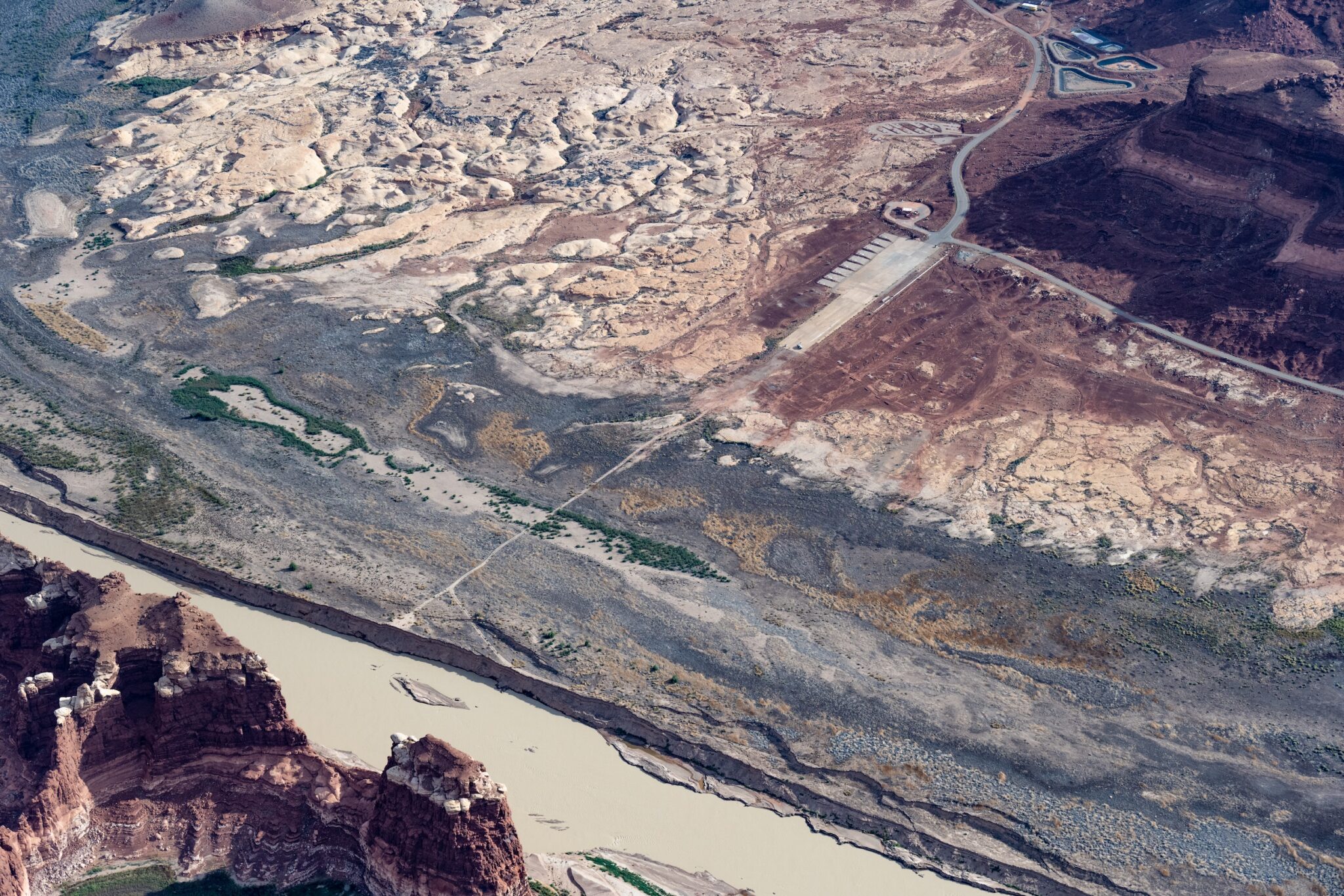
Due to the megadrought, the boat ramp at Lake Powell’s Hite Marina lies far from the Colorado River in this October 2022 aerial view. Photo by Alexander Heilner/The Water Desk.

Click the link to read the article on The Water Desk website (Mitch Tobin):

September 28, 2025

The American Southwest has been gripped by an epic drought that has lasted decades and strained the fast-growing region’s naturally limited water resources.

The megadrought—thought to be the worst in at least 1,200 years—has caused reservoir levels to plummet on the Colorado River and shriveled the Rio Grande. The dry times have also stressed imperiled ecosystems, heightened wildfire risks and curtailed outdoor recreation.

While the drought’s consequences are easy to see, its causes and prognosis are trickier to disentangle, requiring scientists to look deeply into precipitation deficits, rising temperatures and changing patterns in the atmosphere and ocean.

Long before humans began altering the climate with greenhouse gases and other air pollutants, the Southwest was subject to feast-or-famine weather featuring extreme dry spells, raising the possibility that this current drought is just part of that natural variability. 

What scientists are exploring now is how the human touch is imprinted on the drought due to our ongoing transformation of the climate, atmosphere and oceans.

Three recent scientific studies identify human emissions as a key driver in the precipitation declines that have helped cause the Southwest’s current drought, which has been made much worse by rising temperatures due to climate change. 

The papers, published in the July 9 issue of Nature Geoscience and the August 13 issue of Nature, focus on what’s been happening in and above the Pacific Ocean to help explain recent precipitation deficits in the Southwest. As carbon emissions continue to rise, all three papers conclude that human-caused warming is likely to make drought a more persistent feature in the decades ahead.

The three recent studies examine why changes in and above the ocean have shifted storm tracks and made the Southwest’s weather drier, but that’s not the whole story about the drought. The picture is even bleaker when we account for what’s happening to the region’s warming landscape and an increasingly thirsty atmosphere.

Another line of research has found that higher temperatures alone are causing the Southwest to “aridify” by drying out soils, boosting evaporation rates and shrinking the snowpack. Known as a “hot drought,” this aridification due to warming would be troubling enough for the Southwest’s water resources and society. But the three recent studies, which focus on precipitation shortfalls, add another level of worry: relief falling from the skies as raindrops and snowflakes appears increasingly unlikely.

US Drought Monitor map September 23, 2025. The Southwest continues to experience drought conditions, according to this September 23 map from the U.S. Drought Monitor.

Study 1: Why the Pacific’s rhythm is stuck

One of the studies, “Human emissions drive recent trends in North Pacific climate variations,” focuses on the Pacific Decadal Oscillation (PDO) and why it has been stuck, rather than oscillating over recent decades as its name would suggest.

The PDO is a natural rhythm in sea-surface temperatures in the North Pacific Ocean that has warm and cool phases. The cycle, which is similar to the El Niño/La Niña pattern in the tropical Pacific, was thought to last about 20 to 30 years, but in recent decades it has predominantly been in the cool or “negative” phase, which tends to make the Southwest drier. 

“The PDO has been locked in a consistent downward trend for more than three decades, remanding nearby regions to a steady set of climate impacts,” according to the study. “The ongoing, stubbornly persistent, cold phase of the PDO is associated with striking long-term trends in climate, including the rate of global warming and drought in the western United States.”

The conventional scientific understanding of the PDO holds that the pattern waxes and wanes largely due to natural “internal” variability. But this recent study, which relies on 572 climate simulations processed on supercomputers, argues that the PDO is, in fact, very much influenced by human activities and our air pollution. These external forces account for 53% of the variation in the PDO.

“Overall, we find that human activity is a key contributor to multi-decadal trends in the PDO since the 1950s,” according to the paper.

It wasn’t always this way. Between 1870 and 1950, the PDO’s changes were internally generated, with external forces explaining less than 1% of the variability. 

“It seems like as long as emissions continue, we’re going to be stuck in this current phase of drought,” said lead author Jeremy Klavans, a postdoctoral associate in the Department of Atmospheric and Oceanic Sciences at the University of Colorado Boulder. “If emissions were to abate, we think that the PDO would be able to vary freely again, and drought would be, again, a thing of chance. There would be the chance to end the drought.” 

The researchers say they used an “extraordinarily large ensemble” of climate simulations to isolate the signal of human-caused climate change from the noise of natural variability. 

“It takes a really large ensemble to find this signal, and that’s because we think that the signal-to-noise ratio in climate models is too low,” Klavans said.  

That’s distressing news for the region’s water managers, who are already grappling with limited supplies. “We expect there to be reduced water supply in the form of precipitation, including snowfall, in the next 20, 30 years, so as they’re making planning decisions for how to allocate water resources or what infrastructure to build, they should expect less precipitation,” Klavans said.

“It certainly seems that in the near term, given the choices that we’ve made, the PDO will continue to be stuck in drought,” Klavans said.

Study 2: Deep drought long ago offers insights for today

This isn’t the first time the Southwest has faced a megadrought.

Another study, “North Pacific ocean–atmosphere responses to Holocene and future warming drive Southwest US drought,” looks back about 6,000 years ago to a time known as the mid-Holocene. Back then, the Southwest suffered a monster drought lasting thousands of years, but this occurred many millennia before humans began changing the climate with our emissions of greenhouse gases and other pollutants. 

During the mid-Holocene, there was a different external force at play: an increase in the amount of solar radiation hitting the Northern Hemisphere during the summer, which also altered vegetation patterns on the land. 

In a process known as the Milankovitch Cycles, the Earth’s orbit and movement change regularly over the span of tens of thousands to hundreds of thousands of years. Like a spinning top, the planet wobbles. The tilt of its axis also oscillates back and forth. And Earth’s orbit around the sun alters from a near-perfect circle to a slightly more elliptical path. 

The Milankovitch Cycles caused more sunlight to hit the Northern Hemisphere in summer during the mid-Holocene warming. One of the effects was a more vigorous West African monsoon and the greening up of the Sahel and Sahara deserts, which caused those areas to absorb more heat as the land surface darkened. Similar processes happened elsewhere. The paper concludes that this external forcing had a major impact on the Pacific Ocean and the PDO, similar to how human-caused warming is playing out today and into the future. 

“People used to think that droughts in the Southwest were just occurring kind of like as a random roll of the dice, and now we can see that actually it’s like a pair of loaded dice,” said lead author Victoria Todd, a Ph.D. candidate at the University of Texas studying paleoclimatology. “This drought is occurring in wintertime, which is really important for snowpack in the Rockies and its role in Colorado River flow and Western U.S. water resources in general.”

The authors write that “our results suggest that these precipitation deficits will be maintained by a shift to a more permanent negative PDO-like state as long as hemispheric warming persists.”

“Such sustained drying and intense reductions in winter precipitation would have catastrophic impacts across the Southwest United States, particularly in the Colorado River Basin,” according to the paper.

Todd and co-authors investigated what happened during the mid-Holocene by using an analysis of leaf waxes extracted from the cores of lake sediments in the Rocky Mountains. Plants create waxy coatings on their leaves to minimize water loss and protect themselves. These hardy waxes can persist for ages when they’re deposited into sediments, allowing them to reveal critical clues about what the Earth was like when the plant was alive. By analyzing the leaf wax’s isotopes—special forms of chemical elements—researchers can paint a picture of precipitation patterns long ago.

The findings about the mid-Holocene and their analysis of modern climate projections led the researchers to conclude that current models underestimate the size of the precipitation deficits caused by warming. Both in the past and the present, the warming impacts the PDO and steers storms away from the Southwest. 

If the Southwest’s drought were just due to natural variability—a fair roll of the dice—we’d expect the PDO to get unstuck eventually and for the dry spell to break. But the research concludes that pure chance is no longer governing the system. Humans are tilting the odds.

“If global temperatures keep rising, our models suggest the Southwest could remain in a drought-dominated regime through at least 2100,” co-author Timothy Shanahan, associate professor at the University of Texas’ Jackson School of Geosciences, said in a press release

“Many people still expect the Colorado River to bounce back,” Shanahan said. “But our findings suggest it may not. Water managers need to start planning for the possibility that this drought isn’t just a rough patch—it could be the new reality.”

Lake Mead’s elevation has fallen as the region endures a megadrought. Photo by Alexander Heilner/The Water Desk.

Study 3: The effects of aerosols and tropical ocean warming

The third paper, “Recent southwestern US drought exacerbated by anthropogenic aerosols andtropical ocean warming,” offers a hint of optimism but also warns about long-term drought in the Southwest. 

The study identifies two human-caused drivers for the shortfall in winter-spring precipitation in the region: the effects of aerosol pollution in the atmosphere and global warming’s impact on ocean temperatures in the tropical Pacific. These forces have weakened the Aleutian Low, the semi-permanent low-pressure system in the North Pacific that directs storms toward the Southwest when it’s stronger. 

The study concluded that the post-1980 period in the Southwest has seen record-fast drying of soil moisture due to the precipitation declines and human-caused warming. Natural variability still plays a significant role in the Southwest’s precipitation, according to the researchers, but humanity is making its mark.

“We are not saying 100% it’s because of climate change or because of human emissions, but there’s a role from human emissions,” said lead author Yan-Ning Kuo, a Ph.D. candidate in atmospheric science at Cornell. 

Aerosols may conjure deodorant sprays, but in this context, they refer to a broad class of airborne particles that are emitted by human activities, such as burning fossil fuels, and natural causes, such as dust from deserts or sea salt from the ocean.

Some aerosols, such as the sulfates emitted when coal and oil are burned, reflect incoming sunlight and can have a cooling effect. Others, such as sooty black carbon, absorb solar radiation and have a warming effect. Aerosols can also affect cloud formation.

In this study, the authors argue that aerosols can have a significant effect on the atmosphere as they drift eastward from Asia, where booming economies and lax regulations in some areas have caused air pollution to soar in recent decades.

“We actually feel like there’s a hope for good news on the precipitation side because as we clean up aerosols, precipitation might rebound a little bit,” said co-author Flavio Lehner, assistant professor in Cornell’s Earth and Atmospheric Sciences Department.

But while reduced aerosol pollution might help the Southwest’s drought, the emissions of greenhouse gases, such as carbon dioxide, keep rising, and warming temperatures continue to aridify the Southwest’s landscape.

“​​From a precipitation perspective, we might see a recovery in the next decade or two, but together with the continued warming, that might not help much with the drought,” Lehner said. “In none of these scenarios, I think everybody would agree, does it look like the Southwest is not going to be in trouble.”