Push to the top at Gross Dam, in two parts: Major 2026 construction brings new challenges — Jay Adams (DenverWater.org) #FraserRiver #SouthBoulderCreek

Click the link to read the article on the Denver Water website (Jay Adams):

May 22, 2026

Each stage of a big construction project has its own challenges and puzzles to solve along the way. Raising Gross Dam is no different.

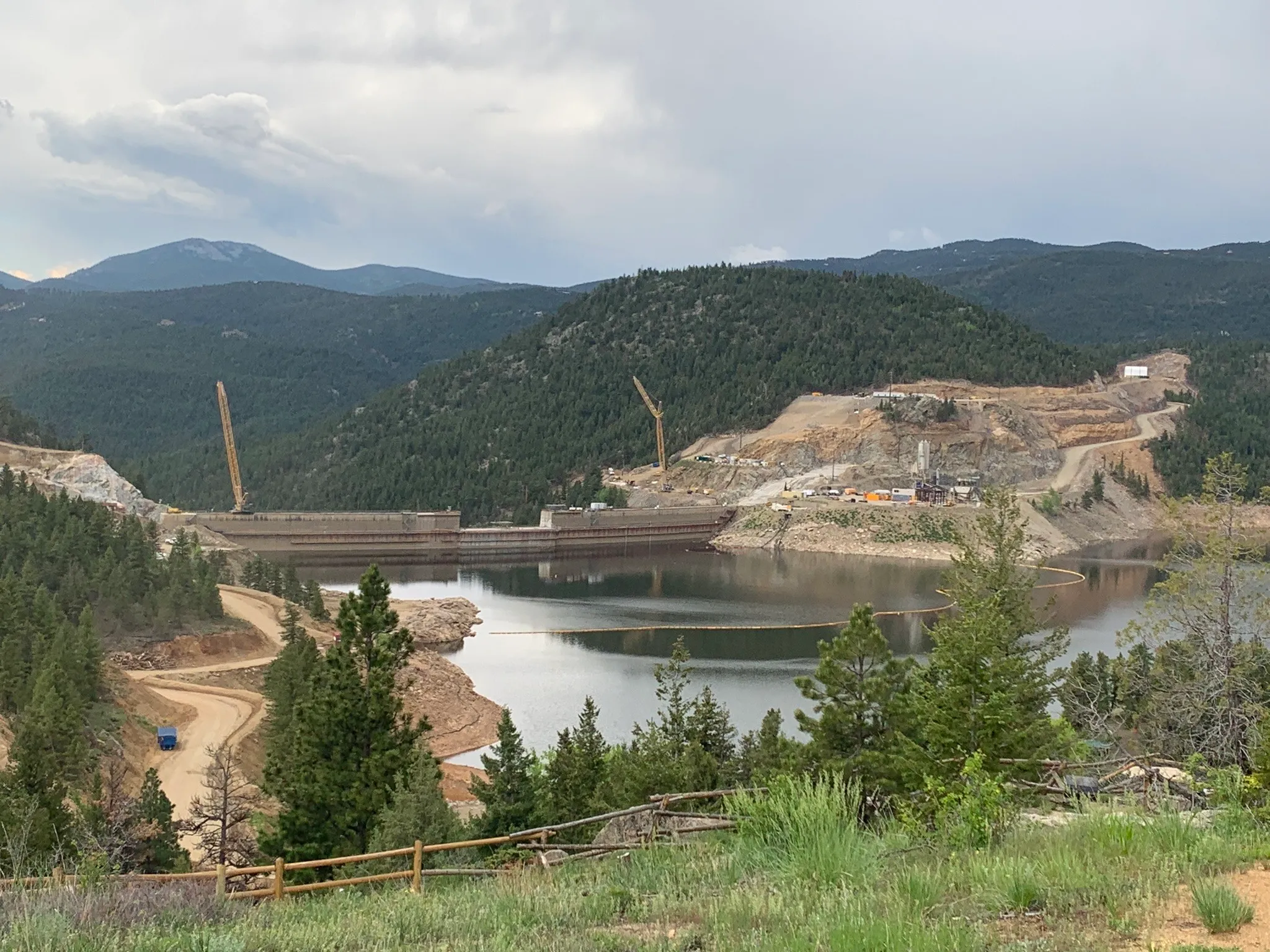
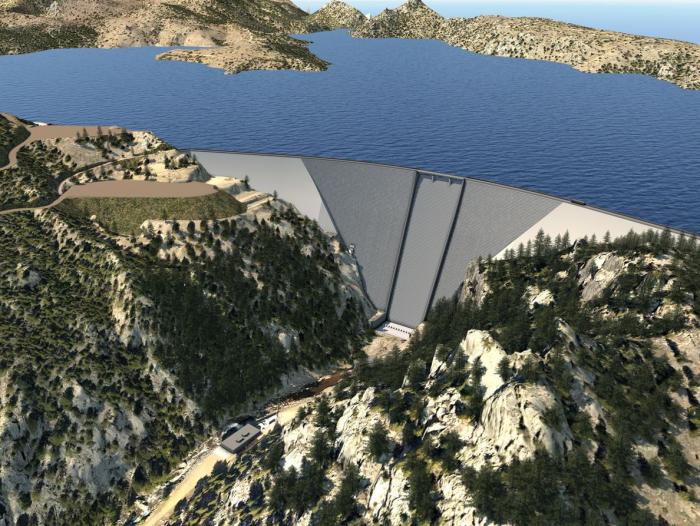
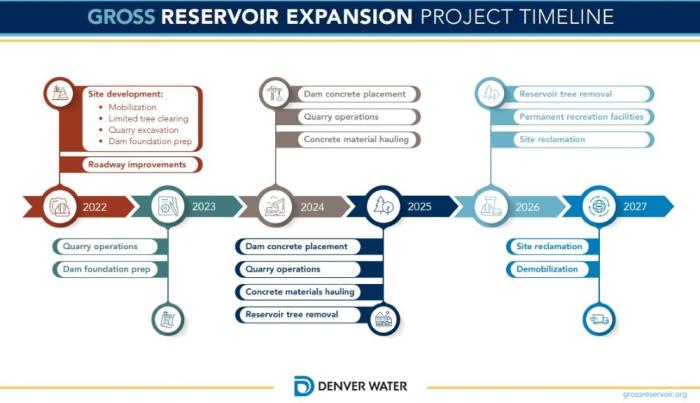
Denver Water is raising the height of the dam by 131 feet, with the final 22 feet going up this spring in two sections that are separated by a giant gap. The Gross Reservoir Expansion Project, which began construction in 2022, is designed to nearly triple the reservoir’s storage capacity. Major construction work resumed in April following a winter break.

And this year’s construction puzzles included:

  • How to move concrete across a 160-foot gap between where the concrete is made and where it’s placed?
  • And, how do you move construction vehicles across that same gap when work on the first section is finished?

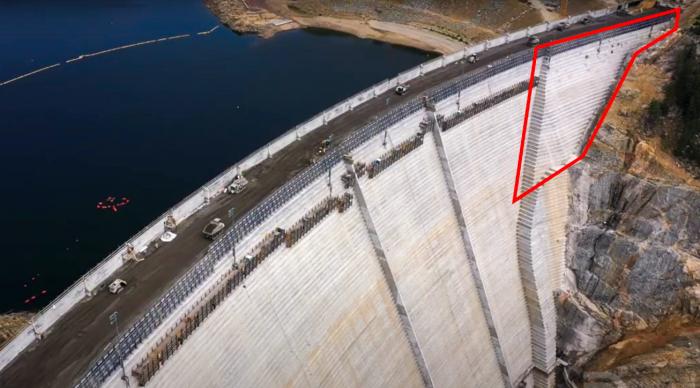
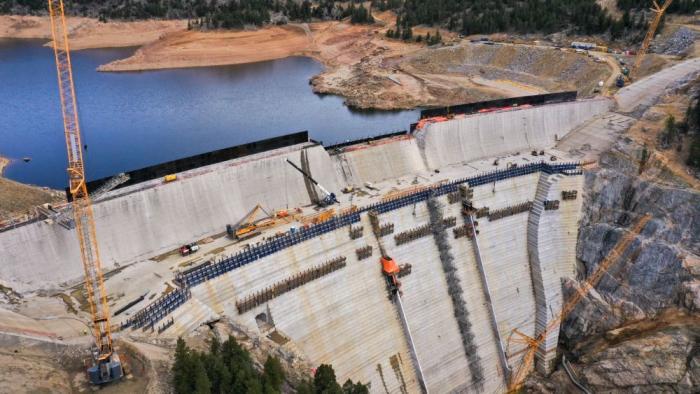
“We are building the top of the dam in two sections because we need to leave a 160-foot gap in the middle of the dam for the spillway channel,” said Casey Dick, Denver Water’s deputy program manager for the Gross Reservoir Expansion Project.

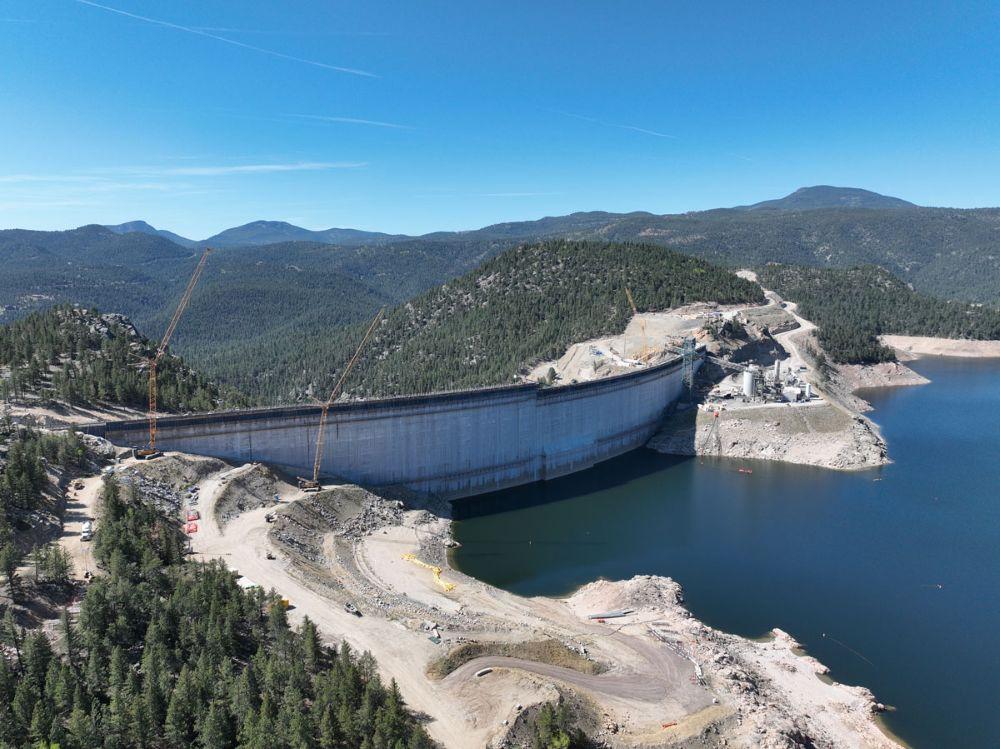
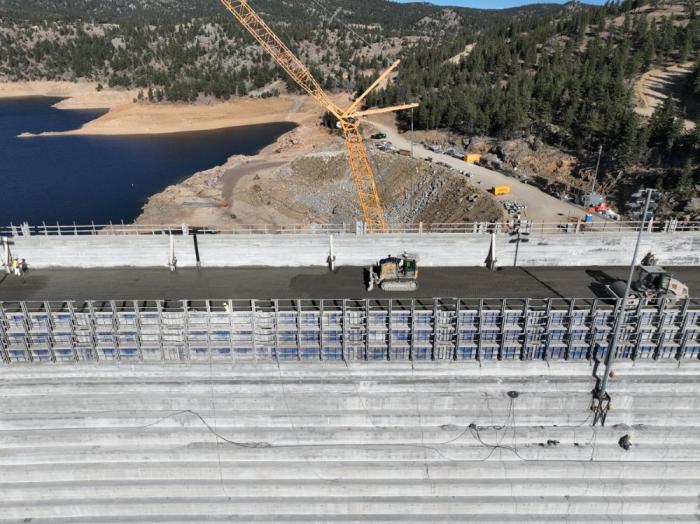
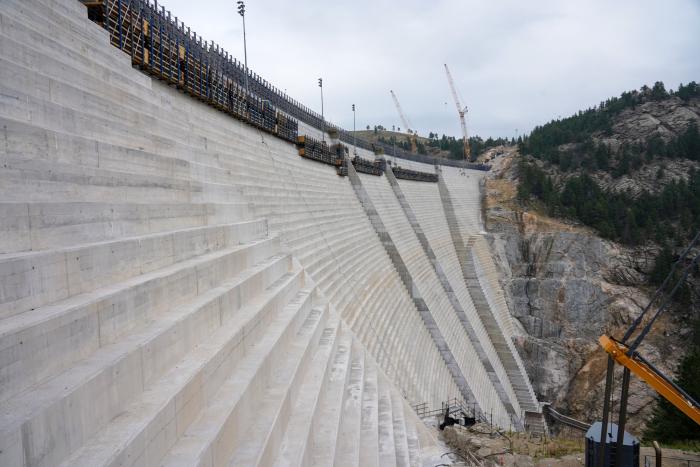
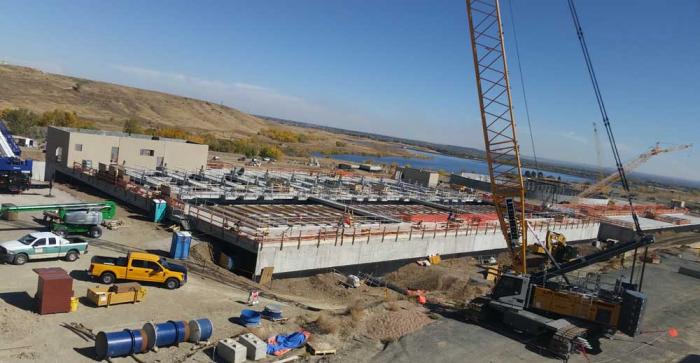
Denver Water is building the last 22 feet of Gross Dam in two sections. The photo shows the left side at its new height. The right side’s last 22 feet will be finished in June. Photo credit: Denver Water.

Spillway channels are safety features on dams that allow water to safely flow out of a reservoir if needed due to flooding rains or exceptionally high and rapid snowmelt.

Raising the dam’s last two major sections, while leaving a 160-foot gap between them, meant coming up with a new way to move concrete across the construction site.

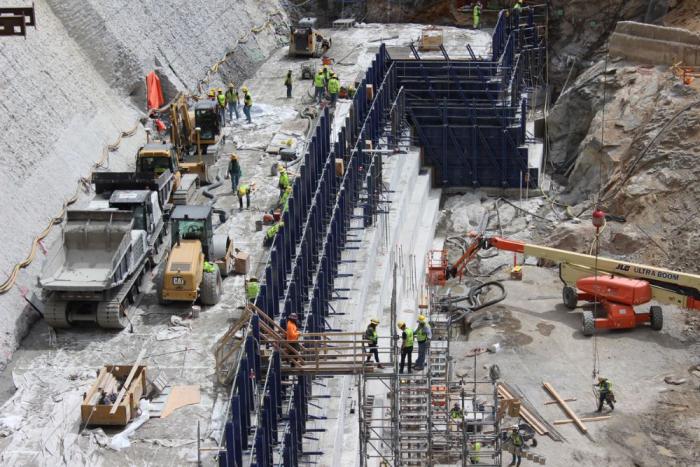
On the lower portion of the dam, crews worked on one continuous structure, which allowed trucks and equipment to easily move from one side of the dam to the other, and to move concrete from the batch plant down a large chute to where it was put into place.

However, with the final 22 feet going up in two sections, construction crews had to find a way to deliver concrete from the batch plant and across the 160-foot spillway gap as the first section went up.

The solution to this puzzle? A series of conveyors positioned in the middle of the dam that tilted higher as the first section rose higher.

“Building the new conveyor system is just another example of all the ingenuity we go through out here to build the dam,” Dick said. “With each new phase, there are new challenges that our team has to figure out.”

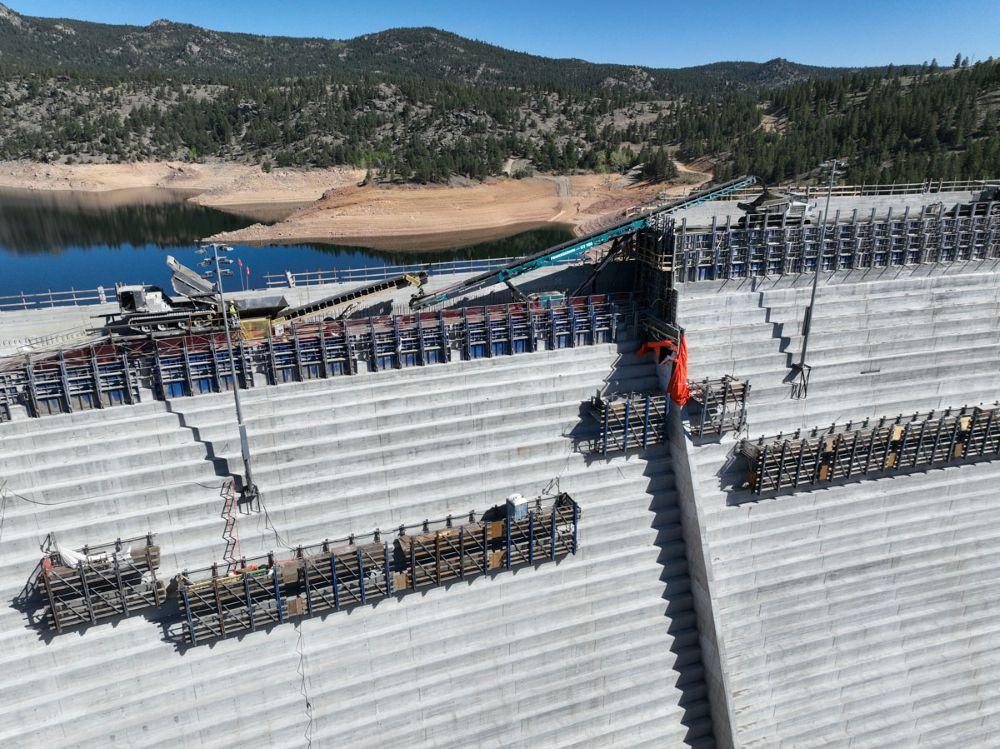
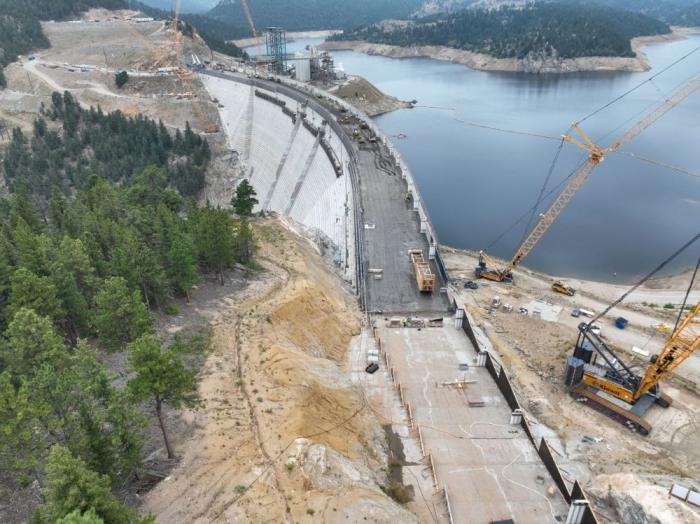
The new conveyor system moved concrete across the gap where the spillway channel will be to the far side of the dam. Photo credit: Denver Water.

Construction crews finished placing roller-compacted concrete on the dam’s left side on May 12.

But once that was done, crews faced the second challenge: How do you move the equipment off the finished, 22-foot higher section of the dam, across the spillway gap, down to where they are needed to complete the second section?

Short answer: If you can’t go over, go around.

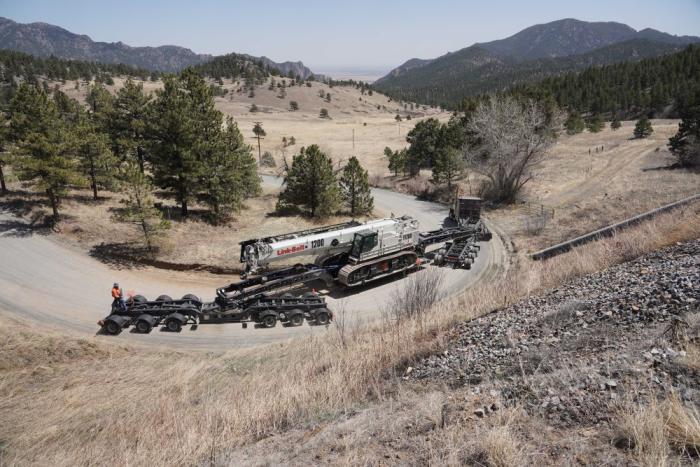
Cranes lifted equipment off the higher section of the dam to the road, where the machines convoyed about 4.5 miles around to the other side using the dam’s access road.

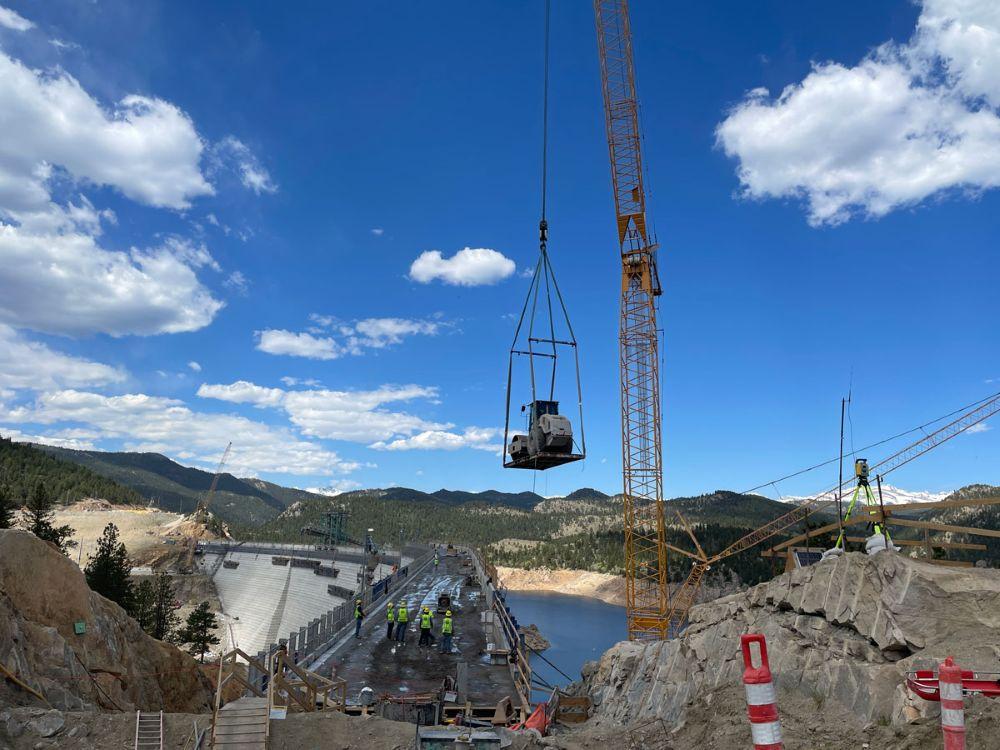
A crane lifts a piece of equipment off the dam. Because of the new spillway gap, equipment was driven across the dam’s access road to get into position on the other side of the dam. Photo credit: Denver Water.

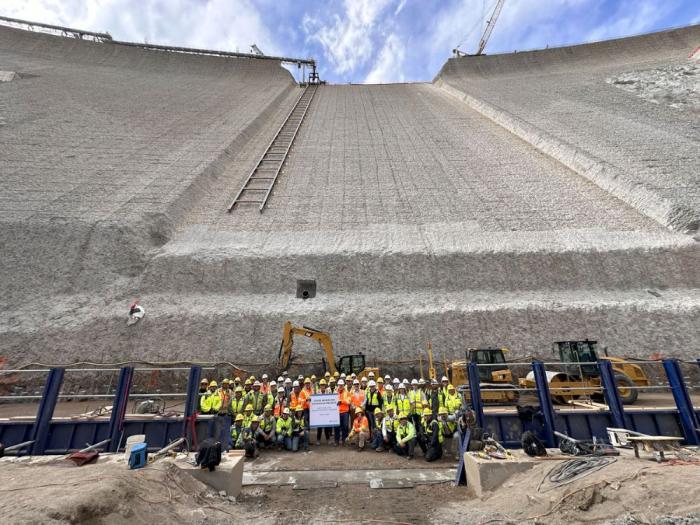
Construction on the final 22 feet of the second side of the dam began at the end of May and is expected to be completed in June.

Once the second section is done this summer, a year’s worth of remaining work includes: finishing the top of the dam, building safety walls; constructing the actual spillway; building a bridge over the spillway and completing the stilling basin at the bottom of the dam.

This view from the bottom of the dam shows the new baffle blocks on the bottom of the stilling basin. The baffle blocks reduce the energy of the water that flows down the spillway. Photo credit: Denver Water.

Full construction on the dam raising project is expected to wrap up in mid-2027.

“There are hundreds of logistical challenges throughout this project, but our team has been able to meet every one of them along the way,” Dick said. “We’re making good progress so far in 2026 and are looking forward to getting a lot of work done in the coming months.”

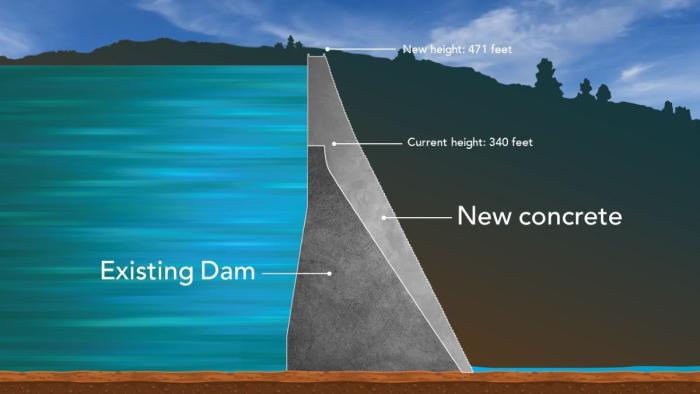
The Gross Reservoir Expansion Project involves raising the height of the existing dam by 131 feet. The dam will be built out and will have “steps” made of roller-compacted concrete to reach the new height. Image credit: Denver Water

Municipal Partnerships for Instream Flow on #Colorado’s Front Range — Jessica Pault-Atiase (Colorado Lawyer)

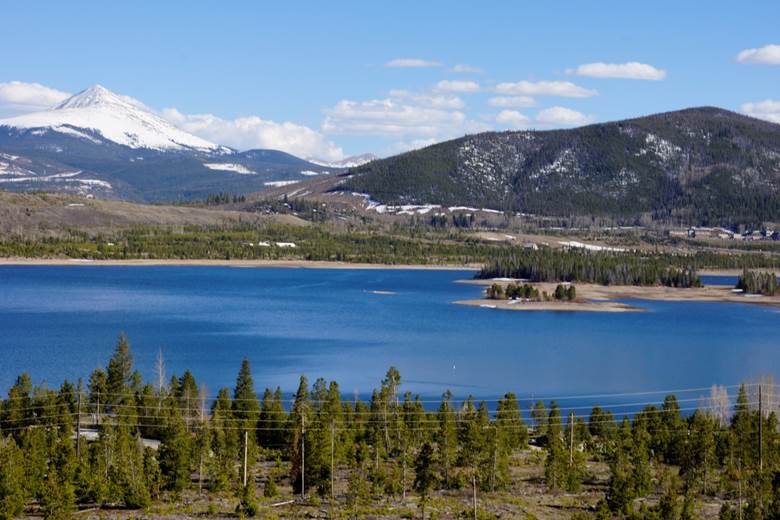
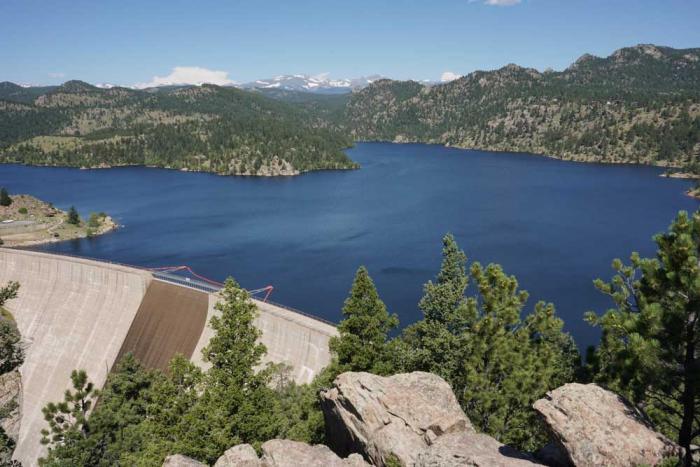
Dillon Reservoir. Photo credit Greg Hobbs.

Click the link to read the article on the Colorado Bar Association website (Jessica Pault-Atiase):

January/February 2026

Incorporating instream flow uses into municipal water supply planning efforts can provide numerous public benefits. This article discusses the framework and opportunity for collaborative instream flow protection in municipal water supply operations.

Colorado’s instream flow program is a dynamic approach to protecting the natural environment that encourages practical and creative solutions to evolving environmental concerns. While water rights typically involve diverting water from the stream, the instream flow program protects water in the stream. Environmental values associated with instream flow uses can work synergistically with municipal water supply operations to realize several public benefits, such as improved water quality, riparian health, urban cooling, resiliency, recreational opportunities, and aesthetic value. As illustrated by the examples discussed later in this article, the instream flow program can facilitate cooperative agreements with municipal water providers for shared beneficial use of our state’s most precious resource.

Water Rights and the Prior Appropriation Doctrine in Colorado

The prior appropriation doctrine governs the ownership and use of water and water rights in Colorado. In simple terms, the prior appropriation system is described as “first in time, first in right.” A water user that has demonstrated an intent to put water to beneficial use first has a vested and prior right to use water in that amount against subsequent water users. This system developed out of necessity during the colonial expansion westward and was influenced by Spanish settlers and early miners to allocate water in the arid environment of Colorado, as an alternative to the more common riparian system of water rights based on land ownership abutting water ways.1

The prior appropriation doctrine has been enshrined in the Colorado Constitution. Article XVI, § 5 dedicates water in Colorado as public property for use by the people, subject to appropriation, and § 6 gives the right to appropriate water for beneficial use in priority.2 The 1969 Water Rights Determination and Administration Act (1969 Act) provides the legal framework for surface and tributary ground water distribution and use under the prior appropriation doctrine.3

An appropriation of a water right under the 1969 Act, as originally codified, meant “the diversion of a certain portion of the waters of the state and the application of the same to a beneficial use.”4 Similarly, beneficial uses were limited to diversions of water from the stream system for extractive uses such as domestic or municipal, irrigation, and manufacturing or industrial activities.5  Environmental uses of water, including instream flows, were not initially addressed in the 1969 Act but were later incorporated through amendments.6

Colorado Instream Flow Program

The Colorado Water Conservation Board (CWCB) was first established by the Colorado legislature in 1937 to protect and develop Colorado’s water resources for the benefit of present and future generations.7 It was not until the national environmental movement in the late 1960s, however, that discussions regarding the value of instream flows and role of the CWCB in the protection of such flows began to garner serious attention and focus.8 In 1973, those discussions culminated in the passage of SB 97 to create the Colorado Instream Flow and Natural Lake Level Program.9 SB 97 was unprecedented at the time and amended the 1969 Act to define beneficial use of a water right to include use by the CWCB for protection of stream flows within a specified reach without a diversion of water from the stream.10

Under the instream flow program, the CWCB has exclusive authority to hold a water right for instream flow uses in Colorado and may appropriate water rights or acquire existing water rights for instream flow, provided that it determines that such water rights are necessary to preserve or improve the natural environment to a reasonable degree.11 Since the program’s inception, the CWCB has appropriated nearly 1,700 instream flow rights across 9,700 miles of stream and completed over 35 water acquisition transactions.12

The General Assembly has reinforced and expanded the CWCB’s ability to acquire water rights for instream flow purposes on several occasions.13 Acquiring and changing senior water rights for instream flows in over-appropriated systems can add great value by preserving the priority date, and therefore the availability, of the water for greater instream flow protection.14 Acquisitions can be donated to or purchased by the CWCB, and the statutory language specifically anticipates potential acquisitions from governmental entities, like municipalities.15 Other free-market developments to the Colorado instream flow program enacted by the state legislature over the years include streamlined processes for loans of water rights for instream flow use, instream flow protection for mitigation releases, and stream flow augmentation plans.16 These developments provide additional opportunities for water users, including municipalities, to participate in the program in support of instream flows.

In addition to implementing the instream flow program, the CWCB is tasked with creating the Colorado Water Plan, which addresses the state’s water challenges through collaborative water planning, including expanded opportunities for instream flow protection.17

Case Studies Along the Front Range

The instream flow program provides reasonable protection of the environment for benefit of the public and is emphasized in the Colorado Water Plan as a balanced approach to addressing environmental needs in the face of climate change.18 Similarly, municipal water service providers, acting in the interest of their respective jurisdictions, must often balance water supply with other public interests. Municipal water projects and water supply planning efforts can be designed to address multiple needs and related uncertainties across a jurisdiction, informed by integrated planning efforts. The various public interests typically considered by municipalities may align with instream flow protection in many respects. The Colorado Water Plan includes several policy considerations that highlight this potential overlap between municipal water interests and instream flows.19

Fundamentally, the Colorado Water Plan encourages a holistic, collaborative approach to water management that balances multiple uses and benefits to meet water shortages throughout the state.20 As competition for water resources in Colorado becomes more pronounced with increased demands and costs, the benefits of water sharing and collaboration will also likely increase.21 The Colorado Water Plan focuses on thriving watersheds as an action area to support stream health, recreational uses, resiliency, erosion control, and water quality, all of which provide tangible benefits to municipal water service providers.22 Accordingly, more water in the stream system for instream flows can be a natural complement to a municipality seeking to balance growing water demands with related public interests. The following examples demonstrate how instream flow uses can benefit municipal water supply, and vice versa, to realize this balance in a meaningful way.

Boulder Creek Instream Flow Project

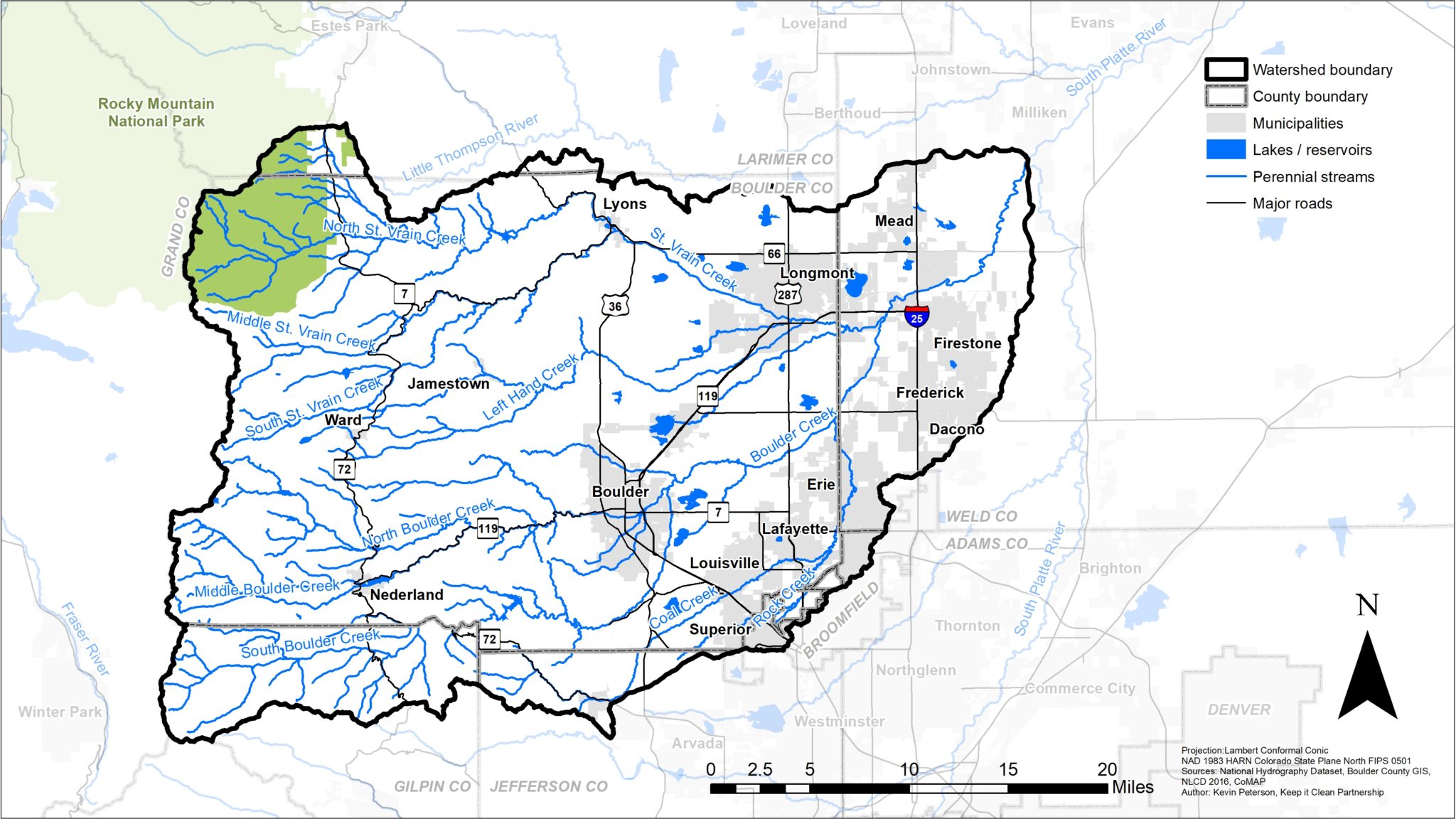
The Boulder Creek instream flow project is a long-standing cooperative project that has been operating in Boulder County for almost 35 years. This project has operated successfully due in large part to the partnership between the City of Boulder and the CWCB and their collaboration with neighboring water users in Boulder County to support environmental stream flows and other uses in the creek.

In the early 1990s, Boulder donated a suite of valuable senior water rights to the CWCB to establish a year-round instream flow program on North Boulder and Boulder Creeks.23 The acquisition was memorialized in a series of donation agreements between Boulder and the CWCB pursuant to CRS § 37-92-102(3), following certain legislative amendments throughout the 1980s that clarified and enhanced the CWCB’s acquisition authority for instream flows.24 Boulder and the CWCB, as co-applicants, also received a water court decree to change the use of the donated rights to include instream flow uses for the project.25

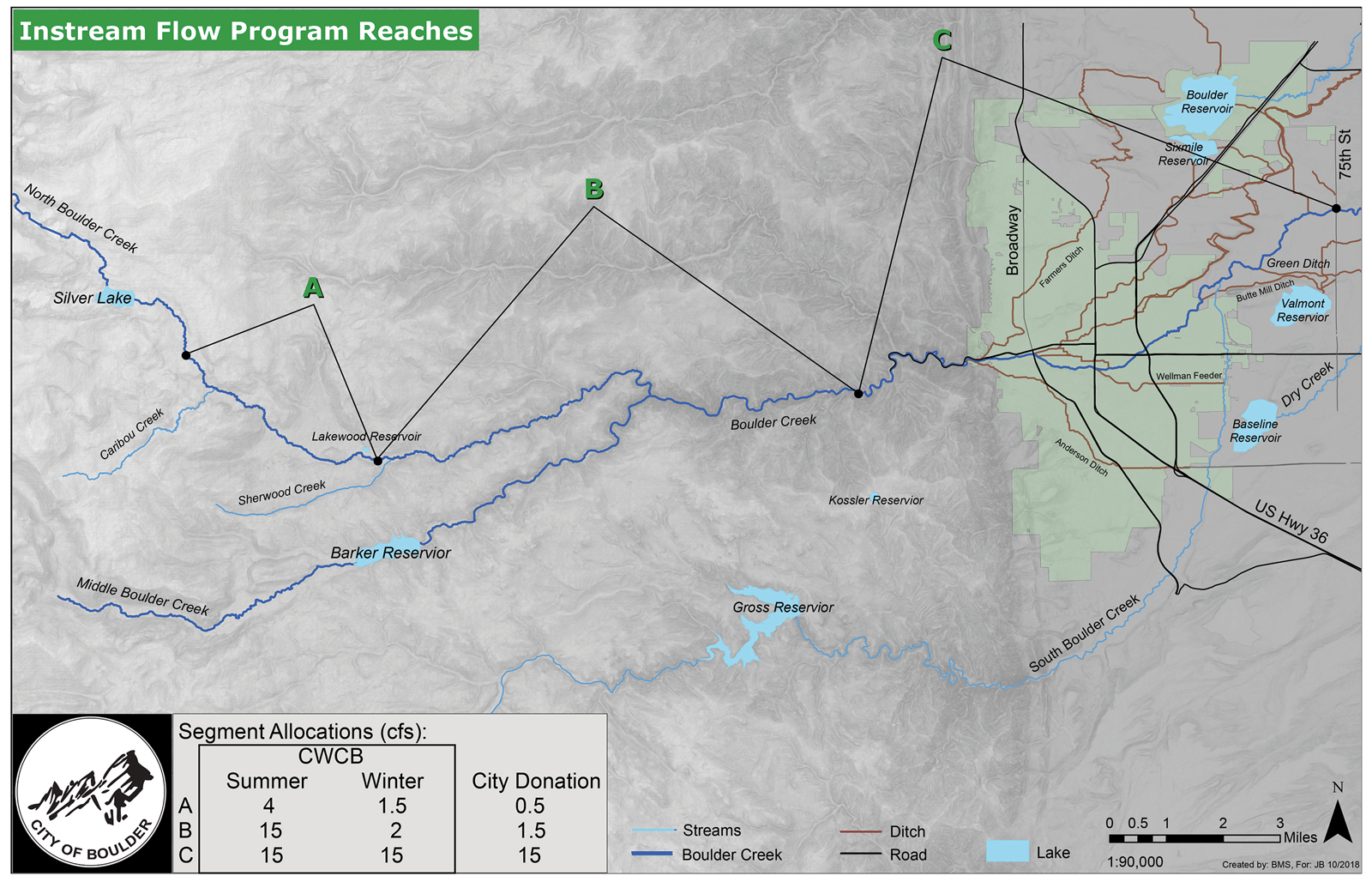
Figure 1. Map depicting locations of instream flow protected reaches along Boulder Creek. Image created by the City of Boulder (Oct. 2018).

The Boulder Creek instream flow project protects three segments from below the Silver Lake Reservoir near the headwaters of North Boulder Creek down to 75th Street in Boulder County (see fig. 1). The donated rights include reservoir releases, bypassed diversions, and changed irrigation ditch shares to support instream flows throughout the year. As part of its donation to the CWCB, Boulder retained the right to use water available under the donated rights (1) for municipal purposes under certain conditions, including drought and emergency conditions in its municipal water supply operations; (2) for municipal purposes anytime they are not needed to meet instream flow amounts; and (3) for beneficial reuse downstream of the protected reaches.26 This provides operational flexibility for the city’s municipal water supply while also supporting instream flow uses by the CWCB in most years. Its participation in the Boulder Creek instream flow program has also helped the city address US Forest Service regulatory requirements for bypasses related to its diversions from North Boulder Creek as part of federal permitting for one of its raw water pipelines.27

The City of Boulder has a long-standing environmental ethos that incorporates instream flows into its water supply planning and operations. Boulder’s water supply planning documents from the 1980s identified the goal of supporting instream flows in Boulder Creek to enhance aquatic and riparian ecosystems, reflecting city planners’ prediction that dry-up periods in the creek would become more severe and frequent with increased water demands.28 Subsequent Boulder water supply and land use planning documents have included similar goals focused on balancing instream flows and environmental preservation with municipal water demands and operations, and emphasizing the connection between stream health and reliable drinking water supplies.29

Because the protected stream segments run through the Boulder city limits, and extend both above and below the city, the project benefits water quality, riparian health, and resiliency in the Boulder municipal watershed and water system operations and provides additional environmental benefits to the larger Boulder County community.

Gross Reservoir Environmental Pool Project

The cities of Boulder and Lafayette entered into an intergovernmental agreement in 2010 with Denver Water to establish a 5,000 acre-foot environmental pool in an enlarged Gross Reservoir to augment stream flows in South Boulder Creek.30 Boulder recognized the need to address low flows on South Boulder Creek as a key goal in its planning documents and identified Denver Water’s planned expansion of Gross Reservoir as an opportunity to use upstream storage to establish a robust instream flow program. Lafayette similarly identified Gross Reservoir for potential water storage in its water rights decrees, providing both a water supply and environmental benefit to its operations. The parties proactively agreed to cooperate to mitigate the reservoir expansion’s impacts to aquatic resources in the South Boulder Creek basin by creating and operating the environmental pool.31

Coordinated with municipal water system operations, releases from the environmental pool will allow Boulder and Lafayette to store their decreed water rights for later release to meet specific target flows below Gross Reservoir in South Boulder Creek throughout the year. The segments identified for the target flows include Gross Reservoir to South Boulder Road (Upper Segment, depicted as segments 1 and 2 in fig. 2) and South Boulder Road to the confluence with Boulder Creek (Lower Segment, depicted as segment 3 in fig. 2).32 The agreement also includes provisions to address emergencies such as extended drought or an unexpected problem with water storage, conveyance, or treatment infrastructure to allow for flexibility in operations to meet both target flows and municipal needs.

Boulder’s releases from the environmental pool are protected as instream flows according to a Water Delivery Agreement with the CWCB dated September 9, 2019, and a water court decree entered for Boulder, Lafayette, and the CWCB.33 Water released by Boulder to meet the target flows will be protected for instream flow uses to the extent that such flows do not exceed the amounts that CWCB has determined to be appropriate to preserve the natural environment to a reasonable degree in South Boulder Creek. Boulder’s target flow releases will support CWCB’s existing appropriated instream flow rights up to the specified amounts (see fig. 2). Boulder may then redivert the water downstream of the protected reaches for its municipal uses.

The environmental pool will provide permanent, dedicated storage for water rights owned by Boulder and Lafayette to be released to enhance stream flows in South Boulder Creek prior to downstream uses for municipal purposes by the parties. These operations provide added flexibility, resiliency, and redundancy to the cities’ respective water supply systems. In turn, the enhanced stream flows will benefit 17.3 miles of South Boulder Creek, including Eldorado Canyon State Park, South Boulder Creek Natural Area, and City of Boulder open space lands, and will support native fish populations and riparian and wetland habitats.

Figure 2. Map depicting target flows and reaches for enhanced stream flows on South Boulder Creek. Image created by the City of Boulder (Aug. 7, 2018).

Poudre Flows Project

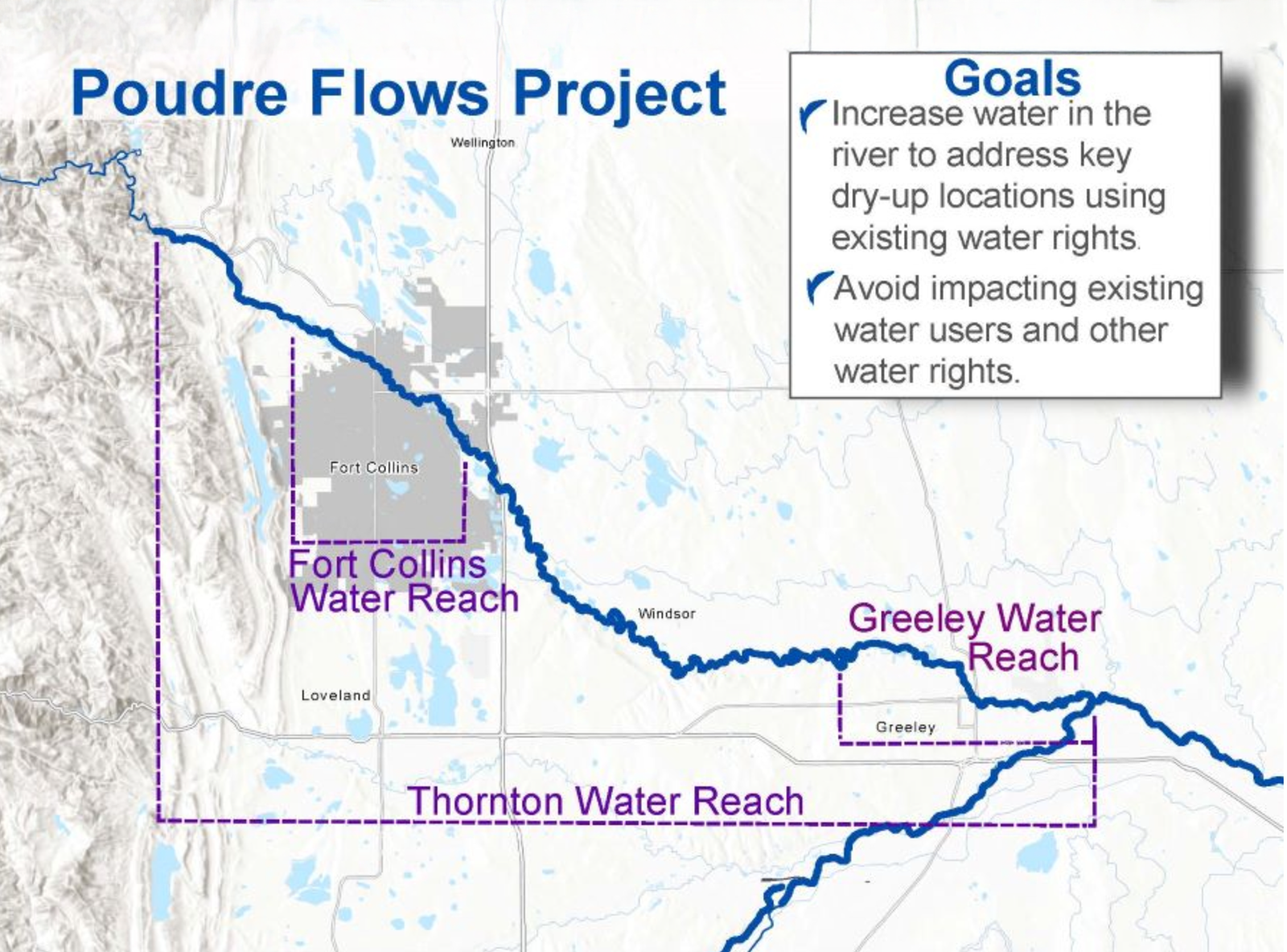
The Poudre Flows Project is the first stream flow augmentation plan developed pursuant to CRS § 37-92-102(4.5).34 It is a partnership amongst the CWCB; municipalities of Fort Collins, Thornton, and Greeley; Colorado Water Trust; Northern Colorado Water Conservancy District; Cache la Poudre Water Users Association; and Colorado Parks and Wildlife. The project will augment stream flows through a 52-mile reach of the Cache la Poudre River, with an overarching goal to improve river health (see fig. 3).35 The concept was first envisioned as part of the Poudre Runs Through It working group, a collaborative group of diverse partners and stakeholders in the Poudre River.36 The City of Fort Collins planning priorities incorporate similar goals, including to “[p]rotect community water systems in an integrated way to ensure resilient water resources and healthy watersheds.”37

The project anticipates that the CWCB, through agreements with water right owners, including Fort Collins and Greeley, will use previously changed and quantified water rights owned by these municipalities and potentially others to augment stream flows in six segments of the Poudre River spanning from Canyon Gage to the confluence with the South Platte River.38 Besides the instream flow protection of the environment to a reasonable degree, project partners have identified numerous additional benefits such as connectivity for fish passage and decreased temperatures and nutrient concentrations, all while avoiding impacts to existing water rights and operations.39

Figure 3. Poudre Flows Project. Source: fcgov.com.

Conclusion

By integrating water supply planning with a holistic approach to water development and management that provides multiple public benefits, municipalities can become strong partners with the CWCB. Together, they can help protect instream flows and balance growing water demands and future uncertainties with the environmental values that make Colorado a beautiful place to live.

NOTES

citation Pault-Atiase, “Municipal Partnerships for Instream Flow on Colorado’s Front Range,” 55 Colo. Law. 48 (Jan./Feb. 2026), https://cl.cobar.org/features/municipal-partnerships-for-instream-flow-on-colorados-front-range.

1See generally Coffin v. Left Hand Ditch Co., 6 Colo. 443, 447 (Colo. 1882).

2. Colo. Const. Art. XVI, §§ 5–6. See also Colo. River Water Conservation Dist. v. CWCB, 594 P.2d 570, 573 (Colo. 1979) (“The reason and thrust for this provision was to negate any thought that Colorado would follow the riparian doctrine in the acquisition and use of water.”).

3. CRS §§ 37-92-101 et seq.

4. CRS § 148-21-3 (1969) (emphasis added). See also Colo. River Water Conservation Dist., 594 P.2d at 574.

5Id.

6See Bassi et al., “ISF Law—Stories About the Origin and Evolution of Colorado’s Instream Flow Law in This Prior Appropriation State,” 22(2) U. Denv. Water L. Rev. 395 (2019), https://dnrweblink.state.co.us/cwcbsearch/ElectronicFile.aspx?docid=211090&dbid=0.

7See Colorado Department of Natural Resources, Colorado Water Conservation Board, https://cwcb.colorado.gov/about-us.

8. Bassi, supra note 6 at 396–97.

9. SB 97, 49th Gen. Assemb., Reg. Sess. (Colo. 1973). See CRS § 37-92-102(3).

10. Bassi, supra note 6 at 398. See also Colo. River Water Conservation Dist., 594 P.2d at 576. SB 97 was carefully drafted to provide environmental protection through the CWCB, as a fiduciary to the public, without inviting riparian rights for adjacent landowners. Id. The Colorado Supreme Court reiterated this important distinction in St. Jude Co. v. Roaring Fork Club, LLC, 351 P. 3d 442 (Colo. 2015), ruling that a diversion from a steam for private instream flows is a “forbidden right” contrary to the prior appropriation doctrine; only the CWCB, with strict limitations identified by the general assembly, can hold an instream flow right for the benefit of the public. Id. at 451.

11. CRS § 37-92-102(3) (The CWCB is “vested with exclusive authority, on behalf of the people of the state of Colorado, to appropriate . . . such waters of natural streams . . . as the board determines may be required for minimum streamflows . . . to preserve the natural environment to a reasonable degree.” The board also may acquire water rights “in such amount as the board determines is appropriate for streamflows . . . to preserve or improve the natural environment to a reasonable degree.”). Legislation enacted in 2002 expanded the Colorado instream flow program to provide that water rights may also be used by the CWCB to improve the natural environment (and not just for preservation purposes). Bassi, supra note 6 at 391.

12. Colorado Department of Natural Resources, Colorado Water Conservation Board, “Instream Flow Program,” https://cwcb.colorado.gov/focus-areas/ecosystem-health/instream-flow-program.

13See Bassi, supra note 6 at 405–06, 417–18.

14Id. at 406. The Colorado Water Trust was formed in 2001 to support Colorado’s instream flow program by promoting voluntary, market-based efforts to restore stream flows in Colorado’s rivers. The Water Trust has been instrumental in facilitating and streamlining the acquisition of water rights from willing partners for use by the CWCB. See https://coloradowatertrust.org.

15. CRS § 37-92-102(3).

16See generally CRS §§ 37-83-105, 37-92-102(8), 37-92-102(4.5).

17. The Colorado Water Plan was adopted by the CWCB in 2023 as a framework for decision-making to address water challenges and build resiliency in the state. The 2023 Water Plan is an update to the first iteration of the plan released in 2015. See https://cwcb.colorado.gov/colorado-water-plan.

18See St. Jude Co., 351 P. 3d at 449 (in its use of water for instream flows, the CWCB has a “‘statutory fiduciary duty’ to the people . . . to both protect the environment and appropriate only the minimum amount of water necessary to do so . . . .”).

19. Colorado Department of Natural Resources, Colorado Water Conservation Board, Colorado Water Plan (2023), https://dnrweblink.state.co.us/CWCB/0/edoc/219188/Colorado_WaterPlan_2023_Digital.pdf.

20See id. at 217–19, 231, 233 (“All areas of the Water Plan are interconnected, and projects need to consider multi-purpose, multi-benefit solutions.”).

21See id. at 217 (“Multi-purpose projects better address water supply challenges across municipal, agricultural, environmental, and recreation sectors as they occur.”).

22See id. at 181, 204–07 (stream health and related environmental benefits can enhance municipal supply or improve the quality of life in urban areas).

23See Decree, In re Application for Water Rts. of the Colo. Water Conservation Bd. on Behalf of the State of Colo. and Water Rts. of the City of Boulder, No. 90CW193 (Colo. Water Div. 1, Dec. 20, 1993).

24Id. See Bassi, supra note 6 at 405–07.

25. Decree, supra note 23.

26See id.

27. Bassi, supra note 6 at 408–09.

28City of Boulder Source Water Master Plan: Vol. 2—Detailed Plan 2-1, 2-3, 3-77, 5-20 (Apr. 2009) (discussing previous planning efforts and priorities regarding instream flows), https://bouldercolorado.gov/media/7670/download?inline.

29Id. at 3.71, 5-21 to 5-33, 7-3. See also Boulder Valley Comprehensive Plan: 2020 Mid-Term Update 31, 62 (adopted 2021), https://bouldercolorado.gov/media/3350/download?inline.

30See Decree, In re Application for Water Rts. of City of Lafayette, City of Boulder, and Colo. Water Conservation Bd. in Boulder Cnty., No. 17CW3212 (Colo. Water Div. 1, Feb. 11, 2021). The author represented the City of Boulder in Case No. 17CW3212 and was involved in prosecuting the case and negotiating the underlying agreement with CWCB.

31. Denver Water’s enlargement of Gross Reservoir is the subject of pending litigation.

32. The target flows and target reaches are based on previously collected data and analysis by Colorado Parks and Wildlife using the R2Cross method, which supported CWCB’s previous instream flow appropriations.

33See id. CRS §§ 37-92-102(3), 37-87-102(4).

34. The cities of Fort Collins and Greeley were instrumental in getting HB 20-1037 passed to authorize the CWBC to use water rights previously decreed for augmentation uses for instream flows. Castle, “To Boost Poudre River Flows, Cities, Conservationists Craft New Plan From Old Playbook,” Water Education Colorado (Jul. 3, 2019), https://watereducationcolorado.org/fresh-water-news/to-boost-poudre-river-flows-cities-conservationists-craft-new-plan-from-old-playbookSee also HB 1037, 75th Gen. Assemb., Reg. Sess. (Colo. 2020), https://leg.colorado.gov/bills/hb20-1037.

35See Boissevain, “Poudre Flows: Collaboration to Protect the Cache la Poudre River,” Colorado Water Trust (Oct. 29, 2024), https://coloradowatertrust.org/collaboration-to-protect-the-cache-la-poudre-river.

36. City of Fort Collins, “Poudre Flows,” https://www.fcgov.com/poudreflows.

37Id.

38See Application, In re Application for Water Rts. of Cache La Poudre Water Users Ass’n, City of Fort Collins, City of Greeley, Colo. Water Tr., N. Colo. Water Conservancy Dist., City of Thornton and Colo. Water Conservation Bd. in Larimer and Weld Cntys., No. 21CW3056 (Colo. Water Div. 1 Apr. 29, 2021).

39See “Poudre Flows,” supra note 36.

Colorado Rivers. Credit: Geology.com

Gross Dam’s successful year: Dam raise 95% complete — Jay Adams (DenverWater.org) #BoulderCreek #FraserRiver #ColoradoRiver #COriver #SouthPlatteRiver #aridification

Click the link to read the article on the Denver Water website (Jay Adams):

December 12, 2025

Workers raise dam 109 feet in 2025. Next year’s goal: Reaching the top.

The Denver Water team working on Gross Dam in Boulder County is celebrating a successful year after the dam raise is 95% complete.

“In 2025, we raised the height of the dam by 109 feet above the original structure,” said Jeff Martin, Denver Water’s program manager for the Gross Reservoir Expansion Project. “We have 22 feet left to go to reach the new height and we’re on track to reach that in 2026.”

The dam-raising aspect of the Gross Reservoir Expansion Project wrapped up for the season on Nov. 14, due to the drop in temperatures. The project is designed to nearly triple the water storage capacity of Gross Reservoir.

In 2025, workers raised the height of Gross Dam by 109 feet. The final 22 feet will be completed in 2026 to reach the dam’s new height of 471 feet. Photo credit: Denver Water.

“We have to stop placing roller-compacted concrete when the temperatures drop below freezing,” said Casey Dick, deputy program manager for the Gross Reservoir Expansion Project.

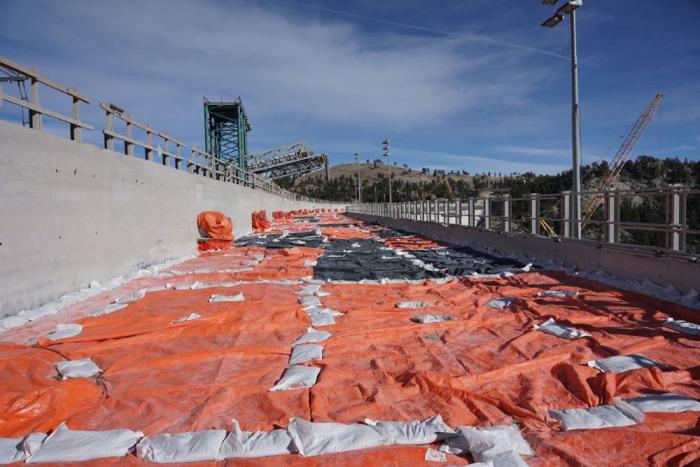
“To prepare for winter, we put blankets on top of the new concrete to keep it from getting too cold. That’s because if the concrete freezes while it is still curing, it can lead to a weakened final product.”

Work associated with the dam raise will resume in spring 2026, when the weather warms up enough to complete the final 22 feet.

Protective “blankets” were placed on top of the dam to insulate the new concrete, so it does not fully cure over the cold, winter months. Photo credit: Denver Water.

Once that work is complete, the dam will be 471 feet tall, which is 131 feet higher than the original. The completed dam also will be longer across its crest, or top. The original crest was 1,050 feet long; the higher dam will have a crest that stretches 2,040 feet from one side of the canyon to the other.


Learn more about the Gross Reservoir Expansion Project.


This year marked the second year of dam raising construction work at Gross.

As of December 2025, workers had placed more than 730,000 cubic yards of concrete. To put that in perspective, Empower Stadium at Mile High, where the Denver Broncos play their home football games, required just 29,000 cubic yards of concrete to build, about 4% of the concrete placed so far on Gross Dam.

Protective “blankets” were placed on top of the dam to insulate the new concrete, so it does not fully cure over the cold, winter months. Photo credit: Denver Water.

Roller-compacted concrete is a special mix of concrete that allows crews to place it on the dam and then spread it out. The concrete is firm enough to be able to drive machinery on top of it. The process is a fast and efficient method of raising the dam. During the construction work, crews raised the height of the dam by about 1 foot per day.

Construction crews use GPS technology and survey equipment to keep track of how high they’ve raised the dam.

“The way we keep track of the elevation gain is that the bulldozers are equipped with GPS-grade control technology, which ensures that each layer of concrete is spread to the correct thickness,” Dick said.

“Once the concrete is rolled and vibrated into place, each layer ends up being 1 foot thick. It’s then checked by surveyors with their equipment to verify the exact elevation.”

The bulldozers are equipped with GPS-grade control technology to monitor the height of the concrete as it is spread across the top of the dam and keep track of the elevation. Photo credit: Denver Water.

Work won’t completely stop over the winter.

Mechanical and pipe work will be done inside the dam, and crews will build a stilling basin at the base of the dam. The basin’s function is to slow the speed of water coming down the dam’s spillway and safely redirect the water into South Boulder Creek.

Work on the stilling basin at the base of the dam will continue over the winter. The stilling basin is designed to slow the flow of water coming down the spillway and channel it into the creek. Photo credit: Denver Water.

“This season was a huge success, and our team met a ton of challenges in raising Gross Dam,” Martin said. “We had legal challenges and adverse weather challenges. We also had wildfire safety operation challenges that shut down our power supply up here. Despite all those setbacks, the dedicated team of 500 men and women rose to the challenge. I’d just like to thank everybody who committed themselves to this project and helped us make 2025 a success.”

Jeff Martin, Denver Water’s program manager for the Gross Reservoir Expansion Project, stands at the south side of the dam. Once completed, the dam will reach up to white line on the rock wall. Photo credit: Denver Water.

Mediation ordered for Denver Water, environmental group over turbulent Gross Dam project — Michael Booth (Fresh Water News)

The middle section of the dam is arched to give the dam strength as water pushes up against the structure. Photo credit: Denver Water.

Click the link to read the article on the Water Education Colorado website (Michael Booth):

October 23, 2025

Denver Water and Save the Colorado must enter mediation at the end of the month to see if a deal is possible on the mid-project challenge to the water utility’s $531 million dam raising underway at Gross Reservoir in Boulder County, according to an order from the U.S. Court of Appeals.

A federal trial judge initially halted construction on the nearly finished dam, saying the U.S. Army Corps of Engineers permits for Denver Water violated U.S. environmental laws and that the water level at Gross could not be raised. Judge Christine Arguello later lifted the injunction on construction, for safety reasons, while Denver Water appealed the permit issues to the 10th Circuit Court of Appeals.

The 10th Circuit will take briefs from both sides of the dam dispute in November, and is now ordering a mediation session for Oct. 30. The conference is to “explore any possibilities for settlement” and lawyers for both sides are “expected to have consulted with their clients prior to the conference and have as much authority as feasible” on settlement questions, the court order says.

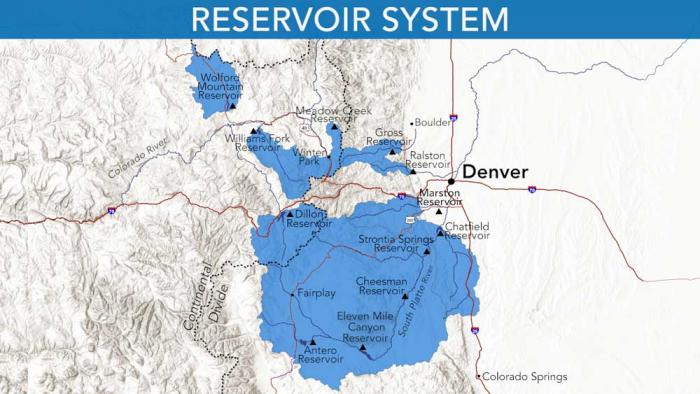
Construction has continued since the injunction was lifted, with Denver Water pouring thousands of tons of concrete to raise the existing dam structure on South Boulder Creek. Denver Water has argued it needs additional storage on the north end of its sprawling water delivery system for 1 million metro customers, to balance extensive southern storage employing water from the South Platte River basin.

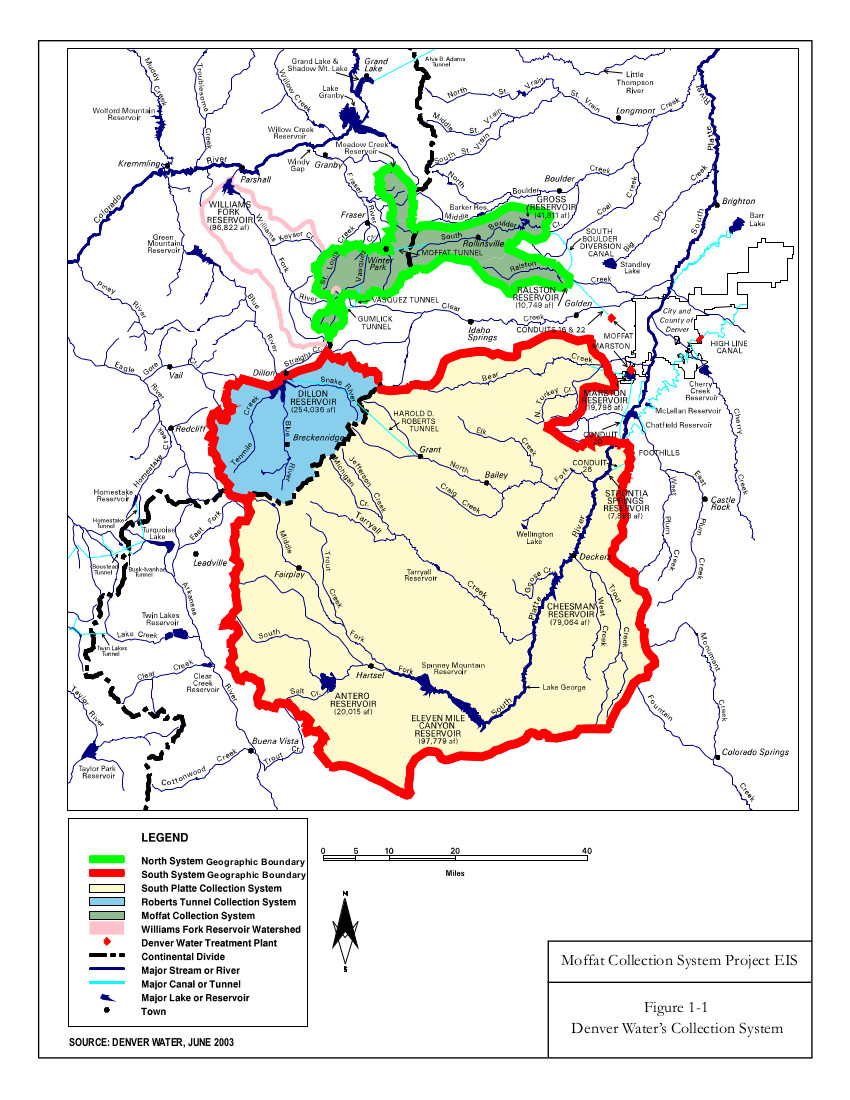
Denver Water’s collection system via the USACE EIS

Save the Colorado and coplaintiffs the Sierra Club, WildEarth Guardians and others argue too much water has already been taken from the Colorado River basin on the west side of the Continental Divide, and that the forest-clearing and construction at Gross is further destructive to the environment. Gross Reservoir stores Fraser River rights that Denver Water owns and brings through a tunnel under the divide into South Boulder Creek.

“We look forward to having a constructive conversation with Denver Water to find a mutually agreeable path forward that addresses the significant environmental impacts of the project,” Save the Colorado founder Gary Wockner said.

When securing required project permits from Boulder County, Denver Water had previously agreed to environmental mitigation and enhancements for damages from Gross construction. But Save the Colorado and co-plaintiffs sued to stop the project at the federal level, and Arguello agreed that the Army Corps had failed to account for climate change, drought and other factors in writing the U.S. permits.

Denver Water declined comment Tuesday on the mediation order.

The halt and restart of the Gross Dam raising came in what has turned out to be a tumultuous year for major Colorado water diversion and storage projects.

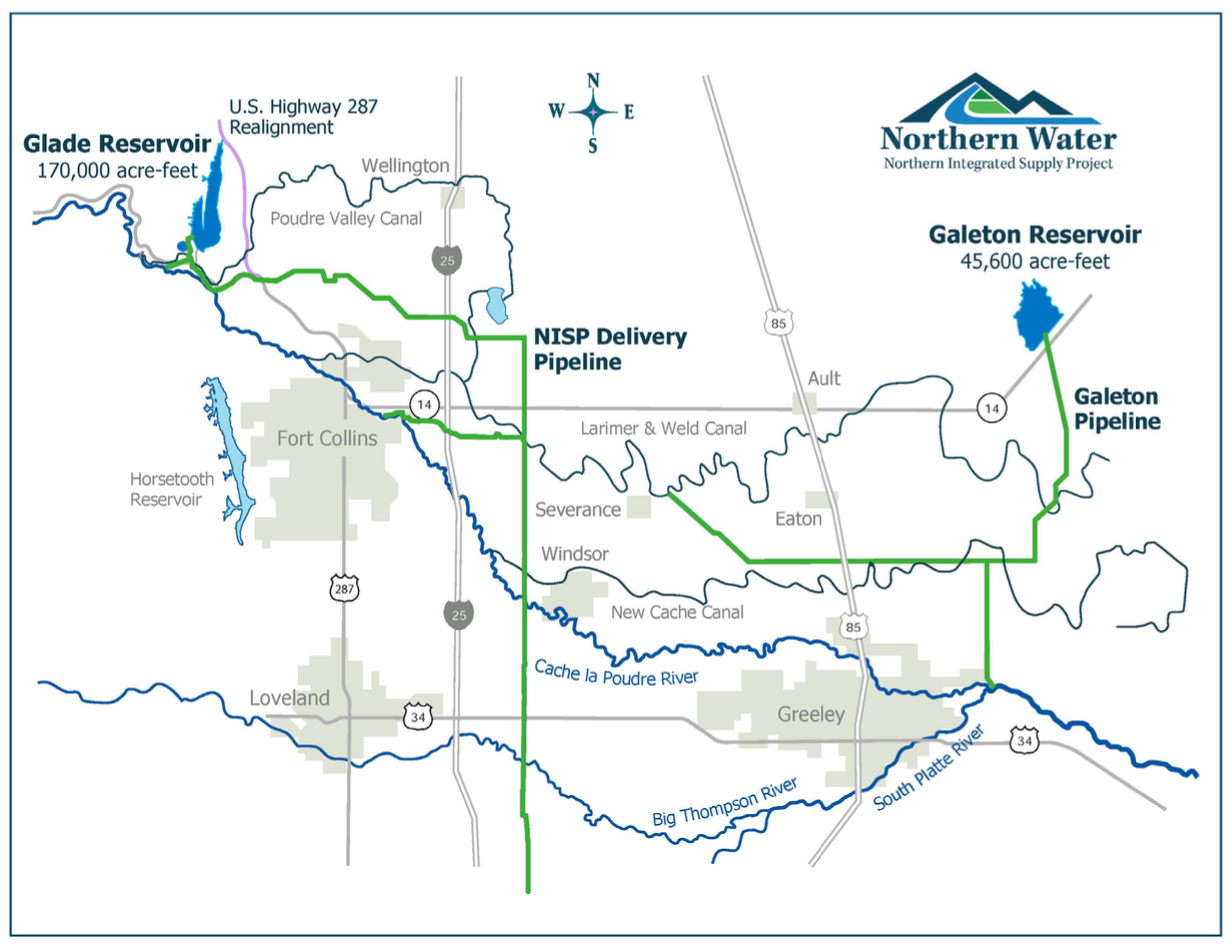
While the Gross Dam decisions were underway, Wockner was finishing negotiations with Northern Water over $100 million in environmental mitigation funding to allow the $2.7 billion, two-dam Northern Integrated Supply Project to move forward. Once the 15 communities and water agencies subscribed to NISP water shares saw the increasing price tag, some began pulling out.

Northern Water reviewed the scale of NISP with engineers, then said it planned to move forward at the previously announced scale. The consortium’s board has asked all 15 initial members to indicate by Dec. 31 where they stand with the project and its price tag.

More by Michael Booth

Roller-compacted concrete will be placed on top of the existing dam to raise it to a new height of 471 feet. A total of 118 new steps will make up the new dam. Image credit: Denver Water.

Colorado Water Trust Responds to Devastating #Drought Conditions with Unprecedented Restoration Efforts — Kate Ryan and Blake Mamich

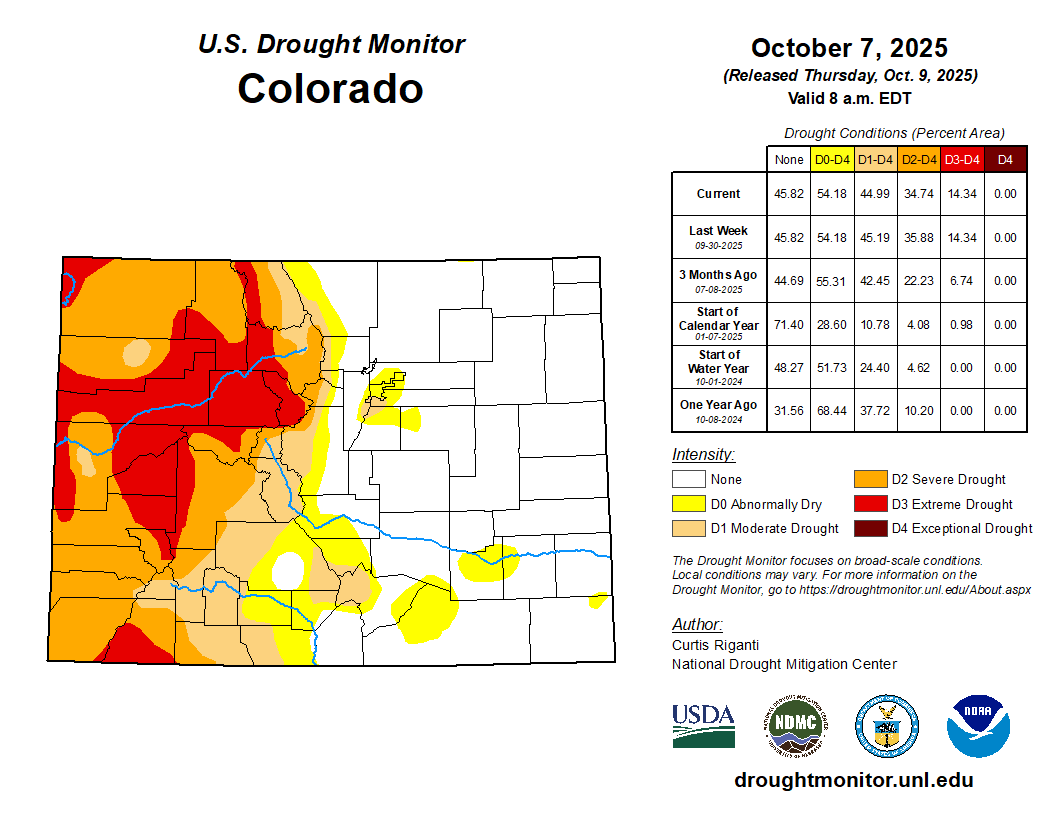
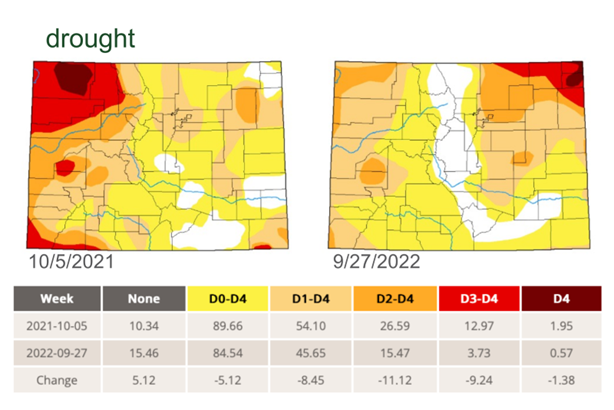
Colorado Drought Monitor map October 7, 2025.

Here’s the release from the Colorado Water Trust (Kate Ryan and Blake Mamich):

October 7, 2025

Colorado’s rivers are running on empty as drought grips the intermountain west. But a record-setting response from Colorado Water Trust is helping keep critical stretches of rivers around our state flowing for fish, farms, and communities alike.

This year, Colorado Water Trust is operating more projects across more rivers than at any point in its 24-year history—and restoring more water to streams than ever before. Across the state and on both sides of the Continental Divide, Colorado Water Trust is partnering with local irrigators, water districts, state agencies, and funders to release more than 16,000 acre-feet of water (over 5.2 billion gallons) back into rivers when it’s needed most. This unprecedented effort highlights how collaboration and creativity can sustain Colorado’s rivers through crisis, offering a model of resilience at a time when the state’s waterways face one of their toughest seasons yet.

Colorado is in the grip of a devastating drought. Nearly 45% of the state is currently experiencing at least moderate drought conditions, with significant portions in severe and extreme drought. Streams across the state are shrinking, water temperatures are rising, and ecosystems, farms, and communities are all feeling the strain. In many places, streamflow gauges are reporting flows in the lowest 10-25 percentile for this time of year. Rivers in some regions are hitting historically low levels far earlier in the season. This year marks the earliest call on the Yampa River in recorded history. The situation is dire, and without swift, creative intervention, stretches of Colorado’s treasured rivers could be left dry.

In response, Colorado Water Trust is rising to meet this challenge by running nearly all of its projects across the state, ensuring that water is returned to rivers when it is needed most. The scale of the response is unprecedented—this year is predicted to see more water restored to Colorado’s rivers through Colorado Water Trust’s work than in any other year since the organization was founded. Some of this year’s projects include:

This map shows the 15-mile reach of the Colorado River near Grand Junction, home to four species of endangered fish. Map credit: CWCB

Colorado River: On the Colorado River, Colorado Water Trust is again operating its project on the 15-Mile Reach, a stretch of river critical to the survival of four endangered and threatened fish species. Colorado Water Trust is expected to restore well over 1 billion gallons of water to this critical reach by releasing water from Ruedi Reservoir near Basalt which is then restored to the Fryingpan and Roaring Fork Rivers before it reaches the 15-Mile Reach of the Colorado River. Through innovative partnerships with the Grand Valley Water Users Association, Orchard Mesa Irrigation District, and the Upper Colorado Endangered Fish Recovery Program, water is being delivered at key times to support flows in this fragile habitat. Backed by generous support from corporate partners such as Niagara Cares, Coca-Cola, and Coors Seltzer, this project has become a model of collaboration and creativity.

Yampa River: Further north in the Yampa Valley, Colorado Water Trust is implementing our projects on the Upper and Lower Yampa River. Releases from Stagecoach Reservoir, made possible through collaboration with Upper Yampa Water Conservancy District and the Colorado Water Conservation Board, have been restoring significant volumes of water to the Upper Yampa as it passes through downtown Steamboat Springs since June. This water is vital for endangered fish within the reach, as well as the recreation economy downstream. Additionally, on the Lower Yampa, strategic releases out of Elkhead Reservoir in coordination with the Upper Colorado River Endangered Fish Recovery Program and the Colorado River District are sustaining critical habitat for endangered fish, as well as supporting the agricultural community downstream. These projects—already amounting to thousands of acre-feet—are keeping the Yampa River flowing through one of its most critical seasons. Without these boosts, irrigators, fish, and the communities of the valley would be facing even greater hardship. These projects are made possible thanks to generous funding from the Colorado Water Conservation Board, the Yampa River Fund, Colorado River District, and more.

Around the state: On smaller tributaries, Colorado Water Trust is also making a difference.The Slater Creek Project, in partnership with local ranchers and Western Resource Advocates, is improving conditions for an important headwater tributary to the Yampa River while supporting the local agricultural economy. So far, this project has restored over 100 million gallons of water to Slater Creek. On the Fraser River, Colorado Water Trust has teamed up with the Grand County Mutual Ditch and Reservoir Company to improve late-season flows through the Vail Ditch Project. This effort, which will return roughly 16 million gallons of water this year, helps cool the river and support critical trout spawning runs. In Boulder County in the Indian Peaks Wilderness by the Continental Divide, Colorado Water Trust’s project out of Jasper Reservoir released water and accounted for approximately 32% of flows in Middle Boulder Creek upstream of Barker Reservoir and 25% of flows in Boulder Creek in downtown Boulder. Across the state, permanent long-term projects are also running, steadily and reliably delivering water to rivers during the hottest, driest part of the year.

Taken together, these efforts represent the most ambitious season in Colorado Water Trust’s history. By weaving together partnerships with irrigation companies, conservancy districts, state and federal agencies, and local communities, and by drawing on the support of a diverse array of funders—Colorado Water Trust is delivering hope where it is needed most.

“These projects demonstrate the power of partnership to keep rivers flowing, even in the toughest years,” said Kate Ryan, Colorado Water Trust’s Executive Director. “It just goes to show how everyone—no matter who you are or where you live—cares about protecting Colorado’s rivers and the people who depend on them.”

While drought continues to tighten its grip on Colorado, these projects demonstrate that collaboration and innovation can keep rivers alive. In the face of crisis, Colorado Water Trust is proving that when partners and funders come together, rivers can be sustained for people, farms, fish, and communities alike. This year will mark the most flow ever restored to Colorado’s rivers through Colorado Water Trust’s work—a milestone born from collaboration, ingenuity, and urgent necessity.

“It’s a strange mix of pride and worry,” said Blake Mamich, Program Director for the Colorado Water Trust “On one hand, I’m thrilled to see so much water restored to rivers this year. On the other, I know that the only reason we can do this work at this scale is because it’s so needed: drought and climate stress are hitting us harder and harder. That’s a hard truth we carry with us every day.”

As Colorado enters one of its most critical water years in recent memory, Colorado Water Trust is committed to ensuring that, even in the face of historic drought, Colorado’s rivers will continue to flow.


About Colorado Water Trust

Colorado Water Trust is a statewide nonprofit organization with a mission to restore water to Colorado’s rivers. Since 2001, they’ve restored over 26 billion gallons of water to Colorado’s rivers and streams. ColoradoWaterTrust.org.

Just Add Water: The Jasper Lake Donation and a New Model for Water #Conservation in the West — Kate Ryan & Matt Moseley (#Colorado Water Trust)

Jasper Reservoir from dam. Photo credit: Colorado Water Trust

Click the link to read the article on the Colorado Water Trust website (Kate Ryan & Matt Moseley):

September 16, 2025

Introduction

In an era where climate change and overconsumption threaten our waterways, a remarkable act of generosity and foresight has emerged from the Indian Peaks Wilderness area of Colorado. On August 29, 2024, an anonymous donor gifted Jasper Lake, including the parcel of land surrounding it and the senior water rights it stores, to the Colorado Water Trust. This marked the largest water donation in Colorado’s history.  This act ensures the protection of 37 miles of Boulder Creek, safeguarding its flow, ecosystems, and recreational value for generations to come.  Since 2024, 100 million gallons of water have been restored to the river as a result of this donation, and the annual benefit will continue to accrue to Boulder Creek streamflow indefinitely.  A warming climate will continue to put pressure on Boulder Creek, but this source of water will be protected forever.

Over the past 25 years, the Colorado Water Trust has restored 27 billion gallons of water to 814 miles of rivers and streams throughout Colorado.  Here is how it works: Much like a land trust can invest in conservation easements to protect property for future generations, the Colorado Water Trust invests in water rights to protect streamflow in our rivers. Water in Colorado is not only the lifeblood of our state and economy, but the right to use it can also be bought and sold.  Instead of diverting water out of the river, the Water Trust uses water rights to protect that water in the river.

In the western United States, where water scarcity is an ever-pressing reality and climate change threatens to exacerbate hydrological extremes, the permanent donation of storage water from Jasper Lake to environmental benefit marks a profoundly important milestone.  This is not merely a gift of water; it is a precedent-setting, visionary act that fuses water law ingenuity, ecological foresight, and an ethic of stewardship.  In an era dominated by competing interests and escalating scarcity, the Jasper Lake donation offers a replicable path forward for other Western states grounded in cooperative frameworks, legal adaptability, and the kind of selfless generosity that serves the public interest.

Jasper Lake Donation

In 1890, nearly a century before Congress designated the Indian Peaks Wilderness as a part of the nation’s Wilderness Preservation system, the Boulder High Line Canal Company constructed Jasper Reservoir.  Known to hikers and wilderness visitors as Jasper Lake, the reservoir has been a source of agricultural water in Boulder County and areas east of the mountains since that time. Nestled just east of the Continental Divide, this enclave for cold-water fish, moose, and backpackers doubled in purpose. Irrigation companies and the Colorado Power Company operated the reservoir over the next century.

Since the 1890s, Jasper Lake has been in a series of private ownerships, having been bought and sold multiple times. In recent years, the City of Boulder leased Jasper Lake water from private owners and provided that water to various Boulder County irrigators.  During that time, the Colorado Water Trust worked with the owners of Jasper Lake to craft a plan for its use for environmental improvements and public benefit.  As these conversations progressed, the owners generously offered Jasper Lake as a donation to the Water Trust.

The Water Trust then sought out a steward for the reservoir with both the capacity and knowledge necessary to manage and maintain the reservoir’s infrastructure. While the Water Trust owns multiple water rights, it focuses its time and energy on transactions that boost streamflow.  Finding the right steward—one who would commit to using Jasper Lake water in environmentally-compatible operations—would free the nonprofit from the burden of operating a high-hazard dam while meeting its mission to add water to Colorado’s rivers. Accordingly, the Water Trust sought a partner with a desire to uphold the environmental and community values vital to operating Jasper Lake in a way that complements the mission of the Water Trust. Luckily, the nonprofit found such a willing steward and partner in the Tiefel Family.

The Tiefel Family, long-time residents of Colorado, have a deep-rooted connection to the state’s natural landscapes and water resources. Known for their unwavering commitment to environmental preservation, the Tiefel Family has dedicated themselves to protecting Colorado’s vital water ecosystems. With a passion for ensuring that future generations can enjoy the natural beauty of Boulder Creek and its surrounding areas, the Tiefel Family established 37-Mile LLC. Named after the length of protected streamflow from Jasper Lake through the wilderness and down Boulder Canyon, 37-Mile LLC is a testament to its mission of safeguarding the region’s water resources from development pressures while promoting sustainable agricultural and irrigation practices.

“Our stewardship of Jasper Reservoir aligns with our broader vision of environmental conservation and community enrichment,” said Doug Tiefel of 37-Mile LLC. “The family is honored to partner with the Colorado Water Trust to ensure that the reservoir’s water continues to benefit the local ecosystems and communities, reinforcing our legacy of environmental responsibility.”

Jasper Reservoir/Boulder Creek. Credit: Colorado Water Trust

With the support of the Tiefel Family and 37-Mile LLC, the Colorado Water Trust entered into an arrangement that benefits all involved.  After the Water Trust accepted the reservoir donation, 37-Mile LLC entered into a purchase agreement to acquire the reservoir subject to a public access easement and a set of restrictive covenants that permanently protect public access to the reservoir and ensure that water released from Jasper Lake will continue to provide environmental benefits well into the future. As an additional benefit, once the water has traveled through Boulder Canyon and to the plains, agricultural producers can then use the water downstream.

The Jasper Lake water donation is truly exceptional in its structure and intent. The reservoir is ideally positioned at high elevation with a long carriage distance, benefiting stream flow in a highly visible and environmentally conscious area like Boulder Creek.  The ability for a secondary use downstream for agricultural benefit further enhances its value.  Most environmental water transfers have historically involved direct flow rights—typically less reliable and subject to seasonal variability.  What makes Jasper Lake unique is that it involves the donation of storage water, which is highly reliable and valuable.  Unlike junior water rights that may or may not be available in a dry year, this donation ensures actual wet water in the stream, when and where it is needed.

Through a uniquely cooperative agreement involving the Water Trust, a generous donor, a family with strong farming and ranching ties to the region, and planning support from the City of Boulder, this donation not only protects two critical components—agricultural heritage and instream ecological health—but also creates a new archetype for interagency collaboration.  The result is a permanent, flexible, and legally sound environmental asset that will benefit both the creek and downstream users in perpetuity.

This project involving Jasper Lake and its water rights represents a new concept in water management, one that the Water Trust hopes to replicate many times in the future. It proves out the potential for the prior appropriation system to rise to meet environmental challenges without the application of an administrative public trust regulatory layer. The biggest challenge is financial. These are market-based transactions and so the Water Trust must either accept donations or be prepared to make competitive offers to be able to acquire permanent public access, remove development potential, and safeguard environmental benefits.

How the Water Trust was Formed; Colorado Water Law 101

Some of the best legal minds in Colorado and the West meticulously brewed the initial notion for a nonprofit trust that would utilize water rights for environmental benefit. The Water Trust was founded in 2001 by water rights scholar David Getches and now-retired water attorneys Michael Browning and David Robbins.  Browning, who was the first chair of the board credits the initial concept being introduced by fellow law colleague Larry McDonnell, who was also on the faculty at the University of Colorado Law School.  With early guidance from David Harrison, the Water Trust has grown from a fledgling nonprofit to a respected water rights innovator, facilitating over sixty transactions that have restored millions of gallons to rivers and streams across Colorado.

The Water Trust emerged from the recognition that the prior appropriation doctrine, often seen as rigid and zero-sum, could be creatively applied to benefit rivers.  The Water Trust set out to proactively secure senior water rights for instream flows in collaboration with the Colorado Water Conservation Board (CWCB), a state agency that holds the exclusive authority to place water to the beneficial use of instream flow in the State of Colorado as a way to preemptively address concerns about the future of the doctrine.  Colorado has been a pure prior appropriation state since even before the 1873 Centennial State ensconced the practice in its constitution. Known as the “Colorado Doctrine,” a set of laws that the Territorial legislature passed in the 1860s established that:

  1. The state’s surface waters and groundwaters constitute a public resource for beneficial use by public agencies, private persons and entities;
  2. A water right is a right to use a portion of the public’s water supply;
  3. Water rights owners may build facilities on the lands of others to divert, extract, or move water from a stream or aquifer to its place of use;
  4. Water rights owners may use streams and aquifers for the transportation and storage of water.

The Water Trust operates squarely within the strict prior appropriation structure that the Colorado Doctrine established. In some western states, such as California, the public trust doctrine has been recognized to create an affirmative duty of state government to act as legal guardian for natural resource assets, including streams and rivers. Colorado, however, has remained a pure prior appropriation state since the 1800s.

The creation of the CWCB instream flow program in 1973 was an environmental era attempt to address streamflow issues without creating an exception to prior appropriation.  As the federal government legislated into law environmental measures including the Clean Air Act and the Clean Water Act, the State of Colorado ensured that water right administration and the practice of prior appropriation would remain untouched by federal environmental measures. However, the initial CWCB instream flow program was not effective enough in protecting streamflow. At the outset, the CWCB’s instream flow program could only appropriate junior water rights and acquire senior water rights at minimum stream flow rates “necessary to preserve the environment to a reasonable degree,” which were often insufficient for genuine environmental protection. This shifted in 2002 when the legislature enabled the CWCB to acquire senior water rights and change their use to instream flow in water court, achieving more reliable priorities and stream flow rates “to improve the environment to a reasonable degree.”

Still, by the turn of the Century, the CWCB had acquired only a handful of senior water rights for instream flow use, and consequently, not all Coloradans found the state instream flow program to be satisfactory. Citizen-led groups had proposed multiple ballot initiatives, but each had failed to recognize one form or another of public trust in Colorado.  Michael Browning explained that the Water Trust’s formation in 2001 was partly a response to concerns surrounding the public trust doctrine and its potential impact on established water rights in Colorado. The founders of the Water Trust aimed to acquire senior water rights voluntarily and work with the CWCB to convert them to instream flow use, preserving their priority dates. The founders understood that acquiring senior priorities for instream flow water rights was key to both meeting environmental priorities and safeguarding the prior appropriation system in an era where many people value sustainability and recreation equally with consumptive water use.

Key early strategies involved acquiring agricultural water rights and partnering with the CWCB for holding and applying them to instream flow use. Browning described the initial concept of purchasing existing water rights for agriculture and converting them to instream flows.  The founders sought input from environmental and agricultural groups to ensure they wouldn’t be seen as a threat and engaged with the CWCB to navigate the politics of instream flows.  Over time, the Water Trust strategy has expanded to include acquisition of reservoir rights like Jasper Lake and exploring ancillary uses such as downstream agricultural application, with environmental benefits accruing on a stream reach but no instream flow use per se.

It has always been crucial for the Water Trust to be perceived as working within the prior appropriation water rights system and not as a radical group trying to undermine it.  From the outset, the Water Trust has committed to voluntary transactions and working through water courts. The initial board consisted of water engineers and lawyers, with an effort to include representatives from agriculture. Browning noted that there were initial fears from some in the water community, but the board’s credibility helped alleviate opposition.  Over time, the Water Trust has grown from a small, Denver-based nonprofit to an influential statewide organization, with staff in the Upper Arkansas Basin and southwest Colorado, establishing roots in the communities where it has the greatest impact.

The first Water Trust acquisition of the Moser Water Rights on Boulder Creek near the Blue River was instructive.  A retiring ranching couple wanted to protect their land under conservation easements, but then discovered they could also protect their senior water rights to benefit the environment.  Their senior water rights gained a dual-purpose when the Mosers’ collaborated with the Water Trust:  CWCB-facilitated instream flow for the creek, and downstream augmentation supply for the Colorado River District, stored in Wolford Mountain Reservoir.  The initial funding for the first water right purchase was primarily private, with the water right costing around $15,000. A significant turning point was the involvement of the Walton Family Foundation, which provided substantial grants allowing the Water Trust to grow and hire staff, including Amy Beattie as its first full-time executive director. Linda Bassi, Chief of the Instream Flow program for the CWCB, was also a key supporter, recognizing the opportunity to enhance the seniority of instream flow rights. The Water Trust developed a partnership with the CWCB—the Water Trust would work with water right owners to purchase water rights and develop streamflow restoration projects, and the CWCB would hold and operate the acquired water for instream flows.

Case studies such as the Little Cimarron River transfer further highlight the Water Trust’s innovative model.  In that project, water rights were split to allow both early-season irrigation by the landowner and late-season instream flow use by the CWCB, satisfying both agricultural and environmental needs without the typical winner-takes-all approach.  This was the first “split-season” use of water for both irrigation and instream flow approved in Colorado water court. Nuanced arrangements like this have allowed the Water Trust to earn the confidence of landowners, water users, and government entities alike.

How the Water Trust has Adapted; Water Law 201

Under the Prior Appropriation Doctrine, water rights are governed by “first in time, first in right.” While this doctrine has often been characterized as overly rigid, seasoned attorneys—such as the late Colorado Supreme Court Justice Greg Hobbs and others—have long shown how water rights can be changed for new uses while maintaining senior priority. As Hobbs is purported to have said, and as board members and staff attorney for the Water Trust have expressed: We’ve done this forever for our clients… now let’s do it for our rivers.

Colorado law permits changes of use to be decreed by its water court, provided there’s no injury to other vested and decreed water rights.  Changing a water right requires limiting the use to historical consumption and diversion patterns in time, place, and amount.  The change process is cumbersome, often requiring tens of thousands of dollars in legal and engineering fees in addition to multiple years to usher a water court application from start to finish.  However, the end result is essential for water users who need a reliable supply, because the seniority, or date of appropriation assigned to a water right originally, is maintained throughout the change of use process.  Historically, an overwhelming proportion of these transfers have involved shifting water from agriculture to municipal or industrial uses.  In recent years, and thanks in part to the fortitude of the Water Trust and the CWCB, instream flow rights transfers have grown to become 1% of water right changes statewide.  While the shift is small, it has transformed rivers like the Little Cimarron and the Alamosa, adding flowing water back into riverbeds that were once unseasonably dry.  It signals that environmental uses are not second-class claims but essential components of modern water management.

The Jasper Lake donation exemplifies this principle.  The donor, instead of selling the valuable storage water on an open market, permanently gifted it for environmental use—a use now recognized and legally protected under Colorado law.  And it was not only the generous donor who has supported their local stream system—37-Mile LLC as the buyer agreed to a set of strict covenants, essentially stripping the Jasper Lake water right of its development potential. This donation operates within the same legal framework as the early consumptive use transfers, including the Moser and Little Cimarron water rights, proving that environmental values can thrive without rewriting the rulebook.

Borrowing from Land Conservation Practices to Save Rivers

The water from Jasper Lake is not just turned loose; it is released into Jasper Creek, from which point it flows down 37 miles of Middle Boulder Creek and Boulder Creek before the Tiefel Family diverts it back out of the stream system for irrigation use. Unlike many Water Trust projects, there is no CWCB instream flow use of the water. Instead, the Water Trust ensured that the water would remain in Boulder Creek by choosing to partner with 37-Mile and requiring, as a condition of their partnership and sale, that 37-Mile would agree never to redivert the water until it reaches that 37-mile point, in addition to several other restrictions.

The restrictions that the Water Trust imposed include restrictive covenants and a public access easement—legal constructs adopted from land use law.  Applying these principles, the property and water rights are permanently tied to ecological and public uses, while still respecting historical agricultural use for the Jasper Lake water. This flexibility was a key component that made the donation viable and attractive, and avoiding water court for a change of use enabled the participants to save on costs and time. The protections that the Water Trust tied permanently to Jasper Lake, the parcel of land surrounding it, and the water rights stored in it include the following:

  1. An easement allowing the public to access Jasper Lake and the parcel of land surrounding it. Colorado law limits the liability of landowners who hold title to inholdings on public lands provided there is signage, which was key to the ability of 37-Mile to take on this responsibility;
  2. Jasper Lake water must be stored until at least August 15 of each year, which provides the public with an opportunity to enjoy the beauty of its waters;
  3. The owner of the Jasper Lake water right must take water deliveries beginning on or after August 15 of each year, which ensures that flows in the Boulder Creek drainage are boosted after snowmelt, when fish and the environment need it most;
  4. The owner of Jasper Lake must take steps to avoid abandonment of the water right;
  5. The owner of Jasper Lake must allow Colorado Parks and Wildlife to stock the lake with fish; and
  6. Finally, if the owner of Jasper Court ever goes to water court, they must consult with the CWCB regarding the possible addition of instream flow use to the water right.

The covenant model ensures that the ecological intent of the donation is locked in perpetuity, regardless of future ownership changes.  This legal durability is critical in an age of shifting climate variability and volatile hydrology.  Moreover, the Jasper Lake donation includes an engineering-informed management plan that allows for strategic releases during critical low-flow periods, providing adaptive benefits for aquatic species, riparian vegetation, and downstream users. It is this combination of legal permanence and operational flexibility that makes the model so powerful.

Why Storage Matters: True Volume, True Impact

Storage rights, especially those high in the drainage area like Jasper Lake, offer great flexibility in release and can be timed to supplement flows when needed most. The long carriage distance of Jasper’s releases down Boulder Creek allows for significant stream flow restoration. Storage water can be released during dry seasons when streamflow is lowest, directly improving water quality, mitigating temperature spikes, and sustaining aquatic life. As the old adage goes, “The solution to pollution is dilution.” More water in the stream doesn’t just benefit fish and bugs; it improves drinking water quality for downstream communities and strengthens overall watershed health.

This is a crucial point: while senior direct flow rights can sometimes provide benefit when left in the stream, they often do so inconsistently.  Stored water, by contrast, provides discretely measurable volumes that can be scheduled and managed.  This transformed the Jasper Lake donation from a gesture to a guaranteed outcome.  Drinking water providers, such as those in the Boulder and Denver metro areas, depend on baseflows to keep treatment costs low.  High-quality source water means fewer chemicals and less energy to meet Safe Drinking Water Act standards.  In this way, streamflow restoration becomes an upstream investment in downstream public health.

Perhaps most importantly, leaving water in the river should be understood not as a passive default, but as an affirmative beneficial use.  Traditionally, beneficial use has been defined through diversion—water being taken out of the river for agriculture, industry, or municipal supply.  But Colorado law now affirms that instream flows can meet the beneficial use standard when they are legally protected and used to preserve the natural environment.  This conceptual shift is profound.  It re-centers the health of the river itself as a priority, recognizing that a flowing stream provides ecological services, supports recreation economies, enhances water quality and sustains life throughout the basin.

Why Permanence Matters: Creative and Collaborative Solutions

What makes the Jasper Lake donation especially promising is its emphasis on collaboration.  Governments, nonprofits, agricultural stakeholders and local communities worked in unison to ensure the project’s success.  Each party brought their priorities to the table—agricultural heritage, legal acumen, ecological resilience—and emerged with a better outcome than any could have achieved alone.

There are few other legal mechanisms in Colorado to protect water for the environment: RISIDS (Recovery Implementation for Endangered Species), Wild & Scenic River designation (with only one such stretch in Colorado), or narrowly focused instream flow rights used by the CWCB.  The Jasper Lake project expands this limited toolbox, showing that partnerships and legal creativity can yield conservation outcomes without requiring federal mandates.

Another instructive comparison is the Water Trust’s work on the Yampa River system, where cooperative agreements among the CWCB, environmental organizations, and agricultural users have led to temporary instream flow leases and beneficial use deliveries to preserve flows during dry years.  These leases, though helpful, are inherently limited by duration and uncertainty.  That uncertainty is, at least to some extent, mitigated by the existence of the Yampa River Fund, an endowed and locally-managed fund that pays for water leasing and sponsors other work to improve the Yampa River and its tributaries.  Jasper Lake moves even beyond that, embedding conservation in perpetuity.

A Model for the West

Twenty-nine states operate under some form of the prior appropriation doctrine.  The Jasper Lake donation stands as a model that others can emulate.  Michael Browning said he still sees great opportunities for similar initiatives in other western states, especially those in the Colorado River Basin, emphasizing the role of nonprofits in adapting the water rights system to recognize environmental and recreational values.  By demonstrating that private rights can be permanently converted to public goods—without litigation, without legislative overhaul, and without harming other users—this project charts a replicable path forward.

While unique in the seven states of the Colorado River Basin, the Water Trust is not alone. The Oregon Water Trust, founded in 1994, and the Washington Water Trust, founded in 1998, are similar organizations.  There is an Arizona Water Trust that primarily focuses on land donations that may include water rights.  Montana, New Mexico, and Utah have all explored instream flow programs, but few have integrated storage donations.  In the Upper Snake Basin of Idaho, a pilot effort to lease stored water for environmental flows is promising, but still temporary.  Jasper Lake shows that permanent storage donations are possible, legal, and immensely beneficial. Especially in the seven basin states, the Colorado Water Trust serves as a useful model and tool for others to replicate.

Lessons Learned

Perhaps the most profound lesson from Jasper Lake is the value of permanence. One-time leases and short-term mitigation projects are common, but they do not provide the stability or reliability that rivers need.  Permanency ensures predictability.  It signals to ecosystems and economies alike that someone is planning for the long term.

Moreover, the donation sets a precedent that stored water can and should be used for instream benefit—and that such uses are not just legally viable but deeply beneficial to the broader hydrological system.  As we consider future projects, the importance of true volume, collaborative administration, and permanence cannot be overstated.

Another key takeaway is the importance of patience.  Water transactions require time—not just to navigate the legal and engineering hurdles, but to build the trust among stakeholders that makes such projects durable.  Funders, partners, and policymakers must embrace this long view.  Water transactions require the same patience and investment mindset we bring to ski areas, resorts, transportation, reservoirs or other large infrastructure projects.  But the payoff—cleaner rivers, healthier ecosystems, and stronger communities—is well worth it.

Gratitude and Foresight

As Michael Browning said, “Progress is possible with goodwill and a shared need.”  The Jasper Lake donation is more than a gift.  It is a template, a catalyst, and a moral benchmark.  It shows that with legal creativity, trust among partners, and courageous donors, we can build a more resilient and ecologically rich future.

As the West grapples with aridification and changing demands, projects like Jasper Lake shine like beacons.  They show us what is possible when we work together and think beyond ourselves.  None of this would be possible without the extraordinary foresight and generosity of the donor.  In a market where water rights fetch increasingly high prices, the choice to donate—permanently, and without reservation—is not only rare but deeply courageous.  It reflects an ethic of care that transcends personal gain and speaks to a commitment of legacy, community, and the natural world.

The success of the Colorado Water Trust also reflects gratitude for the legislative frameworks that made it possible.  Colorado’s instream flow program, the CWCB’s administrative role, and the legal structure built into prior appropriation water law all played essential roles. The Jasper Lake project didn’t require new laws; it simply needed the right vision and the will to collaborate. All it required was to Just Add Water. 

Jasper Lake is truly a remarkable and historic gift.

The Water Report
Written by: Kate Ryan & Matt Moseley 
Read the original article here.

Author Bios: 

Kate Ryan is a water lawyer who joined Colorado Water Trust in 2018 and was appointed as Executive Director in 2023. Her past clients included farmers, ranchers, municipalities, landowners, and the CWCB. Before going to Berkeley Law she obtained a master’s degree in geography at the University of Colorado. Kate does her work at the Colorado Water Trust in order to support that which she holds most dear–our incredible state and the people within, the beautiful rivers and mountains we explore, and a future for her kids where they can experience a continuation of it all.

Matt Moseley is a communication strategist, author, speaker and world-record adventure swimmer. He is the principal and CEO of the Ignition Strategy Group, which specializes in high-stakes communications and issue management. As the author of three books and is the subject of two documentaries, he uses his swimming around the world to bring raise awareness about water issues. He is the co-chair of the Southwest River Council for American Rivers and is a member of the Advisory Board for the Center for Leadership at the University of Colorado at Boulder. He lives in Boulder with his wife Kristin, a water rights attorney and their two children.

Colorado Rivers. Credit: Geology.com

Gross Dam construction making steady progress: Dam is now 60 feet taller after busy summer of work — Jay Adams (DenverWater.org)

Click the link to read the article on the Denver Water website (Jay Adams):

September 18, 2025

Denver Water’s Gross Dam in Boulder County continues to rise after a busy summer of construction.

Hundreds of workers are taking part in the Gross Reservoir Expansion Project, which will raise the height of Gross Dam by 131 feet.

As of Sept. 5, crews had raised the dam by 60 feet. The project is designed to increase the water storage capacity of Gross Reservoir, which supplies water to 1.5 million people in the Denver metro area.

“Over the past two years, we’ve been working on the original dam to prepare it for the enlarged height and width,” said Casey Dick, Denver Water’s deputy program manager for the project.

“At the end of June, the concrete work reached the original crest, so now all the concrete placements are above the existing structure.”

A dump truck fills up with concrete at the top of Gross Dam. The trucks drive across the top of the dam and place the concrete in layers to raise the dam higher. Photo credit: Denver Water.

Once completed, Gross Dam will be 471 feet tall and around 2,000 feet wide.

As the dam has gone up, it has become easier to see some of the differences between the original dam, which was completed in the 1950s, and the newly renovated structure.

For instance, the original surface of the downstream side of the dam was smooth. Now, the downstream side of the dam is a series of stair steps. The steps were an integral part of the construction process and supported the trucks that deposited layers of concrete onto the original structure of the dam.

This picture was taken from roughly the crest of the original dam. The dam has been raised 60 feet as of Sept. 5. The new face of the dam features a stepped design, which was needed for the construction process. Photo credit: Denver Water.

The renovated dam will also take on a new shape.

“The original structure was built as a ’curved gravity’ dam,” Dick said. “Now, we’re taking advantage of that curved geometry in the middle portion of the dam to create what’s called a ‘thick arch’ dam in the center of the canyon.”

The middle section of the dam is arched to give the dam strength as water pushes up against the structure. Photo credit: Denver Water.

Arches are used in dam construction because the force of the water in the reservoir pushes up against the arch and into the canyon walls. This gives an arched dam more strength compared to a flat structure.

“We’ve also built what are called ’thrust blocks’ on the sides of the original dam,” Dick said. “These give the dam additional support by essentially extending the canyon walls upward to support the arch.”

The “thrust blocks,” highlighted in red, extend out from the canyon wall. The blocks provide additional strength where the arch of the dam meets the rock. Photo credit: Denver Water.

As work has risen above the original crest of the dam, workers have built formwork, or temporary molds, on both the upstream and downstream sides of the dam. The temporary structures hold the freshly placed concrete in the proper shape until it hardens and cures.

Workers build formwork, or temporary molds, on the top of the dam. The forms hold new concrete in place until it cures. Photo credit: Denver Water.

With the new added concrete added during the project, Gross Dam is now much steeper than the original structure. At the base, the dam is 300 feet thick, but it gets skinnier as it goes up. At the top, the dam will be just 25 feet thick. Crews have had to adjust to the smaller work area to maneuver their equipment as the project progressed.

Work to raise the dam will continue as late as possible into 2025, until weather conditions make it too cold to place concrete.

“We’d like to thank all the men and women out here from Kiewit-Barnard and the other contractors out here,” Dick said. “They are working around the clock and as fast as they can to complete this project.”

Roller-compacted concrete will be placed on top of the existing dam to raise it to a new height of 471 feet. A total of 118 new steps will make up the new dam. Image credit: Denver Water.

Federal judge permits completion of #Denver Water dam work, citing safety concerns: Senior Judge Christine Arguello backed off of her prior rhetoric and acknowledged safety reasons for permitting the dam’s construction to proceed — #Colorado Politics

Workers from Denver Water and contractor Kiewit Barnard stand in front of Gross Dam in May 2024 to mark the start of the dam raise process. Photo credit: Denver Water.

Click the link to read the article on the Colorado Politics website (Michael Karik). Here’s an excerpt:

Although she stood by her prior determination that the project permit was unlawful, a federal judge last week decided construction on a major Denver Water infrastructure project should continue for safety reasons…Earlier this spring, U.S. District Court Senior Judge Christine M. Arguello found that, as a result of federal law violations, the expansion of Gross Reservoir and Dam should cease permanently and any further construction on the ongoing project would stop temporarily. The pause on construction, Arguello explained, would give her time to hear from engineers and determine what work would need to occur to make the dam safe…

However, on May 29, Arguello retreated from her prior bellicose tone.

“There is a risk of environmental injury and loss of human life if dam construction is halted for another two years while Denver Water re-designs the structure of the dam,” she wrote in her latest order. “Furthermore, the evidence shows that enjoining dam construction would harm Denver Water and the general public by requiring Denver Water to lay off much of its specialized workforce (which also harms those workers), as well as interfere with Denver Water’s contracts with contractors supplying materials and labor for the Project, which in turn, would significantly increase the costs.”

Gross Reservoir dam construction can resume, but federal judge says key environmental permits must be redone — Jerd Smith (Fresh Water News) #BoulderCreek #SouthPlatteRiver #ColoradoRiver #COriver #aridification

Roller-compacted concrete will be placed on top of the existing dam to raise it to a new height of 471 feet. A total of 118 new steps will make up the new dam. Image credit: Denver Water.

Click the link to read the article on the Water Education Colorado website (Jerd Smith):

June 5, 2025

Afederal judge will allow Denver Water to continue work on a $531 million project to raise a dam in Boulder County, dealing a blow to environmentalists who had hoped to stop the construction.

However, Senior U.S. District Judge Christine Arguello in her ruling May 29 prohibited Denver Water from filling Gross Reservoir until federal environmental permits can be rewritten by the Army Corps of Engineers.

“There is no evidence that there would be additional environmental injury resulting from completion of the dam construction. In fact, the opposite is true,” Arguello wrote. “There is a risk of environmental injury and loss of human life if dam construction is halted for another two years while Denver Water redesigns the structure of the dam and gets that re-design approved by” the Federal Energy Regulatory Commission.

FERC is involved because of the hydroelectric plant at the base of the dam.

Denver Water’s general counsel, Jessica Brody, said Friday her agency was pleased the judge recognized the safety issues in leaving the dam half-built.

“We’re relieved that the judge understood and appreciated the safety issues. We are relieved as well that she understood the impact to Denver Water’s customers,” Brody said.

The construction is expected to be completed this year, she said. In the meantime, she said, her agency will move forward in asking a federal appeals panel to rule on whether key environmental permits need to be rewritten, as Arguello has ordered.

If the permits are redone, it could mean that the U.S. Army Corps of Engineers will determine that the metro Denver water provider, which serves 1.5 million people, needs less water from the Fraser River to fill an expanded Gross Reservoir than the original permit authorized.

The judge initially shut the project down April 3, saying that the Army Corps and Denver Water had violated the federal Clean Water Act and the National Environmental Policy Act when the Gross Reservoir expansion permits were issued in 2017.

Save The Colorado, one of the plaintiffs in the case, said Friday morning that it will defend the portion of the Thursday ruling that could prevent or reduce additional diversions from the Fraser River, a key tributary in the Upper Colorado River system.

“Importantly,” said Save The Colorado’s Gary Wockner, “her original 86-page ruling still stands … so they can’t cut trees and they can’t put water in it until it is all resolved.”

Denver Water is helping ensure its future water security with the Gross Reservoir Expansion Project. When the project is complete, it will nearly triple the Boulder County reservoir’s capacity to 119,000 acre-feet. CREDIT: HEATHER SACKETT/ASPEN JOURNALISM

How the case progressed

In her April 3 ruling, Arguello said Denver Water had acted recklessly in proceeding with construction in 2022, knowing that important legal questions were being challenged by Save The Colorado, the Sierra Club and others.

The massive construction project to raise the dam 131 feet and triple the capacity of Gross Reservoir has sparked fierce opposition in Boulder County and prompted several legal challenges from Save The Colorado, a group that advocates on behalf of rivers. Though its early lawsuits failed, the group in 2022 won an appeal that put the legal battle back in play. Despite months of settlement talks, no agreement was reached.

Denver Water first moved to raise Gross Dam more than 20 years ago when the water provider began designing the expansion and seeking the necessary federal and state permits. Denver Water has said raising the dam and increasing capacity of the reservoir is necessary to ensure it has enough water throughout its delivery system and to help with future water supplies as climate change continues to reduce streamflows.

After years of engineering, environmental studies and federal and state analyses, Denver received a permit from the U.S. Army Corps of Engineers, and construction began in 2022.

Arguello’s April 3 ruling said, in part, that the Army Corps should have considered whether ongoing climate change and drought would leave the Colorado River and Western Slope waterways too depleted to safely allow transfer of Denver Water’s rights into a larger Gross Reservoir for Front Range water users.

At the same time, she ordered a permanent injunction prohibiting enlargement of the reservoir, including tree removal and water diversion, and impacts to wildlife.

Almost immediately, Denver Water filed for temporary relief from the order, saying, in part, that it would be unsafe to stop work as the incomplete concrete walls towered above Gross Reservoir.

Arguello granted that request, too, allowing Denver to continue work on the dam considered necessary for safety.

More by Jerd Smith

Moffat Water Tunnel

Spring #snowpack: Slightly better than advertised, weak statewide figures obscure more nuanced scenario for Denver Water as we enter runoff season — Todd Hartman (News on Tap)

North Fork Snake River. Melted snow is the primary source of drinking water for the 1.5 million people who rely on Denver Water every day. Photo credit: Denver Water.

Click the link to read the article on the Denver Water website (Todd Hartman):

May 16, 2025

News headlines this spring offered a bleak picture of Colorado’s snowpack heading into the spring runoff season. But, as always with headlines, it is best to also read the story that follows.

Because the story for Denver Water isn’t quite so dour. 

Snowpack woes hit Colorado’s southern half hard. For Denver Water, positioned farther north, the water supply looks better.

First, let’s do the numbers. 

Denver Water had a weak showing in the South Platte River Basin, with peak snowpack hitting just 84% of normal and — most unhelpful of all — peaking on April 6, 19 days earlier than typical.

The news was far better in the Colorado River Basin (north of the South Platte River Basin), which accounts for the other half of Denver Water’s supply. There, peak snowpack clocked in at 109% on April 25, right on the mark for a typical peak date.

“Overall, not great, but not terrible either,” summed up Nathan Elder, water supply manager for the utility. 

The best news for Denver Water: The utility is starting the runoff and reservoir-filling season with existing storage levels about 2% above average. 

That’s a credit to its customers’ efforts to conserve water and translates into a good chance that Denver Water will be able to fill its storage reservoirs that help 1.5 million people get through the summer hot season.

But “fill” doesn’t mean “spill.” That is, there won’t be excess water to spill into rivers in what can make for dramatic visuals and provide an extra boost to river flows. 

“We hope to fill our reservoirs right to the brim, but that’s where it stops,” Elder said.

Denver Water’s planners are concerned about a hot-and-dry trend taking hold in May, and emphasize the need for residents to adhere to the utility’s annual summer watering rules that allow irrigation only in the evening and morning hours (between 6 p.m. and 10 a.m.) and limit irrigation to no more than three days a week — preferably just one or two days when springtime temperatures are lower.

And watch the skies. When we do get a good rainstorm, turn your sprinkler dial to “off” for a few days.

The generally poor snowpack and early runoff in much of the state, including in the South Platte River Basin, also stokes concerns for a rough fire season, as 9News meteorologist Chris Bianchi pointed out in a May 13, 2025, story

“This year’s snowpack levels resemble those recorded in 2018, 2012, 2002 and 1992. All of which were marked by intense wildfire activity. Three out of those four years saw large-scale fires, raising concerns that 2025 could follow a similar trajectory unless weather patterns shift dramatically.”

And, on a too-long-didn’t-read basis, here’s Bianchi’s tweet that summed up the story:

Denver Water’s watershed experts agree that conditions could increase wildfire risk.

“The risk of wildfire is relatively low when there is snow on the ground. When snowpack melts rapidly, vegetation can dry out quickly and become susceptible to wildfire ignitions,” said Madelene McDonald, a watershed scientist and wildfire specialist for Denver Water.

Though McDonald notes that experts anticipate “average” wildfire behavior in Colorado in 2025, that still means thousands of fires that could collectively affect more than 100,000 acres in the state. 

“It’s important to stay vigilant and prepared to experience wildfire under any snowpack conditions or fire outlook scenarios,” she said.

An April pivot

The current outlook is a pivot from what had been looking like a normal year for snowpack as recently as April 1, Elder said.

“For Denver Water, April is typically a month where we build snow,” he said. 

But that didn’t happen this year, and by mid-May the snowpack had shriveled to half its typical percentage.

The tepid spring in the South Platte River Basin also highlights the importance of Denver Water’s Gross Reservoir Expansion Project, which recently has been slowed in federal court. (Read Denver Water’s recent statement on a May 6 court hearing.) 

That project will expand the reservoir and add roughly 80,000 acre-feet of water storage capacity in the utility’s north system, which gathers snowmelt from the Upper Colorado River Basin. That additional water storage will provide a buffer to protect the utility’s customers from the effects of years when the snowpack is weaker, like this year, in Denver Water’s separate and unconnected south system.

“Our system is robust but suffers from significant imbalance,” Elder said. 

“We rely too heavily on our south system, on the South Platte, which accounts for 90% of our storage,” he said. “Increasing storage to the north will give Denver Water far more flexibility to handle these weaker snowpack years on the South Platte.”

And years marked by a weaker snowpack in the South Platte River Basin have become more common. 

In four of the last five years, the South Platte snowpack above Denver Water’s collection system has peaked below normal. And in that fifth year — last year — it barely cleared the “normal” bar at 101%. All of which amplifies the need for the Gross Reservoir Expansion Project.

Raising Gross Dam, seen here on April 8, 2025, will nearly triple the water storage capacity of the reservoir behind it. The project has been in the permitting and review process for 23 years. Photo credit: Denver Water.

Now, as June approaches, water managers will turn their focus to runoff levels, temperatures and fire potential. And come summer, they will once again — as always — hope for a big dose of monsoonal moisture. 

Those big rainstorms not only deliver a boost to rivers and reservoirs but prompt attentive customers to turn off their irrigation system and let their grass and plants drink up nature’s soaking bounty. 

Remember, the less you pour, the more your water utility can store.

And it’s never a bad time to consider transforming your landscape, or even parts of it. 

Denver Water has a new guide to help: the DIY Landscape Transformation Guide, and it includes ways to eradicate grass in the areas where you want to remodel your landscape with native plants and other changes.

Denver Water relies on a network of reservoirs to collect and store water. The large collection area provides flexibility for collecting water as some areas receive different amounts of precipitation throughout the year. Image credit: Denver Water.

Update on Gross Reservoir Expansion Project following May 6, 2025, testimony: Denver Water provides statement on the risk presented by delaying construction — News on Tap

Storm pattern over Colorado September 2013 — Graphic/NWS via USA Today

Click the link to read the release on the Denver Water website:

May 8, 2025

Following a day of testimony on May 6, Denver Water has been asked by U.S. District Court Judge Christine Arguello to provide the court with the utility’s final summary highlighting its position following the witness testimony and exhibits. There isn’t a specific timetable set for this yet.

The focus of the hearing was for the judge to determine if construction can safely stop while Denver Water moves forward on an additional permitting review as the court ruled on April 3. Here is Denver Water’s statement on the risk presented by delaying construction:

Denver Water has already started the appeal process with the 10th Circuit Court of Appeals. As part of this, the project has been allowed to continue (under a temporary stay) while legal proceedings are underway.

Roller-compacted concrete will be placed on top of the existing dam to raise it to a new height of 471 feet. A total of 118 new steps will make up the new dam. Image credit: Denver Water.

Designer of #Colorado’s Gross Dam expansion warns of possible flooding if judge halts project — Jerd Smith (Fresh Water News) #ColoradoRiver #SouthPlatteRiver

Denver Water is helping ensure its future water security with the Gross Reservoir Expansion Project. When the project is complete, it will nearly triple the Boulder County reservoir’s capacity to 119,000 acre-feet. CREDIT: HEATHER SACKETT/ASPEN JOURNALISM

Click the link to read the article on the Water Education Colorado website (Jerd Smith):

May 8, 2025

Adam engineer who designed a major expansion of Gross Reservoir Dam in Boulder County told a federal judge Tuesday that the raising of the dam, facing a potential halt due to an April federal court ruling, needs to proceed to protect public safety.

Mike Rogers, the civil engineer who designed the $531 million expansion of the dam,  said bad weather could create flood conditions that would lead to a catastrophic failure similar to what occurred with the Oroville Dam failure in California in 2017.

But Stephen Rigbey, a Canadian dam safety expert testifying for Save The Colorado, said any issues with putting the construction project on hold, even in its partially-complete state, could be addressed, and that the risk of a catastrophic failure was “negligible.”

Workers from Denver Water and contractor Kiewit Barnard stand in front of Gross Dam in May 2024 to mark the start of the dam raise process. Photo credit: Denver Water.

Rogers’ and Rigbey’s testimony Tuesday came during a federal hearing in Denver, after which U.S. District Court Judge Christine Arguello will determine whether to allow construction to move forward on the Denver Water project or whether the construction will be paused until new federal reviews she has ordered are completed and legal questions are answered.

But at the end of Tuesday’s hearing, Arguello said the parties to the case had not provided enough information for her to make a decision and ordered them to submit more data later this month.

The massive construction project has raised fierce opposition in Boulder County and prompted several legal challenges from Save The Colorado, a group that advocates on behalf of rivers. Though its early lawsuits failed, in 2022 the river defenders won an appeal that put the legal battle back in play. Despite months of settlement talks, no agreement was reached.

Denver Water’s entire collection system. Image credit: Denver Water.

Boulder County Commissioner Ashley Stolzmann was unmoved by Rogers’ testimony, saying she hopes the judge halts the work to prevent further environmental damage in Boulder County and to protect the Fraser River, a tributary to the Upper Colorado River. The Fraser has served as the source of water for Gross Reservoir since the 1950s, when it was built.

“It’s incredibly disappointing that Denver has chosen to move forward,” Stolzmann said. “With climate change, it really is a time for different entities to work together to repair the climate. I want to see Denver seek alternative solutions.”

Denver Water first moved to raise Gross Dam more than 20 years ago when the water provider began designing the expansion and seeking the necessary federal and state permits. Denver Water has said raising the dam and expanding the reservoir is necessary to ensure it has enough water throughout its delivery system and to help with future water supplies as climate change continues to reduce streamflows.

The Gross Reservoir Expansion Project involves raising the height of the existing dam by 131 feet. The dam will be built out and will have “steps” made of roller-compacted concrete to reach the new height. Image credit: Denver Water

After years of engineering, environmental studies and federal and state analyses, Denver received a permit from the U.S. Army Corps of Engineers and construction began in 2022. It has involved taking apart a portion of the original dam and raising its height by 131 feet to nearly triple the reservoir’s storage capacity to 119,000 acre-feet from 42,000 acre-feet.

The case took center stage again April 3, when Judge Arguello put a temporary halt to construction of the higher dam, at Save The Colorado’s request.

In that high-profile ruling, Arguello said, in part, that the Army Corps should have considered whether ongoing climate change and drought would leave the Colorado River and Western Slope waterways too depleted to safely allow transfer of Denver Water’s rights into a larger Gross Reservoir for Front Range water users.

At the same time, she ordered a permanent injunction prohibiting enlargement of the reservoir, including tree removal and water diversion, and impacts to wildlife.

Almost immediately, Denver Water filed for temporary relief from the order, saying, in part, that it would be unsafe to stop work as the incomplete concrete walls towered above Gross Reservoir.

Arguello granted that request, too, allowing Denver to continue work on the dam considered necessary for safety.

Denver Water has also filed an appeal with the U.S. 10th Circuit Court of appeals, seeking to permanently protect its right to continue building the dam. The appeals court is expected to wait for the lower court to rule, before considering Denver Water’s request.

More by Jerd Smith

Udall/Overpeck 4-panel Figure Colorado River temperature/precipitation/natural flows with trend. Lake Mead and Lake Powell storage. Updated through Water Year 2024. Credit: Brad Udall

Federal judge tells Denver Water to share construction details with challengers of Gross Dam Enlargement project — #Colorado Politics

Workers from Denver Water and contractor Kiewit Barnard stand in front of Gross Dam in May 2024 to mark the start of the dam raise process. Photo credit: Denver Water.

Click the link to read the article on the Colorado Politics website (Michael Karlik). Here’s an excerpt:

April 23, 2025

A federal judge on Tuesday ordered Denver Water to share information with the environmental groups who successfully challenged a reservoir expansion project in Boulder County, as both sides prepare for a hearing to determine how much additional construction is necessary to stabilize the structure…Days later, Arguello allowed for necessary construction to temporarily resume, and the U.S. Court of Appeals for the 10th Circuit has since extended that window while it reviews Arguello’s order. However, last Wednesday, the groups that challenged the project’s legality asked Arguello to intervene on another issue related to the upcoming hearing about how much stabilizing work is warranted…In response to the groups’ questions about risk management plans, spillway capacity and failure modes — plus a request for project documents — Denver Water told the petitioners that disclosure “poses Dam security risks.”

“The fact remains that Denver Water is the only party that currently has available to it extensive documentation that bears directly on the specific safety issues that this Court ordered all parties to address at the hearing,” the environmental groups added in their court filing.

Denver Water vows to take Gross Reservoir Dam expansion fight to the U.S. Supreme Court — Jerd Smith (Fresh Water News)

The dam raise process begins at the bottom of the dam using roller-compacted concrete to build the new steps that will go up the face of the dam. Photo credit: Denver Water.

Click the link to read the article on the Water Education Colorado website (Jerd Smith):

April 24, 2025

Denver Water vowed this week to take the high-stakes battle over a partially built dam in Boulder County to the U.S. Supreme Court if necessary to defend what it sees as its well-established right to continue construction and deliver water to its 1.5 million metro-area customers.

“It would be irresponsible not to do that,” Denver Water’s General Manager Alan Salazar said in an interview Tuesday as a tense month of legal maneuvering continued.

Senior U.S. District Court Judge Christine Arguello on April 3 put a halt to construction of the $531 million Gross Reservoir Dam raise nearly four months after Denver Water and the river-defending nonprofit Save the Colorado failed to negotiate a settlement that would add new environmental protections to the project. When settlement talks stalled, Save the Colorado asked for and was granted an injunction.

Almost immediately, Denver Water filed for temporary relief from the injunction, saying, in part, that it would be unsafe to stop work as the incomplete concrete walls towered above Gross Reservoir in western Boulder County.

Arguello granted that request, too.

Now the water agency, the largest utility in the Intermountain West, has filed an emergency request with the federal appeals court, seeking to permanently protect its right to continue construction as the legal battle continues.

A decision could come as early as this week as a 10th Circuit Court of Appeals panel considers Denver Water’s emergency request, according to environmental advocate Gary Wockner. Wockner leads Save The Colorado, a group that has financed and led litigation against Denver Water and many other agencies seeking new dams or river diversions. Wockner said he is ready to continue the fight as well.

“We are prepared to defend the district court’s decision,” Wockner said, referring to the construction halt.

Alan Salazar, who became Denver Water CEO/Manager in August 2023 Photo credit: Denver Water

The high-profile dispute erupted in Denver just weeks after Northern Water agreed to a $100 million settlement with Save The Colorado and its sister group, Save The Poudre, to allow construction of the Northern Integrated Supply Project, or NISP, to proceed.

The money will be used to help restore the Cache la Poudre River, including moving diversion points and crafting new agreements with diverters that will ultimately leave more water in the river. Northern Water, which operates the federally owned Colorado-Big Thompson Project for the U.S. Bureau of Reclamation, is overseeing the permitting and construction of NISP.

But two years of talks and negotiations between Save The Colorado and Denver Water failed to yield a similar environmental settlement over the Gross Reservoir Dam expansion project. It was after the talks failed that Federal District Court Judge Arguello agreed to halt construction on the dam.

Whether a new environmental deal will be forthcoming now isn’t clear. Both sides declined to comment on whether settlement talks had resumed.

Salazar also declined to discuss whether a deal similar to the $100 million NISP settlement would emerge over the Gross Reservoir lawsuit.

“I don’t want to get into the cost of a settlement,” Salazar said. “But the impact on ratepayers would be significant.

Case sets the stage for future water projects in Colorado

Across the state, water officials are closely watching the case play out.

For fast-growing Parker Water and Sanitation, the preliminary injunction to stop construction, though temporary, is worrisome.

Its general manager, Ron Redd, said he wasn’t sure how his small district, which is planning a major new water project in northeastern Colorado, would cope with a similar injunction or a U.S. Supreme Court battle.

“In everything permitting-wise you need consistency in how you move projects forward,” Redd said. “To have that disrupted causes concern. Is this going to be the new normal going forward? That bothers me.”

Denver Water first moved to raise Gross Dam more than 20 years ago when it began designing the expansion and seeking the federal and state permits required by most water projects.

After years of engineering, studies and federal and state analyses, construction began in 2022. It has involved taking part of the original dam, built in the 1950s, and raising its height by 131 feet to nearly triple the reservoir’s storage capacity to 119,000 acre-feet from 42,000 acre-feet. An acre-foot of water equals 326,000 gallons, enough to serve up to four urban households each year.

The giant utility has said it needs the additional storage to secure future water supplies as climate change threatens stream flows in its water system, a key part of which lies in the Fraser River, a tributary to the Upper Colorado River in Grand County. The expansion was also necessary to strengthen its ability to distribute water from the northern end of its system, especially if problems emerged elsewhere in the southern part of its distribution area, as occurred during the 2002 drought.

And the judge agreed climate change is a factor but she said it’s not clear the water would ever even materialize as flows shrink. She overturned Denver Water’s permits because she said the Army Corps had not factored in Colorado River flow losses from climate change, and whether Denver would ever actually see the water it plans to store in an expanded Gross. Arguello also ruled the Army Corps had not spent enough time analyzing alternatives to the Gross Reservoir expansion.

Wockner said forcing Denver Water and the U.S. Army Corps of Engineers to re-analyze water projections under new climate change scenarios, as his group has asked, is critical to helping protect the broader Colorado River and stopping destructive dam projects.

Whether the questions the case raises about permitting and environmental protections ultimately make their way to the U.S. Supreme Court isn’t clear yet.

But James Eklund, a water attorney and former director of the Colorado Water Conservation Board, the state’s lead agency on water planning and funding, said Denver Water has the expertise and financial muscle to take it there.

“They have really sharp people over there,” he said. “I would say they are not only willing, they would have the facts to present a case they believe would be successful.”

[…]

More by Jerd Smith

The Gross Reservoir Expansion Project involves raising the height of the existing dam by 131 feet. The dam will be built out and will have “steps” made of roller-compacted concrete to reach the new height. Image credit: Denver Water

Judge orders Denver Water to halt expansion of Gross Reservoir over flawed environmental permitting: Water provider’s $531 million project has been underway in Boulder County since 2022 — The #Denver Post #ColoradoRiver #SouthPlatteRiver

Workers from Denver Water and contractor Kiewit Barnard stand in front of Gross Dam in May 2024 to mark the start of the dam raise process. Photo credit: Denver Water.

Click the link to read the article on The Denver Post website (Elise Schmelzer). Here’s an excerpt:

April 4, 2025

Colorado’s largest water provider must stop construction on a $531 million dam expansion already underway in Boulder County after a federal judge found that assessments of how the project would impact the environment were flawed. U.S. District Court Judge Christine Arguello in an order late Thursday blocked Denver Water from enlarging Gross Reservoir east of Nederland until major federal environmental permitting processes are redone. The judge found that allowing the reservoir expansion to continue without redoing the permits would cause irreparable environmental damage that cannot be compensated for by monetary payments. That harm would outweigh any financial costs Denver Water would incur from halting construction, she wrote.

“Environmental injury is often the very definition of irreparable harm — often permanent or at least of long duration,” Arguello wrote. “All parties agree that there will be environmental harm resulting from completion of the Moffat Collection System Project, including the destruction of 500,000 trees, water diversion from several creeks, and impacts to wildlife by the sudden loss of land.”

She issued a preliminary injunction ordering Denver Water to halt construction on the dam until a further hearing when engineers can explain how much further construction is needed to make the partially built dam safe and structurally sound. Denver Water planned to raise the height of the dam by 131 feet, allowing the utility to store more water. She will then issue a permanent injunction on how much more construction will be allowed. The order is a huge victory for environmental groups that for years have opposed the controversial project. A coalition of environmental groups first filed suit in 2018 to stop the expansion of the reservoir, which they say would harm the health of the Colorado River system — where the reservoir’s water is sourced.

Northern Water may be nearing settlement of lawsuit filed to stop $2 billion reservoir project — Jerd Smith (Fresh Water News) #NISP #PoudreRiver #SouthPlatteRiver

A stretch of the Cache la Poudre River, between Fort Collins and Greeley. Credit: Water Education Colorado.

Click the link to read the article on the Water Education Colorado website (Jerd Smith):

February 13, 2025

More than a year after an environmental group sued to stop a $2 billion northern Colorado water project, whispers of a settlement are being heard as the case winds its way through U.S. District Court in Denver.

Last January, Save The Poudre sued to block the Northern Integrated Supply Project, a two-reservoir development designed to serve tens of thousands of people in northern Colorado. The suit alleged that the Army Corps of Engineers had not adequately weighed the environmental impacts and less harmful ecological alternatives to the project…

Colorado-Big Thompson Project map. Courtesy of Northern Water.

Northern Water, which operates the federally owned Colorado-Big Thompson Project for the U.S. Bureau of Reclamation, is overseeing the permitting and construction of NISP. The agency also declined to comment on any potential settlement. Northern Water serves more than 1 million Front Range residents and hundreds of growers in the South Platte River Basin.

“We’re still moving forward with what we need to do on the litigation,” Northern spokesman Jeff Stahla said.

Northern Water’s board discussed the litigation in a confidential executive session last week at a study retreat and it is scheduled to discuss it in another private executive session Feb. 13 at its formal board meeting, according to the agenda.

Sources told Fresh Water News and The Colorado Sun that those discussions are related to the potential multimillion-dollar settlement.

Key developments this past year

In October, a federal judge delivered a favorable ruling to Wockner’s Save the Colorado on a case involving Denver Water’s Gross Reservoir expansion project. Now [envisonmental groups] are seeking an injunction to force Denver Water to stop construction of the dam, which began in 2022.

Workers from Denver Water and contractor Kiewit Barnard stand in front of Gross Dam in May to mark the start of the dam raise process. Photo credit: Denver Water.

Raising the Boulder County dam by 131 feet will allow Denver Water to capture more water from the headwaters of the Upper Colorado River on the Western Slope. In its ruling, the federal court said the U.S. Army Corps of Engineers had failed to consider the impact of climate change on the flows in the Colorado River.

What impact that ruling may have on the NISP case isn’t clear, but [the environmental group that sued Denver Water] said they believe it will give his organization more leverage to push for changes in NISP.

In addition, the City of Fort Collins has dropped its formal opposition to NISP. And Stahla said Northern has continued to push forward with key parts of the development, including the design work needed to relocate a 7-mile stretch of U.S. 287 northwest of Fort Collins.

Fort Collins Mayor Jeni Arndt said the city changed its stance because most of its environmental concerns had been met through the 21-year federal permitting process.

“The EPA had signed off, and the Corps of Engineers had signed off,” she said. “It was obvious that this was not going to be another Two Forks,” referring to a massive dam proposed in the 1970s by Denver Water on the South Platte River near Deckers. It was rejected by the EPA due to environmental concerns.

Arndt said the city also planned to use a later review process, known as a 1041 review, to address other environmental concerns that might arise.

If NISP is ultimately built, and most believe it will be, it will provide water for 15 fast-growing communities and water districts along the Interstate 25 corridor, including the Fort Collins-Loveland Water District, Fort Morgan, Lafayette and Windsor.

The largest participant in the giant project is the Fort Collins-Loveland District. Board member Stephen Smith said he believes NISP will move forward one way or another and that it is critical to serving the water-short region.

“NISP is going to get built and it will provide water to Fort Collins by 2033,” he said.

More by Jerd Smith

The Northern Integrated Supply Project, currently estimated at $2 billion, would create two new reservoirs and a system of pipelines to capture more drinking water for 15 community water suppliers. An environmental group is now suing the Army Corps of Engineers over a key permit for Northern Water’s proposal. (Save the Poudre lawsuit, from Northern Water project pages)

U.S. Representative Joe Neguse Announces $2.4 Million in Infrastructure Funding for Water Resiliency & Restoration Projects in Grand and Boulder Counties

Colorado Rivers. Credit: Geology.com

January 10, 2025

Lafayette, CO — Today, House Assistant Minority Leader Joe Neguse, Co-Chair of the Colorado River Caucus, announced $2.4 million from the Bipartisan Infrastructure Law for two projects in Colorado’s 2nd District aimed at restoring and improving the ecological conditions of local waterways and aquatic habitat near the communities of Granby and Boulder. These investments were allocated by the Bureau of Reclamation’s WaterSMART Environmental Water Resources Projects program.

“Local communities are instrumental in protecting and restoring Colorado’s rivers and streams. This important funding will support locally driven projects that enhance watershed health and resiliency, restore ecological conditions, and embody the spirit of ecological stewardship,” said Assistant Leader Neguse. 

“Colorado is focused on protecting our vital water sources so that there is plenty of clean water for our communities and environment. I applaud Rep. Neguse’s leadership in Congress to pass federal legislation that is delivering for Colorado, and thank our State agencies and Coloradans carrying out these important projects,” said Governor Jared Polis.

Projects in Colorado’s 2nd Congressional District include the Upper Colorado River Ecosystem Enhancement Project, managed by the Grand County Learning By Doing Cooperative Effort (LBD), and the Boulder Creek Headwaters Resiliency Project, led by the Boulder Watershed Collective. Additional information on both can be found HERE and below: 

  • $1,425,859 for the Upper Colorado River Ecosystem Enhancement Project, to restore two stream reaches on the Fraser River and Willow Creek near the community of Granby. 
  • $954,204 for the Boulder Creek Headwaters Resiliency Project, to restore and improve the ecological condition of 181 acres of degraded aquatic and riparian habitat, and 2.8 miles of wet meadow streams throughout the Boulder Creek Watershed near Boulder. 

“This is just another great example of the successful collaboration taking place in Grand County across a wide range of stakeholders that is resulting in very tangible improvements in the ecological health of the Colorado River headwaters,” according to a statement from the Grand County Learning By Doing Management Committee. 

“The projects selected are working through a collaborative process to achieve nature-based solutions for the health of our watersheds and river ecosystems to increase drought resiliency,” said Reclamation Commissioner Camille Calimlim Touton. “This historic investment from the Bipartisan Infrastructure Law gives Reclamation the opportunity to continue to collaborate with our stakeholders to leverage funds for these multi-benefit projects.”

“Denver Water is proud to support ongoing stream improvement projects like those to be funded in this latest round of federal funding. Congratulations to Grand County Learning by Doing on this award. We look forward to working with our partners on the upcoming restoration work to Willow Creek and the Fraser River to benefit the Colorado River Basin,” said Rick Marsicek, Chief of Water Resource Strategy at Denver Water.

Background

Assistant Leader Joe Neguse, whose district includes the headwaters of the Colorado River, has been steadfast in his efforts to address water-related issues, working to enact significant bills that invest in drought resilience and water management, while providing environmental benefits. Most recently, President Joe Biden signed his bill to extend authorization for the highly successful Upper Colorado and San Juan River Basins Endangered Fish Recovery Programs into law. Neguse also recently enacted the Drought Preparedness Act and Water Monitoring and Tracking Essential Resources (WATER) Data Improvement Act

As co-founder and Co-Chair of the Congressional Colorado River Caucus, Neguse has brought together a bipartisan mix of lawmakers each representing a state along the Colorado River Basin. The group is working to build consensus on critical issues plaguing the river and support the work of the Colorado River Basin states on how best to address the worsening levels of drought in the Colorado River Basin. 

Federal Judge Cites Upper Colorado River Basin’s Compact Call Risk — John Fleck (InkStain.net) #COriver #aridification

Workers from Denver Water and contractor Kiewit Barnard stand in front of Gross Dam in May to mark the start of the dam raise process. Photo credit: Denver Water.

Click the link to read the article on the InkStain website (John Fleck):

October 18, 2024

A federal judge this week criticized the federal government for failing to consider the risk of a Colorado River Compact call in its environmental review of the planning for Denver Water’s expansion of Gross Reservoir in Boulder County.

Wrangling over the risk of a compact call – which the judge said could force water use reductions in the Upper Basin if the Upper Basin states fail to deliver enough water past Lee Ferry to the Lower Basin – has been a key point in current negotiations between the two basins over future Colorado River operations.

The ruling, in a lawsuit against Gross Reservoir expansion by Save the Colorado River and others, allows construction to proceed, but criticizes the project’s planners for not considering the fact that the risk of a compact call means there might not be enough water to fill it. (Here’s Elise Schmelzer’s article about the decision.)

In the decision, federal judge Christine Arguello noted that the Army Corps of Engineers environmental review of the project “rests on the assumption that there will be no compact call…. However, considering the American West’s last few decades of severe aridity, such an assumption warrants considerable scrutiny.”

Here’s the full language from Arguello’s ruling. I’ve bolded the key bits:

Further reading of the judge’s sources:

Map credit: AGU

U.S. Army Corps of Engineers’ approval of Gross Reservoir dam expansion violated environmental law, judge rules — The #Denver Post

The dam raise process begins at the bottom of the dam using roller-compacted concrete to build the new steps that will go up the face of the dam. Photo credit: Denver Water.

Click the link to read the article on The Denver Post website (Elise Schmelzer). Here’s an excerpt:

October 17, 2024

The U.S. Army Corps of Engineers violated the Clean Water Act and the National Environmental Policy Act when approving permits for the construction of the dam, U.S. District Court Judge Christine Arguello found in the ruling, issued Wednesday. The federal agency failed to sufficiently consider other options that could be less environmentally damaging than dam expansion, Arguello wrote in her order. Arguello did not order Denver Water to stop construction on the dam, in part because the utility already plans to halt construction in November for the winter season. An abrupt halt to the project could also affect the integrity of the dam, she wrote. The defendants and plaintiffs will now work to create a remedy for the improperly issued permits. Each side must submit briefs on proposed solutions to Arguello by Nov. 15. In a statement, Denver Water said it still hopes “to move the project toward completion.”

[…]

Denver Water argued in its filings that the issues raised were moot since construction had already begun and one of the permits in question already used. Arguello, however, dismissed that argument, as the reservoir had not yet been expanded and the 400 acres of land and 500,000 trees it would drown still remained above water…

One of the Army Corps of Engineers’ failures was its lack of analysis of how climate change could impact the project. As climate change shrinks the amount of water available in the Colorado River system, Arguello asked, is it practical and reasonable to build a reservoir to store water that doesn’t exist? The lack of analysis shows that the USACE did not fully analyze the practicality of the dam project, as required by law, she wrote.

The gift of a historic Boulder County reservoir in the wilderness gives nonprofit a financial lifeline — Fresh Water News

Jasper Reservoir, in the Indian Peaks Wilderness Area in Western Boulder County, has been sold under a set of covenants will ensure it waters are available to Middle Boulder Creek during the fall, when it is driest. Courtesy: The Colorado Water Trust

Click the link to read the article on the Water Education Colorado website (Jerd Smith):

September 19, 2024

Ten years ago, an anonymous benefactor approached the Colorado Water Trust intent on providing it with an interesting gift: a reservoir high in the forests of the Indian Peaks Wilderness Area in western Boulder County.

The 23-year-old nonprofit was thrilled, understanding that the ultimate sale of the gift would insure its financial future, and making sure its mission to keep water in rivers continues.

The trust set to work immediately looking for a buyer who would agree to some very tough restrictions: permanent public access for fishing, hunting and camping, keeping the tiny reservoir full during the summer, and releasing the water down through Barker Reservoir in Nederland into Middle Boulder Creek during the fall, when the 37-mile stream segment is driest. Equally important is a conservation easement that prohibits any development of the water and land around the reservoir.

“The covenants are quite strict,” said Kate Ryan, the trust’s executive director. “We’ve taken away the development potential of the reservoir, so we had to have the right person come along.”

The trust’s day job is to connect private water-right owners with threatened streams, helping set up financing and the legal agreements necessary to ensure the water can be transferred to the state, where it becomes part of the state’s environmental program leaving water in streams that would otherwise be diverted.

Jasper Reservoir/Boulder Creek. Credit: Colorado Water Trust

If that sounds like a tall order, it often is. And finding a buyer for this reservoir would prove equally daunting. It turns out there aren’t a lot of people interested in buying covenant-restricted reservoirs, even in a water-short state such as Colorado.

But in August, the trust and Boulder County’s Tiefel family finalized the deal.

“The trust wanted a partner to help manage the reservoir and run the water down Boulder Creek,” said Doug Tiefel, a real estate developer whose family farms in eastern Boulder County and also has a small reservoir of its own. The family uses its reservoir to irrigate its operations and it leases any excess water to other growers in the area when water is available.

Tiefel said the Jasper Reservoir deal fit his family’s water needs, and their environmental ethic.

“For the ecosystem it is critical to keep more water in the river in late summer and early fall, and that’s why we forged this partnership agreement,” Tiefel said.

Prior to the sale, the reservoir’s water was often leased to other entities, such as the City of Boulder, which would in turn lease it to growers east of town. But the reservoir was managed differently every year. Under the Tiefel’s management plan, the water will flow more consistently, providing Middle Boulder Creek more certainty than it has had in the past, and a continuing supply of water for growers, Tiefel said.

Kim Hutton, the City of Boulder’s senior water resources manager, said the sale is a step forward for the entire Boulder Creek watershed, especially as climate change continues to reduce stream flows.

“The benefit of this sale is to release water when stream flow is low, and that is complementary to what we’re doing,” said Hutton, referring to the city’s efforts to keep water in the creek system.

Ryan hopes the deal will be the first of many in Colorado in which permanent protective easements can be placed on water. She said she’s also grateful for the financial security it provides the nonprofit.

“The revenue gives us the certainty for years to come that we will be able to add water back into Colorado’s rivers and streams,” she said.

More by Jerd Smith

Jerd Smith is editor of Fresh Water News. She can be reached at 720-398-6474, via email at jerd@wateredco.org or @jerd_smith.

#Colorado Water Trust & Partners Protect Jasper Reservoir and its Water in Indian Peaks

Jasper Reservoir from dam. Photo credit: Colorado Water Trust

Here’s the release from the Colorado Water Trust (Kate Ryan and Doug Tiefel):

August 30, 2024

The Boulder Creek watershed is set to receive a vital boost in streamflow thanks to landmark water-sharing agreement facilitated by Colorado Water Trust. This agreement will support wildlife, ecosystems, and recreation during the driest months of the year in perpetuity.

Beginning this fall, water from Jasper Reservoir, located high in the Indian Peaks Wilderness above Nederland, will boost flows in 37 miles of Boulder Creek and its tributaries before being reused below the City of Boulder to help sustain local agriculture. This unique water-sharing agreement is the result of a generous donation of Jasper Reservoir by an anonymous donor to Colorado Water Trust and a subsequent transfer to 37-Mile LLC. The strategic release of water from Jasper Reservoir promises substantial environmental and community benefits for the Boulder Creek watershed and its residents and highlights the potential for collaborative multi-benefit solutions to enhance water resources and protect vital ecosystems in the face of climate change and ongoing development pressures.

On August 29, Colorado Water Trust accepted the donation of Jasper Reservoir in the Indian Peaks Wilderness Area from an anonymous donor. Executing on several years of careful planning, Colorado Water Trust immediately conveyed the reservoir to Doug Tiefel of 37-Mile LLC with a set of restrictive covenants that permanently protects public access to Jasper Reservoir and optimizes the environmental benefits of Jasper Reservoir water in the Boulder Creek system.

Jasper Reservoir/Boulder Creek. Credit: Colorado Water Trust

This fall, 37-Mile LLC will begin releasing water from Jasper Reservoir into the Boulder Creek system. In most years, late summer and fall are the periods in which Boulder County streamflow drops, and aquatic ecosystems benefit from boosted flows. Water released from Jasper Reservoir will be protected for 37 miles from Jasper Reservoir through the streams that traverse the Indian Peaks Wilderness, the Towns of Eldora and Nederland, and the entirety of Boulder Canyon. This project was several years in the making and showcases the opportunity for cross-industry collaborations that protect our precious Colorado resource from development and keep our water in our rivers through reaches of creeks and rivers in need
of boosted flows.

Project History and Backstory:

The beautiful Jasper Reservoir located deep in the Indian Peaks Wilderness was built in 1896. It is a valuable source of water for the Boulder Creek watershed, a popular camping and fishing destination and provides sustenance for wildlife in the region. Its protection is vital to the environment and local rivers, from Jasper Creek in the mountain headwaters, all the way down Boulder Canyon. In late summer and early fall, when temperatures are hottest and streamflow drops low, Jasper Reservoir will help prop streamflows back up.

In 1890, nearly a century before Congress designated the Indian Peaks Wilderness as a part of the nation’s Wilderness Preservation system, the Boulder High Line Canal Company constructed Jasper Reservoir. Irrigation companies and the Colorado Power Company operated the reservoir over the next century.

Since the 1980s, Jasper Reservoir has been in a series of private ownerships, having been bought and sold multiple times. In recent years, the City of Boulder leased Jasper Reservoir water from private owners and provided that water to various Boulder County irrigators. During that time, Colorado Water Trust worked with the owners of Jasper Reservoir to craft a plan for its use for environmental improvements and public benefit. As these conversations progressed, the owners generously offered Jasper Reservoir as a donation to Colorado Water Trust.

The nonprofit then sought out a steward for the reservoir with both the capacity and knowledge necessary to manage and maintain the reservoir’s infrastructure. Additionally, Colorado Water Trust sought a partner with a desire to uphold the environmental and community values vital to operating Jasper Reservoir in a way that complements the mission of Colorado Water Trust. Luckily, the nonprofit found such a willing steward and partner in the Tiefel Family.

The Tiefel Family, long-time residents of Colorado, have a deep-rooted connection to the state’s natural landscapes and water resources. Known for their unwavering commitment to environmental preservation, the Tiefel Family has dedicated themselves to protecting Colorado’s vital water ecosystems.

Jasper Creek. Photo credit: Colorado Water Trust

With a passion for ensuring that future generations can enjoy the natural beauty of Boulder Creek and its surrounding areas, the Tiefel Family established 37-Mile LLC. Named after the length of the protected streamflow, 37-Mile LLC is a testament to their mission of safeguarding the region’s water resources from development pressures while promoting sustainable agricultural and irrigation practices.

With the support of the Tiefel Family and 37-Mile LLC, Colorado Water Trust made an arrangement that benefits all involved. After Colorado Water Trust accepted the reservoir donation, 37-Mile LLC entered into a purchase agreement to acquire the reservoir subject to a set of restrictive covenants that will permanently protect public access to the reservoir and ensure that water released from Jasper Reservoir will continue to provide environmental benefits well into the future.

As an additional benefit, once the water has traveled through Boulder Canyon and on to the plains, agricultural producers can then use the water downstream.

Why This Project is Important and Novel:

Colorado Water Trust’s permanent protections safeguard this wetland that provides invaluable wildlife habitat and will remain forever accessible to the public for camping and fishing. The water will continue to improve Boulder Creek streamflow during the driest months of the year. It’s a multi-benefit solution, which is Colorado Water Trust’s trademark, because it supports local water users, protects the environment and ensures all people can continue to enjoy the beauty of the area. The transaction also helps Colorado Water Trust, a small but mighty statewide nonprofit organization, in its mission to restore water to Colorado’s rivers.

Transactions and sales of water occur regularly throughout the state of Colorado. Certain types of water users have outsized purchasing power, which frequently results in water being transferred without much thought to the water’s role in supporting local river environments and community assets. Similar to how land trusts purchase and protect land through conservation easements, Colorado Water Trust is taking a public-interest approach on water-market transactions to protect rivers and streams in Colorado.

This project involving Jasper Reservoir and its water rights is a new concept in water, one that Colorado Water Trust hopes to replicate many times in the future. The biggest challenge is financial, as these are market-based transactions and Colorado Water Trust must make competitive offers to be able to acquire permanent public access, remove development potential, and safeguard environmental benefits.

Luckily, the anonymous donor in this transaction wanted to donate the reservoir and see its water protected, and the Tiefel Family was willing to forego development potential as the new steward of Jasper Reservoir. Their primary interests include securing environmental protections for the reservoir and Boulder Creek system and keeping water in agriculture to avoid “buy and dry” on the Front Range.

Colorado Water Trust is proud to have led the way on this innovative solution to protect our rivers and hopes to participate in more projects like this in the future.

QUOTE FROM COLORADO WATER TRUST:

“The last twenty-five years of my life have been ever so special, with countless hiking and fishing trips up to Jasper and in Boulder Canyon. Colorado Water Trust’s work will ensure that my loved-ones and our growing community continue to enjoy Jasper’s epic summer views and that we can save streamflow in the Boulder Creek watershed, all the way from the mountains to the City of Boulder.” -Kate Ryan, Colorado Water Trust

QUOTE FROM DOUG TIEFEL:

“Our stewardship of Jasper Reservoir aligns with our broader vision of environmental conservation and community enrichment. The family is honored to partner with the Colorado Water Trust to ensure that the reservoir’s water continues to benefit the local ecosystems and communities, reinforcing our legacy of environmental responsibility.” -Doug Tiefel, 37-Mile LLC

Boulder Creek/St. Vrain River watershed. Map credit: Keep It Clean Partnership

Workers begin raising the dam at Gross Reservoir — News on Tap

Click the link to read the article on the Denver Water website (Jay Adams):

June 6, 2024

Take an animated tour of the unique construction process.

Raising the height of a dam involves many steps, literally and figuratively. 

After two years of excavation and preparation work on the canyon around Gross Dam, workers in May began placing concrete, starting the three-year process of raising the height of the dam itself.

Denver Water is raising the height of Gross Dam by 131 feet as part of the Gross Reservoir Expansion Project. Once complete, the dam will be able to store nearly three times as much water in Gross Reservoir, which will add more resiliency and flexibility to Denver Water’s water storage system.

Workers from Denver Water and contractor Kiewit Barnard stand in front of Gross Dam in May to mark the start of the dam raise process. Photo credit: Denver Water.

Raising the dam is being done by building 118 steps made of roller-compacted concrete. Each step will be 4 feet wide with a 2-foot setback. The existing dam is 340 feet tall. The completed dam will be 471 feet tall. 

Check out this animated video to see how the process works.

This animation shows how Denver Water plans to raise the height of Gross Dam in Boulder County, Colorado, as part of the Gross Reservoir Expansion Project. #grossreservoir #civilengineering #howtoraiseadam

The construction site at the bottom of Gross Dam with equipment used to place concrete and build the new steps. Photo credit: Denver Water.

It will take roughly three years to complete all the steps, with a final completion date set for 2027.

The dam raise process begins at the bottom of the dam using roller-compacted concrete to build the new steps that will go up the face of the dam. Photo credit: Denver Water.

Planning and permitting for the Gross Reservoir Expansion Project began in 2002. Take a look at this video to learn about the process and major accomplishments.

Denver Water is raising the height of Gross Dam in Boulder County, Colorado as part of the Gross Reservoir Expansion Project. This video looks at the history of the project and the work being done to raise the dam.

Gross Dam ready to go up:  Final preparations underway at reservoir before dam raise begins — News on Tap (@DenverWater)

Click the link to read the article on the Denver Water website (Jay Adams):

March 28, 2024

Denver Water is preparing to raise the height of Gross Dam in Boulder Colorado. This is an update on the progress from spring 2024. #Grossreservoir

The top of Gross Dam in Boulder County is bustling this spring as workers build the specialized structures needed to raise the dam.

Denver Water is raising the dam 131 feet as part of the Gross Reservoir Expansion Project. The project will nearly triple the storage capacity of the reservoir and add balance and resiliency to Denver Water’s collection system.

Excavation and foundation preparation at Gross Dam wrapped up in April. The far side of the photo shows the new footprint of the dam. Photo credit: Denver Water.

“Over the past two years we’ve excavated 260,000 cubic yards of rock and placed 27,000 cubic yards of concrete to get the existing dam and the rock around it ready for expansion,” said Doug Raitt, Denver Water’s construction project manager for the Gross Reservoir Expansion Project. 

The next phase of the multiyear project begins in May, when crews will begin the process of building 118 new concrete “steps” that will create the higher dam. Construction on the expansion project began in April 2022 and is scheduled to wrap up in 2027.

Roller-compacted concrete will be placed on top of the existing dam to raise it to a new height of 471 feet. A total of 118 new steps will make up the new dam. Image credit: Denver Water.

The steps will be made of roller-compacted concrete and around 800,000 cubic yards of concrete will be needed to build them. 

So, to prepare for raising the dam, a team from Kiewit Barnard is building a sophisticated concrete batch plant near the top of the dam. At the plant, cement, fly ash, sand and aggregates will be mixed together to make the specific type of concrete mixture used to build the steps.

The batch plant will produce roller-compacted concrete on-site using rock quarried from around Gross Reservoir. Photo credit: Denver Water.

“Producing the roller-compacted concrete on-site really makes for an efficient process so we don’t have to haul it in from off-site,” Raitt said. “We’re also crushing rock that we quarried on-site as well.”


Learn more about the Gross Reservoir Expansion Project at grossreservoir.org.


Crews are also building an elaborate conveyor system that will carry the concrete from the batch plant to the dam. 

Workers are building a conveyor system that will move concrete from the batch plant to the dam. Photo credit: Denver Water.

Once conveyed over the top of the dam, the concrete will slide to the bottom via a chute system, which also will be built this spring. 

At the bottom of the dam, workers are creating a flat surface that will be the base for the new roller-compacted concrete steps.

Workers are building the base of the dam that will serve as a platform for the roller-compacted concrete steps. Photo credit: Denver Water.

“It’s an exciting time as we get ready for the actual dam raise phase of the project,” Raitt said. “Once the roller-compacted concrete process begins, it will take about three years to complete the expansion.”

Colorado transmountain diversions via the State Engineer’s office

Record Demand for #Colorado Water Conservation Board Water Plan Grant Funding — @CWCB_DNR

South Platte River at Goodrich, Colorado, Sunday, November 15, 2020. Photo credit: Allen Best

From email from the Colorado Water Conservation Board (Katie Weeman):

March 13, 2024 (Denver, CO) – The Colorado Water Conservation Board (CWCB) approved 52 Water Plan Grant applications today, which will distribute $17.4 million to fund critical projects to manage and conserve water, improve agriculture, spark collaborative partnerships, and much more. This funding cycle, CWCB received a record 70 applications requesting $25.6 million—$8.2 million more than is currently available. 

“Water is on the top of many Coloradans’ minds. And the projects this program funds are critical to meet and mitigate our state’s most critical water challenges,” said Lauren Ris, CWCB Director. “We received significantly more applications than we had funding for this cycle of Water Plan Grants, showing just how much demand there is for this important funding, and how critical it is that we continue to fuel this effort.”

Every year, the Water Plan Grant Program provides millions of dollars of funding for projects in five key categories: Water Storage & Supply, Conservation & Land Use, Engagement & Innovation, Agricultural Projects, and Watershed Health & Recreation. Water Plan Grants support the Colorado Water Plan, and funded projects are wide-ranging and impactful to the state, focusing on enhancing water infrastructure, restoring ecosystems, supporting education and community collaboration, boosting water conservation and efficiency, guiding resilient land use planning, and more.

During this fiscal year, the CWCB awarded 83 grants totaling $25.2 million. CWCB’s Water Plan Grants run on two application cycles: the December application deadline receives final Board approval during the March Board Meeting, and the July deadline receives votes in September. On March 13, 2024, the Board voted to approve December’s 34-project cohort.

This cycle’s project applications are diverse in scope and location. A few examples include: 

  • South Platte River Basin Salinity Study (Agricultural, $464,361): Colorado State University will conduct a comprehensive study on salinization across seven regions in the South Platte River Basin, to understand the severity and variability of salinity in water and land resources.
  • Denver One Water Plan Implementation Phase 2 (Conservation & Land Use, $200,000): Mile High Flood District will continue Phase 2 of Denver’s One Water Plan, which promotes coordination and collaboration among various city departments, organizations, and agencies in charge of managing all aspects of the urban water cycle.
  • Watershed PenPal Program (Engagement & Innovation, $136,947): Roaring Fork Conservancy will connect communities across the Roaring Fork Valley and Front Range, fostering understanding of water challenges through discussion, letter writing, and shared experiences.
  • Park Creek Reservoir Expansion (Water Storage & Supply, $1,750,000): The North Poudre Irrigation Company will expand the Park Creek Reservoir, increasing water storage capacity by 3,010 acre-feet to benefit agricultural use and water management.
  • South Boulder Creek Watershed Restoration Phase 3 (Watershed Health & Recreation, $1,000,000): Colorado Trout Unlimited will build upon previous phases of this project to support final design and permitting for multiple in-stream diversion structures in South Boulder Creek in Boulder, Colorado.

Looking forward, the CWCB hopes to continue and advance the Water Plan Grant program for decades to come. Projects funded and supported through this program address water-related challenges by harnessing the latest research, tapping into community engagement, and developing innovative solutions that allow water partners, agencies, and Coloradans to work together.

In the last two weeks, #snowpack gains were 137 percent of average at our West Slope stations and 99 percent of average at our East Slope stations — @Northern_Water

January 29, 2024

The West Slope stations are now at 96 percent and East Slope stations are at 93 percent of median snowpack for this date.

Excellent water quality starts with water in the stream — #Colorado Water Trust #BoulderCreek #CrystalRiver

North Fork of the Gunnison River. Photo credit: Colorado Water Trust

Click the link to read the article on the Colorado Water Trust website (Sarah Klahn):

It is a bitterly cold December morning and I am tooling up Boulder Canyon to do some backcountry skiing above Nederland. As I slow down for a hairpin turn, the sun makes its way over the edge of the canyon and I notice some movement in the creek. It’s a little bird known as a Dipper, bobbing up and down on a rock in the creek—and now diving into a pool below a fallen tree. These incredible birds live year-round near flowing streams in the Rocky Mountains and elsewhere in the west. They dive underwater for their food—aquatic insects—and actually have an extra eyelid so they can see while they’re underwater! Dipper populations on a stream mean it has excellent water quality and low silt load—both characteristics of Boulder Creek in Boulder Canyon above the City of Boulder.

Excellent water quality for Dippers and other species that live in or around aquatic ecosystem starts—of course—with water in the stream. In Colorado, water use is controlled under the state’s “prior appropriation system”, which forms the legal framework for water distribution in the state. You may have heard the phrase “first in time is first in right” which simply means the more “senior” rights to use a quantity of water are associated with the earliest uses. In many parts of the state (for example the Cache La Poudre River near Fort Collins or the Rio Grande and its tributaries near Alamosa), many irrigation water rights pre-date statehood. And, while the act of putting water to use forms the basis of a water right, that right is only enforceable if confirmed by a district court or, since 1969, Colorado’s water courts.

The habitat of the American Dipper (Cinclus americana) is usually clear, rushing, boulder-strewn, mountain streams, within tall conifer forests. Photo via http://birdingisfun.com

In many, if not most streams in the state, the amount of water decreed far exceeds available water supplies. Such streams are “over-appropriated”, meaning that only in a very wet year will many of the more recent (“junior”) water rights get to divert water.  In fact, Boulder Creek is over-appropriated at locations downstream of the City of Boulder. The Dippers are still safe in the canyon, where there are few actual diversions of water for consumptive use.

“Over-appropriated” as a concept gets a bad rap. At the time of European settlement, those turning the prairie and mountain valleys into farms and cities were focused on building new homes in an unfamiliar place. Whether we agree with these decisions today, at the time, claiming every drop of available water was an obvious start to settling in a place as arid as Colorado. But Colorado’s prior appropriation system also has flexibility that allows volumes of water to be assigned to “instream flow” uses—providing a means to leave water in the stream to benefit aquatic ecosystems, including our friend the Dipper.

The Colorado Water Trust is on the forefront of creative and thoughtful efforts to use flexibility in state water law to put water back into streams. The Trust works to identify both streams in need of additional flows and water rights owners who want to re-imagine the use of their consumptive water rights to improve stream health in their own neighborhood. Broadly, these tools fall into two categories: leases or loans, which are used by the Trust and water right owners who want to maintain ownership of their water rights; and purchase of water rights from owners who are interested in selling to the Colorado Water Trust.

An image of the Crystal River Valley from an EcoFlight mission in August 2022. The view is downvalley, toward Mount Sopris. A group is exploring a federal designation of wild and scenic for the Crystal River in Gunnison and Pitkin counties. Courtesy of Ecoflight

On the Crystal River, a tributary of the Colorado River, the Water Trust and Cold Mountain Ranch, a water user diverting from a critical reach of the Crystal River, entered into an agreement that compensates the Ranch for coordinating diversions in a manner that enhances stream flows. The result is two-fold: the Ranch coordinates its diversions during certain types of water years to benefit the stream flow, but maintains ownership of its valuable, senior irrigation rights for use when water is more plentiful; and the stream benefits in years in which the river reach would otherwise be dry.

The Trust has also, from time to time, purchased portions of water rights, including an interest in the McKinley Ditch which diverts from the Little Cimarron River near Gunnison. Historically, three miles of the Little Cimarron River near Gunnison ran dry during late summer, due to upstream water diversions. Working with the Trust’s frequent partner, the Colorado Water Conservation Board, the Trust obtained a change decree from the Division 4 Water Court. The change decree authorizes the Trust’s water, which would otherwise be limited to irrigation uses, to be left in the stream for the benefit of the aquatic ecosystem.

Sarah Klahn, Board Member, Colorado Water Trust, Shareholder, Somach Simmons & Dunn. Credit: Colorado Water Trust

The Dippers in Boulder Canyon are in good shape, given the water quality and flow regime in Boulder Creek below Barker Dam; any resident Dippers in the Cimarron or Crystal watersheds in the vicinity of the Water Trust’s projects are in better shape than they were before the Trust’s projects were initiated. And for other streams in Colorado that may experience extreme low flows (or dry up completely) during certain types of water years, the Water Trust is actively looking for opportunities to partner with senior water right owners and use available tools provided by the prior appropriation system to enhance stream flows and enhance and protect aquatic ecosystems.

Sarah Klahn is a member of the Water Trust Board of Directors and a shareholder in Somach Simmons & Dunn. Sarah represents farmers and ranchers, as well as institutional clients, on water rights matters in four western states. 

#Colorado Town Appoints Legal Guardians to Implement the Rights of a Creek and a Watershed — Inside #Climate News #BoulderCreek #SouthPlatteRiver #RightOfNature

Nederland, Colorado. By Kkinder, CC BY-SA 3.0, https://commons.wikimedia.org/w/index.php?curid=1314472

Click the link to read the article on the Inside Climate News website (Katie Surma):

Systemic roadblocks in the U.S. legal system have thwarted efforts to advance the rights of nature movement. The Colorado advocates are testing a new approach.

A town in Colorado has appointed two legal guardians to act on behalf of nature—in this case, a section of Boulder Creek and its watershed situated within the town of Nederland. 

Activists are hailing the move as the first time humans have been appointed to act as legal guardians for nature within the United States, where the so-called rights of nature movement has had a hard time advancing laws that recognized the rights of rivers, forests, animals and ecosystems. 

Earlier this month, the Board of Trustees in Nederland, 45 miles northwest of Denver, authorized the appointment of two guardians to represent Boulder Creek and the watershed for purposes of preparing annual reports about the ecosystems’ health and to make recommendations on improving water quality, wildlife habitats and wetlands protection. 

The board, the town’s legislative body, approved Nederland residents Alan Apt, an author and former board member, and Rich Orman, a retired lawyer, as the ecosystem’s first guardians. 

Legal guardians are regularly appointed by courts to make decisions for, and represent the interests of, children, incapacitated adults and bankrupt organizations.

Importantly, the Nederland board did not give Apt and Orman authority to sue on behalf of the watersheds or to be sued. That exception was aimed at averting pushback from opponents, according to Gary Wockner, the Colorado-based executive director and founder of Save the World’s Rivers and a rights of nature advocate. 

In Florida and Ohio, where communities have passed rights of nature laws, the agriculture industry has successfully pushed for the enactment of state-level legislation preempting the local ordinances, rendering them void. 

Rights of nature laws generally provide higher levels of protection to ecosystems and species than conventional laws, worrying some industry groups who say the laws could be used to block development. 

Overcoming such preemption legislation requires a state level law or constitutional change. Even before voters in Orange County, Florida, overwhelmingly approved a ballot referendum in 2020 recognizing the legal rights of five waterways to exist, the conservative Florida legislature passed a law prohibiting localities from enacting such measures. 

With those lessons in mind, advocates, including Wockner, are using a different tactic in Colorado, where there currently is no rights of nature preemption law on the books. 

“We chose to take a soft approach aimed at winning peoples’ hearts and minds,” Wockner said, adding that Nederland’s resolution is aimed in part at educating people about the shortcomings of existing environmental laws.

Those shortcomings, according to Wockner, include who has legal standing to go to court and enforce environmental protection laws. Typically, to meet standing requirements, plaintiffs must, among other things, show that they have been injured and that the court has the capacity to grant some sort of relief that would benefit them, which has generally required that they be human. 

Rights of nature advocates say that the system is based on the flawed premise that nature—from individual species to whole ecosystems—is merely property that humans generally have the right to destroy. Typically, mainstream legal systems only consider the wellbeing of nature indirectly. For example, if land is illegally polluted, the owner of that land could ask a court to order a remedy for his economic, health or other damages. Generally, there is no way for the court to account for harm to the land in its own right.  

That human-centered approach is criticized by advocates who argue that legal systems should be based on the reality that humans are part of nature and that, similar to humans, the natural world inherently possesses certain rights. They also point out that mainstream legal systems have long recognized that corporations, nation states and other non-human entities have legal rights and the ability, through guardians or other designated representatives, to go to court and enforce those rights. 

Nature, too, advocates say, should have legal standing to assert its rights and request relief, such as for ecosystem restoration, even when there is no immediate human interest at stake. 

In 2021, Nederland town took a step in that direction when it issued a nonbinding declaration recognizing that, within town limits, Boulder Creek and its watershed were “living” entities possessing “fundamental and inalienable rights,” such as to exist, to be restored and to provide an adequate habitat to native wildlife such as black bears, bobcats, brown trout and giant pine trees. 

A previous attempt to advance the so-called rights of nature movement in Colorado was shut down in 2017. Attorney Jason Flores-Williams filed a lawsuit in federal court on behalf of the Colorado River Ecosystem and others, and against the state of Colorado, seeking judicial recognition of the ecosystems’ rights to exist, flourish, regenerate and naturally evolve. 

Colorado’s then attorney general moved to dismiss the complaint, asserting that the suit contained various procedural deficiencies and threatened to sanction Flores-Williams, who, in response, withdrew the lawsuit. 

Colorado Rivers. Credit: Geology.com

Since then, the town of Nederland and three other Colorado municipalities have enacted nonbinding resolutions recognizing the rights of the Uncompahgre RiverGrand Lake and St. Vrain Creeks

“We’re working within the confines of the Colorado and U.S. legal systems, and nibbling away at them,” said Wockner, the Fort Collins-based advocate. “It’s absolutely a long game, but there are a lot of people who think this way.”

The Whanganui is a major river on the North Island of New Zealand. The Whanganui River is a major river in the North Island of New Zealand. It is the country’s third-longest river, and has special status owing to its importance to the region’s Māori people. In March 2017 it became the world’s second natural resource (after Te Urewera) to be given its own legal identity, with the rights, duties and liabilities of a legal person. The Whanganui Treaty settlement brought the longest-running litigation in New Zealand history to an end. Dana Zartner, CC BY-ND via The Conversation

At least six countries—Ecuador, Bolivia, Panama, Uganda, New Zealand and Spain—as well as some Native American tribes, have some form of national law recognizing the rights of nature or legal personhood for ecosystems. Many more nations have some form of court recognition or local laws recognizing the rights of ecosystems or individual species. 

Some of those laws strictly recognize that nature possesses particular rights, like the rights to exist and regenerate, while other laws recognize the legal personhood of an ecosystem, which generally implies that the ecosystem also bears duties. 

The U.S. Supreme Court has in multiple cases recognized legal personhood for non-humans, most prominently in Citizens United v. Federal Elections Commission, where it recognized the legal personhood of corporations. 

Rights of nature laws also vary in who can go to court on nature’s behalf. Some provide legal standing to any person, while others, like Nederland’s resolution, appoint specific guardians. In Colombia, where there is judicial recognition of the rights of the Atrato River, a court created a guardianship body, including members of riverine communities, to enforce the Atrato river’s rights.

Say hello to “The Ditch Project”, 150 years of ditches: Boulder’s constructed landscape

Rough and Ready Ditch – Photo courtesy of the Carnegie Library for Local History / Museum of Boulder Collection

Click the link to go to The Ditch Project website:

In May of 2009, three concurrent venues each showed different artwork, photo essays and educational material about ditches.

Exhibits and featured events at the Boulder Public Library drew crowds of curious Coloradans, while visitors to the Dairy Center for the Arts enjoyed eclectic displays inspired by local water scenes. Various bits of sculpture lined Boulder Creek near the headgates of the Boulder and Left Hand Ditch.

Special programs included tours, storytelling, films, and a symposium of expert speakers. Here, you can revisit parts of the Ditch Project with our comprehensive archive of images, podcasts, and movie clips.

New content will be added here sporadically. Check back here for more updates.

#Water Year whiplash for @DenverWater: An erratic 12 months of feast or famine defined the 2022 water-tracking span #BlueRiver #SouthPlatteRiver #ColoradoRiver #COriver #aridification #CRWUA2022

Click the link to read the article on the Denver Water Website (Todd Hartman):

Water Year 2022 started slow, lit up at wintertime, dried up in early spring, leaped back into action in late summer, then got lazy in early fall before one last hurrah.

The erratic spurts over the just-completed “water year,” the 12-month span between Oct. 1 and Sept. 30 that hydrologists use to track water trends, added up to a not-terrible-but-not-great-either result for Denver Water. 

The Blue River, which flows into Dillon Reservoir, Denver Water’s largest reservoir, in April 2022. Photo credit: Denver Water.

The most noticeable events included a very slow start to mountain snowfall through the first three months (bad), a second straight year of healthy summer monsoons in the mountains (good) and a sizable split between the water fortunes of Denver Water’s collection area (the high country and foothills) versus its service area (Denver and parts of five surrounding counties). 

In short, it translated into a reasonably good water year in higher elevations and a far drier one for the 1.5 million people the utility serves in Denver and nearby suburbs. 

One memorable result? Denver’s first snowfall came Dec. 10 — the latest first snow on record for Denver.

“Every water year is different, and Mother Nature throws new challenges at us almost every time,” said Nathan Elder, Denver Water’s manager of water supply. “But timely rains and good customer practices helped us keep reservoir levels in solid shape and we soldiered through an up-and-down year.”

The very best news appears to be the way a second consecutive year of strong monsoon rains and higher humidity replenished dry soils in the mountains. 

Should Colorado enjoy a deeper winter snowpack this year, it would mean more melting snow in the spring could find its way to streams and reservoirs in 2023, rather than vanishing into parched soils as has been the case in recent cycles. 

Dice up the numbers in a different way and zoom out from Denver Water and the picture looked better from a statewide perspective, with summer precipitation levels the best since 2015. 

Precipitation statewide left much of Colorado in less severe categories of drought than the end of the 2022 water year. Most of Denver Water’s collection system finished the water year out of drought or classified as “abnormally dry,” the lowest classification. Image credit: U.S. Drought Monitor; Colorado Climate Center.

Additionally, soil moisture is at its highest levels in three years, according to climate trackers at Colorado State University and the U.S. Department of Agriculture’s Natural Resources Conservation Service via recent reporting from Marianne Goodland in the Denver Gazette.

While those are positive developments, experts across various agencies agree that Colorado and its water utilities need a string of strong winters, and preferably some wetter/cooler years overall if we’re ever to see longer-term improvements in hydrology. 

But in an era of steady climate change that appears to be unlikely. Colorado’s summer of 2022 was the sixth warmest in the 128-year record maintained by state climatologists.

Denver Water’s supply managers faced some tough conditions in the 2022 water year.

Colorado’s summer of 2022 was the sixth warmest in the 128-year record. It was also the second warmest for minimum temperatures, just behind the summer of 2012. Image credit: Colorado Climate Center.

Ongoing work to expand capacity at Gross Reservoir has limited storage in the facility west of Boulder. At the same time, unusually dry conditions on the South Platte River downstream of Denver left farmers calling on water rights dating all the way back to 1871 (just a decade shy of the oldest water rights on the river).

These rights are senior to all of Denver Water’s South Platte River reservoirs and made it difficult to fill those reservoirs. Cheesman Reservoir’s 1889 right is the most senior storage right in Denver Water’s portfolio.

All of that meant more water bypassed Denver Water’s reservoirs to meet those agricultural calls and there was less ability to make up that water by pulling from Gross Reservoir on the north side of the utility’s system. It also meant higher-than-average flows through the Roberts Tunnel to help supplement South Platte supplies.

Colorado’s summer of 2022 was the 34th-wettest summer in the 127-year record, and 0.56 above average. It was the first above-average summer for rainfall since 2015. Image credit: Colorado Climate Center.

But, in a hat tip to customers and Mother Nature, smart irrigation techniques (like turning off systems in rainy periods) and solid summer precipitation in the higher country (and, at times, in metro Denver) helped keep Denver Water’s reservoirs at just below average levels.

In fact, all that combined to close a storage gap. Reservoirs were 5% below average in July. But by the end of September that deficit fell to just 1% below average.

And there was more good news. Another good summer of monsoons kept wildfires at bay, which was a big relief after the devastating water year of 2020, when record-setting late-season fires extended the burn season into October. 

On the other side of the ledger, another hot September continued a troubling trend

The last month of summer keeps getting warmer. This one set a new record for 90-degree days (10), which — along with other factors — make it the fastest-warming month in the Denver area when compared to the previous 30-year block of records that spans 1981 to 2010.

Conditions improved in late September, when late-season moisture boosted streamflows and dampened soils, especially in the high country, bringing a happy ending to the water year.

After another hot start to September, the unseasonably dry and hot weather gave way to helpful rainfall in Colorado and across the Colorado River Basin, seen in these maps from the National Weather Service’s Colorado Basin River Forecast Center. Tweet credit: Colorado Basin RFC.

Some broader context also is in order. 

The 2022 Water Year for the wider Colorado River Basin was another poor one. One simple metric captures the status of the basin: The amount of water in the two major reservoirs on the river dropped dramatically, with Lake Mead falling 1.8 million acre-feet from a year ago and Lake Powell falling 1.5 million acre-feet in the same time frame. 

Trends in the Colorado River Basin matter a great deal to Denver Water, as the utility gets about 50% of its supplies from the headwaters of the basin. 

Westwide SNOTEL basin-filled map November 13, 2022 via the NRCS.

The new 2023 Water Year that began Oct. 1 is off to a good start for Denver Water. 

After the nip-and-tuck of the summer months, the utility’s reservoir levels have hit their average mark heading into late fall and winter, just where water managers want to be at the beginning of the snow-accumulation season.

“We hope Mother Nature makes a New Water Year Resolution to provide ample snow and rain fall in the water year of 2023,” said Elder.

It’s he and his team who must now begin planning for the various scenarios winter and spring might bring. 

You, too, can make a resolution for the New Water Year: to reduce your water use. Check out Denver Water’s website for rebates and ways to use water efficiently. 

Job opportunity: Deputy Water Commissioner for Water Districts 6 & 7 – Engineering/Physical Sciences Tech I @DWR_CO

From email from DWR (Michael Hein):

The Division of Water Resources, Division 1 Office in Greeley, CO is hiring for the Deputy Water Commissioner for Water Districts 6 & 7 – Engineering/Physical Sciences Tech I position. The purpose of this position is to ascertain the available surface water supply and distribute, control and regulate the surface and groundwater tributary to the South Platte River in the Boulder Creek and Clear Creek basins on a daily basis pursuant to water decrees, substitute water supply plans and state statutes, and may assist in adjacent water districts with water administration. Anyone interested in learning more about the position or seeking to apply can access the following link to the job announcement on the State of Colorado Job Opportunities website:

https://www.governmentjobs.com/careers/colorado/jobs/3594902/dwr-deputy-water-commissioner-water-districts-6-7-engineering-physical-sc?location%5B0%5D=boulder%20county&sort=PositionTitle%7CAscending&pagetype=jobOpportunitiesJobs

The South Platte River Basin is shaded in yellow. Source: Tom Cech, One World One Water Center, Metropolitan State University of Denver.

Construction kicks off at Gross Reservoir: Denver Water’s critical project to raise the dam by 131 feet gets underway — News On Tap #BoulderCreek #FraserRiver #ColoradoRiver #COriver #aridification

Click the link to read the article on the Denver Water website (Jay Adams):

Construction began April 1 on Denver Water’s five-year project to expand Gross Reservoir by raising the height of the dam.

The reservoir and dam, located in the foothills west of Boulder, were named after former Denver Water Chief Engineer Dwight Gross. The dam was completed in 1954 to store water from the West Slope for Denver’s growing population.

The dam was originally designed to be raised in the future when needed.

Now, Denver Water is raising the height of the dam by 131 feet to help ease a storage imbalance in the utilities’ water collection system. Once completed, Gross will be the tallest dam in Colorado.

The dam was originally designed to be raised in the future when needed.
Now, Denver Water is raising the height of the dam by 131 feet to help ease a storage imbalance in the utilities’ water collection system. Once completed, Gross will be the tallest dam in Colorado.

“We’ve been busy bringing trucks, cranes and other heavy equipment to the site to prepare for construction,” said Doug Raitt, construction manager of the Gross Reservoir Expansion Project for Denver Water. “A lot has to be done just to prepare the site for all the work that has to happen.”

Crews navigate a winding road near the dam to bring a large crane to the construction site. Photo credit: Denver Water.

Early work involves blasting rock on the sides of the canyon to make way for the additional concrete that will be placed over the downstream face and above the existing dam.

A machine drills holes into the rock above the dam to place explosives for blasting operations. Photo credit: Denver Water.

Crews also are building a walkway on the upstream side, or reservoir side, of the dam to provide access for workers to walk from one side of the dam to the other.

Upcoming work includes hydroblasting 2 to 3 inches of concrete from the face of the dam so the new concrete will adhere to it. Part of the dam’s spillway will also be removed to prepare for the addition.

Early work involves installing walkways on the upstream side, or reservoir side, of the dam. The walkways are needed because the top of the dam will be removed to make way for the addition. Photo credit: Denver Water.

To raise the dam, crews will start at the bottom and extend the base of the dam out. Then they will build a series of steps up to the dam’s new height — similar to what you see on the sides of an Egyptian pyramid.

The Gross Reservoir Expansion Project involves raising the height of the existing dam by 131 feet. The dam will be built out and will have “steps” made of roller-compacted concrete to reach the new height. Image credit: Denver Water

“When it’s done, it will be the largest dam in Colorado and nearly triple the storage capacity of the existing reservoir,” said Jeff Martin, manager of the Gross Reservoir Expansion Project for Denver Water. “We’re really excited to begin construction on this important project.”

Doug Raitt, construction project manager for Denver Water, stands next to a 60-ton dump truck at the construction site on April 20, 2022. Photo credit: Denver Water.

Martin said that work conducted during 2022 and 2023 will be mostly site preparation for the on-site concrete production and foundation work on the rock on the sides of the dam and around the bottom.

At the height of construction there may be as many as 400 workers on site at a time, Raitt said.

“Raising a dam is often trickier than simply building a new one,” Raitt said. “We have to continue sending water through the dam during construction while transforming the dam into a new structure.”

Crews remove rock that has been blasted away on the north side of the dam. The area near the red machine at the top of the picture will be the new crest of the dam. Photo credit: Denver Water.

Throughout the project, safety will be the No. 1 priority at the site.

“Denver Water and our construction partners have an emphasis on safety for the public and our workers every day,” Raitt said. “We all go through safety training and will continue to evaluate our operations throughout the project.”

Workers take part in safety training with Kiewit-Barnard, the general contractor for the expansion project in April. At the peak of construction, up to 400 workers will be on-site at the dam during the day. Photo credit: Denver Water.

Protecting the environment and wildlife is another important part of the project. Denver Water worked with biologists to make sure there were no bird nests in the area before the start of construction and will continue to do so throughout the project.

Additional environmental mitigation efforts were put in place to protect South Boulder Creek and the reservoir from sediment and erosion washing in during the work. These efforts will continue throughout the project.

Erosion control measures are put up around construction areas to protect dirt and rocks from falling or washing into South Boulder Creek and Gross Reservoir. Photo credit: Denver Water.

Denver Water also is spending time updating community members around the reservoir.

“It’s important that we let them know what’s happening with the project,” Raitt said.

“For months, we’ve been doing outreach to the community with public meetings, newsletters and emails. We’ve received a lot of feedback from our neighbors letting us know what’s important to them and we’ll continue to work with them and update them throughout the project.”

Denver Water is hosting community meetings with residents who live around Gross Reservoir to update them on the project and answer questions. Photo credit: Denver Water.

First steps on Gross Reservoir expansion: After 20 years of preparation, first signs of construction work emerging in vicinity of dam — News on Tap

Expanding the reservoir requires raising the dam 131 feet by placing new concrete on the existing structure. Image credit: Denver Water.

Click the link to read the article from Denver Water (Todd Hartman):

After nearly two decades of planning and permitting, Denver Water’s work to expand Gross Reservoir northwest of Denver is set to kick off.

Over the coming weeks, residents living near the reservoir may notice early signs of construction activity, including limited tree removal, more heavy equipment on roadways and shifts in recreation access to the reservoir.

“We want residents and visitors to the area to be aware and informed; we are taking the initial steps on the project, including mobilization of equipment, in the weeks to come,” said Jeff Martin, the program manager for the expansion project.

“We want to be transparent about the work underway and we want to share information proactively while continuing to address questions and respond to concerns our neighbors have shared. Most importantly, we want to ensure everyone’s safety on the roadways.”

A consistent place to get up-to-date information on the expansion project will be through the project website http://grossreservoir.org as well as via a Google My Map.

The public also can contact Denver Water through email, a phone hotline and virtual office hours, as well as by signing up for email updates and following the utility’s social media channels. Those contact details also are available on the project website and at http://denverwater.org.

Denver Water also held public outreach sessions in February for residents living in the vicinity of the project. About 80 neighbors attended to learn more about what to expect as construction ramps up.

Raising the existing Gross Dam and expanding the reservoir will improve water reliability for more than 1.5 million people. Image credit: Denver Water.

Here are some key things to expect in the coming weeks and months. In many cases, specific start dates for work are still being developed. Those will be shared at http://grossreservoir.org as details are finalized.

  • Improvements to Gross Dam Road. To protect the safety of all drivers, Denver Water is widening the road in various sections to address tight curves as well as improving the intersection at State Highway 72 and Gross Dam Road. Signage and traffic control will be in place to help drivers safely navigate the affected areas.
  • Improving the intersection of State Highway 72 and Gross Dam Road will improve safety for all drivers. Image credit: Denver Water.

  • Limited tree removal. Some trees will be removed in areas planned for site development on the south side of the dam, at the future quarry location, in areas along Gross Dam Road and other areas where various construction activities are planned.
  • Equipment mobilization. Trucks and other heavy equipment will be spotted more frequently on Highway 72 and nearby roads as contractors position materials for upcoming work on roads and near the base of the dam.
  • Denver Water is committed to ensuring materials are delivered safely to the project site. Image credit: Denver Water.

  • Recreation changes. Access to recreation areas on the south side of the dam, including Windy Point, Osprey Point and Miramonte Picnic Area, will be closed in mid-March. Public boat launch access will be relocated from Osprey Point to the North Shore peninsula. This Google My Map is a good place to check for up-to-date information on recreation and access.
  • Access to the North Shore of the reservoir will also be limited temporarily this spring for construction of a temporary parking lot to help accommodate recreation shifts during the expansion project.

    Recreation access will change during the expansion project, this Google My Map is a good place to check for up-to-date information. Image credit: Denver Water.

    Construction activities will increase as the weather warms.

    By this summer, truck trips in the canyon are expected to increase to nearly 20 trips per day and the workforce will grow to roughly 300 people, though a ridesharing program will help reduce traffic impacts. That intensity will drop off again as the weather cools.

    “We recognize this project will have disruptions to the community near the project and within Coal Creek Canyon,” Martin said. “We are committed to clear, two-way communication with the public and keeping people fully informed as we move forward on this critical project.”

    #Colorado fines #Boulder County gold mine $17,000 for #water quality violations — The Colorado Sun

    Caribou Colorado late 1800s. Photo credit: Western Mining History

    From The Colorado Sun (Michael Booth):

    All but $5,000 suspended, as mine reclamation staff says owners of Cross and Caribou mines are making “good faith” efforts to get cleanup online.

    The state Mined Land Reclamation Board imposed a $17,000 fine on owners of the Cross and Caribou mines for water quality violations, but suspended all but $5,000 of the penalty as long as Grand Island Resources continues “good faith” efforts to install containment and cleanup equipment.

    The state agency’s staff largely endorsed the mining company’s presentation detailing completion of a filtration system for any water emitted from the historic mine above Nederland, and said they would continue on-site review of the improvements and water sampling…

    The state board was reviewing a cease and desist order issued late in 2021 that said mine owners failed to make some required pollutant reports in March and April. When the state looked deeper, it found pollutant violations in those months, but also more alleged violations before and after, from December 2020 to last August. Violations included excessive traces of heavy metals, including copper and lead, that can be dangerous to aquatic and human health.

    The state’s order charged the mine with violating the Colorado Water Quality Control Act. Water quality officials ordered the owners to build a new containment and cleanup system, and said it would determine the levels of fines in January.

    Ed Byrne, an attorney for Grand Island Resources, said the company is satisfied with the outcome of the hearing…

    The company will keep working with state and local officials to fully comply with permits, Byrne added.

    An attorney for Save the Colorado, a nonprofit environmental group that is monitoring the mine, said the testimony before the board shows the mine appears to have remedied some pollution problems…

    Cross and Caribou is not currently producing gold ore, but the company has a permit to build an ore processing facility and says it has been spending millions of dollars rebuilding tunnels and cleaning up past mine operations.

    Grand Island said it will also continue to work with Boulder County, City of Boulder and Nederland.

    #Water rates to rise slightly in 2022: Supporting the large, complex system that provides water to 1.5 million people across the #Denver metro area — News on Tap

    From Denver Water (Cathy Proctor and Kim Unger Jay):

    Lea este artículo en español.

    Since its formation more than 100 years ago, Denver Water has always planned ahead when investing in the system that today supplies clean, safe drinking water every day to a quarter of Colorado’s population.

    And with a variety of changes — from regulations to weather patterns — expected in the future, the utility and its 1,000 employees are continuing the work needed to maintain, repair, protect and upgrade its 4,000 square miles of watershed and 3,000 miles of pipe, plus its dams, pump stations and underground storage tanks and more.

    Denver Water delivers safe, clean water to 1.5 million people every day, 25% of Colorado’s population. Photo credit: Denver Water.

    While the global COVID-19 pandemic has added another layer of complexity, Denver Water has worked to keep rate increases for customers as small as possible.

    On Oct. 27, the Denver Board of Water Commissioners adopted new water rates that will effective Jan. 1, 2022, to help pay for critical upgrades and projects to keep this system operating efficiently. How that rate increase will affect individual customer bills will vary depending on where the customer lives in Denver Water’s service area and how much water they use.

    For typical single-family residential customers who receive a bill from Denver Water, if they use 104,000 gallons of water in 2022 as they did in 2021, the new rates will increase their monthly bill by a range of about 47 cents to $1.34 depending on where they live.

    “Denver Water’s mission is to ensure that we deliver safe, clean water to the people who rely on us every day,” said CEO/Manager Jim Lochhead. “Over the next 10 years, we are forecasting an estimated investment of $2.6 billion into our system to increase its resiliency, reliability and sustainability in the face of changes we are anticipating. From more frequent droughts and wildfires to additional regulations we expect we will be asked to meet — we will be prepared.”

    A helicopter collects water from Dillon Reservoir during efforts to contain the Ptarmigan Fire near Silverthorne, Colorado, in late September. Photo credit: John Baker, safety specialist at Denver Water.

    A customer’s monthly bill is comprised of a fixed charge, which helps ensure Denver Water has a more stable revenue stream to continue the necessary water system upgrades to ensure reliable water service, and a volume rate for the amount of water used.

    The fixed monthly charge — which is tied to the size of the meter — is increasing by 74 cents in 2022 for most single-family residential customers to ensure Denver Water is recovering 20% of its needed revenue from fixed charges.

    After the fixed monthly charge, Denver Water’s rate structure has three tiers based on the amount of water used.

    “Even with such large efforts in our future, it’s our goal to have slow and steady rate increases with even, annual adjustments that allow our customers to plan ahead and avoid rate shocks,” said Fletcher Davis, rates manager for Denver Water.

    To keep water affordable, the first tier, which covers essential indoor water use for bathing, cooking and flushing toilets, is charged at the lowest rate.

    The amount of water in this first tier is determined for each customer by averaging their monthly water use as listed on bills dated January through March each year. This is called their average winter consumption.

    Water use above the average winter consumption — typically used for outdoor watering — is charged at a higher price. Efficient outdoor water use is charged in the second tier (middle rate), followed by additional outdoor water use in the third tier (highest rate).

    Meet customers who used Garden In A Box, a Resource Central program supported by Denver Water, to beautify their landscapes with water-wise plants.

    The difference in volume rates for customers who live inside Denver compared to those who live in the suburbs is due to the Denver City Charter, which was changed in 1959 to allow permanent leases of water to suburban water districts based on two conditions: 1) there always would be an adequate supply for the citizens of Denver, and 2) suburban customers pay the full cost of service, plus an additional amount.

    Denver Water encourages customers to be efficient with their water use.

    Using less water means more water can be kept in the mountain reservoirs, rivers and streams that fish live in, and Coloradans enjoy. And using less water also can lower your monthly water bills, saving money.

    “We are continuing our work maintaining and replacing water mains in the street, building a new state-of-the-art treatment plant and water quality laboratory, preparing for the needed expansion of Gross Reservoir and replacing old, customer-owned lead service lines to protect our customers from the risk of lead in drinking water,” Lochhead said.

    “At the same time, we use the tools available to us to help pay for the necessary investment in our system and keep our rates as low as possible.”

    In addition to rates paid by customers, Denver Water relies on bond sales, cash reserves, hydropower sales and the fees paid when new homes and buildings are connected to the system.

    The utility does not make a profit or receive tax dollars. It reinvests money from customer water bills to maintain and upgrade the water system.

    Infographic credit: Kim Unger, Denver Water.

    Prepping for mountain snowmelt today and tomorrow: Learn how #ClimateChange complicates the spring #runoff season and what @DenverWater is doing about it — News on Tap

    From Denver Water (Jay Adams):

    Managing water collected from the mountain snow’s spring runoff has plenty of challenges — and will become more complex in the future due to climate change.

    “As water planners, we prefer to see predictable weather patterns,” said Nathan Elder, water supply manager at Denver Water. “Unfortunately, every year is different and with climate change we’re seeing more variability and that makes it tougher to manage our water supply.”

    That challenge may be most acute during runoff season, that critical — and brief — window of time when snow melts, flows into streams and fills reservoirs. Climate change may lead to changes in runoff timing that, in turn, require more nimble reservoir operations.

    What’s happening?

    Since the 1960s, average temperatures in Colorado have increased 2.5 degrees, according to the Colorado Water Conservation Board. That change is manifesting in significant ways.

    “We’re seeing more swings between wet and dry years, more variation in year-to-year stream runoff and earlier runoff,” said Laurna Kaatz, climate program manager at Denver Water. “We’re also expecting to see more extreme weather events like extreme heat and enhanced drought, but we could also see more intense rainstorms and flooding especially if heavy rain falls on top of a lot of snow.”

    Timing is everything

    The timing of the snow runoff in Summit County, which is home to Dillon Reservoir, provides an example of how climate change impacts not only water collection but also recreation and flooding.

    Rapid snowmelts caused by rain falling on snow could lead to a greater risk of flooding below Dillon Dam.

    During a gradual runoff, Denver Water can take steps to minimize the risk of flooding below the dam, however, if there are more instances of warm weather combined with rain falling on snow, large amounts of water can fill Dillon quickly and send water through the dam’s overflow spillway. This scenario can lead to high water levels on the Blue River through Silverthorne.

    “We do our best to minimize high flows out of our reservoirs, but if there is a fast runoff, we can only do so much and there’s a greater chance for flooding downstream if there’s a major rain-on-snow event,” Elder said.

    Changes in runoff and precipitation also impact when Dillon Reservoir fills — or doesn’t fill — which plays a role in boating season and water levels for the Dillon and Frisco marinas.

    The timing of the runoff also impacts Denver Water’s ability to make the most of its water rights.

    “Later runoff allows us to use our water rights to match higher customer demand during the summer watering season,” Elder said. “Early runoff means we have to let some water go downstream before we can put it to use on the Front Range. This also impacts how much water we can store for times of drought.”

    When Dillon Reservoir is full, water flows down its overflow spillway into the Blue River. Photo credit: Denver Water.

    Extreme weather events

    Colorado has seen several big swings in weather over the last 20 years, suggesting the kind of uncertainty that may be more pronounced as climate change intensifies and the resulting complexity in managing the snow runoff.

    Most recently, the winter of 2017-2018 was exceptionally dry across the state but was followed by above average snow in 2018-2019.

    The years 2012 through mid-2013 were another period of drought, followed by record flooding in September 2013. Two wet years followed in 2014 and 2015.

    The dramatic weather turnaround in 2002 and 2003 is another example of how extreme weather impacts Denver Water’s water supply and planning.

    Those years marked a major period of drought. In 2003, Denver Water was preparing to have water restrictions and Dillon Reservoir was more than half empty and critically low. But in March 2003, the Front Range and central mountains got hit with a major snowstorm that filled Denver Water’s reservoirs.

    “A drought could last one year or several and then be followed by big snow years,” Elder said.

    “We could get most of our water for the year from one or two big storms, so we have to be prepared for these situations.”

    Swings in weather patterns and extreme events could have Denver Water planning for drought conditions with watering restrictions for customers and end up with a surplus of water after a big storm.

    Cheesman Reservoir during the 2002 drought. Photo credit: Denver Water.

    Planning for climate uncertainty

    Denver Water has relied primarily on historical weather patterns and data to plan for how much water it will collect from mountain streams. Now the utility is incorporating climate change into its long-range preparation through scenario planning.

    “One component of scenario planning involves creating a variety of potential climate scenarios instead of simply assuming patterns will stay the same over the next 50 to 100 years,” said Jeff Bandy, a water resource manager at Denver Water. “This approach helps us plan for potential changes in climate and evaluate our system’s reliability.”

    Denver Water takes data from global climate models and uses the information to create various outcomes on streamflow and precipitation in its water collection system.

    The planning team develops scenarios that include variables such as warmer temperatures, more precipitation and shifts in timing of precipitation, all of which result in changes to volume and timing of runoff in Denver Water’s watersheds.

    “We evaluate the scenarios and determine if future infrastructure projects or operational changes are needed,” Bandy said.

    Denver Water’s entire collection system. Image credit: Denver Water.

    Enhancing data collection

    Denver Water collects water from 4,000 square miles in Colorado’s central mountains and foothills. With such a large area, getting accurate and timely information about weather and streamflow conditions is critical to water supply management.

    “We use a lot of different data sources to manage and forecast water supply and a lot of these data sources are based off historical climate data,” Elder said. “With a changing climate, the current data sources are no longer as reliable as they used to be. This makes it more difficult to manage our reservoirs.”

    In preparation for more weather extremes and variability, Denver Water has begun investing in new technology to get a more accurate picture of the snowpack above Dillon.

    Looking to the south from a plane above Dillon Reservoir in June 2019, during an Airborne Snow Observatory flight to gather data on the snowpack above the reservoir for Denver Water. Photo credit: Quantum Spatial.

    “In April 2019 we used NASA’s Airborne Snow Observatory, which uses a plane, to measure snowpack over the mountains in our watershed,” Elder said. “The more we know about the snow, water content and runoff, the better decisions we can make when it comes to managing our water supply for our customers and the communities where our reservoirs are located.”

    Nathan Elder, Denver Water’s manager of water supply, tracks a variety of factors to keep tabs on the snowpack and water supply. Photo credit: Denver Water.

    What can customers do?

    The best way communities can be prepared for the impacts of climate change is to use water wisely.

    “Our water supply is vulnerable to climate and our customers play a major role in how we manage our system,” Elder said. “That’s why we always ask our customers to be efficient with their water all year long and even in wet years.”

    Water is a limited resource in Colorado so climate change will impact communities on both sides of the Continental Divide.

    “Climate change means water change and that’s important to us all,” Kaatz said. “So, it’s our goal at Denver Water to make sure we’re thinking about it and actively preparing for the changes we’re going to experience.”

    #Colorado issues cease-and-desist order for #Nederland-area mine that’s leaking heavy metals into water — The Colorado Sun

    Barker Meadows Dam Construction

    From The Colorado Sun (Michael Booth):

    Tests at the Cross and Caribou mine that drains into drinking water supplies show elevated levels of lead, cadmium and other toxic minerals, as the state threatens high fines.

    State water quality officials have issued a cease and desist order and threatened substantial fines against owners of the Caribou gold mine above Nederland because of heavy metals leaking into drinking water sources, hammering Grand Island Resources over repeated violations.

    The dripping heavy metals are not a current threat to Middle Boulder Creek, Barker Reservoir or the parts of Boulder County downstream, state officials said. But they ordered the owners to build a new containment and cleanup system, and threatened to impose fines of up to $54,833 per day for each of multiple violations for the toxic metals and for failing to report test results.

    “A notice of violation is one of the most serious actions we take, and I think this shows that we really are committed to protecting the resource up there,” said Kelly Morgan, an environmental protection specialist for water quality in the Colorado Department of Public Health and Environment. “This is a big deal to us.”

    In a statement from a Nederland address, Grand Island Resources acknowledged the violations, and said that it had been moving since before the state’s notice to solve the problems and “replace the last 50 years of antiquated and obsolete water purification methods and treatments.”

    “We are working hand in hand with federal, state and local agencies. . . to make all the necessary investments and capital improvements that were not made by previous operators of the Cross and Caribou Mines,” the statement said. The company said it has hired a top engineering team to design new water capture and treatment facilities as ordered by the state.

    Nederland wants the Boulder County Commissioners to help monitor the situation, and is keeping careful track of water supplies fed by Coon Track Creek, where the mine discharges water, and downstream waters, town trustee Alan Apt said. Nederland over the summer passed a “natural rights of rivers” resolution for exactly this reason: protecting western Boulder County’s natural resources for the public, he noted…

    The once-thriving mine is near popular backcountry attractions a few miles northwest and northeast of Nederland, including Eldora ski area, to the Rainbow Lakes and Fourth of July trailheads, to the Caribou Ranch Open Space playgrounds…

    Apt said Grand Island wants to increase the amount of ore it mines at Cross and Caribou and hopes to build an ore crushing and processing plant at the site…

    The company’s attorney Ed Byrne said Boulder County approved an ore processing facility in 2008 and Grand Island still plans to build it, which would save dozens of truck trips a day…

    In terms of how high the eventual fines might be, Byrne said, “there was no chemical spill or release of ore processing water. The higher fine levels are typically reserved for damaging or reckless releases, not rare exceedances of stringent numerical aquatic life standards.”

    […]

    The state’s cease and desist order says mine owners failed to make some required pollutant reports in March and April of this year. When the state looked deeper, it found pollutant violations in those months but also many more alleged violations before and after, spanning a period of December 2020 through August 2021.

    In April, for example, Cross/Caribou self-reported copper traces of 50 micrograms per liter of water, when the state standard is a daily maximum of 20. In January, the mine reported lead of 10 micrograms per liter, when the state 30-day average limit was 3.8. The state’s order charges the mine with violating the Colorado Water Quality Control Act. The notice of violations and cease and desist order in early November say the state is continuing to investigate and may have “additional enforcement actions.”

    […]

    Grand Island Resources must also answer to the state’s Division of Reclamation, Mining and Safety, and will be subject to a hearing in front of the division’s board in mid-December. The company was trying to make improvements in recent months, Morgan said, but the state hasn’t found them effective…

    The violations related to failing to report tainted water were not intentional, Byrne, the company’s attorney, said. Some were “a misinterpretation on our part of the state reporting protocols,” he said, and others were related to weather delaying timely deliveries to a lab in Montana.

    The #Colorado Department of Public Health & Environment alleges #waterquality violations by #Boulder County mining company — Colorado Newsline

    South Boulder Creek near the East Portal of the Moffat Tunnel via Jason Lee Davis

    Colorado water quality regulators have issued a cease and desist order to the owner of two hard-rock mines located just outside the town of Nederland, alleging the mines have discharged potentially hazardous pollutants well in excess of permitted levels into nearby watersheds.

    The Colorado Department of Public Health and Environment’s Water Quality Control Division issued a notice of violation on Nov. 5 to Grand Island Resources, LLC, which acquired the Cross and Caribou Mines in western Boulder County after the death of former owner and miner Tom Hendricks in 2020.

    The violation notice came after a series of compliance advisories were sent to the company over the summer. The November notice alleges a failure to comply with current water quality standards, citing multiple excess effluent discharges of heavy metals during the months of December 2020 to August 2021, as well as a failure to comply with required reporting of additional water pollutants.

    GET THE MORNING HEADLINES DELIVERED TO YOUR INBOX

    Pollutants listed in the violation for exceeding the daily or monthly limits included lead, copper, zinc, silver and cadmium, with the self-monitored data showing several occasions where effluent discharges exceeded levels by up to three or four times the permitted amounts. 

    Grand Island Resources is currently permitted through the state to release treated wastewater via one outfall into Coon Track Creek within the specified effluent limits. The need to stay within these limits is underscored by the fact that the small creek serves as a tributary in the Boulder Creek watershed, ultimately joining another creek through the town of Nederland and flowing into the Barker Reservoir, one of several potable water sources for the city of Boulder.

    In high concentrations, heavy metals are well documented to cause impacts to the environment and human health, including the ability to accumulate in the body over time and cause disease. Critically, the 2021 report of Boulder’s drinking water quality — which employs data from 2020 — reported no violations for lead or copper levels, and no public health advisories have been issued to date.

    Direct water quality testing for the natural spring located off Caribou Road — a spring often utilized by locals and recreational visitors — was not immediately available, nor was the immediate source of the spring known. 

    Representatives of Grand Island Resources did not respond to requests for comment.

    This is not the first time compliance advisories or notices of violations have been issued by CDPHE for the Cross and Caribou Mines. Publicly available documents show repeated enforcement actions regarding either excess effluent discharge or a failure to comply with reporting standards of treated wastewater dating back to the 1980s under previous ownership. 

    The current notice of violation for heavy metal water contaminants comes as Grand Island Resources is seeking revision of its current state permit, having filed for review with the Division of Reclamation, Mining and Safety, a branch of the state Department of Natural Resources, on Feb. 8. No determination has been made to date, with a pending response required from the mining company to proceed. At the same time, the notice of violation has been scheduled for a hearing before the Colorado Mined Land Reclamation Board on Dec. 15 to 16. 

    Grand Island Resources is also currently operating under a special use development agreement with the county of Boulder, according to Jesse Rounds, a senior planner with Boulder County Community Planning and Permitting. Rounds explained that this agreement is separate from the state mining permit and was acquired in the transfer of mine ownership. 

    According to Rounds, so long as the existing agreement is upheld, the agreement remains in place indefinitely. However, the county is now currently reviewing if the requested modifications to the state would continue to uphold the existing special use agreement, or if a full special use review may be necessary.

    The Cross and Caribou Mines were once estimated to potentially be worth billions of dollars in gold, raising questions as to the long-term scale of mining to be conducted by the new company, and the subsequent implications for Boulder County.

    Mining has had an enormous impact on Nederland’s history,” Nederland Mayor Kris Larsen said in an interview. “It’s why our town exists in the first place, and I have no doubt that it will continue to be part of our future as the demand for domestically sourced minerals is only going to grow. But it can’t be done like it’s been done. It has to be done in a responsible way that protects our air, water, and common environment.”

    SUPPORT NEWS YOU TRUST.

    Colorado Newsline is part of States Newsroom, a network of news bureaus supported by grants and a coalition of donors as a 501c(3) public charity. Colorado Newsline maintains editorial independence. Contact Editor Quentin Young for questions: info@coloradonewsline.com. Follow Colorado Newsline on Facebook and Twitter.

    Denver Water reaches Gross Reservoir settlement, but #water supply concerns remain — The #Denver Post #SouthPlatteRiver #ColoradoRiver #COriver #aridification

    Gross Reservoir. Photo: Brent Gardner-Smith/Aspen Journalism

    From The Denver Post (Conrad Swanson):

    The utility will pay millions to mitigate environmental concerns for Boulder County residents

    The county received assurances Denver Water would pay to mitigate environmental damages expected from the work, but the deal still left Commissioner Matt Jones “heartsick.” He said commissioners fought for the best deal possible but he’s still concerned about the damage the project could do locally and for the millions of people who depend on the Colorado River…

    Climate scientists and legal experts said they’re skeptical the parched Colorado River will provide enough water for Denver Water to fill an expanded Gross Reservoir. And even if the water’s there, the expansion and other projects like it will inevitably worsen water shortages on Colorado’s Western Slope and downstream, they said.

    Utility officials, however, hailed the settlement and said that while they won’t be able to fill the reservoir every year — which they’ve known all along — years with above-average precipitation will provide more than enough water.

    “We’re gonna fill the reservoir,” Denver Water Project Manager Jeff Martin said.

    Climate change is trending in the wrong direction for such strong confidence, cautioned Mark Squillace, the Raphael J. Moses Professor of Natural Resource Law at the University of Colorado Law School.

    “This just seems a bit insane to me that Denver Water is unwilling to acknowledge” that climate change is only likely to worsen water shortages on the Western Slope, Squillace said.

    Martin said he still expects to break ground on the five-year, $464 million project by April…

  • Denver Water will pay $5 million to residents most impacted by the work and agreed to reduce noise and dust from the project using electric rather than diesel generators.
  • Denver Water’s drivers must complete bicycle awareness training, provide “truck free” days for cyclists and “leave Gross Dam Road in a better condition than before the project.”
  • Denver Water will pay $5.1 million to replace open space lands that would be flooded by the reservoir expansion and transfer 70 acres near Walker Ranch Open Space to Boulder County.
  • Denver Water will pay $1.5 million to reduce greenhouse gas emissions from the project and another $1 million to restore a stretch along South St. Vrain Creek.
  • Squillace said while those terms might benefit county residents, it’s still not enough and he was disappointed to hear commissioners agreed to settle.

    “We were between a rock and a hard place,” Jones said. “We were pushed into this corner of knowing that and trying to figure out what we could get for Boulder County residents…

    Martin said he and others at Denver Water expect to be able to fill the expanded reservoir in average and above-average years. South Boulder Creek, which is not part of the Colorado River system, also feeds into the reservoir and could supplement water in dry years on the Western Slope, he noted…

    [David] Bahr suggested Denver Water could instead pipe in water from the Missouri River or other places in the Midwest that are expected to see more water in the coming years. While Martin said those types of ideas could be explored for the more distant future, Denver Water officials maintain that an expanded Gross Reservoir is the best course of action for now.

    The project could still come to a halt, Squillace said. The more delays the work faces, the more climate data will be available, increasing political pressure for Denver Water to seek another way to secure its water supply.

    “I’m still not so convinced that the project’s ever going to actually be built,” he said.

    Brad Udall: Here’s the latest version of my 4-Panel plot thru Water Year (Oct-Sep) of 2021 of the Colorado River big reservoirs, natural flows, precipitation, and temperature. Data (PRISM) goes back or 1906 (or 1935 for reservoirs.) This updates previous work with
    @GreatLakesPeck.

    Gross Reservoir Expansion Project is a go after federal, state and local reviews finalized: Project to raise dam will improve water reliability for more than 1.5 million people while benefiting the environment — News on Tap

    From Denver Water (Jay Adams and Todd Hartman):

    After nearly 20 years of preparations, the expansion of Gross Reservoir in Boulder County is moving ahead.

    Last week, Denver Water took the final step necessary to proceed with the project after striking an agreement with Boulder County to take additional actions to offset impacts of the project.

    The accord with Boulder County means Denver Water can proceed with the long-awaited project that will raise the dam, triple the reservoir capacity and mean far more water security for 1.5 million people in an era of more intense droughts, heavier rain events and earlier snowmelt – all driven by climate change.

    “Today is an historic occasion for Denver Water,” CEO/Manager Jim Lochhead told Denver’s Board of Water Commissioners on Nov. 3, upon acceptance of the Boulder County agreement.

    “We bring to a conclusion the federal, state and local review processes that will allow us to begin construction of the expansion of Gross Reservoir.”

    Expanding the reservoir requires raising the dam 131 feet by placing new concrete on the existing structure. Image credit: Denver Water.

    Denver Water personnel will begin close coordination with Boulder County and others to prepare the area and local roadways for construction. Denver Water will continue to engage and communicate with project neighbors to ease impacts of the work.

    “In the two decades Denver Water has spent preparing for the project, we have been driven by a singular value: the need to do this expansion the right way, by involving the community, by upholding the highest environmental standards and by protecting and managing the water and landscapes that define Colorado,” Lochhead said.

    “Boulder County and its residents share these perspectives, and we look forward to continuing to work with them as the project moves ahead.”

    Building the Gross Reservoir Dam in the 1950s. Photo credit: Denver Water.

    Gross Dam was built in the 1950s and named after Dwight D. Gross, a former chief engineer at Denver Water. It was built to store water from the West Slope that travels through the Moffat Tunnel, as well as water from South Boulder Creek.

    “The original engineers designed the dam so that it could be raised twice, if needed,” said Jeff Martin, Gross Reservoir project manager. “Based on our water supply projections and current system shortfalls, that need is here.”

    Denver Water began the permitting process to raise the dam in 2003 and received approvals from the Colorado Department of Public Health and Environment in 2016 and the U.S. Army Corps of Engineers in 2017.

    The plan cleared its final federal hurdle on July 16, 2020, when the Federal Energy Regulatory Commission gave its approval for the project and ordered Denver Water to proceed with design and construction.

    The project has earned support from major environmental groups, business interests, water users on both sides of the Continental Divide and elected officials on both sides of the aisle, including the state’s last five governors.

    Raising the dam will increase the reservoir’s storage capacity by 77,000 acre-feet of water and make Gross Reservoir the second-largest in Denver Water’s system. When complete, Gross Reservoir will be able to hold 119,000 acre-feet, second only to Dillon Reservoir in Summit County, which is capable of holding just north of 257,000 acre-feet.

    The graphic shows the existing dam and water level and how high the new dam will rise above the current water level. Image credit: Denver Water.

    Expanding Gross Reservoir is a major part of Denver Water’s long-term, multipronged approach to deliver safe, reliable water to more than 1.5 million people today and those who will call the Front Range home in the future. That approach includes increased water efficiency, recycling water and responsibly sourcing new storage.

    The additional reservoir capacity will enable increased water capture in wet years to help avoid shortages during droughts. It will also help offset a current imbalance in Denver Water’s collection system that is a significant risk.

    Denver Water has a water storage imbalance between its two collection systems with 90% of its reservoir storage located in the utility’s South System compared to 10% in its North System. This storage imbalance creates vulnerability if there is a drought, mechanical issue or emergency that affects the South System. The storage imbalance is one of the reasons Denver Water is expanding Gross Reservoir. Image credit: Denver Water.

    “Right now, 90% of our water storage is on the south end of our water collection system, but just 10% of our storage is on the north end,” Martin said.

    “By enlarging Gross Dam, we’ll be able to store more water in the north, which will improve our flexibility in the event there’s a problem on the south side that could come from any number of operational issues or threats, like wildfires.”

    Once filled, the expansion at Gross will provide an additional 72,000 acre-feet of water storage, which is roughly the amount 288,000 residential households would use for one year.

    In addition, 5,000 acre-feet of storage space in the expanded reservoir — known as the environmental pool — is reserved to support environmental needs as part of an agreement with the cities of Boulder and Lafayette. Water from the environmental pool will be used to provide beneficial stream flows along a 17-mile stretch of South Boulder Creek below the dam during dry periods to protect fish and aquatic insects.

    Denver Water also has committed over $20 million to more than 60 environmental mitigation and enhancement projects on both sides of the Continental Divide as a result of the project. According to Colorado officials, those commitments will provide a net environmental benefit for the state’s water quality.

    Denver Water will use its existing water rights to fill the reservoir when it is complete. Engineers expect it will take around five years to fill the newly expanded portion of the reservoir, depending on precipitation and water use from customers.

    “In the end, this project won’t be judged by whether we raised the dam, but rather how we went about expanding the reservoir,” Lochhead said. “We will continue to seek community input and look forward to working with Boulder County as the project moves ahead.”

    “Powerless” against #Denver Water, #Boulder County OKs deal to triple size of Gross Reservoir — The #Colorado Sun

    Gross Reservoir — The Gross Reservoir Expansion Project will raise the height of the existing dam by 131 feet, which will allow the capacity of the reservoir, pictured, to increase by 77,000 acre-feet. The additional water storage will help prevent future shortfalls during droughts and helps offset an imbalance in Denver Water’s collection system. With this project, Denver Water will provide water to current and future customers while providing environmental benefits to Colorado’s rivers and streams. Photo credit: Denver Water

    From The Colorado Sun (Michael Booth):

    Commissioners say they hate the project, but the odds of winning a lawsuit were poor. Denver Water upped the offer to help mitigate impacts of construction to $12.5 million.

    The Boulder County Commissioners on Tuesday unanimously approved a settlement allowing Denver Water to expand the dam and pool at Gross Reservoir, despite vocal opposition from some residents, after a $10 million mitigation deal was sweetened by $2.5 million to soften construction impacts for neighbors.

    Denver Water is likely to vote Wednesday to approve a total of $12.5 million in mitigation and open space donations for Boulder County, after last-minute talks raised the sum.

    The commissioners said they were heartsick at the destruction the dam expansion will cause for neighbors and for revered county open lands. But, they added, county attorneys advised them that federal laws preempt their planning process because the existing dam includes a hydroelectric generator and is therefore controlled by federal laws.

    The attorneys said Boulder County would lose a federal suit filed by Denver Water and that the agency would withdraw its mitigation offer if they delayed a vote.

    Denver Water already has the federal approval it needs to raise the dam on South Boulder Creek by 131 feet, and inundate the surrounding forest for 77,000 more acre-feet of storage, nearly tripling capacity…

    The commissioners wanted Denver Water to go through the county’s existing “1041” land use process, allowed under state law, before construction on the Gross Reservoir expansion begins. But in July, Denver Water sued, saying federal laws superseded Boulder County’s process and that its federal permit required the utility to begin construction by 2022. Boulder County was intentionally slowing down the project, Denver Water argued…

    Denver Water Manager Jim Lochhead said in a statement after the vote, “I appreciate that this was a hard and emotional decision for the Boulder County Commissioners.

    “We have tried for the last year to go through the County’s 1041 land use process, and only after delays were we forced to file litigation to prevent violation of the order by FERC for us to commence construction of the project. Denver Water continues to be committed to do everything in our power to mitigate local impacts of construction,” Lochhead said.

    Construction would impact surrounding forests, trails, roads and neighbors, and also temporarily cut off access to popular open spaces in parts of the area. Commissioner Marta Loachamin said she toured areas around Gross Reservoir for the first time in June, and was struck by markings in the forest showing how many trees will have to be removed and how high the new water pool will rise in the canyon.

    Conservation groups who have sued to stop the dam expansion can continue to negotiate with Denver Water for additional mitigation, deputy county attorney David Hughes told the commissioners. Denver Water has indicated they would continue to talk with the groups, he said…

    The conservation groups are adamant Boulder County could have negotiated for more mitigation. Save the Colorado and PLAN-Boulder County said they had proposed $70 million in mitigation as a settlement, and that Boulder County stopped including them in talks last week.

    Gross Dam enlargement concept graphic via Denver Water

    The agreement with Denver Water now includes:

  • $5 million for the construction impacts on immediate neighbors of the reservoir.
  • $5.1 million to Boulder County open space funding to acquire new land or repair and maintain trails and facilities under extra strain from visitors who can’t use Gross Reservoir spaces.
  • $1.5 million to mitigate greenhouse gas emissions from construction.
  • $1 million for South St. Vrain Creek restoration.
  • A transfer of 70 acres of Denver Water land near Gross Reservoir to Boulder County to expand Walker Ranch Open Space.
  • Shutting off a super-sized spigot: A slate of critical construction means closing off a key supply system until spring @DenverWater

    From Denver Water (Todd Hartman):

    Moving water from mountain reservoirs to household taps is never easy. For the next several months, Denver Water will be doing it with the equivalent of one hand tied behind its back.

    A series of major maintenance and construction projects will require Denver Water to, essentially, shut down the entire north side of its collection, delivery and treatment system, and rely wholly on the southern end to supply 1.5 million people with water as the utility heads into the colder seasons.

    The work has required a Colorado Ballet level of choreography to move water around the system months in advance in preparation for a rare set of circumstances.

    This summer, divers spent several weeks installing a new, massive grate at the bottom of Gross Dam. The grate protects the outlet works from potential damage from large debris. Photo credit: Black & Veatch

    “Shifting all that water here and there, it’s a lot to keep straight, a lot to think about, a lot to juggle,” said Nathan Elder, manager of water supply for Denver Water. “And it all comes on top of watching the weather to see what it might — or might not — bring us as far as precipitation.”

    Rivers and creeks in Grand County are part of Denver Water’s North Collection System. Water flows through the Moffat Tunnel, under the Continental Divide, to Gross and Ralston reservoirs. Image credit: Denver Water.

    Denver Water’s entire collection system. Image credit: Denver Water.

    Denver Water is conducting several projects that required the utility to turn off the spigot on its north side supply system late this summer. Those include:

  • Replacing a massive grate at the bottom of Gross Dam that prevents heavy debris from finding its way into the pipes and valves that calibrate water releases at the base of the dam. The project is so complex it requires specially trained diving crews working hundreds of feet under the reservoir surface.
  • Replacing concrete at the Moffat Canal near the east portal of the Moffat Tunnel. The freeze-thaw cycle at 9,200 feet has taken a toll and allowed for water to seep underneath concrete and create the potential for damaging erosion.
  • Repairing deteriorated concrete within the Moffat Tunnel caused by years of scour within the tunnel.
  • Replacing key structures at Ralston Reservoir along Highway 93 near Golden. The work to replace equipment that regulates the way water is carried through the dam will allow for safer operation of reservoir releases. Replacing that equipment requires draining the reservoir.
  • A project to connect the emerging Northwater Treatment Plant to Denver Water’s distribution system. This work, the overarching reason for shutting down north side flows, also requires taking the existing Moffat Treatment Plant offline for modifications related to the Northwater connections.
  • Ralston Reservoir, a key water supply bucket near Golden, has been drained to allow Denver Water to construct a new outlet works to release water from the base of the dam. Photo credit: Denver Water.

    All that north side work means Denver Water will have to rely almost fully on supplies from its southern end that gather water from the South Platte River as well as from Dillon Reservoir in Summit County.

    This north side shutdown is even more complicated than the maneuverings required in the summer of 2020, when Denver Water had to undertake big shifts in how it moved water through its system due to repair work that closed the Roberts Tunnel for two months, closing off access to water from Dillon Reservoir.

    That orchestration was hard enough. Planning for the current shutdown began months ago when engineers decided to coordinate several projects to contain the treatment and delivery disruptions to a single fall and winter cycle.

    “Doing it this way made the most sense,” explained Jennifer Gelmini, a senior engineer at Denver Water who is coordinating the projects. “We realized we were going to have a long outage for the work needed for the Northwater plant connections and Moffat modifications and looked at how we could take advantage of this big shutdown and what other projects could fit into that timeframe.”

    Work started in August to replace concrete at the East Portal of the Moffat Tunnel near Rollinsville. Repairs were required on both the inside and outside of the portal area. Photo credit: Denver Water.

    That plan made it critical to maintain as much water as possible in Dillon Reservoir to help with supplies in the late summer and fall, while also keeping levels high at Cheesman and Marston reservoirs so they can be relied on over the upcoming winter months.

    Anglers and Sunday drivers may have noticed big flows in the North Fork of the South Platte River, too, in late summer, as the utility moved more water than usual from Dillon, through the Roberts Tunnel under the Continental Divide and into the North Fork. At times, late summer flows reached 450 cubic feet per second, compared to a more typical September flow of one-third that volume.

    “We’ve been setting the stage on this for months,” Elder said. “Taking the north end out of the equation means we have to set up our southern end for all the heavy lifting for nearly an eight-month span. It’s a highly unusual and tricky undertaking.”
    Ralston Reservoir near Golden must be drained completely to replace the outlet works at the base of the earthen dam. That reservoir holds nearly 11,000 acre-feet and will be out of commission until the beginning of runoff season in April 2022, creating a dramatic gap in Denver Water’s typical water delivery and treatment pattern.

    Because the 84-year-old Moffat Treatment Plant also will be offline for that period, all the water treatment needs are pushed to the utility’s Marston and Foothills plants in the southwest side of the region.

    Construction continues at the emerging Northwater Treatment Plant below Ralston Reservoir. Work this fall and winter will connect the facility to Denver Water’s distribution system. The plant is expected to be complete in 2024. Photo credit: Denver Water.

    Further complicating such an extended dance: Denver Water this summer had to release large volumes of water from two West Slope reservoirs (Williams Fork and Wolford Mountain) to make up for a water debt it owed on the other side of the Continental Divide.

    While those releases weren’t tied to the projects on the north end, it was another factor water managers had to keep in mind as they ensured Denver Water met all its many obligations, both to its customers and to agreements related to Colorado River flows.

    “This year has been unusual,” Elder said. “No year is ever the same in water supply, but between a pretty dry winter, then a wet spring and early summer, followed by another dry stretch as we try to set the system up for these construction projects, there were a lot of details to sweat.”

    The good news: Come spring, a lot of key projects will be wrapped up, and water managers will once again have more flexibility to manage water between its north and south systems.

    Just in time for spring runoff season.

    @DenverWater, @BoulderCounty to consider settlement proposal to end Gross Reservoir lawsuit — The #Denver Post

    Denver Water is planning to expand Gross Reservoir in Boulder County. The additional storage capacity will create more balance in the utility’s storage and give water planners more flexibility in their operational strategy. Photo credit: Denver Water.

    From The Denver Post (Sam Tabachnik):

    Boulder County and Denver Water could be nearing a settlement to resolve a simmering dispute over plans to expand the Gross Reservoir.

    Denver Water in July sued Boulder County in federal court, claiming commissioners were taking too long to consider the utility’s request to expand the reservoir.

    “The proposed settlement would require Denver Water to pay more than $10 million to mitigate the impacts of the project in Boulder County,” Boulder officials said in a Friday news release. “In exchange, Boulder County would not dispute Denver Water’s claim that the project is exempt from review.”

    Boulder County’s Board of Commissioners will meet Tuesday to discuss the proposed settlement, while Denver Water’s board will meet the following day. A federal judge had set oral arguments in the lawsuit for Nov. 4, but those would be canceled if the agency and county government approve the settlement…

    The proposed expansion would raise the existing Gross Dam by 131 feet and widen it by 800 feet, increasing the reservoir’s capacity from nearly 42,000 acre-feet to nearly 120,000 acre-feet.

    But Denver Water can’t just do it on its own — it needs a permit from Boulder County, which will receive none of the water security and all of the construction, traffic and ecosystem effects. Those who live near the reservoir complain that the five years of construction would bring pollution, lights and noise, while environmental advocates say tens of thousands of trees would have to be cut down to complete the project…

    Some of the money ($2.5 million) would be allocated to assist Boulder County residents directly impacted by the project, while $5.1 million would go to open space funding to replace land consumed by the larger reservoir, Boulder officials said. Other funds would address greenhouse gas emissions from the project and restoration efforts of the South Saint Vrain Creek.

    Denver Water would also agree under the proposed settlement to transfer 70 acres of land near Walker Ranch Open Space to Boulder County, which would be added to the recreational land…

    In its lawsuit this summer, Denver Water alleged that Boulder County was overstepping its authority and jeopardizing the water project.

    A federal judge dismissed a separate lawsuit in March from a coalition of environmental organizations, which sued the U.S. Army Corps of Engineers in 2018 to block the project.

    Rare September 2013 flood was one of #Colorado’s worst natural disasters — The #FortCollins Coloradoan

    Flood damage Big Thompson Canyon September 2013 — photo via Northern Water

    From The Fort Collins Coloradoan (Miles Blumhardt):

    Eight years ago this week, Colorado experienced one of its worst natural disasters when a week of rain flooded 20 counties, caused nearly $4 billion in damages, killed nine people and destroyed more than 2,000 homes.

    Not only was the devastation staggering, but it marked only the second time in Colorado weather history that such a flood happened in September.

    The National Weather Service ranked the 2013 flood its top weather story of the 2010-19 decade…

    On Sept. 10, it started raining and didn’t stop for virtually a week, dropping copious amounts of precipitation from the Colorado-Wyoming border to Colorado Springs…

    Fort Carson near Colorado Springs set a state record of 11.85 inches of rain in a 24-hour period, according to the National Weather Service. Boulder received 9.08 inches in one day and 18.16 inches in the week, which equates to more than the area’s average precipitation for a year.

    Fort Collins reported 5.3 inches, Buckhorn Mountain west of the city 9.87 inches and Estes Park 9.31 inches for the week. For Buckhorn Mountain, 7.62 inches of that rain fell Sept. 11-12…

    At one point, [Fort Collins] was cut off with all roads leading in and out impassable, including Interstate 25 where it crosses the Poudre River and the Big Thompson River near Loveland.

    The flood is one of the reasons the I-25 bridge over the Poudre River is being raised 8 feet as part of the North I-25 Express Lanes project.

    The devastation was staggering:

  • The flood covered 4,500 square miles, or the size of more than 10 Rocky Mountain National Parks
  • The damage estimate reached nearly $4 billion
  • More than 19,000 people were evacuated
  • 26,000 homes were damaged
  • 200 businesses were destroyed and 750 were damaged
  • 200 miles of road were damaged or destroyed, including U.S. Highway 34 in the Big Thompson Canyon
  • 50 major bridges damaged
  • […]

    Storm pattern over Colorado September 2013 — Graphic/NWS via USA Today

    Schumacher said a blocking ridge of high pressure parked over the Pacific Northwest and western Canada prevented other weather patterns from moving into the area.

    A low pressure sat stationary in the Four Coroners area drawing up large amounts of tropical moisture and swinging that moisture out east then back west, creating an upslope condition against the foothills and mountains.

    It rained early that week but then on the evening of Sept. 11 a weak disturbance coincided with the showers and thunderstorms, resulting in a slow and almost stationary area of heavy rain along the Front Range that lasted through much of Sept. 12.

    The rain intensity lightened up, but rain continued through Sept. 16 with many areas of the Front Range receiving 6 to 18 inches of rain over the week.

    Schumacher said another anomaly of the storm was at how high of elevation it rained. He said conventional wisdom is that intense rain rarely happens above 7,500 feet because in upslope conditions the moisture is pushing up the mountainsides, running out of moisture as it moves up in elevation.

    However, the 2013 storm produced up to 10 inches of rain at 10,000 feet and higher…

    Schumacher said the only other September rain that comes close to 2013 was in May of 1938.

    South Fork of the Republican River

    He said heavy rain flooded the Republican River in eastern Colorado then. In 1938 and even in 1997 when Fort Collins was flooded, rainfall measurements were taken by measuring rain found in buckets, old tires or anything that collected rain, Schumacher said.

    Some measurements in 1938 recorded more than 20 inches of rain, but the measurement never became official because the rain was not recorded in a gauge…

    For more information about the 2013 flood, read the Bulletin of American Meteorlogical Society [report].

    A gleaming gift to the great outdoors — News on Tap

    From Denver Water (Todd Hartman):

    Denver Water conveying stunningly scenic parcels to Forest Service as part of Gross Reservoir Expansion Project.

    It’s been getting crowded on the trails, open spaces and forests along the Front Range, especially since COVID-19 sent lock-down weary residents bursting into the backcountry in an eager search for safe, socially distanced outdoor recreation.

    That newfound enthusiasm for backcountry adventure isn’t expected to fade any time soon.
    But now, thanks to an agreement between the U.S. Forest Service and Denver Water, explorers will have just a sliver of additional elbow room.

    Open meadows and mixed forest are common among the parcels Denver Water is conveying to the U.S. Forest Service. Photo credit: Denver Water.

    Denver Water is in the process of conveying 539 acres of wetlands, meadows and forests in Gilpin County to the Forest Service to be managed for public use.

    The remote acreage, near the east portal of the Moffat Tunnel, protects ecologically precious lands near two wildly popular wilderness areas (Indian Peaks and James Peak) and the Arapaho and Roosevelt national forests. The land also complements a larger landscape protection effort in the region assembled by The Conservation Fund.

    “Denver Water is thrilled to be a part of this landscape preservation effort,” said Jim Lochhead, the utility’s CEO/Manager. “This region near these precious wilderness areas is an environmental gem and one much loved by Coloradans, especially many within our service area.

    “Ensuring its permanent protection is an outcome we are proud to be a part of, and we appreciate our partnership with the Forest Service and the Conservation Fund in putting this all together,” he said.

    Denver Water agreed to provide the land for its ecological value and public use as part of a sweeping agreement with the Forest Service to offset environmental impacts associated with the expansion of Gross Reservoir to the east of the area.

    It’s one of several steps Denver Water has already taken to complete so-called “mitigation” projects years ahead of the expansion work.

    Seasonal creeks like this one funnel spring runoff into established waterways and lend the landscape a lush character. Photo credit: Denver Water.

    The lands being conveyed are part of what’s known as the Toll Property, the name derived from a ranching family that owned the land for 120 years.

    Denver Water’s contribution, scattered across 11 parcels, is part of a much larger agreement, according to reporting in the Boulder Daily Camera. A much larger area of 3,334 acres remains in the Toll family’s private ownership, but with a perpetual conservation easement to prevent development.

    An additional 823 acres also were acquired by the Forest Service.

    The entire land protection project creates a significant buffer, separating the adjacent James Peak Wilderness to the west from rural development and urban areas to the east, as described in a summary by The Conservation Fund.

    These parcels in the Mammoth Gulch area look southwest toward the Continental Divide. Photo credit: Denver Water.

    It also helps protect a four-mile stretch of the upper portion of South Boulder Creek, a key part of Denver Water’s supply.

    The landscape is familiar not only to backpackers. Train aficionados know the area as part of the route taken by Amtrak’s California Zephyr, between Denver and San Francisco.

    #Boulder County places Gross Reservoir Expansion proposal on hold

    Gross Dam enlargement concept graphic via Denver Water

    Here’s the release from Boulder County:

    Public hearings set for August and September are canceled

    Last September (2020), Denver Water submitted an Areas and Activities of State Interest (1041) application to Boulder County Community Planning & Permitting (CPP) for its Gross Reservoir Expansion project.

    Since that time, CPP requested additional information from Denver Water. On June 29, 2021, the CPP Director acknowledged Denver Water’s intent to not provide additional requested information, and determined the 1041 review will move to public hearings.

    Denver Water filed a lawsuit against the county in July 2021. The lawsuit alleges that the county does not have the authority to regulate the project because the project requires a permit from the Federal Energy Regulatory Commission. Because of the lawsuit, on July 26, Denver Water’s attorney requested that the CPP Director place the 1041 application on hold, and CPP Director Dale Case granted the request the next day, July 27.

    Consequently, public hearings that were set for August and September have been canceled.

    “It makes sense to have the court resolve the legal issues about whether Boulder County can proceed before conducting hearings on the 1041 review,” said Case. “We have already devoted significant time and resources to processing Denver Water’s application, and it would take even more county resources to proceed with public hearings.”

    The Areas and Activities of State Interest (1041) application for the expansion of Gross Reservoir is a request to store an additional 77,000 acre-feet total of water, which includes increasing the dam height by approximately 131 feet, the dam length by approximately 790 feet, and the spillway elevation by approximately 126 feet; quarry operations to obtain aggregate needed for construction; construction of a temporary concrete batch/production plant and an aggregate processing plant; permanent road improvements to Gross Dam Road from State Highway 72 to Gross Reservoir; temporary road improvements to FS359 (Winiger Ridge Road) and FS97 (Lazy Z Road); and the relocation of the Miramonte Multi-Use Trail.

    View the application materials on the Docket SI-20-0003: Gross Reservoir & Dam Expansion webpage.

    Extreme heat, dry summers main cause of tree death in #Colorado’s subalpine forests — CU Boulder Today #ClimateChange #ActOnClimate

    Meadows, forests and mountain ridges create the high alpine landscapes of Niwot Ridge in the Rocky Mountains, 25 miles northwest of Boulder. Forty percent of the City of Boulder’s water is sourced from the Green Lakes Valley within Niwot Ridge. (Credit: William Bowman)

    From CU Boulder Today (Kelsey Simpkins):

    Even in the absence of bark beetle outbreaks and wildfire, trees in Colorado subalpine forests are dying at increasing rates from warmer and drier summer conditions, found recent CU Boulder research.

    The study, published in February in the Journal of Ecology, also found that this trend is increasing. In fact, tree mortality in subalpine Colorado forests not affected by fire or bark beetle outbreaks in the last decade has more than tripled since the 1980s.

    “We have bark beetle outbreaks and wildfires that cause very obvious mortality of trees in Colorado. But we’re showing that even in the areas that people go hiking in and where the forest looks healthy, mortality is increasing due to heat and dry conditions alone,” said Robert Andrus, lead author of the study and postdoctoral researcher at Washington State University. “It’s an early warning sign of climate change.”

    Dead trees in subalpine Colorado forest on Niwot Ridge, west of Boulder. (Credit: Robert Andrus)

    These deaths are not only affecting larger trees, thus reducing forests’ carbon storage, but hotter and drier conditions are making it difficult for new trees to take root across the southern Rockies in Colorado, southern Wyoming and northern parts of New Mexico.

    It’s well known that rising temperatures and increasing drought are causing tree deaths in forests around the globe. But here in Colorado, researchers found that heat and drought alone are responsible for over 70% of tree deaths in the 13 areas of subalpine forest they measured over the past 37 years. That’s compared with about 23% of tree deaths due to bark beetles and about 5% due to wind damage.

    “It was really surprising to see how strong the relationship is between climate and tree mortality, to see that there was a very obvious effect of recent warmer and drier conditions on our subalpine forests,” said Andrus, who conducted this research while completing his graduate degree in physical geography at CU Boulder. “The rate of increasing mortality is alarming.”

    With temperatures in Colorado having risen by about 2 degrees Fahrenheit since the 1980s and increasing more quickly at higher elevations, estimates of another possible 2.5 or more degrees of warming in the next few decades due to climate change indicate that the rate of tree deaths will only increase.

    A tagged subalpine fir tree, one of more than 5,000 marked trees monitored as part of this 37-year-long study in the Colorado subalpine forest on Niwot Ridge, west of Boulder. (Credit: Robert Andrus)

    Seeing the forest for the trees
    Subalpine forests cover over 10,000 square miles in Colorado and are best known by those who ski or recreate in the mountains. Subalpine fir and Engelmann spruce dominate the area above the Peak to Peak Highway in the Front Range, and if you go over any mountain pass in Colorado, you’re going into the subalpine zone, according to Andrus.

    Previous research at CU Boulder has shown how wildfire, beetle kill and the two combined can affect the mortality and health of Rocky Mountain subalpine forests. This new research isolated the effects of those two common stressors from those of heat and moisture to find out how much of an effect climate change is having on these tree populations.

    “As trees die in increasing numbers due to fire, bark beetles and drought, the warmer and drier climate is making it much less likely that new tree seedlings can establish and replace the dead adult trees,” said Tom Veblen, co-author of the study and professor emeritus of geography.

    Launched by Veblen when he arrived on campus in 1982, this is the longest running study of tree mortality in Colorado with measurements made frequently enough to identify the factors causing tree death. Every three years since, graduate students, postdoctoral researchers and undergraduate field assistants have diligently returned to the more than 5,000 marked trees on Niwot Ridge just west of Boulder. In these 13 subalpine forest plots, they recorded that more trees died during summers with higher maximum temperatures and greater moisture deficits.

    They found that tree mortality increased from .26% per year during 1982 to 1993, to .82% per year during 2008 to 2019—more than tripling within 40 years.

    “It is really challenging because it’s not very visually obvious to the casual observer,” said Andrus. “But the thing to keep in mind is that while warmer, drier conditions are also causing more fire and bark beetle outbreaks, these slow and gradual changes are also important.”

    Additional authors on this publication include Rachel Chai of the Veblen Lab at CU Boulder; Brian Harvey, previously a postdoctoral researcher in geography at CU Boulder and now an assistant professor at the University of Washington; and Kyle Rodman, previously a graduate student in the Veblen Lab at CU Boulder and now a postdoctoral researcher at the University of Wisconsin Madison.

    Does nature have a legal right to exist? #Colorado mountain town says yes — The #Denver Post #RightsOfNature

    Boulder Creek/St. Vrain River watershed. Map credit: Keep It Clean Partnership

    From The Denver Post (Bruce Finley):

    Leaders of the Colorado mountain town Nederland just gave their surrounding 448-square-mile watershed “fundamental and inalienable rights,” like those conferred on people and corporations — bolstering a movement that has gained traction amid concerns nature is suffering.

    The Nederland resolution, which passed 5-1 on July 6, also directs town trustees to appoint guardians who can speak for nature in local decision-making the way court-appointed guardians speak for children, dementia-stricken elders and pop star Britney Spears.

    Under current U.S. law, forests, mountains and rivers lack legal rights, let alone standing to be represented in court.

    Proponents contend subjugating nature as a commodity, used to satisfy human demands, is leading to disaster as the climate warms and they’re pressing for a new paradigm. But federal and state law can preempt local measures, and property rights groups are girding against what they see as an environmentalist grab for moral high ground.

    For now, the focus of the nonbinding resolution in Nederland (population 1,600) is simply to spur deeper conversations about effects of population growth and development — and avoid litigation. Upcoming tests include new construction in the Caribou Ridge subdivision on moose and elk habitat, and a proposed new reservoir along Boulder Creek.

    Alan Apt. Photo credit: Town of Nederland

    “This may become a national movement. We’re at a very early stage, just getting off the ground with this,” said Nederland trustee Alan Apt, a retired publisher and former Fort Collins councilman who led the local effort. “Human needs are important, and we want to make sure we meet the needs of our human population. But we also need to think about the air, water, wildlife, trees – everything that constitutes nature. It’s a survival issue.”

    […]

    Multiplying measures

    At a time when studies warn of open space disappearing across the United States at the rate of a football field every 30 seconds, elected leaders in recent years have passed rights of nature ordinances in Santa Monica, Calif.; Toledo, Ohio; Grant Township and Tamaqua, Pa.; Mora County, New Mexico; and Orange County, Fla.

    The concept has been circulating for decades after emerging a half-century ago in a law professor’s article. The U.S. Supreme Court in 1972 recognized possible rights of nature in a case addressing a proposed ski resort development in a federal forest, with Justice William Douglas declaring in a dissent that “public concern for protecting nature’s ecological equilibrium … should lead to the conferring of standing upon environment objects to sue for their own preservation.”

    The United Nations Convention on Biological Diversity, an international treaty, urges leaders worldwide “to consider and recognize when appropriate the rights of nature.” The Yurok tribe in California in 2019 gave rights to the Klamath River, and the Nez Perce did so with the Snake River last year. Nature’s rights are enshrined in Ecuador’s constitution, and Bangladesh in 2019 gave rivers the same legal rights as humans.

    Crestone in 2018 became Colorado’s first town to pass general rights of nature legislation, part of a push for official certification as a dark skies community that controls light pollution.

    Nederland is the first municipality in the Rocky Mountain West to pass a measure specifically designating a watershed, reflecting water’s essential ecological role and recent river-protection court wins in Colombia and New Zealand based on inherent rights of nature.

    Organizations leading the movement — the nonprofit Save the Colorado River in Colorado and California-based Earth Law — say legal rights for nature to exist, flourish and be restored will guide local government decisions, from proposals to build new houses and roads to routing of new pipelines to siphoning of water that humans demand…

    Colorado voters’ track record on environment-oriented ballot measures, most recently ordering state officials to reintroduce wolves, has opened this as a possibility for establishing legal rights of nature.

    “Young people here in Denver and across the state are talking about it,” GreenLatinos and Sunrise Movement leader Ean Tafoya said. “If corporations have personhood rights, why shouldn’t the natural world?”

    With critical #water supply project facing unacceptable risk, #Denver Water seeks relief from Boulder County process in federal court

    Denver Water is planning to expand Gross Reservoir in Boulder County. The additional storage capacity will create more balance in the utility’s storage and give water planners more flexibility in their operational strategy. Photo credit: Denver Water.

    Here’s the release from Denver Water:

    Denver Water today [July 14, 2021] filed a lawsuit in U.S. District Court against Boulder County, asserting the county is overreaching its authority and jeopardizing a federally ordered reservoir expansion critical to a safe and secure water supply for one quarter of the state’s population while risking long-planned benefits for the West Slope environment.

    BACKGROUND

    For nearly two decades, Denver Water has conducted an exhaustive and comprehensive planning and permitting process at the direction and oversight of six federal and state regulatory agencies. That process culminated last year in a final order to commence expansion of Gross Reservoir from the Federal Energy Regulatory Commission, which has final authority over the expansion project because Gross Reservoir occupies federal lands specifically designated for hydropower production.

    For years, Denver Water has also attempted good faith efforts to work with Boulder County to secure county permits, including through two attempts at an intergovernmental agreement, robust engagement with county staff and neighbors, and participation in a local land-use review known as the “1041 process.” Unfortunately, Boulder County has been unreceptive and is using the 1041 process to frustrate the project, extending and delaying its review to the point that it is now placing the entire project at risk.

    DENVER WATER STATEMENT ON NEED FOR THE PROJECT

    It is hard to overstate the importance of the expansion of Gross Reservoir to the future of the Denver region. It will offer crucial protection to the utility’s water supplies from the urgent threat of catastrophic wildfire and prolonged drought — the same forces that nearly 20 years ago combined to threaten Denver Water’s ability to ensure drinking water to its customers.

    This risk to clean water supplies is even higher today, in an era of rapid climate change and increasing periods of extreme weather. Last year’s record wildfire fire season, which generated the three largest forest fires in Colorado history, only just missed triggering major impacts to Denver Water’s supplies. Water providers to the north haven’t been as lucky, unable to treat some supplies running black and brown with ash produced by the Cameron Peak fire. Denver Water must act now to mitigate these risks.

    The Gross Reservoir expansion conforms in every way to benchmarks in Colorado’s Water Plan, a plan developed through statewide and bottom-up guidance from eight major river basins over two years and published in 2015. That plan calls for increasing the capacity of existing reservoirs as a key element in creating 400,000 acre-feet of additional storage in the state by 2050.

    The State of Colorado, in comments to the U.S. Army Corps of Engineers, expressed its support for the Gross Reservoir expansion and has identified it specifically as fitting within the kind of project defined as necessary in Colorado’s Water Plan: “A significant portion of Colorado’s future needs will be met with the implementation of projects and planning processes that the local water providers are currently pursuing, including the Moffat Collection System Project” (aka Gross Reservoir expansion).

    The reservoir expansion also addresses the significant need for additional supplies in the metro region, as referenced in the Water Plan’s 2019 technical update. That update projected metro Denver demand will increase by 134,000 acre-feet to 280,000 acre-feet by 2050 against a 2015 baseline and the area likely will experience a supply shortfall, even accounting for the Gross Reservoir expansion and other water projects, a drop in per-capita use, and further conservation and reuse.

    DENVER WATER STATEMENT ON DEVELOPMENT OF THE PROJECT

    Denver Water’s diligent and earnest work to build partnerships across the Continental Divide, conduct significant and ongoing environmental mitigation for the project and work closely with regulators since the early 2000s has earned the project the support of major environmental groups, Grand County and each of the last five governors of Colorado. The Colorado Department of Public Health and Environment concluded the project would result in net water quality improvement on both sides of the Continental Divide.

    The dam, when built in the 1950s, was designed to be raised. In the 1980s, amid discussion of the Two Forks project southwest of Denver (later vetoed by the EPA) a coalition of environmental groups recommended the expansion of Gross Reservoir as a viable, environmentally stable project. “We feel that additional capacity at Gross Reservoir is an environmentally acceptable and cost-effective way of increasing the overall yield of the system,” the coalition wrote. It included representatives of the Sierra Club, the Environmental Defense Fund and Trout Unlimited, among several other groups.

    Denver Water also worked industriously with local governments and citizen groups on the West Slope to address the impacts that putting more water in an expanded Gross Reservoir would have on streams in Grand County. Those talks, often intense, and spanning half a decade, resulted in the Colorado River Cooperative Agreement in 2013, an unprecedented cooperative effort involving 18 signatories and 40 partner organizations that began a new era of collaboration and conflict-resolution between Denver Water and the West Slope.

    Expanding Gross Reservoir locks in a key component to that agreement: Denver Water would place a geographic limit on its service area, putting to rest fears the utility would continue to expand its reach to an ever-sprawling suburban ring. The utility also agreed to several measures that would provide more water to West Slope rivers, towns and ski areas and invest in improvements to aquatic habitat. The landmark concord also affirmed that with the Gross Reservoir expansion, Denver Water would benefit from more flexibility in its system, and it would use that flexibility to address stream flow and stream temperature concerns more nimbly and readily in Grand County.

    Additionally, Denver Water worked with the cities of Boulder and Lafayette to establish an environmental pool in Gross Reservoir to provide additional water in South Boulder Creek during low-flow periods. Water in that pool would also supplement supplies for those two cities. Many of these commitments, however, depend on the project going forward and are therefore in jeopardy through Boulder County’s actions.

    As planning for the expansion moved ahead, the utility undertook a proactive strategy to reduce demand. It deployed a water recycling facility to reduce its dependence on West Slope water supplies, embarked on a conservation program renown nationally for its success — cutting per capita water use by 22% between 2007 and 2016 — and has now undertaken direct efforts at water efficiency that pinpoint savings opportunities at the individual customer level. These are only a sample: The utility remains committed to innovation to drive further savings and expand water reuse as a core part of its strategy, work that will continue to be essential even with an increase in storage at Gross Reservoir.

    In short, the effort to build civic and regulatory support for the Gross Reservoir expansion has been persistent, inspired and earnest. The future of the region, its access to clean, safe drinking water, protection of its urban tree canopy and environment, and its economic development rest in large part on the ability of Denver Water to protect water supplies from emerging threats, develop a climate-resilient system and remain prepared for the demands that will result from continued growth within its service area in metro Denver.

    DENVER WATER STATEMENT ON BOULDER COUNTY’S PROCESS

    Boulder County is endangering the project through delays, repeated and expanding requests for information — information demands that duplicate the already completed federal permitting process in which Boulder County participated — the potential for months of additional hearings and the fact that two of the county’s three commissioners have already publicly stated their opposition to, and desire to stop, the expansion project.

    Further, the county’s land use director informed Denver Water on June 29 that the utility — despite over nine months of diligent and painstaking work to respond to Boulder County’s ever-expanding queries — failed to provide sufficient information to county agencies about the project, setting the project up for failure and rendering further involvement with the 1041 process futile.

    These actions also put engineering and construction deadlines at risk, threaten to disrupt FERC-ordered timelines and risk other permits and actions necessary for successful completion of the project. A project of this size and complexity requires extensive preplanning, substantial resources and a highly skilled design and construction team. Delays resulting from Boulder County’s refusal to timely process the 1041 application add substantial costs and cause permitting, procurement and logistical issues that seriously disrupt Denver Water’s ability to execute the project.

    In summary, the actions of a single local jurisdiction, Boulder County, threaten to derail and undermine a federally permitted and state supported project vital to a safe and secure water supply for one-quarter of Colorado’s population. This presents an unacceptable risk to a critical project spanning nearly 20 years and involving intensive review by environmental agencies at the federal and state levels and the engagement of dozens of organizations and communities across the metro area and the West Slope.

    For that reason, Denver Water must seek relief in federal court. The complaint further details Denver Water’s attempts to work with Boulder County, the reasons that federal law preempts Boulder County’s claimed authority over the FERC-licensed expansion project, and the basis for Denver Water’s request that the court prevent Boulder County from further delaying and derailing the project.

    Highway 119 project in Boulder Canyon completed — TheDenverChannel.com

    September 2013 flooding via AWRA Colorado Section Symposium

    From TheDenverChannel.com (Blayke Roznowski):

    The Colorado Highway 119 Boulder Canyon permanent flood repair project is complete after two and a half years of construction.

    The project spanned from Boulder to Nederland to repair damage from the 2013 floods.

    Flood waters saturated the area in September 2013, causing numerous material slides, ditch damage and erosion to the roadway embankment. The floods also washed out the road in several places. Large amounts of debris that fell into the creek led to redirected water flows, which further contributed to erosion of the channel banks, undermining the highway.

    Altogether, the project included:

  • 13 miles of repaved highway
  • 2 miles of entirely redesigned and reconstructed highway
  • Rock blasting to widen roadway in areas where highway was washed out
  • Rock stabilization to prevent rock slides
  • Cleaned, replaced or added culverts to convey stormwater drainage under the highway
  • New highway directional and safety signage
  • Removal of materials placed during emergency repairs
  • Repaired slopes where material failed in the storm
  • Re-established native grass seed and erosion control to slopes that were disturbed during emergency recovery work
  • New, more effective rumble strips
  • Concrete islands to improve the roundabout in Nederland
  • 3,500 feet of trail extension in partnership with Boulder County
  • Hot, dry conditions stressing Grand County waterways — News on Tap

    From Denver Water (Jay Adams):

    Denver Water cuts back on some of its West Slope supplies to help struggling streams.

    The Colorado River is hurting.

    The struggles of the river’s largest reservoirs, Lake Mead and Lake Powell, have been well documented over the last decade as drought has ravished the West.

    The story, however, starts more than 500 miles upstream in Grand County, Colorado.

    The county is filled with streams that make up the beginning of the mighty Colorado’s journey in the mountains north of Grand Lake. Around 60% of the water in Grand County is diverted from these streams and used for agricultural and municipal water supply, mostly on the Front Range.

    That includes the Denver metro area, which receives about 20% of its water from Grand County, where Denver Water has water rights dating back to the 1920s. Most of the water is captured in rivers and streams around Winter Park when mountain snow melts in the spring.

    Rivers and creeks in Grand County are part of Denver Water’s North Collection System. Water flows through the Moffat Tunnel, under the Continental Divide, to Gross and Ralston reservoirs. Image credit: Denver Water.

    But, after a lackluster runoff season on the West Slope combined with dry soils from the past year, the hot, dry conditions in early June meant the high-country rivers and streams needed help.

    Denver Water responded by voluntarily reducing diversions from several Grand County creeks and coordinating with the Colorado River District, Grand County, Northern Water and other Learning By Doing partners to adjust operations, where possible, to help boost water levels in some of the more troubled areas.

    “While our primary responsibility is to make sure we’re supplying water to 1.5 million people in the metro area, we’re always looking for opportunities to help improve conditions on the rivers, to help the aquatic environment, recreation and communities they flow through,” said Nathan Elder, Denver Water’s manager of water supply.

    By reducing diversions, Denver Water foregoes collecting a portion of water it is legally entitled to collect for its water supply in exchange for improving streams and tributaries along the Colorado River.

    The Fraser River flows below a Denver Water diversion structure in Grand County in June 2021. Denver Water voluntarily released around 11,000 acre-feet of water from streams in the county from June 6 through early July in 2021 to improve aquatic habitat downstream. Photo credit: Denver Water.

    It started with a plea for help

    On June 5, the Colorado River District asked Denver Water for help after reporting extremely low water levels and critically high water temperatures on the Colorado River. The river district reported conditions were creating unhealthy habitat for fish and aquatic insects.

    “When the email came in Saturday morning, we were in a position to quickly respond and reduce the amount of water we were pulling from several Grand County creeks,” Elder said.

    Denver Water has continued making operational adjustments since that email.

    The utility estimates that by early July it will have voluntarily foregone collecting around 11,000 acre-feet of water from Grand County to help keep more water in the Colorado and Fraser rivers. That’s roughly enough water to supply over 44,000 residences for one year.

    “It has been helpful to hear directly from stakeholders in Grand County, including Trout Unlimited and ranchers along the river, on where we may be able to truly help the river, the community and the environment with our operational adjustments,” Elder said.

    “With help from the West Slope, we’ve been able to target specific areas and send some beneficial water downstream.”

    This includes adjusting water releases from Williams Fork Dam twice a day in a way that also benefits the Colorado River.

    For example, when releasing water from the dam, Elder and his team try to time the flows, so the water reaches the river in Kremmling — an area prone to higher river temperatures — during hotter times of the day.

    The higher water level helps to cool down the water, which is better for the aquatic environment.

    Warm temperatures and low water levels create unhealthy conditions for fish in Colorado streams. Denver Water worked with the Colorado River District to send cooler water downstream in June to help lower temperatures on the Colorado River near Kremmling. Photo credit: Denver Water.

    Position to help

    The wet spring conditions along the Front Range boosted water supplies in Denver Water’s South Platte River collection system, which drastically reduced customers’ demand for water across the metro area — where Denver Water serves a quarter of the state’s population.

    In fact, from January to May, Denver Water’s customer water use hit a 50-year low across the metro area, despite nearly 600,000 more people in its service area since 1970. That includes years in which the metro area was on mandatory drought restrictions.

    “Some of the low use may be due to COVID-19 impacts on business and obviously a wet, cool spring helped,” said Greg Fisher, demand manager for Denver Water.

    “It’s a great sign that our customers really understand efficient water use and let Mother Nature do the watering for them when possible.”

    This wet spring on the Front Range also helped provide additional flexibility on how Denver Water collected and distributed water across its collection system during the spring snow runoff.

    “We were able to turn off the Roberts Tunnel in April, which helped bring water levels up in Dillon Reservoir for boating,” Elder said.

    “The conditions also enabled us to send more water down the Blue River below Dillon Dam to help improve fish habitat around Silverthorne instead of sending the water to the Front Range.”

    Denver Water uses the Roberts Tunnel to bring water from Dillon — the utility’s largest reservoir — under the Continental Divide to the Front Range.

    But flexibility like this is not always possible, especially with the myriad threats Denver’s water system is facing.

    “Between the rising temperatures, changes to the timing of spring runoff, extreme fire behavior and half a million more people expected in the metro area by 2040, our ability for flexible operations is decreasing in a time when we need it the most,” said Elder.

    “We must take an ‘all-in’ approach that includes conservation, water reuse and development of new water supplies so we can continue to maximize the benefits of a large system.”

    Wet conditions in the metro area during the spring of 2021 reduced demand for water for irrigation. The lower demand gave Denver Water more flexibility to fill its reservoirs and provide additional water for environmental benefits on the West Slope. Photo credit: Denver Water.

    More flexibility

    According to Elder, hot, dry weather conditions highlight the benefits of having a large water collection system, as it provides the water planning team more flexibility in its operational playbook.

    Denver Water relies on a network of reservoirs to collect and store water. The large collection area provides flexibility for collecting water as some areas receive different amounts of precipitation throughout the year. Image credit: Denver Water.

    The vision for the Gross Reservoir Expansion Project, which is in its final steps of permitting, is an example of how additional water storage can really help streams in times of drought.

    “As part of the Gross Reservoir Expansion, some of the voluntary things we’re doing this year — like leaving more water in the Grand County rivers — will become required annual operations for us,” said Elder.

    Denver Water is planning to expand Gross Reservoir in Boulder County. The additional storage capacity will create more balance in the utility’s storage and give water planners more flexibility in their operational strategy. Photo credit: Denver Water.

    That’s because Denver Water is one of 18 partners who signed the Colorado River Cooperative Agreement in 2013, ushering in a new era of cooperation between the utility and West Slope stakeholders, all with the vested interest in protecting watersheds in the Colorado River Basin.

    As part of that agreement, a process called “Learning by Doing” was created, which has helped the utility stay better connected on river conditions in Grand County. The partnership is a collection of East and West Slope water stakeholders who help identify and find solutions to water issues in Grand County.

    “Denver Water has been part of Grand County for over 100 years, and we understand the impact our diversions have on the rivers and streams,” said Rachel Badger, environmental planning manager at Denver Water.

    “Our goal is to manage our water resources as efficiently as possible and be good stewards of the water — and Learning By Doing helps us do that.”

    That’s because Denver Water is one of 18 partners who signed the Colorado River Cooperative Agreement in 2013, ushering in a new era of cooperation between the utility and West Slope stakeholders, all with the vested interest in protecting watersheds in the Colorado River Basin.
    As part of that agreement, a process called “Learning by Doing” was created, which has helped the utility stay better connected on river conditions in Grand County. The partnership is a collection of East and West Slope water stakeholders who help identify and find solutions to water issues in Grand County.
    “Denver Water has been part of Grand County for over 100 years, and we understand the impact our diversions have on the rivers and streams,” said Rachel Badger, environmental planning manager at Denver Water.
    “Our goal is to manage our water resources as efficiently as possible and be good stewards of the water — and Learning By Doing helps us do that.”