Good morning and welcome to another edition of the Land Desk Newswire. The Trump administration is continuing to convert its fossil fuel fetish into real-world, deeply consequential policy, this time by eliminating greenhouse gas emissions limits for coal- and gas-burning power plants. Meanwhile, the BLM moves forward with selling a sizable chunk of public land to bolster Las Vegas sprawl under a 1998 law.
🐓 REGULATORY CAPTURE CHRONICLES 🦊
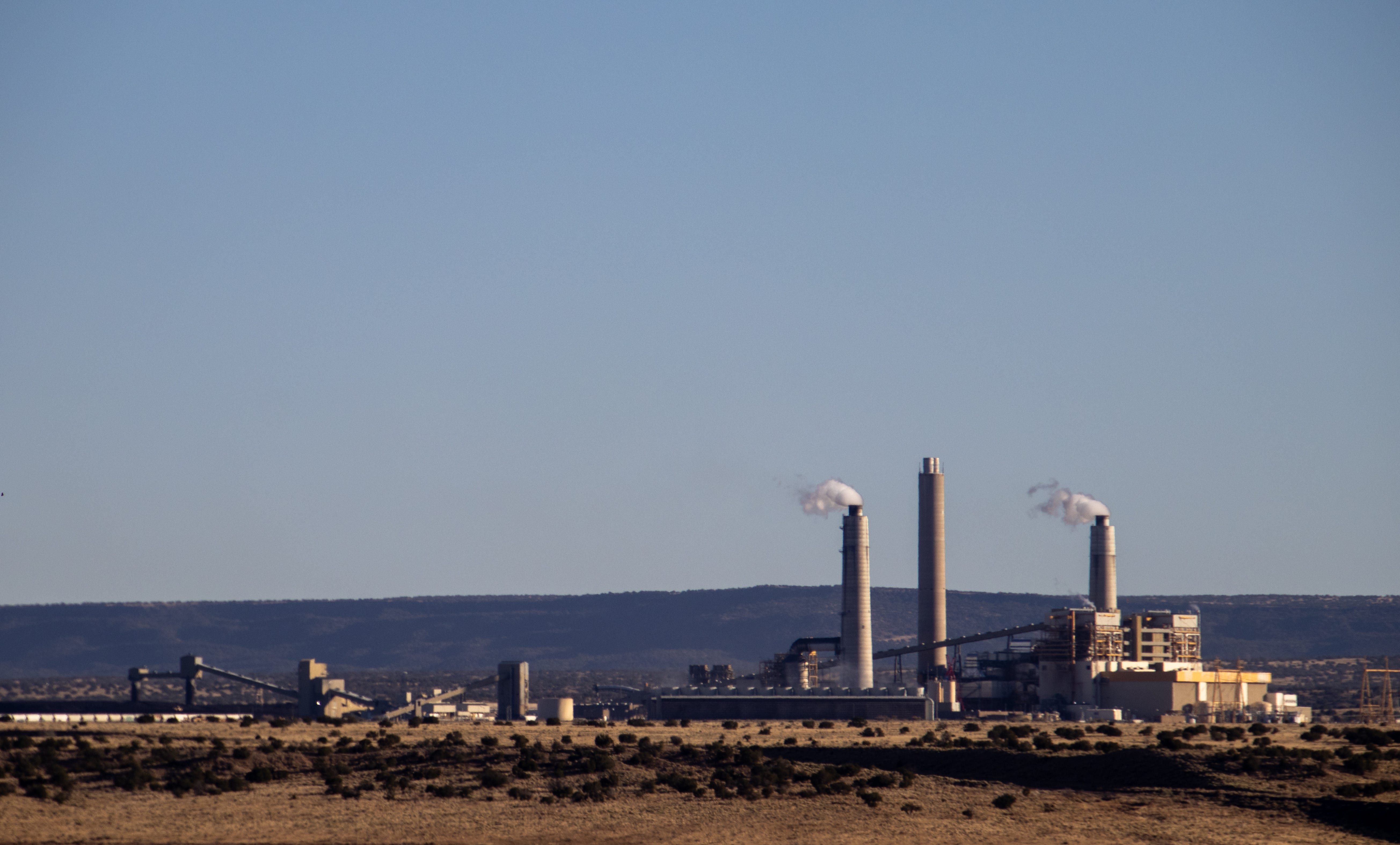
Coronado coal plant in northeastern Arizona. Jonathan P. Thompson photo.
The Trump administration moves to axe Obama- and Biden-era regulations limiting fossil fuel power plants’ greenhouse gas emissions, meaning coal and gas plants will be able to spew planet-warming carbon dioxide without restraint. This could extend the lives of some coal plants, and will help clear the way for the fleet of new gas plants being developed to power hyperscale data centers. While the original rules required facilities to reduce carbon emissions, they also would have kept soot and other health-harming pollutants out of the air, preventing an estimated 1,200 premature deaths per year. Earlier this year the administration rolled back stricter limits on mercury emissions from power plants. (New York Times)
🌵 PUBLIC LANDS 🌲
The Bureau of Land Management sells 940 acres of public land in southern Nevada to the City of Las Vegas, clearing the way for a 6,000-home master-planned community on the northern fringe of the metro area adjacent to Tule Springs Fossil Bed National Monument. The sale was authorized by the 1998 Southern Nevada Public Land Management Act, which allows for such “disposals” of federal land in a congressionally designated boundary. It merely whetted Gov. Joe Lombardo’s (R) appetite for snatching more public land, however, who said he will work to “unlock more federal land for housing.” It’s not clear whence the water will come for this sprawling new development in one of the nation’s more water-constrained cities; the state faces potential further reductions of Colorado River water under the new federal plan. (news release)
A new poll finds that two-thirds of Utah voters support restoring protections to the original, pre-Trump-shrinkage boundaries of Bears Ears and Grand Staircase-Escalante national monuments, and an even larger proportion supports tribal nations having a role in managing ancestral lands. (news release)
🥵 ARIDIFICATION WATCH 🐫
Wyoming researchers say warm water and drought-reduced streamflows may be behind a kidney-damaging parasite killing hundreds of whitefish in the Salt River this summer. The tributary of the Snake River has experienced some of its lowest flows on record this summer, and it was already plagued with E coli bacteria as a result of heavy livestock grazing in the watershed. (WyoFile)
⛏️ MINING MONITOR ⛏️
The Cibola National Forest launches its environmental review of Energy Fuels’ proposed Roca Honda underground uranium mine on about 370 acres of USFS, state, and private land northeast of Grants, New Mexico, and near the base of Mt. Taylor. Ore would be hauled by truck to the White Mesa Mill in southeastern Utah for processing. Public comments will be accepted here until Oct. 14. (agency news release)
IsoEnergy, which owns the Tony M, Dineros, Rim, and Sage Plain uranium mines in southern Utah, agrees to merge with DISA, a startup that looks to use high-pressure slurry ablation technology to pull uranium out of abandoned mine waste piles, to create a “technology-enabled US uranium platform for production, processing, and remediation.” DISA’s attempts to process small waste piles in Western Colorado have yet to come to fruition, and Iso’s bid to reopen the Tony M mine near Ticaboo, Utah, has moved forward only in incremental steps. (World Nuclear News)
Union Pacific Railroad begins hauling coal from Powder River Basin mines to the Port of Guaymas in Sonora, Mexico, where it could be shipped to Asia. The new export node allows the industry to get around environmental opposition to coal exports along the West Coast, but its viability depends on demand. (Trains)
🐟 COLORADO RIVER CHRONICLES 💧
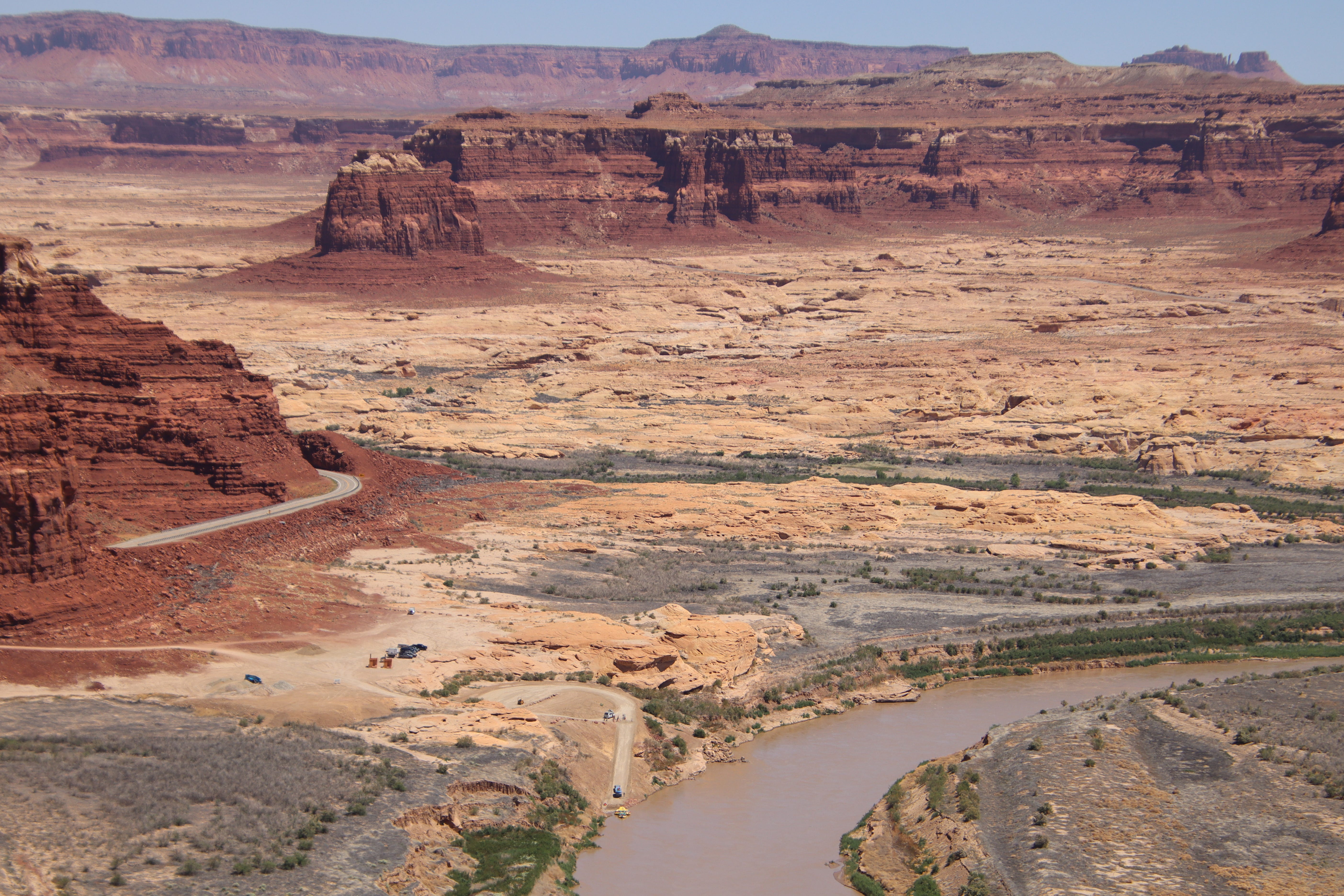
The less-than-ideal North Wash takeout for boaters running the Colorado River though Cataract Canyon. The planned Hite facilities, located to the right of this image just upstream and opposite the Dirty Devil confluence, would replace the North Wash ramp. Jonathan P. Thompson photo.
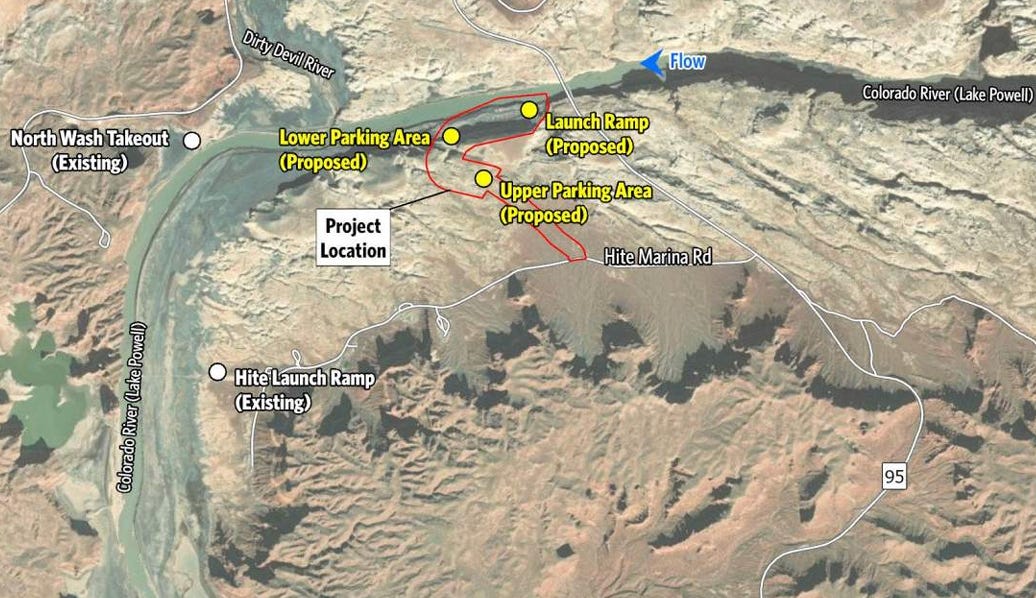
Glen Canyon National Recreation Area moves forward with a plan to develop new low-water boat ramps and other facilities at the Hite and Bullfrog districts on Lake Powell, indicating that the National Park Service expects reservoir levels not to rebound. The Bullfrog ramp is planned for the main channel of the reservoir, southeast of the current facilities, and would be usable for boats up to 125 feet long to a low lake level of 3,450 feet. The Hite ramp would be upstream from the current facilities and is primarily designed as a takeout for Cataract Canyon boaters and a safer alternative to the North Wash takeout on the opposite side of the river. (news release)
The planned Bullfrog low-water boat ramp. Source: NPS.
Arizona officials raise concerns about how the Colorado River crisis might affect its booming semiconductor and chip manufacturing industry, in which a single Phoenix-area facility, known as a “fab,” uses some 4.75 million gallons of water per day. (The Verge)
The Bureau of Reclamation again increases water releases from Flaming Gorge Reservoir in an effort to buoy water levels at Lake Powell, but Utah officials warn it is not a sustainable solution and could harm recreation on the upstream reservoir. (KSL)
🦫 WILDLIFE WATCH 🦅
Colorado Parks and Wildlife has euthanized nearly 300 bears so far this yearfollowing “unprecedented” levels of bear activity in towns across the state, as well as in Wyoming. Bryan Peterson, of Bear Smart Durango, told Cowboy State Daily the conflicts and killings are mostly due to the drought and lack of food sources, but also blamed human carelessness with garbage and food. (Cowboy State Daily, WyoFile)
Colorado Parks and Wildlife kills an uncollared female yearling wolf from the One Ear Pack in Grand County after the animal evaded non-lethal deterrents to prey on livestock. (news release)
🤖 DATA CENTER DIGEST 👾
Bureau of Land Management leadership reportedly orders state directors to identify federal parcels suitable for data center development, indicating that the administration is looking to skirt communities’ opposition to and ban on the facilities by approving them on nearby public lands. (Washington Sun)
Corner Venture Capital applies for an air quality permit for a 300-megawatt natural gas-fired plant to power a proposed hyperscale data center in southwestern New Mexico, raising concerns over air pollution and water use. (Silver City Daily Press, news release)
Google’s proposed 2.7-gigawatt, $17 billion Project Tembo data center complex on 700 acres near Cheyenne, Wyoming, clears local regulatory hurdles, but still has a lot of red tape to tangle with before final approval. The firm says the facilities will use less water-intensive closed-loop cooling systems and draw from deep wells, not surface supplies, and that it will be powered with natural gas fuel cells paired with carbon capture. (Wyoming Tribune Eagle)
🔋NOTES FROM THE ENERGY TRANSITION 🔌
Array Technologies opens its $50 million, 200,000-square-foot solar component manufacturing facility in Albuquerque, where it employs about 300 people. (KRQE)
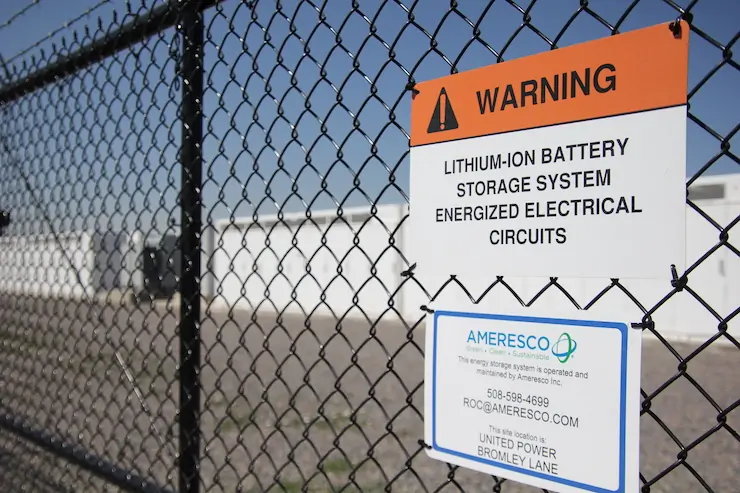
Black Hills Energy moves forward with its planned 50-megawatt battery energy storage system at its Pueblo Airport Generating Station in Colorado. (Energy Storage News)
🛻TRANSPORTATION 🚂
Denver West Express pitches a “concept” of an electric rail line designed to carry skiers from Denver International Airport to the resort town of Avon in less than two hours. The line would cost an estimated $28 billion to $33 billion to construct, but it might go a long ways to alleviate the I-70 ski season gridlock, which makes for one of the nastiest drives in the state — and where high traffic costs about $2.3 billion annually. (Steamboat Pilot)
📈 DATAVIZ OF THE DAY 📊
The Land Desk recently reported on how solar, wind, and battery storage is pushing coal off the West’s power grid, despite the Trump administration’s hostility toward cleaner energy sources. As of June of this year, the trend appeared to be continuing into the future, as a bulk of the generating capacity in the planning pipeline comes from cleaner sources. Click on the graphics for an interactive view, and specifics on each planned power plant.
Click the link to read the article on the Big Pivots website (Allen Best):
September 4, 2026
The integration of batteries into Colorado’s energy picture continues, this time in Pueblo. There, Black Hills Energy has announced plans to add 50 megawatts of storage that will enable it to capture excess renewable energy when it is available.
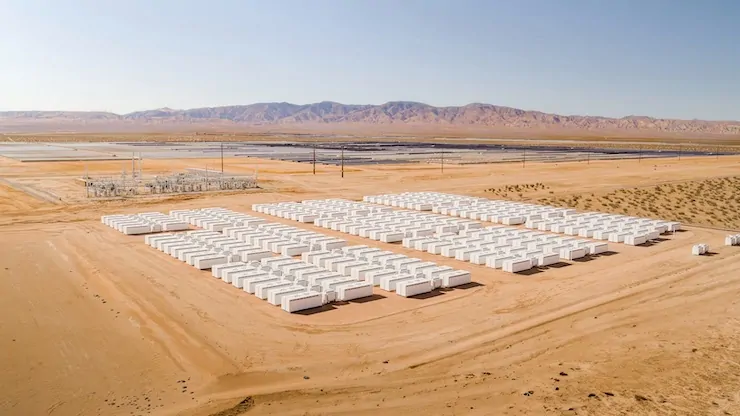
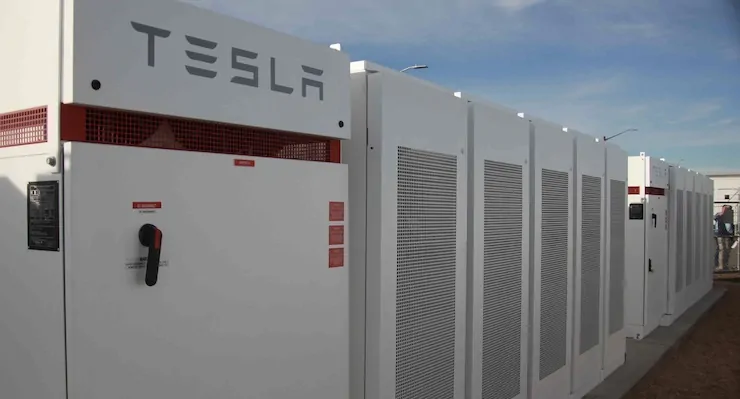
The four-hour Tesla Megapack batteries (pictured above) will be located next to the company’s 420-megawatt natural gas plant near the Pueblo Airport. However, the intent is to use the batteries to store excess electricity generated by the company’s three wind installations in southern Colorado. They have a combined capacity of 149 megawatts.
“We’re very proud that our company’s first large-scale battery storage project will be built right here in Pueblo,” said Campbell Hawkins, vice president of Colorado Utilities at Black Hills Energy.
Black Hills expects to have the battery storage in place by late 2027. The company explains that batteries will enable it to better meet peak demands, such as on hot summer evenings, with renewable energy.
This is part of the company’s work to reduce greenhouse gas emissions 80% by 2030 as compared to 2005, as required by Colorado law.
The batteries in Pueblo can best be understood as part of a near explosion in energy storage in Colorado during the last two to three years. The amount of storage now on line is remarkable given that the very first _ and very small — set of batteries were put into place in 2018 at the United Power headquarters along I-25. And that 4 megawatt-hour of battery storage remained the largest in Colorado until 2022.
American Clean Power will host its Recharge conference in Colorado on Sept. 22-24. The opening session will include a very strong Colorado component on its opening day with both Eric Blank, chair of the Colorado Public Utilities Commission, and Chris Hansen, CEO of La Plata Electric, having half-hour time slots. See more here.
At Pueblo, project partners are Linxon, a global engineering, procurement and construction company, and Cloudbreak Energy, a national developer and independent power producer of distributed resources and utility-scale solar and storage projects.
The Crossing Trails Wind Farm between Kit Carson and Seibert, about 150 miles east of Denver, has an installed capacity of 104 megawatts, which goes to Tri-State Generation and Transmission. Photo/Allen Best
It’s safe to say that the Trump administration has been waging a war on solar and wind energy, both to spite its political adversaries and to bolster the fossil fuel industries.
After all, it froze utility-scale solar and wind permitting on public lands; cut federal tax incentives for both utility-scale and rooftop solar; clawed back federal grants for clean energy manufacturing, transmission upgrades, and climate programs; spent $4 billion (so far) in taxpayer funds to pay offshore wind developers to give up their leases; and halted Defense Department reviews of proposed onshore wind developments, thus stalling them indefinitely. That an administration is actively quashing new energy development even as it declares an “energy emergency” to try to prop up the dying coal industry and further pad petroleum corporations’ pockets is especially absurd.
The data show, however, that Trump’s war on clean energy isn’t going much better than the fight he picked with Iran. For one thing, courts keep slapping down many of his initiatives because, well, they’re illegal. More than that, though, solar and wind generation are making big gains on many state’s electrical grids and, in some cases, are outpacing both coal and natural gas generation, even in fossil fuel strongholds.
That’s in part because there were a lot of projects in the pipeline when Trump took office, such as Pattern Energy’s massive SunZia wind power facility in eastern New Mexico, which added a whopping 3.65 gigawatts to the grid when it came online a couple of months ago. Developers have also been scrambling to get projects built before the federal incentives expire, bringing more capacity online. And, even though federal land permitting has slowed, developers have been bringing new projects online on private land, including fallowed farm fields, with surprising frequency.
And there’s a lot more of that on its way: The Westlands Water District in California is moving forward with its Valley Clean Infrastructure Plan, which will develop a 20-gigawatt solar and battery storage project on more than 100,000 acres of water-constrained ag land in the Central Valley. As Land Desk reader Fred Porter often preaches, these increasingly arid times call for farmers to: “Stop irrigating, plant solar, harvest electrons.”
By putting these huge installations on already disturbed former farmland, it reduces the pressure to put them on more sensitive, ecologically rich public lands. Less irrigating will leave more water in the rivers. As solar and wind displace coal and natural gas generation, they’ll also reduce the need for water in those thermal power plants. And, generating more power will offset the electrons lost if/when hydropower generation stops at Glen Canyon Dam and/or Hoover Dam.
For the blurbs below, I’ve used a snapshot of energy use by state in May of this year, mostly because that’s the most recent data available for all of these states. Keep in mind that electricity demand, and the output of various energy sources, varies from month to month. May is a good month for solar because the sun’s shining, the days are long, and the sky is not obscured by wildfire smoke. Meanwhile, it’s usually not hot enough yet for air-conditioning-related demand spikes.
I’ve only included energy sources that provided 1% or more of a state’s total electricity use that month. In the states below, “other renewables” is geothermal…
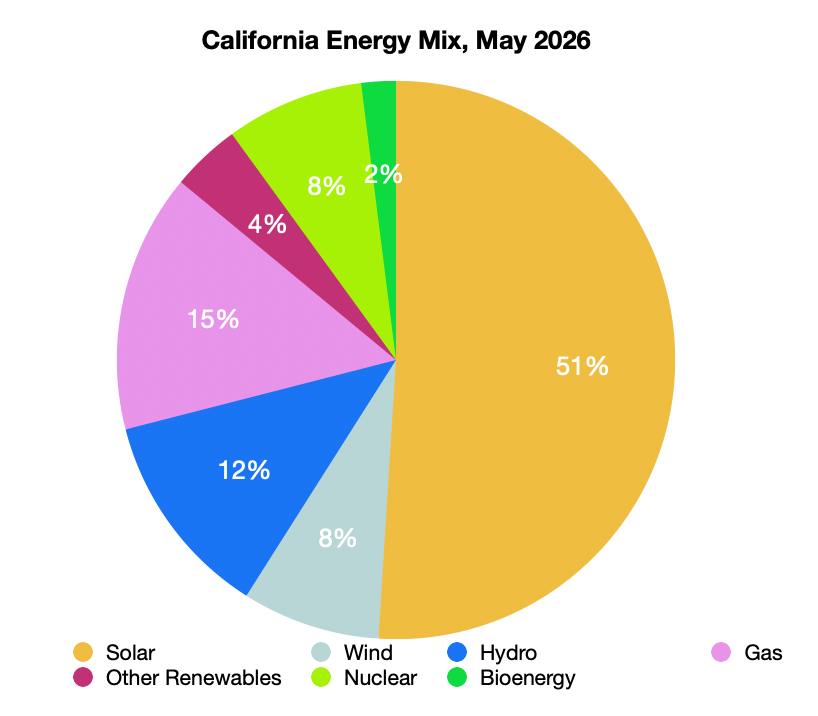
California, as one might expect, is leading the clean energy charge. In May of this year, solar generation accounted for 51% of California’s total electricity production, a new world record (wind accounted for another 8%). Meanwhile, fossil fuels — which in California means natural gas — provided less than 15% of the state’s power in May. Hydropower, nuclear, and biofuels filled in the remaining 26%. A surge in grid-scale battery energy storage capacity in the state over the last few years has helped smooth out the solar “duck curve”; plentiful afternoon solar tops off the batteries, which can then discharge in the evening when solar drops off. There are still challenges, however: California’s grid operator continues to curtail solar generation, meaning it forces arrays to shut down or to pay other states to take it, because at times there’s more solar output than the grid can handle.
Solar: 51%
Gas: 15%
Hydro: 12%
Wind: 8%
Nuclear: 8%
Other renewables: 5%
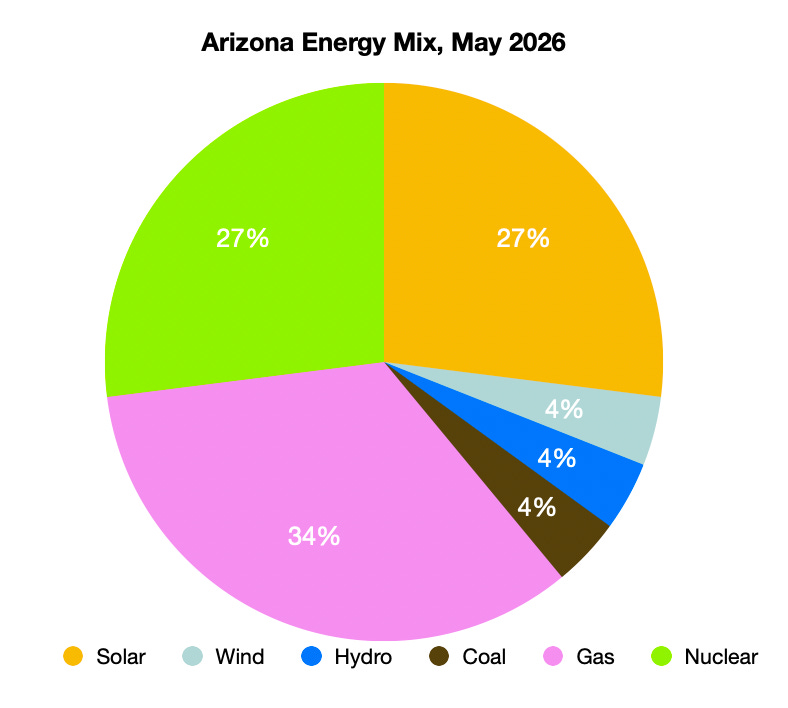
Arizona should be the leader in solar, given how sunny it is, but its clean energy progress has been hampered by Trumpian state lawmakers and utility regulators, who tend to favor fossil fuels for reasons that confound me (I have no idea how energy sources became partisan or why). Still, solar is making huge gains, providing about 27% of the state’s electricity in May, compared to just 12% in 2021. That’s about the same share as nuclear’s, which is somewhat remarkable given that the state is home to the Palo Verde Nuclear Plant.
Salt River Project, the utility that serves most of the Phoenix metro area, continues to add both solar and battery storage. Meanwhile, Arizona Public Service plans to convert its currently shuttered Cholla coal plant near Holbrook to run on natural gas. This was one of the coal plants Trump said would reopen as part of his coal-fetish initiatives. It did not reopen, at least not to burn coal.
Gas: 34%
Solar: 27%
Nuclear: 27%
Wind: 4%
Hydro: 4%
Coal: 4%
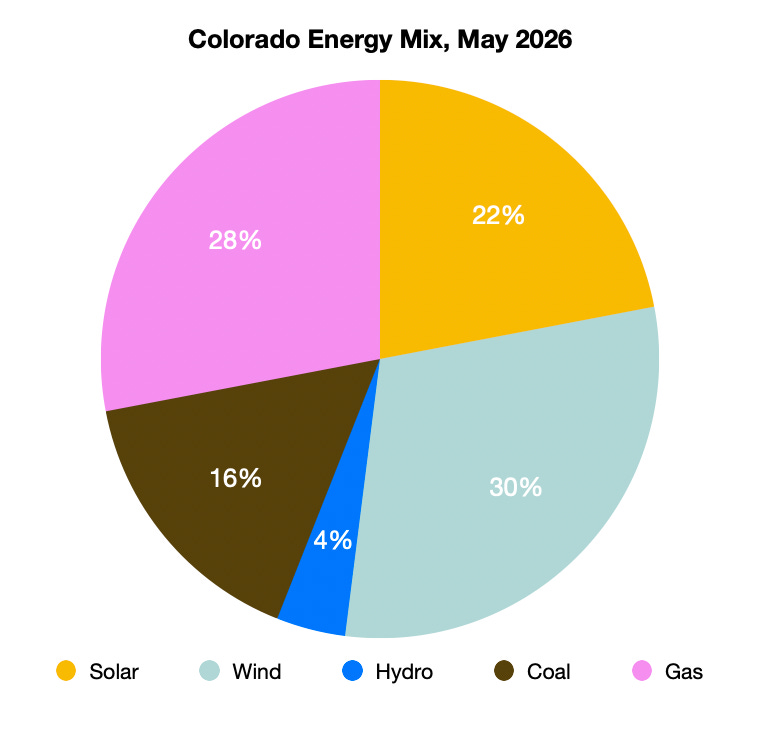
Colorado. Just a decade ago, coal-fired generation dominated Colorado’s grid, accounting for about 50% of all generation in 2016. Stronger clean energy policies and the rising cost of coal has unseated the dirty fuel, with wind power taking over the top spot. Coal’s decline, however, has been slowed in the state by Trump administration orders blocking planned plant retirements, and by projections of data center-driven electricity demand increases.
Wind: 30%
Gas: 28%
Solar: 22%
Coal: 16%
Hydro: 4%
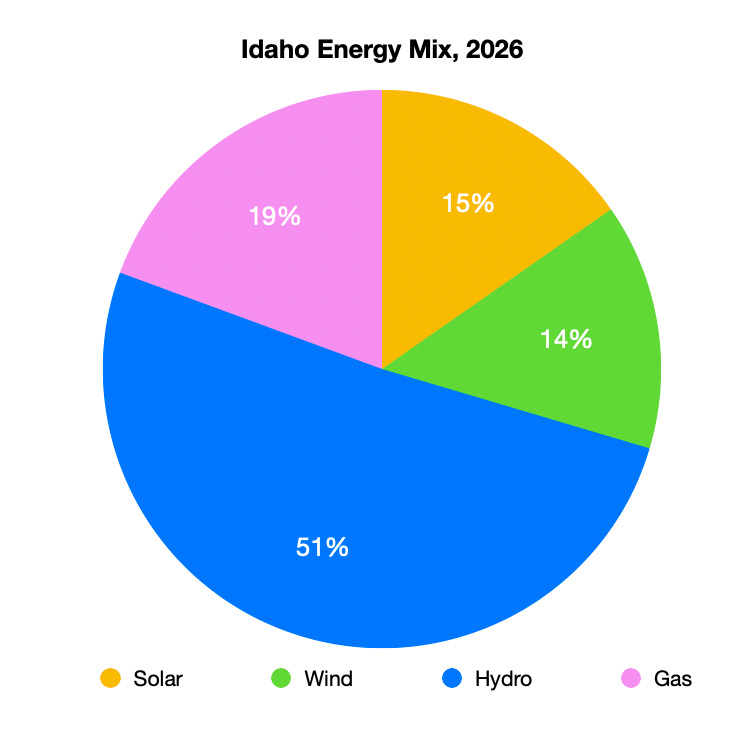
Idaho: Way back in 2006, when coal-fired generation was near its peak in the United States and the Powder River Basin mines were kicking out 1 billion tons of the stuff each year, Ray Ring wrote a story for High Country News about a band of Idaho residents pushing back on a new coal plant. The “West’s New Revolutionaries” ultimately prevailed. And not only did this one facility not get built, but the state has managed to stay off coal altogether. Nowadays, though, rural Idahoans are just as likely to be pushing back against solar and wind installations, the state’s largest utility is hostile toward rooftop solar, and multiple new gas plants are in the pipeline. So don’t expect solar and wind to crowd out other energy sources too soon.
Hydro: 50%
Gas: 19%
Solar: 15%
Wind: 14%
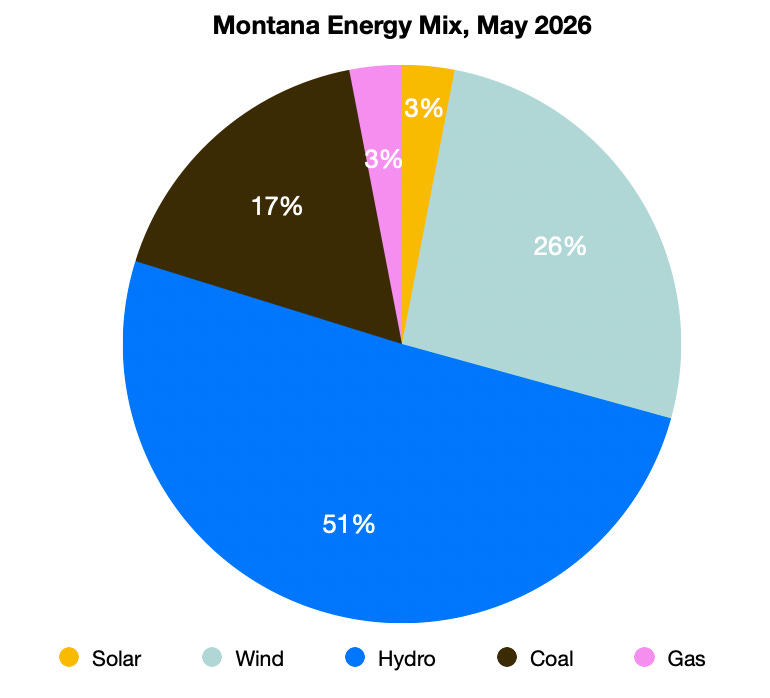
Montana’s state lawmakers and utility regulators have a fondness for fossil fuels. Plus, it’s a big coal mining state and is home to the Colstrip coal power plant, one of the nation’s worst polluters. Nevertheless, coal doesn’t dominate the energy mix here, hydropower does. Wind, however, is making a run for the top spot.
Hydro: 50%
Wind: 26%
Coal: 17%
Solar: 3%
Gas: 3%
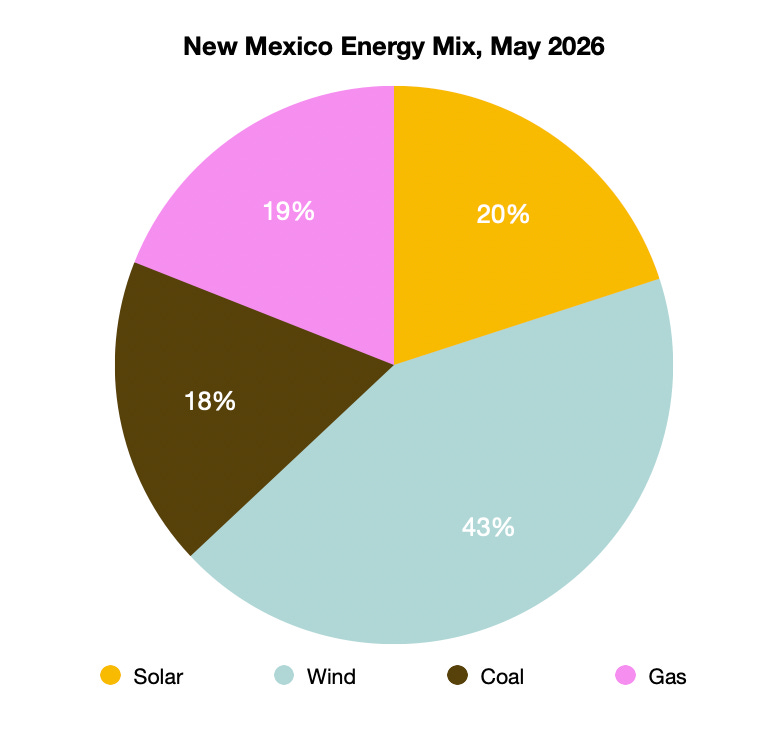
New Mexico produces oodles of methane, i.e. natural gas. The San Juan Basin was once one of the world’s largest gas fields, and in the Permian Basin oil fields the fuel is so plentiful (as an “associated gas” that comes up with the crude) that they just burn it off instead of putting it to use. Still, gas plants generated just 19% of the state’s electricity, while wind and solar combined accounted for 63%. That’s in part because New Mexico has good wind and solar potential, but more importantly it has forward-thinking, progressive policies such as the Energy Transition Act, which not only encourage renewable energy, but also provides a safety net to help coal communities, miners, and power plant workers transition away from the dirty fuel.
Wind: 43%
Solar: 20%
Gas: 19%
Coal: 18%
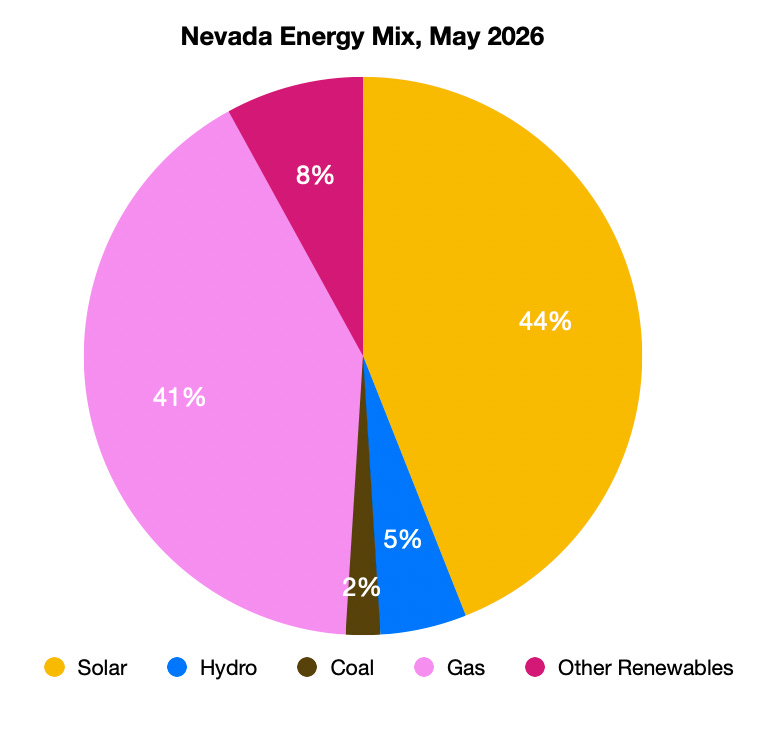
Nevada’s largest utility started moving away from coal years ago, and some of NV Energy’s biggest customers — Las Vegas casino resorts — have demanded clean energy to help them green up their brands. That, combined with Nevada’s large tracts of solar-ready public lands has helped utility-scale solar generation vie with gas as the leader of the state’s energy mix. With several large solar and geothermal projects in the pipeline, shares of those energy sources should continue to grow. The biggest hurdle standing in the way of the Silver State’s energy transition is the Big Data Center Buildup, which threatens to double or even triple overall electricity demand in the next decade or so. NV Energy plans to build more gas generation to keep up.
Solar: 44%
Gas: 41%
Other renewables: 8%
Hydro: 5%
Coal: 2%
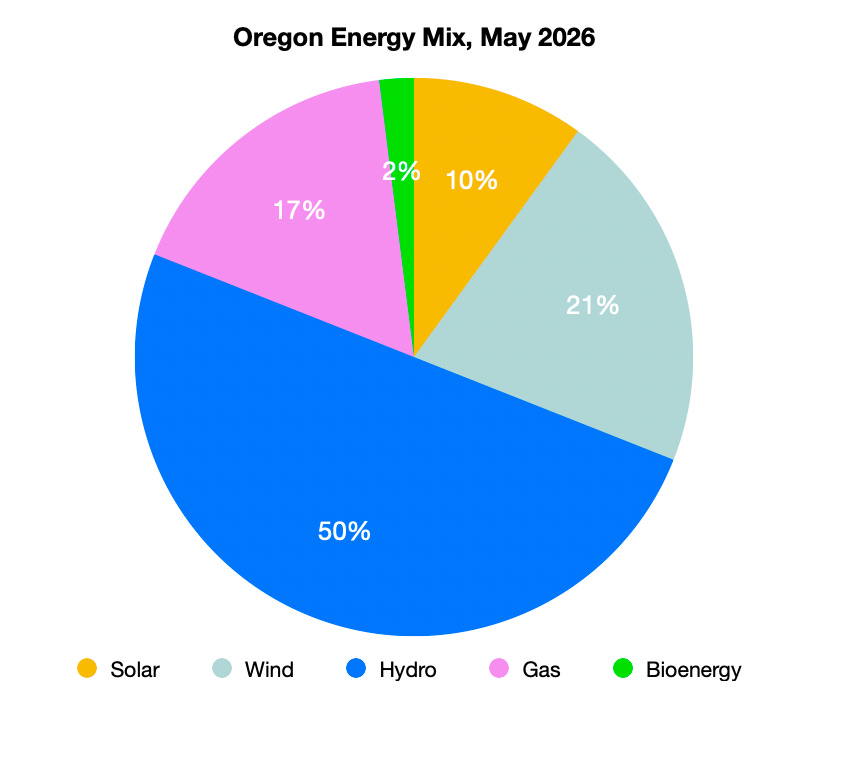
Oregon, like other Northwest states, relies heavily on hydropower from the Columbia River’s dams, but it has also added wind capacity at a fairly rapid rate. Like in many other Western states, Oregon’s energy supply is likely to be strained by data center-driven demand.
Hydro: 50%
Wind: 21%
Gas: 17%
Solar: 10%
Bioenergy: 2%
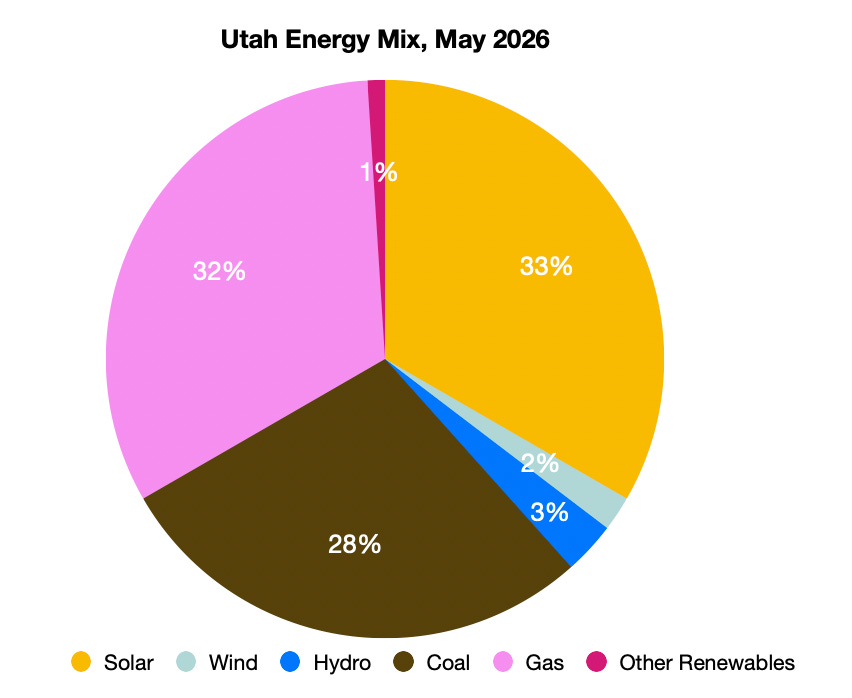
Utah’s Republican-dominated legislature is packed with fossil fuel folks, who have devoted a lot of time and energy trying to keep the coal industry going. Gov. Spencer Cox, meanwhile, is a big nuclear fan, and is courting reactor startups and vying to host a Department of Energy “Nuclear Lifecycle Innovation Campus” that would include nuclear fuel fabrication, enrichment, and radioactive waste storage to add to the existing uranium mining and milling industry.
But for the month of May, at least, solar sat atop the state’s energy mix, bolstered by the new 400-MW Green River solar-plus-storage project, with coal falling to third place. While there’s a lot of talk about nukes, there is real action on the geothermal front in Utah, with Fervo advancing its Cape Station enhanced geothermal project in Beaver County. I’d bet that geothermal’s share climbs long before a reactor comes online in the state.
Solar: 33%
Gas: 32%
Coal: 28%
Hydro: 3%
Wind: 2%
Other renewables: 1%
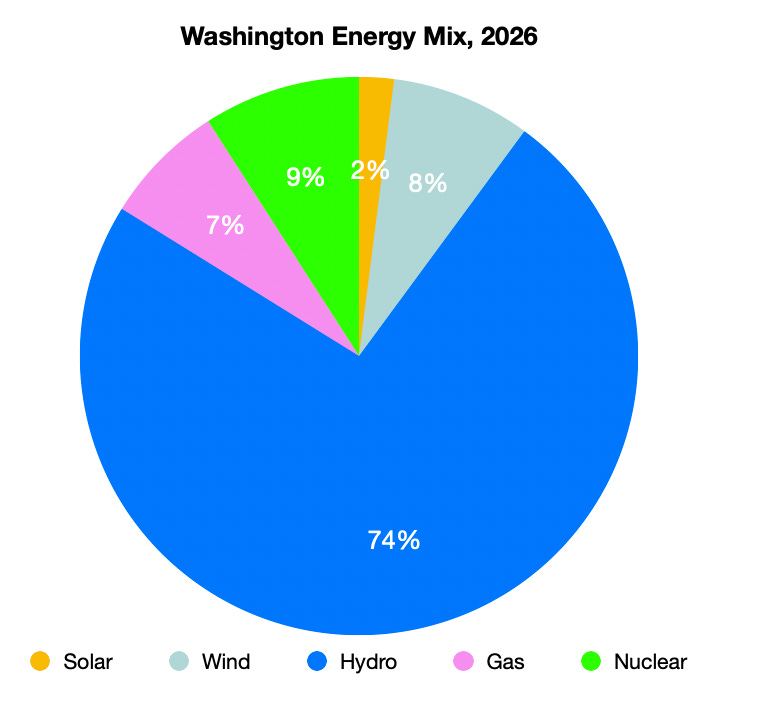
Washington is a hydropower state, naturally, thanks to big dams on the Columbia River and its tributaries. It’s also one of the few Western states with a notable share of power generated by nuclear reactors. Coal is notably absent, in part due to state policy, despite the Trump administration’s order to keep the Centralia coal plant running past its December 31, 2025, retirement date. Centralia will convert to run on natural gas in coming years.
Hydro: 73%
Nuclear: 9%
Wind: 8%
Gas: 7%
Solar: 2%
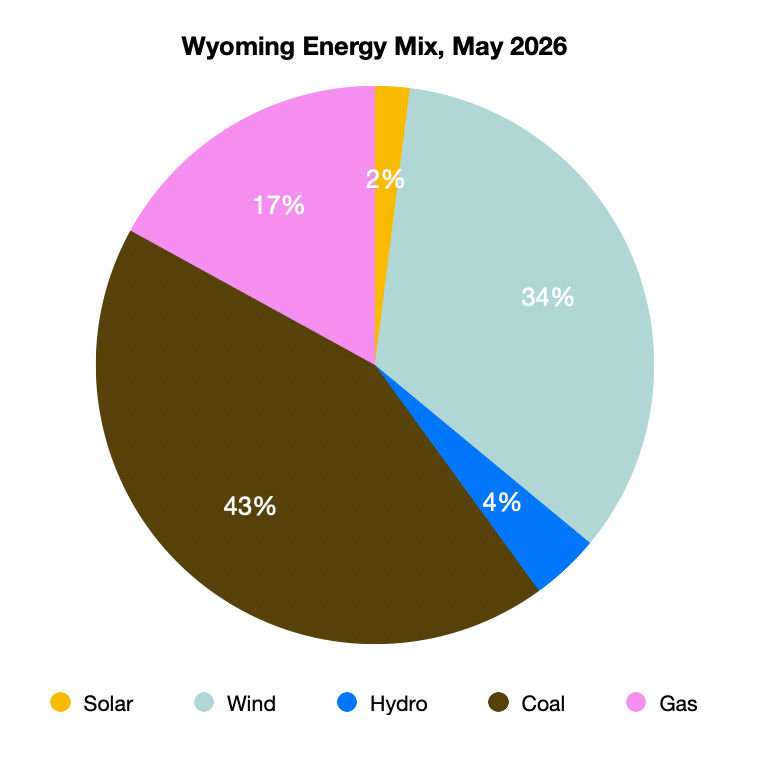
Wyoming has become synonymous with coal production ever since the Powder River Basin mines went big time back in the 1970s. It’s also big on coal-generation: In 2003, coal-fired power plants produced 97% of Wyoming’s electricity. Today, the gaping mines in the Powder River Basin continue to produce a lion’s share of the nation’s coal, but the fuel’s stature in the state’s energy mix is declining, while wind power excels.
Coal: 43%
Wind: 34%
Gas: 17%
Hydro: 4%
Solar: 2%
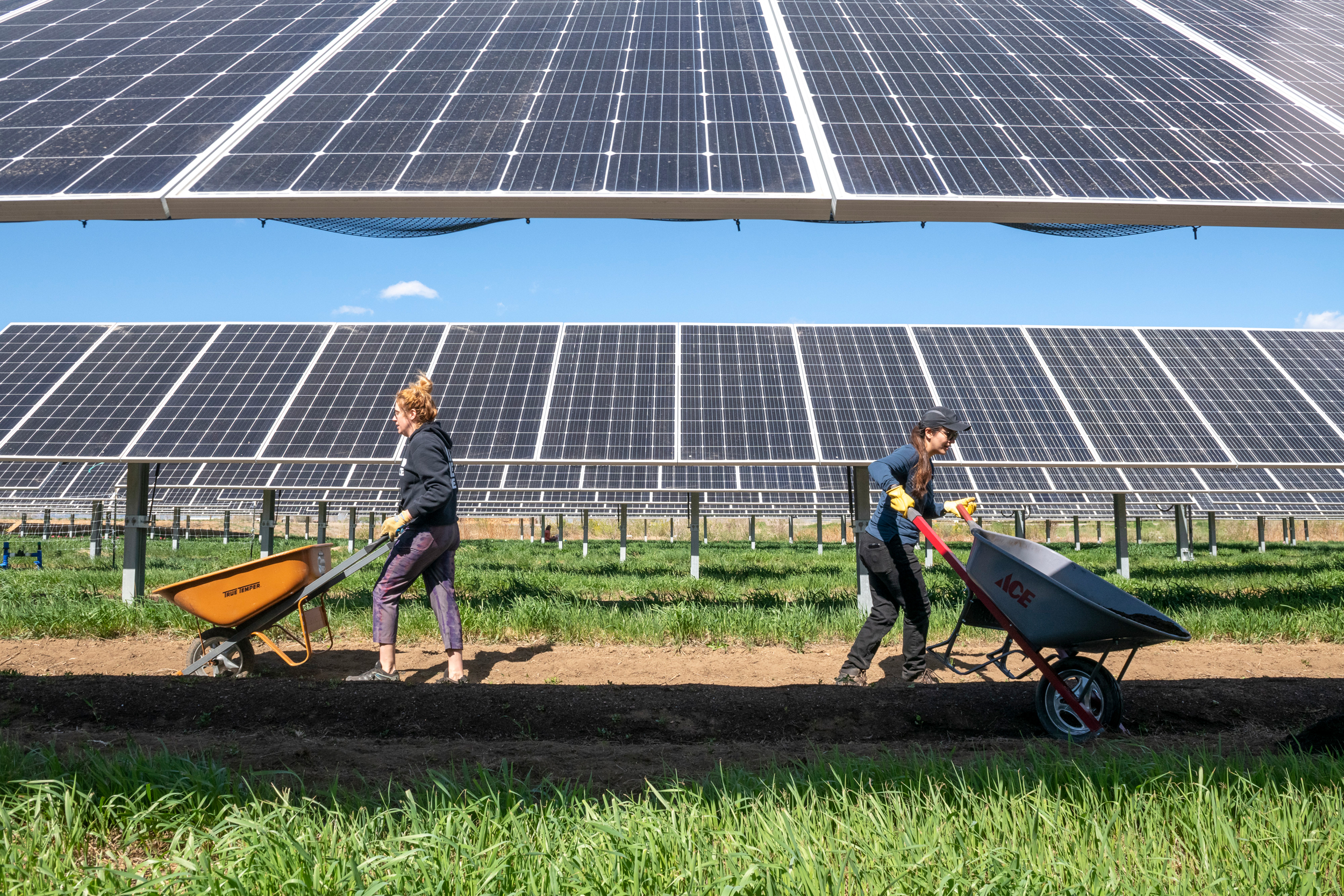
May 6, 2023 – Volunteers with the National Renewable Energy Laboratory’s (NREL’s) ESCAPES (Education, Stewardship, and Community Action for Promoting Environmental Sustainability) program lend a hand to Jack’s Solar Garden in Longmont, Colo. Bethany Speer (left) goes back for more while Nancy Trejo distributes her wheelbarrow load to the agrivoltaic plots. (Photo by Bryan Bechtold / NREL)
The Trump administration is attacking public lands again, this time in an apparent effort to open more special places to off-road vehicles. Late last Friday, Trump issued an executive order revoking a Nixon-era policy aimed at ensuring “that the use of off-road vehicles on public lands will be controlled and directed so as to protect the resources of those lands, to promote the safety of all users of those lands, and to minimize conflicts among the various uses of those lands.”
No, this does not mean unfettered swarms of ATVs will be kicking up dust on your favorite public lands next week. But it does bolster the off-road vehicle lobby’s effort to open up motorized access to federal lands, and takes away one of the long-term planning tools used by land management agencies to protect those places from off-road vehicle use and abuse.
In the nearer-term, Trump’s order could end or diminish the ban on OHVs in national parks, allowing the vehicles to travel backroads in, say, Capitol Reef National Park. This might not sound so bad: If a three-ton SUV can drive there, why not let a smaller side-by-side or four-wheeler on the same road?
The answer lies in the nature of the newer OHVs, namely “side-by-sides” or razors, which more closely resemble souped-up dune buggies than conventional SUVs. While some people use OHVs as mere modes of transportation, the vehicles are more commonly treated and utilized like recreational playthings — very powerful, fast, and noisy toys that tend to travel in herds. They therefore bring their own type of impacts.
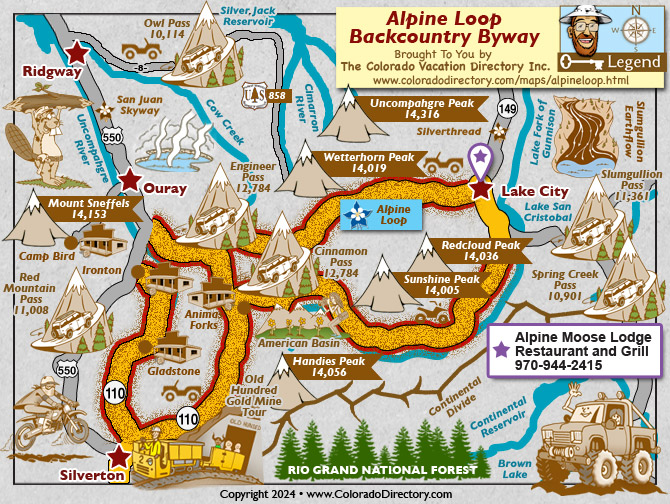
Alpine Loop Backcountry Scenic Byway near Lake City, Ouray, Powderhorn, Ridgway, Silverton Credit: ColoradoDirectory.com
Anyone who has traveled on or hiked around the Alpine Loop in the San Juan Mountains of southwestern Colorado on a busy summer day has likely experienced these particular impacts first-hand. Those roads were first opened up to OHVs in the early 2000s. Since then Alpine Loop traffic numbers have exploded, with at least half of the motorized traffic made up of OHVs.
Law enforcement officers now spend a disproportionate amount of time and energy trying to keep the OHV drivers on designated routes and in compliance with traffic laws. OHV crashes, often resulting in serious injury, are not uncommon. And each summer several riders surrender to the temptation to illegally leave the road — these are off-road vehicles, after all — and rip across the tundra, causing irreversible damage. Unlike regular vehicles, OHVs tend to travel in herds, spewing exhaust and kicking up dust, their collective buzzing reaching far beyond the roads on which they travel. It has become almost impossible during the high season to completely escape the incessant din of OHVs on the Alpine Loop, even in wilderness study areas.
This same phenomenon could now be coming to a national park near you.
The administration claims it eliminated the policy because it was outdated, vague, and redundant, because Congress has since passed a host of other laws protecting public lands from OHVs and other uses. The order goes on to say:
This makes very little sense. Sure, the restrictions on OHVs could hamper energy or timber development if it required destructive off-road vehicle use, but you’re not going to haul a drill rig into the backcountry on a side-by-side. And the idea that a hiker might feel “banned” from a trail because they couldn’t ride get there on an OHV is just silly.
The dubious statement reeks of the rhetoric of the crowd that claims that motorized vehicle restrictions are locking folks out of public lands, and therefore are discriminating against the type of people who drive these vehicles. But the discrimination claim simply does not fly. Mountain bikes are banned from wilderness areas, from a majority of trails in national parks, from some trails on BLM land, and are not allowed to ride off-trail on all federal land. This has nothing to do with the people who ride the bikes, or even the funny clothes they tend to wear, and everything to do with the vehicles’ potential impacts.
Trump probably did this at the behest of the Blue Ribbon Coalition and the likes of Sen. Mike Lee, who has pushed legislation that would open up national parks to OHVs. Maybe he’s trying to garner support from somewhere, given his terrible favorability ratings. Or perhaps he’s trying to appease the motorized crowd, which is probably a bit miffed that their drug of choice — gasoline — is so damned expensive thanks to Donny’s dumb war. Maybe he’s even trying to increase national park entry fee revenues so he can funnel it to his ballroom/drone-port or his White House UFC fight.
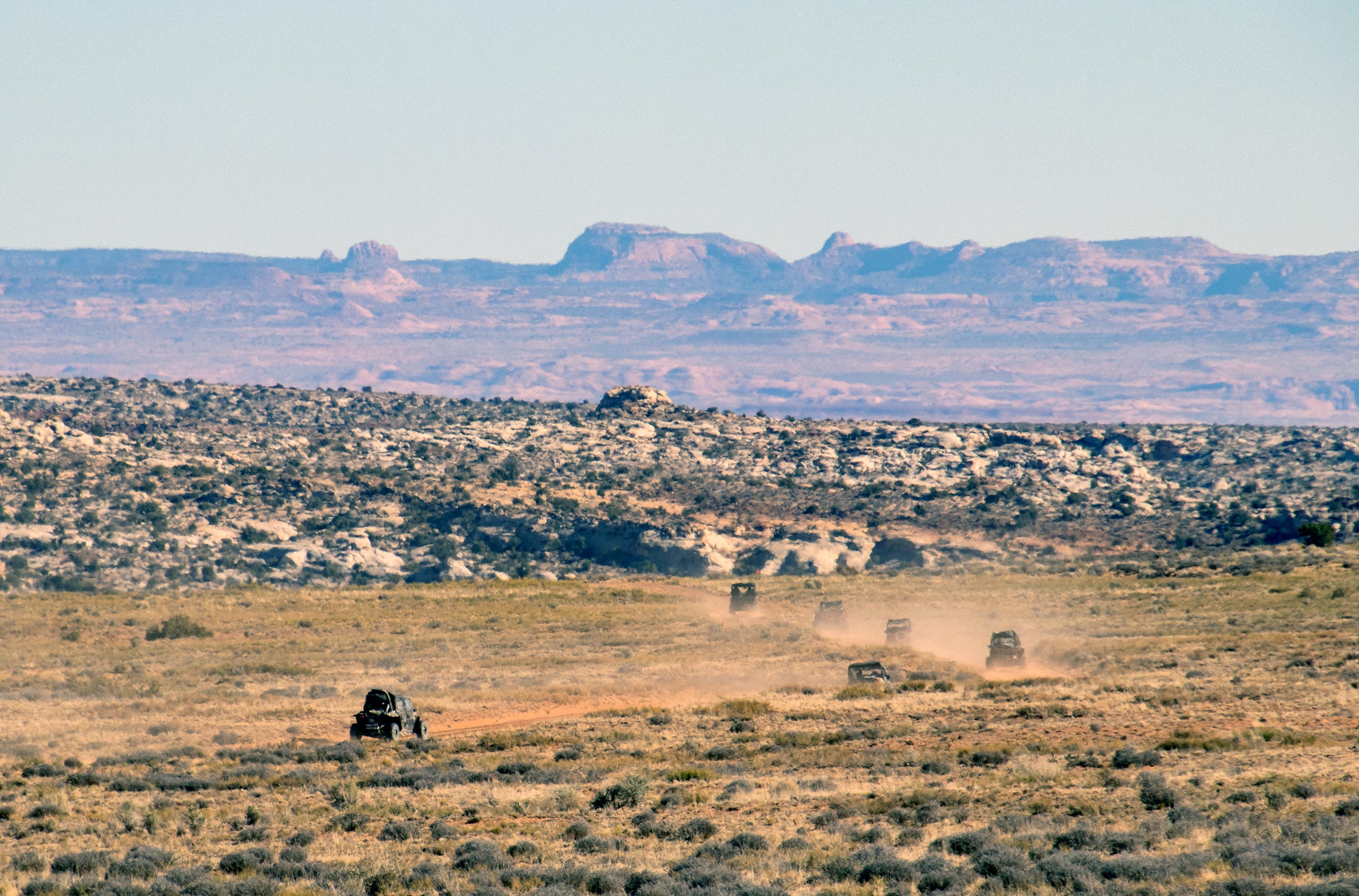
Near Hite with the Henry Mountains. Jonathan P. Thompson photo.
🐟 Colorado River Chronicles 💧
It pretty much goes without saying that if next winter is as bad as this past winter, in terms of mountain snowpack, then the collective users of the Colorado River and its infrastructure will be toast — at least figuratively (maybe literally, too?). Now, my favorite team of Colorado River wonks1 [Anne Castle, Jack Schmidt, Eric Kuhn, Kathryn Sorensen, Katherine Tara] have crunched the latest water numbers, and they’ve found that even a nearly “normal” winter won’t stop depletion of “reasonably accessible storage in Lake Powell and Lake Mead, leading to “devastating consequences.”
Back in 1999, the Colorado River’s storage system, which consists of Lake Powell, Lake Mead, and several other smaller reservoirs in the Upper and Lower basins, was almost full, holding about 60 million acre-feet of active, or available, storage. This provided a robust savings account that could be tapped during the inevitable dry spells on the notoriously fluctuating river system.
The reserve, however, was not adequate for the megadrought — or long-term aridification — that started in 2000 and continues today. Instead of following the usual up-down cycle, the Colorado River’s flows began a downward trend that is on track to hit its lowest point so far this water year, while consumptive use stayed more or less steady. Demand exceeded supply more years than not, drawing the savings account down significantly. That has forced the Bureau of Reclamation to take extraordinary measures, such as reducing downstream releases and tapping upstream reservoirs, to keep Lake Powell’s surface level from dropping below 3,500 feet, or what I call de facto dead pool 2.
Thanks in part to extra releases from Flaming Gorge Reservoir in May, Lake Powell’s surface level climbed slightly to 3,528 feet last month. Given that spring runoff in the Upper Basin has peaked and most tributary flows are decreasing, we can expect that number to start dropping, perhaps precipitously, at least until the monsoon arrives.
The wonks wanted an idea of how things might play out in the slightly longer-term, so they modeled two scenarios:
In the first scenario, they assume that the Colorado River’s natural flow, or the estimated amount of water in the river without human consumption or interference, will be similar to water year 2025, when the mountain snowpack was below average but not nearly as slim as this year. They also assume that consumptive uses will remain at the lowest levels in recent years.
Natural flow: 8.5 MAF at Lees Ferry + .70 MAF from Grand Canyon and Virgin River = 9.20 MAF Consumptive use: 3.56 MAF Upper Basin (includes evaporation and other losses) + 8.23 MAF Lower Basin + Mexico (incl. evap and other losses) = 11.79 MAF Deficit and resulting reservoir drawdown: 2.59 MAF Realistically accessible storage (RAS) remaining in Mead, Powell, and Flaming Gorge: 3.63 MAF
For the second, they plug in snowpack/flow numbers similar to those from water year 2023, which was a huge winter. Consumptive use would be about the same as in 2023.
Under the first scenario, the BoR will almost certainly have to go to a run-of-the-river situation on Glen Canyon Dam to defend 3,500 feet. That would mean releases would be approximately equal to inflows minus evaporation and seepage from the reservoir, and might drop to 3,000 to 4,000 cubic feet per-second or even lower. In the summer of 2002 inflows at times dropped below 1,000 cfs. This would turn the river through the Grand Canyon into a relative trickle, and cause a significant drawdown of Lake Mead.
The second scenario would be far better, but is far from an enduring solution. At best it would buy a little time, perhaps enough for the feds to build bypass tunnels around Glen Canyon Dam to allow for sustained releases below 3,500 feet. If it were followed by another three or four 2023-like winters, then things would start to look pretty darned good.
But if it were followed by just one more dry year it would bring everything back to today’s rather dire situation.
Since there’s no way to bolster supplies, the only way out of this mess is to continue to slash demand. The paper’s authors write:
Oof.
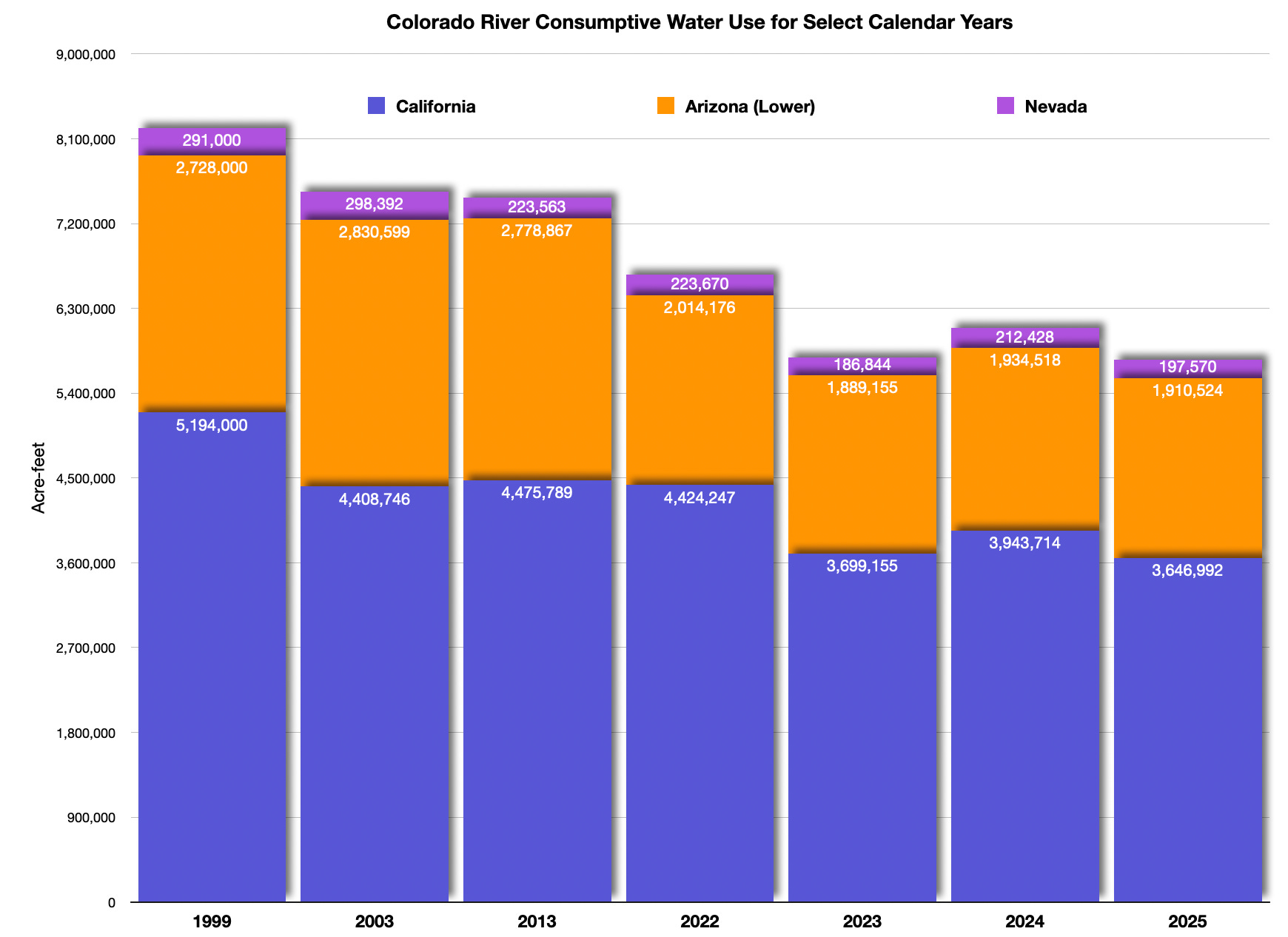
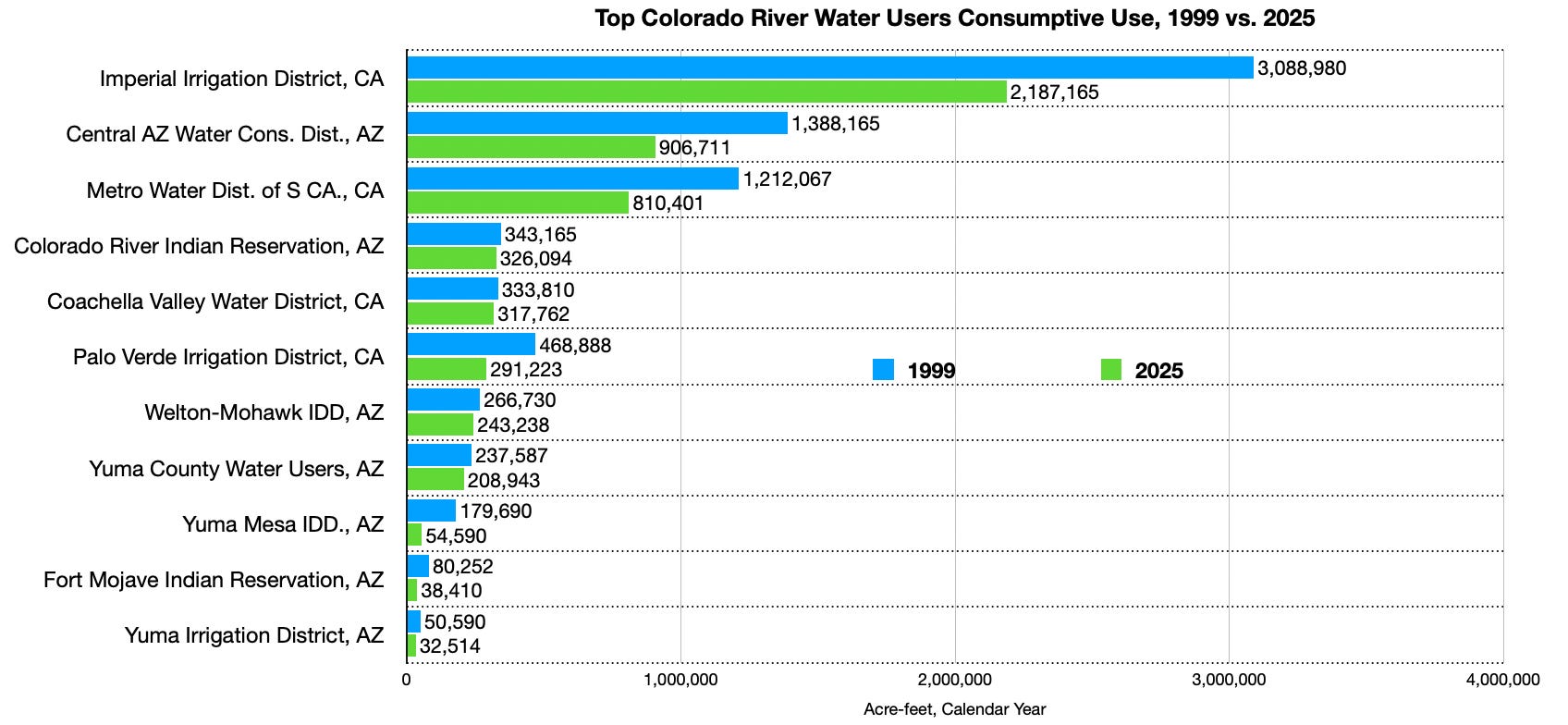
As long as we’re on the topic, the BoR recently released its Lower Basin accounting report for 2025, which tallies up consumptive uses in the basin. As you can see from the following graphs, which the Land Desk whipped up using the BoR data, the Lower Basin uses significantly less water now than it did in 1999, just before the current megadrought began. Upper Basin consumptive use figures for 2025 are not yet available. The following figures do not include reservoir evaporation, conveyance losses, or Mexico’s use.
All three Lower Basin states have substantially reduced Colorado River water consumption since 1999. However, more cuts will be needed if current climatic and streamflow trends continue. Data: USBR, Graphic: The Land Desk
🤖 Data Center Watch 👾
Has Enchant Energy finally found a raison d’être? The Farmington-based company was created in 2019 to try to save the San Juan coal-fired power plant from retirement by retrofitting it with carbon capture equipment. Enchant would then sell the carbon to oil producers in the Permian Basin, while also receiving generous federal tax credits. Basically they wanted to turn the power plant into a taxpayer subsidized carbon dioxide factory. It flopped for various reasons. Now the San Juan plant — and all of its pollution — are no more. We suspected Enchant Energy had met a similar fate.
But then I received a press release letting me know the not-so-up upstart is not dead, but has instead signed a letter of intent with Creekstone Energy to capture carbon from the tech firm’s proposed hyperscale Delta Gigasite data center in Delta, Utah. As is often the case, Creekstone touts all of the renewable energy it plans on building for its center, but the first phase will be powered by natural gas, which emits carbon dioxide.
Enchant hopes to capture the carbon from the gas plant and convert it into marketable fuel. The company has apparently given up on trying to give coal-burning a slightly more climate-friendly veneer (after all, Trump has declared coal to be “clean” and “beautiful”). Instead, it looks like they’re jumping on the data center bandwagon, along with wannabe nuclear reactor developers and the like.
Who knows, maybe this is the thing that finally gives Enchant some meaning. But we’re not holding our breath. After spending gobs of money on lobbying, pulling in some hefty federal grants, then failing spectacularly with the San Juan generating bid, Enchant partnered with another firm and tried to buy the Intermountain coal plant in Delta to use it to power its own data center. That didn’t work, either.
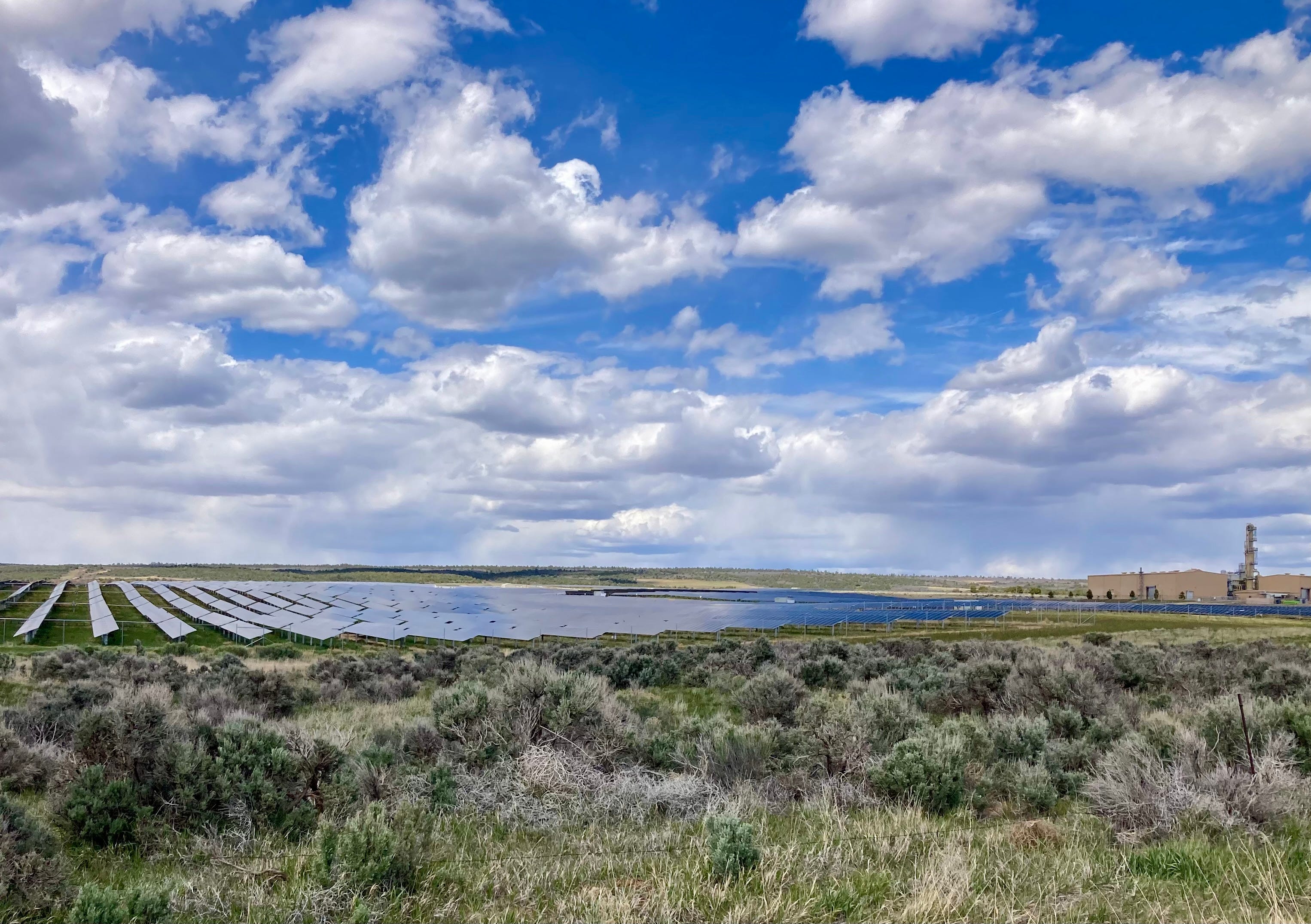
Dolores Canyon solar project outside of Cahone, Colorado, with Airproduct’s apparently defunct helium plant on the right. Jonathan P. Thompson photo.
🔋Notes from the Energy Transition 🔌
Yes, the energy transition may have run into some stumbling blocks, i.e. the Trump administration’s hatred for anything that might compete with coal and oil and gas, but it’s still quietly underway. For example, out by the aforementioned, defunct San Juan coal plant, DESRI recently broke ground on two utility-scale solar installations: the 170-megawatt Foxtail Flats solar-plus-battery storage array; and the 100-MW Four Mile Mesa solar-plus-storage project.
That’s some pretty serious generating capacity and adds to the existing San Juan solar facility nearby. Los Alamos County has signed on to purchase power from Foxtail Flats, and Meta will be drawing electricity Four Mile Mesa via PNM to power its data centers.
Both of the new facilities are under development on Ute Mountain Ute tribal land.
📸 Parting Shot 🎞️
In last week’s comments, ncoffey94 asked what kind of bike I ride. It’s a 2023 Niner RLT, with an aluminum frame, carbon fork, and SRAM Apex parts. It’s nothing fancy and isn’t super light. But I dig it for riding on the roads, dirt, and even singletrack. It’s got 40 mm tires, so isn’t so great in the sand, and with no suspension I don’t do big drops or super-cobbly stuff. But it sure is nice having just one bike for all uses.
Photo credit: Jonathan P. Thompson.
1Anne Castle, Jack Schmidt, Eric Kuhn, Kathryn Sorensen, and Katherine Tara.
2 Water can no longer be released through the penstocks and hydropower turbine below 3,500 feet, forcing dam operators to rely on the lower river outlets for all downstream water releases. Those outlets are not engineered for sustained, long-term use, however, and could be damaged. The feared scenario looks kind of like this: The penstocks are closed; the river outlets release water faster than reservoir inflows; the reservoir surface level drops down to, say, 3,450 feet; the river outlets get damaged so must be shut down altogether, trapping the remaining water behind the dam and halting all releases until the water climbs back up to 3,500 feet. This would effectively dry up the Grand Canyon and cause Lake Mead to start plummeting as well. Of course, no one wants this to happen, so BoR is doing all it can to defend 3,500 feet, making that level the effective dead pool, even though technically 3,370 feet (the river outlet elevation) is the actual dead pool.
May 6, 2023 – Volunteers with the National Renewable Energy Laboratory’s (NREL’s) ESCAPES (Education, Stewardship, and Community Action for Promoting Environmental Sustainability) program lend a hand to Jack’s Solar Garden in Longmont, Colo. Bethany Speer (left) goes back for more while Nancy Trejo distributes her wheelbarrow load to the agrivoltaic plots. (Photo by Bryan Bechtold / NREL)
Click the link to read the article on the Grist website (Rebecca Egan McCarthy & Kate Yoder):
April 20, 2026
Solar power is cheap, fast, and in demand as data centers consume more and more electricity.
The future looked dire for renewable energy in the United States last spring. Republicans in Congress started gutting the Inflation Reduction Act, forcing its generous tax credits for wind and solar into an early retirement. The Interior Department then rolled out a series of byzantine regulations aimed at restricting clean energy on federal land. Some feared those regulations would curb wind and solar development on private land, too.
Although these restrictions do seem to have hindered the wind industry, there are some signs that its fortunes are changing. But a year later, solar continues to boom. MAGA influencers are promoting it, there’s hope for legislation that would speed up approvals for new projects, and the industry has continued to expand over the last year as energy requirements from data centers demand fast, cheap power. The Trump administration has even signed off on some big solar projects: In February, the administration announced that it would allow several solar projects that had been blocked by the new Interior regulations to move forward.
“I feel like there has been so much written that’s like, ‘The Trump administration is delaying this stuff. It’s holding it all up in red tape. Nothing’s getting built,’” said Hannah Hess, director of the Rhodium Group’s Clean Investment Monitor team. “When we look at the data, that’s not true.” Combined, solar and battery storage (which banks excess energy for use when the sun’s not shining) accounted for 79 percent of power generation brought online in 2025 and are expected to continue to grow by 49 percent before the Inflation Reduction Act tax credits expire at the end of 2027.
Support for solar among rank-and-file-conservatives has fallen in recent years, caught up in partisan culture wars, but it could gain more traction in the party if it’s paired with affordability concerns. Some 69 percent of Republicans say they are supportive of solar, provided it lowered electricity costs, according to a recent poll from the research organizations GoodPower and NORC at the University of Chicago. The Solar Energy Industries Association, the industry’s primary lobbying group, has emphasized that its industry aligns with President Donald Trump’s “energy dominance” agendaand lowers energy costs for families and businesses. “Conservative voters are drawing a clear distinction between rhetoric and practical solutions that lower costs,” read a blog post from the association in February.
Even prominent conservative figures seem to be softening toward solar. Katie Miller, a former Trump administration official and the wife of Stephen Miller, the White House’s deputy chief of staff for policy, has gone so far as to herald solar as the “energy of the future.” In February, she posted to X: “Giant fusion reactor up there in the sky — we must rapidly expand solar to compete with China.” That same month, Energy Secretary Chris Wright, who had been a vocal critic of solar power, started saying it could be beneficial. “Is there a commercial role for solar power that can add to the grid affordable, reliable energy?” he said. “Certainly there is.”
Data center developers have begun looking to solar as a complement to oil and gas, rather than a competitor. The incoming demand “feels crazy,” said Jim DesJardins, executive director of the Renewable Energy Industries Association of New Mexico. “It’s scary, almost. Five years ago, we were talking about an increase in load from EVs and building electrification — we’re not talking about that anymore. It’s all data centers and how are you going to power them.” This year marked the first time, said DesJardins, that the New Mexico Oil and Gas Association reached out to sponsor the renewable energy association’s annual conference.
Solar is, by far, the cheapest and fastest way to bring energy online, especially as the shortage of gas turbines — internal combustion engines that convert fuel into a steady, reliable energy — in the U.S. creates yearslong delays to build new power plants that run on natural gas. [ed. emphasis mine] The technology is crucial for data centers that need to run 24 hours a day, seven days a week. “The backlog alone [for turbines] is five to nine years,” said Mike Hall, CEO of Anza Renewables, an energy intelligence and procurement platform based in California. “Then you’ve got to permit it. Then you’ve got to be near a gas pipeline for fuel, and then you’ve got the climate and the carbon issues.” A recent study from the analytics company Sightline Climate found that half of data center deals were expected to be delayed due to power constraints and local opposition, and developers are beginning to realize that waiting in line for a gas turbine could spell doom for their operation.
There are still some obstacles ahead for solar power, however. “We’ve definitely seen examples from our developer customers where the Department of Interior rules are creating challenges for their projects on federal land, but we haven’t seen that it’s really slowed down development on private land,” said Hall. “The bottlenecks are typically still local permitting and interconnection with utilities — those are still major challenges, and we haven’t seen a lot of improvement in either area yet.”
Shortly before Congress adjourned for its winter recess in December, the House passed the Standardizing Permitting and Expediting Economic Development Act, also known as the SPEED ACT, a bipartisan bill that would streamline the permitting process for energy, infrastructure, and transportation projects by overhauling the National Environmental Policy Act, or NEPA. Signed by President Nixon in 1970, NEPA requires federal agencies to consider how proposed infrastructure projects or drilling permits would affect the environment before approving them. Permitting reform is the rare, bipartisan issue that has sparked real enthusiasm on both sides of the aisle.
After a scuffle over the Trump administration’s decisions to shut down offshore wind projects, which judges ruled invalid, Democratic senators Martin Heinrich and Sheldon Whitehouse are coming back to the negotiating table to hammer out a deal. “Right now, we’re leaving electrons on the table thanks to Trump’s deliberate attacks on clean energy — forcing Americans to pay higher electricity bills,” Heinrich’s office told Grist. “To lower costs, this administration needs to stop stalling and slow walking clean energy projects and take the politics out of permitting reform.”
The war in Iran, which has caused oil prices to skyrocket, may serve to boost interest in solar power even more — especially as a way to combat rising electricity costs and promote energy independence. “Energy poverty has always been a problem in the U.S., and it’s gotten significantly worse in recent years,” said Brad Townsend, vice president of policy and outreach at the Center for Climate and Energy Solutions, an environmental policy nonprofit. He pointed to a study from the nonprofit RMI, formerly the Rocky Mountain Institute, that found 1 in 3 households were struggling to pay their utility bills. “I think folks in the administration are increasingly becoming aware of the fact that we can’t turn away renewable energy.”
In terms of the geopolitical reasons to support solar, “no one has fought a war over the sun,” DesJardins told Grist. “Not yet, anyways.”
The dimensions of batteries was demonstrated during the public unveiling of a project for Holy Cross Energy near Glenwood Springs and Carbondale in late 2022. Those particularly batteries did not work out as expected and are being replaced, although two later battery projects in the Hoiy Cross service territory along Interstate 70 west of Glenwood Springs were immediately successful. Photo credit: Allen Best/Big Pivots
Click the link to read the article on the Big Pivots website (Allen Best):
March 19, 2026
Utilities are rapidly integrating energy storage places from Durango to a tiny place near the Nebraska border now best known for storing grain
Amherst lies in northeastern Colorado, about seven miles from the Nebraska border. It has a gas station, a Lutheran church, and a population of 58. Dozens of grain silos, each 110 feet tall, loom over the community. Together, they can store 2.7 million bushels, mostly wheat and corn.
In about a year, Amherst will also be storing electricity. Highline Electric, a cooperative based in nearby Holyoke, plans to install lithium-iron batteries with two megawatts of storage.
Dennis Herman, the general manager of Highline, explained that the battery storage will enable Highline to lower its peak demands for electricity, primarily in late afternoon to early evening hours. This will save money for Highline and its wholesale provider, Tri-State Generation and Transmission Association. Like most everything, electricity typically costs most when in highest demand.
Battery storage is becoming commonplace in Colorado’s energy landscape. Utilities large and small are embracing lithium-iron batteries as prices have continued to plunge.
Xcel Energy by the end of March will have 200 MW of battery storage available. The company expects to have 1,725 MW of capacity by 2028. Tri-State, Colorado’s second largest electrical generator, plans 550 MW in Colorado and another 150 in New Mexico.
Batteries represent a crucial step in the decarbonization of our energy. Fuel agnostic, they can store electricity generated by natural gas or even coal plants. Most commonly they are paired with renewable energy, particularly solar. Utilities with large-scale batteries can stock up on cheap energy to meet hours of peak demand, as in the case at Amherst.
“As we move to a much higher percentage of renewables on the grid, storage takes on a role that is more and more important,” said Will Toor, director of the Colorado Energy Office. “When you think about how we will keep the lights on in the future in a grid with high amounts of renewables, storage just gets more and more important.”
Batteries can also serve other purposes. For example, they can provide electricity in areas of the distribution grid with potential weaknesses, such as places that will lose power if a power line goes down.
Robin Lunt likens the role batteries are playing in energy to that of refrigeration in food supply chains.
“You can move lettuce from California to the Midwest if you have refrigeration. And if you don’t, you’re just betting on the weather,” said Lunt, chief commercial officer for Denver-based Guzman Energy. “Storage is a new tool that smooths out the volatility that currently exists with energy.”
Taking a national perspective, Dennis Wamsted, an analyst with the Institute for Energy Economics and Financial Analysis, sees the “blistering pace of the buildout of solar and battery storage” continuing for at least the next two years. “This allows renewables to gain more market share from coal and gas in U.S. power markets.,” he said in a new report he co-authored.
“Battery storage is about to change how the utility industry operates, and it will be for the better,” he said.
Sharp declines in prices have been crucial in spurring rapid deployment of utility-scale four-hour lithium-batteries. Bloomberg NEF, a research organization, reported that costs in 2025 fell more than 27% even as other clean energy costs rose. Taking a longer view, Energy Storage News in December reported that battery costs during the prior decade fell an average 20% annually even as installations rose 80% annually. Solar recorded parallel cost declines.
Lazard, a global assessment management firm, in 2025 found the sharp price declines were driven by technology advances, including increased cell capacity and energy density. An oversupply of battery cells resulting from lower-than-expected demand for EVs also contributed to the reduced prices.
The One Big Beautiful Bill Act signed by President Donald Trump in 2025 gutted many elements of the Inflation Reduction Act signed into law by President Joe Biden in 2023. Tax credits for battery storage were largely spared and benefit Highline and other not-for-profit electric cooperatives.
First utility scale in 2012
Batteries have stored electricity since Thomas Edison was tinkering in his New Jersey laboratories a century ago. Only in 2012, however, was the first utility-scale application battery storage project implemented in the United States. That was a pilot project in Oregon.
Colorado’s era of utility-scale battery storage began service in November 2018. Brighton-based United Power, an electric cooperative serving a broad arc along metropolitan Denver’s northern fringe, wanted to begin understanding how batteries fit into the puzzle of the energy future.
“Understanding storage is the next logical step in the progression of renewable generation,” said Jerry Marizza in 2018 when announcing the batteries. He was then United Power’s new business director. “Without the ability to store energy, renewables will have an artificial cap placed on their utilization.”
Marizza, who now lives in Arizona, remembers utilities resisting batteries as they had also once resisted solar. Many were blind-sided when prices tumbled. “They just didn’t want to learn about this stuff because they didn’t see any value in doing it,” he said.
“To me, it was a no-brainer,” said Marizza. “We didn’t do it because we wanted to become Renewables USA, although that was a benefit. We did it because it made business sense.”
United Power has rapidly deployed lithium-ion battery storage systems in its service territory north of metropolitan Denver. Photo credit: Allen Best/Big Pivots
The payback on investments has declined to six or eight years. Payback on an electrical substation – crucial to delivering electricity — is 50 years.
In some situations, the payback can be far quicker. In 2024, United added 120 megawatts. Those batteries paid for themselves almost immediately by avoiding the need to buy electricity from other sources during times of high summer temperatures. That saved the cooperative $300,000 a month. Plus, cheap solar can be used to recharge the batteries, further saving money.
United’s first experiment at the cooperative’s office along Interstate 25 between Longmont and Firestone now looks humble. The Tesla four-megawatt batteries sit behind chain link fences and within an enclosure little larger than a typical suburban two-car garage.
One measure of batteries — the one used mostly in this story — is in simple megawatts. A different measure, megawatt-hours, defines how much electric energy can be delivered from a battery over time. United’s 4 MW of storage, for example, has 16 MW-hours. The 2 MW batteries at Amherst will have 8 MW-hours (also called MWh).
Think of megawatts being the water sitting in a jug and megawatt-hours being the time it takes to empty the jug.
United’s small 4-MW experiment from 2018 was slow to be surpassed. Finally, in 2023, Holy Cross Energy began using 5 MW batteries (15 MWh) coupled with 13,500 solar panels at the Colorado Mountain College Spring Valley Campus above Carbondale. Soon after, Xcel began use of far larger battery arrays.
Tri-State is a case study in this altered thinking. Twenty years ago it saw a future consisting almost entirely of coal. By 2018 it had abandoned those ambitions but still discouraged United’s battery experiment. At that time it provided wholesale power to United. Now, Tri-State is working with 10 of its member cooperatives, including Highline, most of them in Colorado, in exploring utility-scale batteries as part of Tri-State’s demand-response program.
“The overall goal of this Tri-State program is to introduce flexibility to electric system loads, which is becoming more necessary as the generating assets being built today are not dispatchable in the traditional sense,” explained Highline’s Herman.
A striking example of the growing and valuable role of batteries can be found in California. In a December 2025 New York Times story, Ivan Penn pointed out that California officials had often asked residents in recent years to use less electricity on hot summer days to prevent power outages. Those alerts ceased after 2022, he wrote, largely because batteries have allowed California to use its abundant solar power well into evening hours.
California’s battery capacity, 14,583 MW, dwarfed Colorado’s 459 MW as of January, according to Clearview, a data-tracking company dedicated to the clean energy transition. Colorado, though, has had a far more rapid rate of growth. It had gained 102 times as much battery capacity by 2025 as compared to the 30-fold increase in California.
Texas, a politically red state, had an adoption rate that dwarfed those of bluish California and mostly blue Colorado: 4,100% since 2020. Batteries are apolitical.
A game changer
Mark Gabriel calls batteries a game changer. He is the chief executive of United Power. The electrical cooperative has nearly 120,000 members. They include data centers, oil-and-gas operators, and expansive suburban neighborhoods. United’s 6% annual growth in demand ranks highest of all Colorado electrical utilities.
How can that demand be satisfied? Wind generation remains the least expensive energy but requires transmission from mostly distant locations. That transmission is costly and typically takes a decade or more to build, Gabriel points out. Renting space on transmission lines is like driving in the toll lane of a highway.
Gas is another option, and United managed to get its natural gas plant near Keenesburg on line in July 2025 after being commissioned just 20 months earlier. The same plant might take three to five years now because of constricted supply lines.
Batteries have tightened supply chains, too, and somewhat heightened prices of late. But they can be installed within 10 months. Too, they can use existing infrastructure. In other words, no new transmission lines needed.
Substations are commonly located in areas where demand for electricity is congregated. “It’s in the distribution system that the batteries have real value,” said Gabriel.
Siting can be a challenge in areas where land is already at a premium. They do take up space, if far less than solar farms. Visually, though, they are boring, small monoliths 8 to 10 feet tall, erected in rows.
United today has 119.5 MW of battery capacity, second in Colorado only to Xcel’s existing 200 MW. Both utilities plan far more.
United Power’s first foray into battery storage was in an area little bigger than a suburban garage behind its office along Interstate 25 between Firestone and Longmont. Photo credit: Allen Best/Big Pivots
United plans 200 megawatt batteries more by 2027 in a project south of Brush called Fortress that will be coupled with 200 MW of solar. That 319.5 MW of battery storage will, if necessary, enable United to meet 40% to 50% of demand.
Xcel Energy is also rapidly expanding its battery capacity. This year it expects to complete two 200-MW battery installations, one near Brush and the second in South Park. In addition, Xcel is contracted to buy capacity from others through power purchase agreements n Adams County and Pueblo County and perhaps elsewhere.
The company is also seeking approval from state regulators to add 400 MW of battery storage adjacent to its Hayden coal plant.
Batteries are also making inroads in homes and businesses. Two electrical cooperatives, Glenwood Springs-based Holy Cross Energy and Fort Collins-based Poudre Valley Electric, have incentives for home batteries, as does Xcel Energy.
Higher prices for these small-scale applications have so far discouraged broad adoption. Multi-day outages during the last year resulting from high-wind events along the foothills west of Boulder and Denver are also spurring purchases for home use.
Microgrids are also becoming more common. At Red Feather Lake, northwest of Fort Collins, 140-kilowatt (446-kilowatt-hour) Tesla Powerpack batteries are coupled with solar and propane generation.
This microgrid is meant to provide power for fire, emergency medical services, and other critical community functions in case Red Feather Lake is cut off from the outside world, as nearly happened during the Cameron Peak Fire in 2021. As was, the fire forced evacuation of the community.
Aspen had a close call in 2018 when it came within one burning electric pole of losing power during the Lake Christine Wildfire. Now, it has a small microgrid for emergency services. So does a hospital at Cortez, among others.
In Durango, La Plata Electric was awarded a state grant for a microgrid at the Mountain Middle School. The electrical cooperative would add battery storage to couple with existing rooftop solar to allow the school to become a haven in case of extended power outages.
A setback because of setbacks
Batteries have occasionally posed problems. Batteries installed for Holy Cross Energy above Glenwood Springs in 2022 underperformed. The manufacturer, Powin, has gone bankrupt, and those batteries are now being replaced with a new Tesla utility-scale battery system. Phil Armstrong, the power manager for Holy Cross Energy, said he expects the new batteries to be in operation soon. Two more recent battery installations worked immediately and as expected.
Wildfire potential has slowed deployment of batteries in La Plata County. The county has had several major wildfires in the last 25 years. Continued drought combined with warming temperatures cause worries of worse to come.
California has had two fires caused by batteries in recent years. At the most recent, in January 2025, anywhere from 55% to 80% of the 100,000 lithium-ion batteries at the Moss Landing Vistra Energy Storage Facility burned, causing concern about air pollution in the Monterey Bay area. As of January 2026, the cause had not been determined, according to Inside Climate News.
Does La Plata County have a legitimate worry about fire? The Durango Herald, in a December editorial, pointed out that Moss Landing relied on older technology and pre-2018 fire codes.
“Battery safety has advanced quickly,” the newspaper said. It cited a National Labs report of 97% decline in battery energy storage system failure rates since 2018 “thanks to modern fire testing, safer chemistries like lithium-iron phosphate, and strict codes.”
Wamsted, of the Institute for Energy Economics and Financial Analysis, had much the same to say: The big fire at Moss Landing was a mess, clearly, but it used a construction technique no longer used across the industry,” he said. “Those batteries were not containerized, simply placed in the turbine building of the old plant. Now, everything is in a container, so if you have a fire, it stays little.”
In January, the county commissioners voted 2-1 to mandate a 200-foot setback from property lines. That leaves only one of the electrical cooperative’s 28 substations in the county eligible for battery storage without a variance.
The Herald said this approach doesn’t add safety. “It adds delay, cost, and uncertainty.”
Chris Hansen, CEO of La Plata Energy, makes a point as Robert Kenney, CEO of Xcel Energy’s Colorado operations, listens during a recent solar and storage association conference in Denver. Photo credit: Allen Best/Big Pivots
“Hansen had urged La Plata County to let hazard-mitigation analysis determine the appropriate property setbacks. “Unfortunately, they decided to use a flat number instead,” he said.
It makes our job harder. It makes it more difficult to get a battery project done in La Plata County at the places we think are best. Really, what we’re going to do is show the county that we can do it safely and reliably. We have a site where we can do that right out of the gate, where there’s enough space, and we’ll then cross the next bridge when we get there.”
La Plata Electric’s second project will be in neighboring Archuleta County, where a site has been identified as having urgent need for storage.
Adams, Arapahoe, Denver, and El Paso along with the city of Fort Collins have already adopted codes governing batteries. So have county commissioners in Pitkin County, which Hansen contends has as much fire risk at La Plata. None, he says, are restrictive.
Jeremiah Garrick, of the COSSA Institute, the educational arm of the Colorado Solar and Storage Association, reports Moffat County has also started work on regulations, as have Teller, Delta, Washington and several other counties scattered across Colorado. Logan County adopted regulations in concert with other regulations in anticipation of a hyperscale data center.
Future batteries
Lithium-ion batteries now rule but will likely be displaced in the next few years by lithium-ion phosphate, solid-state, and sodium-ion batteries.
“You’ve already seen Xcel Energy and United Power be able to get these into tighter footprints in a very safe way,” said Hansen. And that will be even easier when new technologies, solid state and sodium-ion batteries, are available in the market, because they basically have no flammability or oxidization risk at all. So you’ll be able to put them in even tighter footprints than the lithium-ion technology.”
Toor, at the Colorado Energy Office, similarly sees varieties of long-duration storage entering the picture.
Pueblo remains scheduled to be the site of deployment of a 100-hour iron-air storage collaboration between Form Energy and Xcel Energy.. A similar collaboration is alreayd underway in Minnesota.
In Pueblo, Xcel Energy, working with Form Energy, plans to deploy 100-hour iron-air storage. The project depends upon federal funding, and the Department of Energy in the Trump administration hit a pause on the project in 2025. Xcel now says it plans to have this new long-time battery storage technology operating in early 2028. Xcel and Form expect to have a project in Minnesota on line sometime in 2026.
Colorado also has several companies trying to be part of this new future.
Solid Power, a company with offices in Louisville and a factory in Thornton, is focused on solid-state batteries. “We need a new breed of battery that looks, acts, and is built like today’s lithium-ion batteries, but that comes with the benefits consumers and automakers have been seeking for decades: longer life, increased safety and lower costs,” the company states.
The company is focused on the auto market, but as Tesla’s batteries demonstrate, the technologies cross lanes from automotive to utilities.
Synthio, which has roots in the Boulder-Golden-Broomfield triangle, specializes in chemistries, including batteries.
In short, storage during the last few years has become the frontier of this big pivot in energy. What may be most remarkable is that the first batteries of any scale were not used in Colorado until little more than seven years ago.
Into the detailed weeds, if you wish:
Colorado Springs Utilities
Colorado Springs Utilities gained access to 100 MW of battery storage in 2025 and plans another 100 MW in “coming years.”
Holy Cross Energy
Holy Cross Energy has three solar-plus-storage projects at the Colorado Mountain College campus, Parachute, and Rifle. They collectively have 55 MW of storage and 24.5 of solar generation.
Platte River Power Authority
Fort Collins-based Platte River Power Authority has a battery adjacent to the Rawhide power plant. Relatively soon, working with NextEra Energy, it will have 100 MW, 4-hour (400 MWh) utility scale battery project in Weld County . Platte River is also working to add four 5-MW/20-MWh battery storage system batteries in each of its four communities: Longmont, Estes Park, Loveland, and Fort Collins.
Tri-State Generation
The portfolio approved by the Colorado Public Utilities Commission calls for 650 MW of battery storage as follows:
Montrose County, 50 MW
Moffat County, 200 MW
Kit Carson County,150 MW
Other places in eastern Colorado, 150 MW
Plus 200 MW in New Mexico.
United Power
United today has 119.5 megawatts and plans another 200 MW to be completed by December 2027.
Xcel Energy
The company’s Rocky Mountain Battery Energy Storage System has 200 MW/800MWh of storage.
Coming online by the end of 2027:
A 200 MW/800 MWh of storage near the Pawnee coal plant, near Brush.
South Park 200 MW/400MWh. Both projects are expected to come online by the end of 2027.
In addition, Xcel is contracting with several other projects through power purchase agreements. Two will come online in 2027, two in 2028. This is in addition to two already in service.