Good morning and welcome to another edition of the Land Desk Newswire. The Trump administration is continuing to convert its fossil fuel fetish into real-world, deeply consequential policy, this time by eliminating greenhouse gas emissions limits for coal- and gas-burning power plants. Meanwhile, the BLM moves forward with selling a sizable chunk of public land to bolster Las Vegas sprawl under a 1998 law.
🐓 REGULATORY CAPTURE CHRONICLES 🦊
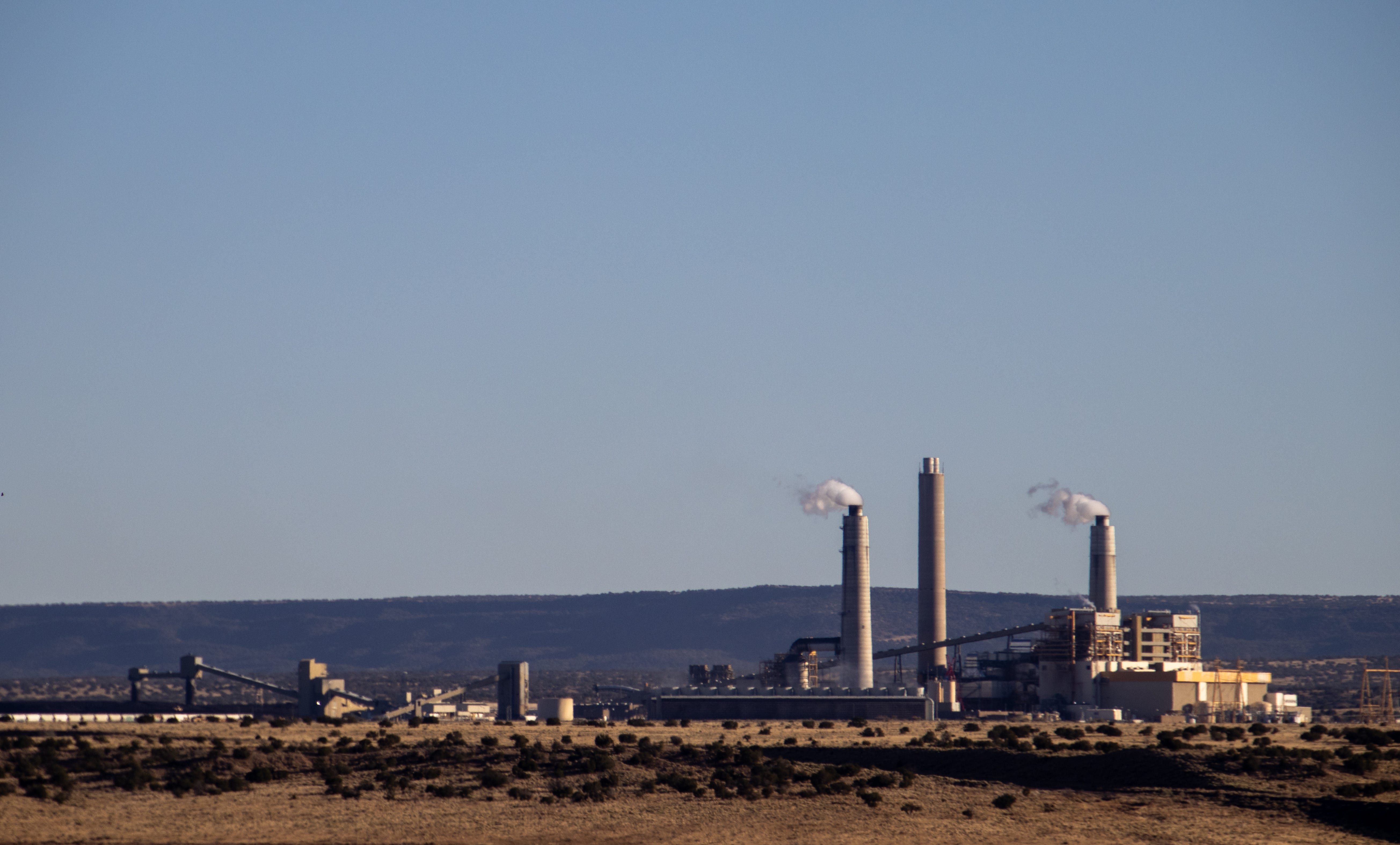
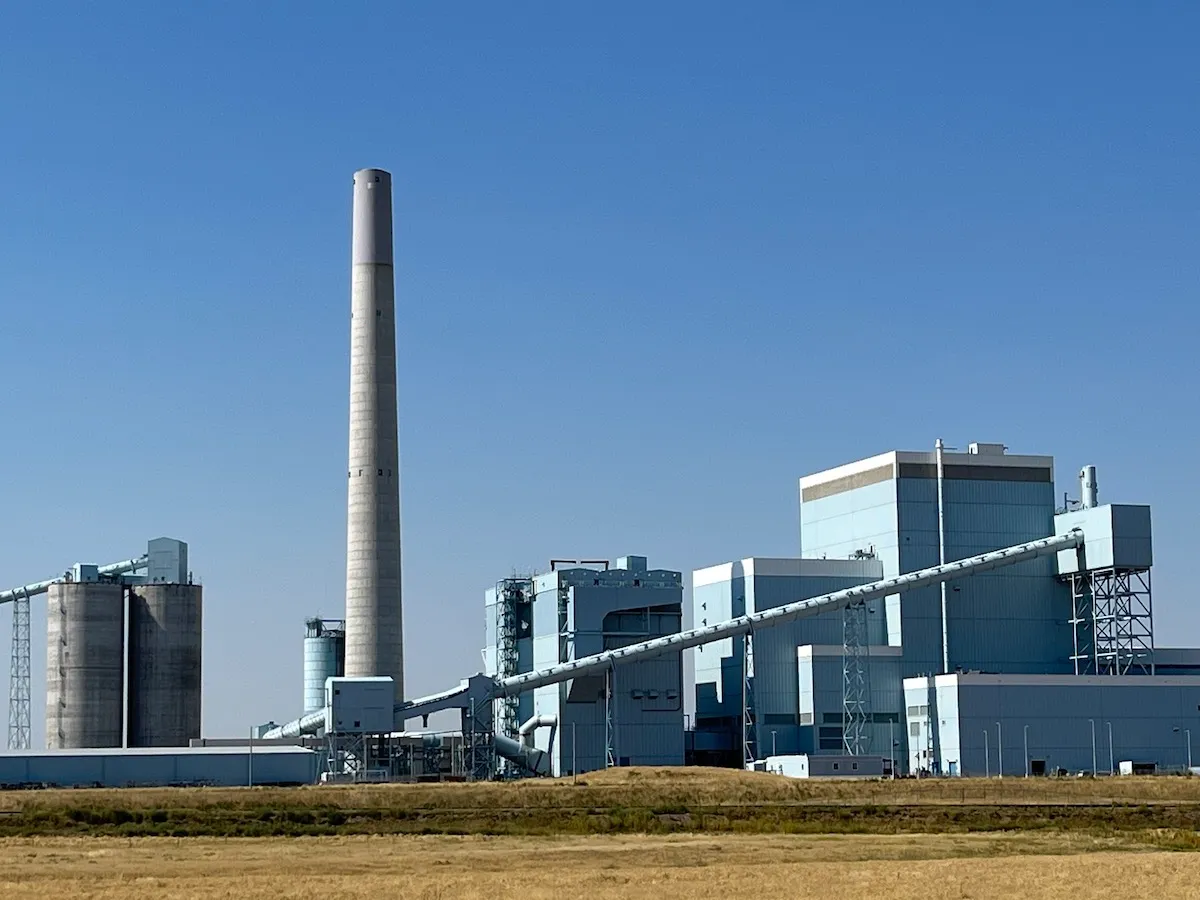
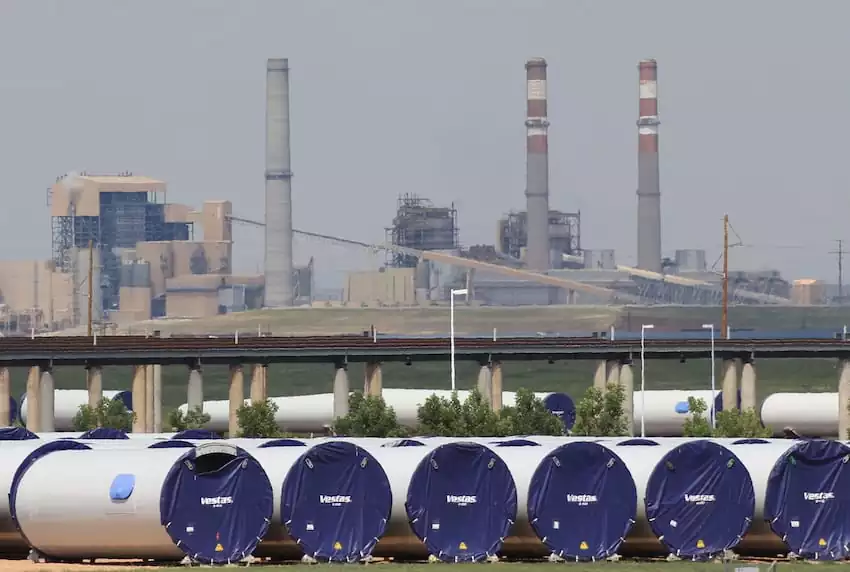
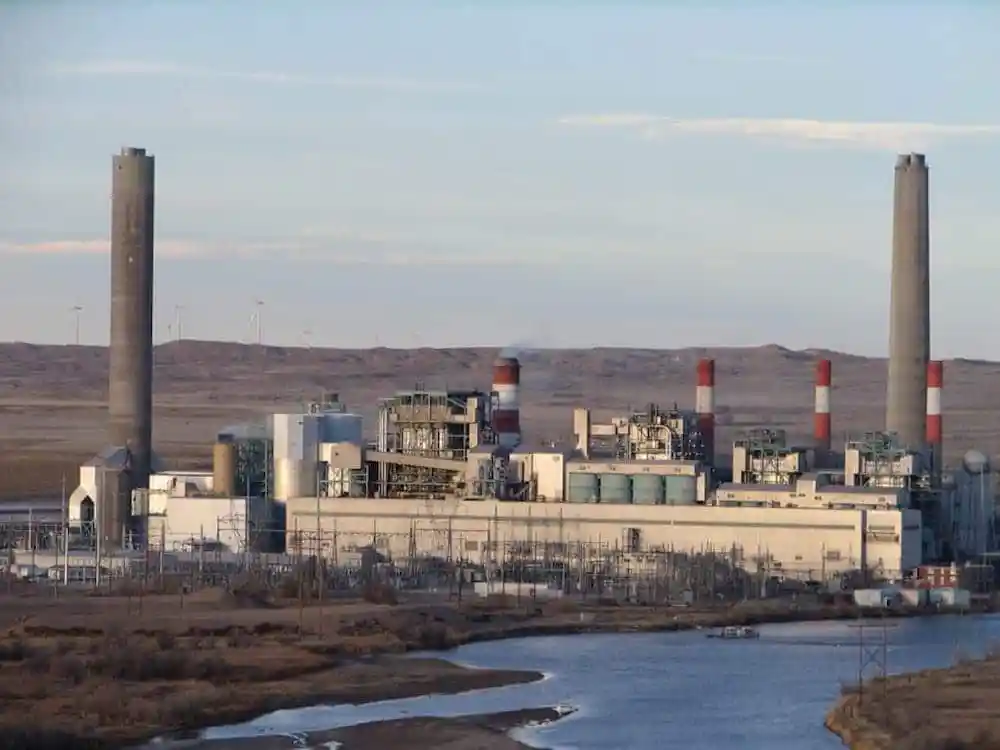
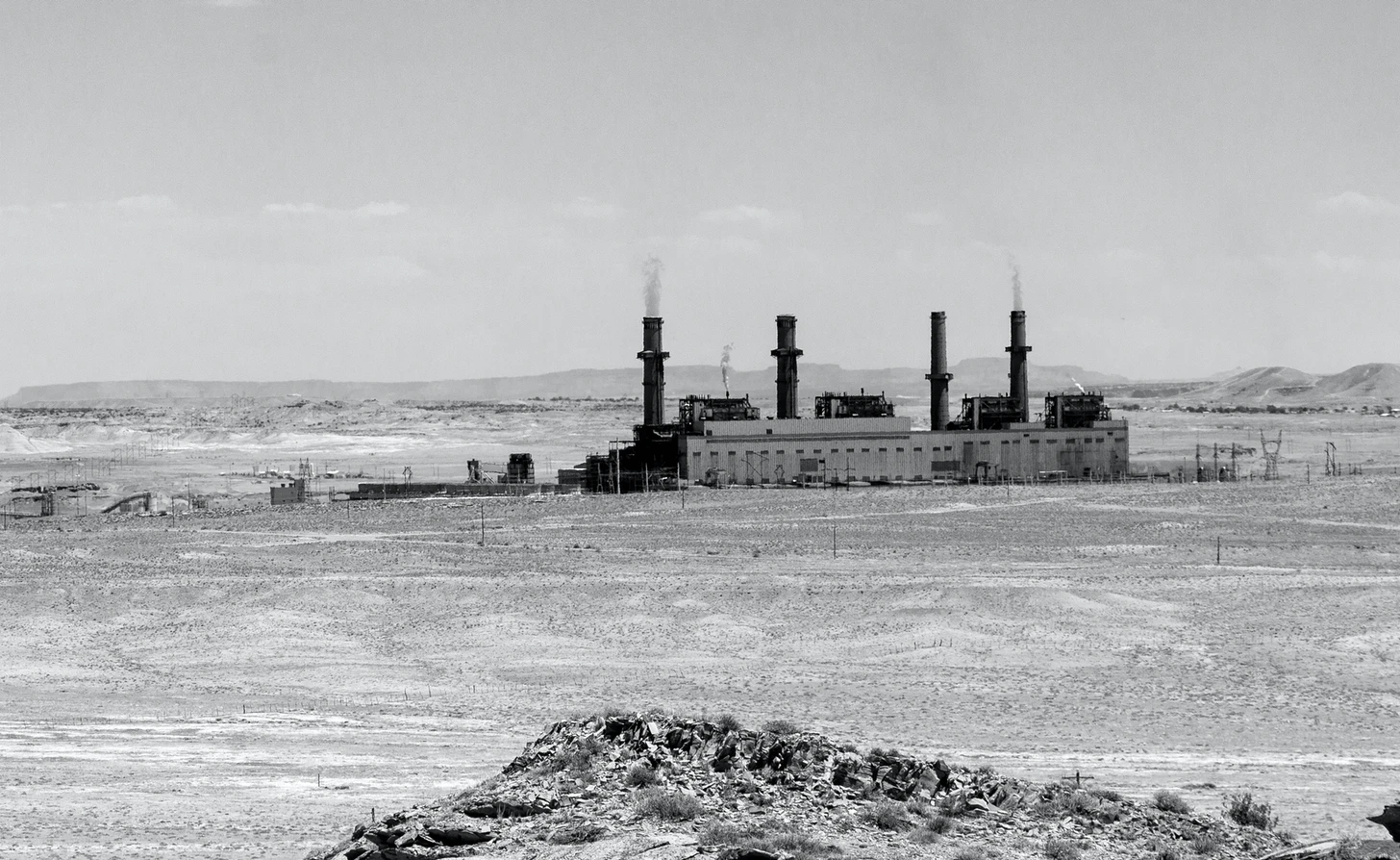
Coronado coal plant in northeastern Arizona. Jonathan P. Thompson photo.
The Trump administration moves to axe Obama- and Biden-era regulations limiting fossil fuel power plants’ greenhouse gas emissions, meaning coal and gas plants will be able to spew planet-warming carbon dioxide without restraint. This could extend the lives of some coal plants, and will help clear the way for the fleet of new gas plants being developed to power hyperscale data centers. While the original rules required facilities to reduce carbon emissions, they also would have kept soot and other health-harming pollutants out of the air, preventing an estimated 1,200 premature deaths per year. Earlier this year the administration rolled back stricter limits on mercury emissions from power plants. (New York Times)
🌵 PUBLIC LANDS 🌲
The Bureau of Land Management sells 940 acres of public land in southern Nevada to the City of Las Vegas, clearing the way for a 6,000-home master-planned community on the northern fringe of the metro area adjacent to Tule Springs Fossil Bed National Monument. The sale was authorized by the 1998 Southern Nevada Public Land Management Act, which allows for such “disposals” of federal land in a congressionally designated boundary. It merely whetted Gov. Joe Lombardo’s (R) appetite for snatching more public land, however, who said he will work to “unlock more federal land for housing.” It’s not clear whence the water will come for this sprawling new development in one of the nation’s more water-constrained cities; the state faces potential further reductions of Colorado River water under the new federal plan. (news release)
A new poll finds that two-thirds of Utah voters support restoring protections to the original, pre-Trump-shrinkage boundaries of Bears Ears and Grand Staircase-Escalante national monuments, and an even larger proportion supports tribal nations having a role in managing ancestral lands. (news release)
🥵 ARIDIFICATION WATCH 🐫
Wyoming researchers say warm water and drought-reduced streamflows may be behind a kidney-damaging parasite killing hundreds of whitefish in the Salt River this summer. The tributary of the Snake River has experienced some of its lowest flows on record this summer, and it was already plagued with E coli bacteria as a result of heavy livestock grazing in the watershed. (WyoFile)
⛏️ MINING MONITOR ⛏️
The Cibola National Forest launches its environmental review of Energy Fuels’ proposed Roca Honda underground uranium mine on about 370 acres of USFS, state, and private land northeast of Grants, New Mexico, and near the base of Mt. Taylor. Ore would be hauled by truck to the White Mesa Mill in southeastern Utah for processing. Public comments will be accepted here until Oct. 14. (agency news release)
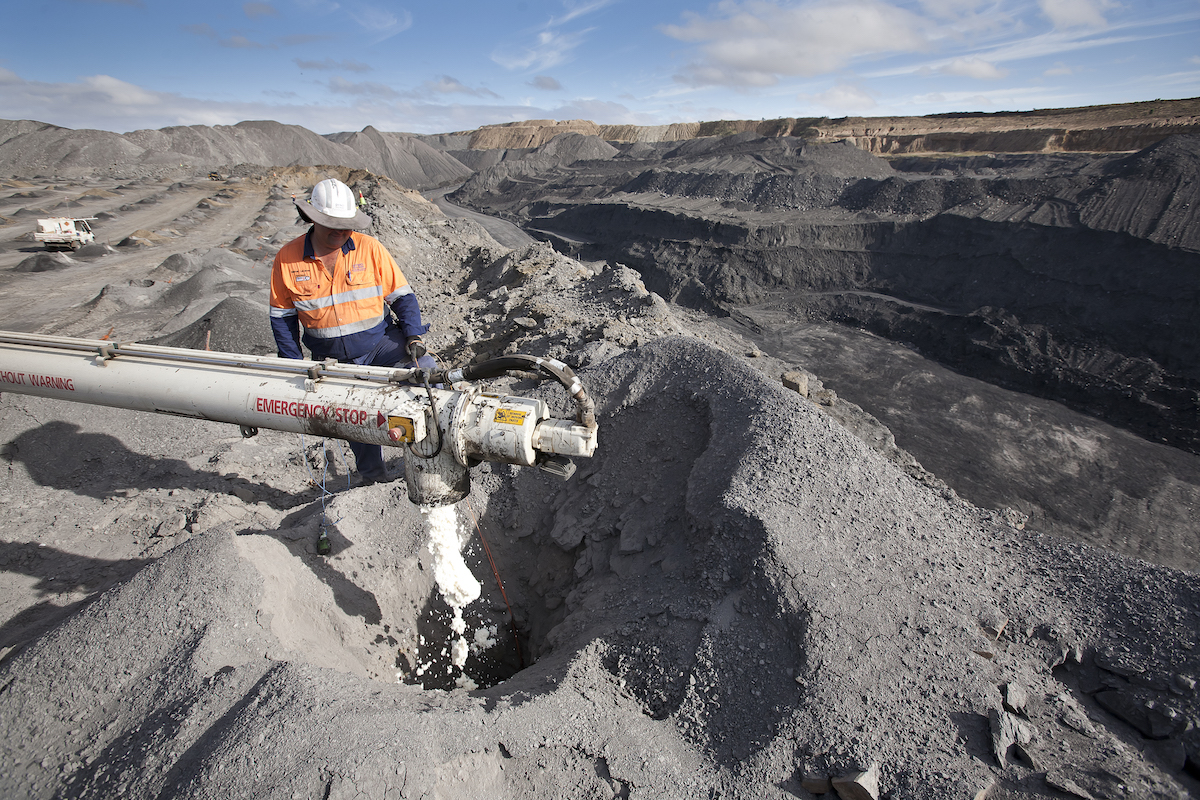
IsoEnergy, which owns the Tony M, Dineros, Rim, and Sage Plain uranium mines in southern Utah, agrees to merge with DISA, a startup that looks to use high-pressure slurry ablation technology to pull uranium out of abandoned mine waste piles, to create a “technology-enabled US uranium platform for production, processing, and remediation.” DISA’s attempts to process small waste piles in Western Colorado have yet to come to fruition, and Iso’s bid to reopen the Tony M mine near Ticaboo, Utah, has moved forward only in incremental steps. (World Nuclear News)
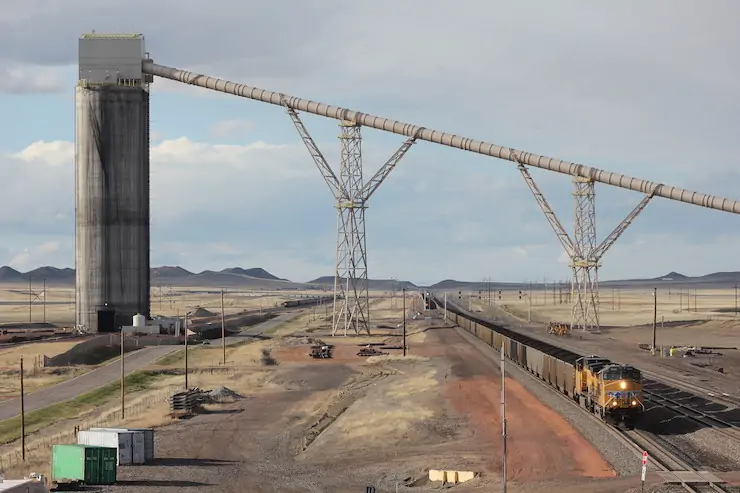
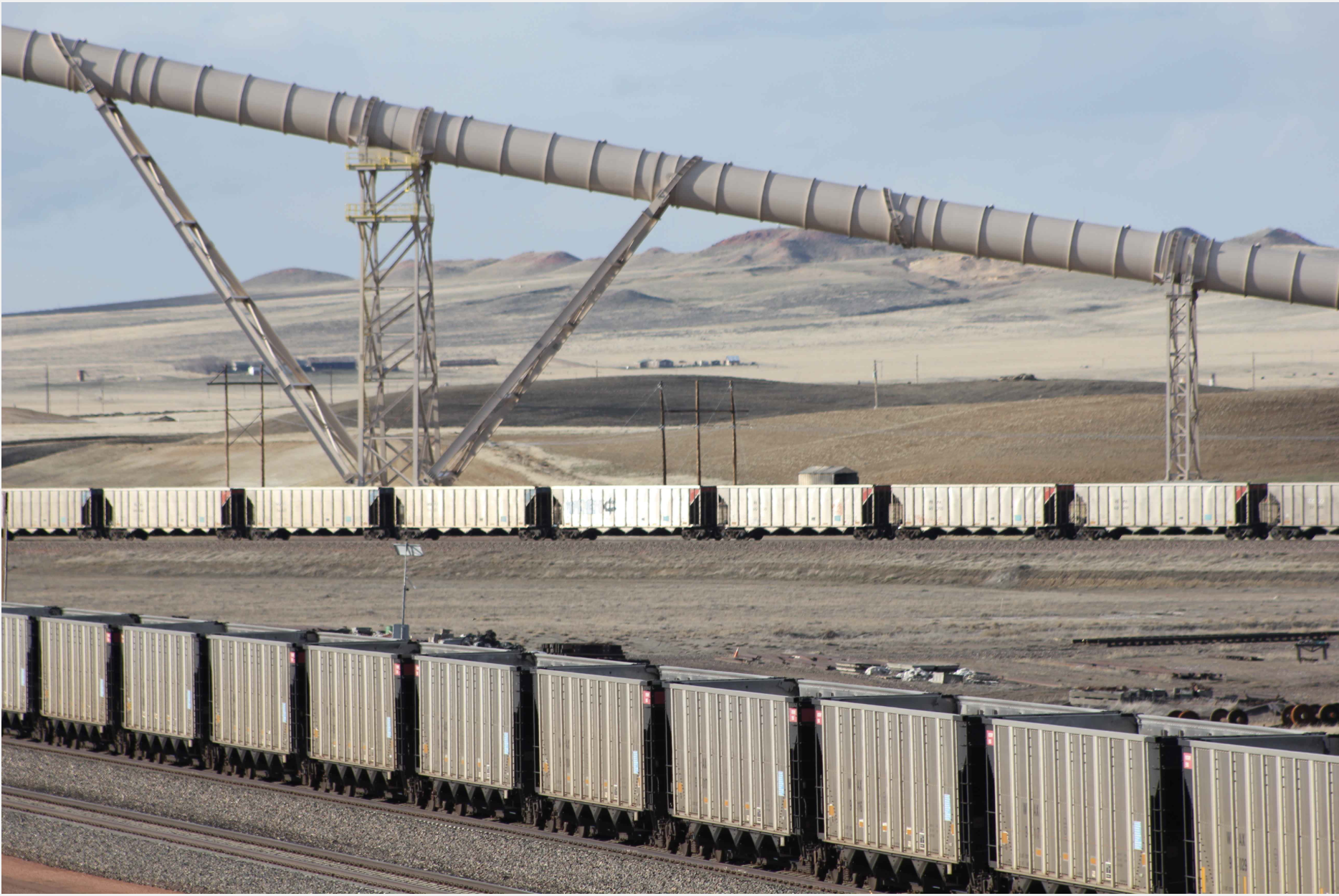
Union Pacific Railroad begins hauling coal from Powder River Basin mines to the Port of Guaymas in Sonora, Mexico, where it could be shipped to Asia. The new export node allows the industry to get around environmental opposition to coal exports along the West Coast, but its viability depends on demand. (Trains)
🐟 COLORADO RIVER CHRONICLES 💧
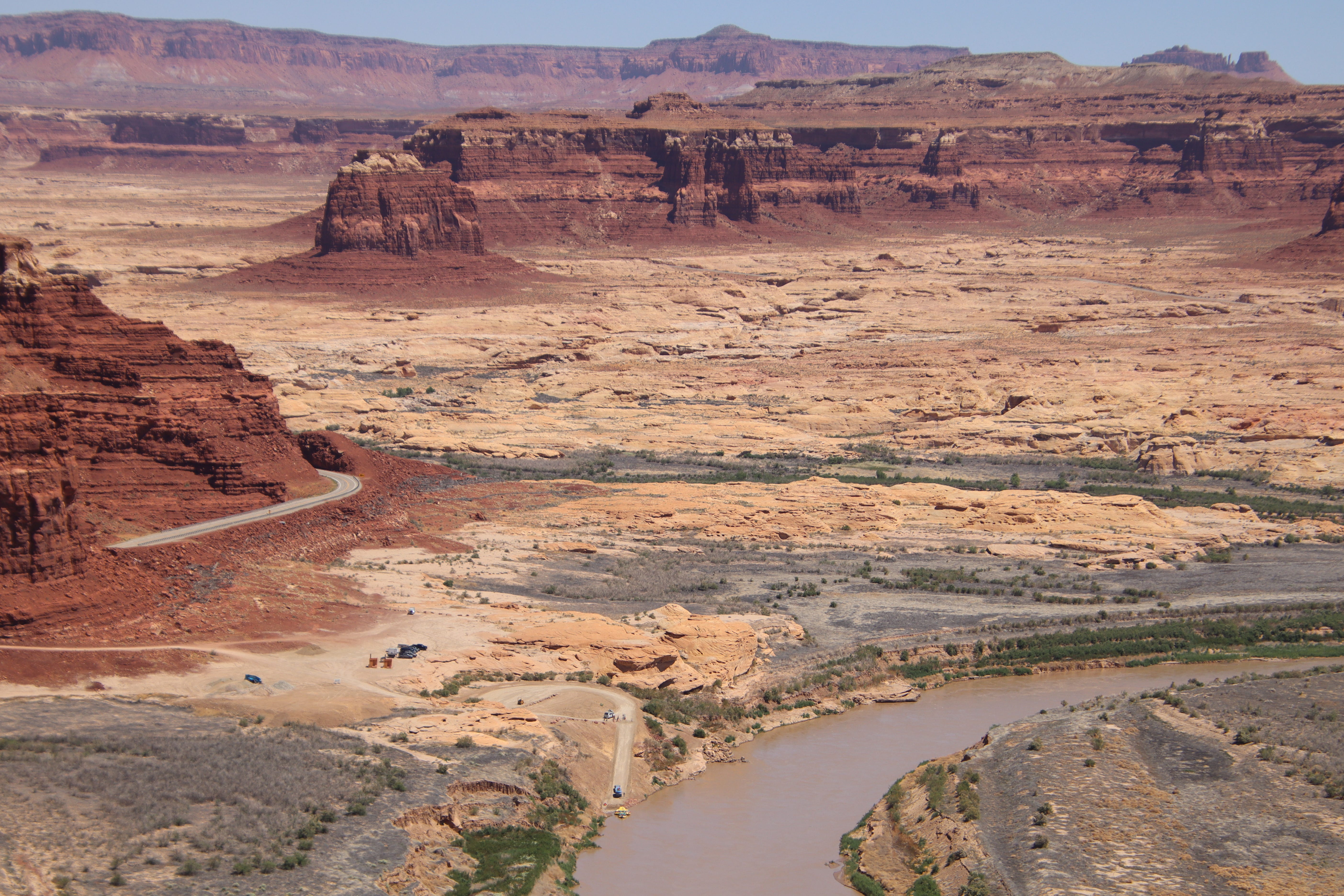
The less-than-ideal North Wash takeout for boaters running the Colorado River though Cataract Canyon. The planned Hite facilities, located to the right of this image just upstream and opposite the Dirty Devil confluence, would replace the North Wash ramp. Jonathan P. Thompson photo.
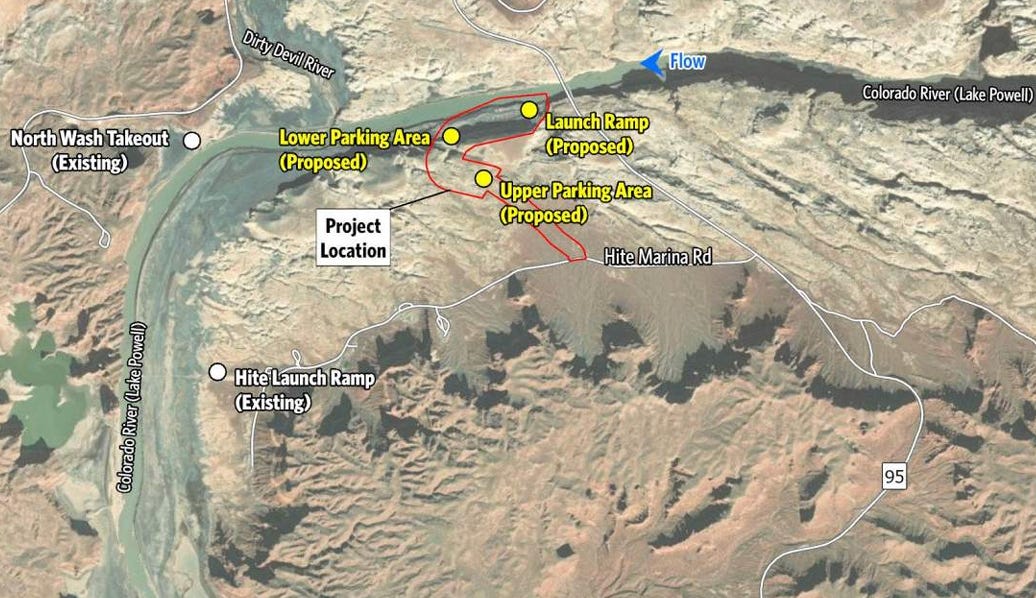
Glen Canyon National Recreation Area moves forward with a plan to develop new low-water boat ramps and other facilities at the Hite and Bullfrog districts on Lake Powell, indicating that the National Park Service expects reservoir levels not to rebound. The Bullfrog ramp is planned for the main channel of the reservoir, southeast of the current facilities, and would be usable for boats up to 125 feet long to a low lake level of 3,450 feet. The Hite ramp would be upstream from the current facilities and is primarily designed as a takeout for Cataract Canyon boaters and a safer alternative to the North Wash takeout on the opposite side of the river. (news release)
The planned Bullfrog low-water boat ramp. Source: NPS.
Arizona officials raise concerns about how the Colorado River crisis might affect its booming semiconductor and chip manufacturing industry, in which a single Phoenix-area facility, known as a “fab,” uses some 4.75 million gallons of water per day. (The Verge)
The Bureau of Reclamation again increases water releases from Flaming Gorge Reservoir in an effort to buoy water levels at Lake Powell, but Utah officials warn it is not a sustainable solution and could harm recreation on the upstream reservoir. (KSL)
🦫 WILDLIFE WATCH 🦅
Colorado Parks and Wildlife has euthanized nearly 300 bears so far this yearfollowing “unprecedented” levels of bear activity in towns across the state, as well as in Wyoming. Bryan Peterson, of Bear Smart Durango, told Cowboy State Daily the conflicts and killings are mostly due to the drought and lack of food sources, but also blamed human carelessness with garbage and food. (Cowboy State Daily, WyoFile)
Colorado Parks and Wildlife kills an uncollared female yearling wolf from the One Ear Pack in Grand County after the animal evaded non-lethal deterrents to prey on livestock. (news release)
🤖 DATA CENTER DIGEST 👾
Bureau of Land Management leadership reportedly orders state directors to identify federal parcels suitable for data center development, indicating that the administration is looking to skirt communities’ opposition to and ban on the facilities by approving them on nearby public lands. (Washington Sun)
Corner Venture Capital applies for an air quality permit for a 300-megawatt natural gas-fired plant to power a proposed hyperscale data center in southwestern New Mexico, raising concerns over air pollution and water use. (Silver City Daily Press, news release)
Google’s proposed 2.7-gigawatt, $17 billion Project Tembo data center complex on 700 acres near Cheyenne, Wyoming, clears local regulatory hurdles, but still has a lot of red tape to tangle with before final approval. The firm says the facilities will use less water-intensive closed-loop cooling systems and draw from deep wells, not surface supplies, and that it will be powered with natural gas fuel cells paired with carbon capture. (Wyoming Tribune Eagle)
🔋NOTES FROM THE ENERGY TRANSITION 🔌
Array Technologies opens its $50 million, 200,000-square-foot solar component manufacturing facility in Albuquerque, where it employs about 300 people. (KRQE)
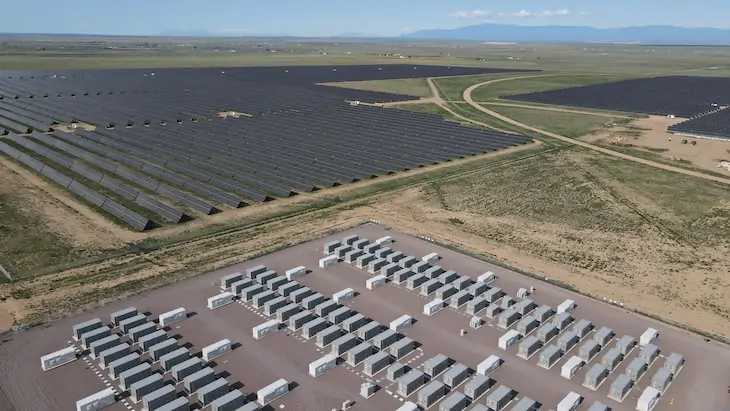
Black Hills Energy moves forward with its planned 50-megawatt battery energy storage system at its Pueblo Airport Generating Station in Colorado. (Energy Storage News)
🛻TRANSPORTATION 🚂
Denver West Express pitches a “concept” of an electric rail line designed to carry skiers from Denver International Airport to the resort town of Avon in less than two hours. The line would cost an estimated $28 billion to $33 billion to construct, but it might go a long ways to alleviate the I-70 ski season gridlock, which makes for one of the nastiest drives in the state — and where high traffic costs about $2.3 billion annually. (Steamboat Pilot)
📈 DATAVIZ OF THE DAY 📊
The Land Desk recently reported on how solar, wind, and battery storage is pushing coal off the West’s power grid, despite the Trump administration’s hostility toward cleaner energy sources. As of June of this year, the trend appeared to be continuing into the future, as a bulk of the generating capacity in the planning pipeline comes from cleaner sources. Click on the graphics for an interactive view, and specifics on each planned power plant.
Click the link to read the release on the USDA website:
July 24, 2026
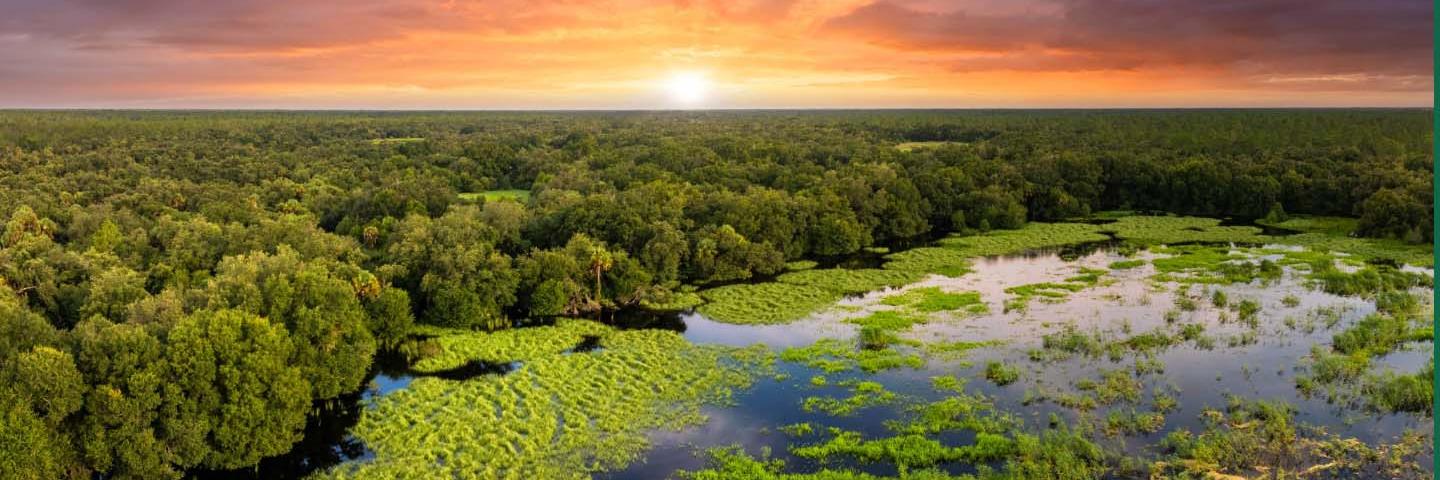
USDA is investing $3 million to support the development of wetland mitigation banks for agricultural producers. through the Wetland Mitigation Banking Program (WMBP).
The U.S. Department of Agriculture (USDA) is investing $3 million to support the development of wetland mitigation banks for agricultural producers. Through the USDA’s Wetland Mitigation Banking Program (WMBP), wetlands are restored, created or enhanced, generating credits that can be purchased by producers looking to compensate for unavoidable impacts to wetlands at another location.
“Wetland mitigation banks provide farmers and ranchers a clear and efficient compliance pathway, while at the same time helping to restore and protect vital wetlands and all the benefits they provide,” said USDA’s Natural Resources Conservation Service (NRCS) Chief Colton L. Buckley. “Through the Wetland Mitigation Banking Program, we can help ensure the long-term resilience and productivity of American working landscapes.”
WMBP awardees work with NRCS to develop a mitigation banking instrument that provides details for developing, establishing and operating a mitigation banking program. Priority will be given to banks in states with significant numbers of individual wetlands, wetland acres and conservation compliance requests. Based on NRCS data, these states are Georgia, Illinois, Indiana, Iowa, Michigan, Minnesota, Nebraska, Ohio, Pennsylvania, South Dakota and Wisconsin.
City and county governments, organizations, tribal governments and other entities are eligible to apply. See the notice of funding on Grants.gov for a full list of eligible entity types.
Applications are due by September 8, 2026. Visit the Grants.gov opportunity for additional details and to apply.
More About WMBP
To participate in most USDA programs, agricultural producers agree to comply with the wetland conservation provisions, meaning producers will not plant agricultural commodities on converted wetlands or convert wetlands to enable agricultural production. In situations where avoidance or on-site mitigation is challenging, the Farm Bill allows for off-site mitigation through the purchase of mitigation banking credits.
Purchasing credits from a wetland mitigation bank provides a legal mechanism for agricultural producers to maintain their eligibility for USDA program benefits if they convert agricultural wetlands.
WMBP award recipients can use the funding to support the costs of developing and establishing a mitigation bank, like costs for site identification, development of a mitigation banking instrument, site restoration, land surveys, permitting and title searches, and market research. WMBP funding cannot be used to purchase land or a conservation easement.
NRCS awarded the first WMBP grants in 2016. Since then, NRCS has awarded 39 projects supporting the creation or expansion of wetland mitigation banks in 14 states.
Awardees can request up to $1 million for a project. Projects may last up to four years.
When a mitigation bank is established, the landowner retains ownership and use of the property, while a conservation easement protects the wetlands from incompatible degrading activities.
To learn more about the Wetland Mitigation Banking Program, and how wetland mitigation banks work, visit the WMBP webpage.
For more than 90 years, NRCS has helped farmers, ranchers and forestland owners make investments in their operations and local communities to improve the quality of our air, water, soil, and wildlife habitat. NRCS uses the latest science and technology to help keep working lands working, boost agricultural economies, and increase the competitiveness of American agriculture. NRCS provides one-on-one, technical advice and financial assistance and works with producers to help them reach their goals through voluntary, incentive-based conservation programs. For more information, visit nrcs.usda.gov.
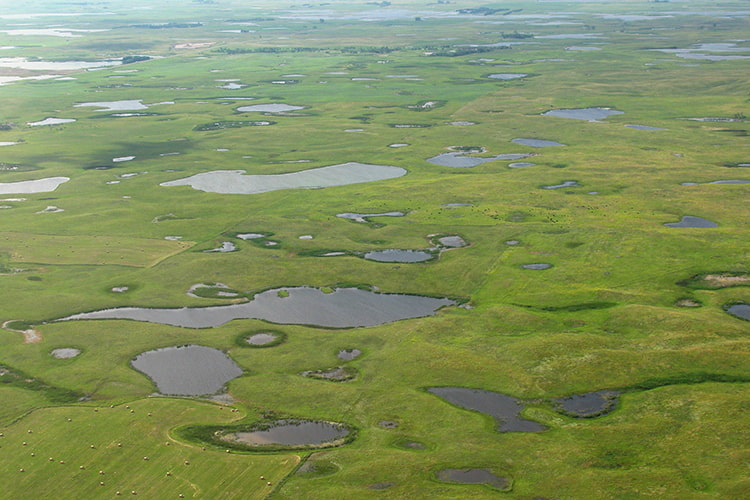
Wetlands, like these in the Prairie-Pothole Region of North Dakota, may capture and store nutrient runoff from cropland fields. Photo Credit: U.S. Fish and Wildlife Service
The Trump administration is attacking public lands again, this time in an apparent effort to open more special places to off-road vehicles. Late last Friday, Trump issued an executive order revoking a Nixon-era policy aimed at ensuring “that the use of off-road vehicles on public lands will be controlled and directed so as to protect the resources of those lands, to promote the safety of all users of those lands, and to minimize conflicts among the various uses of those lands.”
No, this does not mean unfettered swarms of ATVs will be kicking up dust on your favorite public lands next week. But it does bolster the off-road vehicle lobby’s effort to open up motorized access to federal lands, and takes away one of the long-term planning tools used by land management agencies to protect those places from off-road vehicle use and abuse.
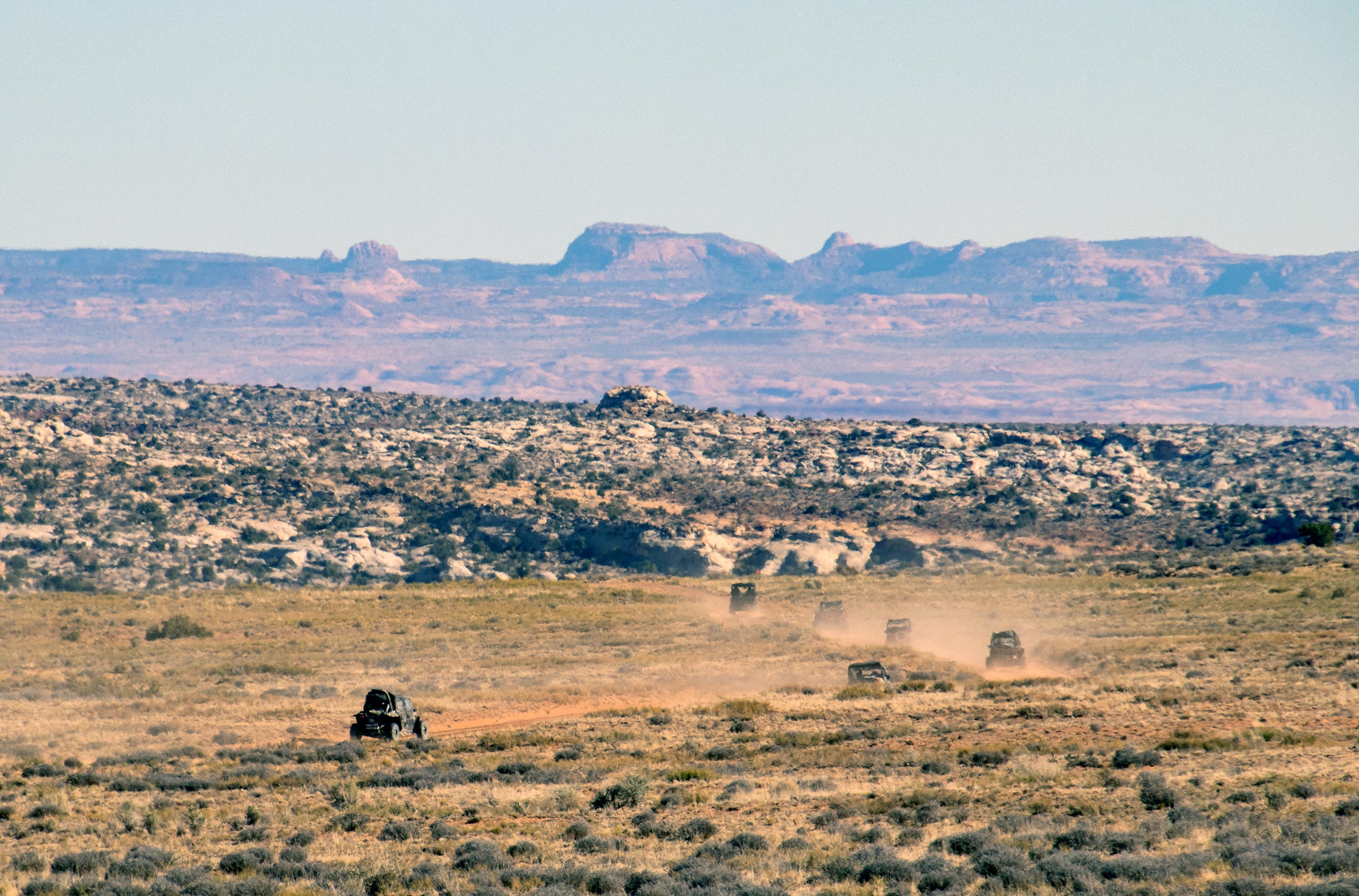
In the nearer-term, Trump’s order could end or diminish the ban on OHVs in national parks, allowing the vehicles to travel backroads in, say, Capitol Reef National Park. This might not sound so bad: If a three-ton SUV can drive there, why not let a smaller side-by-side or four-wheeler on the same road?
The answer lies in the nature of the newer OHVs, namely “side-by-sides” or razors, which more closely resemble souped-up dune buggies than conventional SUVs. While some people use OHVs as mere modes of transportation, the vehicles are more commonly treated and utilized like recreational playthings — very powerful, fast, and noisy toys that tend to travel in herds. They therefore bring their own type of impacts.
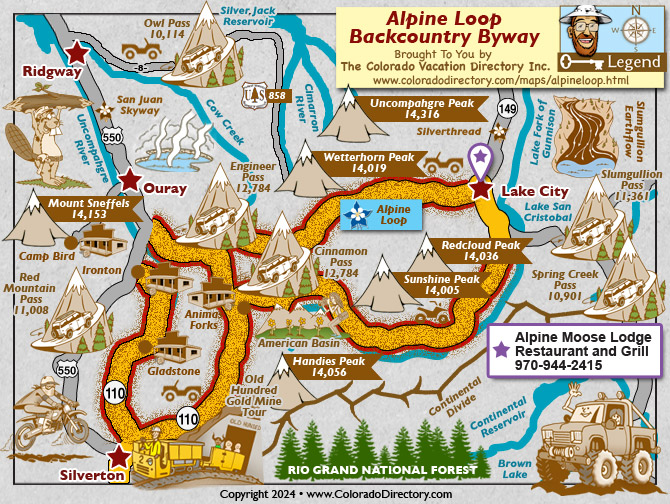
Alpine Loop Backcountry Scenic Byway near Lake City, Ouray, Powderhorn, Ridgway, Silverton Credit: ColoradoDirectory.com
Anyone who has traveled on or hiked around the Alpine Loop in the San Juan Mountains of southwestern Colorado on a busy summer day has likely experienced these particular impacts first-hand. Those roads were first opened up to OHVs in the early 2000s. Since then Alpine Loop traffic numbers have exploded, with at least half of the motorized traffic made up of OHVs.
Law enforcement officers now spend a disproportionate amount of time and energy trying to keep the OHV drivers on designated routes and in compliance with traffic laws. OHV crashes, often resulting in serious injury, are not uncommon. And each summer several riders surrender to the temptation to illegally leave the road — these are off-road vehicles, after all — and rip across the tundra, causing irreversible damage. Unlike regular vehicles, OHVs tend to travel in herds, spewing exhaust and kicking up dust, their collective buzzing reaching far beyond the roads on which they travel. It has become almost impossible during the high season to completely escape the incessant din of OHVs on the Alpine Loop, even in wilderness study areas.
This same phenomenon could now be coming to a national park near you.
The administration claims it eliminated the policy because it was outdated, vague, and redundant, because Congress has since passed a host of other laws protecting public lands from OHVs and other uses. The order goes on to say:
This makes very little sense. Sure, the restrictions on OHVs could hamper energy or timber development if it required destructive off-road vehicle use, but you’re not going to haul a drill rig into the backcountry on a side-by-side. And the idea that a hiker might feel “banned” from a trail because they couldn’t ride get there on an OHV is just silly.
The dubious statement reeks of the rhetoric of the crowd that claims that motorized vehicle restrictions are locking folks out of public lands, and therefore are discriminating against the type of people who drive these vehicles. But the discrimination claim simply does not fly. Mountain bikes are banned from wilderness areas, from a majority of trails in national parks, from some trails on BLM land, and are not allowed to ride off-trail on all federal land. This has nothing to do with the people who ride the bikes, or even the funny clothes they tend to wear, and everything to do with the vehicles’ potential impacts.
Trump probably did this at the behest of the Blue Ribbon Coalition and the likes of Sen. Mike Lee, who has pushed legislation that would open up national parks to OHVs. Maybe he’s trying to garner support from somewhere, given his terrible favorability ratings. Or perhaps he’s trying to appease the motorized crowd, which is probably a bit miffed that their drug of choice — gasoline — is so damned expensive thanks to Donny’s dumb war. Maybe he’s even trying to increase national park entry fee revenues so he can funnel it to his ballroom/drone-port or his White House UFC fight.
Near Hite with the Henry Mountains. Jonathan P. Thompson photo.
🐟 Colorado River Chronicles 💧
It pretty much goes without saying that if next winter is as bad as this past winter, in terms of mountain snowpack, then the collective users of the Colorado River and its infrastructure will be toast — at least figuratively (maybe literally, too?). Now, my favorite team of Colorado River wonks1 [Anne Castle, Jack Schmidt, Eric Kuhn, Kathryn Sorensen, Katherine Tara] have crunched the latest water numbers, and they’ve found that even a nearly “normal” winter won’t stop depletion of “reasonably accessible storage in Lake Powell and Lake Mead, leading to “devastating consequences.”
Back in 1999, the Colorado River’s storage system, which consists of Lake Powell, Lake Mead, and several other smaller reservoirs in the Upper and Lower basins, was almost full, holding about 60 million acre-feet of active, or available, storage. This provided a robust savings account that could be tapped during the inevitable dry spells on the notoriously fluctuating river system.
The reserve, however, was not adequate for the megadrought — or long-term aridification — that started in 2000 and continues today. Instead of following the usual up-down cycle, the Colorado River’s flows began a downward trend that is on track to hit its lowest point so far this water year, while consumptive use stayed more or less steady. Demand exceeded supply more years than not, drawing the savings account down significantly. That has forced the Bureau of Reclamation to take extraordinary measures, such as reducing downstream releases and tapping upstream reservoirs, to keep Lake Powell’s surface level from dropping below 3,500 feet, or what I call de facto dead pool 2.
Thanks in part to extra releases from Flaming Gorge Reservoir in May, Lake Powell’s surface level climbed slightly to 3,528 feet last month. Given that spring runoff in the Upper Basin has peaked and most tributary flows are decreasing, we can expect that number to start dropping, perhaps precipitously, at least until the monsoon arrives.
The wonks wanted an idea of how things might play out in the slightly longer-term, so they modeled two scenarios:
In the first scenario, they assume that the Colorado River’s natural flow, or the estimated amount of water in the river without human consumption or interference, will be similar to water year 2025, when the mountain snowpack was below average but not nearly as slim as this year. They also assume that consumptive uses will remain at the lowest levels in recent years.
Natural flow: 8.5 MAF at Lees Ferry + .70 MAF from Grand Canyon and Virgin River = 9.20 MAF Consumptive use: 3.56 MAF Upper Basin (includes evaporation and other losses) + 8.23 MAF Lower Basin + Mexico (incl. evap and other losses) = 11.79 MAF Deficit and resulting reservoir drawdown: 2.59 MAF Realistically accessible storage (RAS) remaining in Mead, Powell, and Flaming Gorge: 3.63 MAF
For the second, they plug in snowpack/flow numbers similar to those from water year 2023, which was a huge winter. Consumptive use would be about the same as in 2023.
Under the first scenario, the BoR will almost certainly have to go to a run-of-the-river situation on Glen Canyon Dam to defend 3,500 feet. That would mean releases would be approximately equal to inflows minus evaporation and seepage from the reservoir, and might drop to 3,000 to 4,000 cubic feet per-second or even lower. In the summer of 2002 inflows at times dropped below 1,000 cfs. This would turn the river through the Grand Canyon into a relative trickle, and cause a significant drawdown of Lake Mead.
The second scenario would be far better, but is far from an enduring solution. At best it would buy a little time, perhaps enough for the feds to build bypass tunnels around Glen Canyon Dam to allow for sustained releases below 3,500 feet. If it were followed by another three or four 2023-like winters, then things would start to look pretty darned good.
But if it were followed by just one more dry year it would bring everything back to today’s rather dire situation.
Since there’s no way to bolster supplies, the only way out of this mess is to continue to slash demand. The paper’s authors write:
Oof.
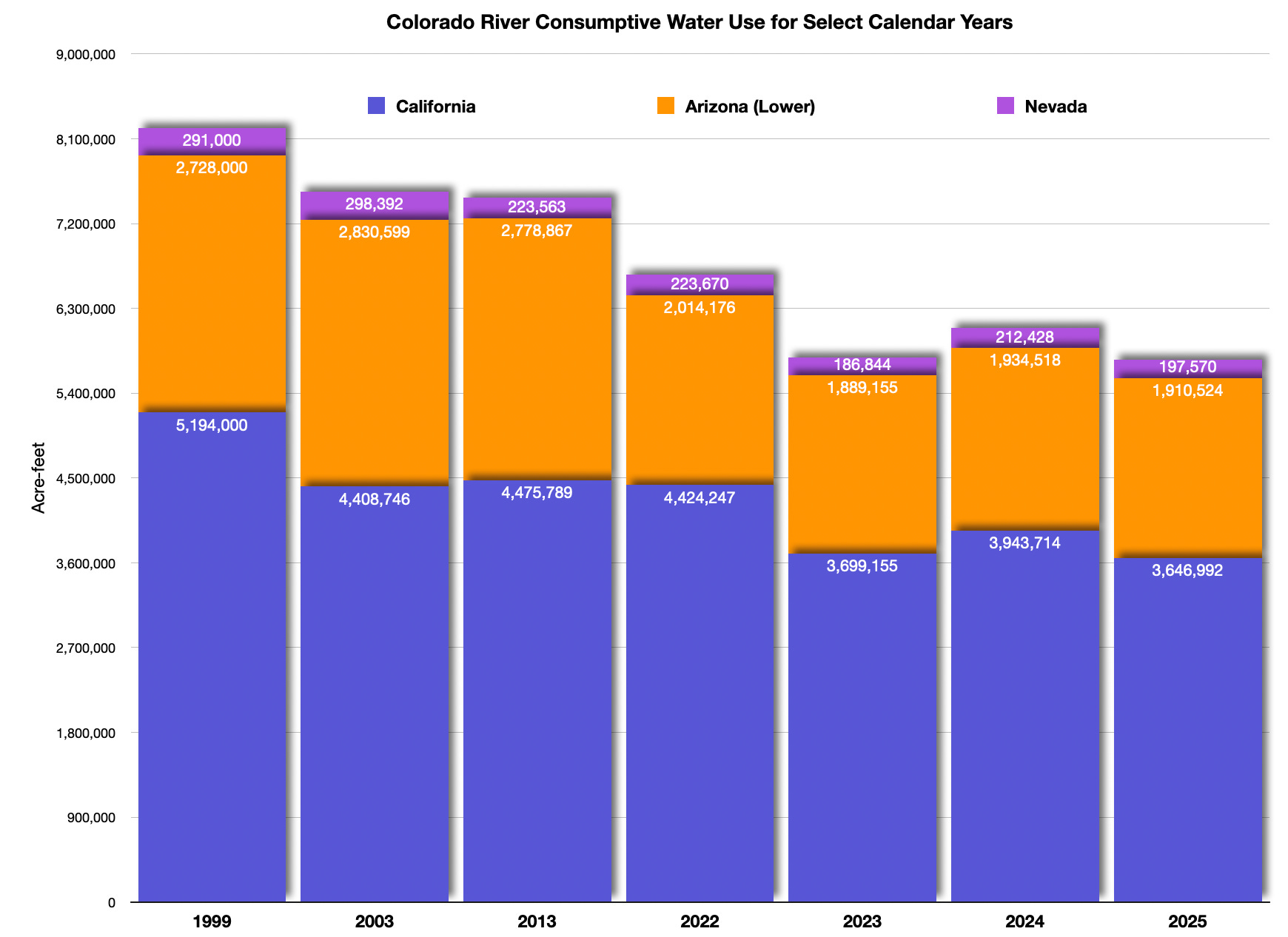
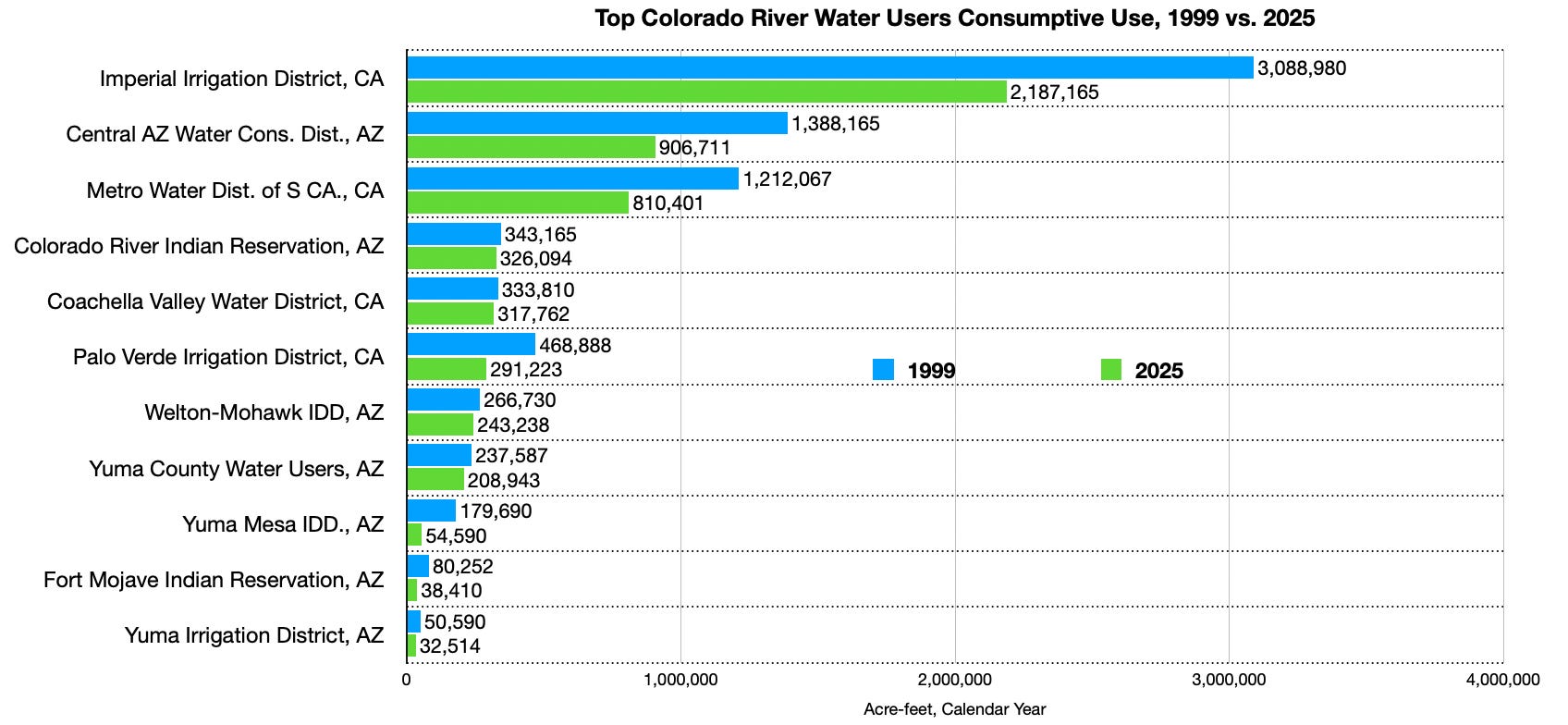
As long as we’re on the topic, the BoR recently released its Lower Basin accounting report for 2025, which tallies up consumptive uses in the basin. As you can see from the following graphs, which the Land Desk whipped up using the BoR data, the Lower Basin uses significantly less water now than it did in 1999, just before the current megadrought began. Upper Basin consumptive use figures for 2025 are not yet available. The following figures do not include reservoir evaporation, conveyance losses, or Mexico’s use.
All three Lower Basin states have substantially reduced Colorado River water consumption since 1999. However, more cuts will be needed if current climatic and streamflow trends continue. Data: USBR, Graphic: The Land Desk
🤖 Data Center Watch 👾
Has Enchant Energy finally found a raison d’être? The Farmington-based company was created in 2019 to try to save the San Juan coal-fired power plant from retirement by retrofitting it with carbon capture equipment. Enchant would then sell the carbon to oil producers in the Permian Basin, while also receiving generous federal tax credits. Basically they wanted to turn the power plant into a taxpayer subsidized carbon dioxide factory. It flopped for various reasons. Now the San Juan plant — and all of its pollution — are no more. We suspected Enchant Energy had met a similar fate.
But then I received a press release letting me know the not-so-up upstart is not dead, but has instead signed a letter of intent with Creekstone Energy to capture carbon from the tech firm’s proposed hyperscale Delta Gigasite data center in Delta, Utah. As is often the case, Creekstone touts all of the renewable energy it plans on building for its center, but the first phase will be powered by natural gas, which emits carbon dioxide.
Enchant hopes to capture the carbon from the gas plant and convert it into marketable fuel. The company has apparently given up on trying to give coal-burning a slightly more climate-friendly veneer (after all, Trump has declared coal to be “clean” and “beautiful”). Instead, it looks like they’re jumping on the data center bandwagon, along with wannabe nuclear reactor developers and the like.
Who knows, maybe this is the thing that finally gives Enchant some meaning. But we’re not holding our breath. After spending gobs of money on lobbying, pulling in some hefty federal grants, then failing spectacularly with the San Juan generating bid, Enchant partnered with another firm and tried to buy the Intermountain coal plant in Delta to use it to power its own data center. That didn’t work, either.
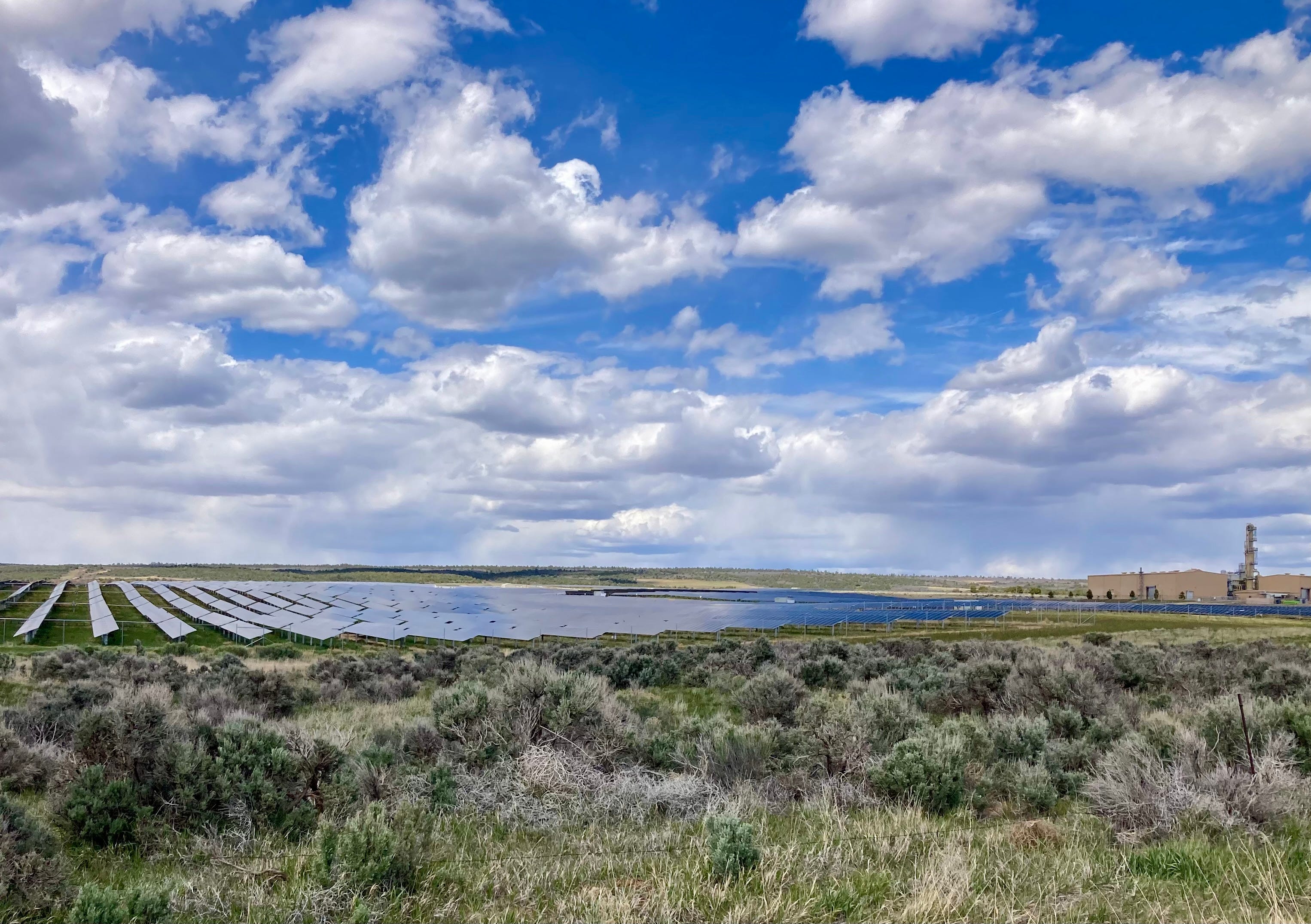
Dolores Canyon solar project outside of Cahone, Colorado, with Airproduct’s apparently defunct helium plant on the right. Jonathan P. Thompson photo.
🔋Notes from the Energy Transition 🔌
Yes, the energy transition may have run into some stumbling blocks, i.e. the Trump administration’s hatred for anything that might compete with coal and oil and gas, but it’s still quietly underway. For example, out by the aforementioned, defunct San Juan coal plant, DESRI recently broke ground on two utility-scale solar installations: the 170-megawatt Foxtail Flats solar-plus-battery storage array; and the 100-MW Four Mile Mesa solar-plus-storage project.
That’s some pretty serious generating capacity and adds to the existing San Juan solar facility nearby. Los Alamos County has signed on to purchase power from Foxtail Flats, and Meta will be drawing electricity Four Mile Mesa via PNM to power its data centers.
Both of the new facilities are under development on Ute Mountain Ute tribal land.
📸 Parting Shot 🎞️
In last week’s comments, ncoffey94 asked what kind of bike I ride. It’s a 2023 Niner RLT, with an aluminum frame, carbon fork, and SRAM Apex parts. It’s nothing fancy and isn’t super light. But I dig it for riding on the roads, dirt, and even singletrack. It’s got 40 mm tires, so isn’t so great in the sand, and with no suspension I don’t do big drops or super-cobbly stuff. But it sure is nice having just one bike for all uses.
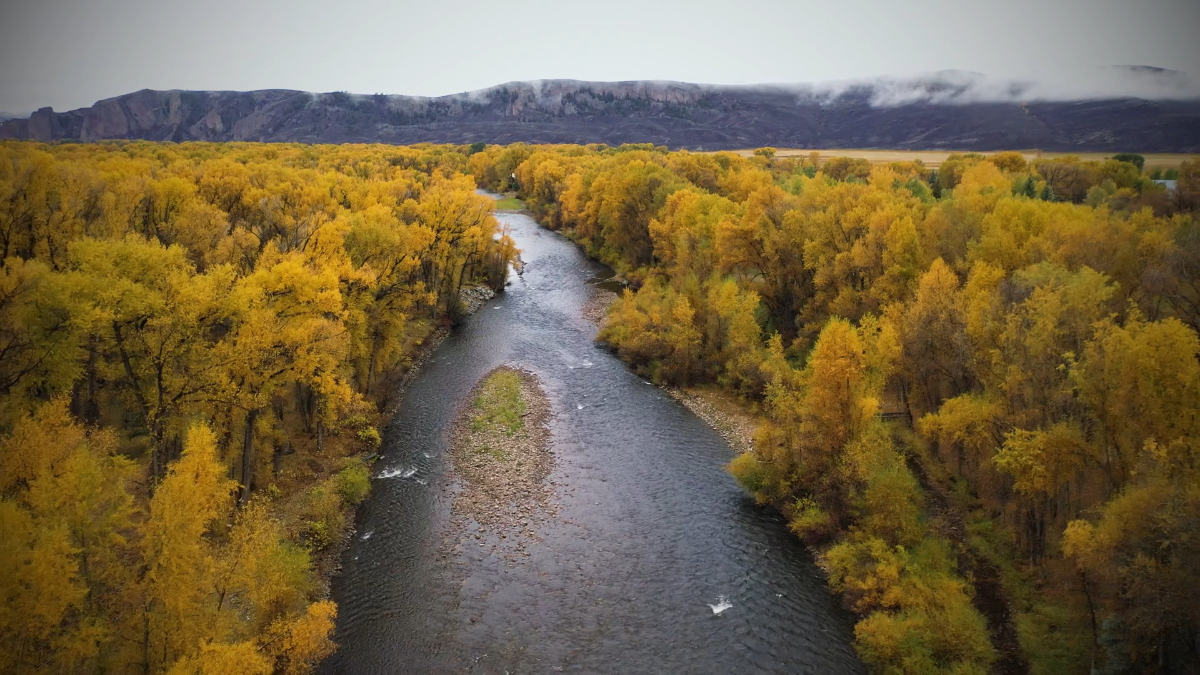
Photo credit: Jonathan P. Thompson.
1Anne Castle, Jack Schmidt, Eric Kuhn, Kathryn Sorensen, and Katherine Tara.
2 Water can no longer be released through the penstocks and hydropower turbine below 3,500 feet, forcing dam operators to rely on the lower river outlets for all downstream water releases. Those outlets are not engineered for sustained, long-term use, however, and could be damaged. The feared scenario looks kind of like this: The penstocks are closed; the river outlets release water faster than reservoir inflows; the reservoir surface level drops down to, say, 3,450 feet; the river outlets get damaged so must be shut down altogether, trapping the remaining water behind the dam and halting all releases until the water climbs back up to 3,500 feet. This would effectively dry up the Grand Canyon and cause Lake Mead to start plummeting as well. Of course, no one wants this to happen, so BoR is doing all it can to defend 3,500 feet, making that level the effective dead pool, even though technically 3,370 feet (the river outlet elevation) is the actual dead pool.
A new study in the journal Science suggests rivers in the arid American West may be doing something unexpected: absorbing carbon dioxide from the atmosphere. The finding could reshape how scientists model climate change.
For decades, researchers believed most rivers were net carbon emitters. That’s because leaves, wood, and other organic material wash into the water, decompose, and release carbon dioxide, a process especially common in shaded, forested landscapes. Most of the data scientists had come from those kinds of environments, particularly in the eastern United States. But the West’s desert and shrubland rivers have been far less studied. Taylor Maavara, an aquatic biogeochemist and one of the study’s lead authors, wanted to change that. Her team gathered data from thousands of river monitoring sites across the continental U.S. and used machine learning to estimate whether each reach of river tends to release carbon or take it up.
Their results point to a stark geographic split: Western rivers — from Nevada to Arizona to parts of New Mexico — are much more likely to act as carbon sinks. Maavara says the region’s open landscapes play a key role. With less tree cover, more sunlight reaches the water, boosting photosynthesis. And with fewer leaves and organic material falling in, there’s less decomposition, a process that releases carbon dioxide back into the air. The findings, she says, “shed some light on the value of these desert ecosystems, which we tend to think of having a bit less life. We show that there’s just as much life, they’re just doing different stuff.” While the U.S. as a whole still emits more carbon from its rivers than it absorbs, this study suggests that the “carbon gap” may be smaller than once believed.And because arid and semi-arid regions make up a large part of the world’s land surface, Maavara says these findings could have global implications
Created by Imgur user Fejetlenfej , a geographer and GIS analyst with a ‘lifelong passion for beautiful maps.’ It highlights the massive expanse of river basins across the country.
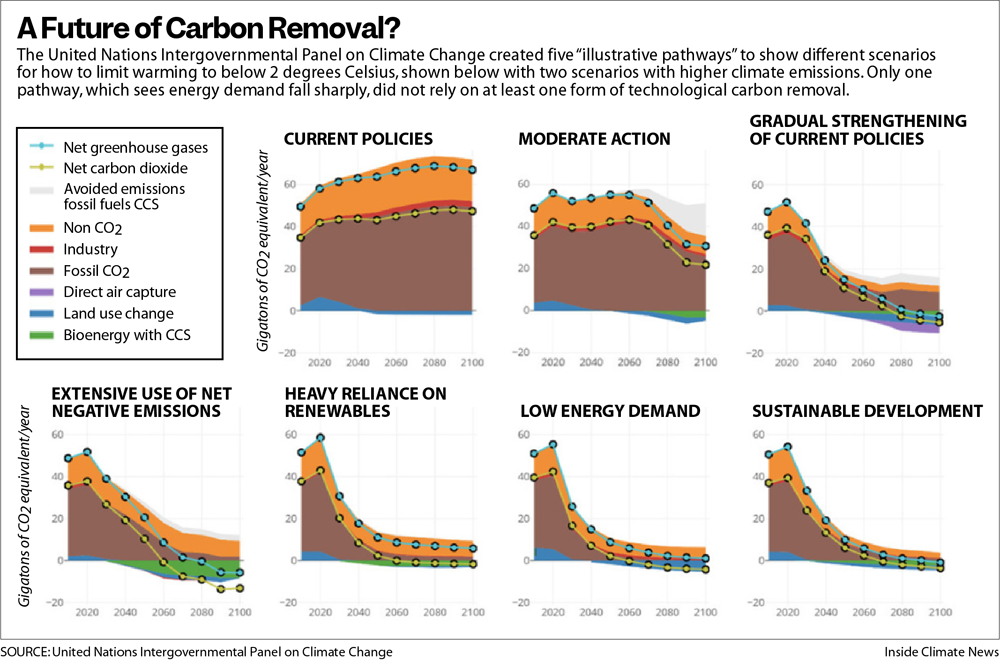
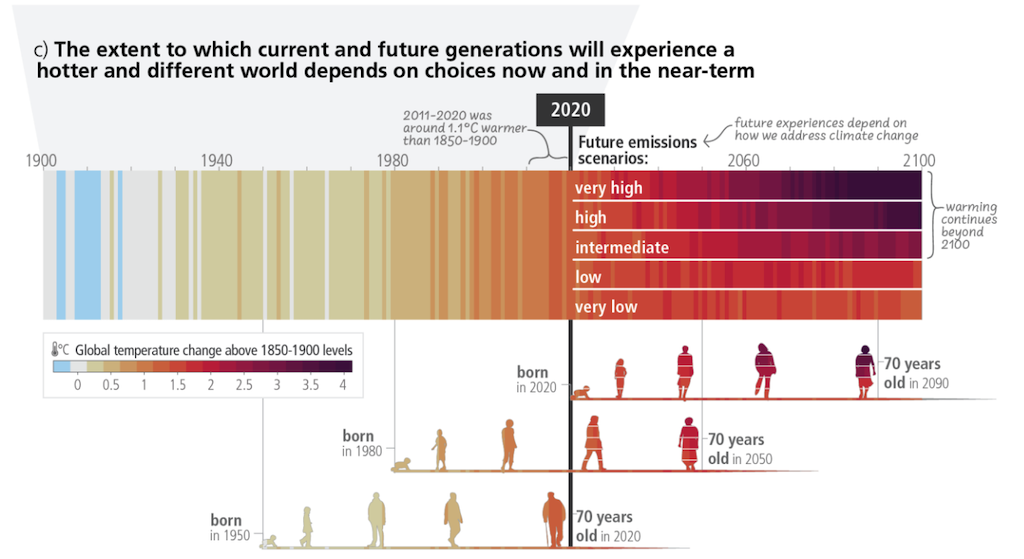
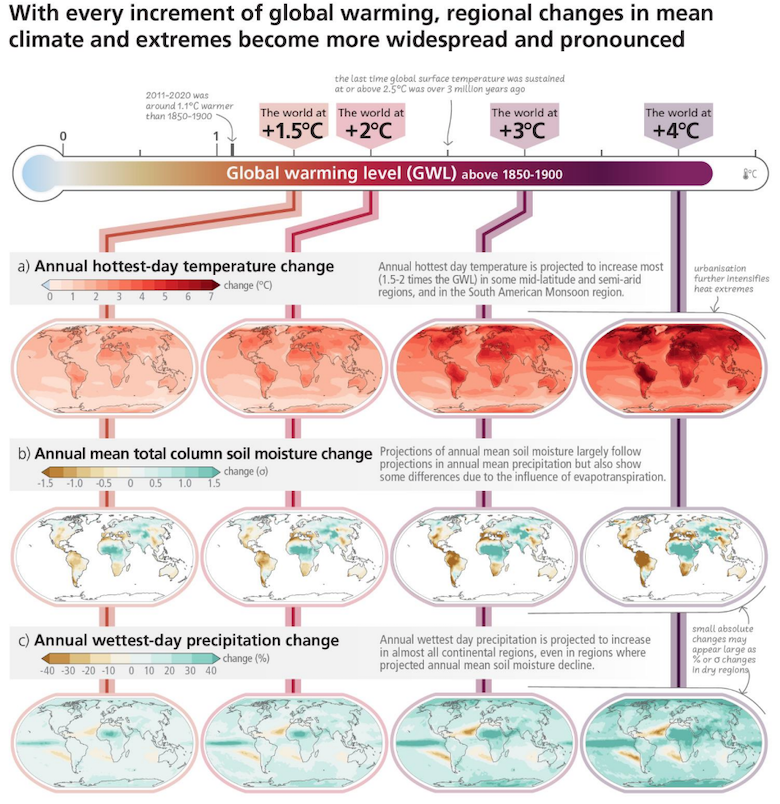
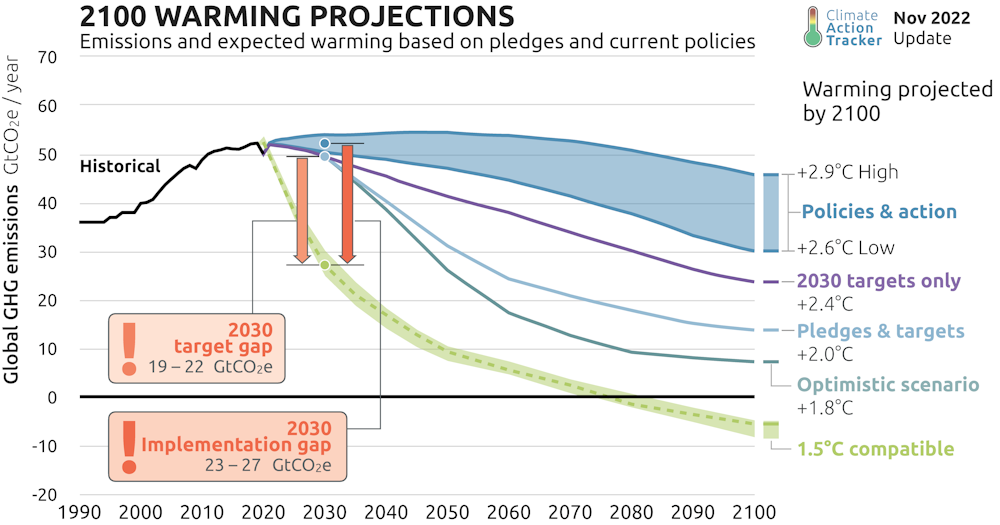
As the world blows past 1.5°C of anthropogenic warming and looks increasingly likely to hit 2.6°C–3.1°C by the end of the century, plenty of controversy still exists, even among geoscientists, about how to slow, stop, or reverse the rapid climate change we are causing. As so many studies have documented, such warming will cause inundation of many coastal cities, trillions of dollars in damage from extreme weather, widespread species extinctions, and unrelenting heat waves. It will also fundamentally threaten financial sectors and economies at all scales. One thing is clear: To mitigate these outcomes, humanity’s first priority should be to drastically reduce its annual emissions of roughly 40 gigatons (billion metric tons) of carbon dioxide (CO2), the greenhouse gas most responsible for driving warming. Without this reduction, other measures will be only modestly effective at best. But unfortunately, at this point, the scale of mitigation needed to keep warming to below 2°C–3°C goes beyond reducing annual emissions. We must also remove and store carbon that has accumulated in the atmosphere…
Not only has focusing on annual emissions over the past few decades failed to reduce them, but it’s also not our annual emissions today (and into the future) that are causing the 1.55°C of warming we’re witnessing. It’s how much CO2 we have already emitted. Our cumulative emissions of 1.8 trillion tons (1,800 gigatons) of CO2 from energy and industry—heavier than the combined mass of all living things on Earth—taken from geologic reservoirs and dumped into the atmosphere, will stay there (and in the ocean) for thousands of years. Even on that happy day when we finally start reducing emissions, we will be the farthest we have ever been from solving the problem, and in fact, we will still be adding to it…
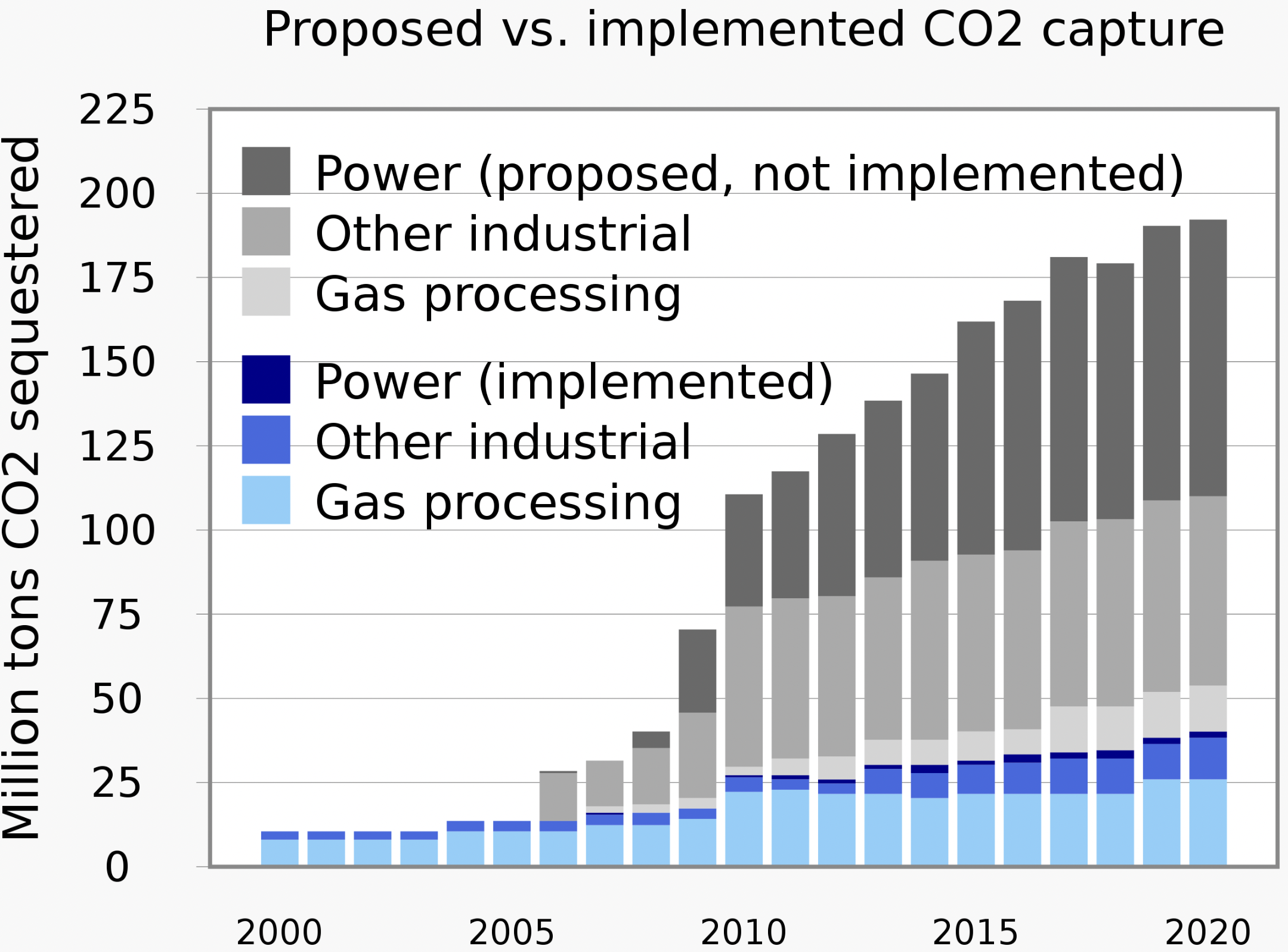
The biggest opportunity—and perhaps the biggest responsibility—for geoscientists to contribute to mitigation is through facilitating durable carbon dioxide removal (CDR). Concerns are sometimes raised about CDR as a form of climate intervention, or geoengineering, yet it is far less risky than the centuries-long geoengineering experiment of using the atmosphere as a sewer. Indeed, removing gigatons of CO2 per year is essential to net zero strategies and avoiding disastrous amounts of warming, as unequivocally stated by the Intergovernmental Panel on Climate Change, Energy Transitions Commission, and American Physical Society. Three principles are generally considered fundamental to CDR. First, CO2 already in the atmosphere must be taken out. This principle distinguishes it from point source carbon capture and storage (CCS), which simply reduces new CO2 emissions from fossil fuel energy and industry sources while competing with clean energy…Many approaches to CDR exist. Direct air capture (DAC), for example, is a rapidly growing method in which CO2 is pulled straight from the atmosphere. Biomass carbon removal and storage (BiCRS) methods capture a fraction of the 480 gigatons of CO2 that plants naturally absorb each year and prevent it from cycling back to the atmosphere by converting biomass to forms that can be isolated and stored. Other CDR approaches focus on managing ecosystems to stimulate more CO2 removal than would occur naturally, the second of the three principles of CDR. Examples include various strategies for enhanced rock weathering in croplands or forests and for marine CDR, such as using nutrients to promote biomass growth and raising the alkalinity of seawater so it pulls more CO2 from the air. Third, and most important, is the fact that however CO2 is removed, it must be stored durably, with minimal likelihood it can return to the atmosphere for a long time. Using captured carbon to create marketable stuff like fertilizer and chemicals may seem economically savvy, but it’s not a durable approach. The entire global industrial demand for CO2 is less than 1% of our annual emissions, and much of this carbon goes right back to the atmosphere or is used for enhanced oil recovery (EOR) to extract more petroleum.
Critics say the Trump administration’s halt to billions in conservation spending could cause long-term damage and slow hard-won progress.
For two decades, farmer John Burk has been working to improve the soil on his farm in Michigan, taking a few extra steps to make it more resilient and productive. His efforts have paid off.
“When we have the dry, hot summers or lack of rainfall, our crops can sustain the dry spells better. We don’t have huge yield decreases,” Burk said. “And when it rains and we have the freak storms, like it seems to do so much now, we don’t have the ponding and all the runoff.”
An added bonus: He needs less fertilizer, a major operating expense.
But Burk, and tens of thousands of farmers across the country like him, have learned that the Trump administration now considers these steps—which include limiting tillage, planting soil-enriching cover crops or installing water chutes to control erosion—“far left climate” activities. The administration has frozen billions of dollars in funding that pay for these activities while the U.S. Department of Agriculture (USDA) and White House conduct ongoing reviews.
The funding freeze, along with layoffs, threatened cutbacks and orders from the administration to remove climate information from the USDA’s website, have had a destabilizing effect on farmers and the agency alike. The agency, which under the Biden administration had more seriously embraced a role in addressing the climate crisis, is in chaos, former staffers say. Frustration from farmers is growing.
“I hear a lot of anger,” said Mike Lavender, policy director at the National Sustainable Agriculture Coalition.
The freeze has stoked uncertainty across farming communities at a particularly bad time. The Trump administration’s tariffs on imports from China, Canada and Mexico have sparked retaliatory tariffs that are expected to hurt American farmers already struggling with low crop prices and high fertilizer costs. Most farmers make decisions about the year ahead in the spring, but without knowing how much funding they can count on, those decisions are especially fraught this year. As extreme weather becomes the norm, the uncertainty mounts. Last year alone, farmers lost more than $20 billion to weather disasters, prompting Congress to approve $31 billion in disaster assistance.
“We’ve got an ag economy where prices are down and you’ve got increasing pressure because of Trump’s trade war—and now you’re taking away a source of income,” said Robert Bonnie, the under secretary for farm production and conservation at USDA under Biden. “You can put payments on hold. You can’t put spring on hold.”
The agency did not respond to specific questions or a request for comment for this story.
For decades, the agency has funneled support and funding for conservation projects through hugely popular programs that are so in demand each year, the agency turns away applicants. These farm practices make the soil healthier and more productive. They also help it store more carbon and are seen as significant tools for controlling climate-warming greenhouse gas emissions.
“Everyone thinks these conservation programs are about farmers,” Burk said. “But it’s way bigger than just the farmer. These don’t just help with yield. It’s helping every single person on the planet.”
The USDA oversees 20 conservation programs that are funded through the Farm Bill, the massive legislation covering farm and nutrition programs that’s negotiated every five years. Under the Biden administration these conservation and energy programs got a huge boost: $19.5 billion from the Inflation Reduction Act, Biden’s signature climate legislation.
But amid the Trump administration’s broader attacks on climate action, most of the unspent dollars remain frozen, despite the popularity of these programs and their benefits beyond addressing climate change.
One analysis, by former USDA employees, says the agency currently owes nearly $2 billion in promised grants and unpaid funds for conservation and energy efficiency programs to more than 22,000 farmers. Another, by an agricultural economist at the University of Illinois Urbana-Champaign, finds that farmers stand to lose $12.5 billion from the agency’s most popular and widely used programs. Congressional Republicans have signalled that they would shift the funds to other programs covered by the Farm Bill.
While the agency and its new secretary, Brooke Rollins, announced in February that $20 million in IRA funding will be released, it’s not clear when and how. Rollins said in a statement that the agency was concerned the dollars were being spent on programs “that had nothing to do with agriculture,” but went on to say the review was being conducted “to ensure that programs are focused on supporting farmers and ranchers, not DEIA programs or far-left climate programs.”
On March 26, the agency said it would release funding for the Rural Energy for America Program, which gives grants for farmers to install energy-efficient projects, like solar panels. In order to receive the funds, recipients of the grants will have to revise their applications to ensure that they “remove harmful DEIA and far-left climate features,” the agency said.
“The Biden administration didn’t go out and make up new practices,” Bonnie said. “These are things farmers have been doing for a long time.”
Cuts or freezes to funding aren’t the only potential challenges to climate action within the agency. The administration cut as many as 1,200 jobs from the agency’s Natural Resources Conservation Service (NRCS) and threatened to relocate offices, terminating dozens of leases. It has directed staff to remove mentions of climate change from the agency’s website (an action over which it was subsequently sued) and has threatened to defund or derail climate research, which would also impact work at universities that partner with the agency.
“Even conservative estimates have been that ag research returns $20 for every dollar spent,” said Karen Perry Stillerman, a deputy director at the Union of Concerned Scientists. “A major retrenchment would be a big deal for farms and for climate adaptation and resilience.”
For decades, environmental and farm groups pushed Congress, the USDA and farmers to adopt new conservation programs, but progress came in incremental steps. With each Farm Bill, some lawmakers threaten to whittle down conservation programs, but they have essentially managed to survive and even expand.
The country’s largest farm lobby, the American Farm Bureau Federation, had long denied the realities of climate change, fighting against climate action and adopting official policy positions that question the scientific consensus that climate change is human-caused. Its members—the bulk of American farmers—largely adhered to the same mindset.
But as the realities of climate change have started to hit American farmers on the ground in the form of more extreme weather, and as funding opportunities have expanded through conservation and climate-focused programs, that mindset has started to shift.
“They were concerned about what climate policy meant for their operations,” Bonnie said. “They felt judged. But we said: Let’s partner up.”
The Trump administration’s rollbacks and freezes threaten to stall or undo that progress, advocacy groups and former USDA employees say.
“We created this enormous infrastructure. We’ve solved huge problems,” Bonnie added, “and they’re undermining all of it.”
“It took so long,” Stillerman said. “The idea that climate change was happening and that farmers could be part of the solution, and could build more resilient farming and food systems against that threat—the IRA really put dollars behind that. All of that is at risk now.”
Burk says he plans to continue with conservation and carbon-storing practices on his Michigan farm, even without conservation dollars from the USDA.
But, he says, many of his neighboring farmers likely will stop conservation measures without the certainty of government support.
“So many people are struggling, just trying to figure out how to pay their bills, to get the fuel to run their tractors, to plant,” he said. “The last thing they want to be doing is sitting down with someone from NRCS who says, ‘If I do these things, maybe I’ll get paid in a year.’ That’s not going to happen.”
Trains load with Powder River Basin coal at the Black Thunder Mine in May 2011. Photo/Allen Best
Click the link to read the article on the Big Pivots website (Allen Best):
May 30, 2024
Wyoming politicos were furious, some enviros elated. But the Biden administration decision about Powder River coal leasing actually had no real consequence. Here’s why in a richer, deeper read.
Hisses and cheers, outrage and elation. These were predictable responses when the Biden administration announced that it plans no new leasing for coal in the Powder River Basin.
Wyoming’s congressional delegation had their usual talking points. Sen. John Barrasso called it part of President Joe Biden’s war on Wyoming.
“This will kill jobs and could cost Wyoming hundreds of millions of dollars used to pay for public schools, roads, and other essential services in our communities,” Barrasso said in a statement. “Cutting off access to our strongest resource surrenders America’s greatest economic advantages — to continue producing affordable, abundant, and reliable American energy.”
Other politicos from Wyoming echoed his words. This will cause the United States to become dependent on energy from other countries. It will create more pollution in other countries who don’t have access to Wyoming’s clean coal. And so forth.
My e-mail revealed some hurrahs from those in the environmental camp. “Wow,” said one individual. Organizations were supportive but more restrained. “A monumental decision,” said an individual from Earthjustice.
My take? It was a decision without consequence. Several people in Wyoming confirmed my reaction.
Provided to YouTube by CDBaby Wyoming Wind · Terry Yazzolino & Dan Thomasma Good Medicine ℗ 2007 Medicine Tree Music Released on: 2007-01-01
“This is a symbolically significant decision for the climate but in terms of practicality it means absolutely nothing,” Shannon Anderson, the staff attorney for the Powder River Basin Resource Council in Sheridan, Wyo., told me.
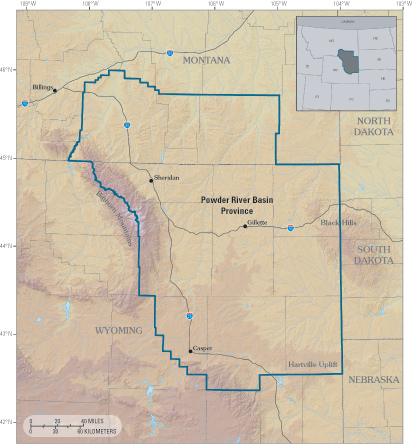
At current rates of extraction, coal companies that mine in the Powder River Basin have enough deposits to continue mining until 2041, she pointed out, citing research by the Bureau of Land Management. The BLM, the federal agency, is responsible for leasing coal from the subterranean land. It does so only in response to proposals from mining companies. In other words, the companies must ask to mine more coal. They haven’t done so lately.
None have done so since 2012. Two pending leases have stalled since 2015, awaiting action by the companies. The door was open for a long time without any coal companies walking in.
“It doesn’t make sense to make federal land available for coal leasing if the coal industry doesn’t want that land,” said Anderson.
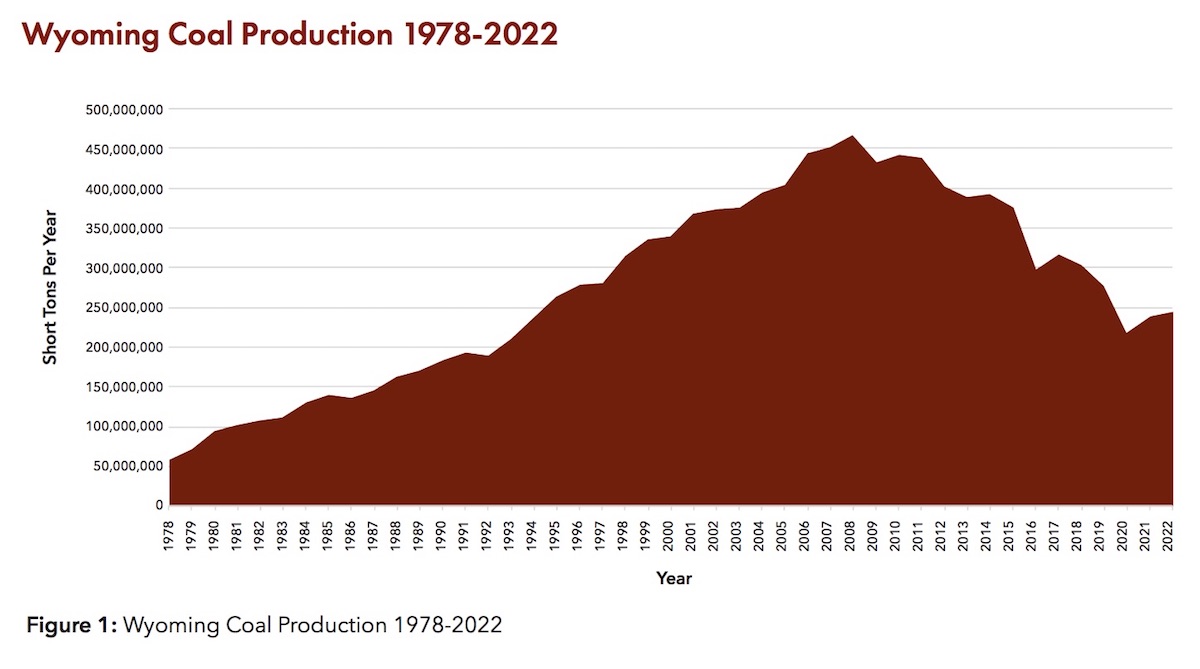
In its announcement of the end of new coal leases in the Powder River Basin of Wyoming, the BLM noted that coal continues to be extracted from 12 surface mines in the field. They produced 220 million short-tons of coal in 2022, compared to 400 million tons in 2008, the peak year for coal extraction in both the Powder River Basin and the United States altogether.
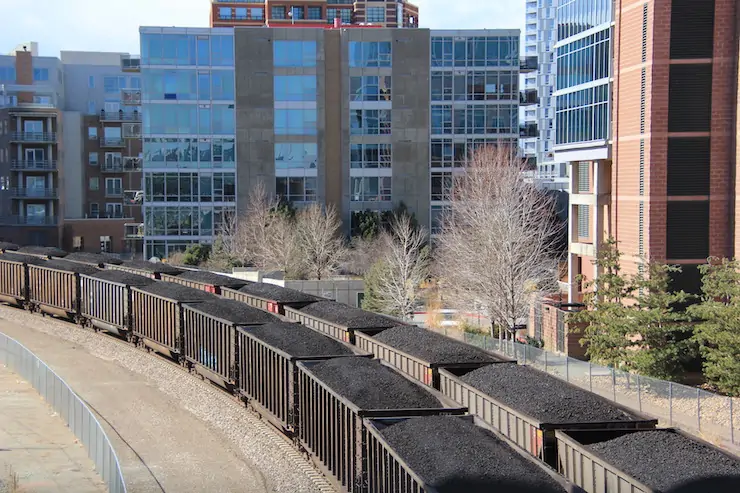
Coal trains two-abreast wound their way through Denver’s LoDo district in March 2018. Demand from Colorado power plants for Powder River Basin coal has already slackened and will cease altogether before 2031. Photo credit: Allen Best/Big Pivots
Paramount is the decline in demand for coal. We’re burning less coal but that’s not because it is less available. Rather, it’s because we have cheaper alternatives and ones that produce fewer or no greenhouse gas emissions.
Colorado burns Powder River Basin coal, but not as much as it once did. Two coal-burning units went down in 2022, one in Pueblo and the second in Colorado Springs.
Two more at Pueblo will follow plus one near Colorado Springs (Nixon), and one north of Fort Collins (Rawhide). Near Brush, the Pawnee coal plant will be converted to natural gas no later than 2026.
All burn Powder River coal, and all will be closed by the end of 2030, perhaps earlier.
On X, the social media platform, I noticed the reaction of Larry Wolfe, who lives in Cheyenne and was for 30 years an attorney specializing in energy with legal heavyweight Holland and Hart.
“You are not watching the news, John (Barrasso), the coal industry is going out of business,” he had written the day after the announcement. “They don’t need new leases. They don’t have the demand for the coal they already own. Down 20% this year, with the companies forecasting 10% annual declines. Done in WY in 10 years or less.”
I called Wolfe to get a keener understanding of Wyoming coal and energy more broadly.
“If you are going to be realistic about this, you have to look at some of these coal companies,” he told me. “They’re not great companies anymore. They used to be — Peabody and Arch and a couple of others. They are not great companies anymore.”
Arch and Peabody were among the 60 coal companies who declared bankruptcy between 2012 and 2020. In addition to mines in the Powder River Basin, they also have mines in Colorado.
Colorado for a couple years had the coal equivalent of man bites dog. A company had reopened a mine west of Trinidad. Then it, too, closed. My research suggests limited coal mining in northwest Colorado beyond 2028, when the last power plant there closes.
West Elk, near Paonia, the state’s largest producer, which is owned by Arch Resources, may last longer. It has reserves of 10 to 12 years at current rates of extraction. It produces about one-tenth the volume of the company’s Black Thunder Mine in the Powder River Basin.
The West Elk Mine near Paonia in March 2022. Photo/Allen Best
On the campaign trail in 2016, Donald Trump promised to bring back “clean, beautiful coal.” He didn’t.
In November 2020, after the election, S&P Global Market Intelligence recalled Trump’s campaign vow. Instead, said S&P, a market analyst, coal jobs had declined 24% during his presidency. In leaving the White House he will likely leave the nation with the “lowest coal production and job figures in recent history.”
Coal undeniably benefited Wyoming. Wyoming accumulated $2 billion in just coal lease bonuses. The money was used to upgrade almost every school in the state, says Wolfe. That went away after about 2015-2016.
The hard-right component of the Republican Party of Wyoming professes to believe that the world around Wyoming has not changed except for the lunk-headed Democrats in Washington D.C. and maybe wayward states like Colorado.
Gov. Mark Gordon, also a Republican, has a more moderate view. He wants to see carbon capture and sequestration technology emerge as the answer that will allow Powder River coal to have a future. There are several coal plants near Gillette and, of course, Powder River coal for decades was delivered to power plants as far away as Georgia.
In his year as chair of the Western Governors Association, Gordon has made CCS (also called carbon capture storage and utilization, or CCSU) his key initiative, the way that Colorado Gov. Jared Polis the prior year had made geothermal his key initiative.
Wyoming also adopted a law that required its coal plants to test carbon capture.
In Colorado, the Polis administration sees a more limited role for carbon capture, such as for sequestering emissions from ethanol plants. Tri-State Generation and Transmission also proposes a new natural gas plant in concert with carbon capture technology.
The Colorado Land Board seems to think this can constitute a revenue stream in years ahead. It has already leased lands near Yuma, Pueblo, and in Weld County.
With his eye on Wyoming, Wolfe is skeptical the technology will pan out.
“Carbon capture doesn’t work very well. It’s not any kind of salvation. The trouble the carbon capture people have is they want to put this technology on old (coal) generation stations that have outlived their useful lives.”
Doing so will require spending perhaps a half-billion dollars per plant. And that will mean having to operate the coal plants for another 30 to 50 years to monetize the additional cost.
Wolfe calls it one of those “little naughty problems that lawyers bring up that people don’t want to talk about, but which are very real.”
Electric utilities “have been passing along research costs to consumers, and those costs have been tolerable. But they have to start making major investments about how to figure out everything,” says Wolfe. “The consumers will just go ballistic, because they won’t want to absorb the cost of what is likely to be a unproductive technology.”
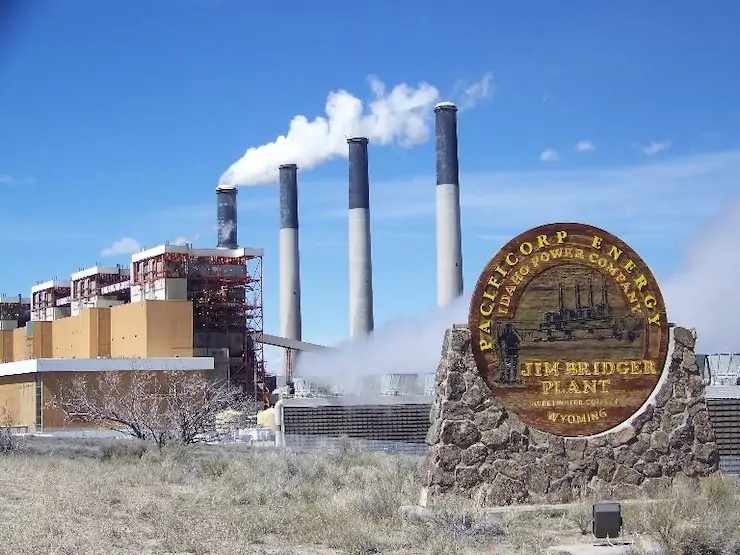
Can carbon capture and sequestration technology be demonstrated to be economically feasible at the Jim Bridge Station in southwestern Wyoming? Photo/Allen Best
Jim Bridger, Wyoming’s largest coal plant, has a capacity of almost 2,442 megawatts — alone equal to the four coal plants on Colorado’s Eastern Slope. It has been identified as among the coal plants that may get retrofitted with carbon capture equipment.
WyoFile’s Dustin Bleizeffer, in an April 2, 2024, story, reported that two electric utilities were planning advanced engineering studies and analysis of potentially retrofitting Bridger’s four coal-burning units. Wyoming ratepayers, he reported, were already paying more than $3 million annually for the initial phases of study but will soon be paying $10 million to $20 million — “with no guarantee that a single coal plant might ultimately be retrofitted with the technology.”
In 2023, he reported, Rocky Mountain Power had estimated a cost of $1 billion per coal unit to install the technology. Another utility, Black Hills Energy, had reported the cost of retrofitting a power plant near Gillette called Wygen II at between $500 million and $668 million. The company in 2008 had estimated the cost at $182.5 million, or the equivalent of $268 in current dollars).
Where might the demand for coal-fired power come from? Cheyenne has been loading up on data centers. They can be seen while driving west from Cheyenne on Interstate 80. Microsoft has two and Meta just weeks ago was revealed to be the company behind a 945-acre data center development in Cheyenne. An 800,000-square-foot facility is planned.
Low electricity costs and Cheyenne’s coolish temperatures – spring comes about a month after it does in Denver just 100 miles to the south – help explain the draw. Resource adequacy could conceivably revive the coal market somewhat, although a safer bet would be on natural gas.
The same questions are starting to be asked in Colorado. The state’s energy office estimates that demand for electricity will increase 50% by 2040.
Wolfe predicts a cascading decline for Powder River coal. Multiple mines will close, leaving just a few that will be highly efficient, using autonomous mining machinery. Railroads – essential to delivery of Powder River coal – will lose interest in serving the much-diminished industry. “They will be wanting to repurpose the engines,” says Wolfe.
“This notion of a sort of glide path down, I wouldn’t count on that for a moment. If you have a couple of back-to-back winters that are really warm and the utilities are maintaining large stockpiles, the companies are going to get into desperate straits.”
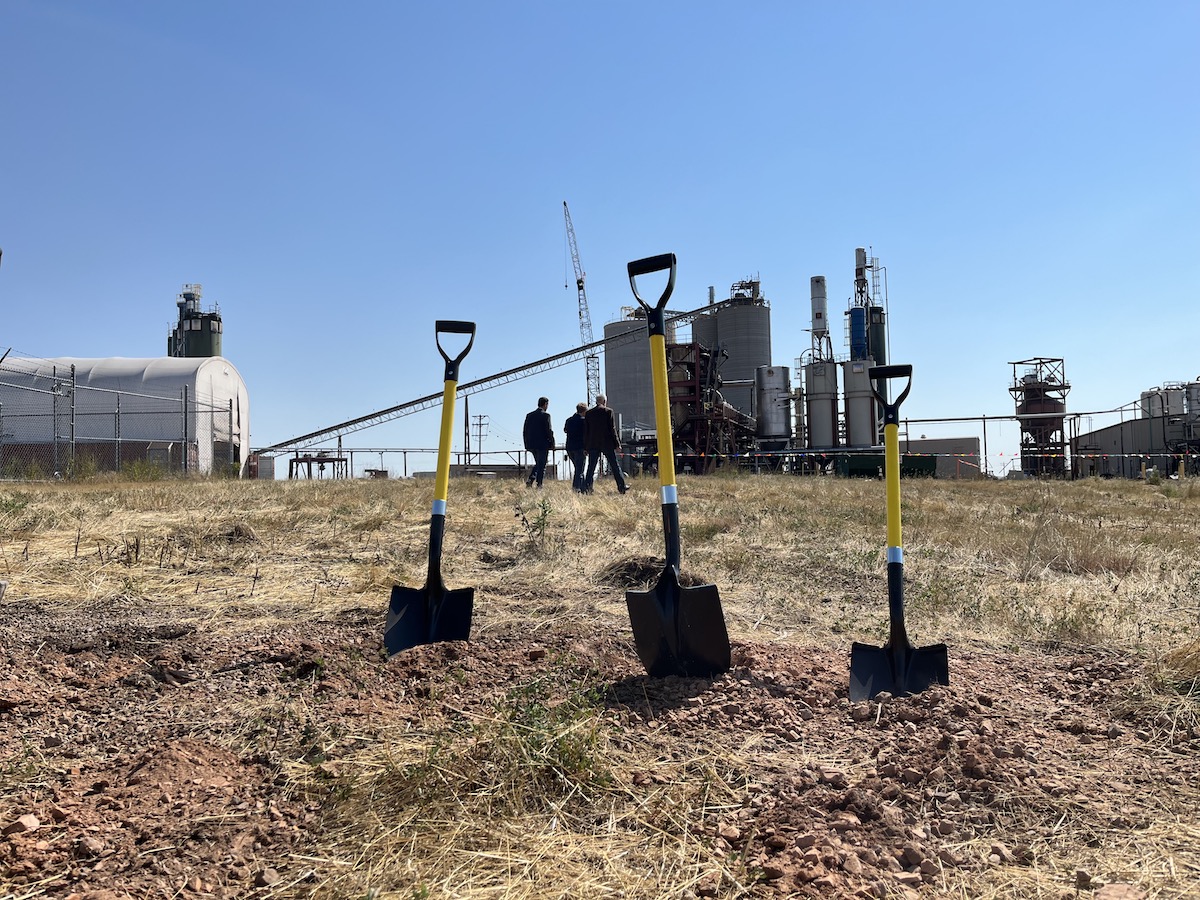
Ceremonial shovels mark the location of the Innovation Center coal refinery field demonstration project north of Gillette on Sept. 2, 2022. It will be co-located with Atlas Carbon’s facility that produces activated carbon products. (Dustin Bleizeffer/WyoFile)
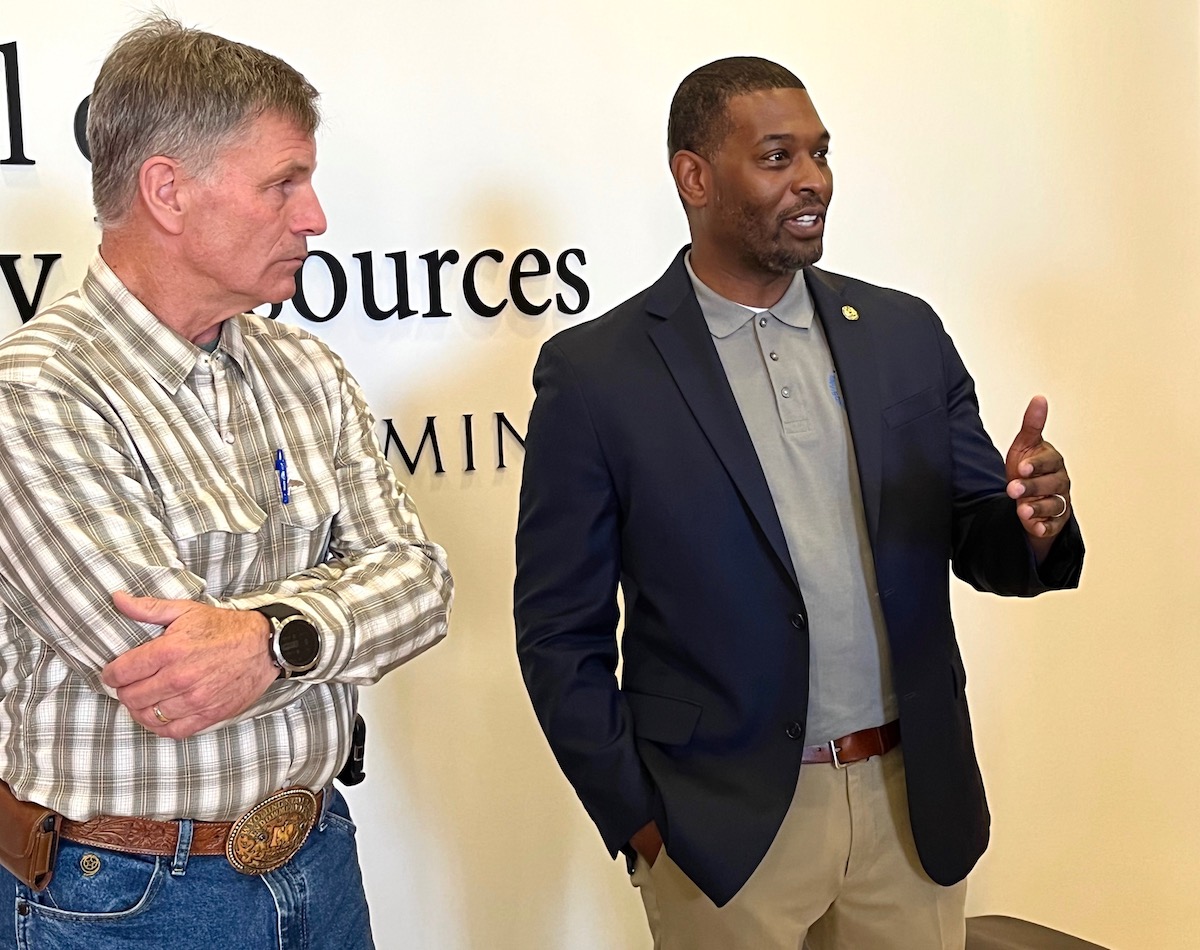
Biden administration’s suite of coal pollution rules a win for climate and health, advocates say, but a major blow to one of Wyoming’s bedrock economic drivers.
Gov. Mark Gordon has promised to sue over a new suite of federal rules that most observers agree will hasten the U.S. thermal coal industry’s trajectory toward extinction — an existential threat to many Wyoming communities and one of the state’s main economic drivers.
The U.S. Environmental Protection Agency on Thursday issued four “final” rules aimed at drastically cutting coal pollution, including a mandate that existing coal-fired power plants cut or capture 90% of their planet-warming carbon dioxide emissions by 2032 or convert to natural gas or close altogether. The agency’s other rules set timelines for significant cuts to smokestack emissions of mercury and other toxic metals, polluted wastewater from coal power plants and more stringent standards for coal ash disposal.
The “power plant” rules make good on President Joe Biden’s promise to address human-caused climate change, according to the EPA. The actions are also intended to help curtail illness and premature deaths from coal pollution while providing a clear regulatory framework for utilities to shift to renewable sources of energy.
The agency also noted that it consulted with coal-reliant utilities about their existing plans regarding coal facilities and crafted the implementation schedules to allow for planning that avoids electrical power supply issues.
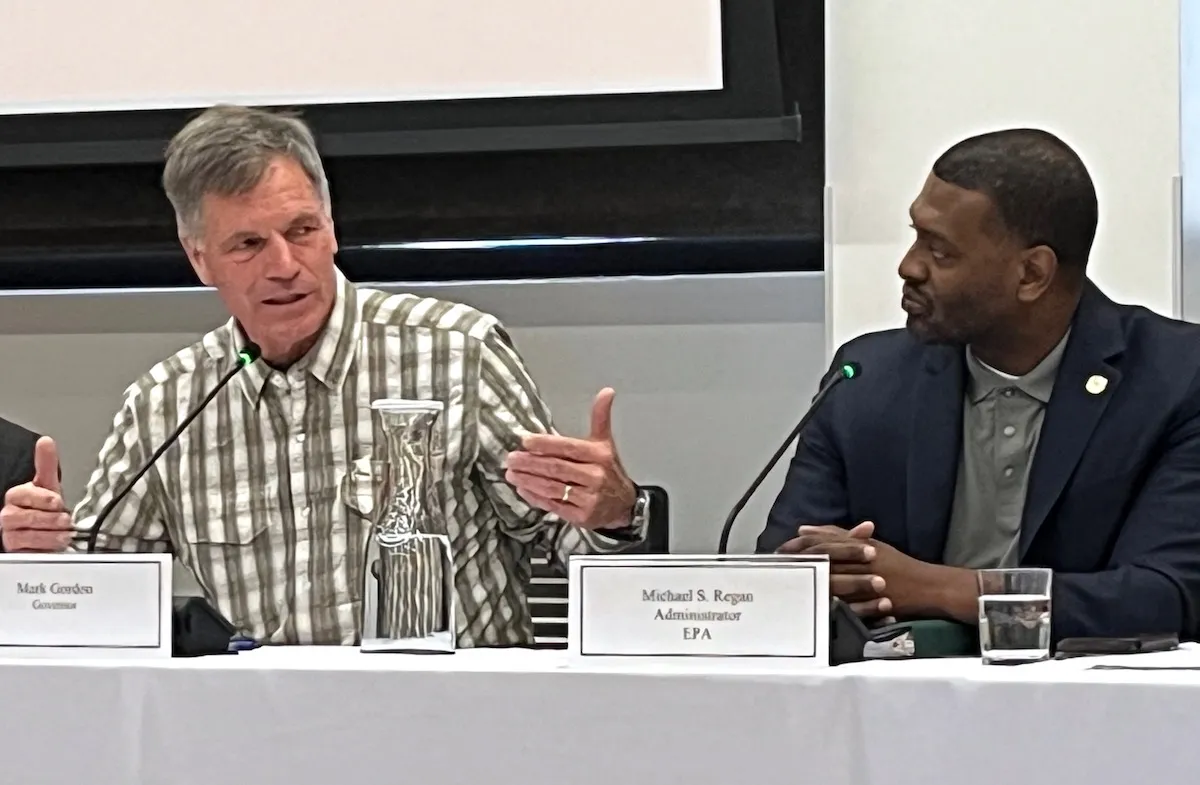
Gov. Mark Gordon and U.S. Environmental Protection Agency Administrator Michael Regan held a joint press conference at the University of Wyoming on August 9, 2023. (Dustin Bleizeffer/WyoFile)
“By developing these standards in a clear, transparent, inclusive manner, EPA is cutting pollution while ensuring that power companies can make smart investments and continue to deliver reliable electricity for all Americans,” EPA Administrator Michael S. Regan said in a prepared statement.
Coal proponents in Wyoming are furious.
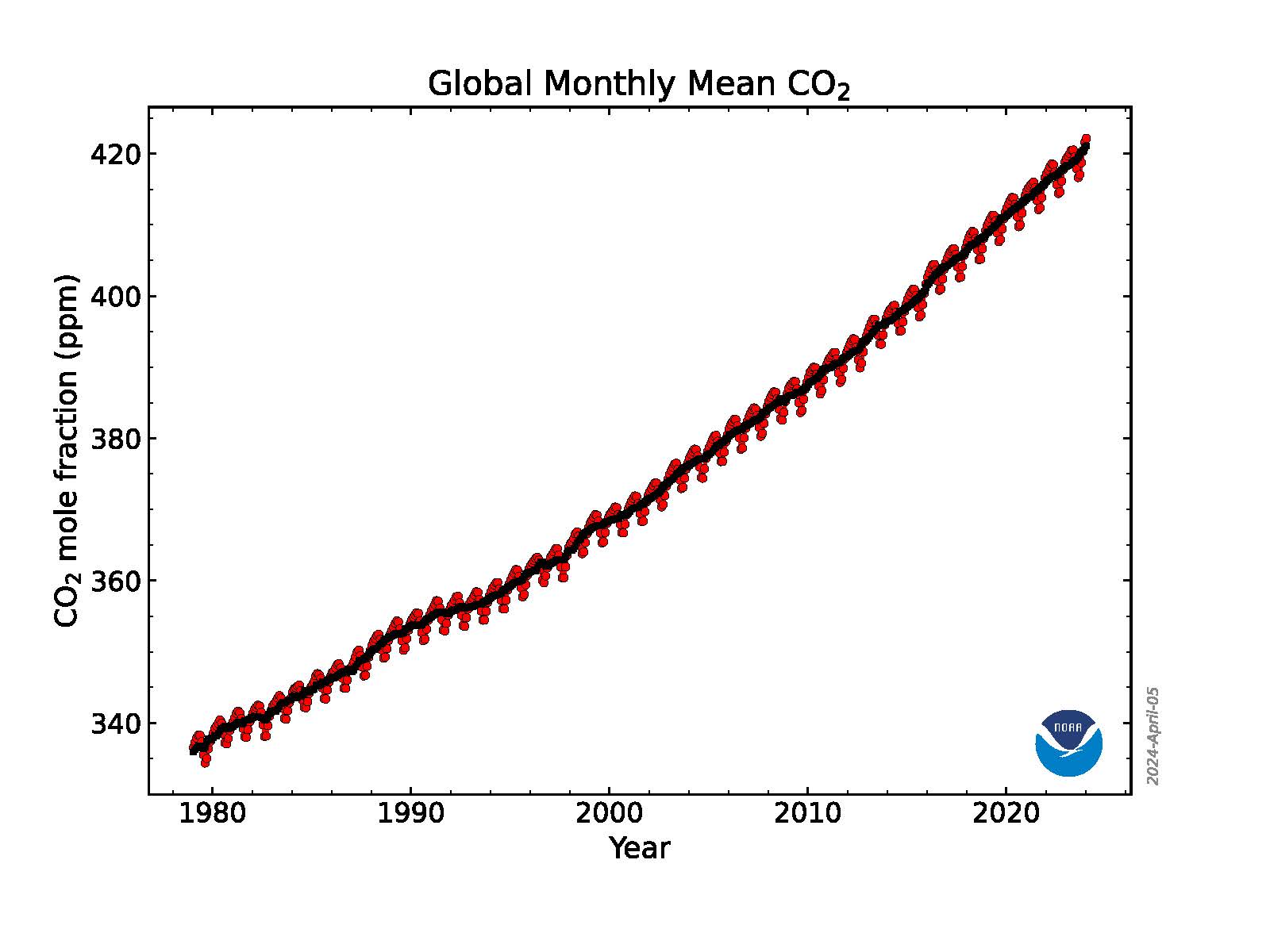
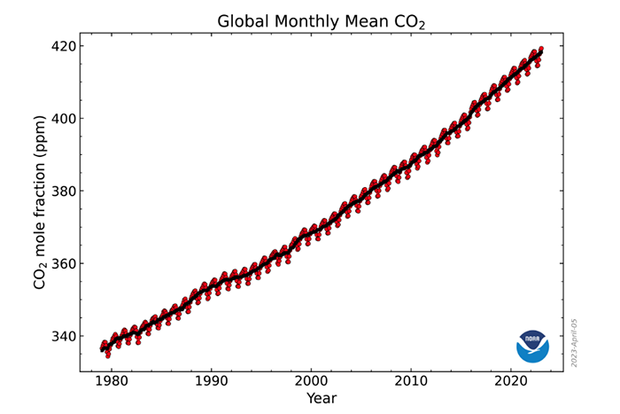
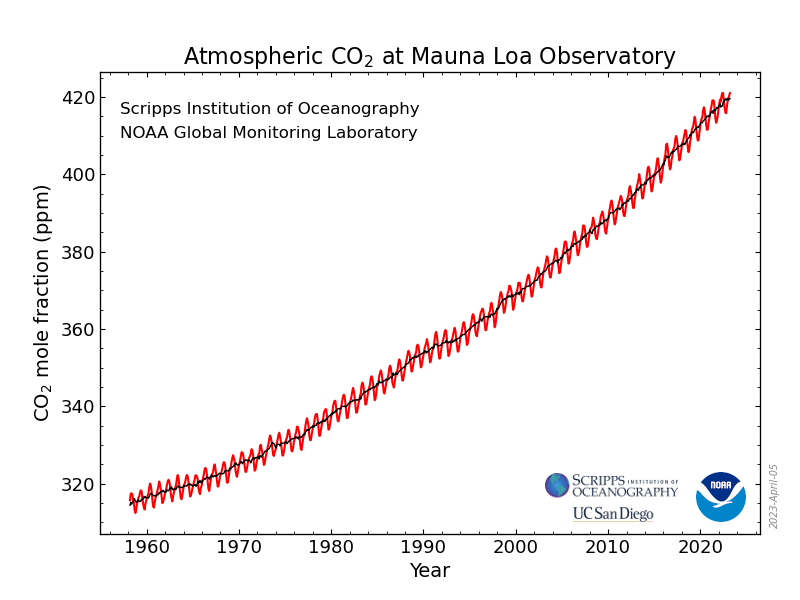
This graph shows the globally averaged monthly mean carbon dioxide abundance measured at the Global Monitoring Laboratory’s global network of air sampling sites since 1980. Data are still preliminary, pending recalibrations of reference gases and other quality control checks. Credit: NOAA GML
While the rules target coal-fueled power plants, they also put Wyoming coal mines on notice: Their already waning U.S. customer base has an expiration date.
“It is clear the only goal envisioned by these rules released by the Environmental Protection Agency today is the end of coal communities in Wyoming,” Gordon said in a prepared statement Thursday. “EPA has weaponized the fear of climate change into a crushing set of rules that will result in an unreliable electric grid, unaffordable electricity and thousands of lost jobs.”
The Wyoming Mining Association also discounted climate change as an excuse to attack the coal industry.
“Wyoming is once again the sacrificial lamb on the altar of the climate change cult,” the association’s Executive Director Travis Deti said.
The rules
The carbon dioxide emissions rule applies to coal-fired power plants as well as new natural gas-fired facilities, requiring them to prevent at least 90% of greenhouse gasses from entering the atmosphere.
“Existing coal-fired power plants are the largest source of [greenhouse gas] from the power sector,” the EPA stated in the rule. “New natural gas-fired combustion turbines are some of the largest new sources of [greenhouse gas] being built today, and these final standards will ensure that they are constructed to minimize their [greenhouse gas] emissions.”
The rule updating Mercury and Air Toxics Standards tightens emissions by about 70%, an especially significant reduction for plants that burn lignite — a lower-value coal than Wyoming’s subbituminous product — according to the agency.
Wyoming remains the nation’s largest coal producer, although production has plummeted by nearly half since 2008, with companies shipping some 237 million tons in 2023, according to the Wyoming State Geological Survey. More than 90% of coal mined in the state is sold to power plants in the U.S., which is why it’s often referred to as “thermal coal” — unlike “metallurgic coal” that is sold to steel manufacturers.
Wyoming coal production has decreased by nearly half since 2008. (University of Wyoming)
Coal mining contributed some $650 million in taxes, royalties and fees to the state in 2019 and employed more than 5,000 workers, according to the Wyoming Mining Association.
The vast majority of coal mining occurs in the Powder River Basin in the northeast corner of the state, while several communities host nearby coal-fired power plants: Gillette, Glenrock, Wheatland, Kemmerer and Rock Springs.
Although Wyoming has experienced declines in both coal production and coal-fired power, the industry still serves as a major economic backbone for the state — and a significant source of government revenue. The potential loss of coal-fired power facilities is an especially daunting prospect for nearby communities.
Those communities have wrestled with the knowledge of potential plant closures for a long time already, and the EPA’s new rules only serve to clarify that potential reality, said Robert Godby, associate professor at the University of Wyoming’s Economics Department.
“It really just kind of steepens the glide path to what we all knew was happening anyway,” he told WyoFile on Friday.
Explosive materials are loaded into a “blast hole” at a coal mine. (Dyno Nobel)
The new rules are likely to be challenged in court, not only by Wyoming, but also by other coal-reliant states, Godby said. Politics will also continue to play a role — particularly if a Republican wins the presidential election this year. He noted, however, that former President Donald Trump was not able to make good on a promise to turn around the coal industry’s decline.
Regardless, utilities are under increasing pressure to make long-term investment decisions in a quickly changing energy environment, and the EPA’s actions this week diminish the likelihood that they’ll find the regulatory certainty needed to invest in coal-fueled power.
“It makes it more likely they’re going to retire [coal plants] and announce firm dates,” Godby said. “That’s going to create more certainty for the communities that are affected.”
Meantime, Gordon, who has touted technologies to reduce carbon dioxide from coal power plants, has vowed to fight the rules.
“These rules are a travesty, and their effects are devastating,” Gordon said. “I have directed the Wyoming Attorney General to engage with and lead a coalition of states to challenge the power plant emissions rule, and we are prepared to apply our litigation strategy to the oncoming wave of federal regulatory actions that threaten Wyoming.”
The University of Wyoming’s School of Energy Resources, and its partners, are advancing multiple CO2 capture and sequestration demonstration projects at Basin Electric’s Dry Fork Station north of Gillette, seen here on Sept. 2, 2022. (Dustin Bleizeffer/WyoFile)
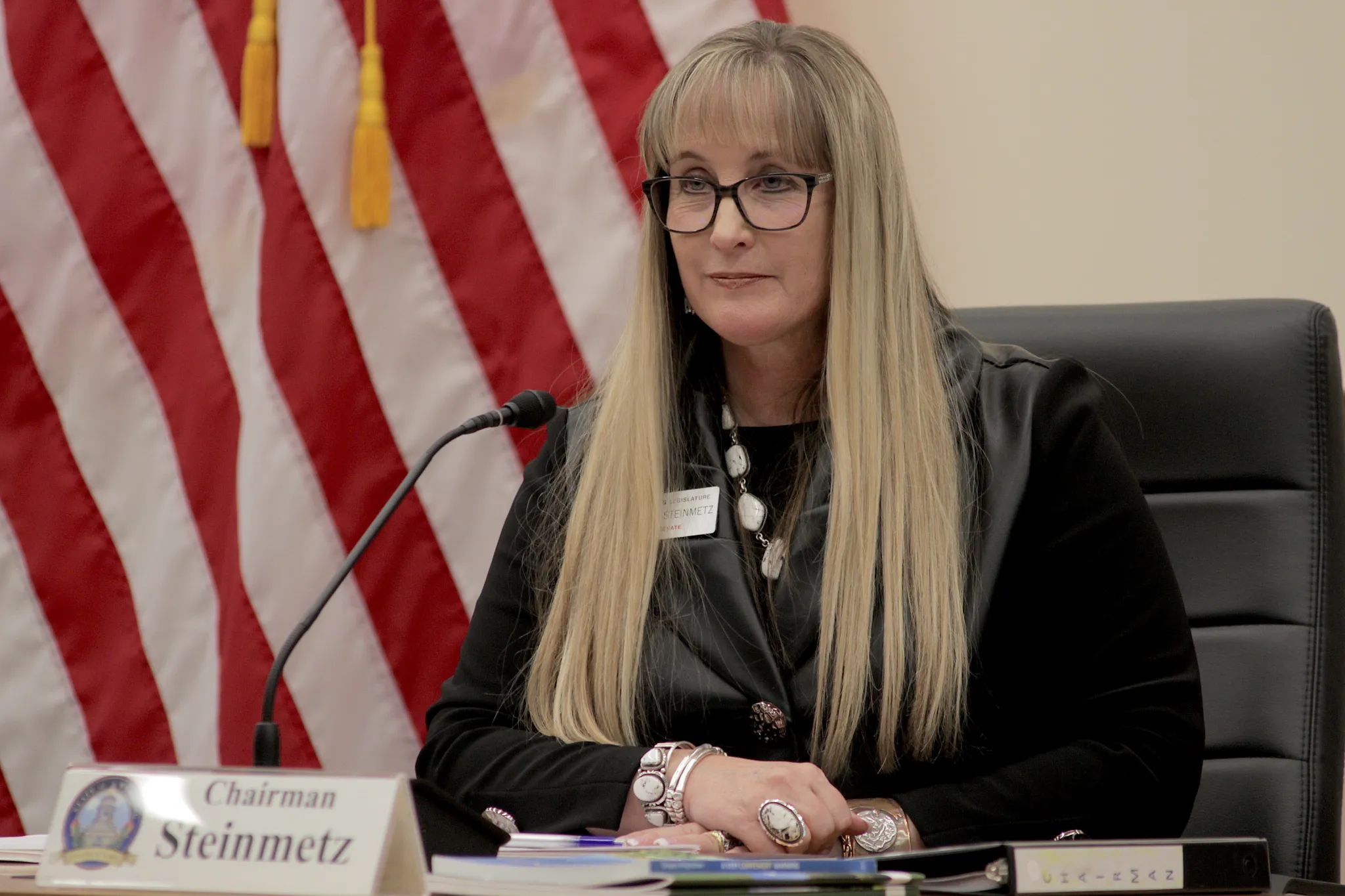
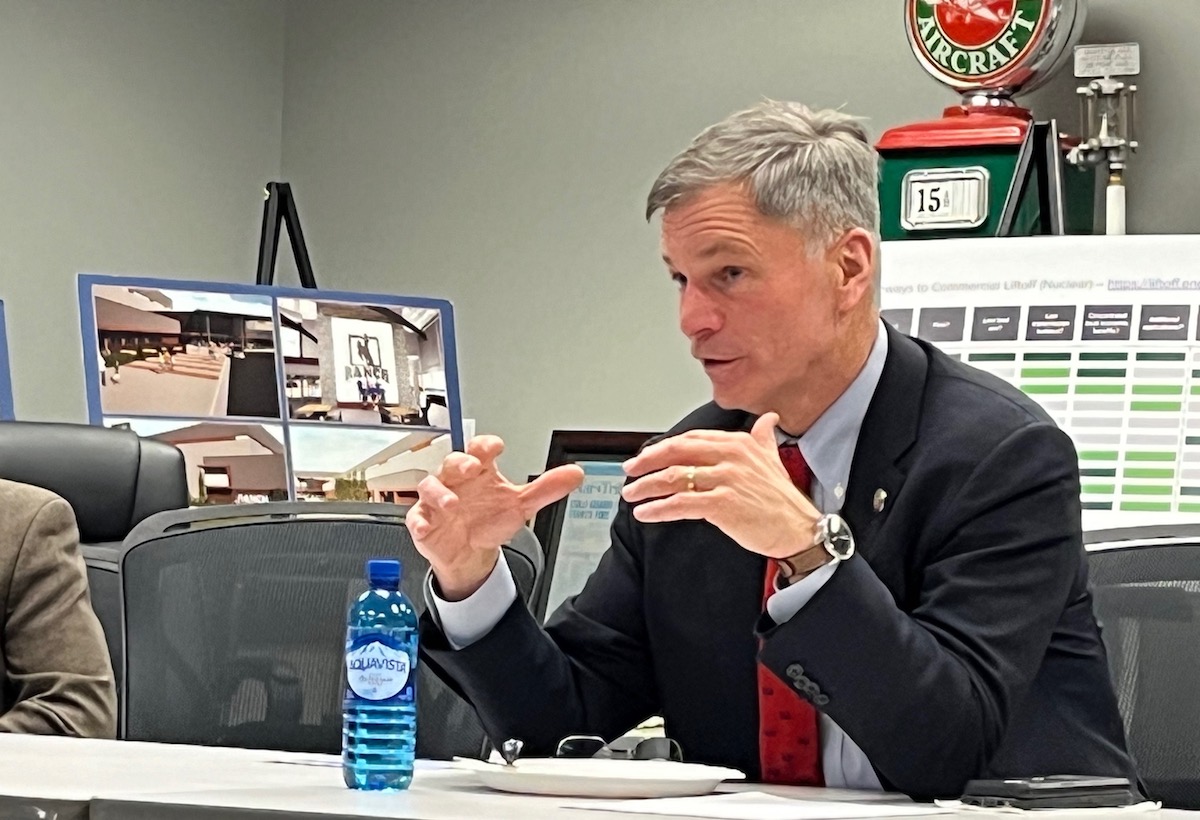
Senator Cheri Steinmetz (R-Lingle) chairs an official Senate Agriculture, State and Public Lands and Water Resources Committee hearing at the Wyoming Capitol in February 2024. (Mike Koshmrl/WyoFile)
Sen. Cheri Steinmetz was clear: The committee chairwoman did not want to hear prevailing viewpoints about carbon dioxide and climate change.
Those who accept what climate scientists have known for decades — that the planet is warming because of human-caused CO2emissions — need not speak up, the Lingle Republican said.
“If proponents of a different viewpoint wish to express that,” Steinmetz said, “they are free to have a hearing of their own.”
That left room for only alternative theories, those that deny or discount the world-changing effect carbon dioxide and other greenhouse gasses are having on human beings, other species and the climatic conditions of the planet.
Purported experts invited to testify, and other speakers, including each lawmaker who spoke, expressed either disbelief that climate change was happening, or a belief that it is inconsequential, even beneficial.
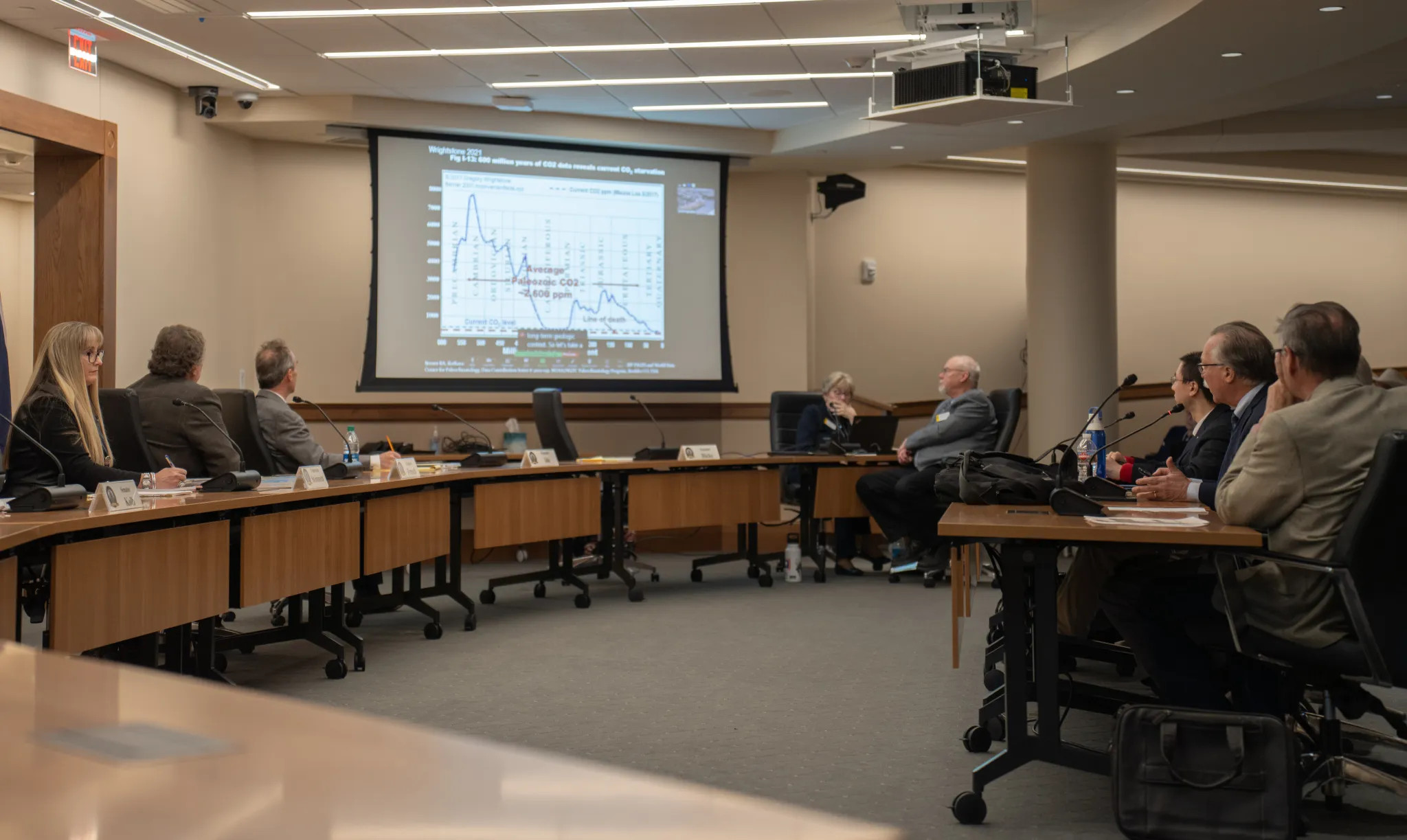
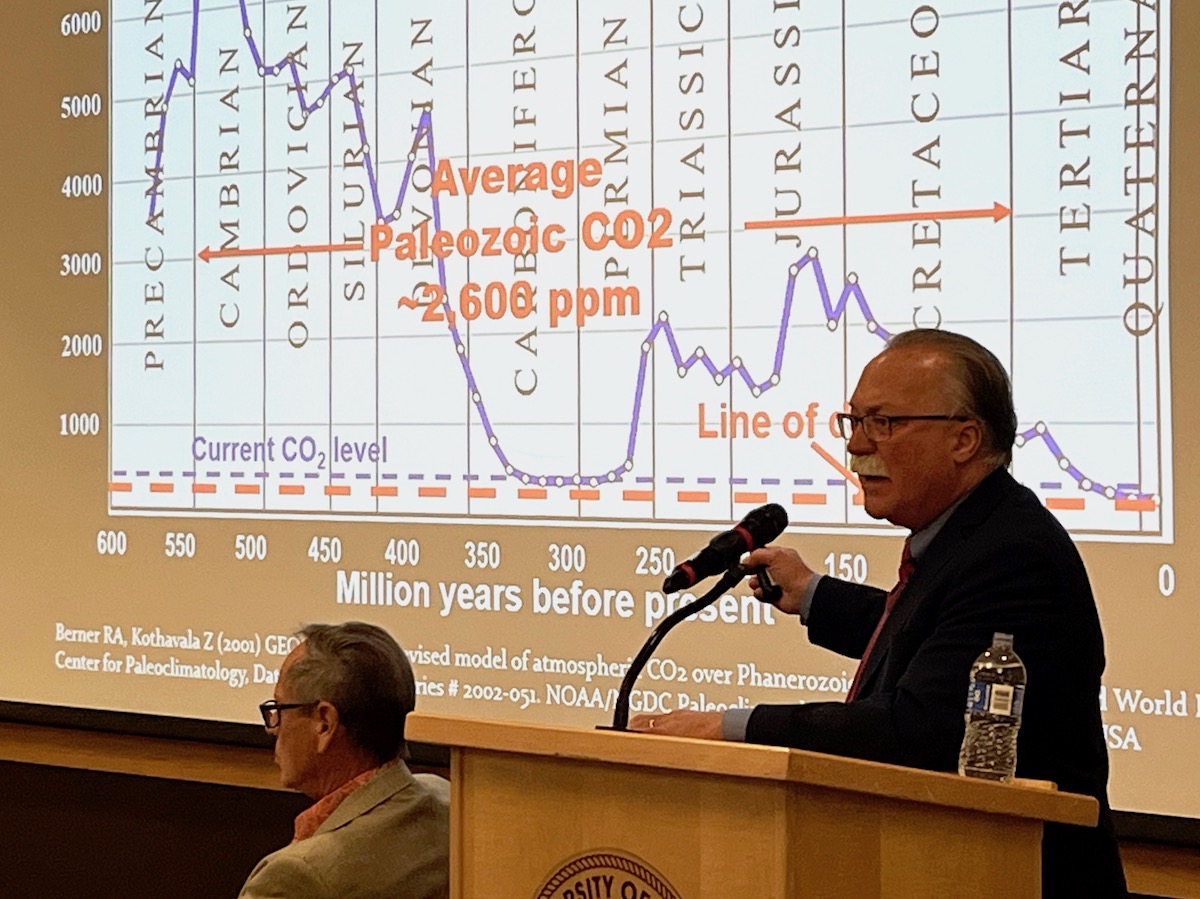
Speakers with the CO2 Coalition testify at a Senate Agriculture, State and Public Lands and Water Resources Committee hearing. The advocacy group is known for spreading disproven claims about climate change. (Ashton J. Hacke/WyoFile)
Flanking Steinmetz in the Wyoming Capitol extension building auditorium were four members of the Senate Agriculture, State and Public Lands and Water Resources Committee: Sens. Dan Laursen (R-Powell), John Kolb (R-Rock Springs), Tim French (R-Powell) and Bob Ide (R-Casper).
They nodded and smiled as they listened to presentations from speakers brought in from the CO2Coalition. The group touted its theory — discredited by the Intergovernmental Panel on Climate Change and other climate scientists — that loading more carbon dioxide into the atmosphere will not tip the planet’s climate into unlivable conditions.
William Happer, a physicist and co-founder of the CO2 Coalition, told lawmakers and attendees that those who believe climate science have been brainwashed.
“I don’t know how you deprogram people from a cult,” Happer said, “it’s really sort of a cult.”
Pamphlets distributed by an advocacy group, the CO2 Coalition, were distributed at a Wyoming Legislature hearing this week. On the front, the pamphlet declares: “CO2 should be celebrated, not captured.” (Ashton J. Hacke/WyoFile)
But the science is clear. In fact, human-caused climate change has pushed Wyoming’s annual mean temperature upward by 2.2 degrees Fahrenheit from 1920 to 2020, according to National Oceanic and Atmospheric Administration data. Wyoming’s highest elevations are warming even faster, already changing the seasonal pulse of water flows that the state’s economy is built around.
Climate change, which is already changing people’s lives in Wyoming, will have a dramatic effect on temperature regimes all across the state, according to University of Wyoming climate scientist Bryan Shuman. A place like Jackson, he said, will go from virtually never touching 90 degrees to getting that warm with regularity.
“On the track we’re on by 2050, [Jackson] will pretty easily start to have about two weeks of 90 degree weather,” said Shuman, one of the lead authors of the Greater Yellowstone Climate Assessment. “By 2100, depending on whether we mitigate carbon emissions or not, [Jackson] either ends up staying around that two-week level or it gets up to about two months of 90 degree weather.”
Deniers’ road trip
The CO2Coalition’s participation at the legislative hearing was part of a three-stop engagement in Wyoming. The Wyoming Republican Party teamed up with conservative group Turning Point USA to host speakers from the coalition for a series of events this week in Gillette, Cheyenne and at the University of Wyoming in Laramie.
Laramie resident Laurie Richmond attended the UW event and said she’s very concerned about Gov. Mark Gordon’s policy goal to capture and store more carbon than is emitted.
The governor, Richmond told WyoFile, won’t even give the CO2Coalition speakers “the time of day” — and she wasn’t happy about it.
Richmond worried about the economic burden of current state policies that attempt to force carbon capture retrofits at Wyoming coal-fired power plants. So far, Wyoming ratepayers are being forced to cover more than $3 million in costs for utilities to study the feasibility of adding carbon capture at five coal-burning units in the state — studies that were mandated by the Wyoming Legislature. If the utilities actually implement carbon capture at the coal plants, Black Hills Energy customers in Wyoming could be tapped for up to $1 billion, and Rocky Mountain Power’s Wyoming customers could pay more than $2 billion, according to preliminary filings with the state.
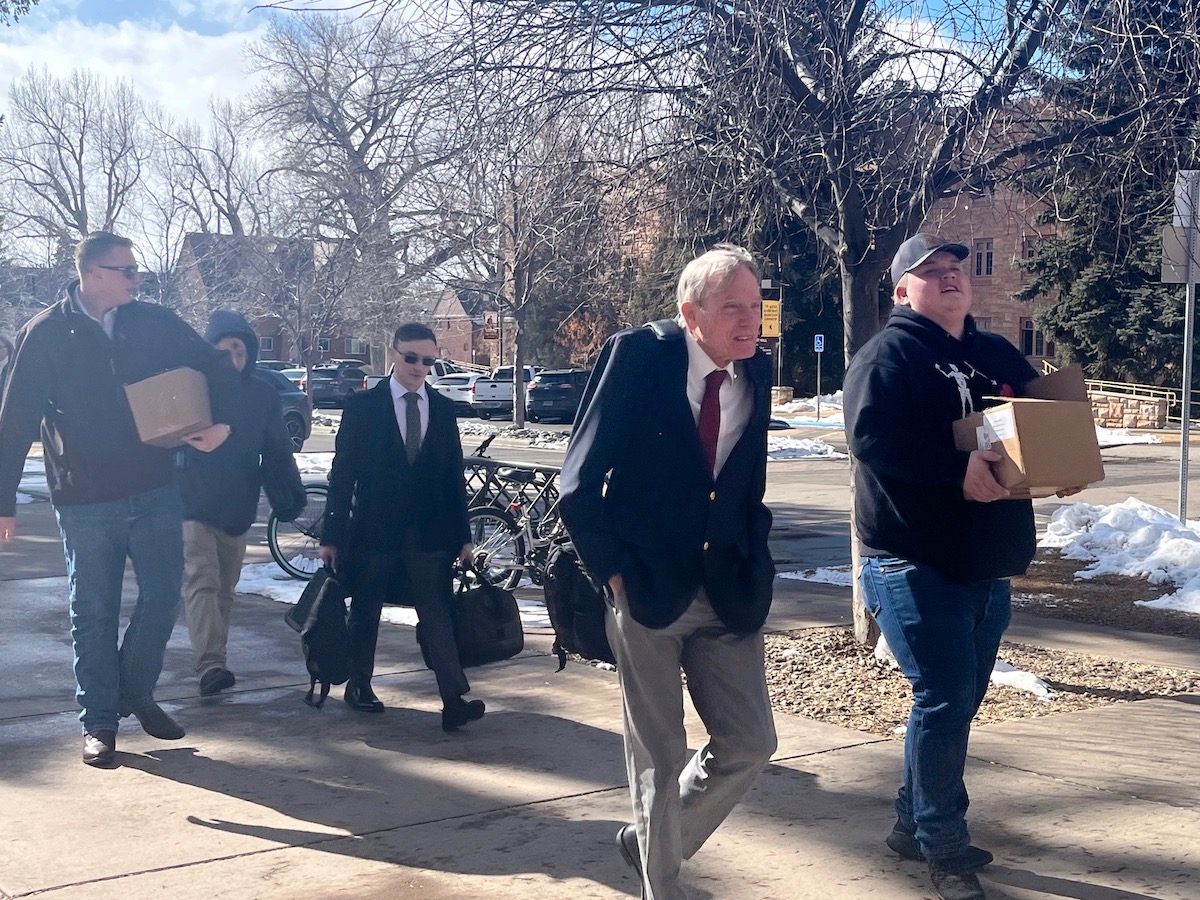
William Happer, co-founder and Chairman of the CO2 Coalition, in the red tie, arrives at the University of Wyoming in Laramie Feb. 14, 2024. (Dustin Bleizeffer)
“This is all about government grifting,” Richmond said. “Can we really afford $1,000 electrical bills every month? So Gov. Gordon’s got a problem coming.”
In the Capitol, Steinmetz said at the onset that the Senate Agriculture hearing wasn’t intended to be a personal attack on the governor. That didn’t stop speakers from taking shots at his policies.
“CO2 capture is unnecessarily costly and dangerous and therefore, it is not worth pursuing for the state of Wyoming — or anyone, for that matter,” Frits Byron Soepyan, a chemical engineer, told lawmakers.
“There are people that are going to say, ‘Climate is not changing.’ Or they’ll say, ‘It’s better to have more CO2.’ We can talk about all of that, but that doesn’t really matter,” Gordon said while speaking to business leaders in Casper on Tuesday.
More than 20 years of climate policy dictated from outside the state has moved markets toward lower-carbon energy sources, Gordon said. If Wyoming’s coal, oil and natural gas are going to remain viable, those industries must have technical solutions to reduce their carbon emissions, the governor has maintained.
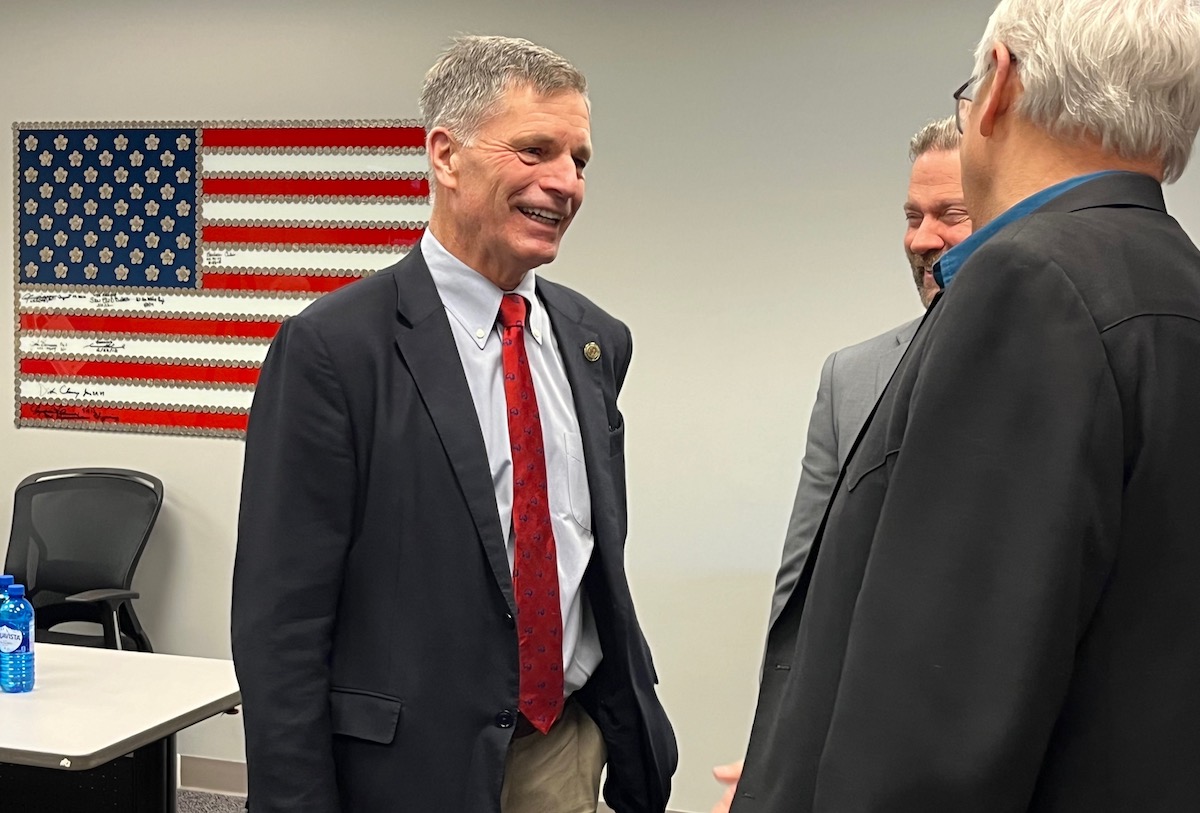
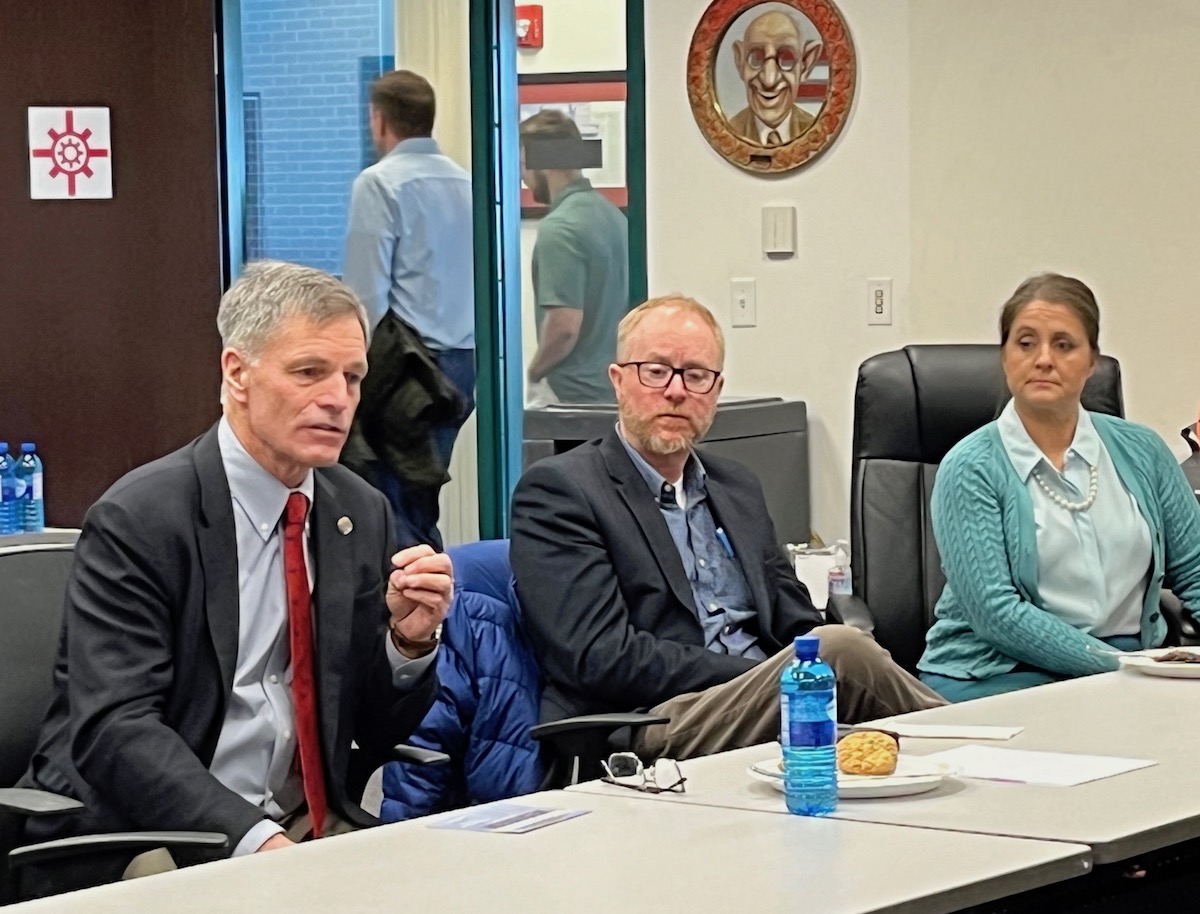
Gov. Mark Gordon visits with City of Casper leaders during an Advance Casper event on Feb. 13, 2024. (Dustin Bleizeffer/WyoFile)
“The reason I say that it doesn’t really matter [where Wyomingites stand on climate change] is that what we are seeing is a regulatory environment that says, ‘We need to move away from fossil fuels because that’s the only way that we can save the planet, and we need to move to renewables because that’s the only way that we can save the climate,’” Gordon said.
“The most important thing is that Wyoming not stick its head in the sand,” he continued. “If [carbon capture] isn’t going to happen here, it’s going to happen — it is already happening in places like Texas and places like Louisiana. We really need to make sure that Wyoming is competitive, that it is a leader and that it is a place that people come to find the solutions.”
Gordon and his chief energy advisor, Randall Luthi, are working with Sen. Cale Case (R-Lander) and others on an idea that more equitably distributes both the cost of adding renewables and the cost of integrating fossil fuel carbon capture into the western electricity grid. All those capital costs — as well as long-term benefits — should be spread “system wide,” Luthi told WyoFile.
Wind turbines north of Medicine Bow, pictured Feb. 9, 2024. (Dustin Bleizeffer/WyoFile)
It will be a tough sell among Wyoming’s counterparts on the western grid, Gordon admitted. But it’s part of his signature “Decarbonizing the West” initiative as chairman of the Western Governors Association. Ultimately, Wyoming cannot impose such a system-wide “fee” on its own, Gordon told WyoFile. But the current electrical power regulatory regime doesn’t fairly distribute the cost of pursuing a net-zero electrical grid.
“We’re all in this together,” Gordon said. “Instead of being a victim, Wyoming can say, ‘If you’re really interested in doing something about CO2, we got the answer. We got the answer from the bottom to the top.’”
A state of climate denial
Steinmetz and other far-right lawmakers in the Legislature have tried to capitalize politically on Gordon’s carbon-capture advocacy. It’s fair to say their criticisms land with some residents of Wyoming, a state long financially dependent on revenue from carbon-producing industries and where fewer than half of residents believe humankind is driving climate change.
Approximately 38% of Wyoming residents believe “climate change is an extremely or very serious problem,” and 46% “have noticed significant effects from climate change over the past 10 years,” according to Colorado College’s annual Conservation in the West Poll, released earlier this month. Fifty-four percent “think that the low level of water in rivers is a serious problem,” according to the poll.
Still, Steinmetz’s and others’ efforts to make a spectacle of Gordon’s carbon policies haven’t gone over seamlessly. There was a fight, for example, over whether the Senate Agriculture Committee’s climate denier-led hearing should have been considered an official legislative event.
In late January Steinmetz spread word of the hearing on official Wyoming Legislature letterhead. She challenged the governor’s authority to pursue a carbon-negative policy: “The Legislature must have a true cost-benefit analysis in order to make an informed policy decision regarding the governor’s decarbonization plans for the state of Wyoming,” the Goshen County senator said in a press release.
CO2 Coalition Executive Director Gregory Whitestone spoke at the University of Wyoming on Feb. 14, 2024. (Dustin Bleizeffer/WyoFile)
The Legislature’s leadership didn’t appreciate it. Two days later the speaker of the House, Rep. Albert Sommers (R-Pinedale) and the Senate president, Sen. Ogden Driskill (R-Devils Tower) sent out another press release purportedly uncoupling the event from the Ag Committee.
The Legislative Service Office explained the decision in an email: “Under the Senate Rules a chairman can convene a meeting of their committee at any point during a legislative session to discuss items they deem to be relevant.”
House Majority Floor Leader, Rep. Chip Neiman (R-Hulett), thought that leaving the hearing sanctioned was “appropriate,” given how “deeply involved agriculture is in the whole issue of climate change.”
Parroting disproven claims
Shuman, the UW climate scientist, missed Turning Point USA’s event with the CO2 Coalition speakers due to a conflict, but afterward he looked into their resumes and a short report they produced about Wyoming and climate change.
“They are not climate scientists,” Shuman said.
The University of Wyoming professor took issue with some of the graphics the CO2 Coalition speakers presented. He was “shocked,” he said, by one graph purporting that annual average max temperatures have declined over the last 90 years in Wyoming, a “truly misleading” assertion.
“Basically, every single weather station across the state refutes that this is the trend,” Shuman said.
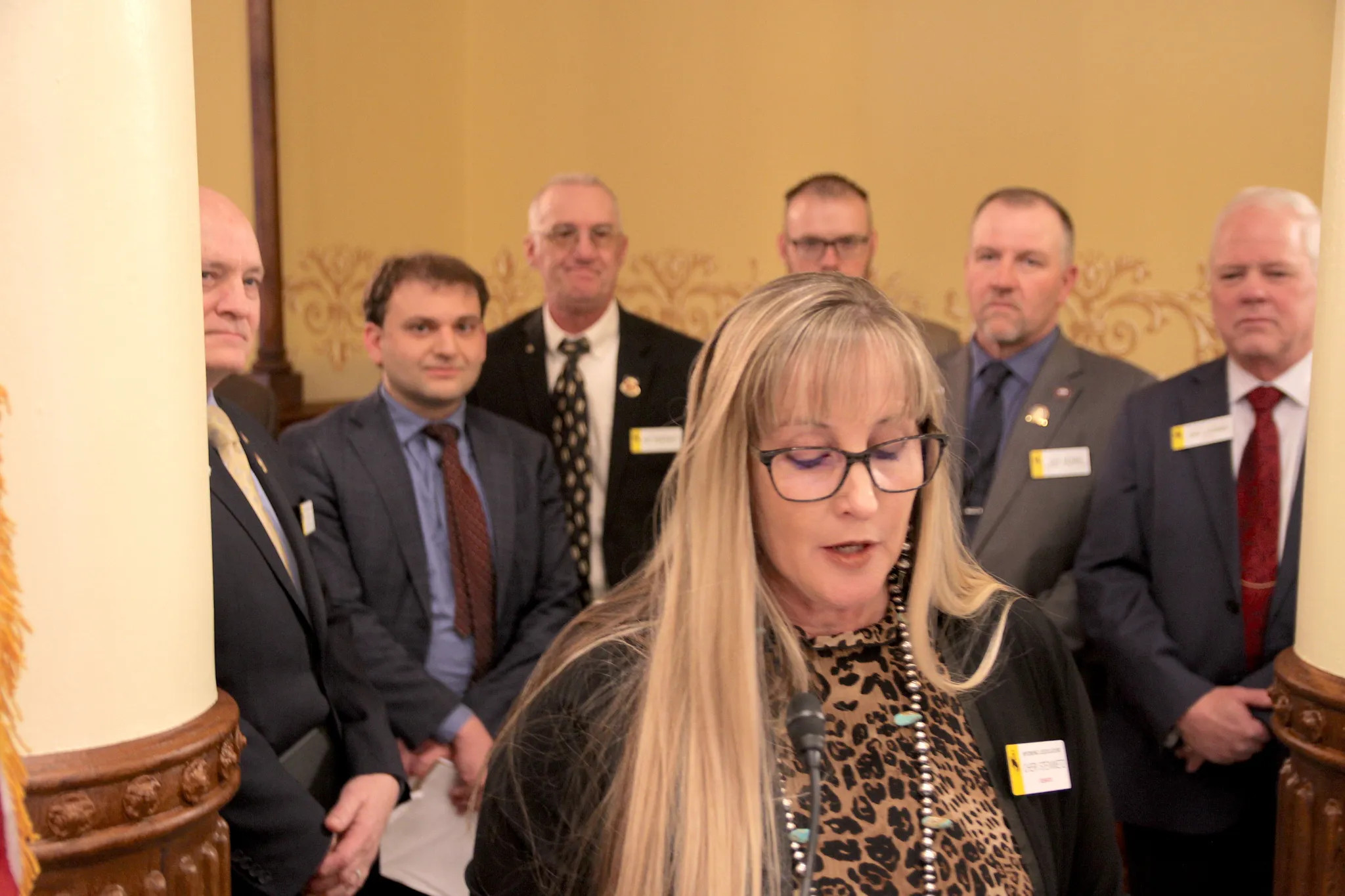
Sen. Cheri Steinmetz (R-Lingle) gives remarks at a press conference that followed a legislative hearing that promoted disproven claims about climate change. (Mike Koshmrl/WyoFile)
Nevertheless, the CO2 Coalition speakers had a receptive audience with the Senate Ag Committee. The next day, Steinmetz and other hardline Republican members of the Legislature gathered for a follow-up press conference.
“Our voters — the citizens of Wyoming — are rightly skeptical of this so-called crisis and permanent carbon capture and sequestration,” Steinmetz said.
Ten members of the Legislature, plus Secretary of State Chuck Gray, spoke after Steinmetz. Some doubted climate change was happening, while others challenged the need to act and take steps like sequestering carbon. Yet other legislators repeated the CO2 Coalition’s primary disproven message: that the primary gas accelerating the climate crisis is actually beneficial.
“We all know CO2is good,” said Sen. Dan Laursen (R-Powell), a hydrographer with the State Engineer’s Office. “Plants have to have it. The more there is there, the plants do better.”
Sen. Tim French (R-Powell) agreed.
Sen. Tim French (R-Powell) gives remarks at a press conference that followed a legislative hearing that promoted disproven claims about climate change. (Mike Koshmrl/WyoFile)
“As a farmer, I need a lot of CO2to grow my crops,” French said. “There’s a lot of hype out there from different individuals, but in my world, my business, I really need it.”
Climate scientists, however, came to consensus decades ago that the atmosphere needs less CO2 — at least if the goal is to inhabit a planet resembling the one we know today. In the middle of the 20th century the average annual temperature in Wyoming was about 40 degrees, Shuman said. Today, it’s approaching 43 degrees.
“While that doesn’t sound like a huge amount, it’s worth keeping in mind that the difference between the last ice age and today is only about 5 to 7 degrees,” Shuman said. “Even a few degrees makes a big difference.”
The Global Monitoring Division of NOAA/Earth System Research Laboratory has measured carbon dioxide and other greenhouse gases for several decades at a globally distributed network of air sampling sites. Credit: NOAA Global Monitoring Laboratory
Gov. Mark Gordon spoke with Advance Casper members Feb. 13 2024 in Casper. (Dustin Bleizeffer/WyoFile)
Click the link to read the article on the WyoFile website (Dustin Bleizeffer):
February 14, 2024
Governor Mark Gordon’s push for carbon capture at coal-fired power plants and for pumping planet-warming carbon dioxide underground to produce more oil isn’t a climate crusade, he told business leaders Tuesday in Casper. It’s an acknowledgment of where policies outside Wyoming have driven markets.
Wyoming, the nation’s top coal producer and among its top oil and natural gas producers, can help meet the goal — and the market reality — of reducing carbon emissions into the atmosphere, he said. But the state doesn’t have to abandon its fossil fuels to do it.
Instead, Gordon is on a mission to prove that integrating carbon capture with fossil fuel production and use is not only economically and technically viable, it’s necessary to fill in the energy-availability gaps that renewable energy introduces into the western electricity grid when the sun doesn’t shine and the wind doesn’t blow.
And if people are honest about the full cost and complete carbon life cycles of both renewables and fossil fuel energy, more states will get on board, he said.
Gov. Mark Gordon visits with Casper business leaders Feb. 13 2024 in Casper. (Dustin Bleizeffer/WyoFile)
“If we can extend the life of these coal plants [by retrofitting them to capture carbon] for a period of time, we can meet that gap,” Gordon told members of Advance Casper, the city’s business and economic development group.
Gordon has been aggressively sharing his energy vision of late. He spoke last fall at Harvard University, which drew a strong rebuke from Wyoming’s far right. He also appeared on “60 Minutes,” where the governor discussed making the state carbon-negative.
One challenge, Gordon explained to members of Advance Casper, is that states that are demanding low-carbon or carbon-free electricity are not fairly distributing those costs, which include the loss of viewsheds and wildlife habitat from wind and solar farms in Wyoming. At the same time, those states don’t want to help pay to capture carbon at Wyoming coal plants, despite their own carbon policies that push costs onto Wyoming ratepayers.
“We need to be able to have the grid pay for the desire to reduce carbon emissions — that’s consumers across” the West, Gordon said.
To that end, Gordon has been lobbying his counterparts in the Western Governors Association. Gordon was elected WGA president last summer, and he established “Decarbonizing the West” as his signature initiative during his one-year tenure.
A sticker at Nerd Gas Co. in Casper. (Dustin Bleizeffer/WyoFile)
The initiative spans an all-of-the-above energy strategy, from nuclear and geothermal power to smarter siting of wind and solar development. Bringing some of those western state leaders onboard with his ideas for adding carbon capture to fossil fuels is still a challenge, Gordon said.
Meantime, the Biden administration — although it’s onboard with Wyoming’s carbon capture research efforts — continues to present existential threats to the state’s struggling fossil fuel industries through restrictive rulemakings to cut carbon emissions, the governor maintains.
State of the state’s energy
In his State of the State address on Monday at the Capitol, Gordon said the Legislature’s task of crafting a state budget for the next two years is particularly challenging under the weight of federal policies that the Biden administration continues to pile on fossil fuels — an industry that has “anchored our economy for over a century,” Gordon said.
The weight of Wyoming’s fossil fuel economic anchor has varied greatly in recent years, and it’s the largest factor in setting the state’s budget — in boom times and in bust. Although revenue from Wyoming’s carbon-based energy industries rebounded after the economic shock of the pandemic, markets have begun to settle back into broader trends that point to a continued decline in Wyoming coal consumption and the potential for even more volatility for oil and natural gas.
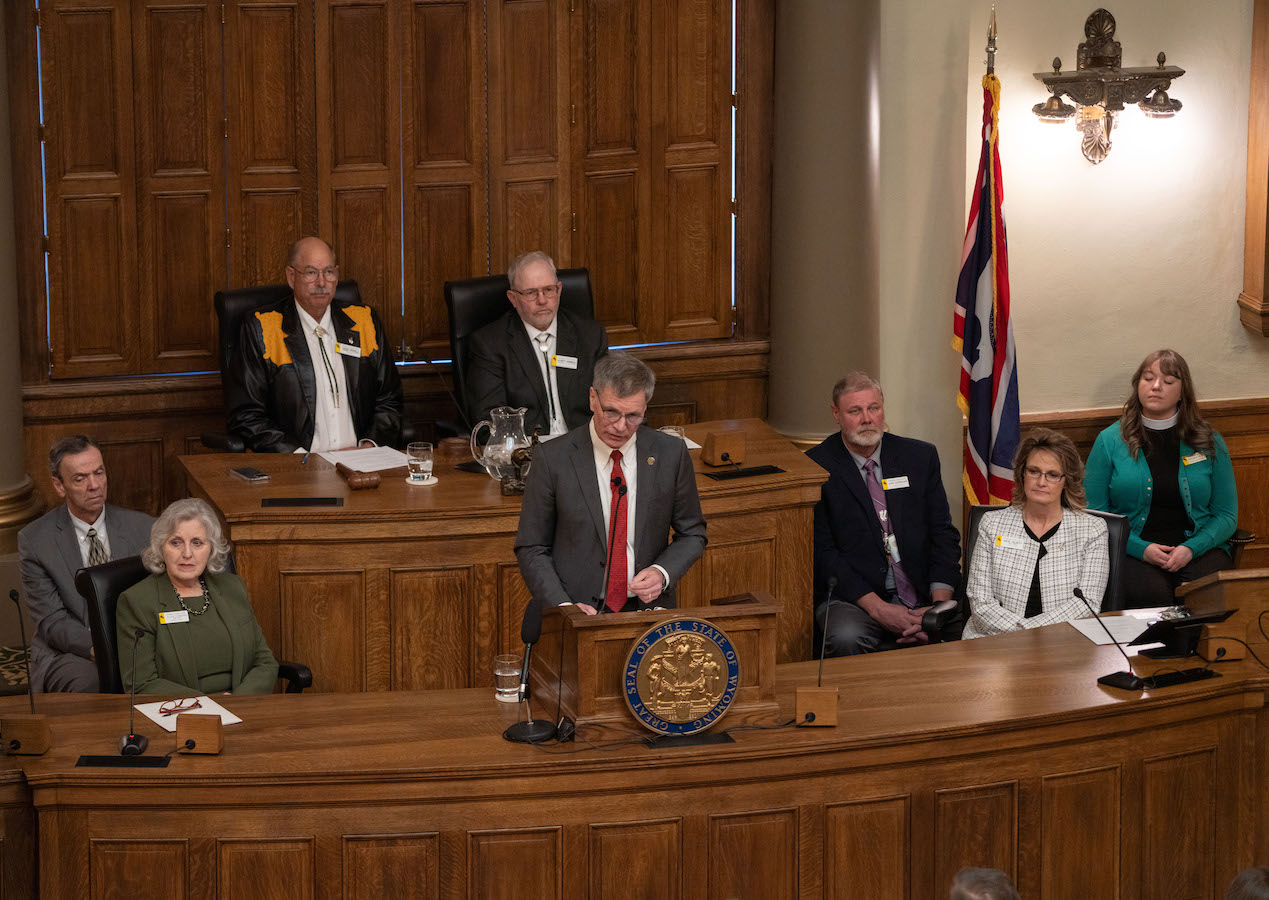
Gov. Mark Gordon gives his State of the State address Feb. 12, 2024, at the Capitol in Cheyenne. (Ashton J. Hacke/WyoFile)
They also represent a federal policy agenda that is “misguided,” “warped” and “unwise” — and, borrowing from a phrase by Gulf War military leader Gen. Norman Schwarzkopf, they amount to “pure, unadulterated ‘bovine scatology,’” Gordon declared.
“Wyoming people know how these policies have left our nation more vulnerable to put our economy — our very way of life — at risk,” Gordon said.
Mauna Loa is WMO Global Atmosphere Watch benchmark station and monitors rising CO2 levels Week of 23 April 2023: 424.40 parts per million Weekly value one year ago: 420.19 ppm Weekly value 10 years ago: 399.32 ppm 📷 http://CO2.Earthhttps://co2.earth/daily-co2. Credit: World Meteorological Organization
Existing green growth policies are leading nowhere fast, so scientists say it’s worth exploring alternatives like degrowth to stay within planetary boundaries.
With Earth’s average annual temperature speeding toward 1.5 degrees Celsius faster than expected and global climate policy on a treadmill, an increasing number of researchers say it’s time to consider a “restorative pathway” to avoid the worst ecological and social outcomes of global warming.
In a study published today in Environmental Research Letters, an international team of scientists wrote that reaching global goals could require focusing on ways to drive rapid changes in the way people live, move, work and eat; on making sure that global wealth is distributed more equitably; and on restoring and protecting biodiversity and ecosystems like forests, oceans, fields and rivers that are critical to removing carbon dioxide from the atmosphere.
The restorative approach should be considered soon because the pace of climate impacts to ecosystems and communities is speeding up, the authors said. Climate extremes are outpacing decades of efforts to cap global warming with tools like carbon trading and offsets. Those are hallmarks of the green growth path mapped out by various United Nations-sponsored climate pacts like the Kyoto Protocol and the Paris Agreement, as well other ancillary agreements. They all aim to keep growing the global economy while reducing greenhouse gas emissions to net zero by 2050—partly based on assuming that large quantities of carbon dioxide will be directly removed from the air and stored by giant machines by then.
Many countries, like France, Sweden and the United States, have reduced emissions while continuing to grow their economies—called decoupling—over the last few decades, but research shows it’s not happening nearly fast enough to cap global warming.
Total global emissions, atmospheric greenhouse gas concentrations and the global average temperature all climbed to record highs during the past 30 years, amounting to about half the total greenhouse gas accumulations in the atmosphere since the start of the industrial age.
“It’s almost too late. We need to get cracking with this,” said Manfred Lenzen, a sustainability researcher at the University of Sydney and co-author of the new paper. “A lot of people think 1.5 is dead already, that we have to realistically aim for staying below 2C,” he said, adding that green growth—decoupling emissions from economic expansion—might have worked if the world had taken it seriously in 2000.
Starting then, it would have taken only a 2 percent annual reduction of greenhouse gas emissions to reach net zero by 2050; starting now means cutting global emissions by 7 percent a year, but the green growth approach is not cutting emissions by anywhere near the required rate, he said. And, particularly as outlined in the policy guiding reports from International Panel on Climate Change, it relies on deployment of unproven technologies.
A future of carbon removal? Credit: Inside Climate News
Carbon-removal technology, for example, is still decades away from deployment at a scale that would match the IPCC’s pathways to cap global warming at 1.5 degrees Celsius, as per the Paris Climate Agreement, said Lenzen.
Lenzen also co-authored a 2021 paper describing a “degrowth” alternative to the existing IPCC options, based on the idea of shrinking economies in rich countries in a controlled way by reducing production and consumption, in order to protect natural resources and reduce environmental damage while improving well-being.
Degrowth Research is Going Mainstream
A 2023 study in The Lancet Planetary Health journal showed that, even in countries with falling emissions and growing economies, emissions are not declining at rates compliant with the Paris Agreement. At the current rates, it would take those countries on average more than 220 years to reduce their emissions by 95 percent, the goal targeted for 2050.
The authors of that study wrote that those decoupling rates in high-income countries “cannot legitimately be considered green … To achieve Paris-compliant emission reductions, high-income countries will need to pursue post-growth demand-reduction strategies, reorienting the economy towards sufficiency, equity, and human wellbeing, while also accelerating technological change and efficiency improvements.”
Another 2023 paper in Nature described widespread scientific skepticism, especially in high-income countries, about the existing strain of tech-driven green growth, and also called for exploring “post-growth perspectives, including [growth-neutral] and degrowth strategies, to cultivate a more comprehensive discourse on sustainable development strategies.”
In any case, Lenzen added, “We’re not giving technology the chance to catch up with consumption, and that has been the dynamics over the past decade,” he said, describing a decades-long trend that is now leading researchers to look at alternative economics built on ecological sustainability and social justice.
The new paper doesn’t specifically use the term “degrowth,” but shares common themes, like focusing on human wellbeing and reduction of inequality. That “opens the possibility of talking about alternative sustainability scenarios without being too provocative about it,” said Lorenz Keyßer, a degrowth researcher at the University of Lausanne. That could make it more palatable to a wider audience, he added, including to the community of scientists who build the complex climate models that integrate human behavior with climate physics.
“Compared to their pathway, I think degrowth thinking is more explicit in terms of the proposed changes,” he said. “And it’s more openly ‘radical’ in the sense of being more pessimistic about green growth and decoupling, and in favor of a more transformative approach, which also includes ruptures and conflict.”
But research on degrowth, and similar related concepts like circular economies, or donut economics, is growing, and the European Parliament last year tasked its research service to study “beyond growth” alternatives, including a hard look to determine whether the European Union Green Deal is really sustainable.
Developing country leaders also recently spelled out steps that could have a huge cumulative impact and help protect vulnerable countries from climate impacts.
Speaking at COP28 in the context of global equity in climate financing, Barbados Prime Minister Mia Mottley said a global financial services tax of 0.1 percent could raise $420 billion, and a 5 percent tax on oil and gas profits would raise another $200 billion, while a 1 percent tax on the value of shipping would raise $70 billion.
And there would have to be some new global compact that “allows countries to recognize that they cannot only act in their own deliberate interest, but they have to also act in the interest of the preservation of global public goods,” Mottley said.
“We happen to be talking about climate,” she added. “But we could easily be talking about pandemics and big pharma. We could easily be talking about the digital divide and big tech.”
“Radical Incrementalism”
Oregon State University ecologist William Ripple, co-author of the new paper, said the findings show that their restorative pathway should be included in climate models along with the five “shared socioeconomic pathways,” or SSPs, that are used by the U.N.’s Intergovernmental Panel on Climate Change.
Current emissions trends, societal denial and lack of political will make their scenario a tough sell, but he said its merits can’t be honestly debated if it’s not included as an option for policy makers.
Their findings suggest a path of “radical incrementalism,” with small short-term steps to achieve big changes, like reducing the need to mine for metals or log forests to levels that don’t threaten biodiversity and ecosystem integrity, with per capita GDP stabilizing over time.
Oil and gas infrastructure is seen on the Roan Plateau in far western Colorado. (Courtesy of EcoFlight)
“Ending fossil fuel subsidies and public lands fossil fuel extraction projects would be great first steps for the U.S. and other developed countries, where applicable,” he said. “These actions would be low-hanging fruit and a good start in the process of radical incrementalism.”
Directly phasing out fossil fuel use is also critical, Ripple added. “An important step in this direction would be the adoption of a global coal elimination treaty since the coal industry has extremely harmful impacts on the climate and human health.”
For the paper, the team compiled a 500-year dataset for several key global climate indicators to measure humanity’s consumption of resources over the period.
“The results show a great acceleration of resource use and impacts since about 1850,” he said. “This illustrates that climate change is a symptom of the broader problem of ecological overshoot, the overexploitation of the Earth, which is driving several environmental crises.” The restorative pathway was designed to tackle this underlying issue, he added.
*As our current predicament makes clear, business-as-usual isn’t working and continued economic growth in wealthy countries isn’t sustainable,” Ripple said. “This motivated us to call for a shift toward post-growth economics where quality of life and societal wellbeing are the main priority.”
The key to curbing ecological overshoot means greatly reducing overconsumption and waste, especially by the wealthy, and implementing ecological economics that would focus on social justice rather than continued growth, he said.
One of the global measures they used dating back to 1820 shows the top 10 percent of the world’s wealthiest have consistently received at least 50 percent of all income, illustrating global economic inequality over the long term.
“The magnitude of this inequality,” he said, “provides further evidence that we need a dramatic change. We face multiple serious and interrelated social and environmental crises. We need economic policies that guide humanity toward more equitable resource use patterns.”
Small island states that arrived after the document was approved, don’t accept the outcome as a consensus decision.
December 13, 2023
Going into overtime under the cover of a dark winter night in Dubai, climate negotiators at COP28 cooked up a weak sauce of climate half-measures that fail to adequately address the existential risk of global warming to millions of people around the globe, according to leading climate experts at the conference.
The UAE Consensus, COP28 president Sultan al-Jaber said, represents a clear step in a just transition away from fossil fuels, but the tarnished image of the United Nations Framework Convention on Climate Change, and its process requiring consensus among nations, took another big hit because 39 small island states most affected by global warming were not in the room when al-Jaber signaled acceptance during the closing plenary.
As a result, there will be an asterisk next to COP28 in the future. To activists and many country delegates, the way the outcome came about further undermined al-Jaber’s leadership, which had been questioned since it was announced last year due to his apparent conflict of interest as head of the Abu Dhabi National Oil Company, one of the biggest fossil fuel producers in the world.
The conference started Nov. 30 with a growing coalition of countries calling for a fossil fuel phase out, and earlier drafts of the decision documents all included some iteration of that language, raising hopes that the UNFCCC would face the heart of the problem head-on.
But the finalized text calls only for accelerating efforts to “phase down” the use of unabated coal power, to “[transition] away from fossil fuels in energy systems, in a just, orderly and equitable manner,” and to accelerate action toward that transition “in this critical decade.”
Some of the speakers at the closing plenary, including Special Presidential Envoy for Climate John Kerry, said the mere mention of moving away from fossil fuels could be interpreted as a successful outcome for the climate summit. Al-Jaber tooted his own horn during the closing plenary by saying, “We have delivered a robust action plan to keep 1.5 in reach.”
That reference to the Paris accord’s goal of limiting warming to 1.5 degrees Celsius over pre-industrial levels elicited an immediate response from some climate scientists, including Rob Larter, a polar researcher with the British Antarctic Survey.
“When you see statements like this you know you’re being lied to,” Larter wrote in a social media post. “What’s been agreed certainly does not keep 1.5C in reach.”
Larter was one of the first scientists to highlight the abrupt and alarming decline of Antarctic sea ice this year. The vast expanses of ice at the poles function as one of the planet’s main cooling systems by reflecting a lot of incoming solar energy back into space. A permanent reduction of that surface would lead to additional heating of the atmosphere.
He faulted the statement for ignoring that carbon dioxide removal technologies will need to be scaled up massively to meet the 1.5 degree Celsius goal, and said there is still no convincing plan on how the transition away from fossil fuels will occur.
“We know it will not happen through national voluntary means alone. Collective, global agreements, on finance, carbon pricing, and technology exchange, are also needed, at a scale that vastly exceeds what is now on the table,” he said.
The new COP28 agreement also calls for “accelerating and substantially reducing non-carbon-dioxide emissions globally, including in particular methane emissions by 2030,” and for speeding the reduction of emissions from road transport, as well as “phasing out inefficient fossil fuel subsidies that do not address energy poverty or just transitions, as soon as possible.”
Kerry said the document should be seen as a significant achievement, given the challenge of trying to win consensus among 200 parties. “For the first time in the history of our regime, the decision supported by all nations of the world calls for transitioning away from fossil fuels in energy systems, so as to achieve net zero by 2050,” Kerry said.
“That is clear,” he said, even if it is not as strong as many would have liked.
Kerry said the applause that rang out in the plenary for the small island state representatives was “a clarion call to all of us about our obligation and responsibility over these next months to make sure we’re reaching as far as we can to implement as fast as we can.”
“We are a little confused about what just happened,” the delegate from Samoa said on behalf of AOSIS. “It seems that you gavelled the decisions, and the small island developing states were not in the room. We were working hard to coordinate the 39 small island developing states that are disproportionately affected by climate change, and so were delayed in coming here.”
The agreement falls far short of what would be needed to prevent some island states from being swamped by rising seas by the end of the century, AOSIS wrote, referring to it as a “draft decision,” which implies that the group doesn’t consider the document finalized.
“The course correction that is needed has not yet been secured,” the AOSIS statement continues. “We have made an incremental advancement over business as usual when what we really needed is an exponential step-change in our actions and support … We do not see any commitment or even an invitation for Parties to peak emissions by 2025.”
Mauna Loa is WMO Global Atmosphere Watch benchmark station and monitors rising CO2 levels Week of 23 April 2023: 424.40 parts per million Weekly value one year ago: 420.19 ppm Weekly value 10 years ago: 399.32 ppm 📷 http://CO2.Earthhttps://co2.earth/daily-co2. Credit: World Meteorological Organization
Although the decision frequently refers to science showing that fossil fuels must be phased out, the agreement doesn’t include a path toward the needed actions, the island states said.
“It is not enough for us to reference the science and then make agreements that ignore what the science is telling us we need to do,” the group wrote.
“I think AOSIS wanted to highlight that this decision could not be seen as being adopted in their name,” said Sébastien Duyck, a senior attorney with the Center for International Environmental Law. “The outcome is not enough to protect their sovereign rights, human rights of future generations.”
Statements from other countries during the closing plenary showed that the consensus touted by al-Jaber is fragile, and was reached mainly to avoid the appearance of a disappointing failure.
The German delegate said there were tears in the room, but that they were not all tears of joy, and spoke directly to island states: “Samoa, Marshall Islands, we see you, we feel you, we know this might not be enough.”
Some oil producing countries from the Arab League said the new agreement veered too far off the Paris Agreement by ignoring the principle of national self-determination, by mentioning a timeline, however vague, for the energy transition, and by shifting the conversation away from emissions to the source of emissions.
COP28 followed a now-familiar pattern: Heads of state, heads of governments and ministers flying in on private jets at the beginning of the talks—in the case of the United Kingdom, three high-level representatives all arriving on separate private jets—and making flashy announcements about scientifically unfounded non-binding deals. [ed. emphasis mine]
The ice sheets of Antarctica are one of the world’s most noted tipping elements. Melt water from the Nansen ice shelf fracture in Antarctica. Photo by Stuart Rankin (CC BY-NC 2.0)
Representatives for Indigenous communities and civil society environmental groups said the agreement doesn’t go nearly far enough to ensure the fossil fuel phase out science demands, or toward ensuring climate justice for developing countries.
Missing is language to ensure that rich nations go first and fast to end their fossil fuel addiction, and the groups pointed out that planned oil and gas developments in just a handful of rich, developed countries are enough to “bust the goal of 1.5 degrees.”
Native land loss 1776 to 1930. Credit: Alvin Chang/Ranjani Chakraborty
The outcome perpetuates a 500-year legacy of colonialism and will lead to more inequality in the future by continuing to encourage the commodification of nature, the Indigenous representatives said. And even though the final documents recognize the role of Indigenous people as the guardians of Mother Earth, “Our rights and knowledge continue to be sidelined in these discussions,” an Indigenous representative said.
The head of the Marshall Islands delegation, John Silk, called the outcome dishonest.
“I came from my home islands to work with you to solve the greatest challenge of our generations, to build a canoe together for my country …” he said. “We have built a canoe with a weak and leaky hull. Yet we have to put it into the water because we have no other option,” he said.
“I appreciate the effort that has gone into this outcome, but it has not been inclusive,” he said. “The fact that the decision was gavelled without a major group in the room … is unacceptable … This is a small step in the right direction in this process, a good signal. But in the context of the real world, where temperatures are rising and people are dying, it is not enough. And so as we sail this leaky canoe together, let’s agree to patch the holes so we can keep the canoe afloat for the sake of all of us, especially the most vulnerable.”
Oil and gas infrastructure is seen on the Roan Plateau in far western Colorado. (Courtesy of EcoFlight)
The University of Wyoming’s School of Energy Resources, and its partners, are advancing multiple CO2 capture and sequestration demonstration projects at Basin Electric’s Dry Fork Station north of Gillette, seen here on Sept. 2, 2022. (Dustin Bleizeffer/WyoFile)
State seeks public comment on proposals submitted by Black Hills Energy, natural gas pipeline giant Williams Companies and others.
The Wyoming Energy Authority has recommended Gov. Mark Gordon award a combined $37.5 million to support six energy projects, including coal-to-hydrogen and carbon capture proposals.
To pay for the initiatives, Gordon would tap a $150 million pot of Wyoming taxpayer money that the Legislature established in 2022 and set aside for the governor to spend at his discretion. The Wyoming Energy Authority, which screens proposals for the Energy Matching Funds program, is accepting public comment on the projects through Sunday.
The agency is looking for both technical input and comments regarding the merits of each project, according to spokesperson Honora Kerr. None of the six recommended applications include renewable energy proposals that don’t involve fossil fuels.
Summaries of the six projects can be viewed at the Wyoming Energy Authority’s website, and comments can be submitted to wea@wyo.gov.
Wyoming utility Black Hills Energy and natural gas pipeline giant Williams Companies are among the six private firms to potentially receive state matching funds. The state’s $37.5 million investment would leverage a total $120 million in federal and private funding, according to the Wyoming Energy Authority.
This map depicts the location of the proposed Sweetwater Carbon Storage Hub. (Bureau of Land Management)
The aim of the Energy Matching Funds program is to give Wyoming-based clean- and low-carbon energy projects a competitive edge by providing matching funds needed to land federal dollars available via the Inflation Reduction Act and Infrastructure, Investment and Jobs Act, according to the energy authority.
Recommended projects
The Wyoming Energy Authority compiles and updates questions and answers about project proposals to this spreadsheet. Here’s a brief description of each of the six energy projects.
° Membrane Technology and Research, Inc.’s partnership with the Department of Energy for carbon capture and storage efforts at Basin Electric’s Dry Fork Station: $8,000,000.
Colorado and Wyoming are collaborating to support a regional team working to power innovative pathways toward climate resiliency by utilizing data, predictive modeling and cutting edge technology to address key challenges. The Colorado-Wyoming Regional Innovation Engine (CO-WY Engine) is one of 16 finalists in the first-ever National Science Foundation (NSF) Regional Innovation Engines Competition, which will award up to $160 million in funding over the next ten years.
Officials in both states recognize the opportunity to secure federal funding that will transform the region into a national leader in developing climate-resilient and sustainable technologies and expand economic opportunities and workforce development in these key areas.
To elevate the CO-WY Engine, Colorado and Wyoming have both committed to align resources that will support the Engine’s goals, including increased engagement of the business community with the region’s research institutions and Federal Labs; attracting more funding to support the commercialization and monetization of new technologies; and growing diversity within the region’s workforce to include rural communities.
“We are thrilled to partner with Wyoming on this plan as Colorado is leading our country on environmental tech to help address climate challenges. This funding will grow the work of our universities and federal labs while creating more jobs,” said Gov. Jared Polis.
“The pathway to a prosperous global future will be paved with adequate, affordable energy and a rigorous commitment to a healthy environment,” Gov. Gordon said. “Wyoming understands the urgency of addressing climate challenges. Our unequaled leadership in innovating and developing needed technologies supports Wyoming’s all-of-the-above energy strategy. This approach will grow our economy, develop our workforce and support thriving communities.”
The CO-WY Engine, spearheaded by Innosphere Ventures, looks to transform the region into a leader in the development and commercialization of climate-resilient and sustainable technologies. These technologies will support communities across the region and the country to monitor, mitigate and adapt to climate impacts. They are expected to have direct applications to water resource management, agriculture technology, and extreme weather, including wildfires and flooding.
“We can solve so many climate-related challenges with technology-driven solutions, and NSF funding will dramatically increase what we can accomplish,” said Mike Freeman, CEO of Innosphere Ventures and lead of the CO-WY Engine’s proposal to the NSF. “We are pleased to have the support of both Colorado and Wyoming, which have such a strong history of collaboration and share our commitment to creating an inclusive, nationally and internationally relevant Engine that employs a diverse workforce and benefits rural and urban communities alike.”
Among the initiatives being explored by Colorado and Wyoming, the Wyoming Business Council, Wyoming Venture Capital, the Colorado Office of Economic Development and International Trade, and Colorado’s Venture Capital Authority are assessing the possibility of a venture capital fund or funds that will invest in startups commercializing technologies that emerge from the CO-WY Engine.
These commitments build upon existing collaboration between the two states, including a four state Memorandum of Understanding (MoU) with New Mexico and Utah to create the Western Inter-State Hydrogen Hub to advance a regional hydrogen economy. Colorado and Wyoming have also signed an MoU outlining the states’ commitments to explore the development of direct air capture to reduce carbon dioxide in the atmosphere.
“Across the Midwest and Mountain States, Wyoming and Colorado rise to the top as one of only a handful of regions that have the talented workforce, collaborative business ecosystem, and research and development capabilities to become a national leader in developing climate resilient technologies. NSF funding will accelerate that growth exponentially, and we are committed to working with Colorado to seize this opportunity,” said Josh Dorrell, CEO of the Wyoming Business Council.
“In Wyoming, Colorado has found a nimble partner equally committed to growing a strong, diversified economy, engaging urban and rural communities alike, and leveraging our regional strengths to create new commercial opportunities that also create climate resiliency. Elevating shared priorities and resources like a regional venture capital fund will directly support the development of the CO-WY Engine as a national and global leader in climate-resilient technologies,” said Eve Lieberman, OEDIT Executive Director. The NSF Engines program envisions supporting multiple flourishing regional innovation ecosystems across the U.S., spurring economic growth in regions that have not fully participated in the technology boom of the past few decades.The NSF is expected to announce successful Regional Innovation Engines this fall.
Crews set up a workover rig June 3, 2022, in the Salt Creek oil field where CO2 from ExxonMobil’s Shute Creek facility was injected for enhanced oil recovery. (Dustin Bleizeffer/WyoFile)
Backed by the promise of billions in federal dollars, energy companies are lining up to accept an invitation by Wyoming officials to collect industrial sources of carbon dioxide and pump it deep underground.
Essentially, the vision is to build a new low-carbon energy industry that scrubs the planet-warming gas from fossil fuels, keeping those fuels in the energy mix and simultaneously helping to address the climate crisis in a way that pays dividends to developers and the state.
Wyoming, according to Gov. Mark Gordon and other state officials, is primed to launch the industry. Not only has the state spent years testing its subterranean capacity to permanently store carbon dioxide, it has devoted more than a decade to building a legal and regulatory framework to win the federal government’s approval. Only Wyoming and North Dakota have won primacy over the federal program to permit such activities.
Now, the state’s top environmental regulator is considering the first in what many expect to be a wave of permit applications to drill the deep wells necessary to launch the new industry.
This schematic depicts how carbon dioxide from industrial sources might be collected for geologic sequestration. (Wyoming Department of Environmental Quality)
“Since 2010 [Wyoming has] been working on how to ensure this particular program could get off the ground and be protective of the environment with a lot of the risks that are involved with these kinds of projects,” said Lily Barkau, natural resources program manager at the Wyoming Department of Environmental Quality.
The agency is soliciting public comments on three carbon dioxide injection well permit applications submitted by Frontier Carbon Solutions. Two more “Class VI” permits are under review at the agency, but not yet ready for public feedback.
Sequestering CO2
Industry and regulatory officials eagerly note that pumping carbon dioxide underground isn’t fantasy. For decades, oil and gas developers have pumped the gas into oilfield formations to squeeze out more oil. Wyoming even has a “backbone” carbon dioxide pipeline that delivers the gas from southwestern and central Wyoming to multiple oilfields in the northeast corner of the state and into Montana.
While Wyoming still hopes to expand “enhanced oil recovery” via carbon dioxide injection, officials are also eager for companies to pump the gas deeper underground into saline formations. Here, at depths of 10,000 to 15,000 feet, carbon dioxide — compressed into liquid form — can be pumped and stored permanently, according to state and industry officials.
Assurances that the gas will remain underground are based on seismic surveys and deep geologic testing conducted by the U.S. Geological Survey and the University of Wyoming School of Energy Resources.
There are skeptics, however, and many questions about the logistics of deep carbon dioxide “sequestration,” as well as whether all of the public resources invested are justified.
Skepticism and questions
So far, capturing carbon dioxide from industrial smokestacks — be they attached to trona processing plants, cement factories or coal-fired power plants — hasn’t proven economical at large scale. However, industry officials point to the federal 45Q tax credit — which was expanded under the Inflation Reduction Act — for vastly improving the economics of carbon capture and storage.
Gov. Mark Gordon and U.S. Environmental Protection Agency Administrator Michael Regan met with University of Wyoming School of Energy Resources officials Aug. 9, 2023 in Laramie. (Dustin Bleizeffer/WyoFile)
Until industrial facilities in the southwest region of the state — including in corners of Colorado and Utah — are fitted with carbon capture, Frontier Carbon Solutions plans to collect its carbon dioxide from a “direct air capture” project still in development.
Other questions remain:
How will facilities such as direct air capture farms get carbon-free power without sprawling renewable energy development on sensitive landscapes?
How much will it cost to safely manage highly saline water displaced by carbon dioxide in deep geologic formations?
And, is all the time and public resources merely a distraction from proven renewable energy and the declining costs of installing wind and solar energy?
“Billions of dollars have been wasted trying to prove that this technology is real,” Wenonah Hauter, executive director of Food & Water Watch, told the Associated Press in May. “And all we have to show for it are a series of spectacular failures.’’
Projects under review
Texas-based Frontier Carbon Solutions is a partner in the Sweetwater Carbon Storage Hub project in southwest Wyoming. The effort is part of the federal CarbonSAFE Initiative led by the University of Wyoming’s School of Energy Resources, which won $40.5 million in support from the U.S. Department of Energy. UW and Frontier Carbon Solutions will contribute another $10.1 million to the project for a total of $50.6 million, according to DOE and university officials.
The “storage hub” will have a minimum storage capacity of 50 million metric tons of carbon dioxide over the life of the project — about 20 years, according to Frontier Carbon Solutions. For context, Wyoming’s annual carbon dioxide emissions from industrial fossil fuel consumption — excluding motor vehicle pollution — was 54.6 million metric tons in 2021, according to the U.S. Energy Information Administration.
The company is seeking three permits under the Wyoming Department of Environmental Quality’s Underground Injection Control program. Public comment closes Oct. 19.
Click here for more information about the company’s permit applications. Comments can be submitted electronically via DEQ-online portals for each of the three permits: permit 242, permit 243 and permit 244. Comments may also be submitted by mail to: Ms. Lily Barkau, P.G., Groundwater Section Manager, Wyoming Department of Environmental Quality, Water Quality Division, 200 West 17th Street, 2nd Floor, Cheyenne, WY 82002.
DEQ will also hold a public hearing on the Class VI well permits, with dates yet to be announced. If the permits are approved, the company will still have to submit more information from initial drilling activities before DEQ can grant Frontier Carbon Solutions a permit to actually inject carbon dioxide, Barkau said.
Tallgrass Energy is also seeking a Class VI injection well permit for its Eastern Wyoming Sequestration Hub in Laramie County. That permit is not yet up for public comment. However, the U.S. Bureau of Land Management is seeking public comment regarding the company’s application for rights-of-way on federal surface in Laramie County.
This diagram depicts how CO2 is injected deep underground for geologic storage. (U.S. Department of Energy)
Public comment has been extended to Oct. 10. More about the project and how to comment can be found on the BLM’s project website.
Tallgrass was awarded $4.1 million for the project from the Wyoming Energy Authority in 2022, which the company will match in full, according to the agency. The grant comes from a $10 million legislative appropriation for carbon capture, storage and utilization projects.
First round of carbon dioxide injection permitting
The state won authority over the program after more than a decade of legislation to establish a legal and regulatory framework to allow for the geologic storage of carbon dioxide.
That framework includes settling the question of who owns the underground “pore space” where carbon dioxide will be stored. The state declared it belongs to the surface estate, which clarifies who gets paid for use of the pore space and who is liable. The state also set out to appease potential developers by giving them an opportunity to transfer their liability for carbon dioxide injections to the state if they meet post-closure requirements intended to protect water and human health, according to Barkau.
Wyoming, with primacy over the federal Class VI injection well permitting program, can shave years off the permitting process, Barkau said. And that makes Wyoming an attractive place to launch carbon dioxide storage projects.
“I think we’ve been able to prove that if the operator is willing to work collaboratively, it can be done in a very expedited time frame and still meet all of the rules and regulations and be protective of human health and the environment,” Barkau said.
Dave Marston has written a profile of friend of Coyote Gulch Allen Best. Click the link to read the article on the Writers on the Range website (David Marston):
Usually seen with a camera slung around his neck, Allen Best edits a one-man online journalism shop he calls Big Pivots. Its beat is the changes made necessary by our rapidly warming climate, and he calls it the most important story he’s ever covered.
Best is based in the Denver area, and his twice-a-month e-journal looks for the radical transitions in Colorado’s energy, water, and other urgent aspects of the state’s economy. These changes, he thinks, overwhelm the arrival of the telephone, rural electrification and even the internal combustion engine in terms of their impact.
Global warming, he declares, is “the biggest pivot of all.”
Whether you “believe” in climate change — and Best points out that at least one Colorado state legislator does not — there’s no denying that our entire planet is undergoing dramatic changes, including melting polar ice, ever-intensifying storms, and massive wildlife extinctions.
A major story that Best, 71, has relentlessly chronicled concerns Tri-State, a wholesale power supplier serving Colorado and three other states. Late to welcome renewable energy, it’s been weighed down with aging coal-fired power plants. Best closely followed how many of its 42 customers — rural electric cooperatives — have fought to withdraw from, or at least renegotiate, contracts that hampered their ability to buy cheaper power and use local renewable sources.
Best’s first newspaper job was at the Middle Park Times in Kremmling, a mountain town along the Colorado River. He wrote about logging, molybdenum mining and the many miners who came from eastern Europe. His prose wasn’t pretty, he says, but he got to hone his skills.
Because of his rural roots, Best is most comfortable hanging out in farm towns and backwaters, places where he can listen to stories and try to get a feel for what Best calls the “rest of Colorado.” Pueblo, population 110,000 in southern Colorado, is a gritty town he likes a lot.
Pueblo has been forced to pivot away from a creaky, coal-fired power plant that created well-paying jobs. Now, the local steel mill relies on solar power instead, and the town also hosts a factory that makes wind turbine towers. He’s written stories about these radical changes as well as the possibility that Russian oligarchs are involved in the city’s steel mill.
In 2015, signs supporting coal were abundant in Craig, Colo. Photo/Allen Best
Best also vacuums up stories from towns like Craig in northwestern Colorado, home to soon-to-be-closed coal plants. He says he finds Farmington, New Mexico, fascinating because it has electric transmission lines idling from shuttered coal power plants.
His Big Pivots may only have 1,091 subscribers, but story tips and encouragement come from some of his readers who hold jobs with clout. His feature “There Will Be Fire: Colorado arrives at the dawn of megafires” brought comments from climate scientist Michael Mann and Amory Lovins, legendary co-founder of The Rocky Mountain Institute.
“After a lifetime in journalism, his writing has become more lyrical as he’s become more passionate,” says Auden Schendler, vice president of sustainability for the Aspen Ski Company. “Yet he’s also completely unknown despite the quality of his work.”
Among utility insiders, and outsiders like myself, however, Best is a must-read.
His biggest donor has been Sam R. Walton’s Catena Foundation — a $29,000 grant. Typically, supporters of his nonprofit give Big Pivots $25 or $50.
Republican River in Colorado January 2023 near the Nebraska border. Photo credit: Allen Best/Big Pivots
Living in Denver allows him to be close to the state’s shot callers, but often, his most compelling stories come from the rural fringe. One such place is the little-known Republican River, whose headwaters emerge somewhere on Colorado’s Eastern Plains. That’s also where Best’s grandfather was born in an earthen “soddie.”
Best grew up in eastern Colorado and knows the treeless area well. He’s written half a dozen stories about the wrung-out Republican River that delivers water to neighboring Kansas. He also sees the Eastern Plains as a great story about the energy transition. With huge transmission lines under construction by the utility giant Xcel Energy, the project will feed renewable power from wind and solar to the cities of Denver, Boulder and Fort Collins.
Best admits he’s sometimes discouraged by his small readership — it can feel like he’s speaking to an empty auditorium, he says. He adds, though, that while “I may be a tiny player in Colorado journalism, I’m still a player.”
He’s also modest. With every trip down Colorado’s back roads to dig up stories, Best says he’s humbled by what he doesn’t know. “Just when I think I understand something, I get slapped up the side of the head.”
Dave Marston is the publisher of Writers on the Range, writersontherange.org, an independent nonprofit dedicated to spurring lively conversation about the West. He lives in Durango, Colorado.
Just for grins here’s a gallery of Allen’s photos from the Coyote Gulch archives.
Top photo, Vestas located a factory to produce wind turbines in Pueblo in 2010 and has added other renewable energy elements even as the coal-burning units have begun to retire. Photo credit: Allen Best
The Thunder Wolf Energy Center east of Pueblo, near Avondale, has 100 megawatts of battery storage. Credit: Big PivotsRebecca Mitchell. Photo credit: Allen BestPhoto credit: Allen Best/Big PivotsThe Yampa River emerging from Cross Mountain Canyon in northwest Colorado had water in October 2020, but only the second “call” ever was issued on the river that year. Photo/Allen BestOn May 17, Rabbit Ears Pass still had plentiful snow for Muddy Creek, a tributary to the Colorado, and for the Yampa River tributaries. Photo/Allen BestByron Kominek on a February afternoon at the site of his late grandfather’s farm, which he calls Jack’s Solar Garden. Photo/Allen BestThis canal in the South Platte Valley east of Firestone, north of Denver, could conceivably also be a place to erect solar panels without loss of agricultural productivity. Photo/Allen BestCanal in the San Luis Valley. Photo credit: Allen Best/Big PivotsSnow blankets buildings and all else in Steamboat Springs. The larger of the two ski areas there had received as much snow by mid-January ad it did all of last season. Photo/Allen Best
Bill McKibben, right, conferring with Land Institute founder Wes Jackson at the 2019 Prairie Festival, has strongly motivated many, including some CRES members. Photo/Allen BestIrrigation in the San Luis Valley in August 2022. Photo/Allen BestNorthern Colorado on July 9, 2021, sunset with Longs Peak in the background. Photo credit: Allen Best/Big PivotsHorizontal sprinkler. Photo credit: Allen Best/Big PivotsA turbine whirls on a farm east of Burlington, Colo. Colorado’s eastern plains already have many wind farms—but it may look like a pin cushion during the next several years. Photo/Allen BestSan Juan Mountains December 19, 2016. Photo credit: Allen BestVail has begun methodically removing grass from its parks from areas that serve little purpose, partly with the goal of saving water. Buffehr Creek Park after xeriscaping. Photo: Town of Vail Glen Canyon Dam, December 2021. Credit: Allen BestYampa River. Photo credit: Allen Best/The Mountain Town NewsSaguache Hotel. Photo credit: Allen Best/The Mountain Town NewsSkyline Drive at night Cañon City. Photo credit: Vista Works via Allen Best/The Mountain Town NewsThe proposal would have Xcel continue tax payments to Pueblo and Pueblo County until 2040.Drilling rigs along the northern Front Range in 2013. Photo/Allen Best
Washington D.C.– More than 500,000 people are calling on the U.S. Forest Service to protect mature and old-growth trees and forests from logging on federal land as a cornerstone of U.S. climate policy.
In April the Forest Service issued a rulemaking proposal to improve the climate resilience of federally managed forests. The public comment period on the proposal closed today.
In addition to the hundreds of thousands of people who weighed in, dozens of environmental and grassroots organizations submitted comments, including the Climate Forests Campaign, a coalition of more than 120 organizations working to protect mature and old-growth trees and forests on federal land from logging.
Activists and environmental advocates gathered today at the D.C. offices of the Department of Agriculture, which oversees the Forest Service, to celebrate the amount of public support.
“Hundreds of thousands of people from across the country have chimed in with enthusiastic support for President Biden’s order to protect mature and old-growth forests on federal land,” said Blaine Miller-McFeeley, senior legislative representative at Earthjustice. “Establishing a durable, nationwide, rule to protect these vital forests would be a historic climate achievement for the U.S.”
“The public wants the nation’s mature forests and trees to be protected from the chainsaw, and with good reason,” said Garett Rose, senior attorney at the Natural Resources Defense Council (NRDC). “They store carbon. They protect imperiled species. They safeguard key waterways. It’s well past time for the federal land managers to adopt a rule that durably protects these climate-critical trees–and lets them be a key ally in the climate right.”
“Mature and old-growth forests are the only proven, cost-effective carbon capture and storage technology. We just have to let them grow,” said Randi Spivak, public lands policy director at the Center for Biological Diversity. “It’s really frustrating that the Forest Service, in the midst of this proposal, is still planning to log even more of these old trees. Our climate can’t wait another year for a rule. The time to act is now.”
“Climate change isn’t off in the distant future; it’s here, now. My hometown of Montpelier, VT and others across the Northeast were ravaged by climate-driven floods on July 10th that could have been mitigated by the presence of old-growth forests,” said Zack Porter, executive director of Standing Trees. “As the single largest steward of forests in the nation, the US Forest Service has an obligation – not just an opportunity – to protect communities from natural disasters by managing national forests, often located in critical headwaters, to grow old.”
“We are urging President Biden to enact a clear rule protecting mature and old growth forests from the Forest Service chopping block,” said Adam Rissien, WildEarth Guardians’ ReWilding Manager. “Public support has never been higher for bold, effective solutions to keep carbon in the woods and in the ground.”
“I’m not surprised that so many people took the time to get involved in this comment period. We love our trees and forests so of course people spoke up, said Ellen Montgomery, public lands campaign director for Environment America Research & Policy Center. “Our forests clean our water, are home for wildlife and are an incredible ally in our work to stop climate change. Our mature and old-growth forests and trees are worth more standing than as lumber.”
Earlier this month, the Bureau of Land Management (BLM) concluded a public comment period for its own proposed rulemaking, with hundreds of thousands of people calling on the federal government to protect mature and old-growth trees and forests from logging. In March the BLM announced its wide-ranging “Conservation and Landscape Health” rule, with a goal to “promote ecosystem resilience on public lands” and included an acknowledgment of the importance of mature and old-growth trees and forests.
In addition to the two proposed rules, the Forest Service and the BLM releasedan inventory of mature and old-growth forests, the first of its kind, as required by theexecutive order President Biden signed on Earth Day 2022. The White House directed the Forest Service and the BLM to inventory and conserve mature and old-growth forests on federal land, and to implement policies to address threats facing forests.
The Climate Forests Campaign has been elevating calls from community members, scientists, and activists around the country about the necessity of protecting these mature and old-growth trees and forests, including from the ongoing threat of logging. The coalition has highlighted the threat to mature and old-growth forests and trees in two reports, citing 22 of the worst logging projects on Forest Service and BLM-managed forests.
Mature and old-growth forests are some of the most effective tools available for mitigating climate change and promoting biodiversity.They store huge amounts of carbon and keep it out of the atmosphere. They also provide essential wildlife habitat and are the most fire-resilient trees in the forest. As the world experiences record-shattering heat and widespread climate disasters, protecting these forests is critical for preventing the worst impacts of climate change.
Around 10,000 years ago, the Neolithic revolution saw many human cultures end their nomadic lifestyles of hunting and gathering to settle and begin farming.
This onset of agriculture has seen humans reshape the Earth’s surface – cultivating crops to provide food for people and animals, grazing livestock on pastures and cutting wood to be used as construction material or fuel.
These interventions into natural ecosystems provide the foundation for modern society, but they also come with some unwanted side effects. One of the most dramatic is the tremendous amount of carbon dioxide (CO2) that is released through the way that humans use the land.
As the global community tries to get a grip of its CO2 emissions, understanding where they are coming from is key to stopping them – and to increasing the amount of atmospheric CO2 taken up by the land.
In this article, we show how we can track the ups and downs of CO2 emissions and removals from land-use change in six very different parts of the world – Brazil, China, the Democratic Republic of the Congo (DRC), Europe, Indonesia and the US.
Past, present and future of land-use emissions
Globally, the largest share of humanity’s CO2 emissions stems from burning fossil fuels, which made up about 87% of CO2 emissions over the past 20 years. Land-use emissions are responsible for the remaining 13%.
Historically, land use was even more important, with land-use emissions being larger than fossil emissions until the 1950s. Collectively, one-third of CO2 emissions since 1750 are due to land-use change.
Although the share of land-use emissions has gone down in recent decades, their importance might increase again in the future due to the potential reduction of fossil fuel emissions in line with global climate mitigation policies.
Likewise, reducing CO2 emissions from land use is a key factor for meeting climate targets – for example, the Glasgow Declaration on Forests, agreed at COP26, calls on countries “to halt and reverse forest loss and land degradation by 2030”.
These intended emission reductions can be complemented by taking up and storing additional carbon in biomass and soils – for instance, via forestation and forest management. Sustainable land use can, thus, itself become a key element for climate mitigation.
CO2 emissions to the atmosphere and carbon uptake by vegetation and soils are known as carbon fluxes. The balance between all of these fluxes determines whether the land is a net “source” of carbon or a net “sink”.
Drone photo of deforestation in the Bolivian Amazon for soybeans. Photo by Rhett A. Butler.
To reverse land use from being an overall global source of CO2 to being a sink, it is essential to understand the various drivers of these fluxes.
Furthermore, as mitigation policies are mainly implemented at the national level, estimating land-use CO2 fluxes for individual countries provides important insights into the effectiveness of mitigation efforts.
Estimating CO2 fluxes from land use
Global estimates of land-use CO2 fluxes are often based on computer models that provide a consistent method of quantifying fluxes for all countries.
Of particular importance are “bookkeeping” models. These track changes in the carbon contents of soil and vegetation that occur due to land-use changes (such as deforestation, where forest is converted to agricultural land) or land management (such as wood harvest, where forest remains forest) based on spatially explicit data.
The resulting CO2 fluxes between land and atmosphere are calculated as the changes in carbon contents of soil and vegetation.
Bookkeeping models account for various processes – ranging from the fast emission of CO2 due to fires, to the rather slow decomposition of long-lived wood products, to the gradual regrowth of forest. They are complemented by CO2 emissions from peat drainage and peat fires from existing estimates.
The Global Carbon Budget (GCB) – published each year by the Global Carbon Project – currently uses estimates from three bookkeeping models to provide land-use CO2 fluxes at global level.
These models have been improved in recent years and now include more detailed data for specific countries. As a result, the most recent GCB of 2022 extended its assessment to include land-use CO2 flux estimates at the country-level.
Land-use CO2 fluxes in individual countries
In the chart below, we take a closer look at six countries and regions with distinct land-use flux dynamics. The chart shows annual land-use CO2 fluxes for each region. Lines above the zero line indicate a net source of CO2, while lines below indicate a net sink. In all countries, land-use CO2 fluxes show substantial year-to-year variability.
Time series of net land-use CO2 fluxes for Brazil (blue), Indonesia (red), the DRC (yellow), China (dark blue), US (orange), and the EU27 of Europe (purple) over 1950-2020. Lines denote the average land-use CO2 flux estimates and shaded areas represent the uncertainty of these numbers (minimum-to-maximum range, as estimated by three bookkeeping models). Chart by Tom Pearson for Carbon Brief.
Brazil (blue), Indonesia (red), China (dark blue) and the DRC (yellow) have had the highest land-use CO2 emissions in the last 70 years – representing around 45% of all emissions from net-emitting countries.
Europe (purple) and the US (orange) have had the largest net CO2 removals – representing about 90% of all removals from countries with a net sink. China switched from net land-use emissions to net removals in the 2000s.
Drivers of land-use change
The models we use allow us to estimate the impact of specific drivers of CO2 fluxes for individual countries. The chart below illustrates the variations that this analysis reveals.
The bars for each region show average CO2 fluxes from deforestation (blue), forestation (dark blue), wood-harvest emissions (yellow) and removals due to regrowth (orange), peat fires and drainage (red) and other transitions (purple) for 1950-2020.
These other transitions include the transformation of shrubland to cropland or pasture or conversions between cropland and pasture. Bars above the zero line indicate sources of CO2, while bars below indicate sinks. The grey bars show the overall net fluxes from land use for each region.
Components of land-use CO2 fluxes in Brazil, Indonesia, China, the DRC, the US and Europe (EU27) averaged over 1950-2020. The individual components are deforestation (blue), forestation (dark blue), wood harvest (yellow for emissions and orange for removals), peat drainage & peat fires (red) and other transitions (purple). Net fluxes for each country are shown in grey.
In Brazil, land-use emissions were high, but relatively constant, between the 1960s and the 1980s. In the 1990s, emissions began to rise and reached a peak in the early 2000s, as deforestation rates accelerated. In the following years, deforestation and emissions decreased substantially under the presidency of Luiz Inácio Lula da Silva (Lula), but they have started to increase again in the most recent years due to less-stringent forest protection policies under former president Jair Bolsonaro.
While deforestation clearly dominates CO2 emissions in Brazil, substantial emissions also stem from wood harvest and from other transitions.
For Indonesia, emissions are characterised by a quick increase in the 1980s, which was predominantly due to deforestation for the expansion of palm oil plantations and cropland. This was followed by several large emissions peaks starting in the late 1990s, caused by widespread peat fires used – on top of drainage – to convert peatlands into agricultural land.
In 1997, remarkably high emissions were apparent resulting from the interaction of land-use changes and an extremely dry El Niño year. Strikingly, Indonesia has the largest CO2 uptake due to forestation of all countries displayed. However, regrowth after harvest only partly offsets wood harvest emissions, pointing to unsustainable forestry practices.
The DRC has had low emissions throughout the 20th century, but emissions increased substantially in the late 2000s and remain high to this day.
Emissions from deforestation dominate land-use fluxes in the DRC, but they are largely counterbalanced by removals due to forestation. Farmers in the DRC often apply shifting cultivation, an agricultural practice in which forests are burned down to obtain arable land (causing CO2 emissions), which is in turn abandoned after a few years, allowing forests to regrow and take up CO2 again. This results in high CO2 fluxes from both deforestation and forestation, respectively. Other fluxes are mostly negligible in the DRC.
China saw a sharp increase in emissions due to deforestation in the 1980s. However, large uncertainties exist regarding the timing and extent of the deforestation activities, which is reflected in the large uncertainties of China’s emissions in that period. Economic reforms starting in 1978 led to decreasing deforestation rates and to forest expansion, causing a decline in CO2 emissions from the 1980s onwards.
In the last 20 years, land-use fluxes in China have remained close to net-zero, as emissions due to deforestation and wood harvest have been largely offset by CO2 uptake from forestation and regrowth after wood harvest.
In the US, emissions decreased in the 1950s, and land use has been a relatively small net carbon sink from the 1960s onwards, albeit with substantial uncertainties. Wood harvest causes the highest emissions, although these are counterbalanced by subsequent regrowth.
Rainforest logging Sumatra, Indonesia. Credit: Sumatran Welfare Society
Collectively, Europe (specifically, the 27 countries that now make up the EU) had a constant carbon sink throughout the last 70 years, mainly due to forestation. Europe has a long history of deforestation, going back to Roman times and intensifying until it reached a peak at the onset of the industrial revolution. In the years that followed, forests in Europe started to regrow again, leading to large-scale CO2 removals. The balance of emissions and removals from wood harvest suggests that forestry in Europe is sustainable.
It is worth noting that the uncertainties around the land-use CO2 fluxes shown here are substantial for several countries – particularly in Brazil, China and the US. These large uncertainties are due to various reasons, but mostly stem from differences in land-use change data used by the different bookkeeping models and differences in process implementation – such as in the consideration of fire management in the US. There are also varying assumptions on how much carbon is stored in soils and different types of vegetation, and on how quickly vegetation and soils emit carbon (after deforestation) or take up carbon (after reforestation) following land-use changes.
Importance of national mitigation plans
Emissions from land-use change can be expected to decrease substantially in the coming years – as long as countries put the land-use commitments within their Paris Agreement climate pledges into action.
Detailed knowledge of the changes and drivers of land-use CO2 fluxes in individual countries provides a key element to monitor and assess the country-specific measures to cut emissions and increase removals.
Specifically, splitting up land-use fluxes into their components allows for a separate assessment of emissions and removals. Net CO2 sinks are only possible if CO2 removals from forestation exceed the sum of emissions from deforestation, peat emissions and other emission-causing land-use transitions.
A comprehensive and reliable quantification of land-use fluxes is also essential in light of the increasing importance of carbon dioxide removal (CDR) technologies, since the vast majority of CDR currently stems from conventional management of land, such as reforestation.
Wyoming’s largest utility will either retire or convert #coal-fired units to natural (#methane) gas, sparing only two coal-burning units in the state beyond 2030
Wyoming coal will play a shrinking role in PacifiCorp’s energy supply portfolio as the utility adds more wind and solar power and either retires or converts its coal-fired power units in the state to natural gas.
Only two of the utility’s 11 coal-fired power units currently operating in the state will continue burning coal beyond 2030 — Wyodak near Gillette and Unit 4 at the Dave Johnston plant in Glenrock — according to the utility’s biennial Integrated Resource Plan filed on Friday. Several coal units will be spared from earlier decommissioning plans and instead be converted to natural gas — Jim Bridger units 3 and 4 in 2030 and Naughton units 1 and 2 in 2026.
Dave Johnston Unit 3 will be retired in 2027, and units 1 and 2 will be retired in 2028 rather than 2027.
All told, PacifiCorp will cut its coal-fired power generation capacity across its six-state operating region by 1,153 megawatts by 2026 and 3,000 megawatts by 2032, and replace it with wind and solar energy, battery storage, nuclear power, wholesale power purchases and energy efficiencies, according to the company, which operates as Rocky Mountain Power in Wyoming.
PacifiCorp plans a major shift from coal to solar, wind, nuclear and battery storage. (PacifiCorp)
“Our Integrated Resource Plan is designed to determine the lowest-cost options for customers, adjusting for risks, future customer needs, system reliability, market projections and changing technology,” said Rick Link, who serves as PacifiCorp senior vice president of resource planning, procurement and optimization.
No carbon capture for coal
One option that doesn’t fit those parameters is retrofitting decades-old coal-fired power units with carbon capture, use and sequestration technologies. PacifiCorp also filed a mandatory report to the Wyoming Public Service Commission Friday to update officials on its call for bidders to possibly install CCUS facilities at its coal units in the state — an action mandated by Wyoming law.
“Through 2042, the [analysis] for all CCUS variants result in higher costs than the preferred portfolio,” PacifiCorp said in its 48-page report. The summary suggests it will cost Wyoming ratepayers “$514 million [to retrofit] Dave Johnston Unit 2, $857 million for Dave Johnston Unit 4, and $1.3 billion for Jim Bridger units 3 and 4.”
Of the 54 companies that PacifiCorp sought bids from, only 21 qualified and only three participated in mandatory site visits, PacifiCorp said. The bidding and analysis also confirmed that adding CCUS to an existing coal-fired power unit drastically reduces a facility’s generation capacity, which would require replacing that lost capacity.
PacifiCorp is still working with vendors to explore the potential for taking on CCUS retrofits, however.
Three of four coal-burning units at PacifiCorp’s Dave Johnston coal-fired power plant near Glenrock will be decommissioned by 2028, according to the utility’s 2023 Integrated Resource Plan. (Dustin Bleizeffer/WyoFile)
“The company has determined that Dave Johnston Unit 4 and Jim Bridger units 3 and 4 remain potentially suitable candidates for CCUS and are being further analyzed under the company’s RFP process approved by the [Wyoming Public Service Commission] in the initial application,” PacifiCorp said in its report.
CCUS retrofits remain a significant cost and power-delivery-reliability risk for Wyoming ratepayers, Powder River Basin Resource Council Chairman David Romtvedt said.
“Ratepayers should not be asked to cover the costs of uneconomical energy projects,” Romtvedt said in a prepared statement. “Instead, we support the addition of cost effective and environmentally responsible renewable energy sources to the company’s overall energy profile.”
Renewable shift and potential nuclear
PacifiCorp’s updated Integrated Resource Plan, which looks ahead 20 years, includes quadrupling its wind and solar resources to 20,000 megawatts by 2032, backed with an additional 7,400 megawatts of energy storage.
The utility still envisions taking ownership of TerraPower’s Natrium nuclear energy facility at Kemmerer — which is expected to begin operating in 2030 — and possibly taking on two more small modular reactors co-located at coal plants in Utah.
Utility giant PacifiCorp hopes to achieve net-zero greenhouse gas emissions by 2050. (PacifiCorp)
The expansion of renewable and low-carbon electric generation facilities is accompanied by approximately 2,500 miles of new transmission lines, many of which will connect Wyoming renewable sources to PacifiCorp service territories in the West. All told, the power shift and transmission buildout should result “in a system-wide 70% reduction of greenhouse gas emissions from 2005 levels by 2030, an 87% reduction by 2035 and a 100% reduction by 2050,” PacifiCorp reported.
Paramount to those greenhouse gas emission savings is curbing the utility’s reliance on coal.
“Driven in part by ongoing cost pressures on existing coal-fired facilities and dropping costs for new resource alternatives, of the 22 coal units currently serving PacifiCorp customers, the preferred portfolio includes retirement or gas conversion of 13 units by 2030 and 20 units by year-end 2032,” PacifiCorp said.
Though it remains to be seen how PacifiCorp’s shift away from coal and toward a lower-carbon energy portfolio will affect jobs and revenue in the state, the company’s plan acknowledges a larger energy industry shift and opportunities for the state, according to Romtvedt.
“Greater use of renewable energy will help us to ease the dislocation caused by the transition away from extractive resources while developing a more sustainable energy future that can support stable economies in our communities,” he said.
Delegates at the IPCC meeting in Interlaken, Switzerland, on 18 March 2023. Credit: IISD
Click the link to read the article on the Carbon Brief website (Aruna Chandra, Daisy Dunne, Orla Dwyer, Simon Evans, Robert McSweeney, Ayesha Tandon, and Giuliana Viglione)
The final part of the world’s most comprehensive assessment of climate change – which details the “unequivocal” role of humans, its impacts on “every region” of the world and what must be done to solve it – has now been published in full by the UN’s Intergovernmental Panel on Climate Change (IPCC).
The synthesis report is the last in the IPCC’s sixth assessment cycle, which has involved 700 scientists in 91 countries. Overall, the full cycle of reports has taken eight years to complete.
The report sets out in the clearest and most evidenced detail yet how humans are responsible for the 1.1C of temperature rise seen since the start of the industrial era.
It also shows how the impacts of this level of warming are already deadly and disproportionately heaped upon the world’s most vulnerable people.
The report notes that policies in place by the end of 2021 – the cut-off date for evidence cited in the assessment – would likely see temperatures exceed 1.5C this century and reach around 3.2C by 2100.
In many parts of the world, humans and ecosystems will be unable to adapt to this amount of warming, it says. And the losses and damages will “escalate with every increment” of global temperature rise.
But it also lays out how governments can still take action to avoid the worst of climate change, with the rest of this decade being crucial for deciding impacts for the rest of the century. The report says:
“There is a rapidly closing window of opportunity to secure a liveable and sustainable future for all…The choices and actions implemented in this decade will have impacts now and for thousands of years.”
The report shows that many options for tackling climate change – from wind and solar power to tackling food waste and greening cities – are already cost effective, enjoy public support and would come with co-benefits for human health and nature.
At a press briefing, leading climate scientist and IPCC author Prof Friederike Otto said the report highlights “not only the urgency of the problem and the gravity of it, but also lots of reasons for hope – because we still have the time to act and we have everything we need”.
Carbon Brief’s team of journalists has delved through each page of the IPCC’s AR6 full synthesis report to produce a digestible summary of the key findings and graphics.
The synthesis report is the final part of the IPCC’s sixth assessment cycle. It “integrates” the main findings of the three working group reports, which have been published over the last 18 months or so:
As the “mandate” was to produce a synthesis of existing material, “there is nothing that is in there that is not in the underlying reports”, author Prof Fredi Otto – a senior lecturer at the Grantham Institute for Climate Change and the Environment at Imperial College London – told a press briefing. This means that the report does not include any research or emissions pledges issued after the cut-off date for the WG3 assessment – which was 11 October 2021, several weeks before the COP26 climate summit in Glasgow.
The synthesis report is much shorter than the full assessment reports. The combined length of the “summary for policymakers” (SPM) – a short, non-technical synopsis – and the underlying report clocks in at 122 pages. This is longer than the 42.5 pages that were planned (pdf), but a fraction of the assessment reports that can top 3,000 pages. As with the assessment reports, the synthesis report has been through several rounds of review by experts and governments.
The report’s SPM was signed off via a line-by-line approval session involving authors and government delegates last week in Switzerland.
However, unlike the assessment reports, the session also approved the underlying full report “section by section”. It was also the IPCC’s first approval session since the Covid-19 pandemic that was held in person.
The approval process was scheduled to be completed on Friday 17 March, but overran – despite multiple “night sessions” and “round-the-clock deliberations”. The SPM was finally approved on the morning of Sunday 19 March in a “sparsely attended room”, as many developing country delegates had already left the venue, Third World Network reported. “People who have to contribute have left the meeting,” said India’s representatives in the early hours before the closing plenary.
Once the SPM was approved, there was then a “huge moment of panic” around whether “it would at all be possible to do the approval of the long report”, Otto said:
“We all almost died of adrenaline poisoning during [Sunday], but then it was approved quite straightforwardly.”
(The Earth Negotiations Bulletin has published a summary of the discussions during the approval session. This is referenced frequently in this article.)
The synthesis report shares the IPCC’s “calibrated language” that the assessment reports use to communicate levels of certainty behind the statements it includes.
The findings are given “as statements of fact or associated with an assessed level of confidence”, based on scientific understanding. The language indicates the “underlying evidence and agreement”, the report explains:
“A level of confidence is expressed using five qualifiers: very low, low, medium, high and very high, and typeset in italics, for example, medium confidence.
“The following terms have been used to indicate the assessed likelihood of an outcome or result: virtually certain 99-100% probability; very likely 90-100%; likely 66-100%; more likely than not >50-100%; about as likely as not 33-66%; unlikely 0-33%; very unlikely 0—10%; and exceptionally unlikely 0-1%. Additional terms (extremely likely 95-100%; more likely than not >50-100%; and extremely unlikely 0-5%) are also used when appropriate.”
The synthesis includes projections based on the latest generation of global climate models, produced as part of the sixth Coupled Model Intercomparison Project (CMIP6) for the AR6 cycle. However, it also brings together different approaches for how future pathways were considered in the assessment reports.
The WG1 report “assessed the climate response to five illustrative scenarios based on Shared Socioeconomic Pathways (SSPs) that cover the range of possible future development of anthropogenic drivers of climate change found in the literature”, the synthesis explains:
“The high and very high GHG emissions scenarios (SSP3-7.0 and SSP5-8.5) have CO2 emissions that roughly double from current levels by 2100 and 2050, respectively. The intermediate GHG emissions scenario (SSP2-4.5) has CO2 emissions remaining around current levels until the middle of the century. The very low and low GHG emissions scenarios (SSP1-1.9 and SSP1-2.6) have CO2 emissions declining to net-zero around 2050 and 2070, respectively, followed by varying levels of net-negative CO2 emissions.”
In contrast, the WG3 report assessed “a large number of global modelled emissions pathways…of which 1,202 pathways were categorised based on their projected global warming over the 21st century, with categories ranging from pathways that limit warming to 1.5C with more than 50% likelihood with no or limited overshoot (C1) to pathways that exceed 4C (C8)”.
The table below, taken from the synthesis report, shows how these pathways relate to the SSPs and their predecessors, the Representative Concentration Pathways (RCPs).
Description and relationship of scenarios and modelled pathways considered across AR6 working group reports. Source: IPCC (2023) Box SPM.1, Table 1
The synthesis report is the final product of the IPCC’s sixth assessment cycle. Its delay from the planned publication in September last year for “management reasons” – and the lack of transparency surrounding these issues – resulted in “unusually blunt statements of discontent from governments” about the IPCC’s impact and credibility, the Earth Negotiations Bulletin reported at the time.
Nonetheless, governments agreed at a September meeting that the IPCC’s seventh assessment cycle (AR7) will begin in July this year and will have a length of between five and seven years. The end of AR6 and the start of AR7 will see the election of a new IPCC leadership team – including chair, vice-chairs and working group co-chairs. The first full assessment reports of AR7 would likely not be expected until 2027 or 2028.
The SPM says with high confidence that human activities have “unequivocally caused global warming”.
2. How is the Earth’s climate changing?
This statement – first made in the IPCC’s WG1 report – is the strongest wording to date about the role of human activities on observed warming from any IPCC assessment cycle.
Overall, the report says that global surface temperature in 2011-20 averaged at 1.09C above 1850-1900 levels – with a 1.59C rise seen over land and a 0.88C rise over the ocean. It adds, with high confidence, that “global surface temperature has increased faster since 1970 than in any other 50-year period over at least the last 2000 years”.
According to the Earth Negotiations Bulletin, delegates “disagreed on how much information to include” in the SPM sub-paragraph on global surface temperature increases. The bulletin outlines the lengthy discussion needed to finalise this section of the text – including decisions on whether to use the “more precise” 1.09C or the rounded 1.1C figure and warnings that the addition of extra sentences “overloaded the sub-paragraph with numbers and diluted the message”.
The SPM also discusses the observed changes and impacts of climate change to date. It makes the following statement with high confidence:
“Widespread and rapid changes in the atmosphere, ocean, cryosphere and biosphere have occurred. Human-caused climate change is already affecting many weather and climate extremes in every region across the globe. This has led to widespread adverse impacts and related losses and damages to nature and people.”
It says that global average sea levels increased by 0.2 metres between 1901 and 2018. Sea level rise accelerated over this time, from a rate of 1.3mm per year over 1901-71 to 2.7mm per year over 2006-18, it adds.
The SPM for the AR6 synthesis report is longer than its AR5 counterpart (pdf) and contains more numbers in its section on observed changes in the climate system.
For example, the AR5 report does not quantify the rate of acceleration of sea level rise, instead saying that “the rate of sea level rise since the mid-19th century has been larger than the mean rate during the previous two millennia (high confidence)”.
Meanwhile, the SPM says human influence has likely increased the chance of “compound” extreme events since the 1950s, including increases in the frequency of concurrent heatwaves and droughts.
The SPM has very high confidence that “increases in extreme heat events have resulted in human mortality and morbidity” in all regions. It adds that extreme temperatures also cause mental health challenges, trauma and the loss of livelihoods and culture. The report also has high confidence that climate change is “contributing to humanitarian crises where climate hazards interact with high vulnerability”.
India in 2022 faced a prolonged heatwave, with temperatures exceeding 42°C in numerous cities across the country. This came just weeks after India recorded its hottest March since the country’s meteorological department began its records over 120 years ago. This image, produced using data from the Copernicus Sentinel-3 mission, shows the land surface temperature across most of the nation. According to the India Meteorological Department, maximum air temperatures reached 43-46°C over most parts of Rajasthan, Vidarbha, Madhya Pradesh and East Uttar Pradesh; in many parts over Gujarat, interior Odisha; and in some parts of Madhya Maharashtra on 28 April. Forecasters warned that heatwave conditions are expected to continue until 2 May. Experts at the Indian Institute of Technology’s Water and Climate Lab stated that, in recent years, the number of Indian states hit by heatwaves has increased, as extreme temperatures become more frequent. Owing to the absence of cloud cover on 29 April (10:30 local time), the Sentinel-3 mission was able to obtain an accurate measurement of the land surface temperature of the ground, which exceeded 60°C in several areas. The data shows that surface temperature in Jaipur and Ahmedabad reached 47°C, while the hottest temperatures recorded are southeast and southwest of Ahmedabad (visible in deep red) with maximum land surface temperatures of around 65°C. The map was generated by using the mission’s Sea and Land Surface Temperature Radiometer instrument. While weather forecasts use predicted air temperatures, this satellite instrument measures the real amount of energy radiating from Earth. Therefore, the map shows the actual temperature of the land’s surface pictured here, which is usually significantly hotter than air temperatures. Sentinel-3 can monitor wildfires, map the way the land is used, provide indices of vegetation state, as well as measure the temperature, colour and height of the sea surface. For more information on the Copernicus Sentinel-3 mission, click here. By Contains modified Copernicus Sentinel data 2022, Attribution, https://commons.wikimedia.org/w/index.php?curid=117497147
Elsewhere, the report has high confidence that animal and human diseases including zoonoses – infections that pass between animals and people – “are emerging in new areas” and very high confidence that “the occurrence of climate-related food-borne and water-borne diseases has increased”.
The SPM warns that climate and weather extremes are “increasingly driving displacement in Africa, Asia, North America (high confidence), and Central and South America (medium confidence), with small island states in the Caribbean and South Pacific being disproportionately affected relative to their small population size(high confidence)”.
The authors write that hot extremes have intensified in cities and that they have high confidence that the observed adverse impacts are “concentrated amongst economically and socially marginalised urban residents”.
The report elaborates, saying it has high confidence that “urban infrastructure including transportation, water, sanitation and energy systems have been compromised by extreme and slow-onset events, with resulting economic losses, disruptions of services and impacts to well-being”.
The table below shows observed changes in the climate and their attribution to human influence. Darker colours indicate a higher confidence in the changes and their human influence. Notably, the table lists “warming of the global climate system since pre-industrial times” as a “fact”.
Observed changes in the climate and their attribution to human influence. Darker colours indicate a higher confidence in the findings. Source: IPCC (2023) Table 2.1
The report has high confidence that climate change has hindered efforts to meet the Sustainable Development Goals by reducing food security, changing rainfall patterns, melting bodies of ice such as glaciers and driving more intense and frequent extreme weather events.
For example, the report says that “increasing weather and climate extreme events have exposed millions of people to acute food insecurity and reduced water security”. (For more on how climate change is affecting extreme weather, see Carbon Brief’s coverage of the IPCC’s WG1 report.)
The report also says that “substantial damages, and increasingly irreversible losses” have already been sustained. For example, it has very high confidence that approximately half of the species assessed globally have shifted polewards or to higher elevations. It has medium confidence that impacts on some ecosystems are “approaching irreversibility” – for example the impacts of hydrological changes resulting from glacial retreat.
The report also has high confidence that “economic impacts attributable to climate change are increasingly affecting peoples’ livelihoods and are causing economic and societal impacts across national boundaries”.
3. How are human-caused emissions driving global warming?
The report states as fact – that is, with no calibrated language – that “human activities, principally through emissions of greenhouse gases, have unequivocally caused global warming”.
In other words, the report states, “human-caused climate change is a consequence of more than a century of net GHG emissions from energy use, land-use and land use change, lifestyle and patterns of consumption, and production”.
Specifically, the report explains that humans have contributed to 1.07C of the observed warming between 1850-1900 and 2010-19, with a likely range of 0.8-1.3C. As the total observed warming over the same period is 1.06C, this means that humans have caused 100% of the long-term global warming to date.
This conclusion is in line with the synthesis report (pdf) of the IPCC’s fifth assessment report (AR5), published in 2014, which said:
“The best estimate of the human-induced contribution to warming is similar to the observed warming over [1951-2010].“
That the influence of human activity is marginally larger than the observed temperature rise reflects the mix of impacts that an industrialised society is having. The warming impact of the GHGs that human activity has produced is likely to be in the range of 1.0-2.0C. But then there is also the cooling influence of other “human drivers (principally aerosols)”, the report notes.
Aerosols include tiny particles – such as soot – that are produced from cars, factories and power stations. They tend to have an overall cooling effect on the Earth’s climate by scattering incoming sunlight and stimulating clouds to form. These human drivers could have contributed to a cooling of 0.0-0.8C, the IPCC says.
The net cooling effect of human-caused aerosols “peaked in the late 20th century”, the report notes with high confidence.
Natural influences on the climate had only a small influence on the long-term trend in global temperature, the reports says, with fluctuations in the sun and volcanic activity causing between -0.1C and 0.1C of temperature change and other natural variability causing between -0.2C and 0.2C.
The increase in concentrations of GHGs in the atmosphere since around 1750 “are unequivocally caused by GHG emissions from human activities over this period”, the IPCC says:
“In 2019, atmospheric CO2 concentrations (410 parts per million) were higher than at any time in at least 2m years (high confidence), and concentrations of methane (1866 parts per billion) and nitrous oxide (332 parts per billion) were higher than at any time in at least 800,000 years (very high confidence).”
The figure below shows “the causal chain from emissions to resulting warming of the climate system”. The bottom panel shows the increase in GHGs over 1850-2019, the middle panel shows the resulting rise in atmospheric greenhouse gas emissions, the top left panel shows the change in global surface temperature since 1850 and the top right panel separates the warming out into its different contributing factors.
The causal chain from emissions to resulting warming of the climate system. Panel (a) shows the increase in GHGs over 1850-2019. Panel (b) shows the resulting rise in atmospheric greenhouse gas emissions. Panel (c) shows the change in global surface temperature since 1850. Panel (d) separates the warming out into its different contributing factors. Source: IPCC (2023) Figure 2.1
The report says with high confidence that “land and ocean sinks have taken up a near-constant proportion (globally about 56% per year) of CO2 emissions from human activities over the past six decades”. However, looking to the future, it adds:
“In scenarios with increasing CO2 emissions, the land and ocean carbon sinks are projected to be less effective at slowing the accumulation of CO2 in the atmosphere (high confidence).
“While natural land and ocean carbon sinks are projected to take up, in absolute terms, a progressively larger amount of CO2 under higher compared to lower CO2 emissions scenarios, they become less effective, that is, the proportion of emissions taken up by land and ocean decreases with increasing cumulative net CO2 emissions (high confidence).”
In 2019, global net emissions of GHGs clocked in at 59bn tonnes of CO2 equivalent (GtCO2e), the report says. This is 12% higher than in 2010 and 54% higher than in 1990, with “the largest share and growth in gross GHG emissions occurring in CO2 from fossil fuels combustion and industrial processes followed by methane”.
The report says, with high confidence, that GHG emissions since 2010 have increased “across all major sectors”. It continues:
“In 2019, approximately 34% (20GtCO2e) of net global GHG emissions came from the energy sector, 24% (14GtCO2e) from industry, 22% (13GtCO2e) from AFOLU, 15% (8.7GtCO2e) from transport and 6% (3.3GtCO2e) from buildings.”
However, although average annual GHG emissions between 2010 and 2019 were “higher than in any previous decade”, the rate of growth during this period (1.3% per year) “was lower than that between 2000 and 2009” (2.1% per year), the report notes. This sentence – which also featured in the WG3 report – was added during the approval session at the request of China, the Earth Negotiations Bulletin reported.
Historical contributions to global GHGs “vary substantially across regions” and “continue to differ widely”, the authors note.
In 2019, around 35% of the global population were in countries emitting more than nine tonnes of CO2e per capita – excluding CO2 emissions from land use, land-use change and forestry (LULUCF), the report says.
In contrast, 41% were in countries emitting less than three tonnes of CO2e. It adds that least developed countries (LDCs) and small island developing states (SIDS), in particular, have much lower per-capita emissions (1.7 and 4.6 tonnes of CO2e, respectively) than the global average (6.9 tonnes), excluding CO2 from LULUCF.
Perhaps most starkly, the authors note with high confidence:
“The 10% of households with the highest per-capita emissions contribute 34-45% of global consumption-based household GHG emissions, while the bottom 50% contribute 13-15%.”
The regional variations in emissions are illustrated by the figure below, which shows historical contributions (top-left), per capita emissions in 2019 (top-right) and global emissions since 1990 broken down by emissions (bottom). (For more on historical responsibility for emissions, see Carbon Brief’s analysis from 2021.)
During the approval session, France – supported by around 15 other countries, including the US and Canada – requested that this figure was elevated into the SPM “to provide a clear and necessary narrative about the causes of warming”, the Earth Negotiations Bulletin reported. However, Saudi Arabia, India and China opposed the move and a subsequent huddle was “unable to reach consensus”.
Regional contribution to global GHG emissions. Panel (a) shows the share of historical cumulative net anthropogenic CO2 emissions per region from 1850 to 2019 in GtCO2. Panel (b) shows the distribution of regional per-capita GHG emissions in tonnes CO2e by region in 2019. Both (a) and (b) are separated out by emissions category. Panel (c) shows global net human-caused GHG emissions by region (in GtCO2e per year) for 1990-2019. Percentage values refer to the contribution of each region to total GHG emissions in each respective time period. (The single-year peak of emissions in 1997 was due to a forest and peat fire event in south-east Asia.) Source: IPCC (2023) Figure 2.2
4. How much hotter will the world get this century?
The world will continue to get hotter “in the near term (2021-40)”, the report says, “in nearly all considered scenarios and pathways” for greenhouse gas emissions.
Crucially, however, there is a choice over how hot it gets by the end of the century. As the synthesis report explains: “Future warming will be driven by future emissions.”
The amount of warming this century largely depends on the amount of greenhouse gases that humans release into the atmosphere in the future “with cumulative net CO2 dominating”.
In order to stop global warming, the report says, CO2 emissions are, therefore, “require[d]” to reach net-zero. (See: What is needed to stop climate change?)
The report looks at a range of plausible futures, known as the shared socioeconomic pathways (SSPs), spanning very low to very high emissions. (See: What is this report?)
If emissions are very low (SSP1-1.9), then warming is expected to temporarily “overshoot” 1.5C by “no more than 0.1C” before returning to 1.4C in 2100, the report says.
If emissions are very high (SSP5-8.5), warming could reach 4.4C in 2100. (See below for more on what it would take for the world to follow these different emissions pathways.)
Notably, there is less uncertainty in these projections than there was in AR5. This is because the IPCC has narrowed the range of “climate sensitivity”, using observations of recorded warming to date and improved understanding of clouds.
The alternative emissions futures are shown in the figure below, which illustrates the 1.1C of warming to date and potential increases to 2100 in the style of the famous “climate stripes”.
The figure also illustrates the warming that would take place during the lifetimes of three representative generations born in 1950, 1980 and 2020.
Observed (1900-2020) and projected (2021-2100) warming relative to pre-industrial temperatures (1850-1900). Projections relate to very low emissions (SSP1-1.9), low emissions (SSP1-2.6), intermediate emissions (SSP2-4.5), high emissions (SSP3-7.0) and very high emissions (SSP5-8.5). Temperatures are colour-coded from the pre-industrial average (blue-grey) through to current warming of 1.1C (orange) and potentially more than 4C by 2100 (purple). Source: IPCC (2023) Figure SPM.1
While limiting warming in line with global targets would require “deep and rapid, and, in most cases, immediate greenhouse gas emissions reductions in all sectors this decade”, these efforts would not be felt for some time. The SPM explains with high confidence:
“Continued greenhouse gas emissions will lead to increasing warming…Deep, rapid and sustained reductions in greenhouse gas emissions would lead to a discernible slowdown in global warming within around two decades.”
This delay means that global temperatures are more likely than not to reach 1.5C during 2021-40, the report says, even if emissions are very low.
The report does not give specific “exceedance” years that breach 1.5C for each emissions pathway. (The 1.5C limit of the Paris Agreement relates to long-term averages, rather than warming in a single year.)
The SPM explains that for very low, low, intermediate and high emissions, “the midpoint of the first 20-year running average period during which [warming] reaches 1.5C lies in the first half of the 2030s”. If emissions are very high, it would be in “the late 2020s”.
Similarly, the report says warming will exceed 2C this century “unless deep reductions in CO2 and other GHG emissions occur in the coming decades”.
At the other end of the spectrum, it has “become less likely” that the world will match the very high emissions scenario (SSP5-8.5), where warming exceeds 4C this century.
The report says, with medium confidence, that emissions could only reach such high levels if there is “a reversal of current technology and/or mitigation policy trends”.
However, it says 4C of warming is possible with lower emissions, if carbon cycle feedbacks or climate sensitivity are larger than thought. It explains in a footnote to the SPM:
“Very high emissions scenarios have become less likely, but cannot be ruled out. Warming levels >4C may result from very high emissions scenarios, but can also occur from lower emission scenarios if climate sensitivity or carbon cycle feedbacks are higher than the best estimate.”
In addition to the path of greenhouse gas emissions, changing emissions of “short-lived climate forcers” (SLCFs) can also add to near- and long-term warming, the report says with high confidence. SLCFs include methane, aerosols and ozone precursors, it explains.
There have been concerns that efforts to cut greenhouse gas emissions could also reduce output of cooling aerosols, “unmasking” additional warming. The report plays down this risk:
“Simultaneous stringent climate change mitigation and air pollution control policies limit this additional warming and lead to strong benefits for air quality (high confidence).”
5. What are the potential impacts at different warming levels?
With every extra bit of global warming, extremes facing the world will become larger, the report says.
The Water Cycle. Credit: USGS
For example, it says with high confidence that continued climate change will further intensify the global water cycle, driving changes to monsoons and to very wet and very dry weather.
As temperatures rise, natural land and ocean carbon sinks will be less able to absorb emissions – worsening warming further, the report says with high confidence.
Other changes to expect include further reductions in “almost all” the world’s ice systems, from glaciers to sea ice (high confidence), further global sea level rise (virtually certain), and increasing acidity and decreasing oxygen availability in the oceans (virtually certain).
Every world region will experience more climate impacts with every bit of further warming, the report says.
Compound heatwave and drought extremes are expected to become more frequent in many regions, the report says with high confidence.
Nuisance flooding.
Extreme sea level events that currently occur once in every 100 years are expected to take place at least annually in more than half all measurable locations by 2100, under any future emissions scenario, it says with high confidence. (Extreme sea level events include storm surges and flooding.)
Other projected changes include the intensification of tropical storms (medium confidence) and increases in fire weather (high confidence), according to the report.
It says that the natural variability of the Earth’s climate will continue to act alongside climate change, sometimes worsening and sometimes masking its effects.
The graphic below, from the report’s SPM, illustrates some of the regional impacts of climate change at 1.5C, 2C, 3C and 4C of global warming. (Current policies from governments have the world on track for around 2.7C of warming.)
A selection of regional climate impacts at 1.5C, 2C, 3C and 4C of global warming. [The world is currently on track for 2.7C]. Source: IPCC (2023) Figure SPM.2
In the near term, every world region is expected to face further increases in climate hazards – with rising risk for humans and ecosystems (very high confidence), the report says.
Risks expected to increase in the near-term include heat-related deaths (high confidence), food-, water- and vector-borne diseases (high confidence), poor mental health (very high confidence), flooding in coastal and low-lying cities (high confidence) and a decrease in food production in some regions (high confidence).
At 1.5C, risks will increase for “health, livelihoods, food security, water supply, human security and economic growth”, the report says. At this level of global warming, many low-elevation and small glaciers around the world would lose most of their mass or disappear, the report says with high confidence. Coral reefs are expected to decline by a further 70–90%, it adds with high confidence.
At 2C, risks associated with extreme weather events will transition to “very high”, the report says with medium confidence. At this level of warming, changes in food availability and diet quality could increase nutrition-related diseases and undernourishment for up to “hundreds of millions of people”, particularly among low-income households in sub-Saharan Africa, south Asia and central America, the report says with high confidence.
At 3C, “risks in many sectors and regions reach high or very high levels, implying widespread systemic impacts”, the report says. The number of endemic species in biodiversity hotspots at a very high risk of extinction is expected to be 10 times higher than at 1.5C, it says with medium confidence.
At 4C and above, around half of tropical marine species could face local extinction, the report says with medium confidence. Around four billion people could face water scarcity, it says with medium confidence. It adds that the global area burned by wildfires could increase by 50-70% (medium confidence).
The graphic below, from the report’s SPM, illustrates the risks facing Earth’s species (a) and human health risk from extreme heat-humidity (b) under different levels of global warming.
It shows that, at temperatures above 2C, some regions will see all of their wildlife exposed to dangerous temperatures, assuming the species do not relocate to somewhere else.
It also shows that, above 2C, some people will live in regions where temperature and humidity conditions are deadly every day of the year.
Risks to species and humans at various levels of global warming. Source: IPCC (2023) SPM.3a and b
The risks identified in this report are larger at lower levels at warming, when compared to the IPCC’s last assessment in 2014.
This is because of new evidence from climate extremes already recorded, improved scientific understanding, new knowledge on how some humans and species are more vulnerable than others and a better grasp of the limits to adaptation, the report says with high confidence.
Because of “unavoidable” sea level rise, risks for coastal ecosystems, people and infrastructure will continue to increase beyond 2100, it adds with high confidence.
As climate change worsens, risks “will become increasingly complex and more difficult to manage”, the report says.
Climate change is likely to compound other societal issues, it says. For example, food shortages driven by warming are projected to interact with other factors, such as conflicts, pandemics and competition over land, the report says with high confidence.
Most pathways for how the world can meet its ambitious 1.5C temperature involve a period of “overshoot” where temperatures exceed this level of warming temporarily before dropping back down.
During this period of overshoot, the world would see “adverse impacts” that may worsen climate change, such as increased wildfires, mass mortality of ecosystems and permafrost thawing, the report says with medium confidence.
The report adds that solar geoengineering – methods for reflecting away sunlight to reduce temperature rise – has the “potential to offset warming within one or two decades and ameliorate some climate hazards”, but could also “introduce a widespread range of new risks to people and ecosystems” and “would not restore climate to a previous state”.
6. What are the risks of abrupt and irreversible change?
The report warns that continued emissions of GHGs will “further affect all major climate system components and many changes will be irreversible on centennial to millennial timescales”.
While “many changes in the climate system” will become larger “in direct relation to increasing global warming”, the likelihood of “abrupt and/or irreversible outcomes increases with higher global warming levels”, the report says with high confidence. For example, it says:
“As warming levels increase, so do the risks of species extinction or irreversible loss of biodiversity in ecosystems such as forests (medium confidence), coral reefs (very high confidence) and in Arctic regions (high confidence).”
The impacts of warming on some ecosystems are already “approaching irreversibility”, the report says, “such as the impacts of hydrological changes resulting from the retreat of glaciers, or the changes in some mountain (medium confidence) and Arctic ecosystems driven by permafrost thaw (high confidence)”.
Abrupt and irreversible changes can include those “triggered when tipping points are reached”, the report says:
“Risks associated with large-scale singular events or tipping points, such as ice sheet instability or ecosystem loss from tropical forests, transition to high risk between 1.5C-2.5C (medium confidence) and to very high risk between 2.5C-4C (low confidence).”
(See Carbon Brief’s explainer for more on tipping points.)
The report has high confidence that “the probability of low-likelihood outcomes associated with potentially very large impacts increases with higher global warming levels”. The impact of these abrupt changes would be dramatic.
Citing an example of the Atlantic Meridional Overturning Circulation (AMOC), a major system of currents in the Atlantic Ocean that brings warm water up to Europe from the tropics and beyond, the report says:
“[AMOC] is very likely to weaken over the 21st century for all considered scenarios (high confidence), however an abrupt collapse is not expected before 2100 (medium confidence). If such a low probability event were to occur, it would very likely cause abrupt shifts in regional weather patterns and water cycle, such as a southward shift in the tropical rain belt, and large impacts on ecosystems and human activities.”
For comparison, the AR5 synthesis report also concluded that a weakening of AMOC was very likely, but said that an abrupt transition or collapse in the 21st century was very unlikely.
The report notes that “low-likelihood, high-impact outcomes could occur at regional scales even for global warming within the very likely assessed range for a given GHG emissions scenario”.
The report has a particularly stark assessment on the projected impacts of global warming on the ocean. The authors warn, with high confidence, that sea level rise is “unavoidable for centuries to millennia due to continuing deep ocean warming and ice sheet melt”. And levels will “remain elevated for thousands of years”.
While the authors are virtually certain that sea level rise will continue through this century, “the magnitude, the rate, the timing of threshold exceedances, and the long-term commitment of sea level rise depend on emissions, with higher emissions leading to greater and faster rates of sea level rise”.
Over the next 2,000 years, global average sea level “will rise by about 2-3 metres if warming is limited to 1.5C and 2-6 m if limited to 2C”, the report says, with low confidence.
Warming beyond 2C could put the Earth’s massive ice sheets at risk, the report says:
“At sustained warming levels between 2C and 3C, the Greenland and West Antarctic ice sheets will be lost almost completely and irreversibly over multiple millennia (limited evidence).”
These projections of sea level rise across thousands of years are “consistent with reconstructed levels during past warm climate periods”, the report notes.
For example, it says with medium confidence, “global mean sea level was very likely 5-25 metres higher than today roughly 3m years ago, when global temperatures were 2.5-4C higher than 1850-1900”.
In addition to rising sea levels, the authors say it is virtually certain that ocean acidification – where seawater becomes less alkaline – will continue throughout this century. And they have high confidence that deoxygenation – the decline in oxygen levels in the ocean – will too.
The report also cautions that the amount of warming – and the impact it would have – could be more severe than projected.
For example, it says, “warming substantially above the assessed very likely range for a given scenario cannot be ruled out, and there is high confidence this would lead to regional changes greater than assessed in many aspects of the climate system”.
On sea levels, the authors add:
“Global mean sea level rise above the likely range – approaching two metres by 2100 and in excess of 15 metres by 2300 under a very high GHG emissions scenario (SSP5-8.5) (low confidence) – cannot be ruled out due to deep uncertainty in ice-sheet processes and would have severe impacts on populations in low elevation coastal zones.”
7. What does the report say on loss and damage?
For the first time ever, the term “loss and damage” is mentioned in an IPCC synthesis report. This reflects its prominence in the 1.5C special report and WG2 report during the sixth assessment cycle.
It acknowledges that there has been an “improved understanding” of what constitutes economic and non-economic losses and damages. In turn, this has served to inform climate policy as well as highlight governance, financial and institutional gaps in how it is being addressed.
The AR6 synthesis report mentions the formal recognition of “loss and damage”. Source: IPCC (2023) Full report p18
After this single mention, the report discusses “losses and damages” more broadly. These, it defines in a footnote in the SPM, are the “adverse observed impacts and/or projected risks and can be economic and/or non-economic”.
Including loss and damage in the IPCC’s assessments has been a fraught process. The use of two separate terms separates the scientific “losses and damages” from the political debate of “loss and damage” under the UNFCCC, even as impacted countries hope to connect the two.
In the plenary discussions, Grenada – supported by Senegal, Antigua and Barbuda, Timor Leste, Kenya and Tanzania – wanted vulnerable countries to be referenced and the differences between the two terms explicitly clarified, given that “the distinction is often confusing to people outside of the IPCC”. The US, meanwhile, supported putting a definition in the footnote.
On the impacts of climate change, the report recognises and reviews “strengthened” evidence of heatwaves, extreme rainfall, droughts and tropical cyclones, plus their attribution to human influence, since the last synthesis report.
In all regions, extreme heat events have resulted in human mortality and morbidity, it says with very high confidence, while climate-related food-borne and water-borne diseases have increased. Climate change is also contributing to humanitarian crises “where climate hazards interact with high vulnerability”, the report states with high confidence.
Climate change has caused “substantial damages, and increasingly irreversible losses” in land-based, freshwater, coastal, ocean and open ecosystems, as well as in glaciers and continental ice sheets, the report’s summary says with high confidence.
The A2 headline statement from the SPM that authors “spent hours crafting” to reflect vulnerability and impacts on human and natural systems. IPCC (2023) SPM p5
The widespread “losses and damages to nature and people” are unequally distributed across systems, regions and sectors”, says the report’s summary, pointing to both economic and non-economic losses.
Sectors such as agriculture, forestry, fishery, energy, and tourism that are “climate exposed” have experienced economic damages from climate change, the report states with high confidence.
Across the world, non-economic loss and damage impacts, such as mental health challenges, were associated with trauma from extreme weather events and loss of livelihoods and culture. (According to the Earth Negotiations Bulletin, India requested that mental health not be included in these impacts, which Finland opposed.)
The report says with high confidence that “vulnerable communities who have historically contributed the least to current climate change are disproportionately affected”.
For example, fatalities from floods, droughts and storms were 15 times higher in highly vulnerable regions between 2010 to 2020, compared to regions with very low vulnerability, it states with high confidence.
In urban areas, losses and damages are “concentrated” in communities of economically and socially marginalised residents, the report notes.
The figure below shows observed impacts on human systems and ecosystems attributed to climate change at global and regional levels, along with confidence in their attribution to climate change.
Observed and widespread impacts and related losses and damages attributed to climate change. Mental health and displacement impacts are limited to only regions assessed. Confidence levels reflect attribution studies so far. Source: IPCC (2023), Figure SPM1a
The report states with very high confidence that “losses and damages escalate with every increment of global warming”.
These will be higher at 1.5C and even higher at 2C, the report’s summary states. Compared to AR5, “global aggregated risk levels” will be high to very high even at lower warming levels, owing to an improved understanding of exposure, vulnerability and recent evidence, including “limits to adaptation”. Climatic and non-climatic risks will increasingly interact, leading to “compound and cascading risks” that are difficult to manage.
However, near-term climate actions that rein in global warming to “close to 1.5C” could “substantially reduce” losses and damages to humans and ecosystems. Still, even these actions “cannot eliminate them all”, the report notes.
Overall, the magnitude and rate of future losses and damages “depend strongly” on near-term mitigation and adaptation actions, the report says with very high confidence.
Delaying mitigation will only increase warming, which could derail the effectiveness of adaptation options, it says with high confidence, leading to more climate risks and related losses and damages.
However, the report and its summary warn with high confidence that “adaptation does not prevent all losses and damages”. The authors point out with high confidence that some ecosystems, sectors and regions have already hit limits to how much they can adapt to climate impacts. In some cases, adaptive actions are unfeasible – that is, they have “hard limits” – for certain natural systems or are simply not an option because of socioeconomic or technological barriers – known as “soft limits” – leading to unavoidable loss and damage impacts.
“One of the new messages in this report is that it effectively busts the myth of endless adaptation,” said report author Dr Aditi Mukherji, director at the Consultative Group on International Agricultural Research (CGIAR), speaking at a press conference.
8. Why is climate action currently ‘falling short’?
Current pledges for how countries will cut emissions by 2030 make it likely that global warming will exceed 1.5C this century and will make it harder to limit temperatures to 2C, according to one of the headline findings of the report.
The establishment of the Paris Agreement – the landmark climate deal reached in 2015 – has led to more target-setting and “enhanced transparency” for climate action, the report says with medium confidence.
At the same time, there has been “rising public awareness” about climate change and an “increasing diversity” of people taking action. These efforts “have overall helped accelerate political commitment and global efforts to address climate change”, the report says, adding:
“In some instances, public discourses of media and organised counter movements have impeded climate action, exacerbating helplessness and disinformation and fuelling polarisation, with negative implications for climate action (medium confidence).”
It says with high confidence that many rules and economic tools for tackling emissions have been “deployed successfully” – leading to enhanced energy efficiency, less deforestation and more low-carbon technologies in many countries. This has in some cases lowered emissions.
By 2020, laws for reducing emissions were in place in 56 countries – covering 53% of global emissions, the report says.
At least 18 countries have seen their production and consumption emissions fall for at least 10 years, it adds. But these reductions have “only partly offset” global emissions increases.
The report adds that there are several options for tackling climate change that are “technically viable”, “increasingly cost effective” and are “generally supported by the public”.
It adds that, over 2010-19, there have been large decreases in the unit costs of solar power (85%), wind (55%) and lithium ion batteries (85%). In many regions, electricity from solar and wind is now cheaper than that derived from fossil fuels, the report says.
Solar installation in the San Luis Valley. Photo credit: Western Resource Advocates
(According to the Earth Negotiations Bulletin, a group of countries including Germany, Denmark and Norway strongly argued for the report to highlight that renewables are now cheaper than fossil fuels in many regions. Finland suggested adding that fossil fuels are the “root cause” of climate change, but this was strongly opposed by Saudi Arabia.)
At the same time, there have been “large increases in their deployment”, including a global average of 10 times for solar and 100 times for electric cars, the report says.
Falling costs and increased deployment have been boosted by public research and funding and demand-side policies such as subsidies, it says, adding:
“Maintaining emission-intensive systems may, in some regions and sectors, be more expensive than transitioning to low-emission systems (high confidence).”
(According to the Earth Negotiations Bulletin, India, supported by Brazil, said the sentence “favoured developed countries as it did not reference feasibility and challenges”.)
Despite this, a “substantial emissions gap” remains between what global GHG emissions are projected to be in 2030 and what they must be if the world is to limit global warming to 1.5C or 2C, the report says with high confidence. (The 2030 projections are derived from country climate pledges made prior to COP26 in 2021.)
This gap would “make it likely that warming will exceed 1.5C during the 21st century”, the report says with high confidence.
Pathways for how the world can limit global warming to 1.5C or 2C depend on deep global emissions cuts this decade, it adds with high confidence.
The report says with medium confidence that country climate plans ahead of COP26 would lead to around 2.8C of warming (range from 2.1-3.4C) by 2100.
However, it adds with high confidence that policies put in place by countries by the end of 2020 would not be sufficient to achieve these climate plans. This represents an “implementation gap”.
When just policies put in place by the end of 2020 are considered, around 3.2C of warming (range 2.2-3.5C) is projected by 2100, the report says with medium confidence.
The chart below, from the SPM, illustrates the warming expected in 2100 from policies implemented by 2020 (red), as well as what emissions cuts would need to look like to reach 1.5C (blue) or 2C (green).
Expected warming in 2100 from policies implemented by the end of 2020 (red), compared with emissions cuts needed to limit warming to 1.5C (blue) or 2C (green). Source: IPCC (2023) SPM.5
“Additional implemented policies since the cut-off date would lead to those curves drawing down a little bit, compared to where they are. But everything that has happened since the IPCC cut-off – which is outside the scope of this synthesis report – would suggest that we’re still some way off.”
(A November 2022 assessment from the independent research group Climate Action Tracker found that country climate plans for 2030 in place by that time would cause 2.4C (range 1.9-2.9C) of warming. Policies in place by that time would cause 2.7C (range 2.2-3.4C), it added.)
The report also notes that many countries have signalled intentions to achieve net-zero greenhouse gas or CO2 emissions by 2050. However, it says such pledges differ “in terms of scope and specificity, and limited policies are to date in place to deliver on them”.
In most developing countries, the rollout of low-carbon technologies is lagging behind, the report adds. This is due in part to a lack of finance and technology transfer from developed countries, it says with medium confidence.
The leveraging of climate finance for developing countries has slowed since 2018, the report says with high confidence. It adds:
“Public and private finance flows for fossil fuels are still greater than those for climate adaptation and mitigation (high confidence).”
9. What is needed to stop climate change?
“There is a brief and rapidly closing window of opportunity to secure a liveable and sustainable future for all,” the report says with high confidence.
The synthesis delivers a blunt message on what will be needed to stop climate change, saying “limiting human-caused warming requires net-zero CO2 emissions”.
(The Earth Negotiations Bulletin says there was debate over this opening sentence in section B5 of the SPM. It reports: “The authors said that a fundamental insight of AR6 is that, to hold warming at any level, net-zero [CO2] emissions are required at some point.)
The report goes on to say, with high confidence, that reaching net-zero greenhouse gas emissions would imply net-negative CO2 – and would “result in a gradual decline in surface temperatures”.
Reaching net-zero emissions requires “rapid and deep and, in most cases, immediate greenhouse gas emissions reductions in all sectors this decade”, according to the report.
Repeating language from the underlying WG3 report, it adds that global GHG emissions must peak “between 2020 and at the latest before 2025” to keep warming below 1.5C or 2C.
In contrast with the direct wording on net-zero, the report barely mentions coal, oil and gas.
A coal train moves in front of the Black Thunder mine outside Wright in October, 2016. (Andrew Graham/WyoFile)
However, it does say net-zero would mean a “substantial reduction in overall fossil fuel use”.
Staying below 1.5C or 2C depends on cumulative carbon emissions at the time of reaching net-zero CO2 and the level of greenhouse gas emissions cuts this decade, the report says.
Specifically, net-zero CO2 needs to be reached “in the early 2050s” to stay below 1.5C:
“Pathways that limit warming to 1.5C (>50%) with no or limited overshoot reach net-zero CO2 in the early 2050s, followed by net-negative CO2 emissions. Those pathways that reach net-zero GHG emissions do so around the 2070s. Pathways that limit warming to 2C (>67%) reach net-zero CO2 emissions in the early 2070s.”
(There was some confusion on this point after a speech by UN secretary-general António Guterres launching the IPCC report. Guterres called for global net-zero emissions by 2050, with developed countries going faster, but did not say if he was referring to CO2 or GHGs.)
There is a direct link between cumulative carbon emissions and warming, with the report saying that every 1,000GtCO2 raises temperatures by 0.45C. The report says with high confidence:
“From a physical science perspective, limiting human-caused global warming to a specific level requires limiting cumulative CO2 emissions, reaching at least net-zero CO2 emissions, along with strong reductions in other greenhouse gas emissions.”
This results in “carbon budgets” that must not be exceeded if the world is to limit warming to a given level. As of the start of 2020, the remaining budget to give a 50% chance of staying below 1.5C is 500GtCO2, rising to 1,150GtCO2 for a 67% chance of staying below 2C.
(Stronger reductions of non-CO2 emissions would mean a larger carbon budget for a given temperature limit, the report notes, and vice versa.)
Some four-fifths of the total budget for 1.5C has already been used up during 1850-2019 and the last fifth would be “almost exhaust[ed]” by 2030, if emissions remained at 2019 levels.
In order to stay within the budget for 1.5C, global greenhouse gas emissions would need to fall to 43% below 2019 levels by 2030 and to 60% below by 2035, falling 84% by 2050.
Even faster reductions are required for CO2 emissions, which would fall to 48% below 2019 levels by 2030, 65% by 2035 and 99% by 2050, when they would effectively hit net-zero.
The synthesis report lists these numbers in a new table, below. While the information is not new, it had not previously been presented in an accessible format. It was added during the week-long approval process and is labelled “Table XX”.
Central (median) CO2 and GHG reductions in 2030, 2035, 2040 and 2050, relative to 2019 levels, in 97 “C1” scenarios that have a greater than 50% chance of limiting warming to 1.5C with no or limited overshoot, and in 311 “C3” scenarios that have a 67% chance of limiting warming to 2C. Numbers in square brackets indicate 5th to 95th percentile ranges across the scenarios. Note that most of these scenarios are designed to cut emissions globally at “least-cost”, meaning they “do not make explicit assumptions about global equity, environmental justice or intraregional income distribution”. Source: IPCC (2023) Table XX.
At a briefing for journalists held by the UK Science Media Centre, Dr Chris Jones, synthesis report author and research fellow at the UK’s Met Office, said: “We hope, obviously, this information is useful for the stocktake process.”
(This refers to the “global stocktake” of progress to date and the efforts needed to meet international climate goals, which is taking place this year as part of the UN climate process.)
The report outlines how the world could reach net-zero CO2 emissions via a “substantial reduction in overall fossil fuel use, minimal use of unabated fossil fuels, and use of carbon capture and storage (CCS) in the remaining fossil fuel systems”.
(The phrase “unabated fossil fuels” is defined in a footnote to the report, by comparison with “abatement”, which it says would mean “capturing 90% or more CO2 from power plants, or 50–80% of fugitive methane emissions from energy supply”.)
While the world needs to make “deep and rapid” cuts in gross emissions, the use of CO2 removal (CDR) is also “unavoidable” to reach net-zero, the report says with high confidence.
The report explains:
“[P]athways reaching net-zero CO2 and GHG emissions include transitioning from fossil fuels without carbon capture and storage (CCS) to very low- or zero-carbon energy sources, such as renewables or fossil fuels with CCS, demand-side measures and improving efficiency, reducing non-CO2 GHG emissions, and CDR.”
CDR will be needed to “counterbalance” hard-to-abate residual emissions in some sectors, for example “some emissions from agriculture, aviation, shipping and industrial processes”.
Emphasising the challenge of limiting warming, the report says the fossil fuel infrastructure that has already been built would be enough to breach the 1.5C carbon budget, if operated in line with historical patterns and in the absence of extra abatement.
This is shown in the figure below. The top panel shows historical emissions and the remaining budgets for 1.5C or 2C, as well as emissions this decade if they remain at 2019 levels and the emissions of existing and planned fossil fuel infrastructure.
The lower panel shows historical warming and potential increases by 2050, in relation to the carbon budgets and the range of possible emissions over the same period.
Cumulative past, projected and “committed” CO2 emissions from existing and planned fossil fuel infrastructure, GtCO2, and associated global warming. Source: IPCC (2023) Figure 3.5.
Delaying emissions cuts risks “lock-in [of] high-emissions infrastructure”, the report states, adding with high confidence that this would “raise risks of stranded assets and cost-escalation, reduce feasibility, and increase losses and damages”.
The report notes that only “a small number of the most ambitious global modelled pathways” avoid temporary overshoot of the 1.5C target. However, warming “could gradually be reduced again by achieving and sustaining net-negative global CO2 emissions”.
On the other hand, the IPCC warns of “additional risks” as a result of overshoot, defined as exceeding a warming level and returning below it later. It states with high confidence:
“Overshoot entails adverse impacts, some irreversible, and additional risks for human and natural systems, all growing with the magnitude and duration of overshoot.”
The report adds that some of these impacts could make it harder to return warming to lower levels, stating with medium confidence:
“Adverse impacts that occur during this period of overshoot and cause additional warming via feedback mechanisms, such as increased wildfires, mass mortality of trees, drying of peatlands, and permafrost thawing, weakening natural land carbon sinks and increasing releases of GHGs would make the return more challenging.”
It says the risks around overshoot, as well as the “feasibility and sustainability concerns” for CDR, can be minimised by faster action to cut emissions. Similarly, development pathways that use resources more efficiently also minimise dependence on CDR.
10. How can individual sectors scale up climate action?
In order to limit warming to 2C or below by the end of the century, all sectors must undergo “rapid and deep, and in most cases, immediate greenhouse gas emissions reductions”, the report says.
Limiting warming to 1.5C with “no or limited overshoot” requires achieving net-zero CO2 emissions in the early 2050s. To keep warming to 2C, net-zero CO2 must be achieved “around the early 2070s”.
It continues, with medium confidence:
Source: IPCC (2023) Full report, p68
Reducing emissions from the energy sector requires a combination of actions, the report says: a “substantial reduction” in the use of fossil fuels; increased deployment of energy sources with zero or low emissions, “such as renewables or fossil fuels with CO2 capture and storage” (CCS); improving energy efficiency and conservation; and “switching to alternative energy carriers”.
For sectors that are harder to decarbonise, such as shipping, aviation, industrial processes and some agriculture-related emissions, the report notes that using carbon dioxide removal (CDR) technologies to counterbalance these residual emissions “is unavoidable”.
Graphic credit: The Nature Conservancy
The language around CCS and CDR was some of the most contentious during the approval session. According to the Earth Negotiations Bulletin, Germany “suggested including a brief overview of the feasibility and current deployment of different CDR methods”, with France adding that policymakers must be made aware of the associated challenges.
But Saudi Arabia countered that if these barriers were made explicit in this section, it “would require similar balancing language on the feasibility of solar and renewables elsewhere in the report”.
Similar discussions were had around CCS, with the authors ultimately agreeing to add a sub-paragraph in a footnote that details both the limits and benefits of CCS, at the urging of Germany and Saudi Arabia, respectively.
The report discusses several technologies across a range of maturity, removal and storage potential and costs. It finds that “all assessed modelled pathways that limit warming to 2C (>67%) or lower by 2100” rely, at least in part, on mitigation from agriculture, forestry and other land use (AFOLU). Such approaches are currently “the only widely practised CDR methods”, the report notes.
However, it details trade-offs and barriers to large-scale implementation of AFOLU-based mitigation, including climate change impacts, competing demands for land use, endangering food security and violation of Indigenous rights.
The report also discusses sector-specific actions that can be taken in order to limit emissions and climate impacts. These transformations, it says, are “required for high levels of human health and well-being, economic and social resilience, ecosystem health and planetary health”.
The chart below shows near-term feasibility of adaptation (left) and mitigation (right) options, divided across six sectors (top left to bottom right): energy supply; land, water and food; settlements and infrastructure; health; society, livelihood and economy; and industry and waste.
For adaptation options, the figure shows the potential for synergies with mitigation strategies and the feasibility of these options up to 1.5C of warming, from low (light purple) to high (dark blue). The dots in each box represent the confidence level, from low (one dot) to high (three dots).
On the right, mitigation options are presented with their potential contribution to emissions reductions by 2030, in GtCO2e per year. The colours indicate the cost of each option, from low (yellow) to high (red), with blue indicating options that are cheaper than fossil fuels. Some of the mitigation options with the highest potential for cost-saving are solar and wind power, efficient vehicles, lighting and other equipment, and public transit and cycling.
Feasibility of climate adaptation options and their synergies with mitigation actions (left) and potential contributions of mitigation options to emissions reductions by the end of the decade (right). Source: IPCC (2023) Figure 4.4a
Some of these mitigation options relate to changes in energy demand, rather than supply. This includes “changes in infrastructure use, end-use technology adoption and socio-cultural and behavioural change”, the report says, noting that such changes can reduce emissions in end-use sectors by 40-70% by mid-century.
The chart below shows the mid-century mitigation potential of demand-side changes across a range of sectors: food (including diet and waste), land transport, buildings, industry and electricity. The green arrows represent the mitigation potential in GtCO2 per year.
The mitigation potential, in GtCO2e per year, of five demand-side sectors (top to bottom): food, land transport, buildings, industry and electricity. The grey bar shows the additional emissions that continued electrification will add. Source: IPCC (2023) Figure 4.4b
Section 4.5 of the report goes into detail about near-term mitigation and adaptation, in subsections covering energy systems; industry; cities, settlements and infrastructure; land, ocean, food and water; health and nutrition; and society, livelihoods and economies. At the urging of India (supported by Saudi Arabia and China) in the approval session, the report notes that the availability and feasibility of these options differs “across systems and regions”.
On energy systems, the report says with high confidence that “major energy system transitions” are required and with very high confidence that adaptation “can help reduce climate-related risks to the energy system”, including extreme events that can damage or otherwise affect energy infrastructure.
It notes that many of the options for large-scale emissions reductions are “technically viable and supported by the public”. It adds:
“Maintaining emission-intensive systems may, in some regions and sectors, be more expensive than transitioning to low emission systems.”
However, adaptation measures for certain types of power generation, such as hydropower, have “decreasing effectiveness at higher levels of warming” beyond 1.5C or 2C, the report notes. Reducing vulnerabilities in the energy sector requires diversification and changes on the demand side, including improving energy efficiency.
The strategies to reduce industrial emissions “differ by type of industry”, the report says. Light manufacturing can be “largely decarbonised” through available technologies and electrification, while decarbonising others will require the use of carbon capture and storage and the development of new technologies. The report adds that extreme events will cause “supply and operational disruptions” across many industries.
“Effective mitigation” strategies can be implemented at every step of building design, construction and use, the report says. It notes that demand-side measures can help reduce transportation-related emissions, as can re-allocating street space for pedestrians and cyclists and enabling telework.
With high confidence, it says:
“Key infrastructure systems including sanitation, water, health, transport, communications and energy will be increasingly vulnerable if design standards do not account for changing climate conditions.”
The report also says that “green” and “blue” infrastructure have myriad benefits: climate change mitigation, reducing extreme weather risk and improving human health and livelihoods.
AFOLU, as well as the ocean, offer “substantial mitigation and adaptation potential…that could be upscaled in the near term across most regions”, the report finds. It notes that conservation and restoration of ecosystems provide “the largest share” of this potential. It reads:
Source: IPCC (2023) Full report, p73
Such actions must be taken with the cooperation and involvement of local communities and Indigenous peoples, the report adds.
With very high confidence, the report states that “mainstream[ing]” health considerations into policies will benefit human health. There is also high confidence in the existing availability of “effective adaptation options” in the health sector, such as improving access to drinking water and vaccine development. The report states with high confidence:
“A key pathway to climate resilience in the health sector is universal access to healthcare.”
The report calls for improving climate education, writing with high confidence:
“Climate literacy and information provided through climate services and community approaches, including those that are informed by Indigenous knowledge and local knowledge, can accelerate behavioural changes and planning.”
It says that many types of adaptation options “have broad applicability across sectors and provide greater risk reduction benefits when combined”. It also calls for “accelerating commitment and follow-through” from private sector actors.
11. What does the report say about adaptation?
The world is not adapting fast enough to climate change – and limits to adaptation have already been reached in some regions and ecosystems, the report says.
It says with very high confidence that there has been progress with adaptation planning and roll-out in all sectors and regions – and that accelerated adaptation will bring benefits for human wellbeing.
Adaptation to water-related risks make up more than 60% of all documented adaptation practices, the report says with high confidence.
Examples of effective adaptation have occurred in food production, such as through planting trees on cropland, diversification in agriculture and water management and storages, the report says with high confidence.
“Ecosystem-based approaches”, such as urban greening and restoring wetlands and forests, have been effective in “reducing flood risks and urban heat”, it adds with high confidence.
In addition, combinations of “non-structural measures”, such as early warning systems, and structural measures such as levees have reduced deaths from flooding, the report says with medium confidence.
But, despite progress, most adaptation is “fragmented, incremental, sector-specific and unequally-distributed across regions”, the report says, adding:
“Adaptation gaps exist across sectors and regions, and will continue to grow under current levels of implementation, with the largest adaptation gaps among lower income groups.”
Key barriers to adaptation include a lack of financial resources, political commitment and a “low sense of urgency”, the report says.
The total amount spent on adaptation has increased since 2014. However, there is currently a widening gap between the costs of adaptation and the amount of money set aside for adaptation, according to the report.
It says with very high confidence that the “overwhelming majority” of climate finance goes towards mitigation rather than adaptation. (See: Why is finance an ‘enabler’ and ‘barrier’ for climate action?)
It adds with medium confidence that financial losses caused by climate change can reduce funds available for adaptation – hence, leaving countries more vulnerable to future impacts. This is particularly true for developing and least-developed countries.
The report says with medium confidence that some people are already experiencing “soft limits” to adaptation. “Soft limits” are those where there is currently no way to adapt to the change, but there may be a way in the future. This includes small-scale farmers and households living in low-lying coastal areas.
Some areas have reached “hard limits” to adaptation, where no further adaptation to climate change is possible, the report says with high confidence. This includes some rainforests, tropical coral reefs, coastal wetlands, and polar and mountain ecosystems.
In the future, “adaptation options that are feasible and effective today will become constrained and less effective with increasing global warming”, the report says. It adds:
“With increasing global warming, losses and damages will increase and additional human and natural systems will reach adaptation limits.”
For example, the effectiveness of reducing climate risks by switching crop varieties or planting patterns – commonplace on farms today – is projected to decrease above 1.5C of warming, the report says with high confidence. The effectiveness of on-farm irrigation is projected to decline above 3C, it adds.
Above 1.5C of warming, small island populations and regions dependent on glaciers for freshwater could face hard adaptation limits, the report says with medium confidence.
At this level of warming, ecosystems such as coral reefs, rainforests and polar and mountain ecosystems will have surpassed hard adaptation limits – meaning some ecosystem-based approaches will become ineffective, the report says with high confidence.
By 2C, soft limits are projected for multiple staple crops, particularly in tropical regions, it says with high confidence. By 3C, hard limits are projected for water management in parts of Europe, it says with medium confidence.
Even before limits to adaptation are reached, adaptation cannot prevent all loss and damage from climate change, the report says with high confidence. (See: What does the report say on loss and damage?)
(According to the Earth Negotiations Bulletin, China requested removing a reference to “adaptation limits” from one of the headline statements of the SPM. It was opposed by countries including the UK, Denmark, Germany, Saint Kitts and Nevis, the Netherlands, Switzerland, Mexico and Belize.)
The report says with high confidence that sea level rise poses a “distinct and severe adaptation challenge”. This is because it requires dealing with both slow onset changes and increases in extreme sea level events such as storm surges and flooding.
The graphic below illustrates some of the adaptation responses to sea level rise, including the time it takes for implementation and their typical intended lifetimes.
“Ecosystem-based” approaches include enhancing coastal wetlands. Such approaches come with co-benefits for biodiversity and reducing emissions, but start to become ineffective above 1.5C of warming, the report says with medium confidence.
“Sediment-based” approaches include seawalls. These can be ineffective “as they effectively reduce impacts in the short-term but can also result in lock-ins and increase exposure to climate risks in the long-term”, the report says.
Planned relocation methods can be more effective if they are aligned with sociocultural values and involve local communities, the report says.
The report warns with high confidence that there is now more evidence of “maladaptation” – actions intended to adapt to climate change that create more risk and vulnerability.
Examples of maladaptation include new urban buildings that cannot easily be adjusted for climate risks or high-cost irrigation systems for agriculture in areas where droughts are projected to intensify, the report says.
Maladaptation “especially affects” marginalised and vulnerable groups, including Indigenous peoples, ethnic minorities, low-income households and people living in informal settlements. This can “reinforce and entrench” existing inequalities.
12. What are the benefits of near-term climate action?
The report is clear that fast action to mitigate emissions and adapt to climate impacts has a range of benefits – but acknowledges that it will likely be disruptive and have high up-front costs.
The rate of climate change and the associated risks “depend strongly” on near-term climate action, the report says. The SPM notes with high confidence:
“The choices and actions implemented in this decade will have impacts now and for thousands of years.”
The overarching benefit of near-term mitigation action is less global warming over time and thereby fewer negative impacts, such as extreme weather events.
Accelerated mitigation measures would also reduce future adaptation costs alongside other benefits, such as reducing the risk of irreversible climate changes, the synthesis report says.
A quick reduction in methane emissions, in particular, can limit near-term warming, the report says with high confidence. Methane has a much shorter lifespan in the atmosphere than CO2.
Delaying actions to prevent further warming will lead to a larger temperature rise, which will, in turn, make adaptation measures less effective, it says.
Adaptation actions can take a long time to be put in place. The report stresses that long-term planning and faster implementation, especially in this decade, “is important to close adaptation gaps”.
Adaptation measures, the report adds, can improve agricultural productivity, innovation, health and wellbeing, food security, livelihood and biodiversity conservation.
Text on mitigation co-benefits for sustainable development Source: IPCC (2023) Full report, p59
There are other co-benefits to cutting emissions and taking faster action on adaptation. The SPM says that “deep, rapid and sustained” action in this decade would lower air pollution, spark more walking and cycling and prompt more sustainable, healthy diets.
The money saved from a health perspective as a result of improved air quality “can be of the same order of magnitude as mitigation costs, and potentially even larger”, the report adds.
There are further economic benefits to near-term climate action, but the SPM says the cost-benefit analysis “remains limited” in assessing all avoided damages.
Outside of the benefits of avoiding possible damages, the economic and social benefits of limiting global warming to 2C exceeds mitigation costs in most literature, the SPM says with medium confidence.
The SPM says that faster mitigation with emissions peaking earlier increases the co-benefits of action and reduces risks and costs in the long-term.
It further says, with high confidence, that near-term actions require “high up-front investments and potentially disruptive changes”.
Barriers to deploy mitigation and adaptation actions need to be removed or reduced to utilise these options at scale, the report says.
To scale up these actions, the report says that both low- and high-cost options, such as using more renewables, making buildings more efficient and using electric vehicles, are required to avoid future lock-ins, advance innovation and start transformational changes.
Leaf charging at the Lionshead parking facility in Vail September 30, 2021.
The impacts of these changes can be “moderated” by reforms and policies in order to accelerate climate action such as improving access to finance for low-emissions infrastructure and technologies, especially in developing countries.
Delaying action comes with multiple challenges, the report says, such as cost escalation risks, lock-in of infrastructure and stranded assets.
In other words, continuing to install unabated fossil fuel infrastructure will “lock-in” emissions into the future. And taking action on fossil-fuel burning sooner rather than later would limit the size of stranded assets – such as fossil-fuel infrastructure – that will be worth a lot less money in future in a world more reliant on low-carbon energy.
Delaying action on this would increase policy risks and may endanger efforts to limit global warming, the report says with high confidence.
Climate action is enabled by good climate governance providing an overall direction, the report says.
This involves setting targets, including climate action in different policy areas, prioritising equitable decision-making and enhancing access to finance. The report adds that climate action benefits from drawing on a diverse range of knowledge.
13. Why is finance an ‘enabler’ and ‘barrier’ for climate action?
Finance is one of the “critical enablers” to speed up climate action, the synthesis report outlines, and lack of funding is a barrier to progress.
Difficulty accessing climate finance slows down both mitigation and adaptation action, particularly in developing countries, the report warns. Improving access to funds will help to accelerate climate action, the report says with very high confidence.
It adds that funding for mitigation and adaptation needs to increase “many-fold” to achieve climate goals, address risks and speed up investment in emissions reductions.
Global climate finance flows have increased and financing channels have broadened over the past decade, but the report notes that average growth has slowed since 2018. The report adds with high confidence:
“Public and private finance flows for fossil fuels are still greater than those for climate adaptation and mitigation.”
It assesses that climate funding is “uneven” and has “developed heterogeneously across regions and sectors”, adding that the money falls short of what is needed to slash emissions and adapt to climate impacts.
There is enough global capital to close investment gaps, the report says, but “barriers” are preventing this funding being used instead for climate action.
Closing gaps and improving access to finance, alongside other actions, can “act as a catalyst for accelerating” climate action, the SPM says. The report builds on this, saying:
“Accelerated support from developed countries and multilateral institutions is a critical enabler to enhance mitigation and adaptation action and can address inequities in finance, including its costs, terms and conditions, and economic vulnerability to climate change.”
Many developing countries do not have enough financial resources for adaptation to help reduce associated economic and non-economic losses and damages, the report says.
The SPM outlines with high confidence that increasing access to finance can help tackle “soft”, avoidable adaptation limits and avert some of the rising risks of climate change. (See: What does the report say about adaptation?)
The “overwhelming majority” of climate finance is geared towards mitigation. But this still falls short, the SPM says, adding with medium confidence:
“Average annual modelled mitigation investment requirements for 2020 to 2030 in scenarios that limit warming to 2C or 1.5C are a factor of three to six greater than current levels, and total mitigation investments (public, private, domestic and international) would need to increase across all sectors and regions.”
Limited access to funding is listed as one of the key barriers to a number of actions including the adoption of low-emissions technology in developing countries.
Harmful impacts of climate change can further reduce a nation’s climate financial resources by causing losses and damages and also impeding economic growth. This adds to the financial constraints for adaptation, especially in developing and least developed countries.
The largest climate finance gaps and opportunities exist in developing countries, the report says, adding that more support is needed from developed nations and multilateral institutions to address inequities.
This could come in the form of larger public grants for climate funding “for vulnerable regions, e.g., in sub-Saharan Africa,” the report says. It adds that these would be cost-effective and have high social returns in terms of access to basic energy.
Reducing the barriers standing in the way of committing more money to climate action would require “clear signalling and support by governments” through actions such as decreasing the perceived risks of climate investments and increasing the returns, the SPM says.
Central banks, investors and other financial actors can change the “systemic underpricing of climate-related risks” and also reduce the “widening disparities” between the money available and the amount required, the SPM adds, noting:
“Public finance is an important enabler of adaptation and mitigation, and can also leverage private finance.”
Developed countries pledged to provide $100bn in climate funding each year by 2020 to help developing countries deal with climate change. The SPM notes that, as of 2018, finance levels were below this goal. (In 2021, Carbon Brief analysed why climate finance flows are falling short.)
According to the Earth Negotiations Bulletin, India, supported by Saudi Arabia and Brazil, requested a reference to this goal in a section on the adoption of low-emission technologies to highlight the finance gap for developing countries.
Tejal Kanitkar, India. Credit: IISD
The final report does reference the missed pledge elsewhere, but the text of low-emission technologies instead refers more broadly to the constraints of “limited finance”.
The SPM says that climate-resilient development – prioritising climate in all aspects of decision-making and policies – is aided by more international cooperation to improve access to finance and better align climate finance flows with the money required.
The report says faster global financial cooperation is key to aiding low-emission and just transitions. (A just transition is one in which workers and their communities are supported in the shift to a low-carbon economy, which is central to the idea of climate justice.) It can also address inequities in access to finance.
In order to scale-up financial flows, the report says there must be lower regulatory market barriers, a stronger alignment of public finance and more public funding in an effort to reduce the perceived risks of low-emission investments.
14. What are the co-benefits for the Sustainable Development Goals?
Comprising 17 goals, this “shared blueprint” for people and the planet recognises that ending poverty “and other deprivations” must accompany strategies that improve health, education, reduce inequality while combating climate change and protecting oceans and forests.
The synthesis report lays out how climate adaptation and mitigation actions can translate into co-benefits that aid countries’ efforts to meet their SDGs.
According to the report, both sets of actions have more potential synergies than potential trade-offs with the SDGs. This, however, depends on the scale and context of how mitigation and adaptation measures are implemented, the interactions between and within different sectors involved, cooperation between countries, governance, policy design and how these options are timed, sequenced and stringently deployed.
Ending “extreme poverty, energy poverty and providing decent living standards to all, consistent with sustainable development objectives…can be achieved without significant global emissions growth”, the report states with high confidence.
The report’s summary recognises that countries are at different levels of development, seeking to improve the well-being of people. With high confidence, it states:
“Development priorities among countries also reflect different starting points and contexts, and enabling conditions for shifting development pathways towards increased sustainability will therefore differ, giving rise to different needs.”
Nonetheless, many mitigation and adaptation systems can help countries meet their near-term development goals in energy, urban and land systems, the report says with high confidence.
Comanche Generating Station. Photo credit: Allen Best/Big Pivots
For instance, better air quality and improved health are some of the many co-benefits of deploying low-carbon energy systems, while urban mass transit powered by these systems can contribute to health, employment, energy security and “deliver equity”.
Conserving, protecting and restoring ecosystems, while managing them to help communities adapt to climate impacts, can help regions attain their food security and biodiversity conservation goals, the report says with high confidence.
In countries and regions that are highly dependent on fossil fuels – not just for energy, but revenues and jobs – mitigating risk calls for “just transition principles, processes and practices” and policies that promote economic and energy diversification, the SPM says with high confidence.
Mitigation actions that are embedded within a wider development context can, therefore, make for faster, deeper and wider emissions reductions, it states with medium confidence.
But to design “context-relevant” actions and plan for their implementation “requires considering people’s needs, biodiversity, and other sustainable development dimensions”, the report states with very high confidence.
Importantly, the report calls “effective governance” to limit potential trade-offs of some mitigation choices – such as the risks posed by large-scale afforestation and bioenergy projects to food systems, biodiversity, ecosystems and livelihoods, it says with high confidence.
Crucially, this requires “adequate institutional capacity at all levels” to safeguard against trade-offs.
Mitigation and adaptation actions taken together – accounting for trade-offs – can benefit not just human well-being, but deliver better ecosystem and planetary health, the report states with high confidence. Social safety nets and land restoration are examples that serve both adaptation and mitigation goals, with co-benefits for poverty reduction and food security.
However, there will be trade-offs, the report cautions. But these can be “evaluated and minimised” by giving weight to “capacity building, finance, technology transfer, governance, development, gender and social equity considerations with meaningful participation of local communities, Indigenous peoples and vulnerable populations”, it states with high confidence.
15. What does the report say about equity and inclusion?
“Equity remains a central element in the UN climate regime,” the SPM says. The report has a section dedicated to “equity and inclusion in climate change action”, which discusses how to ensure that those most vulnerable to the impacts of climate change can contribute to and benefit from climate mitigation and adaptation efforts.
The SPM says that “ambitious mitigation pathways imply large and sometimes disruptive changes in economic structure”. This can include a “shifting of income and employment” during the transition to low-emissions activities.
But the report has high confidence that “social safety nets” and “redistributive policies” that “shield the poor and vulnerable” can resolve trade-offs for a range of sustainable development goals, such as education, hunger, poverty, gender and energy access.
For example, it has high confidence that “while some jobs may be lost, low-emissions development can also open up opportunities to enhance skills and create jobs”. The report emphasises the importance of “broadening equitable access” to the relevant finance, technologies and governance.
It adds:
“Equity, inclusion, just transitions, broad and meaningful participation of all relevant actors in decision making at all scales enable deeper societal ambitions for accelerated mitigation, and climate action more broadly, and build social trust, support transformative changes and an equitable sharing of benefits and burdens”.
The report says that between 3.3 and 3.6 billion people are living in “contexts that are highly vulnerable to climate change”, where vulnerability is highest in “locations with poverty, governance challenges and limited access to basic services and resources, violent conflict and high levels of climate-sensitive livelihoods”.
It says that adaptation can be used to moderate the risks of climate change and the authors have high confidence that “adaptation progress is unevenly distributed with observed adaptation gaps”. The report adds:
“Present development challenges causing high vulnerability are influenced by historical and ongoing patterns of inequity such as colonialism, especially for many Indigenous Peoples and local communities.”
To effectively address adaptation gaps and avoid maladaptation, the report says that “meaningful participation and inclusive planning, informed by cultural values, Indigenous knowledge, local knowledge, and scientific knowledge can help”.
The report also notes that different countries have their own priorities for development, which give rise to differing needs.
For example, it says that “in several countries just transition commissions, task forces and national policies have been established”, while in others, the principles of a just transition need to be integrated into policies through “collective and participatory decision-making processes”.
This section of the report also discusses behavioural interventions. It has high confidence that “individuals with high socioeconomic status contribute disproportionately to emissions, and have the highest potential for emissions reductions”. It says there are many options for reducing emissions from this group, which can be supported by policies, infrastructure, and technology.
Meanwhile, it has high confidence that, for lower-income groups, “eradicating extreme poverty, energy poverty, and providing decent living standards to all in these regions in the context of achieving sustainable development objectives, in the near-term, can be achieved without significant global emissions growth”.
Colorado Capitol Dome from the south. Photo credit: Allen Best/Big Pivots
Click the link to read the article on the Big Pivots website (Allen Best):
On the first Friday in January, three days before she was sworn in as a new state representative from Denver’s south metro area, Ruby Dickson was part of a tour of relatively new businesses in the Boulder area.
This was not your typical chamber of commerce tour, though. It had been organized by then State Rep. Tracey Bernett, who had taken an extraordinary interest in climate change legislation during her first two years in the General Assembly.
The four businesses had in common the goal of drawing carbon dioxide from the air, in the case of one business through the technique of biochar, or creating new processes that eliminated need for emissions such as exist now with virgin steel-making.
If ebullient during the tour, Bernett was under a storm cloud, accused by the district attorney in Boulder County of falsely claiming residency in Louisville, a part of her old district but apart from her home near Longmont that had been put into a new district. Two days later, she resigned.
In leaving, she handed off an idea for legislation to the incoming representative Dickson.
That bill, HB23-1210, “Carbon Management,” easily passed its first legislative test on March 9, getting approval from the House Energy and Environment Committee in an 8-3 vote.
Biochar projects such as this one near Berthoud would be eligible for state funding under the proposed legislation. Photo/Allen Best
If it becomes law, the legislation will crack the door open in Colorado for new technologies and practices that many climate change activists insist will be necessary for the state to meet its mid-century decarbonization goals. But many activists who worry just as intensely about the risks of climate change are convinced it’s a misstep.
The bill has two components. One would make “carbon management projects” eligible for grants under the state Clean Air Program that was established by legislators in 2022 with funding of $25 million. Potential applications among the 11 defined in the bill include bioenergy with carbon capture and storage, durable geological carbon sequestration, and direct air capture and storage.
Enhanced oil recovery—a practice that has provoked hurricane-strength opposition in other places—is expressly excluded from potential grant application.
The program requires cash matches to the grants before the program expires in 2028. The first round of grants will become available in spring 2023.
The second major component of the bill directs the Colorado Energy Office to work with a contractor to create a carbon management roadmap in consultation with stakeholders. It is to be delivered to legislators by February 2025.
This proposed roadmap would be an extension of and complementary to the legislative recommendations issued in late February by the Colorado Oil and Gas Conservation Commission. That 67-page document, “Creating Colorado’s Carbon Sequestration Framework,” goes into great detail regarding the questions that Colorado must resolve if it is to find ways to sequester carbon emission from hard-to-decarbonize sectors in decades ahead.
That new report was triggered specifically by Colorado’s landmark legislation in 2019 that adopted sweeping economy-wise carbon reduction goals for 2025, 2030, and 2050.
An economist, Dickson has a master’s degree from Oxford and, according to her LinkedIn profile, seems to speak Chinese. The thesis for her undergraduate degree was an analysis of Chinese citizens’ investment habits.
She’s a researcher for Rethink Priorities, a consultancy that tries to help organizations identify what resources would be most effective in addressing animal welfare, climate change, and other causes.
Ruby Dickson.
“A lot of the things I’ve worked on involve climate change,” she said in an interview with Big Pivots several days prior to the committee hearing. “I have worked on carbon management technology from that perspective. That is why I was so eager to work on this when I went into the Legislature this year.”
Told that Sen. Chris Hansen had been engaged in something similar, she went to him to solicit interest in a co-sponsorship.
“It was a pretty easy conversation,” she reported.
Dickson in the interview stressed the stopping of further emissions and then actually removing emissions from the air. “There are a lot of potential solutions here, and we shouldn’t leave any stone unturned,” she said.
When this reporter suggested she expect an 8-3 vote along party lines, the three Republicans on the committee all in opposition, she said she reserved hope. One of her bills, regarding work force transition, had gained unanimous Republican support in its committee hearing, she noted.
In this case, though, she was wrong—although Rep. Ty Winter, a rancher from the natural-gas rich Las Animas County whose district extends from Trinidad to the Kansas border, did tell her that he appreciated her efforts to consider the needs of his rural constituents.
“Respectfully no, but I appreciate you thinking about this stuff,” he said in explaining his vote.
Dickson had said that many of the people who would most benefit from and take advantage of the new technologies would be rural people “and people whose jobs are being affected by the transition away from fossil fuels.”
In her opening pitch to the committee, Dickson emphasized both the emergency and the opportunity.
“We really need to set our sights on a net-zero goal very soon,” she said. Colorado, she went on, has an abundance of resources to achieve this, both solar and wind, but potential geologic reservoirs, underground geological formations where carbon emissions can be stowed with some confidence that they will not find their way to the surface. The Canon City Embayment is the most prominent such geological formation in Colorado, but there are others.
Dickson also talked about Colorado’s highly-educated demographics but also the workers being disrupted by the new energy economy. This bill, she said, recognizes the need for guardrails to consider environmental justice. She talked about extensive conversations with environmental and labor groups, and the potential to create well-paying jobs.
This will not pose a cost to Colorado. “I also think there is something to be said for doing our part for the climate crisis and because it’s the right thing to do.”
Where this will go, she acknowledged, is unclear.
“We don’t know what it will look like over the next couple of decades. It could end up being a serious positive for our economy here. We have so many advantages.”
And her takeaways:
“This is the first step in making Colorado the national and even global leader in carbon management,” she said.
“We need to push down the cost curve by learning by doing,” she said, anticipating one counterargument.
The Carbon Management bill specifically excludes enhanced oil recovery from eligibility for grants under Colorado’s Clean Air Program. Photo credit: Allen Best/Big Pivots
Dickson’s bill did get pushback, primarily from the hardest-core environmental activists who, in an unusual way, found common ground with the Legislature’s most ardent climate change denier.
Rep. Ken DeGraaf, who is from Colorado Springs, used the occasion to again suggest that carbon dioxide is not a problem to human health until it gets to be something like 12,000 parts per million. And, he suggested when quizzing witnesses, wasn’t this an extravagant cost for Colorado to attempt to trim emissions when it would make very little difference anyway on a global scale?
Morey Wolfson, who has been in Colorado’s environmental trenches for about 50 years, had testified that carbon removal is extravagantly expensive.
“Here’s the math,” he said. To reduce atmospheric carbon dioxide concentrations, now at 420 parts per million, by just one part, will require removal of 8 billion tons at a cost of $100 per ton. That, he said, will cost $800 billion. “Your state budget is $42 billion.”
“There are so many inexpensive ways to not put carbon into the atmosphere in the first place,” he said.
Jan Rose, from the Colorado Coalition for a Livable Climate, warned that the bill lacked the guardrails needed when moving carbon dioxide around in a gaseous form. She also suggested room for missteps. “I see red flashing signs that say Solyndra,” she said,
referring to California solar company that filed for bankruptcy in 2011, defaulting on $535 million in federal loans.
Leslie Glustrom, testifying on behalf of Clean Energy Action, urged amendments to recognize risks. “If your pipeline breaks, your local concentrations are high enough to kill you,” she warned.
“Prioritize public health and safety first” before enabling companies to chase the Q4 tax credits delivered by the Inflation Reduction Act, she said. The IRA provides tax credits designed to encourage innovation of carbon-removal technologies.
Glustrom also warned against “group think behavior”—a statement again seized upon by DeGraaf, who reporting seeing a “large degree of group think” in play.
Wolfson, too, warned of the “bandwagon effect.”
“Those who support carbon dioxide removal and carbon capture and sequestration, 99% have not done the math that I am talking about,” he said. “I have read thousands of articles, and only 1% of the articles ever tell you that removing 1 ppm will cost you $800 billion.”
Several other witnesses pushed back. Christopher Neidl, who describes himself as a carbon removal evangelist from Austin, Texas, downplayed the the threat from leaks from pipelines.
“They’re not exactly an enormous health threat,” he said. He urged approval of the bill so that “Colorado is in the front of the line instead of being a taker of the technology when it comes.”
Individuals from a new organization called the Signal Tech Coalition also testified. “We are not going to meet our climate goals without carbon removal technologies,” said Quinn Antus, the co-founder and executive director.
The Polis administration has also endorsed the bill’s contents. Keith Hay, the senior director of policy at the Colorado Energy Office, called it an “important first step” to reduction of emissions from economic sectors of Colorado’s economy that will be particularly difficult to decarbonize.
“It sends a signal to the marketplace that Colorado is serious about creating a marketplace for the technologies and that jobs that come with it,” he said. He also noted a “number of Fortune 500 companies that are looking to move into a state with carbon capture technologies.”
Representatives from the Blue-Green Alliance; Healthy Air Water Colorado; Boulder County; Colorado Communities for Climate Action; and Xcel Energy also testified in support. The Xcel rep said that this was among the technologies that it is monitoring and evaluating.
Dickson wrapped up her case by citing a study by Lazard, the consultancy, that found solar prices had dropped 99.5% between 1975 and 2019. ($115/watt to 27 cents/watt). On-shore wind dropped 70% from 2009 to 2021.
The cost of this large-scale drawdown, she said can’t be known now. “But I would guess—and I think a lot of the data show—that the more we try, the cheaper it is going to be.”
This is from Big Pivots 70. Please consider subscribing.
As the votes were taken, there was one interesting additional interplay.
McGraaf dismissed the value of such work. He also said he was “just not a fan of government interference in the market, as was brought up with the Solyndra example that was cited. I am not a fan of government picking winners or losers.”
Rep. Mike Weissman had a lengthy response. He addressed the roadmap and the “very broad spectrum of potential technologies,” and suggested there will be “downstream policy choices and investment choices that we could make.”
Then he addressed the idea of markets free of policy choices. “Frankly, we never have had a free market for energy policy in this country in a couple of key perspectives. We have never adequately internalized the cost of pollution with anything we do, and that’s why we are here today. We have also made policy choices, from the very earliest phase of our country in terms of subsidizing different things.”
Weissman then went on to describe various policies from the opening of federal lands for coal extraction beginning in 1840 to the Energy Act of 2005 that all, in some way, subsidized fossil fuel extraction and use.
“And on and on and on and on,” he continued.
“The question is not whether policy has something to say what about how the market works and energy, but what we say.”
Click the link to read the article on the the Big Pivots website (Allen Best):
In Colorado’s energy transition, some work has advanced at a remarkable pace in the last 15 years. Other aspects are as perplexing now as in 2011 when Dave Bowden interviewed Matt Baker, then a Colorado public utilities commissioner, for a documentary film commemorating CRES’s accomplishments on its 15th anniversary.
Baker described a two-fold challenge. One was to achieve the legislative mandate of getting 30% of electricity from renewables while keeping the cost increase below 2%.
Check that box. In 2021, renewables provided 35% of Colorado’s electricity, according to the Energy Information Administration, even as costs of wind, solar and batteries continue to decline. And utilities now say they can achieve at least 70% by 2030 (and some aim for 100%).
With its sunny days and its windy prairies, Colorado has resources many states would envy. Plus, it’s nice to have NREL in your midst.
Clean energy technologies can and must ramp up even faster. At one time, the atmospheric pollution could be dismissed as unpleasant but worth the tradeoff. That debate has ended. The science of climate change is clear about the rising risks and unsavory outcomes of continuing this 200-year devotion to burning fossil fuels.
Big, big questions remain, though. Some are no more near resolution than they were in 2011 when Baker, who now directs the public advocates office at the California Public Utilities, identified the “desperate need to modernize the grid,” including the imperative for demand-side management.
Leave that box unchecked. Work is underway, but oh so much remains to be figured out.
For example, how much transmission do we need if we emphasize more dispersed renewable generation? Can we figure out the storage mechanisms to supplement them? Might we need fewer giant power lines from distant wind and solar farms? This debate is simmering, on the verge of boiling.
In buildings, the work is only beginning. Colorado has started, in part nudged by the host of laws adopted in 2021, among them the bill that Meillon had worked on for a decade.
John Avenson took a house with strong fundamentals, most prominently southern exposure, and tweaked it until he was confident that he could stub the natural gas line. Photo/Allen Best
Others had been working on the same issue in a different way. Consider John Avenson. Now retired, he was still working as an engineer at Bell Labs when he began retrofitting his house in Westminster to reduce its use of fossil fuels.
The house had a good foundation. It was built in the early 1980s in a program using designs created in partnership with SERI, the NREL precursor. It was part of a Passive Solar Parade of Homes in 1981. And unlike about 80% of houses in metro Denver according to the calculations of Steve Andrews, it faces south, allowing it to harvest sunshine as needed and minimizing the need for imported energy.
Avenson then tweaked and fussed over how to save energy here and then there. Finally, in 2017, he convinced himself that he no longer needed natural gas. He ordered the line stubbed.
To those who want to follow the same path, Avenson has been generous with his time. He can commonly be seen pitching in on other, mostly behind-the-scene roles, for CRES and affiliated events.
CRES’s membership is full of such individuals, people committed to taking action, whether in their own lives or in making the case why change must occur in our policies.
Graphic credit: The Nature Conservancy
But what about the carbon dioxide already in the atmosphere? Can it be mopped up just a bit? Certainly, it’s better to not emit emissions. But we’re cornered now. Focus is growing on ways to return carbon from the atmosphere into the soil. Revised and rewarded agricultural practices may be one way. That will be a component of a major bill in the 2023 Colorado General Assembly climate change docket.
This is also a topic that Larson, since his time in Africa after the Reagan administration short-sheeted the solar laboratory in Golden, has avidly promoted. In 2007, the idea got a name: biochar. It is one technique for restoring carbon to soils. Today, it remains an obtuse idea to most people. It may be useful to remember that a renewables-powered economy sounded weird to many people in 1996, if they thought about it at all.
CRES has been regaining its financial health. “Through disciplined and lean operations, we have been able to slowly grow our annual income to nearly $40,000 a year,” said Eberle, the board president at a 25th anniversary celebration in October. “We have a solid financial base to not only maintain our current programs but consider new opportunities.”
The question lingers for those deeply engaged in CRES about what exactly its role can be and should be.
Always, there are opportunities for informed citizens such as those who are the lifeblood of CRES. Mike Kruger made this point clear in a CRES presentation in October 2022. As the executive director of COSSA, he routinely contacts elected officials and their staff in Washington D.C.
“The same thing happens at the State Capitol,” he said. Two or three phone calls to a state legislator has been enough to bring to their attention a particular issue or even change their vote.
And that takes us to the big, big question: What exactly has CRES achieved in its 26 years?
In this history you have read about a few salient elements:
the shove of Xcel into accepting Colorado Green;
the passing of Amendment 37, which raised Colorado’s profile nationally and set the stage for the election of Bill Ritter on a platform of stepped-up integration of renewables;
the work in recent years to revamp the calculations used in evaluating alternatives to methane.
Teasing out accomplishments, connecting lines directly can be a difficult task. Perhaps instructive might be a sideways glance to other major societal changes. Much has been written about the civil rights movement after World War II that culminated in the landmark federal legislation of the mid-1960s.
There were individuals, most notably the Rev. Martin Luther King Jr. and, in some contexts, his key lieutenants, John Lewis and Jessie Jackson.
But there were others. Consider the march from Selma to Montgomery. There were strong-willed individuals such as Amelia Boynton Robinson and, at one point in the Selma story, the school children themselves who took up the cause as their parents and other elders hesitated.
Civil rights and the energy transition have differences. The former had a deep moral component that was not yet clearly evident in energy when CRES was founded in 1996. The seriousness of climate change was not at the same level then, although arguably it is now.
Now Colorado has emerged as a national leader in this energy transition. For that, CRES deserves recognition. It’s not a singular success. CRES has had teammates in this. But it can rightfully take credit.
Other installments in this series about the history of CRES:
The San Juan Generating Station in mid-June of 2022 The two middle units (#2 and #3) were shut down in 2017 to help the plant comply with air pollution limits. Unit #1 shut down mid-June 2022 and #4 was shut down on September 30, 2022. Jonathan P. Thompson photo.
The City of Farmington announced it has ended the plan it began years ago to acquire the San Juan Generating Station and run it with a partner.
The announcement Dec. 20 followed a loss during arbitration hearings Dec. 14 that the city called a “catastrophic blow” to the partnership between it and Enchant Energy.
Farmington Mayor Nate Duckett said a strategy employed by Public Service Company of New Mexico (PNM) and other plant owners to dismantle key parts of the facility during decommissioning work got the go-ahead from a panel of arbitrators – a panel the city had hoped would instead put a hold on equipment auctions.
“Given PNM’s and the other co-owners’ actions to quickly dismantle SJGS, and the panel’s recent decision to allow them to do so, we have arrived at a point where those actions directly undermine the viability of successful implementation of the Carbon Capture Project,” Duckett said in the press release issued by the city Tuesday afternoon.
Community solar garden in Arvada. Photo credit: Allen Best/Big Pivots
Click the link to read the article on the Big Pivots website (Allen Best):
Colorado in the late 1970s had a convergence of people who thought there had to be another way to power a civilization. Among them were the founders of the Colorado Renewable Energy Society.
Cleve Simpson was one of two state legislators who attended the Colorado Renewable Energy Society’s annual conference in 2022. The reason was not immediately obvious.
The second legislator was scheduled to receive an award that afternoon at the sunshine-dappled Unitarian Church between Golden and Wheat Ridge. But why was Simpson, a Republican who represents the San Luis Valley as well as southwestern Colorado, there to hear about microgrids, agrivoltaics, and other presentations?
Since its founding in 1996, the Colorado Renewable Energy Society has been a fount of educational programming about solar, wind, and other subjects related to energy.
The organization has often provided grassroots and sometimes grasstops—some members are unusually well connected—advocacy for taking steps to achieve this deepening penetration.
Simpson, a graduate of the Colorado School of Mines, is listed on the General Assembly website as being a “farmer/rancher.” That description falls short of his resume. He was a mining engineer who worked 20 years in the lignite coal fields of Texas as well as in Australia before returning to his roots. He’s a fourth-generation farmer in the San Luis Valley.
And farming in the San Luis Valley has a very fundamental challenge. Current levels of water extraction cannot be sustained. Land must necessarily be trimmed from production. Simpson attended the CRES conference, he confided later, because he was interested in how renewable energy–solar, in particular–can leave his farming-based communities economically whole. He was at the meeting to inform himself for his work as a state legislator but also as director of the Rio Grande Water Conservancy District, the agency that must oversee those cuts in water.
Irrigation in the San Luis Valley in August 2022. Photo/Allen Best
Just how the CRES conference may influence Simpson in his duties as a state legislator cannot be said. Only occasionally can dots be directly connected. But he was there, listening intently.
That has been the role of CRES from its founding in Golden during a time when solar was still expensive and the near-term risks of climate change not as clearly defined. It has been, first and foremost, an educational forum, but also a place for people focused on renewable energy to connect and sometimes take direct action, as in advocacy on behalf of the nation’s first voter-initiated renewable energy mandate. At times, CRES has also articulated visions that have resulted in the bills considered and then passed by state legislators.
Many of the challenges that 25 years ago seemed so imposing have now been surmounted. Renewable energy has become the first, not the last, option in electrical generation.
Has CRES outlived its purpose? Certainly not. If old arguments against renewables about cost and integration have been dismantled, renewables must still be scaled even more rapidly than has now occurred if the worst of climate change impacts are to be avoided. There are questions about the impediments to transmission and the proper role of large and central renewables vs. local renewable resources such as rooftop solar. There are questions about the role of storage and its formats, the role of nuclear—if any, and how agriculture can be integrated into decarbonization.
Too, the atmospheric situation has deteriorated so rapidly that the question of mechanisms to draw carbon dioxide from the sky has become legitimate.
Colorado is well on its way to achieving penetration of renewables that was unimaginable even a decade ago. That summit is within sight. But beyond lie many other mountains yet to be climbed. No, CRES has not outlived its purpose.
Coming together of minds
Colorado was a logical place for solar supporters to gather. The state’s 300 days of sunshine is a cliché that happens to be true. It ranks sixth among the 50 states in average annual sunlight.
The National Renewable Energy Laboratory also played a major role ithe creation of CRES. The laboratory was established in 1977 as the Solar Energy Research Institute, or SERI, whose second director was Denis Hayes. As president of the student body at Stanford University in 1970, Hayes helped organize the first Earth Day.
Creation of SERI brought others to Colorado who then figure into the creation of CRES and, more broadly, Colorado’s emergence as a national leader. One of them was Ron Larson, a figure with deep and continuous presence in CRES since its founding in 1996.
In 1972, though, Larson was a young professor of electrical engineering in Atlanta at Georgia Tech who focused on a narrow component of electromagnetics with implications for capabilities of the U.S. military.
Larson wanted more, to scratch a career itch. He applied and was then chosen to represent IEEE, the professional engineering and technology association, as a Congressional fellow. He planned to return to Georgia after a year in Washington. He did not. Something happened during his first week in Washington that profoundly altered his career path—and that of the nation. Arab oil producing states in the Mideast announced an embargo of exports to the United States.
Priorities in Washington shifted dramatically. Larson went to work for the House Science Committee, where he was assigned to work on two solar bills.
Solar photovoltaics, which now has capacity to generate electricity for less than $1 a watt, with prices still descending, then cost 100 times as much. That expense limited its use primarily to exploration of space. The federal budget for research was small, just $4 million to $5 million, but there was strong, bipartisan enthusiasm to pursue solar research. The oil embargo fueled even greater interest, mostly in solar heating for space and water.
“Barry Goldwater wanted solar energy,” says Larson, referring to the U.S. senator from Arizona who was also the 1964 Republican presidential candidate. “Renewable energy then was bipartisan. Everybody was for it.”
A law quickly passed in 1974 authorized creation of SERI. Golden, Colorado was chosen for the site. With a position secured at the laboratory, Larson and his wife, Gretchen, arrived July 5, 1977.
When the Larsons arrived, another young man in Colorado was already devoted to advancing use of solar energy. Morey Wolfson had been a graduate student at the University of Colorado in 1970 when he organized the nation’s third-largest Earth Day celebration. Soon after he set out to learn what was known about solar energy. The Denver Public Library had 35 books on squirrels, he discovered, but just one book on solar. That book had been checked out just once in the six years after being published in 1964.
The takeaway conclusion of that book, “Direct Use of the Sun’s Energy,” by Farrington Daniels, was that there “was no technical reason why direct use of the sun’s energy cannot be the basis for the energy needs of an advanced economy.” [ed. emphasis mine]
From 1973 to 1983, Wolfson operated the Solar Bookstore in Denver at Colfax Avenue and York Street. The store was devoted to renewable energy, and the mail-order business patronized by architects and others kept it afloat, if barely. Wolfson also helped found various environmental groups in Denver before closing the bookstore and joining the staff of the Colorado Public Utilities Commission in 1985. At the PUC, among other assignments, Wolfson was executive assistant to the three commissioners.
Among the commissioners was Ron Lehr, an important figure in Colorado’s energy transition. Lehr’s first glimpse of the issues with which he has been engaged occurred in 1965 when his sister and a friend rafted down the soon-to-be submerged Glen Canyon in southern Utah. She was outraged at the imminent sacrifice of such a beautiful canyon, which the Sierra Club had been working to preserve. The club’s position included the argument that the hydroelectric production from Glen Canyon Dam was unneeded because coal was plentiful on the nearby Kaiparowits Plateau. “It’s important to be humble over time,” Lehr observes wryly.
In 1976, the writings of Amory Lovins, a MacArthur Genius Award prize-winner, captivated Lehr. Reacting to the oil embargo had inspired Lovins to fundamentally rethink the energy equation to include demand as well as supply. His 1976 essay in Foreign Affairs, “Energy Strategy: The Road Not Taken,” changed energy debates permanently.
The path Lovins advocated “combines a prompt and serious commitment to efficient use of energy, rapid development of renewable energy sources matched in scale and in energy quality to end-use needs, and special transitional fossil-fuel technologies. This path, a whole greater than the sum of its parts, diverges radically from incremental past practices to pursue long-term goals.”
The message from Lovins, then revolutionary, today remains profound in its implications. “You read it and the world shifts,” says Lehr of Lovins’s essay. “Thinking about energy could never be the same.”
Lehr downplays his contributions since then. Others say he has been a pivotal figure.“I just happened to be standing there,” he says. “My life has been like that. I have been close to those insights and have been able to pick them up and repeat them and help to make change happen.”
The Colorado in which Denver natives Lehr and Wolfson came of age and to which Larson arrived in the 1970s was blessed– some would say cursed–with fossil fuels of all kinds. It had hydrocarbons in various chemical forms and geological settings, along with methane and coal. Too, it was proximate to the vast inland sea of hydrocarbons in Wyoming and Montana called the Powder River Basin. But it also had outstanding wind and solar resources and intellectual capital.
As Colorado’s population between 1960 and 1980 expanded from 1.8 million to 2.9 million, demand for electricity grew even more robustly. Utilities responded with ever-larger coal-burning plants, the last (until Comanche 3 in 2010) completed in 1984. Coal was cheap, the pollution it produced accepted as a cost of progress as it had been since the start of the Industrial Revolution.
As for solar – well, it was the stuff for space missions, not for earthly tasks. Or so went the conventional logic.
Telling was the fate of the institute that had drawn Larson to Colorado. After Ronald Reagan became president in 1981, he dismantled the solar panels on the White House that his predecessor, Jimmy Carter, had erected. Carter had also traveled to Colorado in 1978 to dedicate the new solar energy research institute. Reagan’s administration three years later slashed the budget from $130 million to $50 million.
The solar research didn’t cease, but it slowed through the Reagan years.
Hayes, the director, told Rolling Stone magazine’s Jeff Goodell in a 2020 interview that the day he got that news was the most horrible day of his life. “It was harder than the days my parents died,” he said. “I spent much of the next year writing letters of recommendation for people, many of whom I had lured out to this thing, and then they suddenly had their lives shattered.”
Steve Andrews was among the contractors who was let go. He remembers well the remarks of Hayes in announcing the news. Hayes called the Department of Energy administrators “dull gray men in dull gray suits thinking dull, gray thoughts.” Instead of taking a scalpel to the skin, he added, the Department of Energy had taken a meat-ax to the muscle of the SERI staff.
“My recollection is that after those remarks, he was required to leave the building a few hours sooner than had been planned,” say Andrews. “The DOE dudes didn’t want more scorched earth salvos delivered by Denis.”
Larson also left. His next career move was to Khartoum, in the African country of Sudan, on an assignment by Georgia Tech as part of a U.S. Administration for International Development mission. Later, he returned to Golden but never to Georgia.
The birth of CRES
CRES was preceded by several grassroots organizations in the Denver area with the same general mission.
The Denver Solar Energy Society, which was later reorganized as the Denver Energy Resource Center, was similar to CRES in that it had monthly educational meetings. It even had paid staff for a time as interest surged in solar during the early 1980s because of federal tax credits adopted in 1977. As many as 400 people attended meetings. Tours of solar homes were conducted, aided by 40-page brochures.
Then, in 1985, federal tax credits expired. Solar enthusiasm vanished.
A national advocacy group, the American Solar Energy Society, or ASES, obviously saw a more prominent role for solar, as did those working at the laboratory in Golden that had been defunded. By 1991, the tide had turned again. President George H.W. Bush visited Golden that year to mark the designation of the solar laboratory as a national laboratory with a broader mission. It became NREL.
Larson says CRES was launched at the instigation of ASES, using funds inherited from the then-defunct Denver solar organization. In its very earliest years, it had a huge crossover in membership with NREL employees. It still has crossover, if not quite as much.
That interplay with NREL was reflected in the initial leadership of H.M. “Hub” Hubbard. He had arrived in Colorado to lead SERI after Hayes was fired.
“Hubbard was a very well-known solar expert in the mid-1990s,” says Larson. “I was behind him in line for dinner and asked him if he would be willing to be chair of CRES, and he said yes. We could not have had a more important person for the first year. In my mind, we might not have been a success without Hubbard.”
Hubbard gave CRES instant credibility and facilitated NREL as the meeting place for several years. Wolfson—who left the PUC in 1999—helped coordinate some of that CRES programming in his new job at NREL. Many of those presenting informational sessions then—and continuing today—were researchers from NREL. Meetings were attended by 20 to 50 people.
Volunteerism was at the core of CRES. Notable was the effort by CRES co-founder Paul Notari, who had been head of the Technical Information Branch at SERI and then NREL. For 14 years he was the publisher and editor of CRES News, a lively newsletter for members from the founding until 2010. Notari was instrumental in early CRES outreach. He identified and contacted almost 500 people in the Denver area who were interested in solar. He wrote news releases and proposed story ideas to local media. In this and other ways, Notari helped knit together disparate individuals and topics into a fluid but somewhat cohesive whole.
Doug Seiter remembers getting involved with the new organization soon after arriving in Colorado in 1997 as an employee of the Department of Energy. Later, he served two terms as president of the board of directors.
“It was the choir, for the most part, people already engaged in the industry or very much interested in doing something in renewable energy,” he says. This collection of like-minded people helped build enthusiasm and coalesce motivation.
Larry Sherwood, the executive director of ASES from 1988 to 2001, concurs that Colorado’s solar conversation in the 1990s revolved around NREL. CRES provided an outlet “for some brilliant minds at NREL to engage in policy or educational types of activities that they were interested in but weren’t part of their research at NREL,” says Sherwood, who would later become a member of the board of directors for several terms. “I think CRES definitely benefitted from those people.”
CRES also has advocacy in its DNA. That was manifested relatively soon after CRES was organized in a case before state utility regulators about a potential wind project in southeastern Colorado. It was likely the first time that the costs of integrating wind into utility operations were decided in a public record.
Coming next:: A team approach by advocates of renewable energy yields a victory when a compelling case is made for a major wind farm in southeastern Colorado.
Lou Ann Varley looks out across the pond that holds water for the cooling towers at the Jim Bridger coal plant, where she worked for 37 years before retiring in 2020. Credit: Nicholas Kusnetz
In early fall, residents of this desolate corner of southwestern Wyoming opened their mailboxes to find a glossy flyer. On the front, a truck barreled down a four-lane desert highway with a solar farm on one side and what looked like rows of shipping containers on the other. On the back was an invitation.
“CarbonCapture Inc. is launching Project Bison,” it read, announcing a “direct air capture facility” set to begin operations here next year. “Join us at our town hall event to learn more.”
Few had heard about the proposal before receiving the flyer, let alone had any idea what a direct air capture facility was. So the following week, about 150 people packed into a large classroom at Western Wyoming Community College in Rock Springs to find out.
“We are a company that takes CO2 out of the air and stores it underground,” said Patricia Loria, CarbonCapture’s vice president of business development, in opening the meeting.
Loria described a plan to deploy a series of units—the shipping container-like boxes pictured on the flyer—that would filter carbon dioxide from the air and then compress the greenhouse gas for injection underground, where it would remain permanently.
As carbon dioxide levels continue to climb, scientists, entrepreneurs and governments are increasingly determining that cutting emissions is no longer enough. In addition, they say, people will need to pull the greenhouse gas out of the atmosphere, and an emerging field of carbon removal, also called carbon dioxide removal or CDR, is attempting to do just that.
There are companies like Loria’s looking to use machines and others trying to accelerate natural carbon cycles by altering the chemistry of seawater, for example, or mixing crushed minerals into agricultural soils. These efforts remain wildly speculative and have removed hardly any of the greenhouse gas so far.
Some environmental advocates warn that carbon removal will be too expensive or too difficult and is a dangerous diversion of money and attention from the more urgent task of eliminating fossil fuels. Perhaps more troubling, they say, the various approaches could carry profound environmental impacts of their own, disrupting fragile ocean ecosystems or swallowing vast swaths of agricultural fields and open lands for the energy production needed to power the operations.
Yet even as those potential impacts remain poorly understood, the Biden administration is making a multi-billion dollar bet on carbon removal. The administration’s long-term climate strategy assumes that such approaches will account for 6 to 8 percent of the nation’s greenhouse gas reductions by 2050, equal to hundreds of millions of tons per year, and it has pushed through a series of laws to subsidize the technology.
The first investments will come from the Energy Department, which is expected to open applications within weeks for $3.5 billion in federal grants to help build “direct air capture hubs” around the country, with a particular focus on fossil fuel-dependent communities like Rock Springs, where mineral extraction is by far the largest private employer. The goal is to pair climate action with job creation.
The money has prompted a rush of carbon-removal-focused companies to fossil fuel communities, from Rock Springs to West Texas to California’s San Joaquin Valley, seeding hope from supporters that a concept long relegated to pilot plants and academic literature is on the cusp of arriving as an industry.
As Loria made her pitch, Lou Ann Varley was listening intently. Varley sits on a local labor union council and spent a 37-year career working at the Jim Bridger coal plant outside town before retiring in 2020. She knows that young workers starting at the plant today won’t be able to match her longevity there, with its four units slated to close over the next 15 years, and hoped Project Bison might offer some of them a new opportunity.
Others weren’t having it. Throughout the presentation, residents listened quietly, sitting in pairs at folding tables in the classroom. Some munched on sandwiches and cookies the company had provided. Others leaned back, arms crossed. But when it came time for questions, they launched a volley of concerns about the potential risks and unknowns.
Who was going to pay for this? Would it use hazardous chemicals? What about earthquakes from the underground injections of carbon dioxide? What would happen if the company went bankrupt, and who would be liable in the event of an accident? Wyomingites are deeply protective of their open landscapes, and many wondered about the impacts of all of the renewable energy that would be required for power.
Direct air capture machines consume tremendous amounts of energy. Project Bison, according to CarbonCapture’s figures, could eventually require anywhere from 5 to 15 terawatt hours of power per year, equal to 30 percent to 90 percent of Wyoming’s current electricity consumption, depending on whether the company can increase its efficiency.
Laura Pearson, a sheep rancher who wore heavy work clothes, was sitting in the back row that night feeling deeply skeptical of the entire premise. Pearson’s family has worked the same land for generations, and she sees the wind farms and solar panels that have started covering parts of her state as a threat to its open range.
“If you don’t think those affect wildlife and livestock grazing and everything else in this state,” she told Loria from across the room, “you’re crazy.”
Loria said the company was working with wildlife scientists and officials to minimize impacts, but Pearson was unswayed.
“I love Wyoming and I don’t want to see it change,” Pearson said after the meeting ended. She said she doubted the company’s intentions, didn’t think carbon dioxide posed such a threat to the planet and didn’t like seeing out-of-state interests, whose demands for cleaner energy have sent Wyoming’s coal sector into decline and are threatening to do the same for its oil and gas, coming to peddle something new. “It’s all about the money,” she said.
A Town With a Storied Coal History
Rock Springs was built on coal. In 1850, an Army expedition found coal seams cropping out of the valley bluffs. Less than 20 years later the Union Pacific Railroad routed the nation’s first transcontinental line through here so its locomotives could refuel as they crossed the Rockies. The mines soon snaked right under the center of town, where the outlaw Butch Cassidy once worked at a butcher shop and earned his nickname.
The rail line still bisects the town, although the old station has been converted into the Coal Train Coffee Depot cafe. A large sign arcs above the tracks outside: “Home of Rock Springs Coal, Welcome.” A stone monument next to the depot lists everyone who died in the mines each year, coming by the dozen in the early 1900s, with names like Fogliatti, Mihajlovic and Papas reflecting all the countries from which men flocked to find work.
The Jim Bridger coal plant, one of the nation’s largest, has faced forced retirement and is slated for closure within 15 years. The impending loss of jobs has brought anxiety to the coal-reliant community of Rock Springs, Wyoming. Credit: Nicholas Kusnetz
Varley started at Jim Bridger, one of the country’s largest coal plants, in 1983 after getting laid off from mining trona, a mineral used in the manufacturing of glass, detergents, chemicals and other products. All but one of the eight largest private employers in Sweetwater County either mine or use the minerals and fossil fuels that underlie this part of Wyoming. As oil, gas and coal operations have shed jobs in recent years, the trona mines have absorbed many of the losses.
Varley began as a laborer, sweeping and shoveling coal or ash, before working her way up through operations and maintenance. Eventually, she helped operate the computer systems that ran the plant. “I loved the job,” she said.
Two years after retiring, Varley still refers to Bridger as “my plant.”
Until recently, her plant was facing the forced shutdown of some of its units for failing to meet federal pollution rules set by the Environmental Protection Agency. But in February, Wyoming Gov. Mark Gordon struck a deal to forestall any retirements by converting two of Bridger’s four units to burn natural gas instead. Still, all of its units are expected to close within 15 years.
Coal trains await loading in the Powder River Basin of Wyoming. Photo/Allen Best
Wyoming produces about 40 percent of the nation’s coal, so the fuel’s plummeting share in the nation’s electricity—from half in 2005 to about 20 percent this year—has brought acute anxiety to towns like Rock Springs.
“It makes it kind of tough when you know that they’re talking towards phasing out coal,” Varley said. Many people who work at the plant, which employs more than 300, get angry about the prospect, she said. “Especially some of the younger ones, because they hired in believing like me that they would be able to retire from that facility.”
Wyoming officials have spent years trying everything to promote carbon capture technology, which removes carbon dioxide from power plant or industrial emissions, in the hope it could save coal. The state university has mapped its geology for places to store CO2. Regulators won federal approval to oversee the underground injection of carbon dioxide, one of only two states to do so, along with North Dakota. (The EPA oversees the practice everywhere else.) In 2020, Wyoming lawmakers passed a law that tried to force utilities to install carbon capture equipment at their coal plants.
These efforts have not yielded a single commercial carbon capture operation at a power plant, but they do seem to have attracted CarbonCapture Inc., to the delight of state economic development officials.
A California-based start-up, CarbonCapture said it has secured enough private investment to begin work next year on the Wyoming plant, although it still needs to receive state and local permits. Rather than attaching to a coal plant, this project would pull carbon dioxide out of ambient air by passing it through giant fans fitted with a chemical sorbent, which traps the CO2. The sorbent is then heated to release the gas for compression before being reused.
Project Bison would initially capture 10,000 metric tons of carbon dioxide per year, but the company said it plans to expand to reach a capacity of 5 million metric tons by 2030. That higher figure would be orders of magnitude above what any company has achieved so far, yet roughly equal to the emissions of one coal power plant, or less than 0.1 percent of total U.S. emissions of nearly 6 billion metric tons in 2020.
The operations would be financed by selling carbon credits to corporations seeking to offset their own emissions. The company said it has already sold credits at $800 per ton to Cloverly, a carbon-offset marketer, and to CO2.com, a new carbon offset venture of TIME, the magazine owned by the billionaire Marc Benioff.
Varley had gone into the town hall meeting feeling optimistic that the project could potentially provide high-quality jobs while also helping the environment. While she wants the coal plant to continue operating for as long as possible, she knows its days are numbered, and when it closes, it could take more than 300 jobs with it.
Southwest Wyoming is hard country to live in: Varley has spent her entire life here and said “it grows on you like a fungus.” The state has the highest suicide rate in the country, and the decline of fossil fuels, it feels to many, will only make life harder.
“People are looking for ways to maintain our ability to live here,” Varley said.
These disasters have driven many people toward desperate acts of civil disobedience, like a scientist who chained himself to the doors of a private jet terminal. They’ve also pushed many to conclude that carbon removal technologies, however unlikely their deployment, will now be necessary to avoid the worst impacts of warming.
When the United Nations Intergovernmental Panel on Climate Change released its latest report this year on how to keep warming below 2 degrees Celsius, it determined that at least some degree of carbon removal was needed but that the amount could vary drastically, depending on how quickly fossil fuel consumption declined and whether nations adopt more sustainable practices.
A future of carbon removal? Credit: Inside Climate News
The only scenarios that did not include meaningful levels of carbon removal generally required global energy use to decline, which seemed unlikely, especially if there was any hope of supplying electricity to the nearly 800 million people who currently lack it.
“It’s critical to have this tool,” said Jennifer Wilcox, the principal deputy assistant secretary in the Office of Fossil Energy and Carbon Management at the Department of Energy, “and we need to have it on the order of gigatons,” or billions of tons.
The last year has brought an explosion of funding to try to make that happen. In addition to the $3.5 billion that Congress allocated to the Energy Department for direct air capture hubs, lawmakers earmarked another $1 billion for research and development this year and, as part of the Inflation Reduction Act, more than tripled the value of a federal tax credit for direct air capture.
United Airlines, Airbus, Microsoft, Alphabet, Meta, Stripe and other corporations have collectively pledged billions more. The billionaire entrepreneur Elon Musk has funded a $100 million prize for carbon removal startups. The field is also one of the fastest growing areas of climate philanthropy.
So far, however, hardly any carbon dioxide has been pulled from the atmosphere. The largest direct air capture plant in operation, opened by a company called Climeworks in Iceland, pulls in about 4,000 metric tons of CO2 per year. By contrast, the Jim Bridger plant outside Rock Springs spewed out 10.8 million metric tons of carbon dioxide in 2021 alone.
Skeptics have noted how far carbon removal is from making a dent in global emissions. Supporters, however, argue that the rates of growth the industry must achieve to make a difference, while high, are comparable to what solar energy generation has seen since the 1990s.
The rush of funding and attention has prompted a new set of questions about carbon removal technologies. The concerns of many skeptics have moved beyond whether carbon removal can possibly work, to wondering what it would look like if it somehow did.
Displacing Herds of Native Pronghorn
Pearson’s route to town takes her past Wyoming’s first utility-scale solar farm, which was built in 2018. The 700-acre site was cleared of vegetation before the panels were installed and surrounded with a chain-link fence. Now it marks a shiny, incongruous break in the high desert, though it is hardly the only disturbance around, with trona mines in each direction.
The sight of it was bad enough for Pearson and other residents, but soon after the project’s completion, residents noticed herds of pronghorn, a fleet-footed antelope-like animal indigenous to the region, tramping onto the highway. The area that the solar farm had enclosed, it turned out, had been used by resident pronghorn, and the fences shut them out. The companies behind the project sponsored a study, published last spring in a scientific journal, that determined that the animals lost nearly a square mile of high-use habitat, about 10 percent of their core range. Today, the pronghorn’s trails and droppings line the perimeter of the fence that locked the animals out of lands they once called home.
A carbon dioxide pipeline runs from an ExxonMobil gas processing plant under Wyoming’s first utility-scale solar farm. The state has tried to attract carbon capture operations to help its ailing coal industry, as well as renewable energy development. The solar farm upstate many locals after it displaced wildlife. Credit: Nicholas Kusnetz
CarbonCapture plans to build its new facility about 20 miles west of the solar farm, a rough and barren landscape of greasewood and sagebrush, and it could eventually need much more solar development to run its operations.
The company has said it will try to minimize the impacts, by choosing lands already disturbed by oil development, for example. But some will be unavoidable. State maps show that the sage grouse, a protected game bird, has core habitats surrounding the area where the plant would be built. Closer to the site, cattle roam on rangeland that is dotted with oil wells and a creek trickles south on its way to the Green River, a tributary of the Colorado.
CarbonCapture said it would initially use natural gas to power its operations while capturing the resulting carbon dioxide emissions, but aims to eventually rely on renewable energy. At full scale, that would require 1,000 acres to house the energy supply, and 100 acres more for the project itself.
The World Resources Institute, an environmental think tank, has estimated that if direct air capture technology reaches the scale envisioned by the Biden administration, about 500 million metric tons of carbon dioxide per year by mid-century, the industry would consume more than 4 percent of the nation’s current total energy supply. If all that energy were generated by wind and solar power, that could mean covering an area equal to a small state with turbines and panels.
The prospect alarms Pearson, who said her family has been offered money to allow solar panels on their land, but that they declined. “We would have been set for life, and we said no way. Because we knew what it would do to the wildlife, to our way of life, to Wyoming’s way of life.”
Adrian Corless, CarbonCapture’s chief executive, said that because the project will connect to the electric grid, the new renewable energy development could be located in other parts of the state, or even out of state.
“There’s a lot of opportunity to find the right situations for land use that are aligned with community expectations and needs,” Corless said.
Justin Loyka, energy program manager in the Wyoming office of the Nature Conservancy, said CarbonCapture asked his organization for help in reducing its impacts, and that there were opportunities to do so. But he added that as renewable energy development spreads, some impacts are inevitable.
“The vast majority of Wyoming is some of the most intact ecosystem in the lower 48,” Loyka said. “Wyoming has these wildlife migration corridors that are hundreds of miles long, and that really doesn’t exist in many other places.”
Many of the companies promising “net-zero” emissions to protect the climate are relying on vast swaths of forests and what are known as carbon offsets to meet that goal.
On paper, carbon offsets appear to balance out a company’s carbon emissions: The company pays to protect trees, which absorb carbon dioxide from the air. The company can then claim the absorbed carbon dioxide as an offset that reduces its net impact on the climate.
However, our new satellite analysis reveals what researchers have suspected for years: Forest offsets might not actually be doing much for the climate.
When we looked at satellite tracking of carbon levels and logging activity in California forests, we found that carbon isn’t increasing in the state’s 37 offset project sites any more than in other areas, and timber companies aren’t logging less than they did before.
The findings send a pretty grim message about efforts to control climate change, and they add to a growing list of concerns about forest offsets. Studies have already shown that projects are often overcredited at the beginning and might not last as long as expected. In this case we’re finding a bigger issue: a lack of real climate benefit over the 10 years of the program so far.
But we also see ways to fix the problem.
How forest carbon offsets work
Forest carbon offsets work like this: Trees capture carbon dioxide from the air and use it to build mass, effectively locking the carbon away in their wood for the life of the tree.
In California, landowners can receive carbon credits for keeping carbon stocks above a minimum required “baseline” level. Third-party verifiers help the landowners take inventory by manually measuring a sample of trees. So far, this process has only involved measuring carbon levels relative to baseline and has not leveraged the emerging satellite technologies that we explored.
Forest owners can then sell the carbon credits to private companies, with the idea that they have protected trees that would otherwise be cut down. These include large oil and gas companies that use offsets to meet up to 8% of their state-mandated reductions in emissions.
It’s clear that offsets are playing a large and growing role in climate policy, from the individual to the international level. In our view, they need to be backed by the best available science.
Satellites offer a more complete record than on-the-ground reports collected at offset projects. That allowed us to assess all of California since 1986.
Using satellite data, we can track carbon changes and harvest rates in offset projects (red) compared with other private forests (black and gray). The highlighted example project started in 2014 (dashed vertical line). Adapted from Coffield et al., 2022, Global Change Biology
Carbon isn’t being added to these projects faster than before the projects began or faster than in non-offset areas.
Many of the projects are owned and operated by large timber companies, which manage to meet requirements for offset credits by keeping carbon above the minimum baseline level. However, these lands have been heavily harvested and continue to be harvested.
In some regions, projects are being put on lands with lower-value tree species that aren’t at risk from logging. For example, at one large timber company in the redwood forests of northwestern California, the offset project is only 4% redwood, compared with 25% redwood on the rest of the company’s property. Instead, the offset project’s area is overgrown with tanoak, which is not marketable timber and doesn’t need to be protected from logging.
Our research points to a set of recommendations for California to improve its offsets protocols.
One recommendation is to begin using satellite data to monitor forests and confirm that they are indeed being managed to protect or store more carbon. For example, it could help foresters create more realistic baselines to compare offsets against. Publicly available satellite data is improving and can help make carbon offsetting more transparent and reliable.
California can also avoid putting offset projects on lands that are already being conserved. We found several projects owned by conservation groups on land that already had low harvest rates.
Additionally, California could improve its offset contract protocols to make sure landowners can’t withdraw from an offset program in the future and cut down those trees. Currently there is a penalty for doing so, but it might not be high enough. Landowners may be able to begin a project, receive a huge profit from the initial credits, cut down the trees in 20 to 30 years, pay back their credits plus penalty, and still come out ahead if inflation exceeds the liability.
Ironically, while intended to help mitigate climate change, forest offsets are also vulnerable to it – particularly in wildfire-prone California. Research suggests that California is hugely underestimating the climate risks to forest offset projects in the state.
The state protocol requires only 2% or 4% of carbon credits be set aside in an insurance pool against wildfires, even though multiple projects have been damaged by recent fires. When wildfires occur, the lost carbon can be accounted for by the insurance pool. However, the pool may soon be depleted as yearly burned area increases in a warming climate. The insurance pool must be large enough to cover the worsening droughts, wildfires and disease and beetle infestations.
Considering our findings around the challenges of forest carbon offsets, focusing on other options, such as investing in solar and electrification projects in low-income urban areas, may provide more cost-effective, reliable and just outcomes.
Without improvements to the current system, we may be underestimating our net emissions, contributing to the profits of large emitters and landowners and distracting from the real solutions of transitioning to a clean-energy economy.
Part of the problem was evident at COP27, the United Nations climate conference in Egypt.
While nations’ climate negotiators were successfully fighting to “keep 1.5 alive” as the global goal in the official agreement, reached Nov. 20, 2022, some of their countries were negotiating new fossil fuel deals, driven in part by the global energy crisis. Any expansion of fossil fuels – the primary driver of climate change – makes keeping warming under 1.5 C (2.7 Fahrenheit) compared to pre-industrial times much harder.
Attempts at the climate talks to get all countries to agree to phase out coal, oil, natural gas and all fossil fuel subsidies failed. And countries have done little to strengthen their commitments to cut greenhouse gas emissions in the past year.
But all signs now point toward a scenario in which the world will overshoot the 1.5 C limit, likely by a large amount. The World Meteorological Organization estimates global temperatures have a 50-50 chance of reaching 1.5C of warming, at least temporarily, in the next five years.
We know from the reconstruction of historical climate records that, over the past 12,000 years, life was able to thrive on Earth at a global annual average temperature of around 14 C (57 F). As one would expect from the behavior of a complex system, the temperatures varied, but they never warmed by more than about 1.5 C during this relatively stable climate regime.
Today, with the world 1.2 C warmer than pre-industrial times, people are already experiencing the effects of climate change in more locations, more forms and at higher frequencies and amplitudes.
Climate model projections clearly show that warming beyond 1.5 C will dramatically increase the risk of extreme weather events, more frequent wildfires with higher intensity, sea level rise, and changes in flood and drought patterns with implications for food systems collapse, among other adverse impacts. And there can be abrupt transitions, the impacts of which will result in major challenges on local to global scales. https://www.youtube.com/embed/MR6-sgRqW0k?wmode=transparent&start=0 Tipping points: Warmer ocean water is contributing to the collapse of the Thwaites Glacier, a major contributor to sea level rise with global consequences.
Steep reductions and negative emissions
Meeting the 1.5 goal at this point will require steep reductions in carbon dioxide emissions, but that alone isn’t enough. It will also require “negative emissions” to reduce the concentration of carbon dioxide that human activities have already put into the atmosphere.
Carbon dioxide lingers in the atmosphere for decades to centuries, so just stopping emissions doesn’t stop its warming effect. Technology exists that can pull carbon dioxide out of the air and lock it away. It’s still only operating at a very small scale, but corporate agreements like Microsoft’s 10-year commitment to pay for carbon removed could help scale it up.
A report in 2018 by the Intergovernmental Panel on Climate Change determined that meeting the 1.5 C goal would require cutting carbon dioxide emissions by 50% globally by 2030 – plus significant negative emissions from both technology and natural sources by 2050 up to about half of present-day emissions.
A direct air capture project in Iceland stores captured carbon dioxide underground in basalt formations, where chemical reactions mineralize it. Climeworks
A recent report by the United Nations Environment Program highlights the shortfalls. The world is on track to produce 58 gigatons of carbon dioxide-equivalent greenhouse gas emissions in 2030 – more than twice where it should be for the path to 1.5 C. The result would be an average global temperature increase of 2.7 C (4.9 F) in this century, nearly double the 1.5 C target.
Given the gap between countries’ actual commitments and the emissions cuts required to keep temperatures to 1.5 C, it appears practically impossible to stay within the 1.5 C goal.
Global emissions aren’t close to plateauing, and with the amount of carbon dioxide already in the atmosphere, it is very likely that the world will reach the 1.5 C warming level within the next five to 10 years.
With current policies and pledges, the world will far exceed the 1.5 C goal. Climate Action Tracker
How large the overshoot will be and for how long it will exist critically hinges on accelerating emissions cuts and scaling up negative emissions solutions, including carbon capture technology.
At this point, nothing short of an extraordinary and unprecedented effort to cut emissions will save the 1.5 C goal. We know what can be done – the question is whether people are ready for a radical and immediate change of the actions that lead to climate change, primarily a transformation away from a fossil fuel-based energy system.
Global proposed (grey bars) vs. implemented (blue bars) annual CO2 sequestration. More than 75% of proposed gas processing projects have been implemented, with corresponding figures for other industrial projects and power plant projects being about 60% and 10%, respectively. sBy <a href="//commons.wikimedia.org/wiki/User:RCraig09" title="User:RCraig09">RCraig09</a> – <span class="int-own-work" lang="en">Own work</span>, CC BY-SA 4.0, Link
Stop and think about this for a moment. Science—that is to say, Euro-American science—has long been held as our model for rationality. Scientists frequently accuse those who reject their findings of being irrational. Yet depending on technologies that do not yet exist is irrational, a kind of magical thinking. That is a developmental stage kids are expected to outgrow. Imagine if I said I planned to build a home with materials that had not yet been invented or build a civilization on Mars without first figuring out how to get even one human being there. You’d likely consider me irrational, perhaps delusional. Yet this kind of thinking pervades plans for future decarbonization…
The IPCC models, for instance, depend heavily on carbon capture and storage, also called carbon capture and sequestration (either way, CCS). Some advocates, including companies such as ExxonMobil, say CCS is a proven, mature technology because for years industry has pumped carbon dioxide or other substances into oil fields to flush more fossil fuel out of the ground. But carbon dioxide doesn’t necessarily stay in the rocks and soil. It may migrate along cracks, faults and fissures before finding its way back to the atmosphere. Keeping pumped carbon in the ground—in other words, achieving net negative emissions—is much harder. Globally there are only handful of places where this is done. None of them is commercially viable…
One site is the Orca plant in Iceland, touted as the world’s biggest carbon-removal plant. Air-captured carbon dioxide is mixed with water and pumped into the ground, where it reacts with the basaltic rock to form stable carbonate minerals. That’s great. But the cost is astronomical—$600 to $1,000 per ton—and the scale is tiny: about 4,000 tons a year. By comparison, just one company, tech giant Microsoft (which has pledged to offset all its emissions), produced nearly 14 million tons of carbon in 2021. Or look at carbon capture at the Archer Daniels Midland ethanol plant in Illinois, which, since 2017, has been containing carbon at a cost to the American taxpayer of $281 million (more than half the total project cost); at the same time, overall emissions from the plant have increased. And the total number of people employed in the project? Eleven. Meanwhile numerous CCS plants have failed. In 2016 the Massachusetts Institute of Technology closed its Carbon Capture and Sequestration Technologies program because the 43 projects it was involved with had all been canceled, put on hold or converted to other things.
It’s obvious why ExxonMobil and Archer Daniels Midland are pushing CCS. It makes them look good, and they can get the taxpayer to foot the bill. The Infrastructure Investment and Jobs Act, passed last year, contained more than $10 billion for efforts to develop carbon-capture technologies. In contrast, the act contained merely $420 million for renewable energy—water, wind, geothermal and solar.