Click the link to read the article on the Big Pivots website (Allen Best):
August 24, 2026
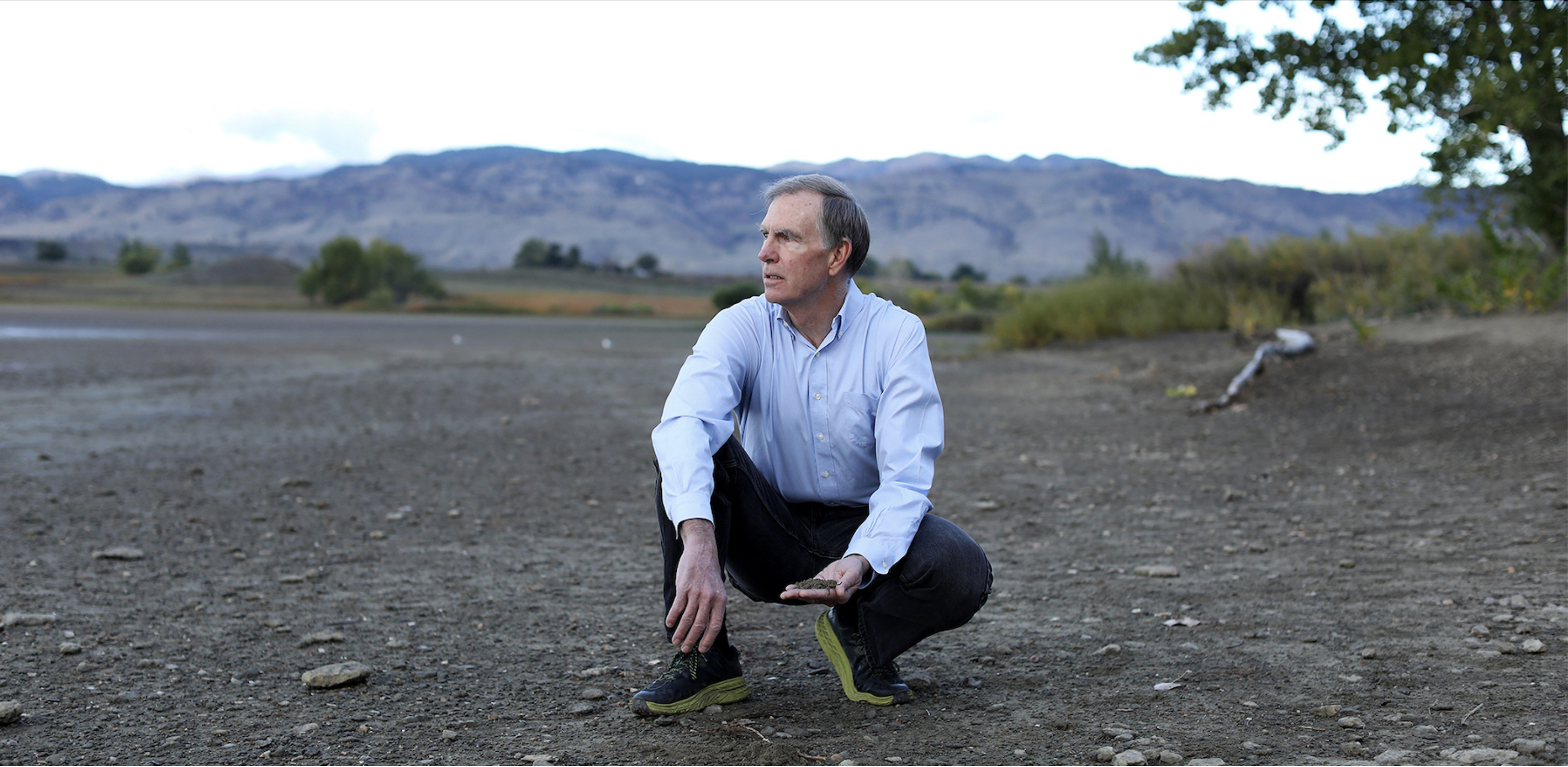
Brad Udall is known far and wide as a prophet of doom about the Colorado River. So why the optimism provoked by last week’s federal marching orders?
“I think we can solve this. I really do,” Udall said in a lecture delivered in Boulder on Aug. 21.
Earlier that same day, the Department of Interior had issued its record of decision about how it would manage the key dams and hence the river during the two water years beginning in October. This came after Colorado and the six other basin states had failed during two years of negotiations to agree about how to share diminished river flows.
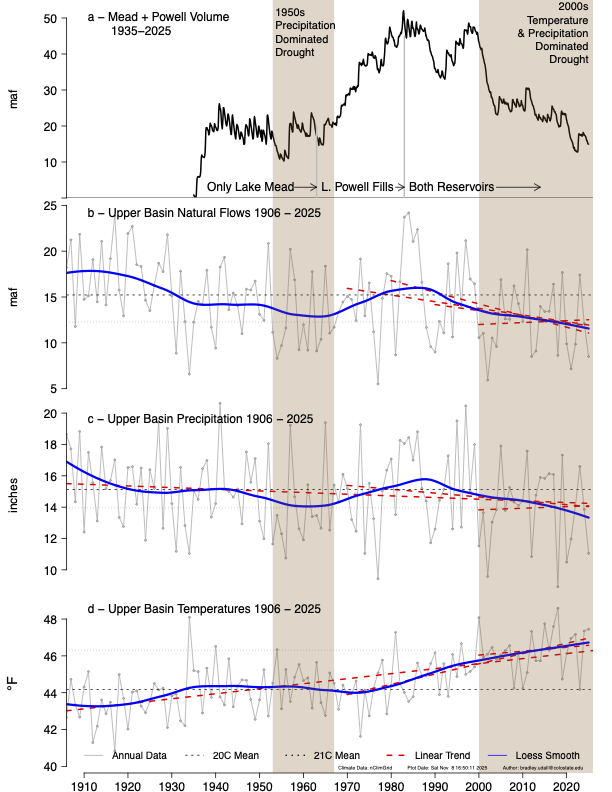
As even schoolboys in Kentucky likely know, the Colorado River has encountered severe problems since 2000. Flows in the river are down 20% and continuing to decline in direct proportion to rising temperatures. The two big reservoirs, Mead and Powell, have declined 75% in stored water.
The lower-basin states, which get their water from these two big reservoirs, had already cut their use significantly. The Department of Interior has ordered the three states to expect 1.25 million acre-feet less water from Mead during the next two years. It also expects the three states to figure out how to store 700,000 acre-feet over the next two years. Colorado and other upper basin states cannot expand water use.
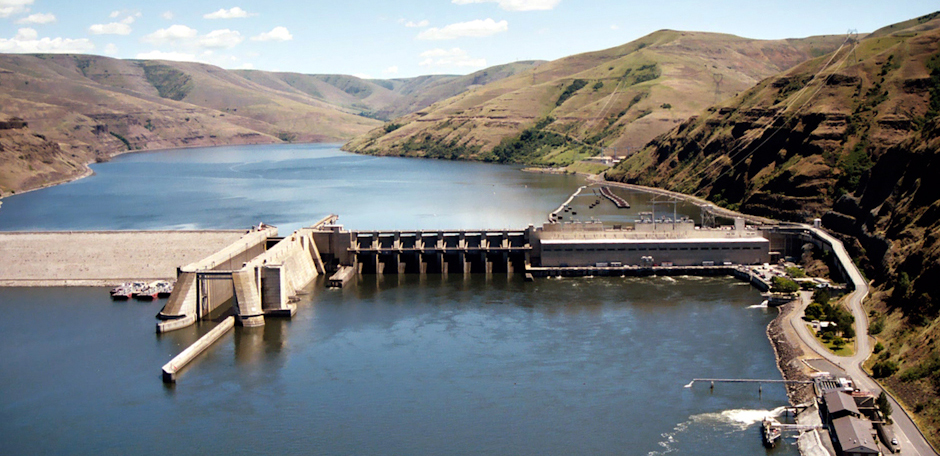
Agriculture users, said Udall, will bear the brunt of these cutbacks. Municipal users — all the cities from Colorado’s Front Range to southern California get water from the river and its tributaries — will have to chip in with water savings. Infrastructure limitations of the two big dams, Hoover and Glen Canyon, when holding little water need to be resolved. For example,
penstocks[river outlet tubes] on the two big dams were never designed for day-in, day-out use, as may be necessary with reduced amounts of water. And as for the hydroelectric production? Yes, it’s a small amount but important. It provides backup power.The process created by the Interior Department — the Bureau of Reclamation is the key agency within Interior — requires new plans every two years for the next decade. Udall sees merit in this approach.
“When the negotiations started, the idea was that we’re going to get a 20-year plan. We got five two-year plans, which you might see as a setback, but I think we might have blundered into something actually useful, because it potentially is true adaptive management, where people get to pay attention repeatedly as this evolves.” [ed. emphasis mine]
Udall also sees strong dynamics producing solutions.
“I think we’re going to see a solution because the people who are involved in the negotiations are hard-working. They’re knowledgeable. They’re intelligent. They have super good relationships with each other. And they know that the chips are down. If they don’t solve it, the solution Mother Nature provides will be downright ugly. I think we will solve this. I actually do.”
When the breakthroughs will occur, Udall said he didn’t know. And he hedged his confidence with caution. “I won’t put bets on this.”
What is clear, though, is that Arizona will be key to solving the conundrum of 21st century flows being far less than 20th century expectations. The river in the last century average 15.2 million acre-feet. Even when it carried healthy volumes of water, though, the river had ceased to reach an embayment of the Pacific Ocean. Flows this century have declined and, since 2020, remarkably so: to an average of just 10 million acre-feet.
Flows will almost certainly decline further. Accumulating greenhouse gas emissions guarantee continued warming, producing reduced flows.
“Western water law is enormously complicated and really inhibits solutions,” he said. “We’ve made a whole bunch of policy mistakes through time, including permanent allocations, assuming way too much water, and enforcing or legalizing really unrealistic policies.”
Whether the framework created by the federal government for finding solutions will work, he said, will depend upon hydrology. In some circles optimism remains that the strong El Niño this year will produce improved precipitation and hence greater flows. And maybe it will, said Udall, but the record on flows during El Nino years has been all over the scattergram. A few very big years — 1983 and 1998 stand out — yes. But some real duds, too. In other words, this coming winter could conceivably be as bad as the past winter. Or, if not as bad, then will continue the downhill slide.
Now rewriting the rules
Udall also made the point that prior agreements were incremental in nature, unlike what the new federal rules represent.
“The rules in 2007 and 2019 were really hard fought, but they were incremental. They were truly incremental. What we’re looking at right now, it’s not incremental. It’s a complete rethink,” he said.
“I think people mistakenly thought that, given the successes in 2007, 2019, we would just kind of waltz our way to new rules. And I think that’s the wrong way to think about what’s going on. This is a really a different deal in 2026.”
This new paradigm imposed by the federal government, Udall went on to say, is the “first global instance where climate change is forcing a complete redo of water management. I think I can make a pretty good case for that.”
Udall has become well known at water meetings in Colorado and beyond, particularly during the last decade, in warning that communities and economic sectors dependent upon the Colorado River were headed for trouble. Climate change is water change, he began saying more than 20 years ago. And in 2014, he conducted research along with another scholar, Jonathan Overpeck, that showed the strong correlation between rising temperatures and reduced flows in the river. That science, he said, has strengthened.
Although living in Boulder, Udall in recent years has been affiliated with Colorado State University’s Colorado Water Center. There, he wears the title of senior water and climate research scientist/scholar.
However, Udall is also understood in terms of his family tree. He is a descendant of John D. Lee, the Mormon settler for whom Lee Ferry (also called Lees Ferry) is named. Located in Arizona, near the Utah border, it divides the Colorado River’s upper and lower basins.
Don’t make too much of being a John D. Lee descendant, he said. “He had 21 wives that we know of, and some have suggested he has 800,000 descendants. That might actually be part of the problem with the Colorado River.”

As for his personal familiarity with the river, Udall divulged that he has rafted the Grand Canyon 45 times, at least some of those in the employ of Ken Sleight, best understood by readers of Edward Abbey’s “Monkey Wrench Gang” as the model for Seldom Seen Smith.
Arizona’s role
In Udall’s view, Arizona is central to solving this 21st century problem. The Central Arizona Project will “see a whole lot less water, but it’s not going to zero. I don’t know quite how that gets revolved, but that’s just so clear,” he said.
The Central Arizona Project delivers water from the Colorado River through 336 miles of canal to metropolitan Phoenix and ultimately Tucson, with farms along the way. It was authorized by Congress in 1968 and completed in 1993. Both his father, Morris, and his uncle, Stewart, were key figures in this. It can deliver 1.6 million acre-feet, the majority of the 2.8 million acre-feet that Arizona was scheduled to receive from the Colorado River under a 1964 court ruling.
As Udall pointed out, farms that got water from the project have received far less since cutbacks began in 2020. And now, more cuts for the farms — and cities — will be coming.
Given an hour for his presentation, far longer than his usual 20- or 30-minute slots, Udall had time to sketch some history, even taking time to define the universal way of measuring water quantities in the basin, the acre-foot.
“The reason that an acre-foot is used is farmers farm in terms of an acre,” he explained. “In the upper basin, you might put a foot or two feet of water on top of an acre to get a hay crop out. In the lower basin, near the Mexico border, you might put 10 feet of water on top of an irrigated field to get 10 different cuttings of alfalfa.”
Thoughts about hay
Alfalfa came up in the Q&A. The question, in not so many words, was how to cut back water used to feed livestock. After all, agriculture uses about 75% of the water (after evaporation) in the Colorado River, and alfalfa and other feedstocks comprise a large portion of that. A full hour could have been devoted to that question — and likely left topics on the table. The tension inherent in this topic is revealed in how the Family Farm Alliance describes this push replace animal forage to crop switching: “crop shaming.”
“It’s easy to hate on alfalfa because people don’t eat it, but we kind of do, right? Dairy, ice cream, beef cattle. And the idea that you’re going to tell farmers not to grow alfalfa, which turns out to be a pretty good crop for them in their rotation, probably isn’t going to work very well. You’re probably far better off to say, ‘Hey, here’s your reduced allocation. You use it as you want,’” responded Udall
“I think most people in this room don’t care about corn. We very much care about alfalfa, and its water use, but I’m not sure trying to prohibit farmers from using a crop that’s key in their rotation and actually has some kind of interesting benefits is a suitable way to get there. “
Udall also mentioned the difficulties of crop switching.
“It’s been suggested that ag shift to higher value products that use less water. One way to do that is only grow stuff in the winter because growing in Yuma (Arizona) and Imperial (Valley) in midsummer is not a great idea. But when you ask a farmer to shift produce or products, you ask them to change marketing, you ask them to (change) labor, transportation, storage, equipment, knowledge. You ask them to change a lot of things, and arguably there’s a need to help this transition happen.”
This discussion, he concluded, is one that needs to be had but is very complicated. “It really is going to take a deep dive to figure out how to deal with this.”
You will be able to soon hear what Udall had to say (and see the slides he shared) at the Getches-Wilkinson Center’s site. The history lessons alone make it worth an hour.
A few other snippets:
• “The lower basin wants some contribution from the upper basin (in reducing use) maybe 5% or maybe 2%, but some kind of skin (in the game). And the upper Basin says no way. Until recently, the upper basin wanted to reserve the right to increase its use.”
• Our (Colorado delegate to the Upper Colorado River Commission) Becky Mitchell has recently been saying, you know, none of this gets us any extra water. And we need to move beyond this, and I applaud Becky for saying that.”
• Udall told a fascinating story about the Central Arizona Project. At the time the proposal for federal funding was before Congress, the Upper Colorado River Commission paid a Denver-based engineer to examine the numbers. That engineer’s conclusion: There’s not enough water for the Arizona project once the upper basin uses its full allocation (as defined in the Colorado River Compact of 1922). The number was 1.2 million acre-feet a year. And the two big reservoirs, Mead and Powell, have been losing 1.25 million acre-feet a year.
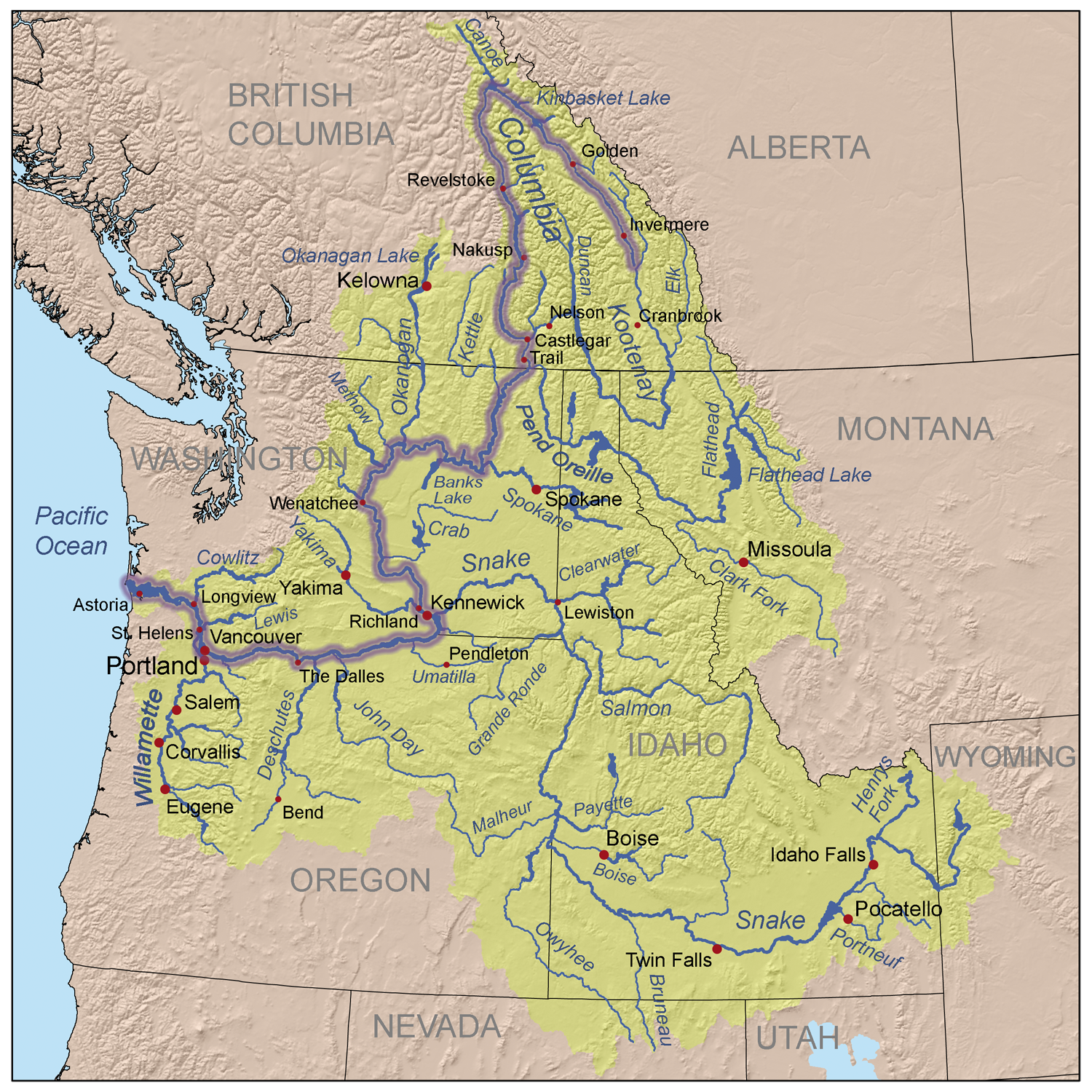
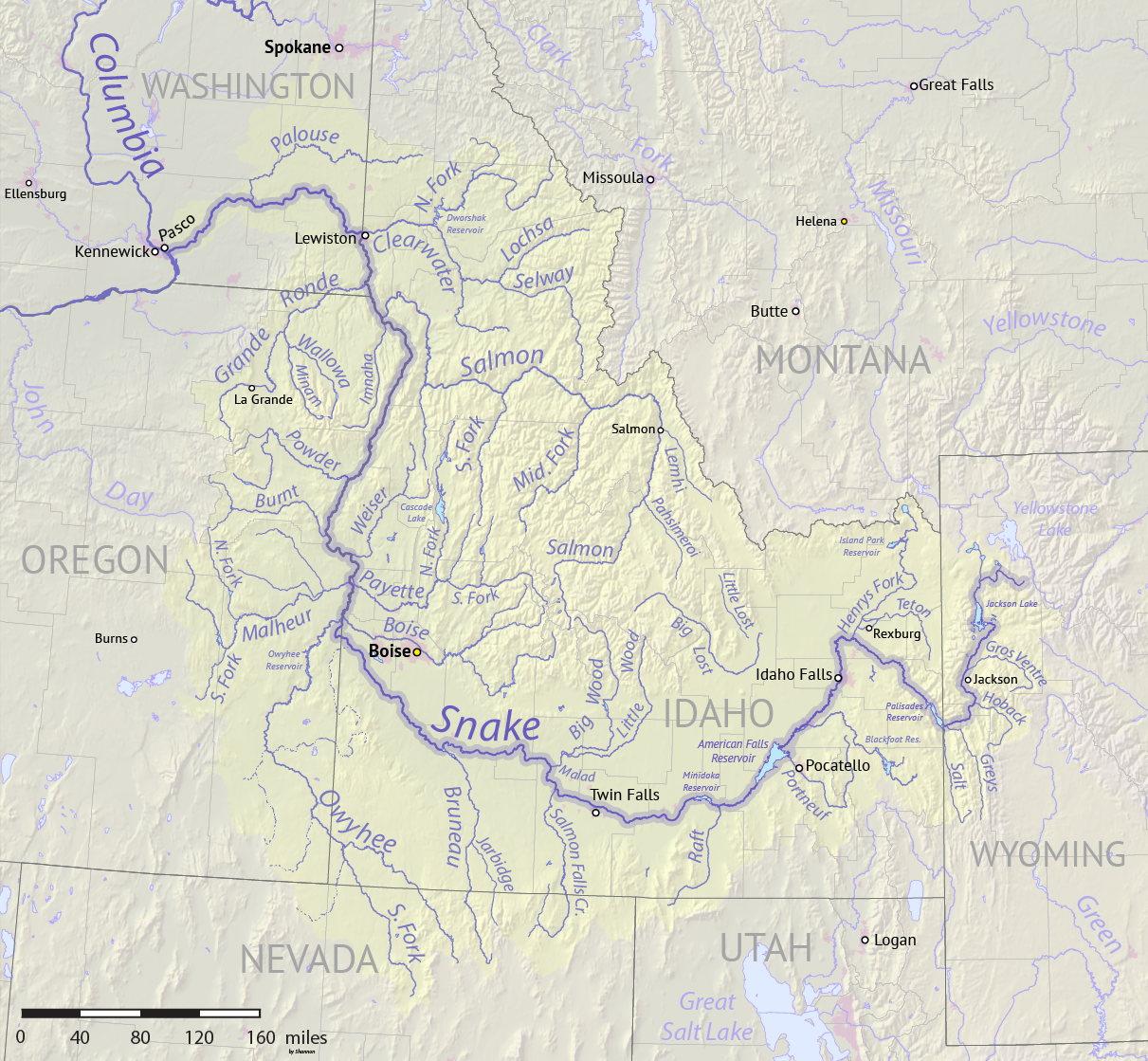
• The idea in 1968, said Udall, was that the federal government was going to figure out how to augment flows of the Colorado River. One of the ideas was to export water from the Snake River in Wyoming’s Jackson Hole to the Green River and hence the Colorado. Washington Sen. Henry “Scoop” Jackson and other members of Congress from the Pacific Northwest objected. And the augmentation that was part of the thinking never has happened.

• On the first-in-time, first-in-right premise of Western water law. “You know, first-in-time, first-in-rank gets reinvented by 4-year-olds every day of the year throughout the world. I was here first; it’s mine. And most parents step in and say you’re going to share, right: But not Western water law. It was completely understandable in the 1800s, where you had a few users. But it’s really not so great in modern society. …
“You can’t have a case where 1,500 famers deprive 5 million people in Phoenix or 2 million people in the Front Range of water, of what I’ll call critical human water needs. It just isn’t going to work politically. Shared sacrifice would be a whole lot better way to deal with this.”
It’s pretty hard to cut back water use under Western water law, because if one user decides not to take water, the next user downstream can grab it. “If we’re trying to get water to Lake Powell, you have to rethink how this gets done.”

• Temperatures have increased 3 degrees Fahrenheit since 1979. “Not a single year after 2000 is below the 20th century average,” he said of the Colorado River Basin. “Increased temps lead to increased evaporation. We think you can lose up to 5% flow (of water) per degree rise.”
Temperature increases have produced up to 15% increase in losses due to evaporation.
• As for precipitation, the last 27 years have been the worst 27 years since record-keeping began in 1895. The declines worsened beginning in around 2015.
A 1% decline in precipitation leads to a 2% decline in flows.
• As for Udall writing a book, as one audience member suggested, he said other authors have covered much of the same ground, even if he has a somewhat different angle. “I don’t know. I need an assistant!”