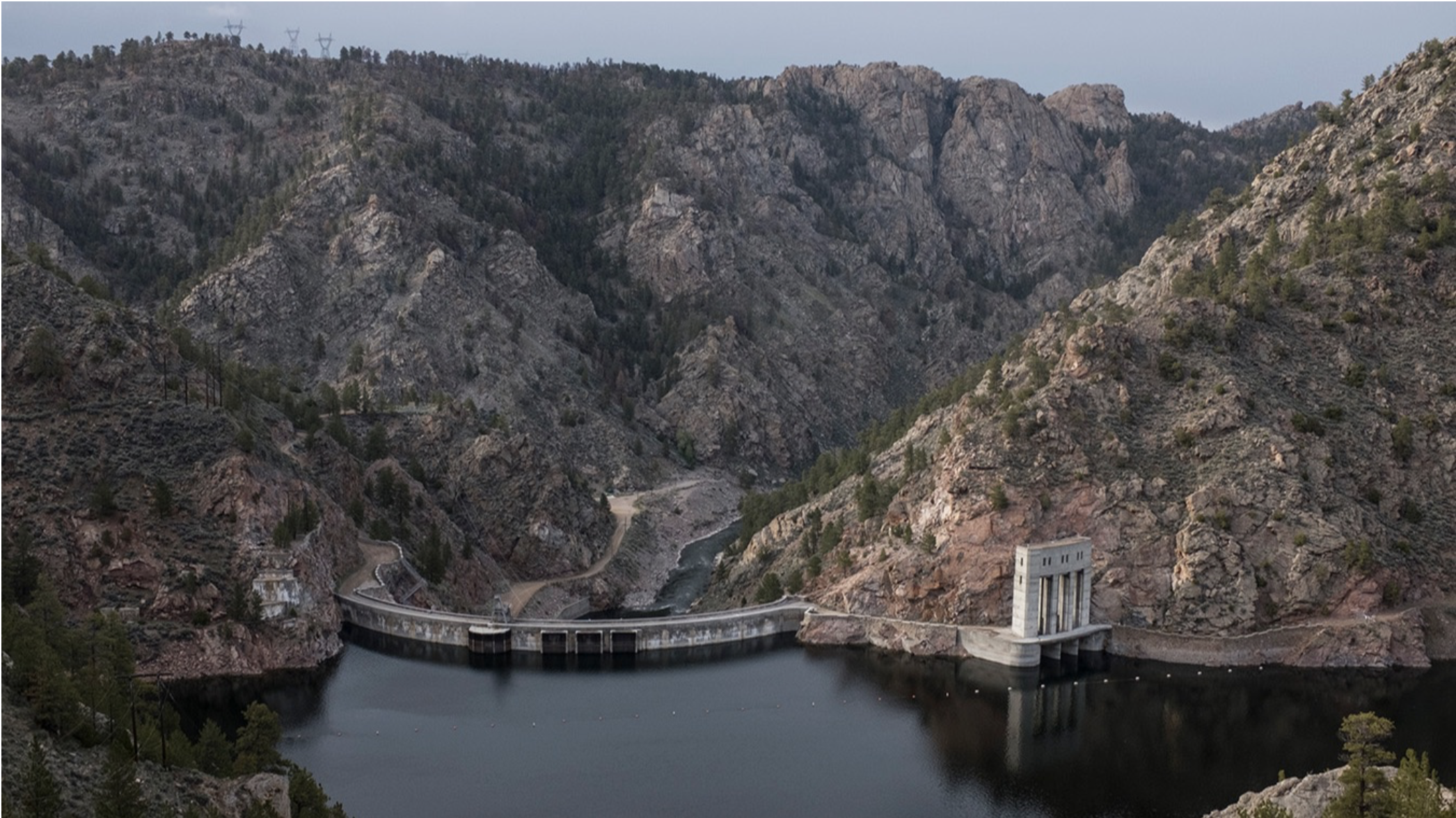
The Seminoe Reservoir backs up at the Seminoe Dam, with the North Platte River flowing freely below to the downstream Kortes Dam above the Miracle Mile. (Ryan Dorgan/WyoFile)
Click the link to read the article on the WyoFile website (Dustin Bleizeffer):
August 6, 2026
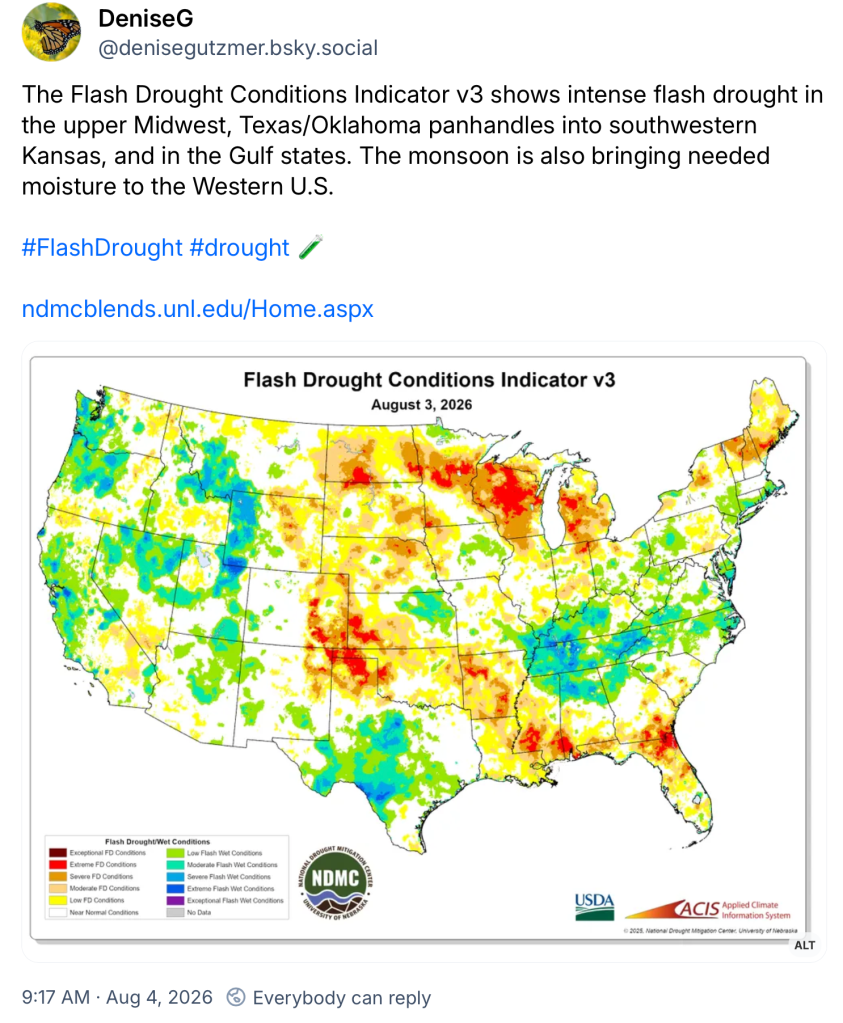
Driven by historically low snowpack and above average temperatures this summer, Seminoe Reservoir has slipped into “near-worst case” water quality modeling scenarios that federal officials are relying on to greenlight a controversial pumped-water storage hydroelectric project there.
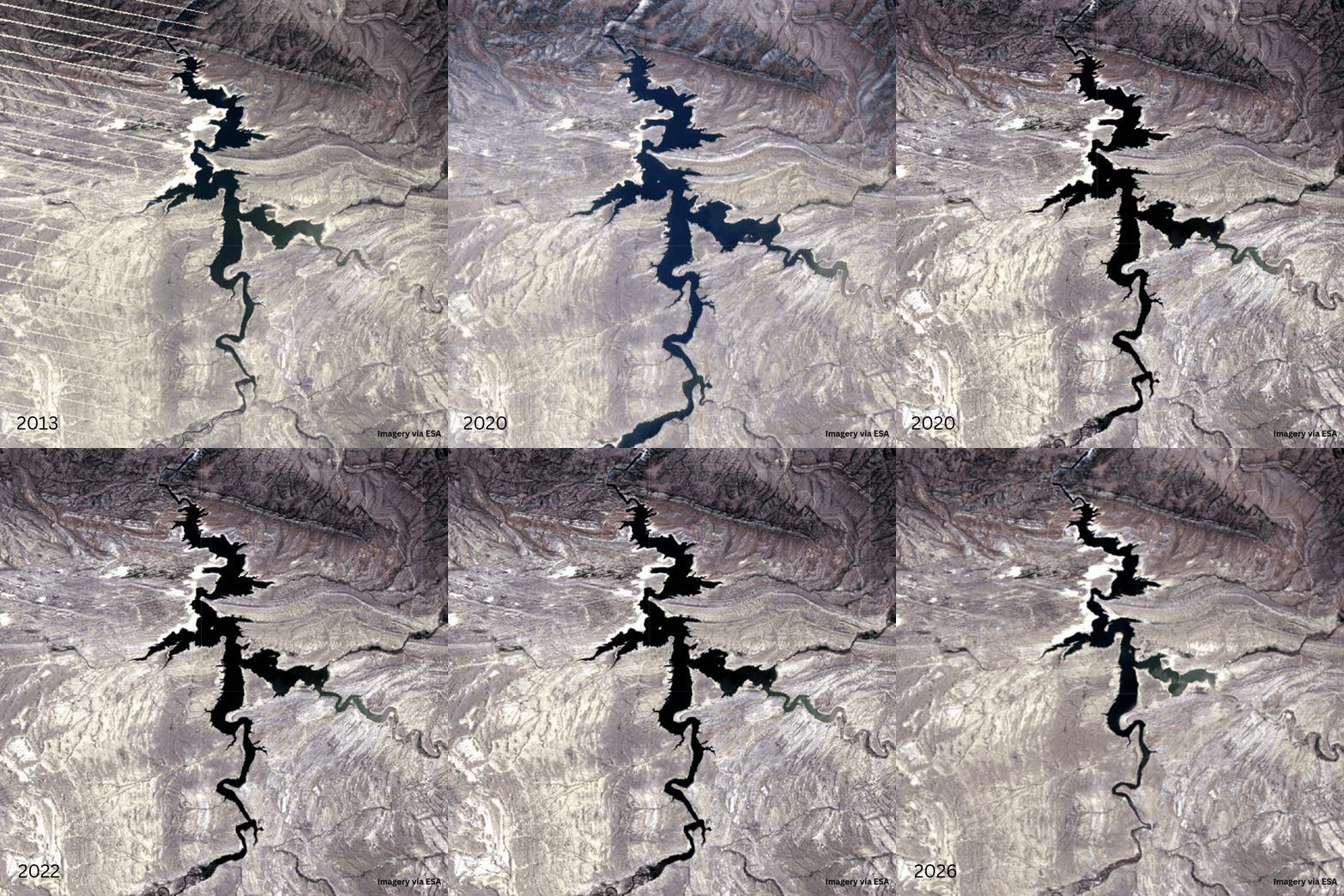
The Carbon County reservoir, which stores water in the North Platte River system, measured just 29.4% capacity Wednesday [August 6, 2026], with a surface water elevation of 6,303 feet above sea level, according to the U.S. Bureau of Reclamation. That’s 12 feet below a “near-worst case” scenario of 6,315-feet elevation for the reservoir based on modeling of past years that opponents of the storage project have criticized as incomplete and shortsighted in consideration of changing climate in the region.
If the facility were in operation today, Seminoe’s current water level would trip a regulatory trigger enforced by the Wyoming Department of Environmental Quality, requiring developer rPlus Hydro to temporarily curtail operations, according to state and federal documents.
“Not a single shovel has hit dirt yet, and we’re already living in the near worst-case scenario,” Trout Unlimited’s Wyoming Government Relations Director Patrick Harrington told WyoFile. “What happens if next year looks like this year and we don’t refill Seminoe? What happens when the system experiences conditions that are drier than those that underpin the environmental analysis?”
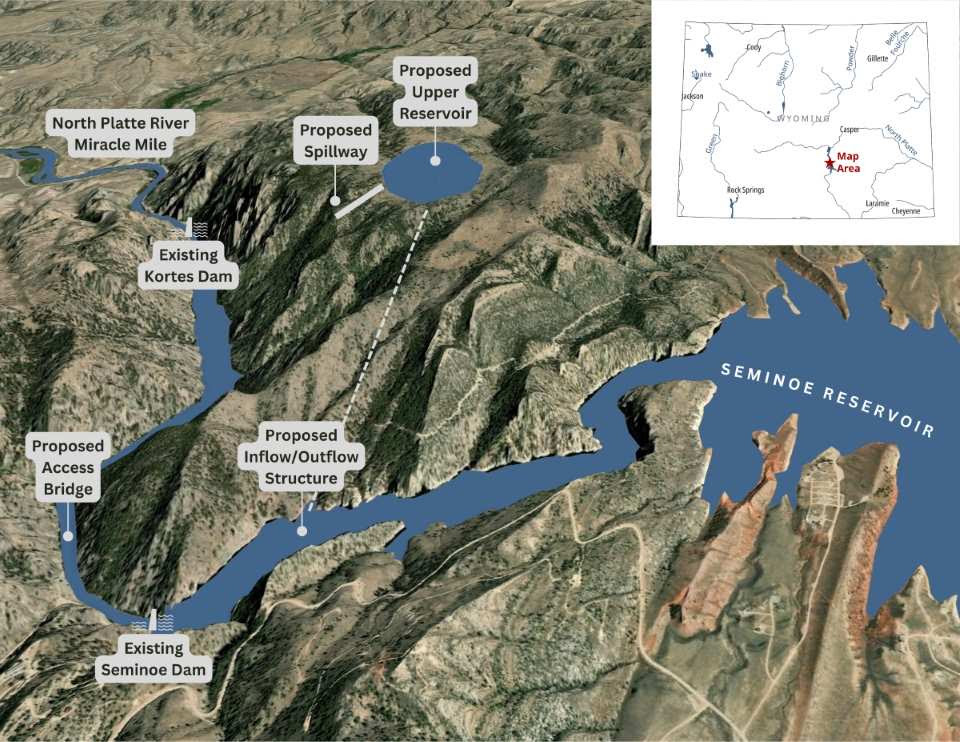
This map depicts a proposed pumped water storage energy project at Seminoe Reservoir. (rPlus Hydro)
Utah-based rPlus Hydro, along with its subsidiary Black Canyon Hydro, expects to receive final approval from the Federal Energy Regulatory Commission this year to construct its Seminoe pumped-water storage project. The company wants to carve a new reservoir on a hill above the Seminoe dam, pump water from Seminoe uphill during the day and release the water through hydroelectric-generating turbines in the evening — an electrical “battery” to provide power when it’s most needed, it says.
The commission in June issued its final environmental impact statement for the project, sparking criticism that it ignored input from local leaders and failed to incorporate more protective measures for fisheries and wildlife, including for the Seminoe-Ferris bighorn sheep herd.
Miracle Mile worries
Among local concerns regarding the $4 billion, five-year construction project is the Miracle Mile stretch of the North Platte River below the Seminoe and Kortes dams. It’s a world-class trout fishery that attracts millions in tourism dollars annually. It’s also designated as an “Outstanding Resource Water.” That decades-old designation, according to the Wyoming Department of Environmental Quality, requires that it suffer “no further degradation from human activity” — a legally enforceable sideboard that the state, as well as natural resource advocates, hope will protect the popular fishing destination.
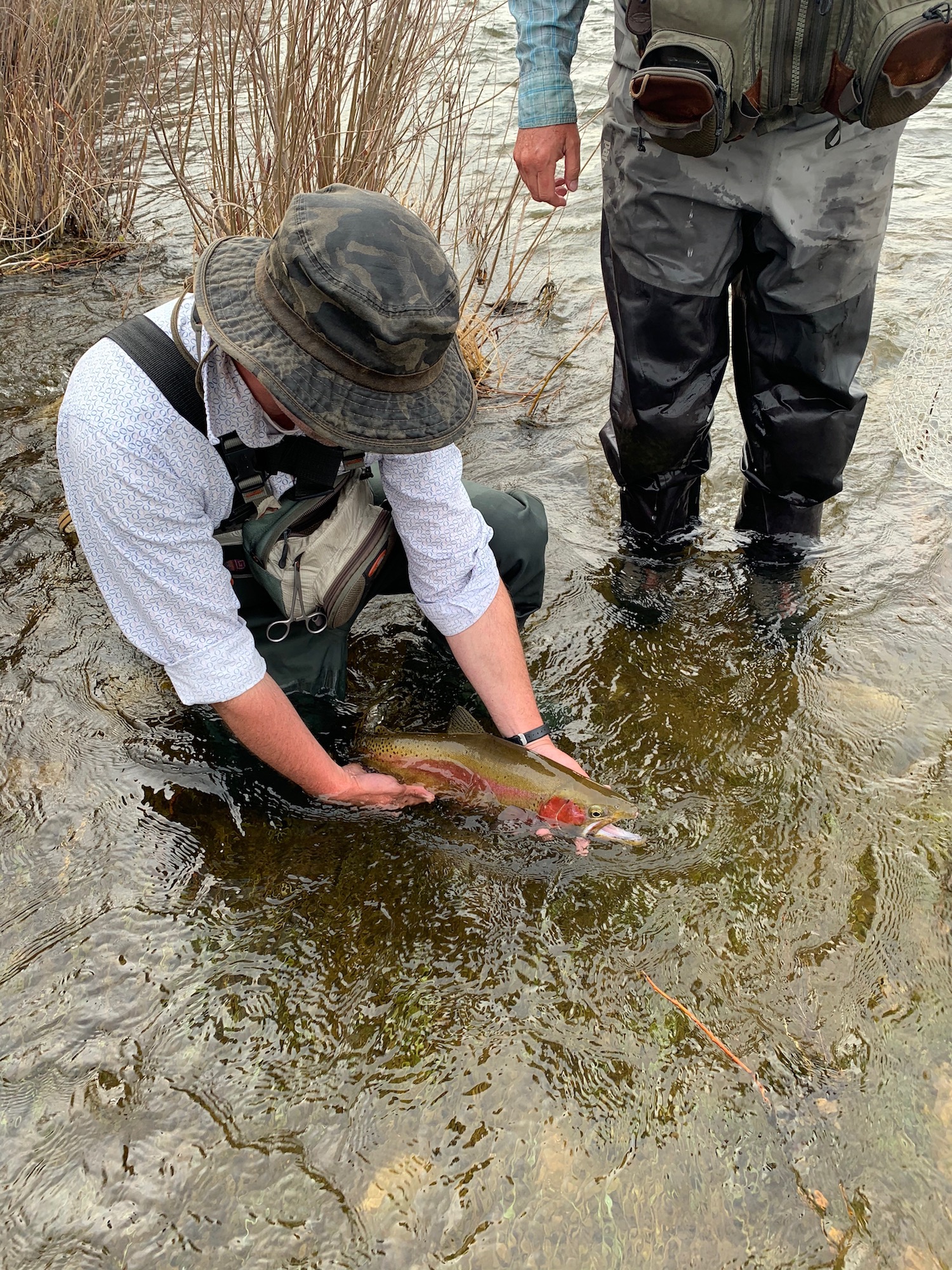
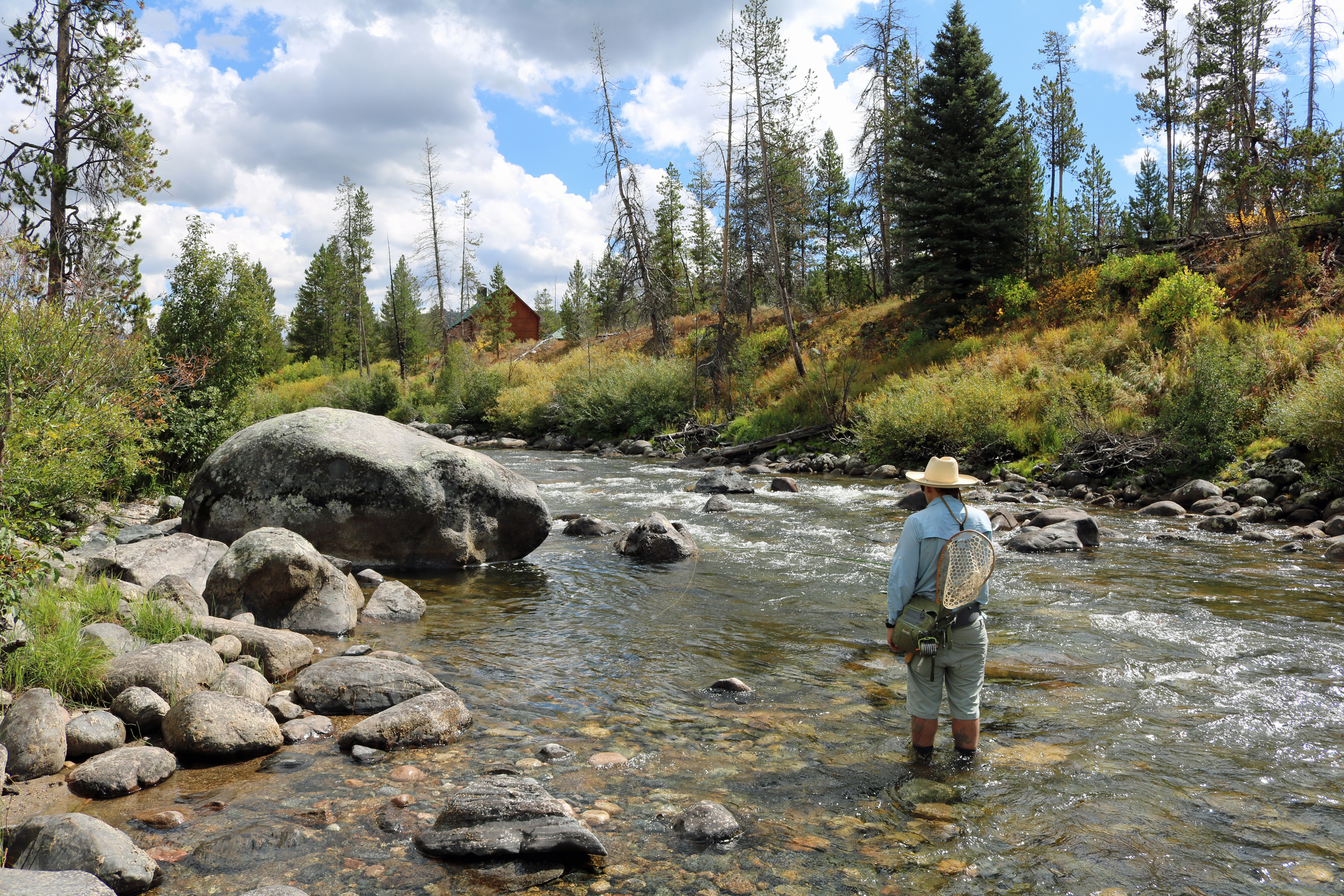
An angler releases a trout caught on the Miracle Mile portion of the North Platte River below Seminoe Reservoir. (Dustin Bleizeffer/WyoFile)
A cold-water species, trout get stressed when water temperatures range between 70 and 75 degrees Fahrenheit. Prolonged temps beyond that can result in a fish kill, according to the Wyoming Game and Fish Department.
Typically, “tailwater” portions of rivers immediately downstream of dams like the Miracle Mile get the benefit of the coldest water in the reservoir, because dam outlets are far below the surface where temperatures tend to be warmer. But rPlus Hydro’s facility would churn the reservoir’s water temperature strata, especially when water levels are low, according to state and federal analysis.
The North Platte River system has suffered low-water conditions this year, beginning in February with various “priority administration” calls that limit irrigation for some users. Though no towns or industrial water users along the main stem have gone without, many of them have dipped into a state-owned backup water supply held in reserve at Pathfinder Reservoir, according to Wyoming State Engineer Brandon Gebhart.
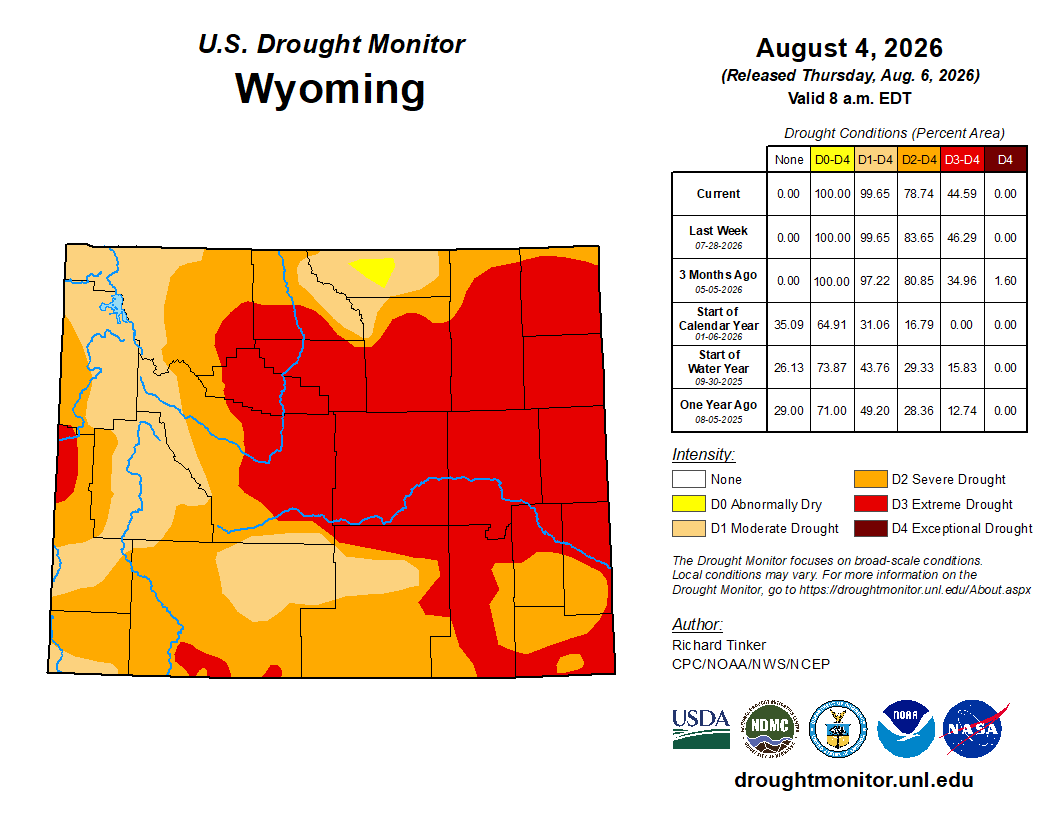
“The entire state is under some classification of drought,” Gebhart told the Wyoming Legislature’s Select Water Committee Thursday. “Over 83% of the state is in severe or extreme drought.”
Gebhart added that many reservoirs in the North Platte drainage system — excluding those on the main stem of the river — are at “dead pool,” meaning water levels are lower than the dam’s outlet, preventing downstream release.
Regulatory analysis, stipulations, so far
Under “moderate” drought conditions, the facility’s daily churn “has the potential to exceed the 1.1 °C [about 2 degrees Fahrenheit] criterion” for the Miracle Mile if Seminoe shrinks below 6,326-feet elevation in July and 6,315-feet elevation in August, according to DEQ. That’s likely to happen about once a decade, the agency concluded in its “adaptive management plan,” which prescribes how rPlus Hydro must comply with the Outstanding Resource Water designation for the Miracle Mile, among other water quality regulations.
But Trout Unlimited and other natural resource advocate organizations note that the analysis is based on a slice of past hydrological data for the Seminoe-Kortes-Miracle Mile waters — from 2013 through 2016. The former was the lowest water-year dataset used to help determine reservoir water level and water temperature parameters, though data was available from other years when water was lower, according to Trout Unlimited and the Lander-based advocacy group Wyoming Outdoor Council.
“Why would the model not include the historic range of natural variability to set realistic triggers for the [water quality adaptive management plan] when at least 25 years of historical data was available, including two highlighted years of lower water availability?” the Outdoor Council said in comments to the FERC.
Surface water at Seminoe Reservoir, seen in August 2013, 2020, 2022 and 2026. (European Space Agency)
Trout Unlimited’s Harrington said his group believes the modeling method is sound, but the concern is that the data is too limited. “We’re not saying that the water-quality model itself is bad. We’re just saying if you feed it incomplete information you’re going to get incomplete answers.”
The state’s certificate for the project calls for continuous water modeling going forward, which should help rectify what critics believe is an incomplete dataset, Harrington noted. After all, the state intends to “adapt” its regulatory parameters, and that includes future hydrological conditions. Though it requires rPlus Hydro to begin real-time water quality monitoring “at least two years before project construction,” the DEQ told WyoFile, the agency doesn’t expect that effort to begin until 2028.
Reached for comment, rPlus Hydro didn’t say whether it has begun collecting hydrological data.
“We know that there are low-water years from time to time on the North Platte, and this happens to be one of them,” a company representative told WyoFile via email. “rPlus continues to be committed to the proactive precautions that were built into the Adaptive Management Plan agreed to with the State of Wyoming.”
Local groups, including the Wyoming Outdoor Council, have also criticized state and federal analysis for not going far enough to consider climate-change forecasts for the region.
While the FERC acknowledges that “localized droughts are projected to increase by 2040 and … decreasing snowpack will affect both surface water availability and groundwater resources, increasing pressure on water resources,” it concludes in supporting documents that site-specific climate-change projections are “beyond the scope of the study.”
Typically, the commission can license hydroelectric facilities for up to 50 years, while rPlus Hydro asserts it can reliably operate for beyond 75 years. That raises the stakes to ensure that permitting and regulatory parameters today account for what could be a drastically different environmental future for the region, Harrington said.
“Whether this drought is persistent, or they come every decade, this is the future we should be preparing for,” Harrington said. “The reality of low-water years is here. It seems like we can count on less and warmer water in the North Platte.”
Congressional plea
In a July Senate Committee on Energy and Natural Resources hearing, U.S. Sen. John Barrasso listed concerns he’s heard from constituents regarding the Seminoe project, including its potential impact on what he described as “one of the most legendary trout fisheries in Wyoming and in the World.” The Republican lawmaker implored FERC Chairwoman Laura V. Swett to “commit to taking a renewed look at the state’s comments and consider their incorporation into your final decision.”
“I know these types of projects have a great impact on communities,” Swett responded. “They’re very emotional for both sides, and I am fully committed to making a measured decision based on the record and working with your staff to arrive at the right choice for the American people.”
Reached by WyoFile for further comment, the FERC replied, “We don’t comment on pending matters.”
Barrasso’s office, however, ensured that it is in communication with the agency regarding the matter.
“FERC followed up with our office after the hearing,” Barrasso’s office told WyoFile via email. “We reiterated Senator Barrasso’s comments on how important it is that FERC take into account the state’s comments regarding wildlife habitat and how important the Miracle Mile is to the people of Wyoming. Senator Barrasso will continue to engage FERC as they make their final decision.”
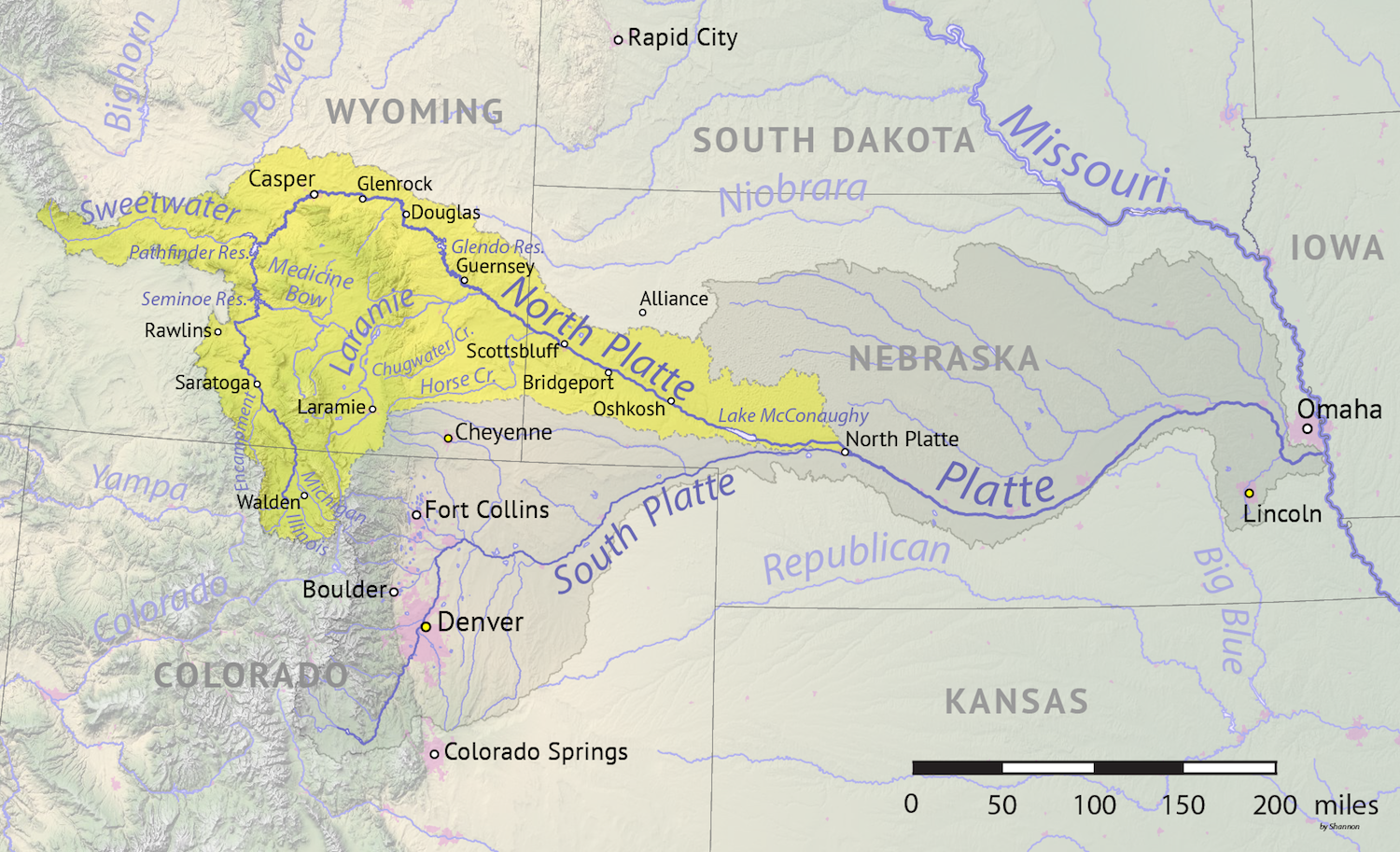
Map of the North Platte River drainage basin, a tributary of the Platte River, in the central US. Made using USGS National Map and NASA SRTM data. By Shannon1 – Own work, CC BY-SA 4.0, https://commons.wikimedia.org/w/index.php?curid=79266632
More than 300 Mountain whitefish were found dead by Colorado Parks and Wildlife on the lower stretch of the Elk River nearly two weeks ago. The fish kill prompted an immediate response by CPW, which implemented a voluntary fishing closure that remains in place.
“While difficult to see, this type of event was expected given the extreme drought conditions this year,” said CPW Northwest Region Senior Aquatic Biologist Ben Felt. “Mountain whitefish are especially vulnerable to high temperatures and low dissolved oxygen levels. Implementing this closure allows CPW to continue protecting this important native species by reducing angler pressure in this area.”
[…]
The shutdown spanned from the Christina State Wildlife Area, about 9 miles north of Steamboat Springs, downstream to its connections with the Yampa River. The fish kill was discovered July 19, and CPW said the cause was extreme drought conditions. During its investigation, CPW measured river temperatures as high as 82 degrees…CPW said temperatures had likely exceeded 80 degrees in the days leading to the fish kill. The Mountain whitefish is one of two native sport fish in Colorado. The other is the cutthroat trout. The fish is endemic to the White and Yampa River watersheds. However, in recent years, due to consistent high temperatures, low dissolved oxygen levels and non-native predatory fish, the whitefish has struggled to survive in the Yampa River. A prior drought in 2002 significantly impacted the Mountain whitefish population. A mandatory fishing closure is in place for the Yampa River for the 0.6 miles between Stagecoach Dam and Stagecoach State Park. Two voluntary closures are also in place on the Yampa River. The first is from the northern boundary of Sarvis Creek State Wildlife Area — about 1.7 miles downstream of Stagecoach Reservoir — extending 3.3 miles through the Bureau of Land Management portion of the river. The second is from the upstream boundary of Chuck Lewis State Wildlife Area to the western edge of Steamboat’s city limit. There is also a low water warning at Yampa River State Park.
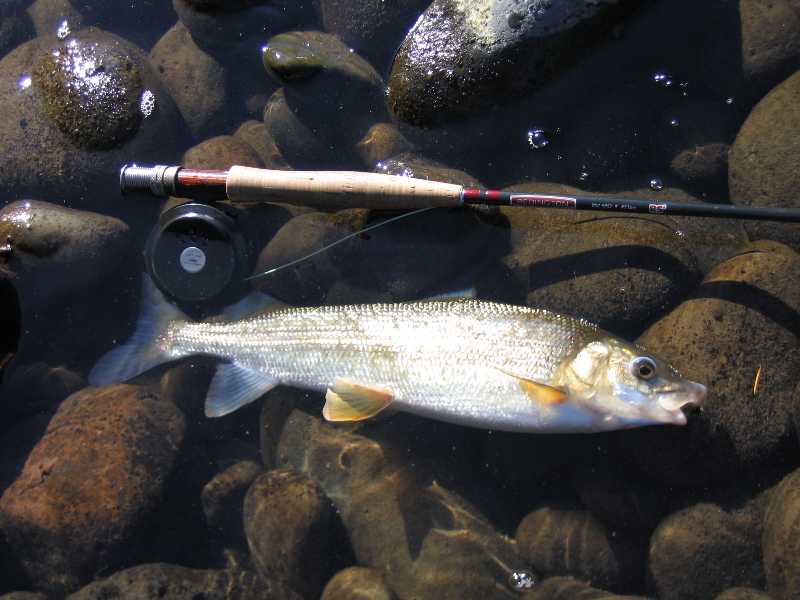
this 16 inch long Mountain whitefish (Prosopium williamsoni) was caught and released in the McKenzie River near the town of Blue River, Oregon on September 1, 2007. By Woostermike at English Wikipedia – Transferred from en.wikipedia to Commons by OhanaUnited., Public Domain, https://commons.wikimedia.org/w/index.php?curid=5099696
On July 13th, the Colorado River District, in partnership with the Colorado Water Trust and the Yampa River Fund, began releasing water from Elkhead Reservoir to mitigate the impacts of extreme drought and critically low streamflows in the Yampa River Valley. Beginning with a release of 10 cubic feet per second, the releases are part of the Yampa River Reservoir Release Program, a 2,000-acre-foot pool first established in 2021 with funding from the Colorado River District’s Community Funding Partnership. The program is designed to reduce drought-related pressure on agricultural producers while supporting river health and aquatic habitat.
“While we’re experiencing exceptionally difficult drought conditions, the story of 2026 is neighbors and water users working together. No single reservoir, organization or water user can solve this alone,” said Hunter Causey, Chief Engineer for the Colorado River District. “By coordinating releases, operations and water use across the basin, we can stretch a limited supply further and provide meaningful benefits for agricultural producers, local communities and the river.”
Below-average snowfall and persistent summer drought have reduced streamflows and increased water temperatures throughout the Yampa River Basin. Releases through the Yampa River Reservoir Release Program are intended to support agricultural water users, help delay or prevent a call on the river during periods of critically low flow, and benefit designated critical habitat for four endangered fish species. Releases are expected to increase in the coming weeks and continue through July.
“The Colorado Water Trust is an environmental nonprofit, and our work is keeping water in rivers,” said Blake Mamich, Programs Director for the Colorado Water Trust. “In a drought this deep, that same mission means showing up for agriculture. Coordinating closely with the River District and the Division of Water Resources, we can time these releases so a single pool of water helps irrigators extend a tough season and keeps water in Yampa for habitat and fish.”
“This is a difficult year for producers throughout the Yampa Valley, and we wanted to be part of a practical solution that helps the broader community,” said Yampa Basin rancher Matt Boeddeker of Lily Park Land & Cattle. “Water users across Colorado are making hard choices and working together to stretch limited supplies, and like them, we hope to help our neighbors complete critical irrigation and reduce the immediate impacts of drought.”
The Yampa River is primarily supplied by snowmelt from the Flat Tops and Gore Range and flows through agricultural areas of northwest Colorado before joining the Green River in Dinosaur National Monument. During dry years, coordinated releases from Stagecoach and Elkhead reservoirs supplement streamflows for agricultural water users, river habitat and endangered fish. The Colorado River District and its partners will continue to monitor streamflow, water temperature, irrigation demand, and habitat needs, and will adjust releases as conditions warrant.
The Moffat County Planning and Zoning Commission voted Wednesday to begin studying how data centers relate to the county’s existing zoning rules, stressing that no data center has been proposed and no decision was made about whether such facilities should be allowed. The commission approved Resolution PC2026-01, initiating a public review of the county’s zoning resolution. It also directs planning staff and commission members to research possible regulations for data centers. The action did not approve or reject a project, change the county’s zoning code, impose a moratorium or commit the county to allowing data centers. Instead, it opened what county Planning Director Candace Miller described as a process to understand the industry and prepare the county in case an application is submitted…Miller said the Planning Department has received no application, speculative proposal or other specific data center plan. She said she brought the issue forward after observing discussions in communities across the country and determining that Moffat County’s zoning resolution does not specifically identify or regulate data centers. The county’s lack of a clear classification leaves unanswered questions about whether different types of data centers would be permitted, conditional or prohibited uses and which zoning districts could be appropriate.
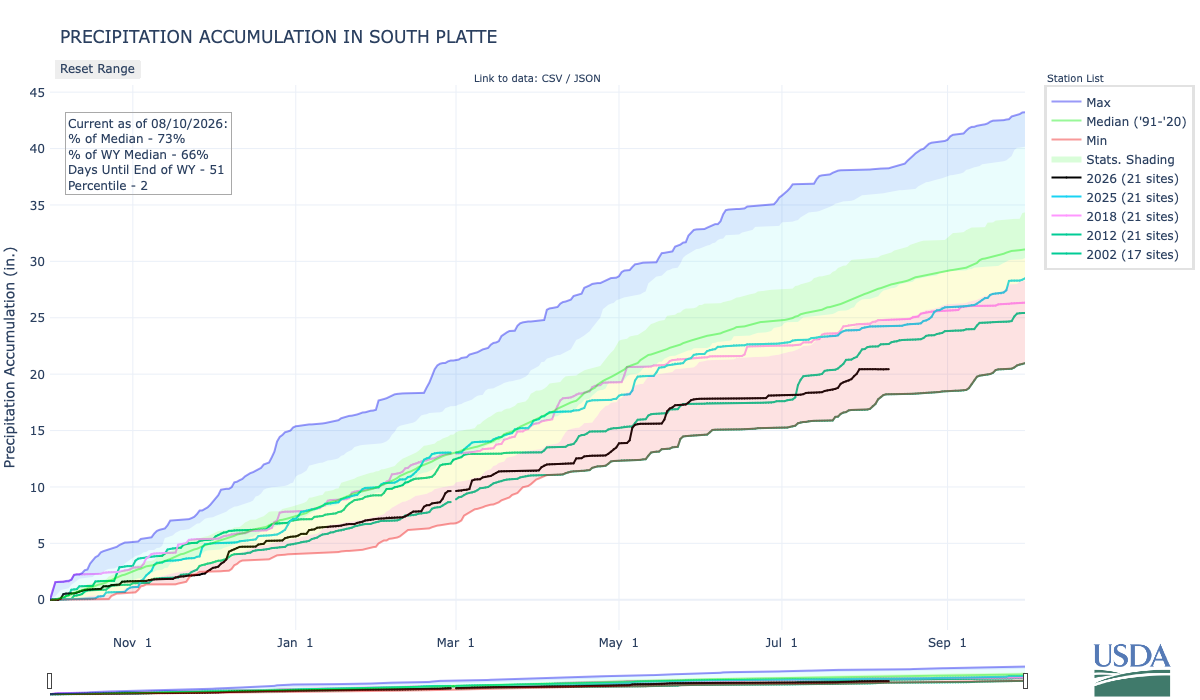
Below is the Precipitation Accumulation in South Platte graph from the NRCS for August 10, 2026. This morning precipitation is at 73% of the median (down 2% one week), and 66% of the water year median (no change one week). There are 51 days left in the water year.
Weather.gov is returning an error this morning. The weather app on my iMac shows chances for precipitation from today through Sunday in the northern and central mountains. It shows chances for precipitation Wednesday through Sunday, down here about 330 miles from Telluride where Butch Cassidy and three other men robbed a Telluride, Colorado bank on June 24, 1889. From the Library of Congress:
This robbery is the first major crime attributed to Cassidy, who would go on to become a notorious bank and train robber, become the leader of the “Wild Bunch” gang, and inspire legends for years to come. Read more about it!…June 24, 1889, Butch Cassidy (Robert LeRoy Parker) and three others rob a bank in Telluride, Colorado. It is the first major robbery attributed to Cassidy…September 17, 1896, Cassidy and the “Wild Bunch” rob a bank in Montpelier, Idaho. In the succeeding years, the outlaws commit several other robberies throughout the Southwestern United States…June 1900, Cassidy considers an amnesty agreement with the governor of Utah, but ultimately does not turn himself in. Soon after, the “Wild Bunch” disbands, but reports of Cassidy continue to surface in the U.S. and South America throughout the early twentieth century.
View northeast Telluride, San Miguel County, Colorado, with San Juans in background and dirt mining roads and streets forming gridlines in town. Creator: Byers & St. Claire Date: 1895-1903. Credit: Denver Public Library Digital Collections
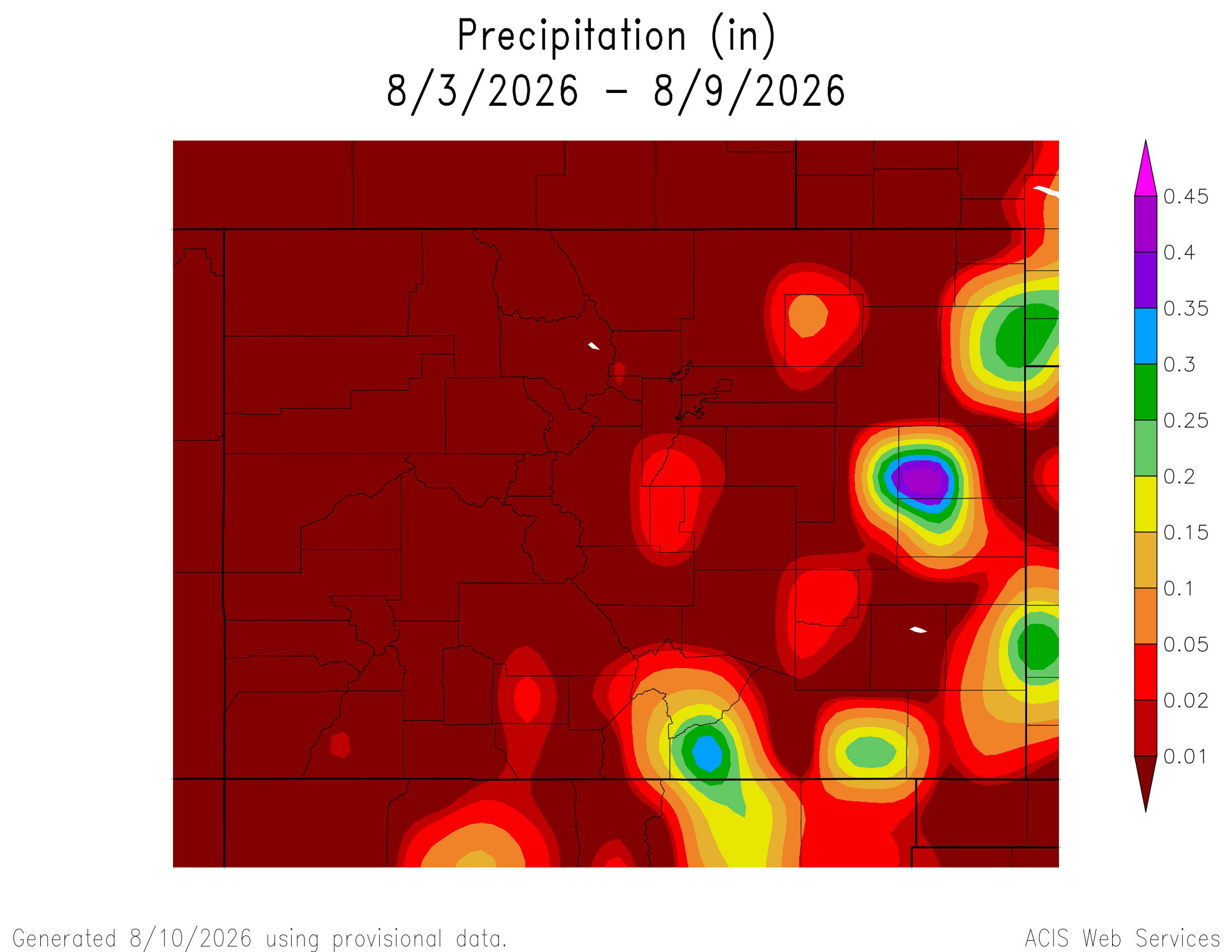
Here’s a look at the 7-Day Colorado precipitation map through August 9, 2026 from the High Plains Regional Climate Center. Precipitation in the South Platte Basin along the Continental Divide of the Americas ranged from 0.00” to 0.05”.
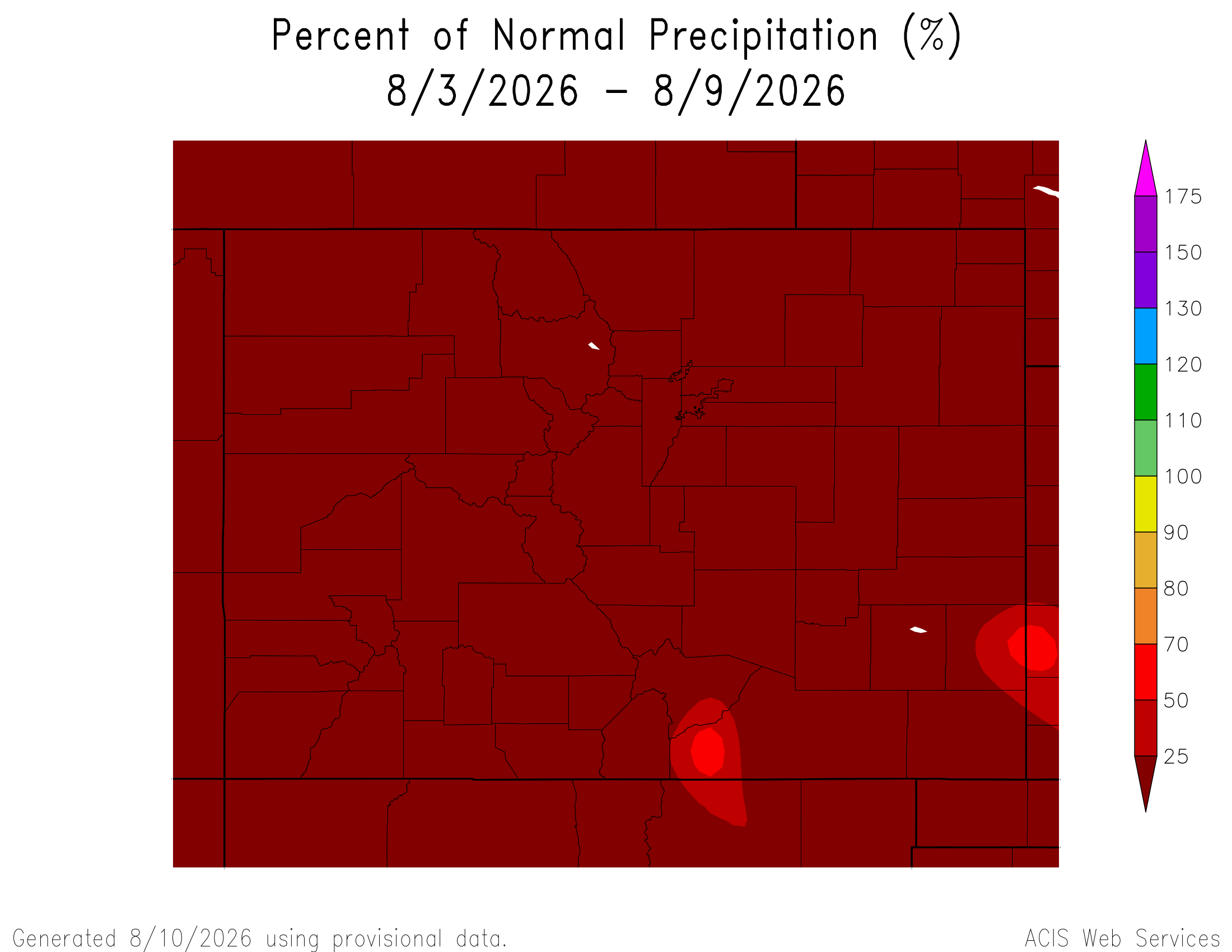
Here’s the 7-Day percent of normal precipitation map through August 9, 2026 from the High Plains Regional Climate Center. Precipitation in the South Platte River Basin along the Continental Divide of the Americas was 0% of normal.
Below is the 7-day Quantitative Precipitation Forecast for the week of August 3, 2026. Precipitation is anticipated for the mountains of the South Platte River Basin and may total up to 4.00″. Viva North American Monsoon!
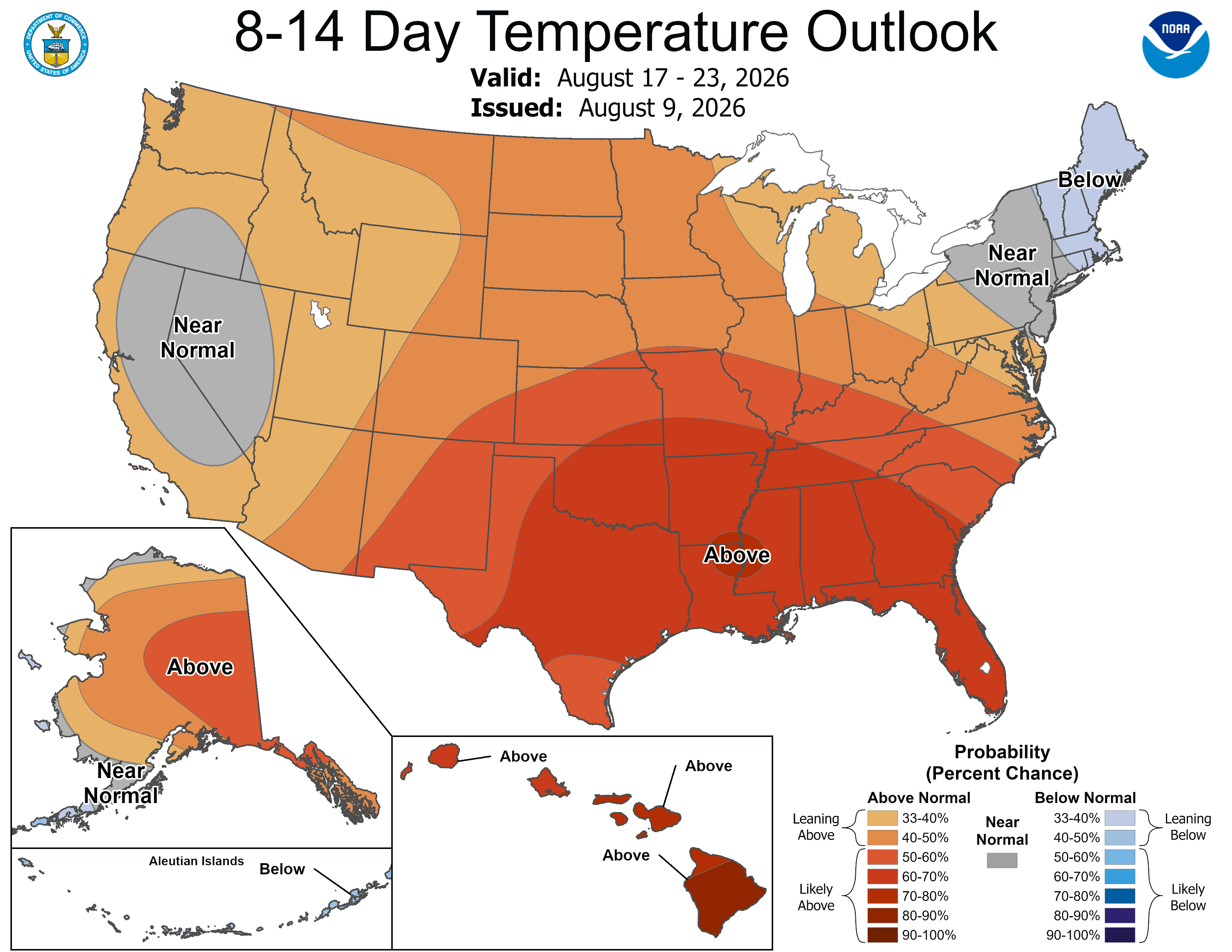
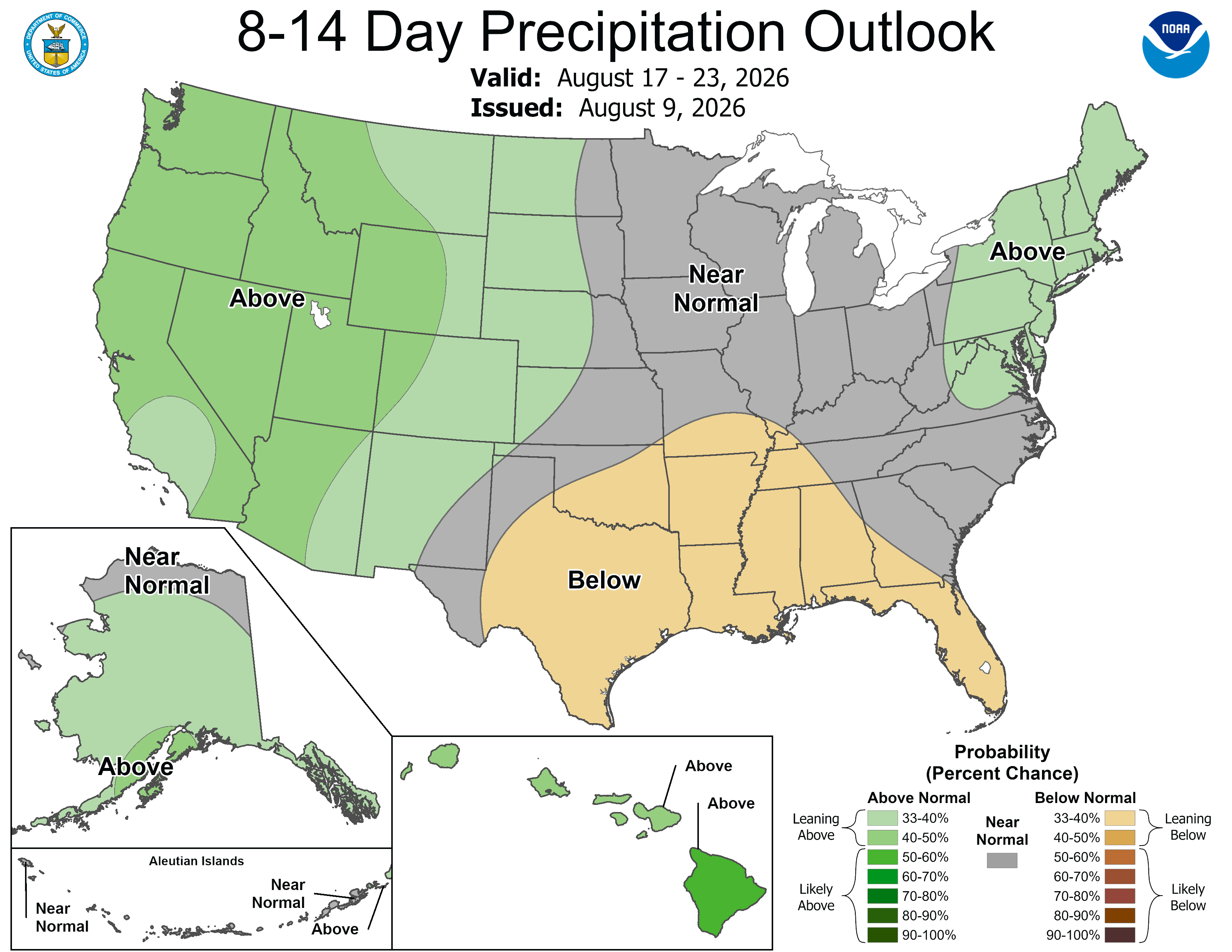
Below are the 8-14 day outlooks from the Climate Prediction Center, issued August 9, 2026, for temperature and precipitation, for the week starting August 17, 2026. The CPC expects above normal temperatures and above normal precipitation for the mountains of the South Platte River Basin.
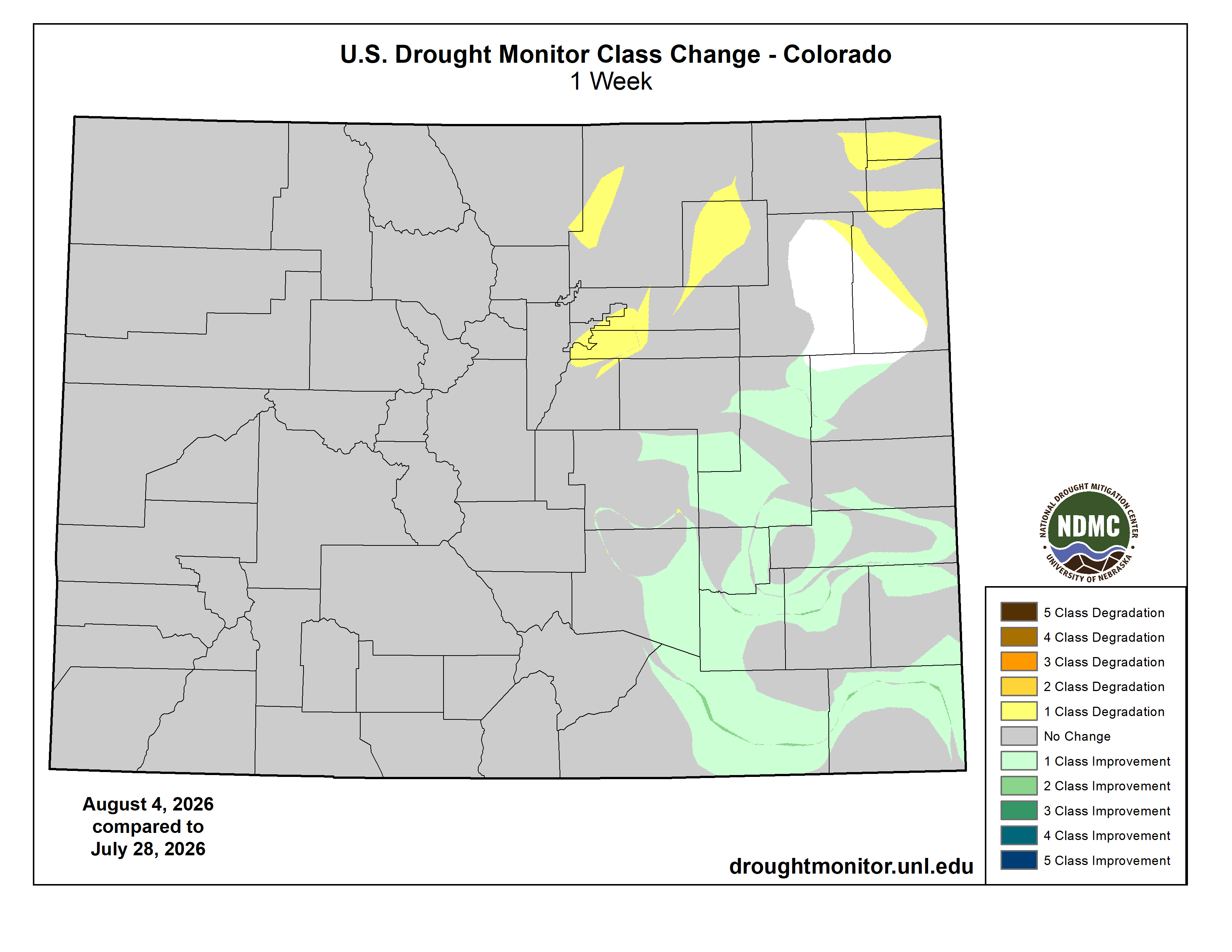
Below is the Colorado Drought Monitor map from August 4, 2026. There were one class degradations in Douglas, Arapahoe, Adams, Denver, Morgan, Weld, and Larimer counties. Drought and abnormal dryness covers 97.29% of Colorado. The South Platte Basin is experiencing Abnormally Dry, Moderate, Severe, Extreme, and Exceptional drought conditions.
Below is the Colorado Drought Monitor one week change map ending August 4, 2026.
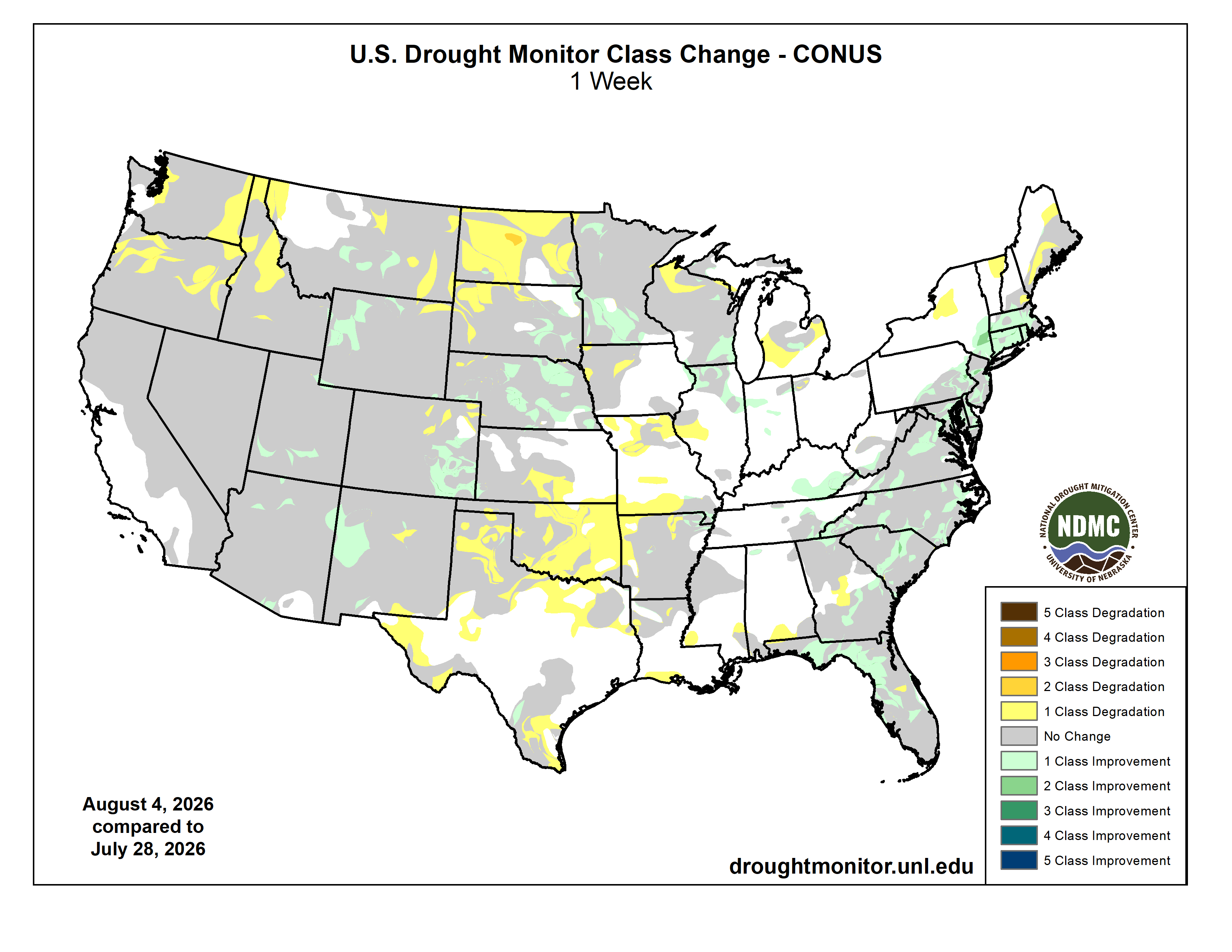
Here’s the US Drought Monitor Map from last week along with the one week U.S. change map.
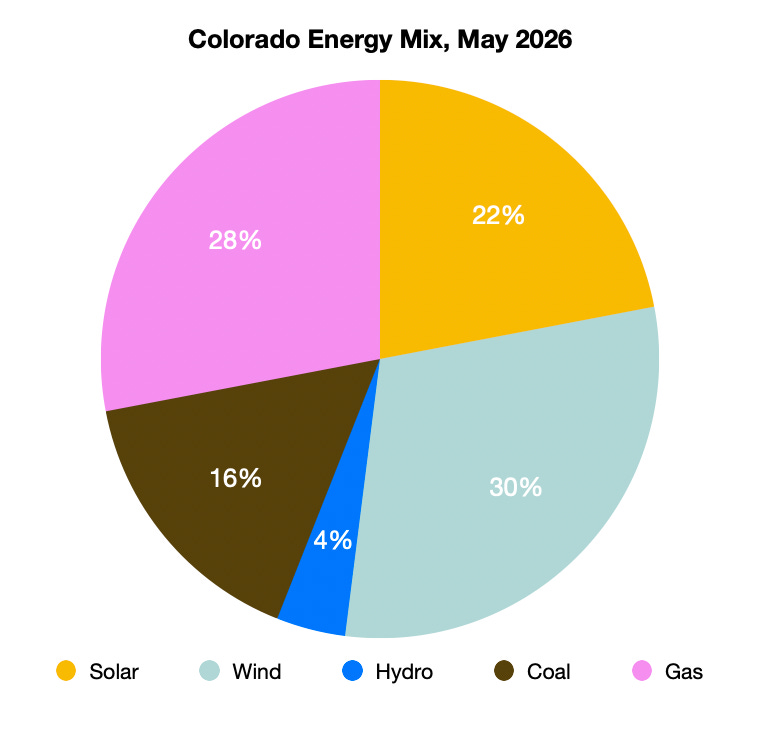
It’s safe to say that the Trump administration has been waging a war on solar and wind energy, both to spite its political adversaries and to bolster the fossil fuel industries…The data show, however, that Trump’s war on clean energy isn’t going much better than the fight he picked with Iran. For one thing, courts keep slapping down many of his initiatives because, well, they’re illegal. More than that, though, solar and wind generation are making big gains on many state’s electrical grids and, in some cases, are outpacing both coal and natural gas generation, even in fossil fuel strongholds.