A Simple Yet Powerful Framework for Managing Water Scarcity — Brian Richter (SustainableWaters.org)

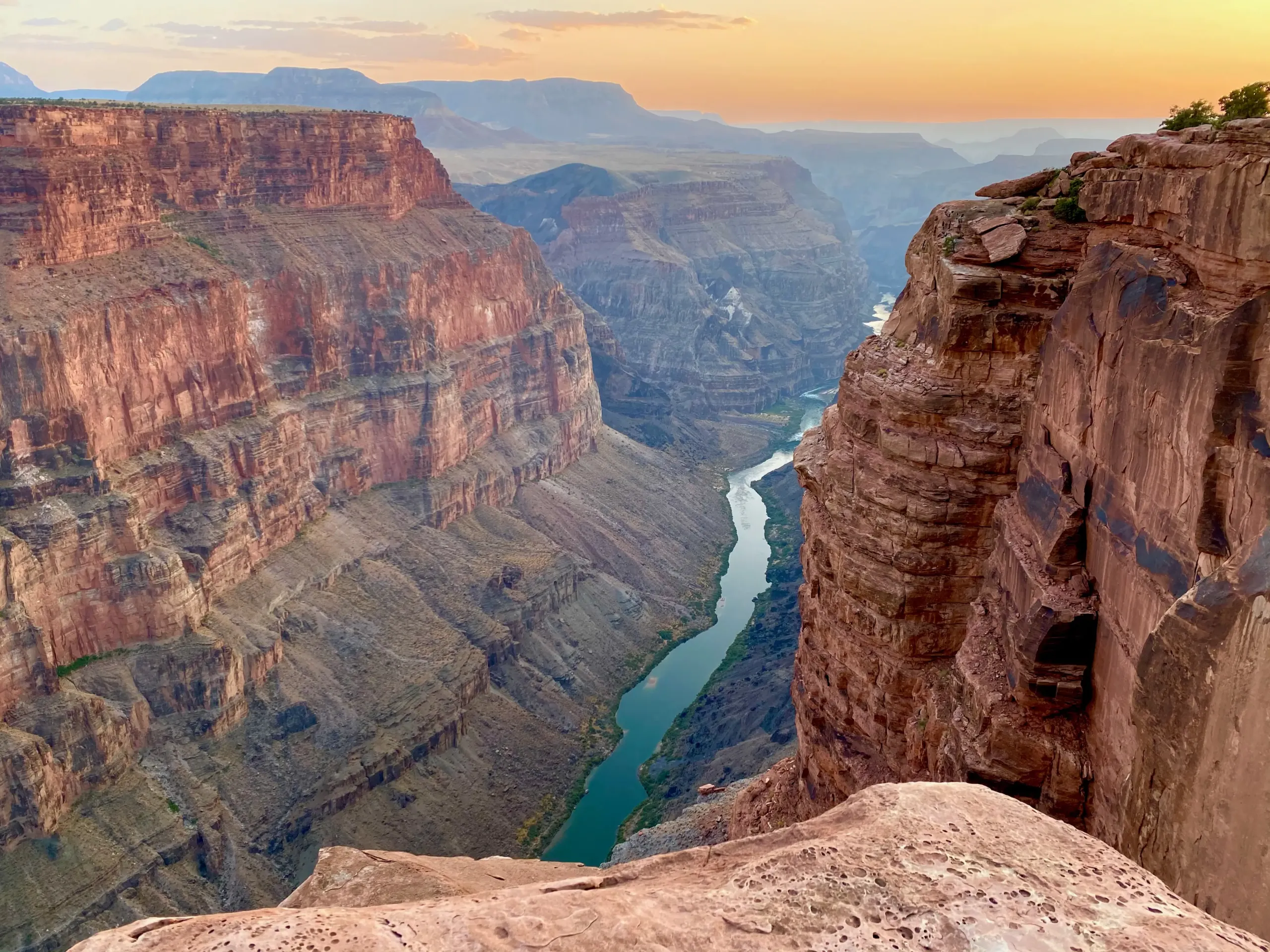
Grand Canyon and Colorado River by Brian Richter

Click the link to read the article on the Sustainable Waters website (Brian Richter):

July 24, 2026

Way back in 2003, Sandra Postel and I published a book entitled “Rivers for Life: Managing Water for People and Nature.” In the book we put forth a concept of “sustainability boundaries” as illustrated below.
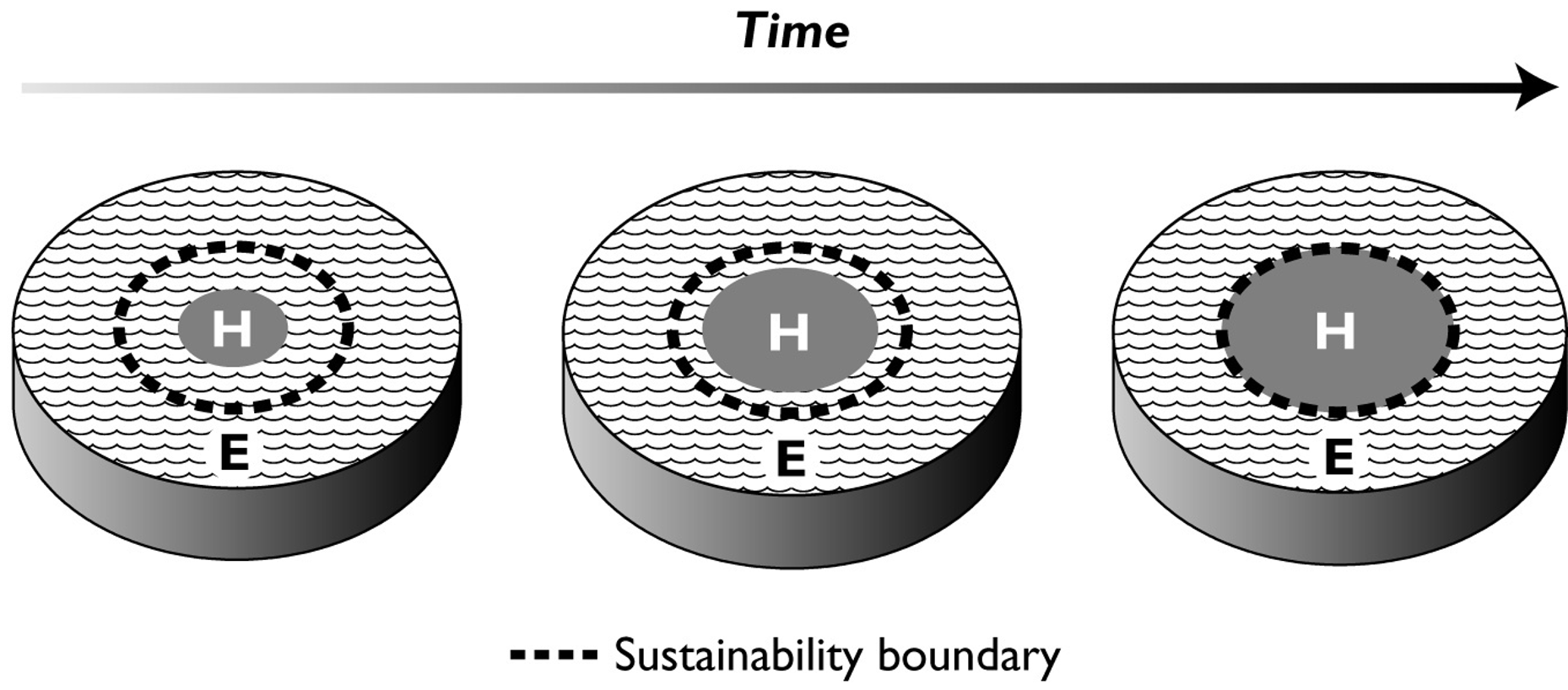
The concept is based on the idea that each hydrologic basin supplies a renewable volume of water that fluctuates from year to year. Human appropriation (H) of this water can increase over time but must stay within the limits of natural replenishment and also leave a sufficient volume of water in situ to support freshwater ecosystem health (E) for the long term. Credit: Sustainable Waters

Over the two decades since publishing the book I have been advising water managers and governments in their efforts to apply this sustainability concept. I’ve also worked with my university students to document places around the world where some form of this concept has been applied, carefully evaluate what has worked, and assess why some applications have struggled.

This concept can be applied at various spatial scales and by various administrative agencies. For example, if you’re trying to manage water scarcity across the entire Colorado River Basin in the American Southwest, the framework would need to include the entire watershed that replenishes the river and its tributaries, and the important actors would include both the US and Mexican federal governments as well as the individual states embedded within the basin. If the area of concern is the New Mexico portion of the Rio Grande, the state’s agencies would work with cities and irrigation districts to apply the concept.

Based on what I’ve learned from real-world experiments and our global research, I’ll outline a simple 3-step framework for operationalizing this concept and successfully managing water scarcity.

Step One: Setting the Cap

The first step is to gain a sound understanding of how much renewable water supply is available on average within the basin of interest. This determination is used to set an enforceable limit, or cap, on how much water can to be allocated for human consumption (H in the diagram above). Physical scientists will play an essential role in advising administrative authorities on where to set the cap.

Importantly, the cap needs to be modified regularly. My recommendation is to adjust the cap at 5-year intervals, based on the prior five years of annual replenishment. If the previous five years have yielded above average replenishment, the cap level might be raised for the next five years. If on the other hand the recent 5 years have been drier than average, the cap will need to be adjusted downward. By adjusting every five years, water users can reap the benefits of good years yet avoid depleting rivers, reservoirs, and aquifers during bad years. A five year interval also provides water managers and water users with a reasonable planning horizon and much-needed certainty.

Step Two: Allocating the Water

Water sharing is one of humanity’s most challenging endeavors. It is immensely difficult to allocate water in a manner that is fair, inclusive, and equitable, but quantitative, clear, and enforceable allocation is absolutely essential in sustainable water management.

My recommendation is to allocate on a percentage basis. For example, the US and Mexican federal governments could work with each of their respective states within the Colorado River Basin and negotiate percentage allocations to each state. These allocations would limit each state to their respective percentages of the overall basin cap (see H in diagram above). In the Colorado River Basin, some of the states have received allocations on a percentage basin, but the cap set in 1922 in this basin was grossly overestimated, leading to dangerous overconsumption that has depleted rivers, reservoirs, and aquifers. A downward adjustment and reallocation among states is desperately needed.

Step Three: Learning to Live Within One’s Allocation

Once a cap is set and water users receive their allocations, the users need to figure out how to live within their respective limits. This is the most fascinating and exciting aspect of water management. Human beings are remarkably resilient and innovative when they embrace a challenge and design ways to live within limits imposed upon them. One of the great benefits of Steps One and Two is that they clearly signal what is available to water users, and what is not. In my experience, the capping and allocating of water supplies provides an immensely beneficial stimulus for change and adaptation. This is how a thousand flowers bloom, meaning there are many ways that individuals, communities, companies, and geopolitical entities can adjust to new limits. They can implement water conservation measures in cities and on farms, recycle urban wastewater, capture stormwater runoff, desalinate salty water, shift to less thirsty crops, or adopt myriad other strategies.

As just one example, cities dependent upon the Colorado River have embraced the reality that their water supplies have been substantially reduced in recent decades due to climate change and long-term aridification. Faced with this challenge to their water security, they have been able to reduce their total water use by 18% even while their populations have increased by 24%!

Back to Retirement

On New Year’s Eve of last year I mentioned in my last blog that I was retiring from my professional water work. I decided to publish this one additional post because I simply can’t stand to watch the massive failures in managing the ongoing water crises in the Colorado River and Rio Grande without saying something. What I’ve said here is a distillation of what I’ve learned over four decades of work on water scarcity. I offer it with the hope that those involved in management of these stressed basins might give it some consideration. The paper cited below summarizes nearly 50 case studies where this framework has been implemented in some form.

Strongly recommended reading: “Taking stock of caps on water use: fostering sustainability or falling short?” (2025)

These #Colorado ranchers want fossil fuel companies held accountable: Having watched #ClimateChange take a toll on their land, they support #Boulder’s landmark lawsuit against Suncor and Exxon Mobil — Sharon Sullivan (ColoradoNewsline.com)

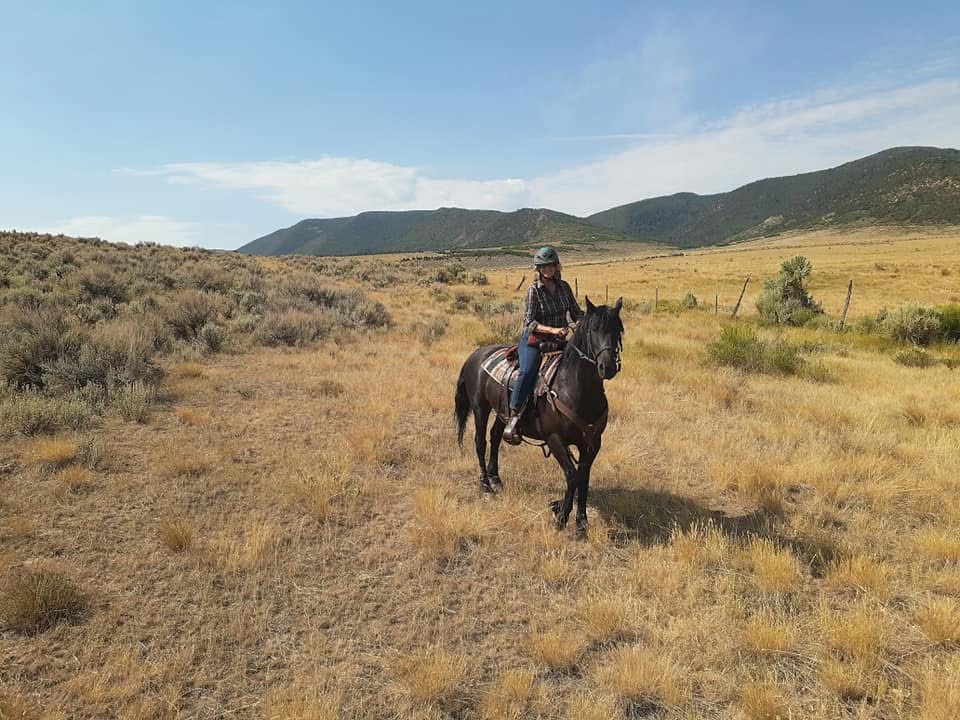
Kathleen Sullivan Kelley rides one of her horses at her Rio Blanco County ranch. (Photo courtesy of Kathleen Sullivan Kelley)

Click the link to read the article on the Colorado Newsline website (Sharon Sullivan):

August 11, 2026

Every three days, Kathleen Sullivan Kelley hauls water from the town of Meeker to fill a 500-gallon tank at her ranch in Rio Blanco County. Kelley’s horses used to drink from ponds on the property, but there’s no longer any surface water, and she and her husband, Reed, sold the last of the 200 cows they once raised. Kelley, 71, is concerned that the ranch could eventually be cut off from the city water source due to worsening drought. 

A year ago, the Lee Fire tore through the Kelleys’ property, sparing their concrete house but destroying miles of trees, as well as all their fencing, plus several buildings and old granaries from a former homesteading community on the ranch. After being forced to evacuate, the Kelleys returned home 60 days later to falling ash and more than 75 years worth of destroyed infrastructure, she said.

“Our (weather) conditions have changed so much during my lifetime,” Kelley said. “Now three-quarters of the year is fire season. We’re watching for fire all the time. That’s our life now. We’re constantly thinking about fire mitigation.”

In July, Kelley joined six other ranchers in filing a brief with the U.S. Supreme Court in support of a lawsuit brought by the city of Boulder and Boulder County against three Suncor Energy entities and Exxon Mobil. Boulder is seeking monetary damages for costs incurred responding to wildfires, repairing transportation infrastructure, restoring watersheds and other harm related to climate change.

The county is not seeking to regulate emissions or fossil fuel production. It only wants the fossil fuel companies to help pay for harms the county contends were caused, in part, by the activities of Suncor and Exxon. The defendants say states lack the authority to regulate pollution, including greenhouse gas emissions, originating beyond its borders.

The ranchers’ brief was a response, in part, to a brief filed by several Colorado counties in support of the fossil fuel companies. 

Case moves to U.S. Supreme Court

EarthRights International is representing Boulder and Boulder County in the lawsuit. In February, the U.S. Supreme Court granted the defendants’ petition to review an earlier Colorado Supreme Court decision allowing Boulder’s case to move forward. The Supreme Court will decide “whether federal law precludes state law claims seeking relief for injuries allegedly caused by the effects of interstate and international greenhouse-gas emissions on the global climate,” and, whether a U.S. Supreme Court review is even appropriate at this stage of the case.

“Proposed federal efforts attempt to shield fossil fuel companies from accountability, leaving local communities and taxpayers to shoulder the financial burden alone. That is a dangerous precedent. Our community should not bear the rising costs of climate impacts caused by decades of deception from the fossil fuel industry.” – Aaron Brockett, Boulder mayor

“More extreme weather, increased wildfire risk and growing strain on critical infrastructure have become an all too familiar reality in Boulder,” said Boulder Mayor Aaron Brockett in a statement provided to Colorado Newsline. “At the same time, proposed federal efforts attempt to shield fossil fuel companies from accountability, leaving local communities and taxpayers to shoulder the financial burden alone. That is a dangerous precedent. Our community should not bear the rising costs of climate impacts caused by decades of deception from the fossil fuel industry. This lawsuit is about accountability, protecting our community and ensuring the companies that knowingly contributed to the climate crisis share responsibility for the costs our communities now face.”

Representatives from Suncor and Exxon did not respond to requests for comment.

The ranchers

Rio Blanco County cattle rancher Deirdre Macnab learned about the case after reading a June 17 article in The Herald Times, a weekly newspaper serving Rio Blanco County. Macnab was disappointed to learn that Rio Blanco County commissioners had spent $7,500 of taxpayer money toward legal fees to file a brief in support of Suncor and Exxon Mobil. Participants in The Associated Governments of Northwest Colorado brief also include Mesa, Delta, Archuleta, Grand, Montezuma, Garfield and Montrose counties. Macnab decided to reach out to other ranchers who have been affected by a changing climate about support for Boulder’s cause.

The burning of fossil fuels has contributed to reduced snowpack, earlier melt-off, increased temperatures, and increasing heat domes, all affecting the agricultural community, Macnab said. Ranchers are not interested in imposing new regulations on the oil and gas industry. The group only wants fossil fuel companies to pay a share of costs that have occurred from harms caused by wildfires, floods and other extreme weather events. Suncor and Exxon both reported record profits last year. 

“That’s the impetus of these ranchers getting behind this,” Macnab said. “It’s the responsibility of fossil fuel companies to support these impacted communities. We’re very concerned about the future.”

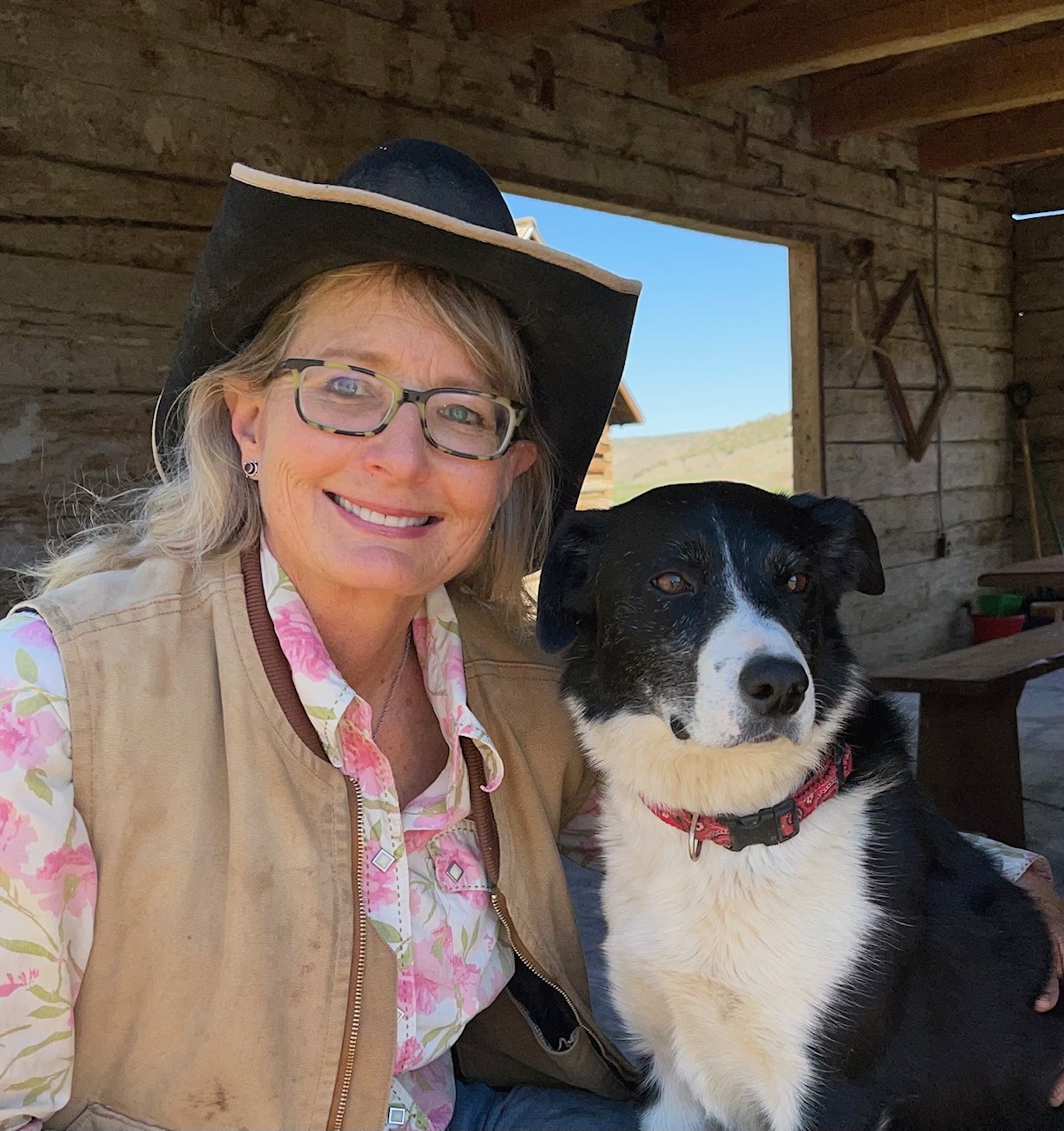
Dierdre Macnab and her border collie pose for a photo at her ranch in Rio Blanco County in June 2021. (Photo courtesy of Dierdre Macnab)

One of the ranchers is Kathryn Bedell, who, like Macnab, engages in regenerative agriculture, which emphasizes sustainable grazing practices and soil rebuilding. Bedell is on the board of the American Grass-fed Association and executive director of the Southwest Grass-fed Livestock Alliance. She promotes grass-fed agriculture instead of fattening cattle on grain in feedlots. The changing climate is affecting her ability to ranch.

In the spring and early summer, she grazed her cattle on what would normally be her hay pastures, because the water sources on her early summer pasture were dry. She expects she will need to sell her entire herd this fall, because she can’t afford to pay for hay for six to seven months, she said. 

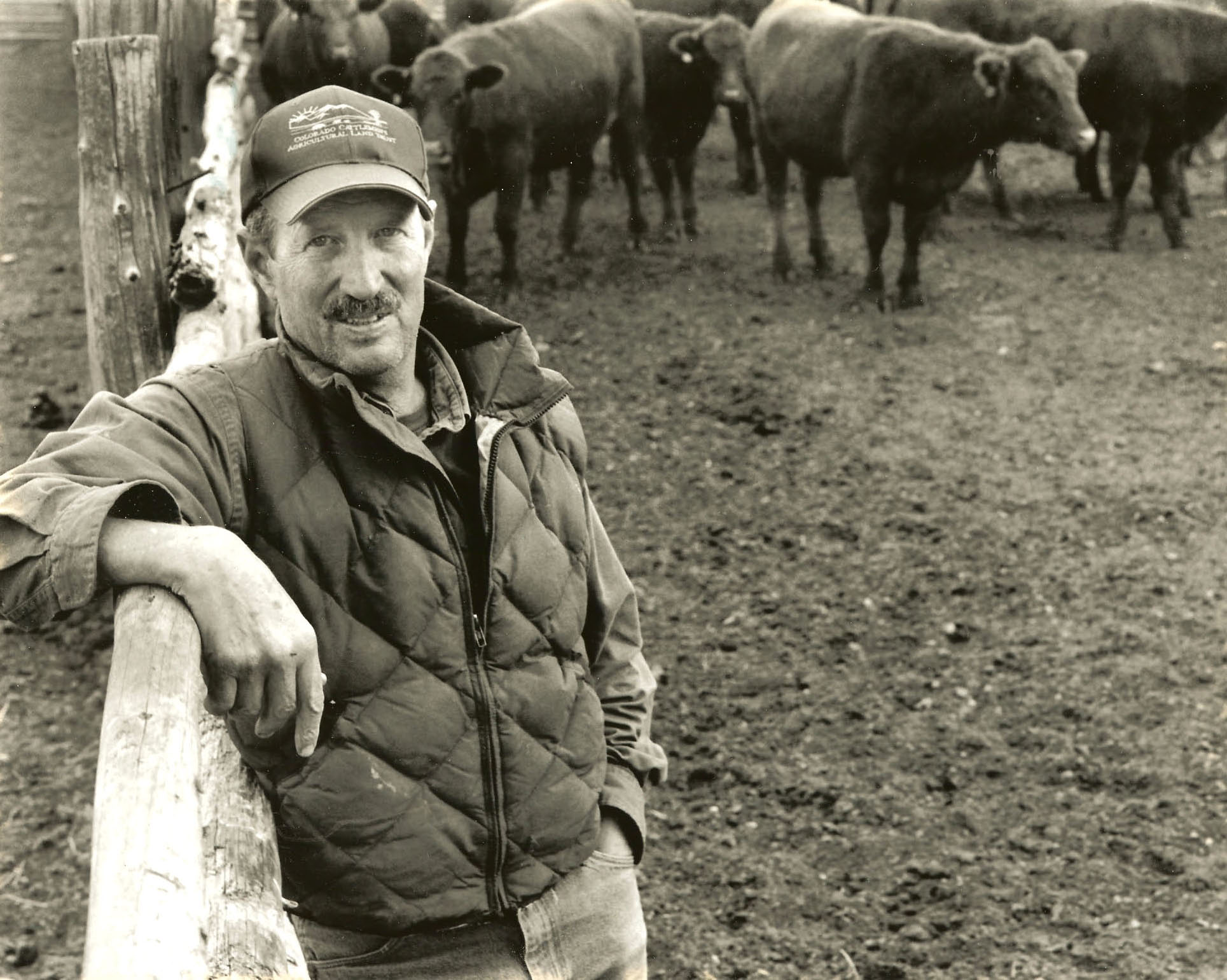
Another brief participant, Jay Fletcher, 78, grew up on the ranch he owns near Steamboat Springs. He supports Boulder’s lawsuit because of the changes he’s seen over his lifetime. Daily temperatures of 90 degrees Fahrenheit never used to happen, he said. Snow left his meadows early this year, on March 2 – that’s a first, he said. The unpredictable weather patterns have made ranching difficult, he said.

Other ranchers supporting Boulder’s lawsuit include Andy Breiter of Boulder County; Mike Callicrate, who ranches and farms in Kansas and operates a retail meat business in Colorado Springs; and Caleb Valdez in Montezuma County. Richman Law and Policy, headquartered in New York state, provided pro bono legal services for the group. 

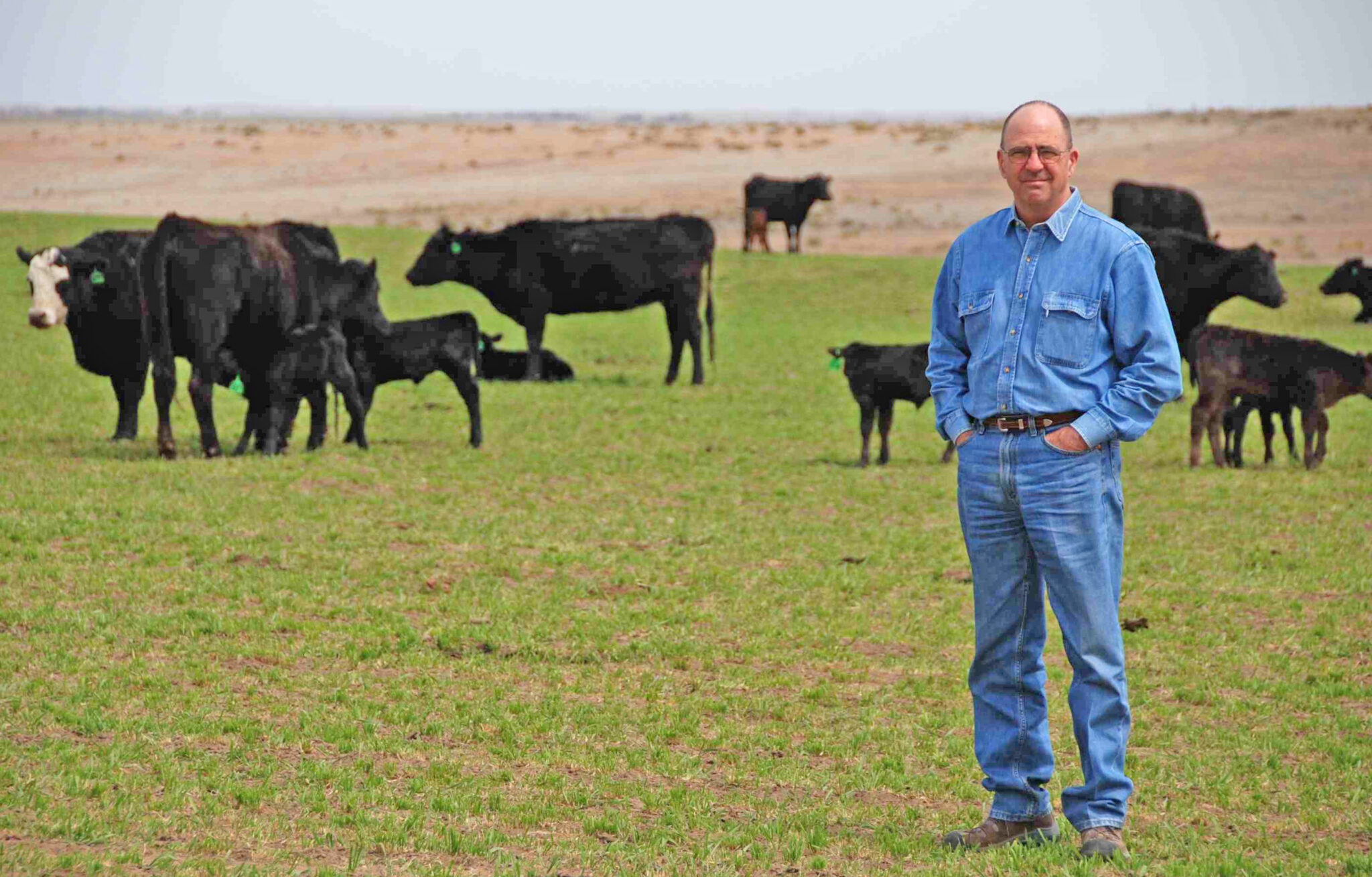
Mike Callicrate at Callicrate Cattle Co. in St. Francis, Kansas, where his cow-calf pairs graze on a pasture. (Photo courtesy of Callicrate Cattle Co.)

Macnab acknowledges some ranchers disagree with their approach, but she said a “significant number” of them agree. The seven ranchers are not seeking financial compensation for their personal losses, but they don’t want counties to be solely on the hook for harms they say are caused at least in part by fossil fuel companies, she said. Suncor is a Canadian company with several subsidiaries, including a refinery in Commerce City. 

The federal government denied Colorado’s appeal for FEMA disaster relief, after the Elk and Lee fires burned more than 137,000 acres in Rio Blanco County last year, costing an estimated $27.5 million in damages. 

Jay Fletcher poses in front of his cows at his ranch near Steamboat Springs. (Photo Courtesy of Jay Fletcher)

Colorado counties that support Suncor, Exxon

Oil and gas companies operate in the counties that support the AGNC brief in favor of Suncor and Exxon — and generate significant revenue for those communities, said Mesa County Commissioner Cody Davis. He said if Boulder succeeds in its case against Suncor and Exxon, the companies will move operations out of Colorado.

“It’s essentially regulating industry so they won’t be able to operate,” Davis said. 

Mesa County contributed $15,000 toward the $75,000 total cost of filing the brief supporting Suncor, Davis said.

In an email to Colorado Newsline, Rio Blanco County commissioners cited high-paying jobs, and “severance tax distributions, federal mineral lease revenues and royalties, and property taxes on energy infrastructure” that help fund roads, schools, emergency services and other essential public functions, as reasons for their participation in the AGNC brief.

Colorado attorney general weighs in

A multistate coalition of attorneys general, including Colorado Attorney General Phil Weiser, filed their own brief with the Supreme Court stating that if it finds it does not have the authority to hear the case, the lawsuit should return to Colorado’s courts. 

“At this stage of the case, it would be an overreach and improper for the Supreme Court to prevent Colorado courts from considering the merits of this litigation,” Weiser said in a statement.

Macnab said she recognizes the critical role that fossil fuel development has played in society. “But now the science is clear, and the technology available and we can begin a more rapid transition to a more sustainable future,” she said. “It’s important that people understand we have to protect our food production, and food producers, and local agriculture. Not only people’s livelihoods are at stake, but also food production.”

Colorado Newsline is part of States Newsroom, a nonprofit news network supported by grants and a coalition of donors as a 501c(3) public charity. Colorado Newsline maintains editorial independence. Contact Editor Quentin Young for questions: info@coloradonewsline.com.

Amid a #ColoradoRiver feud, water leaders ask if Arizona should keep paying for faraway snow — KJZZ.org

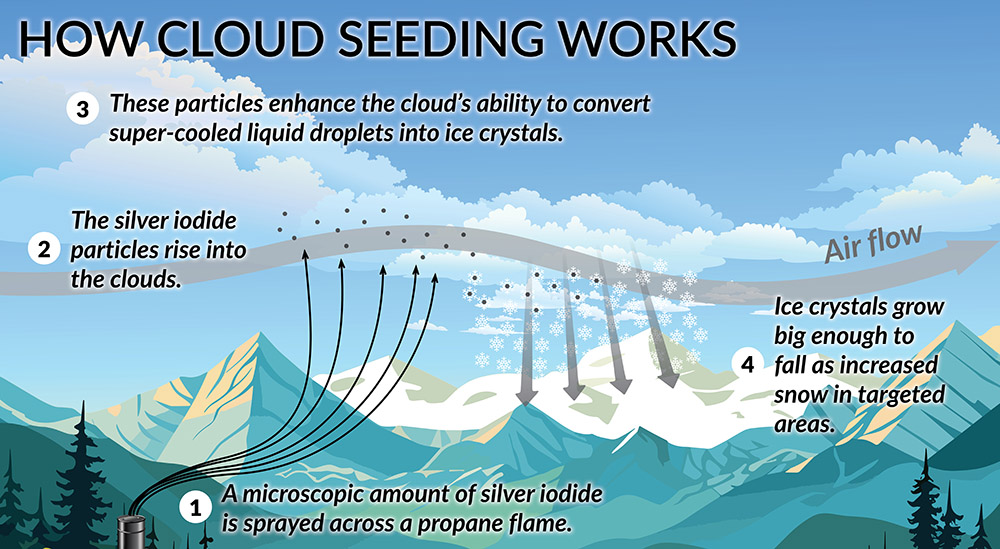
The DRI Cloud Seeding Research Program uses ground-based generators, which are designed and built by DRI and can be operated remotely. Most cloud seeding operations, including those run by DRI, use a compound called silver iodide (AgI) to aid in the formation of ice crystals. Silver iodide exists naturally in the environment at low concentrations, and is not known to be harmful to humans or wildlife.
When storm systems move through one of our cloud seeding project areas, a solution containing a small amount of silver iodide is burned from ground-based generators or released from aircraft. Upon reaching the cloud, the silver iodide acts as an ice forming nuclei to aid in the production of snowflakes. Credit: Desert Research Institute

Click the link to read the article on the KJZZ website (Alex Hager). Here’s an excerpt:

August 7, 2026

The Central Arizona Project runs a 336-mile-long canal system that carries water from the Colorado River across the desert and into the Phoenix and Tucson areas. Since 2007, it has been part of a collaborative effort to run cloud seeding equipment in the Rocky Mountains. The program brings together water users that benefit from faraway snowmelt — like CAP, water agencies in Las Vegas and Los Angeles and major farming districts in Southern California — and agencies that manage water near the snowy mountains themselves. Now, the future of CAP’s participation in that collaboration is in question. At a meeting of the CAP board of directors on Thursday, the cloud seeding program got caught in the middle of bigger water politics.

“I know we’ve been funding this for almost 20 years, and now everybody’s trying to cut us off,” said Barbara Seago, a CAP board member representing Maricopa County. “So my take is, why would we keep funding anything that benefits Colorado if they’re willing to cut us off?”

[…]

In recent years, water agencies in Arizona, California and Nevada have sent about $1.5 million per year to upstream cloud seeding work. Those agencies say it is a small part of the solution to the complicated, politically fraught issue of supply-demand imbalance along the Colorado River, but it is still worthwhile. Technical experts on CAP’s staff explained the program to the board as a way to benefit the Colorado River system overall, even if it is difficult to draw a straight line between dollars spent on cloud seeding and water that physically flows into Arizona’s reservoirs and canals.

“If we have more water on the ground in the watershed,” said Nolie Templeton, CAP’s Colorado River policy and analysis manager, “Then I think everybody in the watershed is going to benefit because more of that water will make it into our rivers and streams.”

Central Arizona Project map via Mountain Town News

#Denver and #Aurora aren’t hitting their water goals — but they’re not panicking either — Denverite.com #drought #aridification

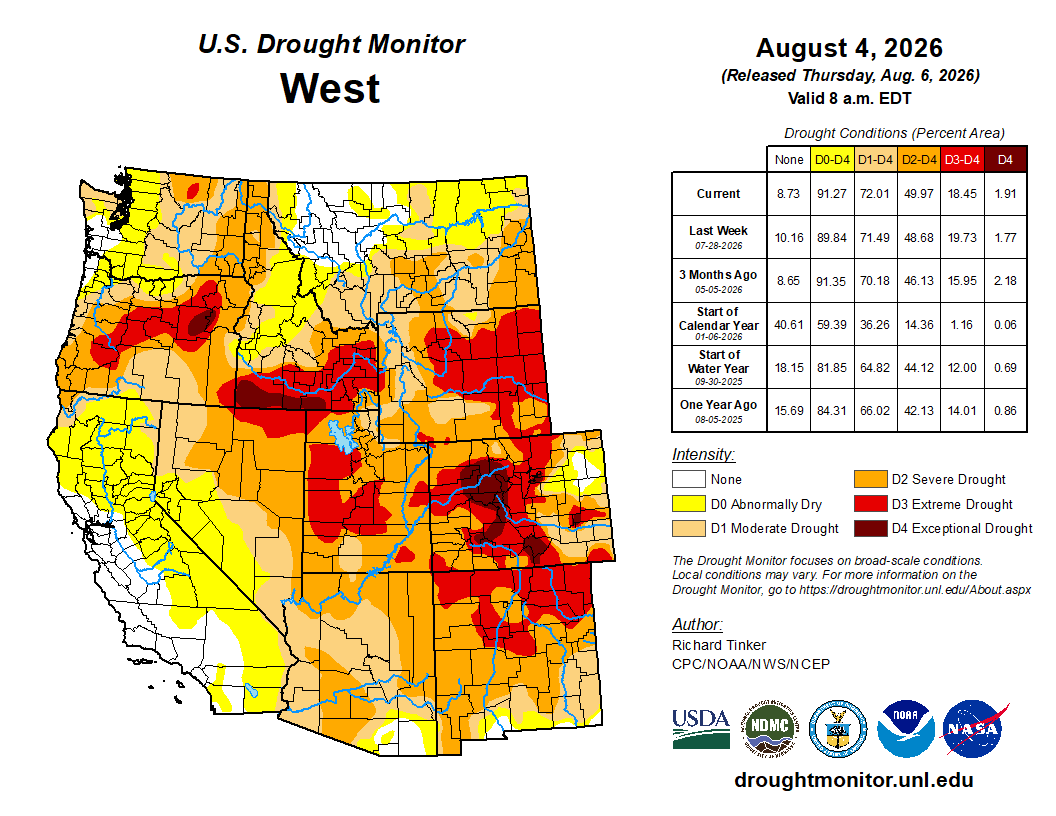
West Drought Monitor map August 4, 2026.

Click the link to read the article on the Denverite website (Sandy Battulga). Here’s an excerpt:

July 20, 2026

Denver Water’s 1.5 million customers are using less water than usual, but it’s still not enough to meet the utility’s goal of reducing water consumption by 20% amid this year’s drought.

“We’d need to be at 10,300 acre-feet of savings. Instead, we are at 1,300 acre-feet of savings, so behind where we want to be,” said utility spokesperson Todd Hartman.

That means the utility, which serves residents in Denver and many surrounding communities, has achieved barely a tenth of its target.

In Aurora, water officials said locals have made progress toward that utility’s 20% goal, but did not provide exact statistics.

While the utilities aren’t hitting their goals, they’re not ringing alarms yet. Both utilities have implemented Stage I water restrictions, and neither plans to move to the more severe restrictions of Stage II.

But that could change depending on how water levels look for the rest of the year — and Aurora Mayor Mike Coffman said it could be soon. In a Facebook post, Coffman wrote that the city is “now teetering on having to move to Stage II drought restrictions that, if enacted, will reduce all outdoor irrigation from two waterings a week down to one, killing off most lawns completely. According to [Kirby] Shedlowski, however, Stage II restrictions are not yet on the table. She said Aurora Water staff would have to recommend that shift to the Aurora City Council, which hasn’t happened yet.

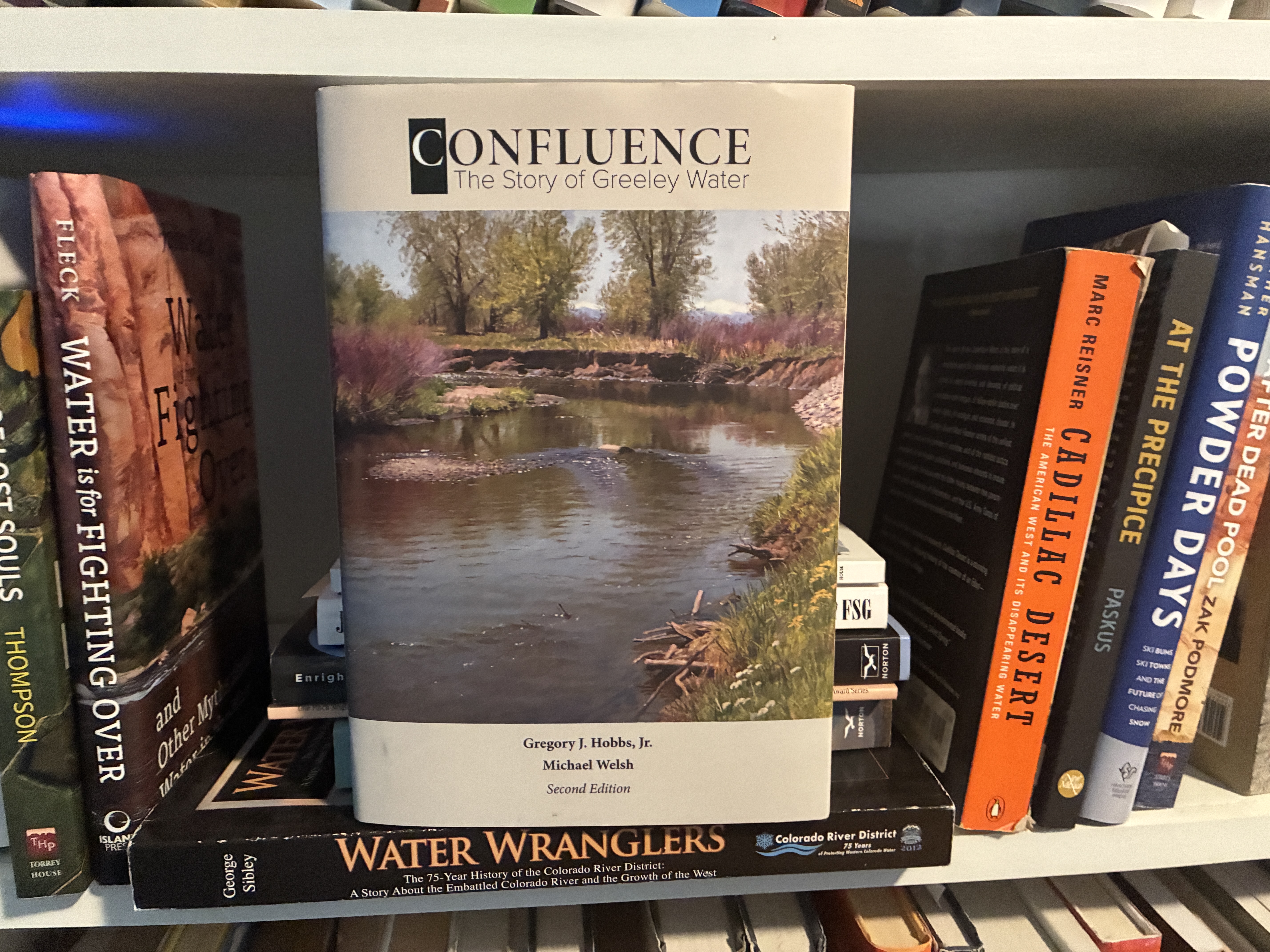
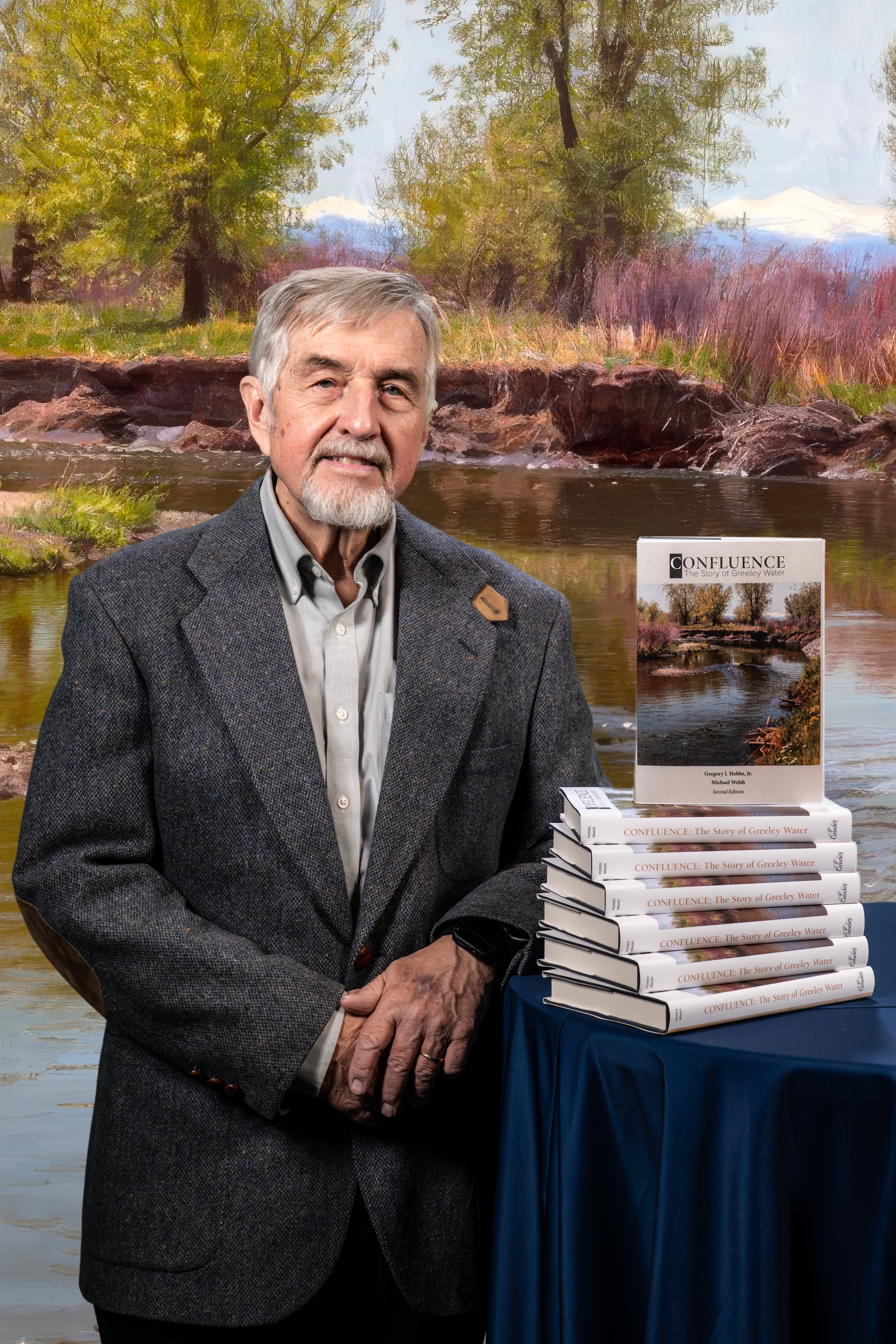
Confluence: The Story of Greeley Water (Second Edition, 2026)

From Tishana ‘Tish’ Cano at the Greeley Water & Sewer Department:

“Here is a land where life is written in water.”  Thomas Hornsby Ferril, named Colorado’s poet laureate in 1979, could not have composed a better description of the agricultural community founded at the confluence of the Cache la Poudre and South Platte Rivers. In April 1870, a group of far-seeking settlers after a long four-day train ride from New York City and other points back East. Their goal was to create a new way of life on the dry and desolate plains of northern Colorado. Water was the key – and in 1874, a conflict with upstream irrigators of the agricultural community of Fort Collins created a flashpoint in Colorado water law and the American West. Both sides met “half-way” near present-day Windsor and launched an iconic, heated debate over western water rights. With guns used in the Civil War at the ready, the parley led to the birth of western water law – the Doctrine of Prior Appropriation.

Authors Gregory J. Hobbs, Jr. and Michael Welsh describe the triumphs and challenges of Greeley’s water history, from its 1884 artesian well in City Park to its 1907 mountain water system. The book chronicles the Colorado-Big Thompson Project of the 1930s and the Milton Seaman Dam and Reservoir construction in the 1940s. Hobbs and Welsh describe the foresight and tenacity of creative men – David Boyd, Henry C. Watson, Delph Carpenter, W.D. Farr, Harold Evans, and others – who shouldered the work and pointed the way to identify, acquire, and deliver affordable water to Greeley for more than a century. “Plan for others as they have planned for you” guides and unites the actions of our story of Greeley Water.

From the Rocky Mountain American Water Works Association:

Public works agencies rarely have time to reflect on their accomplishments and lessons learned, as they pursue on a daily basis their operations, maintenance, and plans for future growth. Yet that retrospective is what the City of Greeley Water Utilities Department, with its century and one-half of service to the community, decided to engage with the research and publication of Confluence: The Story of Greeley Water (2020).

Harold Evans, chairman of the Greeley Water and Sewer Board for the past two decades, believed that those whom the utility served would benefit from a comprehensive analysis of the origins and development of an organization that began before Colorado statehood, and one that has grown over time by addressing the cycles of abundance and scarcity of water that define the Headwaters State.

Joining the team of researchers and writers in 2015 were Gregory J. Hobbs, Junior, a retired associate justice of the Colorado State Supreme Court, often considered the most knowledgeable member of the high court in matters of water law and policy, and Michael Welsh, a professor of history at the University of Northern Colorado, whose decades of teaching and scholarship included studies of the U.S. Army Corps of Engineers in the Southwest and on the West Coast.

This team explored the range of issues and tasks of a municipal water system that began in the summer of 1870 with a single irrigation ditch on the Cache la Poudre River that conveyed water to the fledgling Union Colony (later to become the town of Greeley). As the population increased and the economy evolved, the Greeley water utility added a community artesian well (1884); a mountain water treatment facility above Fort Collins at Bellvue (1907); and a storage facility on the North Fork of the

Poudre River known as Milton Seaman Reservoir (1945); the latter two remaining operational over a century later. Residents of the Colony, and their policies and regulations, also played an important role in the development of statewide and interstate water law. One example would be the enshrining in Colorado’s 1876 constitution of the “prior-appropriation doctrine.” In addition, a Greeley native, Delph Carpenter, who had been employed as a youth inspecting the community’s ditch system to guard against violation of its rules, became an authority on the collaborative features of western water law. Carpenter would be tasked by the U.S. Commerce Secretary, Herbert Clark Hoover, with a key role in the drafting of the Colorado River Compact.

That agreement would permit a group of Greeley and Colorado water professionals a decade later to approach the U.S. Bureau of Reclamation to confront the severity of the Great Depression and the Dust Bowl by means of the Colorado-Big Thompson Project; a multipurpose facility that secured the future for farmers and ranchers of the South Platte River basin, and later the urban growth of the Front Range.

The Greeley Water & Sewer Board, originating in 1958 from the idea that local decisions in water belong with the people, and guided by those who understood and appreciated what water meant to Greeley, established the nonpartisan principles that inform the acquisition and development of water facilities. From the leadership of water pioneer W.D. Farr to today, with Harold Evans, who has a background in Civil Engineering, the Board has possessed expertise and foresight that contributes to Greeley’s good fortune with its most precious resource.

What began with that first ditch has now become a network of multiple reservoirs in four river basins, and prize-winning water pollution-control facilities. The City of Greeley also has taken the lead in water efficiency & quality, working with state and federal partners to replace aging lead pipes, and to institute an advanced metering system and residential and commercial “water budgets” that keep utility customers informed of their use patterns and the value of conservation in times of drought.
Once the first volume on the story of Greeley water appeared, the water utility continued to provide domestic water and wastewater treatment to its network of communities. The City also pursued regional cooperation with the municipalities of Fort Collins, Loveland, Windsor, and Evans. Greeley maintained its partnership with the Northern Water district, in particular its Chimney Hollow Reservoir, which will store additional supplies for a dozen water organizations that own water rights in the CBT system that are not reliably accessible in times of need.

From that recognition in 2020 that the story of Greeley water had not ended came a new edition in the summer of 2026, written to incorporate the purchase of water rights to the vast underground aquifer in far northern Colorado known as the Terry Ranch Project. Other dimensions of the utility’s operations addressed in the second edition of Confluence are the expansion of the “non-potable” water system for use in public and private spaces; the application of sophisticated information technology; and the advanced-planning functions of the “Integrated Water Resources Program,” which identifies scenarios and options for a wide variety of challenges and opportunities in water-resource management decades into the future.

It is our hope that this new look at an old story helps residents and businesses of Greeley and surrounding communities realize how important their water supplies are to their security and prosperity. In 1941, in the midst of a world at war, and as the decade of the Dust Bowl neared an end, Greeley’s leaders embraced a simple but compelling idea: “To plan for others as others have planned for you.” Wise words for their time, and wise words for ours now.

Greg and Bobbie Hobbs
Dr. Michael Welsh