
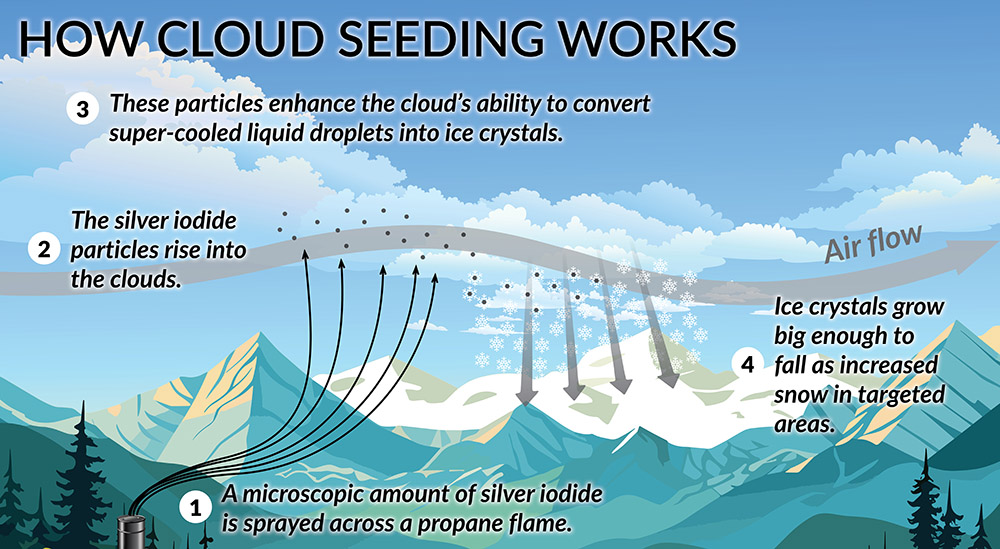
When storm systems move through one of our cloud seeding project areas, a solution containing a small amount of silver iodide is burned from ground-based generators or released from aircraft. Upon reaching the cloud, the silver iodide acts as an ice forming nuclei to aid in the production of snowflakes. Credit: Desert Research Institute
Click the link to read the article on the KJZZ website (Alex Hager). Here’s an excerpt:
August 7, 2026
The Central Arizona Project runs a 336-mile-long canal system that carries water from the Colorado River across the desert and into the Phoenix and Tucson areas. Since 2007, it has been part of a collaborative effort to run cloud seeding equipment in the Rocky Mountains. The program brings together water users that benefit from faraway snowmelt — like CAP, water agencies in Las Vegas and Los Angeles and major farming districts in Southern California — and agencies that manage water near the snowy mountains themselves. Now, the future of CAP’s participation in that collaboration is in question. At a meeting of the CAP board of directors on Thursday, the cloud seeding program got caught in the middle of bigger water politics.
“I know we’ve been funding this for almost 20 years, and now everybody’s trying to cut us off,” said Barbara Seago, a CAP board member representing Maricopa County. “So my take is, why would we keep funding anything that benefits Colorado if they’re willing to cut us off?”
[…]
In recent years, water agencies in Arizona, California and Nevada have sent about $1.5 million per year to upstream cloud seeding work. Those agencies say it is a small part of the solution to the complicated, politically fraught issue of supply-demand imbalance along the Colorado River, but it is still worthwhile. Technical experts on CAP’s staff explained the program to the board as a way to benefit the Colorado River system overall, even if it is difficult to draw a straight line between dollars spent on cloud seeding and water that physically flows into Arizona’s reservoirs and canals.
“If we have more water on the ground in the watershed,” said Nolie Templeton, CAP’s Colorado River policy and analysis manager, “Then I think everybody in the watershed is going to benefit because more of that water will make it into our rivers and streams.”
