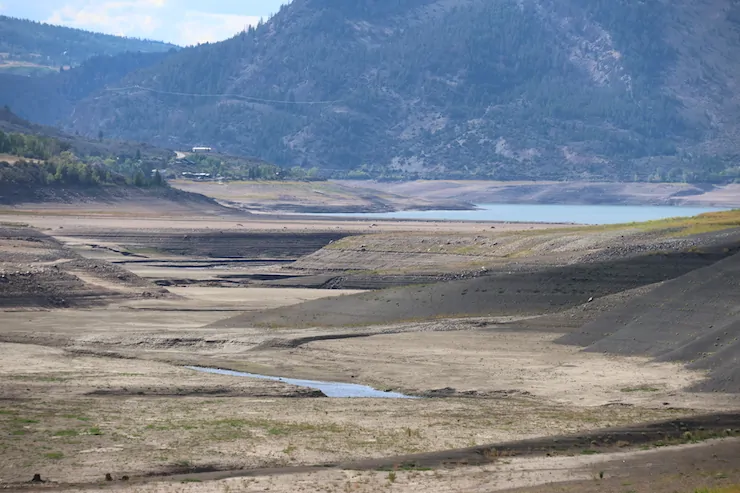
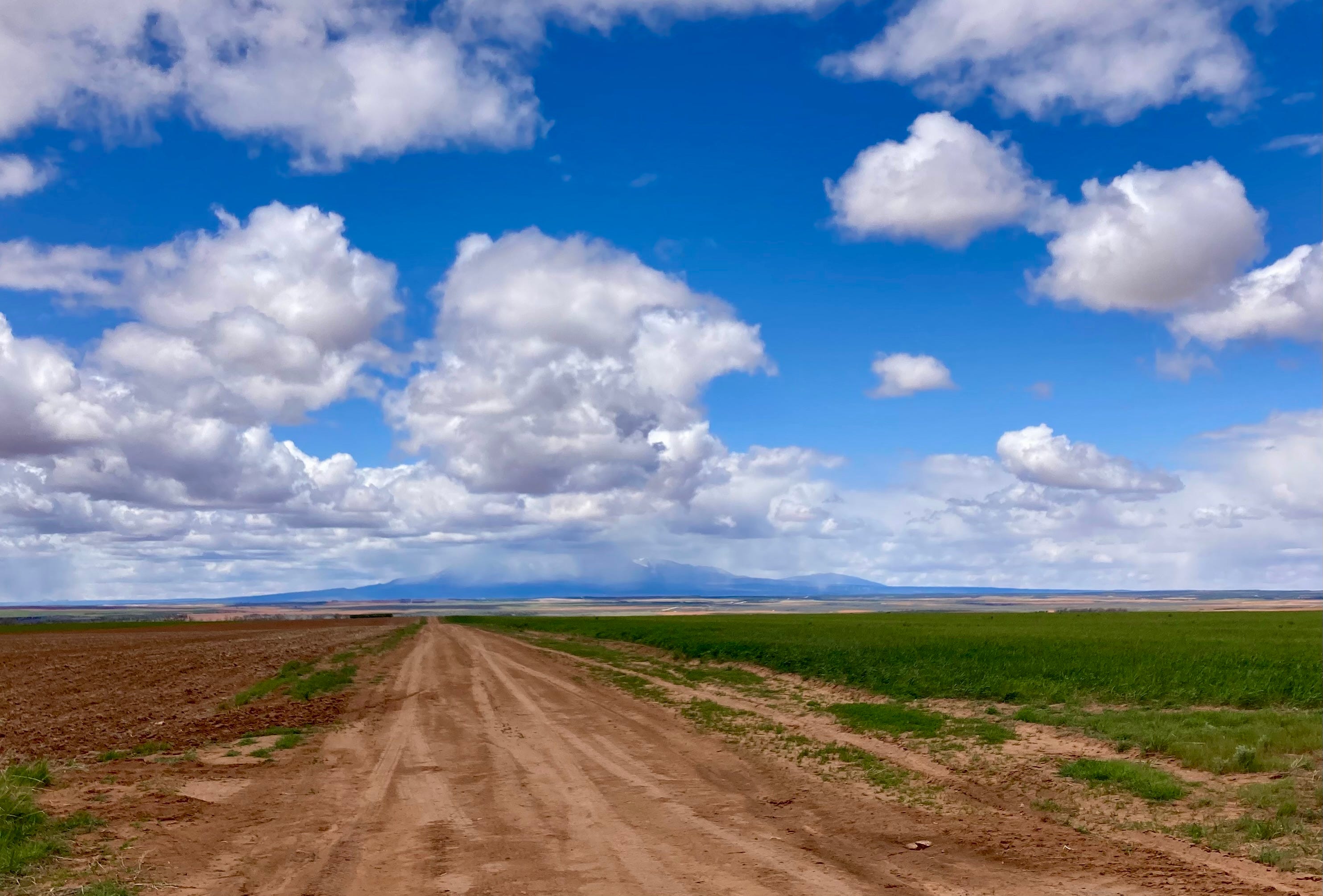
Green Mountain Reservoir August 17, 2026. Photo credit: Allen Best/Big Pivots
Click the link to read the article on the Big Pivots website (Allen Best):
September 7, 2026
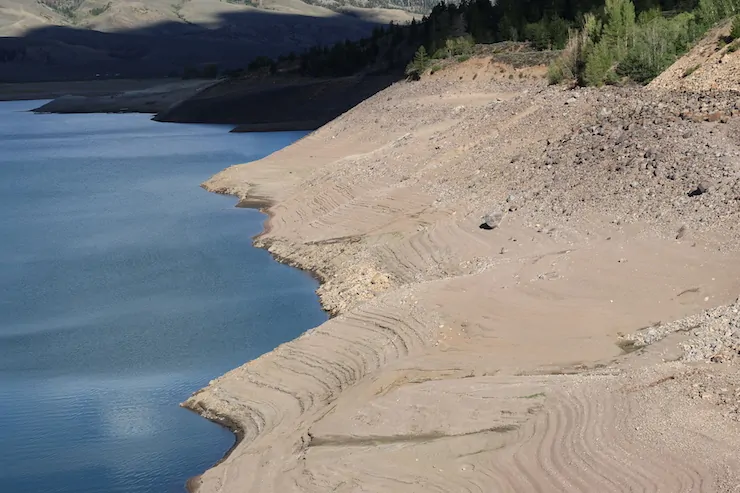
No place in Colorado that I have visited offers such blunt testimony to the warming, drying climate than Green Mountain Reservoir. It also poses a question to those politicians whose answer to non-winters and ever-hotter summers is more dams and reservoirs.
The reservoir between Silverthorne and Kremmling was 14% full during Labor Day weekend, according to the U.S. Bureau of Reclamation, the operator. Put another way, it was 86% empty.
That’s worse even than the roughly 78% empty at Lake Powell, the reservoir located roughly 700 river miles downstream from Green Mountain.
Green Mountain was part of Colorado’s mission begun in the 19th century to put water to “beneficial use,” a central axiom of state water law. Pioneer settlers did an admirable job of this, in the beginning using nothing more than horses, oxen and human labor.
In 1902, the federal government became a partner, creating the Bureau of Reclamation. Over the next roughly 90 years, the federal treasury was visited repeatedly to prevent “waste” of any portion of the Colorado River flowing into the Pacific Ocean.
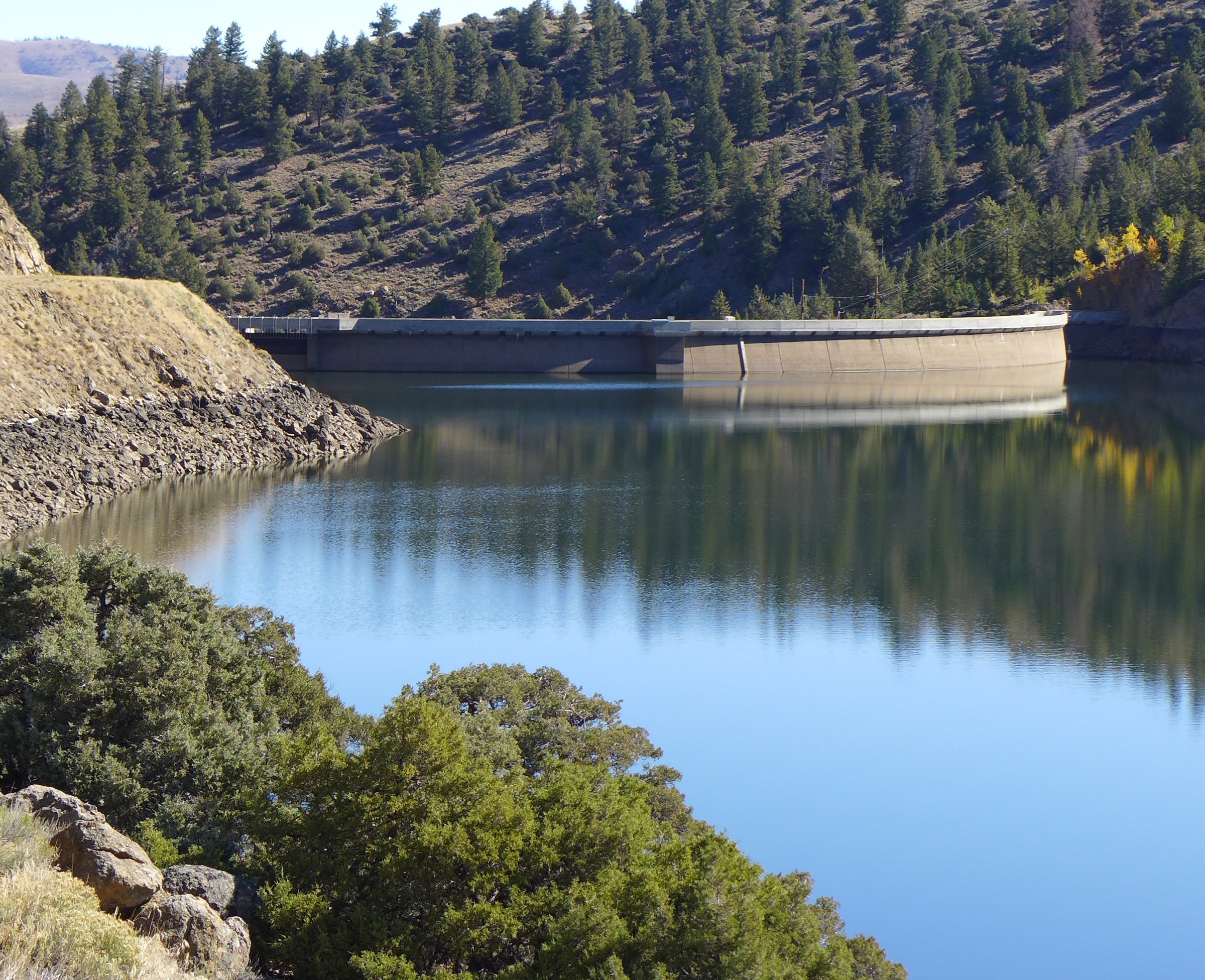
Green Mountain Reservoir, back in the day. Photo credit: Denver Water.
Construction of Green Mountain Dam was part of that work. During the hot, dry 1930s, farmers in the Fort Collins-Longmont-Greeley area wanted to import water from the Colorado River headwaters near Grand Lake. Western Slope irrigators objected. Farms in the Grand Junction area would lose late-season water needed to get their crops and orchards across the finish line.
Green Mountain was the compromise. And it has worked out well. A pool of 66,000 acre-feet of water was reserved for down-stream irrigators in the Grand Junction area. Deliveries in this canal usually continue through October, sometimes later.
This year was different. For the first time in 110-plus years, deliveries ended in late August.
DeBeque Canyon has changed somewhat since this photo of the Roller Dam was taken in 1916. Most notably, now the canyon has an interstate highway. Photo/U.S. Bureau of Reclamation. For a more complete history, see the Palisade Historical Society page.
In April, the Glenwood Springs-based Colorado River Water Conservation District issued a warning. Green Mountain was the lowest it had been since filling during World War II. This jeopardized the late-summer flows to irrigators who took delivery of water from the Government Highline Canal. The canal diverts water from the Colorado River at the Roller Dam, a short distance upstream from Palisade. It then distributes water to farms and orchards for 55 miles, nearly to the Utah border.
Wolford Mountain Reservoir back in the day. An aerial view of Wolford Reservoir, formed by Ritschard Dam.
This year, in a testament to cooperation, the Colorado River District and Colorado Water Conservation Board ponied up more than $1 million to buy use of water. Water was tapped from headwaters reservoirs, most notably Wolford and Williams Fork, near Kremmling, and Ruedi, near Basalt. Others, including Front Range diverters, helped.
Williams Fork Reservoir back in the day. Photo: Brent Gardner-Smith/Aspen Journalism
Irrigators got only 50% of their normal water. In response, many switched crops to varieties of plants that could survive with less water.
Even so, by late August, the water was running out. The Grand Valley Water Users Association, operator of the canal, stopped deliveries on September 3. Maybe monsoon rains will deliver water to resume operations, but that’s the story for now.
Once again, the idea that we just need to store more is entirely too simplistic. Yes, saving for a rainy day is always good, but this idea that we can build our way to more water defies ample evidence about the warming, drying climate.
We can have droughts, yes. They come and go. But the science clearly shows that these hot, dry years of the 21st century will not be ephemeral. They have been driven by a warming climate caused by accumulating greenhouse gas emissions.
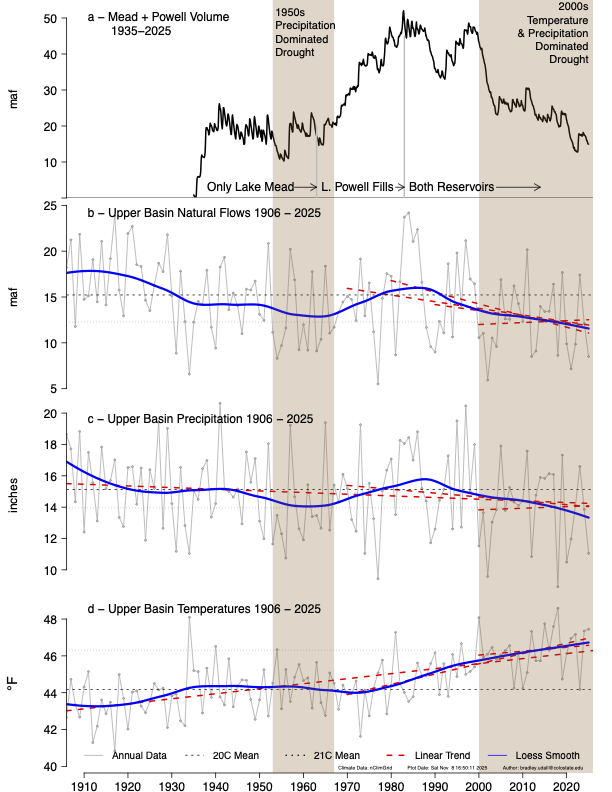
Udall/Overpeck 4-panel Figure Colorado River temperature/precipitation/natural flows with trend. Lake Mead and Lake Powell storage. Updated through Water Year 2025. Note the tiny points on the annual data so that you can flyspeck the individual years. Credit: Brad Udall
In the 20th century, the Colorado River delivered about 15.2 million acre-feet. In this century, the annual flows have declined to 12.2 million acre-feet. Since 2020, average flows have declined even more, to 10 million acre-feet. And this recent span included a very, very big snow year, in 2022-23, a three-wire winter like those of old. But the spring was like those of the 21st century, early and uncommonly warm.
The pitiful storage in Green Mountain, whose shoreline is seen in the above photograph I took on Aug. 17, testifies to this warming, drying climate. So does the canal near Grand Junction where deliveries were cut off last week for the first time in 110 years. And then we have near doubling of 95 degree-plus days in Denver during last 30 years as compared to the three decades before as reported by KUSA.
Might we figure out better infrastructure? Maybe. The idea of storing water underground, as Greeley began doing several years ago, intrigues. It requires more energy but greatly reduces evaporative loss.
The federal government in its documents has excised climate change. So have many politicians in Colorado speaking on the stump, hewing to the recent version of political correctness.
If there are ideas for storing water that don’t assume a return to the climate of the 20th century, I’m all for hearing them. But to think this is just another drought defies tons of evidence.
Thank you so much for attending the 2026 Summer Conference! We enjoyed hosting you, and we hope to see you at our Annual Convention in January.
Recordings from the Conference are now available on our website! These recordings are only for conference attendees, so please do not share this information.
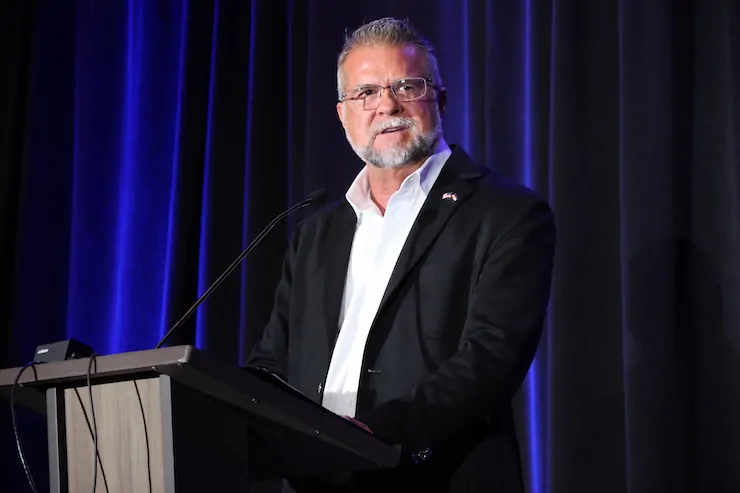
Lauren Boebert at the Colorado Water Congress Annual Summer Conference. Photo credit: Allen Best/Big Pivots
Click the link to read the article on the Big Pivots website (Allen Best):
August 31, 2026
Many political office-seekers spoke at the annual summer conference in Steamboat. Some ‘y’alled to the attendees. Others not so much. Most called for more water storage and “forest resilience.”
“God bless, y’all,” said Victor Marx, the Republican candidate for governor in Colorado in wrapping up his allotted 15 minutes at the podium at the Colorado Water Congress summer conference in Steamboat Springs.
Lauren Boebert, who represents the Fourth Congressional District in Colorado, followed him on the agenda. “It is wonderful to be back with y’all at Water Congress,” said Boebert, a Republican seeking her fourth term in Congress.
Y’alls were common during her quarter-hour on stage. It being a water conference, one of them had to do with water. “So y’all better get real good at that xero-scaping for your lawns and everything you’re building out there because your cactus, your cacti might do just fine, but we’re taking it back,” she said of Arizona.
Dwayne Romero, the Democratic candidate in Boebert’s former Third Congressional District, who preceded them, used none.
What this says exactly, I’m not sure. Y’all is a Southern locution that has become somewhat more common across the United States. I do note that Romero grew up in southeast Texas while Marx was reared in Louisiana, both of those places thick with y’alls and drawls. As for Boebert, she came to Colorado from Florida at the age of four.
Water Congress’s twice-annual conferences always have elected officials as well as water leaders from across Colorado. This being election season in 2026, the time devoted to the pols was greater than normal.
Victor Marx, the Republican nominee for Colorado governor, says Colorado must be prepared adequately for when the rain and snow returns. Photo/Allen Best
Like Marx, some are seeking statewide offices, while others, including Boebert and Romero, are running for Congress in districts with more rural areas.
That makes sense, as the Water Congress has a strong rural constituency. Denver Water is well represented, but so is Logan County. I also noted that Rod Lenz, the chair of the Republican River Water Conservation District’s board of directors, managed to get to the conference by Wednesday morning after a meeting in Holyoke that lasted long into the previous afternoon. That’s a good five-hour trip by car.
As for the y’alls, I have no idea whether Jeff Hurd, the Third Congressional District incumbent, Phil Weiser, the Democratic nominee for governor, drawled y’alls. I suspect not. I have heard both speak several times. Neither is a y’all guy. Both are also attorneys.
Perhaps not surprisingly, Romero and Boebert started out on much the same note in their remarks about the Colorado River. Romero mentioned “decades of lower-basin use” and urged solidarity with Colorado’s negotiating team on “protecting Colorado’s compact entitlements.” Boebert struck the same tone but with more pugilistic language. “We’re fighting for what belongs to us and for our future generations.”
Beyond those obligatory remarks, the two candidates differed greatly. Boebert talked about what she has done for her constituents regarding water and mentioned her work on the Arkansas Valley Conduit Project. “Even though my dear great president may have vetoed that, we are still working to get that over the line for Southeast Colorado.”
Boebert was typical Boebert, saucy and sort of interesting in how she played to her base. She wore blue jeans, as that seems to be her style when making the rounds in Colorado. In what may be more revealing, she also tried to talk about her bi-partisan work. I also noticed she did so when running in a tight race in her former congressional district, the third, in 2022. She won that race by a mere 546 votes, precipitating her move across the Continental Divide.
Maybe it’s because she is in what appears to be a tougher contest with the Democratic candidate, Eileen Laubacher, a retired Navy rear admiral, in a district that in the past has been unflinchingly Republican. Laubacher’s resume, money and growing institutional support could, noted Axios in a story last week, “make Boebert sweat.” Laubacher also spoke at the conference. But again, I was elsewhere.
Themes
Two themes were evident in remarks made by the office-seekers and others at the conference. One was the need for more storage, the other for more “watershed restoration” via Proposition 137, the proposal on the November ballot to divert sales tax revenues from sporting goods to do work in the forests and expand funding for parks.
The discussions in a general way crossed party lines but the storage case was cited more prominently by Republican speakers. Absent, though, was the sort of specifics I thirsted for.
Politicians rarely get into the details when on the stump, of course. And 15 minutes isn’t much time. Boebert’s comments will likely be echoed in the next two months.
“Forest management is not optional anymore. It never was, and for anyone to come up and present policy that is more reactive then proactive is failing you and each and every one of us — is failing future generations,” said Boebert. “Healthy forests hold snow longer, release water cleaner, and protect our watersheds from catastrophic fires that turn drinking water into ash.”
Boebert then took aim at clean energy.
“We hear all the environmental claims about carbon emissions, but these wildfires that are too quickly growing out of control, burning down our beautiful state, neighboring states in the West, with more than 6 billion standing dead trees that no one will allow us to harvest or not harvest enough of, unfortunately even taking lives of first responders…”
Boebert attributed to NASA a statistic: A wildfire produces more greenhouse gas emissions than all of the cars fueled by fossil fuels in a year.
“So EVs aren’t the answer. Sending your money to DC for wind and solar isn’t the answer. It’s being good stewards of our land, managing our forests.”
The storage theme also got lots of attention. It was bipartisan. Little of the conversation went very deep. Some of it was almost insultingly oversimplified.
Consider what Marx had to say: “We can’t make it snow. We can’t make it rain. But we can decide whether we’re prepared for when the water comes. So I believe we should store water in good years. Lord, please send it.”
Udall/Overpeck 4-panel Figure Colorado River temperature/precipitation/natural flows with trend. Lake Mead and Lake Powell storage. Updated through Water Year 2025. Note the tiny points on the annual data so that you can flyspeck the individual years. Credit: Brad Udall
It sounds good, being “prepared adequately.” But that statement assumes good years will come. Examining the science, Colorado State University’s Brad Udall has suggested there may not be any good years, let alone enough to fill all the [reservoirs] already built.
Consider that we have two giant reservoirs on the Colorado River sitting 75% empty. And in the headwaters, Green Mountain Reservoir is 15.1% full, as of Sunday, according to the Bureau of Reclamation. Blue Mesa Reservoir was only marginally better. Navajo, on the Colorado-New Mexico border, is doing better at 40% to 45%.
Romero’s call for partnership
Of the three office-seekers I heard, Romero was most interesting. It was obvious to me he had taken the time to study the Colorado River issues. As for Marx, he rambled.
Romero’s comments were calculated, of course. He was making a case for stability after the chaos of the Trump presidency.
“We have to restore Congress and our federal agencies as institutions that work. Congress has to legislate. It has to authorize projects. It has to appropriate money. It has to conduct oversight. Those are all the rules that were stipulated in the Constitution for our Congress,” he said.
I suspect Jeff Hurd would agree with at least parts of that statement.
Green Mountain Reservoir, seen here on Aug.17, sits about 85% empty. Most other reservoirs have more water stored, but not that much. Photo/Allen Best
He later talked about what this meant on the ground. “A rancher can’t make long-term conservation investments around a pilot program that could disappear with the next administration,” he said.
What must be restored, he continued, is a federal partnership with the state, “where federal dollars turn local grit into lasting resilience. So here’s the heart of it: We have the right people, we have the expertise, we have the will. Now we need to bring real, sustained funding and solutions and resources to bear, enough to help us build resilience for the next 50 years of demand. And we need genuine, reliable partners.”
As for resilience, said Romero, it comes from many projects. “It’s a modernized diversion that lets a farmer grow more with less. It’s a storage that gives a community room to breathe in a drought. It’s a treated watershed that doesn’t burn catastrophically. And it’s securing an historic right like Shoshone, so it benefits Colorado permanently.”
Shoshone, of course, is the hydroelectric plant in Glenwood Canyon, and the Colorado River District is nearing success in its multi-year effort to make sure that the very senior water rights continue to ensure water flows downstream. It’s complicated, of course.
“These things take money. The federal government has helped build the water structure that made this modern American West possible. It is their responsibility to be a reliable partner with us, adapting that infrastructure and those institutions to the 21st century. They need to stay with us for capital and capital improvements.”
Romero wrapped up his speech with this observation: “Our hardest moments are often when we find our common ground.” That means, he said, “creating solutions that last beyond the next drought, the next negotiations, or the next administration, but for generations to come.”
Sounds good – but where does additional storage make sense that allows communities to breathe?
As for forest resilience, it sounds good — but what exactly is being proposed? Most environmental organizations seem to support Proposition 137, as do Denver Water and Northern Water. Western Resource Advocates and other environmental organizations are pushing it.
I still have major questions about the mechanics even after sitting through an hour-long press conference on Monday morning. Sometimes I can be fuzzy in my thinking, but in this case I think there’s some fuzziness about what is being proposed.
Without increasing taxes, Prop 137 would invest an estimated $175 million annually to reduce wildfire risk, protect and conserve water and land, strengthen watershed and forest health, expand access to the outdoors, and sustain Colorado’s outdoor economy.
“Your vote of ‘yes’ on Proposition 137 supports local, regional, and state-level change that prepares our communities for wildfires and keeps our homes, lands, and waters protected. Wildfire preparedness is generational; community-based solutions and state-led funding are key,” said Jennifer Mueller, CEO of The Ember Alliance . “If you want to ensure that our kids and future generations can also enjoy the places we love as Coloradans today, then a ‘yes’ on Prop 137 is a priority.”
Prop 137 would redirect money from the state’s existing sales tax on sporting goods and outdoor equipment, and dedicate those funds to protect drinking water, prevent catastrophic wildfires, and preserve Colorado’s forests, lands, and open spaces.
“Colorado’s lands and water are foundational to our communities, economy, and way of life,” said Robyn Paulekas, executive director of Keep It Colorado . “We have a unique opportunity to make smart, long-term investments that conserve working lands, protect water resources, expand access to the outdoors, and reduce wildfire risk. Prop 137 would provide dedicated, year-after-year funding to help meet those goals without raising taxes.”
Colorado is running out of time to protect the lands, water, and forests that define our state. As temperatures rise and drought places increasing pressure on rivers and water supplies, and wildfires intensify, this initiative will safeguard water for all.
“Denver Water is responsible for delivering clean water to more than one and a half million Coloradans. Our drinking water starts as snowpack and rainfall in the mountains, filters through our forests and flows into the rivers that supply our communities,” said Alan Salazar, CEO of Denver Water . “But bigger, more intense wildfires are increasingly damaging our forested watersheds and degrading our source water supplies. Proposition 137 would provide crucial funding to restore our forests and make them more resilient against the threat of catastrophic wildfire, helping ensure the high-quality water supply that Coloradans depend on.”
A broad and growing coalition of water and wildfire experts, outdoor recreation leaders and small businesses, community advocates, and conservation organizations from across Colorado has endorsed the measure, which would support:
Watershed protection projects that safeguard drinking water supplies
Work to help prevent severe wildfires and restore forests in fire-prone watersheds
Conservation protection of working lands and ranches
Trail and park improvements and new state parks and open space
Wildlife corridor, habitat restoration projects, and invasive species removal
Support for Colorado’s growing outdoor recreation economy and gateway communities
Enhanced outdoor recreation opportunities across the state
“Colorado’s outdoors are the foundation of our recreation economy and a defining part of what makes our state such a special place to live, work, and play. As someone who has spent a career helping people experience these landscapes firsthand, I know how important it is to invest in protecting them for future generations,” said Bill Gamber, co-founder of Big Agnes , a Steamboat Springs-based outdoor gear company. “Funding from Proposition 137 would enable us to conserve our land and water and expand outdoor recreation opportunities, all without increasing taxes. That’s a win for our communities, our economy, and for Coloradans now and in the years to come.”
The campaign has received dozens of endorsements to date from groups that include: American Rivers, Backcountry Hunters and Anglers, Colorado State Grange, Community Agriculture Alliance, Conservation Colorado, Denver Water, Ducks Unlimited, Eagle Valley Land Trust, The Ember Alliance, Environmental Defense Fund, Great Outdoors Colorado, Keep It Colorado, Mountain Towns 2030, National Wildlife Federation, Wildfire Mitigation Council, Rural Is Rad PBC, The Conservation Fund, The Greenway Foundation, The Nature Conservancy, Pikes Peak Outdoors, Routt County Wildfire Mitigation Council, San Luis Valley Great Outdoors, Theodore Roosevelt Conservation Partnership, Tri-State Generation and Transmission Association, Trust for Public Land, Western Resource Advocates, and The Wilderness Society.
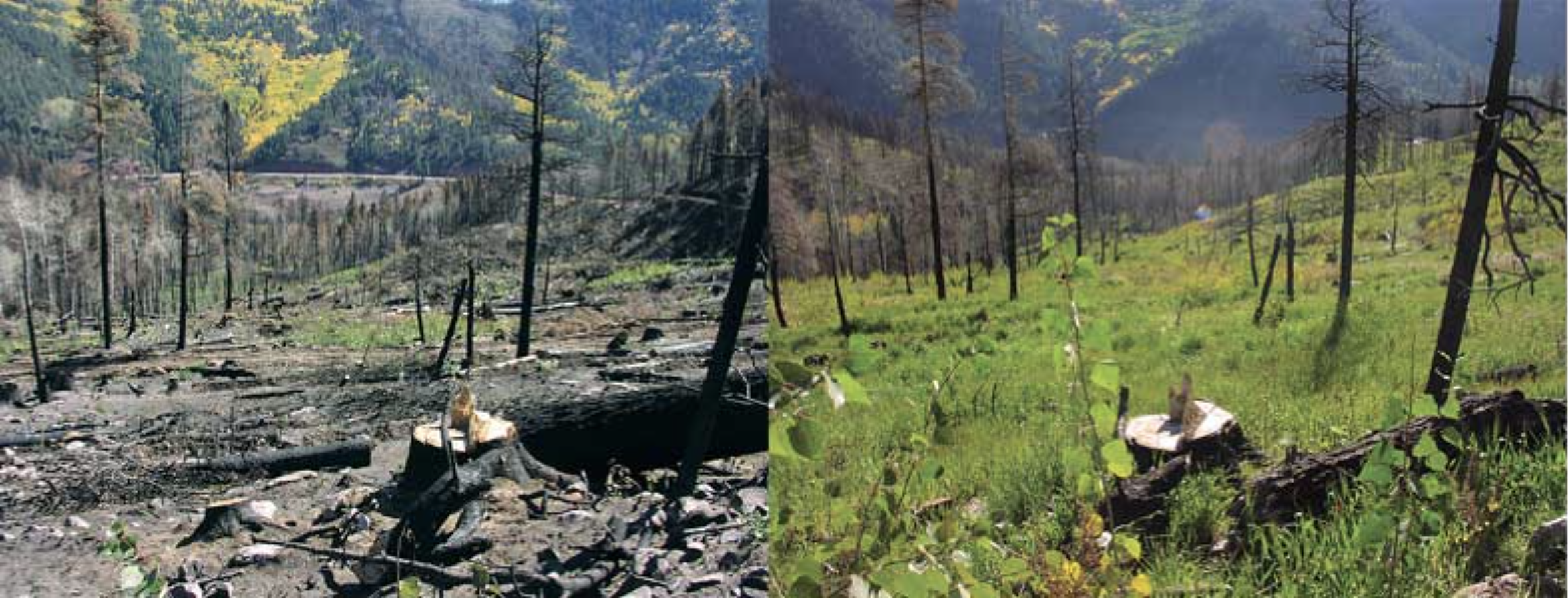
In areas that experience low-severity burns, fire events can serve to eliminate vegetative competition, rejuvenate its growth and improve watershed conditions. But, in landscapes subjected to high or even moderate burn severity, the post-fire threats to public safety and natural resources can be extreme. Photo credit: Colorado State Forest Service
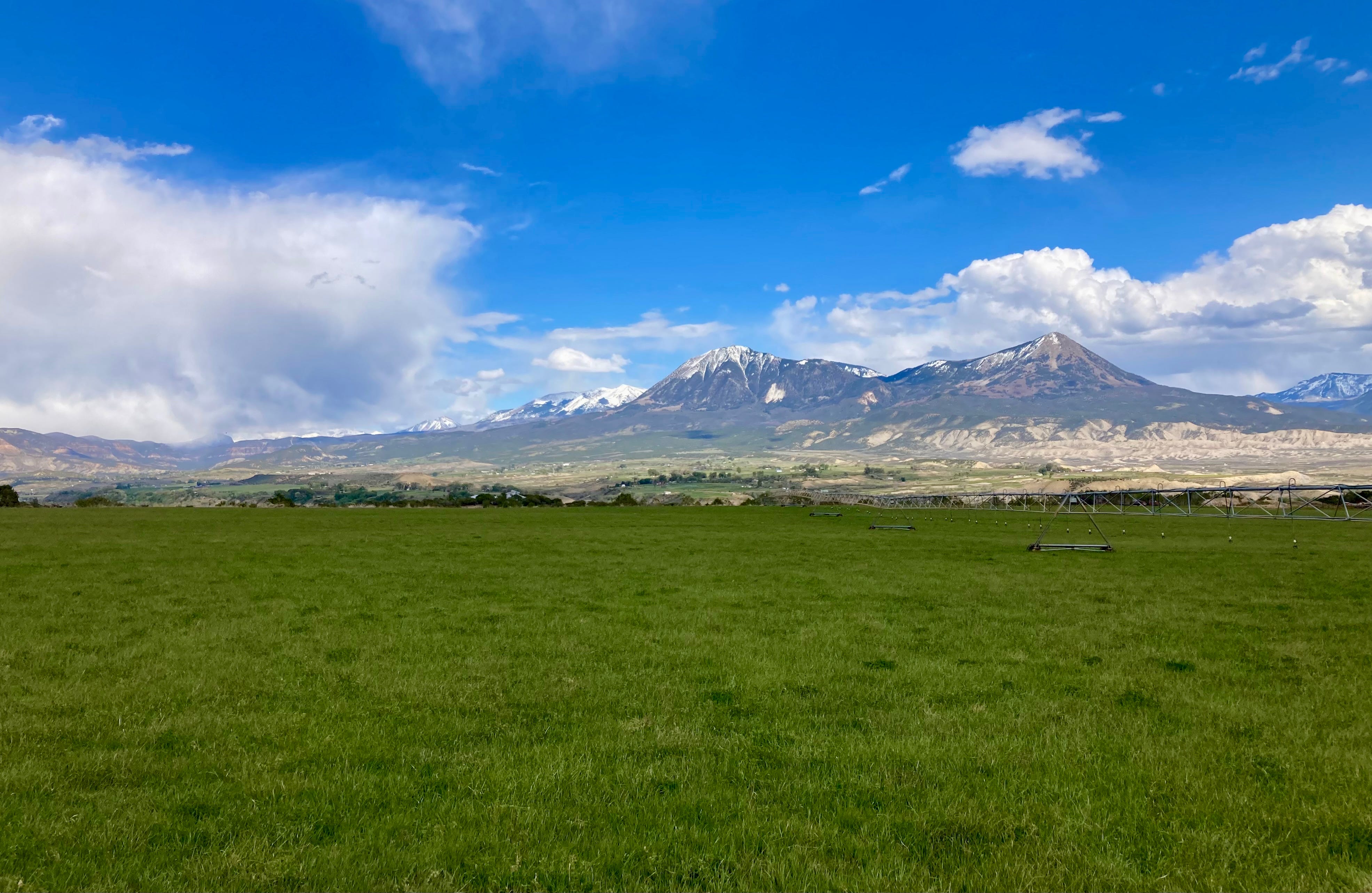
If someone were to be dropped from another planet into the North Fork Valley in western Colorado today, they would be forgiven for assuming there is not a water crisis. A thick carpet of green covers the valley floor, the irrigation canals are filled to the brim, trees are leafing out, the river is running and Paonia Reservoir is almost full, and the mountains are still graced with snow.
I didn’t even come from outer space — I think — and I find the contrast between the news reports of water shortages and restrictions and the on-the-ground situation here to be quite jarring. Is it possible that April precipitation has averted the calamity?
A green hay field on a mesa in the North Fork Valley in western Colorado. Jonathan P. Thompson photo.
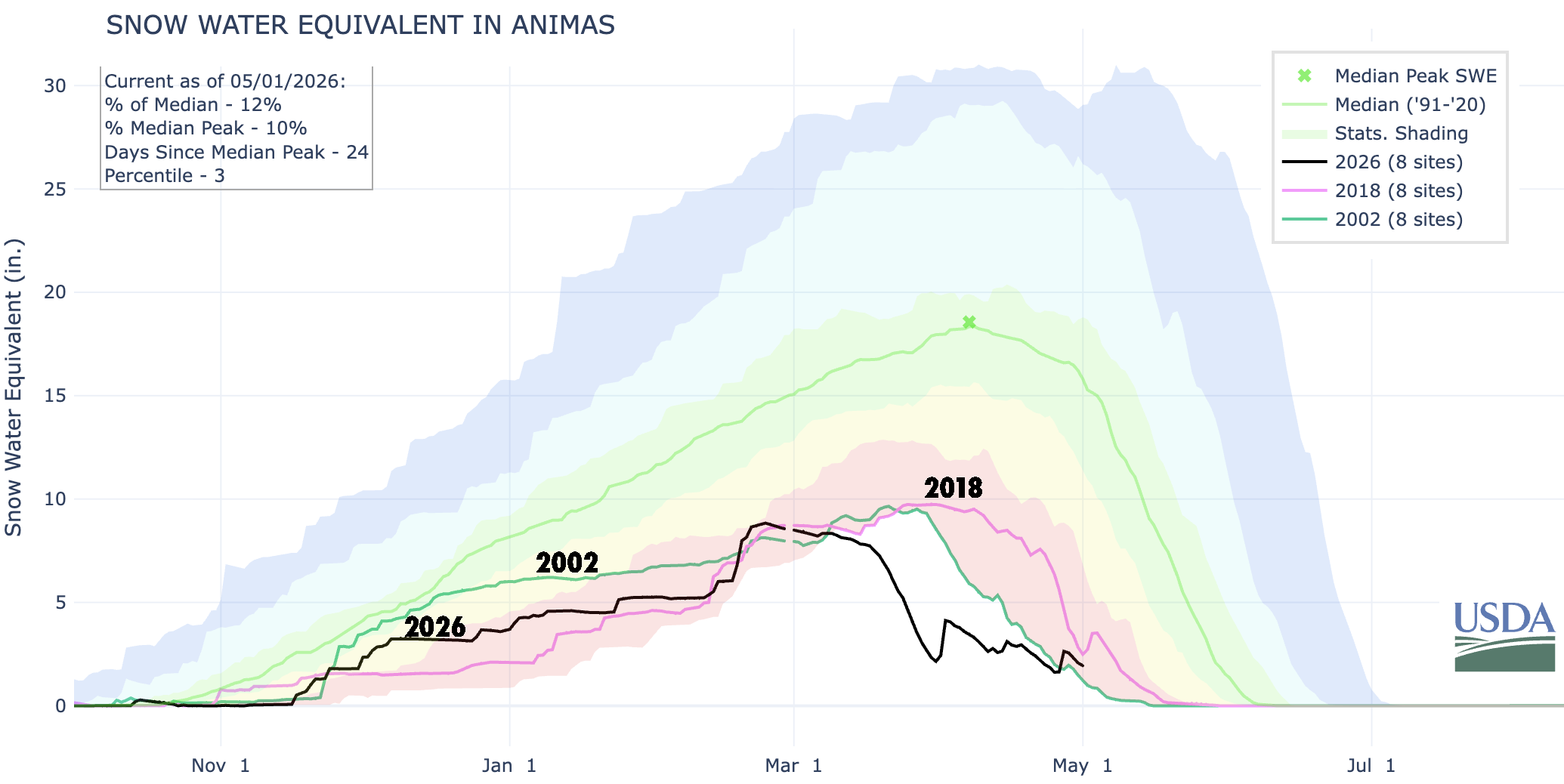
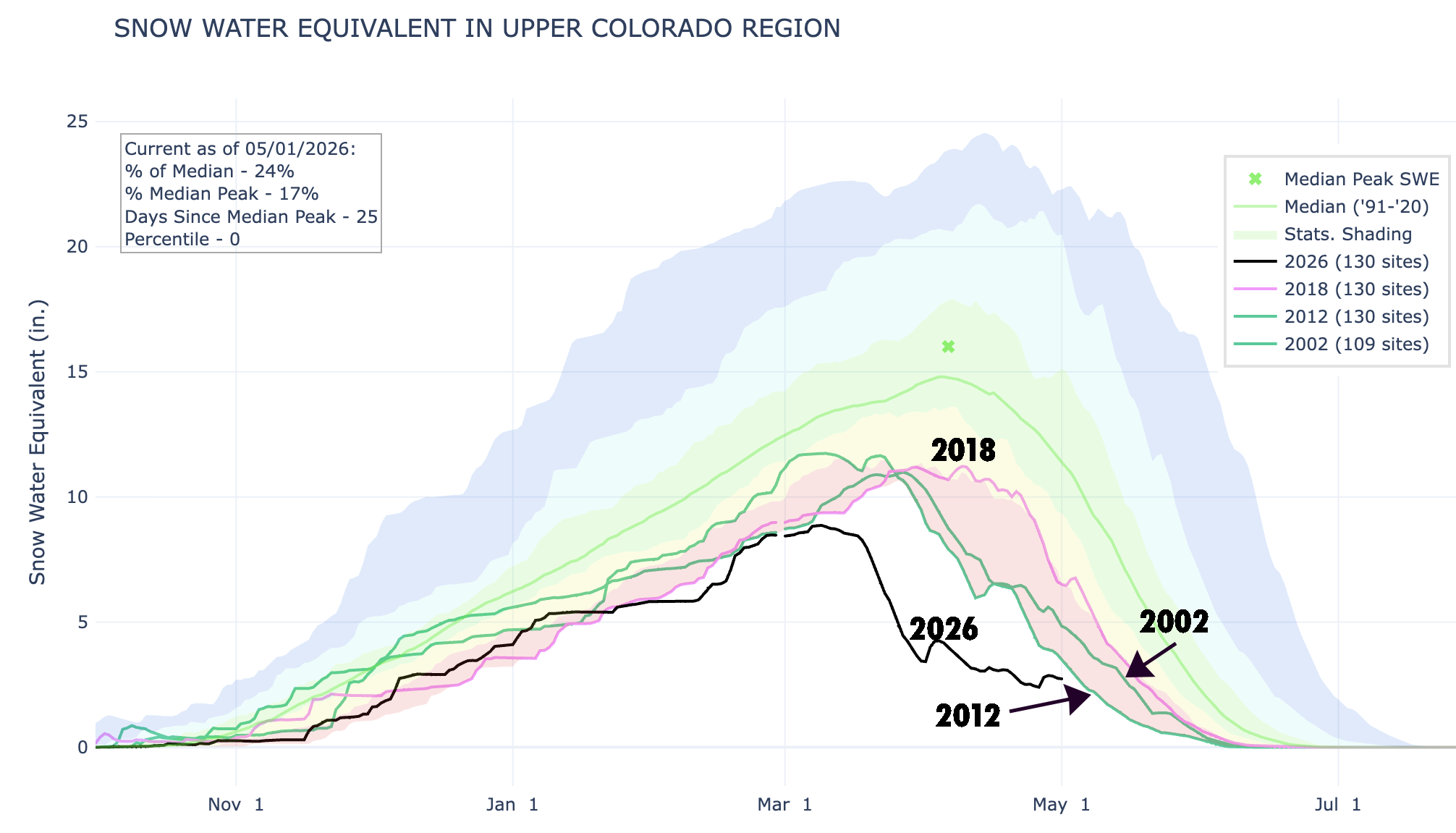
Yes, a series of storms, some quite abundant, have moved through the Upper Colorado River Basin, boosting snowpack and soothing the desiccated earth. It has certainly felt cooler and wetter than normal, but that was mostly an illusion brought on by the abnormally dry winter and the searing March heatwave. And it hasn’t been nearly enough to offset the warm winter and the lack of snow, as the graphs below indicate.
As for the full ditches, I guess you could attribute that to a “make hay while the water is available” sort of ethos. You might as well douse the fields and fill ponds while spring runoff is in full swing and the river still runs, knowing that it may not last beyond June. Meanwhile, Paonia Reservoir’s relatively healthy levels are the result of the Fire Mountain irrigation canal — which relies on reservoir water — being shut down for emergency repairs.
Meanwhile, there is a conspicuous absence here in this agricultural hotspot: There are no blossoms or fruit on apple, cherry, peach, or pear trees. The March heatwave sparked a spectacular orchard super-bloom. That was followed by a devastating freeze that killed all of the fruit, even in orchards where extreme preventative measures were taken, and even “burned” the leaves on some trees. Wacky weather indeed.
The North Fork of the Gunnison’s May 1 snowpack this year is tied for the lowest on record with 2012.
The Animas River watershed did get enough of a boost to bring snowpack levels back up above 2002’s for this date. Source: NRCS.
Even with the recent storms, the Upper Colorado River Basin snowpack remained at record-low levels as of May 1. The previous low year (from 40 years of SNOTEL records) was 2012, with 2002 and 2018 not far behind. Source: NRCS.
🐟 Colorado River Chronicles 💧
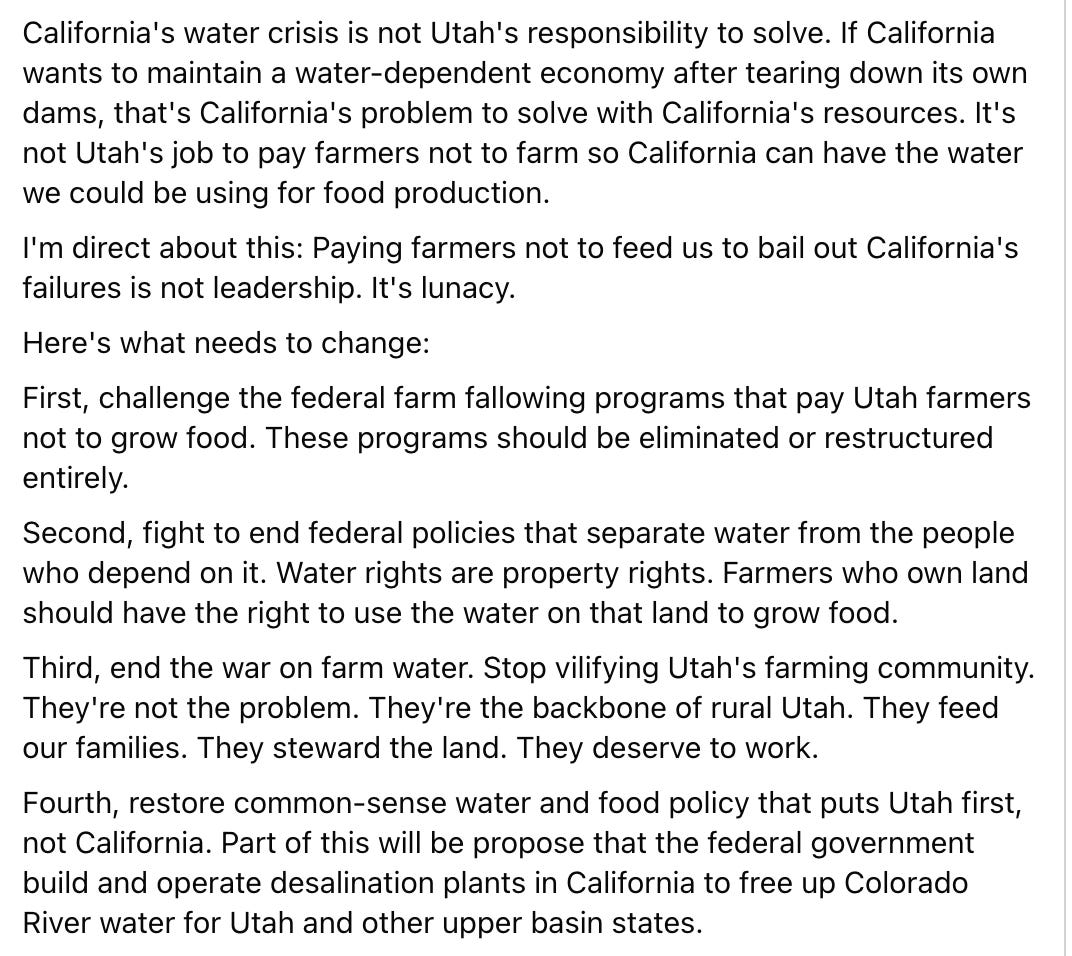
Phil Lyman, the former and hopeful Utah politician, recently posted this on Facebook:
Just to sum it up: He’s knocking a federal program that pays willing farmers to voluntarily cut off irrigation to their fields in order to conserve water in an effort to balance Colorado River demand with the shrinking supplies. And he’s blaming it all on California.
Lyman’s general sentiment is not new, nor is it uncommon among water users in the Upper Basin states. In fact, it’s basically a cliché. Since I was a kid I’ve heard folks saying something along the lines of: If we don’t use the water, it’ll just run on down to California, where those L.A. folks will guzzle it up to fill their swimming pools and water their golf courses. It’s a rather simplistic view, and one that doesn’t account for the realities of water law or the way the Colorado River system works. In other words, it’s just plain wrong, and a candidate for Congress — as Lyman is — should know better.
Udall/Overpeck 4-panel Figure Colorado River temperature/precipitation/natural flows with trend. Lake Mead and Lake Powell storage. Updated through Water Year 2025. Note the tiny points on the annual data so that you can flyspeck the individual years. Credit: Brad Udall
The Colorado River and its users have a problem: Demand for the water exceeds supply, and the supply is continually shrinking. Since boosting supply is not a feasible option, demand — i.e. consumptive use — must be reduced significantly. While everyone must make cuts, agriculture is the river’s largest water user by far, meaning that sector is going to have to make the largest cuts, by volume. This isn’t about demonizing farmers or alfalfa, it’s not about whether Californians or Utahns are more deserving of the water. It’s simple math.
The farm fallowing program is one way to cut consumption quickly by paying willing farmers to voluntarily forego irrigating some or all of their fields on a year-by-year basis. It’s not ideal, but it is legal, voluntary, and can save junior water rights holders, including cities and towns throughout the watershed, from being forced to shut off their water intakes. And in no way is farm fallowing exclusive to Utah. It’s occurring all over the place.
Let’s do a little fact-check of Lyman’s other points:
Farm fallowing in Utah is being done to benefit California, which “demolished its water storage infrastructure.” No and no. The goal here is to leave a little more water in the river, to keep the whole system from collapsing. Any amount conserved in one place will potentially benefit all other river users, as well as the river itself. Foregoing irrigation on a Utah farm, for example, could help keep the taps on in St. George or some other Utah community that relies on the river. Dams have been removed in California, most significantly four structures on the Lower Klamath River. But those were primarily for hydropower production, not irrigation or water storage, and they are far removed from the Colorado River or any associated water storage.
“Paying farmers not to feed us to bail out California’s failures …” Actually, the feds and state and other programs mostly are paying farmers not to grow alfalfa or hay, which feed cattle, and it has nothing to do with California’s “failures.” Indeed, California grows a lot of alfalfa, too, but it also grows all kinds of vegetables — far more than in Utah.
If the water saved in Utah does make it to the Lower Basin and California, then the biggest beneficiary would be … farmers. Most of the water in the Lower Basin goes to the Imperial Irrigation District, where it is used for farming. Those farmers have also been part of the federal fallowing program, and have managed collectively to reduced their Colorado River water consumption by about nearly 1 million acre-feet since 2003.
Lyman calls for eliminating or restructuring federal farm fallowing programs. I’m curious if he’s talked to the farmers about this, especially the ones who may lose their water and be forced to fallow anyway. Isn’t it better to get paid not to grow something than to not get paid for it?
“… fight to end federal policies that separate water from the people who depend on it. Water rights are property rights.” We all depend on water; the California farmers depend on water just as much as Utah farmers do. Furthermore, the California farmers also own their land, they have some of the most senior water rights on the Colorado River, and according to the “Law of the River,” they could likely go to court to force many Utah farmers to stop irrigating altogether, without compensation. The farm fallowing program does not separate water from the farmers, it simply pays them to temporarily forego irrigation.
“… end the war on farm water.” Look, there is not enough water in the Colorado River for everyone. Everyone will have to take cuts, but irrigated agriculture is the biggest user by far, and therefore will have to make cuts in order to balance supply and demand. It’s simple math: All of Las Vegas and southern Nevada use less than one-tenth of the water that goes to the farms in the Imperial Irrigation District.
“… propose that the federal government build and operate desalination plants in California to free up Colorado River water for Utah …” Desalination will likely be a part of the West’s water future, especially for coastal urban areas. But building the plants, and processing and transporting these kinds of volumes of water, would be outrageously expensive and energy-intensive, which would be especially harmful to farmers, who rely on cheap water.
***
The Bureau of Reclamation recently decreased Glen Canyon Dam releases from about 8,200 cfs to a steady 7,000 cfs (without the usual nighttime reductions). This appears to be the lowest sustained releases since the dam was built, and if continued throughout the entire year would lead to only 5 million acre-feet of annual releases, which would make the Lower Basin states even more grumpy and litigation-happy than they already are.
But not to worry, the feds are still on course to release 6 MAF for the water year, because they released about 10,000 cfs during January and February. Still, it’s going to change the complexion of rafting in the Grand Canyon, for sure, and it is certainly pushing the boundaries of the Grand Canyon Protection Act.
📸 Parting Shot 🎞️
Snow falls on the Abajo Mountains in southeastern Utah as seen from near Dove Creek, Colorado. Jonathan P. Thompson photo.