
Click the link to read the article on the Sustainable Waters website (Brian Richter):
July 24, 2026
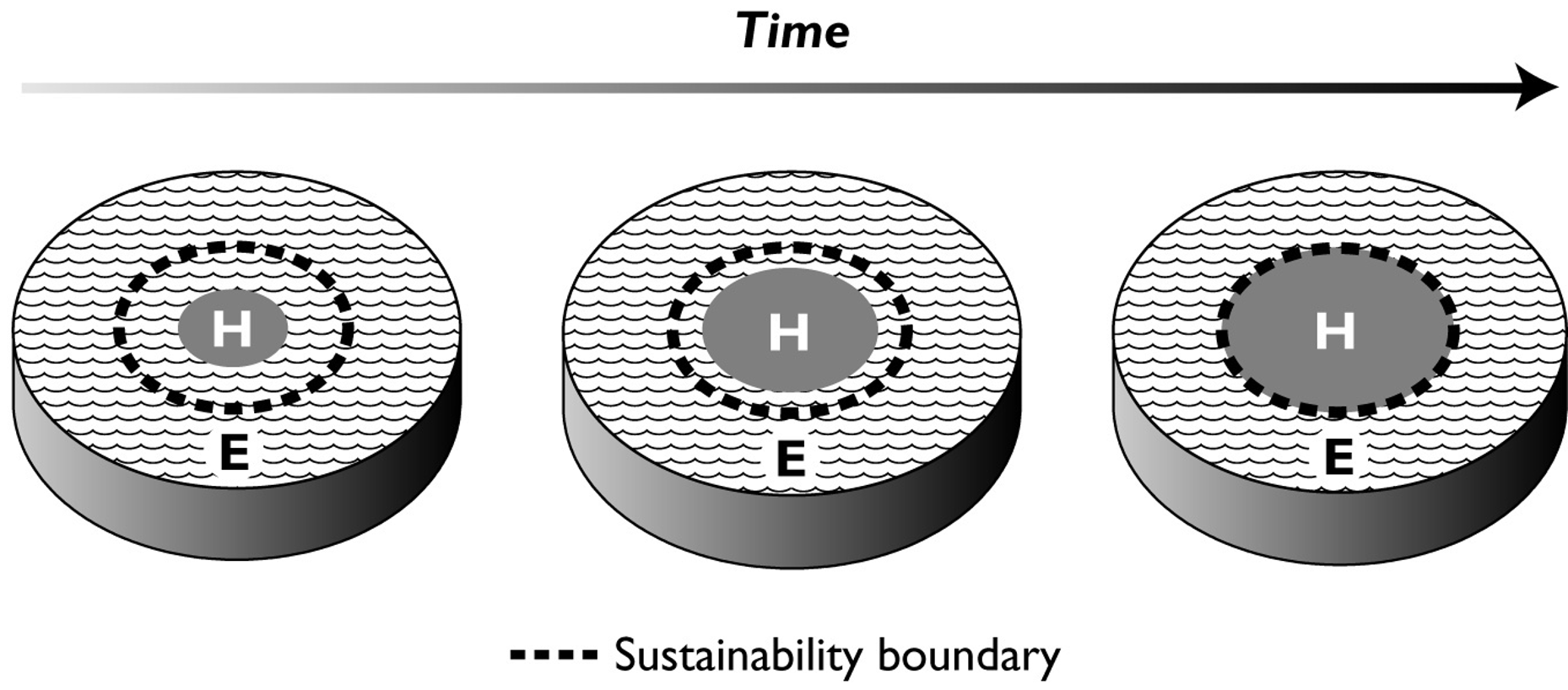
Way back in 2003, Sandra Postel and I published a book entitled “Rivers for Life: Managing Water for People and Nature.” In the book we put forth a concept of “sustainability boundaries” as illustrated below.
Over the two decades since publishing the book I have been advising water managers and governments in their efforts to apply this sustainability concept. I’ve also worked with my university students to document places around the world where some form of this concept has been applied, carefully evaluate what has worked, and assess why some applications have struggled.
This concept can be applied at various spatial scales and by various administrative agencies. For example, if you’re trying to manage water scarcity across the entire Colorado River Basin in the American Southwest, the framework would need to include the entire watershed that replenishes the river and its tributaries, and the important actors would include both the US and Mexican federal governments as well as the individual states embedded within the basin. If the area of concern is the New Mexico portion of the Rio Grande, the state’s agencies would work with cities and irrigation districts to apply the concept.
Based on what I’ve learned from real-world experiments and our global research, I’ll outline a simple 3-step framework for operationalizing this concept and successfully managing water scarcity.
Step One: Setting the Cap
The first step is to gain a sound understanding of how much renewable water supply is available on average within the basin of interest. This determination is used to set an enforceable limit, or cap, on how much water can to be allocated for human consumption (H in the diagram above). Physical scientists will play an essential role in advising administrative authorities on where to set the cap.
Importantly, the cap needs to be modified regularly. My recommendation is to adjust the cap at 5-year intervals, based on the prior five years of annual replenishment. If the previous five years have yielded above average replenishment, the cap level might be raised for the next five years. If on the other hand the recent 5 years have been drier than average, the cap will need to be adjusted downward. By adjusting every five years, water users can reap the benefits of good years yet avoid depleting rivers, reservoirs, and aquifers during bad years. A five year interval also provides water managers and water users with a reasonable planning horizon and much-needed certainty.
Step Two: Allocating the Water
Water sharing is one of humanity’s most challenging endeavors. It is immensely difficult to allocate water in a manner that is fair, inclusive, and equitable, but quantitative, clear, and enforceable allocation is absolutely essential in sustainable water management.
My recommendation is to allocate on a percentage basis. For example, the US and Mexican federal governments could work with each of their respective states within the Colorado River Basin and negotiate percentage allocations to each state. These allocations would limit each state to their respective percentages of the overall basin cap (see H in diagram above). In the Colorado River Basin, some of the states have received allocations on a percentage basin, but the cap set in 1922 in this basin was grossly overestimated, leading to dangerous overconsumption that has depleted rivers, reservoirs, and aquifers. A downward adjustment and reallocation among states is desperately needed.
Step Three: Learning to Live Within One’s Allocation
Once a cap is set and water users receive their allocations, the users need to figure out how to live within their respective limits. This is the most fascinating and exciting aspect of water management. Human beings are remarkably resilient and innovative when they embrace a challenge and design ways to live within limits imposed upon them. One of the great benefits of Steps One and Two is that they clearly signal what is available to water users, and what is not. In my experience, the capping and allocating of water supplies provides an immensely beneficial stimulus for change and adaptation. This is how a thousand flowers bloom, meaning there are many ways that individuals, communities, companies, and geopolitical entities can adjust to new limits. They can implement water conservation measures in cities and on farms, recycle urban wastewater, capture stormwater runoff, desalinate salty water, shift to less thirsty crops, or adopt myriad other strategies.
As just one example, cities dependent upon the Colorado River have embraced the reality that their water supplies have been substantially reduced in recent decades due to climate change and long-term aridification. Faced with this challenge to their water security, they have been able to reduce their total water use by 18% even while their populations have increased by 24%!
Back to Retirement
On New Year’s Eve of last year I mentioned in my last blog that I was retiring from my professional water work. I decided to publish this one additional post because I simply can’t stand to watch the massive failures in managing the ongoing water crises in the Colorado River and Rio Grande without saying something. What I’ve said here is a distillation of what I’ve learned over four decades of work on water scarcity. I offer it with the hope that those involved in management of these stressed basins might give it some consideration. The paper cited below summarizes nearly 50 case studies where this framework has been implemented in some form.
Strongly recommended reading: “Taking stock of caps on water use: fostering sustainability or falling short?” (2025)
