
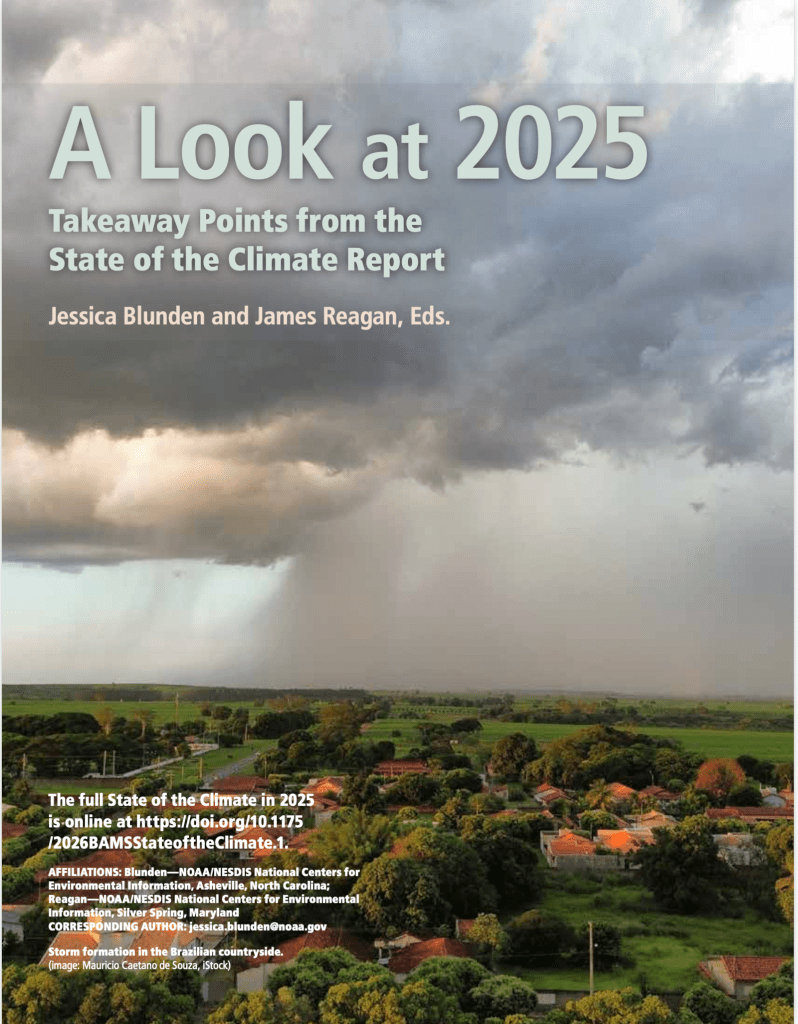
Click link to access the report on the AMS website, here’s the link to the Executive Summary, and the link for the release on the AMS website. From the summary:
GLOBAL CLIMATE
The three main greenhouse gases that warm our atmosphere by trapping some of Earth’s outgoing energy—carbon dioxide, methane, and nitrous oxide—all reached record-high levels in 2025. The average rate of carbon dioxide accumulation in the atmosphere increased from 0.6±0.1 parts per million (ppm) per year in the early 1960s to 2.4 ppm per year during the decade of 2011–20. At the same time, fossil fuel emissions increased from 3.0±0.2 petagrams of carbon per year in the 1960s to 9.8±0.5 petagrams of carbon per year in the most recent 10-year period of 2015–24. Fossil fuel emissions in 2025 are estimated to be a record high of 10.3±0.5 petagrams of carbon. One petagram is equal to more than 2.2 trillion pounds. The annual average global surface temperature for 2025 was among the three highest on record (since at least 1850). Only 2023 and 2024 were warmer, and both of those years were influenced by warm El Niño conditions in the eastern and central Pacific Ocean. In contrast, cool La Niña–like conditions occurred at the beginning and end of 2025. A clear warming trend continued, with the last 11 years being the warmest 11 years on record. Also in 2025, high humidity heat extremes occurred with near-record frequency and intensity. These extremes can lead to dangerous heat-related illnesses. Above Earth’s surface, temperatures in the lower troposphere were also elevated, with 2025 being the second-warmest year on record.
Increasing temperatures also impact the frozen landscape. Land-based glaciers around the world continued to lose ice for the 38th consecutive year, with each losing on average more than one-meter water equivalent—the height of water that would result if the ice melted down to its liquid state—for the fourth straight year. About 41% of the ice lost by glaciers since 1976 has occurred in just the last decade. Permafrost temperatures and active layer thickness—the portion of ground that thaws and refreezes each year—continued to increase in most locations, and many new records were set. During the winter of 2024/25, lakes in the Northern Hemisphere froze later, thawed earlier, and had shorter durations of ice cover than normal, with ice durations 15 days shorter on average compared to the 1991–2020 average.
The average percentage of cloud area fraction in the sky during the year was the second lowest since records began in 1980, at 68.5%, which means that more sunlight than usual reached Earth’s surface. On average, precipitation was below normal over the oceans but above normal over land, which is typical during La Niña conditions. Intense precipitation, as measured by the maximum one-day rainfall averaged across the globe, was the fourth highest on record in 2025. The increased rainfall over land led to above-average lake water storage, with over 70% of monitored lakes in the Northern Hemisphere having higher-than-usual storage levels. However, in Central Asia, the Caspian Sea, which is the world’s largest inland body of water, and the Large Aral Sea, both had lower-than-normal water levels.
Despite the increase in precipitation, surface soil moisture was lower in 2025 than in any other year since 1991. This was mainly due to many areas experiencing above-average evaporation. Globally, the area of the land surface experiencing drought remained elevated compared to conditions before 2019, with substantial increases in eastern Europe, the Danube basin, and Central Asia. Drought conditions eased in southern Africa and central and northern South America.
The Iberian Peninsula had unprecedented fire activity, which drove a record for overall fire emissions in Europe. Nevertheless, at the global scale, 2025 had the lowest overall fire activity in the 23-year record, driven by low activity in South America and Africa. On average, the land surface continued to darken during 2025, driven by wildfires, heatwaves, and low snow cover, all of which are associated with the continued above-average temperatures.
The darker the surface, the more sunlight is absorbed, which creates localized heating. The persistent warmer-than-average conditions also affected plant growth, with early start-of-season dates—the time of year when trees and plants begin to bud—including the earliest on record for the United Kingdom.