The nation’s energy dominance falters: President Trump is killing clean energy, and it’s not even helping fossil fuels — Jonathan P. Thompson (High Country News) #renewable

Welcome to the Landline, a monthly newsletter from High Country News about land, water, wildlife, climate and conservation in the Western United States. Sign up to get it in your inbox. Screenshot from the High Country News website.

Click the link to read the article on the High County News website (Jonathan P. Thompson):

October 30, 2025

Amid all of Donald Trump’s haphazard policymaking and chaos-mongering, one part of his agenda has remained remarkably consistent throughout both terms: the quest for something he calls “energy dominance.” While Trump probably thinks he coined the concept, only the name is new; it’s really merely a macho rebranding of what was traditionally known as “energy independence,” the desire to produce the nation’s energy domestically rather than import it from potential adversaries. The yearning for energy independence became a focus back during the Nixon era, when geopolitical tensions sparked overlapping energy crises. Ever since, it’s been pursued by every administration, both Democratic and Republican.

So, yes, even cardigan-wearing, thermostat-adjusting Jimmy Carter was an energy dominance guy, maybe even the most successful one. Same goes for Presidents Obama and Biden. What distinguishes Trump — despite all of his regulatory rollbacks, his “Drill, Baby, Drill” and “Mine, Baby, Mine” and “Beautiful Clean Coal” rhetoric and various “emergency” orders — is that his push for dominance has not only been ineffective, it has actually served to weaken the domestic energy industry and has even diminished its ability to produce the power needed to keep modern society running.

If Trump really cared about energy dominance, independence or abundance, he would use all of the tools at his disposal to “win” this war. Even an energy warrior who didn’t give a hoot about pollution or the climate would insist on keeping the fastest-growing energy sources — wind and solar with battery backup — in the nation’s arsenal, along with nuclear, geothermal, hydropower and natural gas, simply for practical reasons, relying on what previous administrations have called an “all-of-the-above” approach.

Instead, Trump has essentially discarded the most promising and effective energy technologies by eliminating federal tax credits for wind power and both rooftop and utility-scale solar, shuttering new wind projects on federal land and in federal waters, subjecting proposed utility-scale solar on federal land to additional scrutiny and red tape, and canceling the Solar for All program that aimed to bring clean energy and energy self-reliance to lower-income families. More recently, the administration clawed back over $7 billion in Biden-era funding for clean energy and grid-reliability projects, many of which were in Western states and all of which came from states that favored Kamala Harris over Trump in the 2024 election.

Meanwhile, Trump’s administration is trying to prop up the decrepit and rusty weapons of old, i.e. fossil fuels, and putting them on the front lines in the apparent hope that they don’t crumble away before his term ends.

The administration plans to fork out about $625 million in subsidies in hopes of revitalizing the flagging coal industry and has rolled back myriad regulations (also a form of subsidy) on coal-fired power plants. It has also opened 13 million acres of public land across the West to new coal leasing and overturned Biden-era bans on new leasing in the Powder River Basin in Wyoming and Montana. At the same time, it has inexplicably canceled funding for carbon capture projects aimed at prolonging nearby coal plants’ lives.

Trump is clearly not looking to achieve energy dominance, but rather to exercise his countless grievances and realize some historical fantasy — while, of course, helping fossil fuel executives rake in a few more bucks while they still can. It’s a sort of qualified bid for coal and oil dominance, so long as it benefits red-leaning states.

But so far, even that’s not going too well.

Earlier this month, the Bureau of Land Management held its first coal lease sale in over a decade on public land in the Powder River Basin. There was only one would-be buyer, the Navajo Transitional Energy Company, which bid just $186,000 for a tract containing about 167 million tons of coal — meaning about one-tenth of one cent per ton. That’s in contrast to sales in 2012 that brought in over $1 per ton. The feds rejected the bid on the grounds that it didn’t comply with the Mineral Leasing Act since it didn’t fetch fair market value. The Interior Department promptly canceled another sale in the Powder River Basin for 441 million tons of coal just days before it was scheduled to take place. And a third sale, this one on public lands in southwestern Utah, attracted only one low bid as well; and it, too, was rejected.

One of the generating units at the power plant at Kemmerer, Wyo., is being shut down this year [2017] to reduce emissions that are causing regional haze. 2009 photo/Allen Best

And just days after the administration announced its plans to pour taxpayers’ cash into the coal industry, PacifiCorp, the largest grid operator in the Western U.S., doubled down on its plans to convert its Naughton coal plant in Wyoming to run on natural gas. Idaho Power actually proposed a rate decrease for its customers after it cut costs by shutting down a unit at a Nevada coal plant. Meanwhile, no utility anywhere has seriously proposed building any new coal plants, mainly because it is simply an obsolete, expensive and dirty technology.

The president’s continual desire to “Drill, Baby, Drill” is experiencing a failure to launch, as well. The BLM has handed out drilling permits like Shriners throwing candy to the crowd at a parade, continuing to do so at an alarming rate despite the government shutdown. During the first six months of Trump’s term, the administration issued 2,660 permits to drill on public lands — about 524 per month. That eclipses Biden’s biggest year of 2023, when he issued 317 per month and garnered the disdain of climate activists.

And yet, drill rig counts, the most accurate indicator of the industry’s enthusiasm and a good barometer of future crude oil and natural gas production levels, have remained stagnant during Trump’s term. In fact, they’re significantly lower than they were a year ago, shortly before Trump was elected. That’s due in part to low oil prices, which is something Trump has pushed for (and maybe prodded Saudi Arabia and other OPEC members to encourage by increasing their own oilfield pumping), but also because Trump’s disorderly trade wars are sowing confusion, while his tariffs on steel and aluminum are raising costs for drillers.

The most recent Federal Reserve Bank of Dallas survey of oil and gas executives revealed how poorly Trump’s policies are playing out in the oilfields. Most of the executives surveyed said that Trump’s regulatory rollbacks and federal royalty reductions would bring down their “break-even” costs only slightly, and that they would not appreciably increase production.

Generally speaking, optimism is in short supply in the oilpatch these days.

“It’s going to be a bleak three-plus years for the oilpatch,” one executive said, in a survey that was designed to be anonymous to encourage a candid response. Another noted: “After Liberation Day, we cut our drilling budget in half from 10 wells to five wells.”

And yet another declared, “We have begun the twilight of shale. Several multibillion-dollar firms that have previously been U.S.-onshore-only are making investments in foreign countries and riskier (waterborne) geologies.” They went on to question what will happen to the hundreds of thousands of abandoned and orphaned wells when the drilling boom ends, noting, “Society will not treat us kindly unless we do our part to clean up after we are gone.”

Area of the Arctic National Wildlife Refuge coastal plain, looking south toward the Brooks Range. By U.S. Fish and Wildlife Service – images.fws.gov (image description page), Public Domain, https://commons.wikimedia.org/w/index.php?curid=5787251

Last week, the Trump administration moved to reopen 1.56 million acres on the Arctic National Wildlife Refuge’s coastal plain to oil and gas leasing, just as he did in 2017 at the outset of his first term. The first lease sale in the refuge was held in 2021, just days before Biden was inaugurated, but it attracted only low bids — none from major oil companies — with most of the leases going to an Alaska state agency. Another auction in January 2025 drew no bids at all. The industry simply isn’t all that interested.

Just as Biden’s heightened regulations on oil and gas drilling didn’t slow drilling or production, Trump’s determined deregulation is unlikely to speed it up. Nor will his hostility toward solar and wind kill their momentum: Firms are bringing utility-scale projects online at a rapid rate and financing new proposals despite the lack of federal incentives. Federal policies can serve to mitigate energy development’s impacts or perhaps bolster the companies’ profits somewhat, but they are only one of many factors that influence how much and at what rate development occurs. All the political rhetoric in the world won’t help; so-called energy dominance simply cannot be willed — or forced — into existence.

Real action puts the Upper Basin at the forefront of #ColoradoRiver solutions — The Upper Colorado River Commission #COriver #aridification

Colorado River “Beginnings”. Photo: Brent Gardner-Smith/Aspen Journalism

Click the link to read the release on the Upper Colorado River Basin Commission website:

October 28, 2025

With new agreements and programs and decades of responsible management, the Upper Basin is preparing for future Colorado River operations

The Upper Colorado River Commission (UCRC) is highlighting the real and measurable actions being taken by the Upper Division States — Colorado, New Mexico, Utah and Wyoming — to live within the means of the Colorado River and secure a sustainable future. The Upper Basin is adapting to a drier, more variable river system.

The Upper Basin exemplifies responsible, supply-based water management through an innovative provisional accounting agreement with the Bureau of Reclamation, coupled with decades of intensive water management and uncompensated mandatory reductions. These actions lay a transparent foundation for post-2026 Colorado River operating rules.

For more than 20 years, the Upper Division States have taken real actions, including fulfilling Drought Contingency Plan commitments, modernizing measurement systems, accounting for and reporting of all consumptive uses, implementing aggressive conservation programs, supporting advancements in irrigation efficiency and enforcing mandatory reductions through strict water rights administration. These actions go beyond the obligations in the 1922 Colorado River Compact, reflecting a shared commitment to the long-term stability of the Colorado River.

The new provisional accounting framework, now underway across the Upper Basin, will enable transparent, real-time documentation of voluntary reductions. Moving forward, this technical backbone will ensure future river operations continue to be grounded in facts.

“The Upper Basin is developing solutions that work not only for the Upper Basin but for the entire Colorado River system,” said Chuck Cullom, UCRC Executive Director. “The Upper Basin states and water users are already taking verifiable, on-the-ground actions to live within the river’s means.”

State Leadership in Action

Colorado: Strategic Reductions and Long-Term Investments

Colorado is leading with deep, uncompensated reductions and forward-looking investments to continue to adapt its water systems to a drier future. Farmers and municipalities adjust operations to match real supply, while the state funds millions in watershed health and data-driven conservation programs. Highlights include:

  • Investing $22 million in headwaters and watershed restoration.
  • Launching a diversion measurement installation program, which will provide no-cost structures to increase accuracy and transparency in water use and management on the Western Slope.
  • Committing $25 million in new CWCB conservation and resiliency grants and $110 million in Water Plan grants.
  • Implementing strict water rights administration, with the Dolores Project operating at just 30% of normal supply, the Ute Mountain Ute Farm and Ranch Enterprise receiving only half its typical allocation and senior water rights dating to the 1800s being curtailed.
  • Exploring temporary, voluntary, compensated conservation and strategic upstream releases.
  • Reducing municipal demands through turf removal, water recycling, rate restructures, public education and aggressive conservation. Denver Water has seen more than a 40% reduction in residential per capita use and a 16% reduction in total deliveries despite growing more than 29% since 2000. Colorado Springs has seen a 41% reduction in residential per capita water use and about a 20% drop in total water deliveries despite growing 39% since 2000.

“Colorado water users are taking deeper cuts than required under the Compact. This is not because they’re being paid to, but because they must,” said Commissioner Becky Mitchell. “These are real impacts happening right now, and we’re coupling them with smart investments to prepare for the future.”

New Mexico: Innovative Partnerships and Data-Driven Leadership

New Mexico has long been at the forefront of adaptive management, integrating advanced measurement networks and modeling tools to support efficient operations and now provisional accounting projects. Highlights include:

  • Jicarilla Apache Nation’s 20,000-acre-foot lease and strategic Navajo Reservoir releases (2024–2026) to balance flexibility and supply.
  • Implementing the 2023 Water Security Planning Act for regional scarcity planning and funding prioritization.
  • Establishing the Strategic Water Reserve statute to balance Compact deliveries and environmental needs.
  • Installing a river measurement network and implementing Active Water Resource Management initiatives.
  • Developing the San Juan RiverWare model to enable precise tracking of diversions, return flows and conservation gains.
  • Municipal partners, including Albuquerque and Santa Fe, are leading the nation’s urban conservation by achieving significant per-capita use reductions under a joint conservation MOU. Albuquerque has cut residential per-capita use by 32% and total deliveries by 17%, despite 40% population growth since 2000.

“New Mexico has built the partnerships and tools that make transparent management possible,” said Commissioner Estevan Lopez. “We’ve been planning for a drier river for decades, and now we’re implementing those tools to lead by example.”

Utah: Operational Adaptation and Demand Reduction

Utah is aligning operations and policy to hydrologic conditions, applying provisional accounting principles to on-the-ground management. Highlights include:

Launching a $5 million, two-year Demand Management Pilot Program in 2025-2026 to compensate agricultural producers for temporarily and voluntarily reducing consumptive use in the Colorado River system in Utah (estimated total conservation of ~20,000-30,000 acre-feet).

  • Leveraging $1 billion state conservation appropriations to expand statewide turf conversion and municipal conservation programs: More than 7 million sq. ft. already converted, saving 200+ million gallons annually.
  • Developing an operational accounting and forecasting model of the Colorado River and its subbasins in the state to serve as a planning tool to evaluate impacts of drought mitigation measures, including demand management based on actual supply.
  • Employing state-of-the-art satellite-based, remote sensed Open ET data to measure consumptive water use from field to basin scale
  • Pioneering the first Airborne Snow Observatories (ASO) flights in Utah in the Uintah Mountain headwaters to inform reliable water supply forecasting.
  • Implementing a farm-scale subsurface drip irrigation (SDI) pilot program to compare water consumption of a study alfalfa field using SDI against a sprinkler irrigated field.
  • Partnering with Utah State University and agricultural producers to develop irrigation management plans that identify suitable water conservation methods and programs for individual producers.

“Even our most senior users are taking deep cuts,” said Commissioner Gene Shawcroft. “We’re integrating provisional accounting into operations and moving toward rules rooted in reality, not history.”

Wyoming: Conservation and Transparency at Scale

Wyoming is demonstrating what large-scale, uncompensated reductions look like in practice while developing the technical foundation for provisional accounting and long-term conservation.

Highlights include:

  • In 2025, regulating off water rights to 164,000 acres, which were mandatory and uncompensated reductions.
  • Enforcing necessary reductions even though Wyoming has only developed about 30% of what it was promised under the Compact.
  • Securing $15 million in state and federal funding for consumptive use research and drought resilience.
  • Coordinating releases from Fontenelle Reservoir in August 2025 to study transit losses in the Green River and to advance accurate water accounting.
  • Promoting irrigation efficiency and long-term conservation across the Green River Basin.
  • Pursuing legislation to implement a voluntary, compensated conservation program.
  • Developing operational models for tracking and optimization of uses on the Upper Green River and tributaries.

“Wyoming’s regulation of water rights is real, mandatory and necessary when faced with dry hydrology,” said Commissioner Brandon Gebhart. “Wyoming has, and continues to investigate and implement, meaningful tools to help our water users and the entire system to deal with the hydrologic circumstances we are facing.”

About the Upper Colorado River Commission (UCRC)

The UCRC is an interstate administrative agency made up of duly appointed representatives from the four Upper Division States — Colorado, New Mexico, Utah and Wyoming.

Map of the Colorado River drainage basin, created using USGS data. By Shannon1 Creative Commons Attribution-Share Alike 4.0

Deadline closing in for #Utah and 6 other states hammering out a new water plan: Upstream and downstream states have less than two weeks to power through sticking points — Annie Knox (UtahNewsDispatch.com) #ColoradoRiver #COriver #aridification

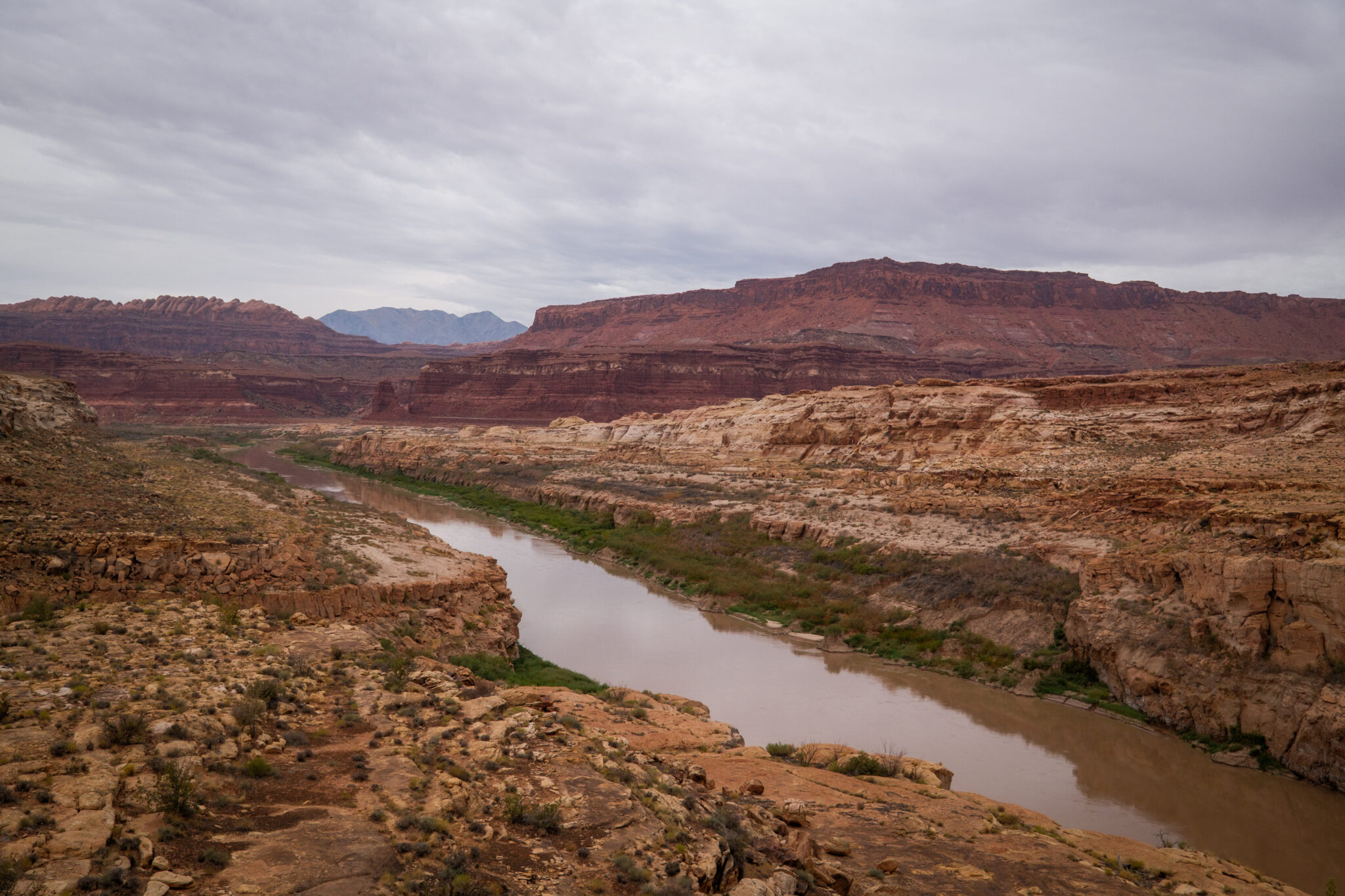
The Colorado River is pictured where if flows near Hite, just beyond the upper reaches of Lake Powell, on Friday, Sept. 19, 2025. (Photo by Spenser Heaps for Utah News Dispatch)

Click the link to read the article on the Utah News Dispatch website (Annie Knox):

October 31, 2025

Utah and six other states along the Colorado River are pushing up against a deadline to figure out as a group how to manage the river and its reservoirs. 

If they can’t reach an agreement by Nov. 11, the federal government is set to intervene and make its own plan. The existing agreement expires at the end of next year. 

“There’s still hope,” Marc Stilson, principal engineer for the Colorado River Authority of Utah, said Thursday. “They’re working hard, and they’re close.” 

The upstream Upper Basin states — Utah, Colorado, New Mexico, and Wyoming — and the Lower Basin states of Nevada, Arizona and California pitched competing plans to the federal government last year. 

Now, in the home stretch of negotiations, the seven states are working through questions including which reservoirs would be managed under the new agreement, how they’ll measure water use and whether the plan will include mandatory cuts to water allocations, Stilson said. 

The Upper Basin states have resisted the idea of mandatory cuts in dry years, saying they typically use much less than their yearly allocation. 

Lower Basin states have said all seven should share water cuts during dry years under the new plan, warning if they don’t, downstream states could face cuts that aren’t feasible for them to absorb, the Nevada Current reported

The river provides water to 40 million people across the U.S. and Mexico, and contributes 27 percent of Utah’s water supply. Hotter temperatures tied to climate change have mixed with drought and overuse to reduce its flow. 

Utah isn’t waiting to prepare for potentially significant changes to how it manages water, said Michael Drake, deputy state engineer with the Utah Division of Water rights. 

It’s been investing in expanding its use of tools to better measure and monitor water use since 2023, Drake told reporters Thursday. 

That year, the Legislature poured $1 million into a Colorado River measurement infrastructure project and approved $650,000 in annual funding to monitor water use, according to the division. 

Whether the state ends up facing cuts as part of the new plan or just working toward new targets, Drake said, it sees a need “to be able to manage water better, and you can’t regulate what you can’t measure.”

“As we get close here, I think reality is starting to hit and so we want to put out the messaging, you know, we can do this,” Drake told Utah News Dispatch. 

He noted the possibility of forced cuts is troubling to many of the state’s farmers. 

“What we’re going to be asking people to do is to see water running in a stream, and to not take it, to leave it there,” Drake said. “It’s a hard pill to swallow.”

Scott Thayn, who farms alfalfa and the grain sorghum in unincorporated Carbon County, agreed.

“If something happens with this new treaty and they drop it 10, 15, 20%,” Thayn said, “most of the years we’re going to be hurting.”

Map credit: AGU