A Sagebrush Rebel returns to Interior: Karen Budd-Falen has spent her career fighting the agency; Mining Monitor; “Avalanche” comes out from behind the paywall — Jonathan P. Thompson (LandDesk.org)

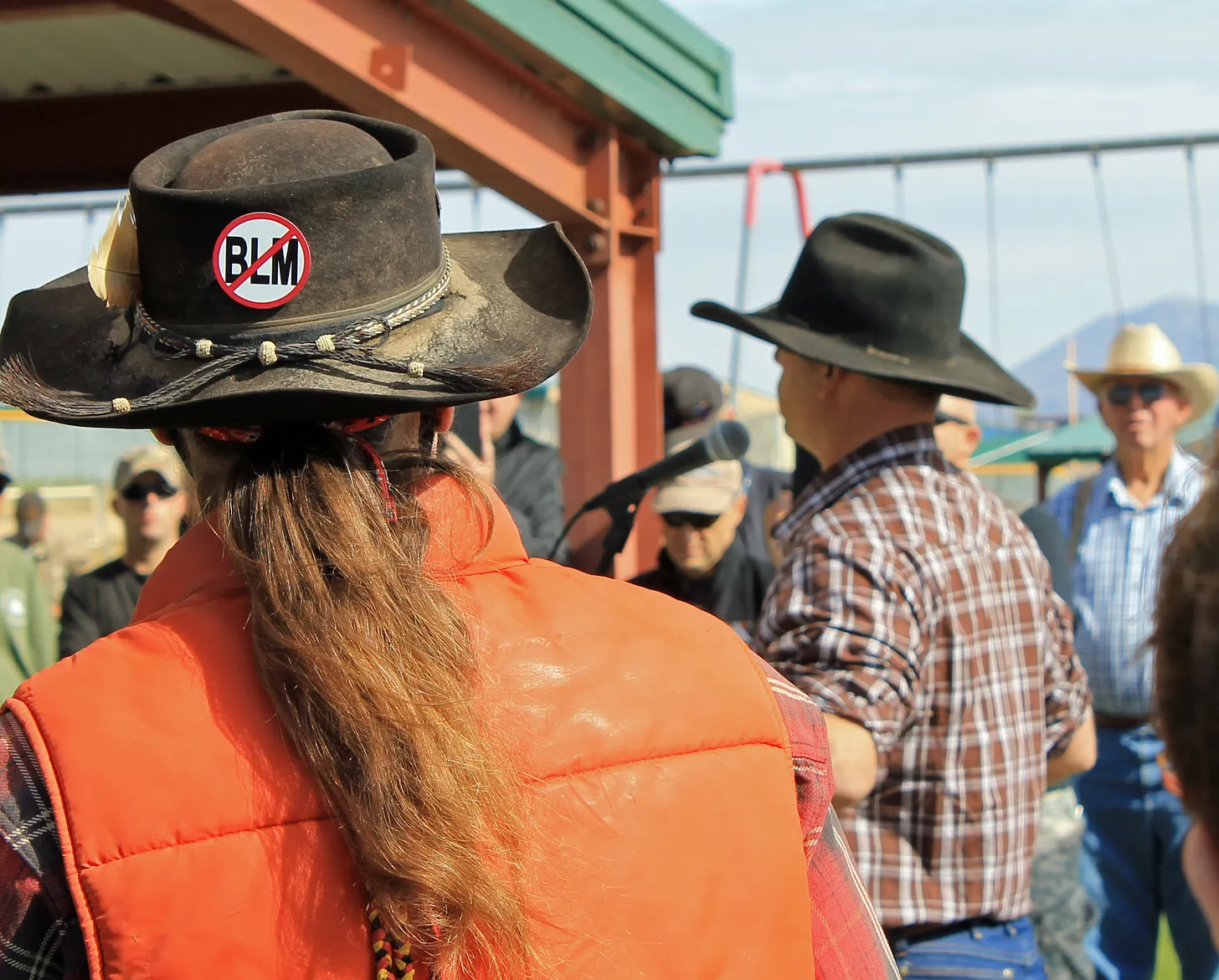
Ryan Bundy speaks at the 2014 Recapture rally to protest federal land management, which took place just days after armed insurrectionists threatened federal officers who had tried to detain Cliven Bundy’s cattle, which had long been grazing on public lands illegally. Karen Budd-Falen — reportedly appointed to be the number three at Interior — represented Bundy years before the standoff, but later condemned his response. Nevertheless, her writings and court cases provided an ideological underpinning for the Bundys and their fellow insurrectionists. Jonathan P. Thompson photo.

Click the link to read the article on The Land Desk website (Jonathan P. Thompson):

March 7, 2025

Interior Secretary Doug Burgum has given another indication of how he plans to oversee public lands with the reported appointment of Karen Budd-Falen, a Wyoming property rights lawyer and rancher, as associate deputy Interior secretary, the department’s third in command. This will be Budd-Falen’s third stint at Interior: She worked under James Watt, Ronald Reagan’s notorious Interior secretary, and served as deputy Interior solicitor for wildlife and parks under the first Trump administration. Budd-Falen revealed the appointment to Cowboy State Daily this week, though the administration has yet to announce it.

Budd-Falen has spent much of her five-decade-long career fighting against federal oversight and environmental protections — she has been called an “architect of the modern Sagebrush Rebellion” — and is a private property rights extremist (except when they get in the way of public lands grazing).

In 2011, Budd-Falen divulged her core philosophy — and her distorted view of the U.S. Constitution — in a keynote speech to a meeting of Oregon and California county sheriffs, many of who adhered to the “constitutional sheriff” creed. She told them that “the foundation for every single right in this country, our freedom of speech, our freedom to vote, our freedom to petition, is all based on the right of ownership of private property.”

While this is obviously a messed up interpretation, it is an honest reflection of her worldview, and she has often stuck with it even if it meant going after extractive interests. In the 1990s, for example, Budd-Falen represented the legendary, stalwart Republican-turned-anti-oil-and-gas activist Tweeti Blancett in her attempt to get the Bureau of Land Management to clean up the mess its industry-friendly ways had facilitated on and around her northwest New Mexico ranch. And Budd-Falen’s law firm often worked with landowners to get the best possible deal from energy companies that developed their property.

But more often than not, Budd-Falen’s vision of private property rights extends beyond a landowner’s property lines and onto the public lands and resources — at the expense of the land itself, the wildlife that live there, and the people who rely upon it for other uses.

In a telling article in the Idaho Law Review in 1993, Budd-Falen and her husband, Frank Falen, argued that grazing livestock on public lands was actually a “private property right” protected by the Constitution. If you were to extend this flawed logic to oil and gas and other energy leases and unpatented mining claims, then corporations and individuals would have private property rights on hundreds of millions of acres of public lands. This may sound alarmist, but the fact is, the federal land management agencies often adhere to this belief. Once an oil and gas lease is issued, for example, a BLM field office is unlikely to deny a drilling permit for the lease, since doing so would be violating the company’s private property rights. Who needs public land transfers when this sort of de facto privatization is commonplace?

Many of Budd-Falen’s cases relied on a similar argument: That private property rights can apply to public resources. She defended Andrew VanDenBerg, for example, who bulldozed a road across the Whitehead Gulch Wilderness Study Area in Colorado’s San Juan Mountains to access his mining claim — just one of many times she wielded RS-2477, the 160-year-old statute, to try to keep roads across public lands open to motorized travel and bulldozers. She represented big landowners who felt that they had the right to kill more big game — a public resource — than the law allowed, because they owned more acreage.

Budd-Falen was instrumental in crafting a slew of ordinances for Catron County, New Mexico, declaring county authority over federally managed lands and, specifically, grazing allotments. While the ordinances and resolutions focused on land use, they also contained language influenced by the teachings of W. Cleon Skousen, an extreme right-wing author, Mormon theologian, and founder of the National Center for Constitutional Studies, née the Freeman Institute, known for its bestselling pocket-size versions of the US Constitution.

The ordinances were “about the legal authority of county governments and the legal rights of local citizens as regards the use of federal and state lands.” They were intended to preserve the “customs and culture” of the rural West, which apparently included livestock operations, mining, logging, and riding motorized vehicles across public lands. And the Catron County commissioners were ready to turn to violence and even civil war to stop, in the words of the ordinance, “federal and state agents” that “threaten the life, liberty, and happiness of the people of Catron County … and present danger to the land and livelihood of every man, woman, and child.” The National Federal Lands Conference, a Utah-based organization launched in the late 1980s by Sagebrush Rebel Bert Smith, a contemporary and philosophical collaborator of Skousen’s, peddled similar ordinances to other counties around the West.

Budd-Falen has been especially antagonistic toward the Endangered Species Act, often representing clients hoping to reduce the law’s scope or to water down its enforcement or applicability. In 2013, for instance, she filed an amicus brief in support of People for the Ethical Treatment of Property Owners’ claim that the ESA should not apply to Utah prairie dogs because the species’ range was confined to one state. The property owners lost and the U.S. Supreme Court declined to hear the case.

Occasionally Budd-Falen has veered away from defending property rights, however, if it means keeping cows on public lands. After Bill Clinton designated Grand Staircase-Escalante National Monument in 1996, the Grand Canyon Trust bought out grazing allotments in the monument from willing sellers with the intention of retiring the permits for good. It was a win-win situation, one that allowed ranchers to bring in a pile of cash and maybe retire or move operations to a more cattle-appropriate area, and it protected sensitive areas from the ravages of grazing.

Nevertheless, Kane and Garfield County commissioners didn’t like the deal, mostly because they didn’t like the monument. So they sued to block the permit retirements, in an attempt to undercut the transactions, and Budd-Falen stepped in to represent them. She said she was trying to ensure the survival of the “cowboy’s Western way of life,” apparently even if it was against the cowboys’ own wishes. “I think it’s important to keep ranchers on the land,” she told the Deseret News. She definitely will not do anything to reform public lands grazing during her tenure, but then that’s no different from any other administration so far, Republican or Democrat.

In the early 1990s Budd-Falen represented a number of southern Nevada ranchers —including Cliven Bundy — in their beef with the feds over grazing in endangered desert tortoise habitat. Budd-Falen was quick to condemn the Bundys’ armed insurrection against the federal government when BLM rangers tried to remove their cows from public lands, where they had been grazing illegally for years. And she also spoke out against the Bundy-led armed takeover of the Malheur National Wildlife Refuge.

Still, one can’t deny that her work and words — often hostile and aimed at environmentalists and federal land agencies — provide an intellectual underpinning for the Bundy worldview. She is an alumni of the Mountain West Legal Foundation, the breeding ground for the Sagebrush Rebellion and Wise Use movement that helped launch the careers of Watt and Gale Norton, the Interior secretary under W. Bush. And in 2007 Budd-Falen told High Country News’s Ray Ring that her most important case was when she used RICO, and anti-racketeering law, to go after BLM agents who had cited her client for violating grazing regulations.

Her rhetoric outside the courtroom not only inflames, but also provides justification for those who may be inclined to take up arms against their purported oppressors. She has referred to federal land management agencies as “a dictatorship” wielding its “bureaucratic power … to take private property and private property rights.” She once made the spurious claim that “the federal government pays environmental groups to sue the federal government to stop your use of your property.”

Seems pretty crazy to put someone like that near the top of a federal land management agency, but then, that’s par for the course for Trump and company.

The tally at Interior now includes, in addition to Budd-Falen:

  • Interior Secretary Doug Burgum, who has close ties to oil tycoon Harold Hamm, and who suggested using “inhospitable or unoccupied” public lands to pay down the federal debt.
  • BLM director Kathleen Sgamma, an oil and gas industry lobbyist who has sued the agency she is now tapped to lead.
  • Deputy Interior Secretary Katharine McGregor, who served the same position during the final year of Trump’s first term, and was most recently the VP of Environmental Services at NextEra Energy in Florida.

⛏️Mining Monitor ⛏️

It appears that Trump’s executive orders are beginning to change the way regional public lands offices operate. Patrick Lohmann with Source NM reports, for example, that Cibola National Forest Service employees — at least the ones that weren’t fired by DOGE — were ordered to prioritize “mission critical” activities, including reviews of proposed uranium mines, to comply with Trump’s energy orders.

There are currently two proposed uranium mines on the forest, which includes Mount Taylor and surrounding areas near Grants, New Mexico. Energy Fuels — the owner of the Pinyon Plain uranium mine and the White Mesa uranium mill — is looking to develop the Roca Honda mine on about 183 acres. And Laramide Resources wants to build the La Jara Mesa mine. Both projects would be underground, not surface mines, and were originally proposed over a decade ago, but stalled out when uranium prices crashed. Now that prices have increased, the firms have expressed renewed interest.
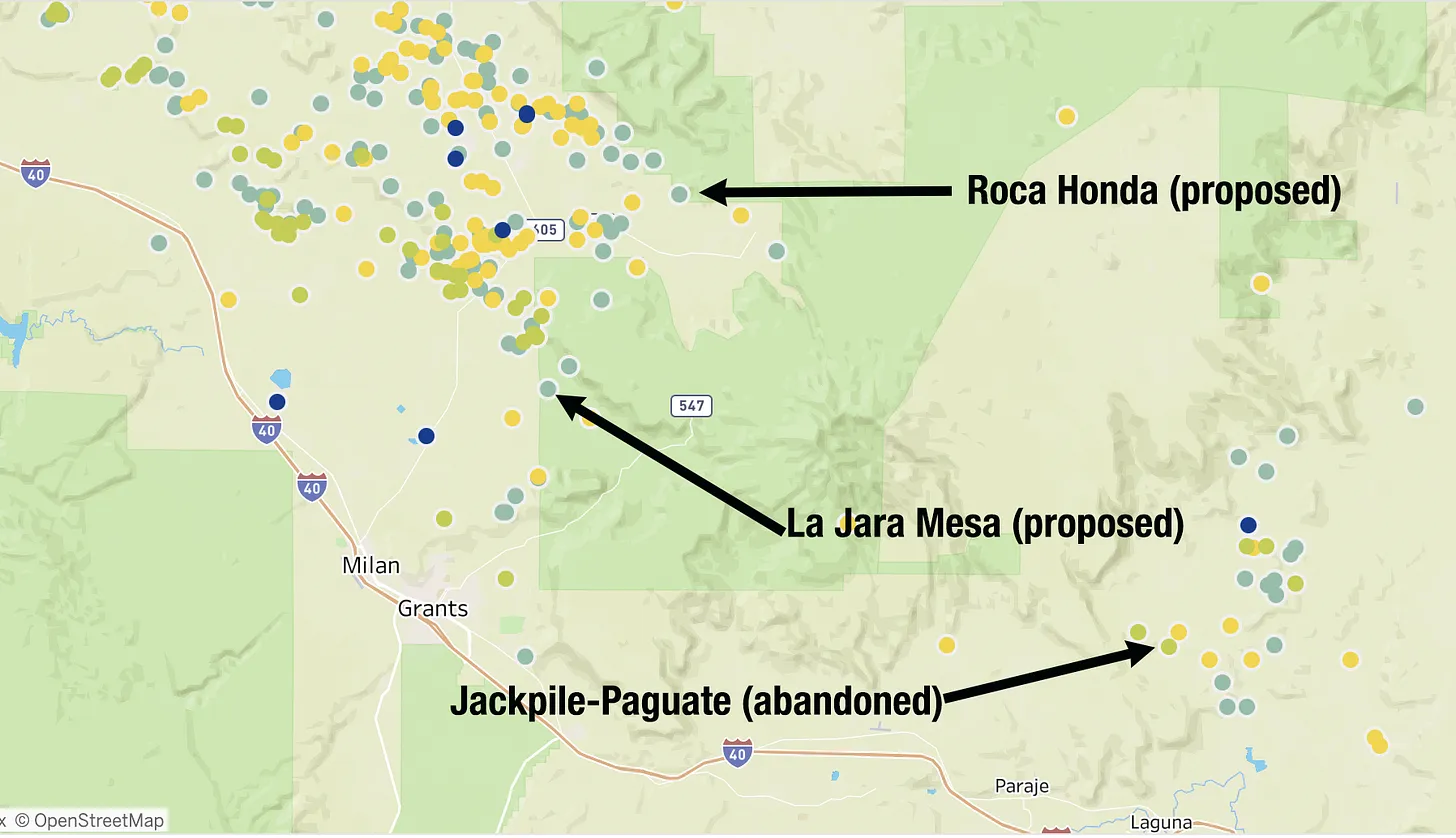
The dots show abandoned uranium mining and milling sites.

The Grants and Mount Taylor area was ravaged by Cold War-era uranium mining and the wounds from the previous boom continue to fester. That include the remnants of Anaconda Minerals Company’s Jackpile-Paguate Mine on Laguna Pueblo land, which was once the world’s largest open-pit uranium mine, producing some 24 million tons of ore.

Miners were exposed to radioactive and toxic heavy metals daily, even spending their lunch breaks sitting on piles of uranium ore. Blasting sent tremors through the pueblo’s adobe homes, and a cloud of poisonous dust drifted into the village of Paguate, just 2,000 feet from the mine, coating fruit trees, gardens, corn, and meat that was set out to dry. A toxic plume continued to spread through groundwater aquifers, and the Rio Paguate, a Rio Grande tributary, remains contaminated more than a decade after the facility became a Superfund site, despite millions of dollars in cleanup work. Laguna residents and former mine workers still suffer lingering health problems — cancer, respiratory illnesses and kidney disease — from the mine and its pollution.

Now the feds are saying approving new uranium mines in the same area is “mission critical.”

***

In December, the Biden administration began the process of halting new mining claims and mineral leasing for the next 20 years on 165,000 acres in the upper Pecos River watershed west of Santa Fe, New Mexico. This included holding meetings to gather public input on the plan. But the BLM canceled the first such meeting, scheduled for late February, and has not announced a new date, sparking fears that the new administration may be withdrawing plans for a mineral withdrawal.

Rio Grande and Pecos River basins. Map credit: By Kmusser – Own work, Elevation data from SRTM, drainage basin from GTOPO [1], U.S. stream from the National Atlas [2], all other features from Vector Map., CC BY-SA 3.0, https://commons.wikimedia.org/w/index.php?curid=11218868

Included within the acreage are more than 200 active mining claims held by Comexico LLC, a subsidiary of Australia-based New World Resources. For the past several years, Comexico has been working its way through the permitting process to do exploratory drilling at what it calls its Tererro mining project. It has met with stiff resistance from locals and regional advocacy groups, partly because mining has a dark history in the Pecos River watershed. In 1991, a big spring runoff washed contaminated mine and mill waste from a long-defunct mine into the upper Pecos River, killing as many as 100,000 trout. That prompted a multi-year cleanup of various mining sites.

***

📸 Parting Shot 🎞️

And now for a special treat, or maybe torture, but either way it might help take your mind off the dismantling of Democracy for a few moments. It’s my blow-by-blow analysis of the 1978 movie Avalanche, starring Rock Hudson and Mia Farrow. Normally this would be behind a paywall, like all of the other Land Desk archives. But I’m opening up to everyone for a limited time only in honor of the snowslide-triggering storm that is pounding the San Juans as I write. Enjoy. And, while you’re at it, check out our interactive map of long-lost ski hills in southwest Colorado.

AVALANCHE: A blow-by-blow analysis of the 1978 disaster flick — Jonathan P. Thompson, February 9, 2022
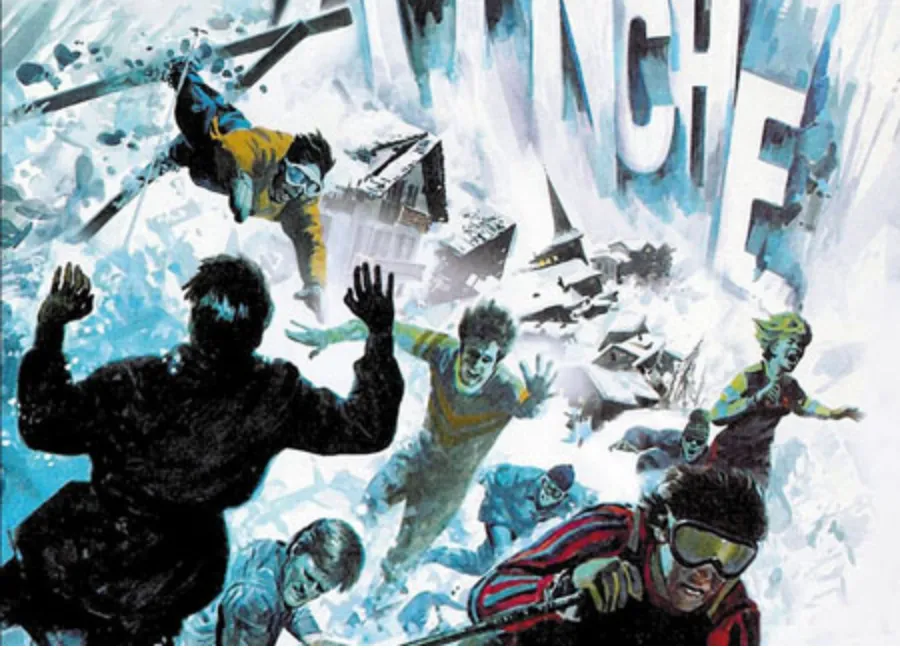
I was drawn in by the close-up winter aerial shots of ridges and peaks of the San Juan Mountains—Look, there’s Vestal! I yelled to my non-existent viewing companions as Rock Hudson’s name flashed on the screen. And Arrow! And Mount Garfield! I kept watching the lost-to-obscurity 1978 disaster film,

Read full story

#NewMexico’s Largest Fire Wrecked This City’s Water Source: Era of megafires endangers #water supplies in American West — Circle of Blue

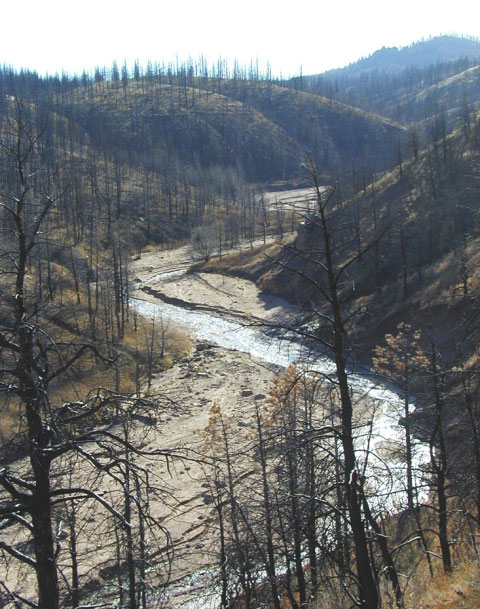
Hermit’s Peak Fire scar. Photo credit: Circle of Blue

Click the link to read the article on the Circle of Blue website (Brett Walton):

October 25, 2023

LAS VEGAS, New Mexico — The largest fire in New Mexico history began with a disastrous government agency blunder. Its consequences for land and a small northern New Mexico city’s water were magnified by man-made climate change. 

In the first week of April 2022, the U.S. Forest Service was setting a controlled burn in Santa Fe National Forest near the rocky promontory of Hermit’s Peak. A tool to thin overgrown forests, prescribed fires are intended to reduce the risk of hundred-thousand-acre megafires that have recently incinerated the American West.

Fanned by shifting winds blowing across dry timber, the deliberately ignited flames jumped containment lines. Then a dormant fire in nearby Calf Canyon reignited and merged with the blaze beneath Hermit’s Peak. Combined, the fire grew into an uncontrolled juggernaut that burned 341,735 acres of public and private land over four months.

But the collision between government error and climate change that produced a colossal fire disaster in the forests of northern New Mexico didn’t end once the flames were extinguished. The fire was a prelude to a water supply emergency that the city of Las Vegas still reckons with.

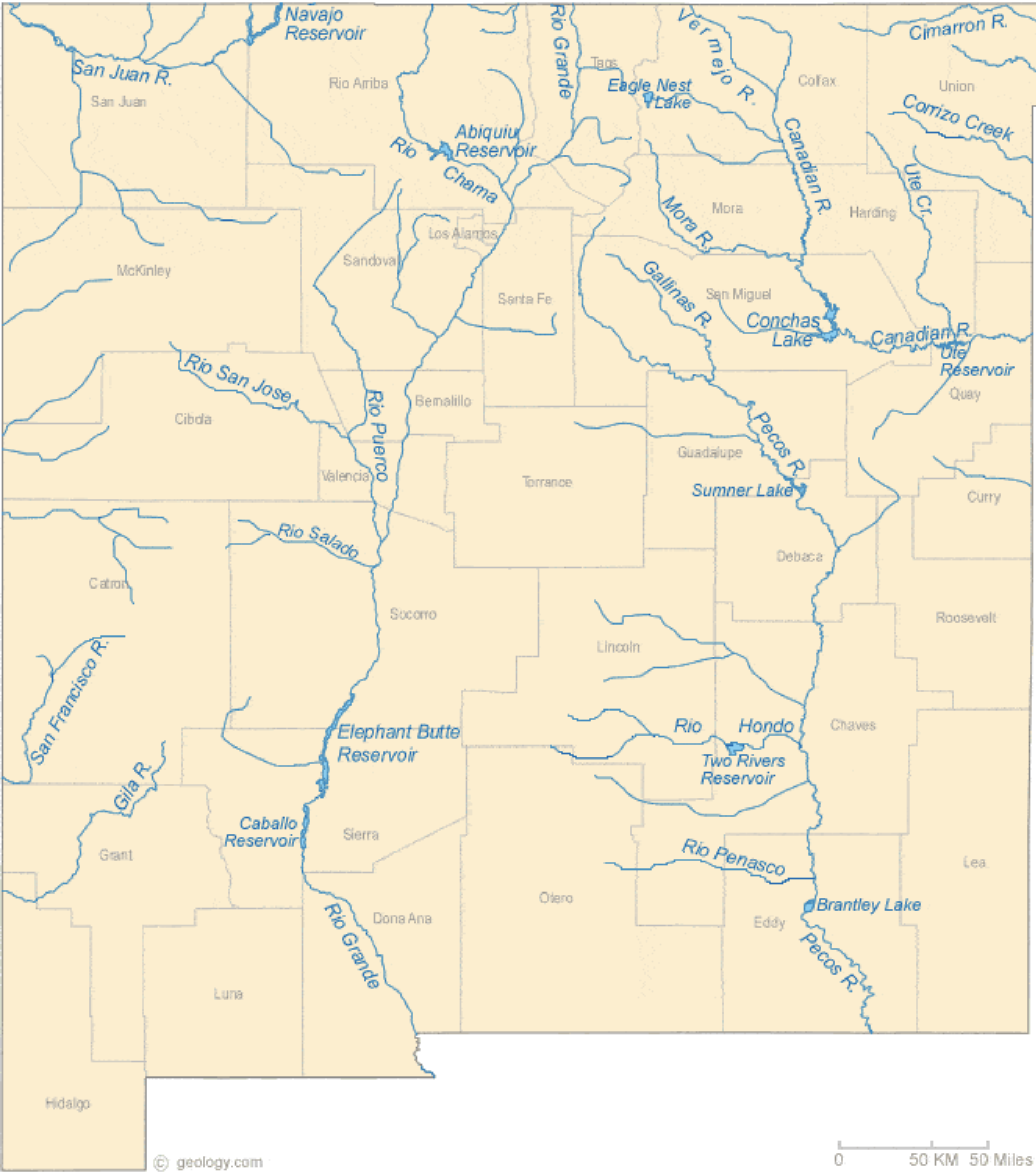
New Mexico Lakes, Rivers and Water Resources via Geology.com.

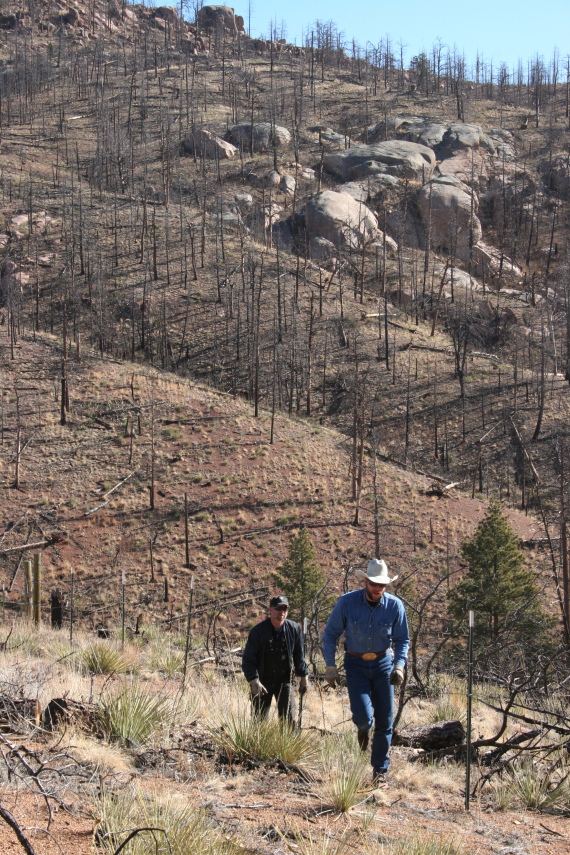
The fire burned the upper reaches of the Gallinas River watershed, the drinking water source for more than 17,000 people in and around Las Vegas. The fire had plenty of fuel — the watershed hadn’t had a major burn in more than a century. Ash and sediment flushed into the river from the bald slopes of the burn scar are undeniable threats to the city’s water treatment system.

By the end of August 2022, amid heavy monsoon rains, Las Vegas had a full-blown menace: a deteriorating river and just 21 days of water remaining in storage.

The trials of Las Vegas in the last year and a half are a sharp illustration of climate vulnerability in the American West, the domino effect of climate disasters, and the cost to taxpayers of repairing the damage. Similar cautionary tales dot the region’s map. Fires in recent years have destroyed water systems in Superior, Colorado; Detroit, Oregon; Malden, Washington; and in the California locales of Paradise, Santa Rosa, and the San Lorenzo Valley. 

The risk of high-severity fire is growing due to decades of fire suppression combined with a warming planet. A fuels buildup is being conditioned to burn. As the number of burned acres trends upwards, the U.S. Forest Service expects one-third of western U.S. watersheds to experience a doubling of post-fire sediment flows in rivers by mid-century. Towns downstream of flammable terrain are a lightning strike or undoused campfire away from being unable to provide reliable water service.

The seat of San Miguel County, Las Vegas is one of the poorest municipalities in one of the country’s poorest states. The city’s poverty rate is more than 30 percent. The Hermit’s Peak/Calf Canyon fire so damaged the Gallinas watershed – charring the soil and increasing the sediment load in streams – that the drinking water treatment system cannot keep up. It must be replaced. 

Unable to afford such a large expense on its own, Las Vegas turned to Congress. Lawmakers were willing to open the public purse due to the federal government’s role in causing the disaster. The Hermit’s Peak/Calf Canyon Fire Assistance Act was included in a short-term budget extension that President Biden signed on September 30, 2022. It offered $2.5 billion to compensate property owners for fire damage. The final 2023 budget bill added $1.45 billion to the pot, bringing the total federal assistance for injuries and property losses to $3.95 billion. That includes $140 million to replace water treatment facilities damaged by the fire.

Las Vegas intends a complete overhaul: a new water treatment plant, equipment to remove sediment from river water before it enters the treatment facility, and a system to purify wastewater to reuse as drinking water. Full build-out might take seven years, but when all the pieces are in place it will be the largest capital project in the city’s history.

“It’s huge,” Mayor Louie Trujillo told Circle of Blue about the federal assistance. “We could have never done it. We don’t have the budget.”

The muddy Gallinas River just downstream from the water intake for Las Vegas, New Mexico. Photo © Brett Walton/Circle of Blue

A Chaotic Period

As soon as the fire started, Maria Gilvarry knew that her city’s water supply was in jeopardy.

“The watershed is our water system,” Gilvarry, the Las Vegas Utilities Department director, told Circle of Blue. “So the more of the watershed that burns, the more that impacts our ability to treat and provide water.”

Even as the forests above Las Vegas smoldered, monsoon rains pummeled the burn scar last summer, delivering huge slugs of soil and debris into the Gallinas River. “It was just day after day of brown and black water,” Gilvarry recalled. The sediment load was too thick for the 1970s-era treatment facility. Two of the city’s three reservoirs were incapacitated by the muck.

Forests are on the frontlines of climate disasters. Hotter temperatures are a hair dryer pointed at mountain slopes that bristle with dense stands of trees and understory growth.

Because forests provide a disproportionately large share of the nation’s drinking water, what happens in the woods doesn’t stay in the woods. Though forests are water sources in eastern ranges like the Appalachians and Catskills, the water-forest-fire relationship is especially acute in the drying American West. 

According to U.S. Forest Service research, national forests in the western states account for just 19 percent of the land area. But they contribute 46 percent of the surface water supply. [ed. emphasis mine]

Amanda Hohner, an assistant professor at Montana State University, has spent a decade studying the effect of wildfire on municipal water systems. She says the places most vulnerable to wildfire contamination of drinking water sources share several characteristics. They are small systems with a single, surface water source — usually a river or lake. Who fits that description? The city of Las Vegas, for one.

Las Vegas has a backup groundwater well for emergencies. But Gilvarry said that mechanical problems kept it offline last summer. When the fire started, the Gallinas River was the only option.

It was a chaotic, high-stress period. Evacuated from her property, Gilvarry was running the utility department while staying in a trailer on a co-worker’s property. Her husband volunteered to fight the fire.

The utility crew shifted to round-the-clock operations at the water treatment plant, watching nervously as the fire approached — but never overran — the facility.

“Young staff members could look out and see flames,” Gilvarry said. “And, you know, they wanted to go home with their families at night. So part of my job was to counsel them and keep them safe, while also keeping water flowing for the community. And they did it — those employees were awesome.”

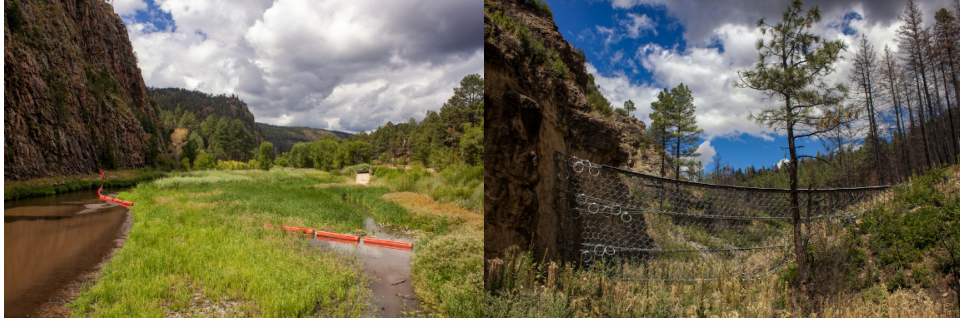
After the fire threat subsided, the task did not get easier. The Army Corps of Engineers installed 10-foot-tall steel Geobrugg netting across side canyons to catch large trees and boulders. The U.S. Geological Survey ramped up its stream monitoring. Straw-filled wattles, rock-filled gabions, berms, and barricades were deployed to prevent ash and sediment from entering the Gallinas. And yet it was not enough. Monsoon rains were severe, and sediment spiked. 

Trujillo and Gilvarry said that Las Vegas made it through the emergency period by focusing on conservation until a temporary state-funded sediment removal system could be installed at Storrie Lake, one of the storage reservoirs. Water department staff talked with restaurants and laundries. They asked car washes to voluntarily shut down. They identified pipe leaks and sealed them. Water was brought in via truck and bottle. Trujillo made frequent appearances on radio, in town hall meetings, at the senior center, at the community college.

“The citizens were ready to help us and they did,” Trujillo said.

After the Hermit’s Peak/Calf Canyon fire, booms and other structures were deployed in and around the Gallinas River to trap large debris and sediment. Photo © Brett Walton/Circle of Blue

‘A Marathon, Not a Sprint’

High-intensity fires do more than scorch trees and destroy homes. They upend the ecological function of entire watersheds. Burned forests become riddled with impairments. Shorn of trees, the land sheds more water than before. Though more water flows downstream, the costs of megafire outweigh this benefit. Without the forest buffer, floods are more destructive and more common. The land erodes easily. More nutrients are flushed downstream. 

For these reasons, the conservation groups American Rivers named the Gallinas one of the country’s most endangered rivers for 2023.

“The recovery of wildfire can be a little bit different from other natural disasters, in that the impacts can be cascading,” explained Madelene McDonald, a water scientist with Denver’s drinking water utility, which has also contended with the ripple effects of wildfires. “They’re not necessarily all at once, but it’s those repetitive storm events that can cause the greatest impact.”

Subsequent rains following the Hayman Fire in 2002 led to erosion problems and silt buildup in the creeks surrounding the Cheesman Reservoir. Photo credit: Denver Water

It happens again and again in the western states. Nitrogen levels in Colorado streams spiked immediately after the 2002 Hayman fire and remained elevated for more than a decade. Nitrogen is a plant vitamin that feeds lake-befouling algal blooms. And that’s not the only contaminant. Carbon, organic matter, heavy metals, and sediment — all accumulate in post-fire streams.

These chemical and physical changes to land and water are impairments that Gilvarry and her staff will face for years. More organic matter in the river can interfere with drinking water treatment. Disinfection chemicals like chlorine can produce toxic byproducts when too much carbon is in the source water. Sediment also clogs reservoirs and reduces water storage capacity.

The risks for Las Vegas were not unknown. The 1994 Gallinas River Watershed Plan, a joint effort with the city, U.S. Forest Service, and Tierra y Montes Soil and Water Conservation District, noted the need to reduce the fuel load in the watershed. The Viveash fire, in year 2000, burned mostly in the adjacent Cow Creek drainage. But some 820 acres of high-intensity fire did creep into the Gallinas watershed.

“A fire of Viveash’s magnitude occurring completely in the Gallinas Watershed would be disastrous for those who depend on Las Vegas’ water quality,” according to a March 2006 environmental assessment of prescribed fire that was prepared by the Santa Fe National Forest. That is exactly what happened with Hermit’s Peak/Calf Canyon.

Though the summer of 2022 was a nightmare, the summer of 2023, in terms of water quality, was much better. Monsoon rains were a trickle, not a flood. Sediment levels have been manageable. All three reservoirs are functioning again.

A bright spot for Gilvarry is that Las Vegas itself did not burn. That means there are no contaminants to flush from drinking water pipes. Cities in California, Colorado, and Oregon had to deal with benzene and other volatile chemicals in their water distribution systems after fires burned within city limits.

Slopes above Cheesman Reservoir after the Hayman fire photo credit Denver Water.

Denver’s experience with wildfire is a template for Las Vegas’s future. Both the Hayman fire and the 1996 Buffalo Creek fire burned the watersheds above Strontia Springs reservoir, a storage facility through which 80 percent of Denver’s drinking water passes. Denver Water is still planting trees in the burn scar. Even today, more than two decades after the fires, McDonald sees sediment levels in the reservoir climb after heavy rain.

“Recovery really is a marathon and not a sprint,” McDonald said.

How can communities like Las Vegas better prepare for the race? McDonald is part of the Wildland Fire Mitigation and Management Commission, a group of more than 50 national and regional fire experts tasked by Congress to recommend policy solutions to the wildfire crisis.

In September the commission submitted its report. Among its many recommendations are five specific to drinking water. In essence, they focus on prevention and response. Before a fire, utilities need to map their vulnerabilities and reduce fire risk in their watersheds by thinning and incorporating low-intensity burns. Risk assessments could identify utilities in need of water infrastructure upgrades – those like Las Vegas that have a sole surface water source or do not have the equipment to handle higher sediment levels. Portland, Oregon, for instance, is building a $1.48 billion water filtration plant, scheduled for completion in 2027, that will filter sediment from post-wildfire erosion in its forested Bull Run watershed.

Congress also has a role, the commission argues. Lawmakers could authorize grant funding for these assessments and amend existing forest restoration programs so that they explicitly target funds to areas with critical sources of drinking water, even though those areas may be far from where people live. Lawmakers could expand the timeline for disaster-relief funding, acknowledging that fire can harm water quality for years.

Gilvarry points to funding as a major obstacle to protecting water for smaller, low-income areas. Even if they are aware of the risks, can they bear the adaptation costs? “For the community to have built a top-of-the-line system ten, twenty, thirty, forty years ago to plan for this would have been multi-million dollars, but it would have come from the residents here,” Gilvarry said. “And I don’t think the residents could have afforded that.”

There are targeted research approaches, too. The Wildfire and Water Security project is investigating how drinking water systems can become more resilient to wildfire. Led by the U.S. Forest Service’s Pacific Northwest Research Station along with academic partners at Montana State, Oregon State, and Washington State, the initiative is considering water treatment options, water quality after fires, and the economic implications of fire damage and risk-reduction costs.

At the state level, the Colorado Water Conservation Board assessed the vulnerability of drinking water infrastructure in the state to wildfire damage. Called Wildfire Ready Watersheds, the program is intended to enable community-level preparation before a fire.

Critical to the effort is the U.S. Forest Service. Armed with $3.5 billion from the two-year-old Infrastructure Investment and Jobs Act to prepare communities for wildfire, the land management agency has adopted a “fireshed” approach in responding to the wildfire crisis. Firesheds are forest and rangeland units of roughly 250,000 acres that, if wildfire erupted, could damage homes, watersheds, water supplies, utility lines, and other critical infrastructure.

The U.S. Forest Service did not make any staff available for an interview. “The agency collaborates in the development and implementation of source water protection plans,” the press office wrote to Circle of Blue in an email. “In many places, we have agreements with local municipalities on how activities in the municipal watershed will be carried out to ensure the drinking water supply is protected; some of these agreements go back decades.”

A year after being pushed to the brink, Las Vegas residents celebrated the return of the People’s Faire, a community arts festival held on August 26 that had been absent for three years due to Covid and the fire.

Food and crafts vendors lined the sun-dappled lawn in front of the Monticello-inspired Carnegie Library, while children plotted their moves on a giant chess board.

Trujillo, in sunglasses and a stylish floral shirt, acted as unofficial host, greeting nearly everyone who passed by. For a moment, on a warm late-summer day, the water emergency was a memory and all was right in Las Vegas.

“It’s nice that we have all this,” an older woman told him. 

Her friend, who was shopping for Christmas presents, agreed. “When I lived in Oregon, we didn’t have the parades,” she said. “We didn’t have all this stuff that we have here. So it is nice. This little town does a lot.”

This article was supported by The Water Desk, an independent journalism initiative based at the University of Colorado Boulder’s Center for Environmental Journalism.

Louie Trujillo is the mayor of Las Vegas. “It was couldn’t have happened at a worst time,” Trujillo said about the fire. “We were just surfacing from Covid. And then the fire broke out and then as a result of the fire, of course, it caused a water crisis in our community.” Photo © Brett Walton/Circle of Blue

Rescuing silvery minnows like ‘slapping a Band-Aid on a severed limb’: The endangered species is only a symptom within a larger system in peril, conservationists say — SourceNM #RioGrande

Mallory Boro and Keegan Epping comb through the fine net for any silvery minnows left in the drying ponds of the Rio Grande at San Acacia. Fish litter the riverbed, inhabiting increasingly smaller ponds where the river breaks. (Photo by Diana Cervantes for Source NM)

Click the link to read the article on the Source NM website (Danielle Prokop):

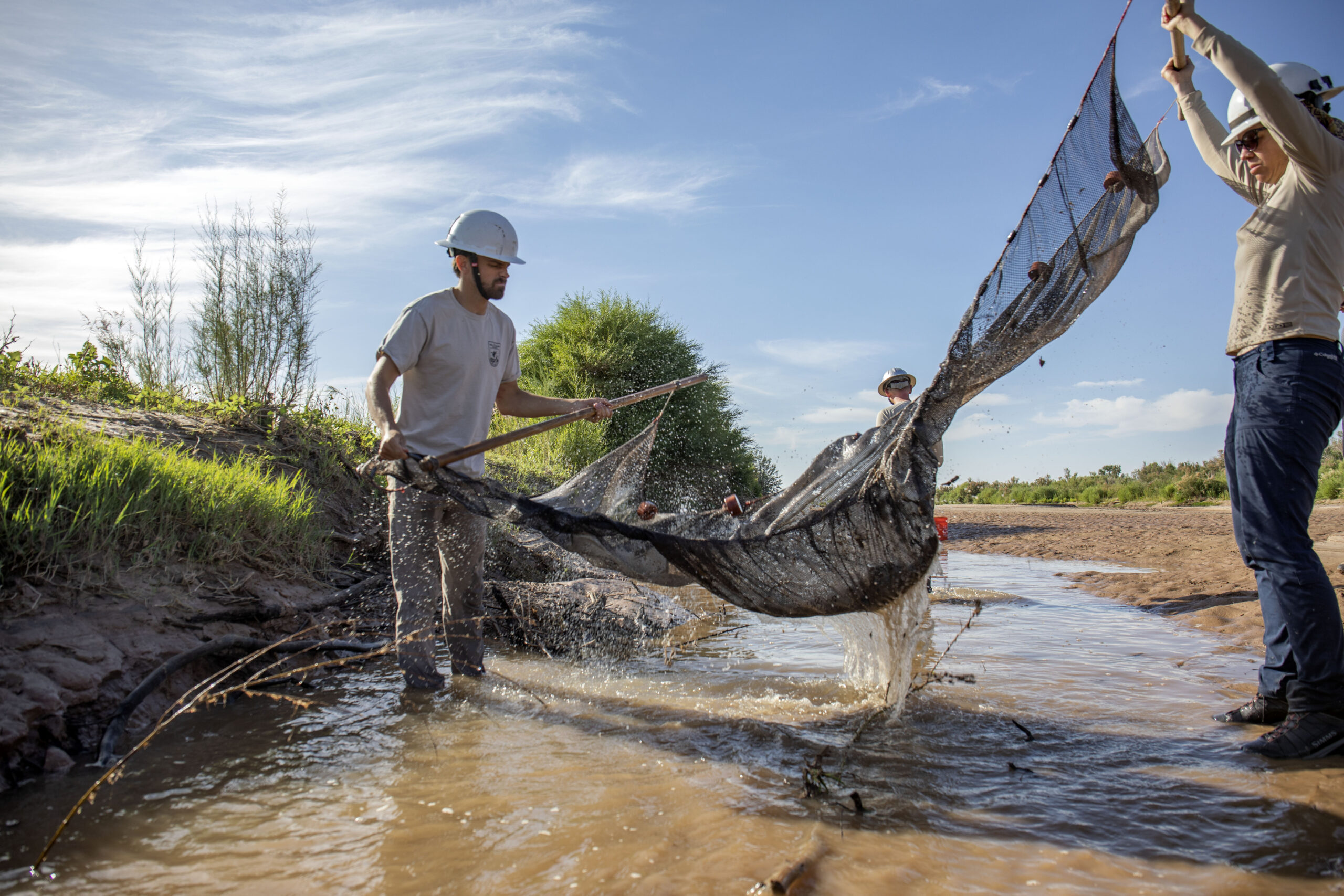
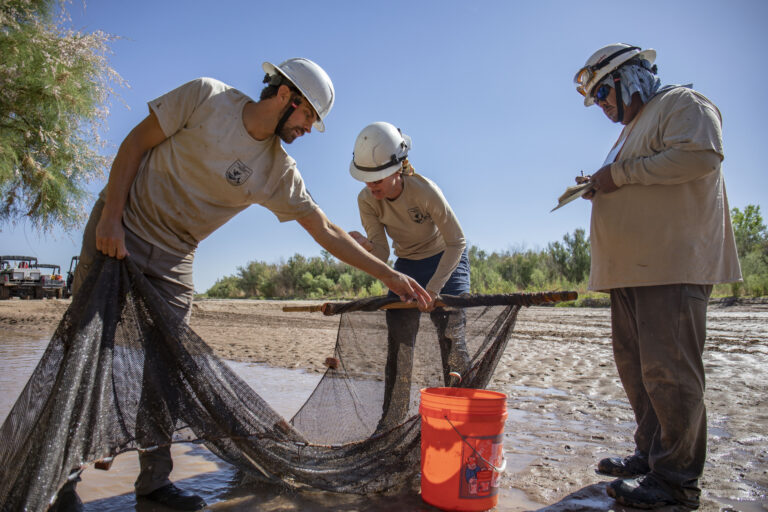
SOCORRO COUNTY, N.M. — Four people walk the streambed, combing the pools in Socorro County’s San Acacia Reach. Two wade thigh-deep in the bank crook, a seine net strung between them, and tug it through the water. Another calls out temperatures and measures the pool. The fourth jots it down in a notebook.

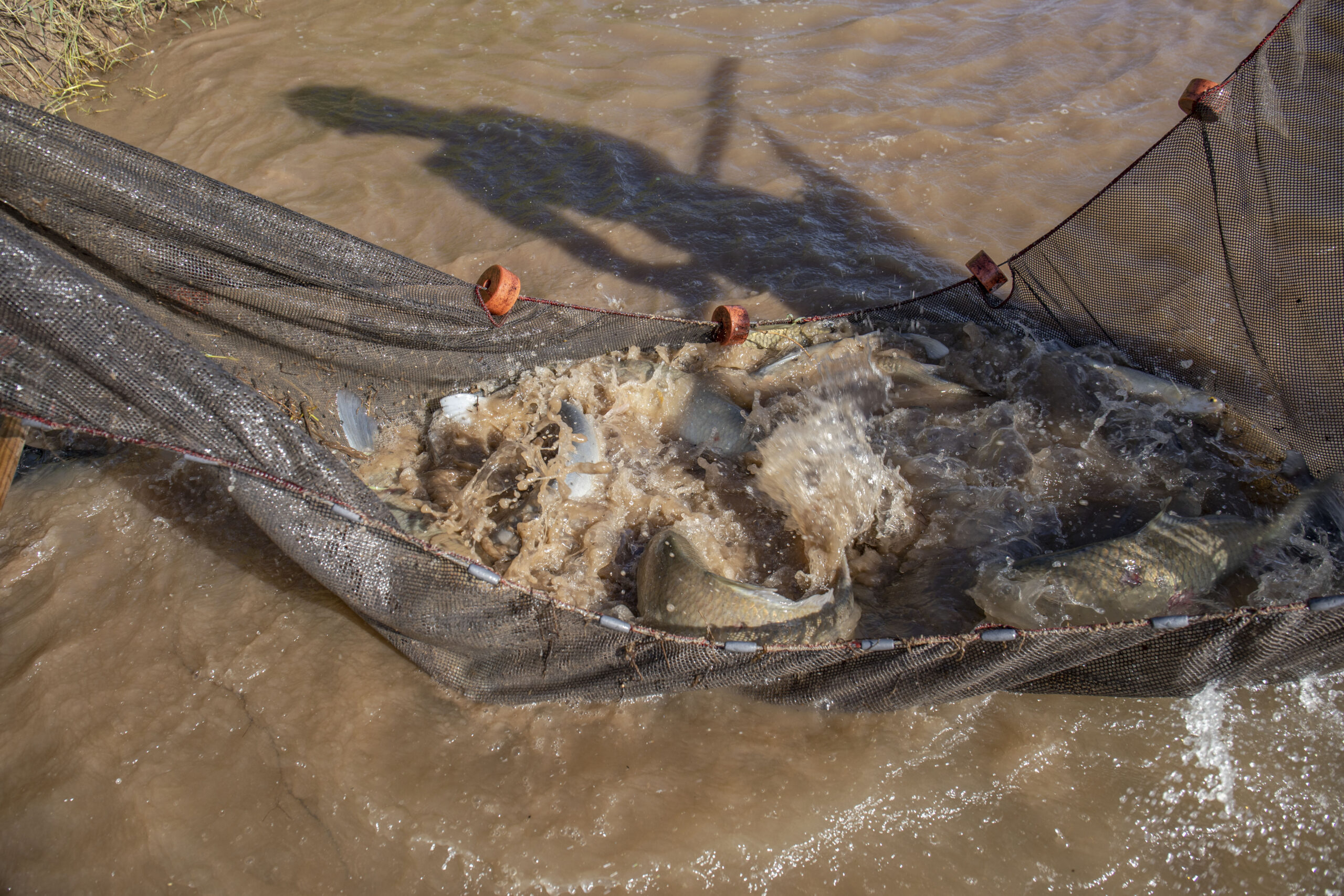
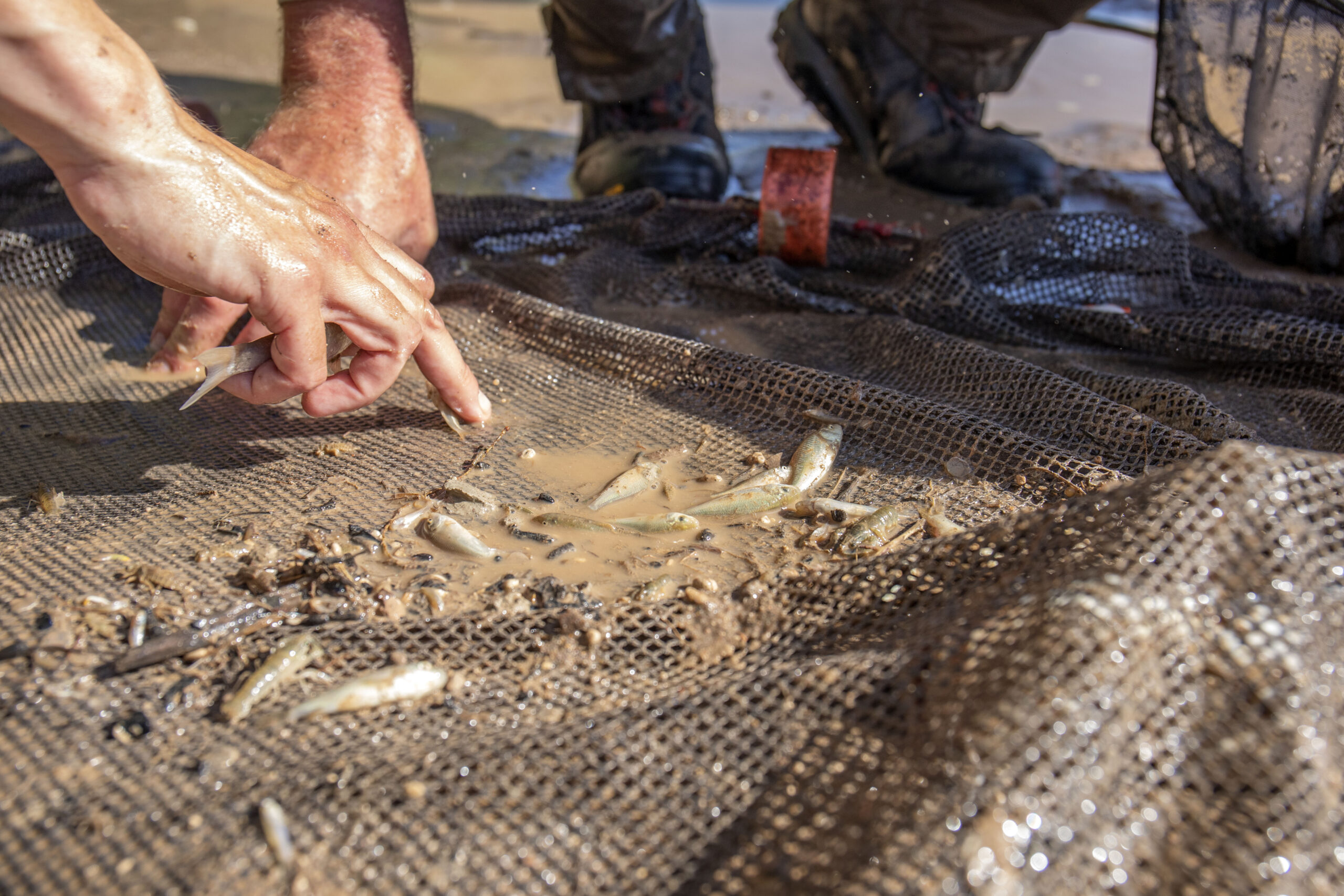
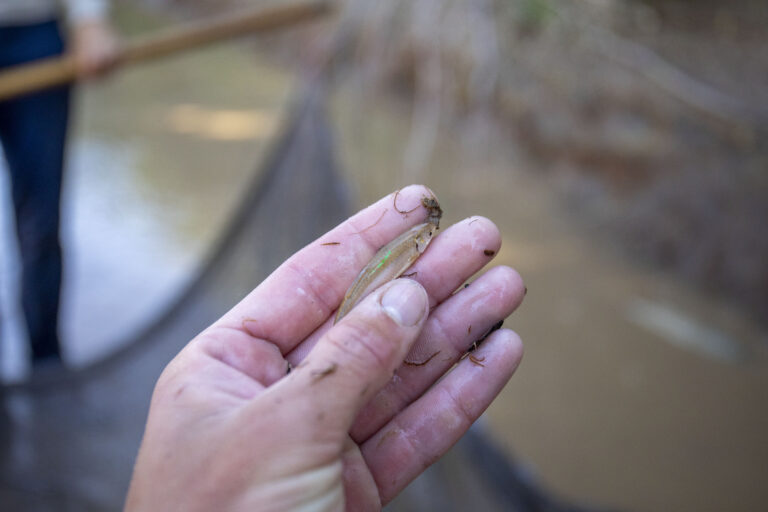
At the edge of the pool, the net is suddenly boiling with violent wriggling and thrashing. Mallory Boro from the U.S. Fish and Wildlife Service gently grasps a small fish with one deft flick of a hand. An endangered silvery minnow.

The minnow is placed in a five-gallon bucket and then moved to an oxygenated rescue tank on the back of an all-terrain vehicle. Then, onward to the next pool to do it all again. There are miles of riverbed left to go.

This is a fish rescue on the Rio Grande. And the people doing it know it’s not enough.

“This is like slapping a Band-Aid on a severed limb,” said Thomas Archdeacon, who has led the silvery minnow recovery project for the U.S. Fish and Wildlife Service in Albuquerque, N.M., for the past decade.

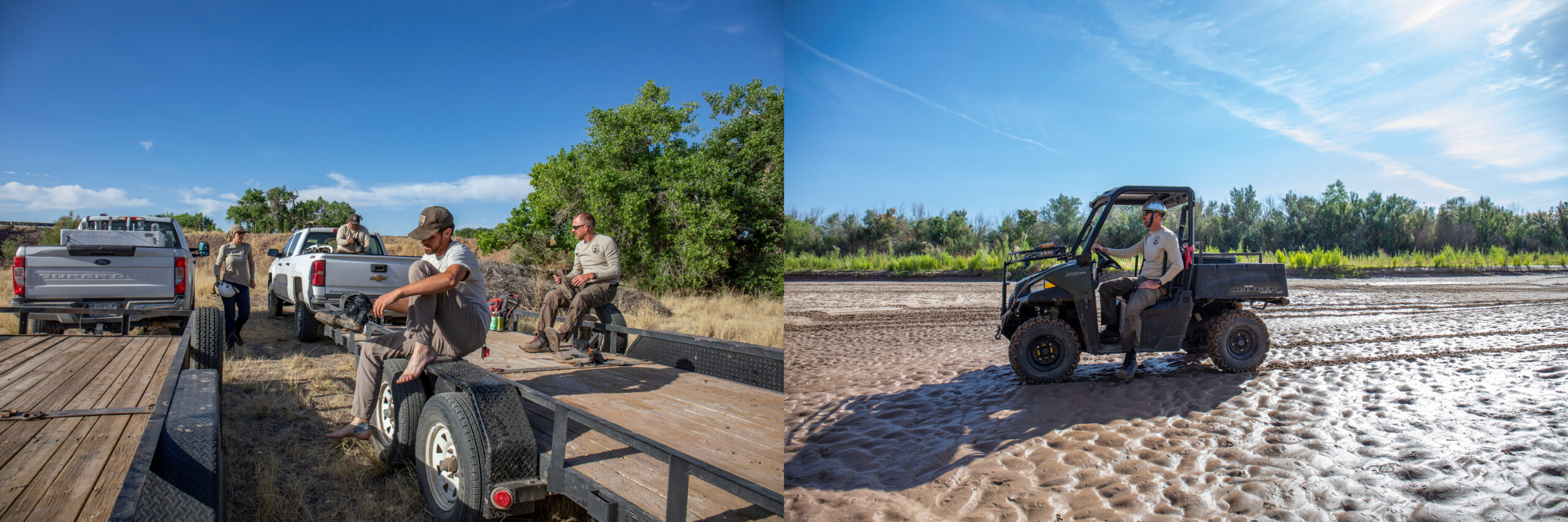
Four team members, left, at the U.S. Fish and Wildlife service pull on their shoes before a fish rescue. Mallory Boro, Lyle Thomas, Keegan Epping and Thomas Archdeacon often work extended hours in the heat to comb through more than 18 miles of riverbed that can dry nearly overnight. Archdeacon, right, has led the silvery minnow program at U.S. Fish and Wildlife for the past decade. (Photo by Diana Cervantes for Source NM)

These rescues require a lot of work, but even so, the fish are often in poor health from being in shallow, hot pools with little oxygen. Or they are sickened by other dead and rotting fish left behind when the water recedes.

“The ones that we rescue don’t survive very well. We’re getting between a 5% and 15% survival rate, which is bad,” he said. “Healthy fish have an 80% to 100% survival rate.”

Archdeacon drops his posture, taking a moment to rest against the ATV. He is an earnest speaker, lent gravitas by the touch of gray in his red hair. He has been studying and publishing research about the fish for nearly 15 years — most of his career.

Between 18 and 20 miles of the river dried in the San Acacia Reach overnight in mid-June, pushing the fish rescue crew to work punishing hours. The pools were smaller and drying faster than usual for June.

A vehicle in the dry riverbed of the Rio Grande. The San Acacia Reach is a stretch of the Rio Grande that has dried nearly every year for the past 25 years. (Photo by Diana Cervantes for Source NM)

More effort has to go to restoring the habitat that fish could survive in, and securing water in the river, he said.

“Eventually, we’re trying to take the emphasis off of the fish rescue, because it’s not effective conservation,” he said, running a hand across his face as the day creeps above 90 degrees.

Spawning between dams

The silvery minnow is not a charismatic species. The nondescript fish is green to yellow on top, a cream underbelly usually no more than 4 inches long, with small eyes and a small mouth. It’s short-lived, estimated to survive just over one year or up to two years in the wild, and four years in captivity.

Shoals of minnows used to swim nearly 3,000 miles of the Rio Grande’s length from the Gulf of Mexico to Española, N.M., and along much of the Pecos River.

They are unique in one aspect: Unlike most freshwater fish, the silvery minnow directly spawns into the water in the spring, and then the fertilized eggs slip downstream. This technique, called pelagic broadcasting, is much more common for marine creatures. The silvery minnow is the last of five species that spawn this way living in the Rio Grande. One is extinct entirely. The others survive in different rivers, but no longer in the Rio Grande.

The U.S. Fish and Wildlife Service team pulls seine nets through almost any pool left in the drying riverbed. The rescuers check each pool for silvery minnow. They throw back the other species of fish. The pools are often hot and poorly oxygenated. (Photo by Diana Cervantes for Source NM)

In earlier times, shallow wetlands emerged at the river’s bend. In slow eddies and silty bottoms, the silvery minnow was prolific. The species follows the river’s rhythms, waiting to spawn when the spike of snowmelt pulses.

But federal and local irrigation projects straightened the river, making it deeper and faster. They removed the bump of snowmelt, storing it in reservoirs for crops. The construction of Elephant Butte and other dams prevented fish from moving upstream. Eggs and larvae drift downstream to face predators or cold water in Elephant Butte. The river carries others into irrigation ditches or dry streambeds, where fish may hatch, but there is little chance for returning to the river to spawn.

In 1994, after years of steep declines, the silvery minnow was listed as endangered at the federal level.

Now, the fish are primarily found in a stretch of river between Cochiti Dam and Elephant Butte — if there’s enough river to support silvery minnow.

“If some catastrophic event occurs, they’re a lot more vulnerable because it’s more likely to affect all of them,” Archdeacon said.

Silvery minnow are primarily found in a stretch of the Rio Grande between Cochiti Dam and Elephant Butte — if there’s enough river to support the fish. “If some catastrophic event occurs, they’re a lot more vulnerable because it’s more likely to affect all of them,” said Thomas Archdeacon, left. (Photo by Diana Cervantes for Source NM)

For 25 years, the San Acacia Reach has dried nearly every summer when farmers divert water for crops, according to documentation held by the Rio Grande Compact Commission.

Archdeacon said he doesn’t have any answers as to why the silvery minnow population has better reproduction and recruitment chances in the reach, compared with upstream in Albuquerque, where the river has only dried once in the last 40 years — in the summer of 2022.

“My guess is that the eggs float downstream, and the channel is wider — more sand bed — and shallower, which is just better for reproduction,” he said.

Drought complicates recovery efforts on all sides. In a good year like 2017, the fish population boomed into the millions. But only a tiny number lasts long enough to continue the next generation. And in lousy years, which are more frequent, that dwindling number of spawners only shrinks. In 2018 and again in 2022, the river dried before the fish could spawn.

Even when thousands of fish spawn simultaneously, only a few successfully carry on to the next generations.

Some of the pools range in depth from a few feet to a few inches. Under the June sun, they rapidly shrink. Archdeacon noted that the pools were appearing earlier each year, and the river is drying faster. (Photo by Diana Cervantes for Source NM)

Federal agencies partnered with hatcheries and the ABQ BioPark to breed other silvery minnows, in the tens of thousands to hundreds of thousands, both for release into the wild and as a bank against inbreeding when wild populations crash.

“Genetically speaking, it’s keeping them from going down a hole they can’t dig themselves out of,” Archdeacon said.

But dumping hatchery fish into the Rio Grande is not a silver bullet. Recovery means a wild, sustainable population, which Archdeacon added would require “serious large-scale habitat restoration” and sufficient water flows to spawn.

If 1 million to 2 million fish were upstream and successfully spawning each spring, he estimated, then fish rescue may be worth it.

But that’s not the reality.

In 2022, early drying wiped out egg collection efforts. With the 2020 and 2021 generations reaching the end of their lifespan, the 2023 generation will be vital for keeping the hatchery populations alive.

“But there’s also nothing that prevents this from happening again,” Archdeacon said.

Lyle Thomas places a silvery minnow found in a pool into an oxygenated holding tank on the back of the carts. The fish are transported to better environments, but their survival rate is low, since the fish are often unhealthy from being in the pools. (Photo by Diana Cervantes for Source NM)

Dry beds 

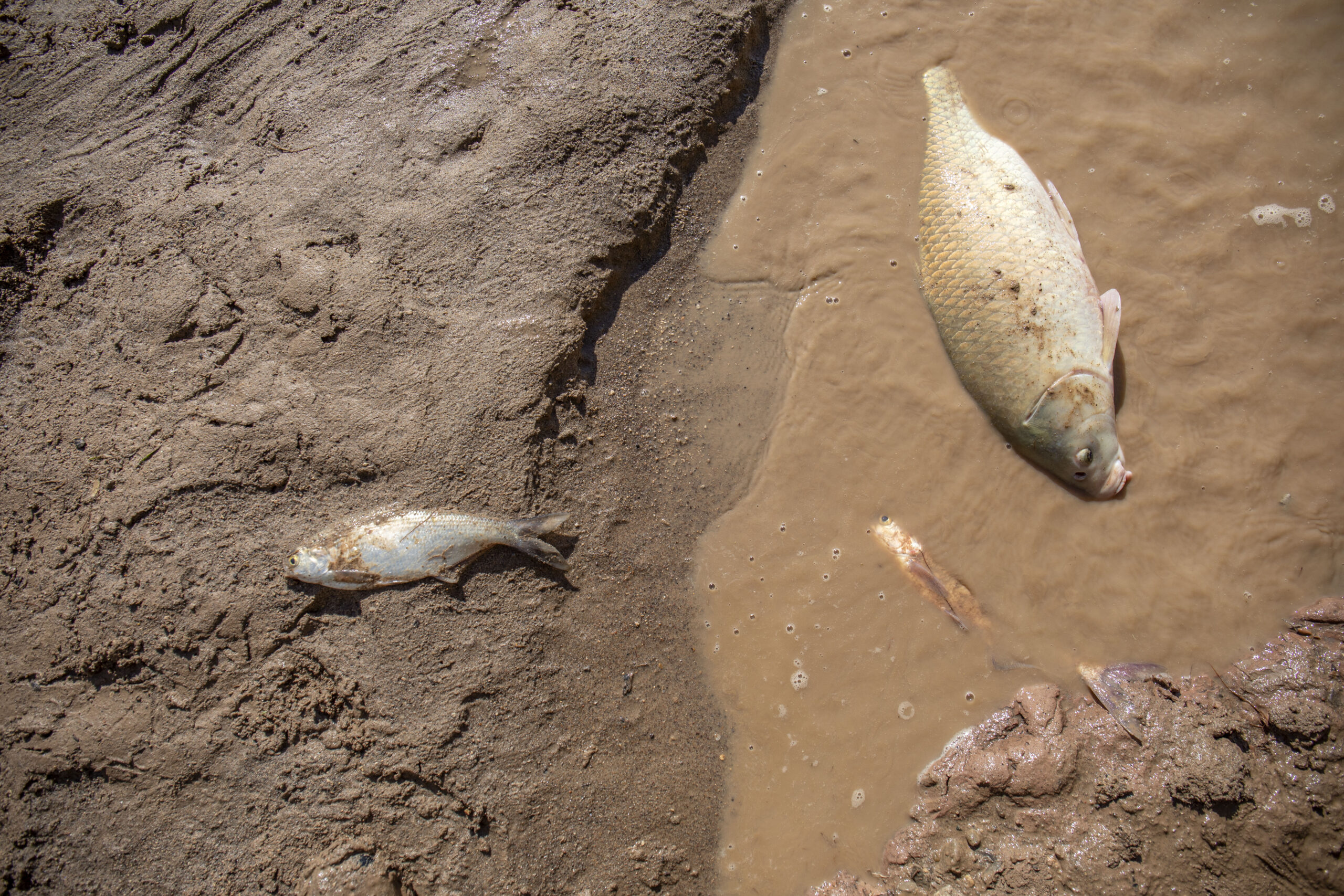
Nothing dies quietly in the riverbed. Dozens of blue catfish, golden green smallmouth buffalo and red shiners grow brown as they writhe in the silt, seeking a pool. Some red remains as their gill slits flare, and they twist and slam their bodies into the mud.

Their moments of frantic slapping stretch into long, excruciating minutes. It takes nearly an hour before some of the larger fish heave their last breath.

When the pools are large enough, maybe between ankle- and knee-deep, the team can throw the fish back in to survive in shrinking pools. But when the pools shrink to just the barest puddle, it means throwing the fish that aren’t silvery minnows out into the mud.

The U.S. Fish and Wildlife team measures the temperatures of each pond, noting what kind of conditions the rescued fish are coming from. At right, Mallory Boro discards a fish from the net, when the pool is too small to return it, searching for silvery minnow. (Photos by Diana Cervantes for Source NM)

Archdeacon cradles a native smallmouth buffalo. “If the river wasn’t dry, nothing would eat them,” he said, putting it onto the ground. “I’d guess this one is about 10-years-old.”

The minnow, unlike the other fish trapped in the pools, is on the federal list of endangered species — that’s why there’s a team to save them.

Human choice is central to what’s happening here, Archdeacon said, just as people make decisions to use water elsewhere, and this dry bed is a consequence.

“You’re choosing people over fish,” he said. “You cannot paint this into a rosy picture. If you’ve been out here, it’s not good.”

Some of the fish rescuers said they’ve become somewhat desensitized to the mass death of other fish. They have a job to do.

Still, it doesn’t really get easy, either.

“I think about this 365 days a year,” Archdeacon said. “I can’t sleep at night. It’s pretty bad.”

From left, a gizzard shad in the streambed. At right, fish species of all kinds turn muddy and brown from struggling to find water in the San Acacia reach, dying by the hundreds. (Photos by Diana Cervantes for Source NM)

Driving out of the sand bed of San Acacia, away from fish gasping in the riverbed, irrigation canals criss-cross under roadways, full and glistening in the sun. Fields of green alfalfa zip by, watered by pivot sprinklers.

Little fish, big controversy

The silvery minnow has been central to a slew of lawsuits against the federal government, at district and appellate levels.

Out of a case brought jointly by New Mexico, irrigation districts and conservation groups, a 10th Circuit Appeals ruling in 1999 found that top U.S. Fish and Wildlife officials at the time had not followed procedures in securing habitat for the fish. Three years later, the same court found the agency was dragging its feet in providing needed documentation, writing: “These delays and irrational decisions come at the expense of the silvery minnow, officially endangered for nearly eight years.”

More years of litigation resulted in a 2020 federal appeals court decision upholding a lower court’s determination that the U.S. Army Corps of Engineers was not allowed to provide additional water for endangered species and was not required to consult with the U.S. Fish and Wildlife Service to change its practices.

In 2021, WildEarth Guardians — a western conservation nonprofit headquartered in Santa Fe — filed a notice of intent to sue the U.S. government over a 10-year plan between agencies to ensure they wouldn’t harm endangered species.

That plan, set up just a few years before the lawsuit, was the result of a consultation on a series of reclamation projects and water operations in habitats for the silvery minnow, Southwestern willow flycatcher and yellow-billed cuckoo — all species with federal protections in the Middle Rio Grande. 

Keegan Epping checks a seine net for any live silvery minnows from a pull. (Photo by Diana Cervantes for Source NM)

The nonprofit wrote a letter addressed to federal agencies and New Mexico state department leaders, announcing their intention to sue:

“We hope that this warning (both the legal notice and the dire conditions on the river) will provide water managers, and quite frankly all people, an incentive to rethink water management as it has existed this past century and chart a new course for this dying river,” the letter said. “The Rio Grande is too valuable to lose.”

After talks and negotiations, further legal action is being taken.

In late November 2022, WildEarth Guardians filed a lawsuit in federal District Court, alleging that the U.S. Fish and Wildlife Service and Bureau of Reclamation violated the Endangered Species Act with the 10-year plan.

U.S. Fish and Wildlife found that the bureau did not jeopardize any endangered species in its 2016 plan. WildEarth Guardians alleges that the decision was “arbitrary,” relies on “vague, uncertain and unenforceable” conservation measures, and failed to consider climate change’s impact. 

The current plan wouldn’t meaningfully recover species, the nonprofit said.

WildEarth Guardians asked the court to toss out the 10-year plan and require the agencies to reexamine projects and operations on the Rio Grande.

When the water dries fish gasp for hours in the streambed until they die.(Photo by Diana Cervantes for Source NM)

The silvery minnow’s population is worse off than when it was listed three decades ago, said Daniel Timmons, the river programs director and Rio Grande waterkeeper for WildEarth Guardians.

“Actually limiting the amount of water that’s being taken out of the river in order to make sure there’s enough water left for fish is an action that the federal government has continued to refuse to do,” Timmons said.

Federal management of dams, diversions and depletions is the primary threat that removes water from the river ecosystem, he said.

“It’s not just about the silvery minnow. It’s about the river as a whole,” Timmons said. “That’s the piece that the federal government to date has really failed to grasp, is the importance of the species as an indicator of an entire river system in crisis and collapse.”

Crisis on the Rio Grande is a multi-part series that travels along the river from Colorado through New Mexico and into Texas.

Read more: ‘Not an object to be bartered,’ the Rio Grande is lifeblood for the land

Las Vegas, #NewMexico declares #water emergency: The city said its reservoirs currently hold less than 50 days worth of water — KOAT #RioGrande #PecosRiver #GallinasRiver

Gallinas River watershed. Map credit: Hermit’s Peak Watershed Alliance

Click the link to read the article on the KOAT website (Nick Catlin). Here’s an excerpt:

Las Vegas is relying solely on its reservoirs to supply water, but it currently contains less than 50 days of water. Las Vegas normally relies on the Gallinas River as its primary water source. However, the Hermits Peak/Calf Canyon fires damaged thousands of acres of the watershed for the river. The city said the fires have caused large amounts of ash and debris to enter the river, preventing Las Vegas from pulling from its primary water source.

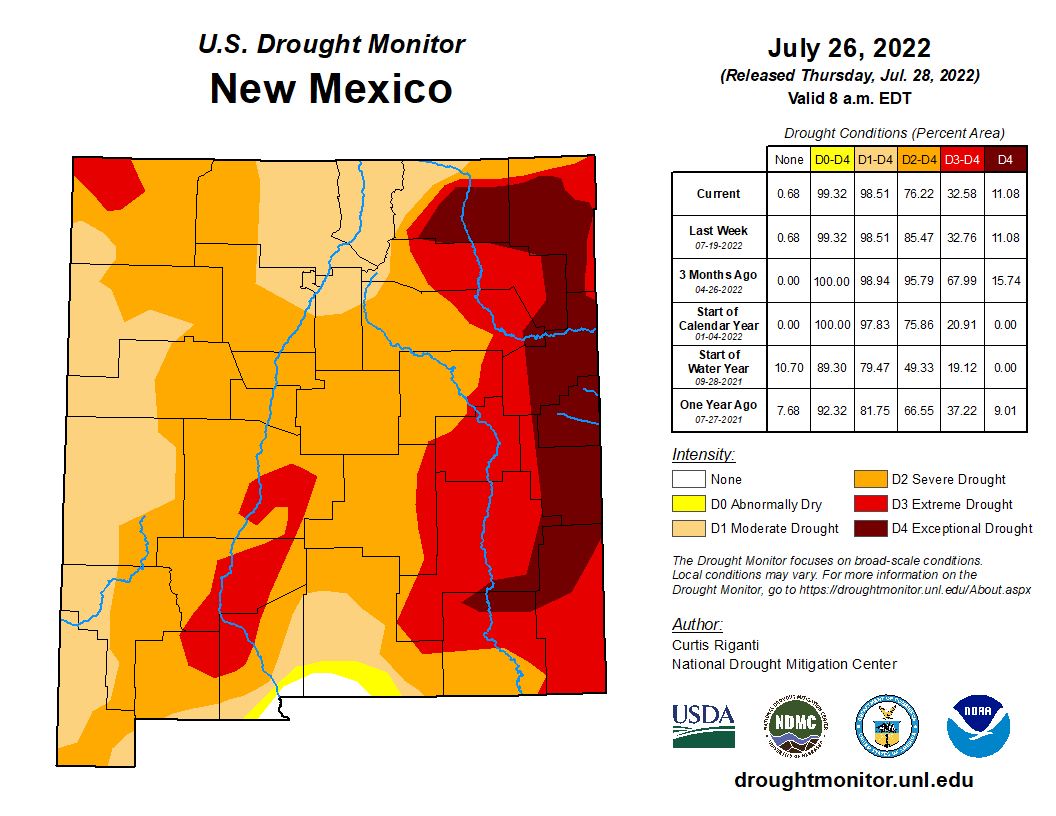
New Mexico Drought Monitor map July 26, 2022.

USDA rule to allow payments for cattle contaminated by harmful chemical — KRQE #PFAS

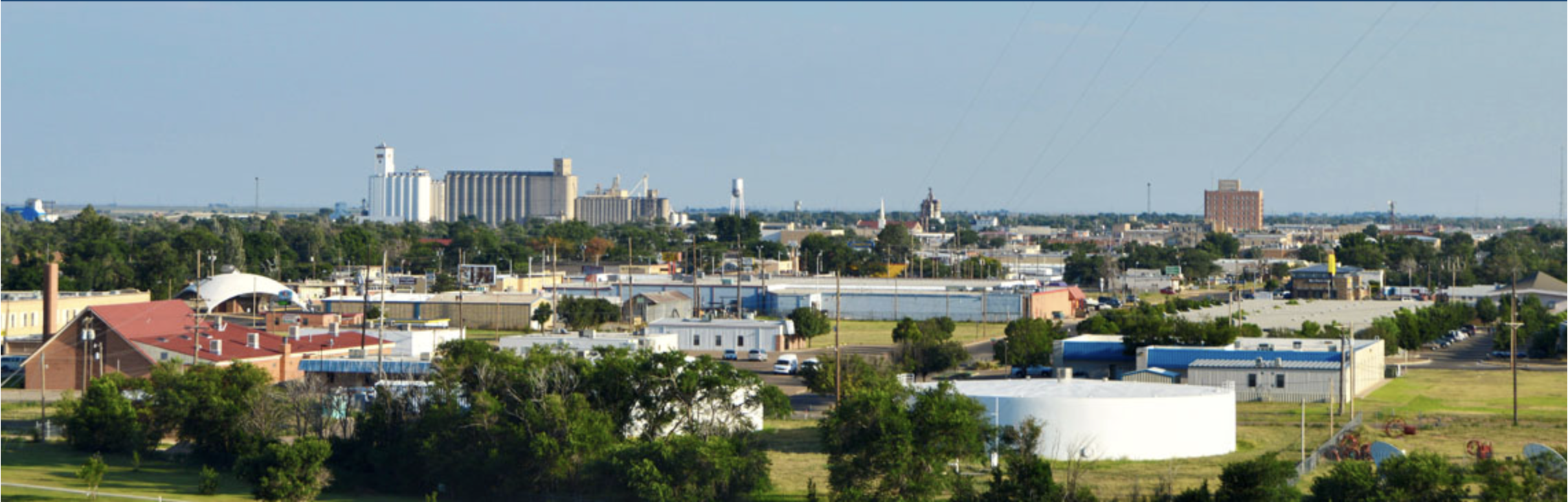
Clovis, New Mexico. Photo credit: Clovis and Curry County Chamber of Commerce

From KQRE (Allison Keys):

The federal government will allow a Clovis dairy to be reimbursed after its groundwater was contaminated by the Cannon Air Force base. The government announced it will finalize a rule change allowing compensation for cows that are not likely to be sold.

Art and Renee Schaap own Highland Dairy. They say a firefighting foam contaminated their water supply which reduced milk production in their cows.

The milk that was produced had to be thrown out for fear it was contaminated too. They filed a lawsuit against the federal government in 2019 saying the military knew about the contamination but didn’t tell them.

Amid #drought, Interstate Stream Commission seeks federal support — #NewMexico Political Report

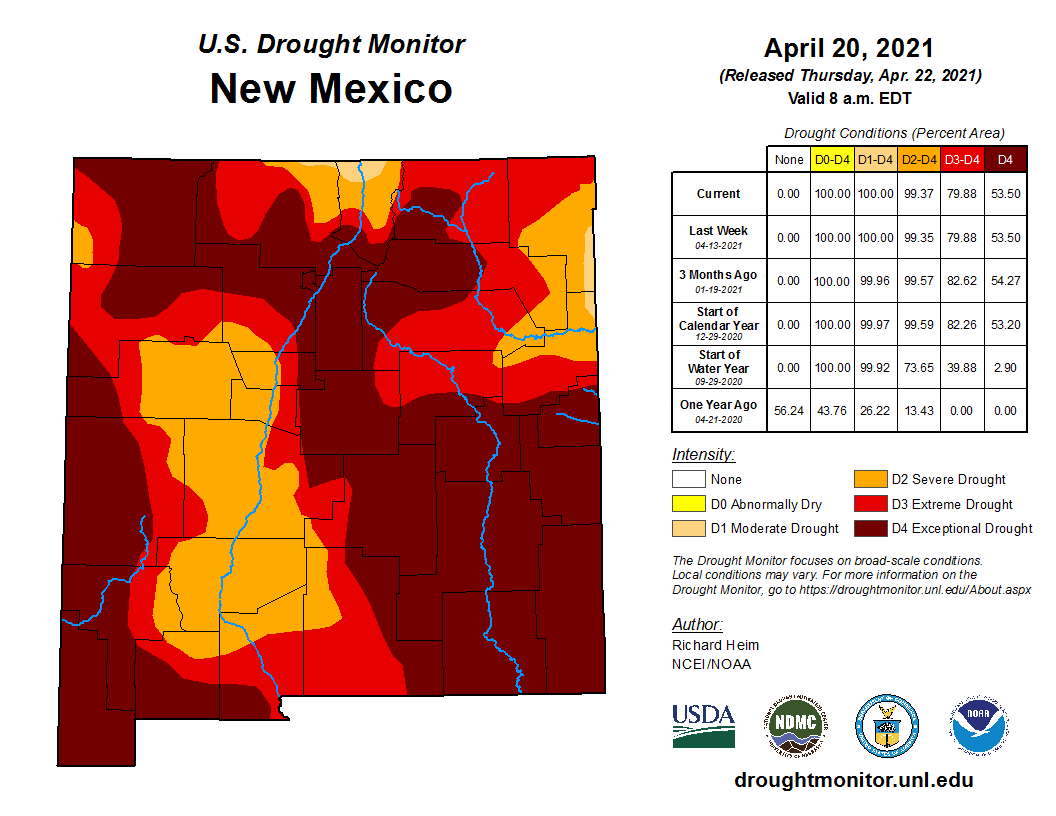
New Mexico Drought Monitor April 20, 2021.

From The New Mexico Political Report (Hannah Grover):

As much of New Mexico faces exceptional drought conditions, the Interstate Stream Commission authorized its chairman to ask the Department of Interior for financial support.

The commission approved delegating that authority to commission chairman during its meeting on Friday.

The chairman will work with State Engineer John D’Antonio to request funding for both long-term and short-term drought relief.

The short-term relief could be something like assistance for farmers, said ISC Director Rolf Schmidt-Peterson…

Low water flow in rivers

The major water basins in the state are experiencing low flows in rivers.

The Upper Colorado River Basin had 89 percent of normal snowpack this year, but the back-to-back years of drought left the soil dry. This led to more of the runoff soaking into the ground rather than flowing downstream, according to the staff report at the start of the meeting. This has left flows in the San Juan, Animas and La Plata rivers at 50 percent of the historic average during March and April.

Meanwhile, the Gila and San Francisco rivers are flowing at 5 to 21 percent of the historic average for March and April.

The headwater tributaries of the Pecos River were flowing at 39 to 47 percent of average during the time period from October to March, according to information from the New Mexico Drought Taskforce. In the Canadian River Basin, the headwater tributaries were flowing at 18 to 67 percent of average.

During the October to March time period, the Rio Grande streamflow upstream of Albuquerque ranged from 35 to 67 percent of average, according to the drought taskforce report…

The Rio Grande Compact is preventing New Mexico from storing water in reservoirs built after 1929 because of the low levels and the state currently owes water from the Rio Grande to downstream users.

Meanwhile, water users in the Pecos River basin will be relying on augmentation wells this year.

Reservoirs below capacity

As streamflow in much of the state is well below average, the reservoirs have dropped.

Ute Reservoir near Logan is at 65 percent capacity, leaving community boat docks on dry land and needing to be shut down. Other reservoirs in the Canadian River Basin aren’t faring any better. Eagle Nest Reservoir is at 43 percent capacity and Conchas Reservoir is at 23 percent capacity.

Meanwhile, in the northwest portion of the state, Navajo Reservoir is 62 percent full. Because of the low amount of water in Navajo Reservoir, the U.S. Bureau of Reclamation is not having the spring peak release this year that is usually done to clear out the channel and improve habitat for endangered fish like the Colorado pikeminnow.