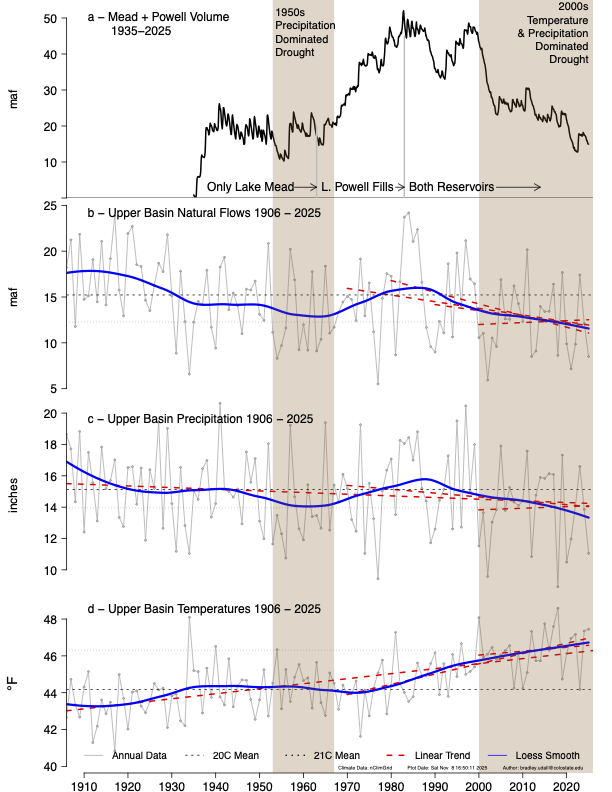
Click the link to read the article on the Tucson.com website (Tony Davis). Here’s an excerpt:
January 31, 2026
Arizona Gov. Katie Hobbs and leaders of the six other Western states that rely on the Colorado River ended a Friday meeting in Washington, D.C. with no deal to end a stalemate over rights to the river’s dwindling water supply. Hobbs indicated that progress was made thanks to newfound flexibility from upstream states over their willingness to make commitments to cut some of their river water use, as the Lower Basin states, including Arizona, have already done. But Colorado officials all but directly contradicted Hobbs’ comments, saying they and Upper Colorado River Basin states were sticking to their position opposing any mandatory water use cuts on their part. The meeting was hosted by U.S. Interior Secretary Doug Burgum…
“I was encouraged to hear Upper Basin governors express a willingness to turn water conservation programs into firm commitments of water savings,” [Katie] Hobbs posted on social media after the two-hour meeting. “Arizona has been and will continue to be at the table offering solutions to the long-term protection of the river so long as every state recognizes our shared responsibility…
Mitchell said, “Colorado is committed to being part of the solution, and with our Upper Basin partners, we have offered every tool available to us. This includes making releases from our upstream reservoirs and establishing a contribution program as part of a consensus agreement. However, any contributions must be voluntary, and we have real ideas and plans to achieve the goals…”As several upper basin governors clearly stated at the meeting, we cannot and will not impose mandatory reductions on our water rights holders to send water downstream,” she wrote. “Our water users are already facing uncompensated reductions through state regulation. In many cases, these reductions impact 1880s water rights that predate the (Colorado River) Compact. Any contribution program must recognize our hydrologic realities: we simply cannot conserve water that we do not get to begin with.”
[…]
Mitchell spoke in even stronger terms earlier in the week at a public talk she gave in Aurora, a suburb of Denver. She spoke at the annual meeting of the Colorado Water Conference, a professional association that advocates for policies and laws that protect the state’s waters.
“For more than a century, we built a system on optimism and entitlement. We planned for abundance, labeled it normal, wrote it in the law, and when the water showed up, we spent it,” Mitchell told the gathering, in remarks reported by the Colorado Sun news website. “When it didn’t, we blamed the weather, climate change or each other. Anything but the simple math.”
The seven states need to tie reservoir releases more closely to the actual amount of water coming in, Mitchell said in an interview after the speech. That was a nonnegotiable for the Friday meeting, she said. Overuse by the Lower Basin is draining the system, Colorado officials say.