Utah’s cloud seeding program began in the early 1950s with initial winter experiments aimed at boosting snowfall in mountainous regions to enhance water supplies. These early efforts were part of broader U.S. weather modification initiatives following World War II discoveries about silver iodide’s role in nucleating ice crystals in supercooled clouds. By the 1970s, amid severe droughts in central and southern Utah, counties collaborated with the state to formalize operations, leading to the Cloud Seeding Act of 1973. This legislation empowered the Utah Division of Water Resources to regulate and fund programs, with North American Weather Consultants often handling implementation using ground-based silver iodide generators.1
The program’s foundational design targeted winter storms from November to April, releasing silver iodide particles from foothill and high-elevation sites to stimulate precipitation in key watersheds like the Uinta Mountains and central Utah ranges. Early operations in the 1973-74 season involved manual generators, with state funding starting in 1975-76 to match local contributions from participating counties such as Beaver and Sanpete. Evaluations drew from prior research, hypothesizing that seeding supercooled clouds would increase snowpack for spring runoff, and the program paused only briefly during non-drought periods but resumed consistently.2
Over decades, Utah expanded its efforts with partnerships like the Central Utah Water Conservancy District, supporting targeted areas including the West Uintas and Emery programs, while annual legislative appropriations—around $300,000 by 2021—ensured continuity. Aerial seeding with aircraft supplemented ground units in the late 1970s and 1980s, but ground-based methods proved more reliable and cost-effective. By the 2020s, amid ongoing water scarcity, the state ramped up investments, reflecting confidence in 5-15% snowfall increases backed by long-term data collection.3
Recent advancements have modernized the program into the world’s largest remote-controlled network, with 190 automated generators deployed statewide by 2025 for safer, faster activation during storms. Funding surged to nearly $16 million in 2025, enabling drone-based seeding pilots in challenging terrains like the La Sal Mountains, replacing prior airplane tests for precise cloud penetration. These innovations, overseen for environmental safety, align with Utah’s water policy to combat the impact of droughts for both agricultural and urban users.4
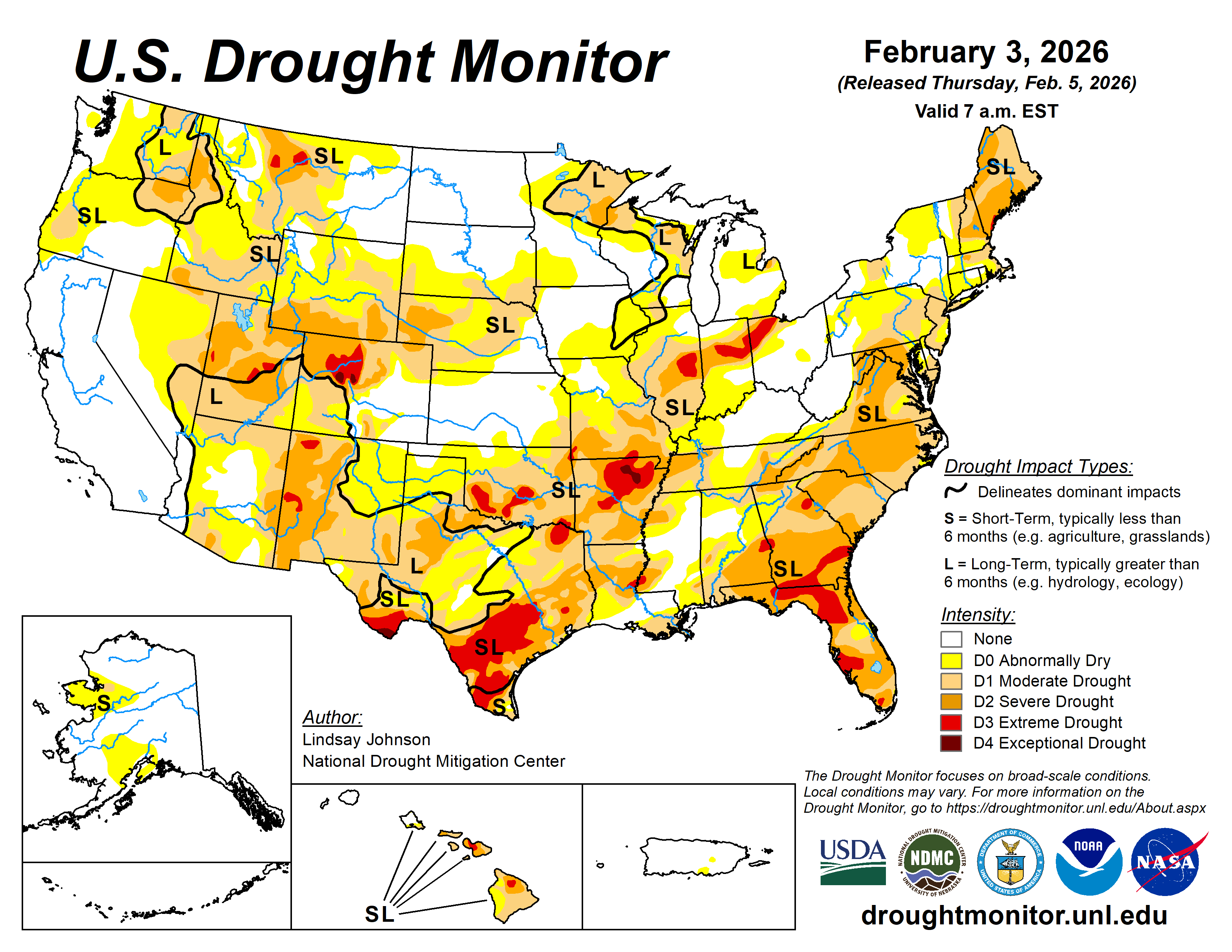
There was a strong west-to-east temperature gradient this week, with temperatures below normal in the East, particularly in the Midwest and Northeast, and above normal in the West. Precipitation was scarce across large portions of the nation, with many areas receiving less than 25% of normal precipitation. Areas of localized precipitation fell across the Pacific Northwest, northern Rockies and the Great Lakes region. Out east, a winter storm brought snow and mixed precipitation to parts of the Tennessee Valley and the Carolinas, with locally heavy snowfall in some locations.
Across the West, snowpack remains well below the seasonal average. Even in areas that received snow, low snowpack combined with dry soils and low streamflows led to degradations across the Intermountain West. Along the West Coast, precipitation remained limited and uneven. Western Oregon saw dry and drought conditions expand toward the Pacific coast and into far south Washington and northwest California.
Elsewhere, scattered degradations occurred across the South and Southeast, where another week without precipitation added to growing precipitation deficits, except for localized areas of improvement that continued to benefit from last week’s heavy snowfall. Other isolated areas of improvement were seen in southern New Mexico and in the Midwest and Northeast…
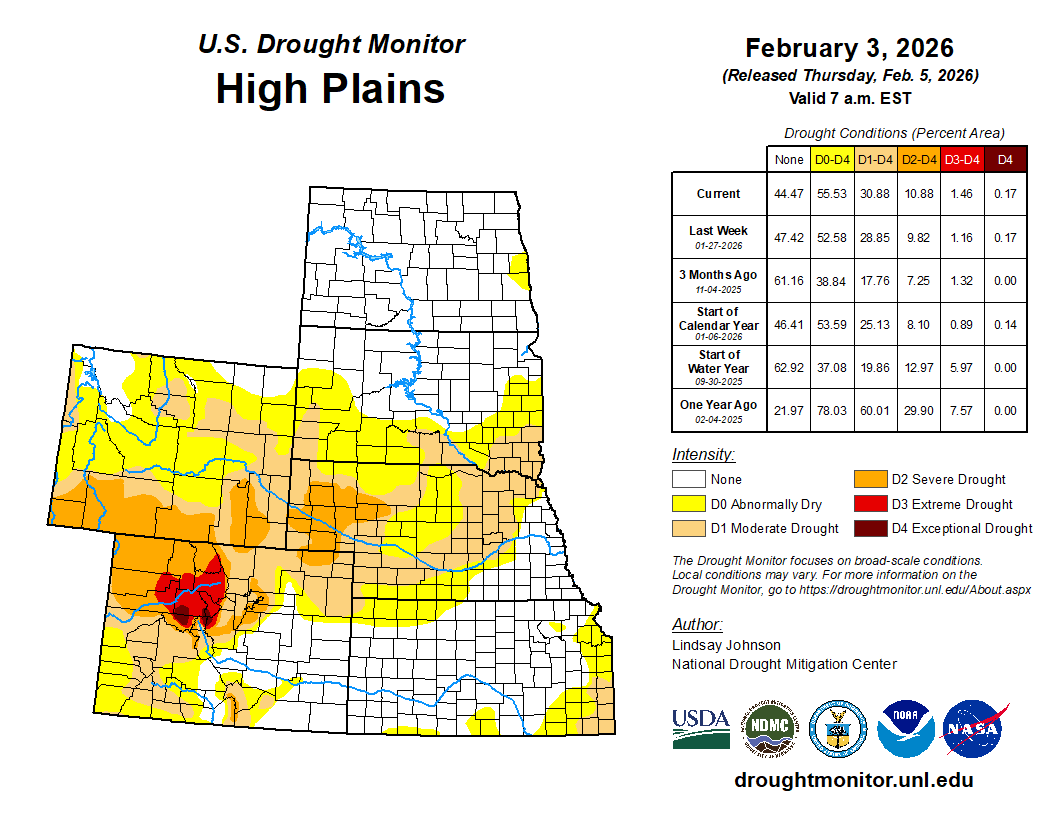
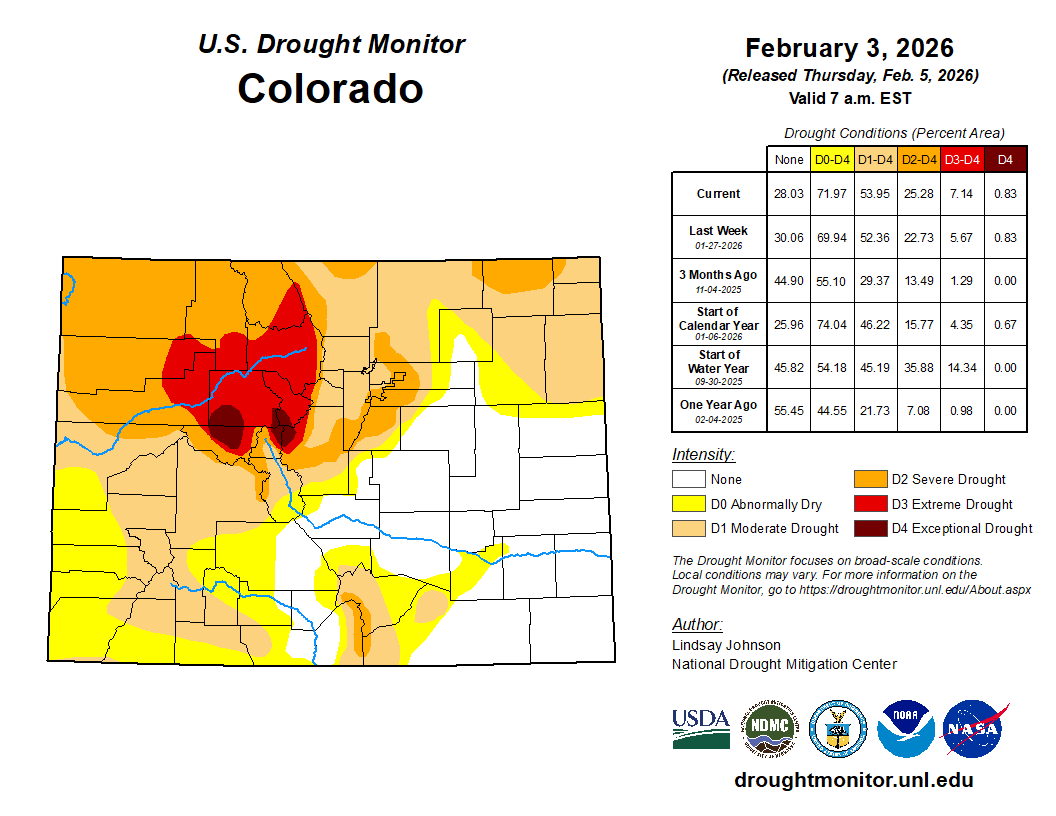
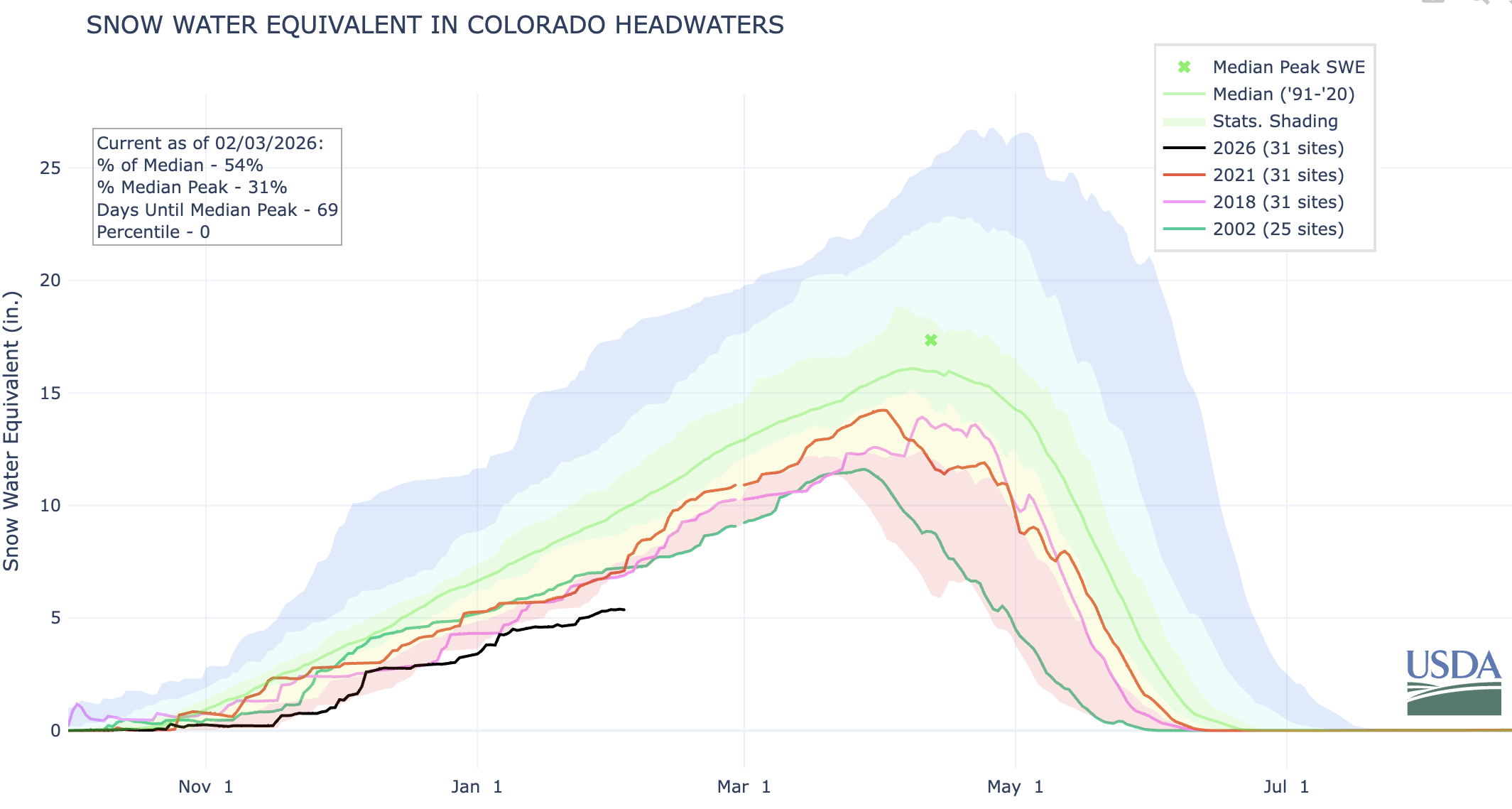
Conditions across the central and northern High Plains were mostly unchanged this week, as most of the region received little to no meaningful precipitation. Cold temperatures persisted, and where snow did fall, it remained largely frozen in place, limiting short-term benefits to soils or hydrologic conditions. Conditions across the Wyoming and Colorado Plains continued to deteriorate. Snow water equivalent (SWE) remains well below average, with SNOTEL data showing values generally in the 50 to 70 percent of median range, reflecting how snowpack continues to fall short for this time of year despite recent snowfall. Severe drought (D2) expanded from southeastern Wyoming into northeastern Colorado and a little into the Nebraska Panhandle. Abnormal dryness (D0) and moderate drought (D2) also expanded across portions of Kansas…
Colorado Drought Monitor one week change map ending February 3, 2026.
Across much of the West, conditions worsened, driven by a deepening snow drought, limited precipitation, and above-normal temperatures that continued to undermine snowpack development. While some mountain snowfall occurred, amounts were generally modest and failed to keep pace with early February climatological accumulation rates, causing snowpack deficits to expand across much of the region.
The Intermountain West saw conditions intensified as snow accumulation continues to fall well short of what is expected this time of the year. Numerous SNOTEL sites reported SWE below the 15th percentile, with several stations registering the lowest SWE on record for early February. These snowpack deficits were compounded by limited recent precipitation, declining soil moisture, and below-normal streamflows, particularly across northern Idaho and western Montana and extending into central and southern Montana and Wyoming. Similarly, Colorado and Utah saw conditions deteriorate as SWE levels are well below the median level along with drier soil moisture.
Across southwestern Idaho, northern Nevada and into eastern Oregon, persistent warmth, scarce precipitation, poor low-elevation snowpack, and low streamflows led to the expansion of abnormally dry (D0) and moderate drought (D1) conditions as well as the introduction of moderate drought (D2) along the Idaho-Wyoming border. SNOTEL stations in the Owyhee, Independence and Snake Mountains are reporting SWE levels between the ninth percentile to the worst on record…
Drought conditions across the South generally continued to worsen this week, as much of the region received little to no precipitation. Temperatures were near to slightly above normal across large portions of the region. Outside of a few localized improvements in northeast Louisiana and southeast Mississippi from last week’s winter storm, conditions continued to degrade across most of the region. Across the southern Plains into the Lower Mississippi Valley, one-category degradations were seen across parts of Texas, Oklahoma, Arkansas, Louisiana and southwest Mississippi after another dry week with no meaningful precipitation. Short- to mid-term precipitation deficits continue to grow and soil moisture continues to decline, along with streamflows…
Looking Ahead
Over the next five to seven days, an active weather pattern is expected across much of the continental U.S., with several regions showing a strong signal for precipitation. The heaviest precipitation is forecast from the lower Mississippi Valley northeastward into the Ohio and Tennessee valleys, where widespread totals of 1 to 3 inches are expected, with locally higher amounts possible. Portions of the central Plains, Midwest, and Great Lakes are anticipated to receive generally 0.5 to 1.5 inches of precipitation during this period. Across the West, precipitation is expected to be widespread from the Pacific Northwest into the northern and central Rockies. Liquid-equivalent totals of 1 to 3 inches are forecast in the Cascades and northern Rockies, with locally higher amounts possible at higher elevations. Farther south into the Great Basin and Southwest, precipitation becomes more scattered, with most areas receiving less than 0.5 inches, and many locations remaining dry. Drier conditions are expected to persist across California, the northern Great Plains, central and southern Texas, and much of the Florida Peninsula, where little to no precipitation is forecast over the next week.
The Climate Prediction Center’s 6–10 day temperature outlook (Feb. 10-14) shows a strong and widespread signal for above-normal temperatures across much of the continental U.S. The highest probabilities of above-normal temperatures are centered over the central and southern Plains, extending northward into the northern Plains and Upper Midwest. Much of the Intermountain West, Rockies, and interior West also favors above-normal temperatures. Along the West Coast, temperatures are expected to be near normal, while parts of the Northeast show a transition from below normal in northern New England to near or above normal farther south. Portions of the Southeast, including Florida, are favored to see near-normal temperatures. Alaska shows a mix of near- to below-normal temperatures across the mainland, with near-normal conditions favored over the southern coast. Hawaii is favored to experience above-normal temperatures during this period.
The Climate Prediction Center’s 6–10 day precipitation outlook (Feb. 10–14) favors above-normal precipitation across much of the western U.S., including the Southwest and West Coast, with elevated probabilities extending into parts of the northern Rockies. Above-normal precipitation is also favored across Alaska and Hawaii during this period. In contrast, below-normal precipitation is favored across Florida and portions of the far Southeast, while much of the central U.S. is expected to see near-normal precipitation.
US Drought Monitor one week change map ending February 3, 2026.
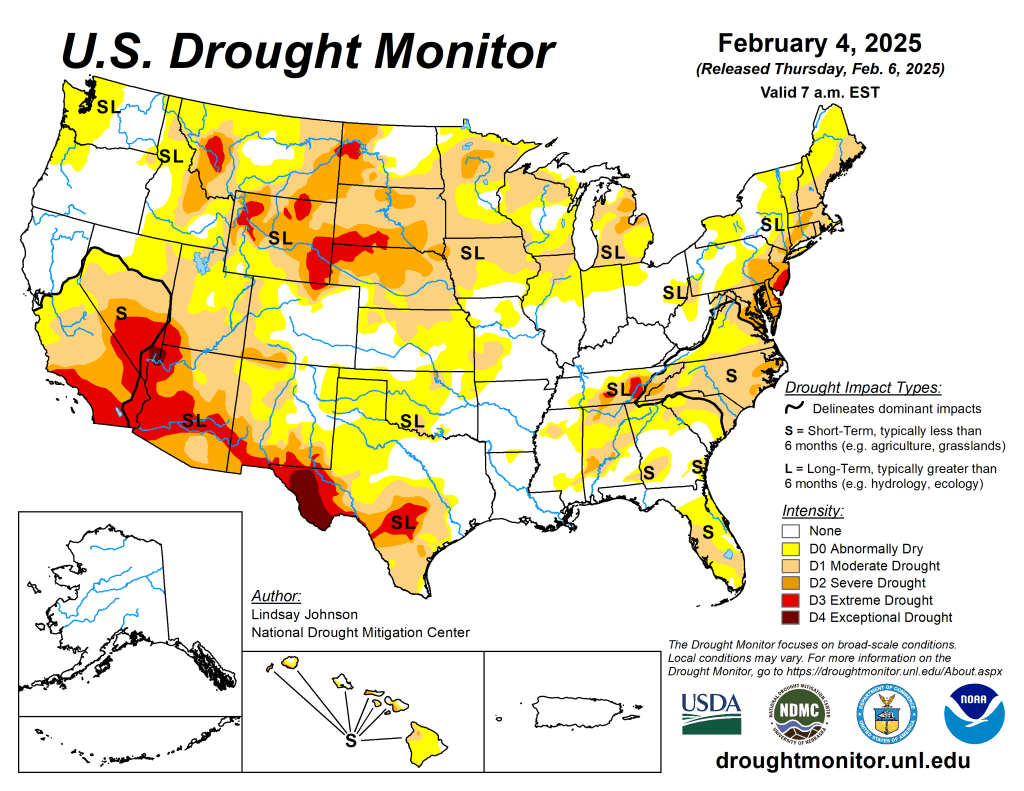
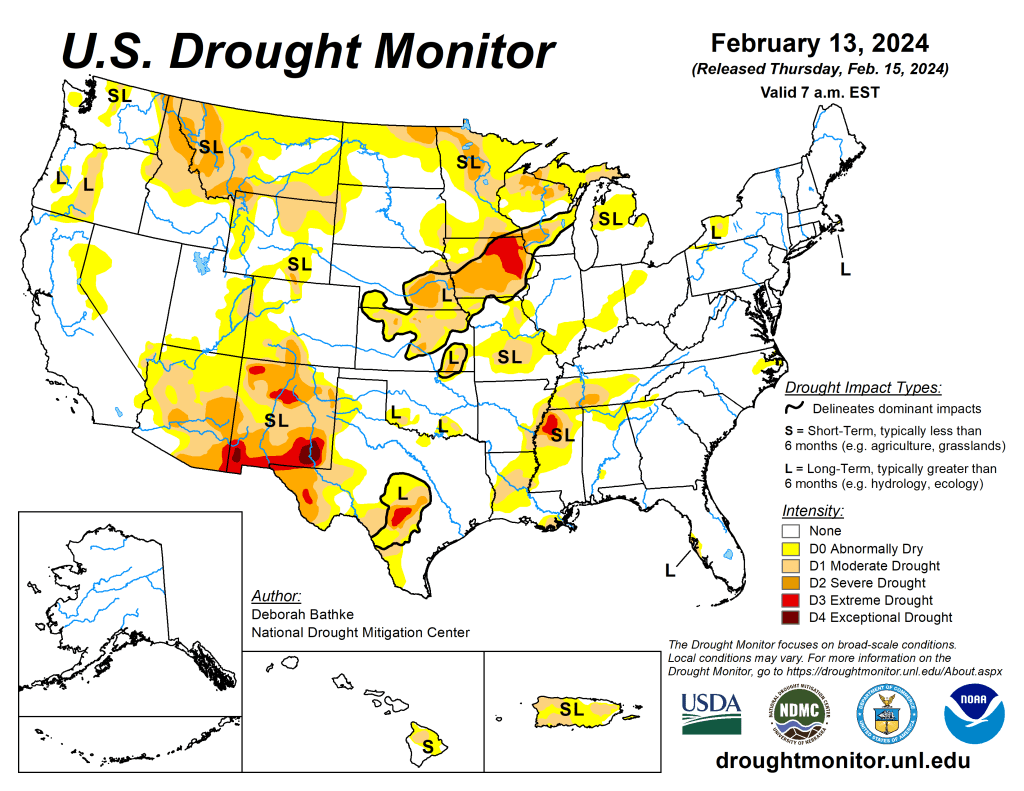
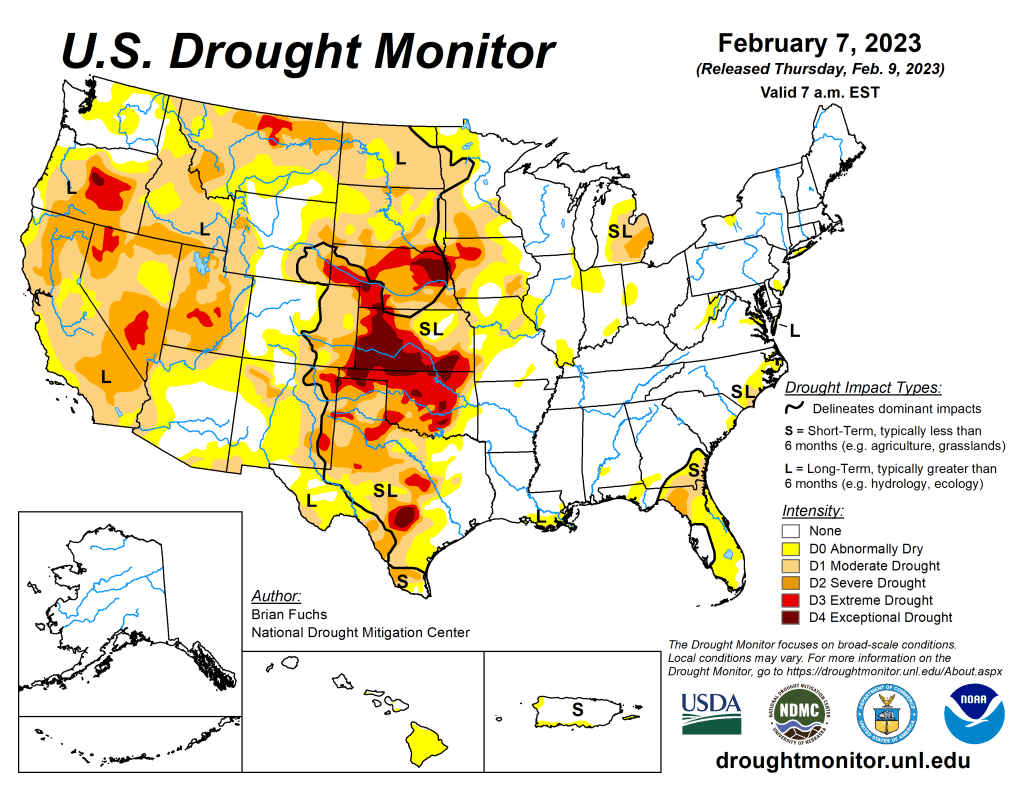
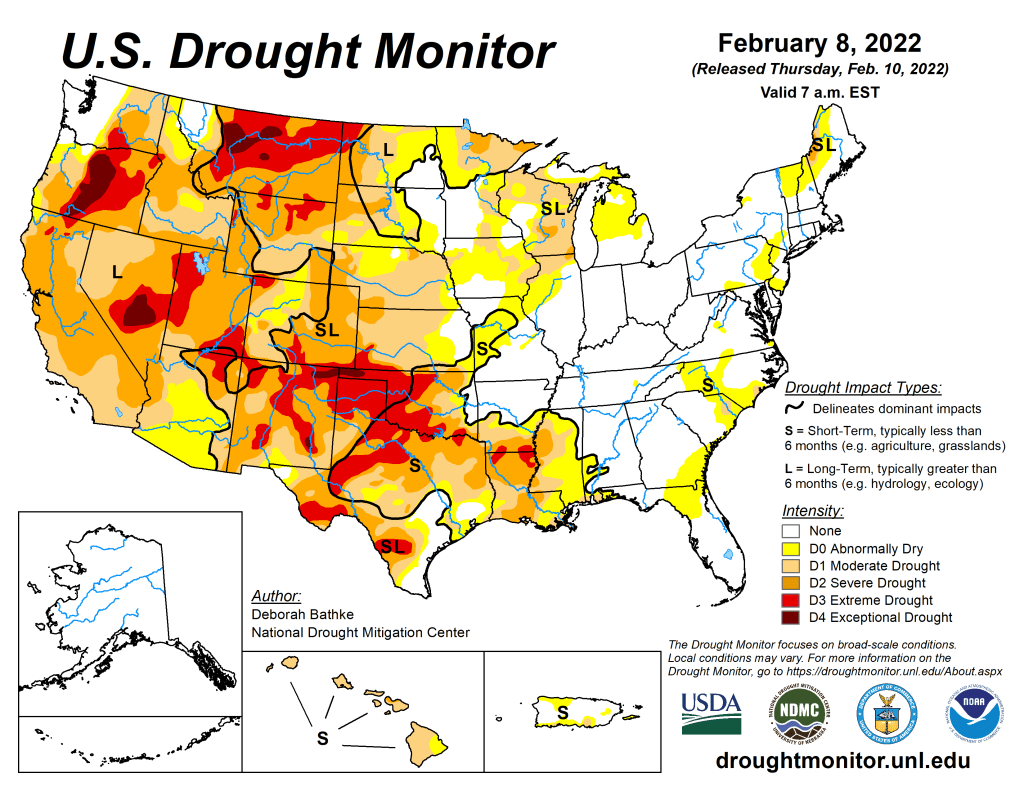
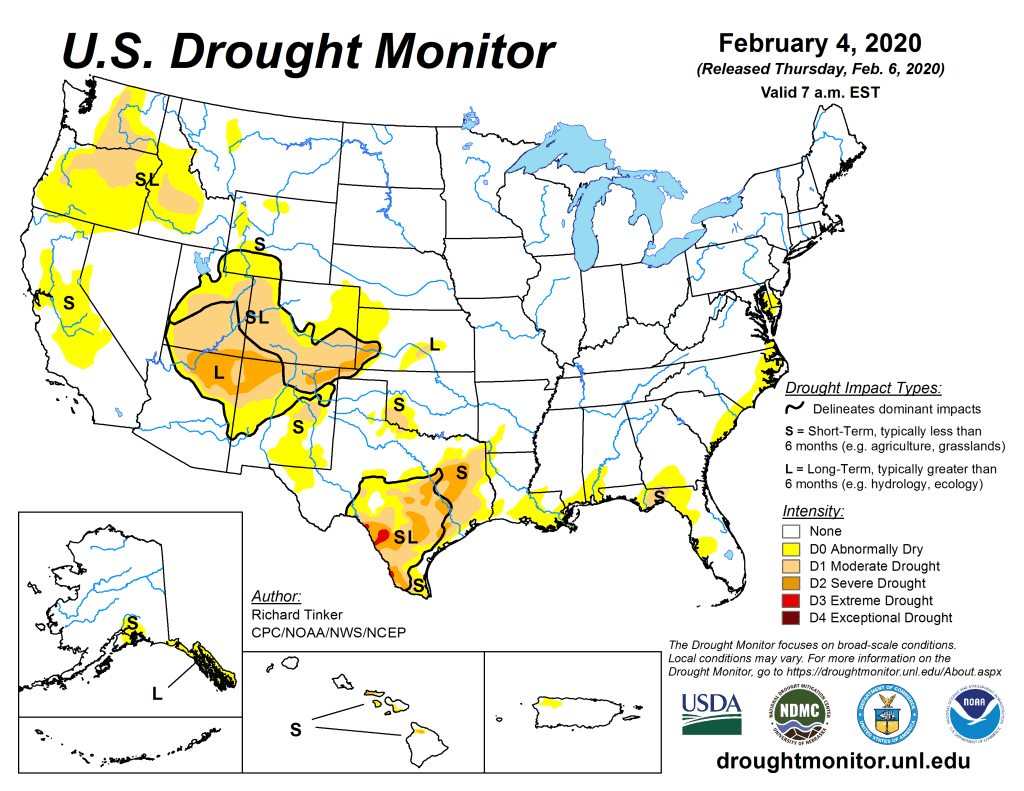
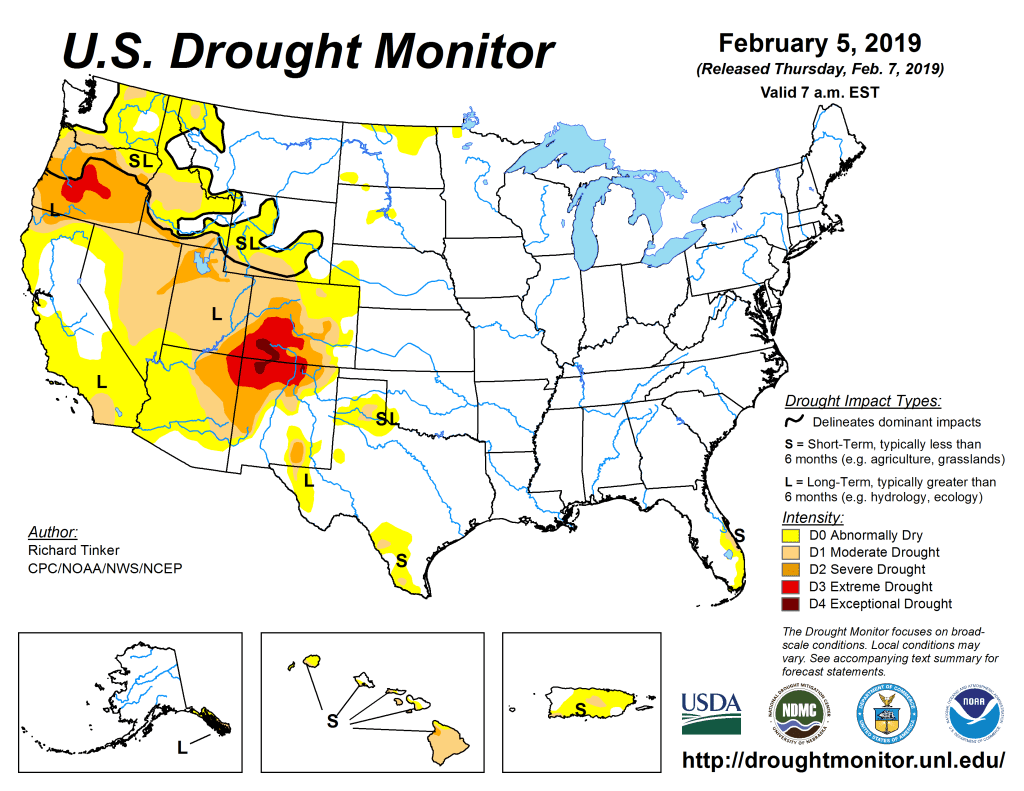
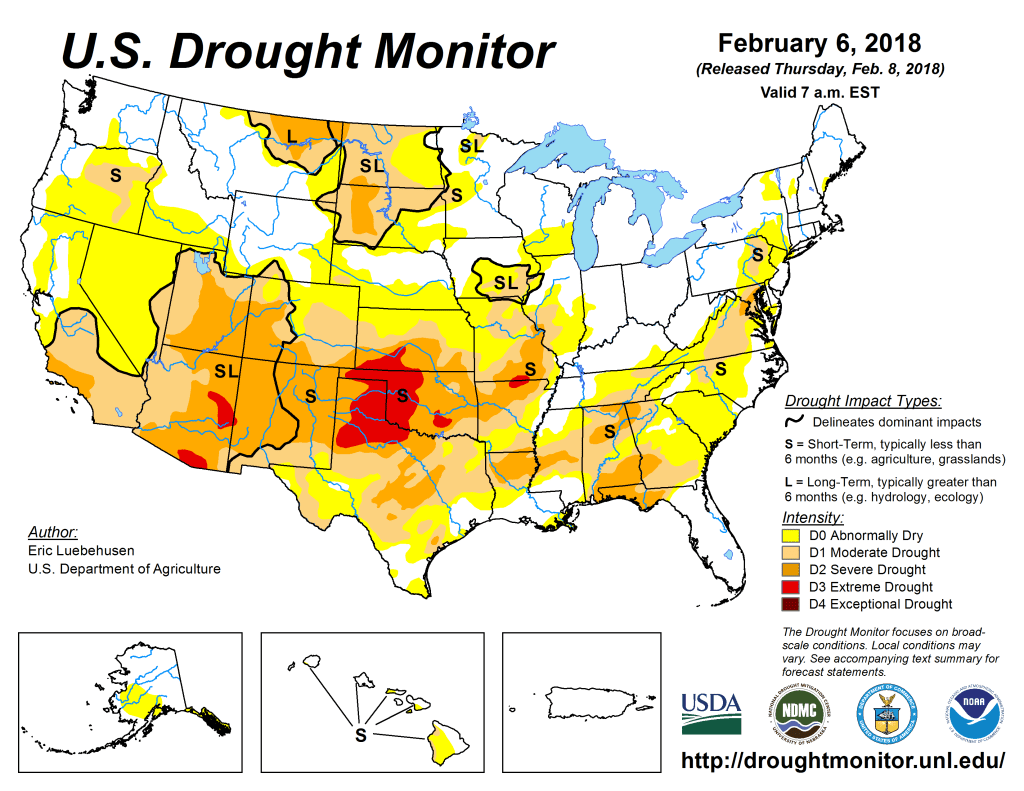
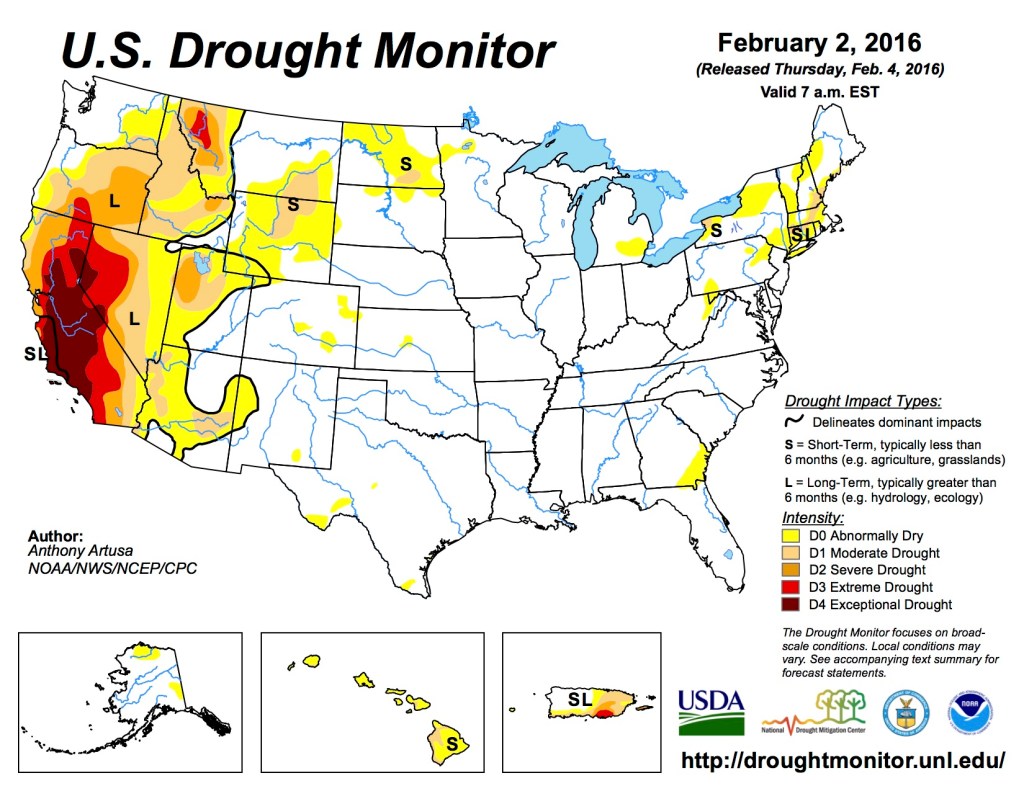
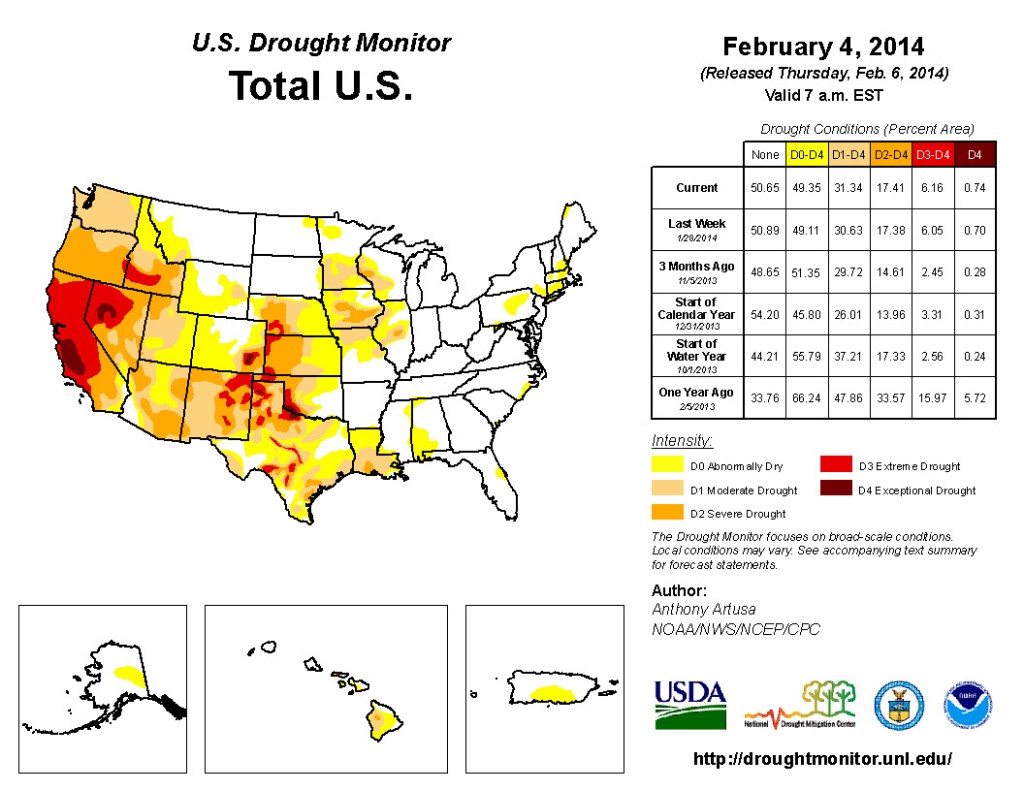
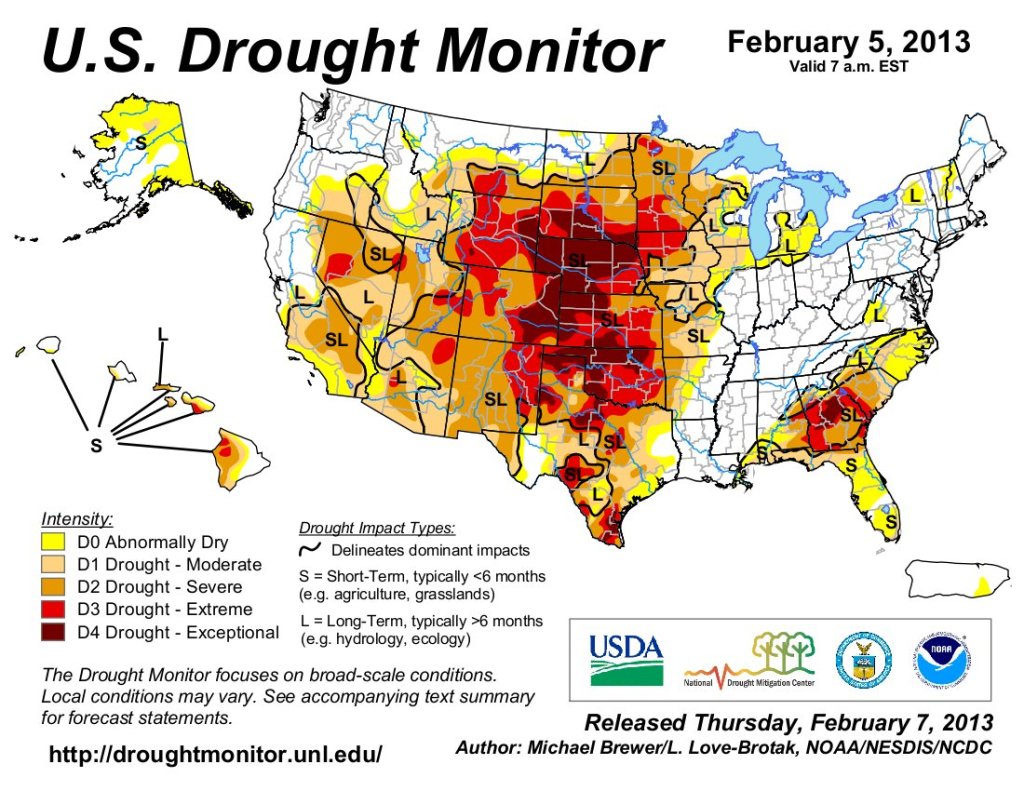
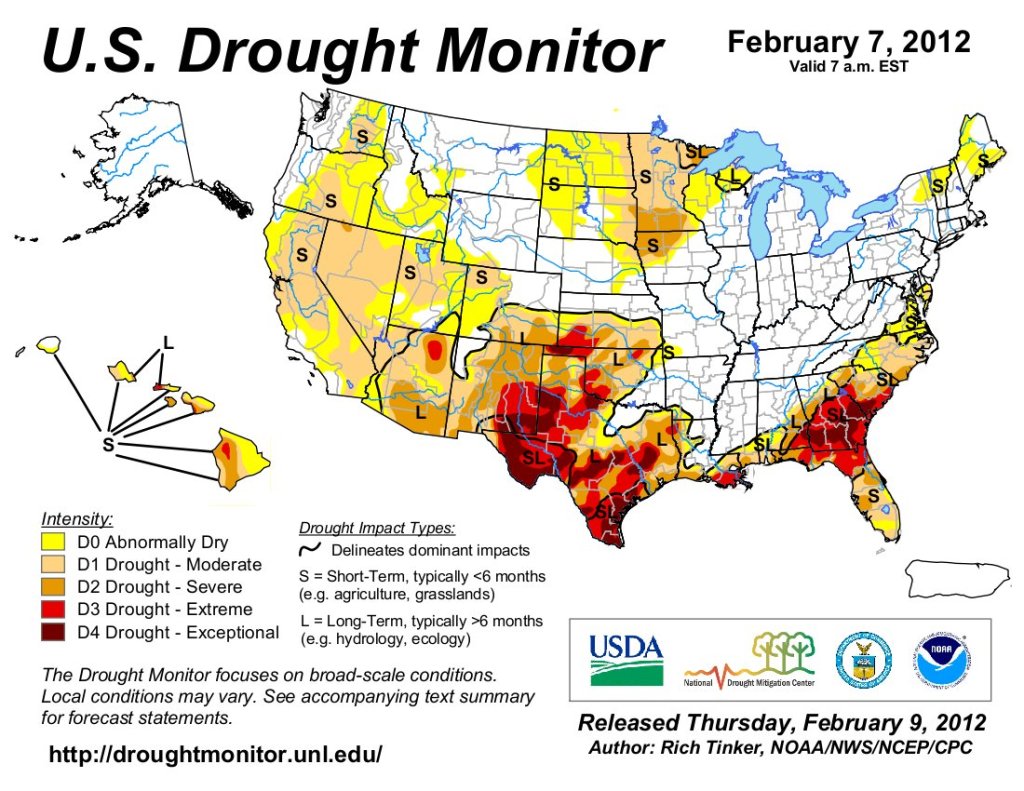
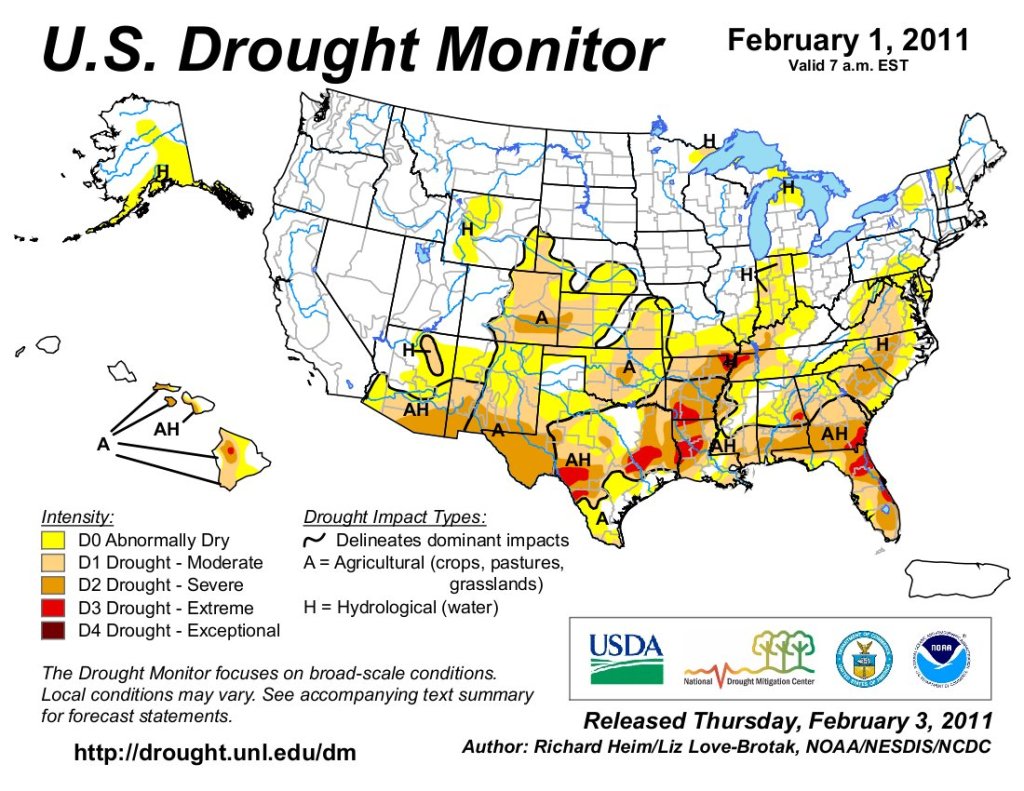
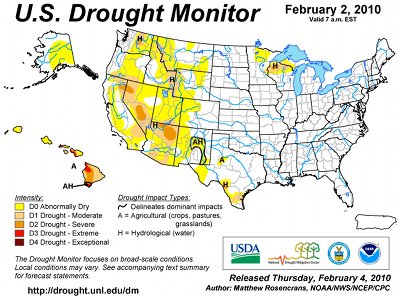
Just for grins here’s a slideshow of early February US Drought Monitor maps for the past few years.
With another federal deadline only weeks away and record-low snowfall further drying out the watershed, states have begun talking about whether they are prepared for litigation
Time and water are running low on the Colorado River.
Amid one of the driest winters on record, representatives from seven Western states have less than two weeks to meet an already-delayed federal deadline to find a new way to share the dwindling Colorado River—one that recognizes the megadrought and overconsumption plaguing the basin.
The current guidelines for implementing drought contingencies expire later this year, but as the Feb. 14 deadline looms, basin states, particularly Arizona and Colorado, have begun discussing the prospect of settling their disputes in court, suggesting that a deal is far from guaranteed. And while a meeting last week in Washington, D.C. between the Interior Department and all seven basin states brought some hope, state negotiators have again dug in their heels.
“I’ll certainly own whatever failure attaches [to me for] not having a seven-state agreement,” said Tom Buschatzke, the director of the Arizona Department of Water Resources and the state’s lead negotiator, in a meeting among the state’s stakeholders on Monday. “The only real failure for me, when I look in that mirror, is if I give away the state of Arizona’s water supply for the next several generations. That ain’t gonna happen, and I won’t see that as failure if we can’t come to a collaborative outcome. To me, that’s successfully protecting the state of Arizona.”
Those who hoped for a repeat of the winter of 2022-2023, when heavy snowfall across the West temporarily and partially replenished critical reservoirs, easing pressure on negotiators, are out of luck. With 2026’s winter about halfway over, it would take record amounts of snowfall for the Colorado River basin to climb back to merely average snowpack levels, said Eric Kuhn, the retired general manager of the Colorado River District and an author on Colorado River issues.
“People are mobilizing for potential litigation, and the question is, is somebody gonna pull a trigger?” Kuhn asked. “Hydrology may be the driving force. It may not be human action. It may be nature that forces us into litigation.”
The Colorado River basin spans parts of Arizona, California, Colorado, New Mexico, Nevada, Utah and Wyoming, and serves over 40 million people across the seven states, 30 tribes and Mexico. It contains dozens of watersheds, all but one of which—the Green River basin in Wyoming and slivers of Colorado and Utah—have experienced below-average or well below-average precipitation since October, when the new water year begins.
A storm in mid-January, which started in the West and brought several inches of snow to eastern parts of the country, did little to alleviate the drought.
“It’s a very critical situation right now,” Kuhn said. “This is climate change at work.”
Low Water, High Pressure
Low snowpack will result in less water melting into reservoirs across the basin come spring and summer. With less water stored, the Bureau of Reclamation’s options for managing the federal infrastructure along the river, including lakes Powell and Mead, the largest reservoirs in the nation, and their respective Glen Canyon and Hoover dams, will be constrained.
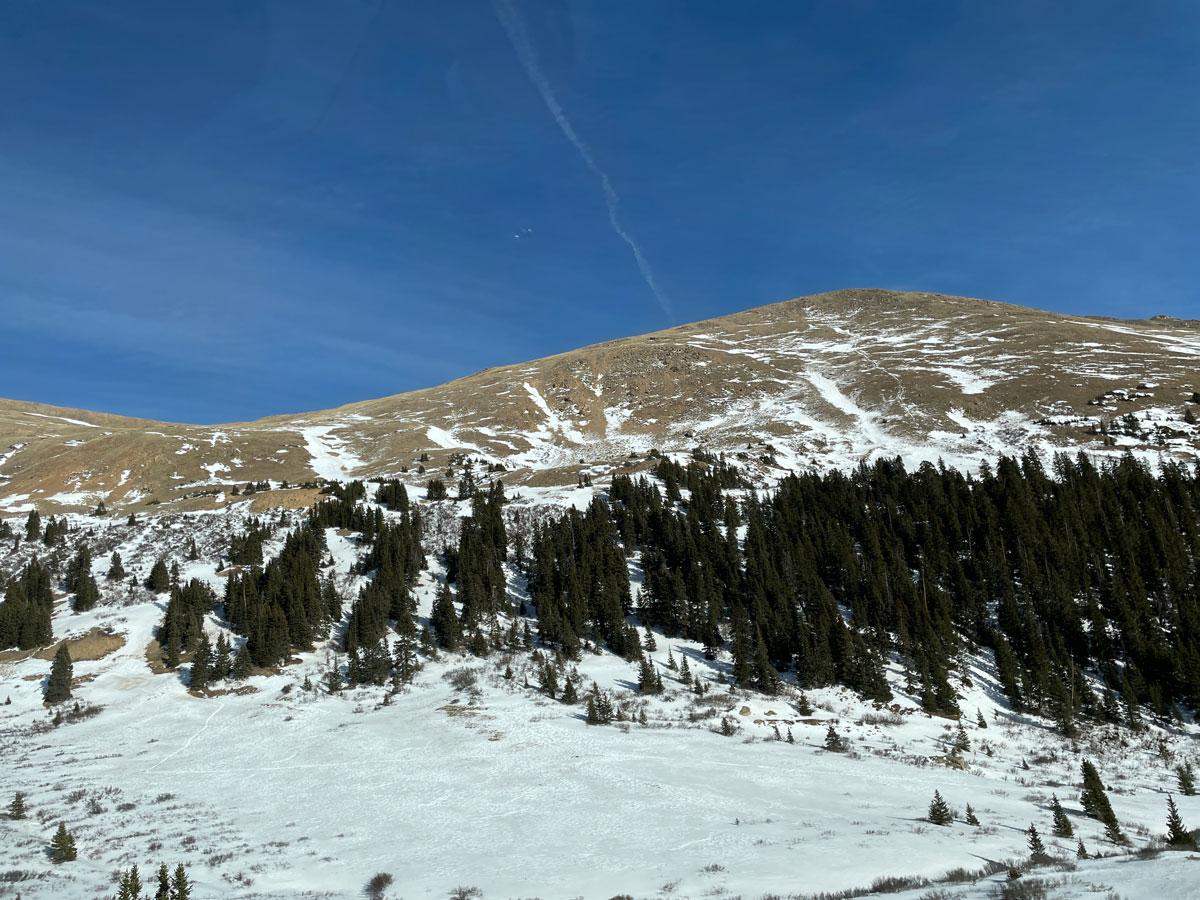
Loveland Pass in Summit County on Dec. 24, 2025. The lack of snow is clearly visible on the higher peaks. Photo credit: Denver Water.
The dams provide hydroelectricity for more than a million people in the Southwest, but must hold water well above the turbines that generate power. If water levels at Lake Powell dip below “minimum power pool” for an extended period of time the agency would have to bypass the turbines, turning off the electricity they produce, and deliver water to the Lower Basin through lower outlets on Glen Canyon Dam, which could compromise the structure. At that point, the Bureau of Reclamation would have to choose between damaging the second-highest concrete-arch dam in the U.S. or reducing water releases to Arizona, California and Nevada, which would be a devastating blow to the region’s cities and economy. Some experts have predicted that could happen as soon as next summer or sooner if this winter’s dry spell continues.
Last September, Kuhn and a consortium of other hydrologists and Colorado River experts authored a report that found that if the current winter was similar to last year’s, Colorado River users would overdraw the river by 3.6 million acre-feet, and there would need to be “immediate and substantial” reductions in water use across the basin to prevent a total collapse of the system. One acre-foot is enough to supply water to two to four households.
Now, with winter looking even more dismal than initially forecast, Kuhn says the Bureau of Reclamation’s options are “further constrained, unless things get wetter in the next two months.”
One option that Kuhn found likely was a big release from Flaming Gorge near the Wyoming-Utah border, the largest federally managed dam upstream of Lake Powell. He guessed the release could be anywhere from half a million to 1 million acre-feet of water.
While today’s drought and low streamflows are a product of nearly three decades of aridification, water forecasters cannot say for sure how climate change will impact future water supplies. Under some models, precipitation remains low and consistent, but rising temperatures dry out soils across the basin, leading them to absorb more snowmelt and further reduce streamflow.
Other hotter futures could also be wetter, Kuhn said, but this would not reinvigorate the river. “We’re expecting stream flows to continue their downward trend,” he said.
And if that is the case, Mother Nature may be the deciding factor between a successful negotiation and litigation.
Hydrologically speaking, we are living through a winter where “that’s a possibility,” Kuhn said. “I think it’s gotta put a lot of pressure on the states.”
Looming Litigation
A resolution in the courts is looking increasingly likely.
During her state of the state address on Jan. 12, Arizona Gov. Katie Hobbs said the “Upper Basin states, led by Colorado, have chosen to dig in their heels instead of acknowledging reality” during negotiations.
The state, she said, had established a $1 million legal fund in anticipation of litigation, with a bipartisan bill introduced to add another $1 million to it. This will “keep putting Arizona first and fight for the water we are owed,” she said.
“As negotiations continue, I refuse to back down.”
Arizona Governor Katie Hobbs at signing ceremony November 19, 2024. Photo credit: ADWR
A week later, Colorado lawmakers asked Becky Mitchell, the state’s lead negotiator, about its prospects in litigation. “We are gonna have the best lawyer,” she said. “We will be ready.”
Earlier in the week, Colorado Attorney General Phil Weiser assured state lawmakers that he is prepared to go to court and blamed the other basin for the lack of a deal.
“The reason it’s hard to get a deal is you need two parties living in reality. And if one party is living in la la land, you’re not going to get a deal,” he said. “I’m committed to not getting a bad deal just to get a deal.”
The Upper Basin states of Colorado, New Mexico, Utah and Wyoming, and the Lower Basin states of Arizona, California and Nevada sounded far apart on a deal at the annual Colorado River Water Users Association conference in Las Vegas last December. Some negotiators advocated for a short-term agreement while others called for greater federal pressure.
Last week, negotiators from all seven basin states met in D.C. to try to break the impasse. After the meeting, governors Spencer Cox, of Utah, and Mark Gordon, of Wyoming, said in a joint statement that “all acknowledged that a mutual agreement is preferable to prolonged litigation,” and both felt encouraged by the results of the meeting.
In a separate statement, Arizona Gov. Hobbs said she was also encouraged, and that the states “reaffirmed our joint commitment to protecting the river.” Arizona has been and remains willing to continue bringing solutions, she added, “so long as every state recognizes our shared responsibility.”
Earlier this month, the federal government released a range of alternativesoutlining how it would manage the system if no deal is reached by Feb. 14. If that deadline passes without an agreement, the political and environmental situation across the basin may become as grim as the snowpack.
Arizona officials have said any of the federal government’s proposals would likely lead them to pursue litigation and that the Bureau of Reclamation’s draft Environmental Impact Statement puts all the risk of the river’s decline on the Lower Basin and does not comply with the bedrock law of the river. Under the outlined federal proposals, the vast majority of the cuts would affect Arizona, which relies heavily on the river for water but holds junior rights, often making it the first to face significant reductions. The state has already had a third of its water rights to the river cut.
“The entire weight of the river cannot fall on Arizonans, the Valley [Phoenix] and the Tucson metro areas,” said Brenda Burman, general manager of Central Arizona Project, the entity delivering Arizona’s Colorado River water, at a press conference Monday. “That’s not acceptable. We, as water managers … we will make sure that there is water flowing.”
The structural deficit refers to the consumption by Lower Basin states of more water than enters Lake Mead each year. The deficit, which includes losses from evaporation, is estimated at 1.2 million acre-feet a year. (Image: Central Arizona Project circa 2019)
The Lower Basin has volunteered to cut 1.5 million acre-feet, the amount of water lost to transpiration and evaporation in a year, and asked that the Upper Basin share in cuts after that amount. The Upper Basin, which has never used the full amount it is entitled to on paper, has proposed making only voluntary cuts to its use.
Sarah Porter, director of the Kyl Center for Water Policy at Arizona State University, said she’s felt litigation is increasingly likely since the basin states missed their initial federal deadline in the fall and their negotiations began to deteriorate.
“I believe that everybody has kind of stared it down and concluded that litigation isn’t such a horrible idea that it needs to be avoided,” she said.
As a former litigator, Porter said the threat of legal action may force both sides to develop their arguments along with facts and data supporting them, which could provide the clarity needed for a settlement. But a lawsuit would extend the uncertainty surrounding the region’s water supply, Porter said, affecting the planning of cities, tribes and farmers waiting for new guidelines.
Litigation would likely focus on one of the most crucial sections in the 1922 Colorado River Compact: Article III(d).
Under this part of the agreement, the Upper Basin “will not cause the flow of the river at Lee’s Ferry,” a point just south of Glen Canyon dam, “to be depleted below an aggregate of 75,000,000 acre-feet for any period of ten consecutive years.” Should the average flow at Lee’s Ferry fall below an average of 7.5 million acre-feet, which is a possibility given current hydrological conditions, the Lower Basin could sue the Upper Basin for failing to uphold this part of the compact.
“High-Stakes Poker”
Any lawsuit would be risky.
“That language has never been interpreted by a court,” said Anne Castle, a senior fellow at the Getches-Wilkinson Center at the University of Colorado and a former assistant secretary for Water and Science at the Interior Department. “This is high-stakes poker for both basins.”
The Lower Basin would presumably argue that Article III(d) means the Upper Basin has an obligation to deliver water, so it would have to adjust its consumption to ensure the Lower Basin receives 7.5 million acre-feet annually.
But the Upper Basin could counter that Article III(d) only prohibits it from overconsuming the river and leaving less than 7.5 million acre-feet at Lee’s Ferry, and climate change is actually responsible for the meager flows. In that case, they would bear no obligation under the compact to make cuts.
Porter said the Upper Basin’s interpretation flies in the face of history. The whole reason the compact exists was the fear California would take all of the river’s water at the time, she said, because that’s where the growth was.
“It is silly to think that California would agree to a deal with the Upper Basin that said they have no responsibility to leave water for California,” she said.
For decades, the Upper Basin cited its delivery obligation to California, Arizona and Nevada to justify building a series of dams and reservoirs above Lake Powell, Porter said.
“There’s a huge amount of evidence that the Upper Basin states … needed those reservoirs upstream because they had an obligation to deliver water to the Lower Basin,” she said.
Even if Congress originally authorized Upper Basin reservoirs to help satisfy provisions in the compact, “that doesn’t tell us what those obligations actually are,” Castle said. “Fixed number obligations don’t work with a changing climate that is causing shrinking flows.”
Not every state is eager to initiate litigation. Wyoming Senior Assistant Attorney General Chris Brown appeared before state lawmakers in January and warned of the pitfalls of letting Congress or the Supreme Court dictate what happens on the river.
Still, “as a headwater state, Wyoming has a long history of zealously defending its rights to use interstate waters, and the rights of its water users,” Brown said in an email. “The Colorado River is no different.”
Tina Shields, water manager for the Imperial Irrigation District, which is California’s biggest and most senior water rights holder, said in a statement that the state continues to work on finding a consensus agreement among all the states that depend on the Colorado River, but could not comment on the status of those negotiations.
“The Colorado River hydrology is unlikely to wait for a court decision, so any speculation about litigation is premature,” she said.
Although Arizona’s Lower Basin counterparts have not touted litigation as an option, Buschatzke said he is confident they will support the state, as compliance with Article III(d) affects them too, though less severely.
And the states may not be the only entities to sue. Under a 2004 water settlement, the Gila River Indian Community receives 653,000 acre-feet of Colorado River water a year, a significant allocation. But getting that water depends on the Central Arizona Project (CAP) not getting its water allotment cut.
Any unilateral action by the Department of the Interior to reduce that flow “would, in our view, constitute a blatant violation of the United States trust responsibility to protect our CAP water as established by Congress under the Arizona Water Settlement Act,” said Gila River Indian Community Gov. Stephen Roe Lewis at the Arizona meeting of water stakeholders.
While litigation may clear up some of the murkier language in the compact, Castle wasn’t sure that it is the best way forward for the river’s stakeholders—particularly since these kinds of disputes can take years to resolve.
“We might get answers to a few questions after years,” she said, “but we have a river to operate in the meantime.”
Map of the Colorado River drainage basin, created using USGS data. By Shannon1 Creative Commons Attribution-Share Alike 4.0
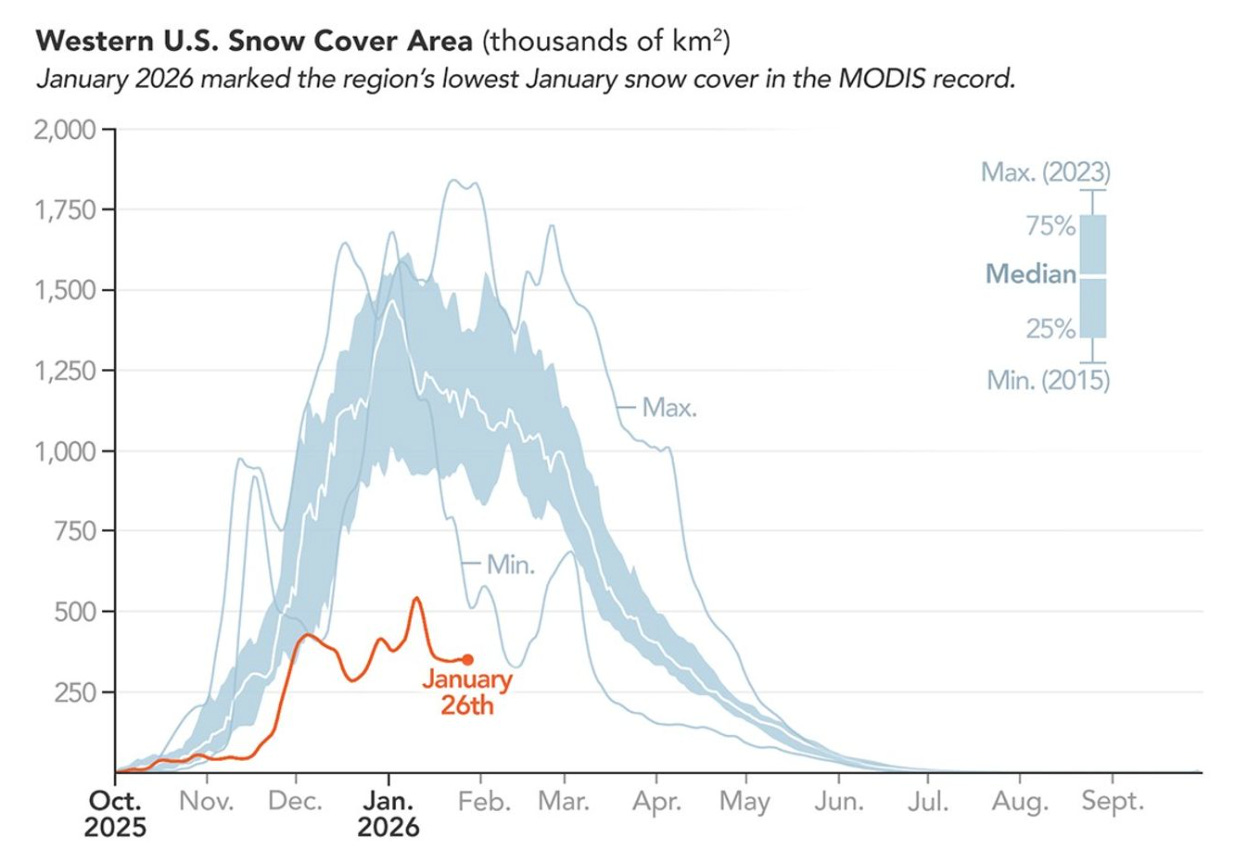
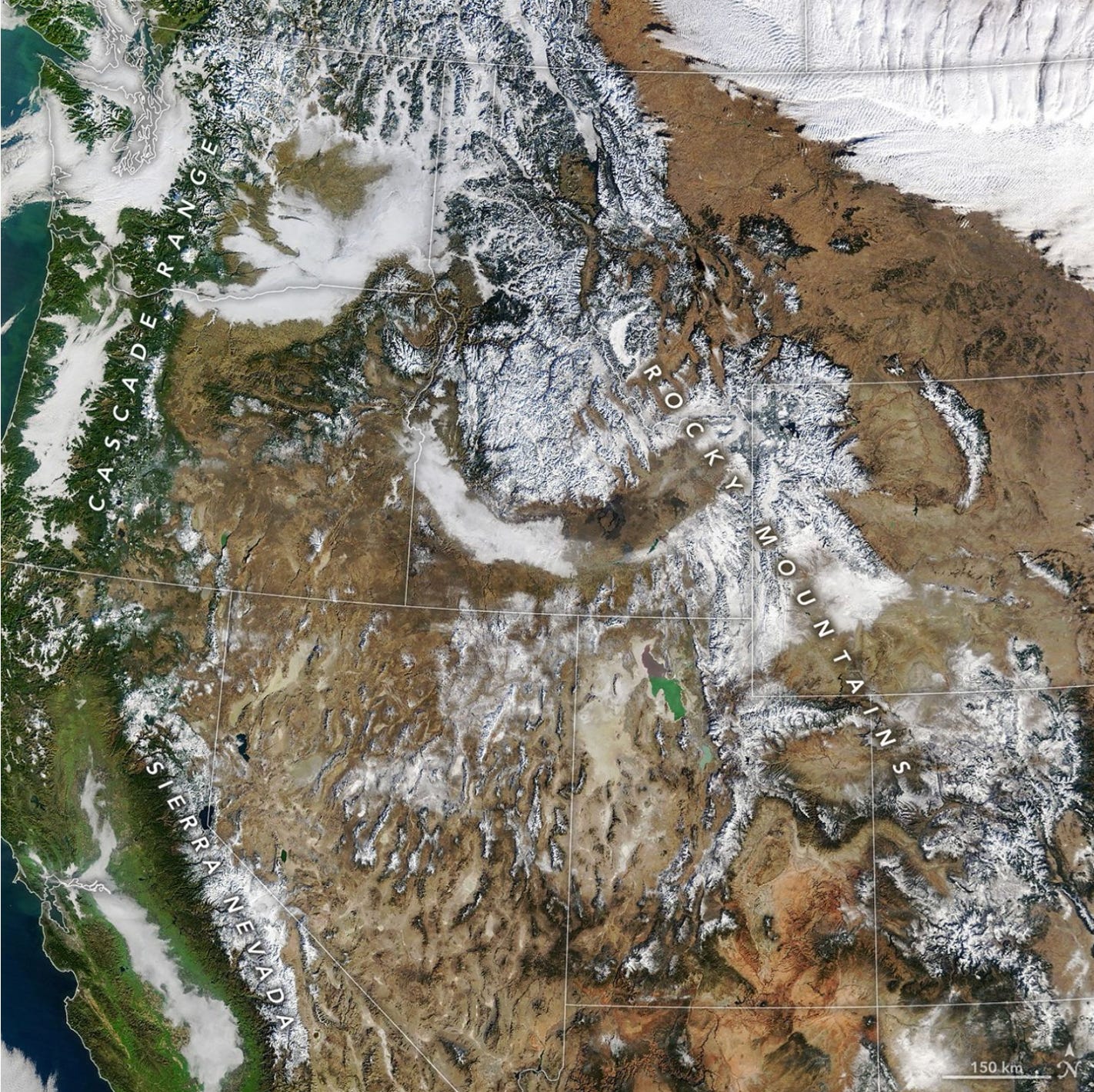
I don’t know if the groundhog saw its shadow yesterday or not (I can never remember whether the shadow is a sign of an early spring or a late one, anyway). But one thing is certain if the little dude was in the Western U.S.: He didn’t see much snow.
Ruh roh. Not looking good out there. Source: NASA.
Officially, meteorological winter ends in less than four weeks from now. In reality, the snowy season hasn’t really begun in much of the western swath of the nation. The aggregate snowpack at 130 monitoring sites across the Upper Colorado River Basin is at its lowest level for Feb. 1 in the last 40 years. Meaning, yes, it is even worse than in 2002, often considered the Winter of the Colorado’s Discontent, and is on a par with 2018.
The high-country snowy season can last until mid-June, so there’s plenty of time for a rebound, and a return to near normal conditions by April would not be unprecedented. The problem is that this year’s snow drought is the result not only of a lack of precipitation, but also unusually warm temperatures. A rebound, then, would require a major shift in both precipitation and temperature patterns, very soon, which to this amateur weather watcher seems pretty unlikely.
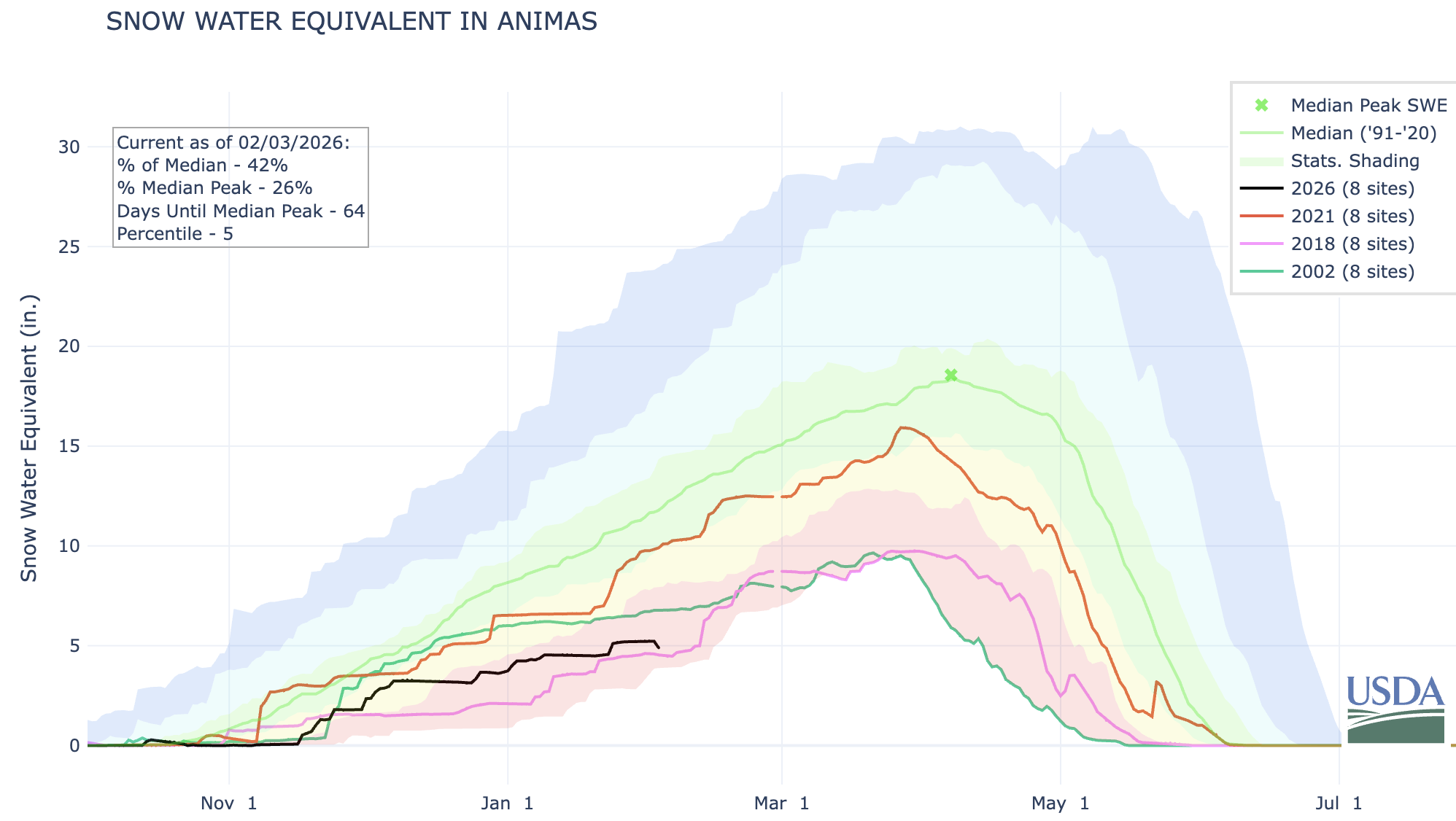
Snowpack in the Animas River watershed is tracking slightly better than in 2018 for this date, but is lagging behind 2002, which was one of the worst winters on record and was followed by a dry, fire-plagued summer (including the Missionary Ridge Fire).
This, of course, is very bad news for the beleaguered Colorado River. The U.S. Bureau of Reclamation’s January projections find that Lake Powell could drop below minimum power pool as soon as this December if the snowpack curve doesn’t veer up sharply in the next several weeks. The Rio Grande isn’t looking much better, snow-wise.
During the summer of 2021, farmers’ ditches in the Four Corners area ran dry as early as June, and the Bureau of Reclamation drew down Upper Basin reservoirs such as Blue Mesa and Flaming Gorge to help prop up Lake Powell’s surface elevation. If current trends continue, this year’s spring runoff threatens to be even slimmer. It could be a tough summer for irrigators, boaters, and anyone else who relies on abundant streamflows.
2014 Recapture protest. Jonathan P. Thompson photo.
Early on a May morning in 2014, I loaded my camera and notebook and myself into the Silver Bullet — my 1989 Nissan Sentra with a duct-taped window — and headed west to Blanding, Utah. Phil Lyman, a San Juan County Commissioner at the time, was planning on leading a convoy of OHV-riders along a closed-to-motorized-vehicle trail on public land in Recapture Canyon to protest what he called “federal overreach.” I was going to observe and report on the event.
I would lying if I said I wasn’t anxious. After all, this was just weeks after a heavily armed group of yahoos had descended on the Bundy Ranch in southern Nevada to stop Bureau of Land Management agents from rounding up cattle grazing illegally on federal land. If the BLM, or environmentalists, tried to interfere with Lyman’s lawbreaking, it could lead to an armed conflict — and I could get caught in the middle.
I’ve been thinking about that protest, the events that led up to it, and the general political atmosphere at the time. And about the similarities and vast differences of what’s happening today.
After Lyman had posted his plans on the Bundy Ranch Facebook page, commenters’ responses included statements like these:
“The BLM is about to learn they can’t push people around any more in the West. Our backs are up against a wall push back! Yet another case of the federal government taking tyrannical control of the people. They need to be put down and put down hard.”
“Why is the BLM still around? If they so much as throw a stone in your way, light ‘em up. Time to quite defending, being ever gnawed at, and go on offense. … Strike while you are still strongest.”
My unease only grew when I arrived at Centennial Park on the town’s southern fringe, where a pre-protest rally was getting underway. It was peopled by a contingent of locals and an equally large number of out-of-towners, many of whom were part of the Bundy group. This included Ryan Bundy, Cliven Bundy’s son, who circulated pocket versions of the U.S. Constitution, peppered with scripture, published by the National Center for Constitutional Studies, a right-wing organization. And Ryan Payne, a so-called militia leader, who told a reporter that during the Bunkerville standoff he had positioned snipers with their sights trained on federal employees: “If they made one wrong move, every single BLM agent in that camp would’ve died.”
Lyman and others spoke at the event, airing their grievances and reasons for protesting. Like the folks in Minneapolis today, their rhetoric suggested, these people were resisting a federal government that had slipped into tyranny and was taking away their Constitutional rights. “They target a community, they targeted Blanding,” Lyman said, (much as the Trump administration has targeted Democratic-leaning cities) adding that the feds had then sent jackbooted thugs in to harass and intimidate its residents. In the speeches, on the signs, and in comments from the crowd in Blanding, I heard words such as “despot,” “dictator,” “tyranny,” and “gestapo.”
***
***
What inspired such outrage in Blanding? For Lyman and friends, examples of “tyranny” and federal overreach included:
The BLM had prosecuted and fined two local men for constructing an OHV trail in Recapture Wash in 2005, a crime that included chopping down old-growth junipers, building a bridge across the creek, installing culverts, and using heavy machinery to clear a path through the riparian zone that was rich with cultural resources.
Then the BLM banned motorized vehicles on that section of Recapture.
In June 2009 the feds raided several homes of Blanding residents suspected of gathering or dealing in artifacts found on public land in violation of the Archaeological Resources Protection Act. This included at least one SWAT team equipped in tactical gear, responding to a potential threat, though they did not wear masks to conceal their identities. Included among those arrested was James Redd, a local physician. A day later, he killed himself; his family later sued the BLM for intentional infliction of emotional distress and wrongful death, but the case was dismissed.
In 2010, the Obama administration floated the idea of establishing a national monument on public land on Cedar Mesa, west of Blanding, sparking an uproar among the anti-federal land management movement.
And in 2008, the BLM subtly changed its resource management plan from considering all trails on public lands being open to motorized travel unless otherwise closed, to closing all trails unless specifically designated as open to motorized travel.
Lyman had organized this protest, and the Bundy crowd had joined, to push back against this. Was this enough to justify a protest? In my opinion: yes. These people were displeased with the federal government’s actions, so they were exercising their First Amendment right to demonstrate peacefully. And they would — like Henry David Thoreau before them — break the law, or practice civil disobedience and risk fines or jail time, to make their point.
Many of the attendees were also exercising their Second Amendment right to bear arms, from the older cowboy-hatted man with a six-shooter, to the young buck in an “American Venom” t-shirt with an AR-15, to the buzz-cut dude with a “REGULATOR” neck tattoo, a Glock semi-automatic sidearm holstered to his thigh, and a t-shirt that read: “United States Militia … Molon Labe.”
At one point during the pre-ride rally, after a shouted dialogue among the attendees in which they threatened any unfriendly journalists that might be among the crowd, an older man spoke up: “We have a treasure, a jewel, and it has been mugged. It’s been stolen from us by people back east. They have stolen our treasure. We have to stop this BLM police state. They come into our town, raiding our town …”
“You’ve got guns, too, by God, that’s what they’re for,” said another voice from the crowd.
***
A little while later, I was hoofing it down Recapture Canyon in an effort to get ahead of the protesters, most of whom would be on motorized three- or four-wheelers. The vehicles are allowed in the first mile or so of the canyon, meaning at that point it would be just a protest, not an act of civil disobedience. If the BLM was going to have its line of riot cops anywhere, it would likely be at the sign marking the motorized closure.
I was only a few hundred yards down the dusty two track when the incessant buzz of two-stroke engines alit on the air. I walked to the side to avoid getting squashed by one of them and snapped photos as one after another buzzed past, their diesel exhaust mingling with the pungent aroma of sage and dust.
A man driving a four-wheeler with a woman sidled up behind him slowed to a stop next to me, causing me to jump. “Hop on,” the man said, motioning to the little cargo area on the back. As we cruised down canyon, the woman asked who I reported for, and whether I was “for us, or against us.” “I’m a freelancer,” I said. “And I’m for the Truth.”
A crowd of OHVers coalesced at the motorized-ban line and my ride slowed to a stop, allowing me to jump off and capture some pictures. There were no flak-jacket-equipped BLM agents here, no riot cops, no tear gas. Just a few San Juan County Sheriff’s deputies, who made no motion to stop or discourage the protesters, even as they continued on past the line in violation of federal rules.
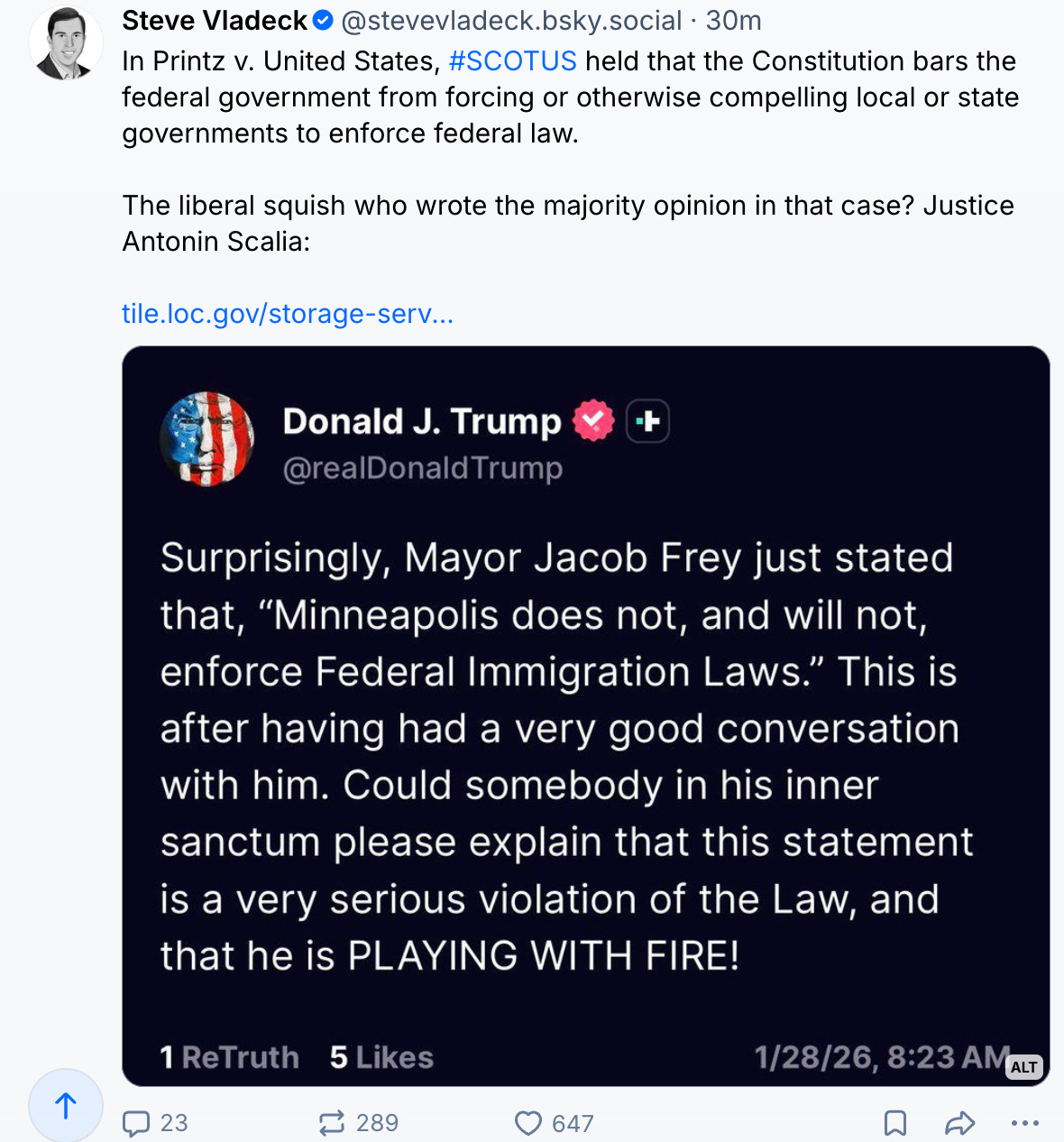
It may strike some folks as off to see a law enforcement officer watching idly as someone breaks the law right in front of them. It’s not. In 1997, the U.S. Supreme Court ruled in Printz v. United States that the federal government cannot compel state or local law enforcement to enforce federal regulations.
**
I continued past the non-motorized line on foot, following in the dust of the OHV convoy. From what I could tell all or almost all of the attendees chose to break the law that day, though most of them stopped at the end of the two-track and beginning of a more primitive trail that passes over archaeological sites.
While I had been anxious about my safety, given the large number of firearms and the intensity of the crowd’s hostility toward the press, I never worried that I would be arrested or detained or tear-gassed by federal agents simply for being present and observing. The same would be true even if I had stayed on the back of the OHV after its driver passed the non-motorized line.
That’s because I was there doing my job as a journalist, and any Democratic government with an inkling of respect for the U.S. Constitution would acknowledge and respect that, and allow me to do my job (while not always making it easy to do so) without fear of government reprisals.
But that was almost 12 years and a few administrations ago. Now, the government is attacking the First Amendment and, really, pretending it simply doesn’t exist. Last month, journalists Don Lemon and Georgia Fort entered a Minneapolis church to cover a protest against the Trump administration’s immigration crackdown, just as I had accompanied the Recapture protesters to cover that event. This time, though, the feds arrested Lemon and Fort and charged them with violating federal law, not long after Trump had reposted a social media post calling for Lemon’s arrest. Prosecutors accused Lemon of peppering the pastor — who also works for ICE — with questions. He was doing his job, in other words, which, under Trump, is apparently a federal offense and could even get him labeled a domestic terrorist.
**
I suppose I shouldn’t be surprised at the Trump administration’s authoritarianism.They promised this, after all, both at campaign rallies and in Project 2025, which the administration has followed closely. But I must say I am a bit surprised that almost none of the folks yelling about federal overreach and tyranny back in the Recapture protest days are speaking up, even mildly.
Lyman is Xeeting about the Gestapo, it’s true, but his target is not masked ICE or CPB agents running amok or even Greg Bovino in his Nazi-esque long coats, but the Utah Department of Natural Resources law enforcement division. Even “Sheriff” Richard Mack, who was a plaintiff in the Printz case, has remained silent or supported the administration’s actions.
It’s disappointing and unmasks the hypocrisy within the Sagebrush Rebellion and its ideological successors. I believe that, early on, the so-called Rebellion’s motives were honest. They saw the public lands as the manifestation of freedom and liberty, they resented having an absentee landlord take those freedoms away, and they stood up to the powers that be — regardless of party or creed — and resisted. But it is now abundantly clear that the movement was long ago hijacked, not only by the extractive industries, but also by the ideologues and demagogues. The old battle cries of Liberty and Freedom and Don’t Tread on Me are no more than empty slogans, the pocket Constitutions that they carry alongside their firearms carry less weight for them than the paper they’re printed on.
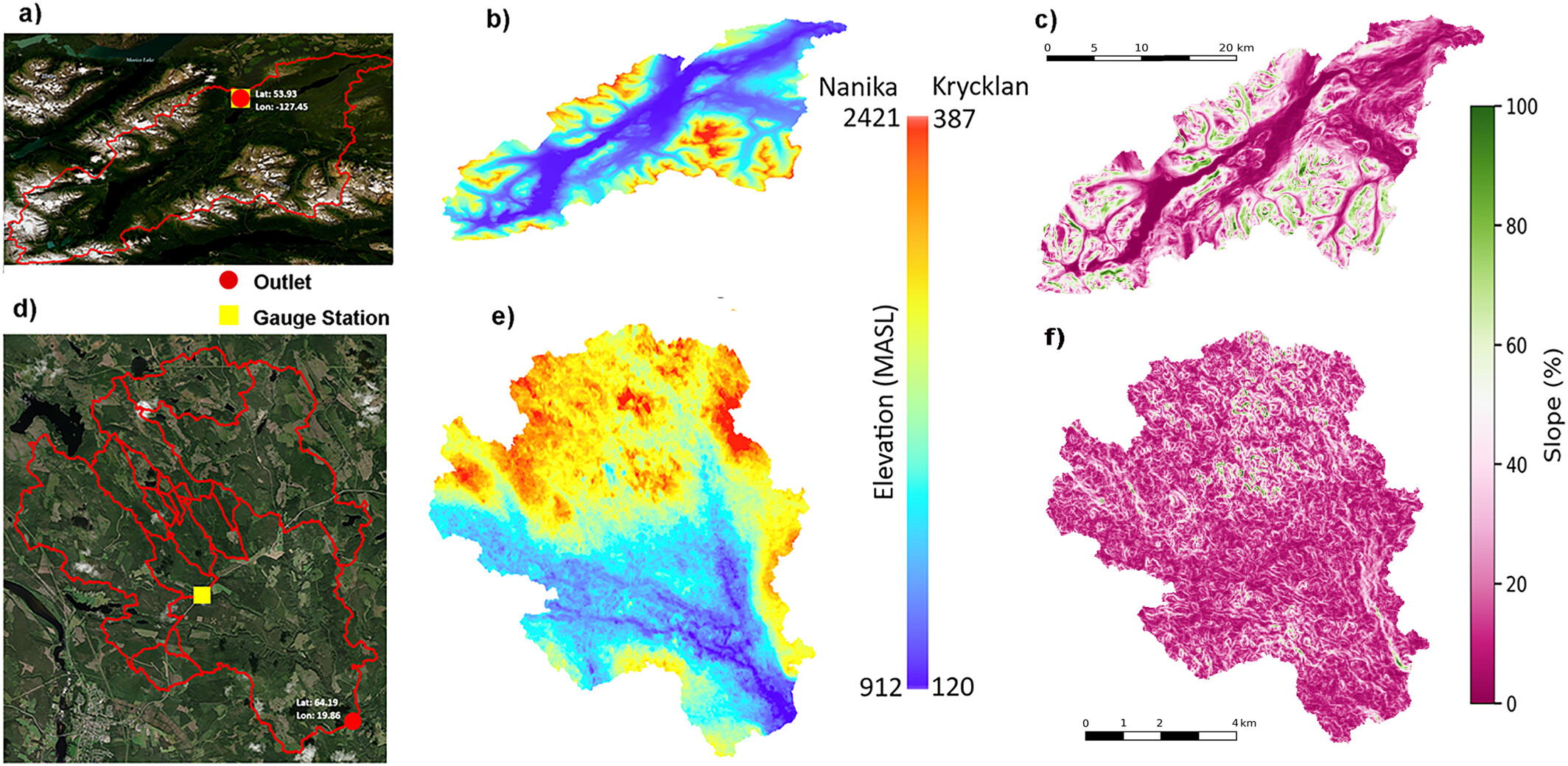
Study sites. (a–c) Nanika catchment in Western British Columbia, Canada. (d–f) Krycklan catchment in the boreal region of northern Sweden. (a, d) Satellite images and boundaries of Nanika and Krycklan. The red circle and yellow square show the locations of the catchment outlet and streamflow measurement station, respectively. (b, e) Topographic map showing the elevational pattern of both catchments. Note the distinct elevational ranges in the two catchments. (c, f) The distribution of slopes in the two catchments, reflecting a larger portion of very steep locations (∼100% or 45°) in the Nanika vs. Krycklan. Slope and elevation maps were generated at 90-m and 30-m resolution for Nanika and Krycklan, respectively.
Understanding how snowmelt is partitioned into different hydrologic flowpaths/storages—and how this partitioning varies over time—is essential for predicting water availability and quality under climate variability. In this study, we examine the time-variance of snowmelt partitioning patterns (SPP) in response to interannual variations in antecedent (Fall) rainfall before snowmelt seasons, across two snow-dominated catchments in Canada and Sweden with contrasting geologic and topographic features. Using integrated subsurface–surface flow and transport modeling, combined with observational data, we simulate the partitioning of snowmelt into shallow flowpath, deep flowpath, evapotranspiration, and long-term storage. To generalize our findings beyond the two case studies, we design a suite of virtual experiments that systematically vary catchment slope and the extent of the hydraulic conductivity’s vertical and lateral heterogeneity. Results show that lateral heterogeneity in conductivity mediates the sensitivity of snowmelt partitioning to interannual variations in antecedent rainfall. While laterally homogeneous catchments display minimal sensitivity of snowmelt partitioning pattern to wet or dry Fall rainfall conditions, catchments with heterogeneous lateral structure store a significantly larger portion of snowmelt and reduce snow-sourced shallow flow contributions in years with high pre-snow rainfall than years with low pre-snow rainfall. In contrast, while slope and vertical conductivity architecture govern SPP, they play a limited role in mediating SPP’s temporal sensitivity to antecedent rainfall variability. These findings reveal that subsurface structure—including the extent of lateral subsurface heterogeneity—modulates the influence of climate variability on snowmelt partitioning and catchment hydrologic function. This has implications for predicting streamflow responses, groundwater recharge, and solute transport under changing climate regimes, and highlights the importance of representing time-variable hydrologic behavior in hydrologic models.
Plain Language Summary
Knowledge of how snowmelt moves through a watershed is essential for managing water supplies and ecosystems in snow-dominated regions. Snowmelt can either run quickly to streams or infiltrate to recharge groundwater, and this balance shifts from year to year with climate and watershed structure. We studied two snowy watersheds that differ in slope and subsurface properties to test how late-summer/fall rainfall (which sets pre-snowmelt wetness) shapes winter snowmelt pathways. In steep terrain with horizontally variable (patchy) subsurface hydraulic conductivity, dry pre-snowmelt conditions direct meltwater horizontally to streams, whereas wetter pre-snowmelt conditions favored deeper infiltration and storage. To generalize, we ran virtual experiments that systematically altered the extent of horizontal variability of hydraulic conductivity. A consistent signal emerged: patchy subsurface hydraulic conductivity produced stronger year-to-year swings in how snowmelt is partitioned between runoff and storage, while horizontally uniform subsurface hydraulic conductivity led to more predictable, stable watershed responses. These results show that antecedent wetness and the horizontal structure of subsurface permeability jointly control the time-variability of snowmelt partitioning. Incorporating these controls can improve forecasts of streamflow and groundwater recharge, and guide planning for flood and drought risks in snow-dependent watersheds under increasing climate variability.
Key Points
Pre-snow rainfall variability alters snowmelt partitioning pattern (SPP) into storage versus runoff, with the magnitude of impact mediated by the extent of hydraulic conductivity’s lateral heterogeneity
Catchments with greater lateral heterogeneity in hydraulic conductivity store (release) a larger (lesser) portion of snowmelt in years with large pre-snow rainfall
Slope and vertical conductivity architecture influence SPP but exhibit limited modulation of SPP temporal sensitivity to pre-snow rainfall variability