
Click the link to read the article on The Alamosa Citizen website:
February 6, 2026
A “poor” spring runoff.
Reservoir storage that is “not well.”
An unconfined aquifer that is getting “worse and worse,” not better.
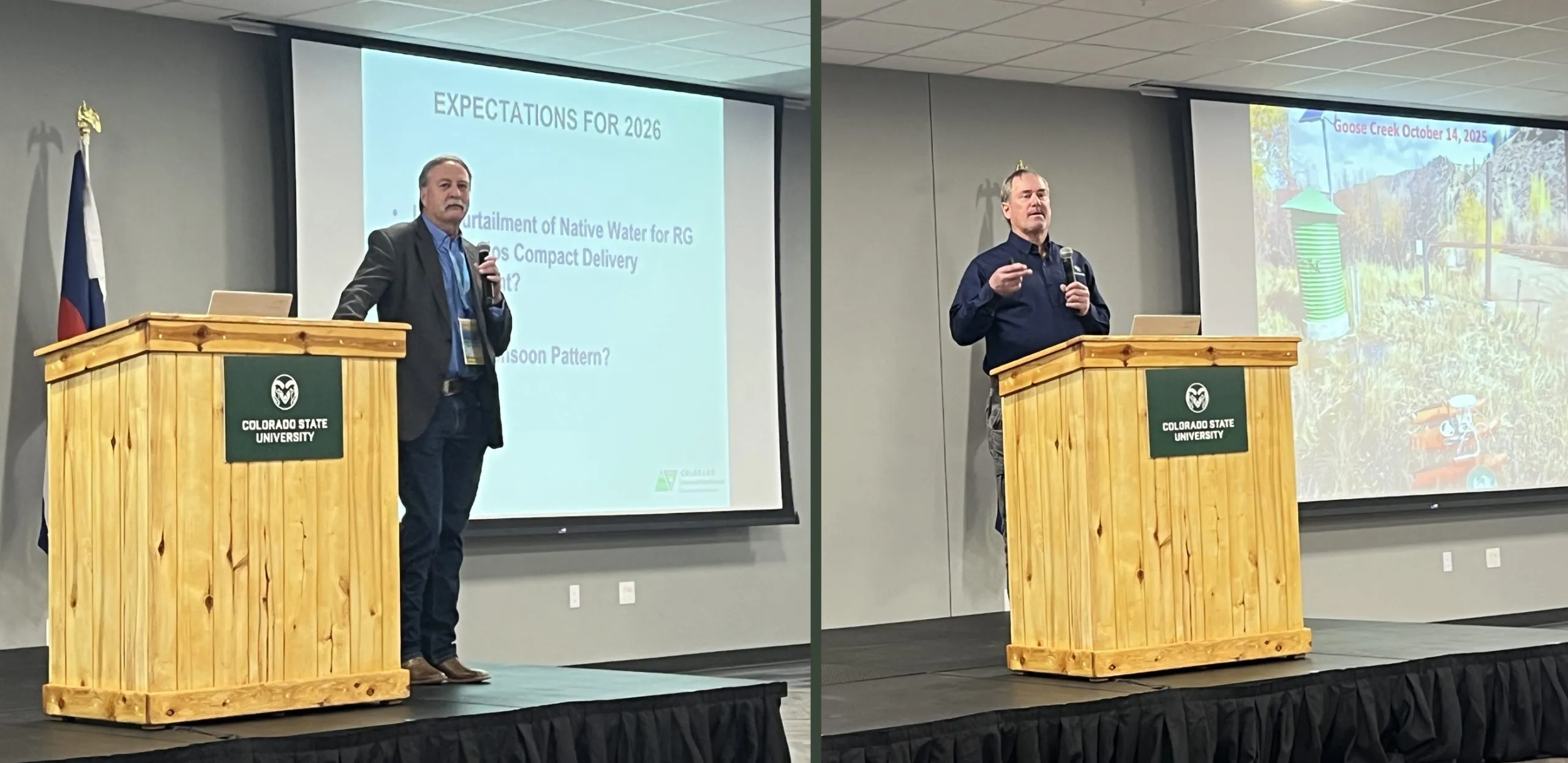
Such is the reality of the situation for the Upper Rio Grande Basin and warnings given to the San Luis Valley farming and ranching community on the final day of the 2026 Southern Rocky Mountain Ag Conference.
If you’re a praying sort, it isn’t too early in 2026 to fold your hands together toward the heavens. If not, a good wish or two would be fine as well.
The outlook is that dire. Except for the hope that a changing weather pattern from La Niña to El Niño at some point this year will deliver the goods and avoid even more of a collapse.
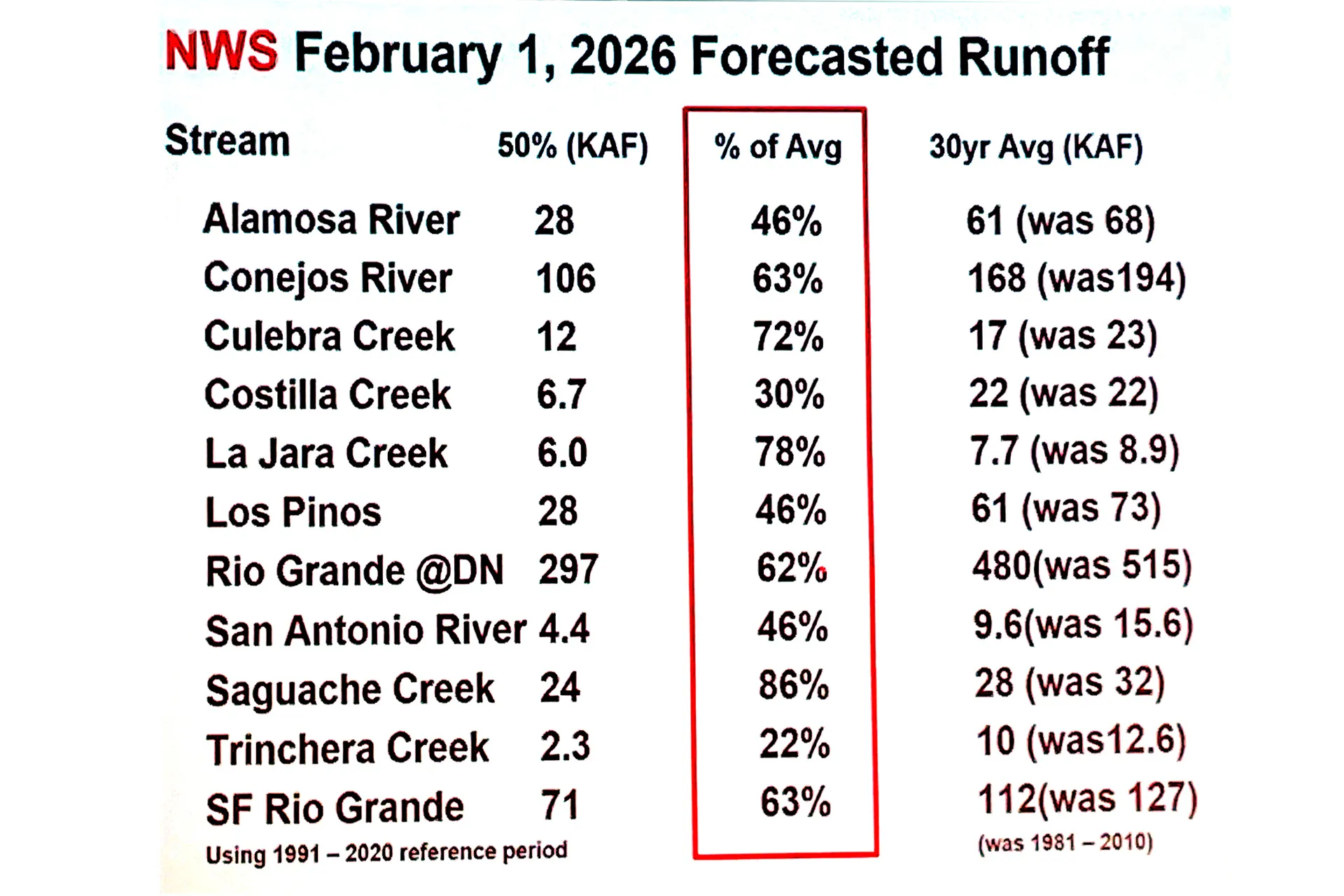
“We do anticipate at this moment, at this date that it’s going to be a poor runoff in 2026,” said Pat McDermott of the Colorado Division of Water Resources. It is customary for him and state division engineer Craig Cotten to provide a look back at the recent water year and a look ahead to the next spring runoff.
McDermott typically attempts a positive spin for the large audience that fills the main conference room at the Outcalt Center of the Ski Hi Complex in anticipation of the state water resources report. He did his best by pointing to a rosier outlook in the 2026 Farmer’s Almanac, the last annual edition.
It is the state, after all, that governs groundwater pumping in the San Luis Valley and has metrics Valley farmers are required to meet to stay in business. One is the recovery of the unconfined aquifer through buy-and-dry and reduced groundwater pumping strategies.
“It just kind of gets worse and worse every year that we look at it,” said Cotten in referencing the storage levels of the Upper Rio Grande’s unconfined aquifer and the greater level of recovery efforts crop producers in Subdistrict 1 are facing as a result.
“Unfortunately it’s going in the wrong direction and it has been for quite some time here,” Cotten said in referencing the latest five-year average for storage.
THE NUMBERS
Rio Grande 2025
493,000 acre-feet – Annual index flow or 80 percent of long-term average past 30 years
125,000 acre-feet – Obligation to New Mexico and Texas under Rio Grande Compact
Rio Grande saw an increase of 95,000 acre-feet due to October 2025 rain.
Conejos River 2025
205,000 acre-feet – Annual index flow or 68 percent of the long-term average of 300,000 acre-feet
46,900 acre-feet – Obligation to New Mexico and Texas
Conejos River saw an increase of 15,000 acre-feet due to October 2025 rain.
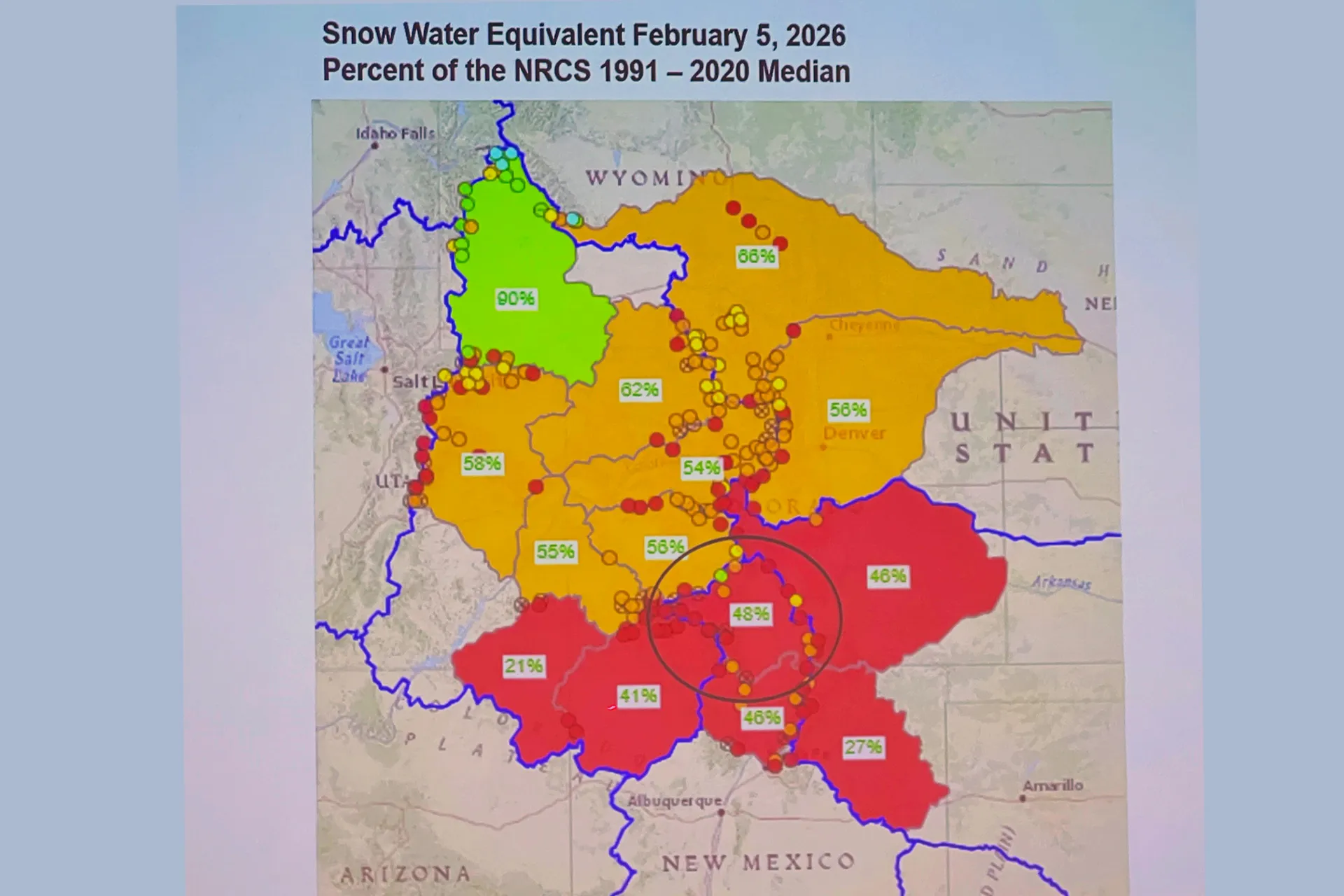
February’s current conditions
Statewide snowpack: 55 percent of median
Upper Rio Grande snowpack: 48 percent of median
Warmest December on record for nine western states based on 131 years of temperature data.
Nathan Coombs and Heather Dutton, both key players in the water conservation world locally and at the state level, gave further explanation on the changing weather patterns that are impacting the basin and the amount of water available for irrigation.
Coombs pointed to the problem of overnight temperatures in the late fall and winter months, and the fact the Valley just isn’t getting the sub-zero temperatures it used to.
Look at December 2025, which saw an average daily low for the month of 11 degrees – double digits overnight – when the normal low for December is 0.8 degrees. January of this year had an average daily low of 4 degrees instead of the -1 that is a normal overnight low temperature for the month. It would have been higher than 4 degrees were it not for sub-zero overnight lows in 5 of the last 7 nights of January.
“We’re not sunburning that much harder, we’re just losing the cold,” Coombs said to his fellow farmers.
The timing of when the moisture comes is off, too. Look at the past two water years – 2024 and 2025 – when heavy rains in October came through and added to the total overall amount of water in the Rio Grande and Conejos River systems.
Too late to help irrigators, but good enough to help the amount of water in the Rio Grande and Conejos River, overall.
“Look at how it’s changing,” Coombs said. “Useful water for irrigation is changing in more ways than just volumes. We’re seeing timing change. So that’s part of what this is. Mother Nature is playing a big role in this. We’ve got to figure that component out a little better. We don’t need to look across the fence at what our neighbors are or aren’t doing. Let’s figure out how we correct to that.”
