In Lower Arkansas River Valley, a $1.39B pipeline is the Holy Grail of clean water — Jerd Smith (Fresh Water News)

Click the link to read the article on the Water Education Colorado website (Jerd Smith):

October 2, 2025

Rick Jones strides quickly into the offices of the May Valley Water Association. He’s running late after a morning of checking leaks in a pipeline that is one of several delivering well water to his 1,500 customers.

Jones has lived in Wiley, nearly 200 miles southeast of Denver, most of his life and has served as superintendent of the association for 38 years.

Outside the front door of his office in a small, well-kept brick building on Main Street, a dispenser delivers radium-free water for 25 cents a gallon to anyone who walks up with a container. It helps the small water company offer clean water because its own groundwater-based system struggles with radium contamination. Having the dispenser helps it meet its state obligations to deliver some clean water to the public.

Last year, the machine dispensed 24,000 gallons.

“It’s usually pretty busy,” Jones says.

But this may be changing. With construction of the long-awaited Arkansas Valley Conduit finally underway,  the May Valley Water Association is in line to get clean water from Pueblo Reservoir, more than 100 miles to the west. Then contamination notices from the state health department will stop and the cloud that lies over these small towns in the Lower Arkansas River Basin due to their historically bad water will begin to lift.

The long-awaited conduit, he says, “is what everyone is hanging their hopes on.”
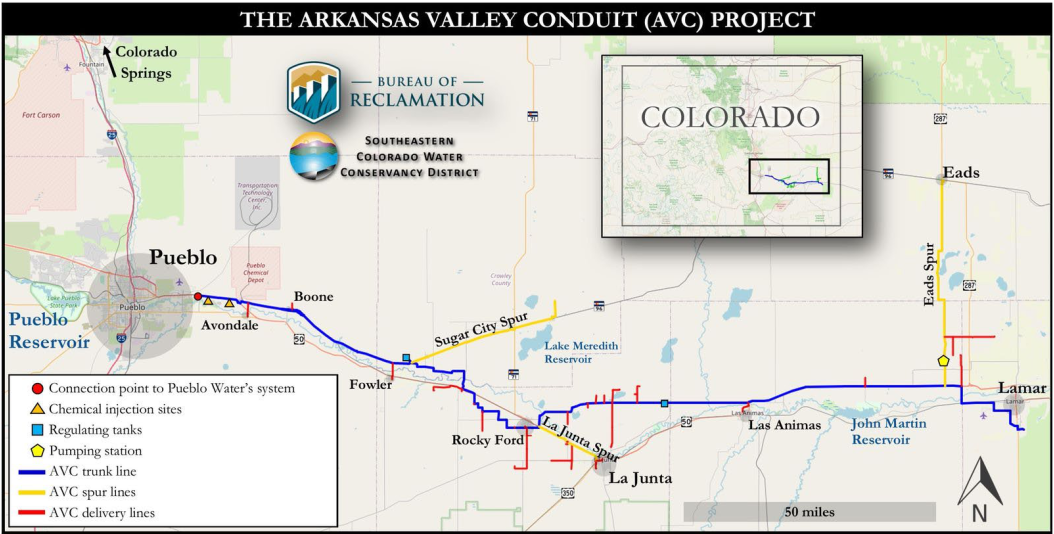
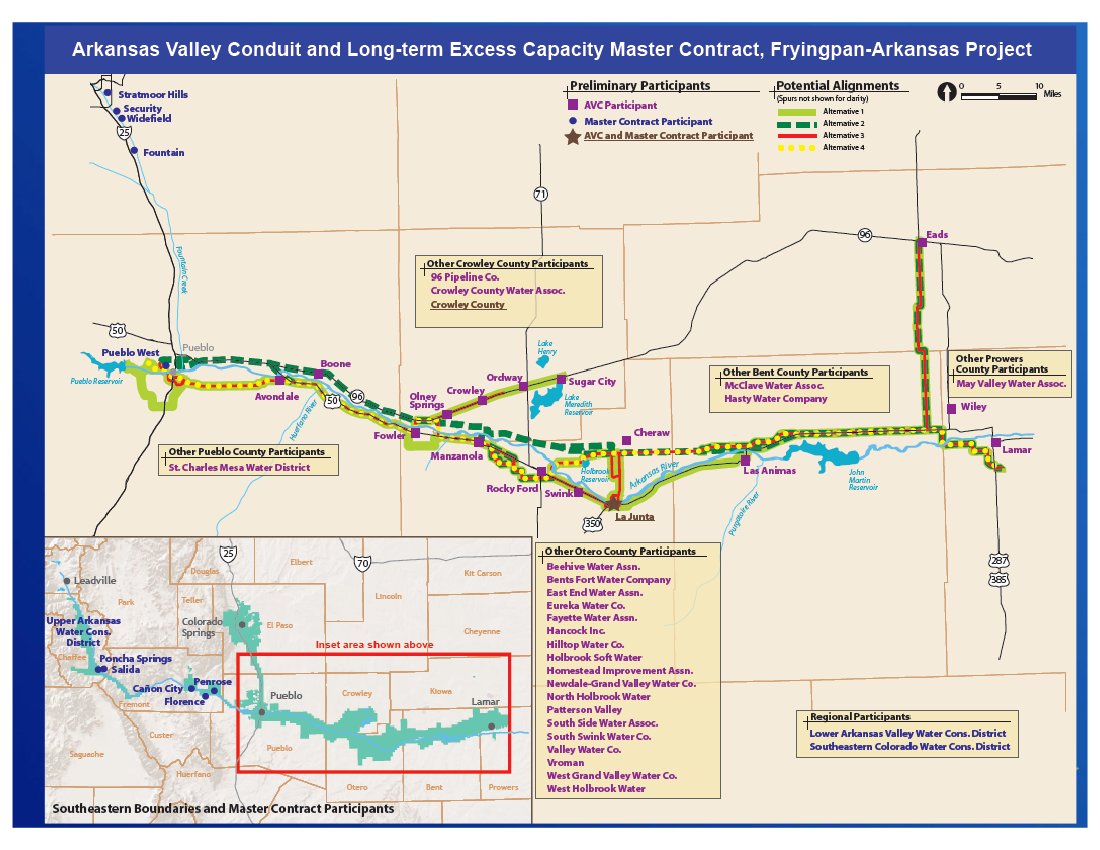
Arkansas Valley Conduit map via the Southeastern Colorado Water Conservancy District (Chris Woodka) June 2021.

A dark water history

The need for clean water in the Lower Arkansas Valley became apparent long before the conduit was initially approved more than 60 years ago. In the 1950s and earlier, by some accounts, wells drilled near the river were showing a range of toxic elements, including naturally occurring radium and selenium. Both can cause severe health problems, including bone cancer, with long-term exposure to radium, and heart attacks and lung issues with selenium, if high amounts are consumed.

In 1962, the U.S. Bureau of Reclamation prepared to build the Fryingpan-Arkansas Project, an ambitious plan to capture clean water from the Arkansas and Colorado rivers and store it in Pueblo Reservoir. The conduit, or AVC, was a component of the project that never got built.

Source: Southeastern Colorado Water Conservancy District

Why? No one could figure out how to provide clean water to so few people living in a remote area of the state, let alone how to pay for it, according to Chris Woodka, a senior policy manager with the Southeastern Colorado Water Conservancy District. The district operates the sprawling Fryingpan-Arkansas Project for the federal government and is overseeing the conduit’s construction.

But everything changed in 2023, when decades of lobbying Congress produced some $500 million in cash toward the $1.39 billion pipeline. That equals $30,888 per person, a cost many people say is extraordinary in a region whose household income of $47,000 is roughly half of the state average of $89,000.

“It’s a very expensive project for 45,000 people,” said Keith McLaughlin, executive director of the Colorado Water Resources and Power Development Authority, which has set aside $30 million in federal grant money to help cover the cost. “It’s an enormous project for that number of people.”

Still he said it’s important for the state, despite the state’s own budget challenges. “You have very low-income communities down there and it’s a really critical project. That makes this very high on our priority list,” McLaughlin said.

To date, 39 communities have signed onto the project. Towns at the far western end of the conduit, such as Avondale and Boone just outside Pueblo, could see water as soon as 2027, while others farther east will wait another 10 years or so as each segment of pipeline is laid and spurs to each community are built, Woodka said.

Alarm as costs rise

La Junta is the largest customer so far, according to Tom Seaba, who manages the historic town’s water and sewer department. He can’t remember a time when the much-delayed conduit and water quality problems didn’t hang darkly over the region.

La Junta residents are among the most critical of the pipeline largely because it’s not clear exactly when it will reach the town, and costs are expected to continue rising, Seaba said..

In the valley these are not idle concerns. The federal government’s first construction estimate in 2016 put the price of the pipeline at $600 million. Nearly 10 years later it has more than doubled, to $1.39 billion, according to the Southeastern Colorado Water Conservancy District.

Seaba won’t say whether he supports or opposes the giant pipe, but he will say that the final cost is likely to be breathtaking.

“Could people’s water bills double? Absolutely,” he said.

To address those staggering costs, Colorado’s congressional delegation, in a bipartisan effort, has pushed hard to make sure the cash comes through and that repayment terms are affordable. The delegation is proposing, right now, to cut interest rates in half and extend the life of the loans to 75 years. The bill has passed the U.S. House, where it was sponsored by Republican Reps. Lauren Boebert and Jeff Hurd, whose congressional districts span the valley. It is pending in the U.S. Senate, where it is being sponsored by Democratic Sens. John Hickenlooper and Michael Bennet.

The State of Colorado has also stepped in to help. The Colorado Water Conservation Board is offering $30 million in grants, and a $90 million loan. The Colorado Water Resources and Power Development Authority can provide up to another $30 million in federal grants if application deadlines can be met.

A plan to share costs

Right now, the U.S. Bureau of Reclamation is slated to pick up 65% of the project’s $1.39 billion cost, or $903.5 million. The Southeastern Conservancy District will cover its 35% share, or $486.5 million.

At the same time, there are also plans to ask the U.S. Bureau of Reclamation to declare the project a hardship due to the region’s low income, and its shrinking population and economy, Woodka said. Should that occur, the valley’s remaining costs could be picked up by the federal government.

Sources: Southeastern Colorado Water Conservancy District, Colorado Water Resources and Power Development Authority, Colorado Water Conservation Board

Still financial pressures are rising. The Colorado Water Resources and Power Development Authority received millions in federal funding after the pandemic, but it must spend all the cash by 2028. And that means that small towns and water districts hoping to connect to the pipeline must move quickly to design new delivery systems, get cost estimates, and submit applications to the state.

McLaughlin, the water and power authority director, is worried these communities, some with just 200 or 300 people, won’t be able to get their loan applications for the spur lines done in time to meet his agency’s deadlines with the federal government. Only a handful have been received to date.

“While we want to fund as many of the spur lines coming in as possible, there are lots of projects competing for the same dollar,” McLaughlin said. “And the money is awarded first-come, first-served.”

The Colorado Department of Public Health and Environment (CDPHE) is also watching the clock as the valley’s water woes continue.

Seventeen of the 39 districts and towns that plan to tap the conduit’s clean water, are under state enforcement orders to permanently remove contaminants, according to the CDPHE. Some of those orders have been in place for decades, and the state has, so far, allowed them to continue delivering flawed water as the long-awaited pipeline comes together.

“As part of this regulatory process, the public drinking water systems are required to do public notice, and certainly they are aware of the health risk associated with their drinking water so they can decide whether they want to make another choice,” said Ron Falco, safe drinking water program manager for the state health department.

Several communities have done just that, spending millions of dollars to install reverse osmosis systems. These remove contaminants and make the drinking water safe to consume.

Las Animas is one of them, according to Bill Long, a resident who also serves as president of the Southeastern Colorado Water Conservancy District.

“In Las Animas, we built a reverse osmosis plant. Now our drinking water is perfect, but we have a problem with the reject water from the RO plant,” Long said, referring to the contaminated wastewater that is a byproduct of treatment. “We can discharge that back to the river, but we can’t do that in perpetuity. We solved one problem but we created a new one. … The state won’t allow us to discharge that forever.”

To Long, the pipeline is the only way to ensure long-term, clean drinking water for the Lower Valley and to provide a chance to rebuild its economy.

“Better water creates new opportunities,” Long said. “If we try to do anything in Las Animas that requires a new water supply, we can’t do it. We would have to build a new RO plant, and apply for a new discharge permit, which the state would likely not give us.” Long was referring to the Arkansas River’s own water quality problems, which can be worsened by the discharges.

Back in Wiley, Jones said the May Valley Water Association plans to start saving to pay for the $5.1 million he expects to spend to repair aging pipes, and install the new lines and pumps that will allow him to connect to the conduit and get off the state’s list of drinking water safety violators.

Does his community feel shortchanged that it has taken so long to have what most communities take for granted?

“Yes. There are people who say ‘Yeah, we got shorted.’ But the good thing is they’ve started it. I guess I’m hopeful. It will bring better water quality, and for some places like us, we will finally get out of trouble with the state.”


More by Jerd Smith

Southeastern #Colorado Water Conservancy District Board welcomes new directors

Arkansas Valley Conduit map via the Southeastern Colorado Water Conservancy District (Chris Woodka) June 2021.

From email from Southeastern Water (Chris Woodka):

April 17, 2025

Two new directors joined the Board of the Southeastern Colorado Water Conservancy District and were sworn in on Thursday, April 17, 2025.

Abby Ortega. Photo credit: Colorado Springs Utilities

Abby Ortega will represent El Paso County and Mike Bartolo will represent Otero County on the 15-member Board. Returning directors who were sworn in include Matt Heimerich, Crowley County; Greg Felt, Chaffee County; Andy Colosimo, El Paso County; and Seth Clayton, Pueblo County. Terms are for four years. Ortega will fill the term for the seat held by Mark Pifher, who retired in December. The term expires in 2028. Bartolo will take over the seat held by Howard “Bub” Miller, who was recognized for 20 years of service to the Board by President Bill Long at Thursday’s meeting.

Ortega is a Fremont County native who is General Manager of Infrastructure and Resource Planning for Colorado Springs Utilities, where she manages resources for gas, electricity, wastewater and water services. She has worked at CS-U since 2003 and held various positions in the water resources area.

She holds a bachelor’s degree from Colorado State University-Fort Collins and is a licensed professional engineer. She has served on the Colorado River Energy Distributors Board, the Fountain Valley Authority Board, the Arkansas Basin Roundtable, Colorado Canal and Twin Lakes Reservoir Co. board and the Arkansas Headwaters Recreation Area Citizen Task Force.

“Fostering relationships across the entire spectrum of issues is crucial for collaborative progress,” Ortega said. “The SECWCD is positioned to be a leader in the future of water in the Arkansas River Valley and I would like to be part of that as a Board member. I have a history of working with recreation, as well as farmers and ranchers.”

She and her husband of 26 years, Gabe Ortega, have three children and live in Fountain.

Mike Bartolo via his LinkeIN page.

Bartolo is a native of Pueblo County and grew up on the St. Charles Mesa. He retired as manager of the Colorado State University Research Center at Rocky Ford in 2023 after more than 30 years. Much of his time since then has been spend advocating for agriculture and developing new strains of peppers. In February 2025, Bartolo was inducted into the Colorado Agricultural Hall of Fame.

He has a PhD in plant physiology from the University of Minnesota, a master’s degree in horticulture from CSU-Fort Collins, and a bachelor’s degree in bioagricultural science from CSU-Fort Collins. He is a member of the Super Ditch Board, the Hilltop Water Company Board and is active in St. Peter’s Church in Rocky Ford.

“I wanted to join the Southeastern Board from a technical aspect to continue learning about water and a concern for agriculture and the communities that rely on agriculture,” Bartolo said.

Bartolo and his wife, Kyle, have two grown children and live in the Rocky Ford area.

The Southeastern District includes parts of nine counties and has a 15-member Board. Its major purpose is administration of the Fryingpan-Arkansas Project in partnership with the  Bureau of Reclamation, and their top project currently is construction of the Arkansas Valley Conduit.

Arkansas Valley Conduit awarded an additional $250 million — Chris Woodka (Southeastern #Colorado Water Conservancy District) #ArkansasRiver

Reclamation Commissioner Camille Calimlim Touton greets several members of the Southeastern District Board, from left, Bill Long, Kevin Karney, Howard “Bub” Miller, Andy Colosimo and Justin DiSanti. Photo credit: Southeastern Colorado Water Conservancy District

January 8, 2025

Camille Calimlim Touton, Commissioner of the U.S. Bureau of Reclamation, traveled to Pueblo on Wednesday, January 8, to announce an additional $250 million for construction of the Arkansas Valley Conduit.

“We are proud to see the work underway because of President Biden’s Investing in America agenda,” Commissioner Touton said. “But there’s much more work to be done and we are again investing in this important project to bring safe drinking water to an estimated 50,000 people in 39 rural communities along the Arkansas River.”

The $250 million is funded through the Bipartisan Infrastructure Law and is part of a $514 package of water infrastructure investments throughout the western United States under the BIL.

The additional funding brings the total federal investment in the AVC to almost $590 million since 2020, along with state funding guarantees of $90 million in loans and $30 million in grants.

“After 25 years, I still almost can’t believe it’s happening, but I drive by and can see it with my own eyes,” Southeastern Water Conservancy District President Bill Long told Commissioner Touton. “There are so many people who have worked so hard who would be so proud to see it being built. This money will get us to the area that has seen the most problems.”

The Southeastern District is the sponsor for the AVC, which is part of the 1962 Fryingpan-Arkansas Project Act. The 130-mile pipeline to Lamar will bring water to 50,000 people being served by 39 water systems when complete.

Several Southeastern Board members attended Wednesday’s announcement.

“You and your team are the ones who have gotten this off the ground,” said Kevin Karney, a La Junta rancher, and at-large Board member.

“People said it would never get built, but now we’re getting it done,” said Howard “Bub” Miller, who represents Otero County on the Board.

The AVC will help 18 water systems that face enforcement action for naturally occurring radionuclides in their groundwater supplies, as well as communities struggling to meet drinking water and wastewater discharge standards.

Construction of the AVC began in 2023, and three major construction contracts have been awarded.

“This money really gets us further down the valley. It is very much appreciated,” Long said.

Here is a link to the Bureau of Reclamation News Release: https://www.usbr.gov/newsroom/news-release/5074.

Below is a news release from Colorado’s Senators: https://www.bennet.senate.gov/2025/01/08/bennet-hickenlooper-welcome-additional-250-million-from-bipartisan-infrastructure-law-for-arkansas-valley-conduit/

Hickenlooper, Bennet Welcome Additional $250 Million for Ark Valley Conduit

Funding awarded from the senators’ Bipartisan Infrastructure Law

In total, Hickenlooper and Bennet have helped secure $500 million in funding for the project

WASHINGTON – Today, Colorado U.S. Senators John Hickenlooper and Michael Bennet welcomed the Bureau of Reclamation (BOR)’s announcement of $250 million in new funding from the Bipartisan Infrastructure Law for continued construction of the Arkansas Valley Conduit (AVC).

“We passed the Bipartisan Infrastructure Law to finally deliver on promises to rural communities,” said Hickenlooper. “In Colorado that means finishing the long-awaited Ark Valley Conduit and bringing clean, reliable drinking water to 50,000 people.”

“For decades, I’ve worked to secure investments and pass legislation to ensure the federal government keeps its word and finishes the Arkansas Valley Conduit,” said Bennet. “This major Bipartisan Infrastructure Law investment will be critical to get this project across the finish line to provide safe, clean water to tens of thousands of Coloradans along the Arkansas River.”

John F. Kennedy at Commemoration of Fryingpan Arkansas Project in Pueblo, circa 1962.

The AVC is a planned 130-mile water-delivery system from the Pueblo Reservoir to communities throughout the Arkansas River Valley in Southeast Colorado. This funding will continue ongoing construction. The AVC is the final phase of the Fryingpan-Arkansas Project, which Congress authorized in 1962.

Hickenlooper and Bennet have consistently and successfully advocated for increased funding for the AVC. Last year, Hickenlooper and Bennet wrote to President Biden to urge him to prioritize funding for the AVC in his fiscal year 2025 budget. The senators also called on Senate Appropriations leaders to provide more funding for the project. In January 2023, Hickenlooper and Bennet urged BOR to allocate additional resources through annual appropriations and Bipartisan Infrastructure Law funding.

As a result of their efforts, the senators have helped deliver $500 million from the Bipartisan Infrastructure Law for the AVC, including $90 million in 2024, $100 million in 2023, and $60 million in 2022. They also secured an additional $10.1 million in fiscal year 2024 and $10.1 million in fiscal year 2023 through the annual government funding bills.

More information on the funding is available HERE.

Arkansas Valley Conduit map via the Southeastern Colorado Water Conservancy District (Chris Woodka) June 2021.

Special Report: Big city water buys in #Colorado’s Lower #ArkansasRiver Valley raise alarms — Fresh Water News

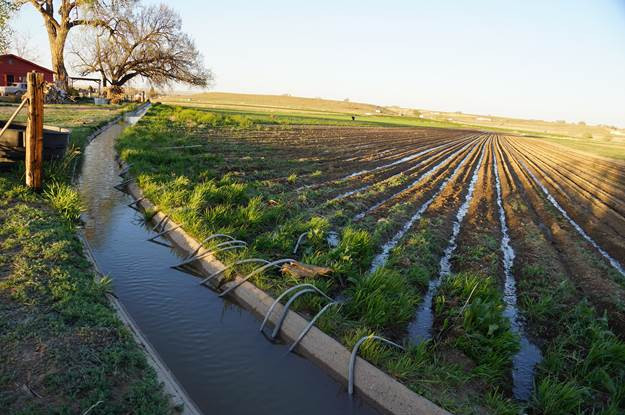
Flood irrigation in the Arkansas Valley via Greg Hobbs

Click the link to read the article on the Water Education Colorado website (Jerd Smith and Michael Booth):

August 8, 2024

From satellite view, the land north of the Arkansas River is a seemingly random checkerboard of vital green and desperate brown, quickly fading from a few thriving farm acres to the broad, water-drained desolation of northern Crowley County.

From the cab of Matt Heimerich’s pickup, each alternating square of emerald corn or desiccated knapweed is a decision by a distant big city — to either share Colorado resources responsibly or toss rural Arkansas River counties to the fate of the hot summer winds.

That square was reseeded with native grass after Aurora bought the water in the 1970s, Heimerich says. That plot, Colorado Springs dried up and it’s all weeds. That farm, Aurora wants to dry it up soon, but the water court referee wants a better reseeding plan.

Heimerich’s family is one of the few farmers remaining in the 790 square miles of Crowley County after city water buy-ups shrank the county’s irrigated acres from more than 50,000 in the 1970s to just a few thousand this year. He jumps down from the pickup to clear invasive kochia weeds from a pipe opening gushing cool canal water down a 1,500-foot corn row.

Straight line diagram of the Lower Arkansas Valley ditches via Headwaters Magazine

Two miles away is downtown Olney Springs, population 310. Crowley County as a whole has only 5,600 residents, and more than a third of those are inmates at two prisons. The only retail operation left in Olney Springs is a soda vending machine against the wall of town hall.

As Heimerich clears his irrigation pipe, he pauses to jab a thumb over his shoulder 150 miles to the north at Aurora, where the population increased by more than 100,000 over 20 years. “When you build a new development, at the end of the day, you’re drying up a farm,” Heimerich said. “Where else is it going to come from?”

“Crowley is just the worst example of what can happen when nobody cares, and nobody pays attention,” he said. The tiny community serves as an enduring reminder of the cultural and economic ruin that occurs when big cities in Colorado and elsewhere purchase farms, dry up the land and move the water to urban areas. It gave rise to the term “buy and dry,” a practice now widely condemned.

The practice was supposed to end in the Lower Arkansas Valley in 2003 with a hard-fought federal court battle and settlement. Since then, state lawmakers and top water and farm agencies have changed laws and spent millions of dollars testing new protective methods for sharing water temporarily between rural and urban areas. They have also spent heavily to improve water quality for thousands of people living near the river who still don’t have clean water to drink.

The big cities insist they have learned their lessons from the Crowley County disaster.

“The results of what happened in Crowley County are unacceptable and widely recognized as a travesty,” said Colorado Springs Utilities spokesperson Jennifer Jordan. “We’ve taken those lessons to heart.”

Arkansas River Basin — Graphic via the Colorado Geological Survey

But outraged Lower Arkansas growers and water districts say new efforts to protect their farm water aren’t working. At the same time, the big cities say new laws making it easier to share farm water don’t provide enough reliable water to grow their communities.

The cities also say big changes in the future water picture, climate-driven reductions in stream flows and threats to their Colorado River supplies leave them little choice but to draw more farm water.

This year they did that, inking deals in the Lower Arkansas worth more than $100 million to buy and lease land and water, raising alarms among local growers and generating big questions about whether the state is doing enough to protect rural farm communities and the water that keeps them going.

Buy and dry light

The cities say a lot has changed in the past 20 years and that these new deals represent innovations in water sharing. But critics in the Lower Arkansas Valley say these same deals signal that no one is doing enough to prevent “buy and dry” or the latest tool in the water acquisition quiver, “lease and dry,” in which water is pulled from farmland periodically.

Aurora, for instance, spent $80 million in April to buy nearly 5,000 acres of farms in Otero County and the more than 6,500 acre-feet of water associated with that land. An acre-foot equals nearly 326,000 gallons of water, enough to irrigate half an acre of corn, or supply at least two urban homes for one year.

Aurora plans to use the water itself in three out of 10 years, leaving it on the farms the rest of the time. Some 4,000 acres of land will be dried up intermittently when Aurora is using the water, according to Karl Nyquist, a developer and grower who negotiated the deal with Aurora and who is operating the farms for Aurora under the lease agreement.

Colorado Springs has a different arrangement just downriver in Bent County, where it will permanently purchase up to 15,000 acre-feet of water from local farmers. Colorado Springs will also help pay local farmers to install modern center pivot irrigation systems that use less water, allowing the city to keep the saved water for its use.

In Crowley County. Photo: Brent Gardner-Smith/Aspen Journalism

In this deal, Colorado Springs and the farmers will be responsible for revegetating any dried-up land. It will use the water in five out of 10 years, and it has agreed to make a one-time, upfront payment of $2.5 million to Bent County plus payments each year based on how much water is taken off the fields. The money is in addition to payments to farmers.

“We wanted to make sure Bent County was kept whole,” said Scott Lorenz, a senior water projects manager with Colorado Springs Utilities.

Bessemer Ditch circa 1890 via WaterArchives.org

And in Pueblo County, perhaps the least controversial of the three deals, Pueblo Water agreed to purchase nearly one-third of the shares in the local historic Bessemer Ditch system for $56.2 million. Pueblo continues to lease the water back to the farmers for now. At the same time, the Palmer Land Conservancy has developed a sophisticated new framework that measures farm productivity on land watered by the Bessemer Ditch and will eventually help direct water to the most productive farms as Pueblo takes its water. The hope is that the new system will increase overall farm productivity on the ditch system and help make up for anything lost when the less productive lands are dried up, according to Dillon O’Hare, Palmer’s senior conservation manager.

Palmer is also working to analyze the impact of the deals on water quality downstream and how to prevent further damage, O’Hare said.

Irrigated farmland is evaporating

The three projects come as new data shows Colorado’s irrigated farmlands are shrinking. Since 1997, the state has lost 32% of these lands, with areas in the Lower Arkansas Valley seeing losses higher than that, according to an analysis of federal agricultural data by Fresh Water News.

Crowley County has lost 90% of its irrigated lands in that period. Pueblo has lost 60.2%, and Bent and Otero have lost 37.6% and 35.2%, respectively.

State agriculture and water officials are worried about the decline, but say they have few tools to prevent it because farmers are free to sell their water rights to whomever they want.

“Am I concerned? Definitely,” said Robert Sakata, a long-time vegetable grower near Brighton, and former member of the Colorado Water Conservation Board who now serves as the director of water policy for the Colorado Department of Agriculture. “We all talk about water being a limited resource, but prime farmland is also limited and it’s important to take that into consideration.”

Not all these losses are due to big city water prospecting. Climate change, market challenges and legal obligations to deliver water to downstream states are also fallowing Colorado farmlands.

Everyone is sympathetic. No one is in charge.

Still, more than 20 years after the intergovernmental peace accords, it wasn’t supposed to be this way.

The Lower Arkansas Valley region is part of the sprawling Arkansas River Basin. The river has its headwaters near Leadville and flows through Buena Vista, Salida, Cañon City, into Pueblo Reservoir and on over the state line east of Lamar.

Its counties were once a sweet spot in the basin’s agriculture economy. The river fed a bountiful chain of tomato, sugar beet and onion fields, as well as acres of luscious Rocky Ford melons, and chiles, corn and alfalfa.

Cities say these latest deals, which they call “water sharing” agreements, will bolster the agricultural economies and keep remaining water on farm fields forever. But the term “sharing” doesn’t sit well with some local farmers and water officials who have a deep distrust of the cities they blame for the region’s decline.

“I call it a charade,” said Mike Bartolo, a retired Colorado State University Extension research scientist who farms in Otero County near Rocky Ford. “You dry up an acre, you’re drying up land that was formerly irrigated. That’s buy and dry.”

While the state’s highly touted Water Plan cheers for the concept of cities helping rural areas thrive after water losses, there is no mechanism or state law or bureaucracy to watchdog new sales.

After the 2003 agreement in the Lower Arkansas Valley, state and local water leaders began testing new ways for cities and farmers to temporarily share water, something that had been almost impossible under older water law.

But Aurora and Colorado Springs say the early experimental programs didn’t provide enough water at reasonable prices to fulfill their fast-growing community needs permanently.

Lorenz, the Colorado Springs Utilities manager, said the city does lease some water in the valley, but it hasn’t been enough to ensure the stability of its long-term water supply.

“The major concern is that we would lease from a particular farmer, and then a different city would come out and buy those water rights and the farmer wouldn’t lease to us anymore,” he said.

And in fact that is what just happened in April, when Aurora purchased the Otero County farms, which had formerly leased water to Colorado Springs.

Colorado Springs Utilities formally opposes the latest Aurora water deal, as do the Southeastern Colorado Water Conservancy District based in Pueblo, and the Lower Arkansas Valley Water Conservancy District in Rocky Ford.

But their anger has so far been expressed by passing resolutions, not filing lawsuits.

How Aurora Water and other cities have treated Arkansas River counties like Crowley after past buy-ups leaves nothing but suspicion about newly announced deals, local leaders say.

Though Aurora says it is not attempting any more permanent dry-ups of local land, “I don’t think any of us believe them,” said Heimerich, Crowley County’s representative on the Southeastern Conservancy board. Heimerich also is a member of the board of Water Education Colorado, which is a sponsor of Fresh Water News. “They’ll do whatever they need to do and apologize later.”

Thornton, Larimer and Weld counties conducted a similar debate publicly — from the 1990s to this year — as Thornton bought up 17,000 acres of northern Colorado farms and their water rights and began drying up the land. County commissioners and other local officials brought their legal weight and bully pulpits to bear in demanding extensive concessions from Thornton. The Adams County city has been reseeding dried up land with native grass and backfilling lost property taxes, but gets mixed reviews from locals.

The latest Lower Arkansas water deals are also pitting Colorado’s big cities directly against each other in conflicts not seen for decades. When the board of Colorado Springs Utilities passed a resolution earlier this year condemning Aurora’s Otero County deal, it was a direct shot from leadership of a city of nearly 500,000 — the Colorado Springs City Council is the utility board.

“The idea is that there’s Denver, there’s a Denver metro complex and they’re going to just do whatever they want to do and the rest of the state has to go along with it,” City Councilman Brian Risley said.

But Alex Davis, a top Aurora Water official, said Colorado Springs’ ire is unwarranted.

“Aurora has worked in close partnership with Colorado Springs for decades and that will continue,” she said. “This is a case where we disagree.”

Peter Nichols, general counsel for the Lower Arkansas Water Conservancy District in La Junta, said he is deeply concerned by what cities are proposing now.

“We thought we were through with all of this. We thought we had it under control,” he said of the Aurora and Colorado Springs purchases.

Nichols is among those who have spent much of the past 20 years creating a system, now known as the super ditch, that allows seven local irrigation companies to negotiate leases with cities.

A map of the Fry-Ark system. Aspen, and Hunter Creek, are shown in the lower left. Fryingpan-Arkansas Project western and upper eastern slope facilities.

Importantly, it also won the legal right to move leased water stored in Pueblo Reservoir out of the valley, via the federal Fryingpan-Arkansas Project and the Otero Pipeline, removing what had been a key barrier to leasing.

Nichols said local growers and water districts have worked hard to find ways to share water so that it doesn’t permanently leave the valley. That the cities are now jumping the line with these new deals isn’t OK with him.

A farmer’s — and a county’s — greatest asset

Colorado Springs and the other thirsty Front Range cities want farmers like the young Caleb Wertz to be the new face of urban water agreements. On a recent 95-degree summer afternoon, Wertz high-tailed it across Bent County driving an ambulance to take an injured neighbor to the hospital. He had planned to be on his farm, but that’s life in the Lower Arkansas Valley.

The population is shrinking, and everyone has too many jobs to count. The local farmer is also a first responder. Your primary care provider is a farmer’s wife.

Arriving back at the farm just after 5 p.m., Wertz talks about what is perhaps the most controversial decision he has ever made: Selling a portion of his agricultural water to fuel housing growth in Colorado Springs.

The deal will pay him enough so that he can install modern irrigation systems, drying up portions of the fields, known as corners, that won’t be reached by the new, center pivot sprinklers, and allow Colorado Springs to buy the saved water.

He is also planting cotton alongside his traditional corn, and he believes he is the first in the state to do so. A new modern variety is supposed to use half the water, just one acre-foot per acre, rather than the two acre-feet of water that older types, such as those grown in Arizona, use.

For Wertz, the agreement will give him enough money to keep farming and enough new technology to make his remaining agricultural water go farther. He will become a rarity in the area: A young farmer with enough land and water to continue the business his family started in 1919 and to expand it.

“The water purchase makes it a lot more doable because we can farm those acres so much more with pivots,” Wertz said. “That’s the case even though we’re drying up the corners. … That has a bad connotation to it. But Colorado Springs is reimbursing the farmers to turn those corners into pasture land or to revegetate. … Even if it is not producing corn, it’s not just becoming wasteland.”

But to some of his neighbors in the valley, Wertz has entered a hostile no-man’s land, facilitating yet another dry-up of farmland in a region that has already lost too much water and land to urban thirst.

“I know people don’t like it and people are entitled to their opinions, but a lot of those are the older generation who don’t like seeing it because of what happened years before I was even born,” said Wertz, who is 23. “I was glad to see the Springs come in and ask questions about working with us.

“We were quite leery at first. But they have proved it to us. It is extending the water use for them and us, and allowing my brother and I to start taking over some of these acres that haven’t been farmed for a while because there isn’t enough manpower.”

But can the land come back after fallowing?

Another worry for Lower Arkansas growers is whether new methods that allow cities to take the water off the fields for one or more years and then return it at a later time, do more harm than good. They’re not sure farmland in the region is resilient enough to bounce back from cycles of city-caused drought.

Perry Cabot, a research scientist and specialist in farming practices and farm economies, has spent years studying the issue. He says that there is hope for fallowing, after years of experiments and tests, but only with crops such as alfalfa and other grasses and sometimes corn.

“The programs we have done saw alfalfa return almost with a vengeance,” Cabot said. “Grass hay is the second-best candidate.”

Nyquist, the developer and grower who is leasing back and farming the land he recently sold to Aurora, agreed, saying fallowing programs do work, but they are not good for small growers who don’t have the cash to buy the necessary new equipment and nutrients that are needed to help fully restore the crops once water returns.

Still, Jack Goble, general manager of the Lower Arkansas Valley Water Conservancy District in Rocky Ford is wary of plans that take water from parts of farm fields over long periods of time.

“And I haven’t found a farmer yet that believes that that’s a viable farming situation, ” he said. “It’s tough to bring that land back.”

Dan Hobbs irrigating from the Bessemer Ditch. Credit: Greg Hobbs

For years, valley water hasn’t been drinkable

Anger aimed west and north from Lower Arkansas Valley towns extends to water quality issues, not just water volume.

For many decades, groundwater wells and the river have been contaminated by farm runoff, mining operations and some naturally occurring pollutants.

The same federal Fryingpan-Arkansas Project that in 1962 created Pueblo Reservoir was also supposed to solve the drinking water problem for 40 communities downriver by building the 130-mile Arkansas Valley Conduit to move clean water from Pueblo Reservoir. But it wasn’t until 2023 that final funding for the $610 million pipeline arrived.

Some downstream leaders are galled that Aurora can start taking more fresh water out of the Arkansas before serious pipeline construction has begun to serve the 50,000 people in long-suffering downstream towns.

“My whole life has been under drinking water restrictions, not being able to attain safe drinking water except to go buy it or to go through extraordinary measures to treat it,” said Dallas May, whose family ranches 15,000 acres north of Lamar. May also is on the Southeastern Colorado Water Conservancy District board.

The Colorado Department of Public Health and Environment’s Water Quality Division, which tests Lower Arkansas water a few times a year, classifies most of the river below Pueblo Reservoir as not supporting drinking water or “aquatic life use.” The classification calls the Lower Arkansas suitable for “warm-water aquatic life” and recreation.

The state did not respond to requests for more detailed assessments of Lower Arkansas water health. Asked if state efforts were improving water quality on the Arkansas, a spokesperson said in an email, “Trend studies require extensive data over a significant period of time. The water quality in watersheds is influenced by a wide variety of factors, including precipitation and weather trends that can highly influence the water quality from year to year.”

Some Lower Arkansas farmers and officials are tired of waiting. They see the problem getting worse as, for instance, Aurora takes more water out of Otero County, “What happens is all of the bad things are concentrated into what is left,” May said, “and that is a huge problem.”

Silence at the state level?

The Colorado Water Conservation Board spent years writing the statewide Water Plan, convening forums and task forces, and conducting listening sessions on the tensions between city water needs and the survival of agricultural communities. They say they are concerned about new city water buys, but add they have no authority to influence any deals because water rights are private property rights and can be bought and sold at will.

The board declined an interview request about Aurora’s water purchase or the broader water use questions.

“The Colorado Water Plan sets a vision for meeting the state’s future water needs and was broadly supported by local communities,” Russ Sands, the board’s water supply planning chief, said in email responses to questions. “But the decisions that happen in local communities regarding their water purchases and planning are largely outside of the state’s control. Accountability for staying true to the vision of the Water Plan is a collective responsibility.”

The loss of irrigated farmland isn’t expected to slow anytime soon as climate change dries up streams and population growth drives cities to buy more. The Colorado Water Plan’s forecast shows the population of the Arkansas River Basin, which includes Colorado Springs and Pueblo, surging more than 60% by 2050, increasing the pressure to tap farm water.

Sakata, the state water policy advisor, who farms near Brighton, said protecting the state’s irrigated farmland will take more work. “We can’t just say lease the water for three out of 10 years. We need to have agreements so that water sharing will be really available.”

As an onion grower, Sakata can’t do interruptible water supply agreements because he has long-standing yearly agreements with suppliers that require him to deliver vegetables. If he fallows his land for a year, the money he would likely be paid wouldn’t be enough to compensate him for the loss of onion sales and the need to support his employees during the break.

Farm research scientist Cabot would like to see the state begin buying irrigated farms, using conservation easements to protect them from development or purchase, and then leasing that land and its water to young growers.

What else state leaders can do to preserve what’s left of Colorado’s irrigated land isn’t clear yet, but Alan Ward, a Pueblo native who is also director of water resources for the Pueblo Water, said the state needs to reexamine its policies and goals.

“There is only so much water available, and I don’t think it’s realistic for the state to continue to think that we can control our urban areas and grow them fast without impacting agriculture.” Clarifying that he was speaking as a private individual, rather than a water official, he said, “I’d rather have the farms continue and not have the urban growth, but I am probably in the minority on that.”

Where does the battle flow next?

Water veterans such as Cabot said the state is likely doing everything it can right now to protect irrigated ag lands. But like Sakata, he says more work needs to be done to shore up farm markets and to create easier, more lucrative water sharing arrangements.

“I don’t want to oversimplify this,” Cabot said, “but the simplest way for cities to get this water is to go to farmers and say ‘How much did you make last year?’ and then offer them 10% more. … These are not just fields. They are farm enterprises.”

Kate Greenberg, Colorado’s agriculture commissioner, is overseeing multimillion-dollar efforts to protect farmlands by improving soil health, solving market challenges and making farm water use more efficient. She says the people of Colorado are on board with her agency’s efforts.

“We did a study last year that showed over 98% of Coloradans believe agriculture is an integral part of our state. If we’re taking water out of agriculture, where are we putting it to beneficial use?

“Are we conserving it to grow urban developments and do we want to see that over preserving agriculture and biodiversity. We need to answer that question as a state.”

Bartolo, the retired CSU researcher, hopes the answer comes soon, before any more of the valley water is siphoned off for urban use.

As news of the deals spreads, Bartolo’s sense of deja vu is growing and his fears for the future of the valley’s irrigated ag lands is growing too. No one knows yet what will happen when Aurora’s contract to use the Fryingpan-Ark to deliver water expires in 2047.

“Having lived through it in my lifetime, I have seen the drastic changes,” Bartolo said.

What worries him, and other growers too, is “what happens if they come back after 2047? What happens then?”

More by Jerd Smith, Michael Booth

Long-delayed #Colorado project included in latest round of federal water funding: Arkansas Valley Conduit first authorized by President John F. Kennedy in 1962 — Colorado Newsline #ArkansasRiver #COriver #ColoradoRiver #aridification

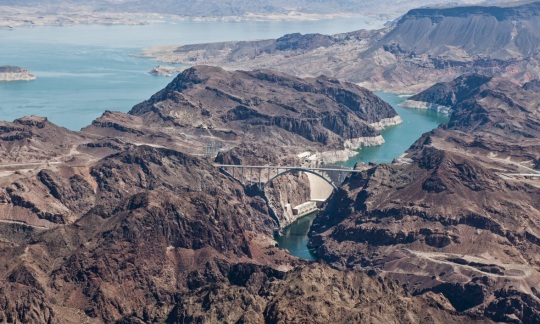
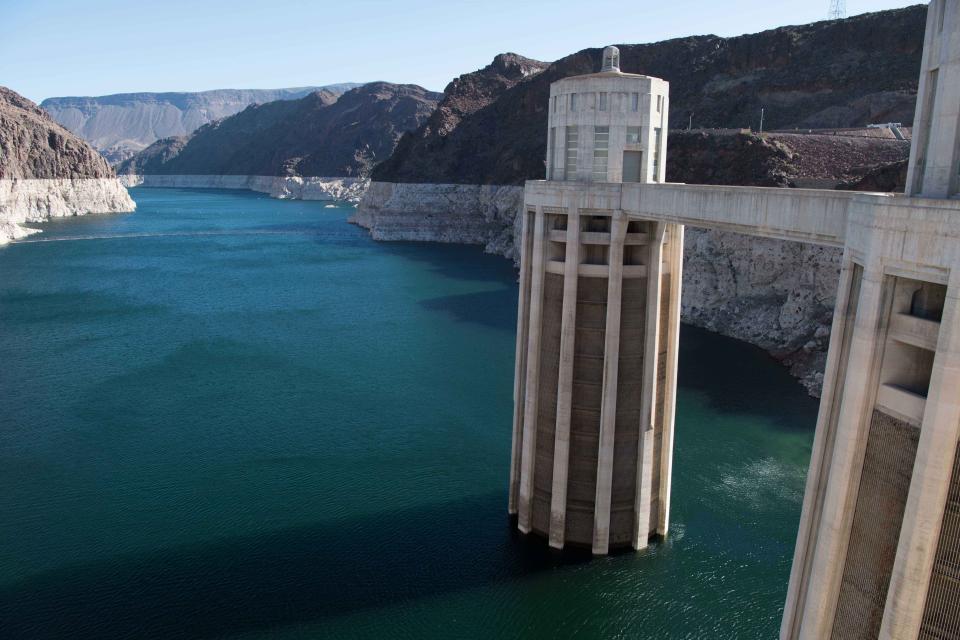
Hoover Dam and Lake Mead. Photo credit: USBR

Click the link to read the article on the Colorado Newsline website (Lia Chien):

May 31, 2024

The U.S. Department of the Interior and Bureau of Reclamation will send $242 million to five projects in Western states to improve water storage and clean drinking water supply, the bureau said Thursday.

The money, part of the president’s domestic infrastructure and manufacturing agenda and funded through the 2021 bipartisan infrastructure law, is expected to develop 1.6 million acre-feet of water storage, supporting 6.4 million people per year. Projects in Colorado, Arizona, Washington state and California will receive funding.

The Arkansas Valley Conduit, a major pipeline project in Colorado that has stalled for decades, is set to receive $90 million. Once completed, it will bring clean water to 50,000 people in 39 communities across the southeastern portion of the state, according to a release from the Bureau of Reclamation.

John F. Kennedy at Commemoration of Fryingpan Arkansas Project in Pueblo, circa 1962.

Finishing the project has been a long time coming. President John F. Kennedy signed a law in 1962 to authorize construction of the pipeline, but work on the project has stalled over the past six decades due to lack of funding.

This year’s spending comes after almost $250 million in previous appropriations from the infrastructure law and other laws. The project overall is estimated to cost over $600 million, according to Colorado Public Radio.

Sen. John Hickenlooper, a Democrat from Colorado, said he is excited to see the project move along.

Arkansas Valley Conduit map via the Southeastern Colorado Water Conservancy District (Chris Woodka) June 2021.

“We broke ground on the Arkansas Valley Conduit to finally deliver clean drinking water to Southeast Colorado. Now, more Bipartisan Infrastructure Law investments like this one will speed up the timeline,” Hickenlooper said in a written statement Friday.

Washington state Cle Elum Pool Raise Project will receive $1 million to increase water capacity an additional 14,600 acre-feet. Cle Elum Lake is on the Cle Elum River, a tributary of the Yakima River that provides essential, high quality drinking water to the city of Cle Elum.

A feasibility study to address water storage solutions in Arizona’s Horseshoe and Bartlett reservoirs is also receiving $8.5 million. The reservoirs provide drinking water to the greater Phoenix area. Over many years, sediment build-up in the Horseshoe Reservoir has reduced water storage capacity.

Climate change affects water supply

Investments in conservation projects like these will also help provide water storage and safe drinking water as Western states feel the effects of climate change, like drought, more frequently, according to the Center for Climate and Energy Solutions, a research and advocacy group.

Rep. Raúl Grijalva, a Democrat from Arizona and the ranking member of the House Natural Resources Committee, said water infrastructure projects like these are critical as the West faces climate change.

Grijalva credited the bipartisan infrastructure law and Democrats’ 2022 energy, taxes and health policy law known as the Inflation Reduction Act with helping to boost federal spending on Western water projects.

“The more than $15 billion for western water projects and programs that Democrats passed in the Inflation Reduction Act and the Infrastructure Law is a gamechanger in our fight to secure clean drinking water, build our resilience to climate change, and restore critical rivers and watersheds,” said Grijalva in a statement.

Grijalva added that more investments are needed, especially to protect the most vulnerable populations from the effects of water shortages.

“While these investments will deliver much-needed relief to communities in Arizona and all over the West, much more must be done, especially for those underserved and Indigenous communities that are being disproportionately impacted by the climate crisis and are too often left behind,” he said.

Southwestern states, including Arizona, are expected to face more intense droughts as climate change intensifies, according to the Center for Climate and Energy Solutions. In the summer of 2021, drought conditions across the West were at their highest levels since 2000, according to the Bureau of Reclamation. Drought conditions worsened in 2022.

Washington state officials declared a drought emergency this April as they expect high temperatures and water shortages this summer.

Arkansas Valley Conduit receives another $90 million in federal funding — Southeastern #Colorado Water Conservancy District #ArkansasRiver

Workers for Pate Construction Company install 30-inch PVC pipe on Colorado Highway 96 as part of the Arkansas Valley Conduit Project. Photo credit: Southeastern Colorado Water Conservancy District

Here’s the release from the Southeastern Colorado Water Conservancy District (Chris Woodka):

May 30, 2024

The Arkansas Valley Conduit received another $90 million in federal funding as construction continues on the drinking water line that will serve 39 water systems east of Pueblo.

“This is great news for the AVC and the people of Southeastern Colorado. Funding at this level is needed to keep the AVC moving forward, and we really appreciate the hard work that our congressional delegation and Reclamation officials at all levels have put into the AVC project,” said Bill

Long, President of the Southeastern Colorado Water Conservancy District. “The Southeastern District is looking forward to the day when we can fulfill the promise to bring clean drinking water to the people of the Lower Arkansas Valley.”

The Department of Interior announced the funding from the Bipartisan Infrastructure Law, along with other Western water projects. The AVC received the largest amount of BIL funding for any of the projects included in this year’s funding.

Arkansas Valley Conduit map via the Southeastern Colorado Water Conservancy District (Chris Woodka) June 2021.

The AVC is being built by the U.S. Bureau of Reclamation and the Southeastern Colorado Water Conservancy District. The 130-mile pipeline will serve 50,000 people when completed. To date, federal appropriations total more than $321 million, with state loans and grants of up to $120 million pledged. Local governments have contributed about $10 million, including American Rescue Plan Act funds.

Construction began on the AVC in 2023, with Reclamation constructing the Trunk Line from its connection with the Pueblo Water system at 36th Lane and U.S. Highway 50. So far, three federal contracts totaling almost $100 million have been issued for the AVC to date. In addition, $22 million has been paid to Pueblo Water for conveyance, treatment and transmission of AVC water from Pueblo Reservoir.

The District, through its Water Activity Enterprise, has built delivery lines to Avondale and Boone,using $1.2 million contributed by the Pueblo County Commissioners through American Rescue Plan Act (ARPA) funding.

Pueblo Dam. Photo courtesy of Colorado Parks and Wildlife

Leann Noga Named Executive Director of the Southeastern #Colorado Water Conservancy District

Leann Noga

Here’s the release from Southeastern Water (Chris Woodka):

Leann Noga, a longtime employee of the Southeastern Colorado Water Conservancy District, was appointed Executive Director of the District at a special Board of Directors meeting on March 8, 2024.

“Each and every one of us very much look forward to working with you, ” Board President Bill Long said. “I think we all have confidence in you and your ability to lead the Southeastern District. It’s a great day for the District.”

Long also thanked Jim Broderick, who is retiring, for his 22 years of service to the District as Executive Director. Mrs. Noga, 43, started working for the District in 2004, and most recently was the Director of Finance and Administrative Services.

“I want to be the spokesperson for the District and carry forward the Board’s message,” Mrs. Noga said following the appointment. “The Board is made up of water experts, and I will draw on that expertise. I will lead by example and manage with fairness and accountability.”

She briefly outlined her goals:

“At the top of the list of course is finishing the Arkansas Valley Conduit,” she said. “I also want to continue to develop relationships for the District, collaborate with others on water issues and protect the District and the value of its water.”

Mrs. Noga started in the District as an administrative support specialist but constantly continued to acquire the skills and education to advance within the organization. In 2013, she earned her Bachelor of Science degree in business administration from Colorado State University-Pueblo. In 2017, she earned a Master of Finance with a specialization in human resource management from Colorado State University.

At the same time, she and her husband Pat began raising a family. They have three children: Patrick, Mikey and Kayle. Pat attended the meeting in support of his wife on Friday. Mrs. Noga is also a member of the National Water Resources Association, Colorado River Water Users Association, Colorado Rural Water Association, Government Finance Officers Association, Colorado Water Congress, Water Education Colorado and Association for Records Management Association.

The Board’s decision was unanimous and came at the end of a search for a new Executive Director that began in December 2023. Several candidates were interviewed in February and Mrs. Noga was named the sole finalist by the Board at a February 21, 2024 meeting. Other Board members voiced strong support for Mrs. Noga.

“I think there is a real belief (in the Arkansas Basin) in your capacity to take on this leadership role and guide the next chapter of the District’s history,” said Board member Greg Felt, a Chaffee County Commissioner and Chairman of the Colorado Water Conservation Board. “There are a lot of people in this basin who are really proud of you, and I think there are lot of women who are exceptionally proud of you.”

Mrs. Noga pointed out after the meeting that the Board’s decision coincidentally occurred on International Women’s Day.

“It’s not lost on me than Leann literally started at the bottom and has worked herself to the top,” said Dallas May, a rancher who represents Prowers and Kiowa Counties. He is also chairman of the Colorado Parks and Wildlife Commission. “I think that’s so commendable that somebody could and would do that, and she’s done that at the same time as raising a family.”

“I think this decision is great for the District’s future,” said Alan Hamel, who represents Pueblo County on the Board. “You have a great staff. I’m sure with your leadership and the support of all 15 Board members, you’ll move the District forward. ”

The Southeastern District was formed in 1958 and includes parts of nine counties: Bent, Chaffee, Crowley, El Paso, Fremont, Kiowa, Otero, Prowers and Pueblo. The District is the state agency for the Fryingpan-Arkansas Project and administers the project in partnership with the U.S. Bureau of Reclamation. The two agencies are working together to build the Arkansas Valley Conduit.

Some of the District’s activities include allocation of Fry-Ark Project water, operation of the James W. Broderick Hydropower Plant at Pueblo Dam, an excess capacity storage contract for Pueblo Reservoir and the Upper Arkansas Voluntary Flow Management Program.

Arkansas Valley Conduit map via the Southeastern Colorado Water Conservancy District (Chris Woodka) June 2021.

Reclamation awards construction contract for Arkansas Valley Conduit treatment facilities: President Biden’s Bipartisan Infrastructure Law supporting major water infrastructure project to provide clean, reliable drinking water to 39 communities in southeastern #Colorado

Arkansas Valley Conduit map via the Southeastern Colorado Water Conservancy District (Chris Woodka) June 2021.

Click the link to read the release on the Reclamation website (Anna Perea and Darryl Asher):

Feb 29, 2024

LOVELAND, Colo. — The Bureau of Reclamation has awarded a contract for the construction of water treatment and connection facilities for the Arkansas Valley Conduit Project to Thalle Construction for $28,710,676. This contract, partially funded by President Biden’s Bipartisan Infrastructure Law, funds construction of a backflow preventor connecting the main trunkline to Pueblo Water’s system, and a treatment facility to address specific water treatment needs for the Project.  

The backflow preventer will be constructed at 36th Lane and U.S. Highway 50, east of Pueblo. The treatment facility will be located along the AVC pipeline route about 4 miles east of 36th Lane. The treatment process will prepare the water for conveyance through the trunkline to Project communities and ensure compatibility of the water with the AVC participants’ water systems.

“We’re extremely pleased to be able to move forward with multiple features of the Arkansas Valley Conduit,” said Jeff Rieker, Eastern Colorado Area Office Manager. “The momentum of making this connection to the eastern end of Pueblo’s water system while downstream pipes are being placed and additional designs are being developed really speaks to the collaborative efforts of all those involved.”

2022 three-party contract between Reclamation, Southeastern Colorado Water Conservancy District Board and the Pueblo Board of Water Works (Pueblo Water), eliminates the need for over 24 miles of pipeline by utilizing Pueblo Water’s existing infrastructure. The water will be either Fryingpan-Arkansas Project water or from participants’ water portfolios, not from Pueblo Water’s resources. 

“This is another important step forward for the Arkansas Valley Conduit, and vital to begin providing high-quality drinking water to the people of the Lower Arkansas Valley. The Southeastern District has tremendous appreciation for the work that Reclamation and our congressional delegation have done to keep this project moving forward,” said Bill Long, President, Southeastern Colorado Water Conservancy District.

In addition to the contract for these facilities, in January, Reclamation awarded a $4.6 million contract to Central Geotechnical Services, LLC to locate and complete subsurface utility engineering surveys for underground utilities along a 34-mile stretch of the Arkansas Valley Conduit. Colorado legislation, SB 18-167, enacted in 2018, set new standards for entities conducting underground excavation.

Arkansas River Basin via The Encyclopedia of Earth

Reclamation awards second construction contract for Arkansas Valley Conduit #ArkansasRiver #ColoradoRiver #COriver #aridification

Arkansas Valley Conduit map via the Southeastern Colorado Water Conservancy District (Chris Woodka) June 2021.

Click the link to read the article on the Reclamation website (Anna Perea and Darryl Asher):

President Biden’s Bipartisan Infrastructure Law supporting major water infrastructure project to provide clean, reliable drinking water to 39 communities in southeastern Colorado

Sep 15, 2023

LOVELAND, Colo. – The Bureau of Reclamation has awarded a contract for the second segment of trunkline of the Arkansas Valley Conduit to Pate Construction Co., Inc. for $27,216,950.00. This contract, partially funded by President Biden’s Bipartisan Infrastructure Law, funds construction of Boone Reach 2, which includes a 5.4 mile stretch of water pipeline and 7.4 miles of fiber conduit. Construction will follow Colorado State Highway 96 from North Avondale to Boone, Colorado.

President Biden’s Investing in America agenda represents the largest investment in climate resilience in the nation’s history and is providing much-needed resources to enhance Western communities’ resilience to drought and climate change. Through the Bipartisan Infrastructure Law, Reclamation is investing a total of $8.3 billion over five years for water infrastructure projects, including water purification and reuse, water storage and conveyance, desalination and dam safety. An overall $160 million has been allocated so far from the Law to complete the Arkansas Valley Conduit project.

This is a major infrastructure project that, upon completion, will provide reliable municipal and industrial water to 39 communities in southeastern Colorado. The pipeline will bring water from Pueblo Reservoir to Bent, Crowley, Kiowa, Otero, Prowers, and Pueblo counties. It is projected to serve up to 50,000 people in the future; equivalent to 7,500 acre-feet of water per year.

“We’re looking forward to this next project milestone,” said Jeff Rieker, Eastern Colorado area manager. “Today’s contract award allows the project to maintain the momentum we’ve built over the past year and helps us achieve the ultimate goal of bringing clean and reliable water supplies to the people of southeastern Colorado.”

“The Arkansas Valley Conduit is vitally important to the people of the Lower Arkansas Valley, so it is very rewarding to see the Bureau of Reclamation moving ahead,” said Bill Long, president of the Southeastern Colorado Water Conservancy District, local sponsors of the Arkansas Valley Conduit. “The Southeastern District also is working to complete this project as quickly as possible to provide a better quality of water for the people of the valley.”

Work on the first segment of trunk line began in spring of 2023 with completion anticipated in 2024. Reclamation expects work on the second segment, Boone Reach 2, to begin in late 2023 with completion slated for late summer 2025.

As the Arkansas Valley Conduit project moves forward, under existing agreements, Reclamation plans to construct the trunkline, water tanks, and related components, while the Southeastern Colorado Water Conservancy District coordinates with communities to fund and build the project’s water delivery pipelines. Eventually, the Arkansas Valley Conduit will connect 39 water systems along the 103-mile route to Lamar, Colorado. 

The project will use Pueblo Water’s existing infrastructure to treat and deliver Arkansas Valley Conduit water from Pueblo Reservoir to a connection point east of the city of Pueblo along U.S. Highway 50. The project will use water from either the Fryingpan-Arkansas Project or from a participant’s water portfolio, but not from Pueblo Water’s resources.

Congress authorized Arkansas Valley Conduit in the original Fryingpan-Arkansas Project legislation in 1962 (Public Law 87-590). This project does not increase Fryingpan-Arkansas Project water diversions from the western slope of Colorado; rather, it is intended to improve drinking water quality.

Currently, many people in the areas that will be served by the Arkansas Valley Conduit rely on groundwater supplies that contain naturally occurring radionuclides, such as radium and uranium, or use shallow wells that contain harmful microorganisms and pollutants. Alternatives for these communities consist of expensive options such as reverse-osmosis, ion exchange, filtration, and bottled water.  

If you have questions or need more information, please contact Anna Perea, public affairs specialist at the Bureau of Reclamation’s Eastern Colorado Area Office, at (970) 290-1185 or aperea@usbr.gov. If you are deaf, hard of hearing or have a speech disability, please dial 7-1-1 to access telecommunications relay services.

Pueblo Dam. Photo courtesy of Colorado Parks and Wildlife

Arkansas Valley Conduit Awarded Another $100 million — Southeastern #Colorado Water Conservancy District #ArkansasRiver

Arkansas Valley Conduit “A Path Forward” November 22, 2019 via Southeastern.

From email from Southeastern (Chris Woodka):

The Arkansas Valley Conduit (AVC) has received an additional $100 million in federal funding, the Department of Interior announced Thursday.

“We are exceedingly excited about today’s announcement,” said Jim Broderick, Executive Director of the Southeastern Colorado Water Conservancy District. “This funding will help us to continue to accelerate the construction of the Arkansas Valley Conduit in order to provide a clean, reliable drinking water supply to the people of the Lower Arkansas Valley.”

The AVC is being constructed by the Bureau of Reclamation and the Southeastern District’s Water Activity Enterprise are building the AVC, which will deliver water to 50,000 in 39 communities east of Pueblo. Reclamation has started construction on the trunk line of the AVC, while Southeastern awarded its first contract for Avondale and Boone delivery lines last week.

The most recent funding brings the total federal funding for AVC to $221 million since 2020, on top of about $30 million previously spent.

The state of Colorado has pledged $120 million toward the AVC, Southeastern has contributed $4.8 million and counties and participants have contributed or pledged $3 million in American Rescue Program Act (ARPA) funds, and participants have contributed about $2 million.

Roughly 1,000 linear feet of 30-inch diameter HDPE pipe has been welded for the Arkansas Valley Conduit trunk line. It will be placed in a trench 9 feet deep, which is being excavated by heavy equipment on Thursday, July 27, 2023. (Photo by Southeastern Colorado Water Conservancy District.)

Here’s the release from Reclamation:

WASHINGTON – The Department of the Interior today [July 27 2023] announced a $152 million investment from President Biden’s Bipartisan Infrastructure Law that will bring clean, reliable drinking water to communities across the West through six water storage and conveyance projects. The projects in California, Colorado and Washington are expected to develop at least 1.7 million acre-feet of additional water storage capacity, enough water to support 6.8 million people for a year. The funding will also invest in a feasibility study that could advance water storage capacity once completed.

President Biden’s Investing in America agenda represents the largest investment in climate resilience in the nation’s history and is providing much-needed resources to enhance Western communities’ resilience to drought and climate change, including protecting the short- and long-term sustainability of the Colorado River System. Through the Bipartisan Infrastructure Law, Reclamation is investing a total of $8.3 billion over five years for water infrastructure projects, including water purification and reuse, water storage and conveyance, desalination and dam safety. The Inflation Reduction Act is investing an additional $4.6 billion to address the historic drought.

“In the wake of severe drought across the West, the Department is putting funding from President Biden’s Investing in America agenda to work to provide clean, reliable drinking water to families, farmers and Tribes throughout the West,” said Secretary Deb Haaland. “Through the investments we’re announcing today, we will expedite essential water storage projects and provide increased water security to Western communities.”

“Water is essential to every community – for feeding families, growing crops, powering agricultural businesses and sustaining wildlife,” said Bureau of Reclamation Commissioner Camille Calimlim Touton. “Our investment in these projects will increase water storage capacity and lay conveyance pipeline to deliver reliable and safe drinking water and build resiliency for communities most impacted by drought.”

The selected projects from today’s announcement are:

California:

  • B.F. Sisk Dam Raise and Reservoir Expansion Project: $10 million to the San Luis and Delta- Mendota Authority, to pursue the B.F. Sisk Dam Raise and Reservoir Expansion Project. The project is associated with the B.F. Sisk Safety of Dams Modification Project. Once completed, the project will develop approximately 130,000 acre-feet of additional storage.
  • North of Delta Off Stream Storage (Sites Reservoir Project): $30 million to pursue off stream storage capable for up to 1.5 million acre-feet of water in the Sacramento River system located in the Coast range mountains west of Maxwell, California. The reservoir would utilize new and existing facilities to move water in and out of the reservoir, with ultimate release to the Sacramento River system via existing canals, a new pipeline near Dunnigan, and the Colusa Basin Drain.
  • Los Vaqueros Reservoir Expansion Phase II: $10 million to efficiently integrate approximately 115,000 acre-feet of additional water storage through new conveyance facilities with existing facilities. This will allow Delta water supplies to be safely diverted, stored and delivered to beneficiaries.

Colorado

• Arkansas Valley Conduit: $100 million to continue construction of a safe, long-term water supply to an estimated 50,000 people in 39 rural communities along the Arkansas River. Once completed, the project will replace current groundwater sources contaminated with radionuclides and help communities comply with Environmental Protection Act drinking water regulations for more than 103 miles of pipelines designed to deliver up to 7,500 acre-feet of water per year from Pueblo Reservoir.

Washington

• Upper Yakima System Storage Feasibility Study: $1 million to begin a feasibility study to identify and assess storage alternatives within the Kittitas Irrigation District area. The district could

utilize conserved water or water diverted for storage as part of total water supply available for tangible improvements in meeting instream flow objectives, tributary supplementation efforts, aquatic habitat improvements, and support the delisting of steelhead and bull trout populations to meet the goals of the Yakima Basin Integrated Plan.

• Cle Elum Pool Raise Project: $1 million to continue to increase the reservoir’s capacity to an additional 14,600 acre-feet to be managed for instream flows for fish. Additional funds for shoreline protection will provide mitigation for the pool raise.

Today’s investments build on $210 million in funding announced last year from the Bipartisan Infrastructure Law for water storage and conveyance projects.

Map of the Arkansas River drainage basin. Created using USGS National Map and NASA SRTM data. By Shannon1 – Own work, CC BY-SA 4.0, https://commons.wikimedia.org/w/index.php?curid=79039596

Biden-Harris Administration breaks ground on Boone Reach trunk line of Arkansas Valley Conduit #ArkansasRiver

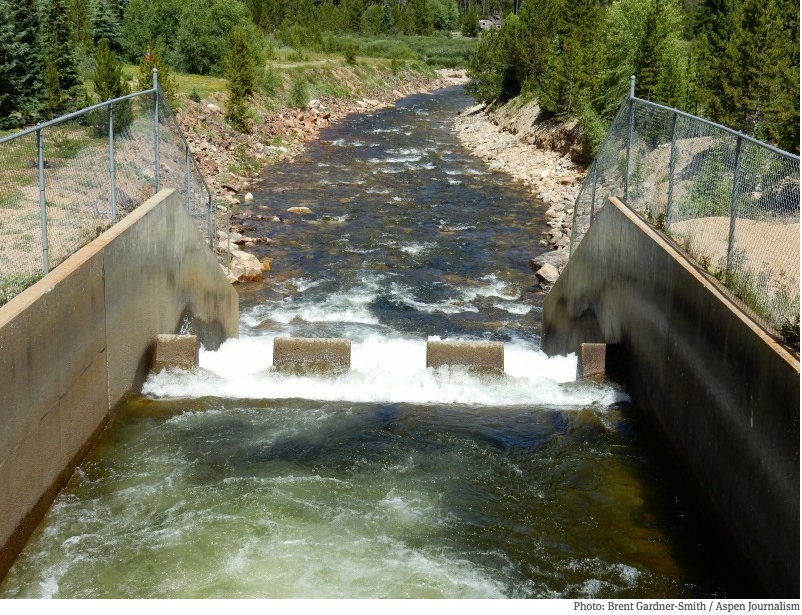
The outflow of the Bousted Tunnel just above Turquoise Reservoir near Leadville. The tunnel moves water from tributaries of the Roaring Fork and Fryingpan rivers under the Continental Divide for use by Front Range cities, and Pitkin County officials have concerns that more water will someday be sent through it.

Click the link to read the release on the Reclamation website (Anna Perea):

Major water infrastructure project funded by the Bipartisan Infrastructure Law to provide clean, reliable drinking water to 50,000 Coloradans once completed

PUEBLO, Colo. – The Bureau of Reclamation today broke ground on the Boone Reach trunk line of the Arkansas Valley Conduit (AVC), a major infrastructure project under President Biden’s Investing in America agenda that will bring clean, reliable drinking water to 39 communities in southeastern Colorado.

Deputy Assistant Secretary for Water and Science Gary Gold and Reclamation Commissioner Camille Calimlim Touton joined local and Federal leaders at the groundbreaking ceremony where they highlighted the $60 million investment provided through President Biden’s Bipartisan Infrastructure Law for the project. When completed, the project’s 230 miles of pipeline will deliver as much as 7,500 acre-feet of water annually from Pueblo to Lamar, where water providers in Bent, Crowley, Kiowa, Otero, Prowers and Pueblo counties will serve a projected future population of 50,000.

“The results of the historic investment from the Bipartisan Infrastructure Law are evident here today as we see this project moving forward,” said Deputy Assistant Secretary for Water and Science Gary Gold. “This project will bring a long-term, clean water supply to so many communities in southeastern Colorado.” 

“Through the President’s Investing in America agenda, Reclamation is now well positioned to help advance these important water projects that have been paused for decades,” said Bureau of Reclamation Commissioner Camille Calimlim Touton. “Our investment in this project, dedicated by President Kennedy more than 60 years ago, will provide the path forward for safe drinking water to so many residents of this area.”

“This long-awaited project is a vital step forward for the Arkansas Valley and shows what can be accomplished through a strong coalition of federal, state, and local partnerships,” said Jeff Rieker, Eastern Colorado Area Manager.

“Generations of people of the Lower Arkansas Valley have waited for the AVC for more than 60 years, and now with construction starting, we are seeing the realization of that dream,” said Bill Long, President of the Southeastern Colorado Water Conservancy District. “This is the culmination of years of determination on the part of Reclamation, the District and the AVC participants to get this job done.”

“This is a truly monumental achievement and marks the culmination of decades of hard work, dedication, and collaboration by those who have devoted their lives to the business of water,” said Seth Clayton, executive director of Pueblo Water. “Pueblo Water is proud to be an integral participant in this important time in history.”

The Arkansas Valley Conduit was part of the 1962 Fryingpan-Arkansas Project Act, and its construction represents the completion of the project. Once complete the project will replace current groundwater sources contaminated with radionuclides and help communities comply with Environmental Protection Act drinking water regulations. The connection point for AVC is at the east end of Pueblo Water’s system, at 36th Lane and U.S. Highway 50, and follows the Arkansas River corridor from Pueblo to Lamar, with spurs to Eads and Crowley County. Reclamation is building the trunk line, while the Southeastern District will build the spur and delivery lines. Estimated total cost is about $600 million.

The Bipartisan Infrastructure Law allocates $8.3 billion for Bureau of Reclamation water infrastructure projects over five years to advance drought resilience and expand access to clean water for families, farmers, and wildlife. The investment will repair aging water delivery systems, secure dams, and complete rural water projects, and protect aquatic ecosystems. The funding for this project is part of the $1.05 billion in Water Storage, Groundwater Storage and Conveyance Projects provided by the Law.  

Michael Bennet, Colorado Senator; Bill Long, Southeastern Colorado Water Conservancy District; Camille Calimlim Touton, Reclamation Commissioner; Rebecca Mitchell, Director Colorado Water Conservation Board stand with pipe for the construction of the Arkansas Valley Conduit. Photo credit: Reclamation

Click the link to read “Arkansas Valley Conduit project breaks ground” on The Pueblo Chieftain website (James Bartolo/USA Today). Here’s an excerpt:

Advocates of the Arkansas Valley Conduit celebrated the groundbreaking of the conduit’s Boone Reach 1 trunk line, which will connect Pueblo’s water system to Boone, on Friday, April 28, at Martin Marietta Rich Sand & Gravel east of Pueblo. The trunk line is the first 6-mile piece of the conduit’s planned 230mile project stretching from Pueblo to Lamar and Eads. Once completed, the conduit will send up to 7,500 acrefeet of Pueblo Reservoir water to about 50,000 southeastern Colorado residents. WCA Construction LLC., a Towaoc, Colorado-based company owned by the Ute Tribe, was awarded a $42.9 million contract from the U.S. Bureau of Reclamation in September 2022 to complete construction of the Boone Reach 1 trunk line.

Communities benefitting from the conduit include communities in eastern Pueblo, Crowley, Otero, Bent, Kiowa and Prowers counties. Drinking water in many of these communities currently contains contaminants like radionuclides and selenium, according to Bill Long, board president of the Southeastern Colorado Water Conservancy District…

Estimates for the total cost of the project are between $600 and $700 million, Long said. Project leaders hope to receive upward of $500 million more from the federal government. After receiving $60 million from the Bipartisan Infrastructure Package, the Arkansas Valley Conduit continues to be a competitive project in the fight for future federal funding, according to U.S. Bureau of Reclamation Commissioner Camile Touton.

Arkansas Valley Conduit map via the Southeastern Colorado Water Conservancy District (Chris Woodka) June 2021.

Reclamation initiates construction on the Arkansas Valley Conduit Boone Reach April 29, 2023

Funding Arrives to Complete the Arkansas Valley Conduit — The Ark Valley Voice #ArkansasRiver

The outfall of the Bousted Tunnel, which delivers water from the Roaring Fork and Fryingpan rivers to the East Slope.

Click the link to read the article on the Ark Valley Voice website (Jan Wondra). Here’s an excerpt:

The Bureau of Reclamation (BoR) announced on Monday that it will direct $60 million in federal funding from the Infrastructure Investment and Jobs Act (IIJA) towards advancing the construction of the Arkansas Valley Conduit (AVC), a 130-mile pipeline project from Pueblo Reservoir east to Eads, Colorado that will deliver safe, clean drinking water to 50,000 people in 40 communities. The Colorado Water Conservation Board (CWCB) has supported this project with $100 million in grants and loans. The Arkansas Valley Conduit project is the final element of the larger Fryingpan-Arkansas Project, which Congress authorized in 1962. The project has literally been decades in the making.

“The SECWCD is thrilled with the announcement by the Bureau of Reclamation that $60 million from the bipartisan Infrastructure Investment and Jobs Act has been allocated for construction of the Arkansas Valley Conduit. This follows on the heels of the award of the first construction contract for the Boone reach,” said Southeastern Colorado Water Conservancy District Senior Policy and Issues Manager Chris Woodka.

“This commitment from BoR is a clear indication of their intent to move this project forward to completion, and to direct resources to it so that clean drinking water will be delivered sooner than originally planned,” he added. “We thank each and every one of you for your patience, and your ongoing support.”

The 5.5 mile Boustead Tunnel transports water from the Fryingpan River drainage into the Arkansas by way of Turquoise Lake (pictured here).

Senators Bennet and Hickenlooper Deliver $60 Million from Bipartisan #Infrastructure Law for Arkansas Valley Conduit: Funding Will Provide Safe Drinking #Water for S.E. #Colorado #ArkansasRiver

President John F. Kennedy at dedication of the Fryingpan-Arkansas Project.

Click the link to read the release on Senator Bennet’s website:

Today [October 17, 2022], Colorado U.S. Senators Michael Bennet and John Hickenlooper welcomed an announcement from the Bureau of Reclamation (BOR) of the distribution of $60 million in funds from the Bipartisan Infrastructure Law to support the completion of the Arkansas Valley Conduit (AVC), providing Coloradans with a secure and safe supply of water. In July, the senators and U.S. Colorado Representative Ken Buck urged the Office of Management and Budget (OMB) and BOR to allocate funds from the infrastructure law for the AVC. The Weeminuche Construction Authority, an enterprise of the Ute Mountain Ute Tribe, has been awarded the contract for this phase of construction of the AVC.

“Sixty years ago, President Kennedy came to Pueblo and promised to build the Arkansas Valley Conduit to deliver clean drinking water to families in Southeastern Colorado. Since I’ve been in  the Senate, I’ve fought to ensure the federal government keeps its word to Colorado and finishes this vital infrastructure project,” said Bennet. “One of the first bills I passed helped to jumpstart and fund construction on the Arkansas Valley Conduit, and with this announcement, we’ve delivered more than $140 million to help complete construction and deliver on this decades-old promise.”

“Thanks to the Bipartisan Infrastructure Act, long-stalled projects like the Ark Valley Conduit are moving forward. Today, we’re bringing this 60 year project over the finish line,” said Hickenlooper. 

Arkansas Valley Conduit map via the Southeastern Colorado Water Conservancy District (Chris Woodka) June 2021.

The AVC is a planned 130-mile water-delivery system from the Pueblo Dam to communities throughout the Arkansas River Valley in Southeast Colorado. This funding will expedite the construction timeline for the Conduit and allow for federal drinking water standards to be met more quickly. The Conduit is the final phase of the Fryingpan-Arkansas Project, which Congress authorized in 1962.

Bennet and Hickenlooper have consistently advocated for increased funding for the AVC. In May, the senators sent a letter to the Appropriations Committee to include funding for the AVC in the FY23 spending bill. In March, Bennet and Hickenlooper helped secure $12 million for the Conduit from the FY22 omnibus bill. Bennet and Hickenlooper will continue working in Washington to ensure communities have the resources needed to complete this vital project for the region.

“We have been working hard to move this project from planning to construction. This announcement follows the first construction contract award, and is a clear indication that the District and Reclamation will continue to partner in this long-time effort to bring clean drinking water to the Lower Arkansas Valley. Our Senators were key to obtaining more than $8 billion for the Bureau in the IIJA, and our delegation’s long-standing bipartisan support along with support from the State of Colorado have put the conduit on Reclamation’s front line for construction,” said Southeastern Colorado Water Conservancy District board president Bill Long.

“The Ute Mountain Ute Tribe and its construction enterprise are honored to be a partner in delivering safe drinking water to the Lower Arkansas Valley. Like other projects Weeminuche Construction Authority has been a part of, the Arkansas Valley Conduit has been a long time coming, but will provide enormous benefit. The infrastructure dollars for the Bureau of Reclamation, making this possible, are a credit to Senator Bennet’s efforts to build support for Western water infrastructure,” said Michael Preston, Board President, Weenuch-u’ Development Corporation of the Ute Mountain Ute Tribe.

“As a regional leader in water issues in southern Colorado, Pueblo Water is proud to help push the Arkansas Valley Conduit forward. Our strong relationship with the Southeastern Colorado Water Conservancy District, the Bureau of Reclamation, and other partners helped make it possible for this project to come to fruition. Through this partnership, communities in Southeastern Colorado will have access to clean water faster than thought possible,” said Seth Clayton, Executive Director of Pueblo Water.

Background: 

Prior to this announcement, Bennet has helped secure over $80 million for the AVC.

In 2009, Congress passed legislation written by Bennet and former U.S. Senator Mark Udall (D-Colo.) to authorize a federal cost share and the construction of the Arkansas Valley Conduit. Bennet then worked to secure $5 million in federal funding for the project. 

In 2013, Bennet and his colleagues sent a letter to the BOR to quickly approve the Conduit’s Environmental Impact Study (EIS) in order to expedite the project’s completion. In 2014, following Bennet and Udall’s efforts to urge the BOR to quickly approve the Conduit’s EIS, the Record of Decision was signed in February. After President  Obama’s budget included an insufficient level of funding for the project, Bennet led a bipartisan letter urging the administration and the House and Senate Appropriations Committees to allow the Conduit’s construction to move ahead as planned. Bennet successfully urged the Department of Interior to designate $2 million in reprogrammed funding from FY14 for the Conduit. Bennet secured language in the FY15 Senate Energy and Water Development Appropriations Act that sent a clear signal to the BOR that the Conduit should be a priority project. 

In 2016, Bennet secured $2 million from the BOR’s reprogrammed funding for FY16, after the project had initially received only $500,000. Bennet then secured $3 million for the AVC as part of the FY17 spending bill. Bennet secured $3 million for the Conduit for FY18.

In April 2019, Bennet and former U.S. Senator Cory Gardner (R-Colo.) wrote to then-Senate Appropriations Committee Chairman Lamar Alexander (R-Tenn.) and Ranking Member Feinstein, urging them to provide funding for the Conduit. Bennet, Gardner, former U.S. Congressman Scott Tipton (R-Colo.), and Buck wrote to the Department of the Interior urging the Department to support the project. Bennet secured approximately $10 million each year for the Conduit in the FY19 and FY20 spending bills. In 2020, Bennet welcomed $28 million from the BOR to begin construction on the AVC to help bring clean drinking water to Colorado communities. He secured $11 million for the AVC in FY21. He joined the ground breaking in October 2020.

Arkansas River Basin via The Encyclopedia of Earth

Reclamation awards construction contract for initial segment of Arkansas Valley Conduit: #Boone Reach Contract 1 connects six miles of pipeline to the eastern end of #Pueblo Water’s system #ArkansasRiver

Arkansas Valley Conduit map via the Southeastern Colorado Water Conservancy District (Chris Woodka) June 2021.

From email from Reclamation (Elizabeth Smith):

The Bureau of Reclamation awarded the inaugural contract of the Arkansas Valley Conduit (AVC) to WCA Construction LLC, for $42,988,099.79. This contract funds construction of the first Boone Reach trunk line section, a 6-mile stretch of pipeline that extends from the eastern end of Pueblo Water’s system toward Boone, Colorado.

The AVC project will use Pueblo Water’s existing infrastructure to treat and deliver AVC water from Pueblo Reservoir to a connection point east of the City of Pueblo along U.S. Highway 50. The water will be either Fryingpan-Arkansas Project water or from participants’ water portfolios, not from Pueblo Water’s resources. Work under this contract will begin in spring of 2023. This section is expected to be completed in 2024.

“Now more than ever, people in the Arkansas River Valley understand the immense value of the Fryingpan-Arkansas Project and the Arkansas Valley Conduit,” said Jeff Rieker, Eastern Colorado Area Manager. “We look forward to the day when these residents can open the faucet and know that their drinking water is safe and healthy.” As the AVC project moves forward, under existing agreements, Reclamation will construct the trunkline, a treatment plant and water tanks while the Southeastern Colorado Water Conservancy District will coordinate with communities to fund and build AVC delivery pipelines. Eventually, the AVC will connect 39 water systems along the 130-mile route to Lamar, Colorado.

The AVC is a major infrastructure project that, upon completion, will provide reliable municipal and industrial water to 39 communities in Southeastern Colorado. The pipelines will bring water from Pueblo Reservoir to Bent, Crowley, Kiowa, Otero, Prowers, and Pueblo counties. It is projected to serve up to 50,000 people in the future (equivalent to 7,500 acre-feet per year).

John F. Kennedy at Commemoration of Fryingpan Arkansas Project in Pueblo, circa 1962.

The AVC was authorized in the original Fryingpan-Arkansas Project legislation in 1962 (Public Law 87-590). The AVC would not increase Fry-Ark Project water diversions from the Western Slope of Colorado; rather, it was intended to improve drinking water quality.

Currently, many people in the areas that will be served by the AVC rely on groundwater supplies that may be contaminated by naturally occurring radionuclides, such as radium and uranium, or use shallow wells that contain harmful microorganisms and pollutants. Alternatives for these communities consist of expensive options such as reverse-osmosis, ion exchange, filtration, and bottled water. 

This contract continues many years of hard work by Reclamation, Southeastern, Pueblo Water and other project partners to improve the lives of residents and provide opportunities for economic development and job creation.

If you have any questions or need more information, please contact Anna Perea, Public Affairs Specialist at the Bureau of Reclamation’s Eastern Colorado Area Office, at (970) 290-1185 or aperea@usbr.gov. If you are deaf, hard of hearing or have a speech disability, please dial 7-1-1 to access telecommunications relay services.

Map of the Arkansas River drainage basin. Created using USGS National Map and NASA SRTM data. By Shannon1 – Own work, CC BY-SA 4.0, https://commons.wikimedia.org/w/index.php?curid=79039596

Is the #ColoradoRiver a bellwether for the [#Colorado’s] other river systems? — The #GrandJunction Daily Sentinel #COriver #aridification

Click the link to read the guest column on the Grand Junction Daily Sentinel website (Eric Kuhn and Jennifer Gimbel). Here’s an excerpt:

Unfortunately, the situation on the Colorado River is not unique. Colorado’s mountains are the headwaters of four major river systems: the Colorado, the Platte, the Arkansas and the Rio Grande. Each river provides critical water supplies for the present and future needs of our state; each is being impacted by the effects of climate change; and under Interstate water compacts signed decades ago, Colorado must share each with its neighboring downstream states. Climate change, or what scientists are now referring to as aridification, has caused all of Colorado to be hotter and drier. The combined effects of climate change, interstate water compact obligations and intense competition for the available water among different communities and water use sectors within our state means that future Coloradans will have to learn to do more with less water. This will take bold action, compromise and a new era of innovation and cooperation among competing water interests within Colorado and among Colorado and its neighboring states.

Rio Grande through the eastern edge of Alamosa July 5, 2022. Photo credit: Chris Lopez/Alamosa Citizen

Already, the farmers in Colorado’s fertile Rio Grande Basin are struggling to maintain an aquifer by restricting pumping. They face an awful choice — reduce their collective uses of the aquifer to a sustainable level so that some farms can survive, or they all fail. At the same time, the surface water supply from the Rio Grande River, which must be shared with New Mexico and Texas, has diminished and most likely will continue to do so.

The Republican River’s South Fork near Hale, Colorado, with the region’s seemingly endless fields. Credit: Wikimedia Commons/Jeffrey Beall

The Republican River Basin, a small but agriculturally important river system that originates on the plains and flows east to its confluence with the Missouri River, is also stressed by overuse of the river supply. Productive farm fields are being fallowed so that Colorado can comply with the Republican River Compact. Fortunately for the Rio Grande and Republican river basins, the General Assembly set aside $60 million to buy out farms in order to leave water in the aquifers and river systems. That amount is a drop in the bucket for what will be needed to recover and sustain those systems.

The Arkansas River and South Platte River systems also have significant challenges. These basins are home to 85% of Colorado’s population and to most of its commercial agriculture. The farm economy in the Arkansas has already suffered when the Colorado State Engineer had to cut back the use of alluvial wells, which were depleting flows to the Arkansas River and causing Colorado to be out of compliance with the Arkansas River Compact. The South Platte River system, which relies on return flows to sustain the river past the state line, is seeing much higher demands. The current return flow regime is threatened by Nebraska reinvigorating the proposed Perkin’s Ditch, a century-old feature provided for in the 1923 South Platte Compact. Both these basins are being hammered by the combined impacts of Front Range cities rushing to buy and dry existing farms to provide water for future growth while their water supplies imported from the Colorado River Basin have become less reliable due to climate change caused drought and compact obligations.

Colorado’s future economy will depend on implementing innovative methods to sustain, deliver and treat water supplies while leaving enough water in our streams to maintain healthy and thriving aquatic ecosystems. Water delivery entities need to think broader to collaborate with others on ways to manage and share their supplies and their systems.

Southeastern #Colorado Water Conservancy District Board Appointments announced

Click the image for a larger view.

Here’s the release from the Southeastern Colorado Water Conservancy District Board (Chris Woodka):

One newcomer is joining five returning members on the Southeastern Colorado Water Conservancy District Board of Directors. The appointments were made by a panel of District Judges in early April, and all six members were sworn into office Thursday, April 21, 2022.

Joining the Board is Matt Heimerich, 64, of Olney Springs, representing Crowley County. He will fill the four-year term of Carl McClure, who served for 17 years before retiring in 2022. The term will expire in 2025.

Heimerich is following in the footsteps of his father-in-law, Orville Tomky, who served on the Southeastern Board from 1988-2005.

Heimerich praised both McClure and Tomky at his first Board meeting for their contributions to Crowley County in dealing with the aftermath of water transfers of water from Crowley County that threatened to devastate the small rural county.

“Trying to bring a transmountain water diversion to the Arkansas Valley started in the 1920s and 1930s, and the need is as strong or stronger today,” Heimerich said. “What else can the Fryingpan-Arkansas Project deliver to meet the challenges faced by the people who live here? On the municipal side of the Project, what a difference it will make when the Arkansas Valley Conduit is completed.”

A New York native, Heimerich married Tomky’s daughter Karen in 1985, and began working in the family’s farming operation in 1987. The family continued farming after water from many of their neighbors’ farms had been sold to municipalities. He is a member of the Colorado Canal and Lake Meredith boards. He plans to make agricultural a priority while on the Southeastern Board.

Heimerich served from 1999-2011 as a Crowley County Commissioner, was on the Arkansas River Compact Administration board from 2007-2013, worked for the Palmer Land Trust in the Arkansas Valley office from 2014-2021, and is a member of the Water Education Colorado advisory board.

Reappointed, and serving four-year terms that expire in 2026 are:

  • Bill Long, President, a businessman from Las Animas, representing Bent County, first appointed in 2002.
  • Curtis Mitchell, Vice President, retired Fountain Utilities Director, representing El Paso County, first appointed in 2014.
  • Ann Nichols, Treasurer, retired General Manager of Finance for Colorado Springs Utilities, representing El Paso County, first appointed in 2006.
  • Alan Hamel, retired Executive Director of Pueblo Water, representing Pueblo County, first appointed in 1988.
  • Tom Goodwin, retired from the Forest Service and USDA, representing Fremont County, first appointed in 2011.
  • The Southeastern District was formed in 1958 to administer the Fryingpan-Arkansas Project, which was approved by Congress in 1962. The District includes parts of nine counties in the Arkansas River basin and brings water into the basin from the Fryingpan River basin on the western slope. There are a total of 15 Directors on the Board.

    USBR, #Pueblo Water, Southeastern #Colorado #Water district ink new deal to ease Lower Arkansas Valley water contamination — @WaterEdCO #ArkansasRiver

    The Lower Arkansas River below Lake Cheraw. Credit: Jerd Smith

    Click the link to read the article on the Water Education Colorado website (Jerd Smith):

    Thousands of people in the Lower Arkansas Valley who’ve struggled to deal with contaminated water for more than 20 years will have access to clean water by 2024 under a new agreement signed by the federal government and two Colorado water agencies last week.

    The Arkansas Valley Conduit (AVC), as the clean water delivery project is known, will bring water from Pueblo Reservoir through the city of Pueblo and out to communities on the Eastern Plains, such as Avondale and Boone, by 2024, and other communities, such as La Junta, as soon as 2027.

    Arkansas Valley Conduit map via the Southeastern Colorado Water Conservancy District (Chris Woodka) June 2021.

    Water officials said the entire pipeline should be completed by 2035 if not sooner. The project will ultimately serve 50,000 people, officials said.

    Under the agreements, signed by the U.S. Bureau of Reclamation, the Pueblo Water Board, and the Southeastern Colorado Water Conservancy District March 18, some $40 million in federal and local funding will be available to launch construction, with subsequent funding for the $600 million project anticipated to come from Congress and local water agencies.

    In addition, the agreement allows Reclamation and Southeastern to pipe the water through the city of Pueblo’s water system, rather than building a separate system to move the water out to the Eastern Plains. Officials said this new agreement will shave costs and several years off the project.

    “This contract signing marks one of the most significant milestones to date towards making the AVC a reality and bringing clean water to communities that desperately need it. It advances the project over 14 miles east from Pueblo Reservoir which puts us much closer to our first participants in Avondale and Boone,” said Brent Esplin, regional director of the Missouri Basin and Arkansas-Rio Grande-Texas Gulf regions for Reclamation, in a statement.

    Naturally occurring selenium and lead, as well as radionuclides, have dogged the region’s water systems since the 1960s. Many of the communities face enforcement actions from the state health department because they don’t have the financial resources to treat the water for drinking and then to treat it again for discharge into the wastewater systems that discharge to the Lower Arkansas River and its tributaries, according to Chris Woodka, senior policy manager with the Southeastern Colorado Water Conservancy District. Southeastern operates the federal Fryingpan-Arkansas Project’s Pueblo Reservoir.

    “This project will relieve some of the pressures that they face. They will get better quality drinking water and they will see improvements to their discharged water,” Woodka said.

    Pueblo Reservoir

    The idea is to deliver clean water from Pueblo Reservoir directly to the communities via the 34-mile pipeline, reducing and sometimes eliminating the contaminants that the water now picks up when it travels through streams and irrigation ditches.

    The conduit has been on planning boards for more than 50 years but it wasn’t until a new federal law was approved in 2009 stipulating that the federal government would pick up 65% of the costs that the plan began to advance, Woodka said.

    Since then the region has wrestled with getting federal cash to start work and convincing local water agencies and the communities who need the water to cooperate on design issues and costs, Woodka said.

    “People are convinced it will get built,” Woodka said. “Now the questions are about affordability.”

    And for small towns, those are big questions.

    Tom Seaba is La Junta’s director of utilities. His city has comparatively clean water, with no radionuclides and a selenium issue that it is treating via reverse osmosis.

    “It could be the silver bullet that everyone would like to take care of the contaminants that are in the water. The flip side is the cost,” Seaba said.

    La Junta charges customer $2.50 per thousand gallons for water now, which includes treatment costs. The new water will cost $2.19 per thousand gallons, untreated, and La Junta will still have to find a way to recoup the cost to disinfect and treat the water.

    “Now that we’re getting down to brass tacks, we need to see if the underlying reality will do for us what everyone hopes it will. If we can connect and that takes care of the problems we have, sign us up. But if it doesn’t, we will have to do something else,” Seaba said.

    Jerd Smith is editor of Fresh Water News. She can be reached at 720-398-6474, via email at jerd@wateredco.org or @jerd_smith.

    Arkansas Valley Conduit Three-Party Contract Approved — Southeastern #Colorado #Water Conservancy District #ArkansasRiver

    A view across Lake Pueblo in Lake Pueblo State Park. The view is towards the south from Juniper Road. By Jeffrey Beall – Own work, CC BY 4.0, https://commons.wikimedia.org/w/index.php?curid=61042557

    Here’s the release from Southeastern Water (Chris Woodka), USBR (Elizabeth Smith), and Pueblo Water (Joe Cervi):

    A three-party contract allowing for the Arkansas Valley Conduit to deliver clean drinking water to 50,000 people in 39 communities east of Pueblo was signed by the Bureau of Reclamation on March 18, 2022, following approval by the Southeastern Colorado Water Conservancy District Board and the Pueblo Board of Water Works (Pueblo Water). The contract was drafted after negotiations that began in November 2021.

    “This contract signing marks one of the most significant milestones to date towards making the AVC a reality and bringing clean water to communities that desperately need it. It advances the project over 14 miles east from Pueblo Reservoir which puts us much closer to our first participants in Avondale and Boone,” said Brent Esplin, Regional Director of the Missouri-Basin and Arkansas-Rio Grande-Texas Gulf regions for Reclamation. “It is also the culmination of years of collaboration between Reclamation, Southeastern, and Pueblo Water to deliver a more cost-effective project to people of the lower Arkansas Valley.”

    The contract will allow the Southeastern District to use capacity in Pueblo Water’s system to treat and deliver AVC water to a pipeline being constructed by Reclamation. The connection point for AVC is at the east end of Pueblo Water’s system, at 36th Lane and U.S. Highway 50.

    Arkansas Valley Conduit map via the Southeastern Colorado Water Conservancy District (Chris Woodka) June 2021.

    The water will be either Fryingpan-Arkansas Project water or from participants’ water portfolios, not from Pueblo Water’s resources. The route of the AVC follows the Arkansas River corridor from Pueblo to Lamar, with spurs to Eads and Crowley County. Reclamation is building the trunk line, while the Southeastern District will build the spur and delivery lines. Estimated total cost is about $600 million.

    The Southeastern and Pueblo Water boards both unanimously approved the contract on March 15 and 17, 2022, respectively.

    “This project is vitally important to the people of the Lower Arkansas Valley,” said Bill Long, President of the Southeastern District board. “It would not be viable, and certainly not affordable without the partnership with Pueblo Water, and I would like to express my appreciation to the board.”

    “This is a truly monumental achievement and marks the culmination of decades of hard work, dedication, and collaboration by those who have devoted their lives to the business of water,” said Seth Clayton, executive director of Pueblo Water. “Pueblo Water is proud to be an integral participant in this important time in history.”

    Many of the Lower Arkansas Valley water systems face water-quality enforcement actions for radionuclides or surface contaminants in groundwater sources. They face ever increasing costs to cope with these problems. The AVC will eliminate or reduce the effects of those contaminants by delivering filtered water from Pueblo Reservoir.

    To deliver the full volume of water through the system, Pueblo Water must make some upgrades, and will receive a $20 million construction recovery fee. In addition, Pueblo Water will receive a $2 million investment payment. As the needs of AVC grow, Pueblo will receive funding for necessary improvements.
    This is seen as a win-win opportunity by both Pueblo Water and the Southeastern District because it reduces the cost of an earlier plan to build a new pipeline south of Pueblo.

    “Not only does the agreement save the AVC project hundreds of millions of dollars and years of construction time, but it also benefits Pueblo Water customers by providing an opportunity to use the excess capacity we have in our system and deliver water to our neighbors in the Lower Arkansas Valley,” Clayton said.

    Pueblo Water will charge an initial rate of $2.19 per 1,000 gallons delivered, which reflects the operation and maintenance costs of those parts of the system needed by AVC. The rate will increase annually at the same rate as Pueblo Water’s other customers.

    Pueblo Water will also renew its contract to store excess capacity water in Pueblo Reservoir for a 50- year period under the contract.

    Finally, the contract spells out environmental commitments and operating conditions related to AVC.

    “The significance of this action is that everybody will have the opportunity to have a clean source of drinking water after more than 20 years of work,” said Jim Broderick, executive director of the Southeastern District.

    Alan Hamel, a Southeastern Board member, and former Pueblo Water executive director, said the idea for the AVC actually goes back 60 years, to the 1962 signing of the Fryingpan-Arkansas Project into law.

    In 1968, there was a plan to jointly build a federal treatment plant for Pueblo Water and the water line for AVC.

    The AVC was put on hold because of the inability of communities to pay for it. The AVC concept was revived in 2000, and a 2009 federal law provided for 65 percent federal funding, to be matched by 35 percent in other funding.

    Reclamation issued a Record of Decision in 2014 which endorsed construction of the AVC to proceed via the “Comanche North” alignment. The alignment was modified in 2019 through a collaborative effort between Reclamation, Southeastern, and Pueblo Water which replaced the pipeline around Pueblo with this contract.

    Federal funding so far has totaled $40 million, while $100 million in loans or grants is available to AVC through the Colorado Water Conservation Board. The District has contributed $4.8 million through its Enterprise, while participants have paid $1.5 million since 2011.

    Pueblo County recently contributed $1.2 million to build delivery lines to Boone and Avondale through local American Rescue Plan Act funds, and other counties or cities in the Arkansas Valley are expected to contribute as well.

    Pueblo County pours more than $12 million into rural #water projects — The #Pueblo Chieftain

    Arkansas Valley Conduit map via the Southeastern Colorado Water Conservancy District (Chris Woodka) June 2021.

    Click the link to read the article on the Pueblo Chieftain website (Tracy Harmon). Here’s an excerpt:

    Rural Pueblo County residents are expected to see improvements to their drinking water in the next few years, thanks to $12.7 million in federal American Rescue Plan Act Funds being disbursed by Pueblo County Commissioners…Projects receiving funding include the Southeastern Colorado Water Conservancy District, which is working to deliver drinking water to Avondale and Boone as part of the U.S. Bureau of Reclamation’s Arkansas Valley Conduit project, said Chris Woodka, issues management coordinator for the district. It will receive $1.2 million to build delivery lines out of the bureau’s trunk line in eastern Pueblo County. That will bring water to about 1,600 Avondale residents and 230 Boone residents. Avondale Water District also will receive $3.2 million and the town of Boone’s water project will get $1.5 million…

    The communities’ water will come out of the Pueblo Reservoir. Once the water arrives in the eastern Pueblo communities, water managers will only have to re-chlorinate it before getting it to their customers, Woodka said…

    Of the remainder of the $12 million water infrastructure funds, Beulah Water Works and Colorado City Metro will get more than $3 million. Last July, the Colorado City Metropolitan District dealt with a low water pressure crisis caused by an internet outage at the district’s water treatment plants.

    USBR Releases Draft Environmental Assessment for Arkansas Valley Conduit #ArkansasRiver

    Arkansas Valley Conduit Logo. Credit: USBR

    Here’s the release from the Bureau of Reclamation (Elizabeth Smith):

    The Bureau of Reclamation released a draft environmental assessment to supplement a final environmental impact statement (FEIS) completed in 2013 for proposed changes associated with construction and operation of the Arkansas Valley Conduit (AVC).

    “Reclamation released an AVC Supplemental Information Report, in June 2021, that identified proposed changes in the AVC footprint, AVC participants, and a three-party contract with the Southeastern Colorado Water Conservancy District (Southeastern) and Pueblo Water,” said Reclamation Eastern Colorado Area Manager, Jeffrey Rieker. “This draft environmental assessment provides the supplemental analysis of the information in that report.”

    Arkansas Valley Conduit map via the Southeastern Colorado Water Conservancy District (Chris Woodka) June 2021.

    Reclamation would construct the AVC trunkline and Southeastern while AVC participants and others would construct AVC spur and delivery pipelines under the Proposed Action. The AVC project would utilize Pueblo Water’s existing system to treat and deliver AVC water from Pueblo Reservoir to a connection point east of the City of Pueblo along U.S. Highway 50, and eliminate 24.7 miles of pipeline construction around the city of Pueblo that was originally included the FEIS’s selected alternative.

    The three-party contract will address AVC’s use of Pueblo Water’s water treatment plant and water delivery system, as well as Pueblo Water’s continued use of excess capacity storage in Pueblo Reservoir. The contract also incorporates the storage of additional water rights associated with the Bessemer Ditch and will replace an existing 25-year excess capacity contract that expires in 2025.

    The environmental assessment has been prepared in compliance with the National Environmental Policy Act and is available for public review and comment at: https://www.usbr.gov/gp/ecao/avc/. The 2013 AVC FEIS, 2014 AVC Record of Decision, and 2021 AVC Supplemental Information Report can also be accessed from this webpage. Reclamation is requesting that any comments on the draft environmental assessment be submitted by January 30, 2022. Comments can be sent to tstroh@usbr.gov. For additional information, please contact Terence Stroh, Environmental Specialist, at 970-461-5469 or the above email address.

    AVC is and authorized feature for the Fryingpan-Arkansas Project in Southeastern Colorado in Pueblo, Crowley, Otero, Bent, Prowers and Kiowa Counties. You can find more information on the Fryingpan-Arkansas Project at: https://www.usbr.gov/projects.

    A #ColoradoRiver veteran takes on the top #Water & Science post at Interior Department — @WaterEdFdn #CRWUA2021 #COriver #aridification #ClimateChange

    Tanya Trujillo, Assistant Interior Secretary for Water and Science (Source: U.S. Department of the Interior)

    From the Water Education Foundation (Douglas Beeman):

    Western Water Q&A: Tanya Trujillo brings two decades of experience on Colorado River issues as she takes on the challenges of a river basin stressed by climate change

    For more than 20 years, Tanya Trujillo has been immersed in the many challenges of the Colorado River, the drought-stressed lifeline for 40 million people from Denver to Los Angeles and the source of irrigation water for more than 5 million acres of winter lettuce, supermarket melons and other crops.

    Trujillo has experience working in both the Upper and Lower Basins of the Colorado River, basins that split the river’s water evenly but are sometimes at odds with each other. She was a lawyer for the state of New Mexico, one of four states in the Upper Colorado River Basin, when key operating guidelines for sharing shortages on the river were negotiated in 2007. She later worked as executive director for the Colorado River Board of California, exposing her to the different perspectives and challenges facing California and the other states in the river’s Lower Basin.

    Now, she’ll have a chance to draw upon those different perspectives as Assistant Secretary of the Interior for Water and Science, where she oversees the U.S. Geological Survey and – more important for the Colorado River and federal water projects in California – the Bureau of Reclamation.

    Lake Powell, a key reservoir on the Colorado River, has seen water levels drop precipitously as a result of two decades of drought. (Source: The Water Desk and Lighthawk Conservation Flying)

    Trujillo has ample challenges ahead of her. For two decades, drought – fueled in no small part by climate change – has gripped the Colorado River Basin, starving the huge reservoirs of Lake Powell and Lake Mead of runoff. Drought plans in place since 2019 failed to stop the decline of these critical reservoirs. New operating guidelines for the river are now being discussed and the Basin’s 30 tribes, which have substantial rights to the river’s waters, want to make sure they get a seat at the negotiating table.

    The Department of Interior faces still other water challenges: For example, in southeastern desert of California, the ecologically troubled Salton Sea has nearly upended past Colorado River negotiations involving drought contingency planning.

    Trujillo talked with Western Water news about how her experience on the Colorado River will play into her new job, the impacts from the drought and how the river’s history of innovation should help.

    WESTERN WATER: You’ve worked on Colorado River issues for years, both in the Upper Basin (as a member of New Mexico’s Interstate Stream Commission) and Lower Basin (as executive director of the Colorado River Board of California). How is that informing your work now on Colorado River Basin issues?

    TRUJILLO: I’m very appreciative of having had several different positions that have allowed me to work on Colorado River issues from different perspectives. As the general counsel of the New Mexico Interstate Stream Commission, we were finalizing the 2007 Interim Guideline process [for the Colorado River] and I very much had an Upper Basin hat on at that time. That was also right in the middle of our work in New Mexico on negotiating the Indian water rights settlements with the Navajo Nation. Both the Guidelines and the Navajo settlement work really expanded the notion of flexibility in the Basin with respect to the existing statutes and the existing regulations.

    I had a Lower Basin perspective when I was working for the state of California on Colorado River issues with the Colorado River Board of California although I was working with a lot of the same people and there were a lot of familiar legal and operational questions. But for the other half of the job, I was brand new to California and was having to learn the whole Lower Basin perspective from scratch.… It was great just to learn the perspective of the Lower Basin and because there are quite a few challenges just within the Lower Basin that are independent of what’s going on in the Upper Basin.

    WW:It’s pretty clear the Colorado River Basin is in trouble – too little snowpack and runoff, too little water left in Lakes Powell and Mead. Are we headed toward a Compact call? Or are there still enough opportunities to protect Powell and Mead and meet obligations to the Lower Basin and Mexico without draining upstream reservoirs?

    More than two decades of drought in the Colorado River Basin have left Lake Mead, the nation’s largest reservoir, at just 34 percent of capacity. (Source: U.S. Bureau of Reclamation)

    TRUJILLO: I think in some respects it’s the wrong way to think about this question…. A better approach is to focus on the strategies the Upper Basin develop to continue to protect the water resources and communities and economies that rely on that water. There’s a lot to build off of.

    Going back to the ‘07 guidelines, we were thinking about building off of the existing regulations that described the operating criteria. We were thinking about how to protect those resources in the Upper Basin, even when there is a drought, even when there is less water that’s naturally occurring in the system on a continual basis.

    But that translates into concerns about how to protect the system in the context of the lower reservoir levels, including the impact on hydropower generation. Each of the Upper Basin states is carefully watching that not only from a power supply perspective, but because if there’s less [hydropower] production, there’s less funding coming in and the funding supports programs that are very important and beneficial to the Upper Basin, like the salinity control program and the [endangered] species recovery programs in the San Juan Basin and the Colorado Basin.

    So I know those are concerns that the states have, to protect the elevations at Lake Powell. And another important concern that we specifically agree on is the need to be very careful with respect to the infrastructure and the structural integrity of the [Glen Canyon] dam itself. We may have to operate the facilities at levels that we haven’t experienced before. So we have no operational experience with how the turbines are going to function – and not only the turbines but also how the structures are going to function if we have to use the jet tubes if the turbines are not available.

    WW: So there’s concern about how the structures function in terms of getting water from one side of the dam to the other? Or in terms of the physical structure itself?

    TRUJILLO: I’m a lawyer and not going to be opining on the actual engineering situation. But we have lots of people who are working in the Upper Basin and Denver Technical Center who are dam safety engineers and they have not had experience in working at this facility under those low water levels. And so that’s where there’s uncertainty. We don’t know how the structures will function under those conditions and that means that people are concerned about that uncertainty because that’s such a critical piece of the infrastructure. [That is] additional motivation among the Upper Basin states for trying to think proactively about how to make sure that the supply and the flows that extend down to Glen Canyon Dam can be maintained.

    WW: Given how drought and climate change have left far less water in the Colorado River than the 1922 Compact assumes, is it time to rethink that Compact? Or do you think the Compact and the rest of the Law of the River has the flexibility to accommodate the current realities? And how?

    TRUJILLO: I might take the liberty of quarreling a bit with the context of the question because I think the focus should be a forward-looking focus as opposed to rethinking the situation that existed 100 years ago. Even just looking at the past 20 years, we’ve been able to be very innovative and very focused on continued efforts to improve the [weather] prediction capabilities and continued efforts to make sure we have additional flexibility, additional tools, and additional conservation options that can help us work at a multi-faceted level. There are multiple layers of innovations and flexibilities that we have been able to successfully pull together, and my expectation and hope is that will be the same kind of approach that we will continue to work through.

    WW: In July, you toured portions of western Colorado to discuss drought and water challenges across the Upper Colorado River Basin. What did you hear? What did you tell them?

    TRUJILLO: That was a great trip. The basis of that trip was a listening session that was co-hosted with the governor of Colorado and our Interior Secretary, Deb Haaland. It was an opportunity to hear updates and perspectives from a wide variety of water users in Colorado…. I personally was able to visit quite a few communities in the West Slope, starting in Grand Junction, and see some of the innovative agreements that are coming together in that area with respect to some upgraded hydropower facilities. So it’s great to have the aging infrastructure issues being addressed in that area.

    Tanya Trujillo, assistant secretary of the Interior, speaks speaks during a stop while on a tour of Colorado this summer with Interior Secretary Deb Haaland (second from left). (Source: U.S. Department of the Interior)

    There is obviously a lot of strong, productive agricultural communities that are clearly watching with respect to any drought developments. I was also able to visit the Colorado River District board meeting and heard a discussion about the different perspectives relating to support for additional infrastructure and funding different infrastructure projects. There was a USGS proposal that was being approved by the River District, and they were able to really showcase the tremendous contribution that USGS is able to provide to some of their cooperative investigations. I also met with representatives from Northern Water and the Arkansas Valley Conduit Project, so it was a great opportunity to get an overview of the many important projects that are underway in Colorado.

    WW: Did they tell you anything that surprised you?

    TRUJILLO: No, I don’t think so. I have a pretty good base of background with some of the challenges that exist in that area. Maybe one way to sum up that that week of visits is that the broad variety of examples there in Colorado can be replicated in other states as well. It was great to just see a diversity of projects that are that are in place there. I would go back there in a second. It was the first trip for me in my tenure as assistant secretary and it was very informative.

    WW: As you know, the Salton Sea has been a festering environmental problem for years, and it threatened to upend California’s participation in the 2019 Lower Basin Drought Contingency Plan when Imperial Irrigation District insisted that the sea’s ills needed to be addressed as part of the DCP. What can — or should — Interior and the Bureau of Reclamation do to help find a sustainable solution for the Salton Sea?

    TRUJILLO: The Salton Sea has had a long history over the past century and is a dynamic and changing terminal lake. For decades there has been a recognition that the changing conditions at the Salton Sea needed to be addressed. The Bureau of Reclamation, other entities within the Department of the Interior and other federal agencies have been involved in the Salton Sea for many decades.

    The receding Salton Sea exposes large swaths of playa that generate harmful dust emissions. (Source: Department of Water Resources)

    There are various types of federal lands surrounding the Salton Sea, the Sonny Bono National Wildlife Refuge provides a sanctuary and breeding ground for migrating birds, and Reclamation plays an important role as a partner with respect to ongoing habitat and air quality projects in support of the state of California’s Salton Sea Management Program and the Dust Suppression Action Plan. Reclamation also works in partnership with Imperial Irrigation District to implement the Salton Sea Air Quality dust control plan. Since 2016, for example, Reclamation has provided approximately $14 million for Salton Sea projects, technical assistance and program management. Reclamation and its federal partners participate in a number of state-led committees and processes, providing technical expertise on activities related to the long-term restoration of the sea.

    Some Coloradans’ drinking water still has highest radium levels in the nation — The #ColoradoSprings Gazette

    Arkansas Valley Conduit map via the Southeastern Colorado Water Conservancy District (Chris Woodka) June 2021.

    From The Colorado Springs Gazette (Evan Wyloge):

    Some of the highest concentrations of radium-contaminated drinking water in the nation are clustered in rural southeast Colorado, according to a recent compilation of data.

    The problem is hardly new. The presence of radium in the area’s groundwater, which is linked to an increased cancer risk particularly for children, has been known for decades. The newly compiled data shows that out of the 50,000 water systems included in the research, six of the ten worst radium levels in the nation are in Colorado.

    The water providers are required to inform their customers of the contamination, and they say they’d like to fix the problem, but providing clean, radium-free tap water in the most remote areas comes with an untenable price tag.

    A massive infrastructure project that promises to largely resolve the problem, the Arkansas Valley Conduit, broke ground this year, but its completion is years away and the bulk of its funding hasn’t materialized yet.

    For now, most are hopeful that the conduit will be fully funded and fully built, but until then, the faucets in the area will still provide water with as much as four times the legal radium limit…

    Radium poses a unique risk to children, because it is treated by the human body like calcium and deposited into developing bones, where it remains radioactive and can kill and mutate cells.

    Although the area’s groundwater was known to have contaminants, high levels of radium in Colorado’s groundwater became a regulatory problem around 20 years ago, when the Environmental Protection Agency promulgated new radionuclide standards. Federal law allows up to 5 picocuries of radium-226 or radium-228, the most common versions of the element, per liter of water…

    Rocky Ford Melon Day 1893 via the Colorado Historical Society

    According to the Environmental Working Group’s new drinking water contamination data compilation, the worst radium content in the nation is found in Rocky Ford, where there was an average of 23 picocuries of radium per liter of water.

    Eighteen other water systems in Colorado contain more than the legal limit. Most are clustered around the small rural towns of Rocky Ford, Swink and La Junta, about an hour’s drive east from Pueblo. The new data show one in every six Otero County resident has tap water above the federal limit.

    After years of testing, studies and planning, the solution that‘s emerged is one proposed sixty years ago: The Arkansas Valley Conduit, the massive clean water delivery system proposal that stalled for decades over the project’s equally massive price tag.

    Elsewhere in the state the Peak View Park mobile home park, situated on a wooded hillside along U.S. Route 24 in Woodland Park, registered more than twice the legal limit of radium for years, as the owners struggled to get the problem fixed…

    But a key feature of the system Peak View Park installed is the access to Woodland Park’s sewer system. LaBarre said he had to make arrangements with the city’s wastewater treatment officials about the timing of their extraction system’s wastewater disposal, so that they can send the radium-saturated byproduct of the extraction process into the sewer when the system can adequately handle it…

    The lack of a sewer system is what cripples any similar efforts in the more rural areas around La Junta. There, where many of the residents use septic tanks, storing an extraction byproduct would be prohibitively expensive…

    Bill Long, the president of the Southeastern Colorado Water Conservancy District, said the towns along the first 12 miles of the [Arkansas Valley Conduit], Boone and Avondale, should be getting clean water from the conduit by 2024.

    More funding will be needed to finish the project, and Long said he believes there will be money allocated from the recently passed federal infrastructure bill, and that the funds could help get the conduit finished, but that the details aren’t yet clear.

    Arkansas River Basin alluvial aquifers via the Colorado Geological Survey

    Unclear waters: How pollution, diversions and #drought are squeezing the life out of the lower #ArkansasRiver Valley — The #Denver Post

    This view is from the top of John Martin Dam facing west over the body of the reservoir. The content of the reservoir in this picture was approximately 45,000 acre-feet (March 2014). By Jaywm – Own work, CC BY-SA 4.0, https://commons.wikimedia.org/w/index.php?curid=37682336

    From The Denver Post (RJ Sangosti):

    The Arkansas Valley Conduit promises to bring clean drinking water to more residents of southeast Colorado

    n the 1940s, the Arkansas River was dammed south of town to build [John Martin Reservoir], a place locals call the Sapphire on the Plains. The reservoir was tied up in a 40-year battle until Colorado and Kansas came to an agreement, in 2019, to provide an additional water source to help keep the levels high enough for recreation and to support fish.

    Forty years may seem like a long time to develop a plan to save fish and improve water levels for a reservoir, but southeastern Colorado is used to long fights when it comes to water…

    Arkansas Valley Conduit map via the Southeastern Colorado Water Conservancy District (Chris Woodka) June 2021.

    For nearly a century, leaders in southeastern Colorado have worked on plans to bring clean drinking water to the area through the proposed Arkansas Valley Conduit, but progress on the pipeline project stalled after a major push in the 1960s. Pollution, water transfers and years of worsening drought amid a warming climate continue to build stress for water systems in the area. Adding to that, the area continues to see population decline combined with a struggling economy.

    The water needed for the conduit will be sourced from melting snowpack in the Mosquito and Sawatch mountain ranges [ed. and Colorado River Basin]. Under the Fryingpan-Arkansas Project Act, passed in the early 1960s, the water has been allocated for usage in the Lower Arkansas Valley. The water will be stored at Pueblo Reservoir and travel through existing infrastructure to east Pueblo near the airport. From there, the conduit will tie into nearly 230 miles of pipeline to feed water to 40 communities in need.

    Renewed plans to build a pipeline to deliver clean drinking water to the Lower Arkansas Valley are bringing hope for many people in southeastern Colorado. But in an area that is inextricably linked to its water, the future can seem unclear…

    “Deliver on that promise”

    “It was nearly 100 years ago, in the 1930s, that the residents of southeast Colorado recognized that the water quality in the lower valley of the Arkansas River was quite poor,” said Bill Long, president of the Southeastern Colorado Water Conservancy District and a former Bent County commissioner.

    Water systems in the district, which includes Pueblo, Crowley, Bent, Prowers, Kiowa and Otero counties, have two main issues affecting drinking water.

    The first is that a majority of those systems rely on alluvial groundwater, which can have a high level of dissolved solids. This can include selenium, sulfate, manganese and uranium, which are linked to human health concerns.

    Second, the remaining systems in the water district rely on the Dakota-Cheyenne bedrock aquifer that can be affected by naturally occurring radionuclides. Radium and other radionuclides in the underlying geologic rock formation can dissolve into the water table and then be present in drinking water wells, also carrying health risks.

    John F. Kennedy at Commemoration of Fryingpan Arkansas Project in Pueblo, circa 1962.

    In 1962, residents in southeastern Colorado thought President John F. Kennedy was delivering a solution to their drinking water problem during a ceremony in Pueblo. Congress had passed the Fryingpan-Arkansas Project Act, and Kennedy came to Pueblo to authorize the construction of a pipeline to deliver clean drinking water…

    Residents of the 1930s began working on ideas to deliver clean drinking water to southeastern Colorado. By the 1950s, they were selling gold frying pans to raise money to send backers to Washington, D.C., to encourage Congress to pass the Fryingpan-Arkansas Project Act. But it wasn’t until 1962 that the pipeline authorization became a reality.

    Fast forward 58 years, and two more politicians came to Pueblo to address a crowd about the same pipeline project. This time, on Oct. 3, 2020, it was at the base of Pueblo Dam. Because of funding shortfalls, the Arkansas Valley Conduit was never built after it was authorized in 1962.

    The Colorado communities could not afford to cover 100% of the costs, as initially required, so in 2009, the act was amended to include a 65% federal share and a 35% local cost share. Additionally, in 2020, Congress appropriated $28 million more toward the project, according to the water conservancy district.

    That October day, Sens. Michael Bennet and Cory Gardner took turns talking about the importance of the project. They told a small crowd that when the pipeline is built, it will provide clean drinking water to 50,000 residents in southeastern Colorado…

    The water conservancy district estimates the pipeline project’s cost will range from $546 million to $610 million…

    Physical construction of the pipeline won’t start until 2022, according to the water district…

    “The solution to pollution Is dilution”

    A hand-painted sign with stenciled letters welcomes travelers on Highway 96 into Olney Springs. The highway cuts across four blocks that make up the width of the small town with around 340 residents.

    Olney Springs is one of six water systems in Crowley County that plans to have a delivery point, known as a spur, on the Arkansas Valley Conduit. The plans for the pipeline call for two spurs in Pueblo County, three in both Bent and Prowers counties, and one in Kiowa County. Out of the 40 total participants, the remaining 25 are in Otero County…

    Located along the Arkansas River about 70 miles east of Pueblo, La Junta is the largest municipality in Otero County. With its population around 7,000 and a Walmart Supercenter, a Holiday Inn Express and Sonic Drive-In, La Junta can feel like a metropolis when compared to Olney Springs.

    La Junta is one of two Arkansas Valley Conduit participants, along with Las Animas, that uses reverse osmosis to remove potentially harmful and naturally occurring toxins from the water. Reverse osmosis is a process that uses pressure to push water through a membrane to remove contaminants. According to the Department of the Interior and the Bureau of Reclamation’s Arkansas Valley Conduit Environmental Impact Statement, reverse osmosis can treat source water to meet standards, but the brine from the process “is an environmental concern, and operation costs are high.”

    The other participants use conventional methods to treat water. The environmental impact statement said those methods can be as simple as adding chlorine for disinfection and filtration or adding chemicals to remove suspended solids, but that those treatments “…cannot remove salt or radionuclides from water.”

    Tom Seaba, director of water and wastewater for La Junta, said out of a total of 24 water districts in Otero County, 19 were in violation with the state due to elevated levels of radionuclide.

    Four of the 19 came into compliance with the state’s drinking water standards after La Junta brought them onto its water system. The remaining 15 are still in violation with the state, according to Seaba.

    La Junta spent $18.5 million to build a wastewater treatment plant that came online in 2019 to help meet water standards for its community. But the city’s water treatment came with its own issue: selenium.

    After La Junta treats its water using reverse osmosis, the water system is left with a concentrate, which is safe drinking water. However, it’s also left with a waste stream high in selenium. “That wastewater has to go somewhere,” Seaba said. It goes to the city’s new wastewater treatment plant…

    According to the environmental impact statement, “La Junta’s wastewater discharge makes up about 1.5% of average annual flow in the Arkansas River.” The study goes on to say that during drought or low-flow events, the wastewater discharge can contribute up to half of the streamflow downstream from the gage.

    Seaba is looking to the Arkansas Valley Conduit as a possible answer. “The solution to pollution is dilution,” he said. The water from the pipeline will not have a selenium problem, Seaba explained. By blending water from the conduit with the selenium waste from reverse osmosis, La Junta hopes to reduce costs and stay compliant with Environmental Protection Agency standards to discharge into the river.

    The environmental review studied a section of the Arkansas River from where Fountain Creek runs into the river east to the Kansas border. The study found that a section of the river was impaired by selenium…

    “I sure don’t drink it”

    The EPA sets a maximum contaminant level in drinking water at 5 picocuries per liter of air for combined radium and 30 micrograms per liter for combined uranium. If contaminant levels are above those numbers, the water system is in violation of drinking water regulations, which the state enforces.

    According to data provided by the Colorado Department of Public Health and Environment, the Patterson Valley Water Company in Otero County, one of the 40 pipeline participants, had the highest result of 31 picocuries per liter for combined radium in 2020. In that same county, Rocky Ford, another pipeline participant, had a high result of 0.2 picocuries per liter for combined radium. According to the state health department, Rocky Ford’s combined radium sample numbers were last recorded in 2013.

    Manzanola, also in Otero County and a pipeline participant, topped the list with the highest result of 42 micrograms per liter for combined uranium in 2020. In contrast, 19 other pipeline participants, from across the valley, had results of 0 micrograms per liter for combined uranium, according to the most recent numbers from the state health department.

    Levels of the two carcinogens are sporadic throughout the valley. The average of the highest results of all 40 participants in the pipeline for combined radium is roughly 8 picocuries per liter and combined uranium is roughly 5 micrograms per liter. According to Seaba, averaging the members’ highest results might seem unfair to some individual water systems because it brings their numbers up, but what those averages do show is that water in Pueblo Reservoir, which will feed the future conduit, is approximately three times less affected by combined radium and combined uranium than the average of current water used by pipeline participants. In 2020, the highest result of combined radium in the Pueblo Reservoir was 2.52 picocuries per liter, and the highest result of combined uranium was 1.7 micrograms per liter…

    “I sure don’t drink it,” said Manny Rodriquez. “I don’t think anybody in town drinks the water.”

    Rodriquez, who grew up in and still lives in Rocky Ford, was not sure if the water at his apartment was in violation of the state’s clean drinking water act or not. State data showed at that time his water was not in violation. Colorado is required to notify residents if their water system is in violation of the clean drinking water act…

    MaryAnn Nason, a spokesperson for the Colorado Department of Public Health and Environment, used an example to show how violations can add up: “If a public water system has two entry points that fail for both combined radium and gross alpha (measures of radionuclides), and they have those same violations for 10 years each quarter, that is going to appear as 160 violations on the website. But really, it is one naturally occurring situation that exists for a relatively long time,” Nason said.

    For some residents like Ruby Lucero, 83, it makes little difference to her if her water is in violation with the state or not. She plans to buy her drinking water no matter what the results say about her tap water…

    Straight line diagram of the Lower Arkansas Valley ditches via Headwaters

    “The struggling farmer”

    In the past decade, Otero County has seen a 2.9% drop in population. Residents have a ballpark difference of $38,000 in the median household income compared to the rest of the state, and the county is not alone. All six counties that are part of current plans for the Arkansas Valley Conduit are seeing economic hard times.

    Adding to those factors is drought. Years of drought keep hitting the area’s No. 1 industry: agriculture.

    The Rocky Ford Ditch’s water rights date back to 1874, making them some of the most senior water rights in the Arkansas River system. In the early 1980s, Aurora was able to buy a majority of those water rights. Over time, Aurora acquired more shares and has converted them to municipal use…

    “We still have a heavy lift before us”

    Planned off the main trunk of the Arkansas Valley Conduit, a pump station near Wiley will push water along a spur to support Eads in Kiowa County. Water that ends up in Eads will have traveled the longest distance of the pipeline project. The majority of the pipeline will be gravity-fed, but this section will need to be pumped uphill.

    The journey is a good representation of Eads’ battle with water. Not only is clean drinking water needed, but the area is also desperate for relief from years of drought exacerbated by climate change…

    Long said that Eads is different from a majority of the other participants in the project because it is not located along the Arkansas River…

    The domestic water that will be delivered via the conduit is even more important for a town like Eads, said Long. “It’s very difficult to attract new industry when you have a limited supply of very poor water.”

    Long believes the conduit will make a huge difference to support communities in the Lower Arkansas River Valley…

    Long has been working on the Arkansas Valley Conduit project for nearly 18 years.

    “After such a long fight, to finally be where we are feels good, but honestly I can say it doesn’t feel as good as I thought it would. Only because I know we have so much work still to do, and I know how difficult the past 18 years have been,” Long said. “We still have a heavy lift before us.”

    Arkansas River Basin via The Encyclopedia of Earth

    Arkansas Valley Conduit project launched — The Pueblo Chieftain

    Arkansas Valley Conduit “A Path Forward” November 22, 2019 via Southeastern.

    From The Pueblo Chieftain (Steve Henson):

    Dignitaries from throughout the nation, including U.S. Secretary of the Interior David Bernhardt and Bureau of Reclamation Commissioner Brenda Burman, gathered at Lake Pueblo for the groundbreaking of a pipeline that will deliver clear water to the Lower Arkansas River Valley…

    As the conduit will bypass the Arkansas River, including the portion on Pueblo’s lower East Side where the heavily polluted Fountain Creek dumps into the river, it is seen as a regional solution to drinking water quality problems facing rural communities of Southeastern Colorado…

    It may be a decade or more before the conduit will be built, but the project is well on its way now.

    When completed, the conduit will serve an estimated 50,000 people in Southeastern Colorado via some 260 miles of pipeline.

    Bill Long, president of the Southeastern Colorado Water Conservancy District and former Bent County commissioner, said: “It’s kind of an emotional event because generations have actually worked on this project and to finally see this kind of progress where we can deliver safe water to folks, which also provides a great opportunity for economic development is close to unbelievable. It truly is a great day.”

    John Singletary, former chairman of the Lower Arkansas Valley Water Conservancy District, agreed:

    “As a young boy in the Arkansas Basin, I sold gold frying pans to support the effort that eventually lead to President Kennedy coming to Pueblo to sign the Fryingpan-Arkansas Project into a law,” Singletary said. “This was the first step in seeing the Arkansas Valley Conduit built. In the decades since, people like Senator Michael Bennet have never lost sight that this project is more than politics. The Conduit is a vision turned reality to help reduce dry-up of farm ground and provide clean drinking water for 50,000 people in 40 communities east of Pueblo.”

    The total project cost is estimated at somewhere between $564 and $610 million to complete over a 15-year period and about $30 million a year for the next 15 years will need to be appropriated to see it finished.

    From The Pueblo Chieftain (Rayan Severance):

    Sen. Michael Bennet, D-Colorado, who also has spent a lot of time and effort on the project throughout his career, echoed Long’s comments about ground finally being broken for the conduit.

    “It is a testament to the commitment of generations of people in the Lower Arkansas Valley to bring clean drinking water to communities that were promised it in the early ’60s and never had that promise fulfilled,” Bennet said. “One of the first things I heard about when I became a senator was the Arkansas Valley Conduit because of Bill (Long) and because of Ray Kogovsek, who had been the congressman for that area, and made the case about how important it was.”

    Bennet said the progress made on getting the conduit built has been a true bipartisan effort in which Democrats and Republicans have worked hand-in-hand…

    The conduit, part of the original Fryingpan-Arkansas Project, would bring water from Pueblo Dam to Lamar and Eads, serving about 40 communities along the route. As it will bypass the Arkansas River, including the portion on Pueblo’s lower East Side where Fountain Creek dumps into the river, it is seen as a regional solution to drinking water quality problems facing rural communities of Southeastern Colorado.

    Many of those water providers are facing enforcement action for high levels of naturally occurring radionuclides in well water. A new source of clean water through the Arkansas Valley Conduit is the least expensive alternative, according to a 2013 Environmental Impact Statement.

    While the project is breaking ground, there is still a long way to go, Bennet cautioned.

    The total project cost is estimated at somewhere between $564 and $610 million to complete over a 15-year period and about $30 million a year for the next 15 years will need to be appropriated to see it finished.

    “It’s not going to be easy to do but we’re going to fight for it,” Bennet said.

    Arkansas Valley Conduit funding gets final approval — The Pueblo Chieftain

    From The Pueblo Chieftain (Ryan Severance):

    Construction of the Arkansas Valley Conduit is expected to begin in the near future following the state’s approval of a $100 million financing package for it.

    The Colorado General Assembly has approved the annual Colorado Water Conservation project bill that contains the funding, and Gov. Jared Polis signed that bill into law earlier this week…

    The Arkansas Valley Conduit is estimated to cost between $564 and $610 million to complete over a 15-year period, according to Chris Woodka of the Southeastern Colorado Water Conservancy District.

    The $100 million in state funding would include $90 million in loans and $10 million in grants over the life of the project. When complete, the conduit will provide clean drinking water to 50,000 people in 40 communities.

    The conduit had received funding since 2010 to prepare for construction of the 130-mile pipeline which will deliver a safe drinking water supply to the Lower Arkansas Valley.

    In February, the Bureau of Reclamation announced that $28 million of fiscal year 2020 funding was being directed to the conduit in an effort to move from planning and design into construction. An additional $8 million has been requested for fiscal year 2021 and is under consideration by Congress, Woodka said.

    Arkansas Valley Conduit “A Path Forward” November 22, 2019 via Southeastern.

    Governor Signs Bill to Fund Arkansas Valley Conduit — Southeastern Colorado Water Conservancy District

    Here’s the release from the Southeastern Colorado Water Conservancy District (Chris Woodka):

    The Southeastern Colorado Water Conservancy District applauded state approval of a $100 million financing package for the Arkansas Valley Conduit that will allow construction to begin in the near future.

    The Colorado General Assembly passed the annual Colorado Water Conservation project bill which contains the funding earlier this month, and Governor Jared Polis signed the bill into law on Monday.

    “The Arkansas Valley Conduit will be a lifeline for the Lower Arkansas Valley for generations to come,” said Bill Long, President of the Southeastern District. “Governor Polis, the General Assembly and the CWCB have all shown vision and foresight with this support of the AVC. This goes beyond just financing a pipeline, because really it’s an investment to assure clean drinking water for the future.”

    Long also noted the strong bipartisan support the AVC enjoys from the entire Colorado congressional delegation, and noted in particular the leadership of Senators Cory Gardner and Michael Bennet, and Congressmen Scott Tipton and Ken Buck.

    “I want to thank the CWCB board and staff for including this funding in their annual bill, and express our sincere gratitude to the legislators from the Arkansas Basin for their leadership and support,” said Kevin Karney, chairman of the District’s AVC committee. “The recognition by the State of Colorado of the benefit of partnering with the Bureau of Reclamation on this project is an enormous boost.”

    The AVC is estimated to cost between $564 million and $610 million to complete over a 15-year period. The $100 million in state funding would include $90 million in loans and $10 million in grants over the life of the project. When complete, the AVC will provide clean drinking water to 50,000 people in 40 communities.

    The AVC had received funding since 2010 to prepare for construction of the 130-mile pipeline which will deliver a safe drinking water supply to the Lower Arkansas Valley. In February of this year, the Bureau of Reclamation announced that $28 million of FY ’20 funding was being directed to the conduit, in an effort to move from planning and design into construction. An additional $8 million has been requested for FY ’21 and is under consideration by Congress.

    “The unanimous approval of this funding package by the CWCB board last November was the absolute catalyst for an improved federal funding picture,” said Southeastern District Executive Director Jim Broderick. “Colorado, like other Western states, recognizes developing a strong partnership with Reclamation allows us to overcome water quality and water supply challenges in rural areas.”

    Arkansas Valley Conduit “A Path Forward” November 22, 2019 via Southeastern.

    Arkansas Valley Conduit will provide fresh water to towns of Southeastern #Colorado — The Mountain Mail

    Arkansas Valley Conduit “A Path Forward” November 22, 2019 via Southeastern.

    From The Mountain Mail (Cody Olivas):

    The Southeastern Colorado Water Conservancy District and U.S. Bureau of Reclamation recently adopted a project management plan that will guide construction of the Arkansas Valley Conduit…

    Terry Scanga, general manager of the Upper Arkansas Water Conservancy District, said he didn’t see the AVC having much impact on Salidans and others in the area. “It’s not going to change river flows,” he said. “It’s not going to impact the allocation (of water) communities in the upper basin get.”

    After thinking about it for a second he said some transit loss might have a “minimal impact” on irrigators, but added that the advantages of the project far outweigh those potential effects.

    [Sam] Braverman said they’re not creating any new water diversions from Colorado’s Western Slope. The big change, he said, is that water will now be piped from Pueblo to surrounding municipalities instead of letting it flow to them in the river, which will improve drinking water quality…

    Salinity, selenium and uranium found in the natural environment all pose water-quality challenges for the Arkansas River in southeastern Colorado.

    Several communities the conduit will serve currently can’t drink their tap water.

    “There’s at least 5,000 people who literally have radioactive water coming out of their pipes,” Braverman said. “They can’t drink their water, and (the municipalities) can’t afford to filter it out.”

    Braverman said another 11,000-12,000 people in the communities get their water from reverse osmosis, but the state doesn’t see those systems as permanent solutions because they put their effluent back into the river. He said drying the effluent, packing it and taking it to landfills would be too costly to be a realistic solution.

    “There’s no way those communities could afford to do that,” he said. “The AVC is really the only answer for all of these communities; this a game changer for disadvantaged areas.”

    The AVC will provide water for municipal and industrial use.

    The project management plan describes how the project will be executed, monitored and controlled.

    Under the plan, the Pueblo Board of Water Works will deliver AVC water to a point east of Pueblo. A contract among the Reclamation Bureau, Pueblo Water and Southeastern Colorado Water Conservancy District is in the discussion stage. From that point, the bureau will construct the trunk line, a treatment plant and water tanks, while Southeastern will coordinate with communities to fund and build connections.

    Southeastern will serve as lead on the “spur and delivery lines” portion of the project and seek funding to design and construct this portion of the project, $100 million of which has already been secured from the Colorado Water Conservation Board, subject to legislative approval.

    Braverman said they just started final design on the first 12 miles of the pipeline…

    Braverman said communities the AVC will serve have been hearing about it for decades, but getting the $28 million recently was the first chunk of money they’ve secured to begin construction.

    “That was a complete shift from where we were,” Braverman said. “Now it’s just a matter of the funding stream continuing.”

    Arkansas River Basin via The Encyclopedia of Earth

    Project Management Plan Developed for Arkansas Valley Conduit — Southeastern Colorado Water Conservancy District

    Arkansas Valley Conduit “A Path Forward” November 22, 2019 via Southeastern.

    Here’s the release from the Southeastern Colorado Water Conservancy District (Chris Woodka):

    Southeastern Colorado Water Conservancy District and the Bureau of Reclamation have adopted a project management plan that will guide construction of the Arkansas Valley Conduit (AVC).

    The AVC is a pipeline project that will deliver clean drinking water to 40 communities serving 50,000 people from Pueblo Dam to Lamar and Eads on the eastern plains. This water supply is needed to supplement or replace existing poor quality water and to help meet AVC participants’ projected water demands. The estimated cost of the AVC is between $564 million and $610 million.

    “The Project Management Plan is the blueprint for how we will build the Arkansas Valley Conduit, and an important step in the future of the AVC,” said Bill Long, President of the Southeastern District Board of Directors. “The AVC is absolutely necessary for the future water quality and health of the Arkansas Valley.”

    “The Department of the Interior and Reclamation are committed to improving the water supplies of rural southeastern Colorado,” said Commissioner Brenda Burman. “I look forward to our continued collaboration with Southeastern to move this long-delayed project forward.”

    “The communities of the Lower Arkansas Valley deserve clean drinking water, which the Arkansas Valley Conduit will supply for 50,000 Coloradans for generations to come,” said Senator Cory Gardner, R-Colo. “I was proud to secure robust federal funding of $28 million to begin construction for the first time since Congress authorized the project and President Kennedy promised completion nearly six decades ago. The project management plan adopted by the Bureau of Reclamation and the Southeastern Colorado Water Conservancy is another great step forward for this project and I’ll continue to work with local and federal leaders to ensure we deliver abundant and affordable clean drinking water to the Colorado communities in need.”

    “This is a significant milestone in our efforts towards construction of the AVC,” said Jeff Rieker, Eastern Colorado Area Manager for Reclamation. “This plan will guide design and construction by Reclamation and Southeastern, and streamline our joint efforts to provide clean water to these communities.”

    Reclamation and Southeastern have worked together for the past year to envision a layout for the AVC that reaches communities with the poorest water quality most quickly, reduces overall costs, and reduces the need for federal appropriations. Many communities have issues with radioactive elements in groundwater supplies. Others face increasing costs to treat water and to dispose of waste by-products from that treatment.

    Under the plan, AVC water will be delivered to a point east of Pueblo by the Pueblo Board of Water Works. A contract among Reclamation, Pueblo Water and Southeastern is in the discussion stage.

    From that point, Reclamation will construct the trunk line, a treatment plant and water tanks, while Southeastern will coordinate with communities to fund and build connections. Reclamation and Southeastern continue to meet regularly, using remote technology, to work on activities such as design, land acquisition and environmental review that will lead to construction.

    “We’re on a path to begin construction in the near future, but we still have a lot of work to do,” said Kevin Karney, who chairs Southeastern’s AVC Committee. “Part of that will be reaching out to AVC participants to help shape how the AVC is developed. Overall, I’m excited to see the AVC moving forward.”

    Congress provided additional funds to Reclamation in FY 2020. Reclamation allocated $28 million for construction of the AVC in February, and an additional $8 million for 2021 was requested in the President’s budget. The Colorado Water Conservation Board approved a $100 million finance package that still must be approved by the Colorado Legislature. Other potential sources of funding are being considered.

    The AVC was part of the 1962 Fryingpan-Arkansas Project Act, but was never built because communities could not afford 100 percent of the costs. In 2009, the Act was amended to provide a 65 percent federal cost share. Reclamation identified a preferred alternative in 2014, which has been modified in the latest project management plan.

    xxx

    For additional information, contact Chris Woodka at Southeastern, (719) 289-0785; Darryl Asher at Reclamation, (406) 247-7608.

    Fryingpan-Arkansas Project via the Southeastern Colorado Water Conservancy District

    Christine Arbogast honored by Colorado Water Congress — Southeastern #Colorado Water Conservancy District @COWaterCongress #CWCAC2020

    Christine Arbogast. Photo credit: Southeastern Colorado Water Conservancy District

    Here’s the release from the Southeastern Colorado Water Conservancy District (Chris Woodka):

    Christine Arbogast, a driving force in the political world of water for four decades, received the highest water award from the Colorado Water Congress at its annual convention last month.

    Ms. Arbogast was surprised to learn she is the 2020 Wayne N. Aspinall “Water Leader of the Year” Award during the closing luncheon at the convention.

    “I had no idea, but it truly is an honor,” she said.

    “What is consistent about Chris is that she cares about people,” one CWC member said. “I would say she is passionate about ensuring people who wouldn’t normally have access get heard on Capitol Hill and gets their voice heard.”

    The award has been presented annually since 1981 in recognition of lifetime achievements, service and commitment to Colorado water projects or programs. Ms. Arbogast is the third woman to receive the award. Nominations are screened by the CWC board and voted on by past recipients.

    A native of Pueblo, Ms. Arbogast is a graduate of Southern Colorado State College (now Colorado State University-Pueblo), with a degree in journalism and political science. After working for the Fremont County Sun and Durango Herald, she began work a press secretary for U.S. Rep. Ray Kogovsek, D-Colo., in 1979.

    After Kogovsek left office in 1984, Ms. Arbogast was special projects administrator for the Colorado Department of Agriculture as the Always Buy Colorado (now Colorado Proud) began. But she soon returned to politics and her old boss when she joined Kogovsek & Associates in 1985. She took over the firm in 2017 after Kogovsek’s death.

    Kogovsek & Associates works primarily in Western states on resource and tribal issues as well as for local government, capital construction projects, and public land use.

    Among the firm’s clients are the Southeastern Colorado Water Conservancy District, the city of Pueblo, Southwestern Water Conservancy District, Rio Grande Water Conservation District, the Republican River Conservation District, the Ute Mountain Ute and Southern Ute tribes, and the Dolores Water Conservancy District.

    Ms. Arbogast was instrumental in completing the Ute Mountain Ute Indian Rights Settlement, defeating American Water Development Inc.’s attempt to appropriate Rio Grande groundwater, and creating the Great Sand Dunes National Park and Rio Grande Natural Area.

    Most recently, she helped the Southeastern District and Bureau of Reclamation secure state and federal funding for the Arkansas Valley Conduit.
    She is the current president of the National Water Resources Association, a group that connects state water agencies such as CWC to advocate for water issues on the national level. For years, she has headed the Federal Affairs Committee of NWRA, and strengthened its role.

    She has been a mentor to countless people in her field, and serves as president of the non-profit Women in Water Scholarship Fund.

    Christine Arbogast and past Aspinall Award winners January 31, 2020. Photo credit: Southeastern Colorado Water Conservancy District

    Arkansas Valley Conduit gains federal funding — Southeastern #Colorado Water Conservancy District

    Arkansas Valley Conduit Comanche North route via Reclamation

    Here’s the release from Southeastern (Chris Woodka):

    The Arkansas Valley Conduit received $28 million in federal funding to finish design and begin construction of the long-awaited pipeline.

    “We are very grateful and thankful for the work of Senator Gardner and our delegation in securing this funding,” said Bill Long, president of the Southeastern Colorado Water Conservancy District, sponsor of the AVC. “This amount of money is a real milestone in the history of the project.”

    […]

    “I think this is a wonderful example of bi-partisan support and partnership of federal, state and local officials that is needed to secure a safe drinking water supply, not only for the people of Southeastern Colorado, but for every rural American,” Long said…

    The AVC is seen by the Colorado Department of Public Health and Environment as the best remedy for high levels of naturally occurring radioactive materials in drinking water for about 15 of the water providers. Other communities are also facing issues of expensive treatment for other sorts of contamination.

    The $28 million is the first step in a $600 million project to provide clean drinking water from Pueblo Dam through a 130-pipeline to Lamar and Eads. The Colorado Water Conservation Board approved a $100 million finance package for AVC in November. State legislative approval is needed to finalize the availability of those funds.

    The Bureau of Reclamation and Department of Interior worked with other cabinet-level agencies in the past two months as part of an initiative to find efficiencies in construction of water projects.

    The AVC will provide clean drinking water to about 50,000 people in 40 communities east of Pueblo.

    The AVC was first authorized as part of the Fryingpan-Arkansas Project in 1962 as a way to provide supplemental water to communities east of Pueblo. It was never built because of the cost to local water systems.

    In 2009, federal legislation made revenues from the Fry-Ark Project available for construction and repayment of the AVC. A 2014 Record of Decision by the Bureau of Reclamation determined the AVC was the best solution for water quality and supply problems in the Lower Arkansas Valley.

    Reclamation has worked with the Southeastern District for the past three years in planning efforts to reduce costs and the time needed to reach water systems east of Pueblo.

    Pueblo Dam. Photo credit: Dsdugan [CC0] via Wikimedia Commons

    From Senator Bennet’s office:

    Colorado U.S. Senator Michael Bennet today released the following statement applauding news that the Arkansas Valley Conduit will receive $28 million of Bureau of Reclamation funding to begin construction on the water diversion and storage project in the lower Arkansas Valley, which would bring clean drinking water to an estimated 50,000 Coloradans:

    “For more than five decades, Coloradans in the southeastern corner of our state have been waiting for the federal government to fulfill its promise to deliver clean drinking water to their communities. Since I came to the Senate, we’ve worked together to pursue any and every avenue possible to ensure we fulfill that promise and build the Arkansas Valley Conduit,” said Bennet. “I’m thrilled this project is one step closer to breaking ground and ensuring that families in southeastern Colorado have access to a safe water supply.”

    The Arkansas Valley Conduit is the final component of the Fryingpan-Arkansas Project, a water diversion and storage project in the lower Arkansas Valley. Once constructed, the Conduit will deliver clean drinking water to families and municipalities throughout Southeastern Colorado.

    In 2009:

  • Congress passed legislation by Bennet and former U.S. Senator Mark Udall (D-Colo.) to authorize the construction of the Arkansas Valley Conduit.
  • Bennet worked to secure $5 million in funding to begin construction on the Conduit as part of the Energy and Water Appropriations Conference Report.

    In 2013:

  • Bennet and his colleagues sent a letter to the Bureau of Reclamation to quickly approve the Conduit’s Environmental Impact Study (EIS) in order to expedite the project’s completion.
  • In 2014:

  • Following Bennet and Udall’s efforts to urge the Bureau of Reclamation to quickly approve the Conduit’s EIS, the Record of Decision was signed in February.
  • After the President’s budget included an insufficient level of funding for the project, Bennet led a bipartisan letter urging the administration and the House and Senate Appropriations Committees to allow the Conduit’s construction to move ahead as planned.
  • Bennet successfully urged the Department of Interior to designate $2 million in reprogrammed funding from Fiscal Year (FY) 2014 for the Conduit.
  • Bennet secured language in the FY 2015 Senate Energy and Water Development Appropriations Act that sent a clear signal to the Bureau of Reclamation that the Conduit should be a priority project.
  • In 2016:

  • Bennet secured $2 million from the Bureau of Reclamation’s reprogrammed funding for FY 2016.
  • Bennet secured $3 million for the Conduit as part of the FY 2017 Energy & Water Appropriations bill.
  • In 2017:

    Bennet secured $3 million for the Conduit for FY 2017.
    In 2019:

  • In April, Bennet and Senator Cory Gardner (R-Colo.) wrote to Senate Appropriations Committee Chairman Lamar Alexander and Ranking Member Dianne Feinstein, urging them to prioritize funding for the Conduit.
  • Bennet, Gardner, Congressman Scott Tipton (R-CO-3), and Congressman Ken Buck (R-CO-4) wrote to the Department of the Interior urging the Department to support the project.
  • Bennet secured approximately $10 million for the Conduit in the December 2019 spending bills for Fiscal Year 2020.
  • From The Pueblo Chieftain (Anthony A. Mestas):

    The Arkansas Valley Conduit, a 130-mile water pipeline that would serve as many as 40 communities and 50,000 people east of Pueblo, is receiving a major financial boost to begin construction, decades after the project was authorized by the U.S. Congress…

    The funding will come from the Department of the Interior Bureau of Reclamation’s Fiscal Year 2020 work plan.

    John F. Kennedy at Commemoration of Fryingpan Arkansas Project in Pueblo, circa 1962.

    Arkansas Valley Conduit update

    From The La Junta Tribune-Democrat (Bette McFarren):

    Issues with clean water supply going back to the settlement of the Arkansas Valley will be aided by the Colorado Water Conservation Board’s approval of a $100 million packet for the Arkansas Valley Conduit.

    “The Southeastern District and Reclamation are working to reduce project costs and the need for up-front federal funding in order to begin construction of the Arkansas Valley Conduit project. About $30 million has been invested in planning since 2011,” wrote Chris Woodka in a recent article about the CWCB’s action.

    “Most of the issues of water quality in the Arkansas Valley are dealing with nucleides,” said Tom Seaba, water and wastewater director for the City of La Junta. “Our new Waste Water Treatment Plan will reduce the contaminants going back into the river, and we will need time and accurate readings to see how effective it is. I don’t think of Selenium as a contaminant, but as a naturally occurring element in our area. We hope to install some other type of treatment to bring us into complete compliance. We are working under a discharge specific variance that is good for five years, and may be renewed for five years. All other elements are under control. We are in year two of the variance.

    “Many of the smaller systems, such as South Swink and May Valley, are in much worse condition. A cleaner water source from the Pueblo Water Reservoir would make compliance with clean water standards a non-issue.” Seaba said 15 of the 24 public water systems in Otero County have state water violations for naturally occurring radioactive contaminations.

    Swink and four other small systems are currently importing water from La Junta because of La Junta’s reverse osmosis water treatment plant. For smaller water companies, the improvements La Junta has made are not financially possible.

    Arkansas Valley Conduit Comanche North route via Reclamation

    @CWCB_DNR approves $100 million package for Arkansas Valley Conduit — Southeastern #Colorado Water Conservancy District

    Arkansas Valley Conduit Comanche North route via Reclamation

    Here’s the release from Southeastern (Chris Woodka):

    The Colorado Water Conservation Board unanimously approved a $90 million loan and $10 million non-reimbursable investment for the Arkansas Valley Conduit at its November meeting.

    The loan, which still requires approval by the Colorado Legislature, will assist in a $500 million project that is being planned by the Southeastern Colorado Water Conservancy District and the Bureau of Reclamation. The AVC will bring clean drinking water to 50,000 people in 40 communities east of Pueblo in Bent, Crowley, Otero, Prowers and Pueblo counties.

    The Southeastern District and Reclamation are working to reduce project costs and the need for up-front federal funding in order to begin construction of the AVC project. About $30 million has been invested in planning since 2011.

    “Poor water quality has been an issue in this area of the state since before Colorado even existed.  All the way back to explorers traveling along the Arkansas River in the early 1800s noted the poor drinking water in their journals,” said CWCB board member Jack Goble, who lives in Hasty. “And the lack of clean drinking water still exists today.  Taking a drive down Highway 50, you’ll pass by dozens of water filling stations, with at least one in almost every town in the Valley.”

    In its presentation, the Southeastern District noted strong support from the State Legislature, the congressional delegation and Gov. Jerad Polis for AVC. The Legislature approved a resolution in January asking the Administration to restore AVC funding. The congressional delegation drafted its own letter to the Administration as well.

    “I will continue to support efforts to work with our departments on opportunities to seek state financing and grant opportunities to advance this project,” Polis wrote in a letter earlier this year.

    Bill Long, President of the Southeastern Board, introduced three of the system operators who will benefit from AVC: Rick Jones of the May Valley Water Association, Norman Noe of the South Swink Water Company, and Tom Seaba of La Junta.

    “The only way we can move forward in the Arkansas Valley is to have safe drinking water for all of our residents,” Long said.

    May Valley faces state enforcement actions for violations of state standards for radioactive contaminants it has dealt with for 20 years, and other solutions would cost as much as $200 per month per customer, Jones said.

    “It’s disheartening to be told you can’t drink the water,” Jones said.

    Noe told the CWCB that it is also becoming increasingly expensive to deal with radioactive waste that is produced by the wells that the communities rely on for a water supply.

    Seaba said 15 of the 24 public water systems in Otero County have state water violations for naturally occurring radioactive contamination. Four of the systems have already connected with La Junta. La Junta treats water with reverse-osmosis, but the waste stream contains selenium. The city spent $19 million on a wastewater plant and still cannot meet selenium standards.

    “If the conduit is funded and built, you will solve the problems for these communities,” Seaba said.

    The AVC was authorized in 1962, but was not built because local communities could not afford to pay 100 percent of the cost. New federal legislation in 2009 requires a 35 percent local cost share, but also allows revenues from the Fryingpan-Arkansas Project to be used for construction and repayment of the AVC.

    The presentation was at times emotional, teeing off with a recap of the history of the AVC by Alan Hamel, a Southeastern board member and former CWCB member. He showed a video of President John F. Kennedy, who came to Pueblo in 1962 and delivered a stirring speech about the importance of water projects to all of the people in the United States.

    Several CWCB members shared their own emotional comments during discussion.

    “It’s the responsibility of all of us on the board to make sure that all Coloradans have the basic right for clean drinking water,” said Heather Dutton, who chairs the CWCB.

    Arkansas Valley Conduit update

    From High Plains Public Radio (Abigail Beckman):

    Chris Woodka is with the Southeastern Colorado Water Conservancy District. He said part of the reason we’re seeing more water systems violate water standards is that federal and state standards have changed. They are now accounting for even more minute quantities of contaminants.

    He said water from wells can be especially affected because, “shallow wells in the alluvial aquifer are high in organic contaminants, nitrate and selenium.”

    “Deeper wells often have elevated levels of radioactive materials,” he said. “And nearly all of the communities east of Pueblo take water from wells.”

    Some communities have responded by using water filters. Las Animas and La Junta have both installed large reverse osmosis membrane systems to remove contaminants from the water supply. Woodka said that has improved the taste and appearance.

    But, he said, even after filtration, radium and uranium can still remain in the water at low levels.

    And then there’s the cost.

    “Those communities still face tremendous expense in disposing of the waste from the treatment processes,” Woodka said, “which can only be reduced by adding more clean water.” And extra water, let alone clean water, is hard to come by in a drought-prone state like Colorado. But there is one possible solution that’s been in the works for decades.

    It’s called the Arkansas Valley Conduit.

    Arkansas Valley Conduit Comanche North route via Reclamation

    The U.S. Bureau of Reclamation describes the conduit as a “bulk water supply pipeline designed to meet existing and future municipal and industrial water demands in the Lower Arkansas River Basin.”

    It would include about 230 miles of buried pipeline, a water treatment facility, and water storage tanks. Water would be routed to six counties – Pueblo, Otero, Crowley, Bent, Kiowa and Prowers – and would serve an estimated 50,000 people.

    The project was first approved in 1962. Some work was completed in the early 1980’s, but the actual conduit has yet to come to completion. Woodka said that’s mainly because of cost.

    “[These] communities could never afford to build [the conduit] themselves.” Woodka explained.

    Congress passed a law in 2009 that reduced the amount of money local governments would have to pitch in for the project. Woodka said that finally made the construction of the conduit feasible.

    But it’s still a $500 million project.

    “The main problem that we’ve run into,” said Woodka, ”has been getting adequate federal appropriations to start building it. He said they are working on ways to lower the overall costs of the project.”

    Woodka said lawmakers at the state and national level have been “extremely active” in promoting this project on both sides of the political spectrum…

    [Republican State Senator Larry Crowder] said the key now is for residents to get involved.

    “We’re getting the cities involved, we’re getting the people in the cities involved to send letters to Senator Gardner, Senator Bennet and Congressmen Buck and Tipton,” he said, “to make sure that they are aware of how the people feel about it.”

    Twenty-four water systems across the Arkansas Valley are in violation of the Clean Water Act — The La Junta Tribune-Democrat

    Arkansas Valley Conduit Comanche North route via Reclamation

    From The La Junta Tribune-Democrat (Christian Burney):

    Twenty-four water systems across the Arkansas Valley are in violation of the Clean Water Act due to the levels of radioactive contaminants – some of them naturally occurring – in the water, according to data from the Colorado Department of Public Health and Environment.

    The systems deemed to be in open health-based violation are located in or near La Junta, Cheraw, Rocky Ford, Manzanola, Swink and Wiley, and the water produced by those facilities is high in radioactive elements, radium and uranium and, in fewer instances, gross alpha radiation.

    Colorado Sen. Larry Crowder (R-Dist.35) told the La Junta Tribune-Democrat that other municipalities – such as Fowler, Ordway, Sugar City, Las Animas, Eads and Hasty – could also be affected.

    While those towns were not identified by the CDPHE to be in open violation of clean water standards, various contaminants such as selenium were measured by some of their water systems, he said.

    The fact that radioactive contaminants exist in some water systems is not itself a new development. As Lower Arkansas Valley Water Conservation District Manager Jay Winner put it, communities in the region have been dealing with them for years…

    But the CDPHE’s findings reveal that radium levels in some Arkansas Valley water systems is up to 63 times higher than levels at the Pueblo Reservoir, and the amount of uranium is up to 12 times higher, Crowder said.

    What does that mean if you’re born and raised here and have been drinking the contaminated water your entire life?

    Maybe nothing, but the potential does exist for health problems if the impurities in drinking water regularly exceed the maximum contaminant level (MCL) recommended by the EPA and if there is long-term exposure.

    For instance, the EPA says prolonged exposure to levels of nitrate (measured as nitrogen) – which is in fertilizer and which makes its way into groundwater and aquifers via runoff – exceeding the MCL could result in serious illness and, potentially, death in infants below 6 months of age.

    Long-term exposure to selenium that exceeds the MCL could result in hair or fingernail loss, numbness in fingers or toes and other circulatory problems.

    Several water systems tested positive for radium 226 and 228 (combined), which the EPA says could result in an increased risk of cancer, if the exposure is prolonged and above the recommended MCL. Radium appears in groundwater through the erosion of natural deposits…

    Crowder requested the water quality tests in preparation for another push to get federal funding for the long overdue Arkansas Valley Conduit, which would deliver water from the Pueblo Reservoir up to about 130 miles downstream, bypassing the sources of contamination and providing cleaner water to communities in the Arkansas Valley.

    #ArkansasRiver Basin Water Forum recap

    Arkansas Valley Conduit Comanche North route via Reclamation

    From The Pueblo Chieftain (Peter Roper):

    Pushing the…administration to continue financial support for the Arkansas Valley Conduit pipeline is a priority, Colorado Sen. Cory Gardner told an audience of water district officials here Wednesday.

    The 130-mile pipeline — which would run from Lake Pueblo to Lamar — was first authorized in 1962 but was unfunded until 2009, when Congress began authorizing planning funds for the long-awaited project.

    Speaking to the Arkansas River Basin Water Forum in Pueblo, the Republican senator said he recently met with officials of the Bureau of Reclamation earlier this month to press the administration to support the pipeline project.

    “I won’t let the federal government walk away from its obligation to the communities along the project,” he told the audience of several hundred water district officials at the Pueblo Convention Center.

    Most recently, the federal bureau completed a feasibility study of the project.

    Headwaters of the Arkansas River basin. Photo: Brent Gardner-Smith/Aspen Journlaism

    From The Pueblo Chieftain (Peter Roper):

    [Colorado and Kansas] are working together now on how to share a river that is lifeblood to eastern Colorado and western Kansas farmers and ranchers, according to experts at the 25th Arkansas River Basin Water Forum here this week.

    The states have been to the U.S. Supreme Court seven times since 1902, most often because Kansas officials charged that Colorado was overusing the river. That wasn’t an empty claim, lawyer Matt Montgomery told the audience Thursday.

    “The river essentially runs dry every summer near Dodge City because of its heavy use by agriculture in Colorado and Kansas,” he said.

    Of course, it resurfaces further east and continues its way to the Mississippi River.

    The historic source of the water feud was the fundamental clash in water philosophy. Colorado’s landowners and Legislature believed in an appropriated system of awarding water rights. People with the most senior water rights on the river get water before any junior rights are recognized.

    Kansas, which was settled earlier, had a more land-based view. Owning land next to a river granted the landowner automatic water rights. The problem was the Arkansas might be used up before it reached some Kansas landowners.

    Also, Colorado farmers were quick to drill wells in the valley. More than 1,000 new ones were installed after World War II, Montgomery said.

    When states fight, it’s the U.S. Supreme Court that has primary jurisdiction. The court ordered the two states to reach some accommodation — and they created the Arkansas River Compact in 1949.

    John Martin Reservoir back in the day

    To help regulate water flow in the river, John Martin Reservoir was built in the 1940s near Lamar.

    “But then Lake Pueblo and Trinidad Reservoir were built (in the 1970s), and that triggered the last lawsuit from Kansas, that Colorado was storing too much water,” Montgomery said.

    But the two new lakes weren’t the problem; it was the additional wells that were depleting the river, he noted.

    Today, the two states monitor the river use — and in Colorado, water courts require augmentation to the river before new wells are added.

    @SenBennetCO: Budget continuing resolution includes $3 million for the Arkansas Valley Conduit

    Arkansas Valley Conduit Comanche North route via Reclamation

    Here’s the release from Senator Bennet’s office:

    Colorado U.S. Senator Michael Bennet today announced that several Colorado priorities are included in the $1.1 trillion omnibus budget deal to fund the government through September 30, 2017.

    “This bipartisan agreement removes the threat of a government shutdown and makes significant investments in education, infrastructure, and science programs that are important to Colorado,” Bennet said. “During a time of unprecedented mistrust in government, this agreement is an example of a responsible, bipartisan solution to maintain important investments in our country.”

    Below are several Colorado priorities secured by Bennet and included in the budget deal:

  • Provides $3 million for the Arkansas Valley Conduit, six times more funding than previous years. Bennet worked with the Senate Appropriations Committee to include this funding to ensure work on the Conduit will continue.[ed. emphasis mine]
  • Restores year-round eligibility for the Pell Grant program, which will allow college students to continue their coursework during summer months. Bennet has pushed for year-round Pell grants since it was cut in 2011.
  • Provides $150 million for the Denver RTD Eagle P3 project to complete the next phase of the Denver metro area’s light rail transportation project.
  • Fully funds the Payment in Lieu of Taxes (PILT) program, which provides Colorado counties with funding to carry out vital services like fire and police protection, school construction, and road maintenance. Bennet has consistently advocated for full funding of this program.
  • Increases funding for the National Renewable Energy Laboratory (NREL), located in Golden. The $92 million in funding is a $30 million increase from the previous budget.
  • Increases investments in NASA, including $2.15 billion for the Space Launch System and $1.35 billion for the Orion Crew Exploration Program. Dozens of Colorado aerospace companies are involved in these projects.
  • Increases funding for the Transportation Security Administration, including more money for security in unsecure areas and funding to help reduce long wait times at airports. Bennet worked with Denver International Airport to secure this funding to support the airport’s efforts to enhance security and improve the efficiency of its screening process.
  • Includes language that will allow Colorado businesses to hire returning workers through the H-2B visa program. More than 300 Colorado businesses rely on the H-2B visa program to hire temporary non-agricultural workers for seasonal jobs that are vital to our state’s economy.
  • Pueblo Reservoir: Reclamation awards master storage contract to Southeastern District

    Pueblo dam releases
    Pueblo dam releases

    Here’s the release from the Southeastern Colorado Water Conservancy District (Chris Woodka):

    The Southeastern Colorado Water Conservancy District has signed an Excess Capacity Master Storage Contract with the Bureau of Reclamation, culminating an effort that began in 1998.

    “This is a great opportunity for the communities of the Arkansas Valley, which allows us to assist and provide them with a more secure water supply for the future,” said Bill Long, president of the Southeastern District board. “It’s been a very long process, much longer than we anticipated, but well worth it.”

    The master contract allows participants to store water in Pueblo Reservoir when space is available. Pueblo Reservoir was built by Reclamation to store Fryingpan-Arkansas Project water and for flood control. But it rarely fills with Project water. Excess capacity contracts allow water from other sources, including Fry-Ark return flows, to be stored in Pueblo Reservoir.

    The initial contract will allow 6,525 acre-feet of water to be stored in 2017, which will become the minimum number for future years. The contract allows storage of up to 29,938 acre-feet annually for the next 40 years.

    For 2017, 16 communities signed subcontracts with the Southeastern District to participate in the master contract. Another 21 communities plan to join once the Arkansas Valley Conduit is built, and do not have an immediate need to join the contract.

    Participants in 2017 include: Canon City, Florence, Fountain, La Junta, Lower Arkansas Valley Water Conservancy District, Olney Springs, Rocky Ford, Penrose, Poncha Springs, Pueblo West, St. Charles Mesa Water District, Salida, Security, Stratmoor Hills, Upper Arkansas Valley Water Conservancy District, Widefield.

    “It’s a big step for the District,” said Jim Broderick, executive director of the Southeastern District. “The ability to use excess-capacity storage on a long-term basis has been a goal of the District for almost 20 years. This will add certainty to the process.”

    Reclamation first issued excess capacity contracts in 1986. Last year, more than 29 excess-capacity contracts were issued more than 60,000 feet – one quarter of the available space in Pueblo Reservoir. For many years, Pueblo Water, Colorado Springs Utilities and Aurora Water were the major entities that used the contracts on an annual basis.

    Pueblo became the first community to get a long-term contract in 2000. Aurora first used its long-term contract in 2008. In 2011, Colorado Springs, Fountain, Security and Pueblo West obtained a long-term contract as part of Southern Delivery System.

    The next step for the Southeastern District is the Arkansas Valley Conduit. Reclamation anticipates completing the feasibility study later this year, which will allow construction to begin.
    “The master contract is absolutely essential to the conduit,” Long said. “It will give us long-term reliability for a clean water supply.”

    Arkansas Valley Conduit Comanche North route via Reclamation
    Arkansas Valley Conduit Comanche North route via Reclamation

    Pueblo County gives federal Bureau of Reclamation land access for Arkansas Valley Conduit field work

    Arkansas Valley Conduit Comanche North route via Reclamation
    Arkansas Valley Conduit Comanche North route via Reclamation

    From The Pueblo Chieftain (Jon Pompia):

    In a brief meeting Monday, the Pueblo County commissioners approved a resolution granting permission to the federal Bureau of Reclamation to access county property for field work associated with the proposed Arkansas Valley Conduit.

    Reclamation officials will conduct surveys and soil testing related to the conduit alignment, the commissioners learned. The county will be notified by Reclamation before entry onto county property is taken.

    In voting to OK the resolution, Commissioner Liane “Buffie” McFadyen noted, “It makes me a bit more optimistic it (the conduit) could happen in my lifetime.”

    Lake Pueblo: Reclamation sets comment deadline on excess capacity water storage contract

    Pueblo Dam
    Pueblo Dam

    From The Pueblo Chieftain (Chris Woodka):

    Negotiations are continuing with participants in a master contract for the excess capacity storage of water in Fryingpan-Arkansas Project facilities, primarily Lake Pueblo.

    The Bureau of Reclamation released a public notice in The Pueblo Chieftain on Saturday seeking comments on its draft master contract with the Southeastern Colorado Water Conservancy District.

    The deadline for comments to the Eastern Colorado Area Office in Loveland is Sept. 15.

    The contract was negotiated in January, but did not include storage amounts. The district is in the process of meeting with each of the participants on the details of subcontracts, which will be submitted to Reclamation in order to finalize the contract, said Jim Broderick, executive director of the district.

    “We’ll be meeting with all the participants in August,” Broderick said.

    In the environmental impact statement for the master contract, there were 37 participants seeking nearly 30,000 acre-feet (9.7 million gallons) annually.

    More than half of those were participants in the Arkansas Valley Conduit, but others included several communities in the Upper Arkansas Valley, Pueblo West and El Paso County communities.

    Arkansas Valley Conduit bill advances out of US Senate committee

    Arkansas Valley Conduit Comanche North route via Reclamation
    Arkansas Valley Conduit Comanche North route via Reclamation

    From US Senator Gardner’s office via the Kiowa County Press:

    The Senate Energy and Natural Resources Committee today approved three bills authored by Senator Cory Gardner (R-CO): legislation pertaining to the Arkansas Valley Conduit and Florissant Fossil Beds Monument as well as the Bolts Ditch Access and Use Act.

    Authorized in the 1960s, the Arkansas Valley Conduit project in Southeast Colorado will deliver clean drinking water to local communities across the region upon completion. Gardner’s bill extends greater flexibility to the Southeastern Colorado Water Conservancy District by allowing the maximum use of miscellaneous revenue collected from the Fryingpan-Arkansas Project to be immediately reinvested into the Arkansas Valley Conduit once construction begins.

    Gardner’s Bolts Ditch Access and Use Act would authorize special use of the Bolts Ditch headgate and the segment of the Bolts Ditch within the Holy Cross Wilderness Area, allowing Minturn to use its existing water right to fill Bolts Lake. This would solve a problem created in 1980 when Congress designated Holy Cross Wilderness area, but inadvertently left Bolts Ditch off of the list of existing water facilities.

    “I’m proud the Energy and Natural Resources Committee approved legislation I authored relating to the Arkansas Valley Conduit and Florissant Fossil Beds Monument, as well as the Bolts Ditch Access and Use Act,” said Gardner. “My Bolts Ditch and Arkansas Valley Conduit bills recognize Coloradans, not Washington bureaucrats, know how to best manage our state’s water resources, and I’m proud to return power to local Colorado communities.”

    Gardner’s Florissant Fossil Beds Monument legislation will allow for enhanced wildfire protection as well as additional habitat for wildlife and recreational opportunities for visitors. Established as a national monument in 1969, the Florissant Fossil Beds National Monument is located west of Pikes Peak and less than 40 miles from Colorado Springs, CO. The park is home to diverse fossil deposits, maintaining a collection of over 12,000 specimens. The park also provides recreational experiences and curriculum-based education programs for its visitors. A private landowner submitted a proposal to donate 280 acres of land adjacent to Florissant Fossil Beds Monument, but due to current law the land transfer cannot take place. The park, which currently possesses 5,998 acres of land, has a legislative ceiling of 6,000 acres. Therefore, if acquired, the 280-acre parcel of land would project the park above its legal threshold. This legislation is commonsense in that it would permit a private landowner to donate land to Florissant Fossil Beds National Monument.

    Senate bill would ease conduit cost to Lower Ark towns — The Pueblo Chieftain

    Arkansas Valley Conduit Comanche North route via Reclamation
    Arkansas Valley Conduit Comanche North route via Reclamation

    From The Pueblo Chieftain (Chris Woodka):

    A bill that would ease the cost burden of the Arkansas Valley Conduit to local communities got its first hearing in the U.S. Senate water and power subcommittee Tuesday.

    The bill, S2616, would allow miscellaneous revenues from the Fryingpan-Arkansas Project to be applied to the local match of the conduit.

    Legislation in 2009 allowed those revenues to be applied to the federal cost of building the $400 million conduit.

    Because of the 65-35 cost share, however, the Southeastern Colorado Water Conservancy District will face heavy expenses. The bill would allow the district’s share to be paid first, with any funds not needed being used to repay the federal share.

    Under the new law, the costs of Ruedi Dam, the Fountain Valley Conduit and South Outlet Works still would be repaid before funds could be used for the conduit. Like the Arkansas Valley Conduit, they are all parts of the Fryingpan-Arkansas Project which was authorized in 1962.

    The district is anticipating up to $100 million in loans from the Colorado Water Conservation Board — $60 million already has been committed, said Bill Long, president of the district board.

    He presented the committee with a letter of support from the CWCB.

    Long, a Las Animas businessman and Bent County commissioner, detailed the water quality problems faced by the Lower Arkansas Valley. Those include radioactivity, salts and sulfates. The 40 communities involved in the project serve more than 50,000 people and face increasingly strict regulatory standards, he said.

    “S2616 will achieve the goal of significantly reducing federal outlays while providing a reliable, safe drinking water supply to the rural communities in the Lower Arkansas River Valley,” Long said. “The alternative — contaminated supplies which pose a significant threat to public health and prohibitive costs for individual system improvements — is unacceptable.”

    Sen. Cory Gardner, R-Colo., a member of the committee, and Sen. Michael Bennet, D-Colo., are co-sponsors of the legislation.

    “Water is a precious resource in Colorado and throughout the west. As home to the headwaters for 20 states, our communities continuously look for ways to conserve water,” Bennet said.

    During the hearing, Estevan Lopez, commissioner for the Bureau of Reclamation, lent his support to the bill.

    “While we are still undertaking a detailed analysis of the full implications of such a reallocation of federal receipts, the reallocation of federal revenues to a non-federal entity for the benefit of that non-federal entity should be given careful consideration,” Lopez said.

    Lopez said about $21 million in appropriations already has been provided through this year. At least $3 million is anticipated this year.

    Construction on the conduit is expected to begin in 2019.

    Once the conduit is completed, there would be a 50-year repayment of the 35 percent local share that is addressed in S2616.

    Funding for the Arkansas Valley Conduit makes it out of US Senate

    Arkansas Valley Conduit Comanche North route via Reclamation
    Arkansas Valley Conduit Comanche North route via Reclamation

    From The Pueblo Chieftain (Chris Woodka):

    A bill that includes $3 million for the Arkansas Valley Conduit passed the U.S. Senate today on a 90-8 vote, with both Colorado senators working to include funding for the conduit.

    The Energy and Water Development Appropriations bill (HR2028) has passed the House and now will go to President Barack Obama to sign into law.

    The $3 million for the conduit will continue work on planning and land acquisition for the conduit, which will provide clean drinking water from Pueblo Dam along a 120-mile route to Lamar and Eads. A total of 40 communities serving 50,000 people will benefit.

    “Some of the pieces have finally started falling into place,” said Bill Long, president of the Southeastern Colorado Water Conservancy District, the sponsor of the conduit.

    Long will travel to Washington, D.C., next week to testify on behalf of legislation (S2616) that would allow the district to use miscellaneous revenues from the Fryingpan-Arkansas Project to repay nonfederal loans. The legislation is key to making the cost of the conduit, which could be as high as $400 million, affordable to Arkansas Valley communities, he said.

    The $3 million was included in the administration’s budget, and Sen. Michael Bennet, D-Colo., said he fought to keep it in the bill.

    “The Arkansas Valley Conduit is a critical project to deliver clean drinking water to dozens of communities in Southeast Colorado,” Bennet said. “The president’s budget included this crucial funding, and we fought to ensure it was included as the bill moved through the Senate.”
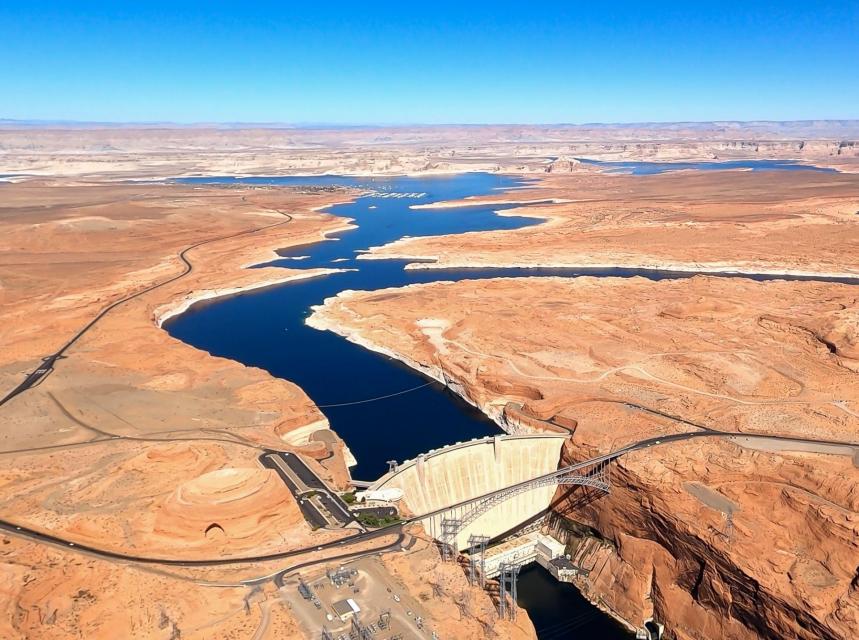
    The conduit is part of the original Fryingpan- Arkansas Project, but was not built because of the expense. Now, the communities in the Lower Arkansas Valley are seeking its construction because of the escalated cost of other methods of treating water in order to reach state and federal water quality standards.

    “The federal government made a commitment more than five decades ago, and this funding ensures Congress is doing its part to fulfill that promise,” Bennet said. “We will continue to pursue any avenue necessary to ensure this project is completed as promised.”
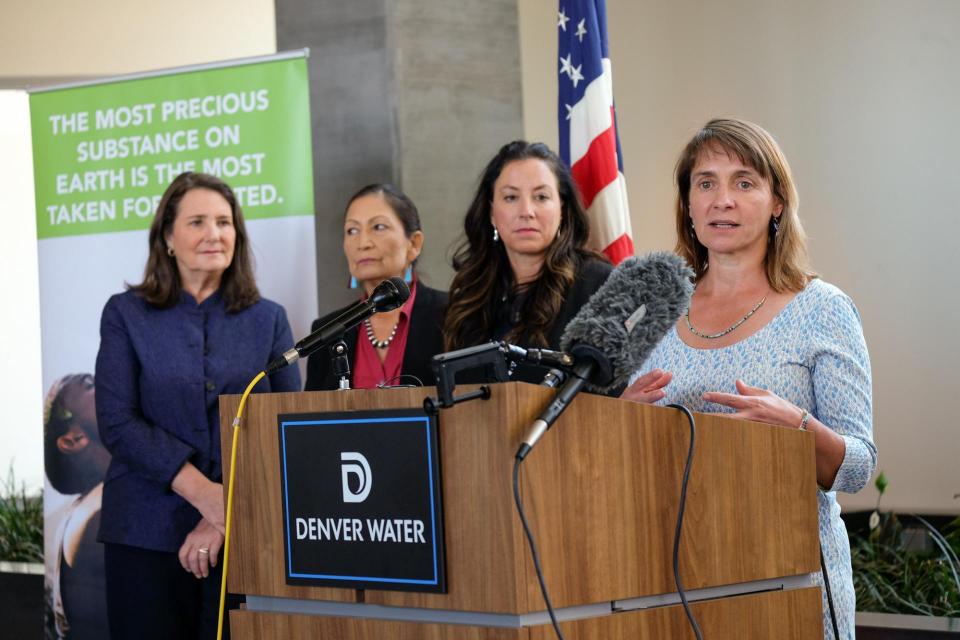
    Sen. Cory Gardner, R-Colo., applauded the vote because it assisted the conduit, as well as the National Renewable Energy Laboratory in Golden.

    “I’m proud to have secured the funding for two important provisions in this appropriations package that directly affect Colorado,” Gardner said. “The Arkansas Valley Conduit project will result in cleaner, safer water in Southeast Colorado, and this important funding was approved to assist in the cost of construction.”
    Bennet and Gardner are co-sponsors of S2606, the bill Long is scheduled to testify about next week.

    $5 million in the US budget for the Arkansas Valley Conduit

    From The Pueblo Chieftain (Chris Woodka):

    More funding for the Arkansas Valley Conduit has started flowing from the federal government.

    An additional $2 million in discretionary funds will be shifted to this year’s conduit budget by the Bureau of Reclamation. Another $3 million is included in President Barack Obama’s 2017 budget, Sen. Michael Bennet, D-Colo., announced today.

    Bennet worked with local officials, Reclamation and the administration to increase funding. The conduit already received $500,000 this year.

    “We’ve been pushing the Administration and Congress to live up to the commitment it made more than five decades ago to communities in southeast Colorado,” Bennet said. “This funding will help move this project forward, and we will continue to fight to keep these additional resources in next year’s budget to ensure Coloradans in these communities finally have a reliable source of clean drinking water.”

    Bennet will work with congressional leaders and the appropriations committee to try to ensure the money remains in the budget. Congressional gridlock in the past few years has kept funding at minimal levels.

    “This was truly a bipartisan effort,” said Bill Long, president of the Southeastern Colorado Water Conservancy District, the local agency guiding the effort to build the conduit. “It’s certainly better to have $2.5 million than to work with than $500,000.”

    The money will go toward engineering, legal work and land acquisition over the next three to five years that will allow construction of the pipeline to begin.

    The goal is to raise about $5 million annually during that period. The Southeastern district is working with Reclamation to attempt to apply other revenues from the Fryingpan-Arkansas to move conduit work forward.

    Once construction begins, it will take larger amounts of money to build the conduit, which is potentially a $400 million project. The conduit will bring clean drinking water to 50,000 people in 40 water districts from St. Charles Mesa to Lamar.

    The plan is to filter the water at Pueblo Water’s treatment plant, then move the water to other systems via the conduit. Most of those systems rely on wells and are struggling to meet water quality standards.

    Arkansas Valley Conduit Comanche North route via Reclamation
    Arkansas Valley Conduit Comanche North route via Reclamation

    Arkansas Valley Conduit Project is Updated — The Prowers Journal

    Arkansas Valley Conduit Comanche North route via Reclamation
    Arkansas Valley Conduit Comanche North route via Reclamation

    From The Prowers Journal (Russ Baldwin):

    The alignment of the Arkansas Valley Conduit project was updated for Prowers County Commissioners and interested citizens during an informational meeting on Wednesday, September 2. The $400M project, to move 15 million gallons of water per day to 39 entities between Pueblo and Lamar, was proposed in the early 1960s. Because of lack of funding, it has made little progress until the past several years. Jean Van Pelt, Project-Program Coordinator for the Southeastern Colorado Water Conservancy District, and members of the Bureau of Reclamation, described the latest plans, concentrating on the path the water conduit will take through Prowers County, leading up to the City of Lamar’s two water storage tanks south off of Memorial Drive. Van Pelt stated that the group was also seeking, ”Local input on different infrastructures or features they may not be aware of that could affect the alignment.”

    Kevin Meader, Principal Engineer for the Conservancy District said, “The Bureau is working on the preliminary design. We started that a year ago after the record of decision was issued on the Environmental Impact Statement. At that time we identified the preferred alternative for the conduit. By next year, we’ll put together an updated cost estimate which will go to Congress for appropriations for final design and construction towards the end of next year. From that we can move into final design and we’re looking at about 2017 and 2018 and the initial bidding on construction contracts is expected by around early 2020.” He added that if Congress approves the cost, it won’t be funded all at once, but probably in $25M to $45M payments over several years. Van Pelt added that in 2011 Congress agreed to share the project costs with the communities on a 65%/35% basis, and the $140M balance will not have to be borne by the 39 entities. Construction would begin at Pueblo Dam and head east to Lamar with a junction to Eads. Holly, Bristol, Granada and Hartman are not included in the conduit plans as those communities decided to opt out of a contract with the S.E. Water Conservancy District when the project was first proposed over 50 years ago. Van Pelt, when asked if they could opt back in, replied the process would be lengthy and costly for each of the communities, and any work on the conduit would be stalled while the necessary studies were conducted on constructing those new routes.

    Meader pointed out the water supply would be a supplemental, not a primary water source, which would become palatable only after each entity provided its own disinfectant procedure before making it accessible to the public. The water would be strictly for human use and not for any ag-related purposes. He added that water quality in some communities along the pipeline, such as La Junta, Boone or Fowler, has shown a need for a potable water source.

    Arkansas Valley Conduit up for $2M boost — The Pueblo Chieftain

    Preferred route for the Arkansas Valley Conduit via Reclamation
    Preferred route for the Arkansas Valley Conduit via Reclamation

    From The Pueblo Chieftain (Chris Woodka):

    An additional $2 million would be funneled to the Arkansas Valley Conduit under an amendment to the water and energy appropriation bill (HR2028).

    The amendment, sponsored by U.S. Rep. Scott Tipton, R-Colo., was approved by the House Thursday. It adds $2 million to the Bureau of Reclamation’s water resources account to advance and complete work on the conduit.

    “As you know, water is the lifeblood of the Western United States and absolutely critical to the vitality of our communities and local economies,” Tipton told the House.

    The move was supported by U.S. Rep. Ken Buck, R-Colo.

    “This project was authorized in 1962 to bring clean drinking water to 40 communities in Southeastern Colorado, many of which are in violation of clean water standards because of naturally occurring elements,” Buck said. “Why don’t we spend some money to benefit future generations instead of ourselves?”

    The Southeastern Colorado Water Conservancy District is lobbying Washington to put more funding in the $400 million Arkansas Valley Conduit, which would bring clean drinking water from Pueblo Dam to 50,000 people from the St. Charles Mesa to Lamar and Eads.

    Only $500,000 was budgeted this year for conduit work.

    More Arkansas Valley Conduit coverage here and here.

    Arkansas Valley Conduit update: Only $500,000 so far in federal budget, Southeastern Water was hoping for $5.5 million this year

    Preferred route for the Arkansas Valley Conduit via Reclamation
    Preferred route for the Arkansas Valley Conduit via Reclamation

    From The Pueblo Chieftain (Chris Woodka):

    Funding for the Arkansas Valley Conduit has flatlined in the federal budget. Striking a somber tone, Executive Director Jim Broderick broke the news Thursday to the Southeastern Colorado Water Conservancy District. The district sought $5.5 million for the conduit in fiscal year 2016, but so far only $500,000 is included in a constricted federal budget.

    “It’s hard to pinpoint the reason for flatlining,” Broderick said. “But I think this is a short-term problem. … The issue isn’t that we’re dead in the water, we’re just going slow.”

    He speculated that the federal Office of Management and Budget frowned on the project because it has not yet begun moving dirt and a general policy that water-quality projects should involve the Environmental Protection Agency.

    The conduit progress has been overseen by the Bureau of Reclamation, which shifted funds this year to boost conduit funding to about $3 million. However, there may not be much money available.

    Reclamation had a $96 million budget for projects nationwide this year, but allocated $50 million to deal with California drought issues and $30 million to settle claims with American Indian tribes.

    District officials are continuing with attempts to encourage reprogramming federal money for the project. In the interim, the district will work closely with state officials to find money and analyze the workflow toward building the conduit.

    On a positive note, Broderick said the conduit could move up in the federal pipeline by 2019.

    The $400 million conduit would reach 132 miles from Pueblo Dam to Lamar and Eads, and would serve 50,000 people in 40 communities. It was first authorized by Congress as part of the Fryingpan-Arkansas Project in 1962.

    More Arkansas Valley Conduit coverage here and here.

    CWCB meeting recap: $29,000 for compliance study until Arkansas Valley Conduit is online

    Arkansas Valley Conduit Comanche North route via Reclamation
    Arkansas Valley Conduit Comanche North route via Reclamation

    From The Pueblo Chieftain (Chris Woodka):

    New state regulations are creating a headache for Arkansas Valley water providers who are banking on the Arkansas Valley Conduit to improve water quality.

    The Colorado Water Conservation Board approved a $29,000 grant this week that will go toward a $70,000 program to create a working group to chart a course of action for 38 communities until the conduit is completed.

    Water in many of the systems is contaminated by metals, salts and/or radionuclides and managing treatment of the water is more complicated because of recent solid waste regulations by the Colorado Department of Health and Public Environment.

    That’s created a hardship because smaller private water companies do not have the resources to comply or even determine compliance and the state has not clearly explained what is or is not required. The regulation presumably covers disposal of by-products.

    There are ongoing concerns about radionuclides, which affect 12 of the communities.

    The $400 million conduit, which will move water from Lake Pueblo to Lamar and Eads, is seen as the best solution to the water quality problems for about 50,000 people. However, construction of the conduit might be a decade away from reality.

    The Southeastern Colorado Water Conservancy District and Lower Arkansas Valley are contributing $7,500 each toward the project, as well as $27,500 in inkind services.

    More CWCB coverage here.

    Southeastern Colorado Water Conservancy District 2015 budget update

    Pueblo dam releases
    Pueblo dam releases

    From The Pueblo Chieftain (Chris Woodka):

    The Southeastern Colorado Water Conservancy District board is expected to approve a $17.9 million budget at its next meeting, 11 a.m. Dec. 4.

    The district last week reviewed the details of the budget and hosted a public hearing. No member of the public attended.

    A mill levy of 0.94 mills is planned, the same as 2014. One mill is an assessment of $1 for every $1,000 of assessed valuation. The district covers parts of nine counties, including Chaffee, Fremont, Pueblo, El Paso, Crowley, Otero, Bent, Prowers and Kiowa.

    The district also makes money through sales of water and grants.

    More than $12 million will go toward repayment of the Fryingpan-Arkansas Project, including the Fountain Valley Conduit. The conduit serves El Paso County communities that pay a dedicated mill levy on top of the district mill levy.

    The district will spend $2.34 million for its own operating expenses, and $3.5 million on enterprise, or business, activity.

    Included in the enterprise fund are the Arkansas Valley Conduit, and an ongoing project to develop hydroelectric power at Pueblo Dam.

    More Southeastern Colorado Water Conservancy District coverage here.

    Arkansas Valley Conduit update

    Preferred route for the Arkansas Valley Conduit via Reclamation
    Preferred route for the Arkansas Valley Conduit via Reclamation

    From The Pueblo Chieftain (Chris Woodka):

    A regional water conservation plan already is opening doors for participants in the Arkansas Valley Conduit. The Southeastern Colorado Water Conservancy District has worked with the communities to develop strategies to improve water systems in advance of the conduit’s construction. Benefits include measuring how water is used, plugging leaks and managing pressure.

    “The need is the infrastructure, and that’s what we’re trying to focus on,” said Jean Van Pelt, project coordinator for the Southeastern district. “When the conduit is completed, we don’t want it to connect to aging systems with leaking pipes.”

    The conduit will take clean drinking water 130 miles from Pueblo Dam to Lamar and Eads. Along the way, 40 small communities are expected to tap into the line to bring water to 50,000 people. The $400 million project is at least a decade away from completion.

    The district also is seeking a master contract for storage in Lake Pueblo for conduit participants and other water users in the Southeastern district.

    One of the requirements placed on the communities by the Bureau of Reclamation is to ensure that water is not wasted, so conservation plans are needed.

    “We went out and interviewed all of the conduit participants and we are in the process of integrating the master contract participants as well,” Van Pelt said.

    Large utilities have more resources to employ strategies like rate structures, leak detection, metering, system audits and consumer education.

    The Southeastern district also offers a tool box on its website where communities can pick and choose from ideas for reducing water waste in their systems.

    The regional conservation plan also gives a leg up to private water companies seeking grants to improve their water supply, which require both conservation plans and governmental structure to administer the grant.

    “The plan needs to be in place,” Van Pelt said.

    The conservation plan and tool box have been under development since 2011 at a cost of $50,000-$60,000 per year using grants from Reclamation and the Colorado Water Conservation Board.

    More Arkansas Valley Conduit coverage here.