Pueblo has a fraught history with the #ArkansasRiver, but a new $11 million park could change that — Parker Yamasaki (Fresh Water News)

Pueblo Water Works Park screenshot from the website.

Click the link to read the article on the Water Education Colorado website (Parker Yamasaki):

September 25, 2025

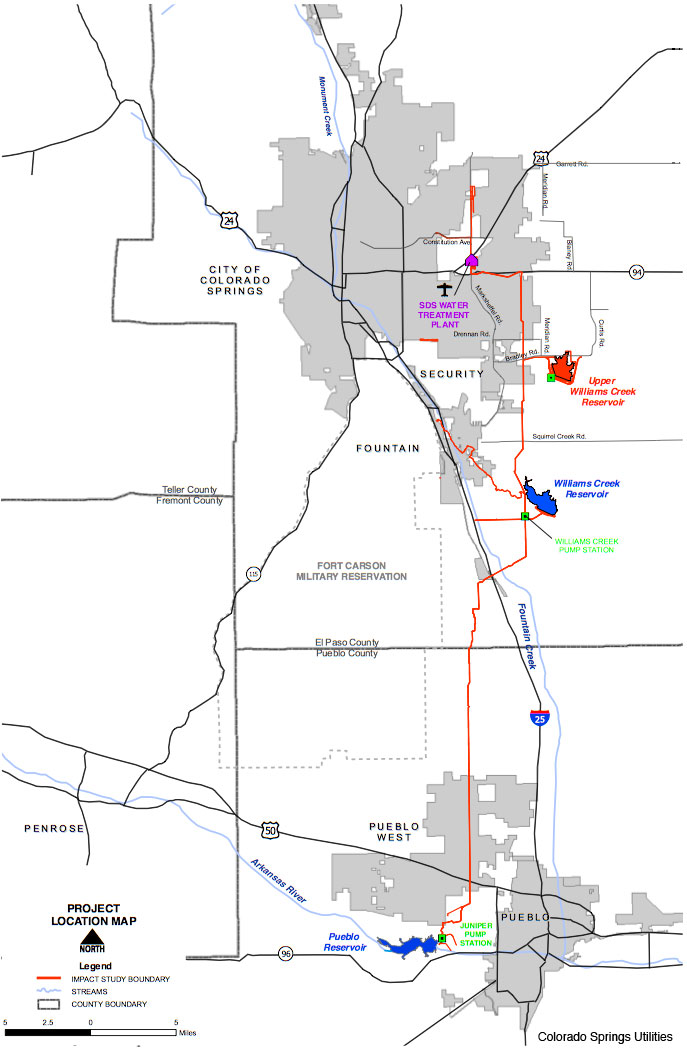
There’s a dirt lot in Pueblo that edges right up to the Arkansas River at the spot where a dam used to be.

For about a year, Joe Cervi, spokesperson for Pueblo Water, drove his truck down a broken road, opened a sliding iron gate, rolled down a gravelly path past two small reservoirs and a set of defunct railroad tracks, parked at the edge of that dirt lot, and ate his lunch.

Cervi would sit, eat and watch in awe as a construction crew demolished the dam — “demolition is just so fun to watch,” Cervi said — then replaced it, boulder by boulder, with an 11.5 acre river park, complete with a tubing chute, standing wave, two pedestrian bridges, beaches, pathways and something that the project’s engineers call a “party island.”

Waterworks Park, which officially opened in May, took just under seven years and $11 million to bring it from idea to the ribbon cutting. The project turned a once-dangerous swimming hole — the old dam had been the site of several drownings — into a quarter-mile-long, family-friendly park that rivals any mountain town’s riverside recreation.

Pueblo has a brutal history with its backyard river. For over a century the river was purely used for industry and agriculture, demonstrating the irony of a city built for access to waterways that residents will rarely use.

The city also sits at a geographic junction, where the land flattens and the river’s major uses glide from recreation to irrigation. But this awkward point on the map appears too far east to make it onto CPW’s fishing brochures, too far west to be purely agricultural.

The effort to remake the Arkansas as a center of community loosely began about 50 years ago, in earnest about 30 years ago.

Pueblo levee Arkansas River.

In the late 1970s a group of artists took to the levee by night and kicked off what would be a decades-long and Guiness World Record-setting mural project, creating something of a tourism draw — or at least something for local artists to do in town — that continues to this day.

Pueblo River Walk at Night, credit: John Wark

In the 1990s, the Historic Arkansas Riverwalk of Pueblo Foundation started collecting money from a 20-year, $12.85 million bond passed by voters to lay infrastructure for 32 acres of walkable canals that wind beneath the city’s downtown streets. That project is ongoing, with a new boathouse expected sometime between December and June 2026.

But Waterworks Park is a whole new beast. It’s the first project that actually gets people in the river. Before the park was completed, boaters couldn’t navigate that section without exiting and walking around the dam, and fish couldn’t navigate that section at all.

Cervi grew up in Pueblo and visited the river as a teen for “just something to do,” he said. The same way that loitering in a parking lot or kicking rocks down the sidewalk is “just something to do.”

But now, with the Riverwalk and the levee murals well established, and Waterworks Park officially open to the public, there’s a lot more to do on the river than just … something.

“It’s so transformational,” Cervi said, looking upstream from one of the new bridges. “It’s just cool. I think I just want people to know that Pueblo can have nice things too.”

The hub of Colorado

While walking the park, Cervi toggled between logistical — “about a quarter-mile long, 11.5 acres, cost $11 million dollars,” he said almost immediately upon exiting his truck — and contemplative. This is his project, this is his city, after all.

“The river is why Pueblo is Pueblo,” he said. “The reason why settlers settled here is the confluence of Fountain Creek and the Arkansas River. That’s why it became the hub.”

It was the confluence of the creek and the Ark that birthed the city in the mid-1800s and it was the confluence of the creek and the Ark that almost killed it a century later.

The calls started around 6:30 p.m. on June 2, 1921, when a cloudburst unleashed over the river 10 miles west of town. Another storm, 30 miles to the north, caused Fountain Creek to swell simultaneously.

By 1:30 a.m., floodwaters from the two waterways met in Pueblo and surged onto the power plant property causing the lights in downtown Pueblo to flicker on and off, while logs jammed under bridges and flushed water into the streets. At 2:15 a.m., agricultural lands west of town were said to be underwater, by 3 a.m. reports came of livestock floating down the river.

A home that was ripped from its foundations and floated onto Main Street during the 1921 flood in Pueblo. (Courtesy Pueblo City-County Library District)

Downtown Pueblo and the surrounding farms were destroyed. More than 57,000 acres of ag land were flooded, and close to 5,000 acres became fully unusable. Passengers on the Missouri Pacific and the Denver and Rio Grande Western trains were swept into the river, Estimates of how many people died vary between about 80-120, though a report by the U.S. Department of the Interior conducted in 1922 states that “the exact extent of losses to life and property will never be known.”

In the immediate aftermath of the flood, the city rerouted the Arkansas to push it up against the bluff where it runs today, built the concrete levees now covered by murals, and established the Pueblo Conservancy District, an eight-person elected board that still works to protect downtown from the threat of floods.

These days it’s Fountain Creek — which absorbs runoff from Colorado Springs — that the District is concerned by. The “creek” might be a bit of a misnomer, according to Corinne Koehler, board member and former president of the Pueblo Conservancy District. “It’s a river now,” she said plainly. “But that’s for another story.”

A photograph titled “Searching for Bodies” taken the morning after the flood of 1921 in Pueblo. (Courtesy Pueblo City-County Library District)

While most people focus on the buildings, businesses and lives lost in the flood, it would continue to haunt the city’s political decisions and economic standing for decades, eventually push Pueblo from a railway hub in a prime location to an afterthought filled in by heavy industry.

At that time, Rollins Pass, which climbed the Rockies outside of Denver to connect the Front Range to northwestern Colorado was one of the most dangerous rail passes in the world — cattle died of cold, passengers would be stranded for days, and, despite its name, the pass was routinely impassable during the winter months.

Moffat Tunnel/Rollins Pass. By Francisbausch – Own work, CC BY-SA 4.0, https://commons.wikimedia.org/w/index.php?curid=78722779

The idea for a tunnel beneath Rollins Pass had been proposed three times by the 1920s, and was officially voted down by Coloradans in 1919, with dissent coming primarily from Pueblo, El Paso, and Las Animas counties, which all benefited from railroad lines traveling through southern Colorado.

After the flood, a special legislative session convened to discuss how to prevent future overflows. A bill was proposed to create the Pueblo Conservancy District and, seizing the opportunity to further their tunnel interests, legislators from Denver and the northern districts tacked on the Moffat Tunnel Improvement District.

Supporters of the tunnel argued that a water diversion tunnel could prevent similar overflows on the Front Range, and a $9 million bond for a combination tunnel was approved.

At the same time, efforts by nearly every town between Denver and Salt Lake City to draw new railways, residents and tourists to the northwestern corner of the state began to pull attention from the southern Colorado cities.

“In the early 1800s, there was a chance that Pueblo was going to be Denver,” Cervi said. “It was the hub of Colorado — it had steel, it had water, it had rail, it had everything. It’s hard to say why people do what they do.”

“It’s in times of disaster, you make these deals,” Koehler said. “We had no choice.”

Working on water time

While crossing one of two new bridges, a man stopped Cervi to ask him about parking. They’re working on it, Cervi told the man, but not everyone wants people to back their cars right up to the river. So far, access is one of the only negative pieces of feedback they’ve received, Cervi said.

Gary Lacy, an engineer on the project and founder of Recreation Engineering and Planning, concurred in fewer words: “The access and parking is driving me freaking nuts.”

“Well I think this is the pride of Pueblo,” the man on the bridge told Cervi. “Just look at it, I mean, it’s amazing.”

“It’s amazing what $11 million will buy you,” Cervi responded.

“Hey, I think that’s a deal,” the man said.

To fund the park Pueblo Water took out a $9.75 million loan from the Colorado Water Conservation Board. They tried looking for grants and partnerships, but didn’t want to wait around while costs went up.

“At the end of the day if you want something done you’ve just got to finance it,” Cervi said. “So we took out a loan and started digging.”
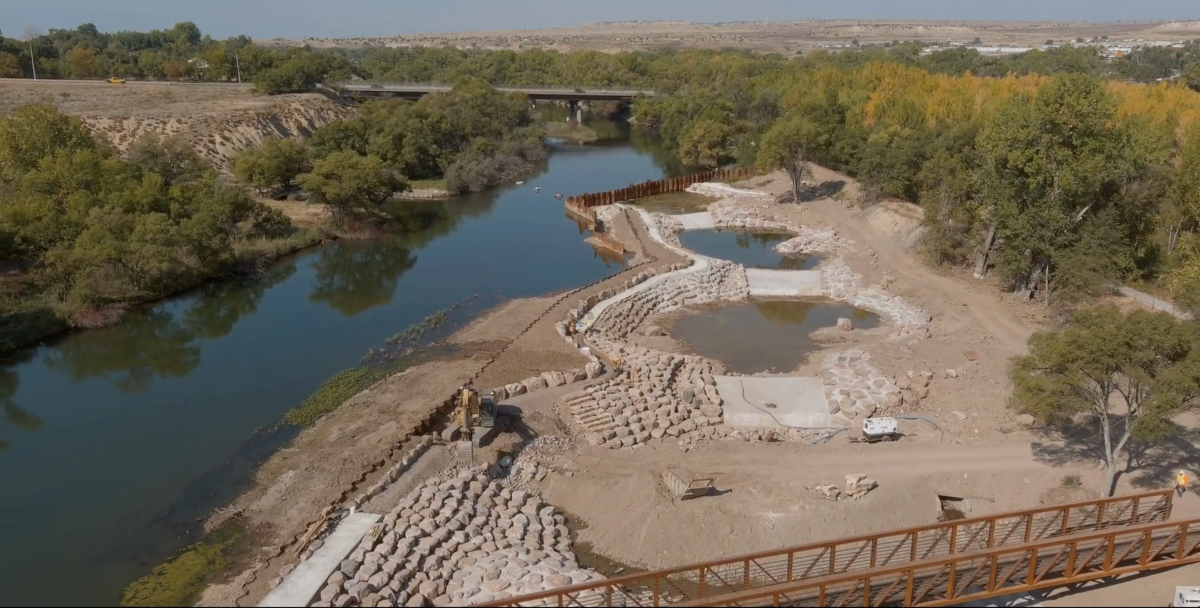
In order to construct the $11 million Waterworks Park in Pueblo, engineers damed half of the river to dry up the side where construction was taking place, then switched sides. (Screenshot from construction video, courtesy Pueblo Water)

On the east end of the new island, a black bench faces downstream. Carved into the backrest is a dedication to Pueblo Waterworks Executive Director Seth Clayton.

“It was his vision, he’s the one who said we can’t wait for grants. Because when you wait, costs go up,” Cervi said. “So if we want to get it done let’s just get it done. Pueblo Water is the kind of organization that gets shit done.”

Pueblo Water has been operating in some form since 1874. But Pueblo Water in its current form, with its current ability to get shit done, has existed since 1954 when a new city charter was written to fix a slapdash governing document written in 1911 that had been “amended so many times it was clearly a different document,” according to a letter submitted to Pueblo Water in 1997.

The charter committee consisted of 21 elected representatives, including four local drug store owners, two men from the Southern Colorado Power Company, two union representatives, a city council member, a housewife, a lawyer and a fireman. They were given 60 days to write the new charter.

The 89-page document merged two water districts into Pueblo Water and established a five-person water board, known officially as the Board of Water Works of Pueblo, Colorado.

The charter writers were unambiguous about the board’s independence. “The (City) Council shall have no jurisdiction or control, but shall adopt all ordinances requested by said board,” the charter says.

“Pueblo Water was in the position to obtain the loan and do the park because of our board,” Cervi said. “They said let’s just do it. It’s as simple as wanting to get it done.”

It’s hard to parse how much of Cervi’s Nike-tinged “just do it” attitude comes from his six years of experience with Pueblo Water, and how much is inherent to the native Puebloan, whose great-uncle, Gene Cervi, owned the Rocky Mountain Journal and passed on the motto “you can love me or you can hate me, but you’re going to read me” to a young Cervi.

In either case, Cervi is quick to credit not just the five-person board serving staggered six-year terms, but the board members before them and before them.

“We don’t just decide, OK what are we going to fix this year?” Cervi said. “They decided 10 years ago what we’re going to fix this year.”

Waterworks Park notwithstanding, of course. But even that investment was built on the work of boards past, he said. Pueblo Water was in a position to ask for a loan because of their financial stability, something that 71 years of independent governance set them up for.

“People want something immediate, sometimes they want change for change’s sake,” Cervi said. “You can’t do that in water.”

Give an inch, take a quarter-mile

One change that Pueblo Water did make at a moment’s notice was adding a standing wave to the edge of the park.

“They’d be like, how about a beach? How about a surf wave? How about a party island?” said Lacy. “I’d be like, don’t say that to us unless you mean it.”

They meant it.

In the 1980s, while working for the City of Boulder, Lacy helped engineer the Boulder Creek corridor, removing five dams and adding parks and biking trails along its banks.

“That, I think, is what really started it,” Lacy said.

In the ’90s, Golden grabbed Lacy to clean up and construct paths along Clear Creek, the downtown flow that runs from roughly Loveland Pass straight into the mouth of the Coors factory on the east end of town.

While the Boulder project was partly a public safety effort, Golden saw its creek as an economic opportunity for recreation and tourism.

“Salida and all these places afterward saw that and said: ‘We want that in our town,’” Lacy said.

Lacy and his company are now responsible for more than 100 dam removals and in-stream parks all over the U.S. and Canada, including the Scout Wave in Salida which helped boost riverside visitationfrom around 9,000 people in 2023 to at least 20,000 during high flows last year.

From the hips down, river surfing feels the same as ocean surfing, according to Roo Smith, a Boulder-based videographer who grew up surfing off the Washington coast.

“I’m feeling the edges of my board, I’m feeling the fins, I’m feeling the speed of the water zooming beneath me, everything is the same,” Smith said.

“But up here,” Smith said, pointing to his shoulders, “You’re not moving. So normally when people are starting, they’ll get on a wave and feel their feet getting rocked backwards, so they’ll lean forward and fall.”

Smith found his way to river surfing while attending Colorado College in 2017. He and a friend brought their boards to a roiling little ripple built as a whitewater park on a stretch of the Ark near downtown Pueblo.

It didn’t take immediately. Or, as Smith put it, “IT WAS SO FRUSTRATING.”

The board was too small, the wave was too small. “I was like, I want this to work, I know it should work, and it just isn’t working,” Smith said. So he came back with a buoyant stand-up paddleboard that he rented from the college recreation department.

Smith keeps videos of those early rides on his phone. In one, he settles into the wave, then abruptly grabs the board’s thick rail with his hands and kicks up into a headstand. Then he plants his feet, crouches low, and keeps surfing.

Someone yelps from behind the camera. “Yeah Roo!” they shout.

“Colorado surfers, they’re insane,” Cervi said. “They check the water flow to see if they can catch a wave, even in the winter, and if they can, they will.”

“It’s insane,” he repeated.

When Smith was getting started, he’d check a website called endlesswaves.net to find surfable river waves.

“I remember we went to this one wave, I think it was called Larry’s wave, in that really dirty part of Denver,” Smith said. (It’s called Dave’s Wave and it’s in Commerce City, he later corrected.)

“It started snowing, and we’re all in 2 mm wetsuits which are not nearly warm enough to be in a river in Colorado, in February, so we’re all freezing, and it’s snowing, or maybe hailing, but we surfed it. It was really fun.”

If Roo is a little hazy on the details from his early adventures, he’s clear-eyed about the potential for the sport.

It’s an exceptionally positive group of people, he said. All of the good things about surfing culture, without the territorial baggage.

“I haven’t seen any negativity surrounding the sport, which is really refreshing, coming from other sports where it’s like don’t share the powder spot, don’t share where the secret wave is,” Smith said. “Everyone’s like, here’s the pin to the new wave, come surf it!”

Cervi is hopeful that Pueblo’s new wave, and the park as a whole, will end up on more people’s maps.

“People talk down on Pueblo all the time because they can, and if you’ve never been off I-25 you might, because that’s all you’ve seen of it,” he said. “But it’s like the old adage, ‘you can’t call my sister ugly. Only I can call my sister ugly.’ This is my town, you know?” he laughed. “I get to say what’s good and bad for Pueblo. And this is definitely good for Pueblo.”

Sitting with his lunch at what was then a construction site, Cervi was fascinated by the details of building the new park. He’d watch the cranes place thousands of individual boulders, one at a time. “They’d sit there with and just turn them like, 1 inch, 3 inches. Then tilt them.”

Working on this project gave him a greater appreciation for his backyard river, and despite the occasional complaint about a lack of parking or permanent restrooms, he sees its potential to change Pueblo’s relationship to its river, even if it has to happen an inch or three at a time.

More by Parker Yamasaki

Map of the Arkansas River drainage basin. Created using USGS National Map and NASA SRTM data. By Shannon1 – Own work, CC BY-SA 4.0, https://commons.wikimedia.org/w/index.php?curid=79039596

#ColoradoRiver District offers proposal on Western Slope water deal — Heather Sackett (AspenJournalism.org) #CORiver #aridification

The Shoshone hydro plant in Glenwood Canyon. The Shoshone hydropower plant in Glenwood Canyon. The CWCB will hold a hearing on the water rights associated with the plant in September. Credit: Heather Sackett/Aspen Journalism

Click the link to read the article on the Aspen Journalism website (Heather Sackett):

July 25, 2025

Front Range asked for Colorado Water Conservation Board neutrality on historic use of Shoshone water rights

In an effort to head off concerns about the state’s role in a major Western Slope water deal, a Western Slope water district has offered up a compromise proposal to Front Range water providers. 

In order to defuse what Colorado River Water Conservation District General Manager Andy Mueller called “an ugly contested hearing before the CWCB,” the River District is proposing that the state water board take a neutral position on the exact amount of water tied to the Shoshone hydropower plant water rights and let a water court determine a final number. 

“Although we believe this would be an unusual process, the River District believes it would address the primary concern (i.e., avoiding the state agency’s formal endorsement of the River District’s preliminary historical use analysis) that we heard expressed by your representatives at the May 21, 2025 CWCB meeting regarding the Shoshone instream flow proposal,” Mueller wrote in an email to officials from the Front Range Water Council.

The River District worked with CWCB staff to draft the proposal, but it may not go far enough to address Front Range concerns.

The River District, which represents 15 counties on the Western Slope, is planning to purchase some of the oldest and largest non-consumptive water rights on the Colorado River from Xcel Energy for nearly $100 million. The water rights, which are tied to the Shoshone hydropower plant in Glenwood Canyon, are essential for downstream ecosystems, cities, endangered fish, and agricultural and recreational water users. As part of the deal, the River District is seeking to add an instream flow water right to benefit the environment to the hydropower water rights.

The effort has seen broad support across the Western Slope. The River District has raised $57 million toward the purchase from at least 26 local and regional partners. The project was awarded a $40 million Inflation Reduction Act grant in the waning days of the Biden administration, but those funds have been frozen by the Trump administration. 

“These water rights are foundational to the Colorado River,” said Amy Moyer, chief of strategy at the River District. “It’s the number one project for the Western Slope. It’s the top priority to move forward.”

Critically, because its water rights are senior to many other water users — they date to 1902 — Shoshone can force upstream water users to cut back. The Shoshone call has the ability to command the flows of the Colorado River and its tributaries upstream all the way to the headwaters.

The twin turbines of Xcel Energy’s Shoshone hydroelectric power plant in Glenwood Canyon can generate 15 megawatts. The River District is proposing that the CWCB remain neutral on the issue of the plant’s historic water use. Credit: Heather Sackett/Aspen Journalism

Putting a precise amount on how much water the plant has historically used is a main point of contention between the River District and the Front Range Water Council, a group that includes some of Colorado’s biggest municipal water providers: Denver Water, Colorado Springs Utilities, Aurora Water and Northern Water. These entities take water that would normally flow west, and bring it to farms and cities on the east side of the Continental Divide through what are called transmountain diversions. About 500,000 acre-feet of water annually is taken from the headwaters of the Colorado River and its tributaries to the Front Range.

Estimates by the River District put the Shoshone hydro plant’s average annual use at 844,644 acre-feet using the period between 1975 and 2003 — before natural hazards in the narrow canyon began knocking the plant offline regularly in recent years.

But Front Range Water Council members say this estimate is flawed and could be an expansion of the historical use of the water right. They have requested a hearing at the September CWCB meeting to hash out their concerns.

“The preliminary analysis that has been presented appears to expand historic use and creates potential injury,” Abby Ortega, general manager of infrastructure and resource planning at Colorado Springs Utilities told the CWCB at its May meeting.

Determining past use of the Shoshone water rights is important because it will help set a limit for future use. While changing the use of a water right is allowed by going through the water court process, enlarging it is not. The amount pulled from and returned to the river must stay the same as it historically has been.

As part of the River District’s deal to buy the water rights, the CWCB — which is the only entity in the state allowed to hold an instream flow water right — must officially accept the water right and then sign on as a co-applicant in the water court change case. 

But Front Range water providers said that doing so would amount to an endorsement of the River District’s historical use estimate, which would mean taking a side in the Front Range versus Western Slope disagreement.

“If you agree to accept the right and as I understand it, the instream flow agreement, you’re agreeing to be a co-applicant, which risks you accepting their analysis,” said Alexandra Davis, an assistant general manager with Aurora Water, at the CWCB’s May meeting.

Some members of the Front Range Water Council have asked that the CWCB remain neutral during the water court change case. In May 9 and June 9 letters to the CWCB from Marshall Brown, general manager of Aurora Water, he said the CWCB shouldrefrain from endorsing any specific methodology or volume of water.

“… [T]he CWCB should remain neutral in the water court proceedings and defer to the court’s determination of the appropriate methodology and volumetric quantification,” the May 9 letter reads. 

The River District’s offer does just that: It proposes that the CWCB should not take a position regarding the determination of historical use of the Shoshone water rights. 

“We heard the issues that are most front and center from these entities,” Moyer said. “And so we are trying to find a path forward that works for everyone.”

But even if Front Range Water Council members are in favor of the proposal, it is unlikely to result in a cancellation of the hearing. CWCB Executive Director Lauren Ris said in an email that under the board’s rules, they are required to hold a hearing. And Jeff Stahla, public information officer at Northern Water, said they will still be asking for the hearing to proceed. 

Spokespeople from Colorado Springs Utilities, Aurora Water and Denver Water all declined to comment on the River District’s proposal because it was marked as confidential. 

Some members of the Front Range Water Council have concerns beyond CWCB neutrality that could be addressed at the September hearing. 

In a May 14 letter to the CWCB, Denver Water’s CEO Alan Salazar said the water provider also wants to carry over some provisions from existing agreements like the Shoshone Outage Protocol. This agreement has an exception in cases of extreme drought that allows Denver Water to keep taking water if its reservoirs fall below certain levels and streamflows are low. Denver Water added that by omitting the last two decades of Shoshone water use, the River District’s study period is skewed, and that using an upstream stream gauge to measure historical use is improper.  

The hearing is scheduled for the next CWCB board meeting Sept. 16-18. The board can approve or disapprove the acquisition of the water rights, or make changes to the proposal and adopt the amended proposal. The board is required to take action at the September hearing unless the River District approves an extension. Pre-hearing statements are due by Aug. 4.

CWCB board members Brad Wind, who is general manager of Northern Water, and Greg Johnson, manager of resource planning at Denver Water, recused themselves from the July 17 CWCB board meeting discussion of the Shoshone water rights and plan to recuse themselves from future Shoshone discussions and decisions. 

Map of the Colorado River drainage basin, created using USGS data. By Shannon1 Creative Commons Attribution-Share Alike 4.0

Case study details water #conservation wins in #Colorado — National #Drought Mitigation Center

Bessemer Ditch circa 1890 via WaterArchives.org

Click the link to read the article on the National Drought Mitigation Center website:

March 2025

The Bessemer Ditch is an irrigation canal that serves agricultural areas in Pueblo County. In 2009 and 2010, the Pueblo Board of Water Works acquired nearly one-third of water rights to the ditch to supply the city of Pueblo with water. While necessary to support the city, it simultaneously threatens producers’ livelihoods.  

Since 2015, Palmer Land Conservancy, a nonprofit based in Colorado Springs, has been working with the county to help preserve the area’s agricultural identity while allocating water wisely.

As part of these efforts, a “substitution of dry-up” provision was developed and later incorporated into Pueblo Water’s decree. This keeps the most fertile agricultural land in production by enabling voluntary, market-based transactions where less productive farmland is substituted to be dried-up. 

Palmer was invited to work with the Pueblo County agricultural community to identify ideal dry-up candidate areas (DCAs) through the Bessemer Farmland Conservation Project. The DCA farms, which are often located along riparian corridors, would be revegetated once dried up, according to the plan—bolstering local ecology. 

The project is funded by the Colorado Water Conservation Board of the Colorado Department of Natural Resources and partners.

Read the case study.

Special Report: Big city water buys in #Colorado’s Lower #ArkansasRiver Valley raise alarms — Fresh Water News

Flood irrigation in the Arkansas Valley via Greg Hobbs

Click the link to read the article on the Water Education Colorado website (Jerd Smith and Michael Booth):

August 8, 2024

From satellite view, the land north of the Arkansas River is a seemingly random checkerboard of vital green and desperate brown, quickly fading from a few thriving farm acres to the broad, water-drained desolation of northern Crowley County.

From the cab of Matt Heimerich’s pickup, each alternating square of emerald corn or desiccated knapweed is a decision by a distant big city — to either share Colorado resources responsibly or toss rural Arkansas River counties to the fate of the hot summer winds.

That square was reseeded with native grass after Aurora bought the water in the 1970s, Heimerich says. That plot, Colorado Springs dried up and it’s all weeds. That farm, Aurora wants to dry it up soon, but the water court referee wants a better reseeding plan.

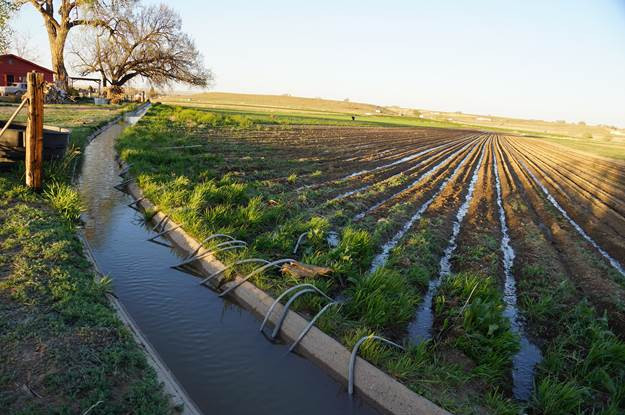
Heimerich’s family is one of the few farmers remaining in the 790 square miles of Crowley County after city water buy-ups shrank the county’s irrigated acres from more than 50,000 in the 1970s to just a few thousand this year. He jumps down from the pickup to clear invasive kochia weeds from a pipe opening gushing cool canal water down a 1,500-foot corn row.

Straight line diagram of the Lower Arkansas Valley ditches via Headwaters Magazine

Two miles away is downtown Olney Springs, population 310. Crowley County as a whole has only 5,600 residents, and more than a third of those are inmates at two prisons. The only retail operation left in Olney Springs is a soda vending machine against the wall of town hall.

As Heimerich clears his irrigation pipe, he pauses to jab a thumb over his shoulder 150 miles to the north at Aurora, where the population increased by more than 100,000 over 20 years. “When you build a new development, at the end of the day, you’re drying up a farm,” Heimerich said. “Where else is it going to come from?”

“Crowley is just the worst example of what can happen when nobody cares, and nobody pays attention,” he said. The tiny community serves as an enduring reminder of the cultural and economic ruin that occurs when big cities in Colorado and elsewhere purchase farms, dry up the land and move the water to urban areas. It gave rise to the term “buy and dry,” a practice now widely condemned.

The practice was supposed to end in the Lower Arkansas Valley in 2003 with a hard-fought federal court battle and settlement. Since then, state lawmakers and top water and farm agencies have changed laws and spent millions of dollars testing new protective methods for sharing water temporarily between rural and urban areas. They have also spent heavily to improve water quality for thousands of people living near the river who still don’t have clean water to drink.

The big cities insist they have learned their lessons from the Crowley County disaster.

“The results of what happened in Crowley County are unacceptable and widely recognized as a travesty,” said Colorado Springs Utilities spokesperson Jennifer Jordan. “We’ve taken those lessons to heart.”

Arkansas River Basin — Graphic via the Colorado Geological Survey

But outraged Lower Arkansas growers and water districts say new efforts to protect their farm water aren’t working. At the same time, the big cities say new laws making it easier to share farm water don’t provide enough reliable water to grow their communities.

The cities also say big changes in the future water picture, climate-driven reductions in stream flows and threats to their Colorado River supplies leave them little choice but to draw more farm water.

This year they did that, inking deals in the Lower Arkansas worth more than $100 million to buy and lease land and water, raising alarms among local growers and generating big questions about whether the state is doing enough to protect rural farm communities and the water that keeps them going.

Buy and dry light

The cities say a lot has changed in the past 20 years and that these new deals represent innovations in water sharing. But critics in the Lower Arkansas Valley say these same deals signal that no one is doing enough to prevent “buy and dry” or the latest tool in the water acquisition quiver, “lease and dry,” in which water is pulled from farmland periodically.

Aurora, for instance, spent $80 million in April to buy nearly 5,000 acres of farms in Otero County and the more than 6,500 acre-feet of water associated with that land. An acre-foot equals nearly 326,000 gallons of water, enough to irrigate half an acre of corn, or supply at least two urban homes for one year.

Aurora plans to use the water itself in three out of 10 years, leaving it on the farms the rest of the time. Some 4,000 acres of land will be dried up intermittently when Aurora is using the water, according to Karl Nyquist, a developer and grower who negotiated the deal with Aurora and who is operating the farms for Aurora under the lease agreement.

Colorado Springs has a different arrangement just downriver in Bent County, where it will permanently purchase up to 15,000 acre-feet of water from local farmers. Colorado Springs will also help pay local farmers to install modern center pivot irrigation systems that use less water, allowing the city to keep the saved water for its use.

In Crowley County. Photo: Brent Gardner-Smith/Aspen Journalism

In this deal, Colorado Springs and the farmers will be responsible for revegetating any dried-up land. It will use the water in five out of 10 years, and it has agreed to make a one-time, upfront payment of $2.5 million to Bent County plus payments each year based on how much water is taken off the fields. The money is in addition to payments to farmers.

“We wanted to make sure Bent County was kept whole,” said Scott Lorenz, a senior water projects manager with Colorado Springs Utilities.

Bessemer Ditch circa 1890 via WaterArchives.org

And in Pueblo County, perhaps the least controversial of the three deals, Pueblo Water agreed to purchase nearly one-third of the shares in the local historic Bessemer Ditch system for $56.2 million. Pueblo continues to lease the water back to the farmers for now. At the same time, the Palmer Land Conservancy has developed a sophisticated new framework that measures farm productivity on land watered by the Bessemer Ditch and will eventually help direct water to the most productive farms as Pueblo takes its water. The hope is that the new system will increase overall farm productivity on the ditch system and help make up for anything lost when the less productive lands are dried up, according to Dillon O’Hare, Palmer’s senior conservation manager.

Palmer is also working to analyze the impact of the deals on water quality downstream and how to prevent further damage, O’Hare said.

Irrigated farmland is evaporating

The three projects come as new data shows Colorado’s irrigated farmlands are shrinking. Since 1997, the state has lost 32% of these lands, with areas in the Lower Arkansas Valley seeing losses higher than that, according to an analysis of federal agricultural data by Fresh Water News.

Crowley County has lost 90% of its irrigated lands in that period. Pueblo has lost 60.2%, and Bent and Otero have lost 37.6% and 35.2%, respectively.

State agriculture and water officials are worried about the decline, but say they have few tools to prevent it because farmers are free to sell their water rights to whomever they want.

“Am I concerned? Definitely,” said Robert Sakata, a long-time vegetable grower near Brighton, and former member of the Colorado Water Conservation Board who now serves as the director of water policy for the Colorado Department of Agriculture. “We all talk about water being a limited resource, but prime farmland is also limited and it’s important to take that into consideration.”

Not all these losses are due to big city water prospecting. Climate change, market challenges and legal obligations to deliver water to downstream states are also fallowing Colorado farmlands.

Everyone is sympathetic. No one is in charge.

Still, more than 20 years after the intergovernmental peace accords, it wasn’t supposed to be this way.

The Lower Arkansas Valley region is part of the sprawling Arkansas River Basin. The river has its headwaters near Leadville and flows through Buena Vista, Salida, Cañon City, into Pueblo Reservoir and on over the state line east of Lamar.

Its counties were once a sweet spot in the basin’s agriculture economy. The river fed a bountiful chain of tomato, sugar beet and onion fields, as well as acres of luscious Rocky Ford melons, and chiles, corn and alfalfa.

Cities say these latest deals, which they call “water sharing” agreements, will bolster the agricultural economies and keep remaining water on farm fields forever. But the term “sharing” doesn’t sit well with some local farmers and water officials who have a deep distrust of the cities they blame for the region’s decline.

“I call it a charade,” said Mike Bartolo, a retired Colorado State University Extension research scientist who farms in Otero County near Rocky Ford. “You dry up an acre, you’re drying up land that was formerly irrigated. That’s buy and dry.”

While the state’s highly touted Water Plan cheers for the concept of cities helping rural areas thrive after water losses, there is no mechanism or state law or bureaucracy to watchdog new sales.

After the 2003 agreement in the Lower Arkansas Valley, state and local water leaders began testing new ways for cities and farmers to temporarily share water, something that had been almost impossible under older water law.

But Aurora and Colorado Springs say the early experimental programs didn’t provide enough water at reasonable prices to fulfill their fast-growing community needs permanently.

Lorenz, the Colorado Springs Utilities manager, said the city does lease some water in the valley, but it hasn’t been enough to ensure the stability of its long-term water supply.

“The major concern is that we would lease from a particular farmer, and then a different city would come out and buy those water rights and the farmer wouldn’t lease to us anymore,” he said.

And in fact that is what just happened in April, when Aurora purchased the Otero County farms, which had formerly leased water to Colorado Springs.

Colorado Springs Utilities formally opposes the latest Aurora water deal, as do the Southeastern Colorado Water Conservancy District based in Pueblo, and the Lower Arkansas Valley Water Conservancy District in Rocky Ford.

But their anger has so far been expressed by passing resolutions, not filing lawsuits.

How Aurora Water and other cities have treated Arkansas River counties like Crowley after past buy-ups leaves nothing but suspicion about newly announced deals, local leaders say.

Though Aurora says it is not attempting any more permanent dry-ups of local land, “I don’t think any of us believe them,” said Heimerich, Crowley County’s representative on the Southeastern Conservancy board. Heimerich also is a member of the board of Water Education Colorado, which is a sponsor of Fresh Water News. “They’ll do whatever they need to do and apologize later.”

Thornton, Larimer and Weld counties conducted a similar debate publicly — from the 1990s to this year — as Thornton bought up 17,000 acres of northern Colorado farms and their water rights and began drying up the land. County commissioners and other local officials brought their legal weight and bully pulpits to bear in demanding extensive concessions from Thornton. The Adams County city has been reseeding dried up land with native grass and backfilling lost property taxes, but gets mixed reviews from locals.

The latest Lower Arkansas water deals are also pitting Colorado’s big cities directly against each other in conflicts not seen for decades. When the board of Colorado Springs Utilities passed a resolution earlier this year condemning Aurora’s Otero County deal, it was a direct shot from leadership of a city of nearly 500,000 — the Colorado Springs City Council is the utility board.

“The idea is that there’s Denver, there’s a Denver metro complex and they’re going to just do whatever they want to do and the rest of the state has to go along with it,” City Councilman Brian Risley said.

But Alex Davis, a top Aurora Water official, said Colorado Springs’ ire is unwarranted.

“Aurora has worked in close partnership with Colorado Springs for decades and that will continue,” she said. “This is a case where we disagree.”

Peter Nichols, general counsel for the Lower Arkansas Water Conservancy District in La Junta, said he is deeply concerned by what cities are proposing now.

“We thought we were through with all of this. We thought we had it under control,” he said of the Aurora and Colorado Springs purchases.

Nichols is among those who have spent much of the past 20 years creating a system, now known as the super ditch, that allows seven local irrigation companies to negotiate leases with cities.

A map of the Fry-Ark system. Aspen, and Hunter Creek, are shown in the lower left. Fryingpan-Arkansas Project western and upper eastern slope facilities.

Importantly, it also won the legal right to move leased water stored in Pueblo Reservoir out of the valley, via the federal Fryingpan-Arkansas Project and the Otero Pipeline, removing what had been a key barrier to leasing.

Nichols said local growers and water districts have worked hard to find ways to share water so that it doesn’t permanently leave the valley. That the cities are now jumping the line with these new deals isn’t OK with him.

A farmer’s — and a county’s — greatest asset

Colorado Springs and the other thirsty Front Range cities want farmers like the young Caleb Wertz to be the new face of urban water agreements. On a recent 95-degree summer afternoon, Wertz high-tailed it across Bent County driving an ambulance to take an injured neighbor to the hospital. He had planned to be on his farm, but that’s life in the Lower Arkansas Valley.

The population is shrinking, and everyone has too many jobs to count. The local farmer is also a first responder. Your primary care provider is a farmer’s wife.

Arriving back at the farm just after 5 p.m., Wertz talks about what is perhaps the most controversial decision he has ever made: Selling a portion of his agricultural water to fuel housing growth in Colorado Springs.

The deal will pay him enough so that he can install modern irrigation systems, drying up portions of the fields, known as corners, that won’t be reached by the new, center pivot sprinklers, and allow Colorado Springs to buy the saved water.

He is also planting cotton alongside his traditional corn, and he believes he is the first in the state to do so. A new modern variety is supposed to use half the water, just one acre-foot per acre, rather than the two acre-feet of water that older types, such as those grown in Arizona, use.

For Wertz, the agreement will give him enough money to keep farming and enough new technology to make his remaining agricultural water go farther. He will become a rarity in the area: A young farmer with enough land and water to continue the business his family started in 1919 and to expand it.

“The water purchase makes it a lot more doable because we can farm those acres so much more with pivots,” Wertz said. “That’s the case even though we’re drying up the corners. … That has a bad connotation to it. But Colorado Springs is reimbursing the farmers to turn those corners into pasture land or to revegetate. … Even if it is not producing corn, it’s not just becoming wasteland.”

But to some of his neighbors in the valley, Wertz has entered a hostile no-man’s land, facilitating yet another dry-up of farmland in a region that has already lost too much water and land to urban thirst.

“I know people don’t like it and people are entitled to their opinions, but a lot of those are the older generation who don’t like seeing it because of what happened years before I was even born,” said Wertz, who is 23. “I was glad to see the Springs come in and ask questions about working with us.

“We were quite leery at first. But they have proved it to us. It is extending the water use for them and us, and allowing my brother and I to start taking over some of these acres that haven’t been farmed for a while because there isn’t enough manpower.”

But can the land come back after fallowing?

Another worry for Lower Arkansas growers is whether new methods that allow cities to take the water off the fields for one or more years and then return it at a later time, do more harm than good. They’re not sure farmland in the region is resilient enough to bounce back from cycles of city-caused drought.

Perry Cabot, a research scientist and specialist in farming practices and farm economies, has spent years studying the issue. He says that there is hope for fallowing, after years of experiments and tests, but only with crops such as alfalfa and other grasses and sometimes corn.

“The programs we have done saw alfalfa return almost with a vengeance,” Cabot said. “Grass hay is the second-best candidate.”

Nyquist, the developer and grower who is leasing back and farming the land he recently sold to Aurora, agreed, saying fallowing programs do work, but they are not good for small growers who don’t have the cash to buy the necessary new equipment and nutrients that are needed to help fully restore the crops once water returns.

Still, Jack Goble, general manager of the Lower Arkansas Valley Water Conservancy District in Rocky Ford is wary of plans that take water from parts of farm fields over long periods of time.

“And I haven’t found a farmer yet that believes that that’s a viable farming situation, ” he said. “It’s tough to bring that land back.”

Dan Hobbs irrigating from the Bessemer Ditch. Credit: Greg Hobbs

For years, valley water hasn’t been drinkable

Anger aimed west and north from Lower Arkansas Valley towns extends to water quality issues, not just water volume.

For many decades, groundwater wells and the river have been contaminated by farm runoff, mining operations and some naturally occurring pollutants.

The same federal Fryingpan-Arkansas Project that in 1962 created Pueblo Reservoir was also supposed to solve the drinking water problem for 40 communities downriver by building the 130-mile Arkansas Valley Conduit to move clean water from Pueblo Reservoir. But it wasn’t until 2023 that final funding for the $610 million pipeline arrived.

Some downstream leaders are galled that Aurora can start taking more fresh water out of the Arkansas before serious pipeline construction has begun to serve the 50,000 people in long-suffering downstream towns.

“My whole life has been under drinking water restrictions, not being able to attain safe drinking water except to go buy it or to go through extraordinary measures to treat it,” said Dallas May, whose family ranches 15,000 acres north of Lamar. May also is on the Southeastern Colorado Water Conservancy District board.

The Colorado Department of Public Health and Environment’s Water Quality Division, which tests Lower Arkansas water a few times a year, classifies most of the river below Pueblo Reservoir as not supporting drinking water or “aquatic life use.” The classification calls the Lower Arkansas suitable for “warm-water aquatic life” and recreation.

The state did not respond to requests for more detailed assessments of Lower Arkansas water health. Asked if state efforts were improving water quality on the Arkansas, a spokesperson said in an email, “Trend studies require extensive data over a significant period of time. The water quality in watersheds is influenced by a wide variety of factors, including precipitation and weather trends that can highly influence the water quality from year to year.”

Some Lower Arkansas farmers and officials are tired of waiting. They see the problem getting worse as, for instance, Aurora takes more water out of Otero County, “What happens is all of the bad things are concentrated into what is left,” May said, “and that is a huge problem.”

Silence at the state level?

The Colorado Water Conservation Board spent years writing the statewide Water Plan, convening forums and task forces, and conducting listening sessions on the tensions between city water needs and the survival of agricultural communities. They say they are concerned about new city water buys, but add they have no authority to influence any deals because water rights are private property rights and can be bought and sold at will.

The board declined an interview request about Aurora’s water purchase or the broader water use questions.

“The Colorado Water Plan sets a vision for meeting the state’s future water needs and was broadly supported by local communities,” Russ Sands, the board’s water supply planning chief, said in email responses to questions. “But the decisions that happen in local communities regarding their water purchases and planning are largely outside of the state’s control. Accountability for staying true to the vision of the Water Plan is a collective responsibility.”

The loss of irrigated farmland isn’t expected to slow anytime soon as climate change dries up streams and population growth drives cities to buy more. The Colorado Water Plan’s forecast shows the population of the Arkansas River Basin, which includes Colorado Springs and Pueblo, surging more than 60% by 2050, increasing the pressure to tap farm water.

Sakata, the state water policy advisor, who farms near Brighton, said protecting the state’s irrigated farmland will take more work. “We can’t just say lease the water for three out of 10 years. We need to have agreements so that water sharing will be really available.”

As an onion grower, Sakata can’t do interruptible water supply agreements because he has long-standing yearly agreements with suppliers that require him to deliver vegetables. If he fallows his land for a year, the money he would likely be paid wouldn’t be enough to compensate him for the loss of onion sales and the need to support his employees during the break.

Farm research scientist Cabot would like to see the state begin buying irrigated farms, using conservation easements to protect them from development or purchase, and then leasing that land and its water to young growers.

What else state leaders can do to preserve what’s left of Colorado’s irrigated land isn’t clear yet, but Alan Ward, a Pueblo native who is also director of water resources for the Pueblo Water, said the state needs to reexamine its policies and goals.

“There is only so much water available, and I don’t think it’s realistic for the state to continue to think that we can control our urban areas and grow them fast without impacting agriculture.” Clarifying that he was speaking as a private individual, rather than a water official, he said, “I’d rather have the farms continue and not have the urban growth, but I am probably in the minority on that.”

Where does the battle flow next?

Water veterans such as Cabot said the state is likely doing everything it can right now to protect irrigated ag lands. But like Sakata, he says more work needs to be done to shore up farm markets and to create easier, more lucrative water sharing arrangements.

“I don’t want to oversimplify this,” Cabot said, “but the simplest way for cities to get this water is to go to farmers and say ‘How much did you make last year?’ and then offer them 10% more. … These are not just fields. They are farm enterprises.”

Kate Greenberg, Colorado’s agriculture commissioner, is overseeing multimillion-dollar efforts to protect farmlands by improving soil health, solving market challenges and making farm water use more efficient. She says the people of Colorado are on board with her agency’s efforts.

“We did a study last year that showed over 98% of Coloradans believe agriculture is an integral part of our state. If we’re taking water out of agriculture, where are we putting it to beneficial use?

“Are we conserving it to grow urban developments and do we want to see that over preserving agriculture and biodiversity. We need to answer that question as a state.”

Bartolo, the retired CSU researcher, hopes the answer comes soon, before any more of the valley water is siphoned off for urban use.

As news of the deals spreads, Bartolo’s sense of deja vu is growing and his fears for the future of the valley’s irrigated ag lands is growing too. No one knows yet what will happen when Aurora’s contract to use the Fryingpan-Ark to deliver water expires in 2047.

“Having lived through it in my lifetime, I have seen the drastic changes,” Bartolo said.

What worries him, and other growers too, is “what happens if they come back after 2047? What happens then?”

More by Jerd Smith, Michael Booth

Reclamation awards construction contract for Arkansas Valley Conduit treatment facilities: President Biden’s Bipartisan Infrastructure Law supporting major water infrastructure project to provide clean, reliable drinking water to 39 communities in southeastern #Colorado

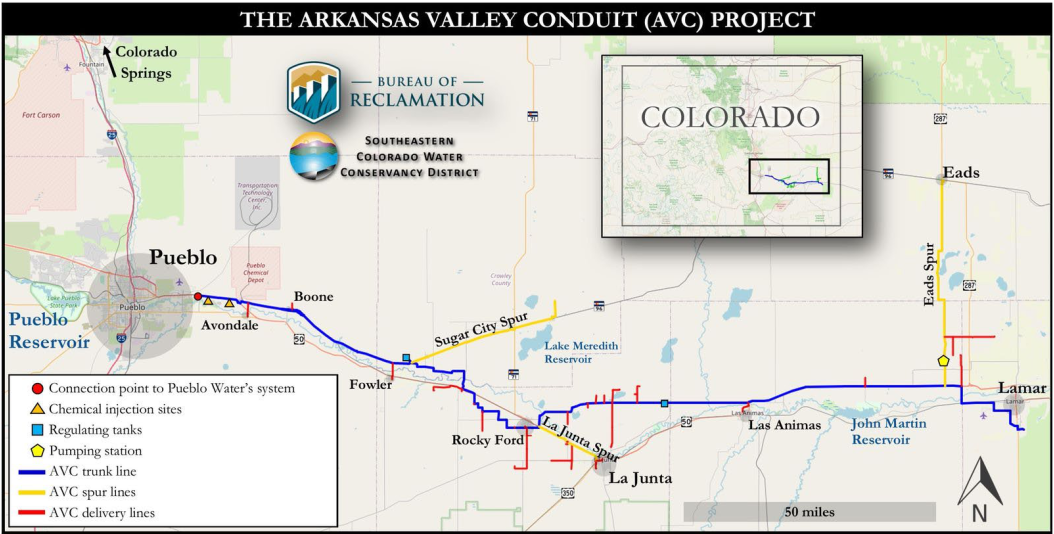
Arkansas Valley Conduit map via the Southeastern Colorado Water Conservancy District (Chris Woodka) June 2021.

Click the link to read the release on the Reclamation website (Anna Perea and Darryl Asher):

Feb 29, 2024

LOVELAND, Colo. — The Bureau of Reclamation has awarded a contract for the construction of water treatment and connection facilities for the Arkansas Valley Conduit Project to Thalle Construction for $28,710,676. This contract, partially funded by President Biden’s Bipartisan Infrastructure Law, funds construction of a backflow preventor connecting the main trunkline to Pueblo Water’s system, and a treatment facility to address specific water treatment needs for the Project.  

The backflow preventer will be constructed at 36th Lane and U.S. Highway 50, east of Pueblo. The treatment facility will be located along the AVC pipeline route about 4 miles east of 36th Lane. The treatment process will prepare the water for conveyance through the trunkline to Project communities and ensure compatibility of the water with the AVC participants’ water systems.

“We’re extremely pleased to be able to move forward with multiple features of the Arkansas Valley Conduit,” said Jeff Rieker, Eastern Colorado Area Office Manager. “The momentum of making this connection to the eastern end of Pueblo’s water system while downstream pipes are being placed and additional designs are being developed really speaks to the collaborative efforts of all those involved.”

2022 three-party contract between Reclamation, Southeastern Colorado Water Conservancy District Board and the Pueblo Board of Water Works (Pueblo Water), eliminates the need for over 24 miles of pipeline by utilizing Pueblo Water’s existing infrastructure. The water will be either Fryingpan-Arkansas Project water or from participants’ water portfolios, not from Pueblo Water’s resources. 

“This is another important step forward for the Arkansas Valley Conduit, and vital to begin providing high-quality drinking water to the people of the Lower Arkansas Valley. The Southeastern District has tremendous appreciation for the work that Reclamation and our congressional delegation have done to keep this project moving forward,” said Bill Long, President, Southeastern Colorado Water Conservancy District.

In addition to the contract for these facilities, in January, Reclamation awarded a $4.6 million contract to Central Geotechnical Services, LLC to locate and complete subsurface utility engineering surveys for underground utilities along a 34-mile stretch of the Arkansas Valley Conduit. Colorado legislation, SB 18-167, enacted in 2018, set new standards for entities conducting underground excavation.

Arkansas River Basin via The Encyclopedia of Earth

Coloradans offer to cut water use in exchange for $8.7 million — @BigPivots #ColoradoRiver #COriver #aridification

Water feature along Pueblo’s River Walk. Photo/Allen Best

Click the link to read the article on the Big Pivots website (Shannon Mullane):

February 18, 2024

Coloradans gunning to join this year’s effort to save water in the Colorado River Basin could help conserve up to 17,000 acre-feet of water — much more than the 2,500 acre-feet saved in 2023 — and receive about $8.7 million in return.

The voluntary, multistate program pays water users to temporarily use less water. State and federal officials relaunched the effort, called the System Conservation Pilot Program, in 2023 in response to federal calls to cut back on water use in the drought-stressed river basin. After a stumbling relaunch in 2023, this year’s program is moving forward with more applications, more potential water savings and more money for participants.

“The changes this year — it was just much more transparent,” said Greg Vlaming, a consultant who helped nine growers apply to the program. “The application process was simple and easy. It took me less than 15 minutes per application.”

The conservation program was initially piloted from 2015 to 2018. In 2023, officials relaunched it with $125 million in federal funding as a way to cut back on water use in response to a looming water supply crisis in the Colorado River Basin. The basin supplies water for 40 million people across the western U.S., 30 Native American tribes and northern Mexico.

Interest in the program has grown steadily. During the four-year pilot, about 15 to 45 people applied each year. In 2023, the program received more than 80 applicants.

But program costs have grown as well, in part because the program’s managers have boosted reimbursement rates to keep up with rising crop prices, according to the Upper Colorado River Commission, which oversees the program.

Last year, the four Upper Basin states — Colorado, New Mexico, Utah and Wyoming — spent nearly $16.1 million in federal funding to conserve about 37,810 acre-feet of water. During the four-year pilot, the program spent half that amount, about $8.5 million, to conserve more water, about 47,000 acre-feet.

One acre-foot supports about two families of four to five people for one year.

This year’s application period closed in December with 124 applications, according to the Upper Colorado River Commission. Of those, Colorado water users submitted 56; Utah, 32; New Mexico, one; and Wyoming, 35.

The river commission, which includes representatives from the federal government and each of the Upper Basin states, is scheduled to consider the applications March 4.

Then, once a federal review is complete and all project details are finalized, applicants have the final say about whether they will participate. The commission aims to launch the conservation projects in April, said Executive Director Chuck Cullom.

In Colorado, most of the applications come from farmers and ranchers who proposed cutting their water use by temporarily fallowing fields, or by switching to crops that use less water or can better withstand drought. About 20 proposals aim to save enough water to warrant $100,000 or more in compensation per project.

The Ute Mountain Ute tribe of southwestern Colorado has offered to use crops that require less water and will, if the tribe’s offer is accepted, get $1.1 million in return. Photo credit: Allen Best/Big Pivots

The Ute Mountain Ute Farm and Ranch in southwestern Colorado proposed the state’s biggest project this year. If approved, the enterprise will use crops that require less water and will fallow nearly 900 acres of land for an estimated 2,172 acre-feet of water savings. It would receive $1.1 million in return.

David Harold, owner of the Tuxedo Corn Company in Olathe, proposed saving 600 acre-feet of water. In return, he’d get about $305,000, roughly equivalent to the cost of a nice tractor, he said.

The program asks farmers to cut down their water use — buy-and-dry under a different name — but it’s also a way to experiment, he said. How can he respond to an uncertain water supply with as little impact to the local economy as possible and still survive as a farmer?

Harvesting a Thinopyrum intermedium (Kernza) breeding nursery at The Land Institute By Dehaan – Scott Bontz, CC BY 3.0, https://commons.wikimedia.org/w/index.php?curid=5181663
Sainfoin (Onobrychis viciifolia) has amazing properties and was largely ignored during the post war years of industrial agriculture. Not surprisingly, it’s making a bit of a comeback. Photo credit: Soil Association

Harold chose not to fallow — not growing crops means fewer hands to help with production and that impacts the local economy. Instead, he decided to turn off irrigation when it was hottest and least efficient, and to grow more drought resistant crops, like Kernza and sainfoin.

The payment was enticing, but in the long term not enough to offset all of the uncertainties that farmers face, he said. The conservation program’s reimbursement rate could change, or the program could end. There was a disaster with corn earworm in the sweet corn industry last season. State regulations, water supplies and labor costs change.

“The list goes on and on and on of why I should be doing everything I can to diversify or maneuver. Be agile. Be thoughtful,” Harold said. “The past will not be the future; what my dad did is not likely what’s going to work for me. It’s kind of daunting out there.”

Alan Ward stands at the Ewing Ditch headgate.

Pueblo Water was the only municipal water provider to apply. The Front Range utility normally takes about 943 acre-feet of water from the Ewing Placer Ditch in the Colorado River Basin and diverts it into the Arkansas River Basin for homes and gardens around Pueblo. If accepted, it will leave all of that water in the Colorado River Basin in return for up to $479,987.
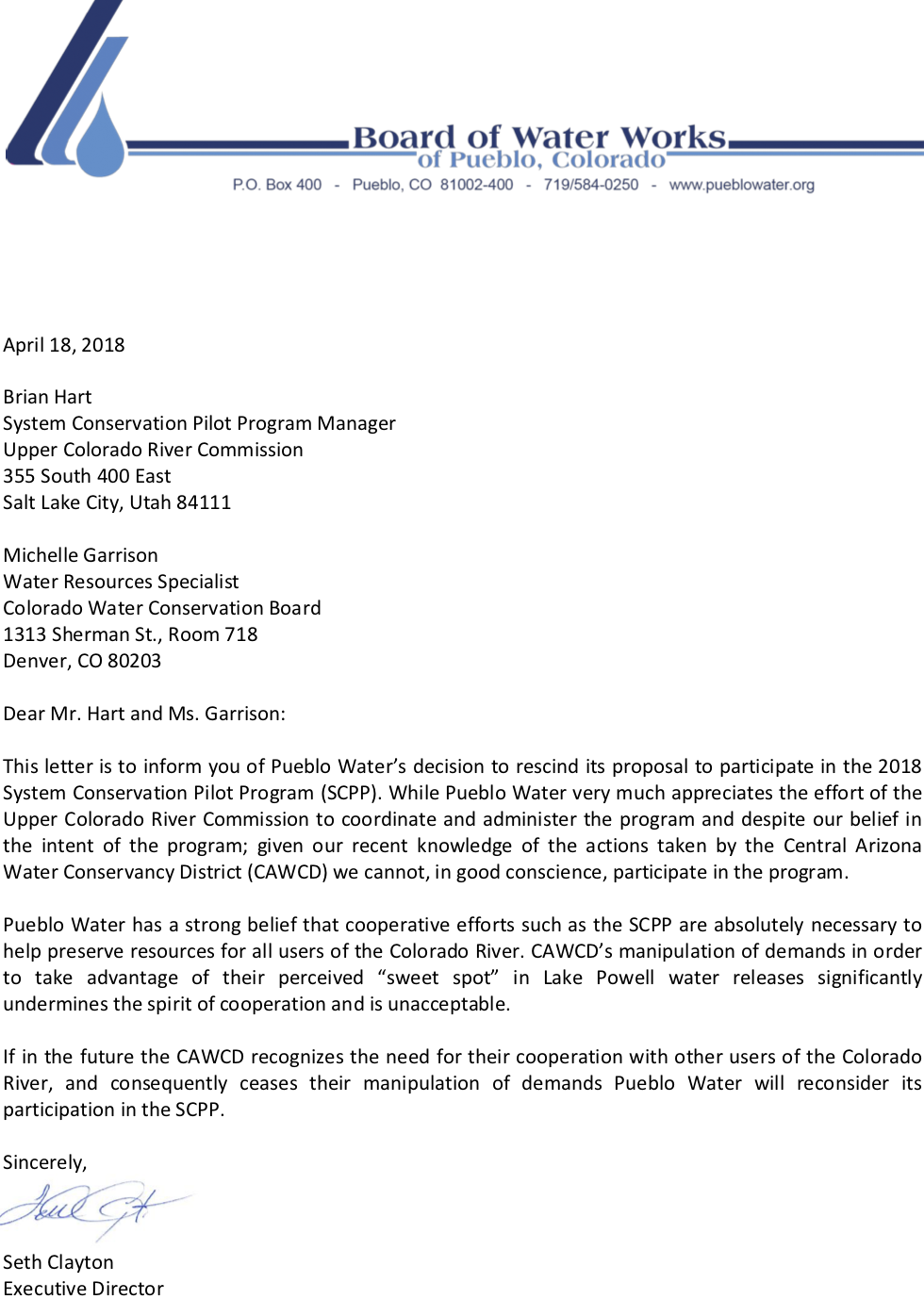
“The primary purpose we’re doing it is just because we think, for this particular year, the water’s going to be more valuable in the System Conservation Pilot Project than it’s going to be on the Arkansas River,” said Alan Ward, division manager of water resources for Pueblo Water. “I don’t think we have plans to dedicate it (the funding) to any specific purpose. Essentially what it does is it subsidizes the cost of water for our customers.”

In 2023, when participants negotiated their own reimbursement rates, compensation for the top five applicants ranged from about $70,000 to $195,000 per project, according to the Colorado Water Conservation Board.

In response to participant feedback, officials this year switched to a fixed-rate structure based on a market analysis by the federal and state governments.

Corn harvest was underway on this farm between Montrose and Delta in September 2019. Photo/Allen Best

Colorado participants will receive $509 per acre-foot of saved water, the highest compensation rate of the four Upper Basin states. New Mexico producers will receive $300, while those in Utah and Wyoming will receive $506 and $492, respectively. Reimbursement rates will vary for other projects, like leaving water storage in reservoirs, or municipal and industrial water savings.

“I’m not complaining about it,” Vlaming said. “But when I say $509 per acre-foot to guys, they’re like, ‘Where do I sign?’ Some of these guys are going to get paid quite well.”

For water users, negotiating their own rates was one of several problems with last year’s program, alongside a short application period and unclear communication about how to apply and how water savings were calculated.

The application process was much more streamlined this year because officials learned from the process in 2023, said Cullom, the Upper Colorado River Commission executive director.

“The process — which included pre-application interviews and discussions between the applicant and the states and the consultants — helped strengthen all the applications,” he said. “I think we improved the process. That’s some feedback we’ve heard.”

[…]

This story was published by Fresh Water News, a service of Water Education Colorado.

Upper Colorado River Basin map via the Upper Colorado River Commission.

Chaffee County Commissioners hear proposal for Clear Creek Reservoir expansion — The Chaffee County Times #ClearCreek #ArkansasRiver

Clear Creek Reservoir

Click the link to read the article on the Chaffee County Times website (Hannah Harn). Here’s an excerpt:

The presented concept project would be a partnership between Pueblo Water and [Colorado Springs Utilities] to enlarge the reservoir. Colorado Springs Utilities would use the enlarged space for the first 30 years, at which point Pueblo Water would get half of it. The reservoir’s dam was built in 1902 and was used by the Otero Irrigation Co. until 1955 when the reservoir was sold to Pueblo Water. Since then, [Alan] Ward said, Pueblo Water has “spent a lot of money doing various projects to upgrade the dam for improved safety.”

The purpose of the project “is to bring it up to modern dam safety standards,” Ward said. “The challenge with the dam as it is today … the dam is built on a foundation of rock and gravel, which allows a lot of water to seep through. We’ve constantly battled seepage issues over the years.”

The other reason for the enlargement is to increase water storage to “increase resiliency, reliability, and flexibility” in meeting future water needs for Pueblo Water and Colorado Springs Utilities. The current dam is 70 feet high with a capacity of 11,140 acre-feet (currently restricted at 9,100 af). The enlargement proposal would bring the dam to a height of 106 feet and 30,000 af capacity. The reservoir’s surface area would increase from 414 acres to 631 acres. The dam would be built on the downstream side of the current dam, closer to the highway. Another impact of the project…They also may be adding an upstream buttress to hold things in place in case of an earthquake…Around 30-40 acres of wetlands around the reservoir would be impacted as the reservoir backs further up the valley, as well as a few small areas at the base of the existing dam. Ward also noted the large boreal toad population in nearby ponds.

Arkansas River Basin — Graphic via the Colorado Geological Survey

Through a Memorandum of Understanding delivered to the @usbr, the @SNWA_H2O & water agencies in the Upper & Lower #ColoradoRiver Basin affirmed their commitments to implement comprehensive & innovative #water #conservation programs, initiatives, policies & actions within their communities #COriver #aridification #CRWUA2022

Major municipal #water providers across #ColoradoRiver Basin announce commitment to significant reductions in water use — @DenverWater #COriver #aridification

[

Map credit: AGU

Click the link to read the article on the Denver Water Website:

Large water providers from across the Colorado River Basin announced today a commitment to substantially expand existing efforts to conserve water, reduce demands and expand reuse and recycling of water supplies.

The agreement includes water providers in both the upper and lower basins of the Colorado River, stretching from Colorado’s Front Range to Las Vegas and Los Angeles. The providers invite other utilities in the basin to join in the commitment to increasing water-use efficiency and reducing the demand for water.

The agreement comes amid a two-decade drought on the river that affects 40 million people who rely on it for drinking water, agriculture, power production, landscape irrigation, recreation and more. Demands for water in the basin have exceeded available supply, reducing storage levels in lakes Mead and Powell to critically low levels.

The water providers are outlining their commitments in a Memorandum of Understanding that was delivered to Bureau of Reclamation Commissioner Camille Touton today. Some providers have committed to pursuing the MOU’s intent while awaiting final approval through their various governing boards.

“We are developing prudent municipal water conservation actions that every community that relies on the Colorado River should be using,” water providers said in the letter to Touton. Moving forward, “We will describe the steps our organizations will take now and codify our commitment to continued effort as we work to ensure our river and the communities it serves continue to thrive. We sincerely hope our commitment to action inspires other stakeholders that share the river to do the same.”

Specifically, the agreement will focus on several key areas as pathways to cutting water use, including:

  • Develop programs to replace non-functional or passive cool weather turf grass (grass that serves primarily a decorative role and is otherwise unused) with drought- and climate-resistant landscaping, while maintaining vital urban landscapes and tree canopies where appropriate.
  • Increase water reuse and recycling programs where feasible.
  • Continue and expand conservation and efficiency programs to accelerate water savings.
  • “Achieving the protection storage volumes needed to preserve water and hydropower operations within the Colorado River basin cannot be met by a singular country, basin, state, or water use sector,” continued the letter to BOR. “While municipal water use represents only a small fraction of total Colorado River water use, progress begins with one and then many until we are all moving in the same direction.”

    While not all the conservation strategies under consideration may make sense for each community, utilities say the agreement demonstrates the commitment that municipal water providers have not only to coordinating and collaborating on strategies to conserve and manage water demands, but to also help protect the Colorado River system.

    Links to the letter to the BOR, the MOU and a support letter from the Southeastern Colorado Water Conservancy District.

    Quotes from signatories to the BOR letter:

    “The water supply challenges we are facing on the Colorado River are accelerating at an alarming pace. Everyone who relies on the Colorado River must take bold and immediate action to reduce their use on this vital water source,” said Adel Hagekhalil, general manager of the Metropolitan Water District of Southern California. “This agreement represents our commitment to working with our municipal partners on the river to come up with innovative, collaborative approaches to better manage our Colorado River supplies and promote a more sustainable future for our communities.”

    “With climate change and aridification affecting the entire Basin, improving the health of the Colorado River system requires a swift and collective effort of all water users — in all sectors — to reduce water use and implement actionable strategies, policies and programs to protect this vital resource and balance water supplies with demands,” said John Entsminger, Southern Nevada Water Authority general manager.

    “Climate change and overuse of the Colorado River have put us squarely within the crisis we long saw coming. The bottom line now: We all need to work on solutions, no matter our individual impacts on river flows,” said Jim Lochhead, CEO of Denver Water. “While we have long been a conservation leader, Denver Water has consistently said it is prepared to do even more, and the commitments contained in this agreement reflect our readiness to take further important steps to keep more water in the Colorado River Basin.”

    “Water issues in the arid west are accelerating,” stated Aurora Water General Manager Marshall Brown. “Aurora is embracing these conservation pathways through Colorado’s largest potable reuse system, an aggressive turf replacement rebate program and a new ordinance that prohibits nonfunctional turf in new developments. We’re doing what needs to be done to ensure a reliable water supply for our community in unpredictable times and we challenge other municipalities to do the same.”

    “Colorado Springs Utilities is committed to conservation programming that ensures a clean, reliable water supply for years to come. Building on our customers’ successful 41% reduction in per capita use since 2001, we continue to pursue and implement water efficiency and reuse initiatives that support our vibrant community and make wise use of this valuable resource,” said Colorado Springs Utilities CEO Aram Benyamin.

    “The Southeastern Colorado Water Conservancy District supports the efforts of the Upper Colorado River Commission (UCRC), the State of Colorado, and municipal and agricultural water providers in the basin, to collaborate in bringing the system into balance,” said Jim Broderick, executive director of the district.

    USBR, #Pueblo Water, Southeastern #Colorado #Water district ink new deal to ease Lower Arkansas Valley water contamination — @WaterEdCO #ArkansasRiver

    The Lower Arkansas River below Lake Cheraw. Credit: Jerd Smith

    Click the link to read the article on the Water Education Colorado website (Jerd Smith):

    Thousands of people in the Lower Arkansas Valley who’ve struggled to deal with contaminated water for more than 20 years will have access to clean water by 2024 under a new agreement signed by the federal government and two Colorado water agencies last week.

    The Arkansas Valley Conduit (AVC), as the clean water delivery project is known, will bring water from Pueblo Reservoir through the city of Pueblo and out to communities on the Eastern Plains, such as Avondale and Boone, by 2024, and other communities, such as La Junta, as soon as 2027.

    Arkansas Valley Conduit map via the Southeastern Colorado Water Conservancy District (Chris Woodka) June 2021.

    Water officials said the entire pipeline should be completed by 2035 if not sooner. The project will ultimately serve 50,000 people, officials said.

    Under the agreements, signed by the U.S. Bureau of Reclamation, the Pueblo Water Board, and the Southeastern Colorado Water Conservancy District March 18, some $40 million in federal and local funding will be available to launch construction, with subsequent funding for the $600 million project anticipated to come from Congress and local water agencies.

    In addition, the agreement allows Reclamation and Southeastern to pipe the water through the city of Pueblo’s water system, rather than building a separate system to move the water out to the Eastern Plains. Officials said this new agreement will shave costs and several years off the project.

    “This contract signing marks one of the most significant milestones to date towards making the AVC a reality and bringing clean water to communities that desperately need it. It advances the project over 14 miles east from Pueblo Reservoir which puts us much closer to our first participants in Avondale and Boone,” said Brent Esplin, regional director of the Missouri Basin and Arkansas-Rio Grande-Texas Gulf regions for Reclamation, in a statement.

    Naturally occurring selenium and lead, as well as radionuclides, have dogged the region’s water systems since the 1960s. Many of the communities face enforcement actions from the state health department because they don’t have the financial resources to treat the water for drinking and then to treat it again for discharge into the wastewater systems that discharge to the Lower Arkansas River and its tributaries, according to Chris Woodka, senior policy manager with the Southeastern Colorado Water Conservancy District. Southeastern operates the federal Fryingpan-Arkansas Project’s Pueblo Reservoir.

    “This project will relieve some of the pressures that they face. They will get better quality drinking water and they will see improvements to their discharged water,” Woodka said.

    Pueblo Reservoir

    The idea is to deliver clean water from Pueblo Reservoir directly to the communities via the 34-mile pipeline, reducing and sometimes eliminating the contaminants that the water now picks up when it travels through streams and irrigation ditches.

    The conduit has been on planning boards for more than 50 years but it wasn’t until a new federal law was approved in 2009 stipulating that the federal government would pick up 65% of the costs that the plan began to advance, Woodka said.

    Since then the region has wrestled with getting federal cash to start work and convincing local water agencies and the communities who need the water to cooperate on design issues and costs, Woodka said.

    “People are convinced it will get built,” Woodka said. “Now the questions are about affordability.”

    And for small towns, those are big questions.

    Tom Seaba is La Junta’s director of utilities. His city has comparatively clean water, with no radionuclides and a selenium issue that it is treating via reverse osmosis.

    “It could be the silver bullet that everyone would like to take care of the contaminants that are in the water. The flip side is the cost,” Seaba said.

    La Junta charges customer $2.50 per thousand gallons for water now, which includes treatment costs. The new water will cost $2.19 per thousand gallons, untreated, and La Junta will still have to find a way to recoup the cost to disinfect and treat the water.

    “Now that we’re getting down to brass tacks, we need to see if the underlying reality will do for us what everyone hopes it will. If we can connect and that takes care of the problems we have, sign us up. But if it doesn’t, we will have to do something else,” Seaba said.

    Jerd Smith is editor of Fresh Water News. She can be reached at 720-398-6474, via email at jerd@wateredco.org or @jerd_smith.

    #Pueblo Water: There are no water restrictions for residents within the city — The Pueblo Chieftain

    Pueblo photo via Sangres.com

    From Pueblo Water via The Pueblo Chieftain:

    There are no water restrictions for residents in Pueblo, per Pueblo Water.

    The utility released a statement Monday stating that “there are no water restrictions in place” and that “some communities not served by Pueblo Water have implemented water restrictions.”

    One community with water restrictions in place is Pueblo West. Residents there are currently on Stage 1 voluntary water restrictions. That only applies to those in Pueblo West — not within the city.

    “While everyone should use water as efficiently as possible,” the Pueblo Water release reads, “Pueblo Water does not plan to issue any restrictions this year.”

    For tips to use water wisely, or for more information, visit http://pueblowater.org/seasons-tips/.

    #Pueblo Board of #Water Works implements safety project for #ArkansasRiver — KOAA

    Pueblo photo via Sangres.com

    From KOAA (Samantha Alexander):

    The safety project includes replacing the dam near City Park with drops, which would make it safer for those tubing or kayaking from Lake Pueblo dam through the levee near downtown.

    “It’s number one hazard mitigation project, but number two it is a tremendous quality of life project for the community,” said Seth Clayton, Executive Director of The Pueblo Board of Water Works.

    The project is estimated to cost a little over ten million dollars. The board is hoping to receive a grant from the Federal Government.

    Construction on the drops would begin sometime next year.

    Arkansas Valley Conduit will provide fresh water to towns of Southeastern #Colorado — The Mountain Mail

    Arkansas Valley Conduit “A Path Forward” November 22, 2019 via Southeastern.

    From The Mountain Mail (Cody Olivas):

    The Southeastern Colorado Water Conservancy District and U.S. Bureau of Reclamation recently adopted a project management plan that will guide construction of the Arkansas Valley Conduit…

    Terry Scanga, general manager of the Upper Arkansas Water Conservancy District, said he didn’t see the AVC having much impact on Salidans and others in the area. “It’s not going to change river flows,” he said. “It’s not going to impact the allocation (of water) communities in the upper basin get.”

    After thinking about it for a second he said some transit loss might have a “minimal impact” on irrigators, but added that the advantages of the project far outweigh those potential effects.

    [Sam] Braverman said they’re not creating any new water diversions from Colorado’s Western Slope. The big change, he said, is that water will now be piped from Pueblo to surrounding municipalities instead of letting it flow to them in the river, which will improve drinking water quality…

    Salinity, selenium and uranium found in the natural environment all pose water-quality challenges for the Arkansas River in southeastern Colorado.

    Several communities the conduit will serve currently can’t drink their tap water.

    “There’s at least 5,000 people who literally have radioactive water coming out of their pipes,” Braverman said. “They can’t drink their water, and (the municipalities) can’t afford to filter it out.”

    Braverman said another 11,000-12,000 people in the communities get their water from reverse osmosis, but the state doesn’t see those systems as permanent solutions because they put their effluent back into the river. He said drying the effluent, packing it and taking it to landfills would be too costly to be a realistic solution.

    “There’s no way those communities could afford to do that,” he said. “The AVC is really the only answer for all of these communities; this a game changer for disadvantaged areas.”

    The AVC will provide water for municipal and industrial use.

    The project management plan describes how the project will be executed, monitored and controlled.

    Under the plan, the Pueblo Board of Water Works will deliver AVC water to a point east of Pueblo. A contract among the Reclamation Bureau, Pueblo Water and Southeastern Colorado Water Conservancy District is in the discussion stage. From that point, the bureau will construct the trunk line, a treatment plant and water tanks, while Southeastern will coordinate with communities to fund and build connections.

    Southeastern will serve as lead on the “spur and delivery lines” portion of the project and seek funding to design and construct this portion of the project, $100 million of which has already been secured from the Colorado Water Conservation Board, subject to legislative approval.

    Braverman said they just started final design on the first 12 miles of the pipeline…

    Braverman said communities the AVC will serve have been hearing about it for decades, but getting the $28 million recently was the first chunk of money they’ve secured to begin construction.

    “That was a complete shift from where we were,” Braverman said. “Now it’s just a matter of the funding stream continuing.”

    Arkansas River Basin via The Encyclopedia of Earth

    Project Management Plan Developed for Arkansas Valley Conduit — Southeastern Colorado Water Conservancy District

    Arkansas Valley Conduit “A Path Forward” November 22, 2019 via Southeastern.

    Here’s the release from the Southeastern Colorado Water Conservancy District (Chris Woodka):

    Southeastern Colorado Water Conservancy District and the Bureau of Reclamation have adopted a project management plan that will guide construction of the Arkansas Valley Conduit (AVC).

    The AVC is a pipeline project that will deliver clean drinking water to 40 communities serving 50,000 people from Pueblo Dam to Lamar and Eads on the eastern plains. This water supply is needed to supplement or replace existing poor quality water and to help meet AVC participants’ projected water demands. The estimated cost of the AVC is between $564 million and $610 million.

    “The Project Management Plan is the blueprint for how we will build the Arkansas Valley Conduit, and an important step in the future of the AVC,” said Bill Long, President of the Southeastern District Board of Directors. “The AVC is absolutely necessary for the future water quality and health of the Arkansas Valley.”

    “The Department of the Interior and Reclamation are committed to improving the water supplies of rural southeastern Colorado,” said Commissioner Brenda Burman. “I look forward to our continued collaboration with Southeastern to move this long-delayed project forward.”

    “The communities of the Lower Arkansas Valley deserve clean drinking water, which the Arkansas Valley Conduit will supply for 50,000 Coloradans for generations to come,” said Senator Cory Gardner, R-Colo. “I was proud to secure robust federal funding of $28 million to begin construction for the first time since Congress authorized the project and President Kennedy promised completion nearly six decades ago. The project management plan adopted by the Bureau of Reclamation and the Southeastern Colorado Water Conservancy is another great step forward for this project and I’ll continue to work with local and federal leaders to ensure we deliver abundant and affordable clean drinking water to the Colorado communities in need.”

    “This is a significant milestone in our efforts towards construction of the AVC,” said Jeff Rieker, Eastern Colorado Area Manager for Reclamation. “This plan will guide design and construction by Reclamation and Southeastern, and streamline our joint efforts to provide clean water to these communities.”

    Reclamation and Southeastern have worked together for the past year to envision a layout for the AVC that reaches communities with the poorest water quality most quickly, reduces overall costs, and reduces the need for federal appropriations. Many communities have issues with radioactive elements in groundwater supplies. Others face increasing costs to treat water and to dispose of waste by-products from that treatment.

    Under the plan, AVC water will be delivered to a point east of Pueblo by the Pueblo Board of Water Works. A contract among Reclamation, Pueblo Water and Southeastern is in the discussion stage.

    From that point, Reclamation will construct the trunk line, a treatment plant and water tanks, while Southeastern will coordinate with communities to fund and build connections. Reclamation and Southeastern continue to meet regularly, using remote technology, to work on activities such as design, land acquisition and environmental review that will lead to construction.

    “We’re on a path to begin construction in the near future, but we still have a lot of work to do,” said Kevin Karney, who chairs Southeastern’s AVC Committee. “Part of that will be reaching out to AVC participants to help shape how the AVC is developed. Overall, I’m excited to see the AVC moving forward.”

    Congress provided additional funds to Reclamation in FY 2020. Reclamation allocated $28 million for construction of the AVC in February, and an additional $8 million for 2021 was requested in the President’s budget. The Colorado Water Conservation Board approved a $100 million finance package that still must be approved by the Colorado Legislature. Other potential sources of funding are being considered.

    The AVC was part of the 1962 Fryingpan-Arkansas Project Act, but was never built because communities could not afford 100 percent of the costs. In 2009, the Act was amended to provide a 65 percent federal cost share. Reclamation identified a preferred alternative in 2014, which has been modified in the latest project management plan.

    xxx

    For additional information, contact Chris Woodka at Southeastern, (719) 289-0785; Darryl Asher at Reclamation, (406) 247-7608.

    Fryingpan-Arkansas Project via the Southeastern Colorado Water Conservancy District

    American Water Works Association: Winner of the Best Water in the Rocky Mountain Section- Pueblo Water

    Here’s the release from AWWA Rocky Mountain Section (Dena Egenhoff):

    Denver, Colorado (September 18, 2018) – The water has been tasted, the water has been tested and the winner of the “Best of the Rocky Mountain Section” water taste test has been announced! Pueblo Water, Colorado took first place with a panel of veteran judges and media reporters evaluating water appearance, quality, odor, and taste, of course. Competition was stiffer this year with 11 municipalities, from Wyoming, Colorado and New Mexico, competing for the title of the best drinking water in the mountain west during the 2018 annual conference of the Rocky Mountain Section of the American Water Works (RMSAWWA) in Denver, Colorado. You can learn more about the winner Pueblo Water utility by visiting http://www.pueblowater.org. Second place was awarded to City of Santa Fe Water Division, New Mexico, with Roxborough Water and Sanitation District-Littleton, Colorado coming in third.

    Pueblo Water will now go on to represent the mountain west in the national “Best of the Best” water taste test at the American Water Work’s Annual Conference and Exposition (ACE 19) in Denver, Colorado June 9-12, 2019. Over 12,000 water professionals across the country will gather at ACE 19 where best-tasting tap water in North America will be declared.

    Judges this year’s event were the voice of the Colorado River basin and water issues in Western U.S. Luke Runyon with KUNC Harvest Media, Jamie Sudler the voice of H2O radio and KGNU that inspire people to connect to water issues, veteran sensory taste tester Jordan Kelly with Odell Brewing, Mark Jockers the Government and Public Affairs Manager for Clean Water Services and brewer of beer from treated wastewater, Pinar Omur-Ozbek an assistant professor of engineering and renowned water expert with Colorado State University, and Alan Forrest, American Water Works Association Vice-President.

    The RMSAWWA is the regional section for the AWWA, which is the largest non-profit, science-based organization for drinking water professionals in the world. The RMSAWWA covers Wyoming, Colorado and New Mexico and has over 2,400 members, representing water utilities, engineering consultants and water treatment specialty firms.

    From The Greeley Tribune (Sara Knuth):

    With high marks for its mineral-rich, clean flavor, Greeley took fifth place Monday in the American Water Works Association’s Rocky Mountain Section awards.

    The city, which came into the competition to defend a national title, faced stiff competition this year from three states: Colorado, New Mexico and Wyoming. Pueblo Water ultimately won the competition, according to a news release, beating 11 other municipalities. The competition was hosted during the 2018 annual conference of the Rocky Mountain Section of the American Water Works in Denver.

    In 2017, Greeley won the award and went on beat out 33 regional winners to earn the distinction of having the best-tasting water in the nation at the American Water Works Association’s annual conference. It also won the People’s Choice Award, making it the first city ever to win both.

    In an email, Aaron Benko of Denver Water said Greeley shouldn’t take down billboards that highlight the city’s water quite yet.

    “I believe that Greeley is still the only utility to win the Best of the Best and People’s Choice,” he said.

    Pitkin County and West Slope close to securing 1,000 AF of water for upper Roaring Fork

    The upper Roaring Fork River, east of Aspen, near the river’s confluence with Difficult Creek. The stretch of river between Difficult Creek and Maroon Creek is often plagued by low flows in late summer and fall.

    By Brent Gardner-Smith, Aspen Journalism

    As a way to settle a 2009 state water court case led by Pitkin County and the Colorado River District, the Front Range city of Aurora has agreed to let as much as 1,000 acre-feet of water run down the upper Roaring Fork River each year instead of diverting the water under Independence Pass.

    The pending settlement could mean that about 10 to 30 cubic feet per second of additional water could flow down the river through Aspen in summer and fall.

    It’s an amount of water that Pitkin County Attorney John Ely said would be “visibly noticeable” and would help bolster flows in the often water-short stretch of the Roaring Fork between Difficult and Maroon creeks.

    “It’s exciting,” Ely said. “It’s not very often you get to put water into the upper Roaring Fork. These opportunities are pretty limited, and I’m not sure if we’ll ever see another one.”

    A June 13 memo from Ely on the agreement states that “the Pitkin County Healthy Rivers and Streams Board has long recognized this reach of the Roaring Fork as one of the most stressed reaches of the Roaring Fork” and that “the Roaring Fork Conservancy’s State of the Watershed report identifies the upper Roaring Fork just above Aspen and heading into town as being severely degraded.”

    The Pitkin Board of County Commissioners is expected to approve the settlement in the form of an intergovernmental agreement with Aurora on Wednesday.

    Aurora’s city council also is expected to approve the agreement, as is the Colorado River District board of directors at its July meeting. A Water Court judge has set a July 20 deadline for the parties to file the settlement.

    Officials with Pitkin County and the Colorado River District see the deal with Aurora as a victory, especially as some estimates, according to Ely, place the value of water in Aurora at $50,000 an acre-foot, which makes the 1,000 acre-feet of water potentially worth $50 million.

    The settlement is also of high value to officials at the Colorado River District, who led the efforts of the West Slope entities in the case.

    “I think it’s a big deal,” said Peter Fleming, the general counsel for the Colorado River District, which represents 15 counties on the Western Slope. “I think it’s going to be a good deal for Pitkin County, the Roaring Fork River, and the West Slope as a whole. And frankly, I think it’s a pretty good deal for Aurora, as well.”

    But Tom Simpson, a water resource supervisor with Aurora, said it’s a “bittersweet” deal for the growing Front Range city.

    “We’ve worked hard on this agreement over the last year,” Simpson said. “It is bittersweet, but we are happy that we are finally there.”

    The deal lets Aurora retain its current use of 2,416 acre-feet of water it diverts on average each year from the top of the Fryingpan River Basin, but Aurora also is giving up 1,000 acre-feet of water it now diverts from the top of the Roaring Fork River Basin.

    Aurora also is agreeing to abide by operating protocols and future potential use of the senior water rights on the Colorado River now tied to the Shoshone hydropower plant in Glenwood Canyon. That agreement could limit the amount of additional water Aurora can divert in the future from the Colorado River Basin.

    The provisions of the agreement relating to the Shoshone water right also include an acknowledgement that the senior water right might someday be changed to include an instream flow right rather than the water being diverted out of the river and sent to the hydropower plant.

    “Aurora will not oppose an agreement between a West Slope entity or entities, the Colorado Water Conservation Board, and any other entity entered for the purpose of adding instream flow as an additional use of the senior hydropower right,” the agreement states.

    Simpson agreed the overall deal represented a “haircut” for Aurora’s water rights in the Colorado River Basin.

    “Yes, we’re going to get the 2,416 acre-feet out of Busk, but we’re going to make these other deliveries on the Roaring Fork, and we might lose just a little bit of water on the Shoshone protocol,” he said. “It’s a haircut, absolutely.”

    On the other hand, Simpson said “while this agreement is not perfect, we feel like it is a good agreement, and preserves some of our Busk-Ivanhoe water and lets us all move forward.”

    A view of Ivanhoe Reservoir, where water from the upper Fryingpan River headwaters is collected before being sent under the divide to Busk Creek, Turquoise Reservoir, and then the Front Range.

    Started in 2009

    In December 2009, Aurora filed a water rights application in Division 2 Water Court in Pueblo to change the use of its water rights in the Busk-Ivanhoe transmountain diversion system in the Fryingpan River headwaters.

    The system, built in the 1920s, gathers water from Ivanhoe, Pan, Lyle, and Hidden Lake creeks and diverts the water through the Ivanhoe Tunnel to Turquoise Reservoir near Leadville before it is sent to East Slope cities. The system was built to deliver water to irrigators in the lower Arkansas River basin.

    The water rights to the system carry appropriation dates from 1921 to 1927, which makes them junior to the senior water rights on the Colorado River near Grand Junction known as the “Cameo call.”

    The Pueblo Board of Water Works bought half of the Busk-Ivanhoe system in 1972, and Aurora gradually secured its half-ownership in the system between 1986 and 2001.

    In its 2009 application, Aurora told the water court it wanted to change the use of its water in the Busk-Ivanhoe system from irrigation to municipal use.

    However, it also conceded it had already been using the Busk-Ivanhoe water for municipal purposes in Aurora, even though its water-right decree limited the use of the water to irrigation in the lower Arkansas River valley. It also came to light that Aurora was first storing the water in Turquoise Reservoir without an explicit decreed right to do so.

    That caught the attention of Pitkin County, the Colorado River District, a host of other Western Slope water interests, and the state engineer’s office, which administers water rights.

    As Ely put it in a June 13 memo to the Pitkin County commissioners, “In 1987, Aurora began using Busk-Ivanhoe water for undecreed municipal and residential purposes in an undecreed area, the South Platte Valley, after storing the water in an undecreed manner in Aurora system reservoirs.”

    Aurora’s stance was that since the water had been diverted under the Continental Divide, it didn’t matter how it used or stored the water, as it should make no difference to the West Slope. But an array of West Slope entities, including the Colorado River District, disagreed with Aurora’s position.

    In July 2013 the Western Slope entities and the state took Aurora to a five-day trial in Div. 2 Water Court in Pueblo, arguing that Aurora should not get credit for its 22 years of undecreed water use and storage.

    “It was always an issue of fact at trial as to how much water was in play because it depends on how you calculate the yield of the project,” Ely said.

    In 2014, thought, the district court judge in Division 2 ruled in Aurora’s favor, and the West Slope interests then appealed to the state Supreme Court.

    The appeal process prompted a host of entities on both sides of the Continental Divide to come forward and argue aspects of the case before the court. It also prompted a scolding of Aurora by former Supreme Court Justice Greg Hobbs over the use of undecreed water rights.

    In 2016, the Colorado Supreme Court reversed the lower court’s decision, ruled in favor of the Western Slope, and remanded Aurora’s original change application back to the lower court.

    “The Supreme Court wrote that notwithstanding the fact that the change application and original decree concerned developed transmountain water, water used for undecreed purposes cannot be included in a calculation for historic consumptive use and is therefore excluded from water available for change of use,” Ely wrote in his June 13 memo.

    So, rather than going back to Water Court and continuing to fight over the potential size of the Busk-Ivanhoe rights, which the West Slope now saw as being between zero and well-less than 2,416 acre-feet, Aurora began negotiating in January 2017 with the Western Slope entities still in the case, which included Pitkin County, Eagle County, the Colorado River District, the Grand Valley Water Users Association, the Basalt Water Conservancy District, Eagle County, Orchard Mesa Irrigation District, and Ute Water Conservancy District.

    Today, each of those entities is also a party to the intergovernmental agreement expected to be submitted to the water court in July, along with a proposed decree for Aurora’s Busk-Ivanhoe rights.

    Ely said Pitkin County didn’t start out in the case with an eye on securing 1,000 acre-feet for the Roaring Fork, but did have a local interest in the operation of the Busk-Ivanhoe project.

    “We weren’t doing it to obtain an end result, we were doing it because the [Busk-Ivanhoe] project is in our backyard and we felt it was the right thing to do,” Ely said. “And all the other dialogue developed after the trial and the Supreme Court decision.”

    At the time of the 2016 Colorado Supreme Court decision, Pitkin County had spent $353,000 in legal and other fees in the case, using money brought in by a tax to fund the county’s Healthy River and Streams program, which includes litigation in water court.

    Since then, Ely said the county had spent an additional $27,300 for hydrology and engineering work, but had not spent more on additional outside legal help, as he and Assistant County Attorney Laura Makar handled the settlement negotiations for the county.

    The dam across the main stem of the upper Roaring Fork that diverts water from Lost Man Creek and the Roaring Fork into a tunnel under Green Mountain and, eventually, into Grizzly Reservoir and the tunnel under Independence Pass to the Arkansas River basin. Some of the water owned by Aurora will be bypassed at this point to run down the Roaring Fork.

    Pan, or Fork?

    For Pitkin County and other Western Slope entities, it made more sense to negotiate with Aurora for some of the water it owns in the Independence Pass-Twin Lakes system rather than the Busk-Ivanhoe system, as any water bypassed by the Busk-Ivanhoe system would be scooped up by the Fry-Ark Project, which sits below the Busk-Ivanhoe system in the upper Fryingpan valley and also diverts water to the East Slope.

    Aurora owns 5 percent of the shares in the Twin Lakes Reservoir and Canal Co., which operates the Independence Pass Transmountain Diversion System. Its share of the water diverted each year from the top of the Roaring Fork equals about 2,100 acre-feet a year, so the 1,000 acre-feet of water equals about half of Aurora’s water in the Twin Lakes company.

    In the 10 years from 2007 through 2016, Twin Lakes Co. diverted a total of 485,762 acre-feet of water from the upper Roaring Fork River Basin through its diversion system, putting the 10-year average for that period at 48,567 acre feet. 2011 was the biggest year of diversions since 2007, with 67,463 acre-feet diverted, and 2015 was the lowest year since 2007, with 18,374 acre-feet diverted.

    Colorado Springs owns 55 percent of the shares in Twin Lakes Co., Pueblo 23 percent, Pueblo West 12 percent, and Aurora 5 percent. There are also other minority shareholders, holding 5 percent of the shares, still using the water from the system for agriculture.

    Twin Lakes is not a party to the intergovernmental agreement between Aurora and the West Slope entities, but it is willing to work with all involved to make the water deliveries as beneficial as possible for the Roaring Fork River.

    Ely said Pitkin Country was grateful for the willingness of the Twin Lakes Co. to work with the county and the Colorado River District to release the water in a way that benefits the river, even if it means more work for the operators of the Independence Pass-Twin Lakes system.

    According to Kevin Lusk, the president of the Twin Lakes Reservoir and Canal Co. and a senior engineer at Colorado Springs Utilities, the company is simply responding to the desires of a shareholder in the company, Aurora.

    He also said it’s legal under a 1976 water-rights decree held by Twin Lakes to bypass water for use on the West Slope instead of diverting it under the Continental Divide.

    “The decree allows for this type of operation and so really all we’re doing as a company is accommodating the request of one of our shareholders to do something that was contemplated and provided for in the decree,” Lusk said.

    And as part of the agreement, representatives from Pitkin County, the Colorado River District, Aurora, and Twin Lakes will meet each year to agree on a delivery schedule for the water that describes the “desired rate, timing, amount, location and ultimate use of the water, as well as the operational needs and constraints” of the Independence Pass-Twin Lakes diversion system.

    In a letter attached to the agreement laying out how Aurora and the Twin Lakes Co. plan to manage the releases, Aurora said it “would prefer the water to be delivered at times of the year and at locations that will provide the most benefit to the Roaring Fork River stream flow. Typically this will be in the second half of the summer, beginning July 15, through the fall season.”

    And Pitkin County feels the same way, according to Ely.

    “We would like it delivered later in the year when the flows of the river start to go down,” he said.

    However, Lusk at Twin Lakes said if the West Slope entities wait too long in the season to bypass the water, it may not be there to bypass.

    “I know that there is a great interest in saving a lot of this water and bypassing it at the end of the season,” Lusk said. “But it’s going to be a bit of a balancing act. You’ve got to take the water when it’s there, because if you don’t take advantage of it there won’t be any to release later.”

    Lusk also said that if the West Slope really wanted to take full advantage of the water, it might consider building a reservoir above Aspen to store the water at peak runoff and then release it later in the season.

    Grizzly Reservoir on Lincoln Creek, well above its confluence with the Roaring Fork River at Lincoln Gulch Campground. The reservoir briefly stores water before it is diverted under the Continental Divide.

    Flows on the Fork

    According to a draft resolution to be voted on by the Pitkin County commissioners Wednesday, there were several factors that went into the county’s goal of acquiring 1,000 acre-feet per year of water for the upper Fork, including “the expected amount of yield for Aurora in the Busk-Ivanhoe system; existing in-basin and out-of-basin diversions from the Roaring Fork River between Independence Pass through the City of Aspen; potential future demand on the river; extent of existing conditional water rights; and the results of a stream analysis and channel measurement study.”

    If the deal is approved, as soon as next year 700 acre-feet of Aurora’s water is expected to be captured briefly in the Independence Pass system, which includes dams on Lost Man Creek, the main stem of the Roaring Fork River, and on Grizzly Creek, and then released down either the Fork or Lincoln Creek toward Aspen.

    Another 200 acre-feet of Aurora’s Twin Lakes water will be held in Grizzly Reservoir on Lincoln Creek, which holds 570 acre-feet of water. That water will then be released late in the year, after most transmountain diversions have stopped, to bolster late-season flows in the river.

    “So it’s actually reservoir release of previously stored water, while the [700 acre-feet] is a true bypass of water that would have gone through the tunnel that day to the other side,” Lusk said. “It’s new for us. We typically don’t operate the reservoir that way. Typically we would run that reservoir quite a bit lower, just for safety-of-dam reasons. But this change in operation is going to be holding the reservoir up much fuller for a lot longer, and we just need to watch the behavior of the dam.”

    Another 100 acre-feet of water could also eventually be left in the Roaring Fork each year after a complicated exchange-of-water arrangement is worked out with Aurora and other parties on the Fryingpan River, which brings the potential total water left in the Fork to 1,000 acre-feet.

    There is also a drought contingency provision which will allow Aurora to bypass 100 acre-feet less than they would have under the deal if the water level in their system of reservoirs falls below 60 percent on April 1 in a given year. So in a dry year, that could bring additional flows in the Roaring Fork back to 900 acre feet.

    The upper Roaring Fork River at the Cascades at about 6 p.m. on Thursday, June 16, 2016, after Lincoln Creek surged into the Fork, about an hour after the Twin Lakes Tunnel was closed. When the Twin Lakes system is closed for whatever reason, as it has been the past several seasons, the Roaring Fork River leaps to life with renewed intensity.

    Other provisions

    The pending Busk-Ivanhoe settlement also includes a provision that allows the Basalt Water Conservancy District to store 50 acre-feet of water in Ivanhoe Reservoir, which holds 1,200 acre-feet of water and serves more as a forebay for the Ivanhoe Tunnel diversions than a storage reservoir.

    And, in a provision to Aurora’s benefit, the West Slope entities, including Pitkin County, have agreed not to fight, at least on a wholesale basis, the permitting of two potential reservoirs that Aurora is working on, Wild Horse Reservoir in South Park and Box Creek Reservoir, which could hold between 20,000 and 60,000 acre-feet on private land on the south flank of Mt. Elbert.

    “Any participation in the permitting processes by the West Slope Parties will not seek to prevent the project in its entirety and comments or requests may be raised only for the purpose of addressing water related impacts caused directly by either of the two above specified projects on the West Slope,” the draft agreement between Aurora and the West Slope says.

    The concession from the West Slope is significant as Box Creek Reservoir will be able to store water from the West Slope.

    The West Slope entities also agree not to oppose changes in diversion points tied to the Homestake transmountain diversion system in the Eagle River Basin, not to oppose Aurora’s efforts to repair the Ivanhoe Tunnel, which is also called the Carlton Tunnel. The tunnel was originally built as a railroad tunnel, and then used as a highway tunnel.

    Finally, the parties to the deal have agreed, in what’s called a “diligence detente,” not to challenge in water court for 15 years a list of conditional water rights, held by both East Slope and West Slope entities, that are required to periodically file due-diligence applications with the state.

    The list of conditional water rights includes rights held by Aurora tied to the Homestake project and rights by the Southeastern Water Conservancy District tied to the Fry-Ark Project. They also include rights held by the Colorado River District on a number of West Slope water projects, including the potential Iron Mountain Reservoir near Redcliff and the Wolcott Reservoir near Wolcott.

    Notably, the agreement does not include provisions to legally shepherd the water from the Independence Pass-Twin Lakes system all the way to the confluence of Maroon Creek, so it’s possible that diverters on the river near Aspen, such as the Salvation Ditch, could pick up the water left in the river.

    However, Ely said the county will seek cooperation from diverters on the river near Aspen.

    “We’ve had some conversations with water users on this side of the hill, and we’ve had conversations with the Division 5 engineer’s office, and we’re hopeful that when the water is being bypassed and put in the river and there is an increase of flow, folks won’t take advantage of that and we’ll be able to get it down through Aspen,” Ely said. “And eventually, you know things will change, and we hope to have that water associated with its own water right, so we can call it further down, but that won’t be the case right away.”

    An additional benefit to the deal, according to Ely, is that the management of the 1,000 acre-foot pool of water from Aurora may also lead to better management of a 3,000 acre-foot pool of water also available in the Independence Pass-Twin Lakes system.

    That pool was created to mitigate the impacts to the Roaring Fork River from diversions by the Fry-Ark Project on Hunter, Midway, and No Name creeks, which drain into the Fork in central Aspen. And while Twin Lakes releases the water down the Roaring Fork, releases from the Fry-Ark Project replace the water in Twin Lakes Reservoir, where both transbasin diversion systems can send water.

    For years, the water from the 3,000 acre-foot pool has been released at a rate of 3 cfs on a year-round basis and has not been timed to help bolster low-season flows. Now, given the greater cooperation over the management of the 1,000 acre-foot pool from Aurora, how the 3,000 acre-foot pool from Fry-Ark is managed may also change, to the benefit of the river.

    Aspen Journalism is collaborating on the coverage of rivers and water with The Aspen Times. The Times ran a shorter version of this story on Tuesday, June 12, 2018.

    #ColoradoRiver: The Pueblo Board of Water Works pulls out of 2018 System Conservation Program #COriver

    From The Nevada Independent (Daniel Rothberg):

    Pueblo Water’s decision comes after four states and Denver’s municipal water agency accused the Arizona agency — the Central Arizona Water Conservation District — of undermining Lake Powell elevations by manipulating the complicated supply-and-demand rules that govern water orders.

    “Given our recent knowledge of the actions taken by [CAWCD] we cannot, in good conscience, participate in the program,” Seth Clayton, Pueblo Water’s executive director, wrote in the letter.

    The letter, dated April 18, comes as the Arizona agency is set to meet next week with negotiators for the Upper Basin states of Colorado, New Mexico, Utah and Wyoming. The Colorado River is split into two basins with two main reservoirs. The Upper Basin stores water in Lake Powell and the Lower Basin stores water in Lake Mead, 30 miles outside of Las Vegas.

    The Arizona agency at the center of the controversy, CAWCD, has kept quiet in recent days, despite increasing media attention, so as not to affect the outcome of those discussions.

    The Lower Basin states of Arizona, California and Nevada are also scheduled to meet on May 2, although that meeting had been scheduled before the letters to CAWCD were reported last week. The commissioner for the Bureau of Reclamation had been invited to that meeting.

    The Pueblo letter confirms what Upper Basin water managers feared — that Arizona’s actions would dissuade water users from joining the conservation program. The program, which is in its pilot phase, pays water users to conserve. The hope is that the conserved water, by not leaving the system, will boost the elevation of Lake Powell. The Arizona agency has said it wants to maximize the amount of water it gets from the Upper Basin, which stores water in Lake Powell.

    “[Upper Basin water users] do not want to be putting water into Lake Powell if it gets immediately pulled down to feed this policy that the district is trying to advance,” said James Eklund, who represents the state of Colorado on the Upper Colorado River Commission.

    CAWCD has said its strategy is to help Arizona prepare for shortage, noting that its actions are permissible under current Colorado River rules. In a statement last week, a spokesperson said: “We have been reaching out to our partners in the Upper Basin, hoping to clarify apparent misunderstandings, and to facilitate in-person, collaborative discussions aimed at finding solutions that will benefit the communities and environment served by this mighty river.”

    Jim Gardner won’t seek re-election to the Pueblo Board of Water Works

    From The Pueblo Chieftain (Jon Pompia):

    Now, after 18 years on the city’s Board of Water Works, Jim Gardner, 85, won’t be seeking reelection…

    “I’m old,” Gardner said with a laugh. “But I can shoot my age in golf and I want to spend more time going that.”

    When a vacancy on the water board opened up in 1999, Gardner was appointed by City Council to fill the slot.

    He said frequent conversations with a friend — well-known civic activist and longtime water board member Bud Whitlock — helped spur his interest in water and related issues.

    “Mr. Whitlock would talk about it all the time as being very important,” Gardner said. “And water is an engineering type thing and I’m interested in that kind of stuff.”

    After his appointed term ended in 2000, Gardner chose to run for the seat and was successful in obtaining it — a pattern he repeated for three terms.

    Along the way, Gardner said he “really got to know Alan Hamel,” the longtime executive director at Board of Water Works of Pueblo. “And he was a good guy to work with.

    “One of the first things I remember is working with Alan to reduce the cost of operation in the water department. I thought we were spending too much money on the buildings and so forth. And we got that done.”

    Another cause Gardner championed was the filling of key department positions with local, rather than out-of-the-area, talent.

    “People were retiring, especially from important sections,” Gardner explained. “And Alan came to a meeting one day and said, ‘We will have do a big search for a financial director,’ and so forth.

    “And I said, ‘You know Alan, I think we can find them all right here in town.’ And Alan did just that — he never went outside out of town again.

    “It’s important that they use local people who are qualified,” he said.

    Now that he is stepping down, Gardner has offered his endorsement to Sandy Gutierrez, who just announced her intention to run for the open board seat.

    “I’ve known her over the years to be a level-headed person,” he said. “And she will learn a lot working with the board.”

    A board, by the way, that Gardner praised as being top shelf.

    “I’m proud to say that we worked to get a good board and today we have a first-class board. It’s very cohesive,” Gardner said. “They all have good heads. No one carries an agenda to the board. They listen to the staff, which I also will say is first-class.

    “It’s amazing how well we work together.”

    One of the major acquisitions Gardner played an instrumental role in is the purchase of the Bessemer Ditch.

    “That goes back years ago, during the drought of 2001, 2002,” Gardner said. “And I was worried about the Western Slope curtailing our water through the mountains.

    “And I said, ‘We’ve got to buy more native water.'”

    And the city did just that, securing 32 percent of the Bessemer Ditch.

    “It’s going to cost a lot of money but it’s native water, and the federal government can’t mess with us. Now, we’ve got a lot of water but we need security.”

    On all levels, Gardner’s tireless efforts on behalf of the board are appreciated and will long be remembered.

    “Jim got on the board shortly after I started working,” said Alan Ward, Pueblo Water’s water resources division manager. “So pretty much my whole career he’s been on the board.

    “And he’s led us through some big capital projects like the purchase of the Bessemer Ditch. He’s dedicated a lot of years to us and he will be missed, I can tell you that.”

    As an architect and principal in HGF Architects, Inc., Gardner’s elaborate handiwork can be seen throughout the region — from Buell Children’s Museum/Sangre de Cristo Arts and Conference Center to Pueblo Community College’s Academic Center and Learning Facility to the Pueblo City-County Health Department building.

    Pueblo County Planning and Development Board okays gravel pit near Bessemer Ditch

    From The Pueblo Chieftain (Anthony A. Mestas):

    [A] contentious battle over a proposed gravel pit at Badger Hills between Avondale Boulevard and 40th Lane came to an end with a granted permit from the Pueblo County Planning and Development Board.

    If appealed, the decision would go to the Pueblo County commissioners.

    The company has been granted a special-use permit for a 1,500-acre mineral and natural resource extraction and mining operation.

    Those in opposition of the proposal have complained about the amount of truckloads that would travel along 36th Lane to U.S. 50 in front of Vineland Elementary School and Vineland Middle School.

    The opponents said they do intend to appeal the decision. They have 10 days to do so.

    Earlier, there even was contention on the vote. The permit passed 5-1. Donald Thorne voted no. Then he resigned from the commission. He said he was not happy with some of the decisions the planning commission has made recently.

    Fremont Paving has an existing gravel pit on 36th Lane. If the commissioners allow the permit, a private road would connect the existing gravel pit to the new operation. The haul route from there would continue on 36th Lane.

    John Paul Ary, of Fremont Paving, said his company is limited to 70 trucks a day from the new site to the existing one. Those in opposition said there would be 200 plus trucks a day when added to the truckloads already coming from the older operation.

    Those in opposition also have said the operation would cause environmental concerns in the area and thick dust.

    Black Hills Energy donates water rights and infrastructure to Pueblo Water for the Arkansas River Walk

    Historic Pueblo Riverwalk via TravelPueblo.com

    From The Pueblo Chieftain (John Pompia):

    At the El Pomar Fountain in the shadow of the Union Avenue bridge, Christopher Burke, vice president of Colorado Utility Operations for Black Hills Energy, officially transferred ownership of water rights and water diversion infrastructure to officials representing Pueblo Water, the city of Pueblo and Historic Arkansas Riverwalk of Pueblo.

    The water rights, appraised at $280,000, were donated to Pueblo Water. To the city were given water diversion infrastructure — head gates, tunnels, diversion dams, ponds, etc. — and the pipeline that carries water from the Arkansas River to the HARP channel.

    Formerly, this system was used to transmit cooling water to the now-decommissioned power plant but now has become an essential part of the operation of HARP’s water course.

    While the water infrastructure is nearly a century old and is fully depreciated, the hypothetical cost of replacing these assets critical to properly operate the water flows would be substantial

    PBOWW will replace some lead water lines free of charge

    Roman lead pipe -- Photo via the Science Museum
    Roman lead pipe — Photo via the Science Museum

    From The Pueblo Chieftain (Jon Pompia):

    The “Get the Lead Out” program creates a partnership between property owners and Pueblo Water to help eliminate lead service lines in the community. Pueblo Water soon will begin replacing older lead residential water service lines — the pipe connecting each residence to the water main in the street or alley — with Type K soft copper tubing, at no charge to the property owner.

    Pueblo Water officials believe the lead lines in Pueblo’s service area comprise a very small percentage of the 40,000-plus customer connections…

    Pueblo Water officials said the best protection for residents with lead service lines is to remove the potential sources of lead. Known lead service lines will be replaced as quickly as service schedules allow, minimizing any inconvenience to residents.

    Should any service interruption be necessary during line replacement, residents will be given as much advance notice as possible.

    In addition to the lead service line removal project, Pueblo Water has begun a physical inventory of service lines of unknown composition in neighborhoods where the known lead lines exist, in an effort to discover if there are any additional lead lines that have not yet been documented.

    If and when additional lead lines are discovered, they will also be replaced at no charge to the customer.

    PUC OKs Black Hills water transfer to help Pueblo Riverwalk — @ChieftainNews

    Historic Pueblo Riverwalk via TravelPueblo.com
    Historic Pueblo Riverwalk via TravelPueblo.com

    Here’s an excerpt from the The Pueblo Chieftain (Peter Roper):

    The Colorado Public Utilities Commission voted unanimously Wednesday morning to keep the water in the Historic Arkansas Riverwalk of Pueblo by approving the transfer of Black Hills Energy’s water rights for its old Downtown power station to the Pueblo Board of Water Works and the city of Pueblo.

    The transfer guarantees there will be an adequate flow of water in the HARP channel. The utility is giving the water rights to the Pueblo water board and all the gates and channels to the city…

    In its response to Vaad and Epel, Black Hills officials said the water rights that were used to cool the old Power Stations 5&6 were so limited that the best use was to give them to the Pueblo water board to help support HARP.

    Fountain Creek: 150 KGAL of PFC-laden water released into #Colorado Springs sewer system by Peterson AFB

    The Fountain Creek Watershed is located along the central front range of Colorado. It is a 927-square mile watershed that drains south into the Arkansas River at Pueblo. The watershed is bordered by the Palmer Divide to the north, Pikes Peak to the west, and a minor divide 20 miles east of Colorado Springs. Map via the Fountain Creek Watershed Flood Control and Greenway District.
    The Fountain Creek Watershed is located along the central front range of Colorado. It is a 927-square mile watershed that drains south into the Arkansas River at Pueblo. The watershed is bordered by the Palmer Divide to the north, Pikes Peak to the west, and a minor divide 20 miles east of Colorado Springs. Map via the Fountain Creek Watershed Flood Control and Greenway District.

    From The Denver Post (Bruce Finley):

    The spill, which Air Force officials said they’re investigating, happened as the Air Force increasingly faces scrutiny as a source of groundwater contamination nationwide.

    The surge of waste containing elevated perfluorinated chemicals (PFCs) — used at military airfields to douse fuel fires and linked by federal authorities to kidney cancer, testicular cancer, low birth weights and other health problems — flowed through a Colorado Springs Utilities wastewater treatment plant before crews could try to block it. Then it trickled into Fountain Creek.

    “Even if we would have been able to head it off at the plant, we’re not equipped. I don’t know of any wastewater plants in the country equipped to remove PFCs,” utilities spokesman Steve Berry said. “We would not have been able to remove that chemical before it was discharged back into the environment from our effluent.”

    Fountain Creek flows south toward Pueblo and into the Arkansas River.

    Pueblo Board of Water Works spokesman Paul Fanning said Pueblo didn’t hear about the spill until reporters made inquiries Tuesday.

    “We don’t use any groundwater or surface water from Fountain Creek. We use water from the Arkansas River taken upstream from where Fountain Creek flows in,” Fanning said. “But it is not a good thing to have those contaminants anywhere in our water. There are some reported health effects. It is in our interest to protect our public.”

    […]

    The PFC-laced waste was held in a tank at a firefighter training area on the base, located at the southeastern edge of Colorado Springs. PFCs are a component in the aqueous film-forming foam used to extinguish fuel fires.

    Air Force officials said in the statement that they discovered the spill Oct. 12 during an inspection. They notified Colorado Springs Utilities the next day. The tank was part of a system used to recirculate water to a firefighter training area…

    In Colorado, government well test data show PFCs have contaminated groundwater throughout the Fountain Creek watershed, nearly as far south as Pueblo, at levels up to 20 times higher than that EPA health advisory limit of 70 parts per trillion.

    Public-water authorities in Fountain, Security and Widefield have scrambled to provide enough alternative water. Security has been purchasing millions of gallons of diverted Arkansas River water from Colorado Springs, installing new pipelines and minimizing pumping from contaminated municipal wells. Since Sept. 9, Security has not pumped any water from wells, water and sanitation district manager Roy Heald said. “This spill does not affect us immediately,” Heald said. “Our only concern would be the long-term effect on Fountain Creek and the Widefield Aquifer.”

    Some parents south of Colorado Springs began paying for bottled water — to be safe. A contractor delivers emergency bottled water to at least 77 households.

    The Air Force has contributed $4.3 million to help communities deal with the contamination.

    Colorado Springs utilities crews will work with the military “to keep PFCs out of our system. That is the goal,” Berry said. “How do we protect our customers and our system from this chemical? That is the focus. It goes beyond the Air Force. It is any industrial process that may use that chemical.”

    El Paso County Public Health “takes this discharge seriously and will coordinate with the Colorado Department of Public Health and the Environment to collect water samples along Fountain Creek, if warranted,” spokeswoman Danielle Oller said.

    CDPHE has been informed, agency spokesman Mark Salley said, adding: “It is under investigation by the Air Force, and the department is waiting for information. … The Air Force has demonstrated its commitment to identifying and addressing PFC contamination at Peterson Air Force Base and facilities nationwide.”

    From The Colorado Springs Gazette (Tom Roeder and Jakob Rodgers):

    The release last week posed no threat to Colorado Springs drinking water.

    The base said the release was discovered Oct. 12. The cause hasn’t been determined, but Fred Brooks, Peterson’s environmental chief, said the holding tank was designed to be difficult to discharge.

    “It’s not a direct connection,” Brooks said. “This tank would have to have numerous valves switched to actually discharge.”

    Was it intentional?

    “That’s a possibility,” Brooks said…

    An investigation has been opened to determine the cause of the discharge, said Col. Doug Schiess, who commands Peterson’s 21st Space Wing, in the statement.

    Colorado Springs Utilities said the chemical-laden water passed through the utility’s Las Vegas Street sewage treatment plant and was released into Fountain Creek. The plant does not have the capacity to remove the chemical.

    “There was no risk to the drinking water,” said Steve Berry, a Utilities spokesman. “This did not impact the drinking water, the finished water system, in any way. It went directly into the wastewater system.”

    While Peterson notified Colorado Springs, base officials didn’t warn others downstream. Brooks said the base isn’t required to issue a wider notification, noting that the chemical is “unregulated” – a term used for substances that haven’t drawn enforceable drinking water standards…

    Peterson had scheduled a public firefighting demonstration on Oct. 12, the day the discharge was discovered. The fire training exercise was canceled, with a spokesman at the base blaming the delay on a “bad valve”

    Brooks, the base environmental officer, said two mechanical valves and an electric one must be switched to allow water to flow out of the tank, which held the outflow from fire training exercises dating back as far as 2013.

    He said the water wasn’t tested for levels of the firefighting chemical.

    A second tank on the base holding fire training residue wasn’t discharged.

    The Air Force banned use of the foam outside fire emergencies last year and last month announced a plan to replace the product at all of its bases around the globe. Brooks said the foam at Peterson will be replaced in about two weeks.

    The water contamination in Security, Widefield and Fountain has drawn a pair of lawsuits against the manufacturers of the firefighting foam alleging they sold it to the Air Force despite its toxic risks.

    Although downstream, no drinking water supplied to Pueblo residents by the Pueblo Board of Water Works comes from Fountain Creek, said Paul Fanning, the agency’s spokesman. The Pueblo Reservoir does not pull from Fountain Creek.

    The Widefield Water and Sanitation District is the only water system immediately downstream of the treatment plant now using the Widefield Aquifer, which leaches water from Fountain Creek, where the chemicals flowed.

    Widefield officials have previously said they plan to shut off their wells by sometime in October.

    Other communities have shut off their wells to the tainted aquifer.

    All the water flowing to homes supplied by the Security and Fountain water systems now comes from the Pueblo Reservoir – meaning that last week’s spill should not affect those communities.

    “The long-term effects would be concerning,” said Roy Heald, Security water district’s general manager. “But short-term immediate effects – there wouldn’t be any for us.”

    The EPA said it wasn’t involved with the spill.

    The Colorado Department of Public Health and Environment gave the Air Force a vote of confidence despite the chemical discharge.

    “The Air Force has demonstrated its commitment to identifying and addressing (perfluorinated compound) contamination at Peterson Air Force Base and facilities nationwide,” the state agency said.

    Photo via USAF Air Combat Command
    Photo via USAF Air Combat Command

    Arkansas River Basin: “Those releases help keep the rafting industry afloat” — Alan Ward

    Twin Lakes collection system
    Twin Lakes collection system

    From The Pueblo Chieftain (Chris Woodka):

    After a wet spring, summer has been relatively dry, and drought conditions are creeping back into Colorado, particularly over the Rocky Mountains in the center of the state and the Rio Grande basin.

    River flows have dropped, so Reclamation and Pueblo Water are running water from accounts in upper reservoirs to Lake Pueblo. This serves two purposes: Creating space for imports next spring and providing water for the voluntary flow program that extends the commercial rafting season.

    Finding the additional space in Clear Creek, Twin Lakes and Turquoise reservoirs was problematic this year, because reservoirs still were full from a very wet 2015. Twin Lakes filled early with native water and delayed imports from the Western Slope.

    The Fryingpan-Arkansas Project has delivered more than 58,760 acre-feet so far, about 90 percent of what had been expected when allocations were made in May.

    The Southeastern District, which determines allocations, will adjust agricultural deliveries, because cities already had requested less water than they were entitled to receive.

    Pueblo Water imported about 13,500 acre-feet of water, about 92 percent of normal. Part of the reason was the lack of free space at Twin Lakes, and part was due to maintaining long-term limits since storage space was scarce anyway, said Alan Ward, water resources manager.

    Pueblo Water will lease more than 21,700 acre-feet of water this year because of the potential storage crunch earlier this year.

    Even so, Pueblo Water had 49,133 acre-feet of water in storage at the end of June, which was down from last year, but 17,600 acre-feet more than was in storage at the end of May. Most of the gain came in the upper reservoirs, and is now being sent to Lake Pueblo, where it is needed for leases and to make space, Ward said.

    “Those releases help keep the rafting industry afloat,” Ward said.

    #COWaterPlan: Dealing with the “gap”

    Clear Creek Reservoir
    Clear Creek Reservoir

    From The Pueblo Chieftain (Chris Woodka):

    This is the first in a continuing series about how Colorado’s Water Plan will be put into action.

    New sources of water are unlikely, so the Arkansas River basin’s focus should be on which crops or landscapes are irrigated, because irrigation is the largest use of water.

    Pueblo Water plans to increase storage in key locations above, in and below Lake Pueblo.
    Although we won’t find the water supply we want, wise use and efficient water management can stretch the supply we have.

    That’s the outlook from Alan Ward, water resources manager for Pueblo Water.

    Ward has been involved with filling municipal water needs during the severe drought of 2002 and the more prolonged drought of 2011-13.

    He oversees a complex water leasing program that allows Pueblo to make the fullest use possible of its water portfolio.

    Ward was part of Pueblo Water’s team that purchased more than one-quarter of the Bessemer Ditch water rights to secure future supply, and as a result is now a member of the canal company’s board of directors.

    Colorado’s Water Plan was unveiled last year as an evolving way to meet water needs for the state for decades to come.

    The process to develop the document was exhaustive, with hundreds of meetings, thousands of comments and 10 years of effort. It will take even more work to implement the plan and to focus activities that are in line with the plan’s objectives.

    To gain a better understanding of how policymakers view the plan, The Pueblo Chieftain and Arkansas Basin Roundtable is asking key individuals three basic questions: How the gap will be filled, what projects are anticipated and what actions can be taken to prevent the gap from getting bigger.

    Here are Ward’s answers:

    How do we fill the gap in the Arkansas River basin within Colorado’s Water Plan and the Basin Implementation Plan?

    “Since the water of the Arkansas River basin is already completely appropriated, the ‘gap’ is really the difference between the water supply we have and the water supply we’d like to have.
    I am not optimistic about the prospects of increasing supply. There is no currently unused supply to develop locally within the Arkansas River basin, so an increased supply would have to be imported from elsewhere.

    “I think that the expense along with the political and environmental hurdles make importation of new water supply into the Arkansas River basin very complicated and climate change may lead to even less supply on both the Eastern and Western slopes.

    “As an alternative, I believe the focus in the Arkansas River basin should be on adapting to having less water than we would like. Storage is key to making the most efficient use of the available water supply.

    Storage allows for some control of the timing and location of the limited water supply so that it can be used when and where it is most needed.

    Storage also provides the flexibility to move water in ways that can enhance recreational opportunities and minimize environmental impacts.

    “Irrigation, whether for crops and livestock grazing or lawns and urban landscapes, is the primary consumptive use of water in the Arkansas Basin (and most of the western United States). I believe that there just isn’t the water capacity to increase the amount of irrigated land, so there needs to be some difficult discussions about what gets irrigated. If urban irrigation increases, then agricultural irrigation will have to decrease or vice versa. It is important to note that urban irrigation has been on a downward trend so there is probably room for some urban growth without an overall increase in the amount of urban irrigation.

    “Determining where water should be used for irrigation is a complex problem.

    Because water rights are a private property right that can be transferred to new uses, there can be tensions about what role government should play in shaping the free-market movement of water rights and what involvement local communities should have in the transfer of water rights. Finding the right balance between the rights of individuals to use their property as they wish and achieving the desired outcomes of the broader public will be difficult.

    “Other water uses such as domestic (including indoor urban), environmental, recreational and industrial are extremely important, but they are so small relative to irrigation use that changes in these water uses will only have minor impacts on the ‘gap’ at a basinwide scale.”

    What projects do you plan to fill the gap?

    “Pueblo Water is looking to add storage capacity at three key locations for its operations.

    “Clear Creek Reservoir can be enlarged to provide additional storage in the Upper Arkansas River basin, which may facilitate better management and optimization of Pueblo’s water imported from the Western Slope.

    “Pueblo Reservoir is ideally located in that it is low enough in the basin that a significant amount of water flows into it from upstream.

    Many of the largest water users can take delivery of water from the reservoir either by pipeline or by release down the Arkansas River. Enlargement of Lake Pueblo could provide flexibility and water management efficiencies to Pueblo Water and many other urban, rural and agricultural water users.

    “Storage located a short distance downstream of the city of Pueblo would allow for more efficient reuse of Pueblo Water’s fully consumable water supplies while at the same time optimizing the timing of flow on the Arkansas River through Pueblo for recreational and environmental benefits.

    “Pueblo Water has committed to partner with Colorado Springs, Aurora, Fountain, Pueblo West and the Southeastern Colorado Water Conservancy District in developing this type of storage in order to recapture water that the parties could have captured at Lake Pueblo if not for the Pueblo Flow Management Program (recovery of yield storage).”

    How do we keep the gaps for agriculture and municipalities from becoming bigger?

    “Keep expectations for water supply in line with actual water supply, plus encourage wise use and efficient water management, including expansion of storage.”

    Pueblo Board of Water Works meeting recap

    Fen photo via the USFS
    Fen photo via the USFS

    From The Pueblo Chieftain (Chris Woodka):

    The Pueblo Board of Water Works Tuesday approved two contracts with Colorado Mountain College to improve storage and collection facilities in the high country.

    A $50,000 contract to take a bathymetric survey of Clear Creek Reservoir and an $85,000 payment over 10 years for a fen research project near Leadville were approved.

    The bathymetric survey — basically underwater topography — will serve two purposes, said Steve Anselmo, water resources engineer. It will update the storage capacity of the reservoir by identifying areas that have silted in, and identify any sinkholes that could contribute to seepage paths into the dam’s foundation.

    The study would be conducted in conjunction with the U.S. Geological Survey.

    The last time the lake bed was surveyed was in 2007, when the reservoir was drained in order to repair the outlet works.

    Pueblo Water has been participating in the fen research project since 2005, along with the Army Corps of Engineers, U.S. Fish and Wildlife Service, EPA and Colorado Mountain College. The purpose is to see if a fen can be relocated, said Alan Ward, water resources manager.

    Fens are wetlands with certain soil characteristics that take thousands of years to develop.

    The presence of fens was the major obstacle Pueblo Water faced when it determined that it was not feasible to build a reservoir at Tennessee Creek. Aurora also faces the challenge at its proposed Box Creek Reservoir in Lake County.

    While relocation of fens is not realistic for Tennessee Creek because of the large number that are present, the research could help Pueblo Water in future projects, Ward said. That could include its Tennessee Creek Ranch as a receiving site for transplanted fens.

    Pueblo’s payment of $85,000 would go toward a total project cost of $580,000. Aurora would pay $300,000 and Denver Water $150,000.

    Southeastern #Colorado Water board meeting recap

    From The Pueblo Chieftain (Chris Woodka):

    Full reservoirs in the Arkansas River basin point to the need for even more storage when dry years return, the Southeastern Colorado Water Conservancy District learned Thursday.

    “I don’t think people realize how close we were to spilling water this year,” said Jim Broderick, executive director. “This is the reason you need more storage. People think of storage only during drought and when it’s flooding. We need to get past that and look at additional storage to capture more water.”

    The storage situation may not be entirely settled, because heavy rain in May could mean some water safely stored may be released.

    “Unless we have another Miracle May, we’ll be all right,” said Phil Reynolds, of the Colorado Division of Water Resources.

    To get to “all right,” however, water users have cooperatively released water from Lake Pueblo to meet flood control requirements.

    Capacity in Lake Pueblo was decreased by 11,000 acre-feet, to a total of 245,000 acre-feet, this year because of sedimentation. Space for 93,000 acre-feet is reserved for flood control after April 15. That was complicated this year because of high residual storage from 2015.

    Aurora, whose water would be first to spill, leased its stored water to farmers last year. The Pueblo Board of Water Works used early leases to move some of its water out of storage, but still has higher than usual levels in reserve.

    The Lower Arkansas Valley Water Conservancy District moved about 1,500 acre-feet into the permanent pool at John Martin. Colorado Parks and Wildlife moved 5,000 acre-feet of water it leased into Trinidad Reservoir.

    But the valley may be running out of places to store water.

    “Moving forward in how we move and manage water, storage is a key component,” said Alan Hamel, who was president of the Southeastern district board when the Preferred Storage Option Plan was developed and now represents the basin on the Colorado Water Conservation Board. “This basin needs water storage in the upper basin, more in Pueblo and below Pueblo.”

    PSOP, which developed in the late 1990s, was abandoned by the district after multiparty negotiations broke down in 2007, but certain elements moved ahead. One of those was how excess capacity in Lake Pueblo could be better used.

    Right now, there are about 27,000 acre-feet of water in the so-called if-and-when accounts that might be vulnerable to spills. Another 57,000 acre-feet of winter water likely would not spill this year, unless more water than expected is collected through the Fryingpan-Arkansas Project.

    About 65,000 acrefeet of Fry-Ark water is expected to be brought into Turquoise Lake through the Boustead Tunnel, if conditions remain average, said Roy Vaughan, manager of the project for the Bureau of Reclamation.

    “But that’s a moving target,” Vaughan said.

    "Miracle May" -- Upper Colorado River Basin May 2015 precipitation as a percent of normal
    “Miracle May” — Upper Colorado River Basin May 2015 precipitation as a percent of normal

    SDS: #Colorado Springs councillors OK stormwater agreement with Pueblo County

    Southern Delivery System map via Colorado Springs Utilities
    Southern Delivery System map via Colorado Springs Utilities

    From The Colorado Springs Gazette (Billie Stanton Anleu):

    The City Council committed Colorado Springs on Wednesday to spend more than $460 million over 20 years on a stormwater projects pact with Pueblo County.

    The intergovernmental agreement, negotiated chiefly by Mayor John Suthers, is expected to resolve Fountain Creek stormwater problems for downstream residents and avert lawsuits threatened by the U.S. Environmental Protection Agency through the Department of Justice and by Pueblo County.

    Further, the accord would allow Colorado Springs Utilities’ Southern Delivery System to start pumping water as scheduled on April 27.

    Pueblo County officials threatened to rescind that $825 million project’s 1041 permit, which they issued in April 2009, if the city didn’t ante up enough guaranteed funding for stormwater projects.

    The deal now hinges on a vote by Pueblo County’s three commissioners, set for 9 a.m. Monday.

    Any delay of the SDS would reduce the worth of warrants on equipment and work while leaving four partner communities – Colorado Springs, Pueblo West, Fountain and Security – without the water deliveries they expect.

    The council, meeting in special session Wednesday, didn’t hesitate to approve the pact. Only Councilwoman Helen Collins, a steadfast foe of government spending, dissented in the 8-1 vote.

    The agreement calls for 71 stormwater projects to be completed by 2035. Engineers for Pueblo County and Colorado Springs chose the projects and will review them each year to allow for fluctuating priorities.

    The money will be spent in five-year increments, at a rate of $100 million the first five years followed by $110 million, $120 million and $130 million. Any private developers’ projects or other efforts would be in addition to the promised amounts.

    If the projects aren’t completed in time, the accord will be extended five years. And if Colorado Springs can’t come up with the money required, the city-owned Utilities will have to do so.

    The agreement was tweaked slightly Wednesday, on request of the Pueblo County commissioners, to increase one miscalculated payment to a water district by $332, to add the word “dam” to references to a study of water-control options, and to add “and vegetation” to a clause about removing debris from Pueblo’s city levees. A clause was added to note that after the agreement expires, both sides agree to coordinate and cooperate with one another, as they always will be upstream-downstream neighbors.

    “This is basically an investment in this city,” said water attorney David Robbins, a consulting lawyer for the council. “The stormwater facilities would have ultimately had to be built anyway. They benefit your citizens, not just the people downstream.”

    Asked about the option for a dam, Robbins said, “It has been studied, studied again, and another study may add to our knowledge, but doesn’t require this city to contribute any more money. The dam would require moving two railroads and an interstate highway. Just the facility relocation costs make it quite expensive.”

    Colorado Springs has failed to properly enforce drainage regulations, conduct adequate inspections, require enough infrastructure from developers or properly maintain and operate its stormwater controls, the EPA found during inspections in August.

    The downstream victim has been Pueblo County, which saw Fountain Creek sediment increase at least 278-fold since the Waldo Canyon fire in 2012, degrading water quality and pushing water levels higher, Wright Water Engineers Inc. found during a study for the county last year.

    Sediment increased from 90 to 25,075 tons a year, while water yields rose from 2,500 to 4,822 acre-feet, the engineers found.

    As Colorado Springs development sprawls, the amount of impermeable pavement grows. So the city also is beefing up its long-underfunded Stormwater Division, increasing the staff of 28 to 58 full-time employees, mostly inspectors, and more than doubling the $3 million budget for compliance to about $7.1 million.

    The city and Utilities negotiated for nearly a year with Pueblo County, as Colorado Springs has beefed up its stormwater program to fix the problems and fend off the threats of lawsuits.

    From The Pueblo Chieftain (Chris Woodka):

    The Pueblo Board of Water Works would like to see up-front bonding and longer term for an intergovernmental agreement between Pueblo County and Colorado Springs.

    Still, it’s probably the best deal possible, the board agreed during comments on the proposed deal at Tuesday’s monthly meeting.

    In February, the board provided its input with a resolution recommending certain actions to Pueblo County commissioners.

    Colorado Springs City Council approved the deal Wednesday, while Pueblo County commissioners will meet on it Monday. It provides $460 million for stormwater projects over the next 20 years, triggers $50 million in payments over five years for Fountain Creek dams and adds $3 million to help dredge and maintain levees in Pueblo.

    “One of the things we encouraged Colorado Springs to do was bond the projects up front,” said Nick Gradisar, president of the water board. “It would be to everyone’s advantage to do the projects sooner rather than later.”

    Board member Tom Autobee said the agreement is comprehensive, but was uncertain about the 20-year timeline for improvements.

    “What I’d like to see is to extend it beyond 20 years for the life of the project,” Autobee said. “We need to look at that.”

    Board member Jim Gardner was assured by Gradisar that Pueblo County is guaranteed a voice in which projects are completed.

    “They have a priority list and can’t switch unless both sides agree, as I understand it,” Gradisar said.

    “This is a great opportunity to correct the issues,” said Mike Cafasso.

    “What we said got listened to,” added Kevin McCarthy. “I think this is the best deal we’re going to get.”

    From The Pueblo Chieftain (Chris Woodka):

    Colorado Springs won’t need the full use of the Southern Delivery System for years, but some can’t wait for the $825 million water pipeline to be turned on.

    Pueblo County commissioners heard testimony supporting a proposed agreement with Colorado Springs designed to settle issues surrounding the City Council’s decision to abolish its stormwater enterprise after the county had incorporated it into conditions for a 1041 permit in 2009.

    “One in five people in Pueblo County live in Pueblo West and are impacted by SDS,” said Jerry Martin, chairman of the Pueblo West metro board. “With the newest break, we will depend on SDS for a very long time.”

    Pueblo West joined the SDS project as a costsaving alternative to a direct intake on the Arkansas River downstream of Pueblo Dam. It shared in the cost of permitting and building the pipeline.
    Last summer, it used SDS when its own pipeline broke.

    Pueblo West’s main supply comes from the South Outlet Works and crosses under the river. The new break is more severe, Martin explained.

    An agreement reached last summer allows Pueblo West to use SDS before it is fully operational, and settled some lingering legal issues related to Pueblo West’s partnership in SDS.

    Security Water and Sanitation District, located south of Colorado Springs, also needs SDS to go online before summer, said Roy Heald, general manager of the district.

    “Security has an immediate need for water because there are emerging contaminant in our wells,” Heald said.

    Seven of the district’s 25 wells into the Fountain Creek aquifer were found to be contaminated earlier this year. The solution is to blend water from the Arkansas River with the well water to dilute contaminants. Right now, Security gets enough water from the Fountain Valley Conduit to make its supply safe. But in summer, water demands will increase, Heald explained.

    Larry Small, the executive director of the Fountain Creek Watershed Flood Control and Greenway District, said the agreement paves the way for flood control projects seven years after the district was formed.

    Small was on City Council when the stormwater enterprise was abolished on a 5-4 vote. He voted against eliminating the fee that was then in place. He was hired to run the Fountain Creek district two years later. The district has representatives from both Pueblo and El Paso counties.
    The district was formed by the state Legislature out of concerns about the effect of El Paso County’s growth on Fountain Creek and the danger that is posed to Pueblo.

    The $460 million for Colorado Springs stormwater projects over the next 20 years is needed to slow down Fountain Creek, but that doesn’t mean Pueblo would be protected. There are at least 18 projects south of Colorado Springs involving either detention ponds or dams that the district wants to get started on.

    That process would get a kick start with $20 million in the next nine months if the agreement is approved by commissioners and Colorado Springs City Council in the next week. Three more payments of $10 million over the next three years would follow under terms of the 1041 agreement.

    “This agreement says that we’re not just going to put something in place, but that we’re going to monitor it,” Small told commissioners. “It’s a cooperative, collaborative process. We don’t have to rely on rumors and innuendo.”

    The city of Pueblo also would benefit from a potential $6 million in Fountain Creek dredging or levee maintenance projects that would cost the city only $1.2 million over the next three years. Pueblo Stormwater Director Jeff Bailey last week told The Pueblo Chieftain that the city has projects lined up, depending on how the funds are structured.

    A separate $255,000 project to dredge between Colorado 47 and the Eighth Street bridge already is in the works. It would be funded by Pueblo County, the Lower Arkansas Valley Water Conservancy District, the Fountain Creek district and the state.

    For Colorado Springs, SDS is a 40-year solution to provide water both for future growth and redundancy for the major water infrastructure it already has in place. Earlier comments to commissioners from Colorado Springs officials indicated only about 5 million gallons per day initially would flow through the SDS pipeline to El Paso County. It has a capacity of 75 million gallons per day.

    Colorado Springs Mayor John Suthers said warranties on the project kick in when testing on SDS is completed at the end of this month, however, so Colorado Springs also would like to see the pipeline up and running by next week.

    #ColoradoRiver Basin #Drought: PBOWW board meeting recap

    Alan Ward stands at the Ewing Ditch headgate,
    Alan Ward stands at the Ewing Ditch headgate,

    From The Pueblo Chieftain (Chris Woodka):

    A contract for a pilot program that would leave some of Pueblo’s water on the Western Slope was approved Tuesday by the Pueblo Board of Water Works.

    Pueblo Water will leave 200 acre-feet (65 million gallons) of water from the Ewing Ditch for a fee of about $134,000 as part of an $11 million pilot project to test tools to manage drought in the Colorado River basin.

    The program is paid for by the Upper Colorado River Commission, Bureau of Reclamation, Southern Nevada Water Authority, Denver Water, Central Arizona Water Conservation District and the Metropolitan Water District of Southern California.

    It will test methods to maintain levels in Lake Powell and Mead through conservation techniques in all seven states in the Colorado River basin.

    “How is it tracked?” water board member Kevin McCarthy asked.

    “It’s going to be hard to watch 200 acre-feet from the top of Tennessee Pass to Lake Powell,” said Alan Ward, water resources manager. “But in theory, it gets there.”

    Pueblo Water only has to bypass the flows, Ward explained.

    The board approved the concept last summer, and the bypass is only about one-third of what originally was proposed.

    The Ewing Ditch was purchased by Pueblo Water from Otero Canal in 1954 after it was dug in 1880 to bring Colorado River basin water over Tennessee Pass into the Arkansas River basin. It typically yields about 900-1,000 acrefeet per year, although the amount can vary. In some years, such as 2015, there might not be places to store the water.

    The water board also passed a resolution supporting HB1005, which would legalize rain barrels in Colorado. Board President Nick Gradisar requested the resolution after already offering his personal support to the bill’s co-sponsor, Rep. Daneya Esgar, D-Pueblo.

    A contract of $275,000 to Black & Veatch to study water distribution was also approved.

    Colorado transmountain diversions via the State Engineer's office
    Colorado transmountain diversions via the State Engineer’s office

    Unlike Flint — The Pueblo Chieftain

    Water infrastructure as sidewalk art
    Water infrastructure as sidewalk art

    From The Pueblo Chieftain (Chris Woodka):

    Just 40 years ago, Pueblo Water would track complaints from customers about “red water” coming out of the faucets.

    It stained clothes so badly that cases of heavyduty laundry cleaner were part of the utility’s routine supplies.

    “The water wasn’t harmful to customers, but it had an iron taste,” said Terry Book, executive director. “We have very few complaints now.”

    “And most of the time, it’s the smell coming from the pea trap (on sinks), that they mistake for coming from the waterlines,” adds Matt Trujillo, director of operations.
    Pueblo is not remotely in danger of seeing the same types of problems that Flint, Mich., has experienced recently despite demographic similarities.

    Flint experienced increased lead and other contaminants in its water after switching its source of supply from Lake Huron to the Flint River in April 2014 to save money. Within six months, bacteria was found in the water and a boil order was issued. General Motors stopped using municipal water in October 2014 because it corroded car parts.
    The Environmental Protection Agency found high levels of lead in the water in February 2015, and elevated levels of lead in blood tests of children in August.

    Under state and federal orders, Flint optimized corrosion controls, then switched back to using Detroit’s water supply.

    Finally, in December, the city declared a state of emergency, confirmed by President Barack Obama in January.

    Like Pueblo, Flint is a relatively poor community of about 100,000 people with aging infrastructure.

    Unlike Flint, Pueblo recognized the need to upgrade old waterlines decades ago.

    “Since 1978, we’ve concentrated on removing undersized or unlined pipes,” Book said. “Problems like Flint’s have occurred elsewhere. Older communities haven’t had the money to fix problems.”

    The Pueblo Board of Water Works anticipated the need back in the 1960s, when it revised its rate structure to include repairs and maintenance.

    By the time Book came to work for Pueblo Water in the late 1970s, a waterline replacement program had started. Each year, about $1.5 million is spent on replacing or repairing lines.

    At one time most Pueblo waterlines were cast iron, and some dated back to the late 1800s.

    There were a few asbestos- cement pipe installations in the mid-1900s.

    There were even some wooden waterlines up until a few years ago.

    Today, almost all of the delivery lines in Pueblo are PVC or at least ductile iron lined with cement to prevent leaching metals. The exception is an area around North Greenwood Street, with unlined pipes that will be addressed in the near future, Book said.

    Pueblo has had relatively little trouble with lead in water because there aren’t many
    lead pipes in Pueblo. Only 32 service lines, which connect to individual customers from the mains, are known.

    “With the service line repair program (started last year), we’ve replaced one already,” Book said. “They aren’t a big problem because we have hard water, and the calcium coats the inside of the pipes.”

    Copper and lead are also monitored each year for the Consumer Confidence Report that is posted on Pueblo Water’s website. The numbers are derived from testing of 50 households — the 32 which have lead pipes leading into the homes and 18 others that have brass fittings that contain lead (no longer allowed under building codes), explained Don Colalancia, water quality manager.

    The number reported is the 90th percentile, which is the fifth highest household in the sample. In 2014, 9.3 parts per billion were found, compared with more than 300 parts per billion in Flint.

    The report, which is scheduled to be updated next week for 2015 measurements, also provides information about other contaminants, how Pueblo’s water is treated and how facilities such as water tanks are maintained to prevent contamination.

    Another factor in water quality safety is the source of supply. Pueblo gets nearly all of its water from Lake Pueblo, completed in 1975 as part of the Fryingpan-Arkansas Project.

    “The raw water from a reservoir is generally of better quality and less expensive than taking it from a river,” Colalancia said. “Pueblo Reservoir has high-quality water.”

    By using the South Outlet Works at Lake Pueblo, Pueblo Water can take advantage of a manifold that is capable of drawing water from four elevations.

    “The reservoir will ‘turn’ at certain times and that affects water quality,” Book explained.

    Finally, politics play a minor role when it comes to Pueblo’s water.

    In Flint, state and local politics reportedly played a big part in the city’s decision to attempt to save money by switching sources. That led to ineffective efforts to use chemicals to correct the problem, and ultimately more expense to deal with the outcome.
    In Pueblo, the Pueblo Board of Water Works consists of five members who are elected for staggered six-year terms. The board makeup has been more consistent than other Pueblo County governments, with most members serving multiple terms. Mike Cafasso, the junior member of the board, has served since 2007. Kevin McCarthy, the senior member, was first elected in 1988.

    “It’s a dedicated board,” Book said. “And they’ve always supported the staff.”

    Pueblo Water is leasing stored water to help with reservoir drawdown for runoff

    Historic Pueblo Riverwalk via TravelPueblo.com
    Historic Pueblo Riverwalk via TravelPueblo.com

    From The Pueblo Chieftain (Chris Woodka):

    Anticipating a storage crunch later in the spring, Pueblo Water is inviting Arkansas River basin water users to bid on raw water leases.

    “A lot of it is about trying to get our upper reservoir water levels down at Clear Creek, Turquoise and Twin Lakes,” said Alan Ward, water resources manager for Pueblo Water. “The leases now are driven by what’s in storage, not any prediction of what we’ll get in 2016.”

    Pueblo Water is trying to make space for water it expects to gain this year, so will lease at least 20,000 acrefeet (6.5 billion gallons) of water through the spot market this year. That’s more than typical because 2015 was a wet year, with the trend likely to continue and make storage space tight again.

    “If additional water is available, additional proposals may be approved in later months,” Ward said.

    Two separate sets of contracts are being offered. One group would provide 15,000 acre-feet of water before May 31, while the other offers 5,000 acre-feet that must be taken by the end of the year.

    The water is leased to the highest bidders, and can vary throughout the season. Last year, in February, more than 10,800 acre-feet were leased for prices over $100 per acre-foot. But after heavy rains in May and June, there were few takers for additional water. Pueblo Water was able to lease some to Fowler and the Lower Arkansas Water Management Association for about $50 per acre-foot in early summer and to Colorado Parks and Wildlife for $15 per acrefoot in late summer.

    Bids for raw water must total a minimum of $500 and be returned to Pueblo Water by Feb. 11. Water leased through this program cannot be used to grow marijuana.

    #Colorado Springs Issue 300 abolishing permanent stormwater funding, “the definition of hoodwink” — Jay Winner

    Fountain Creek erosion via The Pueblo Chieftain
    Fountain Creek erosion via The Pueblo Chieftain

    From The Colorado Springs Gazette (Billie Stanton Anleu):

    Colorado Springs city and Utilities officials on Tuesday fended off another in a rash of recent challenges to the massive Southern Delivery System water project, scheduled to start operating April 27.

    The Pueblo Board of Water Works agreed to table for one month a resolution supporting Pueblo County efforts to require guaranteed stormwater funding if the SDS is to keep its hard-won 1041 permit.

    Pueblo County issued that permit only after Colorado Springs Utilities spent years negotiating and crafting complex agreements with county, local, state and multiple federal agencies.

    It’s the key to the $829 million SDS, one of the biggest modern-day water projects in the West, geared to deliver up to 50 million gallons of water a day to Pueblo West, Colorado Springs, Fountain and Security.

    But Utilities’ massive project and its 1041 permit are not to be confused with the city of Colorado Springs’ beleaguered MS4 permit, SDS Director John Fredell told the Water Works board.

    The city’s MS4, or Municipal Separate Storm Sewer System permit, is vulnerable since longtime neglect of critical stormwater controls led the U.S. Environmental Protection Agency to cite the city in October with multiple violations.

    For years, Colorado Springs hasn’t properly enforced drainage regulations, conducted adequate inspections, required developers to provide enough infrastructure or maintained and operated its own stormwater controls adequately, EPA inspections in August concluded. [ed. emphasis mine]

    Now city officials are negotiating with the EPA and the Department of Justice to maintain the MS4 permit. They don’t deny the EPA’s claims. Indeed, they had discussed the problems and started scrambling for solutions shortly after John Suthers was sworn in as mayor last June, months before the EPA inspections.

    Fountain Creek Watershed
    Fountain Creek Watershed

    But downstream Pueblo County has been a prime victim of Colorado Springs’ failure to control stormwater surging through Fountain Creek and its tributaries. And the county holds the 1041 permit, which some believe could be used as leverage.

    As Colorado Springs development has sprawled farther, more sponge-like land has morphed into impermeable pavement, leaving stormwater roiling across the terrain.

    Sediment in Fountain Creek has increased at least 278-fold since the Waldo Canyon fire in 2012, pushing water levels far higher, reported Wright Water Engineers Inc. of Denver, contracted by the county. [ed. emphasis mine]

    Sediment grew from 90 to 25,075 tons per year while water yields increased from 2,500 to 4,822 acre-feet, the engineers found. [ed. emphasis mine]

    City and Utilities officials have been meeting with those engineers and their own consulting engineering firm, MWH Global, to prioritize projects.

    They’ve developed a list of 73, including 58 projects recommended by Wright Water, said city Public Works Director Travis Easton. Work on the first of those commences next week, with detention ponds to be developed along flood-prone Sand Creek near the Colorado Springs Airport.

    But skepticism lingers in Pueblo County, despite that effort plus creation of a new Stormwater Division, more than doubling the number of city inspectors and enforcement staff and the vow to dedicate $19 million a year to stormwater solutions.

    They’ve heard promises before, Water Works board members noted Tuesday. They want a guaranteed, ironclad source of funding to stanch the stormwater that inundates their communities. And they want it yesterday.

    “History’s important,” said Dr. Thomas V. Autobee, a Water Works board member.

    Jay Winner, executive director of the Lower Arkansas Valley Water Conservancy District, had threatened in August to file a federal lawsuit against Colorado Springs for violations of the Clean Water Act.

    Tuesday, Winner reminded the water board of how the then-Colorado Springs City Council eradicated its stormwater enterprise fund in 2009 – soon after the 1041 permit was issued – “the definition of hoodwink.”

    Voters had just passed Issue 300, requiring payments to city-owned enterprises to be phased out. The subsequent council vote still rankles downstream Fountain Creek denizens.

    Still, that fund never provided more than $15.8 million, Fredell noted. By contrast, the city and Utilities now are determined to spend more than $19 million a year on stormwater for at least 10 years.

    They’re working on an intergovernmental agreement that would provide the guarantees Pueblo County seeks.

    “Enforceablity is always an issue,” Mark Pifher, SDS permitting and compliance manager, told the Water Works board. “But we’re in discussion with the EPA and Department of Justice. The handwriting is on the wall. There will be either a consent decree or a federal order, and nothing is more enforceable.”

    “If we can work this draft into something sustainable,” Autobee said, “that’s what I’d like to see.”

    Board Chairman Nicholas Gradisar said he’s encouraged by the city and Utilities’ concerted efforts and swift action. “What I’m not encouraged by is the inability to come to agreement with Pueblo County.”

    Gradisar said the funding must be guaranteed in perpetuity, not only 10 years, with an enforcement mechanism that doesn’t require a federal lawsuit.

    Suthers, City Council President Merv Bennett and Utilities officials will meet with the Pueblo County Board of Commissioners at 1:30 p.m. Monday to continue discussions on the fate of the 1041 permit.

    That meeting is in commission chambers at the old downtown Pueblo County Courthouse, 215 W. 10th St.

    That night, the Pueblo City Council is to decide on a resolution similar to that tabled by the Water Works Board. It would support the county’s efforts to obtain sustained stormwater funding from Colorado Springs.

    The council meets at 7 p.m. Monday at City Hall, 1 City Hall Place, in Council Chambers on the third floor.

    More coverage from Chris Woodka writing for The Pueblo Chieftain:

    The Pueblo Board of Water Works decided to wait a month before dipping its toes into the fray between Colorado Springs and Pueblo County over the Southern Delivery System.

    The board tabled a resolution demanding a permanent funding mechanism for stormwater control on Fountain Creek in connection with Pueblo County’s 1041 permit with SDS, after testimony muddied the waters.

    After SDS Project Director John Fredell tried to convince the water board that the two issues are not related, Jay Winner, general manager of the Lower Arkansas Valley Water Conservancy District cried foul.

    “When you talk about stormwater, it’s not about the law or politics,” Winner said, turning to Colorado Springs oŸcials and inviting them to look at the damage along Fountain Creek in Pueblo. “The people are the ones getting injured. You need to do something about stormwater. You people are causing the issue.”

    Winner said the Lower Ark district has tried for more than a decade to get Colorado Springs to agree to permanent funding.

    Colorado Springs City Council President Merv Bennett, under questioning by water board President Nick Gradisar, admitted that Colorado Springs has not been in compliance with its stormwater permit. He, along with Colorado Springs Councilman Andy Pico and Public Works Director Travis Easton, explained in detail how the city would spend $19 million annually to address stormwater control.

    About $12 million would go toward capital costs and $7 million to maintenance.

    “It’s not only for downstream users, but for the benefit of Colorado Springs,” Bennett said. “We’re not waiting.
    We’re moving forward.”

    Colorado Springs is trying to negotiate a 10-year agreement with Pueblo County to ensure the funds stay in place.

    Part of the water board’s resolution was to support Pueblo County in the bargaining.

    Gradisar questioned whether that would go far to cover $500 million in identified stormwater projects, and blamed politics for the failure of past efforts to fund flood control.

    “Left to its own devices, Colorado Springs Utilities would have taken care of these problems,” Gradisar said.

    Southern Delivery System route map -- Graphic / Reclamation
    Southern Delivery System route map — Graphic / Reclamation

    “But your voters . . . they probably wouldn’t have passed SDS.”

    Water board member Tom Autobee brought up the issue of the $50 million Colorado Springs Utilities promised to pay to the Fountain Creek Watershed Flood Control and Greenway District when SDS goes on line.

    Fredell explained that the SDS pipeline, pumps and treatment plant still are in testing, so Utilities does not believe the payment is due until 2017 under the 1041 agreement. Fountain Creek district Executive Director Larry Small, a former Colorado Springs councilman, said it should have been paid last week.

    Fredell argued that stormwater control is not a condition of the 1041 permit, since the permit deals with new growth related to SDS.

    Since SDS is not serving customers, it does not apply, he said.

    “But the damage is being caused now, what happens with SDS,” Gradisar replied?

    That drew a reaction from Pueblo West Metropolitan District board member Mark Carmel, who questioned whether SDS was just a speculative venture for Colorado Springs. He called for reopening the entire 1041 permit to incorporate new concerns.

    Water board member Mike Cafasso said the draft resolution presented at Tuesday’s meeting could be improved and moved to table it. Other board members agreed to take it up again at the board’s February meeting.

    Pueblo Dam hydroelectric project DEIS is on the street

    Pueblo dam releases
    Pueblo dam releases

    From The Pueblo Chieftain (Chris Woodka):

    A draft environmental assessment statement has been completed for a proposed 7-megawatt hydroelectric plant at Pueblo Dam.

    The Bureau of Reclamation is accepting comments until Jan. 30 on the project.

    The project is a joint eort of the Southeastern Colorado Water Conservancy District, Colorado Springs Utilities and the Pueblo Board of Water Works.

    Two generators designed to operate at both high and low flows would be constructed on the North Outlet Works, which was built as part of the Southern Delivery System. A separate connection for hydropower was included in the design.

    Electrical generation would not consume any water, operating on flows that already are released from the dam.

    The Western Area Power Administration would have first opportunity to purchase power, which would be available to Black Hills Energy or Utilities if WAPA declines.

    However, the power lines would be connected to the Black Hills substation that provides electricity to the Juniper Pump Station that provides power for SDS to pump water to Pueblo West and El Paso County.

    The assessment notes there would be potential temporary impacts on air quality, water quality and wildlife (including some fish die-o) during construction.

    Long-term eects would be less noticeable and not significant, because the flows into the Arkansas River, state fish hatchery, South Outlet Works or the SDS pipeline are not altered, according to the document.

    The draft environmental assessment statement may be found at http://usbr.gov/gp/nepa/sopa.

    Comments should be addressed to TStroh@usbr.gov.

    For copies or more information, call Terence Stroh, 970-962-4369.

    Pueblo Water renews pact with Colorado Springs — The Pueblo Chieftain

    From The Pueblo Chieftain (Chris Woodka):

    The Pueblo Board of Water Works Tuesday agreed to renew a 25-year agreement with Colorado Springs Utilities to work together on water issues of mutual concern or benefit.

    The agreement was first drafted in 1990 and renewed for another 25 years on Tuesday.

    “In 1990, we executed an agreement with Colorado Springs on exchanges and storage space,” said Terry Book, executive director of Pueblo Water. “The new agreement eliminates some provisions that no longer apply or weren’t as straightforward as we thought.”

    “How much water is involved?” asked board member Jim Gardner.

    “It’s the spirit of the agreement,” replied Alan Ward, water resources manager. “It says (things such as) we’ll share storage when it’s available, but it doesn’t say how much.”

    Among provisions of the agreement:

  • The right to use each other’s reservoir space if it is available.
  • Contract exchanges, which allow water to be traded between reservoirs.
  • Cooperation to maximize opportunities for exchange and reuse of water.
  • Right of first refusal for long-term contracts of exchange opportunity by either party.
  • The agreement grew out of legal cases during the 1980s which set priorities among Pueblo Water, Colorado Springs Utilities and Aurora Water for exchanging water into Lake Pueblo. Pueblo has the first priority for exchanges.

    All three entities use exchanges to maximize water rights that either bring water into the basin from the Colorado River system or, in Aurora’s case, take it out of the Arkansas River system.

    The new agreement incorporates more recent changes, including:

  • Intergovernmental agreements in 2004 that establish Arkansas River flow regimes through Pueblo.
  • A recovery of yield program associated with those agreements.
  • A 2009 low flow program that was adopted as part of Utilities’ Southern Delivery System and Pueblo Water’s purchase of Bessemer ditch shares.
  • Pueblo Dam
    Pueblo Dam

    Pueblo Board of Water Works OKs 2016 budget with rate increase

    Historic Pueblo Riverwalk via TravelPueblo.com
    Historic Pueblo Riverwalk via TravelPueblo.com

    From The Pueblo Chieftain (Chris Woodka):

    A $38.7 million budget that will mean a 3 percent rate increase for customers was approved Tuesday by the Pueblo Board of Water Works.

    The rate increase will mean a little more than $1 per month increase for the typical customer.

    The budget also sets rates for private fire protection, the Downtown water dispensing station and metered hydrant sales. Rates for water used outside service boundaries are 1.5 times higher.

    Included in items related to the budget are a 0.79 cost-of-living increase for employees and other employee benefits. The benefits are negotiated year-round by committee and generate little friction.

    “The staff should be commended for working year-round on the employee benefits package,” said board member Jim Gardner.

    No one showed up to comment at the budget hearing, and most of the details already had been explained to the board at a workshop last week.

    Arkansas River Basin: Winter water storage starts up

    Straight line diagram of the Lower Arkansas Valley ditches via Headwaters
    Straight line diagram of the Lower Arkansas Valley ditches via Headwaters

    From The Pueblo Chieftain (Chris Woodka):

    Some Arkansas Valley farmers remember — and not too fondly — the cold, blustery and sometimes snowy days around this time of year when they’d venture out to irrigation headgates and fight the ice to move water.

    For the past 40 years, most have not had that chilly experience. The water is stored either in Lake Pueblo, John Martin Reservoir or along the Arkansas River in a ditch company’s reservoir.

    On Sunday, winter water storage began this year, reflecting one of those unusual cases when all of the water interests in the Arkansas River basin appear to be rowing in the same direction.

    “The best thing we did was the winter water program,” said Carl Genova, a Pueblo County farmer, when he left the Southeastern Colorado Water Conservancy District board in 2009. “The district was able to get all those people together.”

    To be fair, achieving harmony in the program was no simple task. Ditch companies that had snarled at each other for a century came together in 1975 when Pueblo Dam had been completed to fulfill a vision from the Dust Bowl days of the 1930s.

    The idea isn’t complicated: You hold back the flows of the Arkansas River for a few months when no crops are growing for use later in the season.

    But the execution of that concept is as complicated as the hit-or-miss, use-it-or-lose-it water conditions farmers in Southeastern Colorado have always labored under.

    The winter water storage program was voluntary for the first 12 years, until a court decree was issued in 1987. The decree required participation not only by ditch companies, but by Pueblo and Colorado Springs as well. The Southeastern district administers and the U.S. Bureau of Reclamation and Corps of Engineers operate two of the reservoirs used in the program.

    And, oh yeah, Kansas also accused Colorado of violating the Arkansas River Compact when it filed suit in the U.S. Supreme Court in 1985. The special master in the case threw out that claim a decade later.

    Winter water has operated every year since 1975, with the exception of 1978, when the Catlin Canal refused to join because of a lawsuit with the Colorado Game and Fish Department. The program was diminished in 1998-99, when the safety of dams program lowered the level of Lake Pueblo temporarily so the dam could be reinforced.

    In most years, it boils down to a math problem for farmers to contemplate during the chilly months. The water is allocated to the participating ditch companies and stored where they can best use it.

    Over the past 20 years, it has stored an average of about 130,000 acrefeet (40 billion gallons) of water annually for use in the following irrigation season. The water is stored from Nov. 15-March 15.

    During wet years, some winter water spilled — about 300,000 acre-feet total — from Lake Pueblo because there was no place to store it. Priority storage in Lake Pueblo goes to ditch companies that do not have their own reservoirs.

    In recent years, there have been some quirky ripples surrounding the winter water program.

    The release of water through Pueblo to support its Gold Medal trout fishery in the winter months became an issue during negotiations surrounding Pueblo Water, Aurora and Colorado Springs use of Lake Pueblo in 2004. The cities agreed not to exchange water into Lake Pueblo during low-flow periods.

    The city of Pueblo had placed boulders in the river below Pueblo Dam to improve fish habitat, and having water during the river months became more critical. Pueblo already was gaining a reputation as a winter fishing mecca during times when other sites were less accessible.

    The very next year, Arkansas River flows dried up as the winter water program sought to balance its accounts in Lake Pueblo because too much water had been stored in reservoirs below Pueblo.

    After the same thing happened briefly in 2007, water users agreed to leave 100 cubic feet per second in the river and sort out the accounting later.

    Three years later, the Pueblo Conservancy District needed to make emergency repairs to the levee through the Downtown Whitewater Park, partly caused by concrete anchors of parts of the kayak course that were attached to the levee.

    By storing winter water in Lake Pueblo, flows in the Arkansas River are kept artificially low, making for favorable construction conditions.

    That lesson was remembered last year, when the district began a complete rebuild of the levee through Pueblo and timed the work in the river bottom to the reduced flow period.

    Winter water storage also places a very junior call on the river, 1910, that allows many junior rights in the Arkansas River basin — both upstream and downstream — to use or store water that might otherwise not be available.

    Pueblo Board of Water Works 2016 budget

    Pueblo photo via Sangres.com
    Pueblo photo via Sangres.com

    From The Pueblo Chieftain (Chris Woodka):

    Pueblo Water will hold the line on its water rate increase while stepping up big capital projects next year by transferring funds from its reserves.

    “We’re in a good position,” Seth Clayton, director of administrative services, told the Pueblo Board of Water Works at its work session Tuesday. “Affordability is the most important thing.”

    The water board is looking at a 3 percent rate increase when it gives final approval to the 2016 budget at its monthly meeting next week. The budget hearing will be at 2 p.m. Tuesday, 319 W. Fourth St.

    The budget totals $38.7 million, and includes shifting $4.6 million from reserves. The move won’t hurt the long-term fiscal health of Pueblo Water, Clayton explained.

    #COWaterPlan: “…we’ve got to work the problem of the gap from both the supply side and the demand side” — James Eklund

    From the Glenwood Springs Post Independent (Brent Gardner-Smith):

    The Colorado Water Plan set to be released Nov. 19 will include a goal of developing 400,000 acre-feet of additional water storage in Colorado and a corresponding goal of reducing water use in the state by 400,000 acre-feet.

    “The gap between supply and demand that we are forecasting is 560,000 acre feet by 2050, and if you add up 400,000 acre feet in conservation and 400,000 acre feet in storage, we zero out the gap,” said James Eklund, the director of the Colorado Water Conservation Board, which has been preparing the water plan for the last two years.

    “And,” Eklund said, “while we are not saying which specific projects are going to have to come on line, we are saying that as an entire state we’ve got to work the problem of the gap from both the supply side and the demand side.”

    Eklund said the goal of developing 400,000 acre-feet of additional water storage by 2050 was realistic.

    As examples, Eklund cited, without officially endorsing, the proposed Moffat, Windy Gap and NISP projects, all of which are under review and include expanded reservoir storage.

    Gross Reservoir, southwest of Boulder, is proposed to be enlarged to hold an additional 77,000 acre-feet of water as part of the expansion of the Moffat Collection System.

    The proposed Chimney Hollow Reservoir, part of the Windy Gap Firming Project, would add 90,000 acre-feet of storage southwest of Loveland.

    The proposed Glade and Galeton reservoirs, which are at the core of NISP, or the Northern Integrated Supply Project, would add 170,000 and 45,000 acre feet of new storage, respectively, near Fort Collins.

    And the planned expansion of Chatfield Reservoir, south of Denver, of which the CWCB is an official sponsor, would add 20,600 acre-feet of storage.

    In all, that’s 402,600 acre-feet of proposed additional storage on the Front Range.

    “We think the projects on the books are going to get us most of the way there,” Eklund said. “So I don’t see the storage goal as pie-in-the-sky. And I don’t see it requiring some really big nasty project that somebody has been worrying about emerging.”

    W. SLOPE NEEDS STORAGE

    He also pointed to the growing potential to store water in underground aquifers near Denver as an additional opportunity. And, he noted, the Front Range “does not have a copyright on the idea of more storage.”

    “The Western Slope needs more storage, too,” Eklund said. “They have gaps, municipal and industrial supply and demand gaps, just the like the folks on the Front Range. “

    But the storage projects now in process may not be enough, or happen fast enough, for many Front Range water providers and planners, at least judging by the comment letters sent to the CWCB on the draft water plan by a Sept. 17 deadline.

    Colorado Springs Utilities, in a Sept. 17 comment letter, told the CWCB it was “disappointed with the relative lack of discussion on storage” in the water plan.

    “While we appreciate the plan’s focus on enlarging existing storage, we believe more attention should be paid to developing storage of all types, e.g., on-channel storage, off-channel storage, gravel pit storage, etc.,” wrote M. Patrick Wells, the managing engineer for water resource planning for CSU.

    “The plan should include an affirmative statement that it is state policy to develop additional storage,” Wells said. “This cannot be stressed enough, and Colorado needs to do as much as it can to secure as much additional storage of all types within its borders as is possible.”

    ‘STRETCH GOAL’

    The city of Westminster, which sits between Denver and Boulder, “believes that many of the components of the water plan will be successful only if there is the political will to create more water storage, including identifying new storage locations, expanding existing storage and encouraging regional storage solutions,” Westminster Mayor Herb Atchison wrote in a Sept. 17 letter.

    And John Kaufman, the general manager of Centennial Water and Sanitation District, which serves customers south of Denver, told the CWCB “more storage, particularly on the East Slope of the Continental Divide, is needed. And creative ways to bring more West Slope water to the East Slope should be explored in a manner that also benefits West-Slope interests.”

    Kaufman also said in his Sept. 17 letter that the water plan “will not achieve full success if conservation is viewed as the keystone of the plan.”

    While there is abundant enthusiasm for additional storage among Front Range water providers, there is less support for, and even belief in, the CWCB’s goal of conserving an additional 400,000 acre-feet, which has been dubbed a “stretch goal” during the development of the water plan.

    Aurora Water, for example, questioned the assumptions used by CWCB in reaching its 400,000 acre-foot goal.

    Joe Stibrich, Aurora Water’s water resources policy manager told the CWCB in a Sept. 17 letter he understood CWCB added up 154,000 acre-feet of potential “passive conservation” savings, 166,000 acre-feet of “active conservation” savings, and 80,000 acre-feet of “aspirational stretch” savings to reach its goal.

    Stibrich said “additional work is needed to validate the numbers” and that it would be more useful to “define potential saving in a range” such as 320,000 to 400,000 acre-feet.

    And he said CWCB should make sure people know its “stretch goal” is just aspirational.

    “By its very nature, a stretch goal is aspirational and is not achievable under current policies and with existing technology and programs,” Stibrich said.

    CONSERVATION LIMITS?

    And the Front Range Water Council, made up of the largest water providers in Colorado, told the CWCB that reaching the conservation goal couldn’t be expected to come before new storage.

    “The plan should reject the notion that project approvals should be contingent of first meeting any sort of conservation goals or targets,” the letter from the council said. “Passive and active conservation savings occurs over time as a result of technological innovation, education, market penetration and other factors and as a result, does not naturally lend itself to being ‘sequenced’ ahead of other water supply options. “

    Burt Knight, Greeley’s director of water and sewer, bluntly warned against relying on conservation.

    “We cannot conserve our way out of the anticipated gap, and the conservation mandates proposed in this draft could have a domino effect on our environment, our economy, our public health and our quality of life,” Knight wrote.

    Offering another perspective, Richard Van Gytenbeek, the outreach coordinator for Trout Unlimited’s Colorado Water Project, said the state should go beyond the 400,000 acre-foot goal in the plan and set a goal of saving 460,000 acre-feet.

    “A stretch goal, by its very definition, should be aggressive and go beyond what we know we can do using the types of strategies already in place,” Van Gytenbeek told the CWCB in a Sept 17 letter. “Colorado needs to be aggressive and discover how far we truly can go in water efficiency.”

    And in addition to the full-throated call for more storage in the comment letters to the CWCB, there are also words of caution about new dams and reservoirs.

    “Reservoirs can provide beneficial stream flows downstream, but they can also do the opposite,” said Ken Neubecker, the assistant director for the Colorado River Program at American Rivers, in a Sept. 14 comment letter.

    While Neubecker concedes that additional water storage “must be considered,” he told the CWCB ”we must also recognize that politically such storage will be difficult.”

    “It is easy for politicians and roundtables to demand more storage,” Neubecker said, “until they identify the specific ‘backyard’ they want to fill, the source they wish to deplete and the existing uses they intend to deprive.”

    Aspen Journalism is collaborating with the Glenwood Springs Post Independent and The Aspen Times on coverage of water and rivers in Colorado. More at http://www.aspenjournalism.org.

    The Pueblo Board of Water Works is looking at a 3% rate hike for 2016

    Water infrastructure as sidewalk art
    Water infrastructure as sidewalk art

    From The Pueblo Chieftain (Chris Woodka):

    The Pueblo Board of Water Works is looking at a 3 percent rate increase for next year, after absorbing a loss of about $800,000 in revenues this year.

    “We’re going to be about $800,000 short in water sales this year, but it shouldn’t affect the budget because we’ve made it up in other areas,” said Seth Clayton, director of administrative services.

    Board member Tom Autobee was concerned that revenues were off from projections, looking at revenue reports for the first nine months of the year.

    Clayton explained that revenues were at 75 percent at that time, but have been increasing because of more outdoor watering during a warm, dry fall. He expects a shortfall of about 350 million gallons of usage, out of an estimated 8.2 billiongallon projection.

    Revenues have picked up in several other areas, including raw water leases, main assessments and the plant water investment fee. Combined, they produced more than $1 million in revenues than was expected.

    The water board will have a workshop on its 2016 budget on Nov. 10, and could have some additional pieces to fit together. A public hearing and adoption is scheduled for Nov. 17.

    On Tuesday, the board heard a presentation from Sparq Natural Gas on the potential long-term savings of converting vehicles to compressed natural gas. The state Department of Local Affairs has grant money available to ease front-end costs.

    The board also reviewed its policy on charging customers for water at a Downtown filling station. New software will streamline the billing process with a “pay at the pump” approach, Clayton said.

    And it looked at the $1 per month fee that serves as an insurance policy for service line replacement and repairs, which began appearing on customers’ bills in September.

    Since May, Pueblo Water has repaired 37 lines at an average cost of $3,500 per incident, said Matt Trujillo, director of operations.

    At that rate, there would be 87 cases per year, within the range of being covered by the $34,000 the fee generates each month. The board agreed to wait for a year of operation to determine how well the program is working.

    Overall, the budget for next year holds few surprises.

    Revenues are projected to be about $33.9 million. Pueblo Water employs 137 people with about $9 million in salaries and $5.5 million in related personnel costs.

    Other large expenditures include $3.6 million for utilities, primarily electricity; $1.9 million for outside services; $1.4 million for main expansion and improvement projects; and $1 million for the continuing automated meter program.

    The Pueblo Board of Water Works is looking at options to enlarge Clear Creek Reservoir

    Clear Creek Reservoir
    Clear Creek Reservoir

    From The Pueblo Chieftain (Chris Woodka):

    One of the most popular sayings surrounding the upcoming state water plan has been “one size does not fit all.”

    Pueblo Water is taking that to heart in its own planning for the future of Clear Creek Reservoir, located in northern Chaffee County.

    “Clear Creek is an important part of our future,” said Alan Ward, water resources manager for Pueblo Water. “We’re looking to see if there’s a sweet spot so we can look at enlargement that is most costeffective.”

    The Pueblo Board of Water Works Tuesday approved a $97,600 contract with GEI Consultants to look at various sizes for enlargement of the reservoir.

    The reservoir now holds 11,500 acre-feet (3.7 billion gallons). GEI did a study in 2001 on what it would cost to enlarge the reservoir to 30,000 acre-feet.

    But those numbers are out of date by now, and there may be some intermediate sizes that are less costly and more practical.

    The biggest factor is land acquisition. U.S. Forest Service and some private land lies behind the reservoir and would be inundated as reservoir levels rise. If the storage were increased to less than 30,000 acrefeet, not as much land would be needed, Ward explained.

    While the dam is not unsafe, Pueblo Water is studying seepage issues and the effectiveness of corrective measures that have been performed. The risk assessment by Black & Veatch will be complete in October.

    The study also will look at improving the outlet works in order to maintain large releases when necessary.

    Pueblo Water purchased Clear Creek Reservoir and Ewing Ditch from the Otero Canal Co. in 1954, and uses it to store primarily transmountain water by exchange. There is an in-basin water storage right that occasionally comes into priority during wet conditions, such as this spring.

    Fryingpan-Arkansas Project operations update: Surplus supply going into water year 2016

    From The Pueblo Chieftain (Chris Woodka):

    What to do with all the water?

    The Southeastern Colorado Water Conservancy District tackled the question Thursday by approving additional allocations requested by cities and farms in the Arkansas Valley.

    But more than half of additional water brought in by the Fryingpan-Arkansas Project will be carried over to next year and added to next year’s allocations.

    In May, the district allocated about 46,000 acre-feet (15 billion gallons), with about one-third going to cities and two-thirds to farms. But continued wet conditions added another 22,500 acre-feet to the amount available for allocation.

    A total of 72,000 acrefeet were imported, but some of it goes for other obligations or to account for losses.

    Wet conditions and the way water has to be delivered or accounted for cut down on demand for the additional water, Executive Director Jim Broderick explained.
    Most cities had plenty of water in storage and not many places to store additional water.

    “A lot of people were at their limit and not making request,” Broderick said. “It’s been a wet year and there is no place to put the water. Everything got full.”

    The big exception was the Pueblo Board of Water Works, which did not take any water from the first allocation. Pueblo Water took 6,500 acre-feet. All told, cities added 8,200 acre-feet to their supplies.

    The large canal companies downstream did not jump at all of the additional water either, because there was no way to store it for when it would be needed. About 2,600 acre-feet were allocated during the second round.

    That still leaves about 11,700 acre-feet that was brought over from the Fryingpan River basin through the Boustead Tunnel into Turquoise Lake for later distribution in the Arkansas River basin.

    “It will be applied to the first allocation next year,” Broderick said. “My guess is that a lot of the water is going to be available to agriculture.”

    That could create a problem even with average moisture next spring, raising the possibility that water stored in excess capacity, or if-and-when accounts, could spill.

    About 55,000 acre-feet of if-and-when water is stored in Lake Pueblo now, about one-quarter of the water in the reservoir.

    Some winter water could also spill, if the amount exceeds 70,000 acre-feet. About 24,000 acre-feet are now in storage. However, winter water could be stored downstream as well.

    Turquoise and Twin Lakes are nearly storing at capacity. Lake Pueblo is at 80 percent of capacity, but 145 percent of average for this time of year, according to Roy Vaughan, manager of the Fry-Ark Project for the Bureau of Reclamation.

    If water conditions are typical, 26,000 acre-feet could spill next spring, but it is too soon to make an accurate prediction, Vaughan said. But he said most forecasts are calling for at least 100 percent of snowpack.

    “Part of the question is are we bringing water in and using it that year, or are we storing it?” Broderick said. “For the past few years, we have been using other water and storing (Fry-Ark) water.”

    Fryingpan-Arkansas Project via the Southeastern Colorado Water Conservancy District
    Fryingpan-Arkansas Project via the Southeastern Colorado Water Conservancy District

    Pueblo Board of Water Works approves participation in #ColoradoRiver conservation pilot program

    Alan Ward stands at the Ewing Ditch headgate,
    Alan Ward stands at the Ewing Ditch headgate,

    From The Pueblo Chieftain (Chris Woodka):

    A pilot program that would leave some of Pueblo’s water on the Western Slope — for a fee — was approved by the Pueblo Board of Water Works Tuesday.

    The program would pay Pueblo Water about $400,000 over the next two years to leave 600 acre-feet (195 million gallons) in the Colorado River basin. It’s part of an $11 million pilot project to test tools that could be part of a Colorado River drought conservancy plan.

    The program is sponsored by the Upper Colorado River Commission, Bureau of Reclamation, Southern Nevada Water Authority, Denver Water, Central Arizona Water Conservation District and the Metropolitan Water District of Southern California.

    About $2.75 million is set aside for conservation programs in the Upper Colorado states, which are Colorado, New Mexico, Utah and Wyoming. Pueblo would contribute the water in a fairly painless way by shutting down the diversion of the Ewing Ditch, which brings water into the Arkansas River basin from Piney Gulch in the Eagle River basin.

    The diversion is one of the oldest in the state, constructed in 1880 at Tennessee Pass.

    The diversion ditch originally was dug by the Otero Canal and was purchased in 1954 by Pueblo Water. It delivers an average of about 920 acre-feet, but in wet years like this one, not all of the water is taken.

    Pueblo’s storage accounts are full this year, with 52,174 acre-feet in storage, equivalent to two years of potable water use in the city. Pueblo’s total water use annually, including raw water leases and other obligations, is usually 70,000-80,000 acre-feet.

    Typically, about 14,700 acre-feet would be brought across the Continental Divide, but this year, only about 5,760 acre-feet has arrived from all transmountain sources.

    “There’s no place to put it,” Water Resources Manager Alan Ward told the water board this week. “It’s close to as much as we’ve ever had in storage.”

    The Ewing Ditch contribution is about 37 percent of average this year, similar to Twin Lakes, which was shut down when the reservoir near Leadville reached capacity in May. Pueblo Water brought over 71 percent of its Busk-Ivanhoe water even though it was trying not to take any, Ward said.

    A showdown over how transmountain diversions are calculated is brewing in the Colorado Supreme Court — Chris Woodka

    From The Pueblo Chieftain (Chris Woodka):

    A showdown over how transmountain diversions are calculated is brewing in the Colorado Supreme Court.

    At issue is last year’s ruling on a change of use case filed by Aurora in water court in Pueblo.

    Division 2 Water Judge Larry C. Schwartz ruled that Aurora is entitled to export an average of 2,416 acre-feet (787 million gallons) annually, even though Aurora waited more than 20 years to change the use of the water from agriculture to municipal.

    Aurora shares Busk-Ivanhoe with the Pueblo Board of Water Works on the system that formerly was operated by the High Line Canal. It brings water into Busk Creek above Turquoise Lake from Ivanhoe Lake through the Carleton Tunnel, which once was a train passage and later an automobile route across the Continental Divide.

    Pueblo Water has a 1993 decree changing its water rights from its 1971 purchase of its half of Busk-Ivanhoe. Aurora purchased the other half from High Line shareholders beginning in 1986, but did not file for a change of use until 2009.

    Western Slope groups and the state Division of Water Resources are arguing that Aurora’s claim to water should be reduced by 27 percent because the city misused the water after purchasing its share of the Busk-Ivanhoe system.

    They claim that Schwartz should have counted the 22-year period as zeros when calculating the historic use of water from the Busk-Ivanhoe system. Schwartz determined that the years where the water was used improperly should not count in the calculation, but said the amount of Aurora’s diversion should be recalculated separately from the amount awarded to Pueblo in 1993.

    Aurora’s share is slightly less than Pueblo Water’s (2,634 acre-feet average annually) as a result.

    Supporting Schwartz’s decision are the state’s largest municipal water providers, including Denver Water, Colorado Springs, Pueblo Water, Northern Water and the Southeastern Colorado Water Conservancy District, all of which bring water across the Continental Divide.

    They argue that water courts serve to prevent injury to other water users, not penalize inappropriate historic uses.

    “It’s not very likely to have a direct impact on any of our existing rights,” said Alan Ward, Pueblo Water’s resource manager. “We appreciate the court did not see a need to be punitive. That could be an issue with other water rights in the future.”

    The Lower Arkansas Valley Water Conservancy District also supports Schwartz’s position because of its own pending change case on the Larkspur Ditch, which it purchased from the Catlin Canal and uses to bring water over from the Gunnison River basin.

    Schwartz ruled in favor of Aurora in the case (09CW142) in May, and it was appealed by multiple Western Slope groups in October. Reply briefs in the case are due March 21, after which the court could hear oral arguments.

    More water law coverage here

    Is dam seepage cause for alarm? — The Pueblo Chieftain

    Clear Creek Dam via Colorado Guy
    Clear Creek Dam

    From The Pueblo Chieftain (Chris Woodka):

    The Pueblo Board of Water Works agreed to hire Black & Veatch Engineering for $130,000 to assess the risk of Clear Creek Dam, located in northern Chaffee County. The earthen dam, built on a glacial moraine, has experienced seepage during the past 20 years, creating the occasional need to lower water levels temporarily to fix problems, Steve Anselmo, water resources engineer, told the board. Seepage monitoring has revealed 300-700 gallons per minute at varying exit points.

    In 1997, when the downstream face became set, the water level in Clear Creek was lowered and a drain blanket installed and low spots filled in. Additional low spots were filled in 2007, when the water level was lowered to replace the outlet gates.

    No unusual problems occurred until 2014, when one flow stopped and a new seepage path was detected.

    “The new seepage path created in 2014 has raised the question of how to determine if this seepage event and others that might occur in the future pose a risk to the safety of the dam,” Anselmo said in a memo to the board.

    “What actions should be taken to address that risk?”

    The Black & Veatch study will look at the probability of a significant event and develop short-term and long-term solutions.

    Pueblo Water bought Clear Creek from the Otero Canal Co. in 1954 and in 2004 filed an application in water court that would nearly triple its storage capacity. Clear Creek can now store 11,439 acre-feet of water. A native water right produces a small amount of water, but most of the water in the reservoir is imported from the Western Slope through tunnels and ditches and moved into the reservoir by exchange.

    More Pueblo Board of Water Works coverage here.

    Aurora diversion decision faces appeal — The Pueblo Chieftain

    From The Pueblo Chieftain (Chris Woodka):

    A decision earlier this year that sets limits on how much water Aurora can divert through the Busk-Ivanhoe system is being appealed by Western Slope groups.

    The Lower Arkansas Valley Water Conservancy District last week agreed to enter the case as well because it could affect its diversions through the Larkspur Ditch.

    Division 2 water judge Larry Schwartz approved a decree that would allow Aurora to divert an average 2,416 acre-feet annually.

    Pitkin County, the Colorado River District and Grand Valley Water Users appealed the decision based on the calculation of historic use of the four high-mountain creeks which are part of the Busk-Ivanhoe system.

    Aurora shares Busk-Ivanhoe with the Pueblo Board of Water Works on the system that formerly was operated by the High Line Canal through the Carleton Tunnel, which once was a train and automobile route across the Continental Divide. It delivers water into Turquoise Lake near Leadville. The tunnel has collapsed in several spots, but water can still make its way through.

    Pueblo Water has a 1993 decree changing its water rights from its 1971 purchase of its half of Busk-Ivanhoe. Aurora purchased the other half in 1986.

    Lower Ark water attorney Peter Nichols said the change case on the Larkspur Ditch is stayed in water court because of issues similar to Busk-Ivanhoe case.

    “The district has filed an amicus brief in the Busk-Ivanhoe case because the decision contains an issue similar to the change on Larkspur,” Nichols told the board.

    The Lower Ark purchased most of the Larkspur Diversion from the Gunnison River from the Catlin Canal Co.

    Water court cases are appealed directly to the Colorado Supreme Court.

    More Busk-Ivanhoe coverage here.

    Pueblo Board of Water Works board OKs $35.79M budget

    Pueblo photo via Sangres.com
    Pueblo photo via Sangres.com

    From The Pueblo Chieftain (Chris Woodka):

    Replenishing the water development fund, beginning work to convert Bessemer Ditch shares and continuing to swap out old meters for automated equipment are major projects envisioned by the Pueblo Board of Water Works in its 2015 budget.

    The board Tuesday approved a $35.79 million budget that will mean a 3.25 percent increase for Pueblo Water customers. The increase also will be applied to all multiyear water leases.

    No one protested the hike at a public hearing Tuesday.

    The rate hike is an average $1.16 increase in the monthly billing for residential customers with a 1-inch meter.

    “When looking at the Front Range cities’ average monthly bills, the board has the lowest cost of water for major water utilities,” said Executive Director Terry Book.

    Contributions to the water development fund are expected to top $1 million this year, with some of the revenue from the $5.5 million Xcel Comanche plant lease providing the money.

    The fund is used for onetime projects such as the acquisition of water rights and large infrastructure projects. Contributions had been on hold since the 2009 purchase of Bessemer Ditch shares and revenues used to service debt.

    Engineering and legal work on the Bessemer Ditch shares should begin with the anticipated filing of a change case in water court next year. The shares, which are being leased back to farmers, must be converted before the water can be used for municipal purposes.

    The water rights were purchased partly as a defensive measure to prevent El Paso County communities from obtaining them. The water may not be needed until future growth occurs and the purchase agreements provided a 20-year leaseback option.

    Pueblo Water has replaced about 80 percent of its water meters with automated equipment. It will replace about 4,000 more for about $1 million next year.

    More Pueblo Board of Water Works coverage here.

    Pueblo Board of Water Works raw water lease revenue = $9 million

    Pueblo photo via Sangres.com
    Pueblo photo via Sangres.com

    From The Pueblo Chieftain (Chris Woodka):

    Pueblo Water’s role as a water broker has kept customers’ rates the lowest among major Front Range cities.

    In next year’s $35.9 million budget, about $8.9 million of $33.1 million in operating revenue will be generated from raw water leases, according to projections studied this week at a workshop with the Pueblo Board of Water Works.

    “It’s becoming a greater percentage of the budget,” said Seth Clayton, director of administrative services.

    That, along with deeper spending of reserves, is keeping Pueblo water rates the lowest among major Colorado cities.

    Water rates are on course to increase 3.25 percent next year, and the decision will be finalized after a public hearing at 2 p.m. Nov. 18. The increase will amount to about $1 per month in the typical bill.

    Even with that, Pueblo’s rates will remain less than half of Colorado Springs or Aurora, and lower than Denver, the only large city that comes close to the level.

    At the same time, Pueblo customers have reduced average household consumption to an average 114,400 gallons per year in 2014, about 20 percent less than in 2005. Part of the decrease was due to a rainy summer, but Clayton noted there is a declining trend to water usage that has continued since the drought of 2002.

    Next year’s budget assumes a slight increase in usage, with an average of 117,000 gallons per household. A total of about 8.12 billion gallons is expected to be consumed.

    The board also reviewed a projected decline in operating capital from $17.9 million in 2014 to $9.6 million in 2012. Clayton explained the decrease is expected in order to service debt, which will cost about $5.22 million next year. Much of the debt was assumed with the purchase of Bessemer Ditch shares in 2009.

    At the same time, Pueblo Water will begin to increase its water development fund with contributions from some of the lease revenues. Contributions to the fund were halted for several years in order to repay debt. Next year, the fund is expected to grow by $1.02 million.

    Major expenditures include $3.26 million for utilities (mostly electricity), $1.73 million for outside services, $1.65 million for repairs or maintenance, $807,000 for water rights maintenance, $764,000 for chemicals and $220,000 for gas and oil.

    Employee salaries and benefits will increase 2.5 percent.

    More Pueblo Board of Water Works coverage here.

    Twin Lakes Reservoir and Canal Co, Aspen and the #ColoradoRiver District reach deal

    From the Aspen Daily News (Brent Gardner-Smith):

    The city of Aspen and Front Range water interests have reached a compromise 20 years in the making that allows more water to be sent east when the spring runoff is plentiful, in exchange for bolstering flows when the Roaring Fork River is running low in the fall. The deal is between the Twin Lakes Reservoir and Canal Co., which operates transbasin diversion tunnels underneath Independence Pass, and the city of Aspen and the Colorado River District, which works to protect water rights on the Western Slope.

    The deal, which has its roots in a 1994 water court application from Twin Lakes that sought to increase diversions during the runoff in high-snowpack years. It will leave 40 acre-feet of water in Grizzly Reservoir when Twin Lakes exercises its rights under the 1994 proposal. That water will be stored in the 500-acre-foot reservoir and released into the Roaring Fork for about three weeks in late summer, when seasonal flows are at their lowest. The water must be called for and released in the same year it was stored.

    Grizzly Reservoir, located about 8 miles up Lincoln Creek Road near the Continental Divide, is a component of the transbasin-diversion system. A tunnel underneath the reservoir channels water underneath the mountain to the south fork of Lake Creek in the Arkansas River basin, on the other side of the pass.

    Additionally, under the deal, the River District will have the right to store 200 acre-feet of water in Grizzly Reservoir and can call for up to 150 acre feet of that water in a year. Importantly, that 200 acre-feet can be stored long-term in the reservoir until it is called for by the River District, which manages water rights across the Western Slope.

    Another 600 acre-feet will be provided to the River District for seasonal storage in Twin Lakes Reservoir, also on the east side of Independence Pass. The district will then trade and exchange that water with various entities, which could lead to more water staying on the Western Slope that would otherwise be diverted through other transbasin tunnels.

    Twin Lakes diverts an average of 46,000 acre-feet a year from the headwaters of the Roaring Fork and sends it to Colorado Springs and other Front Range cities. The city of Colorado Springs owns 55 percent of the shares in the Twin Lakes Reservoir and Canal Co., entities in Pueblo own 23 percent, entities in Pueblo West own 12 percent, and Aurora owns 5 percent.

    Aspen and the River District intend to cooperatively use the stored water in Grizzly Reservoir to boost late-summer flows in the Roaring Fork as it winds through Aspen proper.

    Water already flowing
    The stretch of the Roaring Fork River below the Salvation Ditch on Stillwater Drive typically runs below environmentally sound flows each year for about eight weeks, according to city officials. And given that this spring saw a high run-off, the three parties to the agreement managed some water this year as if the deal was already signed.

    “At the close of the current water year (which ended the last day of September), Twin Lakes started making releases of some of the water stored for the River District, followed by release of the 40 acre-feet, as directed by Aspen and the River District,” Phil Overeynder, a special projects engineer for the city, wrote in an Oct. 3 memo to city council. “These releases had the effect of increasing flows in the Roaring Fork through the Aspen reach by approximately 20 percent and will last for approximately a three-week period at the end of the lowest flow conditions of the year.”

    Overeynder added that “both Aspen and the River District believe that this agreement, while not perfect, is of real and meaningful benefit to the Roaring Fork.”

    Aspen City Council approved the agreement on its consent calendar during a regular council meeting on Monday. The agreement is on the River District’s Tuesday meeting agenda, and Twin Lakes approved it last month.

    The deal still needs to be accepted by Pitkin County and the Salvation Ditch Co. in order to satisfy all of the details of the water court’s 2001 approval of the 1994 water rights application.

    Junior and senior rights
    In addition to its junior 1994 water right, Twin Lakes also holds a senior 1936 water right that allows it to divert up to 68,000 acre-feet in a single year and up to 570,000 acre-feet in a 10-year period.

    Originally, the water diverted by Twin Lakes was used to grow sugar beets to make sugar, but it is now primarily used to meet the needs of people living on the Front Range.

    The 1936 water right still has some lingering restrictions in high-water years, according to Kevin Lusk, an engineer with Colorado Springs Utilities who serves as the president of the board of the private Twin Lakes Reservoir and Canal Co. Under its 1936 right, when there is plenty of water in the Arkansas River and the Twin Lakes Reservoir is full, Twin Lakes is not allowed to divert water, even though it is physically there to divert, Lusk explained. So in 1994 it filed in water court for a new water right without the same restrictions so it could divert more water to the east. It was dubbed the “Twin Junior,” water right.

    The city of Aspen and the River District objected in court to the “Twin Junior” and the agreement approved Monday is a long-delayed outcome of the case.

    Aspen claimed that if Twin Lakes diverted more water in big-water years, the Roaring Fork wouldn’t enjoy the benefits of the high water, including flooding the Stillwater section and replenishing groundwater supplies. That process, the city argued, helps the river in dry times.

    “We don’t necessarily agree with the theory behind it,” Lusk said of the city’s claim, but added that Twin Lakes agreed to the deal as part of settlement negotiations.

    And since 2014 turned out to be a high-water year, Twin Lakes exercised its right to divert water under its 1994 Twin Junior right, and worked cooperatively with Aspen and the River District to release 40-acre feet of “mitigation water” as described in the pending deal.

    The new agreement between the city, Twin Lakes and the River District is in addition to another working arrangement between Twin Lakes and Aspen related to the Fryingpan-Arkansas diversion project, which diverts water from the headwaters of the Fryingpan River.

    That agreement provides 3,000 acre-feet of water each year to be released by Twin Lakes into the main stem of the Roaring Fork beneath a dam near Lost Man Campground, normally at a rate of 3 to 4 cubic feet per second.

    More Twin Lakes coverage here.

    Pueblo water use down 3% for 2014

    Pueblo photo via Sangres.com
    Pueblo photo via Sangres.com

    From The Pueblo Chieftain (Chris Woodka):

    Puebloans have been stingy with water this year, and it’s likely going to cost the Board of Water Works.

    “We’re going to be 3 percent short in water use,” said Seth Clayton, director of administrative services for the water board.

    Pueblo is on pace to use less than 8 billion gallons, down about 250 million gallons from projections.

    The reason was a cool, wet, early summer that reduced the need for outdoor watering. On the hottest summer days, it’s not unusual for the peak pumping in Pueblo to hit 50 million gallons per day.

    This year, the peak came on June 30, when 46.5 million gallons were pumped. Part of the reason for lower pumping totals has been reduced use in city parks, which receive water at no cost.

    “September has been better with the warm weather,” Clayton said.

    The average household will use about 113,000 gallons this year, which is down from 117,000 gallons last year and the average of 127,000 gallons from 2004-14.

    Treated water sales are expected to fall $1.68 million below projections, but will be offset by $1 million in raw water leases, Clayton added.

    “Overall, we will be about $800,000 short on revenue, but we’ll make up most of that on reduced expenditures,” Clayton said.

    Total revenues for the water board were projected to be $34.48 million at the beginning of this year.

    More Pueblo Board of Water Works coverage here.

    Pueblo Board of Water Works leases net $1.07 million in revenue

    Pueblo photo via Sangres.com
    Pueblo photo via Sangres.com

    From The Pueblo Chieftain (Chris Woodka):

    Improved weather conditions have freed up more water for the Pueblo Board of Water Works to lease, filling in a potential hole in revenues. Water leases on the spot market this year will bring in about $1.07 million, with 8,567 acre-feet (2.8 billion gallons) leased through the bidding process.

    An additional 2,535 acre-feet in leases to two well augmentation groups and to Mauro Farms were approved Tuesday, bringing in $228,750, after the initial round of leases in March. The additional water is being provided because imports from the Western Slope are higher than expected, while demand in Pueblo has tapered off during a cool, wet summer, said Alan Ward, water resources manager.

    Pueblo’s transmountain water sources have yielded more than 19,000 acre-feet in the first six months of this year, about 128 percent of average. More than 44,000 acre-feet of water are in storage, 114 percent more than last year at the same time.

    At the same time, Pueblo pumped just above 5 billion gallons through its treated water system as of July 31, a decrease of 7.83 percent from the five-year average. The board has 39,890 accounts, which represents an increase of 324 over 2005.

    Roughly two-thirds of the board’s revenue comes from metered water sales within the city, which are projected to bring in $23.3 million. However, if decreased use continues, that figure could be about $1 million less by the end of the year.

    More Pueblo Board of Water Works coverage here.