
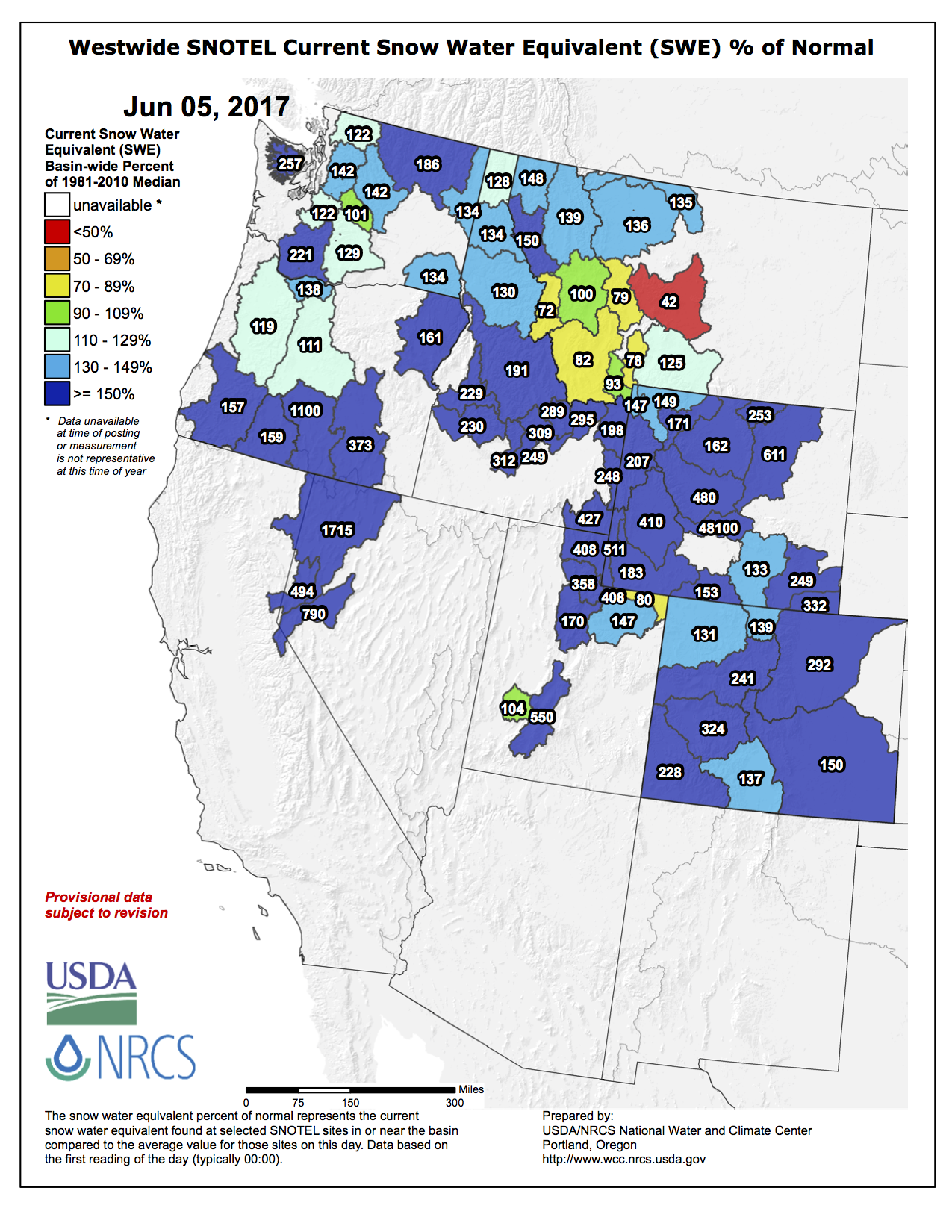
Click on a thumbnail graphic to view a gallery of snowpack data from the NRCS. Please note that despite the blueness of the basin-filled map much of the snowpack has melted-out. Statewide Snow Water Equivalent left approximately = four inches.


Here’s the Westwide SNOTEL basin-filled map.
From The Montrose Daily Press (Katharhynn Heidelberg):
The massive reservoirs that store Colorado River water critical to several states and Mexico run the risk of being drained and so, require careful management.
“We do not want to drain the system,” Eric Kuhn, the retiring general manager of the Colorado River District, told local water users Wednesday.
Kuhn and several others spoke during the Gunnison River Basin State of the Rivers annual public meeting in Montrose.
Kuhn spoke of Lake Powell and Lake Mead, which collectively store 50 million acre-feet of the 60 million acre-feet of stored water from within the Colorado River Basin, and which supply the water needs of multiple states.
Draining down the two lakes would affect everything from several compacts governing water rights between states, to power generation.
The district is developing and implementing contingency plans to “keep enough in our savings account,” Kuhn said. For Lake Powell, that means keeping at least enough in it to generate power — a cushion, but a cushion that’s a little low, he said.
At Lake Mead in the Lower Colorado River Basin, the goal is to equalize; in order to do that, demand must be reduced by a staggering 20 percent.
The contingency plan will help the millions who depend on water from Powell and Mead weather droughts. “If we were to go into drought, we would be prepared,” Kuhn said.
The Colorado Basin is having a good year so far — but not necessarily great, he said earlier.
“It’s a really, really busy time right now on the Colorado River. … We’re trying to figure out how we’re going to live with a developed river,” Kuhn said, but added water rights will be honored as required by legal agreements.
Projected runoff is overall normal: While some parts of the Colorado River Basin are approaching record runoff, others are only hitting average runoff. It’s a good year “but not a great year,” Kuhn said.
The river basin is the lifeblood of farming and municipal uses.
“Every drop of water is used in the Colorado River Basin. … We’re basically at a zero-sum (operation),” Kuhn said.
After agricultural usage, the biggest use of Colorado River water is evaporation, which takes 2 million acre-feet a year — more than all municipal uses combined, he said.
The Gunnison River is a main tributary of the Colorado. The Gunnison River Basin is among those within the Colorado River Basin showing an above-average year.
Bob Hurford, the division engineer for the Colorado Division of Water Resources, pointed to readings from the North Fork, which showed above-average snowpack, while, he said, the Uncompahgre River also showed “another good snowpack year.”
Ridgway Reservoir is 118 percent of seasonal peak, and runoff could extend into July, Hurford said, telling users to expect peak flow above 1,000 cubic feet per second.
“The big dog is the Upper Gunnison Basin. It was a big, big, big year,” Hurford said. The basin is 143 percent of seasonal peak.
Good soil moisture also is helping, as is average to above-average precipitation, leading to an overall good supply for irrigation water in the Gunnison River Basin.
Plus: “You can expect a decent monsoon season again,” Hurford said.
Monsoonal moisture, which usually arrives in July, is critical to growers during hot summer months.
The basin is experiencing an “average wet” category year, said Ryan Christianson, water operations manager for the U.S. Bureau of Reclamation. The federal body manages stored water in the Gunnison River Basin as part of the Aspinall Unit.
The Gunnison Tunnel should be taking on its full amount later in summer, Christianson said.
The meeting wound down with honors for Kuhn’s years of service. State Rep. Marc Catlin, R-Montrose, presented him with beans grown in the Uncompahgre Valley and Russell Stover’s candies, while Colorado Water Conservation Board Director John McClow gave him a basket of “Gunnison Basin goodies” — food and drink items produced thanks in part to river water.
Kuhn and the Colorado River District, said Catlin have “saved this valley” more than once.
Kuhn’s segment of the meeting also was filmed by a PBS crew for inclusion in “This American Land.”
