Seven U.S. states and Mexico depend on the Colorado River, shown here in the Grand Canyon. But over the past century, the river’s flow has decreased by roughly 20 percent. (Bureau of Reclamation)
Click the link to read the article on the E&E News website (Jennifer Yachnin). Here’s an excerpt:
October 3, 2025
Scott Cameron will take over as acting head of the Bureau of Reclamation, shifting titles at the Interior Department while he maintains his role as the Trump administration’s lead official in negotiations over the future of the Colorado River. Interior Secretary Doug Burgum tapped Cameron for the role on Oct. 1, announcing the decision in a secretarial order that also updated other leadership roles recently confirmed by the Senate. The decision comes in the wake of President Donald Trump’s decision on Sept. 30 to withdraw his nomination of Ted Cooke, a former top official at the Central Arizona Project, to be Reclamation commissioner.
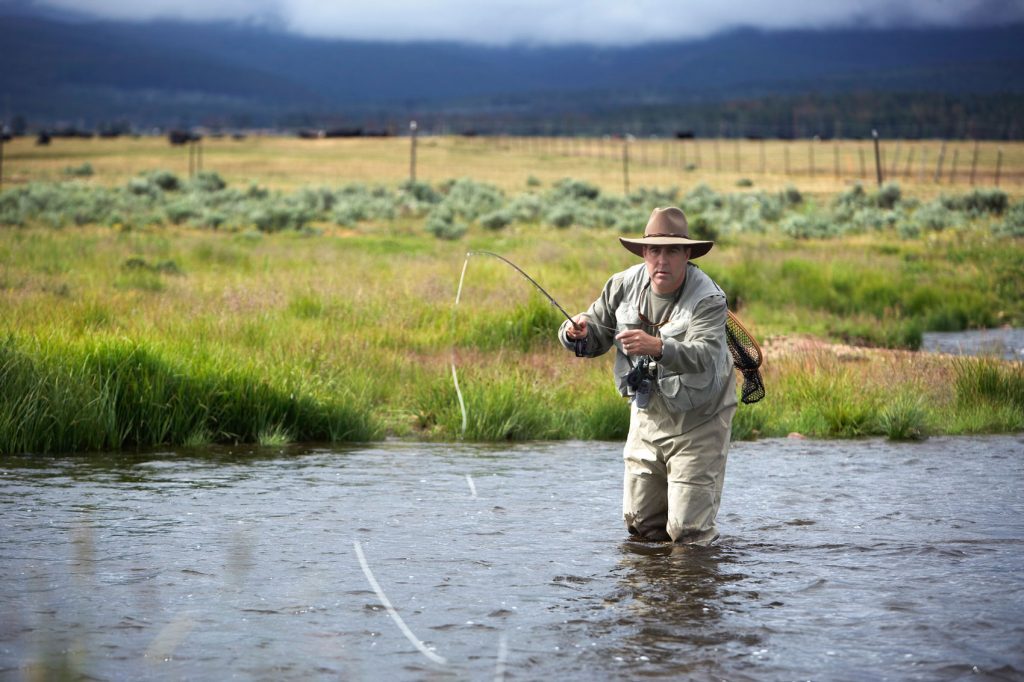
Colorado fly fishing, whitewater and other water-related recreational pursuits contribute significantly to Colorado’s $34.5 billion recreational economy. Photo courtesy of the Winter Park Convention and Visitors Bureau
Click the link to read the article on The Denver Post website (Judith Kohler). Here’s an excerpt:
October 5, 2025
While economists and politicians debate the merits and drawbacks of higher taxes on imports, industry representatives, state officials and business owners say the small and mid-sized companies that make up the bulk of Colorado’s outdoor business sector are struggling with the fallout. And the new tariffs come on top of duties that have been historically higher than for many other industries. Through the years, outdoor businesses have gone to China, Vietnam and other countries where materials and production facilities for technical gear and equipment are more available. All those factors make it difficult for outdoor businesses to move production to the U.S. At best, they say, it would take a few years to develop the factories and necessary expertise. Michael Mojica began moving some of the manufacturing for his business, Outdoor Element, from China to Vietnam in search of lower tariffs. But the shift wasn’t quite fast enough in the quickly changing trade arena. He received word from his logistics company that, even though the shipment was on the water, increase in tariffs on steel and aluminum announced Aug. 18 would pile another 50% onto the 28% rate he already was paying on those goods. Outdoor Element uses the metals for products that include multitool carabiners, stoves, knives and fire-starting equipment.
“I was planning to pay $4,200 for tariffs. I ended up paying $12,600. There went my profit,” Mojica said.
Outdoor Element, based in Englewood, had its best year in 2024. This year, Mojica is questioning whether he’ll be able to stay in business…
The effects of tariffs on outdoor businesses are no small thing for the national or state economy. The U.S. Bureau of Economic Analysis said the outdoor recreation economy accounted for 2.3% of the national gross domestic product in 2023. The total economic output was $1.2 trillion in terms of gross output. In Colorado, the outdoor industry accounted for 3.2% of the state’s GDP in 2023, according to the federal agency. A study conducted for the state found that the economic output associated with outdoor recreation by Colorado residents totaled $65.8 billion in 2023, contributing $36.5 billion to the state’s GDP. The Statewide Comprehensive Outdoor Recreation plan said the economic activity supported approximately 404,000 jobs in Colorado, which represented 12% of the entire labor force, and produced $22.2 billion in salaries and wages. Other economic contributions in 2023 included $11.2 billion in local, state and federal tax revenue, according to the study. Colorado’s outdoor industry is vulnerable to negative impacts from tariffs because the majority of the goods are produced in Cambodia, Vietnam and other countries with high levies on imports to the U.S., a Sept. 4 report by the Polis administration said. The industry is also mostly made up of small businesses.
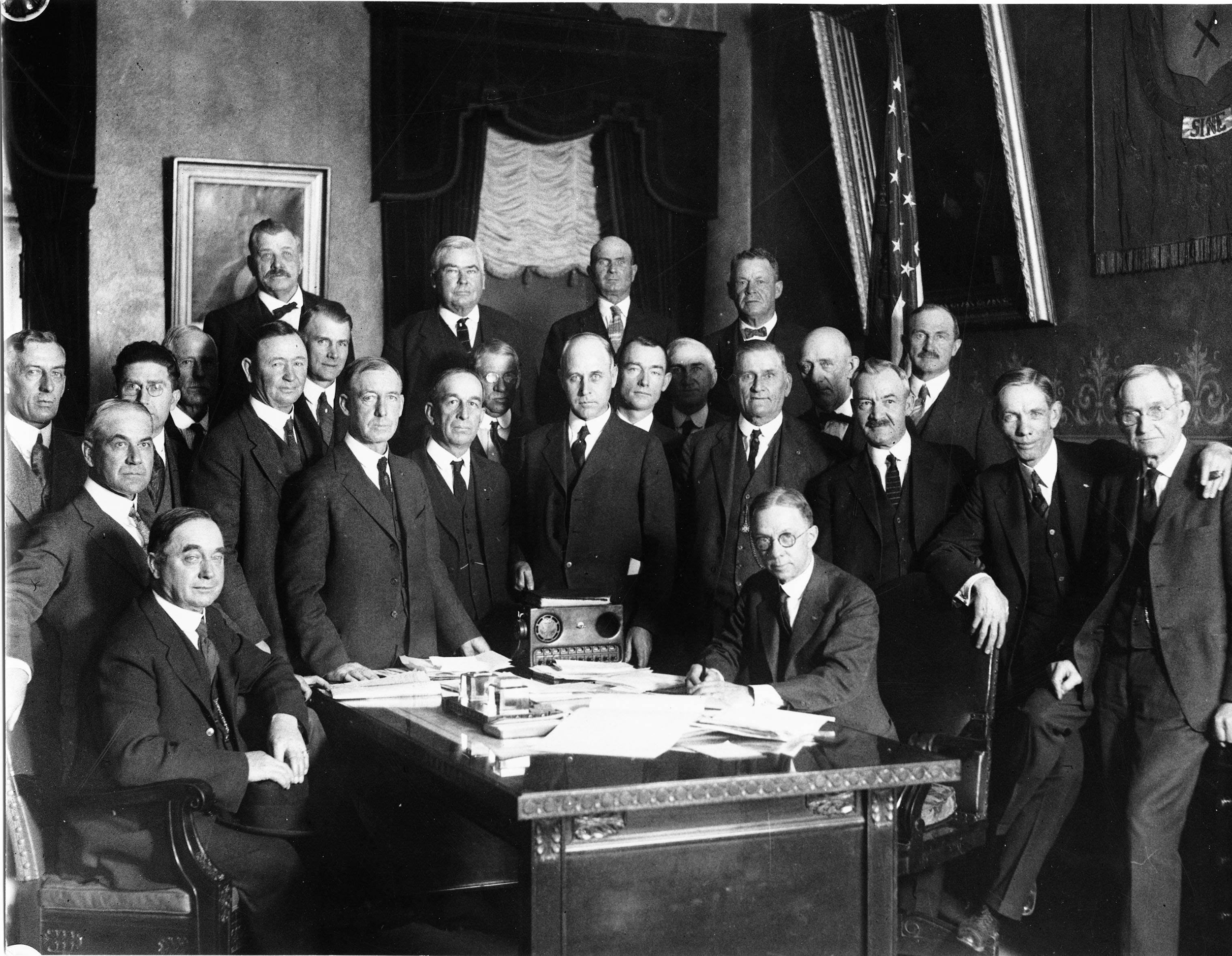
Colorado Governor Clarence J. Morley signing Colorado River compact and South Platte River compact bills, Delph Carpenter standing center. Unidentified photographer. Date 1925. Print from Denver Post. From the CSU Water Archives
Click the link to read the article on the InkStain website (Eric Kuhn, Anne Castle, John Fleck, Kathryn Sorensen, Jack Schmidt, and Katherine Tara):
October 6, 2025
As negotiators for the seven Colorado River Basin states rapidly approach Reclamation’s November deadline for providing a framework for a seven-state agreement for the Post-2026 Operating Guidelines for Lakes Powell and Mead, a larger threat looms. Reclamation’s recently released September 24-Month study minimum probable projection is consistent with our mass balance analysis of storage in the next year, solidifying the likelihood of critical conditions if the coming winter is dry. Reclamation’s latest analysis predicts that storage at Lake Powell would fall below the 3500-ft elevation as early August 2026 and might continue to be below this critical elevation until March 2028. As we noted in our recent white paper, Reclamation has committed to protecting Lake Powell from going below 3500 ft.
This projection of future conditions in the event of persistent dry conditions poses a conundrum—Reclamation could reduce releases from Powell to protect the 3500-ft reservoir elevation, but in doing so, low releases would most likely trigger the dreaded 1922 Colorado River Compact tripwire–the amount of water delivered from Lake Powell to Lake Mead during a 10-year period that is less than the threshold. The Lower Division states are likely to litigate if the 10-yr average wire is tripped. Under one prevailing interpretation of the Compact, Upper Basin states must not cause the 10-yr flow at Lee Ferry to be depleted to less than 82.5 MAF to deliver water to the Lower Basin and Mexico. As explained in a new white paper, there is a very real chance that the 10-yr running average will be 82.78 MAF, just a hair above the tripwire, one year from now. In alternate scenarios, the 10-yr running average would hit the tripwire in 2027 or 2028. If Reclamation exercises its authority to reduce Lake Powell deliveries to as low as 6 MAF, the tripwire is triggered even earlier. In the face of this imminent possibility, Basin States and the Federal Government must commit to an enforceable agreement to reduce their total consumptive Colorado River uses with an equitable sharing of the burden sufficient to justify a waiver of claims under the Compact for the duration of the agreement. The alternative is a deeply uncertain future for the Basin.