Flood damage estimated at $13 million — The #PagosaSprings Sun

Click the link to read the article on the Pagosa Springs Sun website. Here’s an excerpt:

October 23, 2025

Assessments and discussions have followed the historic floods that took place on Oct. 11 and 14, with several governmental entities continuing to work to determine the extent of the damage caused by the floods and their effects on the area. Pagosa Country experienced two historic floods in four days thanks to moisture from the remnants of a pair of tropical storms, Priscilla and Raymond. The flooding for the San Juan River at Pagosa Springs peaked at 8,270 cubic feet per second (cfs) and 12.66 feet at 6 p.m. on Oct. 11 and again at 8,560 cfs and 12.82 feet at 5:15 a.m. on Oct. 14, putting the two events as the fourth and third highest on record, behind floods in October 1911 and June 1927. Other area river levels were also significantly impacted, including the Piedra and Blanco rivers.

Area river levels have continued to decline since Oct. 14, with the San Juan River at Pagosa Springs running at 537 cfs and 5.52 feet as of noon on Wednesday, Oct. 22. That compares to a median of 88.00 cfs for the same date and a mean of 143.67 cfs. The increased moisture has also led to a significant increase in the level of Navajo Lake Reservoir. On Oct. 9, Navajo was at 6,020.44 feet elevation. By Oct. 21, that had increased by 12.10 feet to 6,032.54, according to the Lake Navajo Water Database. It remains 52.46 feet below full pool, or 6,085 feet elevation. It remains down 8.51 feet from a year prior. The database shows that total inflows for water year 2026, which began on Oct. 1, are at 421.49 percent of the average, and the rivers feeding Navajo are running at 147.04 percent of average.

Colorado Drought Monitor map October 21, 2025.

The storms also helped area drought. As of Oct. 14, the last update available by the U.S. Drought Monitor, 65.53 percent of the county was abnormally dry or above, with 3.71 percent of the county falling into moderate drought. A week, prior, 100 percent of the county was in moderate drought or above, with 30.18 percent being in severe drought or above, with 0.31 percent of that being in extreme drought…

On Oct. 21, Town Manager David Harris updated the Pagosa Springs Town Council on the damages to town infrastructure caused by the recent flooding along the San Juan River, with an early “thumbnail sketch” assessment showing around $9 million worth of damages. The major costs are associated with debris removal, riverbank stabilization, inflow and infiltration of unwanted water into the sewer system, 10th Street culvert replacement, sewer line replacement on the 1st Street bridge after the line was damaged by debris, and damages to a river restoration project that the town invested in some years ago, he explained…[Riley Frazee] noted total damages in the county based off of initial assessments is around $13 million. Of that $13 million, about $8.125 million is from the Town of Pagosa Springs and about $4 million is from damage to public roadways in Archuleta County. Archuleta County Sheriff Mike Le Roux noted that there are still about 200 miles of secondary roadways to be assessed. During the Oct. 18 tour with Bennet, Le Roux noted about 30 miles of primary county roads require “total reconstruction” and about 60 miles require significant patching and repair. Frazee also mentioned that the San Juan River Village Metro District sustained sewer system and roadway damage of about $2 million, which also qualify as infrastructure.

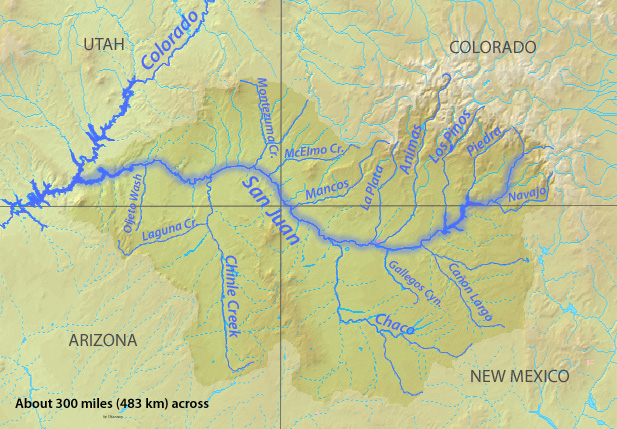
San Juan River Basin. Graphic credit Wikipedia.

Two ranching properties awarded land conservation easements: Action helps preserve ‘Gateway to the Flat Tops’ — Colorado Cattlemen’s Agricultural Land Trust

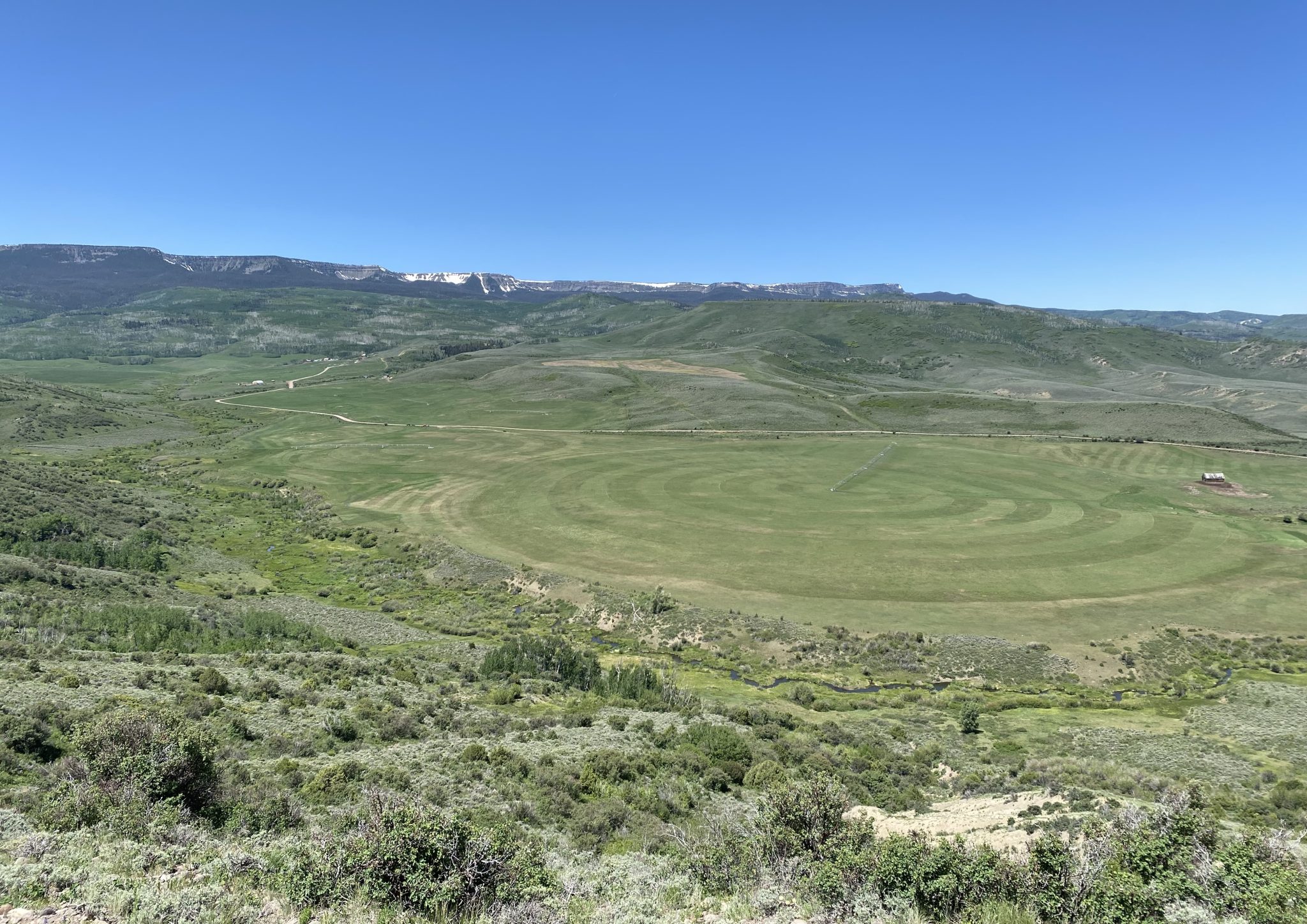
The Colorado Cattlemen’s Agricultural Land Trust brokered a new 2,348-acre conservation easement with the Snyder family on Fish & Cross Ranch west of Yampa. CCALT/Courtesy photo

Click the link to read the release on the Steamboat Pilot & Today website (Colorado Cattlemen’s Agricultural Land Trust):

October 22, 2025

The Colorado Cattlemen’s Agricultural Land Trust has completed a new 2,348-acre conservation easement with the Snyder family on Fish & Cross Ranch, a working cattle ranch located at the base of the Little Flattops west of Yampa.

The ranch is in an area known as “The Gateway to the Flat Tops” where landscape-level conservation investments through the Routt County Purchase of Development Rights program have created a “stronghold of interconnected agricultural lands and habitat corridors,” according to a land trust media release.

This new conservation easement adds to Routt County’s commitment to conserve working landscape and allows the family owners to continue taking care of the agricultural lands and wildlife habitat. In exchange for county funds, the landowner grants a perpetual conservation easement, or deed restriction, on the property, protecting the land from development.

Ownership of the property remains vested with the landowner, who can use and manage the property consistent with the terms of the conservation easement.

“Their commitment to agricultural conservation will carry on to future generations of their family and continue to support the rural economy in South Routt County,” CCALT Conservation Manager Monica Shields said.

“As was evident this summer, agricultural lands not only provide important wildlife habitat and scenic views, but the hay meadows and wetlands act as critical wildfire breaks during times of drought. The Fish and Cross Ranch, nestled up against the Flat Tops Wilderness area, serves all these critical community functions,” added Shields.

Routt County Commissioner Tim Redmond noted the “property links together U.S. Forest Service, BLM and state lands, as well as existing conservation easements, to form a pristine tract that protects views and critical wildlife corridors.”

Lands within the easement include sagebrush rangelands, aspen woodlands and irrigated pastures with senior water rights along Watson Creek tied to those lands through the conservation easement. The property is utilized as part of a larger cattle and hay operation operated by the Snyders as well as natural habitat. Allen Snyder and his family purchased the ranch in 2006, and four generations currently live and work on the ranch.

“We would like to thank everyone who helped make this easement possible, from the PDR board and county commissioners to the CCALT team and Natural Resources Conservation Service,” said Tyler Snyder. “We are very blessed to be able to take a step forward in continuing to pass down the generational legacy of ranching in the Yampa Valley to generations to come.”

Since the initiation of the program in 1997, Routt County has helped fund the purchase of conservation easements on 68,535 acres for approximately $32 million. Funding for the program comes from a 1.5 mill levy in county property tax approved by voters through 2035.

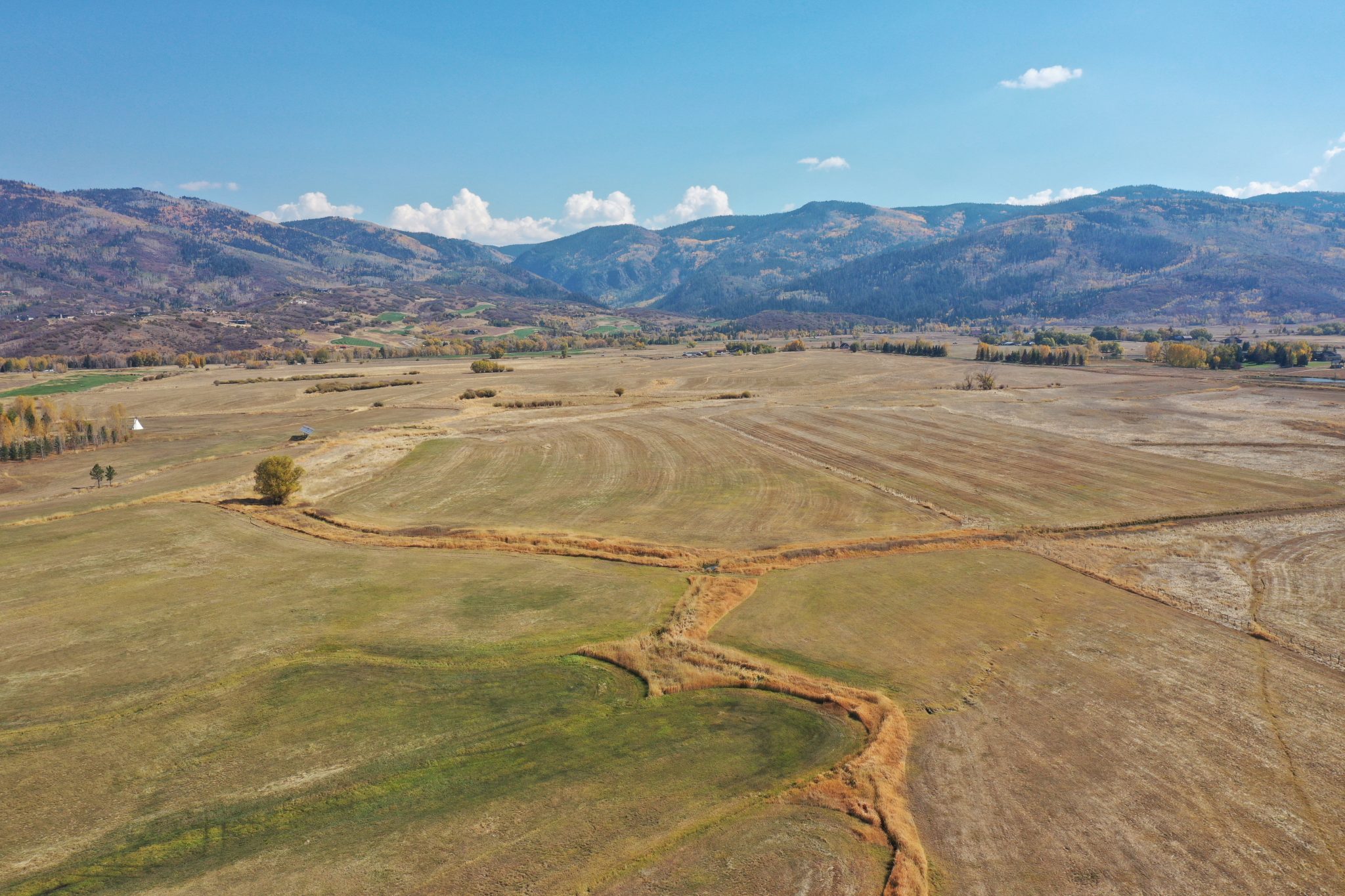
The Colorado Cattlemen’s Agricultural Land Trust brokered a new 120-acre conservation easement with landowner Susan Larson on Wild Goose Ranch south of Steamboat Springs. CCALT/Courtesy photo

In addition, earlier in October the land trust and the county program worked with landowner Susan Larson to conserve 120 acres of Wild Goose Ranch south of Steamboat Springs.

The easement secures irrigated hay meadows and riparian habitat and fulfills the conservation vision of Susan and her late husband, Jim Larson. The Wild Goose Ranch is comprised primarily of irrigated hay meadows with 92% of the easement area in active hay production.

“Since our arrival in the Yampa Valley full time, our family has always felt a duty to protect the land and the water, especially here in the South Valley,” Larson said. “We have felt even more strongly about this responsibility with all the growth that has occurred in the last several years all over Colorado and notably here in Routt County.”

This protection safeguards valuable wildlife habitat for elk, mule deer, moose, black bear and species of special concern such as the Columbian sharp-tailed grouse and greater sandhill crane, while also securing scenic views along Colorado Highway 131 and U.S. Highway 40, according to a media release.

Routt County Commissioner Sonja Macys noted, “Nestled in the highly scenic South Valley floor corridor, the ranch is a vital part of the iconic landscape of working agriculture and conserved lands that residents and visitors alike enjoy when descending Rabbit Ears Pass.”

The land trust has conserved more than 820,000 acres of farmland, ranchland, wildlife habitat and open space across Colorado, including more than 83,000 acres in Routt County.

Yampa River Basin via Wikimedia.

Save-the-Date / 2025 #ArkansasRiver Compact Administration Annual Meeting December 9, 2025

Map of the Arkansas River drainage basin. Created using USGS National Map and NASA SRTM data. By Shannon1 – Own work, CC BY-SA 4.0, https://commons.wikimedia.org/w/index.php?curid=79039596

From email from the Kansas Department of Water Resources (Kevin Salter):

October 23, 2025

The 2025 ARCA Annual Meeting will be held on Tuesday, December 9, 2025 at:

Historic Cow Palace Inn, 1301 N Main St, Lamar, CO 81052

Meetings of ARCA are operated in compliance with the federal Americans with Disabilities Act. The meeting room is on the second floor with no elevator access, if you will need accommodations to attend this meeting please contact Stephanie Gonzales at (719) 688-0799.

The ARCA committee meetings will be held on Monday, December 8, 2025 at this same location.  Draft agendas for the ARCA Annual and committee meetings will be provided in advance of these meetings.

For those needing lodging at the Historic Cow Palace Inn, there has been a block of rooms reserved for $100 per night (plus taxes); just mention “ARCA” when making reservations.  The hotel phone number is (719) 691-6167 and their website is https://www.historiccowpalaceinn.com/.

#Colorado tops nation in electric vehicle sales: Almost one-third of all new car sales from July through September were for EVs or plug-in hybrids — Allen Best (BigPivots.com)

Click the link to read the article on the Big Pivots website (Allen Best):

October 23, 2025

It’s another one of those good news, bad news stories.

First, the bad news. The federal government withdrew its tax credits of up to $7,500 for purchase or lease of a new EV (and $4,000 for a used EV). Congress made that decision in early July, as part of the One Big Beautiful Act. The deadline was Oct. 1.

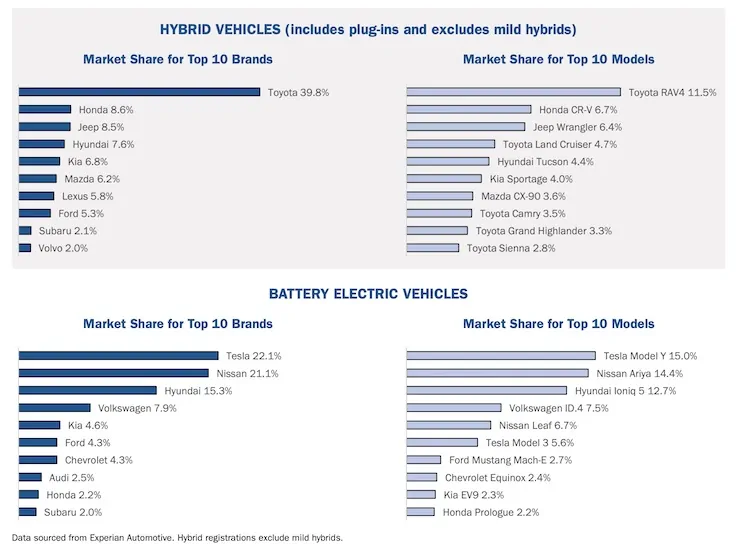
The good news is that the deadline spurred Coloradans to set a new record for purchases of EVs. From July through September, 32.4% of new vehicle sales in Colorado were EVs or plug-in hybrids. Colorado led the nation, slight ahead of California.

Colorado now has surpassed 210,000 EV registrations. To put that into perspective, then-Gov. John Hickenlooper in 2018 declared a goal of 940,000 registered EVs in Colorado by 2030.

The state has a long way to go. But it does have momentum.

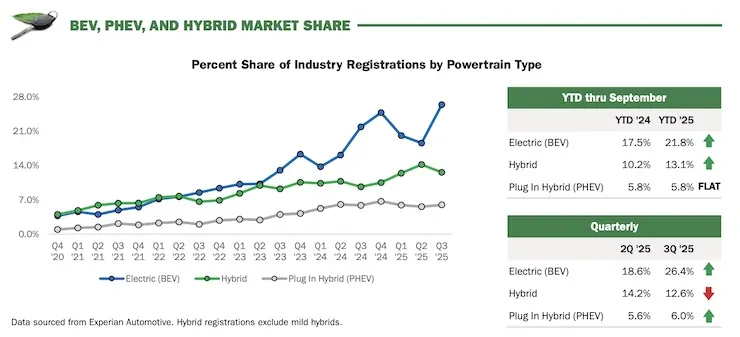
This chart from the Colorado Automobile Dealers Association shows how the sales of EVs and plug-in hybrids has grown during the last five years in Colorado. Sales of EVs dropped in the first six months of this year but leaped to a record in response to the imminent federal deadline.

In a statement issued by his office, Gov. Jared Polis heralded the sales. “Coloradans and the free market are saying loud and clear that affordable, clean and efficient electric vehicles are here to stay,” he said. Those electric cars, he said, save money while improving air quality.

First road charge for Coyote Gulch’s Leaf in Granby May 19, 2023. Note the Colorado Energy Office’s logo below the connectors on the unused charger.

We hear less about range anxiety. We still don’t have high-speed charging stations to match the “filling stations” created in the 20th century. However, the state as of early October, had 1,487 high-speed charging ports at 458 locations around Colorado. They can be found from Cortez to Holyoke, and from Dinosaur to Lamar.

And the number of EVs is, in some places, reaching a tipping point.

Travis Madsen, transportation manager for the Southwest Energy Efficiency Project, reports a trip to New Mexico recently along Interstate 25. At Pueblo, he stopped to recharge. For the first time ever anywhere in his experience, he had to wait. All the ports were busy.

Madsen also had good news. From July through September, a record 167 new fast-charging ports were installed in Colorado.

Will this momentum continue?

Madsen doesn’t expect sales to remain above 30% during the next few quarters. He does hope that public awareness has grown about the value of EVs regardless of federal tax credits. EVs still generally cost more, but they require less maintenance and can be fueled far more cheaply, especially at home. Department of Energy data show that current EVs are 2.6 to 4.8 times more efficient at traveling a mile compared to a gasoline internal combustion engine, according to the Natural Resources Defense Council.

To help maintain momentum, the state on Nov. 3 will raise Vehicle Exchange Colorado rebates from the existing $6,000 to $9,000 for new EV purchases and leases. For used EV purchases and leases, the prices will rise from $4,000 to $6,000. The program aims to enable income-qualified Coloradans to access EVs. Maybe that will include writers.

Screenshot

World Meteorological Congress endorses actions to promote AI for forecasts and warnings

Click the link to read the release on the World Meteorological Congress website (Clare Nullis):

October 23, 2025

The power of Artificial Intelligence (AI) to improve the accuracy, accessibility and reach of weather forecasts and early warnings has been recognized by the World Meteorological Organization, which will seek to ensure that all countries can benefit from its life-saving potential.

Key messages

  • AI can accelerate Early Warnings for All
  • Forecasts and warnings save millions of lives and billions of dollars
  • AI will compliment – not replace – traditional forecasting tools
  • WMO science for action supports the global economy
Credit: WMO / Melissa Debray

An Extraordinary World Meteorological Congress issued a call to the public, private and academic sectors to collaborate on the development of AI and machine learning (ML) technologies to protect communities and economies from hazards like extreme heat and rainfall. It also paved the way for AI/ML to be anchored in WMO’s global observation, data processing and forecasting backbone.

The resolutions were part of a wider package of measures approved by the Extraordinary Congress to accelerate progress towards WMO’s top overriding priority – to ensure universal coverage of early warning systems through the achievement of Early Warnings for All by the end of 2027.

“Early warnings are not an abstraction. They give farmers the power to protect their crops and livestock. Enable families to evacuate safely. And protect entire communities from devastation,” UN Secretary-General António Guterres told the Extraordinary Congress on 22 October in a ceremony which was one of the highlights of WMO’s 75th anniversary activities.

“We know that disaster-related mortality is at least six times lower in countries with good early-warning systems in place. And just 24 hours’ notice before a hazardous event can reduce damage by up to 30 per cent. Early-warning systems work. And they’re finally getting the attention – and investment – they deserve,” said the UN Secretary-General.

Mr. Guterres launched Early Warnings for All in 2022 with the goal of ensuring universal coverage by the end of 2027.

high-level event opened by Mozambique President Daniel Francisco Chapo heard an urgent Call to Action from WMO Secretary-General Celeste Saulo to accelerate progress.

“Throughout this week, one thing has been made abundantly clear: the World Needs WMO,” said Celeste Saulo in concluding remarks at the end of Congress.

“The visit of the United Nations Secretary-General, the participation of presidents and ministers and the global attention they attracted is a reminder that what we do matters. Now we must build on this momentum. This is the moment to turn visibility into impact. To translate recognition into investment. To make sure that our transformation continues — that WMO remains not only relevant, but more essential than ever,” she said.

Global forecasting backbone

Congress approved a new set of technical regulations concerning early warning services, providing a clear reference and ensuring that the authoritative and trusted role of National Meteorological and Hydrological Services in issuing reliable and accurate warnings are supported and enshrined in national legislation

It issued a “call to all stakeholders” to collaborate on the development of AI/ML environmental monitoring and prediction technologies, tools and applications, noting the “unprecedented pace of progress” and the “transformative potential” to achieve Early Warnings for All.

The resolution builds on decisions by the WMO Executive Council in June 2025. It reaffirms WMO’s mission to facilitate international cooperation and standardization, building on decades of trust and data collection. AI must complement, not replace, existing well-honed scientific forecasting methods and infrastructure.

It emphasizes open data, open-source tools, and FAIR principles to foster transparency and global participation. It calls for ethical frameworks which establish principles for cooperation, intellectual property, and responsible AI use.

Congress also approved a resolution to integrate AI into the global forecasting infrastructure.

Acknowledging the significant disparity in forecasting capabilities among WMO Members, Congress stressed the need to support National Meteorological and Hydrological Services (NMHSs) globally, especially those in low- and middle-income countries, LDCs, and SIDS, to access and utilize new AI technology.

Due to rapidly evolving AI/ML technologies, Congress agreed to develop a new WIPPS strategy incorporating AI. The WMO Integrated Processing and Prediction System (WIPPS) is a worldwide network of operational centres that makes scientific and technological advances accessible and exploitable by Members, providing products related to weather, climate, water, and the environment.

While AI offers transformative potential for operational forecasting and warnings, the resolution recognizes that considerable challenges remain in AI systems’ capability to support forecasts of local high-impact weather systems and hydrological processes. These challenges must be addressed, tested, and demonstrated for operational use.

To ensure all Members benefit, the resolution requested WMO bodies enhance capacity development on AI use under WIPPS for low- and middle-income countries, LDCs, and SIDS. Furthermore, WIPPS pilot projects are essential to explore and deliver new prediction products, demonstrating AI’s potential to enhance developing countries’ capabilities.

An ongoing pilot project between the meteorological services of Norway and Malawi, which demonstrate an AI weather prediction and the concept of Forecasts-in-a-Box, was presented to Congress. It has showed improvements in forecasts – and is being closely watched as a model for other countries with resource constraints.

In other action, Extraordinary Congress:

  • Advanced the goals of the Global Greenhouse Gas Watch by integrating key components into existing programmes, including the expanded World Weather Watch and the Global Atmosphere Watch Programmes.
  • Approved WMO’s first Youth Action Plan, marking a structured approach to integrating youth perspectives into its work and empowering the next generation of leaders. This is a landmark step in nurturing young meteorologists, hydrologists and climate and ocean scientists, marking a new era of shared inter-generational responsibility and expertise in weather, water, and climate action.
  • Streamlined procedures on elections and appointment of the WMO Secretary-General.
  • Endorsed the WMO Secretary-General’s restructuring of WMO, responding to evolving global challenges, the need for a more integrated Earth system services and increasing financial constraints. 
  • Requested the WMO Executive Council to set up a task force to develop recommendations for modification to the strategic and operating plans for 2026/2027 as a result of the ongoing liquidity challenges of WMO.

Executive Council 

WMO’s Executive Council met on 24 October immediately following Extraordinary Congress.
It confirmed a total budget of 138.7 million for the biennium 2026/2027.  It agreed to the terms of reference and composition of the new task force which will identify proposals for realignment of WMO’s Strategic and Operating Plans during the 2026–2027 biennium, given the ongoing financial uncertainty.
Science for Action

The Extraordinary Congress was held as WMO celebrates its 75th anniversary, with the theme of Science for Action. 

WMO’s work underpins resilient development, food, transport, energy, security, health, water management and disaster risk reduction.  

It is essential to the global economy and society and can leverage potential to unlock even more benefits for the global good.

Credit: WMO / Fabian Rubiolo

Science for Action

The Extraordinary Congress was held as WMO celebrates its 75th anniversary, with the theme of Science for Action

WMO’s work underpins resilient development, food, transport, energy, security, health, water management and disaster risk reduction.  

It is essential to the global economy and society and can leverage potential to unlock even more benefits for the global good.