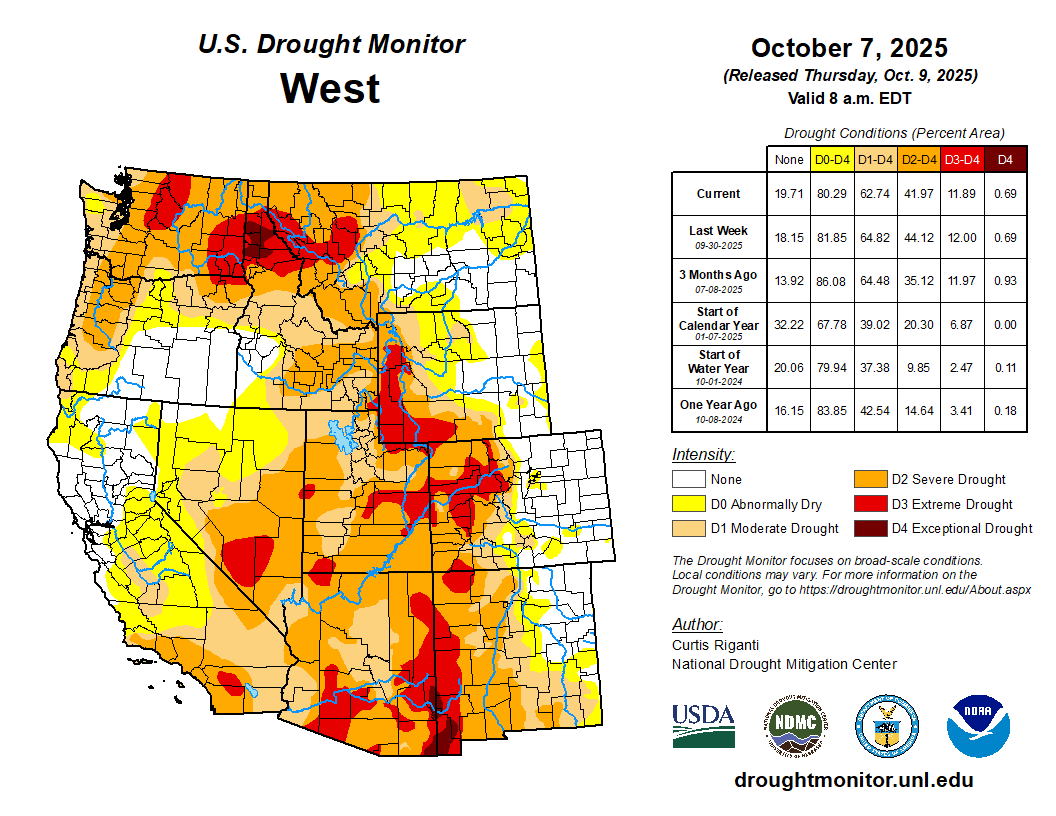
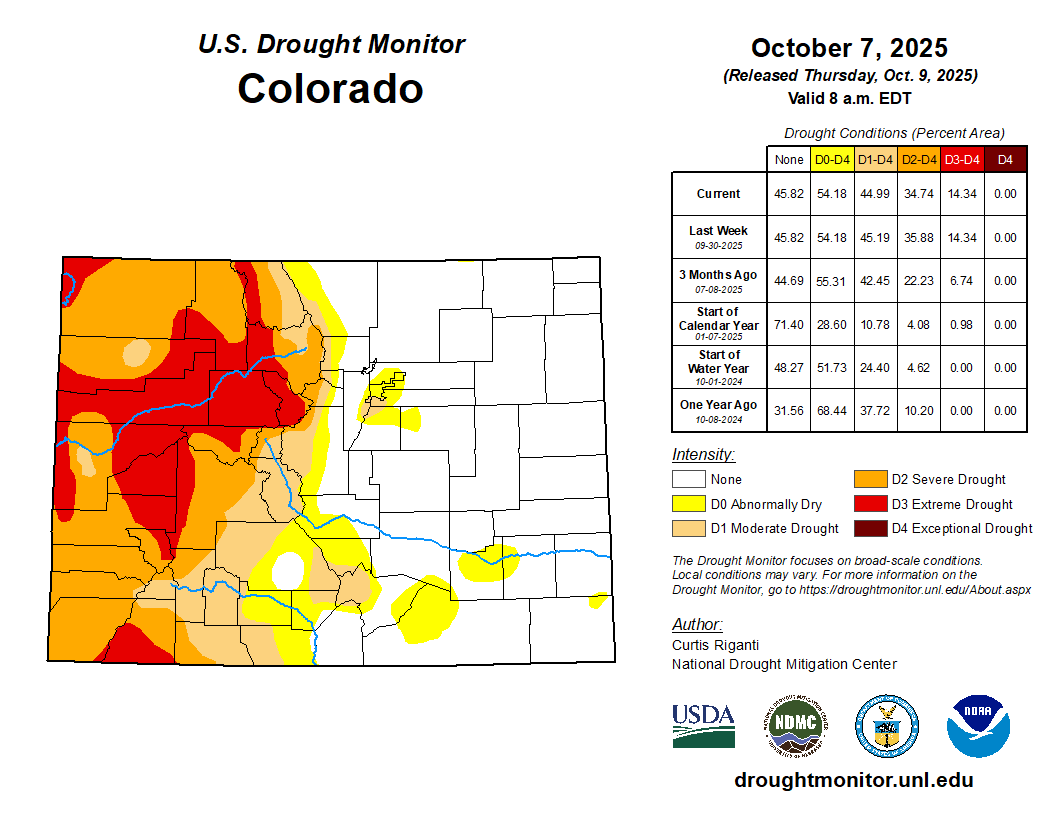
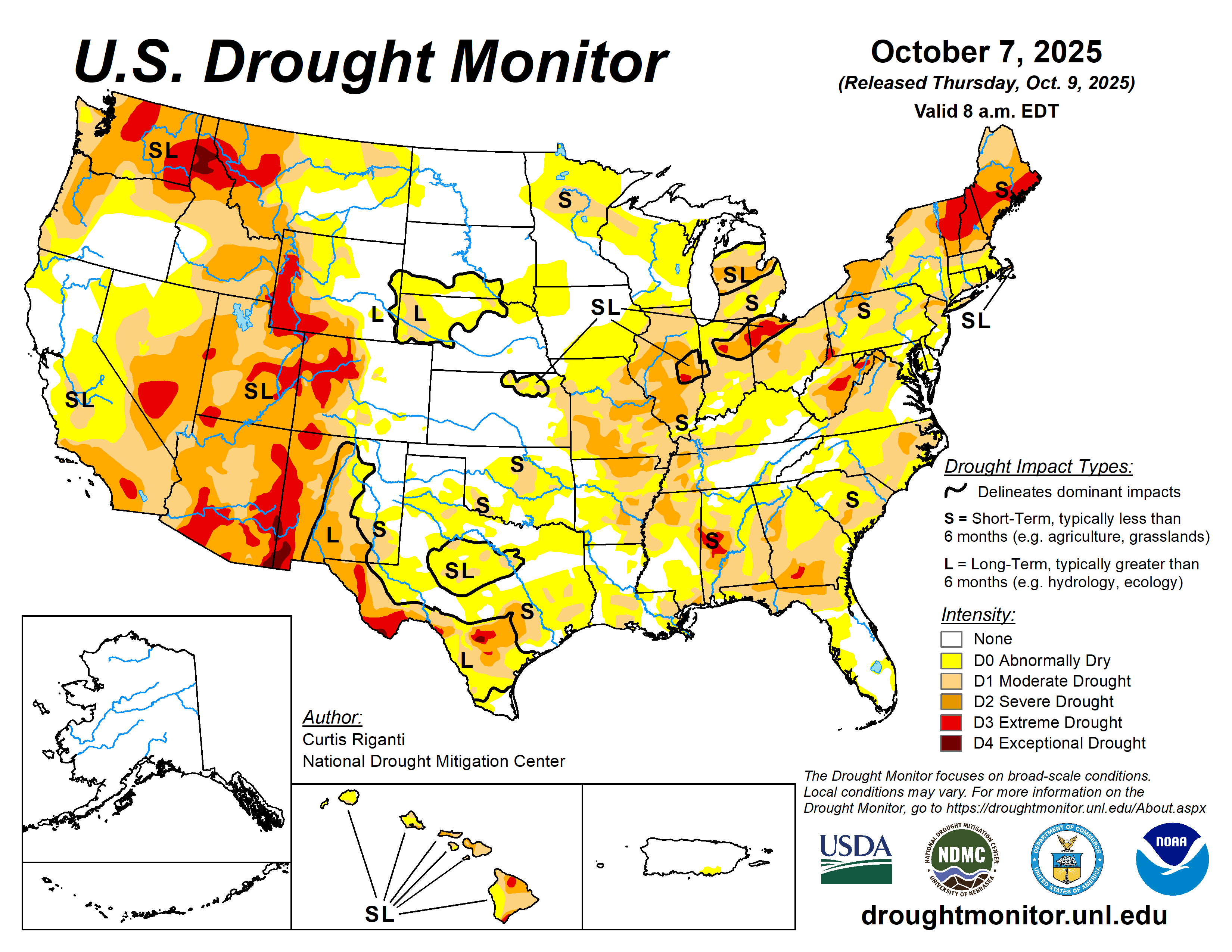
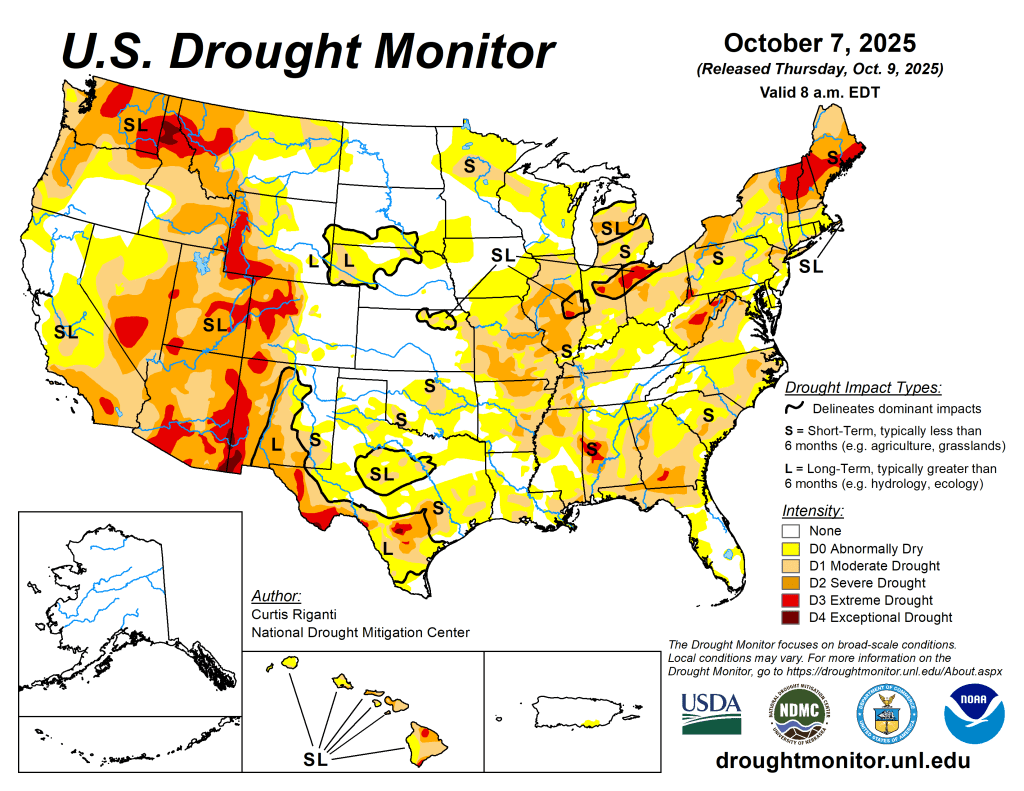
#Drought news October 9, 2025: Recent heavy precipitation and reassessment of recent conditions led to widespread improvements in parts of the W. United States, especially the Las Vegas area, northern areas of #Nevada and #Utah, S.E. #Wyoming and a few spots in the #Colorado Rocky Mountains

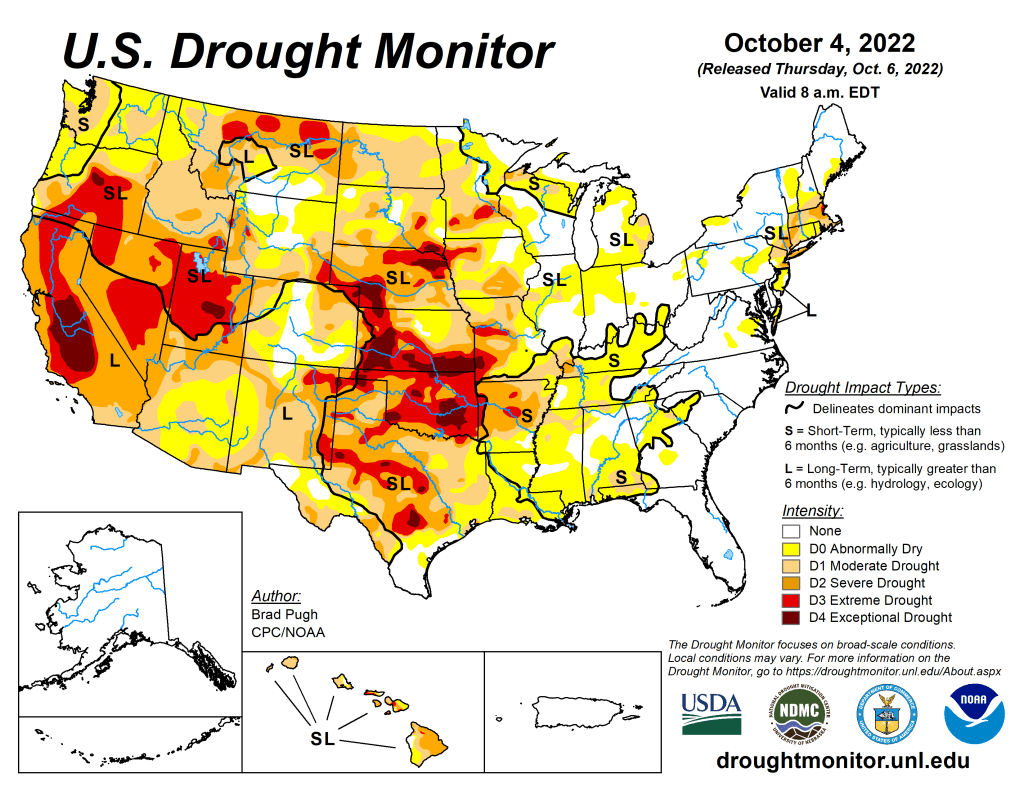
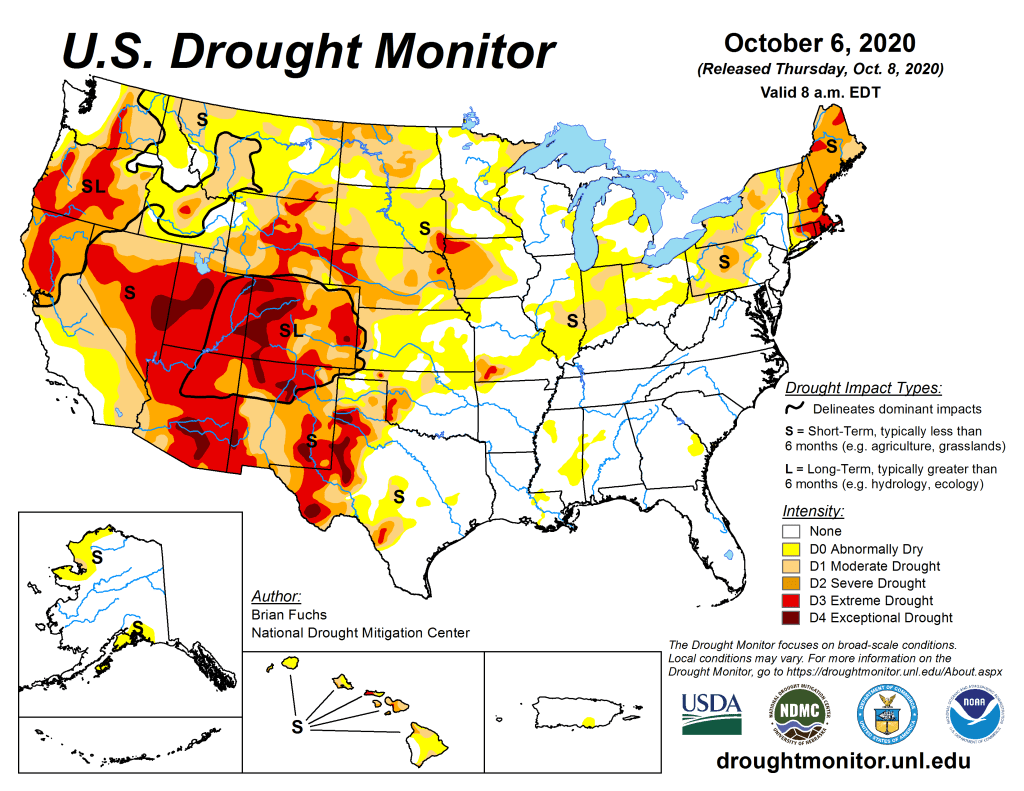
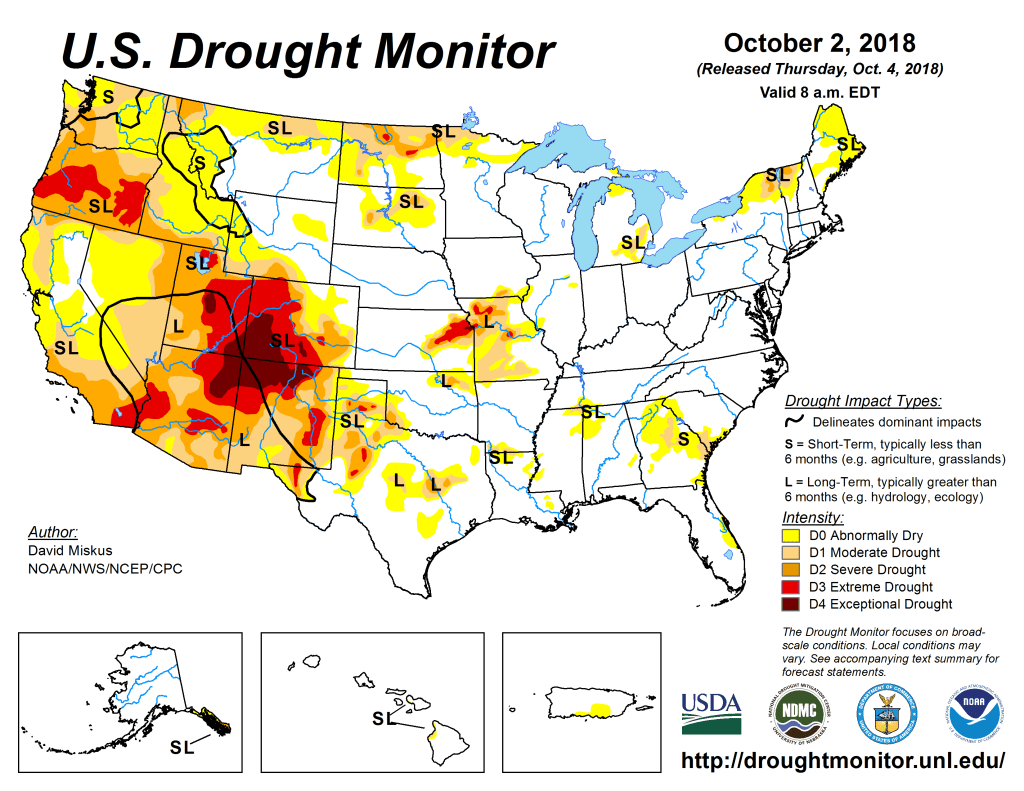
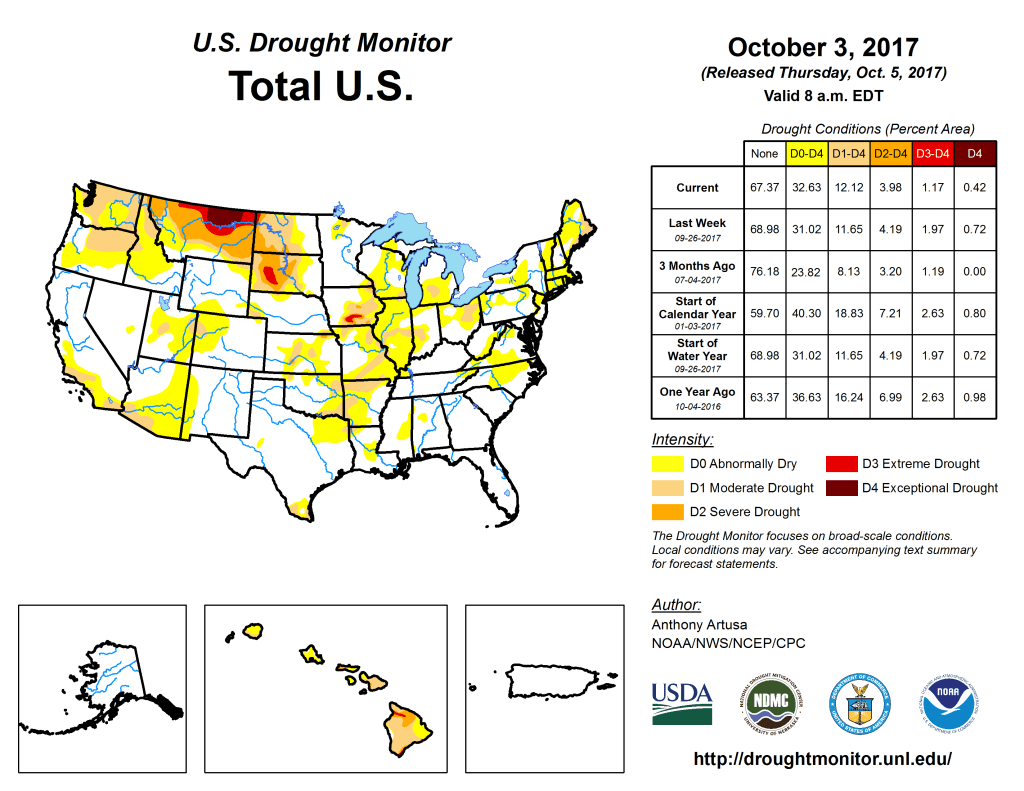
Click on a thumbnail graphic to view a gallery of drought data from the US Drought Monitor website.
Click the link to go to the US Drought Monitor website. Here’s an excerpt:

This Week’s Drought Summary

The recent pattern of numerous changes in the USDM continued with this week’s map release. Continued dry weather in the Northeast led to widespread worsening of drought and abnormal dryness there. From Missouri northward to the Great Lakes states, many locations saw drought or abnormal dryness worsen. In particular, intense short-term drought continued to worsen in parts of Missouri, Illinois, Indiana and Ohio. However, in southeast Missouri and in the Ohio River Valley and some parts of the Mississippi River Valley, welcome rains fell, locally over 3 inches, leading to widespread improvements in ongoing drought and abnormal dryness in these areas. Much of Alabama, the Carolinas and Georgia saw drier weather, with local exceptions. As such, drought and abnormal dryness also expanded across portions of these states and a few spots in nearby Florida. Very heavy rain fell in southeast Louisiana; one area received over 5 inches of rain, leading to a 2-category improvement in the USDM, surrounded by nearby 1-category improvements after the heavy rain. In west Louisiana, Oklahoma and Texas, dry weather this week led to many degradations as primarily short-term dryness intensified. A few areas of central and southwest Texas are also seeing long-term dryness and drought and saw some intensification this week. Drier weather this week in northeast Montana led to the development of moderate drought there. Recent heavy precipitation and reassessment of recent conditions led to widespread improvements in parts of the western United States, especially the Las Vegas area, northern areas of Nevada and Utah, Oregon and southwest Idaho, southeast Wyoming and a few spots in the Colorado Rocky Mountains. A wetter month of September also led to localized improvement away from abnormal dryness on the northeast coast of Kauai, though ongoing drought conditions remained unchanged elsewhere in Hawaii after a mainly drier week…

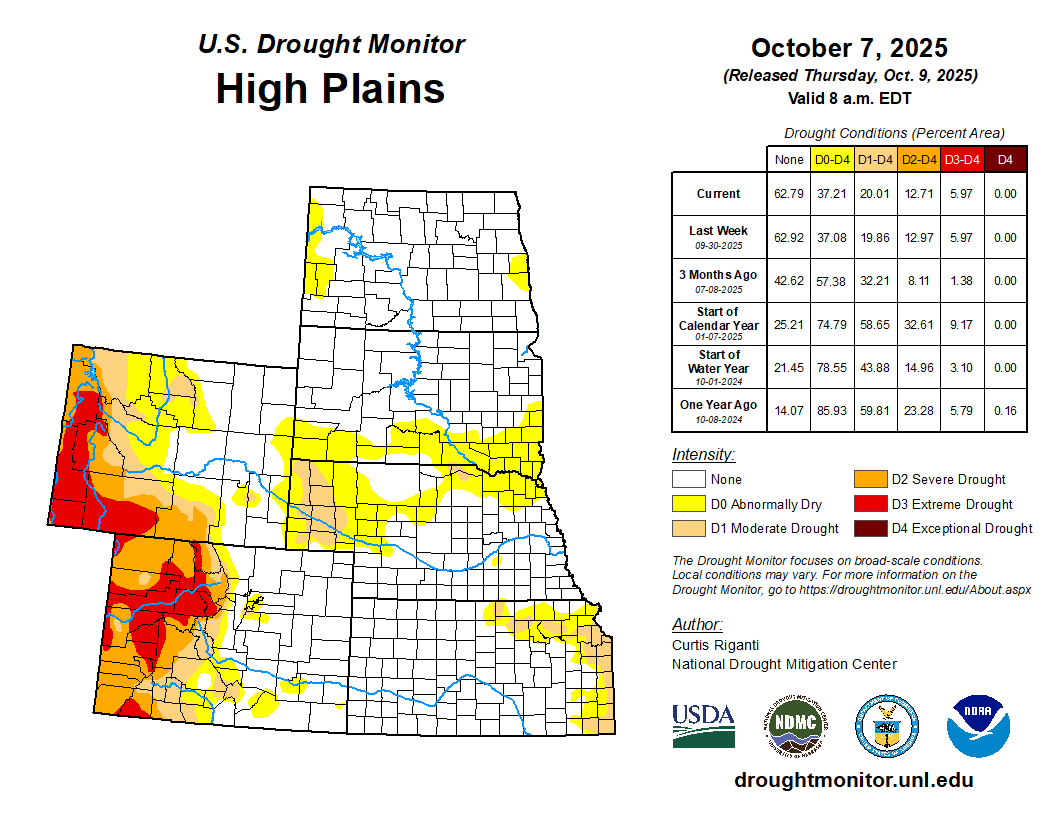
High Plains

Temperatures this week across the High Plains region were mostly 5-15 degrees above normal, with parts of central Colorado and southern and western Wyoming seeing closer to normal temperatures. Moderate to locally heavy precipitation fell in parts of the San Juan Mountains in southwest Colorado, the Rocky Mountains of northern Colorado and across much of Wyoming, northwest South Dakota and central to north-central North Dakota. Precipitation this week added to a generally wetter recent pattern in the San Juans, north-central Colorado and southeast Wyoming. In these areas, short- and medium-term precipitation deficits lessened and soil moisture conditions improved, allowing for some improvements to ongoing drought and abnormal dryness. In north-central Kansas, moderate drought improved in some areas where locally over 2 inches of rain fell. In eastern Kansas, short-term abnormal dryness and moderate drought worsened in spots where streamflow and soil moisture levels dropped along with growing precipitation shortages. In northeast Nebraska and southeast South Dakota, dry weather over the past couple of months continued this week, leading to a large expansion in abnormal dryness that also extended further into northwest Iowa and southwest Minnesota…

Colorado Drought Monitor one week change map ending October 7, 2025.

West

Cooler-than-normal temperatures prevailed in much of Oregon, California and Nevada, while the rest of the region was mostly 1-5 degrees above normal. Scattered heavy precipitation fell this week across much of the central and northern half of the region, with notable exceptions in central and eastern Washington and Oregon, southwest Wyoming, and north-central and northeast Montana. In northeast Montana, drier weather this week and temperatures that were 5-15 degrees above normal led to the development of moderate drought where short-term precipitation and soil moisture deficits grew. Recent precipitation, either from this week or the weeks preceding, led to improvements in streamflow and soil moisture and lessening precipitation deficits across much of northern and southern Nevada (and immediately adjacent parts of California and Arizona). Similarly improving conditions also occurred in northern Utah, south-central and southwest Idaho, Oregon and the Olympic Peninsula of Washington, leading to improvements in the USDM depiction in parts of these areas…

South

Short-term dryness continued to intensify in south-central and west-central Louisiana and across much of Texas and parts of Oklahoma, all of which largely saw a mostly dry and warmer-than-normal week. Very dry weather over the last month continued in parts of Oklahoma, especially from the Oklahoma City area north and in southwest Oklahoma, where adverse impacts to agriculture were reported. In central and southwest Texas, recent dry weather compounded impacts from long-term dryness and drought…
Looking Ahead

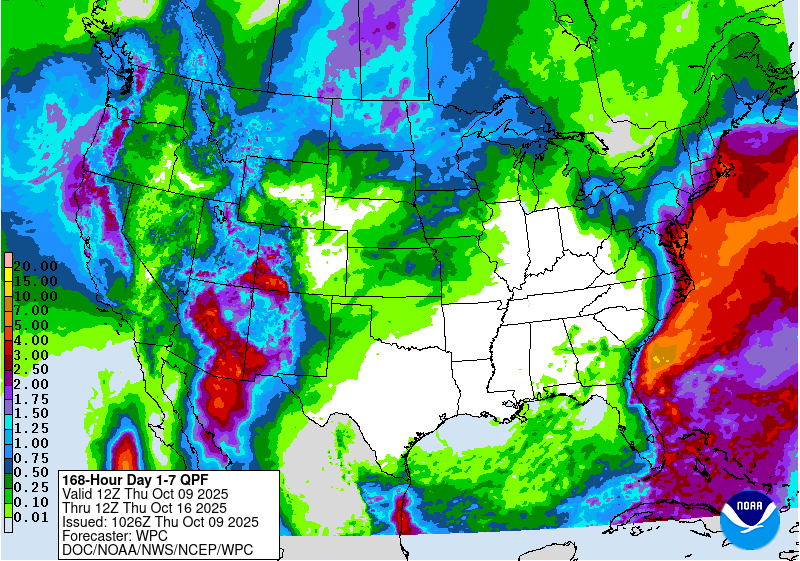
The National Weather Service Weather Prediction Center (WPC) forecast covering the period from the evening of October 8 to the evening of October 13 calls for an inch or more of precipitation from northwest California northward through northwest Washington. The WPC is also forecasting areas west of the Continental Divide in New Mexico and Colorado, as well as much of Arizona and Utah, to receive over 1 inch of precipitation, with some areas in Arizona and southwest Colorado forecast to receive over 3 inches. Forecast precipitation amounts dwindle north of Utah, though portions of Idaho and Montana may receive a half inch or more during this period. Heavy rain amounts are possible from the east coast of Florida northwards through the Atlantic Coast to southern New England. As of the afternoon of Wednesday, October 8, the east coast of Florida and the coasts of North Carolina and Virginia, as well as the Delmarva Peninsula, New Jersey appear most in line to receive at least 1.5 inches of rain, with higher amounts possible. However, given the forecasted tight gradient in rainfall amounts, small shifts in the track of the storm system may significantly impact how much rain falls in any particular location along or near the East Coast. Meanwhile, across most of the Great Plains, Midwest and South, mostly dry weather is forecast.

Looking ahead to October 14-18, the National Weather Service Climate Prediction Center forecast favors warmer-than-normal weather across most of the central and eastern Contiguous U.S., especially in the southern Great Plains and Lower Mississippi River Valley. Colder-than-normal weather is favored across much of California, Nevada, Oregon, Idaho, Washington and western Montana. Above-normal precipitation is favored across most of the West (except for northwest Oregon and most of Washington) and into the northern half of the Great Plains and western Great Lakes states. Above-normal precipitation is slightly favored in most of New England, while below-normal precipitation is slightly favored in northwest Washington. Below-normal precipitation is favored in the south-central and southeast U.S., with a slight lean toward below-normal precipitation extending northward to Lake Erie. Above-normal temperatures are strongly favored in most of Alaska, with above-normal precipitation also favored across most of the state. In far southeast Alaska, near- or below-normal precipitation is more likely. Above-normal precipitation and warmer-than-normal temperatures are favored across Hawaii.
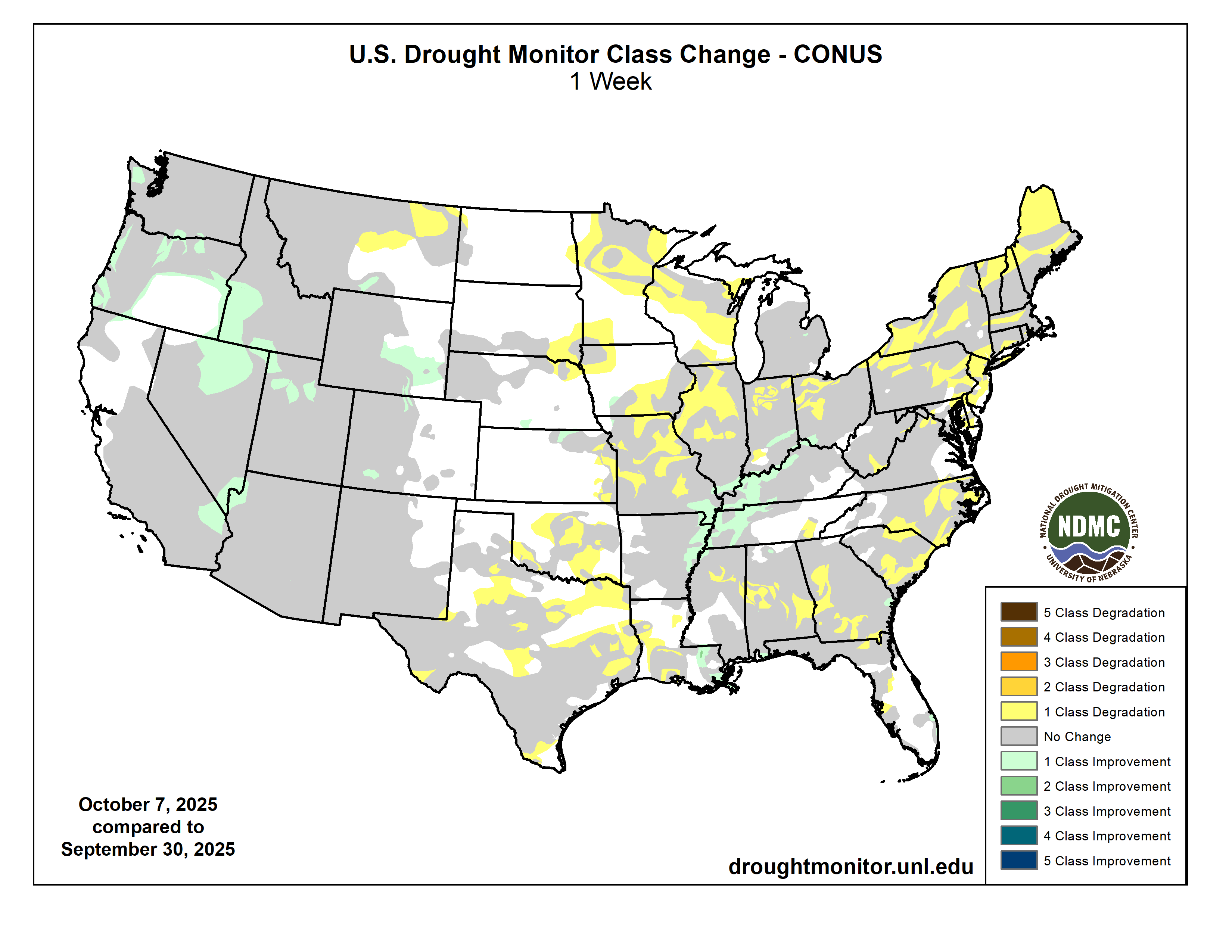
US Drought Monitor one week change map ending October 7, 2025.

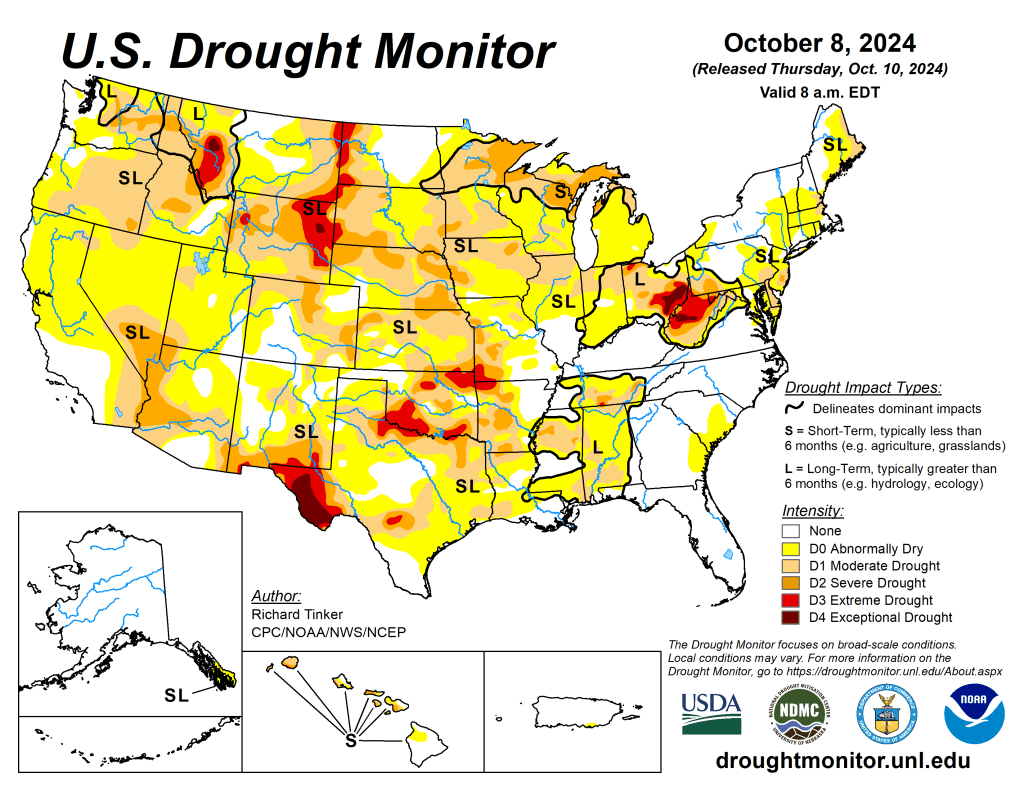
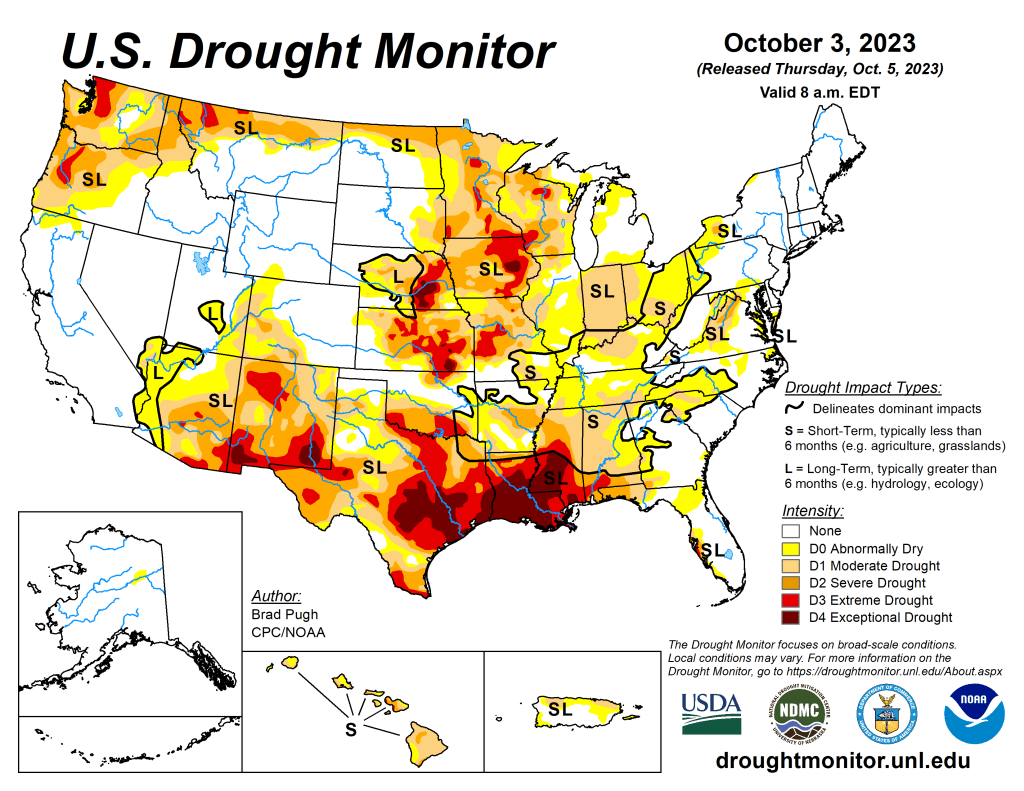
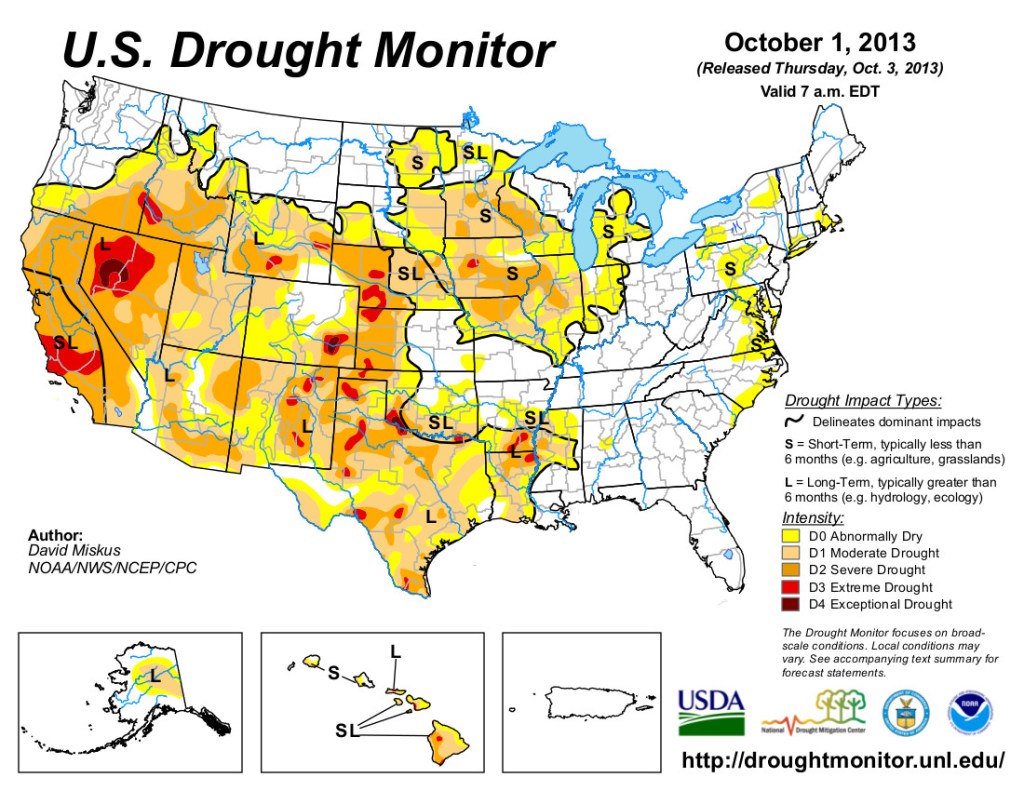
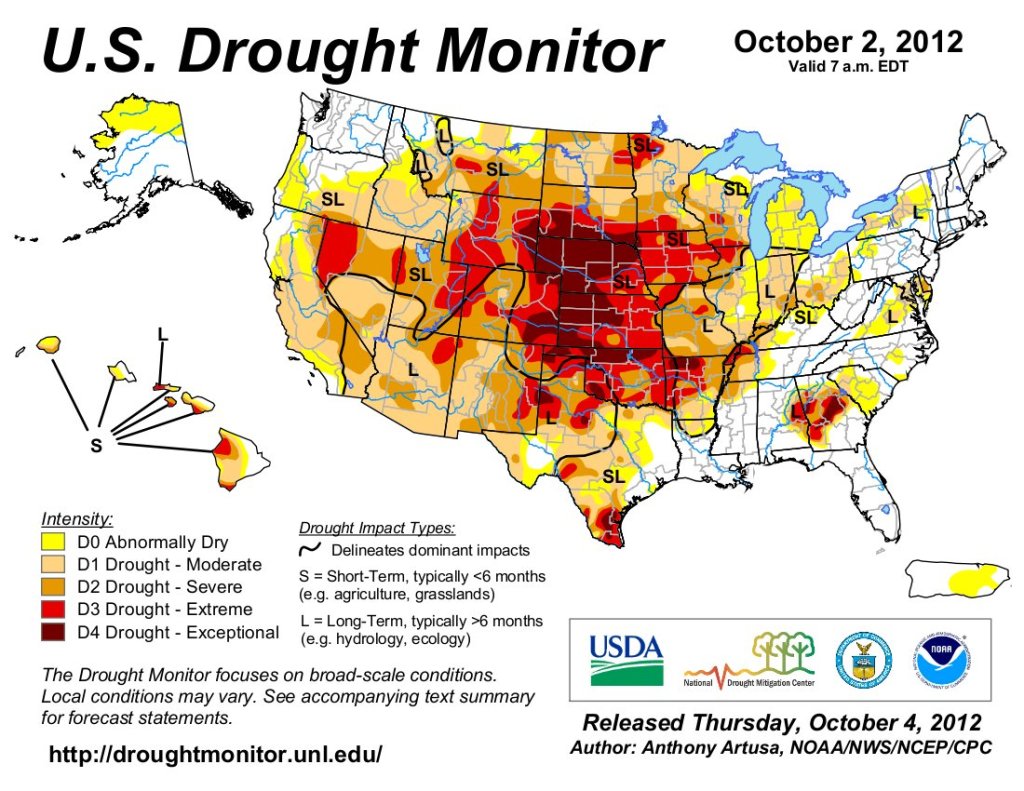
Just for grins here’s a slideshow of early October US Drought Monitor maps for the past few years.
The #ColoradoRiver District hosts annual Water Seminar — The #GrandJunction Daily Sentinel #COriver #aridification #CRD2025

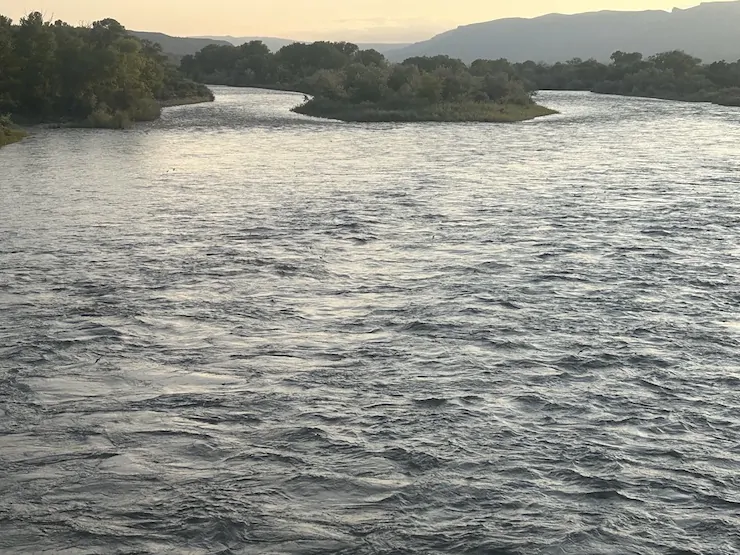
The Colorado National Monument and the Colorado River from the Colorado Riverfront trail October 3, 2025.

Click the link to read the article on the Grand Junction Daily Sentinel website (Nathan Deal). Here’s an excerpt:

October 4, 2025

The Colorado River District (CRD) hosted its annual Water Seminar on Friday [October 3, 2025], bringing together water leaders, politicians and city officials for a variety of discussions and activities. The seminar, titled ā€œAcross Dividesā€, was held at Colorado Mesa University, focusing on candid conversations and solution-focused dialogue to address water issues. The audience included agricultural producers, water providers, local and state government leaders, non-profit representatives, community members and CMU students.

ā€œOver the course of today, we’ve leaned into the conference theme of ā€˜Across Divides.’ We’ve explored spaces where perspectives don’t always align, where there are divides in language, where there are divides in theory, where there are divides in practice,ā€ said CRD Chief of Strategy Amy Moyer during her closing remarks…

The keynote address was given by CRD General Manager Andy Mueller, who discussed the challenges facing the Western Slope and Colorado River Basin as well as the work being done by the district and its local partners and the Shoshone water rights situation. He also discussed the impact of shrinking supplies and interstate pressures on Colorado…The ā€œLost in Translation: Interstate Divideā€ panel represented agriculture, drinking water, tribal nations and environmental interests from the Upper and Lower Basins, examining how the new supply-driven model proposal could shape the future of the Colorado River…

Moyer encouraged attendees to implement three actions in their lives to make sure the seminar leads to positive results.

ā€œFirst, follow up with the contacts that you made with the people at your table, with the presenters here today…. Find somebody you haven’t had the chance to talk to,ā€ she said. ā€œThe second thing is to apply one new idea that you learned from today, whether it’s in your personal life or your professional life…. Lastly, stay engaged with us at the Colorado River District. Look for the events and conversations that we hold throughout the year.ā€

A simple #ColoradRiver story: use less water — Allen Best (BigPivots.com) #COriver #aridification #CRD2025

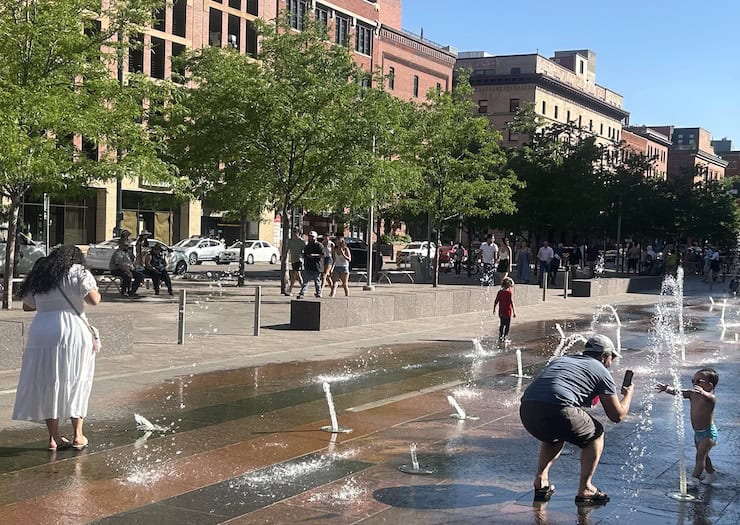
A child amid the splish-splashes of water at Denver’s Union Station on June 21, 2025. Photo credit: Allen Best/Big Pivots

Click the link to read the article on the Big Pivots website (Allen Best):

October 2, 2025

New report says the story is not near as complicated as some would have you believe. It identifies nine areas of focus for using less water.

A few hours before I read a new Colorado River Basin report this week, I was at a neighborhood meeting in the metropolitan Denver municipality where I live. A sustainability plan is being worked up. The water component will encourage conservation.

I said that the messaging on this, unlike some other components of sustainability, should be relatively easy. After all, 75% of this municipality’s water arrives from the headwaters of the Colorado River through the Moffat Tunnel.

Udall/Overpeck 4-panel Figure Colorado River temperature/precipitation/natural flows with trend. Lake Mead and Lake Powell storage. Updated through Water Year 2024. Credit: Brad Udall

And most everybody at this point understands that the Colorado River is in trouble. For more than 20 years we have seen the photos of the bathtub rings of the reservoirs and the water levels far below. So many years have yielded below-average runoffs, a 20% reduction altogether in the 21st century. The number of broken hottest-ever temperature records have vastly dwarfed the coldest-ever records.

Understanding the intricate efforts to better align the political governance of the river with the physical reality is a far more difficult story to tell, but it has not been for absence of effort in Big Pivots and hundreds of other outlets. Scores of stories have been written in just the last month or more about the seeming inability of negotiators from the seven basin states to come to agreements in advance of a November deadline set by the federal government.

Now comes a new report, ā€œThere’s No Water Available,ā€ from Great Basin Water Network and partners.  It offers nine recommendations under the subtitle of ā€œCommonsense Recommendations to Limit Colorado River Conflict.ā€

If longer-term drought is one component of the declined flows, the science is now firm that the warming climate is a reality that will remain and with it more erratic precipitation, surprising shifts in temperature, dry soils and many other factors. ā€œIt is clear that the future will be about adapting to hydrologic extremes. It is also clear that the water laws and hydraulic engineering developed in the 20th century did not foresee the realities we face today,ā€ says the report.

Then there is this arresting statement:

ā€œThe supply-focused approaches during the last 120 years — i.e. encouraging use — has landed us in crisis. It’s time for a fresh, modernized approach. Nevertheless, we believe that the necessary change isn’t as complicated as people in power want us to believe.ā€

Simply put, say the authors from the Glen Canyon Institute, Sierra Club and other organizations, we must use less water. ā€œWe can do so in an equitable way that does not involve foot-dragging and finger-pointing.ā€

Who needs to budge? Well, almost everybody — the historically shorted Native Americans being the exception. ā€œAll parties currently using water must commit to using less water than they have in the past,ā€ says the report.

The area around Yuma, Ariz., and California’s Imperial Valley provide roughly 95% of the vegetables available at grocery stores in the United States during winter months, February 2017, The report calls for more resilience built into agriculture. Photo credit: Allen Best/Big Pivots

Upper basin states — Colorado, New Mexico, Utah and Wyoming — come in for special mention. Perhaps it’s a negotiating tactic, but they have continued to maintain detailed estimates of how much more water they want to use. ā€œRather than planning on using more, we need states to plan on cutting,ā€ says the report.

They call for all states to have curtailment plans. ā€œHaving a clear-cut understanding of what entities have to cut during shortages is something that’s already in place in the lower Basin. The upper basin must develop a similar system of cuts predicated on water availability and delivery obligations that consider downstream use and upper basin water availability.ā€

Andy Mueller, general manager of the Colorado River Water Conservation District, the lead water agency for much of Colorado’s Western Slope, made that call at the district’s annual meeting in 2024. Some agreed. See: ā€œHeading for the Colorado River cliff.ā€ Big Pivots, Oct. 20, 2024.  However, Jim Lochhead, a former Western Slope resident and then Denver Water CEO, said he believed that the process of preparing for a compact curtailment was too difficult, too messy, until the clear need arrives. See: ā€œBone-dry winter in the San Juans,ā€ Big Pivots, Jan. 28, 2025.

The upper basin states have argued that they never used the water allocated under the Colorado River Compact of 1922, while the lower-basin states did — and then some. Only lately have the lower-basin state tightened their belt. The upper basin states don’t want to be restricted — not, at least, to the same degree.

This position was explained in a forum during May by Becky Mitchell, Colorado’s representative in the negotiations. She talked about how the upper-basin had developed more slowly and still has not used its full allocation. See: ā€œSharing risk on the Colorado River,ā€ Big Pivots, May 29, 2025.

ā€œThe main thing that we got from the compact was the principle of equity and the ability to develop at our own pace,ā€ said Mitchell. ā€œWe shouldn’t be punished because we didn’t develop to a certain number.ā€ The conversation, she added, is ā€œwhat does equity look like right now?ā€

Upper-basin states want a willingness in this settlement for agreement that focuses on the water supply, not the demand, she said. ā€œCommon sense would tell you, maybe Mother Nature should drive how we operate the system.ā€ That, she said, is the bedrock principle of the proposal from the upper division.

The Colorado River at Silt looked healthy in early June, and indeed runoff from the river’s headwaters in northern Colorado was near normal. The overall runoff, though, was far, far below average — what is becoming a new norm. Photo/ Allen Best

This new report rejects this ā€œnatural flowā€ plan. ā€œAgencies do not yet have the means to quickly and accurately measure natural flow data, a measurement metric that tracks water as if there were no human usage and infrastructure. That’s because the basin at-large is missing key data points.ā€

The report also argues that any new dams and diversions need to be off the shelf, cities can do a better job of conservation, and Glen Canyon Dam needs work to allow it to be functional at lower water levels. The report also recommends making farms resilient to new realities.

Some elements of the Colorado River conversations have shifted dramatically. One of them is the new insistence of the last 10 years that the water rights of tribes be honored. Representatives of tribal nations now are almost always on the agenda at water conferences in Colorado. Twenty years ago? No, they were not. Lorelei Cloud, the chair of the Colorado Water Conservation Board since May, is a member of the Southern Ute Reservation.

Of the basin’s 30 tribes, 22 have recognized rights to 3.2 million acre-feet of Colorado River system water annually. That’s approximately 25% of the basin’s average annual water supply. Twelve tribes have still-unresolved claims. It is estimated that 65% of tribal water is unused by tribal communities (but in many cases consigned to other users). Junior users would be curtailed in order to honor those tribal rights, says the report.

The connection between declines in groundwater and surface flows is also part of a broader shift in the conversation. A May 2025 study that groundwater supplies in the Colorado River Basin are shrinking by nearly 1.3 million acre-feet per year. Excessive groundwater depletion had surfaced as a surrogate water supply to satisfy surface water deficits.

In the upper basin, half the water we see at the surface comes from groundwater, according to research from the U.S. Geological Survey.  ā€œThis seminal USGS analysis underscores that as temperatures rise and evapotranspiration rates increase, there will be less groundwater entering surface water systems.ā€

There are obvious limitations to a short report, and I found the agriculture and municipal sections too shallow. The bibliography of sources, though, was quite valuable.

Will we see other reports of a similar nature in coming weeks and months? Quite likely. This conversation is far from over. In some ways, it’s just beginning.

Map credit: AGU