Click on a thumbnail graphic to view a gallery of drought data from the US Drought Monitor website.


Click on a thumbnail graphic to view a gallery of drought data from the US Drought Monitor website. Here’s an excerpt:
This Week’s Drought Summary
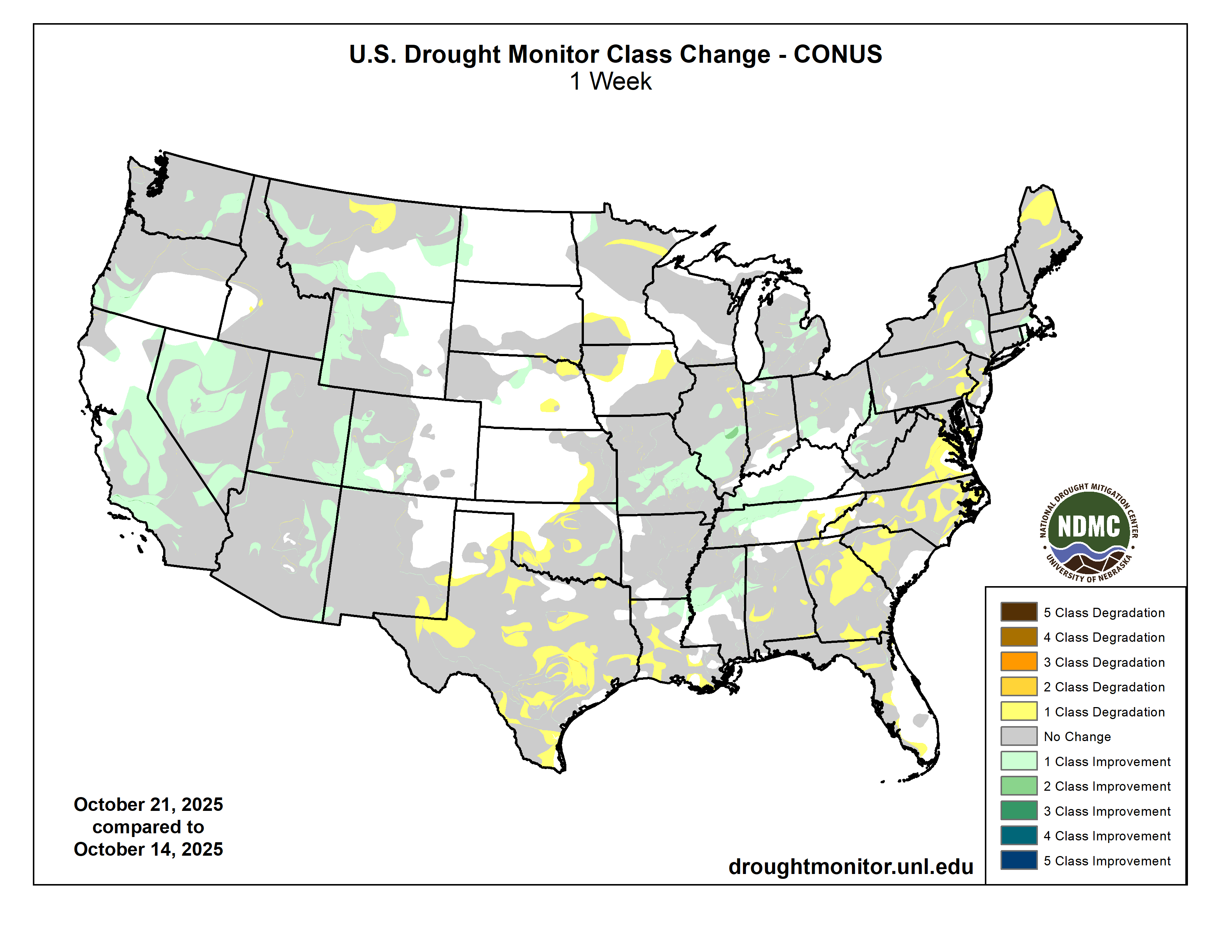
Recently, precipitation has been spatially variable across the Contiguous U.S. (“Lower-48”). Over the past 30 days, heavy precipitation (4 to locally over 8 inches) fell on parts of central and southern New England, the interior Northeast (especially eastern New York state), the Ohio Valley (particularly northern Kentucky and adjacent areas), eastern South Carolina, eastern Florida, parts of the Tennessee and adjacent Mississippi Valleys, isolated sites in the central Plains, the higher elevations in the Rockies, central Arizona and other scattered locations across the Southwest, parts of the Great Basin, portions of California (where such amounts are unusual this early in the wet season), and the Pacific Northwest (where these amounts are not unusual).
In stark contrast, an inch or less of precipitation has been noted in the desert Southwest and lower elevations across the interior West, most of the central and southern Plains, the northern Great Plains, the northwestern Great Lakes, portions or northern and western Florida, and some interior sections of the Southeast and Mid-Atlantic region.
Given the regional variability, there were a lot of changes in the Drought Monitor this week, with large parts of the West, much of the Ohio and middle Mississippi Valleys, and scattered locations across northern Mississippi, the Eastern Great Lakes, and the Northeast. At the same time, conditions have deteriorated across much of the southern and south-central Plains, the South Atlantic region from interior Georgia through eastern Virginia, southern parts of the Lower Mississippi Valley, and scattered areas across the rest of the Southeast, the Mid-Atlantic region, the Northeast, the Upper Mississippi Valley, and the northern Plains.
In sum, the array of improvements and deterioration incorporated into this week’s Drought Monitor resulted in slight declines in overall coverage of the various drought severity levels across the Lower-48. Abnormally dry or worse conditions cover 72 percent of the country, down from 74 percent last week. About 21 percent of the country is experiencing Severe Drought or worse (D2-D4), down slightly from 23 percent last week. For the 50 states plus Puerto Rico in total, coverage of abnormally dry or worse conditions fell from 62 to just under 60.5 percent…
High Plains
A wide range of precipitation totals were observed last week. Generally, 1.5 to 3.0 inches hit the northern and western Dakotas, much of central and eastern Wyoming, and scattered locations in northwestern Wyoming. An inch or a little more fell on many locations in a swath from central Nebraska into southeastern South Dakota, but other locations reported several tenths of an inch of precipitation at best, with most areas from southwestern Wyoming through western Nebraska and from eastern Nebraska through Kansas reporting little or none. This pattern resulted in less change here than in most other regions. Areas of deterioration were introduced in parts of the east-central and southeastern High Plains Region while improvement resulted from heavier precipitation farther west. The most widespread areas of improvement covered southwestern Colorado and western Wyoming. Coverage of dryness and drought is considerably lower in this region than in others, with the total area entrenched in some degree of dryness or drought (D0-D4) dropping slightly to a bit over 36 percent this week. The extent of Extreme Drought (D3) was almost cut in half, from 3.3 percent down to 1.7 percent. There is no D4 in the Region, but D3 remains across much of southwestern Wyoming and part of central Colorado. The proportion of the Great Plains States in this Region experiencing some degree of dryness or drought (D0-D4) is relatively low compared to much of the Lower-48; specifically, 3 percent of North Dakota, 32 percent of South Dakota, 35 percent of Nebraska, and 28 percent of Kansas…

West
Some unusually heavy early-season rain and snow has affected portions of the West, including areas of central and southern California where October so far has been wetter than most such months on record. Large portions of central and upper southern California, the Great Basin, and the western and eastern tiers of Utah saw improvement on this week’s Drought Monitor, along with patches of central and eastern Arizona, southwestern Oregon, central and eastern Washington, and parts of eastern, southern, and western Montana. Only a portion of north-central Montana saw any deterioration. The total area covered by any dryness (D0-D4) declined from 80 to a bit over 74 percent this week while the coverage of the more intense drought categories (D2-D4) dropped from 38.5 percent to just over one-third of the Region. D3-D4 was still entrenched over a decent proportion of the Region, but declined from almost 9 percent last week to about 6.5 percent this week. The only remaining area of the most intense category (D4) is in north-central Idaho…
South
Moderate to heavy rain resulted in several areas of improvement in Tennessee, central and northern Mississippi, northeastern Louisiana, and eastern Oklahoma. Farther south and west, subnormal precipitation continued for another week, resulting in numerous areas of deterioration from central and southern Louisiana westward across Texas and central through western Oklahoma. The proportion of the Region experiencing some degree of dryness or drought (D0+) increased slightly this week, from 79 percent to about 80.5 percent. There was a bigger jump in areas covered by some degree of drought (37 percent, up from a bit over 32 percent). The most intense drought (D3 with some isolated patches of D4) cover parts of the panhandle of western Texas and a sizeable part of south-central Texas. The heaviest rains this week (2 to 4 inches) were observed in a broken pattern from northwestern Louisiana through northern Mississippi. In contrast, southern sections of the Lower Mississippi Valley and the vast majority of Texas and Oklahoma received a few tenths of an inch at best, with most sites reporting no measurable precipitation…
Looking Ahead
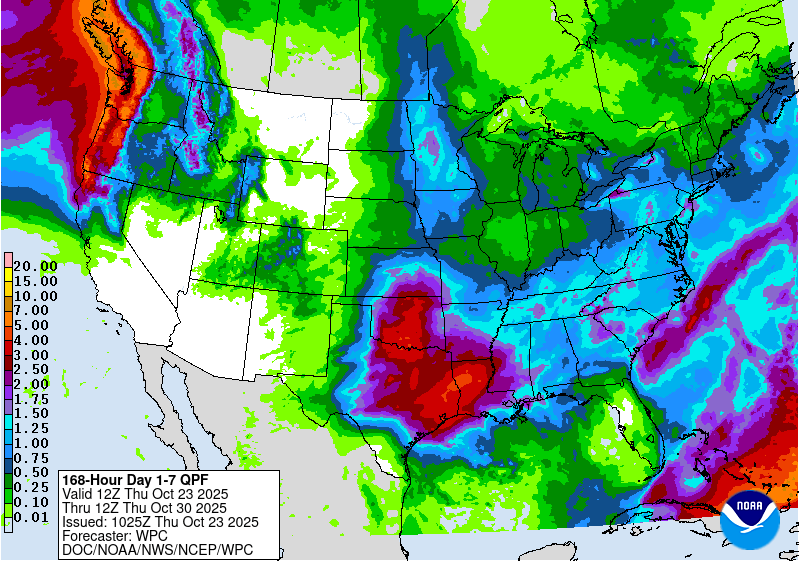
Over the next 5 to 7 days, two general areas are expected to receive heavy precipitation: The Pacific Northwest, and a swath from the southern Great Plains through the Lower Mississippi and Lower Ohio Valleys. Windward areas and higher elevations are expecting 5 to locally over 10 inches of precipitation, with 2 or more inches anticipated for other areas from the Cascades to the Pacific Coast. Meanwhile, 3 to 5 inches are expected from the Red River (South) Valley into eastern Texas and parts of the Lower Mississippi Valley. Elsewhere, totals exceeding 1.5 inches are forecast in the higher elevations of northern and central Idaho and adjacent areas. Moderate amounts (0.5 to locally over 1.5 inches) are expected to fall on the Ohio Valley, the Middle and Upper Mississippi Valley, and remaining locations in the southern half of the Plains outside Deep South Texas. Look for a few tenths to around an inch of precipitation in the northern Sierra Nevada, plus portions of the northern Intermountain West and Rockies. Elsewhere, light amounts at best are anticipated in most of New England, parts of the Mid-Atlantic region, the South Atlantic coastal plain, much of Peninsular Florida, Deep South Texas, most lower elevations across the interior West including the Southwest into central California, plus most of the Great Basin. Daily highs are forecast to average 4 to 8 deg. F below normal from central California through the Pacific Northwest and across the northern Intermountain West. Similar anomalies should affect the Atlantic Seaboard and Piedmont from northern Georgia through southern New England. Meanwhile, unusually warm weather will likely continue across the northern Plains, with daily highs averaging 5 to 10 deg. F above normal from northern Minnesota through the Dakotas and northern Great Lakes into northeastern New York. Also, highs averaging 4 to 8 deg. F above normal are expected from the Southwest through western and southern Texas. Low temperatures should average warmer with respect to normal across most of the Lower-48, especially over the Plains, Mississippi Valley, the Southwest, and the Great Basin. Low temperatures could average 6 to 13 deg. F above normal in the northeastern Great Plains and adjacent areas. The only broad area expecting below-normal lows (by 2 to 5 deg. F on average) stretches from Virginia northward through much of New York.
The Climate Prediction Center’s 6-10 day outlook valid for October 29 – November 1 favors heavier than normal precipitation continuing across the Pacific Northwest, where odds for significantly above-normal precipitation range from 50 to 70 percent. Wet weather is slightly favored across most of the Rockies and Plains as well as parts of central and northern California, northwestern Nevada, and the Pacific Northwest. Wetter than normal conditions are nominally favored across Hawaii. Abnormally dry weather is expected from central and western Texas through central and southern sections of the High Plains and Rockies. Odds for subnormal amounts exceed 50 percent from eastern Arizona through parts of the Texas Big Bend. Meanwhile, warm weather is favored from California, the Southwest, and the Great Basin through parts of the northern Rockies, the High Plains, the northern Great Plains, the Great Lakes, and northern New England. There is a better than 60 percent chance for warmth from southern California into western New Mexico. Cool weather is forecast across the South Atlantic region from Maryland through parts of Florida along with the central and southern Appalachians and the adjacent central Gulf Coast. The Hawaii forecast favors warmth, with chances exceeding 50 percent across the western half of the island chain.