Click the link to read the article on the Santa Fe New Mexican website (Lily Alexander). Here’s an excerpt:
October 17, 2025
What would it take to get New Mexico out of megadrought? The short answer: water. The longer answer: multiple years of heavy winter snows. The Southwestern U.S. — including New Mexico — has faced a steady drought for a quarter century, improving and degrading as seasonal moisture comes and goes. The short-term drought in the state is now relatively mild, thanks to a rainy summer monsoon, but the longer-term conditions paint a different picture — one that’s harder to fix, said Andrew Mangham, a senior service hydrologist with the National Weather Service in Albuquerque.
“A really good, aggressively wet monsoon season — just one — can wipe out drought effects in terms of the short term,” Mangham said. “This can improve fine fuels, by which I mean grasses and shrubs; those can be quite healthy. Surface soils can be fairly wet. But that doesn’t necessarily mean that it’s going to fill up the reservoirs.”
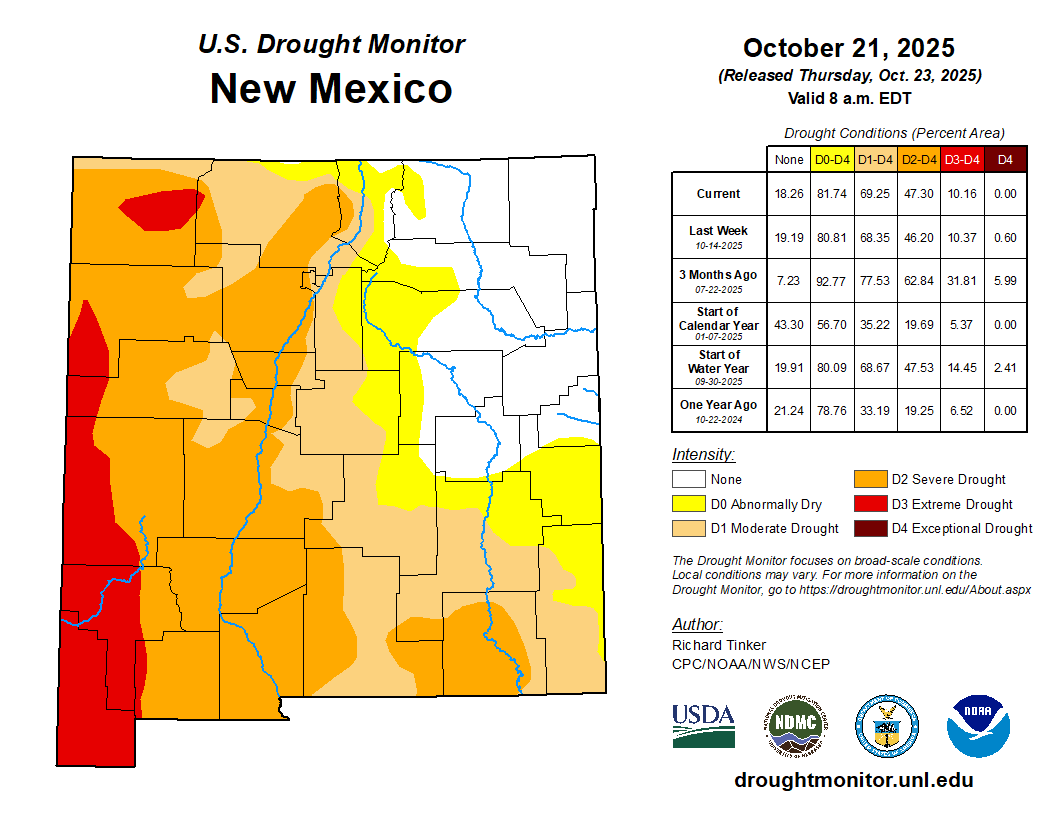
Drought is measured through multiple sectors: hydrological, referring to reservoir and river levels; agricultural, referring to how drought impacts crops; and ecological, referring to forest health. The U.S. Drought Monitor tracks the short-term drought across the state, categorizing it from “abnormally dry” to “exceptional” in intensity. A swath of northeastern New Mexico is not currently experiencing drought, but the rest of the state is facing at least abnormally dry conditions, according to the monitor’s most recent data; the drought is worst in southwestern New Mexico, as it has been for months…Around the time the reservoir storage levels dropped, the Southwest entered what scientists call a megadrought, now in its 25th year. This is believed to be the worst megadrought of the past 1,200 years, and recent research from the University of Texas at Austin indicates it could continue at least through the end of the century. New Mexico’s long-term drought wholly improving would require heavy wintertime snows in the northern part of the state and in southern Colorado, Mangham said, as that’s the source of much of the water that ends up “recharging” the state’s rivers and reservoirs…Snowpack is more helpful for drought than the spotty, hard-hitting storms of the summer monsoon, Mangham said. This is because snow is typically slower-moving than rain — and too much rain at once leaves only a little soaking into the soil.