What’s holding up the #ColoradoRiver negotiations? Experts break down the sticking points — Shannon Mullane (Fresh Water News) #COriver #aridification

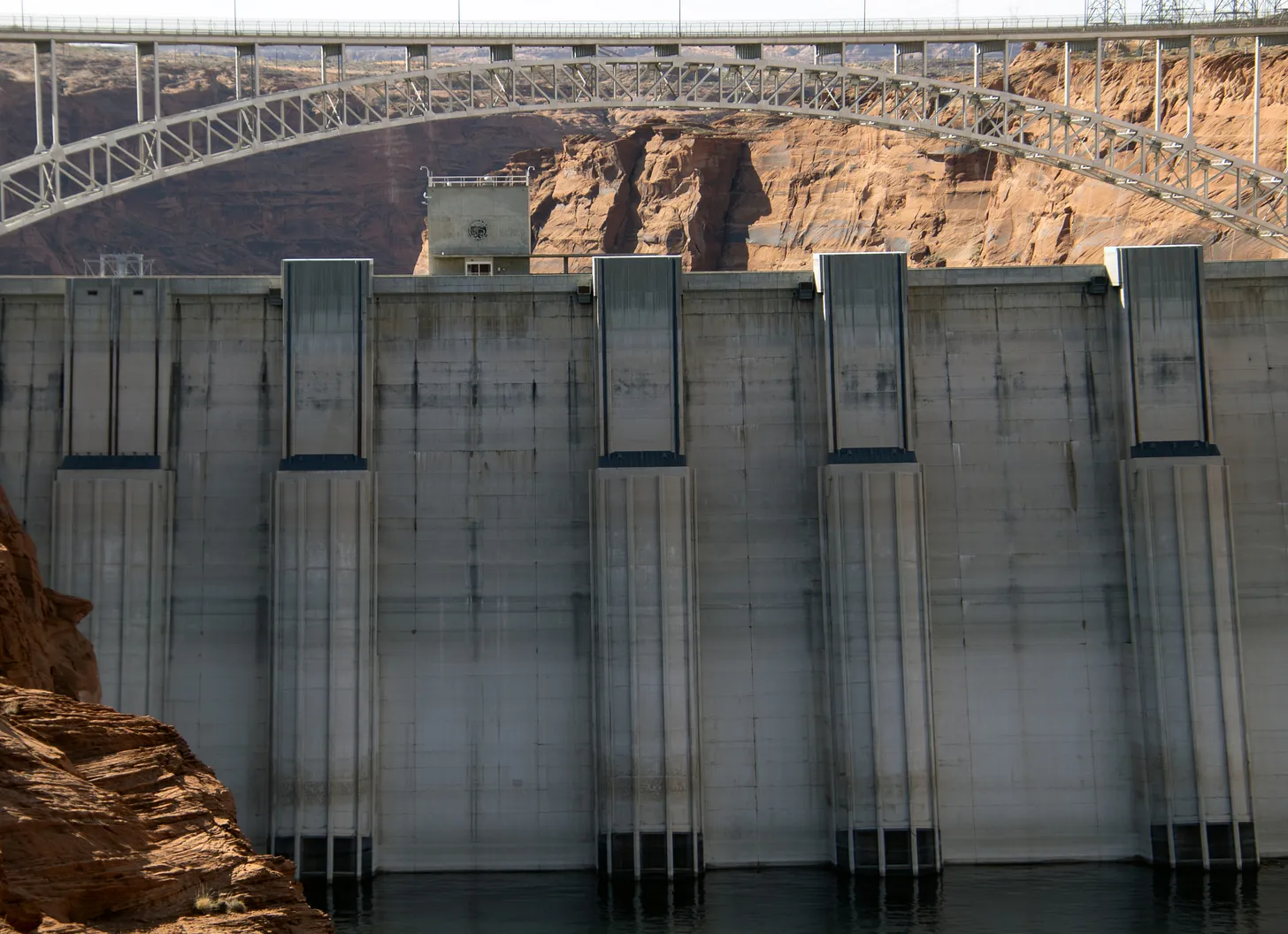
The back of Glen Canyon Dam in 2023 when the surface level was about 3,522 feet above sea level. Jonathan P. Thompson photo.

Click the link to read the article on the Water Education Colorado website (Shannon Mullane):

October 30, 2025

Seven states in the Colorado River Basin are days away from a Nov. 11 deadline to hash out a rough idea of how the water supply for 40 million people will be managed starting in fall 2026. And they’re still at loggerheads over what to do.

The rules that govern how key reservoirs store and release water supplies expire Dec. 31. They’ll guide reservoir operations until fall 2026, and federal and state officials plan to use the winter months to nail down a new set of replacement rules. But negotiating those new rules raises questions about everything from when the new agreement will expire to who has to cut back on water use in the basin’s driest years.

And those questions have stymied the seven state negotiators for months. In March 2024, four Upper Basin states — Colorado, New Mexico, Utah and Wyoming — shared their vision for what future management should look like. Three Lower Basin states — Arizona, California and Nevada — released a competing vision at the same time. The negotiators have suggested and shot down ideas in the time since, but they have made no firm decisions.

This shows that Colorado’s Western Slope is the biggest supplier of water to the Colorado River. Source: David F. Gold et al, Exploring the Spatially Compounding Multi‐Sectoral Drought Vulnerabilities in Colorado’s West Slope River Basins, Earth’s Future (2024). DOI: 10.1029/2024EF004841

As the clock ticks down, onlookers have been increasingly frustrated and critical of the lack of progress in the closed-door negotiations.

“They seem to have been stuck basically on the same stuff for the last two-plus years,” said Jim Lochhead, former CEO/manager for Denver Water, the state’s largest water provider. “Part of why it’s so frustrating is they keep circling around to the same conversations over and over again.”

The Department of the Interior is managing the process to replace the set of rules, established in 2007, that guide how key reservoirs — lakes Mead and Powell — store and release water.

The federal agency plans to release a draft of its plans in December and have a final decision signed by May or June. If the seven states can come to agreement by March, the Department of the Interior can parachute it into its planning process, said Scott Cameron, acting head of the Bureau of Reclamation, during a meeting in Arizona in June.

Colorado River Storage Project map. Credit: Reclmation

If they cannot agree, the feds will decide how the basin’s water is managed. The federal government already has significant authority in the Lower Basin. But federal officials have also said they could leverage their authority over federal water projects in the Upper Basin, like Blue Mesa and the Colorado River Storage Project, to manage water in coming years.

The states could also take the matter to court, which could take decades to resolve and would put water management in the hands of judges instead of Colorado River communities, experts say.

“I think, if the definition of failure is that they don’t come to an agreement, we’ll know on Nov. 11,” said Sarah Porter, director of the Kyl Center for Water Policy at Arizona State University. “My sense is that they’ve all tried really hard.”

So what exactly is holding up progress? [Shannon Mullane] reached out to nine water professionals, from state negotiators to water experts, to break down the sticking points.

Water cuts in the Upper Basin (yes, that includes Colorado)

One of the top sticking points in the negotiations is whether the four Upper Basin states will commit to making firm water cuts or conservation goals during the basin’s driest years, experts said.

Colorado, New Mexico, Utah and Wyoming officials say the states regularly do not use their full legal allocation of Colorado River water, about 7.5 million acre-feet per year. The four states’ usage usually hovers closer to 4.5 million acre-feet per year and can fall to 3 million acre-feet in drier years, according to Upper Basin accounting.

They’re already cutting off junior water users early in dry years, like 2022. Water sharing is based on “first in time, first in right,” which means more recent, or junior, water rights are cut off before older, senior rights.

The officials argue that they’re already cutting back, and using less than their share, so why commit to cutting more? Conserving more water is also dependent on how much water is flowing through rivers and streams in any given year, Commissioner Becky Mitchell, Colorado’s governor-appointed negotiator, said.

Rebecca Mitchell, John Entsminger, Estevan Lopez, Gene Shawcroft, JB Hamby, Tom Buschatzke at the Getches-Wilkinson Center/Water and Tribes Initiative Conference June 6, 2024. Photo credit: Rebecca Mitchell

“We cannot conserve water that is not there,” she said.

In March 2024, the states proposed voluntary, temporary cuts, but that doesn’t work for the Lower Basin officials.

The downstream states proposed in March 2024 that they could take the first cuts — up to 1.5 million of their 7.5 million-acre-foot legal allocation — if reservoir storage is 38% to 69% of its capacity. After that, the Upper Basin and Lower Basin could evenly split additional cuts, according to the Lower Basin proposal.

That was a nonstarter for the Upper Basin officials, who balked when the Lower Basin asked them to cut up to 1.2 million acre-feet, or about a quarter to a third of the typical water use in the upstream states. Some of the Upper Basin states also say they do not currently have the legal authority to impose mandatory water cuts within their states when it comes to interstate water sharing agreements. [ed. emphasis mine]

This is one of two major disagreements in the negotiations, according to California Commissioner JB Hamby. The other is how and when water is released from the Upper Basin at Glen Canyon Dam to the Lower Basin, he said.

“There’s been lots of proposals bandied about back and forth between the basins and the feds,” Hamby said. “We’re not any closer at this point in time because those are the two most critical sticking points.”

Arizona officials declined to comment for the story. Nevada’s representative did not respond to requests for comment.

The political sticking point

Each of the seven negotiators is accountable to their home state. They have to be able to sell a deal to their water users and state lawmakers in a way that feels like a win, Porter of Arizona State University said.

In Arizona, Commissioner Tom Buschatzke must strike a deal that water users and the state legislature can get behind.

“There may be a situation where no deal is better than trying to sell a deal to your water users that you know they will utterly hate,” Porter said.

There are certain nonstarters for Arizona: Everyone expects to see water cuts for communities, like Phoenix, that rely on the Central Arizona Project, a 336-mile federal system that supplies Colorado River water to the most populated regions in Arizona. But it’s hard to see a benefit for Arizona in a deal with no water, or not enough water, for the project, Porter said.

And water users can sue if they don’t like the seven-state deal or if senior water users are asked to cut back on water to help junior water users. That would run counter to how the legal priority system has worked for over a century. Such lawsuits would tie up Colorado River water management in court for years, Porter said. [ed. emphasis mine]

Udall/Overpeck 4-panel Figure Colorado River temperature/precipitation/natural flows with trend. Lake Mead and Lake Powell storage. Updated through Water Year 2024. Credit: Brad Udall

“We’re really on the precipice of significant new, bigger shortages, and so the likelihood of a water user bringing legal action because of cuts outside of the priority system … is much higher than it was in 2019,” Porter said.

In past meetings, Cameron of the Bureau of Reclamation has called on water users to be more flexible so their state commissioners have room to negotiate.

“I urge you to continue to work with Tom (Buschatzke), embrace his leadership and give him the freedom to maneuver to strike an appropriate deal with his six colleagues in the other states,” Cameron said during an Arizona Reconsultation Committee meeting in June.

In Colorado, Mitchell said she is still working closely with water users within the state.

“We have firmly sat in the negotiating room with the principles we have always had,” she said. “That is something I have promised Coloradans: The principles that we developed are still the principles that I am taking into the room with me. Those are factored in as we are negotiating.”

What experts want to see

Water experts and professionals have been stuck on the outside of the closed-door negotiations, waiting on updates with greater frustration as the deadline draws near.

Now the states have less than two weeks to agree, at a high-level, on how to manage the water supply for millions of people, two countries, 30 Native American tribes, key food supplies and multibillion-dollar industries.

“They have the most thankless task that anyone in the Colorado basin could have,” Porter said.

Lochhead, formerly of Denver Water, said it seems impossible to reach any kind of comprehensive agreement before Nov. 11. They might be able to reach a conceptual outline, he said. They might be able to find a way forward if they were less entrenched in the Upper Basin versus Lower Basin dynamic, he added.

Jennifer Pitt and Brad Udall at the Getches-Wilkinson Center/Water and Tribes Initiative conference June 5, 2025. Photo credit: Allen Best/Big Pivots

Jennifer Pitt, Colorado River Program Director for the National Audubon Society, suggested that states work toward making the most out of water supplies instead of legal questions that are tough to resolve.

“Once the rules of the game become clear, people are going to lean hard into those solutions,” she said. “And there are many of them.”

John Berggren, regional policy manager for Western Resource Advocates, said the basin needs to see compromise as a win, not a loss. Officials need to educate their constituents that compromising empowers people to choose their destiny, instead of having courts or the federal government dictate it for the basin.

“A compromise is not a bad thing,” Berggren said. “Coming to agreement, coming to the table is actually a good thing for us.”


10 sticking points

The Colorado River water experts and negotiators highlighted 10 key sticking points:

  1. The term of the agreement: The negotiators have weighed different options for how long the new agreement should last and whether there should be a short-term period for states to ramp up conservation programs and water use reductions. This is a lower-level sticking point where states might be able to find consensus more easily.
  2. Reservoir management: The states have also debated which reservoirs will be managed under the new agreement. The Lower Basin wants to include upstream reservoirs, including Blue Mesa Reservoir in Colorado. The Upper Basin only wants Lake Mead and Lake Powell involved and worries that including upstream reservoirs will change how water flows through the basin or encourage Lower Basin overuse.
  3. Rebuilding reservoir storage: Commissioner Mitchell of Colorado was adamant that the new plan needs to prioritize rebuilding reservoir storage, since key reservoirs — Lake Mead and Lake Powell — are falling closer to critical levels. Commissioner Hamby of California said the states can figure out how to handle reservoir storage, and other issues, like water cuts, pose a greater challenge.
  4. Operating Lake Mead and Lake Powell: The current operational rules are mainly based on reservoir levels and river forecasts. When Lake Mead reaches a certain water level, it triggers adjustments in Lake Powell. The state officials agree these rules did not work. Colorado wants to prioritize the health of Lake Powell and base operations on real water levels — not forecasts. The states almost came to an agreement on how to do this earlier in the summer, but the idea was re-shelved.
  5. Cutting back on water: This is a particularly thorny issue. Would the Upper Basin commit to firm water conservation goals or mandatory cuts? Is the Lower Basin doing enough to address the Upper Basin’s concerns about overuse in the three downstream states? Officials in both basins say large cutbacks to their water supply would be an existential threat to their communities now and in the future.
  6. Basic accounting: The states disagree on key numbers. How does each state count its water use, shortages and conservation efforts? How much water is the Upper Basin supposed to send down to Mexico, or is that the Lower Basin’s job? How do downstream states count water use from tributaries, like the Gila River?
  7. 100-year-old issues: The states are also bolstering their legal arguments when it comes to unclear language in the Colorado River Compact of 1922, which laid out how the two basins were supposed to share water. Does it say the four upstream states are required to deliver a certain amount of water to the three downstream states? Or does it say the upstream states aren’t supposed to cause the water deliveries to go below a certain level? Some Upper Basin lawyers say they can argue that climate change, not the states’ water use, is the cause.
  8. Distrust: The basin states have thrown plenty of barbs at each other during the negotiations. Each has accused the other of gaming the system in some way. Lower Basin and Upper Basin officials have said other states could time reservoir releases from lakes Mead or Powell to benefit their state. The Lower Basin has questioned whether the Upper Basin has inflated shortage calculations. The Upper Basin has long complained about Arizona’s practice of taking Colorado River water out of Lake Mead and storing it underground.
  9. Group dynamics: The basin has split into Team Lower Basin and Team Upper Basin. Could states make more progress if they operated more independently, threw out ideas, formed coalitions and convinced others to join?
  10. In-state politics: Even if the state officials can work out the details of an agreement, they still have to take it home and convince their states it’s a good idea. That can be complicated. In Colorado alone, there are decades-old conflicts over water between the Western Slope and Front Rangefarmers and citiestribal and non-tribal water users.

More by Shannon Mullane

Map of the Colorado River drainage basin, created using USGS data. By Shannon1 Creative Commons Attribution-Share Alike 4.0

Snowmaking off to a fast start, even as Mother Nature takes her time: Ski resorts crank up the snow guns, thanks to ‘wet-bulb’ weather and Denver Water

Click the link to read the article on the Denver Water website (Todd Hartman):

October 27, 2025

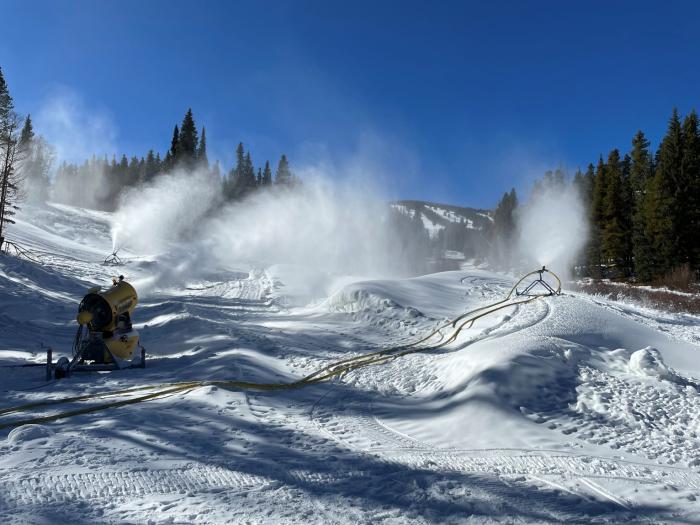
The snow season in Colorado’s high country is off to a slow start, but snowmaking at the ski resorts? That’s going gangbusters.

As October draws to a close, ski resorts are cranking out the snow due to a combination of the resorts’ annual race to opening day, this year’s unusually compressed window for the right meteorological conditions, and long-standing water supply agreements with Denver Water.

Snowmaking underway on the slopes at Breckenridge Ski Resort, one of six ski resorts in Denver Water’s watershed with agreements in place to use some of the utility’s water to make snow in the winter. Photo credit: Denver Water.

This year’s race to be the first ski resort to open ended over the weekend, when Keystone opened Saturday for three hours of afternoon skiing, followed by Arapahoe Basin, which opened for a full day of skiing on Sunday. 

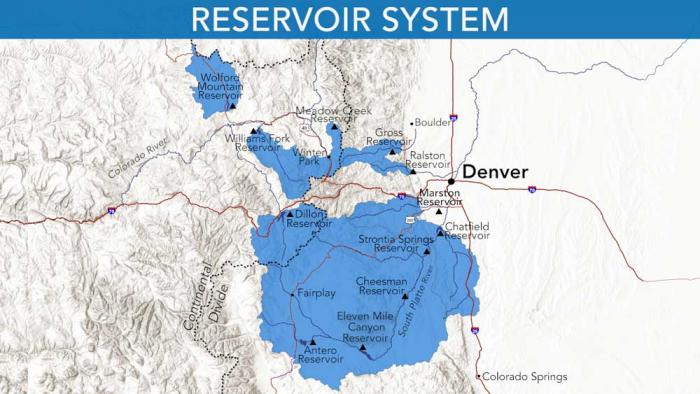
Denver Water collects water from across 4,000 square miles of mountain watershed, an area that’s also home to six major ski resorts: Arapahoe Basin, Breckenridge, Copper Mountain, Frisco Adventure Park, Keystone and Winter Park.

And stream gauges operated by Denver Water act as a proxy measure for snowmaking activity. 

For example, the gauges monitoring streams affected by snowmaking at Winter Park and Keystone showed big overnight dips in recent days, as the resorts diverted water from the streams to their snowmaking equipment to get a head start on the ski season.

“The snow guns are blasting — and we can really see it reflected in those stream gauges,” said Nathan Elder, manager of water supply for Denver Water. “This appears to be one of the bigger starts to snow-making at the resorts as they gear up for opening day.”

The series of big drops in the amount of water flowing through the Moffat Tunnel last week indicates water being diverted to make snow at Winter Park Resort. Image credit: Colorado Water Conservation Board, Division of Water Resources.

The snowmaking boom can also be credited to something called “wet bulb” temperatures, a concept explained by 9News meteorologist Cory Reppenhagen in a story that aired Oct. 23.

It’s a reference to the impact of evaporative cooling in the dry Colorado air. In essence, the low humidity of the cold and dry air allows resorts to make snow even if the actual air temperature is above freezing. 

“These ‘wet bulb’ conditions that are ideal for snowmaking have come later in the year than usual, so the resorts have had less time to make snow and are going strong now,” Elder said.

Water managers can see the activity in places like gauges on the Snake River, where overnight on Oct. 21, the stream that was flowing at 21 cubic feet of water per second plunged down to 6 cubic feet per second for several hours, then jumped back up to 32 cfs when the snowmaking at Keystone stopped the next day.

Importantly, the snowmaking machines couldn’t work their magic without the water the ski resorts are able to divert from high country streams. And the resorts can do that thanks to agreements with Denver Water that get the most use out of every drop of water.

Denver Water has very senior water rights in Grand and Summit counties, dating back to the 1920s and 1940s, before the ski resorts were open or made snow.

Agreements between Denver Water and the six ski resorts — Arapahoe Basin, Breckenridge, Cooper Mountain, Frisco Adventure Park, Keystone and Winter Park —allow the resorts to capture and use water for snowmaking, helping get the ski season off to an earlier start than they likely would be able to do otherwise.

The resorts use water that would otherwise get collected and stored in Denver Water reservoirs.

But it all evens out in the end. When the machine-made snow melts, it will flow downstream and wind up in the utility’s reservoirs on its way to customer taps next spring and summer.

Providing water for snowmaking is just one way Denver Water helps improve recreation in our collection system.

Watch a video on how Arapahoe Basin makes snow

And those agreements are crucial this year, due to a late start to the snowfall season.

The average amount of snow measured at mountain tracking sites (called SNOTELs) as of Oct. 23 was 0 inches.  There have only been seven other years, in the 46 years since SNOTELs began tracking data in 1979, when the average measurement was zero that late in October.

However, says Elder, do not despair.

A slow October roll-out does not automatically translate to a bad snow year overall.

“A slow start does not mean the peak snowpack in April will be low,” he said. “In some of those years the peak was well above average.”

And forecasts indicate that ‘wet-bulb’ temperatures are looking good for the remainder of this week, meaning more snowmaking will be underway.

So, if you haven’t already, get ready to break out those skis.

Denver Water relies on a network of reservoirs to collect and store water. The large collection area provides flexibility for collecting water as some areas receive different amounts of precipitation throughout the year. Image credit: Denver Water.

Agricultural drones are taking off globally, saving farmers time and money

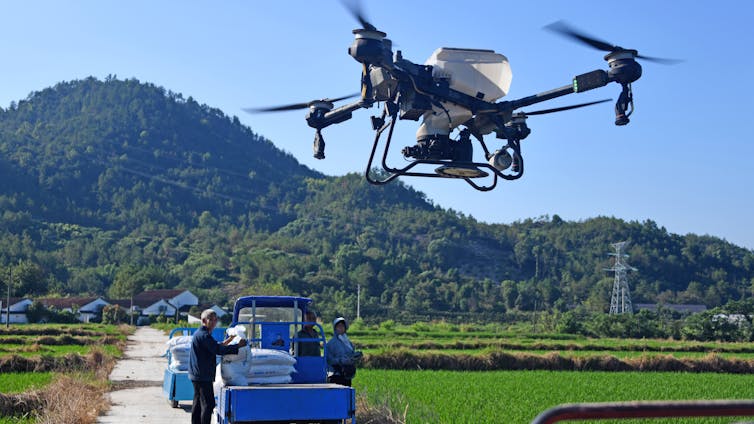
A farmer in China operates a drone to spray fertilizer on fields. Wang Huabin/VCG via Getty Images

Ben Belton, Michigan State University and Leo Baldiga, Michigan State University

Drones have become integrated into everyday life over the past decade – in sectors as diverse as entertainment, health care and construction. They have also begun to transform the way people grow food.

In a new study published in the journal Science, we show that use of agricultural drones has spread extremely rapidly around the world. In our research as social scientists studying agriculture and rural development, we set out to document where agricultural drones have taken off around the world, what they are doing, and why they have traveled so far so fast. We also explored what these changes mean for farmers, the environment, the public and governments.

From toys to farm tools

Just a few years ago, agricultural drones were expensive, small and difficult to use, limiting their appeal to farmers. In contrast, today’s models can be flown immediately after purchase and carry loads weighing up to 220 pounds (100 kg) – the weight of two sacks of fertilizer.

Their prices vary from country to country due to taxes, tariffs and shipping costs. In the U.S., a drone owner can expect to spend US$20,000 to $30,000 for the same equipment that a farmer in China could buy for less than $10,000. However, most farmers hire service providers, small businesses that supply drones and pilots for a fee, making them easy and relatively affordable to use. https://www.youtube.com/embed/1_XkHEUIi5Q?wmode=transparent&start=0 A promotional video for the DJI Agras T100 agricultural drone, which can carry a maximum load of 220 pounds (100 kg).

Agricultural drones are now akin to flying tractors – multifunctional machines that can perform numerous tasks using different hardware attachments. Common uses for drones on farms include spraying crops, spreading fertilizer, sowing seeds, transporting produce, dispensing fish feeds, painting greenhouses, monitoring livestock locations and well-being, mapping field topography and drainage, and measuring crop health. This versatility makes drones valuable for growing numerous crops, on farms of all sizes.

Technological leapfrogging

We estimated the number of agricultural drones operating in some of the world’s leading agricultural countries by scouring online news and trade publications in many different languages. This effort revealed where agricultural drones have already taken off around the world.

Historically, most agricultural technology – tractors, for example – has spread from high-income countries to middle- and then lower-income ones over the course of many decades. Drones partially reversed and dramatically accelerated this pattern, diffusing first from East Asia to Southeast Asia, then to Latin America, and finally to North America and Europe. Their use in higher-income regions is more limited but is accelerating rapidly in the U.S.

China leads the world in agricultural drone manufacturing and adoption. In 2016, a Chinese company introduced the first agriculture-specific quadcopter model. There are now more than 250,000 agricultural drones reported to be in use there. Other middle-income countries have also been enthusiastic adopters. For instance, drones were used on 30% of Thailand’s farmland in 2023, up from almost none in 2019, mainly by spraying pesticides and spreading fertilizers.

In the U.S., the number of agricultural drones registered with the Federal Aviation Administration leaped from about 1,000 in January 2024 to around 5,500 in mid-2025. Industry reports suggest those numbers substantially underreport U.S. drone use because some owners seek to avoid the complex registration process. Agricultural drones in the U.S. are used mainly for spraying crops such as corn and soy, especially in areas that are difficult to reach with tractors or crop-dusting aircraft.

Safer, but not risk-free

In countries such as China, Thailand and Vietnam, millions of smallholder farmers have upgraded from the dangerous and tiring job of applying agrochemicals by hand with backpack sprayers to using some of the most cutting-edge technology in the world, often using the same models that are popular in the U.S.

Shifting from applying chemicals with backpack sprayers to drones substantially reduces the risk of direct exposure to toxins for farmers and farmworkers.

However, because drones usually spray from a height of at least 6 feet (2 meters), if used improperly, they can spread droplets containing pesticides or herbicides to neighboring farms, waterways or bystanders. That can damage crops and endanger people and nature.

Saving labor or displacing it?

Drones save farmers time and money. They reduce the need for smallholders – people who farm less than 5 acres (2 hectares), which account for 85% of farms globally – to do dangerous and tiring manual spraying and spreading work on their own farms. They also remove the need to hire workers to do the same.

By eliminating some of the last remaining physically demanding work in farming, drones may also help make agriculture more attractive to rural youth, who are often disillusioned with the drudgery of traditional farming. In addition, drones create new skilled employment opportunities in rural areas for pilots, many of whom are young people.

On the downside, using drones could displace workers who currently earn a living from crop spraying. For instance, according to one estimate from China, drones can cover between 10 and 25 acres (4 to 10 hectares) of farmland per hour when spraying pesticides. That is equivalent to the effort of between 30 and 100 workers spraying manually. Governments may need to find ways to help displaced workers find new jobs.

A person pours liquid into a tank attached to a drone, while standing near a large field.
An agricultural worker fills a drone tank with pesticide spray at a farm in Brazil. Mateus Bonomi/Anadolu Agency via Getty Images

Sky’s the limit

Drones spray and spread fertilizers and seeds evenly and efficiently, so that less is wasted. They may also reduce damage to crops in the field and consume less energy than large farm machines such as tractors.

In combination, these factors may increase the amount of food that can be produced on each acre of land, while reducing the amount of resources needed to do so. This outcome is a holy grail for agricultural scientists, who refer to it as “sustainable intensification.”

However, much of the evidence so far on yield gains from drone-assisted farming is anecdotal, or based on small studies or industry reports.

The drone revolution is reshaping farming faster than almost any technology before it. In just five years, millions of farmers around the world have embraced drones. Early signs point to big benefits: greater efficiency, safer working conditions and improved rural livelihoods. But the full picture isn’t clear yet.

Ben Belton, Professor of International Development, Michigan State University and Leo Baldiga, Ph.D. Student in Geography, Environment and Spatial Sciences, Michigan State University

This article is republished from The Conversation under a Creative Commons license. Read the original article.