Click the link to read the article on the InkStain website (John Fleck):
March 18, 2026
Some notes on the current state of the Colorado River…
I’m preparing for a panel discussion this evening in Albuquerque. I promised – three-finger promise, Scout’s honor, which still means something to me – that I wouldn’t use any swear words., either in the blog post or the panel discussion.
The state of the water
Per the latest numbers from my colleague/collaborator/friend Jack Schmidt, Lake Powell currently holds 1.57 million acre feet of water above the protect-the-infrastructure no-go line of elevation 3,500.
Storage at this point in the year is similar to 2022, when we began a hair-about-to-be-on-fire drill as Interior raced to figure out how to protect Glen Canyon Dam because of newly understood (or newly publicly understood) risks of dropping below minimum power pool and using the dam’s outlook works. That constraint still holds.
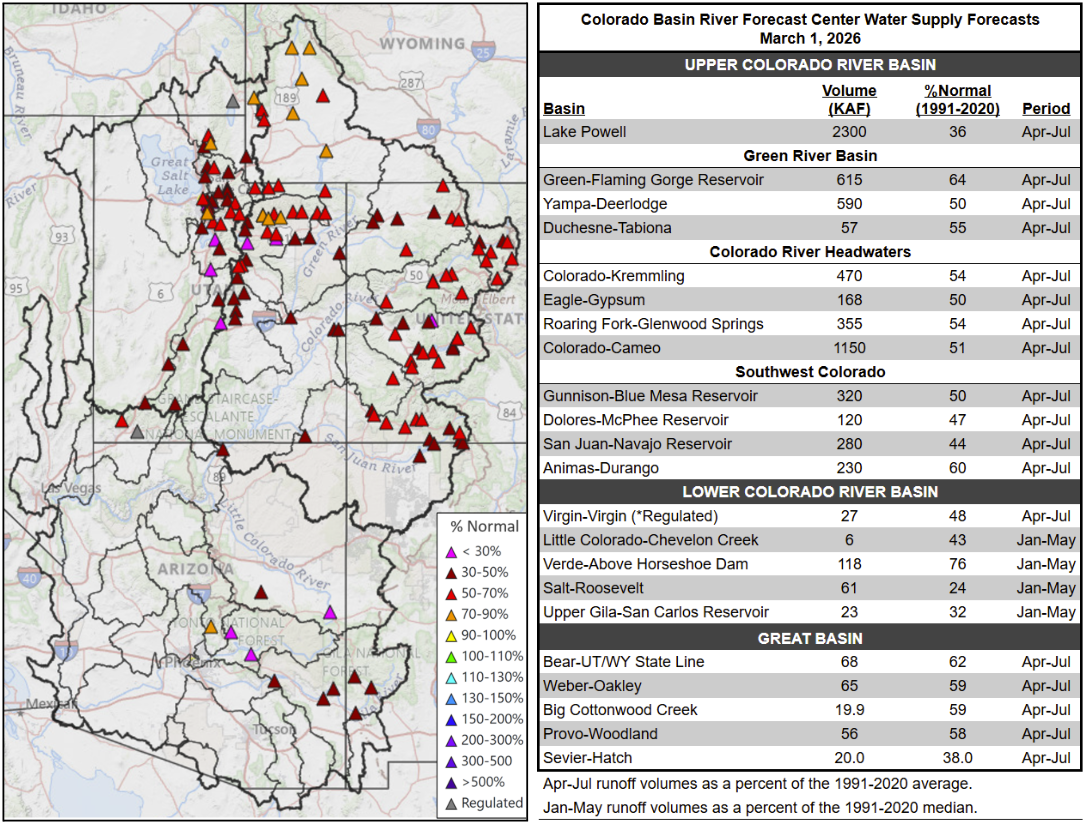
The forecast this year is a catastrophe compared to 2022: 1.75 million acre feet for the 2026 runoff season, compared to 3.8 maf in the 2022 runoff season. [ed. emphasis mine]
The result, according to the most probable forecast from Reclamation, is that absent some sort of action (see governance below) Powell will drop below 3,500 in September, and stay that way until the spring runoff in 2027.
According to the min probable forecast, which is realistic given the looming heat-pocalypse, we hit 3,500 by July and stay there forever (by which I mean as far as the current 24-month forecast runs – as the late Jim Morison wrote, the future’s uncertain and the end is always near).
The state of the governance
The state of the governance nests two separate by closely linked problems: near term actions and long term rules.
Near term actions
Protecting Glen Canyon Dam from that 3,500 no-go line requires coming up with a least 2 million acre feet of water over the next two years – to get us past that spring 2027 problem described above. There are two ways to do this. The first is to release a bunch of water from upstream, primarily Flaming Gorge Reservoir. How much? Dunno. The second is to cut releases from Glen Canyon Dam, reducing flows through the Grand Canyon and into Lake Mead. How much? Dunno, though we may find out soon.
The current rules, adopted in response to the challenges of 2022-23, allows releases from Glen Canyon Dam to drop this year to 6 million acre feet, which effectively gets 1.5 million of the needed 2 million feet from Lake Mead by reducing releases thereto. Another 500,000 in releases from upstream reservoir gets you 2 million acre feet, with room to do more if the hydrology gets even worse – which it might.
Longer term actions
The longer term stuff is where, as a student of governance, this gets really interesting for me. As a citizen of the basin, I am inclined to swear words at the dysfunction that has left us with no long term plan beyond the end of this year. But I Scout’s honor promised, so shifting to the “student of governance” schtick gives me a view from nowhereway to approach this dispassionately, without the, y’know, words that would have made Mr. Vinatieri, my Scoutmaster, disappointed in me.
Others have chronicled the failure of the seven U.S. Colorado River Basin states to come to a consensus agreement on a set of river operating rules, we need not repeat that here, other than to note that what we have here is a classic case of what has been called the tragedy of the anticommons. This is a situation where many people or entities – in this case the states of the Colorado River Basin – each have the power to block a solution that might be to the benefit of the community as a whole. In this case, each of the seven states of the Colorado River Basin have blocking power over solutions that would prevent the reservoirs from crashing.
See above: the reservoirs are crashing and we have no plan to prevent it because any proposal that might prevent it has been blocked by one or more states that object.
The reason behind this is a set of rules written beginning in the 1920s governing the river – the Colorado River Compact and a series of ad hoc additions that followed – that attempted to lay out rules for managing the river but failed to include functional processes for modifying the rules when they proved inadequate to changing the situation. We’re now stuck with a system under which each of the seven basin states has blocking power over any attempt to change the rules.
This violates one of the fundamental institutional design principles identified by the late Elinor Ostrom, who taught us so much about how we succeed or fail in overcoming the tragedy of the commons: “How will the rules … be changed over time with changes in the performance of the resource system, the strategies of participants, and external opportunities and constraints?” We have to have rules about how we rewrite the rules. We lack that.
Despite this, we have succeeded in the past, in a series of rule-writing exercises that began in the late 1990s, by depending on principled actors at the state level recognizing that they needed to balance their need to protect their own community’s water supplies against the need to solve problems at the scale of the basin as a whole.
My personal values on this question are both instrumental (things that I think are in the best interests of myself and my community) and deontological (things that I think are fundamental moral principles). The second first: I think we have ethical obligations to those upstream and downstream of us in shared river basins. This is, for me, fundamental. The second is instrumental – I think compromise is in the best interests of my community’s water supply and therefore its future, because if we end up in litigation and the system crashes, we stand to lose a lot more than if we compromise, are willing to act on our obligations to our downstream neighbors by using less ourselves.
The last two years of increasingly hostile negotiations among the states make clear that behavior that recognizes those principles is gone, replaced by interpersonal bickering and a game of chicken driving the basin toward litigation (effectively hoping to manage the basin by convincing a judge of our preferred interpretation of ambiguous rules written a century ago) and reservoir collapse.
Thar be dragons.
Map of the Colorado River drainage basin, created using USGS data. By Shannon1 Creative Commons Attribution-Share Alike 4.0
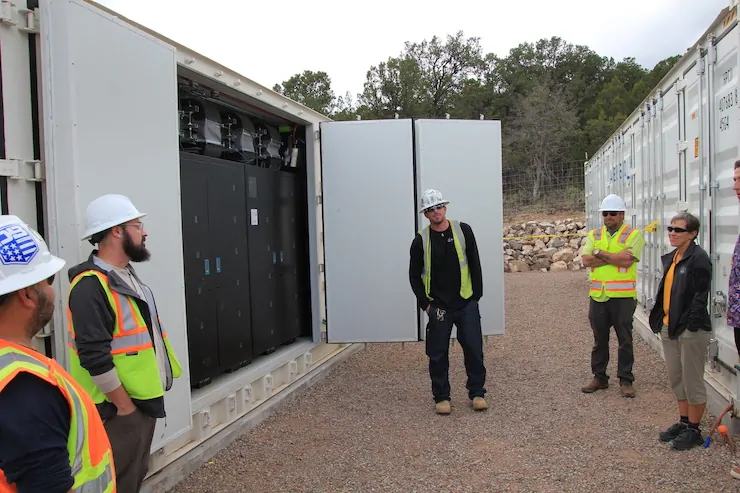
The dimensions of batteries was demonstrated during the public unveiling of a project for Holy Cross Energy near Glenwood Springs and Carbondale in late 2022. Those particularly batteries did not work out as expected and are being replaced, although two later battery projects in the Hoiy Cross service territory along Interstate 70 west of Glenwood Springs were immediately successful. Photo credit: Allen Best/Big Pivots
Click the link to read the article on the Big Pivots website (Allen Best):
March 19, 2026
Utilities are rapidly integrating energy storage places from Durango to a tiny place near the Nebraska border now best known for storing grain
Amherst lies in northeastern Colorado, about seven miles from the Nebraska border. It has a gas station, a Lutheran church, and a population of 58. Dozens of grain silos, each 110 feet tall, loom over the community. Together, they can store 2.7 million bushels, mostly wheat and corn.
In about a year, Amherst will also be storing electricity. Highline Electric, a cooperative based in nearby Holyoke, plans to install lithium-iron batteries with two megawatts of storage.
Dennis Herman, the general manager of Highline, explained that the battery storage will enable Highline to lower its peak demands for electricity, primarily in late afternoon to early evening hours. This will save money for Highline and its wholesale provider, Tri-State Generation and Transmission Association. Like most everything, electricity typically costs most when in highest demand.
Battery storage is becoming commonplace in Colorado’s energy landscape. Utilities large and small are embracing lithium-iron batteries as prices have continued to plunge.
Xcel Energy by the end of March will have 200 MW of battery storage available. The company expects to have 1,725 MW of capacity by 2028. Tri-State, Colorado’s second largest electrical generator, plans 550 MW in Colorado and another 150 in New Mexico.
Batteries represent a crucial step in the decarbonization of our energy. Fuel agnostic, they can store electricity generated by natural gas or even coal plants. Most commonly they are paired with renewable energy, particularly solar. Utilities with large-scale batteries can stock up on cheap energy to meet hours of peak demand, as in the case at Amherst.
“As we move to a much higher percentage of renewables on the grid, storage takes on a role that is more and more important,” said Will Toor, director of the Colorado Energy Office. “When you think about how we will keep the lights on in the future in a grid with high amounts of renewables, storage just gets more and more important.”
Batteries can also serve other purposes. For example, they can provide electricity in areas of the distribution grid with potential weaknesses, such as places that will lose power if a power line goes down.
Robin Lunt likens the role batteries are playing in energy to that of refrigeration in food supply chains.
“You can move lettuce from California to the Midwest if you have refrigeration. And if you don’t, you’re just betting on the weather,” said Lunt, chief commercial officer for Denver-based Guzman Energy. “Storage is a new tool that smooths out the volatility that currently exists with energy.”
Taking a national perspective, Dennis Wamsted, an analyst with the Institute for Energy Economics and Financial Analysis, sees the “blistering pace of the buildout of solar and battery storage” continuing for at least the next two years. “This allows renewables to gain more market share from coal and gas in U.S. power markets.,” he said in a new report he co-authored.
“Battery storage is about to change how the utility industry operates, and it will be for the better,” he said.
Sharp declines in prices have been crucial in spurring rapid deployment of utility-scale four-hour lithium-batteries. Bloomberg NEF, a research organization, reported that costs in 2025 fell more than 27% even as other clean energy costs rose. Taking a longer view, Energy Storage News in December reported that battery costs during the prior decade fell an average 20% annually even as installations rose 80% annually. Solar recorded parallel cost declines.
Lazard, a global assessment management firm, in 2025 found the sharp price declines were driven by technology advances, including increased cell capacity and energy density. An oversupply of battery cells resulting from lower-than-expected demand for EVs also contributed to the reduced prices.
The One Big Beautiful Bill Act signed by President Donald Trump in 2025 gutted many elements of the Inflation Reduction Act signed into law by President Joe Biden in 2023. Tax credits for battery storage were largely spared and benefit Highline and other not-for-profit electric cooperatives.
First utility scale in 2012
Batteries have stored electricity since Thomas Edison was tinkering in his New Jersey laboratories a century ago. Only in 2012, however, was the first utility-scale application battery storage project implemented in the United States. That was a pilot project in Oregon.
Colorado’s era of utility-scale battery storage began service in November 2018. Brighton-based United Power, an electric cooperative serving a broad arc along metropolitan Denver’s northern fringe, wanted to begin understanding how batteries fit into the puzzle of the energy future.
“Understanding storage is the next logical step in the progression of renewable generation,” said Jerry Marizza in 2018 when announcing the batteries. He was then United Power’s new business director. “Without the ability to store energy, renewables will have an artificial cap placed on their utilization.”
Marizza, who now lives in Arizona, remembers utilities resisting batteries as they had also once resisted solar. Many were blind-sided when prices tumbled. “They just didn’t want to learn about this stuff because they didn’t see any value in doing it,” he said.
“To me, it was a no-brainer,” said Marizza. “We didn’t do it because we wanted to become Renewables USA, although that was a benefit. We did it because it made business sense.”
United Power has rapidly deployed lithium-ion battery storage systems in its service territory north of metropolitan Denver. Photo credit: Allen Best/Big Pivots
The payback on investments has declined to six or eight years. Payback on an electrical substation – crucial to delivering electricity — is 50 years.
In some situations, the payback can be far quicker. In 2024, United added 120 megawatts. Those batteries paid for themselves almost immediately by avoiding the need to buy electricity from other sources during times of high summer temperatures. That saved the cooperative $300,000 a month. Plus, cheap solar can be used to recharge the batteries, further saving money.
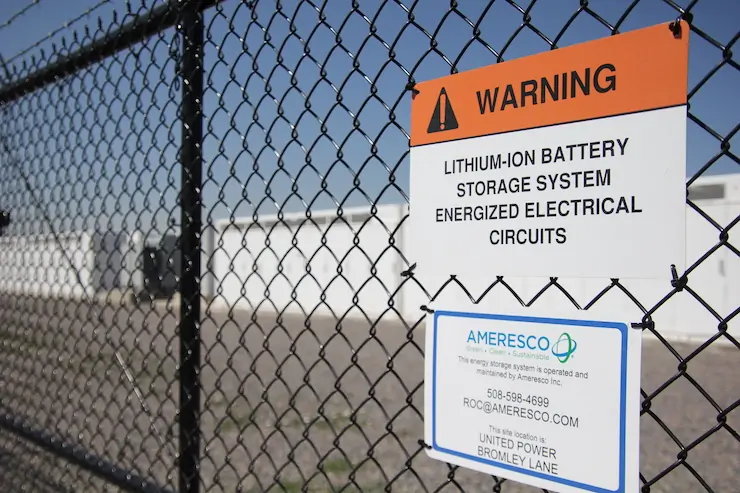
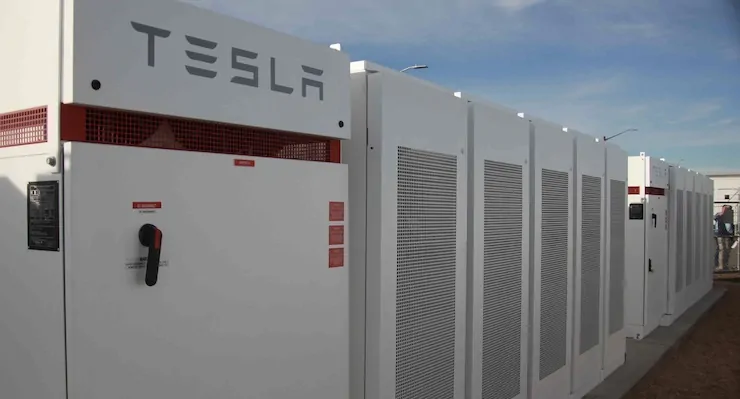
United’s first experiment at the cooperative’s office along Interstate 25 between Longmont and Firestone now looks humble. The Tesla four-megawatt batteries sit behind chain link fences and within an enclosure little larger than a typical suburban two-car garage.
One measure of batteries — the one used mostly in this story — is in simple megawatts. A different measure, megawatt-hours, defines how much electric energy can be delivered from a battery over time. United’s 4 MW of storage, for example, has 16 MW-hours. The 2 MW batteries at Amherst will have 8 MW-hours (also called MWh).
Think of megawatts being the water sitting in a jug and megawatt-hours being the time it takes to empty the jug.
United’s small 4-MW experiment from 2018 was slow to be surpassed. Finally, in 2023, Holy Cross Energy began using 5 MW batteries (15 MWh) coupled with 13,500 solar panels at the Colorado Mountain College Spring Valley Campus above Carbondale. Soon after, Xcel began use of far larger battery arrays.
Tri-State is a case study in this altered thinking. Twenty years ago it saw a future consisting almost entirely of coal. By 2018 it had abandoned those ambitions but still discouraged United’s battery experiment. At that time it provided wholesale power to United. Now, Tri-State is working with 10 of its member cooperatives, including Highline, most of them in Colorado, in exploring utility-scale batteries as part of Tri-State’s demand-response program.
“The overall goal of this Tri-State program is to introduce flexibility to electric system loads, which is becoming more necessary as the generating assets being built today are not dispatchable in the traditional sense,” explained Highline’s Herman.
A striking example of the growing and valuable role of batteries can be found in California. In a December 2025 New York Times story, Ivan Penn pointed out that California officials had often asked residents in recent years to use less electricity on hot summer days to prevent power outages. Those alerts ceased after 2022, he wrote, largely because batteries have allowed California to use its abundant solar power well into evening hours.
California’s battery capacity, 14,583 MW, dwarfed Colorado’s 459 MW as of January, according to Clearview, a data-tracking company dedicated to the clean energy transition. Colorado, though, has had a far more rapid rate of growth. It had gained 102 times as much battery capacity by 2025 as compared to the 30-fold increase in California.
Texas, a politically red state, had an adoption rate that dwarfed those of bluish California and mostly blue Colorado: 4,100% since 2020. Batteries are apolitical.
A game changer
Mark Gabriel calls batteries a game changer. He is the chief executive of United Power. The electrical cooperative has nearly 120,000 members. They include data centers, oil-and-gas operators, and expansive suburban neighborhoods. United’s 6% annual growth in demand ranks highest of all Colorado electrical utilities.
How can that demand be satisfied? Wind generation remains the least expensive energy but requires transmission from mostly distant locations. That transmission is costly and typically takes a decade or more to build, Gabriel points out. Renting space on transmission lines is like driving in the toll lane of a highway.
Gas is another option, and United managed to get its natural gas plant near Keenesburg on line in July 2025 after being commissioned just 20 months earlier. The same plant might take three to five years now because of constricted supply lines.
Batteries have tightened supply chains, too, and somewhat heightened prices of late. But they can be installed within 10 months. Too, they can use existing infrastructure. In other words, no new transmission lines needed.
Substations are commonly located in areas where demand for electricity is congregated. “It’s in the distribution system that the batteries have real value,” said Gabriel.
Siting can be a challenge in areas where land is already at a premium. They do take up space, if far less than solar farms. Visually, though, they are boring, small monoliths 8 to 10 feet tall, erected in rows.
United today has 119.5 MW of battery capacity, second in Colorado only to Xcel’s existing 200 MW. Both utilities plan far more.
United Power’s first foray into battery storage was in an area little bigger than a suburban garage behind its office along Interstate 25 between Firestone and Longmont. Photo credit: Allen Best/Big Pivots
United plans 200 megawatt batteries more by 2027 in a project south of Brush called Fortress that will be coupled with 200 MW of solar. That 319.5 MW of battery storage will, if necessary, enable United to meet 40% to 50% of demand.
Xcel Energy is also rapidly expanding its battery capacity. This year it expects to complete two 200-MW battery installations, one near Brush and the second in South Park. In addition, Xcel is contracted to buy capacity from others through power purchase agreements n Adams County and Pueblo County and perhaps elsewhere.
The company is also seeking approval from state regulators to add 400 MW of battery storage adjacent to its Hayden coal plant.
Batteries are also making inroads in homes and businesses. Two electrical cooperatives, Glenwood Springs-based Holy Cross Energy and Fort Collins-based Poudre Valley Electric, have incentives for home batteries, as does Xcel Energy.
Higher prices for these small-scale applications have so far discouraged broad adoption. Multi-day outages during the last year resulting from high-wind events along the foothills west of Boulder and Denver are also spurring purchases for home use.
Microgrids are also becoming more common. At Red Feather Lake, northwest of Fort Collins, 140-kilowatt (446-kilowatt-hour) Tesla Powerpack batteries are coupled with solar and propane generation.
This microgrid is meant to provide power for fire, emergency medical services, and other critical community functions in case Red Feather Lake is cut off from the outside world, as nearly happened during the Cameron Peak Fire in 2021. As was, the fire forced evacuation of the community.
Aspen had a close call in 2018 when it came within one burning electric pole of losing power during the Lake Christine Wildfire. Now, it has a small microgrid for emergency services. So does a hospital at Cortez, among others.
In Durango, La Plata Electric was awarded a state grant for a microgrid at the Mountain Middle School. The electrical cooperative would add battery storage to couple with existing rooftop solar to allow the school to become a haven in case of extended power outages.
A setback because of setbacks
Batteries have occasionally posed problems. Batteries installed for Holy Cross Energy above Glenwood Springs in 2022 underperformed. The manufacturer, Powin, has gone bankrupt, and those batteries are now being replaced with a new Tesla utility-scale battery system. Phil Armstrong, the power manager for Holy Cross Energy, said he expects the new batteries to be in operation soon. Two more recent battery installations worked immediately and as expected.
Wildfire potential has slowed deployment of batteries in La Plata County. The county has had several major wildfires in the last 25 years. Continued drought combined with warming temperatures cause worries of worse to come.
California has had two fires caused by batteries in recent years. At the most recent, in January 2025, anywhere from 55% to 80% of the 100,000 lithium-ion batteries at the Moss Landing Vistra Energy Storage Facility burned, causing concern about air pollution in the Monterey Bay area. As of January 2026, the cause had not been determined, according to Inside Climate News.
Does La Plata County have a legitimate worry about fire? The Durango Herald, in a December editorial, pointed out that Moss Landing relied on older technology and pre-2018 fire codes.
“Battery safety has advanced quickly,” the newspaper said. It cited a National Labs report of 97% decline in battery energy storage system failure rates since 2018 “thanks to modern fire testing, safer chemistries like lithium-iron phosphate, and strict codes.”
Wamsted, of the Institute for Energy Economics and Financial Analysis, had much the same to say: The big fire at Moss Landing was a mess, clearly, but it used a construction technique no longer used across the industry,” he said. “Those batteries were not containerized, simply placed in the turbine building of the old plant. Now, everything is in a container, so if you have a fire, it stays little.”
In January, the county commissioners voted 2-1 to mandate a 200-foot setback from property lines. That leaves only one of the electrical cooperative’s 28 substations in the county eligible for battery storage without a variance.
The Herald said this approach doesn’t add safety. “It adds delay, cost, and uncertainty.”
Chris Hansen, CEO of La Plata Energy, makes a point as Robert Kenney, CEO of Xcel Energy’s Colorado operations, listens during a recent solar and storage association conference in Denver. Photo credit: Allen Best/Big Pivots
“Hansen had urged La Plata County to let hazard-mitigation analysis determine the appropriate property setbacks. “Unfortunately, they decided to use a flat number instead,” he said.
It makes our job harder. It makes it more difficult to get a battery project done in La Plata County at the places we think are best. Really, what we’re going to do is show the county that we can do it safely and reliably. We have a site where we can do that right out of the gate, where there’s enough space, and we’ll then cross the next bridge when we get there.”
La Plata Electric’s second project will be in neighboring Archuleta County, where a site has been identified as having urgent need for storage.
Adams, Arapahoe, Denver, and El Paso along with the city of Fort Collins have already adopted codes governing batteries. So have county commissioners in Pitkin County, which Hansen contends has as much fire risk at La Plata. None, he says, are restrictive.
Jeremiah Garrick, of the COSSA Institute, the educational arm of the Colorado Solar and Storage Association, reports Moffat County has also started work on regulations, as have Teller, Delta, Washington and several other counties scattered across Colorado. Logan County adopted regulations in concert with other regulations in anticipation of a hyperscale data center.
Future batteries
Lithium-ion batteries now rule but will likely be displaced in the next few years by lithium-ion phosphate, solid-state, and sodium-ion batteries.
“You’ve already seen Xcel Energy and United Power be able to get these into tighter footprints in a very safe way,” said Hansen. And that will be even easier when new technologies, solid state and sodium-ion batteries, are available in the market, because they basically have no flammability or oxidization risk at all. So you’ll be able to put them in even tighter footprints than the lithium-ion technology.”
Toor, at the Colorado Energy Office, similarly sees varieties of long-duration storage entering the picture.
Pueblo remains scheduled to be the site of deployment of a 100-hour iron-air storage collaboration between Form Energy and Xcel Energy.. A similar collaboration is alreayd underway in Minnesota.
In Pueblo, Xcel Energy, working with Form Energy, plans to deploy 100-hour iron-air storage. The project depends upon federal funding, and the Department of Energy in the Trump administration hit a pause on the project in 2025. Xcel now says it plans to have this new long-time battery storage technology operating in early 2028. Xcel and Form expect to have a project in Minnesota on line sometime in 2026.
Colorado also has several companies trying to be part of this new future.
Solid Power, a company with offices in Louisville and a factory in Thornton, is focused on solid-state batteries. “We need a new breed of battery that looks, acts, and is built like today’s lithium-ion batteries, but that comes with the benefits consumers and automakers have been seeking for decades: longer life, increased safety and lower costs,” the company states.
The company is focused on the auto market, but as Tesla’s batteries demonstrate, the technologies cross lanes from automotive to utilities.
Synthio, which has roots in the Boulder-Golden-Broomfield triangle, specializes in chemistries, including batteries.
In short, storage during the last few years has become the frontier of this big pivot in energy. What may be most remarkable is that the first batteries of any scale were not used in Colorado until little more than seven years ago.
Into the detailed weeds, if you wish:
Colorado Springs Utilities
Colorado Springs Utilities gained access to 100 MW of battery storage in 2025 and plans another 100 MW in “coming years.”
Holy Cross Energy
Holy Cross Energy has three solar-plus-storage projects at the Colorado Mountain College campus, Parachute, and Rifle. They collectively have 55 MW of storage and 24.5 of solar generation.
Platte River Power Authority
Fort Collins-based Platte River Power Authority has a battery adjacent to the Rawhide power plant. Relatively soon, working with NextEra Energy, it will have 100 MW, 4-hour (400 MWh) utility scale battery project in Weld County . Platte River is also working to add four 5-MW/20-MWh battery storage system batteries in each of its four communities: Longmont, Estes Park, Loveland, and Fort Collins.
Tri-State Generation
The portfolio approved by the Colorado Public Utilities Commission calls for 650 MW of battery storage as follows:
Montrose County, 50 MW
Moffat County, 200 MW
Kit Carson County,150 MW
Other places in eastern Colorado, 150 MW
Plus 200 MW in New Mexico.
United Power
United today has 119.5 megawatts and plans another 200 MW to be completed by December 2027.
Xcel Energy
The company’s Rocky Mountain Battery Energy Storage System has 200 MW/800MWh of storage.
Coming online by the end of 2027:
A 200 MW/800 MWh of storage near the Pawnee coal plant, near Brush.
South Park 200 MW/400MWh. Both projects are expected to come online by the end of 2027.
In addition, Xcel is contracting with several other projects through power purchase agreements. Two will come online in 2027, two in 2028. This is in addition to two already in service.