
Click the link to read the article on the Big Pivots website (Allen Best):
April 8, 2026
Will inflows into Lake Powell will drop below those of 2002? You remember that year? A year of heat, drought and fire. An essay about changes and what precipitates them.
Just what we need in Colorado, an El Niño that could cause a hotter-than-average summer for the Western United States and other parts of the globe, continuing into 2027.
Risk of an El Ninõ has been rising, reported the Washington Post on Monday citing the work of a medium-range weather forecasting organization. This one could push global temperatures to record levels, particularly in 2027. “Real potential for the strongest El Ninõ event in 140 years,” wrote Paul Rondy, a professor of atmospheric science at the State University of New York at Albany.
This, explained the Post, could also yield milder winter temperatures in the United States.
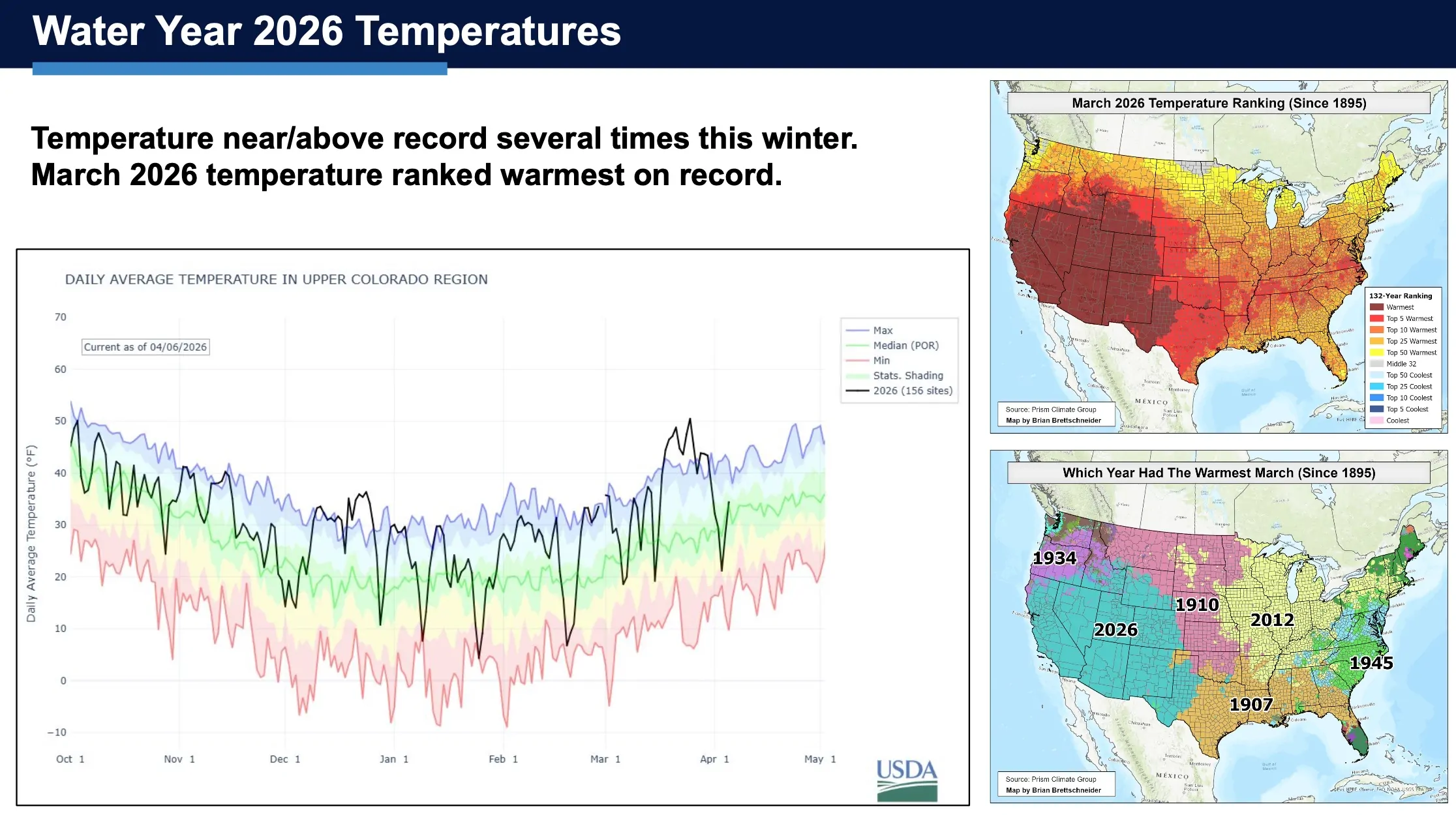
We already know something about warm winters. November was the third warmest November on record in Colorado. December and February broke records, as Colorado state climatologist Russ Schumacher has reported.
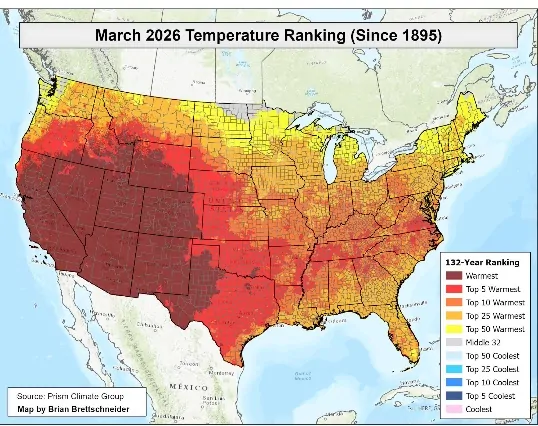
Then came March and a records-busting string of days during the “heat dome.” Fort Collins went over 90, a threshold not achieved on average until June. These hottest and earliest thresholds were breached at locations across Colorado.
Across the Colorado River Basin, average daily temperatures during March were the warmest on record. This wreaked havoc on an already so-so or less snowpack.
“March was not … helpful,” consulting climate researcher Jeff Lukas observed drily in a LinkedIn post on Monday. “Record heat for the Upper Colorado River Basin and near-record-low precipitation in what should be one of the snowiest months. The basin-wide snowpack peaked at the earliest date and lowest level on record.”
In Colorado, the snowpack in the Eagle River drainage on April 1 was 21% of the 30-year average. The Roaring Fork River was 26%. On the Yampa it was 20%. On the San Juan, it was 17%. In all these cases and others, the snowpack had fallen by half or more compared to March 1.

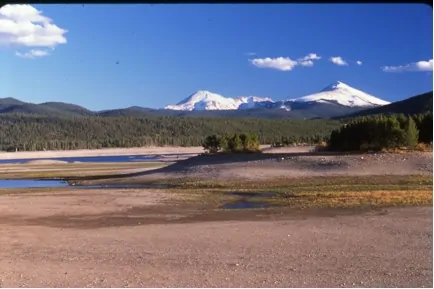
Lake Powell, already shrunken to 24% to 25% of capacity, will almost assuredly show even more shoreline. As of Tuesday the reservoir level was down almost 31 feet from a year ago. The Colorado River Basin Forecasting Center on Tuesday predicted 22% of average flows into Powell. Rain and snow could still help, but at least in the next 10 days, they are unlikely.
Two benchmarks, 1977 and 2002, exist for awful-flow years on the Colorado River since Glen Canyon Dam was completed in the 1960s. In 2002, flows into Powell were shockingly low, about 25% of average. The decline after two so-so years was remarkable. Powell, however, had been 94% full to start the century.
Margins have narrowed. Becky Bolinger, a climate researcher in Colorado, pointed out Monday on LinkedIn that the Colorado River Basin Forecast Center currently projects flows April-through-July flows will be a little greater than 2002. “I think it is entirely plausible that the actual volume for 2026 comes in as a new record low,” she wrote.
See the Colorado River Basin Forecast Center slide deck here.
What will the Bureau of Reclamation do? It operates the big dams on the Colorado River, including Glen Canyon. Average releases from Glen Canyon Dam since 2000 have been 8.29 million acre-feet.
One Colorado hydrologist, once again writing on LinkedIn, speculated that the Bureau will reduce the releases from Powell to 6 million acre-feet and conceivably even lower. That would leave Powell above the minimum level needed to produce power, if barely. Power production from 2000 to 2023 declined 17%.
The value of clean power is great. It is part of the portfolio of nearly all electrical cooperatives in the region, including those in Colorado, as well as municipal providers. The greater value, say utility executives, is the ability of the dam’s hydro unit to restart the Western grid, if necessary. This is called a black start. Such a need is unlikely but huge if it were to occur. The giant amounts of battery storage, however, have reduced that importance in the last few years.
Those reduced flows from Powell, however, would likely annoy Arizona and California. The Colorado River Compact of 1922 split the water in the river system between the lower-basin states and Colorado and other upper-basin states. It put a figure on the division: 7.5 million acre-feet. (And more must flow from the upper basin for Mexico and to account for evaporation). In 1922, they thought there was plenty left for Mexico and more yet to flow into the Pacific Ocean. Wisely, in 1948, the upper basin states, in their compact amongst themselves, instead used a percentage.
In question is what exactly the 1922 compact says is the obligation of upper basin states? Must they allow all the water in the Eagle, Yampa and other headwaters rivers be allowed to flow downstream to deliver 7.5 million acre-feet? What if that much water isn’t there?
Colorado River Basin states have notoriously been at an impasse about how to share the shrinking river. The position of Colorado — and other upper-basin states — was pithily captured in a statement by Becky Mitchell, Colorado’s chief negotiator, “We’ve been asked to solve a problem we didn’t create with water we don’t have,” she has said.
“It’s plain: the precarious situation facing the Basin today was fueled by overuse in the Lower Basin,” wrote Nick Peters, the chief system planning and projects officer for Colorado Springs Utilities, in an op-ed published during March in Colorado Politics.
Peters argued against a short-term deal in response to the exigency of this year’s dramatic declines.
In late March, I saw Mitchell at an event in Fort Collins celebrating the 60th anniversary of the Colorado Water Center. “I follow you to Lamar. I follow you to Grand Junction. I follow you to Silverthorne. I follow you here to get an interview,” I said jokingly.
“You can follow me tomorrow to Durango to the basin roundtable there if you want,” she answered with a smile.
We spoke about the Colorado River, but not on the record.
Two days later, I saw that she had traveled to southwest Colorado while I likely still slumbered. There, she delivered enough fire and brimstone to bring the attendees gathered at the roundtable in Ignacio to their feet in a standing ovation, according to the Durango Herald.
In Fort Collins, the Colorado Water Center dinner had been arranged around tables. I had signed up to be at Jennifer Gimbel’s table. As a director of the Colorado Water Conservation Board, she had once represented Colorado in the Colorado River affairs. She is now senior policy scholar at the Water Institute.
“It’s my understanding they were hoping to get a deal for 20 to 30 years. Now they’re looking at five years,” she told me. “They really need to just look at this year.”
I asked her whether the negotiations have been as transparent as they should be. Some have said they are not. We can hear the talking points of Becky Mitchell and other negotiators, but we have not heard about their strategies.
Gimbel pointed me to the frequent appearances of Mitchell at the basin roundtables and other water forum. She’s constantly on the road.
Also relevant, she observed, was a paper that had been published several days previously on The Conservation by Karen Schlatter, director of the Colorado Water Center, and Sharon Megdal, of the University of Arizona. The paper is titled “Why Colorado River negotiations stalled, and why they could resume with the possibility of agreement.”
Schlatter and Megdal traced the trajectory of prior agreements on the Colorado River, pointing to the role of federal leadership in forging agreement.
“In this round of negotiations, federal leadership has been lagging,” they write. ”The Department of the Interior has not made clear what the consequences might be for the states if they fail to agree. The U.S. Bureau of Reclamation has been without a permanent commissioner since President Donald Trump retook office in January 2025. And federal staff have only recently begun helping to facilitate the discussions.”
They also say this: “We believe that agreement between the seven states is still possible. It may be less effective to bring in a third-party facilitator at this stage in the negotiation process, though, because of the degraded trust, hardened positions and shortage of time.”
Earlier in the evening, a film had been shown that extolled the work of the water center. Colorado State University produced Elwood Mead, after whom the reservoir along the Arizona-Nevada border is named, and others. The current staff of the water center includes Brad Udall, who has deep roots at many levels in the Colorado River Basin
Udall said something that captivated me, in part because it improved upon my own thoughts. I had been toying with an essay that laid out how Colorado during the roughly first 130 years of its existence had been all about putting water to beneficial use. And the last roughly 35 years had been most prominently about reconciling its past with the new limits. I was thinking in part of groundwater mining but also the fact that there really is no water to be had on the surface. There’s less. We’ve hit the wall and it is moving.
In Udall’s thesis — which I learned from him later he has delivered in several slide shows — the history of the Colorado River Basin can be seen in three phases. The 19th century water law meets 20th century infrastructure now colliding with 21st century population and climate change.
And 2026 seems to be a seminal year in that journey. We already have had heat records tumbling left and right, with an El Nino likely to deliver more. We quite possibly will see a record for low inflow into Lake Powell, undercutting 2002.
I remember June 2002 quite well. On that month’s first Sunday I stood atop a mountain in Colorado and saw smoke from the Hayman Fire, which soon became the biggest fire in Colorado history (it’s now ranked 4th) as well as fire from the Coal Seam Fire near Glenwood Springs. More came later. It was a smoky summer in Colorado.
A few weeks ago, I heard former Gov. Bill Ritter and Bryan Hannegan, the CEO of Holy Cross Energy, fret about the risk of wildfire. The drought, said Ritter, “puts us in a very, very difficult and delicate position.”
State officials, meanwhile, are gearing up to address Front Range forests vulnerable to bark beetles. And at the Public Utilities Commission, Chairman Eric Blank has been openly worrying about whether Colorado will have enough electricity this summer to meet demand if we have unusually hot weather.
Changes mostly occur in increments, but there are times that changes take giant steps. “This year is going to teach us a lot,” said Nathan Coombs, manager of the Conejos Water Conservancy District in the San Luis Valley, when I saw him in Fort Collins. The district depends upon water storage in Platoro Reservoir, located in the San Juan Mountains. The normal inflow into the reservoir in late March, he said, was 12 to 15 cubic feet per second. “This morning, it was 195, because of the heat melting the snow.”
Two days later, at a forum in Alamosa, Coombs, a fourth-generation farmer, further explained the predicament. These earlier flows must be allowed to proceed downstream. Only later in the year will the reservoir be allowed to retain water. But will there be any?
Maybe we will get giant rain and snowstorms yet this spring. In the next 10 days, the forecast is for both wetter and warmer than normal. And, as Coombs and others pointed out, big rainstorms last October left the soil saturated.
October, of course, should bring snow, not rain, to higher elevations. We are living in different times, mostly warmer. Then there’s that elevated risk of an El Niño and a much, much warmer summer ahead of us and the winter beyond that.
