
Click the link to read the commentary on the Colorado Newsline website (Quentin Young):
April 9, 2026
So many crises threaten society these days. Daily news about war, the emergence of AI, runaway costs of living, the threat of new pandemics, the growing dangers of fascism in Washington — it’s a deluge of worry, and it can be hard to think about much else.
But the pile of troubles in recent years has diverted attention from the long-term crisis of climate change, arguably humanity’s supreme challenge, which is not going away just because it gets less attention. Some commentators have suggested that no one has the bandwidth anymore to think about climate change. But climate change doesn’t care about your bandwidth, and conditions in Colorado prove the point. [ed. emphasis mine]
The state just had its warmest winter on record by almost 2 degrees Fahrenheit, and average temperatures from December through February were more than 8 degrees above the 20th century average, as Newslinereported last month. Cities up and down the Front Range saw record-high numbers of 60-degree days this winter. The state is also fantastically dry, part of an aridification process driven by global warming.
As reporter Chase Woodruff wrote, “Hotter, drier conditions in Colorado have stressed water supplies, made the state’s forests more vulnerable to insects and diseases, and greatly increased wildfire risk.”
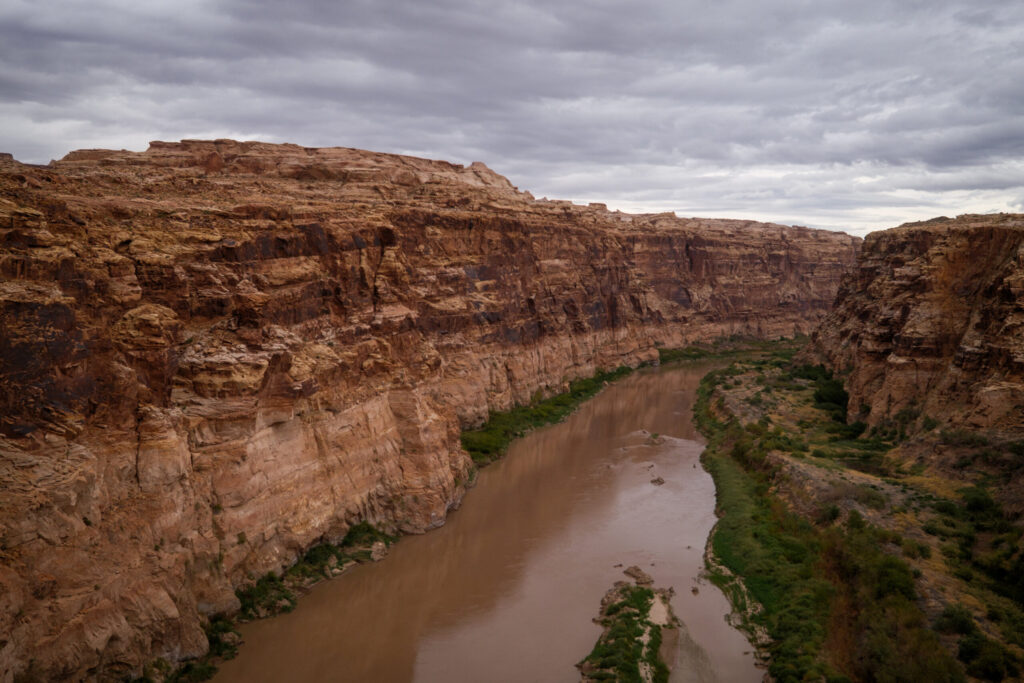
Waterways in Colorado this year are universally expected to see below-normal flows, including the Colorado River, which is forecast to run at just 68% of normal. The Colorado River, a vital resource for 40 million people, this century has experienced critical streamflow depletions. The river is down 20% from historic annual averages. Some projections suggest Lake Powell, a crucial reservoir on the river, could dropfor the first time below the minimum level needed for it to produce hydropower at the Glen Canyon Dam, energy generation relied on by almost 6 million people.
Low snowpack that’s contributing to streamflow shortages is also a blow to the Colorado ski industry, which generates $4.8 billion a year and supports more than 46,000 jobs across the state. At the current trajectory, the industry will disappear by the end of the century. Climate modeling shows the ski season could be shortened by more than a month by 2050 and more than two months by 2090. And it’s not just less snow — climate change is to blame for increasingly poor snow.
The latest forecasts suggest Coloradans should brace for more brutal wildfires this year. Hot and dry conditions, along with low moisture content in vegetative fuels, are already at levels on the Front Range typical of peak fire season. Worsening conditions as summer unfolds will further increase the state’s vulnerability to wildfires. Tinderbox conditions are becoming the norm: The three largest wildfires in Colorado history all occurred in 2020, and the state’s 20 biggest fires have all occurred in the past 20 years.
There is no scientific doubt that climate change contributes to bigger, fiercer wildfires and other extreme ecological events, and there is no scientific doubt that the primary cause of climate change is the human combustion of fossil fuels.
Yet government policies, especially as guided by MAGA priorities, reject the science. In February, the Trump administration revoked the so-called endangerment finding, which recognized the dangers of greenhouse gas emissions and allowed climate regulations under the Clean Air Act. The administration is forcing coal-fired power generation in Colorado to persist past a planned retirement date, apparently to accommodate coal business interests.
Climate change so far has not figured prominently in 2026 statewide elections. The platforms of the top Democratic candidates for governor, U.S. Sen. Michael Bennet and Attorney General Phil Weiser, both mention climate change as a problem to confront. But Bennet touts a “market-based path to cut emissions” that resembles the disappointing carrot-over-stick approach of the administration of Gov. Jared Polis, under whom the state has failed to meet its own greenhouse gas emission reduction targets.
Many Coloradans fear the federal government, and they’re struggling to pay for housing, health care and other necessities, while national and world events seem ever more alarming. But, though it usually doesn’t produce spectacular daily headlines, climate change threatens eventually to leave whole regions of the Earth uninhabitable.
The worst effects of climate change can still be avoided, but only if voters insist leaders address it with the emergency response it demands.
