Boaters, anglers want clarity around public access to Colorado’s streams: Coalition wants lawmakers to consider right to float and to wade — Heather Sackett (AspenJournalism.org)

No trespassing signs line a section of the Fryingpan River flowing through private property upstream of Basalt. The Fryingpan is a popular stream for anglers, though public access is limited. CREDIT: HEATHER SACKETT/ASPEN JOURNALISM

Click the link to read the article on the Aspen Journalism website (Heather Sackett):

October 22, 2025

A group of recreation advocates are hoping Colorado lawmakers will settle the state’s legal gray area surrounding public river access. The Colorado Stream Access Coalition is fighting for the public’s right to use the state’s waterways for recreation, a right they say is guaranteed in the Colorado Constitution. 

“Our position is that under the Colorado Constitution, it’s always been understood that there was a public easement,” said Mark Squillace, a law professor at the University of Colorado Boulder and an expert on water and natural resources policy. “And if there’s a public easement, even though it’s private property, the public gets to use it. We would like to see legislation that basically guarantees the right to both wade and float through private property.” 

Squillace was referring to a clause in the state constitution that declares all unappropriated water in every natural stream to be the property of the public and dedicated to the use of the people of the state.

Kestrel Kunz, southern Rockies protection director at American Whitewater, testified at the Water Resources Committee in August, asking legislators to guarantee public access to rivers for all Coloradans, while respecting landowners’ property rights. Kunz said American Whitewater gets regular reports of conflicts between boaters and property owners.

American Whitewater is seeking legal public protections for boating on Colorado’s rivers, to portage around hazards and to scout when needed.

“Colorado offers no clarity, no protection and no certainty for landowners or the public,” Kunz said. “That lack of clarity is dangerous.”

The issue of stream access highlights a basic tension in Colorado’s laws and values: Are rivers just another category of property that can be privately owned and fenced off? Or are they so central to the state’s culture, identity and outdoor recreation economy that they should be considered public resources open to public use?

“There are a lot of very wealthy landowners in this state that are strongly opposed to the public having any rights in what they consider to be their rivers,” Squillace said. “And we don’t believe they own the rivers. We think those are public resources that should be held in common for all the people to use.”

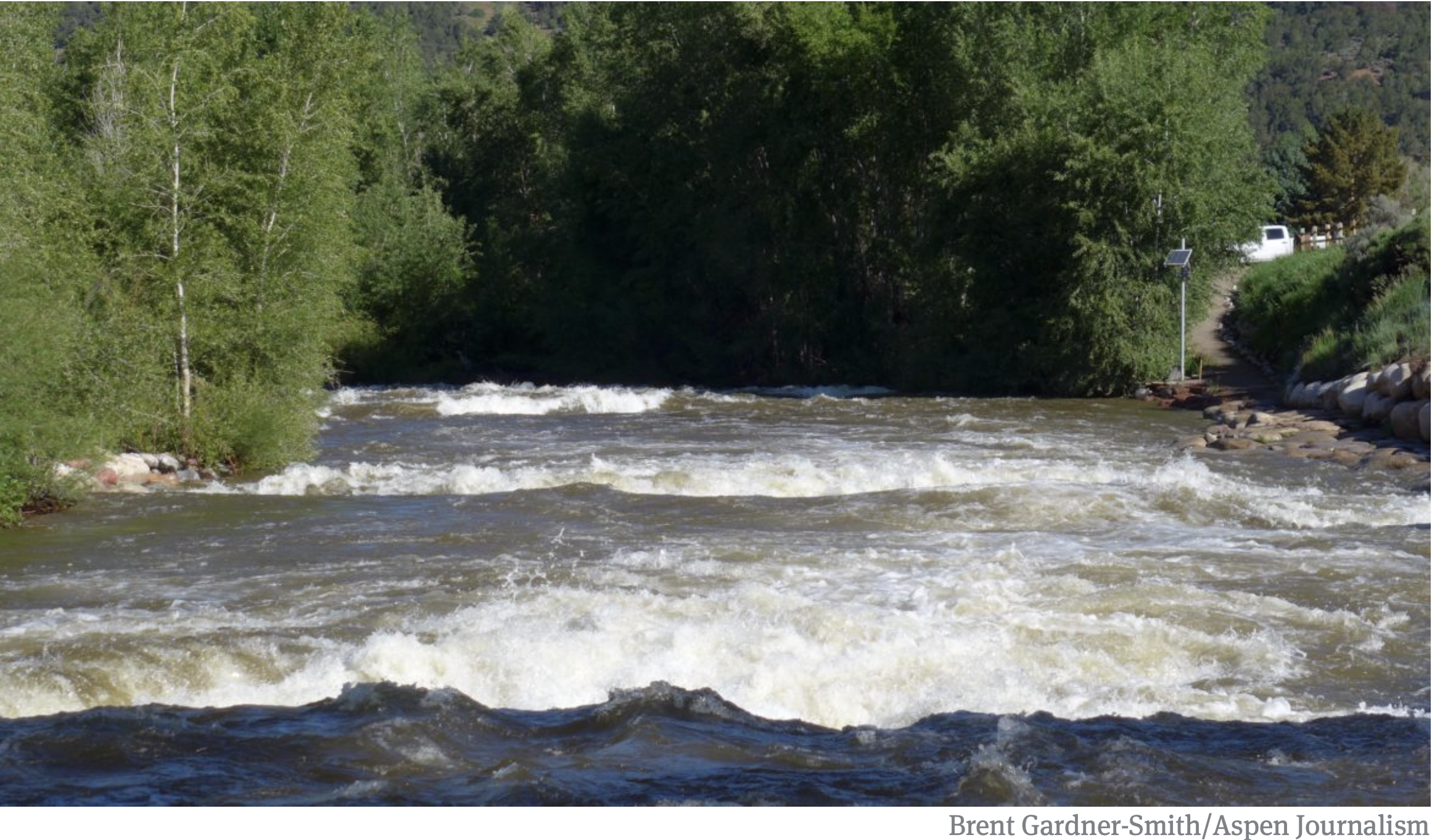
Paddlers float through North Star Nature Preserve on the Roaring Fork River upstream of Aspen. Some river access advocates want the state to clarify the right of boaters to touch the beds and banks of streams, and the ability to portage and scout for safety. CREDIT: HEATHER SACKETT/ASPEN JOURNALISM

The public’s right to use waterways was codified in a 19th century U.S. Supreme Court decision that said states own the beds of “navigable” rivers, meaning rivers that were used for commerce at the time of statehood. But Colorado does not consider any of its rivers to be navigable, meaning the streambeds belong not to the state — and therefore the public — but to adjacent property owners. A 1979 Colorado Supreme Court decision in People v. Emmert ruled on the side of property owners, saying that the public could not float through private property. 

A subsequent Colorado attorney general opinion said boaters can float through private property, and as long as they don’t touch the streambed or banks, they won’t be charged with criminal trespass. But stream-access supporters say this informal policy needs to be clarified into law and should also make allowances for boater safety. 

Kent Vertrees, a board member and staffer for Friends of the Yampa, said any new law should make it OK for people to get out of their boats to scout hazards and rapids, and portage around obstacles without fear of getting in legal trouble or being harassed by landowners. 

“If there is a new tree that’s fallen or something that’s blocking such as a fence, I believe I can get out of the river to safely get around,” he said. “All I’m doing is portaging for this safety element. And that’s the gray area that needs to be figured out.”

Vida Dillard, president of the Roaring Fork Kayak Club, agrees. Her organization is part of the coalition supporting clarity around stream-access laws. The club, which has 53 active memberships, focuses on improving access to the sport for everyone, especially beginners. She said situations such as helping a swimmer or scouting could cause tensions with landowners, and that uncertainty disproportionately affects newcomers to kayaking.

“We teach our students to scout hazards and make really conservative choices,” she said. “And if you’re afraid you’re going to be trespassing or have a confrontation, it might make you less likely to hike out or make choices on the river that you need to make to be safe.”
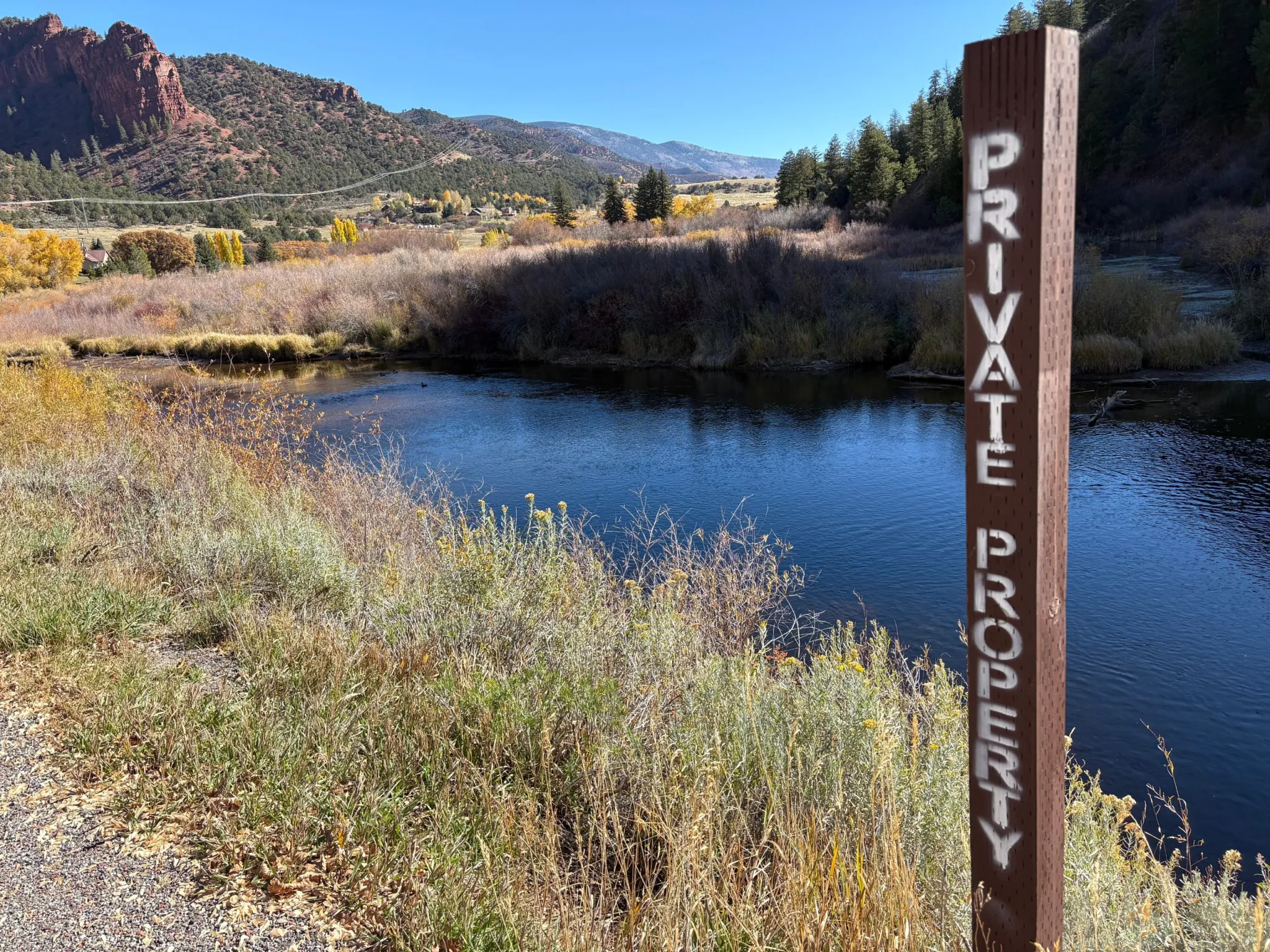
Private property signs line a section of the Fryingpan River upstream of Basalt. Some advocacy groups a pushing for more public river access for anglers. CREDIT: HEATHER SACKETT/ASPEN JOURNALISM

Wading into murky waters

According to Squillace, stream access is ripe for legislation because of the case of Roger Hill, a fly fisherman on the Arkansas River, which thrust the issue into the national spotlight. 

Hill had baseball-size rocks thrown at him by a property owner and later sued the state on the basis that he believed the river was navigable when Colorado became a state in 1876, and therefore the streambed he was standing on while casting his line was public. But the Colorado Supreme Court ruled in June 2023 that Hill had no legal standing in the case. 

“I think it reflects the controversial nature of this issue,” Squillace said. “I think maybe the court was trying to duck the hard question of finally declaring that maybe the Arkansas River is navigable, in fact, and so should be open to public access.”

Coalition members will have to address a widening schism in their membership: those who think any new legislation should include the right of anglers, such as Hill, to wade and those who think it should remain more narrowly focused on the right to float. Some see the right to wade as an additional, expanded use and is where some landowners draw the line. 

American Whitewater recently left the coalition and together with Colorado Whitewater and the American Canoe Association, is pursuing legislation that would grant just the right to float. Vertrees said the right to float and the right to wade are two separate issues that shouldn’t be lumped together. 

“I personally cannot support [the right to wade] because I believe it will tank the whole thing,” he said. “I just personally believe that it’s going to be hard to do them both at once.”

Anglers want to be able to walk up and down a streambed to fish, but only after entering the river through a public access point and not trespassing across private property to get there. This right to wade is particularly relevant to the Fryingpan River, which is a popular Gold Medal trout fishery where only about half of the river below Ruedi Reservoir is public and no trespassing signs line stretches of the waterway.
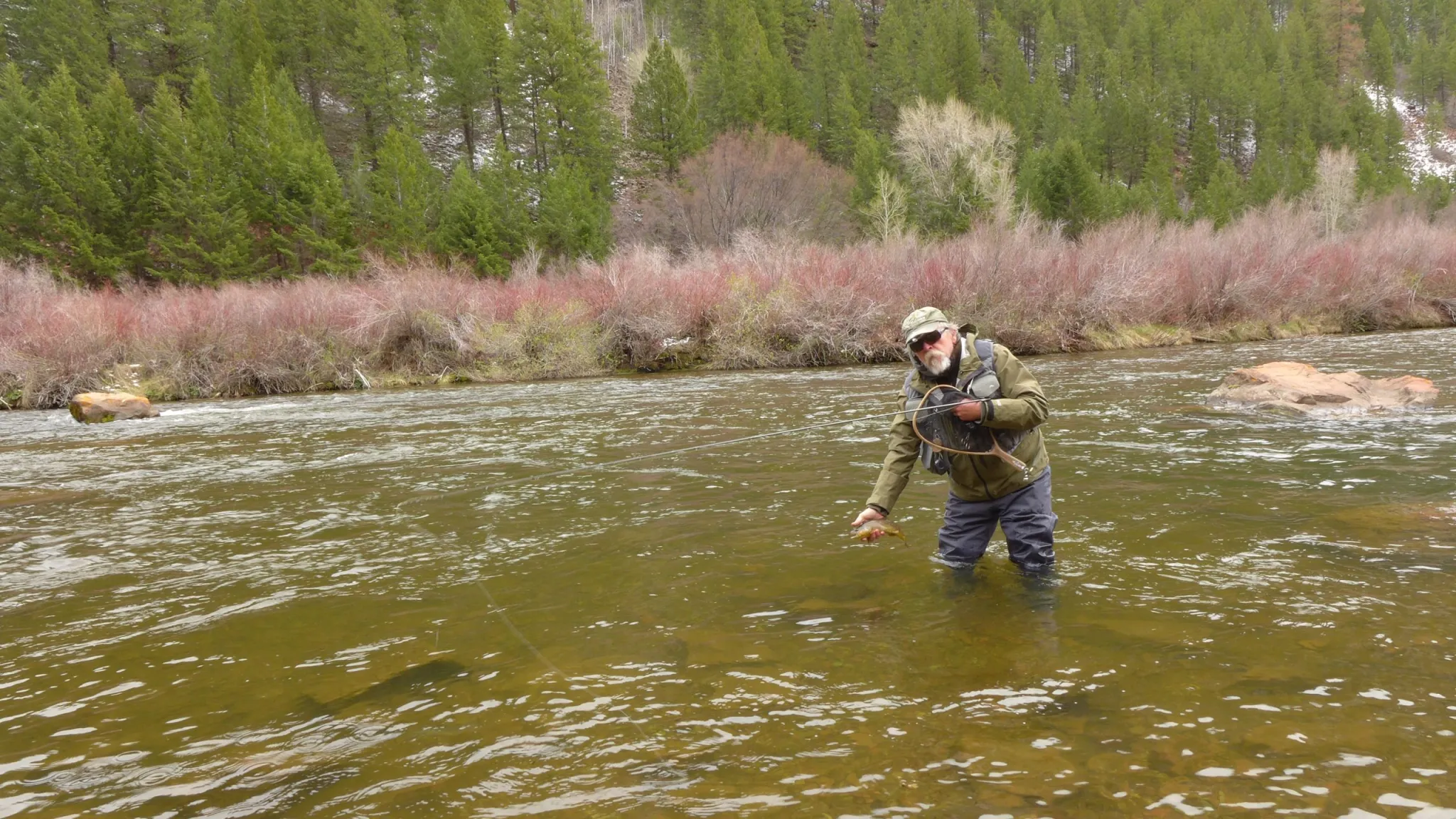
Bill Nein, of Salida, prepares to release a brown trout he caught back into the Fryingpan River. Some river access proponents want the state to clarify rules regarding public use of streambeds and banks for fishing. CREDIT: HEATHER SACKETT/ASPEN JOURNALISM

More education needed

Opponents of a law expanding access say that this is a private property issue and that landowners have the right to exclude others from their property. Garin Vorthmann testified on behalf of the Colorado Farm Bureau at the Water Resources Committee meeting in August. She said she was also working with a broad coalition of landowners, private businesses and real estate agents.

“Depriving a landowner of the right to exclude people from their private property without just compensation is considered a taking,” she told lawmakers. “Legislation that would change the ownership of the bed or bank to be public or owned by the state obligates the government to provide just compensation to the landowner and will embroil the state in expensive litigation.”

Other experts say addressing this issue through legislation might only make it worse. A report released in September by the conservative-leaning Common Sense Institute said that “the path to clarification is fraught with innumerable bad outcomes where both sides and ultimately the state of Colorado will be worse off than they are now” and that “attempts by either side to expand those rights at the expense of the other are likely to create more problems than they solve.”

Greg Walcher, former director of the Colorado Department of Natural Resources and co-author of the report, said a better approach would be a public education campaign so that boaters know exactly where they are allowed to float: through land that is already owned by the state or federal government and therefore public. The study notes the importance of rivers to Colorado’s outdoor recreation economy, and the millions that the Great Outdoors Colorado (GOCO) grant program has invested in stream access and conservation projects in recent years. 

“The floating industry has become huge in Colorado, so we need to find a solution,” Walcher said. “And part of that is making sure people understand where they can and can’t float.”

Proponents of stream access agree that education is important, and to that end, Steamboat Springs-based advocacy organization and content studio Rig to Flip is releasing a short film by Cody Perry called “Common Waters,” which features the Hill case and outlines the issue as they see it: that Colorado is one of the worst states for providing public access to streams, and in a place that prides itself on an outdoor lifestyle, increased access and clarity on the rules are needed. 

With proponents still hashing out differing options on what a policy proposal should call for, any new legislation for the 2026 session won’t be introduced by the Water Resources and Agricultural Review Committee, but there’s still a chance lawmakers could take it up. Coalition members say they are continuing to meet with stakeholders and figuring out the best way forward.

“At American Whitewater, we believe that people are really only going to protect the resource if they have the opportunity to explore that place and understand and experience a river,” Kunz said. “So our hope is that by allowing people to access these rivers in Colorado that we will ensure future generations of river stewards.”

Colorado Rivers. Credit: Geology.com

Forest Service presents results of beaver inventory — Heather Sackett (AspenJournalism.org) #FryingpanRiver #RoaringForkRiver #ColoradoRiver

Beavers have constructed a network of dams and lodges on this Woody Creek property. Pitkin County funded a two-year beaver inventory in the headwaters of the Roaring Fork and its tributaries. Credit: HEATHER SACKETT/Aspen Journalism

Click the link to read the article on the Aspen Journalism website (Heather Sackett):

January 17, 2025

Thanks to Pitkin County, local land managers now have more information about beavers and their habitat, which could eventually lead to projects aimed at improving stream conditions.

Over the summers of 2023 and 2024, technicians with the U.S. Forest Service covered roughly 353,000 acres of land throughout the headwaters of the Roaring Fork River and its tributaries, surveying 296 randomly chosen sites on 66 streams for beavers, their dams and lodges or other signs they had once been there like chewed sticks. The surveys, which were funded with $100,000 from Pitkin County Healthy Rivers, found that 17% of the sites were currently occupied by beaver, 34% of the sites had some signs of beaver and 37% of sites had evidence of past beaver occupation. 

Clay Ramey, a fisheries biologist with the White River National Forest, presented the findings of the two-year inventory to the Healthy Rivers board at its regular meeting Thursday evening. 

“It would seem that while beaver were once common there, the vegetation has shifted from aspen to conifer and therefore that area doesn’t appear to have a lot of potential for beaver in its current state,” the inventory report reads.

Another interesting finding from the inventory is that there is less willow found in areas where cattle graze. But what that means for beavers is unclear. 

“The beavers are occupying grazed areas and ungrazed areas basically to the same extent,” Ramey said. “So there was nothing to suggest that beavers are avoiding or being excluded from grazed areas.”
Samantha Alford, right, and Stephanie Lewis, technicians with the U.S. Forest Service, measure the slope and width of Conundrum Creek in summer 2023. A two-year inventory of beavers in the headwaters of the Roaring Fork watershed recorded where beavers currently live and where they lived in the past. Credit: HEATHER SACKETT/Aspen Journalism

The information gleaned from the inventory will now help the Forest Service decide where to do prescribed burns and stream restoration projects in an effort to create more and better beaver habitat. Ramey said the Forest Service is undergoing a National Environmental Protection Act process for projects on Fourmile Creek and Middle Thompson Creek. Both creeks had evidence of extensive use by beavers in the past, but Fourmile in particular is currently under-utilized by the animals, with only 3% of sites currently occupied by beavers. Growing more willows may entice beavers back.

Pitkin County Healthy Rivers, whose mission includes improving water quality and quantity, has been working over the past few years to educate the public about the benefits to the ecosystem of having North America’s largest rodent on the landscape. Funding the Forest Service beaver inventory is part of the organization’s “Bring Back Beavers” campaign. 

Prized for their pelts by early trappers and later seen as a nuisance to farmers and ranchers, beavers were killed in large numbers and their populations have still not fully recovered. But there has been a growing recognition in recent years that beavers play a crucial role in the health of ecosystems. By building dams that pool water, the engineers of the forest can transform channelized streams into sprawling, soggy floodplains that recharge groundwater, create habitat for other species, improve water quality, and create areas resistant to wildfires and climate change. 

Healthy Rivers Board Chair Kirstin Neff said the ultimate driver of the organization’s commitment to bringing back beavers is an interest in the health of the Roaring Fork watershed. 

“Our goal is to get good habitat work done on the ground,” Neff said. “The things we’re concerned about are water availability for wildlife and downstream users and things like wildfire risk.” 

Aspen Journalism, which is solely responsible for its editorial content, is supported by a grant from the Pitkin County Healthy Community Fund.

This story is provided by Aspen Journalism, a nonprofit, investigative news organization covering water, environment, social justice and more. Visit aspenjournalism.org.

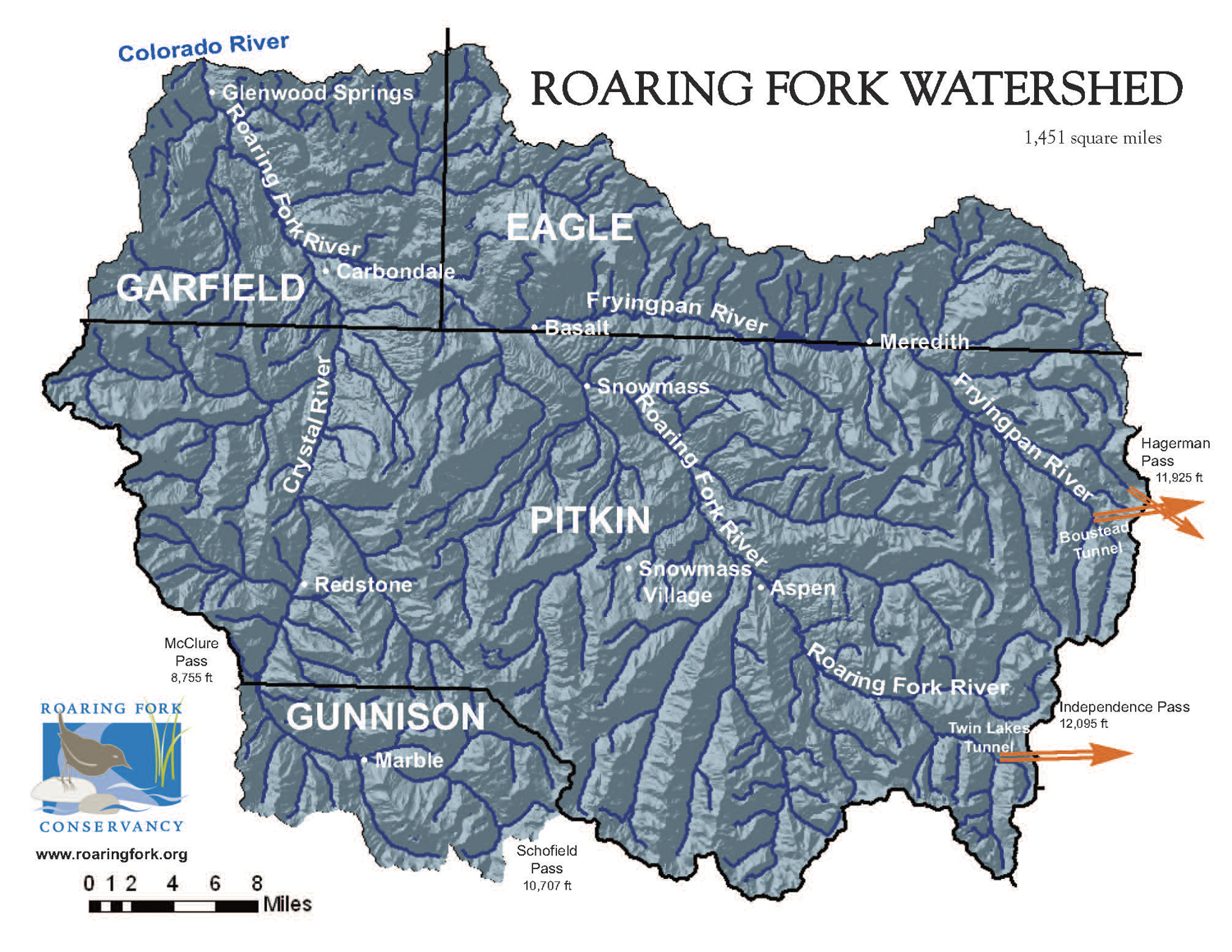
Map of the Roaring Fork River drainage basin in western Colorado, USA. Made using USGS data. By Shannon1 – Own work, CC BY-SA 4.0, https://commons.wikimedia.org/w/index.php?curid=69290878

Arkansas Valley Conduit awarded an additional $250 million — Chris Woodka (Southeastern #Colorado Water Conservancy District) #ArkansasRiver

Reclamation Commissioner Camille Calimlim Touton greets several members of the Southeastern District Board, from left, Bill Long, Kevin Karney, Howard “Bub” Miller, Andy Colosimo and Justin DiSanti. Photo credit: Southeastern Colorado Water Conservancy District

January 8, 2025

Camille Calimlim Touton, Commissioner of the U.S. Bureau of Reclamation, traveled to Pueblo on Wednesday, January 8, to announce an additional $250 million for construction of the Arkansas Valley Conduit.

“We are proud to see the work underway because of President Biden’s Investing in America agenda,” Commissioner Touton said. “But there’s much more work to be done and we are again investing in this important project to bring safe drinking water to an estimated 50,000 people in 39 rural communities along the Arkansas River.”

The $250 million is funded through the Bipartisan Infrastructure Law and is part of a $514 package of water infrastructure investments throughout the western United States under the BIL.

The additional funding brings the total federal investment in the AVC to almost $590 million since 2020, along with state funding guarantees of $90 million in loans and $30 million in grants.

“After 25 years, I still almost can’t believe it’s happening, but I drive by and can see it with my own eyes,” Southeastern Water Conservancy District President Bill Long told Commissioner Touton. “There are so many people who have worked so hard who would be so proud to see it being built. This money will get us to the area that has seen the most problems.”

The Southeastern District is the sponsor for the AVC, which is part of the 1962 Fryingpan-Arkansas Project Act. The 130-mile pipeline to Lamar will bring water to 50,000 people being served by 39 water systems when complete.

Several Southeastern Board members attended Wednesday’s announcement.

“You and your team are the ones who have gotten this off the ground,” said Kevin Karney, a La Junta rancher, and at-large Board member.

“People said it would never get built, but now we’re getting it done,” said Howard “Bub” Miller, who represents Otero County on the Board.

The AVC will help 18 water systems that face enforcement action for naturally occurring radionuclides in their groundwater supplies, as well as communities struggling to meet drinking water and wastewater discharge standards.

Construction of the AVC began in 2023, and three major construction contracts have been awarded.

“This money really gets us further down the valley. It is very much appreciated,” Long said.

Here is a link to the Bureau of Reclamation News Release: https://www.usbr.gov/newsroom/news-release/5074.

Below is a news release from Colorado’s Senators: https://www.bennet.senate.gov/2025/01/08/bennet-hickenlooper-welcome-additional-250-million-from-bipartisan-infrastructure-law-for-arkansas-valley-conduit/

Hickenlooper, Bennet Welcome Additional $250 Million for Ark Valley Conduit

Funding awarded from the senators’ Bipartisan Infrastructure Law

In total, Hickenlooper and Bennet have helped secure $500 million in funding for the project

WASHINGTON – Today, Colorado U.S. Senators John Hickenlooper and Michael Bennet welcomed the Bureau of Reclamation (BOR)’s announcement of $250 million in new funding from the Bipartisan Infrastructure Law for continued construction of the Arkansas Valley Conduit (AVC).

“We passed the Bipartisan Infrastructure Law to finally deliver on promises to rural communities,” said Hickenlooper. “In Colorado that means finishing the long-awaited Ark Valley Conduit and bringing clean, reliable drinking water to 50,000 people.”

“For decades, I’ve worked to secure investments and pass legislation to ensure the federal government keeps its word and finishes the Arkansas Valley Conduit,” said Bennet. “This major Bipartisan Infrastructure Law investment will be critical to get this project across the finish line to provide safe, clean water to tens of thousands of Coloradans along the Arkansas River.”

John F. Kennedy at Commemoration of Fryingpan Arkansas Project in Pueblo, circa 1962.

The AVC is a planned 130-mile water-delivery system from the Pueblo Reservoir to communities throughout the Arkansas River Valley in Southeast Colorado. This funding will continue ongoing construction. The AVC is the final phase of the Fryingpan-Arkansas Project, which Congress authorized in 1962.

Hickenlooper and Bennet have consistently and successfully advocated for increased funding for the AVC. Last year, Hickenlooper and Bennet wrote to President Biden to urge him to prioritize funding for the AVC in his fiscal year 2025 budget. The senators also called on Senate Appropriations leaders to provide more funding for the project. In January 2023, Hickenlooper and Bennet urged BOR to allocate additional resources through annual appropriations and Bipartisan Infrastructure Law funding.

As a result of their efforts, the senators have helped deliver $500 million from the Bipartisan Infrastructure Law for the AVC, including $90 million in 2024, $100 million in 2023, and $60 million in 2022. They also secured an additional $10.1 million in fiscal year 2024 and $10.1 million in fiscal year 2023 through the annual government funding bills.

More information on the funding is available HERE.

Arkansas Valley Conduit map via the Southeastern Colorado Water Conservancy District (Chris Woodka) June 2021.

Lower #ArkansasRiver water districts, #Aurora prepare for talks over city’s controversial $80M farm water purchase — Jerd Smith (Fresh Water News)

Straight line diagram of the Lower Arkansas Valley ditches via Headwaters Magazine

Click the link to read the article on the Water Education Colorado website (Jerd Smith):

October 3, 2024

Arkansas Valley water districts and Aurora plan to open talks as soon as December aimed at providing aid to the region to offset the impact of a controversial, large-scale water purchase by Aurora that will periodically dry up thousands of acres of farmland.

The talks are likely to include renegotiating a hard-fought, 21-year-old agreement among water providers, Aurora, Pueblo, Colorado Springs and the U.S. Bureau of Reclamation, and others.

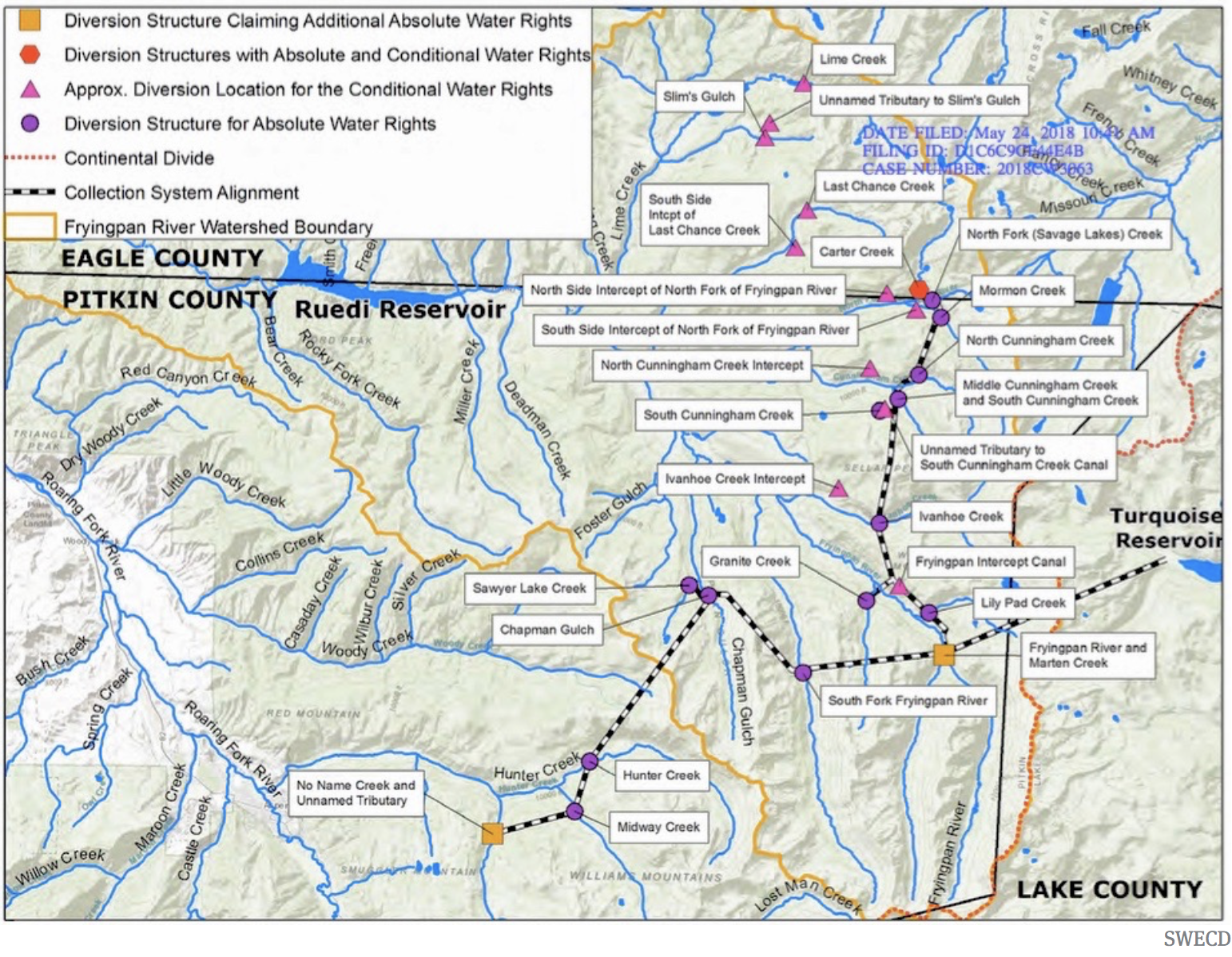
A map filed as part of Southeastern’s diligence application that shows the extent of the Fry-Ark Project. On its southern end, it diverts water from creeks near Aspen. The conditional rights within the Holy Cross Wilderness are on its northern end.

The agreement is not set to expire until 2047, but Bill Long, president of the Southeastern Water Conservancy District, which manages the Fryingpan-Arkansas Project for the Bureau of Reclamation, said the districts and Aurora have agreed to reopen the pact early to find ways to compensate the valley for the new loss of farm water.

“We hope that this issue can be resolved in a way that’s beneficial to both parties,” Long said. “What that looks like at this point I am not sure. We strongly believe the agreement has been violated and appropriate mitigation, or them not taking the water out of the valley, needs to occur. In our minds, there is no gray area.”

Aurora declined an interview request, but spokesman Gregory Baker acknowledged via email that Aurora has agreed to the talks, though a firm date has not been set.

Baker also confirmed that the water rights have been placed in a special account and won’t be used for two years while negotiations are underway.

The original 2003 agreement helped settle a number of lawsuits and disputes with Aurora after it asked to use the federally owned Fryingpan-Arkansas Project and Pueblo Reservoir. The deal gave Aurora the right to use the federal system for moving farm water it owned at the time in exchange for $25 million in cash payments over the 40-year life of the deal, among other provisions. The contract with the federal government was finalized in 2007.

Catlin Ditch water serving the Arkansas Valley an Otero County Farm to be purchased by Aurora Water. The purchase allows for periodic water draws from the Arkansas River basin for Aurora, a unique water transfer proposal in Colorado, officials say. PHOTO COURTESY OF AURORA WATER

The latest battle erupted this spring shortly after Aurora announced its $80 million purchase of more than 5,000 acres of farmland and the irrigation water used to farm the land in Otero County.

Southeastern’s board quickly voted unanimously in April to oppose the purchase, and others, such as Colorado Springs and the Lower Arkansas Valley Water Conservancy District in Rocky Ford, followed suit.

Jack Goble, general manager of the Lower Arkansas Valley district, said the planned talks should pave the way for ensuring the valley’s farmers and ranchers are better protected against urban water harvesting.

“This is a big deal,” Goble said.

Aurora facing growth pressures

While Lower Arkansas officials argue that the 2003 agreement prohibits future water exports by Aurora, city officials have said previously that the purchase does not violate the pact, in part, because it involves leasing the water temporarily, rather than permanently removing it from the valley.

Fast-growing Aurora, Colorado’s third largest city, has had a controversial role in the history of agricultural water in the Arkansas Valley. In the 1970s and 1980s, it purchased water in several counties, drying up the farms the water once irrigated, and moving it up to delivery and storage systems in the metro area.

The Fryingpan-Arkansas project was built in the 1950s to gather water from the Western Slope and the headwaters of the Arkansas River and deliver it to the cities and farms of the Arkansas Valley. Local residents, via property taxes, have repaid the federal government for most of the construction costs and continue to pay the maintenance and operation costs of the massive project, according to Southeastern’s Long.

Aurora isn’t the only city that has moved to tie up agricultural water in the Lower Arkansas Valley. Recently, Colorado Springs inked a deal with Bent County and Pueblo Water has purchased water in the historic Bessemer Ditch just east of Pueblo.

At the same time, irrigated farm and ranch lands, the backbone of the state’s $47 billion agricultural economy, have been disappearing across the state. A new analysis by Fresh Water News and The Colorado Sun shows that 32% of irrigated ag lands have been lost to drought and urban development, and to other states to satisfy legal obligations to deliver water.

Long said the pending talks are “a recognition by Aurora that when making deals to acquire ag water, they need to be responsible and make sure there are benefits for all the parties. When we get to the table they may play hard ball, but I truly do think they want to fix this issue. That is in the best interest of all of the parties.”

More by Jerd Smith. Jerd Smith is editor of Fresh Water News. She can be reached at 720-398-6474, via email at jerd@wateredco.org or @jerd_smith.

Map of the Arkansas River drainage basin. Created using USGS National Map and NASA SRTM data. By Shannon1 – Own work, CC BY-SA 4.0, https://commons.wikimedia.org/w/index.php?curid=79039596

#Aspen proposes second turbine for Ruedi hydro plant: Increased fish flows make power production inefficient — @AspenJournalism #FryingPanRiver #RoaringForkRiver #ActOnClimate

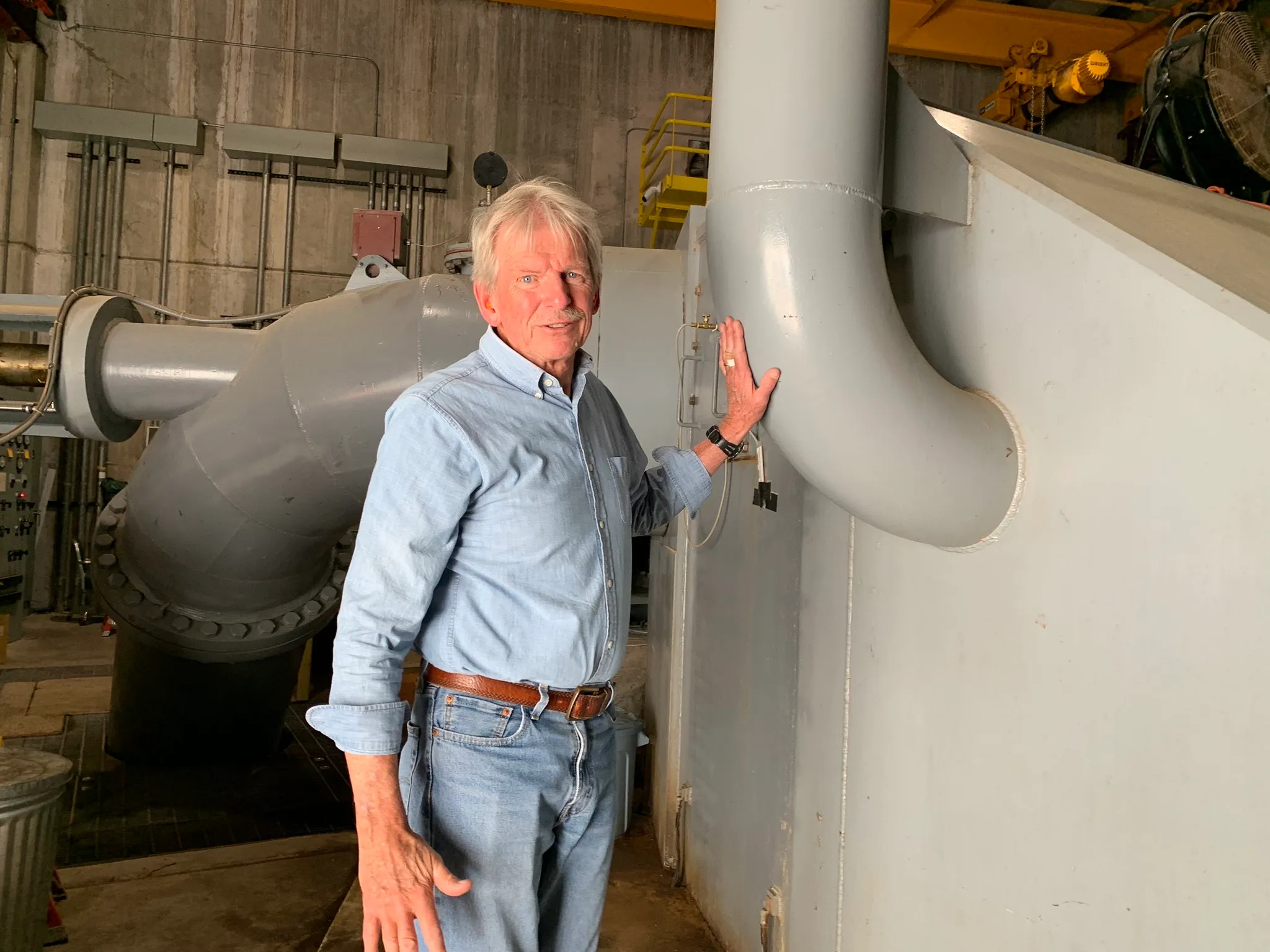
Utilities Engineer for the City of Aspen Phil Overeynder at the hydroelectric plant at Ruedi Reservoir. Releases from the reservoir in recent years have been too high in the summer and too low in the winter for Aspen to make hydropower efficiently. Credit: Heather Sackett/Aspen Journalism

Click the link to read the article on the Aspen Journalism website (Heather Sackett):

September 18, 2024

The city of Aspen wants to add a second turbine and generator unit to its hydroelectric plant at the base of Ruedi Dam, which officials say will allow for more power generation during times of high and low flows. 

Officials say an additional turbine, which is estimated to cost about $4.6 million, will restore the plant’s power production capacity to its originally intended 5 megawatts and allow the city to maintain its renewable energy goals. Since 2012, increased releases from Ruedi to benefit downstream endangered fish have meant that late summer and early fall flows are too high for the existing turbine to operate efficiently. 

Adding another turbine requires amending Aspen’s license for the Ruedi facility with the Federal Energy Regulatory Commission. According to the city’s draft FERC application for an amendment posted on the Aspen Community Voice website, which officials say they plan on filing by the end of the month, the timing and amount of water released from Ruedi Reservoir has changed since the hydro project began operating in 1986. Power production has diminished in recent years to just 68% of what was originally intended.

Hydroelectric Dam

“After 40 years of reservoir and hydroelectric operations, it is now clear that achieving power output (maximum capacity and energy values) that approximates the original level authorized under the license will require additional generation equipment,” the application reads.

The City of Aspen has a hydroelectric power plant at the base of Ruedi Reservoir, which helps them meet renewable energy goals. Aspen officials want to add a second turbine to make power more efficiently. Credit: Heather Sackett/Aspen Journalism

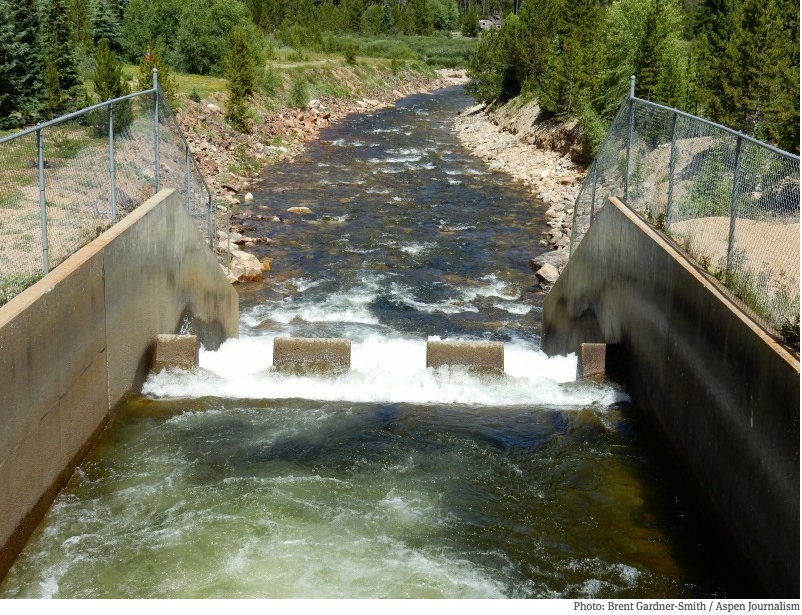
The facility is most efficient at flows between 100 and 225 cfs. But summer and fall flows are often higher than this range and winter flows often lower. Aspen has no control over how much water is released from the reservoir, which is managed by the U.S. Bureau of Reclamation.

According to the city’s application, gross energy production has declined from an average of 18.5 million kilowatt hours annually from 1986 to 2004 to 15 million kWh over the last decade. 

“The equipment is kind of mismatched for what’s going on with those releases,” said Phil Overeynder, utilities engineer for the city of Aspen. “So we’re losing all of that energy above 225 cfs. If we have an additional turbine, we’ll be able to hit the sweet spot for the releases and generate the full amount of energy when it’s available.”

Also, an error in the design of the powerplant introduces air into the water column, reducing the efficiency of the turbine. Because of this flawed design, the hydro plant can’t efficiently make power above about 225 cfs. The city looked at options to fix this problem, Overeynder said, including raising the floor of the building, but the least expensive solution is adding another turbine.

A new turbine would be rated for 1.2 megawatts of production and the original turbine would be downgraded to a 3.8 megawatt capacity, for a total of 5 megawatts — the same as the plant’s current rating, but split between two turbines. During periods of higher releases, about 230 cfs would be routed through the existing turbine and 70 cfs would be routed through the new turbine for about 92% efficiency.

The project would also upgrade the hydro plant so it can be operated remotely, and would let the city continue making hydropower with one turbine if the other one is down for maintenance. The total project cost including the new turbine would be around $8.6 million, according to Overeynder.

“The proposed second turbine at Ruedi, together with other planned actions, will enable Aspen to restore the balanced power supply, which will maintain grid reliability and resiliency while continuing to provide 100% renewable energy,” the application reads.

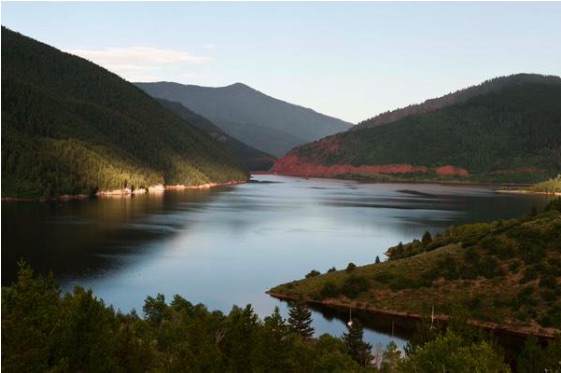
Ruedi Reservoir on the Fryingpan River is operated by the U.S. Bureau of Reclamation. Releases for the Colorado River Endangered Fish Recovery Program have boosted late summer and fall river flows in recent years. Credit: Heather Sackett/Aspen Journalism

Fish flow

Releases out of Ruedi have changed since the hydro plant began operating, with the reservoir now one of the most important sources of water for the Colorado River Endangered Fish Recovery Program. The program, designed to get water into a chronically de-watered section of the Colorado River near Grand Junction known as the 15-mile reach, has about 15,000 acre-feet of water available most years in Ruedi. Entities that own water in Ruedi such as Garfield County, Caerus Energy, Grand Junction area water provider Ute Water and the Colorado River Water Conservation District have also in recent years leased their water to the recovery program to boost flows beyond the dedicated 15,000 acre-foot pool. 

All of the recovery program’s releases are made in July through October, when streamflows naturally are reduced, but irrigation demands in the Grand Valley leave diminished river levels for endangered fish. According to numbers provided by recovery program staff, the Ruedi fish water releases increased from an average of 18,586 acre-feet in the time period from 1998 to 2012, to 20,460 acre-feet in the time period of 2013-2023. 

“Ruedi is an essential piece of our ability to manage water for the endangered fish,” said Juile Stahli, director of the Upper Colorado Endangered Fish Recovery Program. “Ruedi has become really critical in helping us affect the ecology downstream.”

According to Tim Miller, a hydrologist with the U.S. Bureau of Reclamation who manages Ruedi, the current reservoir release pattern — higher flows in the late summer and lower flows in the winter — began after 2012 when the water in the reservoir was fully contracted. The owners of this contracted water (like those mentioned above) release it when they need it, and many lease it to the recovery program. Because more contract water is released from Ruedi, Miller said he has to make up that loss to the reservoir by releasing less water over the winter, resulting in low winter flows. 

“I can tell you with absolute certainty that since Ruedi has been fully contracted we have released more water for fish augmentation than we did since the program started,” Miller said. “Because we’ve released more contract water, given an average fill, it’s going to take more water to fill the reservoir the next year. So my releases during the winter were lower to recover that.”

According to data from USBR, the average flow out of the reservoir from July to October before the endangered fish recovery program started from 1980 to 1997 was 180 cfs. The average release after the program began in 1998 has been 204 cfs. The number of days releases have exceeded 225 cfs has also been trending upward since the recovery program began.

Aspen’s 100% renewable energy goals

Aspen first achieved its goal of 100% renewable energy in 2015, when a project that retrofit the Ridgway Reservoir dam in the Uncompahgre River basin to generate hydroelectric power came online. The city of Aspen was integral in launching the project, funding a feasibility study in the early 2000s and signing a 10-year contract in 2012 to purchase about 10 million kwh a year from Ridgway once it became available. Ridgway now accounts for about one-seventh of Aspen’s total power portfolio, according to Overeynder. In an effort to continue meeting its 100% renewable goal, the city is also looking to continue and potentially expand its hydroelectric power generation capacity on Maroon Creek. 

Aspen has begun the process of relicensing the project with FERC, which is smaller than the Ruedi project and has a capacity of 450 kilowatts. Aspen is also proposing to add additional units on Maroon Creek for a total of 500 kw. 

Hydropower, including energy Aspen buys from projects at Ridgway Reservoir and Western Area Power Administration, is supposed to make up about 45% of the city’s energy portfolio. But that percentage has dropped with the declining power production at Ruedi in recent years. The city also buys wind and solar power to achieve 100% renewable energy.

“If we do this (project at Ruedi) plus what we did already at Ridgway and are proposing to do at Maroon Creek, we will get back up to that 45%,” said Justin Forman, Aspen’s Utilities Director. “For us, every megawatt counts and if it’s something local like this, we’re super proud of it and it certainly fits into the values that we have.”

The FERC relicensing process will take several years, with sign-offs also needed from the Colorado Department of Public Health and Environment, the U.S. Army Corps of Engineers and Pitkin County. Overeynder expects the new turbine to be operating sometime in 2027.

The city of Aspen supports Aspen Journalism with a community nonprofit grant. Aspen Journalism is solely responsible for its editorial content.

Map of the Roaring Fork River drainage basin in western Colorado, USA. Made using USGS data. By Shannon1 – Own work, CC BY-SA 4.0, https://commons.wikimedia.org/w/index.php?curid=69290878

Bureau of Reclamation to host Ruedi Reservoir water operations public meeting #FryingPanRiver

Sunrise at Ruedi Reservoir October 20, 2015. Photo via USBR.

From email from Reclamation (Anna Perea):

July 24, 2024

The Bureau of Reclamation has scheduled the annual public meeting to discuss the Ruedi Reservoir Water Operations for the 2024 water year. The meeting will be held on Wednesday August 7, 2024, from 6:00 p.m. – 8:00 p.m. at the following location:

Roaring Fork Conservancy River Center
22800 Two Rivers Road
Basalt, CO 81621

Topics will include: 

  • Reservoir operations update (Reclamation)
  • Colorado River 15-Mile Reach endangered fish update (U.S. Fish and Wildlife)
  • Fryingpan River projects (Roaring Fork Conservancy)
  • Updates on Ruedi water leases (Colorado Water Conservation Board) 
  • Overview of East Slope Fryingpan-Arkansas Project (Reclamation)  
  • Public question and answer session 

For more information, please contact Tim Miller, Hydrologist, Eastern Colorado Area Office, by phone or e-mail: (970) 461-5494, or tmiller@usbr.gov.

Media inquiries or general questions about Reclamation should be directed to Anna Perea, Public Affairs Specialist, at 970-290-1185 or aperea@usbr.gov. If you are deaf, hard of hearing or have a speech disability, please dial 7-1-1 to access telecommunications relay services.

Ruedi Reservoir detects invasive mussels — KDNK #FryingpanRiver

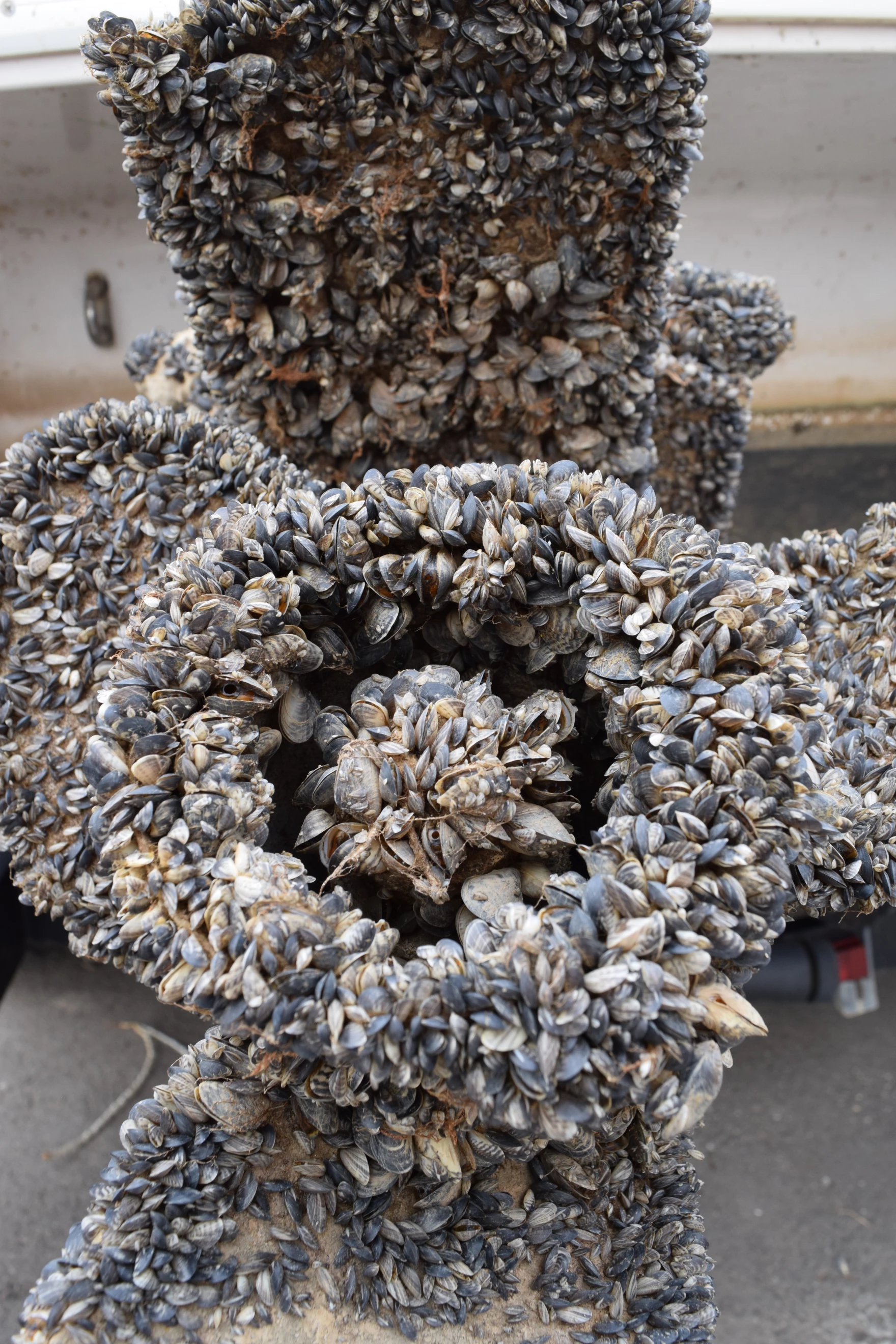
Mussels covering a propeller. Colorado Parks And Wildlife

Click the link to read the article on the KDNK website (Lily Jones). Here’s an excerpt:

May 17, 2024

On Wednesday, May 1st, the Ruedi Reservoir boat ramp opened along with motorized watercraft inspection and decontamination for aquatic nuisance species such as the quagga and zebra mussels. On the second day of the season, two boats were found to be infested with mussels as opposed to only three boats for the entirety of the 2023 season. Most of the infected boats are coming from Lake Powell, which is ridden with quagga mussels. Due to the increasing threat they pose, Reudi Reservoir has a mandatory inspection and decontamination protocol in place for entry and departure in compliance with state regulations. The inspection station is operated by CPW from daylight to dark through October.

Ruedi Reservoir expected to fill again — The #Aspen Daily News #FryingPanRiver #RoaringForkRiver #ColoradoRiver #COriver #aridification

Ruedi Reservoir on the Fryingpan River as seen on March 24. The reservoir is at its lowest level in nearly two decades, but U.S. Bureau of Reclamation officials say if forecasts hold, it should still be able to fill in 2022. CREDIT: HEATHER SACKETT/ASPEN JOURNALISM

Click the link to read the article on The Aspen Daily News website (Austin Corona). Here’s an excerpt:

Ruedi Reservoir is expected to hit full capacity for only the second time in five years, according to projections shared by reservoir managers. The managers don’t know exactly when the reservoir will hit capacity, though Tim Miller, hydrologist for the Bureau of Reclamation — the federal agency that operates Ruedi Dam —  said it will likely stay full through July. Miller said calls for Ruedi water farther down the Colorado River could change that timeline. Ruedi is currently 68.8% full.

Ruedi did not reach its full capacity for three years between 2020 and 2022. Low runoff kept the reservoir from filling in 2020, and then overshoots in inflow projections and dry soils caused the reservoir to miss its capacity again in 2021. Reservoir levels then dropped to a 20-year nadir in March 2022 and never quite reached full capacity during a rebound that summer. Those three years were the only multiyear stretch in which Ruedi failed to fill in the last 10 years. Reservoir levels also fell short in 2018.  Ruedi ended its dry streak after a wet winter in 2023, with Miller reporting in August that last year was almost flawless for reservoir operations.

This year, Miller said snowpack and runoff projections look similar to 2023. Water supply forecasts from the National Oceanic and Atmospheric Administration’s Colorado Basin River Forecast Center project a total Fryingpan River April-July runoff volume at Ruedi roughly 10% higher than projections from the same time in 2023 (this year’s May 1 projection is 135,000 acre feet). Miller said the Ruedi may receive even greater flows than expected this year because of operational issues at a connected facility on the eastern slope. Miller said water managers may have to leave more water in the Fryingpan River this year than usual if Turquoise Lake, an eastern slope reservoir that receives Fryingpan water through a tunnel under the continental divide, fills up. Miller said Turquoise’s outflow will be limited this year because both pump/turbine units at the Mount Elbert pumped-storage powerplant, which constitutes one outlet for the reservoir, are not operating this summer. 

Ruedi Reservoir expected to fill again — The #Aspen Daily News #FryingpanRiver #RoaringForkRiver #ColoradoRiver #COriver #aridification #snowpack

Click the link to read the article on The Aspen Daily News website (Austin Corona). Here’s an excerpt:

May 10, 2024

Ruedi Reservoir is expected to hit full capacity for only the second time in five years, according to projections shared by reservoir managers. The managers don’t know exactly when the reservoir will hit capacity, though Tim Miller, hydrologist for the Bureau of Reclamation — the federal agency that operates Ruedi Dam —  said it will likely stay full through July. Miller said calls for Ruedi water farther down the Colorado River could change that timeline. Ruedi is currently 68.8% full.

Ruedi did not reach its full capacity for three years between 2020 and 2022. Low runoff kept the reservoir from filling in 2020, and then overshoots in inflow projections and dry soils caused the reservoir to miss its capacity again in 2021. Reservoir levels then dropped to a 20-year nadir in March 2022 and never quite reached full capacity during a rebound that summer. Those three years were the only multiyear stretch in which Ruedi failed to fill in the last 10 years. Reservoir levels also fell short in 2018. 

Ruedi ended its dry streak after a wet winter in 2023, with Miller reporting in August that last year was almost flawless for reservoir operations. This year, Miller said snowpack and runoff projections look similar to 2023. Water supply forecasts from the National Oceanic and Atmospheric Administration’s Colorado Basin River Forecast Center project a total Fryingpan River April-July runoff volume at Ruedi roughly 10% higher than projections from the same time in 2023 (this year’s May 1 projection is 135,000 acre feet).

Miller said the Ruedi may receive even greater flows than expected this year because of operational issues at a connected facility on the eastern slope. Miller said water managers may have to leave more water in the Fryingpan River this year than usual if Turquoise Lake, an eastern slope reservoir that receives Fryingpan water through a tunnel under the continental divide, fills up. Miller said Turquoise’s outflow will be limited this year because both pump/turbine units at the Mount Elbert pumped-storage powerplant, which constitutes one outlet for the reservoir, are not operating this summer. 

Airborne survey indicates short runoff season — The #Aspen Daily News #RoaringForkRiver #FryingpanRiver #ColoradoRiver #COriver #aridification

Click the link to read the article on The Aspen Daily News website (Austin Corona). Here’s an excerpt:

April 18, 2024

A report from an airborne survey conducted on April 9 shows that snowpack in the upper reaches of both rivers is warmer and smaller than last year. The survey was conducted by Boulder-based Airborne Snow Observatories, a private company operating through contracts with local governments. The survey area includes the headwaters of the Roaring Fork from the Continental Divide to just above Aspen, as well as the Fryingpan River above Ruedi Reservoir, and the headwaters of Snowmass Creek, Maroon Creek, Castle Creek, Hunter Creek and Woody Creek…

Jeff Deems, a Carbondale resident and chief technical officer for hardware at ASO, said the “cold content” of the snow — a measurement of how much energy is required to melt snow — measured on the day of the survey indicates that much of the watershed’s snowpack is already melting or on the verge of melting. According to a report from ASO’s survey, the amount of snow in the basin below freezing, or “unripe,” is roughly 10 percentage points lower than last year around the same time. It currently stands at about 26% of the overall snowpack. The rest of that snow is right at, or approaching, its melting point.  

“I think we’re seeing a fairly warm snowpack this year,” Deems said. “I dug a snow pit on April 9, when the plane was in the air, at 11,000 feet on Richmond Ridge. And most of the snowpack was isothermal — so that is at zero degrees Celsius, at the melting point. There was a very minimal layer in the middle that was a few degrees below freezing.”

The total amount of water in this year’s snowpack is smaller than last year. The snow water equivalent, or SWE, in the survey area this year was about 520,000 acre-feet on April 9, a roughly 12% drop from the same number taken at the same time last year (the 2023 survey occurred April 11-12). Deems said the SWE observed in the April 9 flight indicates that this year’s snowpack is smaller than previously thought. Snow telemetry (SNOTEL) sites around the basin show similar snowpack conditions from last year, while the ASO survey shows a clear drop in SWE.  Deems said he thinks the disparity is a result of changing snow distribution patterns, which the SNOTEL sites cannot measure with detail because they are tied to a fixed location.

This map shows the snowpack depth of the Maroon Bells in spring 2019. The map was created with information from NASA’s Airborne Snow Observatory, which will help water managers make more accurate streamflow predictions. Jeffrey Deems/ASO, National Snow and Ice Data Center

Reclamation awards construction contract for Arkansas Valley Conduit treatment facilities: President Biden’s Bipartisan Infrastructure Law supporting major water infrastructure project to provide clean, reliable drinking water to 39 communities in southeastern #Colorado

Arkansas Valley Conduit map via the Southeastern Colorado Water Conservancy District (Chris Woodka) June 2021.

Click the link to read the release on the Reclamation website (Anna Perea and Darryl Asher):

Feb 29, 2024

LOVELAND, Colo. — The Bureau of Reclamation has awarded a contract for the construction of water treatment and connection facilities for the Arkansas Valley Conduit Project to Thalle Construction for $28,710,676. This contract, partially funded by President Biden’s Bipartisan Infrastructure Law, funds construction of a backflow preventor connecting the main trunkline to Pueblo Water’s system, and a treatment facility to address specific water treatment needs for the Project.  

The backflow preventer will be constructed at 36th Lane and U.S. Highway 50, east of Pueblo. The treatment facility will be located along the AVC pipeline route about 4 miles east of 36th Lane. The treatment process will prepare the water for conveyance through the trunkline to Project communities and ensure compatibility of the water with the AVC participants’ water systems.

“We’re extremely pleased to be able to move forward with multiple features of the Arkansas Valley Conduit,” said Jeff Rieker, Eastern Colorado Area Office Manager. “The momentum of making this connection to the eastern end of Pueblo’s water system while downstream pipes are being placed and additional designs are being developed really speaks to the collaborative efforts of all those involved.”

2022 three-party contract between Reclamation, Southeastern Colorado Water Conservancy District Board and the Pueblo Board of Water Works (Pueblo Water), eliminates the need for over 24 miles of pipeline by utilizing Pueblo Water’s existing infrastructure. The water will be either Fryingpan-Arkansas Project water or from participants’ water portfolios, not from Pueblo Water’s resources. 

“This is another important step forward for the Arkansas Valley Conduit, and vital to begin providing high-quality drinking water to the people of the Lower Arkansas Valley. The Southeastern District has tremendous appreciation for the work that Reclamation and our congressional delegation have done to keep this project moving forward,” said Bill Long, President, Southeastern Colorado Water Conservancy District.

In addition to the contract for these facilities, in January, Reclamation awarded a $4.6 million contract to Central Geotechnical Services, LLC to locate and complete subsurface utility engineering surveys for underground utilities along a 34-mile stretch of the Arkansas Valley Conduit. Colorado legislation, SB 18-167, enacted in 2018, set new standards for entities conducting underground excavation.

Arkansas River Basin via The Encyclopedia of Earth

Weekend storm boosts #RoaringForkRiver Basin #snowpack to median — The #Aspen Daily News

Click the link to read the article on the Aspen Daily News website (Scott Condon). Here’s an excerpt:

January 16, 2024

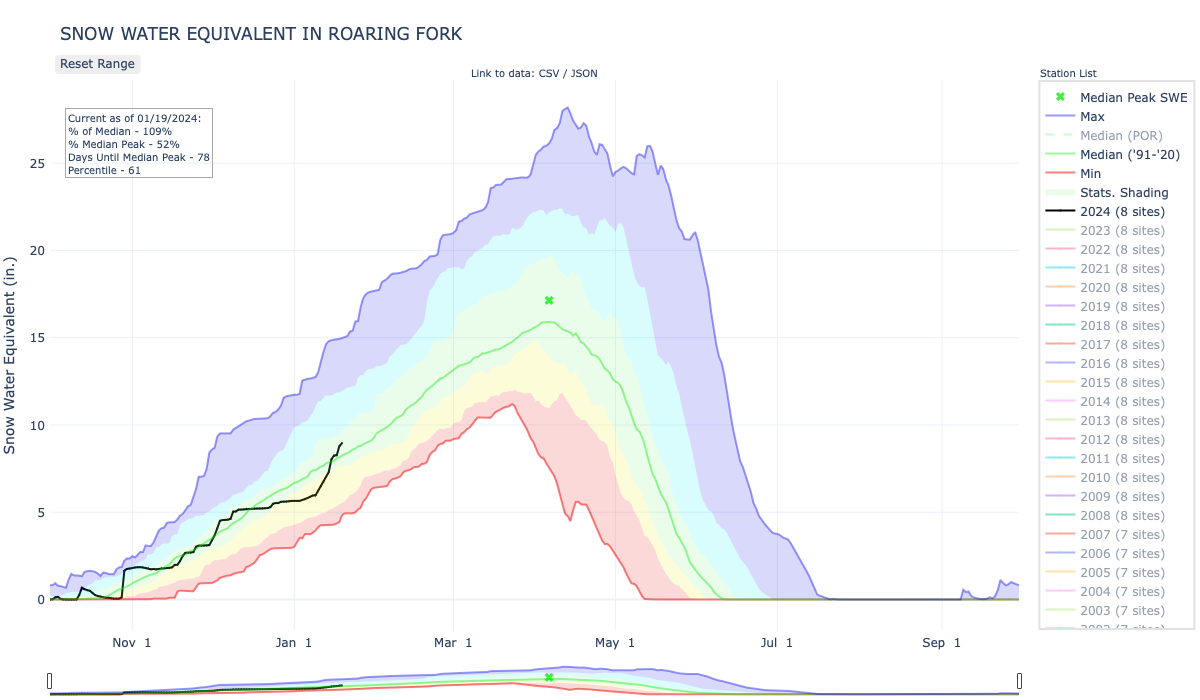
For the Roaring Fork Basin overall, the snowpack soared from just 85% of average on Thursday morning to 102% on Monday morning, according to the NRCS. The Fryingpan Valley was the biggest gainer from the storms. The Chapman Tunnel Snotel site is at 107% of median. The Ivanhoe site is at 128%, Kiln is at 105% and Nast Lake is boasting a snowpack at 145% of median. Meanwhile the Independence Pass Snotel site remains well below the rest of the basin. Independence was at only 67% of median as of Thursday morning. That improved to 80% by Monday morning with more snow falling. Nevertheless, that’s the lowest reading in the region. In the Crystal River drainage, McClure Pass was at 82% of median as of Monday morning. The North Lost Trail Snotel site outside of Marble was at 117%. The Schofield site, which typically has one of the highest snowpacks in the region, was at 90% Monday.

Map of the Roaring Fork River drainage basin in western Colorado, USA. Made using USGS data. By Shannon1 – Own work, CC BY-SA 4.0, https://commons.wikimedia.org/w/index.php?curid=69290878

“The whole thing starts moving and creaking with these really crazy sounds when you’re out on it. It’s a sound show” — Al Beyer via The #Aspen Daily News

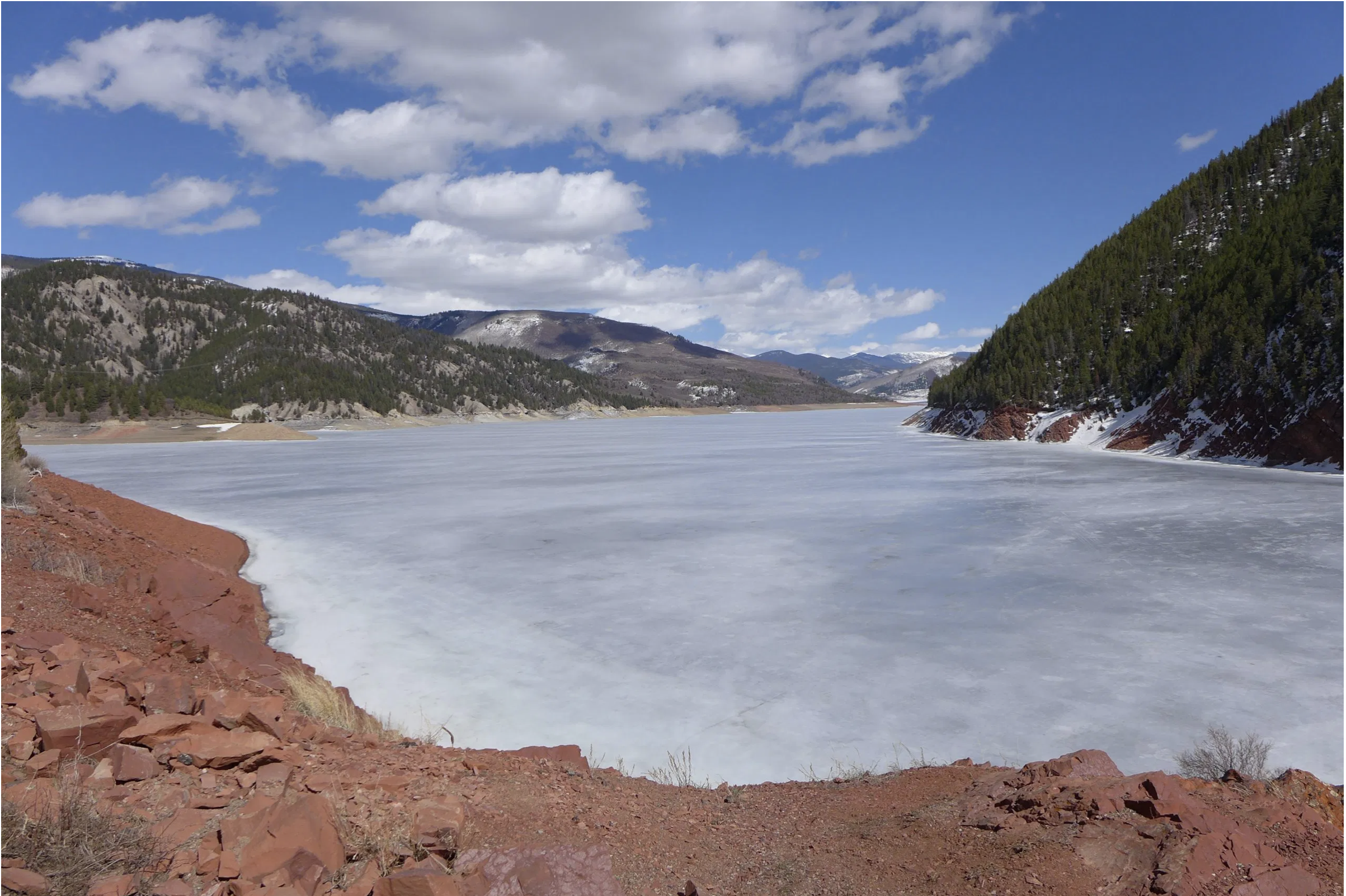
The dam on a frozen Ruedi Reservoir as seen on March 24, 2024. CREDIT: HEATHER SACKETT/ASPEN JOURNALISM

Click the link to read the article on The Aspen Daily News website (Austin Corona). Here’s an excerpt:

…when it finally freezes, [Ruedi Reservoir’s] surface becomes an ephemeral world all to itself. Al Beyer, an Old Snowmass-based architect who has been skating Ruedi’s winter surface since the 1990s, sees the ice as dynamic and complicated. Beyer said a person can even notice the ice forming its own kind of tectonic plates, which press and warp one another in a slow drama.

“It has tension and compression to it,” Beyer said.

The lake chatters, whistles and peals as vibrations run for miles across the lake. The sound of the ice is almost entirely unique — something between the sound of wind against high-tension bridge cables and a whale’s song.

“The whole thing starts moving and creaking with these really crazy sounds when you’re out on it. It’s a sound show,” Beyer said.

Map of the Roaring Fork River drainage basin in western Colorado, USA. Made using USGS data. By Shannon1 – Own work, CC BY-SA 4.0, https://commons.wikimedia.org/w/index.php?curid=69290878

Reclamation awards second construction contract for Arkansas Valley Conduit #ArkansasRiver #ColoradoRiver #COriver #aridification

Arkansas Valley Conduit map via the Southeastern Colorado Water Conservancy District (Chris Woodka) June 2021.

Click the link to read the article on the Reclamation website (Anna Perea and Darryl Asher):

President Biden’s Bipartisan Infrastructure Law supporting major water infrastructure project to provide clean, reliable drinking water to 39 communities in southeastern Colorado

Sep 15, 2023

LOVELAND, Colo. – The Bureau of Reclamation has awarded a contract for the second segment of trunkline of the Arkansas Valley Conduit to Pate Construction Co., Inc. for $27,216,950.00. This contract, partially funded by President Biden’s Bipartisan Infrastructure Law, funds construction of Boone Reach 2, which includes a 5.4 mile stretch of water pipeline and 7.4 miles of fiber conduit. Construction will follow Colorado State Highway 96 from North Avondale to Boone, Colorado.

President Biden’s Investing in America agenda represents the largest investment in climate resilience in the nation’s history and is providing much-needed resources to enhance Western communities’ resilience to drought and climate change. Through the Bipartisan Infrastructure Law, Reclamation is investing a total of $8.3 billion over five years for water infrastructure projects, including water purification and reuse, water storage and conveyance, desalination and dam safety. An overall $160 million has been allocated so far from the Law to complete the Arkansas Valley Conduit project.

This is a major infrastructure project that, upon completion, will provide reliable municipal and industrial water to 39 communities in southeastern Colorado. The pipeline will bring water from Pueblo Reservoir to Bent, Crowley, Kiowa, Otero, Prowers, and Pueblo counties. It is projected to serve up to 50,000 people in the future; equivalent to 7,500 acre-feet of water per year.

“We’re looking forward to this next project milestone,” said Jeff Rieker, Eastern Colorado area manager. “Today’s contract award allows the project to maintain the momentum we’ve built over the past year and helps us achieve the ultimate goal of bringing clean and reliable water supplies to the people of southeastern Colorado.”

“The Arkansas Valley Conduit is vitally important to the people of the Lower Arkansas Valley, so it is very rewarding to see the Bureau of Reclamation moving ahead,” said Bill Long, president of the Southeastern Colorado Water Conservancy District, local sponsors of the Arkansas Valley Conduit. “The Southeastern District also is working to complete this project as quickly as possible to provide a better quality of water for the people of the valley.”

Work on the first segment of trunk line began in spring of 2023 with completion anticipated in 2024. Reclamation expects work on the second segment, Boone Reach 2, to begin in late 2023 with completion slated for late summer 2025.

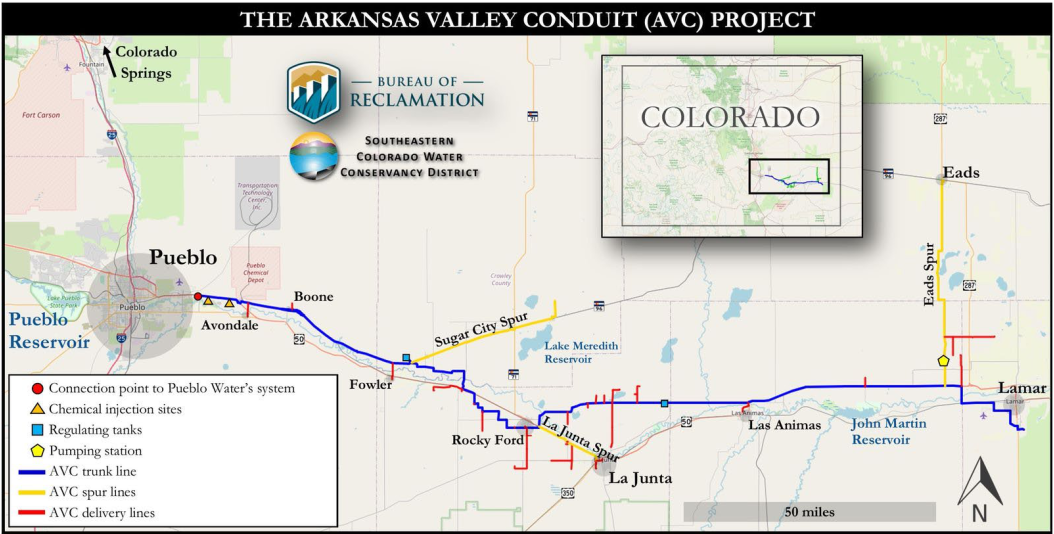
As the Arkansas Valley Conduit project moves forward, under existing agreements, Reclamation plans to construct the trunkline, water tanks, and related components, while the Southeastern Colorado Water Conservancy District coordinates with communities to fund and build the project’s water delivery pipelines. Eventually, the Arkansas Valley Conduit will connect 39 water systems along the 103-mile route to Lamar, Colorado. 

The project will use Pueblo Water’s existing infrastructure to treat and deliver Arkansas Valley Conduit water from Pueblo Reservoir to a connection point east of the city of Pueblo along U.S. Highway 50. The project will use water from either the Fryingpan-Arkansas Project or from a participant’s water portfolio, but not from Pueblo Water’s resources.

Congress authorized Arkansas Valley Conduit in the original Fryingpan-Arkansas Project legislation in 1962 (Public Law 87-590). This project does not increase Fryingpan-Arkansas Project water diversions from the western slope of Colorado; rather, it is intended to improve drinking water quality.

Currently, many people in the areas that will be served by the Arkansas Valley Conduit rely on groundwater supplies that contain naturally occurring radionuclides, such as radium and uranium, or use shallow wells that contain harmful microorganisms and pollutants. Alternatives for these communities consist of expensive options such as reverse-osmosis, ion exchange, filtration, and bottled water.  

If you have questions or need more information, please contact Anna Perea, public affairs specialist at the Bureau of Reclamation’s Eastern Colorado Area Office, at (970) 290-1185 or aperea@usbr.gov. If you are deaf, hard of hearing or have a speech disability, please dial 7-1-1 to access telecommunications relay services.

Pueblo Dam. Photo courtesy of Colorado Parks and Wildlife

Biden-Harris Administration breaks ground on Boone Reach trunk line of Arkansas Valley Conduit #ArkansasRiver

The outflow of the Bousted Tunnel just above Turquoise Reservoir near Leadville. The tunnel moves water from tributaries of the Roaring Fork and Fryingpan rivers under the Continental Divide for use by Front Range cities, and Pitkin County officials have concerns that more water will someday be sent through it.

Click the link to read the release on the Reclamation website (Anna Perea):

Major water infrastructure project funded by the Bipartisan Infrastructure Law to provide clean, reliable drinking water to 50,000 Coloradans once completed

PUEBLO, Colo. – The Bureau of Reclamation today broke ground on the Boone Reach trunk line of the Arkansas Valley Conduit (AVC), a major infrastructure project under President Biden’s Investing in America agenda that will bring clean, reliable drinking water to 39 communities in southeastern Colorado.

Deputy Assistant Secretary for Water and Science Gary Gold and Reclamation Commissioner Camille Calimlim Touton joined local and Federal leaders at the groundbreaking ceremony where they highlighted the $60 million investment provided through President Biden’s Bipartisan Infrastructure Law for the project. When completed, the project’s 230 miles of pipeline will deliver as much as 7,500 acre-feet of water annually from Pueblo to Lamar, where water providers in Bent, Crowley, Kiowa, Otero, Prowers and Pueblo counties will serve a projected future population of 50,000.

“The results of the historic investment from the Bipartisan Infrastructure Law are evident here today as we see this project moving forward,” said Deputy Assistant Secretary for Water and Science Gary Gold. “This project will bring a long-term, clean water supply to so many communities in southeastern Colorado.” 

“Through the President’s Investing in America agenda, Reclamation is now well positioned to help advance these important water projects that have been paused for decades,” said Bureau of Reclamation Commissioner Camille Calimlim Touton. “Our investment in this project, dedicated by President Kennedy more than 60 years ago, will provide the path forward for safe drinking water to so many residents of this area.”

“This long-awaited project is a vital step forward for the Arkansas Valley and shows what can be accomplished through a strong coalition of federal, state, and local partnerships,” said Jeff Rieker, Eastern Colorado Area Manager.

“Generations of people of the Lower Arkansas Valley have waited for the AVC for more than 60 years, and now with construction starting, we are seeing the realization of that dream,” said Bill Long, President of the Southeastern Colorado Water Conservancy District. “This is the culmination of years of determination on the part of Reclamation, the District and the AVC participants to get this job done.”

“This is a truly monumental achievement and marks the culmination of decades of hard work, dedication, and collaboration by those who have devoted their lives to the business of water,” said Seth Clayton, executive director of Pueblo Water. “Pueblo Water is proud to be an integral participant in this important time in history.”

The Arkansas Valley Conduit was part of the 1962 Fryingpan-Arkansas Project Act, and its construction represents the completion of the project. Once complete the project will replace current groundwater sources contaminated with radionuclides and help communities comply with Environmental Protection Act drinking water regulations. The connection point for AVC is at the east end of Pueblo Water’s system, at 36th Lane and U.S. Highway 50, and follows the Arkansas River corridor from Pueblo to Lamar, with spurs to Eads and Crowley County. Reclamation is building the trunk line, while the Southeastern District will build the spur and delivery lines. Estimated total cost is about $600 million.

The Bipartisan Infrastructure Law allocates $8.3 billion for Bureau of Reclamation water infrastructure projects over five years to advance drought resilience and expand access to clean water for families, farmers, and wildlife. The investment will repair aging water delivery systems, secure dams, and complete rural water projects, and protect aquatic ecosystems. The funding for this project is part of the $1.05 billion in Water Storage, Groundwater Storage and Conveyance Projects provided by the Law.  

Michael Bennet, Colorado Senator; Bill Long, Southeastern Colorado Water Conservancy District; Camille Calimlim Touton, Reclamation Commissioner; Rebecca Mitchell, Director Colorado Water Conservation Board stand with pipe for the construction of the Arkansas Valley Conduit. Photo credit: Reclamation

Click the link to read “Arkansas Valley Conduit project breaks ground” on The Pueblo Chieftain website (James Bartolo/USA Today). Here’s an excerpt:

Advocates of the Arkansas Valley Conduit celebrated the groundbreaking of the conduit’s Boone Reach 1 trunk line, which will connect Pueblo’s water system to Boone, on Friday, April 28, at Martin Marietta Rich Sand & Gravel east of Pueblo. The trunk line is the first 6-mile piece of the conduit’s planned 230mile project stretching from Pueblo to Lamar and Eads. Once completed, the conduit will send up to 7,500 acrefeet of Pueblo Reservoir water to about 50,000 southeastern Colorado residents. WCA Construction LLC., a Towaoc, Colorado-based company owned by the Ute Tribe, was awarded a $42.9 million contract from the U.S. Bureau of Reclamation in September 2022 to complete construction of the Boone Reach 1 trunk line.

Communities benefitting from the conduit include communities in eastern Pueblo, Crowley, Otero, Bent, Kiowa and Prowers counties. Drinking water in many of these communities currently contains contaminants like radionuclides and selenium, according to Bill Long, board president of the Southeastern Colorado Water Conservancy District…

Estimates for the total cost of the project are between $600 and $700 million, Long said. Project leaders hope to receive upward of $500 million more from the federal government. After receiving $60 million from the Bipartisan Infrastructure Package, the Arkansas Valley Conduit continues to be a competitive project in the fight for future federal funding, according to U.S. Bureau of Reclamation Commissioner Camile Touton.

Arkansas Valley Conduit map via the Southeastern Colorado Water Conservancy District (Chris Woodka) June 2021.

Hydrologist: Ruedi ‘in good shape’ for handling #runoff — #Aspen Daily News #FryingpanRiver #RoaringForkRiver #ColoradoRiver #COriver #aridification

Ruedi Reservoir on the Fryingpan River as seen on March 24, 2022 The reservoir was at its lowest level in nearly two decades. Reclamation is confident it will fill in 2023. CREDIT: HEATHER SACKETT/ASPEN JOURNALISM

Click the link to read the article on the Aspen Daily News website (Scott Condon). Here’s an excerpt:

Hydrologist Tim Miller said the current snowpack levels make him confident Ruedi Reservoir can be filled in the first week of July without releasing extraordinary amounts of water…The Colorado Basin River Forecast Center is forecasting runoff into Ruedi at 104% of median. In 2019, when the region was hit with an ongoing storm cycle in March that triggered numerous destructive avalanches, the forecasted runoff volume was 144% of median, he noted.

The Fryingpan Valley snowpack is currently ranging between 120% to 159% of median at three automated stations called Snotel sites operated by the U.S. Natural Resources Conservation Service. Miller said the sites provide a good gauge of snowpack at lower and middle elevation ranges. He checks the Independence Pass Snotel site east of Aspen as well. Although it is out of the Fryingpan River basin, its close proximity provides a good clue about upper elevation snowpack. The cumulative snowpack at Kiln, Ivanhoe and Independence sites is 126% of median, he said. There isn’t a one-to-one relationship between snowpack levels and runoff forecasts, according to Miller. Runoff projections consider factors such as soil moisture levels, which were low coming into this winter because of drought. Drier soils capture some of the water before it reaches rivers and streams…

“We should be able to fill that without a problem,” Miller said. “It generally fills the first week of July, almost always.”

U.S. Senators Bennet and Hickenlooper Urge Reclamation to Allocate Additional Funding for the Arkansas Valley Conduit #ArkansasRiver

Arkansas Valley Conduit map via the Southeastern Colorado Water Conservancy District (Chris Woodka) June 2021.

Click the link to read the article on Senator Bennet’s website:

Today [January 23, 2023], Colorado U.S. Senators Michael Bennet and John Hickenlooper urged the Bureau of Reclamation (BOR) to consider allocating additional funding from the recent omnibus funding bill for Fiscal Year 2023 (FY23) or the Bipartisan Infrastructure Law (BIL) for the Arkansas Valley Conduit (AVC).

The AVC is a planned 130-mile water-delivery system from the Pueblo Reservoir to communities in Bent, Crowley, Kiowa, Otero, Prowers, and Pueblo counties. The Conduit is the final phase of the Fryingpan-Arkansas Project, which Congress authorized in 1962.

“[T]he Conduit has been one of Colorado’s top priorities for nearly six decades,” wrote the senators. “Continuing to invest in this project will allow the project’s stakeholders to plan for more effective construction and delivery of clean drinking water throughout Southeast Colorado.”

In the letter, the senators highlight the $60 million allocated for the construction of the AVC from the BIL last fall, and ask BOR to allocate additional funds, which could be immediately applied to help advance different components of the AVC.

“For years, this project languished due to insufficient funding and a prohibitive cost-share agreement,” continued the senators. “Congressional appropriations over the past decade coupled with BOR’s recent $60 million award will finally enable the construction of this long-promised project. More investment, from the FY23 omnibus or future BIL awards, would accelerate the construction timeline and improve planning efficiency.”

Bennet and Hickenlooper have consistently advocated for increased funding for the AVC. The FY23 omnibus spending bill, which was signed into law in December, included $10.1 million for the Conduit after Bennet and Hickenlooper urged the Senate Appropriations Committee to continue to fund the project last May. In October, the senators visited Pueblo to celebrate the announcement of $60 million in BIL funds for the Conduit. The senators and U.S. Representative Ken Buck (R-Colo.) urged the OMB and BOR in July to allocate these funds. In March, Bennet and Hickenlooper secured $12 million for the Conduit from the FY22 omnibus bill. Prior to FY22, Bennet helped secure more than $70 million for the AVC. Bennet and Hickenlooper will continue working in Washington to ensure Colorado has the resources needed to complete this vital project for the region.

In 2009, Congress passed legislation Bennet worked on with former U.S. Senator Mark Udall (D-Colo.) to authorize a federal cost share for the construction of the Arkansas Valley Conduit. In 2013, Bennet and his colleagues sent a letter to the BOR to quickly approve the Conduit’s Environmental Impact Study (EIS) in order to expedite the project’s pre-construction process. In 2014, following Bennet and Udall’s efforts to urge the BOR to quickly approve the Conduit’s EIS, the Record of Decision was signed in February. Bennet joined the groundbreaking for the project in October 2020.

The text of the letter is available HERE and below.

Local and state-wide groups join forces to boost winter flow in the #FryingpanRiver — #Colorado Water Trust #RoaringForkRiver #ColoradoRiver #COriver #aridification #CRWUA2022

Ruedi Reservoir, near the headwaters of the Fryingpan River, was still frozen in early April 2021. CREDIT: HEATHER SACKETT/ASPEN JOURNALISM

From email from the Colorado Water Trust (Kate Ryan, Rick Lofaro, Brendon Langenhuizen, and Rob Viehl):

Colorado Water Trust and Roaring Fork Conservancy have teamed up with the Colorado River Water Conservation District (Colorado River District) and the Colorado Water Conservation Board to purchase and release water from Ruedi Reservoir to mitigate the impacts of anchor ice on the Fryingpan River. On Friday, December 16, the first release of water from Ruedi Reservoir will begin. The project aims to release 1.26 billion gallons of water (or 3,866 acre-feet) between December 16, 2022, and March 1, 2023, to the Fryingpan River, maintaining flows around 65 cubic-feet-per-second (cfs) in order to diminish ice buildup.

Anchor ice is a natural occurrence, but can have serious consequences on the hydrology of the river and the health of the ecosystem within. When there are low flows in the river during the cold winter months, large amounts of anchor ice can form on the bottom of the river, negatively impacting fish and macroinvertebrate function and diversity. Maintaining minimum winter flows between 60 to 70 cfs increases ecological resilience in the river through mitigating the formation of the anchor ice, and improving recovery from previous anchor ice impacts.

The partners will monitor the flow levels in the Fryingpan River, water temperature, air temperature, and anchor ice presence, from December through March. Anchor ice survey results will be compared to previous two years to continue to observe trends and build a long- term data set. “Roaring Fork Conservancy’s unique anchor ice monitoring program will allow us to objectively document anchor ice over time. This allows us to continue to promote management of Ruedi Reservoir with local benefits in mind” says Rick Lofaro, Executive Director of Roaring Fork Conservancy.


Newly Funded Water Projects to Aid in More Accurate #Water Forecasting — The #ColoradoRiver District #COriver #aridification

Soil Moisture sensing device. Photo credit: Colorado River
District

Click the link to read the release on the Colorado River District website:

During the Fourth Quarterly General and Enterprise Meeting of 2022, the Board of Directors approved $195,293 for four new Community Funding Partnership projects. In less than two years of operation, the Community Funding Partnership has supported over 60 projects and awarded over $5.6 million to benefit West Slope water, according to Amy Moyer, Director of Strategic Partnerships.

Two of the most recent board-approved projects represent critical steps forward in accurately forecasting water supplies in the Colorado River Basin.

The Airborne Snow Observatory (ASO) Snow Mapping in the Roaring Fork and Fryingpan Watersheds, and the Roaring Fork Basin – Evaluation of Soil Moisture for Water Planning will increase the precision, reliability, and understanding of snowpack and soil moisture measurements, respectively.

According to the project summary provided by the Aspen Global Change Institute (AGCI) in its application, “In the Colorado River Headwaters Basin in 2021, a March snowpack of around 91% of average translated into only 54% of average streamflow by end of June (data from NRCS), contributing to severe deficits in the water supply and creating challenges for water managers.”

Devices such as SNOTel (snow telemetry) sites have been used for decades to measure snowpack levels. The data gathered from SNOTEL sites combined with 30-year climate averages predict how much water will likely end up in the river after the snow melts. While the sites accurately reflect snow conditions in a localized area, they are limited in scope and struggle to account for variability between drainages within the same river basin. Soil moisture measurement stations are even more sporadic across the River District’s fifteen counties. The data and analyses gathered by ASO and AGCI will create a more comprehensive picture of the overall health of the snowpack and its transition to streamflow by leveraging new technology and real time measurements.

A large part mission of the Colorado River District is to ensure that policymakers and water managers have accurate and up-to-date data and modeling. Over 65% of the Colorado River’s natural flow originates within the District’s fifteen counties making decision-support tools a critical need for water managers across the West.

Funded Projects

Airborne Snow Observatory Snow Mapping in the Roaring Fork and Fryingpan Watersheds – Water Year 2023

Project Applicant: Airborne Snow Observatory, Inc.
Approved Amount: $75,000
Location: Eagle, Pitkin Counties

Initially a program within NASA, Airborne Snow Observatory, Inc. (ASO) is a Colorado Public Benefit Corporation that combines state-of-the-art remote sensing tools with snowpack modeling and fast data processing to deliver snow measurements of high accuracy, high resolution, and full-watershed coverage. The proposed project will support ASO snow mapping flights during winter/spring 2023 in the Upper Fryingpan and Roaring Fork watersheds. This project will provide an unparalleled inventory of the mountain snowpack that supplies the majority of runoff in the Roaring Fork River system.

Roaring Fork Basin – Evaluation of Soil Moisture for Water Planning

Project Applicant: Aspen Global Change Institute
Approved Amount: $60,293
Location: Garfield, Pitkin Counties

The Aspen Global Change Institute manages the Roaring Fork Observation Network (also known as iRON) to collect and share data on soil moisture, climate, and ecology in the Colorado River headwaters basin. The iRON program centers around data collected by ten stations at different elevations and ecosystem types across the Roaring Fork Watershed. This project responds to a community need to better understand how soil moisture data can be effectively leveraged to better understand the relationship between snowpack, soil moisture, and streamflow in Western Colorado and beyond.

GVIC ML 260 Lateral Piping Project

Project Applicant: Grand Valley Irrigation Company
Approved Amount: $40,000
Location: Mesa County

The Grand Valley Irrigation Company owns and operates the ML 260 lateral, which includes a 3,540-foot stretch that remains an open, trapezoidal ditch comprised of aging concrete. The project will pipe the remaining portion of the lateral resulting in a completely enclosed system. Piping will greatly reduce maintenance, such as monthly silt and root removal and concrete work to patch the ditch, while improving flows by eliminating silt deposition. Additionally, piping will prevent approximately 153 tons of salt from entering the Colorado River and reduce seepage losses that are currently estimated at 45 AF per year.

Ruedi Winter Releases

Project
Applicant: Roaring Fork Conservancy
Approved Amount: $20,000
Location: Eagle County

Increased pressure on the Fryingpan River due to growing population, recreation, and climate change has led to the need for strategic management of Ruedi Reservoir to ensure long-term ecological health and viability of the fishery. Maintaining minimum winter flows at 60-70 cfs increases ecological resiliency through mitigating the formation of anchor ice, which can negatively impact macroinvertebrate community function and diversity. Roaring Fork Conservancy, along with Colorado Water Trust, will partner with the Colorado Water Conservation Board and local entities to fund the release of 25 cfs from Ruedi Reservoir to supplement winter flows on the Fryingpan River. The Fryingpan River, a Gold Medal Stream, hosts thousands of anglers a year. Based on a 2015 Economic Impact study, the river accounts for over $3 million in economic output.

Funding Arrives to Complete the Arkansas Valley Conduit — The Ark Valley Voice #ArkansasRiver

The outfall of the Bousted Tunnel, which delivers water from the Roaring Fork and Fryingpan rivers to the East Slope.

Click the link to read the article on the Ark Valley Voice website (Jan Wondra). Here’s an excerpt:

The Bureau of Reclamation (BoR) announced on Monday that it will direct $60 million in federal funding from the Infrastructure Investment and Jobs Act (IIJA) towards advancing the construction of the Arkansas Valley Conduit (AVC), a 130-mile pipeline project from Pueblo Reservoir east to Eads, Colorado that will deliver safe, clean drinking water to 50,000 people in 40 communities. The Colorado Water Conservation Board (CWCB) has supported this project with $100 million in grants and loans. The Arkansas Valley Conduit project is the final element of the larger Fryingpan-Arkansas Project, which Congress authorized in 1962. The project has literally been decades in the making.

“The SECWCD is thrilled with the announcement by the Bureau of Reclamation that $60 million from the bipartisan Infrastructure Investment and Jobs Act has been allocated for construction of the Arkansas Valley Conduit. This follows on the heels of the award of the first construction contract for the Boone reach,” said Southeastern Colorado Water Conservancy District Senior Policy and Issues Manager Chris Woodka.

“This commitment from BoR is a clear indication of their intent to move this project forward to completion, and to direct resources to it so that clean drinking water will be delivered sooner than originally planned,” he added. “We thank each and every one of you for your patience, and your ongoing support.”

The 5.5 mile Boustead Tunnel transports water from the Fryingpan River drainage into the Arkansas by way of Turquoise Lake (pictured here).

$43M to bring clean water: Arkansas Valley Conduit to serve east #Pueblo County — The Pueblo Chieftain #ArkansasRiver

Fryingpan-Arkansas Project via the Southeastern Colorado Water Conservancy District (Click to enlarge)

Click the link to read the article on The Pueblo Chieftain website (Tracy Harmon). Here’s an excerpt:

A nearly $43 million contract was awarded to a Colorado construction company marking the “first giant step” in the Arkansas Valley Conduit project designed to bring clean drinking water to eastern Pueblo County and southeastern Colorado. The federal Bureau of Reclamation awarded the inaugural contract for the conduit to WCA Construction LLC, for $42.9 million to cover construction of the first 6-mile section of the 30-inch trunk line that extends from the eastern end of Pueblo Water’s system toward Boone. Located in Towaoc, the construction company is owned by the Ute Mountain Ute Tribe and as a tribal enterprise the company employs a workforce that is 70% indigenous…

Since 2020 the federal government has appropriated $51 million toward the project, with those funds paying for the trunk line construction. Pueblo County has awarded $1.2 million in American Rescue Plan Act funding to connect the communities of Avondale and Boone to the trunk line, Woodka said. Work under the initial contract will begin in the spring of 2023 and is expected to be completed in 2024. “We are now in the process of designing those connection lines, then we will be putting those lines in. We hope everything is connected to Boone and Avondale by the end of 2024,” [Chris] Woodka said. That will bring water to about 1,600 Avondale residents and 230 Boone residents. Currently, many people in the areas that will be served by the conduit rely on groundwater supplies that may be contaminated by naturally occurring radionuclides, such as radium and uranium, or use shallow wells that contain harmful microorganisms and pollutants.

Coalition offers help to parched #ColoradoRiver — @COWaterTrust #COriver #aridification

Here’s the release from the Colorado Water Trust (Dana Dallavalle Hatlelid):

Responding to drought and summer long low-flow conditions on the Colorado River, a coalition of groups and funders led by Colorado Water Trust is restoring water to the river. Colorado Water Trust deliveries began 9/25/22 and continue at a 150 cfs (cubic feet per second) rate. That rate will drop to 100 cfs over the weekend and continue through 10/20/22, most likely tapering to 50 cfs on 10/11. Division of Water Resources confirmed they will administer Colorado Water Trust’s water to the 15-Mile Reach based on average monthly flows being below the Upper Colorado Endangered Fish Recovery Program’s 810 cfs target. Total water restored will be 4500 acre-feet (1.46 billion gallons). The hard work and generosity of our partners enabled us to provide the needed water supply just in time to keep the river flowing at healthier levels in designated critical habitat, including the 15-Mile Reach just east of Grand Junction.

Philanthropic and funding partners include Western Colorado Community Foundation, Lyda Hill Philanthropies, Intel Corporation, Bonneville Environmental Foundation, Nite Ize, and the National Fish and Wildlife Foundation.

Fryingpan River downstream of Ruedi Reservoir. Photo credit Greg Hobbs

Colorado Water Trust and the Upper Colorado River Endangered Fish Recovery Program have arranged for a release of water from Ruedi Reservoir to the Fryingpan, Roaring Fork, and Colorado rivers. The water will be designated for improving flow conditions for endangered fish in the 15-Mile Reach. The flows will support four species of endangered and threatened fish, including the Colorado pikeminnow, humpback chub, bonytail, and razorback sucker, as well as indirectly supporting agricultural water deliveries and the regional recreational economy.

“The corporations and individuals that stepped up to allow us to make these large additions to the Colorado’s flow are the community-minded heroes of this drought year. In the future, ever more creative ways will have to be found to share the water that Nature gives us, with each other and with Nature itself,” says Andy Schultheiss, Executive Director of Colorado Water Trust. “As we continue to experience the impacts of a changing climate, we will have to find ways to adapt to the new paradigm.”

Colorado River in Grand Junction. Photo credit: Allen Best

Between 2019 and 2021, Colorado Water Trust delivered over 6028 acre-feet of water to the Colorado River (nearly 2 billion gallons). In a typical year, Colorado Water Trust works closely with Grand Valley Water Users Association and Orchard Mesa Irrigation District to identify when there is available capacity in the Grand Valley Power Plant for hydropower generation. This year, thanks to partial support from Colorado Water Trust, the Grand Valley Power Plant is undergoing much needed reconstruction. Until the new plant is complete, Colorado Water Trust will designate the water released for endangered fish protection and not hydropower generation at the Power Plant. Colorado Water Trust also works closely with the Upper Colorado River Endangered Fish Recovery Program to determine when the 15-Mile Reach needs supplemental water most to support the fish.

Orchard Mesa Irrigation District and Grand Valley Water Users Association have been collaborating with the Colorado Water Trust and their contributing partners for the last several years. Our partnership helps those of us in the Grand Valley and 2200 other water diverters maintain the Endangered Species Act compliance. We look forward to our continued collaboration with the Colorado Water Trust,” says Mark Harris of Grand Valley Water Users Association.

“Intel commends the Colorado Water Trust for their important work to support the health of the Colorado River,” says Fawn Bergen, Intel’s Corporate Sustainability Manager. ”Intel’s support for this project brings us closer to our goal of reaching net positive water by 2030, and we are proud to help sustain this vital habitat; a healthy river supports healthy communities.”

We are extremely grateful to the Colorado Water Trust for providing releases to support endangered fish during another challenging water year. These releases will improve habitat in the 15-Mile Reach during an especially stressful time of year,” says David Graf, Instream Flow Coordinator for the Upper Colorado River Endangered Fish Recovery Program. “The Recovery Program has shown that collaborative conservation can enhance populations of endangered fish while also meeting water user needs. These efforts by the Colorado Water Trust, Orchard Mesa Irrigation District, and Grand Valley Water Users demonstrate that with creative thinking and hard work, partnerships can find solutions that support humans and the environment.”

Map of the Roaring Fork River drainage basin in western Colorado, USA. Made using USGS data. By Shannon1 – Own work, CC BY-SA 4.0, https://commons.wikimedia.org/w/index.php?curid=69290878

The Roaring Fork Conservancy also helps to inform Colorado Water Trust of conditions on the Fryingpan and Roaring Fork Rivers so that releases will complement flows on the stream sections between Ruedi Reservoir and the Colorado River. This year, the water released from Ruedi Reservoir will serve a few purposes before it supports the health of endangered, native fish in the Colorado River in the 15-Mile Reach. The water will bring flows in the Fryingpan River closer to their average, and will cool water temperatures on the Roaring Fork River.

ABOUT COLORADO WATER TRUST: Colorado Water Trust is a statewide nonprofit organization that works collaboratively with partners all across Colorado on restoring flow to Colorado’s rivers in need using solutions that benefit both the people we work with and our rivers. Since 2001, we’ve restored 16.8 billion gallons of water to 588 miles of Colorado’s rivers and streams.

Reclamation awards construction contract for initial segment of Arkansas Valley Conduit: #Boone Reach Contract 1 connects six miles of pipeline to the eastern end of #Pueblo Water’s system #ArkansasRiver

Arkansas Valley Conduit map via the Southeastern Colorado Water Conservancy District (Chris Woodka) June 2021.

From email from Reclamation (Elizabeth Smith):

The Bureau of Reclamation awarded the inaugural contract of the Arkansas Valley Conduit (AVC) to WCA Construction LLC, for $42,988,099.79. This contract funds construction of the first Boone Reach trunk line section, a 6-mile stretch of pipeline that extends from the eastern end of Pueblo Water’s system toward Boone, Colorado.

The AVC project will use Pueblo Water’s existing infrastructure to treat and deliver AVC water from Pueblo Reservoir to a connection point east of the City of Pueblo along U.S. Highway 50. The water will be either Fryingpan-Arkansas Project water or from participants’ water portfolios, not from Pueblo Water’s resources. Work under this contract will begin in spring of 2023. This section is expected to be completed in 2024.

“Now more than ever, people in the Arkansas River Valley understand the immense value of the Fryingpan-Arkansas Project and the Arkansas Valley Conduit,” said Jeff Rieker, Eastern Colorado Area Manager. “We look forward to the day when these residents can open the faucet and know that their drinking water is safe and healthy.” As the AVC project moves forward, under existing agreements, Reclamation will construct the trunkline, a treatment plant and water tanks while the Southeastern Colorado Water Conservancy District will coordinate with communities to fund and build AVC delivery pipelines. Eventually, the AVC will connect 39 water systems along the 130-mile route to Lamar, Colorado.

The AVC is a major infrastructure project that, upon completion, will provide reliable municipal and industrial water to 39 communities in Southeastern Colorado. The pipelines will bring water from Pueblo Reservoir to Bent, Crowley, Kiowa, Otero, Prowers, and Pueblo counties. It is projected to serve up to 50,000 people in the future (equivalent to 7,500 acre-feet per year).

John F. Kennedy at Commemoration of Fryingpan Arkansas Project in Pueblo, circa 1962.

The AVC was authorized in the original Fryingpan-Arkansas Project legislation in 1962 (Public Law 87-590). The AVC would not increase Fry-Ark Project water diversions from the Western Slope of Colorado; rather, it was intended to improve drinking water quality.

Currently, many people in the areas that will be served by the AVC rely on groundwater supplies that may be contaminated by naturally occurring radionuclides, such as radium and uranium, or use shallow wells that contain harmful microorganisms and pollutants. Alternatives for these communities consist of expensive options such as reverse-osmosis, ion exchange, filtration, and bottled water. 

This contract continues many years of hard work by Reclamation, Southeastern, Pueblo Water and other project partners to improve the lives of residents and provide opportunities for economic development and job creation.

If you have any questions or need more information, please contact Anna Perea, Public Affairs Specialist at the Bureau of Reclamation’s Eastern Colorado Area Office, at (970) 290-1185 or aperea@usbr.gov. If you are deaf, hard of hearing or have a speech disability, please dial 7-1-1 to access telecommunications relay services.

Map of the Arkansas River drainage basin. Created using USGS National Map and NASA SRTM data. By Shannon1 – Own work, CC BY-SA 4.0, https://commons.wikimedia.org/w/index.php?curid=79039596

Ruedi Reservoir at lowest level in two decades: #Water managers waiting to see if spring #runoff is enough to fill depleted storage buckets — @AspenJournalism #FryingpanRiver #RoaringForkRiver #ColoradoRiver #COriver #aridification

Ruedi Reservoir on the Fryingpan River as seen on March 24. The reservoir is at its lowest level in nearly two decades, but U.S. Bureau of Reclamation officials say if forecasts hold, it should still be able to fill in 2022. CREDIT: HEATHER SACKETT/ASPEN JOURNALISM

Click the link to read the article on the Aspen Journalism website (Heather Sackett):

Ruedi Reservoir is at about its lowest level of the year — and also of the past 19 years — according to numbers from the Bureau of Reclamation.

As of Wednesday, the reservoir on the Fryingpan River contained 54,914 acre-feet of water and was about 54% full. And according to U.S. Bureau of Reclamation data, outflow is currently slightly more than inflow, meaning levels may not have bottomed out yet.

The last time the level was this low was in the drought year of 2003 when Ruedi hit 46,117 acre-feet, according to Timothy Miller, a hydrologist with Reclamation, which operates the reservoir. Many reservoirs across the West are at their lowest levels of the year right before spring runoff starts, and water managers will start to see in the next month what this year will bring and whether it’s enough to fill depleted storage buckets.

Despite the current low levels, Miller said forecasts show Ruedi should be able to fill this year — but just barely. The most recent forecast from the Colorado Basin River Forecast Center shows that spring inflow for Ruedi will be about 96% of average.

“If we continue to get average precipitation, we should be able to fill by the skin of our teeth,” he said. “We won’t have any extra water. It’s going to be a tight fill.”

In 2021, Ruedi, which has a capacity of about 102,000 acre-feet, was only about 80% full after spring runoff.

Ruedi Reservoir was 54% full as of March 24, 2022 — its lowest level in nearly two decades.

“April hole”

Something that may influence if and how Ruedi fills this year is a phenomenon called the “April hole.” Agricultural irrigators downstream in the Grand Valley usually begin filling their ditches around April 1, and if irrigation ramps up faster than the snow melts in the high country, there may not be enough water to meet their demand.

Grand Valley irrigators, with large senior water rights dating to 1912, can command the entire Colorado River and its tributaries in western Colorado by placing a call. This means water users with junior water rights have to stop taking water so that the Grand Valley irrigators can get their entire amount of water to which they are entitled. When these irrigators put a call on the river, known as the “Cameo call,” it can control all junior water rights upstream of their diversion at the roller dam in DeBeque Canyon.

Water travels through a roller dam, generating power, then continues downstream. Roller Dam near Palisade. The Grand Valley Diversion Dam in DeBeque Canyon sends water from the Colorado River into the Grand Valley Project Canal. Rehabilitation of the structure could be one of the projects funded by the River District’s new Partnership Project Funding Program. Photo credit: Hutchinson Water Center

The Cameo call doesn’t come in April of every year, but it did in 2021 and lasted for 16 days — the longest April hole ever. Dry soils and hot temperatures in 2020 and 2021, fueled by climate change and drought, robbed the river of flows and created conditions never before seen by water managers.

“Last year was definitely the extreme,” said James Heath, Division 5 Engineer for the Colorado Division of Water Resources. “We never had a call in April last that long. The prior longest was in 2002, with five days of call.”

Instead of curbing their water use when the Cameo call is on, some water users simply release water from Ruedi that they have bought and store there as part of an augmentation plan. The problem, Heath said, is that many of these water replacement plans counted on a call lasting at most seven days.

“What we are finding is a lot of the plans were originally decreed for a worst-case call scenario of seven days in April,” he said. “Last year, they were diverting out of priority and injuring the downstream water rights.”

Heath said his office is still figuring out how to address these shortfalls and analyze different entities’ augmentation plans. He said Ruedi had to release about 1,300 acre-feet of water last year to satisfy the Cameo call in April.

The dam on a frozen Ruedi Reservoir as seen on March 24. Last year, an “April hole” where downstream irrigations demands outpaced snowmelt resulted in a Cameo call and extra releases from Ruedi. CREDIT: HEATHER SACKETT/ASPEN JOURNALISM

Hydropower production

A consequence of low levels in Ruedi is a reduced capacity to generate power at the hydroelectric plant, which is operated by the city of Aspen. Steve Hunter, utilities resource manager with the city, said the bottom line is this: the less water, the less power that is able to be produced. Hunter said if water levels fall below 7,700 feet elevation, utilities staff may decide to shut the unit off because the water pressure may not be generating much power. Ruedi was at 7,708.7 feet Wednesday. When Ruedi is full, the surface elevation is 7,766 feet above sea level.

When hydropower production decreases, Hunter said Aspen fills its all-renewable portfolio by buying more wind power.

“When hydro goes down, wind picks up the slack,” he said. “We are not in a terrible place right now. We are not Glen Canyon Dam.”

Hunter was referring to water levels in Lake Powell, which last week dipped to their lowest ever, hitting a target elevation of 3,525 feet, just 35 feet above the minimum level needed to generate hydropower at the dam.

“Hydropower across the board in the West is being affected by drought,” Hunter said. “This is crunch time, just watching what happens in the next month as we approach peak snow-water equivalent and see what the snowpack does.”

Aspen Journalism covers water and rivers in collaboration with The Aspen Times. This story ran in the March 25 edition of The Aspen Times.

#Wildfire mitigation efforts gain urgency in #Aspen, Pitkin County: U.S. Forest Service is ready to roll with 5 projects, Pitkin County helps with funding — The Aspen Times

Above: The Lake Christine Fire, July 4, 2018. Photo: Katie Baum Hueth, Eagle County Sheriff’s Office. Photo via Wildfire Today

From The Aspen Times (Scott Condon):

The Marshall Fire that destroyed more than 1,000 structures in Boulder County Dec. 30 has increased the urgency of completing wildfire mitigation projects in the Aspen area and Pitkin County.

The U.S. Forest Service is working with the governments of Aspen and Pitkin County as well as fire districts and homeowners associations to identify places that are the highest priorities for fuels reduction. The private lands on Red Mountain and public lands surrounding the high-end neighborhood are one of the highest priorities…

Richards said the Marshall Fire that swept through parts of Louisville and Superior show the importance of fire mitigation on private lands as well as national forests…

A working group loosely referred to as the Roaring Fork Fuels Collaborative is looking at numerous wildland fire mitigation projects, including one called Sunnyside, which would treat lands adjacent to Red Mountain subdivision. Between 1,000 and 1,500 acres would be targeted, according to Kevin Warner, Aspen-Sopris District Ranger. It would require mechanical treatment of tree and vegetation removal and prescribed burns in areas away from homes. The earliest that project could advance is probably spring 2024, Warner said.

Cooperation from the homeowners would be essential so that land within the subdivision would be treated as well. Aspen Fire Chief Rick Balentine said his department is working on demonstration projects to show homeowners that easing wildfire risk doesn’t mean ruining their property…

The Forest Service led a project in 2016 to treat lands near Red Mountain in the Hunter Creek Valley. Additional work on up to 1,500 acres in Hunter Creek could be undertaken as soon as this spring, according to Gary Tennenbaum, director of the Pitkin County Open Space and Trails program. He credited the Forest Service for leading the successful 2016 project and not causing alarm in Aspen. He also credited the agency for its willingness to propose working close to Red Mountain…

Warner said five wildland fire mitigation projects throughout the region are being planned. The Forest Service and its partners probably don’t have the resources to pursue them all this year, but priorities will be dictated by factors such as moisture levels this spring and the ability to get a permit from the state over air quality.

The contending projects include 2,000 acres in Collins Creek east of the settlement of Woody Creek, 2,000 acres in Braderich Creek west of Redstone, the 1,500 acres in Hunter Creek in Aspen’s backyard, a project in Cattle Creek north of Basalt Mountain in Eagle County and a project in the Seven Castles area in Fryingpan Valley…

Pitkin County has budgeted $300,000 over three years to assist the Forest Service. The highest priority for the county is “where the forest meets homes,” said county emergency manager Valerie MacDonald. The county has collaborated in recent years on several small projects that reduced fuels on federal lands in the Crystal River Valley that are adjacent to private properties, such as Swiss Village, she said.

A project north of Redstone treated 100 acres. “It gives the historic town of Redstone a fighting chance to evacuate safety,” MacDonald said.

Like other speakers at the meeting, she said getting cooperation from private landowners is the key to building resiliency. Pitkin County is 83% public lands, but much of its private property is in what’s known as the wildland-urban interface…

The local planning comes as the U.S. Forest Service released a major new initiative called “Confronting the Wildfire Crisis.” It will target “firesheds” in the Western U.S. — areas 250,000 acres and larger with a high likelihood that an ignition could expose homes, communities and infrastructure to wildfire.

The initiative will target 20 million acres on national forestlands as well as up to 30 million acres on other federal, state and private lands over the next 10 years. It will also come up with a maintenance plan beyond the next decade.

President Joe Biden’s infrastructure bill earmarked $3 billion for the effort beyond regular funding for wildfire mitigation. The strategy is drawing criticism from some environmental groups.

How low can Ruedi Reservoir go? — @AspenJournalism #ColoradoRiver #COriver #aridification

The boat ramp at Ruedi Reservoir allows motor boats to access the water. The Bureau of Reclamation is projecting that the reservoir will fall to 55,000 acre-feet this winter.
CREDIT: HEATHER SACKETT/ASPEN JOURNALISM

From Aspen Journalism (Heather Sackett):

Bureau of Reclamation warns of potential impacts to Aspen hydro plant, water contract holders

Water levels at Ruedi Reservoir could fall so low this winter that the city of Aspen could have difficulty making hydro-electric power and those who own water in the reservoir could see shortages.

That’s according to projections by the Bureau of Reclamation, which operates the reservoir near the headwaters of the Fryingpan River. At the annual Ruedi operations meeting on Aug. 5, officials estimated the reservoir will fall to around 55,000 acre-feet this winter, what’s known as carry-over storage. According to Tim Miller, a hydrologist with the Bureau of Reclamation who manages operations at Ruedi, the lowest-ever carry-over storage for the reservoir was just over 47,000 acre-feet in 2002, one of the driest years on record. Last year’s carry-over was about 64,000 acre-feet.

At 55,000 acre-feet, the elevation of the water is about 7,709 feet. That’s about two feet lower than Aspen officials would like.

“We don’t like being below 7,711,” said Robert Covington, water resources/hydroelectric supervisor for the city.

That’s because the hydro plant needs a certain amount of water pressure to operate. The higher the water elevation, the more water pressure there is.

According to Covington, power providers Xcel Energy and Holy Cross Energy sometimes temporarily and quickly shut down the hydro-electric plant when there are problems with transmission lines or they need to do repairs.

“It’s very common for these types of plants to automatically shut down,” Covington said.

The problem is that restarting the plant requires a larger amount of water than the 40 cubic feet per second that is roughly the minimum amount required to operate the plant efficiently.

“It’s very difficult for us to get back online so we end up pushing more water through for a very short period of time,” he said.

If Aspen has to shut down the plant because flows are too low, the city could purchase more wind power to maintain its 100% renewable portfolio.

“When we go lower on hydro, we go with wind, which is generally the most cost-effective,” said Steve Hunter, utilities resource manager with the city.

Anglers dock at Ruedi Reservoir on Aug. 5. Bureau of Reclamation officials project that low carry-over storage combined with another low runoff year could lead to shortages for water contract holders.
CREDIT: HEATHER SACKETT/ASPEN JOURNALISM

Shortages to contract holders

Another consequence of low carry-over storage means that Ruedi will start out even lower next spring when the snow begins to melt and the reservoir begins to fill again. That means if there is below-average runoff again, some contract holders who own water in Ruedi could have to take shortages, something that has never happened before, Miller said.

There are 32 entities that have “contract water” in Ruedi, which the bureau releases at their request. This is water that has been sold by the bureau to recover the costs of building and operating the reservoir. The contract pool is separated into two rounds and contract holders will take a previously agreed upon shortage amount depending on which round they are in.

“If we get another similar type of runoff this year, there will be shortages most likely to the contract pool,” Miller said.

The 15-Mile Reach is located near Grand Junction, Colorado

But there are still uncertainties in predicting how low the reservoir will go. The biggest of these is how much water will be released for the benefit of the endangered fish in the 15-mile reach of the Colorado River near Grand Junction.

There is a 10,412 acre-foot pool available for the fish, but in dry years entities that store water in Ruedi will sometimes coordinate to release more fish water in the late summer and fall. This would draw down the reservoir even further. It’s still not clear how much water will be released this fall for the four species of endangered fish.

“The release defines the carry-over,” Miller said.

Despite initial bureau forecasts in April that projected Ruedi could probably fill to its entire 102,373 acre-foot capacity, Ruedi ended up only about 80% full this year. July 11 was the peak fill date at 83,256 acre-feet and an elevation of 7,745 feet.

“It was probably a little over-optimistic,” Miller said of the April forecast. “But at the time our snowpack was average. It was a reasonable forecast given the conditions.”

As climate change worsens the drought in the Western U.S., Ruedi is not the only reservoir to face water levels so low that they threaten the ability to produce hydroelectric power. Last month, the bureau began emergency releases from Upper Basin reservoirs, including Blue Mesa on the Gunnison River, to prop up levels in Lake Powell and preserve the ability to produce hydropower at Glen Canyon Dam.

This story ran in the Aug. 10 edition of The Aspen Times.

A Massive Plumbing System Moves #Water Across #Colorado’s Mountains. But This Year, There’s Less To Go Around — KUNC

The Lost Man diversion canal, about to duck under SH 82 above Aspen, in the Roaring Fork River watershed. Photo: Brent Gardner-Smith/Aspen Journalism

From Aspen Public Radio (Alex Hager) via KUNC:

High up on Colorado’s Independence Pass, a narrow, winding road weaves through the evergreens and across mountain streams, up and over the Continental Divide at more than 10,000 feet. At one point that road crosses a canal.

It’s easy to miss if you’re not looking for it, but that canal is part of water infrastructure that makes life on Colorado’s Front Range possible.

The state has a geographical mismatch between where water shows up and where much of the population has settled.

“Wherever you are in this state, you’re either at the source of the drinking water supply, you’re in the middle of the drinking water supply, or you’re at the end of the tap,” said Christina Medved, outreach director at Roaring Fork Conservancy. “So on the Western slope, we are at the source of the water.”

About 80% of Colorado’s water falls on the western side of the state. Much of it is high-mountain snow and rain that eventually trickles down into streams and rivers like the ones on Independence Pass.

But about 80% of Colorado’s people live on the east side of the mountains. Because of gravity, that water doesn’t flow to them naturally. Instead, Colorado’s heavily-populated Front Range relies on a massive plumbing system to keep drinking water flowing to its taps.

Colorado transmountain diversions via the State Engineer’s office

For a century and a half, engineers have carved up the mountains with tunnels and canals that pipe water across the state through trans-mountain diversions. Some of that infrastructure is nestled near the high-alpine headwaters of the Roaring Fork River, which eventually flows through Aspen and Glenwood Springs on its way to the Colorado River. Near Lost Man reservoir, a dam and tunnel create a juncture between water that will follow that natural path westward to the Colorado, and water that will be diverted eastward through the mountains and onto cities such as Colorado Springs.

A tunnel through the mountains draws in water that will pass through two reservoirs and the Arkansas River on its way to the southern portion of the Front Range. Water diverted from the Colorado River basin, through trans-mountain diversions, makes up 60 to 70% of the water used by Colorado Springs. Denver, Greeley, Fort Collins and smaller municipalities on the Front Range also rely heavily on Western Slope water.

Graphic via Holly McClelland/High Country News.

And these kinds of set ups aren’t confined to Colorado. Similar systems bring water to big cities all across the region. Salt Lake City, Albuquerque and Los Angeles rely on canals and tunnels to ship faraway water into their pipes. New ones are in the works on the Front Range and in southern Utah.

But these systems aren’t without critics.

Water from the Roaring Fork River basin heading east out of the end of the Twin Lakes Tunnel (June 2016), which is operated by the Twin Lakes Reservoir and Canal Co., a member of the Front Range Water Council. Photo: Brent Gardner-Smith/Aspen Journalism

“When you first learn about it, the concept of a trans-mountain diversion is crazy,” said Andy Mueller, general manager of the Colorado River Water Conservation District. “It seems wrong. It seems antithetical to the health of the river. And I have to say all of that’s true.”

His organization was set up in the 1930s to oppose these diversions and ensure that there is enough water for people on the Western side of the state…

The issue is, contemporary environmental values aren’t written into the West’s water law. Instead, water use is defined by regulations written when Colorado first became a state in the 1800s. The rules say that if you have rights to use water, it doesn’t matter if you want to use it hundreds of miles away from its source – even if that requires miles of cross-mountain plumbing to do so.

Colorado Drought Monitor map July 13, 2021.

At this moment, there is less water to pull from in every part of the state. The Front Range escaped from drought after steady spring rains, but those high-mountain areas that usually provide a dependable source of water for all of Colorado are experiencing a different fate. The western slope is deep in the second year of drought conditions, leaving snowpack and river flows lower than they should be.

Mueller thinks that only sharpens the need for the Front Range to curtail its water use. Although they retain the legal right to use a certain amount of water, he’s asking them to use less – which he says will promote the health of rivers and their ecosystems west of the divide.

The ditch that moves water from Lost Man Reservoir to Grizzly Reservoir and then under the Divide to the South Fork of Lake Creek and the Arkansas River.

On the Front Range, those on the receiving end of diversions say they are listening to their western counterparts when they put up distress signals during particularly critical times. They also say deliberate conservation work is paying off in the longer term. Nathan Elder, water supply manager for Denver Water, said over the past two decades, per capita water use in his district is down by 22%.

“Everyone in Colorado needs to decrease their use,” he said…

Amid tension between demands for water on both sides, exacerbated by extreme drought conditions, is the fact that there is not much of an alternative. Colorado’s water system is built to accommodate the fact that the majority of its people and the majority of its water are far from each other. Without fundamental changes to the bedrock of water law, those asking for water will have to work within a system built on trans-mountain diversions…

Some contingency planning – within the reality of a diversion-centric system – is already in place. In Colorado Springs, which receives some of the flow diverted from the top of Independence Pass, re-use practices are helping the city get more mileage out of the water it’s apportioned.

Graphic credit: Water Education Colorado

Abby Ortega, water resources manager for Colorado Springs Utilities, said reused water accounts for 26% of the city’s total portfolio and the city relies heavily on storage to get through dry years like this one.

Brad Udall: Here’s the latest version of my 4-Panel plot thru Water Year (Oct-Sep) of 2019 of the #coriver big reservoirs, natural flows, precipitation, and temperature. Data goes back or 1906 (or 1935 for reservoirs.) This updates previous work with @GreatLakesPeck

But climate change threatens to increase the frequency and intensity of droughts, which has water managers on edge and looking more intently at ways to maximize what’s available.

“Every water planner in the state has some worry with the rapidly declining hydrology on the Colorado river,” Ortega said.

Unclear waters: How pollution, diversions and #drought are squeezing the life out of the lower #ArkansasRiver Valley — The #Denver Post

This view is from the top of John Martin Dam facing west over the body of the reservoir. The content of the reservoir in this picture was approximately 45,000 acre-feet (March 2014). By Jaywm – Own work, CC BY-SA 4.0, https://commons.wikimedia.org/w/index.php?curid=37682336

From The Denver Post (RJ Sangosti):

The Arkansas Valley Conduit promises to bring clean drinking water to more residents of southeast Colorado

n the 1940s, the Arkansas River was dammed south of town to build [John Martin Reservoir], a place locals call the Sapphire on the Plains. The reservoir was tied up in a 40-year battle until Colorado and Kansas came to an agreement, in 2019, to provide an additional water source to help keep the levels high enough for recreation and to support fish.

Forty years may seem like a long time to develop a plan to save fish and improve water levels for a reservoir, but southeastern Colorado is used to long fights when it comes to water…

Arkansas Valley Conduit map via the Southeastern Colorado Water Conservancy District (Chris Woodka) June 2021.

For nearly a century, leaders in southeastern Colorado have worked on plans to bring clean drinking water to the area through the proposed Arkansas Valley Conduit, but progress on the pipeline project stalled after a major push in the 1960s. Pollution, water transfers and years of worsening drought amid a warming climate continue to build stress for water systems in the area. Adding to that, the area continues to see population decline combined with a struggling economy.

The water needed for the conduit will be sourced from melting snowpack in the Mosquito and Sawatch mountain ranges [ed. and Colorado River Basin]. Under the Fryingpan-Arkansas Project Act, passed in the early 1960s, the water has been allocated for usage in the Lower Arkansas Valley. The water will be stored at Pueblo Reservoir and travel through existing infrastructure to east Pueblo near the airport. From there, the conduit will tie into nearly 230 miles of pipeline to feed water to 40 communities in need.

Renewed plans to build a pipeline to deliver clean drinking water to the Lower Arkansas Valley are bringing hope for many people in southeastern Colorado. But in an area that is inextricably linked to its water, the future can seem unclear…

“Deliver on that promise”

“It was nearly 100 years ago, in the 1930s, that the residents of southeast Colorado recognized that the water quality in the lower valley of the Arkansas River was quite poor,” said Bill Long, president of the Southeastern Colorado Water Conservancy District and a former Bent County commissioner.

Water systems in the district, which includes Pueblo, Crowley, Bent, Prowers, Kiowa and Otero counties, have two main issues affecting drinking water.

The first is that a majority of those systems rely on alluvial groundwater, which can have a high level of dissolved solids. This can include selenium, sulfate, manganese and uranium, which are linked to human health concerns.

Second, the remaining systems in the water district rely on the Dakota-Cheyenne bedrock aquifer that can be affected by naturally occurring radionuclides. Radium and other radionuclides in the underlying geologic rock formation can dissolve into the water table and then be present in drinking water wells, also carrying health risks.

John F. Kennedy at Commemoration of Fryingpan Arkansas Project in Pueblo, circa 1962.

In 1962, residents in southeastern Colorado thought President John F. Kennedy was delivering a solution to their drinking water problem during a ceremony in Pueblo. Congress had passed the Fryingpan-Arkansas Project Act, and Kennedy came to Pueblo to authorize the construction of a pipeline to deliver clean drinking water…

Residents of the 1930s began working on ideas to deliver clean drinking water to southeastern Colorado. By the 1950s, they were selling gold frying pans to raise money to send backers to Washington, D.C., to encourage Congress to pass the Fryingpan-Arkansas Project Act. But it wasn’t until 1962 that the pipeline authorization became a reality.

Fast forward 58 years, and two more politicians came to Pueblo to address a crowd about the same pipeline project. This time, on Oct. 3, 2020, it was at the base of Pueblo Dam. Because of funding shortfalls, the Arkansas Valley Conduit was never built after it was authorized in 1962.

The Colorado communities could not afford to cover 100% of the costs, as initially required, so in 2009, the act was amended to include a 65% federal share and a 35% local cost share. Additionally, in 2020, Congress appropriated $28 million more toward the project, according to the water conservancy district.

That October day, Sens. Michael Bennet and Cory Gardner took turns talking about the importance of the project. They told a small crowd that when the pipeline is built, it will provide clean drinking water to 50,000 residents in southeastern Colorado…

The water conservancy district estimates the pipeline project’s cost will range from $546 million to $610 million…

Physical construction of the pipeline won’t start until 2022, according to the water district…

“The solution to pollution Is dilution”

A hand-painted sign with stenciled letters welcomes travelers on Highway 96 into Olney Springs. The highway cuts across four blocks that make up the width of the small town with around 340 residents.

Olney Springs is one of six water systems in Crowley County that plans to have a delivery point, known as a spur, on the Arkansas Valley Conduit. The plans for the pipeline call for two spurs in Pueblo County, three in both Bent and Prowers counties, and one in Kiowa County. Out of the 40 total participants, the remaining 25 are in Otero County…

Located along the Arkansas River about 70 miles east of Pueblo, La Junta is the largest municipality in Otero County. With its population around 7,000 and a Walmart Supercenter, a Holiday Inn Express and Sonic Drive-In, La Junta can feel like a metropolis when compared to Olney Springs.

La Junta is one of two Arkansas Valley Conduit participants, along with Las Animas, that uses reverse osmosis to remove potentially harmful and naturally occurring toxins from the water. Reverse osmosis is a process that uses pressure to push water through a membrane to remove contaminants. According to the Department of the Interior and the Bureau of Reclamation’s Arkansas Valley Conduit Environmental Impact Statement, reverse osmosis can treat source water to meet standards, but the brine from the process “is an environmental concern, and operation costs are high.”

The other participants use conventional methods to treat water. The environmental impact statement said those methods can be as simple as adding chlorine for disinfection and filtration or adding chemicals to remove suspended solids, but that those treatments “…cannot remove salt or radionuclides from water.”

Tom Seaba, director of water and wastewater for La Junta, said out of a total of 24 water districts in Otero County, 19 were in violation with the state due to elevated levels of radionuclide.

Four of the 19 came into compliance with the state’s drinking water standards after La Junta brought them onto its water system. The remaining 15 are still in violation with the state, according to Seaba.

La Junta spent $18.5 million to build a wastewater treatment plant that came online in 2019 to help meet water standards for its community. But the city’s water treatment came with its own issue: selenium.

After La Junta treats its water using reverse osmosis, the water system is left with a concentrate, which is safe drinking water. However, it’s also left with a waste stream high in selenium. “That wastewater has to go somewhere,” Seaba said. It goes to the city’s new wastewater treatment plant…

According to the environmental impact statement, “La Junta’s wastewater discharge makes up about 1.5% of average annual flow in the Arkansas River.” The study goes on to say that during drought or low-flow events, the wastewater discharge can contribute up to half of the streamflow downstream from the gage.

Seaba is looking to the Arkansas Valley Conduit as a possible answer. “The solution to pollution is dilution,” he said. The water from the pipeline will not have a selenium problem, Seaba explained. By blending water from the conduit with the selenium waste from reverse osmosis, La Junta hopes to reduce costs and stay compliant with Environmental Protection Agency standards to discharge into the river.

The environmental review studied a section of the Arkansas River from where Fountain Creek runs into the river east to the Kansas border. The study found that a section of the river was impaired by selenium…

“I sure don’t drink it”

The EPA sets a maximum contaminant level in drinking water at 5 picocuries per liter of air for combined radium and 30 micrograms per liter for combined uranium. If contaminant levels are above those numbers, the water system is in violation of drinking water regulations, which the state enforces.

According to data provided by the Colorado Department of Public Health and Environment, the Patterson Valley Water Company in Otero County, one of the 40 pipeline participants, had the highest result of 31 picocuries per liter for combined radium in 2020. In that same county, Rocky Ford, another pipeline participant, had a high result of 0.2 picocuries per liter for combined radium. According to the state health department, Rocky Ford’s combined radium sample numbers were last recorded in 2013.

Manzanola, also in Otero County and a pipeline participant, topped the list with the highest result of 42 micrograms per liter for combined uranium in 2020. In contrast, 19 other pipeline participants, from across the valley, had results of 0 micrograms per liter for combined uranium, according to the most recent numbers from the state health department.

Levels of the two carcinogens are sporadic throughout the valley. The average of the highest results of all 40 participants in the pipeline for combined radium is roughly 8 picocuries per liter and combined uranium is roughly 5 micrograms per liter. According to Seaba, averaging the members’ highest results might seem unfair to some individual water systems because it brings their numbers up, but what those averages do show is that water in Pueblo Reservoir, which will feed the future conduit, is approximately three times less affected by combined radium and combined uranium than the average of current water used by pipeline participants. In 2020, the highest result of combined radium in the Pueblo Reservoir was 2.52 picocuries per liter, and the highest result of combined uranium was 1.7 micrograms per liter…

“I sure don’t drink it,” said Manny Rodriquez. “I don’t think anybody in town drinks the water.”

Rodriquez, who grew up in and still lives in Rocky Ford, was not sure if the water at his apartment was in violation of the state’s clean drinking water act or not. State data showed at that time his water was not in violation. Colorado is required to notify residents if their water system is in violation of the clean drinking water act…

MaryAnn Nason, a spokesperson for the Colorado Department of Public Health and Environment, used an example to show how violations can add up: “If a public water system has two entry points that fail for both combined radium and gross alpha (measures of radionuclides), and they have those same violations for 10 years each quarter, that is going to appear as 160 violations on the website. But really, it is one naturally occurring situation that exists for a relatively long time,” Nason said.

For some residents like Ruby Lucero, 83, it makes little difference to her if her water is in violation with the state or not. She plans to buy her drinking water no matter what the results say about her tap water…

Straight line diagram of the Lower Arkansas Valley ditches via Headwaters

“The struggling farmer”

In the past decade, Otero County has seen a 2.9% drop in population. Residents have a ballpark difference of $38,000 in the median household income compared to the rest of the state, and the county is not alone. All six counties that are part of current plans for the Arkansas Valley Conduit are seeing economic hard times.

Adding to those factors is drought. Years of drought keep hitting the area’s No. 1 industry: agriculture.

The Rocky Ford Ditch’s water rights date back to 1874, making them some of the most senior water rights in the Arkansas River system. In the early 1980s, Aurora was able to buy a majority of those water rights. Over time, Aurora acquired more shares and has converted them to municipal use…

“We still have a heavy lift before us”

Planned off the main trunk of the Arkansas Valley Conduit, a pump station near Wiley will push water along a spur to support Eads in Kiowa County. Water that ends up in Eads will have traveled the longest distance of the pipeline project. The majority of the pipeline will be gravity-fed, but this section will need to be pumped uphill.

The journey is a good representation of Eads’ battle with water. Not only is clean drinking water needed, but the area is also desperate for relief from years of drought exacerbated by climate change…

Long said that Eads is different from a majority of the other participants in the project because it is not located along the Arkansas River…

The domestic water that will be delivered via the conduit is even more important for a town like Eads, said Long. “It’s very difficult to attract new industry when you have a limited supply of very poor water.”

Long believes the conduit will make a huge difference to support communities in the Lower Arkansas River Valley…

Long has been working on the Arkansas Valley Conduit project for nearly 18 years.

“After such a long fight, to finally be where we are feels good, but honestly I can say it doesn’t feel as good as I thought it would. Only because I know we have so much work still to do, and I know how difficult the past 18 years have been,” Long said. “We still have a heavy lift before us.”

Arkansas River Basin via The Encyclopedia of Earth

Ruedi Reservoir will pay a price for warm, dry April — The #Aspen Times #FryingpanRiver #RoaringForkRiver #ColoradoRiver #COriver #aridification

From The Aspen Times (Scott Condon):

Reservoir expected to reach only about 90% of capacity this summer

The dry, warm month of April prevented the snowpack from building and sunk the chances to fill Ruedi Reservoir this summer, according to the U.S. Bureau of Reclamation…

The snowpack in the upper Fryingpan Valley was only about 60% of median as of May 1, he said. Forecasts are for runoff into the reservoir to be only about 55% of average…

Ruedi Reservoir is at about 60% full right now. It holds 102,000 acre-feet of water. It would need about 42,000 acre-feet to fill.

Current projections are for it to reach about 90,000 acre-feet this summer, according to Miller…

The Roaring Fork River basin, like much of Colorado and the Western United States, has been battling a prolonged drought. AccuWeather Inc. reported Wednesday that 75% of the Western U.S. is experiencing drought conditions. About 21% of the areas are facing exceptional drought, which is the most extreme…

West Drought Monitor map May 4, 2021.

A lower water level in the reservoir also will mean lower releases into the lower Fryingpan River through the summer. Water levels won’t be as high as usual in late spring and early summer, so there won’t be a disruption to the Gold Medal trout stream.

However, low water levels and high summer temperatures are a regular cause for concern. The Basalt-based Roaring Fork Conservancy has sounded the alarm in past summers about high water temperatures stressing trout.

Water releases could increase in June once downstream entities that possess senior water rights make a “call” for water for agricultural uses, Miller said.

April Long, director of the Ruedi Water and Power Authority, said the reservoir is used to meeting numerous water needs in the Roaring Fork Valley and on the Colorado River system. It is hard to know the full impact of the reservoir not filling, she said.

Directors Reappointed to Southeastern District Board

John F. Kennedy at Commemoration of Fryingpan Arkansas Project in Pueblo, circa 1962.

Here’s the release from the Southeastern Colorado Water Conservancy District (Chris Woodka):

Five Directors were reappointed to the Board of Directors of the Southeastern Colorado Water Conservancy District, and were sworn in on Thursday, April 15, 2021.

Reappointed are: Seth Clayton, Executive Director of Pueblo Water, representing Pueblo County, and Secretary of the Board; Andrew Colosimo, Government Affairs Manager for Colorado Springs Utilities, representing El Paso County; Greg Felt, Chaffee County Commissioner and a member of the Colorado Water Conservation Board; Carl McClure, a Crowley County farmer; and Howard “Bub” Miller, an Otero County farmer and rancher.

The Southeastern District is the state agency responsible for the Fryingpan-Arkansas Project, which is operated by the Bureau of Reclamation. The Fry-Ark Project includes Pueblo Reservoir, Twin Lakes, Turquoise Reservoir, Mount Elbert Forebay and Power Plant at Twin Lakes, Ruedi Reservoir, a West Slope Collection System, and the Boustead Tunnel.

The Fry-Ark Project is designed to import 69,200 acre-feet annually for use by cities and farms in the Arkansas River basin from the Fryingpan River watershed near Basalt. Fry-Ark Operating Principles list environmental conditions that must be met when water is diverted.

The District also operates the James W. Broderick Hydropower Plant at Pueblo Dam, which was completed in 2019 under a Lease of Power Privilege with Reclamation.

The District is working with Reclamation to build the Arkansas Valley Conduit, a pipeline that will deliver a clean source of drinking water to 50,000 people in 40 communities east of Pueblo.

The District includes parts of nine counties, and has 15 directors who are appointed to 4-year terms by a panel of District Court judges.

Other directors of the Board are: President Bill Long, Bent County; Vice-President Curtis Mitchell, El Paso County; Treasurer Ann Nichols, El Paso County; Pat Edelmann and Mark Pifher, El Paso County; Patrick Garcia and Alan Hamel, Pueblo County; Tom Goodwin, Fremont County; Kevin Karney, at-large; and Dallas May, Prowers and Kiowa Counties.

#RoaringForkRiver on its way to 100 more acre-feet of flows – @AspenJournalism #ColoradoRiver #COriver #aridification

The Roaring Fork River near Mill Street in Aspen in June 2020. An intergovernmental agreement between Pitkin County and the City of Aurora aims to leave 100 acre-feet more in the river that would otherwise be diverted to the Front Range.
CREDIT: HEATHER SACKETT/ASPEN JOURNALISM

From Aspen Journalism (Heather Sackett):

Pitkin County on Wednesday inched a bit closer to having an additional 100 acre-feet of water flow down the Roaring Fork River with the approval of an intergovernmental agreement and memorandum of understanding.

Pitkin County commissioners unanimously approved on first reading the IGA with the city of Aurora and the MOU between the county, Aurora and the Bureau of Reclamation. The agreements are the final step in a yearslong effort by the county to get more water into the often water-short upper Roaring Fork by means of a complicated exchange.

As part of a 2018 settlement of a water court case, Aurora is allowed, in exchange for leaving more water in the Roaring Fork, to continue diverting water out of the headwaters of the Fryingpan River basin to the Front Range through the Busk-Ivanhoe system.

This can be done because Aurora owns about 5% of the diversions of the Twin Lakes Reservoir and Canal Company, the entity that owns and operates the Independence Pass Transmountain Diversion System.

The IGA and MOU bring the total amount of water to be left by Aurora in the Roaring Fork to 1,000 acre-feet. That amount is about half of the water that Aurora owns in the Twin Lakes company.

Pitkin County’s goal was to get more water into the habitually stressed reach of the Roaring Fork that flows through Aspen during the summer and fall. Aurora has released water into the Roaring Fork for the past two summers under this settlement agreement.

“It was definitely noticeable by users of the river, and they were excited,” said Commissioner Patti Clapper. “It worked exactly like we wanted it to work, and the fact that we were able to draw this water when we needed it most was really a key point in this whole deal.”

But the extra water in the Roaring Fork could be diverted and used by any downstream senior water-rights holder. The new agreements would allow Aurora — which still maintains ownership of the water, even though it’s being released to the benefit of Pitkin County — to “call” the water down to the confluence of the Roaring Fork with the Fryingpan in Basalt. This water could then be used to satisfy downstream water users, who usually meet demands by releasing water they store in Ruedi Reservoir.

Leaving this water, up to 900 acre-feet, stored in Ruedi would allow Aurora to take half that amount (up to 450 acre-feet) from Ivanhoe Reservoir and send it to the Front Range for municipal use. Pitkin County would be entitled to about a quarter of the water (up to 100 acre-feet), which Aurora would release back into the Roaring Fork, bringing the complicated exchange full circle.

Ivanhoe Reservoir in the upper Fryingpan River headwaters serves as a collection point for water about to be sent through the Busk-Ivanhoe tunnel. Through a complicated exchange the City of Aurora will continue to divert water from this point, but leave more water in the Roaring Fork River.
CREDIT: BRENT GARDNER-SMITH / ASPEN JOURNALISM

Benefits to using Fork water

There are secondary benefits to using Aurora’s water released into the Roaring Fork to satisfy downstream needs and leaving stored water in Ruedi, said Pitkin County Attorney John Ely. Fewer releases from Ruedi means reservoir levels can stabilize, and it would be better for anglers in the Fryingpan’s gold-medal trout fishery.

“You won’t see as many surges of water being released from Ruedi down the lower Fryingpan, making it more difficult for fishermen to access the river,” Ely said. “Those three benefits alone are pretty good scores for us.”

Ely said with the additional 100 acre-feet on top of the earlier agreement already in effect, there could be an extra 20 to 30 cubic feet per second of water flowing down the Roaring Fork, making it possible to run the Slaughterhouse rapid later in the season, among other benefits.

“I think if we are going to get 20 cfs on top of that, that saves the life of the upper Roaring Fork,” said Commissioner Greg Poschman. “I am really, really grateful and excited to see this happen.”

The IGA will have a second reading and final approval by commissioners on April 28. The agreement will allow the governments to move ahead with a storage contract and water-court filing to execute the exchange.

Aspen Journalism covers water and rivers in collaboration with The Aspen Times. This story ran in the April 15 edition of The Aspen Times.

#Drought and dry soils again will diminish #Colorado’s spring #runoff — @AspenJournalism #snowpac

Ruedi Reservoir, near the headwaters of the Fryingpan River, was still frozen in early April. Water forecasters are predicting low spring runoff this year, which could affect whether Ruedi fills.
CREDIT: HEATHER SACKETT/ASPEN JOURNALISM

From Aspen Journalism (Heather Sackett):

Water forecasting agencies in Colorado have released their April streamflow predictions, confirming what many already knew: Drought and dry soils will diminish rivers this spring.

“The main story of this water supply outlook season is the effect of last year’s drought going into winter,” said Karl Wetlaufer, a hydrologist and assistant supervisor with the Natural Resources Conservation Service Colorado Snow Survey. “We are anticipating significantly lower runoff compared with the snowpack because we entered winter with such dry conditions that the soils are going to have to soak up a ton of moisture before it actually makes it through the system into the river.”

The Colorado Basin River Forecast Center and NRCS both released streamflow forecasts this week for the months of April through July. This is the second year in a row parched soils will rob rivers of their water.

If soils were not so dry, streamflow predictions would track closely with snowpack. But this year, in many areas streamflows are predicted to be down by 15% to 20% compared with the snowpack, and streamflow for all river basins in the state are predicted to be below average.

NRCS relies heavily on data from SNOTEL (short for snow telemetry) sites for its water supply forecasts. These automated sensors collect snow and weather data from remote, mountainous areas around the state. At the beginning of the month, the snow-water equivalent, which is a measure of how much water is contained in the snowpack, was 90% of average for the Colorado River headwaters, which includes the Roaring Fork River basin. Warm weather the first few days of the month had dropped that number to 78% by Wednesday.

According to NRCS models, streamflow for the Roaring Fork River, measured at its confluence with the Colorado River in Glenwood Springs will be 70% of average. The CBRFC model predicts just 68% of average. Throughout the Colorado headwaters, streamflow predictions range from 57% to 77% of average.

According to CBRFC hydrologist Cody Moser, most river basins in Colorado were in the bottom five driest years for soil moisture going into the winter and some places, like the San Juan River basin in the southwest corner of the state, had record low soil moisture.

“We had poor soil moisture entering the season,” Moser said. “We also have below normal snow, so a lot of things are working against a good runoff season.”

The Lake Powell inflow forecast, at 3.2 million acre-feet, is just 45% of normal and a 2% decrease from the CBRFC March forecast.

The Roaring Fork River (left) joins with the Colorado River in downtown Glenwood Springs. Despite a snowpack that was 90% of average at the beginning of April, streamflow forecasts at this location are only 68-70% of normal.
CREDIT: HEATHER SACKETT/ASPEN JOURNALISM

Another tricky year for Ruedi

Tim Miller, a hydrologist at the Bureau of Reclamation, which operates Ruedi Reservoir, said predicting inflow into the reservoir from the Fryingpan River and surrounding tributaries is like “looking out into the crystal ball.”

It’s Miller’s job to release enough water from the reservoir to make room for the inflow. Filling it to capacity — roughly 102,000 acre-feet — requires precision and can be tricky. Last year Miller missed the mark by about 5,000 acre-feet, leaving reservoir levels a bit low. It was because streamflow forecasts didn’t fully account for the spring’s lack of precipitation, warmer-than-normal temperatures and dry soils, he said.

“We were over-forecasting until right at the very end,” Miller said. “It wasn’t until the end of May and early June that we realized we just weren’t going to get that volume. Last year, because of those forecasts, I was releasing quite a bit more water at this time because I was expecting a bigger inflow.”

This year, Miller said he plans on releasing just the minimum needed to meet the instream flow needs of the lower Fryingpan until he knows there will be enough runoff to fill the reservoir. Much of the water stored in Ruedi is either “fish water,” released for the benefit of endangered fish downstream or contract water, which has been sold by the bureau to cover the costs of building and operating the reservoir. Many different entities and water providers, including Ute Water Conservancy District and the Colorado Water Conservation Board, own some of this contract water.

The reservoir has a decent chance of filling this year, Miller said, but there is another factor that could negatively impact those chances. Ruedi is currently 57% full, down from where it was at this time last year, about 66% full, according to Miller.

“Ruedi is lower starting out than what it would have been starting out last year, so that’s going to be an issue,” Miller said. “There are just a lot of things to juggle.”

The bureau is predicting about 112,000 acre-feet of runoff for the upper Fryingpan River basin this year, but about half that will be taken through the Boustead Tunnel system to the Front Range, Miller said.

The dam at Ruedi Reservoir, seen here in early April. The reservoir is currently 57% full and Bureau of Reclamation officials predict it will be possible to fill this year if they keep releasing just the minimum downstream for now.
CREDIT: HEATHER SACKETT/ASPEN JOURNALISM

Local effects

So how might low runoff affect local water providers and users? For starters, the city of Aspen is still in Stage 2 drought restrictions, a carry-over from last August. That means restrictions on washing sidewalks and vehicles, and outdoor watering. One of the biggest water uses in Aspen is outdoor watering of lawns and landscaping.

“We are going to do our damnedest to make sure people are responsible,” said Steve Hunter, utilities resource manager with the city of Aspen.

Hunter said he has been talking with other local water managers about creating a valley-wide unified message about the drought, to target residents and visitors alike. The next city drought response committee meeting is April 23.

Despite the bleak streamflow outlook, weather is still a big unknown. Late spring storms and summer monsoon season — which mostly failed to materialize in 2020 — could begin to turn things around.

“We are just going to be prepared,” Hunter said. “We need to be adaptable. It may get worse, it may get better, it may stay the same.”

Aspen Journalism covers water and rivers in collaboration with The Aspen Times. This story ran in the April 9 edition of The Aspen Times.

Ruedi Reservoir operations update: 60 CFS in the #FryingpanPan River starting January 1, 2021

From email from Reclamation (Elizabeth Jones):

Ruedi Reservoir release will increase tomorrow morning by approximately 14 cfs. The flow at the Fryingpan River gage below Ruedi Reservoir will increase from 46 cfs to 60 cfs for the next two months. The release increase is due to a contract release, and the goal is to mitigate formation of anchor ice within the Fryingpan River channel.

Fryingpan River downstream of Ruedi Reservoir. Photo credit Greg Hobbs

Arkansas Valley Conduit project launched — The Pueblo Chieftain

Arkansas Valley Conduit “A Path Forward” November 22, 2019 via Southeastern.

From The Pueblo Chieftain (Steve Henson):

Dignitaries from throughout the nation, including U.S. Secretary of the Interior David Bernhardt and Bureau of Reclamation Commissioner Brenda Burman, gathered at Lake Pueblo for the groundbreaking of a pipeline that will deliver clear water to the Lower Arkansas River Valley…

As the conduit will bypass the Arkansas River, including the portion on Pueblo’s lower East Side where the heavily polluted Fountain Creek dumps into the river, it is seen as a regional solution to drinking water quality problems facing rural communities of Southeastern Colorado…

It may be a decade or more before the conduit will be built, but the project is well on its way now.

When completed, the conduit will serve an estimated 50,000 people in Southeastern Colorado via some 260 miles of pipeline.

Bill Long, president of the Southeastern Colorado Water Conservancy District and former Bent County commissioner, said: “It’s kind of an emotional event because generations have actually worked on this project and to finally see this kind of progress where we can deliver safe water to folks, which also provides a great opportunity for economic development is close to unbelievable. It truly is a great day.”

John Singletary, former chairman of the Lower Arkansas Valley Water Conservancy District, agreed:

“As a young boy in the Arkansas Basin, I sold gold frying pans to support the effort that eventually lead to President Kennedy coming to Pueblo to sign the Fryingpan-Arkansas Project into a law,” Singletary said. “This was the first step in seeing the Arkansas Valley Conduit built. In the decades since, people like Senator Michael Bennet have never lost sight that this project is more than politics. The Conduit is a vision turned reality to help reduce dry-up of farm ground and provide clean drinking water for 50,000 people in 40 communities east of Pueblo.”

The total project cost is estimated at somewhere between $564 and $610 million to complete over a 15-year period and about $30 million a year for the next 15 years will need to be appropriated to see it finished.

From The Pueblo Chieftain (Rayan Severance):

Sen. Michael Bennet, D-Colorado, who also has spent a lot of time and effort on the project throughout his career, echoed Long’s comments about ground finally being broken for the conduit.

“It is a testament to the commitment of generations of people in the Lower Arkansas Valley to bring clean drinking water to communities that were promised it in the early ’60s and never had that promise fulfilled,” Bennet said. “One of the first things I heard about when I became a senator was the Arkansas Valley Conduit because of Bill (Long) and because of Ray Kogovsek, who had been the congressman for that area, and made the case about how important it was.”

Bennet said the progress made on getting the conduit built has been a true bipartisan effort in which Democrats and Republicans have worked hand-in-hand…

The conduit, part of the original Fryingpan-Arkansas Project, would bring water from Pueblo Dam to Lamar and Eads, serving about 40 communities along the route. As it will bypass the Arkansas River, including the portion on Pueblo’s lower East Side where Fountain Creek dumps into the river, it is seen as a regional solution to drinking water quality problems facing rural communities of Southeastern Colorado.

Many of those water providers are facing enforcement action for high levels of naturally occurring radionuclides in well water. A new source of clean water through the Arkansas Valley Conduit is the least expensive alternative, according to a 2013 Environmental Impact Statement.

While the project is breaking ground, there is still a long way to go, Bennet cautioned.

The total project cost is estimated at somewhere between $564 and $610 million to complete over a 15-year period and about $30 million a year for the next 15 years will need to be appropriated to see it finished.

“It’s not going to be easy to do but we’re going to fight for it,” Bennet said.

@CWCB_DNR: Proposed Acquisition of Contractual Interest in Ruedi Reservoir Water for ISF Use #ColoradoRiver #COriver #aridification

This map shows the 15-mile reach of the Colorado River near Grand Junction, home to four species of endangered fish. Experts are concerned that rain on the Grizzly Creek Fire burn area could create ash and sediment flows that could pose a threat to fish. Map credit: CWCB

From email from the Colorado Water Conservation Board (Rob Viehl):

Proposed Acquisition of Contractual Interest in Ruedi Reservoir Water for ISF Use on the Fryingpan River and the 15-Mile Reach of the Colorado River

The Colorado Water Conservation Board will be considering an offer from the Colorado River Water Conservation District, acting through its Colorado River Water Projects Enterprise (“District”) of a short-term lease of 3,500 acre-feet of water that the District holds in Ruedi Reservoir for instream flow (“ISF”) use. The proposal is to use the released water to supplement winter flows in the Fryingpan River below Ruedi Reservoir from January 1, 2021 – March 31, 2021; and from April 1 – December 31, 2021, to help meet or reduce shortfalls to the U.S. Fish and Wildlife Service’s flow recommendations for the endangered fish critical habitat in the 15-Mile Reach of the Colorado River. The Board will consider this proposal at its September 16-17, 2020 virtual meeting. The agenda for this Board meeting can be found at:

https://cwcb.colorado.gov/virtual-board-meeting-september-16-17-2020

Consideration of this proposal initiates the 120-day period for Board review pursuant to Rule 6b. of the Board’s Rules Concerning the Colorado Instream Flow and Natural Lake Level Program (“ISF Rules”), which became effective on March 2, 2009. No formal Board action will be taken at this time.

Information concerning the ISF Rules and water acquisitions can be found here.

The following information concerning the proposed lease of water is provided pursuant to ISF
Rule 6m.(1):

Subject Water Right:
RUEDI RESERVOIR
Source: Fryingpan River
Decree: CA4613
Priority No.: 718
Appropriation Date: 7/29/1957
Adjudication Date: 6/20/1958
Decreed Amount: 140,697.3 Acre Feet

Decree: 81CW0034 (Second Filling)
Appropriation Date: 1/22/1981
Adjudication Date: 12/31/1981
Decreed Amount: 101,280 Acre Feet
Bureau of Reclamation Contract: 079D6C0106
Contract Use: Supplement winter instream flows in the Fryingpan River
Contract Amount: 5,000 Acre Feet
Amount Offered for Consideration: Up to 3,500 acre-feet

The following information concerning the proposed additional use of leased water remaining after March 31, 2021 is provided pursuant to ISF Rule 6m.(1):

Subject Water Right:
RUEDI RESERVOIR
Source: Fryingpan River
Decree: CA4613
Priority No.: 718
Appropriation Date: 7/29/1957
Adjudication Date: 6/20/1958
Decreed Amount: 140,697.3 Acre Feet

Decree: 81CW0034 (Second Filling)
Appropriation Date: 1/22/1981
Adjudication Date: 12/31/1981
Decreed Amount: 101,280 acre-feet
Bureau of Reclamation Contract: 139D6C0101
Contract Use: Municipal use in Colorado River Basin; includes “use of water by . . . piscatorial users, including delivery of water to supplement streamflow. . . .”
Contract Amount: 4,683.5 acre-feet
Amount Offered for Consideration: Up to 3,500 acre-feet.

Proposed Reach of Stream:
Fryingpan River: From the confluence with Rocky Ford Creek, adjacent to the outlet of Ruedi Reservoir, downstream to its confluence with the Roaring Fork River, a distance of approximately 14.4 miles.

Upper Colorado River Endangered Fish Recovery Program

15-Mile Reach of the Colorado River: From the confluence with the headgate of the Grand Valley Irrigation Company (lat 39 06 06N long 108 20 48W) downstream to its confluence with the Gunnison River.

Purpose of the Acquisition and Proposed Season of Use:
The leased water would be used to supplement the existing 39 cfs ISF water right in the Fryingpan River to preserve the natural environment, and used at rates up to 70 cfs to meet the Roaring Fork Conservancy and Colorado Parks and Wildlife flow recommendations to improve the natural environment to a reasonable degree. The leased water would be used to also supplement the existing ISF water rights in the 15-Mile Reach to preserve the natural environment from July 1 – September 30, 2019, and to provide water at rates above the existing decreed ISF rates to help meet or reduce shortfalls to the U.S. Fish and Wildlife Service’s (“USFWS”) flow recommendations for the endangered fish critical habitat in that reach to improve the natural environment to a reasonable degree from April 1 –December 31, 2019.

Water stored in Ruedi Reservoir will be released to the Fryingpan River during the winter time period. The existing instream flow water right is decreed for 39 cfs from November 1 – April 30. The objective of the lease would be to maintain Fryingpan River flows at a rate of 70 cfs to prevent the formation of anchor ice at times when temperatures and low flows could otherwise combine to create anchor ice, which adversely impacts aquatic macroinvertebrates and trout fry.

The 15-Mile Reach of the Colorado River provides critical habitat for two species of endangered fish: the Colorado pikeminnow and the razorback sucker. This reach is sensitive to water depletions because of its location downstream of several large diversions. It provides spawning habitat for these endangered fish species as well as high-quality habitat for adult fish. Due to development on the Colorado River, this reach has experienced declining flows and significant dewatering during the late summer months, and at times, there are shortages in the springtime. As a result, the USFWS has issued flow recommendations for the 15-Mile Reach since 1989 to protect instream habitat for the endangered fish.

Supporting Data:
Available information concerning the purpose of the acquisition and the degree of preservation and improvement of the natural environment, and available scientific data is available at:

https://dnrweblink.state.co.us/cwcb/0/edoc/213103/6.pdf?searchid=2484c28a-57b0-4eb7-8831-b8085c8ffa2b

Linda Bassi
Stream and Lake Protection Section
Colorado Water Conservation Board
1313 Sherman Street, Room 721
Denver, CO 80203
linda.bassi@state.co.us
303-866-3441 x3204

Kaylea White
Stream and Lake Protection Section
Colorado Water Conservation Board
1313 Sherman Street, Room 721
Denver, CO 80203
kaylea.white@state.co.us
303-866-3441 x3240

This slideshow requires JavaScript.

Hard-to-predict water year leaves Ruedi Reservoir levels low — @AspenJournalism #ColoradoRiver #COriver #aridification

Sailboats dock at the Aspen Yacht Club marina in 2018. Levels in Ruedi Reservoir are projected to be down to about 84,500 acre-feet around Sept. 1, which could reduce access to the club’s boat ramp. Photo credit: Brent Gardner-Smith/Aspen Journalism

From Aspen Journalism (Heather Sackett):

Ruedi Reservoir is feeling the effects of an unusual water year, with less water for endangered fish and with low reservoir levels predicted for late summer and fall.

“This year was a strange year,” Tim Miller, a U.S. Bureau of Reclamation hydrologist who manages operations at Ruedi, said at an annual public meeting about reservoir operations held virtually Wednesday. “For most of the year, it seemed like we were doing well, we thought we would get a fill on the reservoir. However, things really turned around in late spring and early summer.”

At the meeting convened by the Bureau of Reclamation, Miller said the reservoir, which holds just over 102,000 acre-feet of water, topped out at 96,750 acre-feet this year — about 5,000 acre-feet short of filling. That means there is 5,000 acre-feet less water available this season to boost flows downstream for endangered fish in what’s known as the “15-mile reach” of the Colorado River near Grand Junction.

As reservoir levels continue to drop over the next month, Aspen Yacht Club members may not be able to access the boat ramp over Labor Day weekend. By Sept. 1, reservoir levels are predicted to be down to about 84,500 acre-feet and the surface to be at an elevation of 7,747 feet, which is 19 feet lower than when it’s full.

“After Sept. 1, it’s going to be dicey,” Miller said of accessing the private marina’s boat ramp. The U.S. Forest Service boat ramp will still be accessible at those levels, he said.

Bruce Gabow of the Aspen Yacht Club said that when water levels are 13 feet below full, the club’s docks become grounded and inoperable. He said that most years, boats are taken out of the reservoir by mid-September, but with water levels dropping sooner this year, many will need to go before the end of August.

“Everyone has kind of been expecting it, but they will be bummed out,” he said of the club’s members.

Ruedi Reservoir is currently 92% full, at 94,065 acre-feet. It topped out on July 17 at 96,914 acre-feet. In 2018, the reservoir also didn’t fill, topping out at 92,650 acre-feet, according to Miller.

Each spring, Miller must decide how much water to release from Ruedi and when to release it to make room for inflow from snowmelt. Those decisions are based on streamflow forecasts from the Colorado Basin River Forecast Center and the Natural Resources Conservation Service, as well as the Bureau of Reclamation’s statistical forecasts.

This year’s unusual conditions made for tricky forecasting, leading some to question whether more and better data collection is needed, instead of relying primarily on snow telemetry, or SNOTEL, data. These automated remote sensors collect weather and snowpack information in remote watersheds, but they provide only a snapshot of a specific location. Each of the three forecasting agencies over-predicted Ruedi inflow for the months of April, May and June.

Usually, the amount of runoff closely mirrors snowpack. And with snowpack in the Roaring Fork River basin slightly above normal, as measured by SNOTEL sites, it seemed that is where runoff would also end up. But parched soils from a dry fall sucked up some of the moisture before it made its way to streams and eventually the reservoir. Miller also suspects that a high rate of sublimation — where snow goes from a frozen state to vapor, skipping the liquid phase — may have also played a role.

“To do our statistical forecast, it’s 90% snowpack only,” Miller said. “We had some different variables this year.”

Please subscribe to Aspen Journalism’s newsletters – daily, weekly or monthly – your choice!.

By the end of May, Miller realized inflow projections were too high and began scaling back releases. Ruedi also did not participate in Coordinated Reservoir Operations this year. In the annual CROS, which began around May 29, water managers from across the state aimed to enhance peak spring runoff by releasing water from reservoirs at the same time. The peak flows have ecological benefits, especially for fish in the 15-mile reach.

“It was pretty much a last-minute declaration we couldn’t do CROS,” Miller said.

This photo from August 2018 shows low water levels at the Aspen Yacht Club docks at Ruedi Reservoir. The reservoir missed filling by 5,000 acre-feet in 2020 because of low runoff. Photo credit: Brent Gardner-Smith/Aspen Journalism

Better data?

April Long, executive director of Ruedi Water & Power Authority, suggested that water managers should explore other ways of collecting data in addition to SNOTEL information to improve forecast accuracy. The city of Aspen and Denver Water have experimented with LiDAR technology — which analyzes the reflection of laser light to create detailed three-dimensional maps — to track the depth of mountain snowpack, providing a more complete picture of the water contained in that snowpack.

“With this year of unexpected results from our snowpack and the way it melted off, I have concern that with climate change and climate variability, we are going to see more uncertainty,” Long said in a follow-up interview with Aspen Journalism. “I wonder how much benefit we could gain if we knew a little more.”

Editor’s note: This story has been updated to reflect the date Ruedi storage peaked in 2020.

Aspen Journalism is a local, investigative, nonprofit news organization that collaborates on coverage of water and rivers with The Aspen Times and other Swift Communications newspapers. This story ran in the Aug. 7 edition of The Aspen Times.

Reservoir Releases to Bolster Flows in 15-Mile Reach of #ColoradoRiver — The #Colorado Water Trust #COriver #aridification

A map of the Fry-Ark system. Aspen, and Hunter Creek, are shown in the lower left. Fryingpan-Arkansas Project western and upper eastern slope facilities.

Here’s the release from the Colorado Water Trust, et al. (Mark Harris, Mark Harris, Donald Anderson, and Scott McCaulou):

On Saturday, August 1, Colorado Water Trust, Grand Valley Water Users Association, and Orchard Mesa Irrigation District will initiate their implementation of an agreement that will deliver 877 acre-feet of water to the Grand Valley Power Plant and the 15-Mile Reach of the Colorado River above its confluence with the Gunnison River near Grand Junction, Colorado this summer. Grand Valley Water Users Association and Orchard Mesa Irrigation District identified available capacity in their water delivery system for Colorado Water Trust to deliver water decreed for power generation through the Grand Valley Power Plant, from where it subsequently returns to the 15-Mile Reach. This delivery will mark the second execution of an innovative agreement that Colorado Water Trust, Grand Valley Water Users Association, and Orchard Mesa Irrigation District entered last year with assistance from the Upper Colorado Endangered Fish Recovery Program and the Bureau of Reclamation.

The agreement furthers common goals of streamflow restoration for the 15-Mile Reach and takes steps toward unlocking a $425,000 grant from Walton Family Foundation to renovate the aging Grand Valley Power Plant. Thanks to donor support, Colorado Water Trust has purchased stored water from the Colorado River District. That water will be released from Ruedi Reservoir to the Colorado River for use in the power plant and to increase 15-Mile Reach flows to support four species of endangered fish including the Colorado Pikeminnow, Humpback Chub, Bonytail, and Razorback Sucker.

“We are so grateful to Grand Valley Water Users Association and Orchard Mesa Irrigation District for coordinating with us to boost flows in the 15-Mile Reach. Seeing the project work for a second year in a row proves the lasting success of our partnerships, and it’s particularly important to the fish this year, with flows as low as they are.” says Kate Ryan, Senior Staff Attorney for Colorado Water Trust.

This is the second time in the past two summers that Colorado Water Trust purchased water stored in Ruedi Reservoir for release to the 15-Mile Reach of the Colorado River to help maintain healthy streamflow and water temperatures. Purchases since 2019 will result in delivering over 1200 acre-feet of water to the Colorado River. Colorado Water Trust works closely with Grand Valley Water Users Association and Orchard Mesa Irrigation District to identify when there is available capacity in the power plant. Colorado Water Trust also works closely with the Upper Colorado River Endangered Fish Recovery Program to determine when the 15-Mile Reach needs supplemental water most to support the fish. When these two conditions overlap, Colorado Water Trust releases the water purchased out of storage for delivery to the power plant and then the 15-Mile Reach.

“Orchard Mesa Irrigation District and the Grand Valley Water Users Association appreciate the Colorado Water Trust’s facilitation of this agreement–it benefits our two organizations at the Grand Valley Power Plant, and the many other water users who support flows through the 15-Mile Reach. We believe these kinds of collaborative efforts to be of great value to the people of Colorado, the Colorado River, and the fish,” says Mark Harris, General Manager of Grand valley Water Users Association.

“Maintaining adequate flows for endangered fish through the 15-Mile Reach is possible only because of the extraordinary cooperation our Recovery Program enjoys from multiple partners and stakeholders. We are delighted to add the Colorado Water Trust to that mix of cooperators. This year, in light of unusually low flow conditions in the Colorado River, the additional water made available through this leasing arrangement is especially welcome,” says Donald Anderson, Hydrologist and Instream Flow Coordinator for the Upper Colorado River Endangered Fish Recovery Program.

The Roaring Fork Conservancy also helps to inform Colorado Water Trust of conditions on the Fryingpan and Roaring Fork Rivers to so that releases will complement flows on the stream sections between Ruedi Reservoir and the Colorado River. This year, the water released from Ruedi Reservoir will serve a few purposes before it supports the health of endangered, native fish in the Colorado River in the 15-Mile Reach. The water will bring flows in the Fryingpan River closer to their average, and will cool water temperatures on the Roaring Fork River. Finally, on the Colorado River, the water will generate hydropower, helping to produce clean energy.

“Flowing rivers are an economic engine in Colorado, providing immense value to irrigators, drinking water providers, and recreation across the state,” says Todd Reeve, CEO of Bonneville Environmental Foundation and Director of Business for Water Stewardship. “It is for this reason that we are seeing more and more corporate funders step forward to invest in innovative projects like this one that help keep the rivers in Colorado flowing.”

Essential to the project’s success are dedicated donors: Bonneville Environmental Foundation, Coca Cola, Colorado Water Trust donors, and Daniel K. Thorne Foundation. Without these generous donations and the collaborative work of local and state agencies, water releases to support the health of the 15-Mile Reach of the Colorado River would not be possible.

ABOUT COLORADO WATER TRUST: Colorado Water Trust is a statewide nonprofit organization that works collaboratively with partners all across Colorado on restoring flow to Colorado’s rivers in need using solutions that benefit both the people we work with and our rivers. Since 2001, we’ve restored 12 billion gallons of water to rivers and streams across the state.

This map shows the 15-mile reach of the Colorado River near Grand Junction, home to four species of endangered fish. Water from Ruedi Reservoir flows down the Fryingpan River and into the Roaring Fork, which flows into the Colorado River in Glenwood Springs. Map credit: CWCB

@USBR to Host Ruedi Reservoir Water Operations Public Meeting #ColoradoRiver #COriver #aridification

From email from Reclamation (Elizabeth Jones):

The Bureau of Reclamation has scheduled the annual public meeting to discuss the Ruedi Reservoir Water Operations for the 2020 water year.

The meeting will be held on August 5, 2020, from 6:30-8:00 pm using Webex (Webex is a web-based platform that hosts online meetings with HD video, audio and screen sharing.)

To join from a mobile device (attendees only):
Dial: 1-415-527-5035, 1992510741## US Toll

To join by phone:
Dial: 1-415-527-5035 US Toll

The meeting will provide an overview of Ruedi Reservoir’s 2020 projected operations for late summer and early fall, which are key tourist seasons in Basalt. Also, representatives of the Colorado Water Conservation Board and the U.S. Fish and Wildlife Service will give a presentation on the upcoming implementation of the Ute Water Conservancy District and Garfield County leases of Ruedi Reservoir water to the Board for instream flow use in the 15-Mile Reach of the Colorado River. The meeting will include a public question and answer session.

For more information, please contact Tim Miller, Hydrologist, Eastern Colorado Area Office, by phone or e-mail: (970) 290-4895, or tmiller@usbr.gov.

The blue expanse of Ruedi Reservoir as seen from the air. Students with the Carbondale-based Youth Water Leadership Program took to the air with EcoFlight to see how people have modified water in the Roaring Fork watershed. Photo credit: Heather Sackett/Aspen Journalism

Arkansas Valley Conduit funding gets final approval — The Pueblo Chieftain

From The Pueblo Chieftain (Ryan Severance):

Construction of the Arkansas Valley Conduit is expected to begin in the near future following the state’s approval of a $100 million financing package for it.

The Colorado General Assembly has approved the annual Colorado Water Conservation project bill that contains the funding, and Gov. Jared Polis signed that bill into law earlier this week…

The Arkansas Valley Conduit is estimated to cost between $564 and $610 million to complete over a 15-year period, according to Chris Woodka of the Southeastern Colorado Water Conservancy District.

The $100 million in state funding would include $90 million in loans and $10 million in grants over the life of the project. When complete, the conduit will provide clean drinking water to 50,000 people in 40 communities.

The conduit had received funding since 2010 to prepare for construction of the 130-mile pipeline which will deliver a safe drinking water supply to the Lower Arkansas Valley.

In February, the Bureau of Reclamation announced that $28 million of fiscal year 2020 funding was being directed to the conduit in an effort to move from planning and design into construction. An additional $8 million has been requested for fiscal year 2021 and is under consideration by Congress, Woodka said.

Arkansas Valley Conduit “A Path Forward” November 22, 2019 via Southeastern.

Boating survey aims for better river management for recreation — @AspenJournalism

Russell and Andrea Shaffran, of Aspen, ready their boat for a float down the lower Roaring Fork River. Pitkin County is funding an American Whitewater survey of recreational flows on the Roaring Fork and Crystal rivers. Photo credit: Heather Sackett/Aspen Journalism

From Aspen Journalism (Heather Sackett):

Pitkin County has approved funding for a study that aims to protect recreational flows in the Roaring Fork and Crystal rivers, and how future water development projects and climate change might affect those flows.

At a meeting earlier this month, Pitkin County commissioners approved a recommendation from the county’s Healthy Rivers Board to fund the $19,355 proposal from American Whitewater. The project includes an extensive survey of river users — specifically boaters — about what flows are optimal for certain popular river segments.

Kayakers, commercial river outfitters, stand-up paddleboarders and anyone else who runs local rivers can weigh in with their flow preferences for popular reaches of the Roaring Fork like North Star, Slaughterhouse, Toothache and the river below Basalt. They will also ask about the Crystal River, which gets less recreational traffic than the Roaring Fork, but has some well-known stretches, like the Narrows and Meatgrinder, which are favored by experienced kayakers, and the more accessible reach from Avalanche Creek to the BRB campground.

The lower Roaring Fork is increasingly popular with anglers, but this survey will focus on boating, both commercial and private.

Once American Whitewater determines what flows boaters prefer, the organization will use its “boatable days” tool, which compares the flow preferences to the historic river hydrology to see if and when the flow preferences are met and how that might change in dry or wet years.

“It allows us to actually quantify river recreation opportunities so it can be used to inform water management decisions and understand future impacts,” said Kestrel Kunz, Southern Rockies stewardship assistant for American Whitewater. “We can see how climate change might affect the number of boatable days in the valley.”

According to a report by the Colorado River Outfitters Association, the economic impact of commercial boating on the Roaring Fork in 2019 was $4.8 million. The economic impact statewide was $188 million. But despite the size of its contribution to the economy, recreation is an area often overlooked by traditional water planning and management, according to Pitkin County Healthy Rivers Board Chair Andre Wille.

“Recreation seems to really get the short end of the stick when it comes to streamflow management,” Wille said. “I think water managers in the Roaring Fork area and in a lot of other Western Slope rivers, the water managers are all about irrigation and recreation isn’t really taken into as much consideration as it should be, especially considering the economic impact of recreation and the importance to the citizens.”

About 40% of the headwaters of the Roaring Fork and Fryingpan rivers is sent to Front Range fields and cities — including Aurora, Colorado Springs and Pueblo — through transmountain diversions. When the Twin Lakes tunnel underneath Independence Pass ratchets its intake up or down, it can affect boating conditions downstream on the Roaring Fork and diversions out of the Fryingpan can affect flows on the lower Roaring Fork.

The information collected in the survey could help water managers better plan when and how much water to divert.

“It’s just a chance to get some data from recreation users and it would be nice if water managers would take that into consideration,” Wille said. “There might be other stream management strategies that are beneficial to the Roaring Fork. There might be a better way to manage filling (Twin Lakes) reservoir.”

The survey, which will be available on the American Whitewater and Pitkin County Healthy Rivers websites and local paddling forums, will ask boaters about their skill level, frequency of participation and craft type. The survey will allow boaters to assign use-acceptability ratings to various streamflows and ask them for their perspectives on water management planning. American Whitewater aims to collect at least 150 surveys each from boaters on the Roaring Fork and Crystal rivers.

James Foerster, owner of Aspen-based rafting company Elk Mountain Adventures, said he’s excited to see the county focusing on recreational boating. The company is one of three, along with Blazing Adventures and Aspen Whitewater that run trips on the Roaring Fork.

Foerster’s company runs what they call “adventurous” rafting trips from Cemetery Lane to Jaffee Park in Woody Creek on the Slaughterhouse section of the Fork, as well as “family-friendly trips” from Jaffee Park to Wingo Junction above Basalt on the Toothache section and from Hooks Spur Bridge, near the Fed Ex outlet by Willits, down the river to the Catherine Store Road bridge above Carbondale.

He says guides will change the put-in and take-out locations to adapt to changing flows as the season goes on.

“I think every commercial outfitter would tell you more water is better,” Foerster said. “I think what it really comes down to is the flows we get coming through Aspen in late July and August, they are unsustainable. And the lower Crystal as well, mainly because of diversions and ditches.”

Carbondale-based Lotic Hydrological will develop the survey. The findings will be synthesized and presented as technical reports by December 2020.

Aspen Journalism is a local, nonprofit, investigative news organization covering water and rivers in collaboration with The Aspen Times and other Swift Communications newspapers. This story ran in the June 30 edition of The Aspen Times.

Map of the Roaring Fork River drainage basin in western Colorado, USA. Made using USGS data. By Shannon1 – Own work, CC BY-SA 4.0, https://commons.wikimedia.org/w/index.php?curid=69290878

Arkansas Valley Conduit will provide fresh water to towns of Southeastern #Colorado — The Mountain Mail

Arkansas Valley Conduit “A Path Forward” November 22, 2019 via Southeastern.

From The Mountain Mail (Cody Olivas):

The Southeastern Colorado Water Conservancy District and U.S. Bureau of Reclamation recently adopted a project management plan that will guide construction of the Arkansas Valley Conduit…

Terry Scanga, general manager of the Upper Arkansas Water Conservancy District, said he didn’t see the AVC having much impact on Salidans and others in the area. “It’s not going to change river flows,” he said. “It’s not going to impact the allocation (of water) communities in the upper basin get.”

After thinking about it for a second he said some transit loss might have a “minimal impact” on irrigators, but added that the advantages of the project far outweigh those potential effects.

[Sam] Braverman said they’re not creating any new water diversions from Colorado’s Western Slope. The big change, he said, is that water will now be piped from Pueblo to surrounding municipalities instead of letting it flow to them in the river, which will improve drinking water quality…

Salinity, selenium and uranium found in the natural environment all pose water-quality challenges for the Arkansas River in southeastern Colorado.

Several communities the conduit will serve currently can’t drink their tap water.

“There’s at least 5,000 people who literally have radioactive water coming out of their pipes,” Braverman said. “They can’t drink their water, and (the municipalities) can’t afford to filter it out.”

Braverman said another 11,000-12,000 people in the communities get their water from reverse osmosis, but the state doesn’t see those systems as permanent solutions because they put their effluent back into the river. He said drying the effluent, packing it and taking it to landfills would be too costly to be a realistic solution.

“There’s no way those communities could afford to do that,” he said. “The AVC is really the only answer for all of these communities; this a game changer for disadvantaged areas.”

The AVC will provide water for municipal and industrial use.

The project management plan describes how the project will be executed, monitored and controlled.

Under the plan, the Pueblo Board of Water Works will deliver AVC water to a point east of Pueblo. A contract among the Reclamation Bureau, Pueblo Water and Southeastern Colorado Water Conservancy District is in the discussion stage. From that point, the bureau will construct the trunk line, a treatment plant and water tanks, while Southeastern will coordinate with communities to fund and build connections.

Southeastern will serve as lead on the “spur and delivery lines” portion of the project and seek funding to design and construct this portion of the project, $100 million of which has already been secured from the Colorado Water Conservation Board, subject to legislative approval.

Braverman said they just started final design on the first 12 miles of the pipeline…

Braverman said communities the AVC will serve have been hearing about it for decades, but getting the $28 million recently was the first chunk of money they’ve secured to begin construction.

“That was a complete shift from where we were,” Braverman said. “Now it’s just a matter of the funding stream continuing.”

Arkansas River Basin via The Encyclopedia of Earth

Fryingpan-Arkansas Project operations update

The blue expanse of Ruedi Reservoir as seen from the air. Students with the Carbondale-based Youth Water Leadership Program took to the air with EcoFlight to see how people have modified water in the Roaring Fork watershed. Photo credit: Heather Sackett/Aspen Journalism

From email from Reclamation (Brittany Jones):

The release from Ruedi Reservoir will increase Friday afternoon by 25 cfs. The flow at the Fryingpan River gage below Ruedi Reservoir will change from 135 cfs to 160 cfs where it will remain for the near future.

For any concerns regarding Ruedi Reservoir operations please contact either Brittany or Elizabeth Jones at (406) 247-7611 or (406) 247-7618.

Friday, April 03 2020, 1400 hrs
Increase the reservoir release by approximately 25 cfs (carried out by High Country Hydro, Inc. personnel). After this change, the flow at the Fryingpan River gage below Ruedi Reservoir is expected to increase from 135 cfs to approximately 160 cfs, with a gage height of 1.76 feet.

Garfield County to lease its Ruedi Reservoir water to help endangered fish in #ColoradoRiver — @AspenJournalism #COriver #aridification

The “braiding” of shallow water and exposed riverbed concerns biologists. The 15-mile reach of the Colorado River near 19 Road in Grand Junction is home to four species of endangered fish. Garfield County is leasing some of the water it owns in Ruedi Reservoir to help bolster flows during late summer and early fall. Photo © Brent Gardner-Smith/Aspen Journalism

From Aspen Journalism (Heather Sackett):

Through the release of water it owns in Ruedi Reservoir, Garfield County will help endangered fish species in an often-depleted section of the Colorado River.

Garfield County will lease 350 acre-feet of water annually over the next five years to the Colorado Water Conservation Board under the CWCB’s instream-flow program. The water will bolster flows July through October in the 15-mile reach of the Colorado River near Grand Junction, home to the endangered humpback chub, bonytail, razorback sucker and Colorado pikeminnow. The CWCB board approved Garfield County’s offer at its meeting last week in Westminster.

Garfield County owns 400 acre-feet a year of Ruedi water as a backup source for the county, municipalities and other water users within its service area. Since the county does not immediately need the water, it will lease the water to the CWCB for five years at $40 an acre-foot for the first year and $45 an acre-foot for the second year. The price would go up in years three through five by 2% annually. The maximum price the CWCB would pay for the water is $14,000 in 2020 and $78,915 over the five years of the lease.

Water from Ruedi Reservoir flows down the Fryingpan River and into the Roaring Fork, which flows into the Colorado River at Glenwood Springs.

“We are really appreciative that Garfield County stepped up and offered to lease the water,” said Linda Bassi, CWCB’s stream- and lake-protection chief. “You never know what kind of water year we are going to have, so it’s great to have an extra supply to send down to the reach for those fish.”

The blue expanse of Ruedi Reservoir as seen from the air. Students with the Carbondale-based Youth Water Leadership Program took to the air with EcoFlight to see how people have modified water in the Roaring Fork watershed. Garfield County is leasing 350 acre-feet of water it owns in Ruedi Reservoir to help bolster flows in the Colorado River for endangered fish. A section of fish habitat known as the 15-mile reach often has low flows in late summer because of two large upstream irrigation diversions. Photo credit: Heather Sackett/Aspen Journalism

Preserving Fryingpan fishing

Late summer, flows in the 15-mile reach are often lower than what is recommended by the U.S. Fish and Wildlife Service for healthy fish habitat mainly because of two large upstream irrigation diversions: DeBeque Canyon’s Grand Valley Project, known as the Roller Dam, and Palisade’s Grand Valley Irrigation Canal.

Gail Schwartz, who represents the Colorado River mainstem, Fryingpan and Roaring Fork region on the CWCB board, reminded staffers of the need to coordinate flows out of Ruedi to preserve conditions for anglers. When flows exceed about 300 cubic feet per second, it becomes difficult to wade and fish the Fryingpan’s popular Gold Medal Fishery waters. At critical wading flows of 250 to 300 cfs, Colorado Parks and Wildlife recommends releases be capped at 25 cfs to avoid dramatic changes for anglers.

“We want to support the economy and the recreation on the Fryingpan and we want to support the success of the 15-mile reach for the species,” Schwartz said.

This map shows the 15-mile reach of the Colorado River near Grand Junction, home to four species of endangered fish. Water from Ruedi Reservoir flows down the Fryingpan River and into the Roaring Fork, which flows into the Colorado River in Glenwood Springs. Map credit: CWCB

More fish water

At its March meeting, the CWCB board will consider another lease of Ruedi water for endangered fish. The Ute Water Conservancy District, which provides water to about 80,000 people in the Grand Junction area, is offering to renew its lease of 12,000 acre-feet of water it stores in Ruedi Reservoir. The CWCB could lease the water at $20 an acre-foot for 2020, at a total cost of $240,000.

Aspen Journalism collaborates with The Aspen Times and other Swift Communications newspapers on coverage of water and rivers. This story was published in the Feb. 6 edition of The Aspen Times.

Fryingpan River downstream of Ruedi Reservoir. Photo credit Greg Hobbs

Leaders of youth-water program get bird’s-eye view of #RoaringFork watershed — @AspenJournalism

The blue expanse of Ruedi Reservoir as seen from the air. Students with the Carbondale-based Youth Water Leadership Program took to the air with EcoFlight to see how people have modified water in the Roaring Fork watershed. Photo credit: Heather Sackett/Aspen Journalism

From Aspen Journalism (Heather Sackett):

On a recent, clear, cold Saturday morning, local students from Carbondale-based Youth Water Leadership Program packed into a six-seat, single-engine Cessna 210 piloted by Gary Kraft of EcoFlight.

From the cockpit and high above the Roaring Fork watershed, certain features jumped out — the long, straight line of Red Mountain Ditch cutting across the hillside; infrastructure of the Twin Lakes Reservoir and Canal Co. siphoning water to the Front Range; the ponds that feed Aspen Skiing Co.’s snowmaking system; and the glittering surface of Ruedi Reservoir.

One goal of the flight was to give students a firsthand experience of natural resources — in this case, rivers and water. Aspen-based EcoFlight flies policymakers, students and journalists over Western landscapes to highlight man-made impacts to the natural world.

“The best way to teach people about places is to get them in the places,” said Sarah Johnson, watershed-education specialist and founder of the Youth Water Leadership Program.

The plane took off from the Aspen airport, gaining altitude as it flew up Independence Pass to the headwaters of the Roaring Fork, down the Fryingpan River valley, around the white flanks of Mount Sopris and up the Crystal River valley before cruising past the Maroon Bells and Aspen Mountain back to the airport.

This snowmaking pond on the east side of Aspen Mountain as seen from the air with EcoFlight. Students from Carbondale-based Youth Water Leadership Program got a tour of water infrastructure in the Roaring Fork Valley. Photo credit: Heather Sackett/Aspen Journalism

How humans modify water

Also evident from the air were the burn scars from 2018’s Lake Christine Fire on Basalt Mountain, as well as the many large homes near Aspen with ponds on the property. For Coal Ridge High School senior and youth-water program leader Aidan Boyd, it was striking to see the patterns of land use in the valley.

“It is really interesting to compare the remote mountains that seem completely untouched to as you get more into the towns it’s just a very different feeling,” he said. “We’ve talked a little bit about how a lot of really wealthy houses will modify water — houses with lakes and pools. It was really interesting to see that.”

From 13,000 feet, it also became apparent just how near to one another are the headwaters of the watershed’s three main tributaries: the Roaring Fork, Fryingpan and Crystal rivers — something that isn’t evident when one travels the region by car. All three begin as trickles in close proximity, high among the 14,000-foot peaks of the Elk and Sawatch ranges.

“I never really realized how close everything is to each other because I’ve always driven up to Aspen and Basalt,” said Isla Brumby-Nelson, an eighth-grader at the Waldorf School on the Roaring Fork.

From left, youth water student leaders Aidan Boyd, Isla Brumly-Nelson and water education specialist and program founder Sarah Johnson in EcoFlight’s Cessna 210. Students got a bird’s-eye view of how humans have modified water in the Roaring Fork watershed. Photo credit: Heather Sackett/Aspen Journalism

Youth Water Leadership Program

The goal of the Youth Water Leadership Program is not only to increase students’ knowledge of their local watershed and Colorado River issues, but also to create student-driven, call-to-action projects. Students will present these projects — on topics that range from how drought affects small farmers to microplastics and desalination — at the annual Youth Water Leadership Summit in December.

The invitation-only event is sponsored by Pitkin County Healthy Rivers and Streams. Representatives from the Colorado Water Conservation Board, the Colorado River Water Conservation District, Colorado Parks and Wildlife, and Sen. Michael Bennet’s office have already confirmed they will attend.

“The program is about teaching young people how to participate in public life,” Johnson said.

The Saturday field trip culminated with a tour of the Snowmass Water and Sanitation District and Zeigler Reservoir. But the bird’s-eye view of the watershed that students experienced with EcoFlight is the experience that is most likely to stay with them, Johnson said.

“I think that perspective is eye-opening,” she said, “when you start to see all the ditches and diversions, man-made lakes versus natural lakes and how many more water-storage structures there were than we thought. … They are going to have this reference point and bring that into the conversation, and I think that is powerful.”

Editor’s note: Aspen Journalism collaborates with The Aspen Times and other Swift Communications newspapers on coverage of rivers and water. This story ran in the Nov. 2 edition of The Aspen Times.

Map of the Roaring Fork River watershed via the Roaring Fork Conservancy

Basalt applies flood mitigation lessons learned in August flash flood — The Aspen Times

From The Aspen Times (Scott Condon):

Lessons learned from an Aug. 4 flash flood on the south side of Basalt Mountain educated a consortium of governments on what needed to be done to try to avoid a repeat performance.

A contractor for the town of Basalt is working at the intersection of Cedar Drive and Pinon Drive in the Hill District to better handle water spilling out of the Lake Christine burn scar…

He credited the Natural Resources Conservation Service, a federal agency, for looking at the road intersection and adapting a flood mitigation plan. The NRCS had to sign off on all work performed after the federal government awarded a $1.23 million Emergency Watershed Protection Program grant earlier in the year to Basalt, Eagle County and Colorado Parks and Wildlife.

Basalt via Panoramio

Wildfire mitigation projects help reduce damage from the #LakeChristineFire burn scar

From The Aspen Times (Scott Condon):

A large catch basin that Eagle County sculpted into the mountainside above Basalt in recent weeks prevented significantly more water, mud and debris from swamping part of the Hill District during [the August 4, 2019] flash flood, officials said Thursday.

Eagle County Road and Bridge Department used heavy equipment to dig out a settlement pond and then used the dirt removed to regrade the hillside above the Basberg Townhouses. Boulders were placed in two drainage channels that led the water to the settlement pond. While water topped the pond during Sunday’s downpour, a lot of it was captured. Thick, sludge-like water was still in the pond Thursday.

This summer, the town of Basalt also created berms, added curb and gutter and installed a swale to direct water, all just uphill from the Basbergs…

The work was part of a $1.35 million Emergency Watershed Protection Program project. The federal government supplied a $1.23 million grant through the Natural Resources Conservation Service. The state of Colorado contributed $153,359. Basalt, Eagle County and Colorado Parks and Wildlife are undertaking in-kind projects valued at $153,359, or 12.5%, to cover a local match.

The grant was administered by Basalt. Projects were identified by the Natural Resources Conservation Service. Engineering was provided by SGM, a consultant for Basalt town government.

Basalt Town Manager Ryan Mahoney said about 20% of the work has been completed. Additional projects have been identified above Basalt, on the hillside overlooking Ace Lane’s Tree Farm property in El Jebel and on Basalt Mountain where it drops steeply to Upper Cattle Creek where several historic cabins are located.

Mahoney said he felt work performed at and around a culvert at the intersection of Pinon and Cedar drives in the Hill District also softened the blow of the flash flood.

The town widened the area around the entrance to the culvert but it was still overwhelmed by the amount of water roaring down from a usually dry gulch on the mountain.

“We’ve got some river pigs — big concrete blocks — at the bottom of the drainage,” he said. “Those are to hold debris back.”

[…]

Governments teamed to install three rain gauges on Basalt Mountain so the risk of flash flooding can be better assessed in the future. Those rain gauges were calibrated this week to ensure accurate readings.

In addition, National Weather Service meteorologists visited Basalt Mountain with local emergency responders this week to get a better feel for the lay of the land. Thompson said Sunday’s storm demonstrated that different sections of Basalt Mountain can experience vastly different weather.

The projects funded through the Emergency Watershed Protection Program will continue through the summer and into fall. All told, work will be undertaken in nine drainages, Mahoney said.

Rain wreaks havoc on Lake Christine burn scar — The Aspen Daily News #stormwater

From The Aspen Daily News (Madeleine Osberger):

A storm that unleashed its power over the Lake Christine burn area beginning late Sunday afternoon triggered multiple debris flows and water on Frying Pan Road that temporarily trapped 20 different vehicles, but resulted in no known injuries, according to Scott Thompson, chief of Roaring Fork Fire Rescue…

A Pitkin Alert evacuation notice went out at 5:31 p.m. aimed at those who lived in the area of Pinon Road and Cedar Drive imploring them to “please take all necessary precautions,”which included seeking higher ground. “Do not enter flowing water or debris,” was among the initial warnings.

Frying Pan Road was closed intermittently Sunday from Riverside Drive to about 2 1/2 miles up the road, according to deputy chief Cleve Williams. The intersection of Cedar Drive and Two Rivers Road was reopened by 10 p.m. on Sunday…

According to the National Weather Service in Grand Junction, an inch of rain fell over the first hour, beginning at 5 p.m. There were reports of heavy rain after the first 30 minutes and flooding started on the south end of the Lake Christine burn scar. By 8:30 p.m. the rain had subsided and, according to Chief Thompson, was expected to let up before midnight.

From The Aspen Times (Rick Carroll) via The Glenwood Springs Post Independent (Click through to view the photo gallery):

One of the trigger points for the floods was at Pinon Drive and Cedar Drive, an area above Basalt from where the initial 911 calls were placed at approximately 5:30 p.m. Sunday…

All of the roads, including Frying Pan Road — where 10 vehicles had been stuck Sunday and later removed — had re-opened to traffic by Monday. Pinon and Cedar drives, as well as Two Rivers Road, also had been closed. Two Rivers Road opened late Sunday; Pinon and Cedar opened Monday morning.

Crews also on Monday determined the floods had not damaged the integrity of roads and bridges, said Birch Barron, Eagle County emergency manager.

Structural damage to the residences in the affected area appeared to be limited, according to Barron.

“We believe there were less than 10 private residences with debris in or around structures, and for the majority of those structures, the debris was in nonresidential spaces — garages and basement and property surrounding that,” he said.

The county had not received any reports of residences being uninhabitable, Barron noted.

The evacuation zone impacted about 30 residences; however, a number of individuals couldn’t evacuate because of dangerous road conditions, Barron said.

Sunday’s response was a collaborative effort among Eagle and Pitkin counties, the town of Basalt, area law enforcement and emergency response teams, as well as state and federal agencies, Barron said.

The flow out of Ruedi Reservoir was increased Monday by 50 cubic feet per second to help clear up the Fryingpan River, which had taken on a muddy hue from the flood’s debris and sediment.

“This should be a big help toward protecting fish and river health,” said Kris Widlak, Eagle County’s director of communications.

Screenshot from the Glenwood Springs Post Independent. Photo credit: Anna Stonehouse via The Aspen times

@USBR to Host Ruedi Reservoir Water Operations Public Meeting

Fryingpan River downstream of Ruedi Reservoir. Photo credit Greg Hobbs

Here’s the release from the Bureau of Reclamation (Tyler Johnson):

The Bureau of Reclamation has scheduled the annual public meeting to discuss the Ruedi Reservoir Water Operations for the 2019 water year.

The meeting will be held on August 7, 2019, from 6:30-8:00 pm at the following location:

Roaring Fork Conservancy River Center
22800 Two Rivers Road
Basalt, CO 81621

The meeting will provide an overview of Ruedi Reservoir’s 2019 projected operations for late summer and early fall, which are key tourist seasons in Basalt. Also, representatives of the Colorado Water Conservation Board and the U.S. Fish and Wildlife Service will give a presentation on the upcoming implementation of the Ute Water Conservancy District lease of Ruedi Reservoir water to the Board for instream flow use in the 15-Mile Reach of the Colorado River. The meeting will include a public question and answer session.

For more information, please contact Tim Miller, Hydrologist, Eastern Colorado Area Office, by phone or e-mail: (970) 461-5494, or tmiller@usbr.gov.

#Runoff news: Flood warnings for all major rivers in the Roaring Fork watershed

From The Aspen Daily News (Craig Turpin):

A flood advisory has been issued for all major rivers in the Roaring Fork watershed by the National Weather Service. The advisory is in effect until further notice.

According to a report issued Wednesday by the Roaring Fork Conservancy, the rivers in this watershed are currently flowing at more than twice the average for this time of year.

On Monday, the Roaring Fork River at Glenwood Springs hit 9,030 cubic feet per second, which is the biggest peak of 2019, according to RFC’s report. While flows have declined slightly since July 1, they are expected to surge over the next week, the report continued.

The Fryingpan River below Ruedi Reservoir was measured at 950 cfs on Wednesday, according to the RFC.

Basalt Police Chief Greg Knott said in his six years at the helm, he’s seen the Fryingpan River hit 950 cfs just one other time, which was in 2016.

Both Ruedi and Twin Lakes reservoir are expected to fill to capacity in the coming days.

“These elevated flows will cause the Fryingpan River to remain above bankfull levels,” according to the NWS. “Minor lowland flooding can be expected along the river.”

[…]

The July 3 report from RFC showed the Roaring Fork River in Aspen at 747 cfs and at a whopping 4,370 cfs in Basalt below the confluence with the Fryingpan River.

Waves in Basalt whitewater park still gnarly — @AspenJournalism

The first wave in the Basalt whitewater park, just below the low highway bridge and the small boat ramp at Fisherman’s Park, can surprise even experienced boaters. And it can flip rafts. Photo credit: Brent Gardner-Smith/Aspen Journalism

From Aspen Journalism (Brent Gardner-Smith):

As the flow in the Roaring Fork River at the Basalt whitewater park has climbed over 2,500 cubic feet per second this week, the park’s two “play” waves, produced by concrete structures embedded in the river, are still proving capable of flipping rafts and sending people for long, cold swims.

The two structures, built in late 2016 and early 2017 by consultants and contractors working for Pitkin County, were re-engineered last winter after complaints by experienced local boaters that the artificial waves were hazardous.

But the low flows in 2018 did not provide a fair test to see whether the rearranged waves were still a menace for rafters.

With the return of more-typical high spring flows, the two waves — meant to be fun to surf at low water and located in a section of river not otherwise considered difficult to run — are showing they can still be a challenge even for experienced boaters.

The second wave in the Basalt whitewater park, on June 19, 2019. There is a small sneak far river left, but otherwise, it’s just churning foam. Photo credit: Brent Gardner-Smith/Aspen Journalism

3 of 9

On Sunday, three rafts in a group of nine boats piloted by noncommercial rafters, or “private boaters,” flipped in the upper of the two waves.

Both of the waves have steep drops that lead directly into a nearly riverwide wall of churning foam, save for narrow and hard-to-spot “sneaks” through relatively calm water on far river let, or the left side of the river looking downstream.

Emergency personnel from the Roaring Fork Fire Rescue Authority responded Sunday to a 911 call about the flipped rafts and numerous people in the river.

“One of the first boats, if not the first, flipped in that first wave, and it’s a keeper, and it didn’t let them out,” said Robert “Sardo” Sardinsky, a volunteer with the rescue authority and who was downstream of the incident and was relaying the information he was given. “So, all of a sudden, there is a bunch of people in the water. And then, two more rafts flipped. And it sounds like the boats were being held in there.”

Sardinsky helped retrieve two of the flipped rafts, several miles downstream of the whitewater park, and he also talked with a number of the boaters in the party.

He said the group included boaters from both the Roaring Fork and Eagle River valleys, and he described them as calm, knowledgeable, experienced and well-equipped, wearing both wetsuits and personal flotation devices.

“They all appeared to be quite capable,” Sardinsky said.

The river was flowing through the whitewater park on Sunday at 4 p.m. at about 2,800 cfs, which can be calculated by subtracting the flow of the Fryingpan River from the flow of the Fork as measured downstream of the whitewater park in Emma.

“In my 30 years with the fire department and swiftwater rescue, it is the most dynamic rescue we’ve had,” he said. “It was the most number of people in river spread out over the most distance. And it’s incredibly fortunate that everyone got out.”

Sardinsky said about a week before Sunday’s events, a woman he knows had fallen off a paddle board into the first wave, at lower water, and had been trapped in the wave’s circulating hydraulic. The woman escaped by diving down to the bottom of the river, out from under the wave.

All of the boaters thrown into the river on Sunday either self-rescued or were rescued by their fellow boaters. None of them required emergency personnel to fish them out.

According to Kyle Ryan, who also volunteers with the rescue authority and was helping to coordinate Sunday’s response, the rafts that flipped were normal-sized whitewater rafts with oar frames, and were not especially small or lightweight.

“They were normal-looking whitewater rafts,” he said. “And everyone seemed to be pretty well-experienced.”

Ryan said two members of the rafting party asked to be transported to the hospital, but he said they did not appear to be seriously injured.

The first wave in the Basalt whitewater park on June 19, 2019, at about 2,500 cfs. Ut can stop, or flip, a raft, and it’s hard to gain momentum before the second wave. Photo credit: Brent Gardner-Smith/Aspen Journalism

Play wave?

Also on Sunday, a raft being run as a paddleboat by another group of experienced boaters flipped in the first wave of the whitewater park, throwing six people into the river for a “frigid and scary swim.”

According to a public post on Facebook by Mary Sundblom, she and the five other boaters, including at least one former raft guide, set out Sunday to paddle from Northstar, east of Aspen, to Glenwood Springs.

Along the way, they ran the Slaughterhouse section of the Fork below Aspen and the most technical part of the river, as well as the difficult Toothache section in Woody Creek before heading for Basalt.

She wrote that the group scouted the river before their run, “got intel from longtime river rats,” and had “great lines” and “no swims” through Slaughterhouse and Toothache.

“Then the Basalt ‘play’ wave got us, flipped the raft, dumping 6 of us in for a frigid and scary swim,” Sundblom wrote. “After floating through some big waves and getting tumbled over some shallow rocks … I was stoked to find myself next to my captain when the boat floated down to us after a few surfs of its own … where he was able to flip it back over and pull my ass in! Such a beautiful feeling of RELIEF!

“We all made it out just fine, slightly rattled, with a few bumps and bruises, but continued on. That’s how the river goes.”

Tyler Manchester, who grew up in the valley and has rowed the Colorado River through the Grand Canyon without difficulty, was in the boat with Sundblom on Sunday.

He said via text on Thursday that “we were told to sneak left, but it came up fast and we weren’t ready. We hit it a little sideways. Definitely got washing-machine tumbled in both (waves), but everyone was flushed immediately.

“Had to swim upstream to get the boat,” Manchester noted.

The Basalt whitewater park is located below the low Basalt “bypass bridge,” which crosses the Fork at the junction of upper Two Rivers Road, just upstream of downtown Basalt. Floating beneath the bridge is often dark and spooky, but the current does not usually send boats directly at the bridge’s pylons.

The whitewater park also can be described as being just below Fisherman’s Park, which has a small boat ramp, across from the entrance to Elk Run and upstream of the 7-Eleven in Basalt.

An overview of the Basalt whitewater park. There is third wave now in the park, although it’s not as burly as the first two. At least not at 2,500 cfs. Photo credit: Brent Gardner-Smith/Aspen Journalism

Watching it

Pitkin County Attorney John Ely, who has overseen the development of the whitewater park for the county, said Wednesday that he was aware of the recent raft flips, and he’s in touch with the consultants at River Restoration in Carbondale who designed the structures, oversaw their re-engineering and have been keeping a close eye on this year’s emerging waves.

Ely said he didn’t yet have enough information to determine whether the county needs to ask the consultants to do more work on the structures in the river.

The county chose the location for the park in large measure because it is just above the Fork’s confluence with the Fryingpan River, making it a good place to establish water rights tied to the wave-producing structures. Such water rights are called recreational in-channel diversion, or RICD, rights.

County officials have said their highest priority in developing the park was to establish the recreational water rights, which carry a 2010 priority date, and that the resulting recreational experience was a secondary concern.

The water rights are tied to the design of the structures, which are supposed to create fun, recreational play waves at flows between 240 and 1,350 cfs. The river on Sunday in that section of river was flowing at about 2,500 cfs, which is not unusual for June.

At higher flows, the wave structures are not necessarily meant to produce fun play waves, but they also are not supposed to produce big keeper waves, either.

Aspen Journalism covers rivers and water in collaboration with The Aspen Times. The Times published this story on Thursday, June 20, 2019.