
From The Pueblo Chieftain (Chris Woodka):
While water in storage reduced the impact of the 2012 statewide drought, permanent conservation measures are needed to head off future problems, a conservation group said Wednesday. “Conservation every year can help us in a drought year,” said Drew Beckwith, water policy manager for Western Resource Advocates.
The group hosted a conference call with journalists to explain its position on drought measures being implemented around the state. Many cities already have announced water restrictions, farmers have to cut back on irrigation and storage supplies are being drawn down.
While the group credited high storage levels last year for blunting impacts throughout Colorado, more storage is not the answer, Beckwith said. “Just because you build a reservoir doesn’t mean you’ll have water to store,” he said.
More storage is a key component in statewide water planning discussions by the Colorado Water Conservation While water in storage reduced the impact of the 2012 statewide drought, permanent conservation measures are needed to head off future problems, a conservation group said Wednesday. “Conservation every year can help us in a drought year,” said Drew Beckwith, water policy manager for Western Resource Advocates.
The group hosted a conference call with journalists to explain its position on drought measures being implemented around the state. Many cities already have announced water restrictions, farmers have to cut back on irrigation and storage supplies are being drawn down.
While the group credited high storage levels last year for blunting impacts throughout Colorado, more storage is not the answer, Board and Interbasin Compact Committee. They also have recommended conservation, reuse and water sharing between farms and cities, all strategies embraced by Western Resource Advocates. The group condones some storage projects that are sustainable, but the state should adopt permanent conservation measures such as low-use appliances, drought-tolerant landscapes and prohibition of outside watering from 10 a.m. to 6 p.m., Beckwith said. Bart Miller, water program director for Western Resource Advocates, said municipal water providers and the public are more aware of drought than in 2002. “This year looks a lot like 2002, with snowpacks topping out in the first week of April,” Miller said. “Utilities are better prepared and moving more quickly.”
But in 2002, most cities didn’t start putting restrictions in place until May.
In 2012, when snowpack started melting in March, few cities adopted any restrictions because storage levels still were high from near-record snow levels the previous year…
Colorado snowpack as of Wednesday was 73 percent of average, and just 68 percent of average in the Arkansas River basin. It’s 66 percent in the Colorado River basin, which provides supplemental water to cities and farms in this basin. Snowpack provides 80 percent of the state’s water.
● Reservoir storage in the state is about 71 percent of average, and 39 percent of capacity. It was 105 percent of average at the same time last year. Storage in the Arkansas River basin is at 55 percent of average, compared with 89 percent last year. Storage is at just 19 percent of capacity.
● Rio Grande snowpack is 66 percent of average, while reservoir storage is 53 percent of average and 16 percent of capacity.
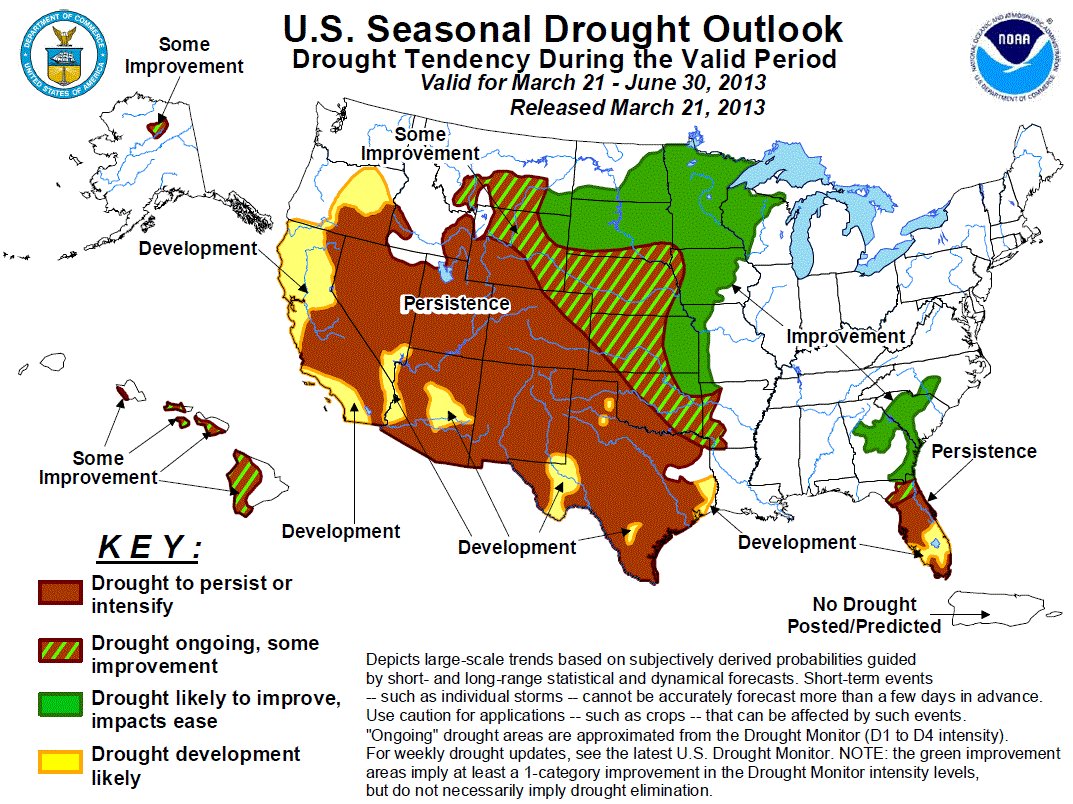
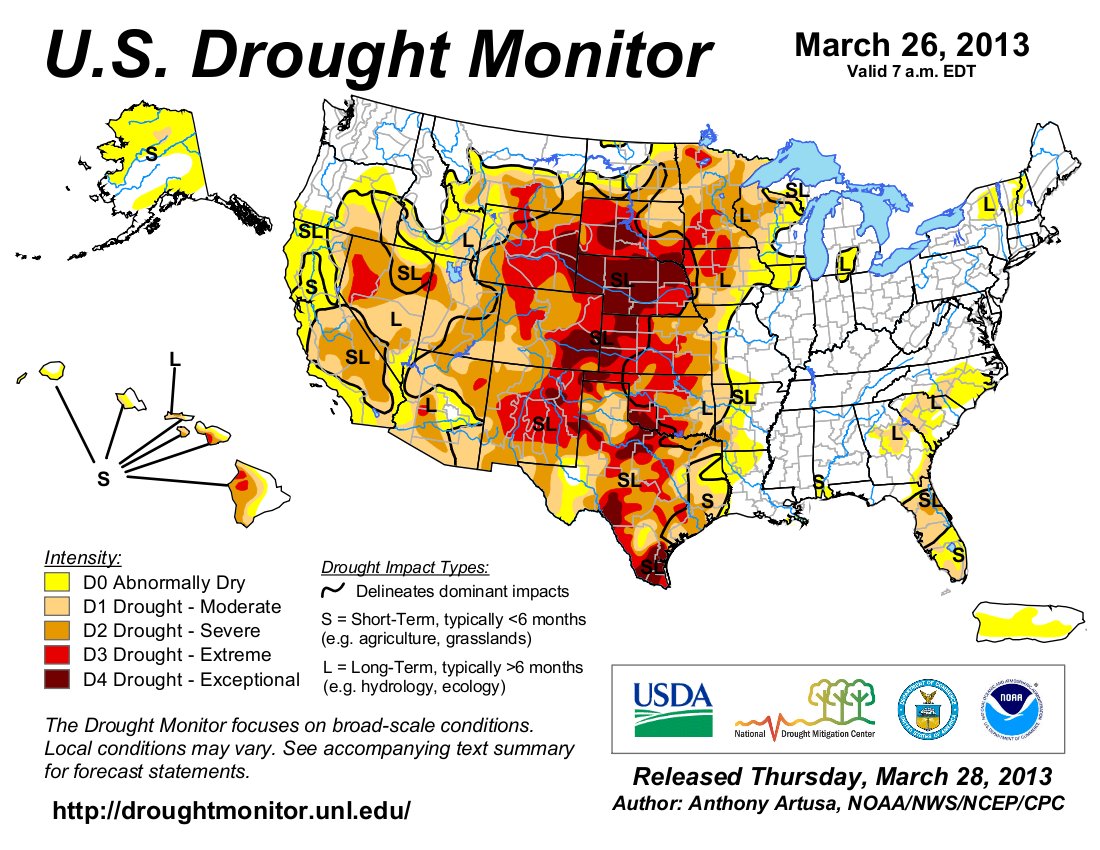
● The entire state of Colorado is in some stage of drought, with the most extreme area over the Eastern Plains. The Arkansas River basin has been in drought since August 2010. During that 31-month period, precipitation has been half of normal in the Pueblo area.
From The Pueblo Chieftain (Matt Hildner):
Snowpack and streamflow figures in the Rio Grande Basin are approaching the drought conditions of a decade ago, the division engineer for the basin said Tuesday. “It’s ugly,” Craig Cotten said. “We’re getting close to what it was in 2003.”
He said snowpack for the basin was at 73 percent of the average peak.
And preliminary forecasts from the Natural Resources Conservation Service for the San Luis Valley’s two biggest rivers are just as grim.
The Rio Grande is expected to have 335,000 acre-feet, which is down by roughly 70,000 acre-feet from last year.
Forecasters predict the Conejos River will have 107,000 acre-feet, down from 215,000 acre-feet last year.
Irrigators on the Rio Grande will be allowed to open their ditches Monday, but they’ll see a river that’s well below normal flows. “The Rio Grande right now is about 300 (cubic-feet per second) when it should be about 500 or 600 cfs,” he said.
The low flow numbers likely will reduce the burden irrigators face under the Rio Grande Compact, the requirements for which vary depending on the level of snowpack and streamflow.
Cotten said curtailments of diversions on the Rio Grande would start at 8 percent.
From the Westminster Window (Ashley Reimers):
Westminster City Council unanimously approved the city’s water conservation plan at its March 25 meeting. The plan will provide a roadmap for the city to reach conservation goals in the Comprehensive Water Supply Plan.
Since 2010 city staff has been updating the city’s water conservation plan and staff also encouraged the community to make comments on the plan before the plan was finalized and approved during the meeting.
The plan has also been reviewed by the Colorado Water Conservation Board (CWCB) and if approved by CWCB, the city will qualify for future funding from the state board.
“The plan develops long-term strategies for water conservation programs, implementing and tracking water savings to assure attainment of the water conservation goals required to meet the city’s future build-out water needs,” said Stu Feinglas, city water resources analyst.
According to the staff report, the city has a goal of conserving another 2,200 acre-feet of water by build-out, which represents a 6 percent reduction in build-out water demand due to future conservation savings. Feinglas said the city has been doing water conservation for a long time, and in turn, the city has saved quite a bit of water.
Most of the city’s conservation needs will be met through passive conservation, like customers purchasing efficient washers and toilets and following the city’s landscape regulations, he added.
“Our customers are already using water at a very efficient level,” Feinglas said. “People are buying efficient appliances and using the city’s free irrigation audit to learn how to effectively irrigate their yards with the appropriate amount of water.”
From the Fort Collins Coloradoan (Bobby Magill):
April 1 is the day Colorado’s water watchers face the truth about the state’s snowpack, which generally peaks around that date. On that day, they begin predicting how much water is going to flow into mountain streams and reservoirs and how high the Poudre River’s rollicking rapids are going to be during the spring runoff. This is the truth they face now: Snowpack in Northern Colorado is 30 percent below normal, except in the Laramie and North Platte river basins, where it’s 20 percent below normal. Statewide, the average snowpack is 28 percent below normal…
The good news is that Northern Colorado’s snowpack often peaks later than the rest of the state, so there’s hope that new snow in the coming weeks could improve its levels, Colorado State Climatologist Nolan Doesken said. The bad news is that this dry year comes on the heels of one of the driest years on record…
Streamflow on the Poudre River during runoff season this year is expected to be about 35 percent below normal and 49 percent below normal on the Big Thompson River, Doesken said. It’ll take three or four major spring rain and snowstorms to recover from the current drought. “Probability is we’ll have one or two,” he said.
From the Summit County Citizens Voice (Bob Berwyn):
The good news is that the snowpack hasn’t quite peaked yet, according to the April 1 compilation of statistics from automated SNOTEL sites and manual survey results. The bad news is that soil moisture in many parts of the state is still at drought levels, and reservoir levels are well below average and lagging behind last year. While March snowfall was above average in some parts of Colorado, the statewide snowpack increased by only one percent during the month, from 73 percent of median on March 1, to 74 percent of median on April 1.
Like this:
Like Loading...