
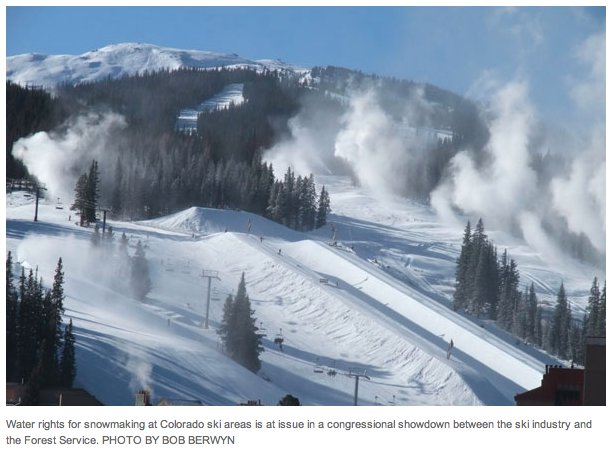
From The Colorado Springs Gazette (James Hagadorn):
Like grow lights and center-pivot irrigators, snow guns are technological lynchpins of the Colorado economy.
But what governs how snow is made? And what are its impacts?
The region’s humidity is a major factor. If the air is dry enough, snow can be made at temperatures above freezing, or 32 degrees. Just as evaporating sweat helps to cool us, when it’s dry, water droplets evaporate and cool as they’re ejected from snow guns. Thus, in dry conditions, evaporative cooling lowers localized temperatures enough to freeze water droplets, even with temps up to 40 degrees. Conversely, when air is moist, little evaporation occurs and lower ambient air temperatures are needed for ice crystals to form.
During snowmaking, another type of cooling – called expansive or adiabatic – also takes place. If you’ve ever felt how cold a can of compressed air gets after usage, you’ve experienced this effect. Such cooling occurs when compressed air shot from a snow gun expands as it’s released from the water nozzle. The expansion causes cooling, helping to freeze the water droplets. This process can drop temps nearly 100 degrees within inches of the water nozzle.
Many ski areas have hundreds of snow guns and a cornucopia of special nozzles to take advantage of these phenomena. They are used on the ground or mounted on towers, poles or lances. All rely on high water pressure and high air pressure to produce snow.
Man-made snow isn’t shaped like the delicate and pointy six-sided snowflakes that children cut from folded paper. Rather, it is shaped like a sphere and is a denser, larger particle. Sometimes the cores of flakes made by snow guns aren’t frozen by the time they hit the ground, so the piles, or whales, of snow are allowed to cure for days until they’re bulldozed into place.
Whether it’s fresh or stale, artificial snow behaves quite differently than nature’s own. To skiers and riders, it’s more akin to sticky concrete than to fluffy powder. That’s because it’s almost 30 percent ice and 70 percent air, compared with the best natural snow, which is about 10 percent ice and 90 percent air. One positive is that man-made snowflakes are more durable, making them ideal for establishing a base or creating jumps, pipes and terrain parks.
Snowmaking uses an incredible amount of energy. It takes megawatts to transfer water uphill and cool it before pumping it; to compress, cool and dehumidify air before sending it downpipe; and to install, maintain and run all of the associated equipment.
With higher temperatures and higher humidity, the costs can more than double. That’s why there’s been a push over the years for better technology that brings efficiencies in energy, climate and timing. For example, nozzles have improved to the point where they make much smaller crystals with less air, which translates to more snow for the same amount of pumping energy.
Today’s snow guns use less than a third of the air employed by those a decade ago – a notable achievement given that compressing air requires more energy than pumping water. Some ski areas store water in upslope ponds, which then feed into snowmaking lines, again saving pumping energy. Other ski areas have built bottom-of-mountain storage ponds because pumping water long distances, with the miles of pipe needed to transport water to snow guns, is expensive.
In general, 20 percent more snow is made in Colorado today, using 40 percent less energy, than 10 years ago.
But what about the water? Most of it is purchased or taken from streams, rivers and runoff. Like the Front Range’s “buy and dry” strategy for securing agricultural water, ski corporations have snapped up senior water rights to the tune of millions per year. Fortunately, nearly 80 percent of this water gets returned to the system whence it came, with the remainder lost to evaporation. Some even recapture the meltwater and reuse it.
The quantity – and timing of diversion/return – of this water has serious impacts on the quality of water and scope of downstream watersheds.
And the future? As the planet warms, the high country will have warmer average low temperatures. The ski seasons will become shorter, and their shoulders will be less predictable because spring storms will more frequently bring rainfall or freezing rain in place of light fluffy snow. So snowmaking will become even more important, despite the fact that the energy byproducts from installing, maintaining and operating snow guns contribute to global warming.
Notwithstanding these issues, plan on seeing more snowmaking. It feeds the state’s economic engine and continues to improve in efficiency, reducing its environmental impact. Over the long haul, it is more predictable than the cloud-seeding strategies invested in by skiing and agriculture industries.