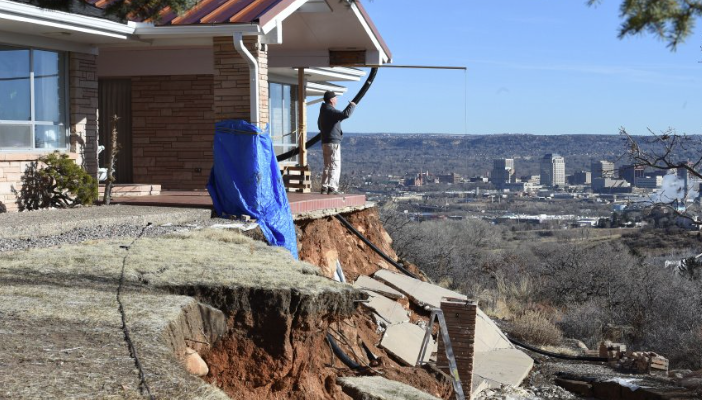
Rick Sisco’s home in the Skyway neighborhood has been riding a landslide for months. It started as a crack, became a chasm, then a 13-foot cliff.
But because Sisco’s circa-1964 home was built long before Colorado Springs passed its geological hazards ordinance, city officials know very little about the landslide that has ruined Sisco’s property.
It’s part of an estimated $14 million problem now facing the city, involving several older homes in southwest Colorado Springs that have been destroyed or buckled by landslides in the wake of record-setting rains in May. A lack of information is yet another obstacle facing city officials, who are dealing with damaged homes, unstoppable landslides and development concerns.
The city hopes federal aid will cover 75 percent of the $14 million price tag to buy at least 20 homes, but the city and homeowners will pay the remainder.
In the meantime, city officials will also consider updating the geological hazards ordinance, which requires assessments of landslide risk on properties.
While Colorado Springs’ geology is infamous for its landslide potential, the city has not faced a problem of this scale since April 1999, when heavy rains triggered slides and prompted the buyout of 27 homes on the southwest side of town.
Modern landslides in the Pikes Peak region are a consequence of ancient geology. The land that formed Colorado Springs sits on steep and weak shale eroded over millions of years. Because of this, landslides have plagued Colorado Springs since 1959, city records show.
A 1996 landslide prompted the city to pass the first version of the geological hazards ordinance, which required geological assessments for homes in danger zones, such as the Broadmoor Bluffs areas. The ordinance was updated in 1999 and 2011, but older homes like Sisco’s have escaped the city’s scrutiny. Now, nearly two decades after the last rash of landslides, these homes built without geological study are at risk.
“What we know now is that these are very expansive soils,” said Tim Mitros, a city engineer who is helping oversee the landslides for the Office of Emergency Management. “If we would have known that back in the day, we would have required overdigs and underdrains. . But because (these homes) were built back in the ’50s, when we didn’t have a geological hazards ordinance, they are being impacted.”
City officials have informally asked the Housing and Building Association to help them evaluate existing codes, HBA President Tim Seibert said. Re-evaluating codes is an natural part of disaster response and one the city and the HBA have worked on before, most recently after the 2012 Waldo Canyon fire, which prompted drastic changes to fire and building codes for homes in wildfire-prone neighborhoods.
But it’s too early to say if the city’s geological hazards ordinance will change, said Bret Waters, director of the Office of Emergency Management.
“I think after every disaster we want to evaluate not just ordinances, but the entire event,” Waters said. “Could that end up with a change in code? We don’t know at this point. We’ve really got to continue to study this – if there needs to be some solution to prevent it in the future.”
The city plans to look at ordinances adopted by other municipalities affected by landslides, Mitros said. A potential ordinance change in Colorado Springs might target empty land platted before the hazards ordinance was passed, Mitros said.
“We do have a lot of building lots on the west side that were platted before 1996,” he said. “Should we look at those differently? I don’t know.”