Colorado River “Beginnings”. Photo: Brent Gardner-Smith/Aspen Journalism
Click the link to read the article on The Aspen Times website (Ali Longwell). Here’s an excerpt:
October 8, 2025
The Shoshone water rights acquisition and negotiations on post-2026 Lake Powell and Mead operations dominate conversations at the Colorado River District’s annual water seminar
Western Slope elected officials, water managers, engineers, and conservationists met in Grand Junction on Friday, Oct. 3, all focused on one thing: the uncertain future of the Colorado River.
“Water users, as a lot, tend to crave certainty, and that certainty seems more and more elusive these days,” said Peter Fleming, general counsel for the Colorado River District, at this year’s annual seminar hosted by the River District.
While the seminar broached many of the challenges and opportunities facing those who rely on the Colorado River, most discussions came back to two looming decisions that will dictate how the future looks for the 40 million people, seven states, two counties, and 30 tribal nations that rely on the waterway. This includes the River District’s proposed $99 million acquisition of the Shoshone water rights and the interstate negotiations over the post-2026 operations of Lake Powell and Lake Mead. Both decisions will have ramifications for all Colorado River users — including agriculture, recreation, and municipal water — but are stalled by competing interests, be it political, geographic, or otherwise…The River District is currently working through a multi-year process to purchase the Shoshone water rights from Xcel Energy for $99 million. The rights — established in the early 1900s — are the oldest, non-consumptive water rights on the Colorado River…The Shoshone water right is currently tied to the hydroelectric power plant in Glenwood Canyon, which returns 100% of the water used to produce electricity to the river. However, he said that uncertainty surrounding the plant’s longevity, given its age and location — which he called an “area of great geohazard” — led the River District to seek acquisition of the rights. Under the proposed acquisition, Xcel would continue to operate the plant…The district intends to purchase the right and reach an instream flow agreement with the Colorado Water Conservation Board — the only entity that can hold an instream flow water right in Colorado. Doing so would maintain the status quo of the river, the River District claims. Defining what the status quo looks like, though, has led to disagreements between the West Slope entity and East Slope water providers…
Water allocation on the Colorado River dates back to the 1922 compact agreement, which divided the river between the upper and lower basins. Right now, it’s not the compact, but the 2007 operational guidelines for Lake Powell and Lake Mead that are being renegotiated. While the four Upper Basin states — Colorado, New Mexico, Utah, and Wyoming — rely predominantly on snowpack for water supply, the Lower Basin states — Arizona, Wyoming, and Nevada — rely on releases from Lake Powell and Lake Mead. The 2007 guidelines for the two reservoirs, which govern how they store and release water, are set to expire in 2026. The seven states have until Nov. 11 to try and reach a consensus on the reservoirs’ post-2026 operations; otherwise, the federal government will step in and impose its own plan.
Becky Mitchell, who has been negotiating on Colorado’s behalf, said on Friday that she is “hopeful” for this seven-state consensus “because the alternative is not great.” “I think we’ve kicked the can and we’re at the end of the road,” Mitchell said…Throughout the negotiations, the Lower Basin states have advocated for basin-wide water use reductions. The Upper Basin states, however, have pushed back on the idea, claiming they already face natural water shortages.
“In Western Colorado, it happens every year,” [Andy] Mueller said.
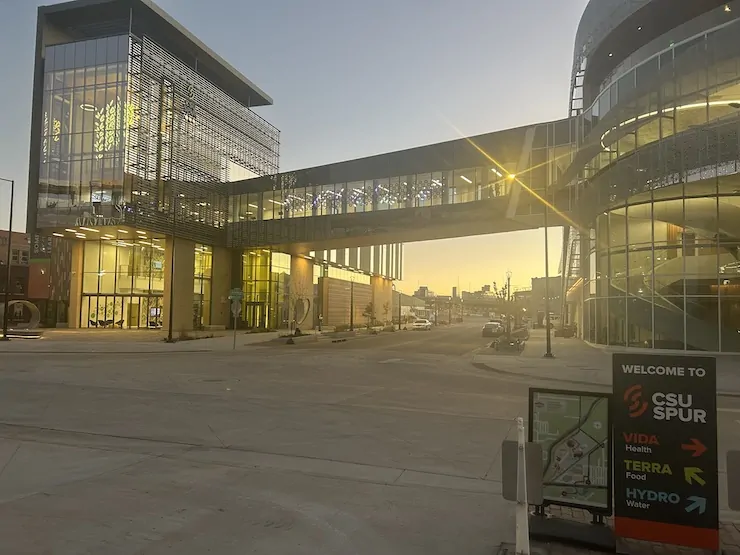
CSU Spur at dusk October 14, 2025. Photo credit: Allen Best/Big Pivots
Click the link to read the article on the Big Pivots website (Allen Best):
October 17, 2025
We heard about Colorado’s warming but uncertain climate. We heard about research projects. But what exactly is this new Climate Hub all about?
Colorado State University has created a Climate Hub that is to be based at its Spur campus in the heart of what used to be industrial Denver. This is on the grounds of the National Western Complex.
This is north of downtown Denver, near Colorado’s transportation hub: the intersection of Interstates 70 and I-25. When I first visited the National Western, no interstate highways existed anywhere. That dates me. I can vaguely remember my grandfather, a farmer/rancher from northeastern Colorado, boosting me up atop a fence to see all the cattle. I suspect that some were his.
The cattle have all disappeared except during the Stock Show each January. You can still smell a bit of manure, though, when walking from the parking lot to the Hydro Building, one of four major and architecturally interesting buildings erected on this new campus so far. A certain amount of research goes on at this campus. A correspondent from Gardner, a hamlet in south-central Colorado, mentioned that he had just mailed water and soil samples that he needed tested to the laboratory in the Hydro Building. Denver Water operates its lab there.
As for this event, I suspect it would fall under the label of “marketing.” I was there for the full two hours of presentations and heard much that was interesting but left without understanding exactly what was new.
CSU undeniably has its fingers in what the Climate Hub, at its website, calls “a defining challenge of our time.”
Russ Schumacher, the state climatologist, a professor at CSU, was an obvious choice for leading off a program like this. He recapped the climate report issued in 2024: We have already warmed an average 1.5 degrees Fahrenheit, he said. The 10 warmest years in Colorado’s recorded history going back to the 1870s have been in the 21st century. Last year was the fourth warmest, but this year, not as warm — but still in the top 20 on record.
And much more warming is in store, between 1 and 4 degrees Fahrenheit by 2050, given current emissions trajectories.
“Precipitation is more complicated,” he explained. “If you look at long-term trends, it hits hard, too, but you see a lot of ups and downs.”
Flooding will worsen, as will wildfires. We can also expect more heat waves and droughts.
Oh yummy. Somebody other than Russ, with his happy persona, could leave you very depressed.
The Climate Hub “explainer” meeting on Oct. 14 on the CSU Spur campus. Photo credit: Allen Best/Big Pivots
But then, that’s the story at CSU. They are figuring out solutions. Debby-downer is not the vibe.
For example, there was no talk of converting the world into vegetarians. Instead, Dr. Sara Place, who is an associate professor of feedlot systems (yes, I’m not making this up), talked about the effort to reduce the methane from the burping of cattle. It’s burps, not farts, that produce this significant component of our greenhouse problem. They constitute 3.1% of total U.S. greenhouse gas emissions.
The takeaway static from the cows-burping presentation was that 80% of the methane emissions come from cattle grazing on grass, not cattle chowing down in feedlots as they fatten up for the conveyor belt to the butchery. And yes, solutions are being devised, although I am at a loss to explain any of this.
Somewhat similarly, we got a peek at the research that has been underway at CSU now for a number of years to tighten up the methane emissions leaking from our “natural” gas infrastructure. “You can’t manage what you don’t measure,” said Dr. Dan Zimmerle.
And still other research, some of it global in scale, is underway, a bit difficult to summarize in something less than, well, maybe a 10,000-word tome. And some of it very Colorado-centric. One presenter asked if any of those in the room had been to Sterling? To Eads? (These are towns in eastern Colorado). My hand was only among a few raised in the room.
This was all part of an explanation about a new concept called digital twins. They can observe what is happening in the field from laboratories.
Surprising, though, was a tag-team effort to peel us back from the narrow confines of what we think we know to imagine possible futures. It was a marked departure from the usual conveyor belt of facts and exhortations at climate meetings.
Courtney Schultz, director of the CSU Climate Initiative, quoted an author, Jim Dater, who had said that the future cannot be predicted. The only useful ideas about the future should (at first) appear to be ridiculous.
Only later did I think about science itself. Some of the big ideas, such as plate tectonics, were originally seen as ludicrous, to be laughed out of the room.
We were asked by Lynn Badia, a professor of English, to engage in what she called speculative storytelling.
We were quickly induced to exercise some of this outside-our-boxes imagining. Can’t say that anything I imagined for Olde Town Arvada in 2050 was all that imaginative. High(er) rises? Fewer blue skies. The next round, I got a little more adventurous: glasses that you could wear that would allow you to see the essence of the person you were looking at.
Again, only later, did I ponder smart phones. Twenty-five years ago could I see people wandering down sidewalks, sauntering across streets, seemingly mindless of traffic or, for that matter, anything else around them, their faces scrunched close to little boxes in their hands? We call them smart phones, and sometimes I seem them in droves — and just down the street.
“Have you exaggerated the possible changes to the point of absurdity?” Badia asked us.
It was fun. I am so accustomed to trying to verify facts, not to imagine the future.
Others in attendance that I consulted afterward echoed my read on the event. CSU wants to make its presence better known and the willingness to work with the private sector. That already exists with the methane-testing center. Zimmerle said they were working with many oil and gas companies trying to respond to increasing regulation by the Colorado Department of Public Health and Environment. A member of the Climate Central team talked about providing help to Fort Collins Utilities.
One individual pointed to two themes: (a) the value of collecting, analyzing and making available substantive data; and (b) a growing partnership between universities and the private sector, filling in the new gap caused by the termination of the federal government as a research partner.
You can also see that at the CSU Climate Hub website in its statement that it “partners with diverse groups to co-create impactful solutions.”
The Legacy building, which is located across the street from the Hydro and Terrra buildings on the CSU Spur campus in Denver, appears to be ready for imminent occupancy. Photo credit: Allen Best/Big Pivots
As we left the Hydro building, I paused to study the latest edifice — a word I use with deliberation — that is soon to be available for public occupation. Just down the street, though, were train cars, perhaps containing crude oil. Who knows.
When I first moved from the mountains to Denver in 1998, I remember the vacant field west of the train tracks at Union Station. Nothing there. A place of homeless people, maybe. Now? The folks from Aspen and Vail have built luxury real estate. Some of the units overlook the train tracks that to this day are used by coal trains exporting carbon from the coal pits of Wyoming to distant power plants.
I could not then imagine the scene observable today at Union Station. Frankly, it has been very hard for some people to imagine the end of the fossil fuel era. But I may live long enough to see the end of those coal trains. I can imagine that.
President Donald Trump’s quest for what he calls energy dominance has run into a few snags, many of which are of his own making. Let’s set aside, for a moment, the fact that the term “energy dominance” doesn’t really make sense (What is energy dominating? Or are we dominating energy? Or …????). Let’s assume that it’s just an insecure male’s version of energy independence (so woke!), or just a dumb term for producing enough energy to keep all the data centers running.
In that case, don’t you think you’d want to use all of the tools — or weapons, if you prefer — at your disposal? Certainly any reasonable person, even one who doesn’t care about pollution or greenhouse gas emissions, would do that, pushing for more solar, wind, battery storage, hydropower, and geothermal, in addition to nuclear and natural gas. But as has been shown over and over, Trump tends to let his personal whims — along with a desire to crush everything that he thinks Democrats favor — erase rationality.
As a result, he has waged war on the most promising energy sources (i.e. solar and wind), while trying to dust off the old, dying ones (i.e. fossil fuels) and prop them up on the battle lines in hopes they won’t fall down too soon. Well, it’s not working out so well.
Oil and gas drilling is continuing on federal lands, although at a much slower pace than during the Biden administration, even though Trump has handed out drilling permits like candy at a parade. That’s in part due to low oil prices, and in part due to higher drilling costs: Trump’s tariffs have increased the price of pipe and other materials used on the rigs.
The number of rigs actively drilling has stayed somewhat steady over the last nine months, but rig counts remain below what they were in 2023 and 2024 and there are no signs that Trump’s “drill, baby, drill” rhetoric is having the desired effect. Source: Baker Hughes, Land Desk graphic.
But the most obvious failure is playing out in the administration’s bid to revitalize the flagging coal industry. Let’s take a look:
After the administration and congressional Republicans made much ado about rescinding Biden-era moratoria on new federal coal leasing, the Interior Department rushed to auction off parcels containing hundreds of millions of tons of coal in Montana, Wyoming, and Utah. They flopped:
In Montana, the Navajo Transitional Energy Company bid $186,000 for a tract containing an estimated 167 million tons of coal adjacent to its Spring Creek Mine in the Powder River Basin. That’s a mere 1/10 of one cent per ton. Contrast that with other Powder River Basin leases in 2012 that brought in more than $1/ton. The feds rejected the bid, saying it was below fair market value.
The dismal result prompted the Bureau of Land Management to cancel the 441-million-ton West Antelope coal lease sale in Wyoming.
And then the Interior Department rejected a single lowball bid for a lease containing about 6 million tons of federal coal in Utah.
On a somewhat related note: After the Trump administration announced it would subsidize the coal industry to the tune of $625 million, PacifiCorp said it would go forward with its plans to convert the Naughton coal plant in Wyoming to run on natural gas.
You’d think that maybe the administration would get a hint and adjust their strategy accordingly. Yeah, right.
A warning sign in the Lisbon Valley. Jonathan P. Thompson photo.
⛏️ Mining Monitor ⛏️
Last week, Anfield Energy announced that Utah regulators had approved its proposed Velvet Wood uranium mine in the Lisbon Valley. “Permitting Complete, Construction to Follow,” the company’s press release says, adding that they expected to break ground within 30 days. The project was the first beneficiary of Trump’s accelerated “energy emergency” permitting, and the BLM completed its environmental review in a mere 13 days.
The company may be jumping the gun a bit. The Utah Division of Oil, Gas, and Mining actually gave only tentative approval to the project, conditioned upon the company posting a $539,000 bond. And it specifies that no ground disturbance can happen until the project gets other applicable agencies’ go-ahead.
But as Sarah Fields of Uranium Watch points out, Anfield has not yet received approvals from other state agencies for its radon ventilation shafts, wastewater treatment plant, or its air quality permit.
Anfield — or at least its PR team — is busy as of late. They also announced that they had completed the first phase of exploratory drilling at the defunct JD-7 uranium mine in the Paradox Valley. While these announcements are a dime-a-dozen, I was a bit intrigued by this one, because the JD-7 is like a poster child of the follies of the last uranium “boom.” It’s an open pit, a gaping wound overlooking the valley, but never actually produced any uranium because the “boom” busted before it even really began. Somehow I’m not convinced that this time will be much different.
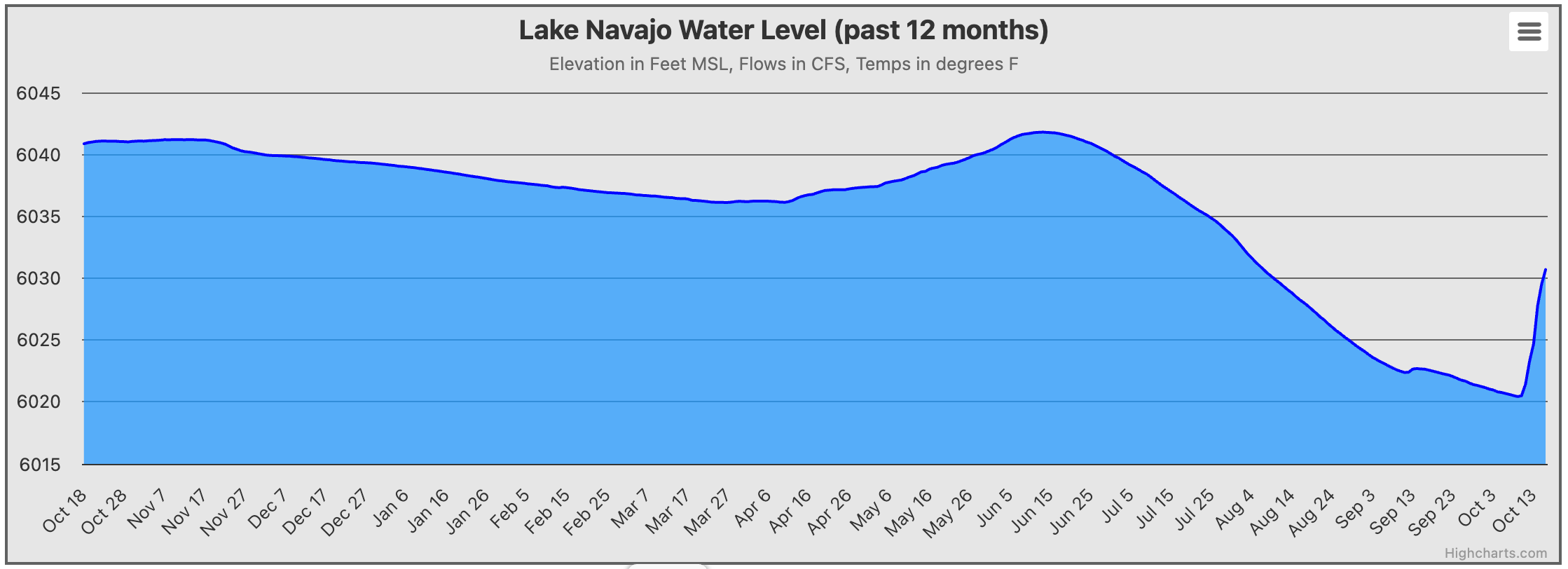
As one might expect, the recent rains and resulting flooding boosted reservoir levels. Navajo Reservoir saw its surface level jump considerably (rising about 10 feet) due to all that water in the San Juan River. However, it’s still lower than it was this time last year.
Source: Lake Navajo Water Database
Lake Powell, which is much, much bigger, only added 1.28 feet to its surface level, and remains 32 feet below what it was on this date last year. But as the following graph shows, the big water is still making its way into the reservoir, so its level could keep climbing.
📸 Parting Shot 🎞️
I’m on the road right now, making my way from southern Oregon to southwestern Colorado via a circuitous route. And no, I’m not in the Silver Bullet (I’ll reveal the purpose of the trip later, along with more details about Land Desk transportation). I don’t have my good camera with me, but I’ve tried to get some snapshots anyway.
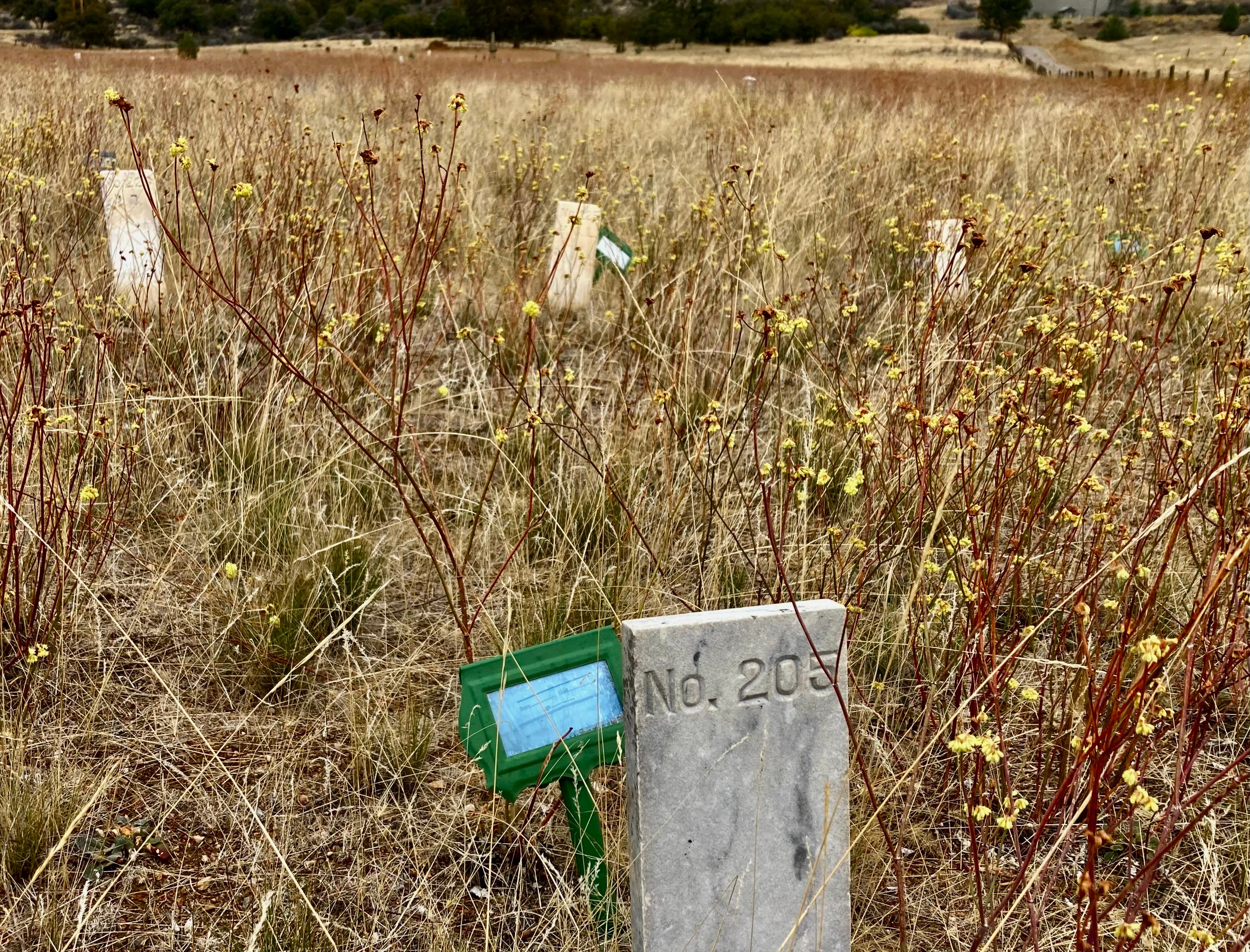
Gravestones in City Cemetery, Yreka, California. Photo credit: Jonathan P. Thompson
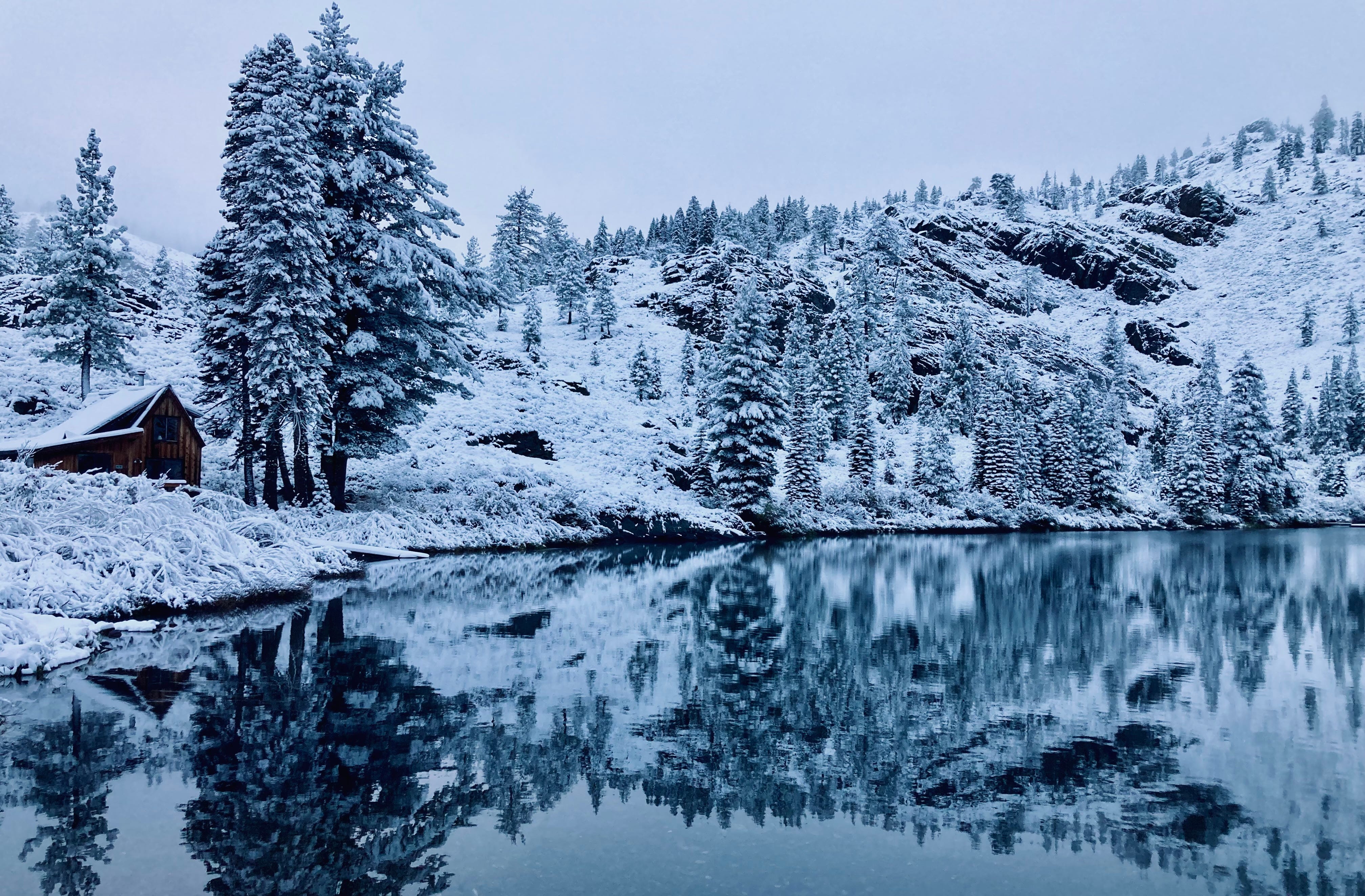
Snow and water in the eastern Sierras. Jonathan P. Thompson photo.
Basin and Range country along Hwy 50. Photo credit: Jonathan P. Thompson