Click the link to read the article on The Land Desk website (Jonathan P. Thompson):
October 17, 2025
🔋Notes from the Energy Transition 🔌
President Donald Trump’s quest for what he calls energy dominance has run into a few snags, many of which are of his own making. Let’s set aside, for a moment, the fact that the term “energy dominance” doesn’t really make sense (What is energy dominating? Or are we dominating energy? Or …????). Let’s assume that it’s just an insecure male’s version of energy independence (so woke!), or just a dumb term for producing enough energy to keep all the data centers running.
In that case, don’t you think you’d want to use all of the tools — or weapons, if you prefer — at your disposal? Certainly any reasonable person, even one who doesn’t care about pollution or greenhouse gas emissions, would do that, pushing for more solar, wind, battery storage, hydropower, and geothermal, in addition to nuclear and natural gas. But as has been shown over and over, Trump tends to let his personal whims — along with a desire to crush everything that he thinks Democrats favor — erase rationality.
As a result, he has waged war on the most promising energy sources (i.e. solar and wind), while trying to dust off the old, dying ones (i.e. fossil fuels) and prop them up on the battle lines in hopes they won’t fall down too soon. Well, it’s not working out so well.
Oil and gas drilling is continuing on federal lands, although at a much slower pace than during the Biden administration, even though Trump has handed out drilling permits like candy at a parade. That’s in part due to low oil prices, and in part due to higher drilling costs: Trump’s tariffs have increased the price of pipe and other materials used on the rigs.

But the most obvious failure is playing out in the administration’s bid to revitalize the flagging coal industry. Let’s take a look:
- After the administration and congressional Republicans made much ado about rescinding Biden-era moratoria on new federal coal leasing, the Interior Department rushed to auction off parcels containing hundreds of millions of tons of coal in Montana, Wyoming, and Utah. They flopped:
- In Montana, the Navajo Transitional Energy Company bid $186,000 for a tract containing an estimated 167 million tons of coal adjacent to its Spring Creek Mine in the Powder River Basin. That’s a mere 1/10 of one cent per ton. Contrast that with other Powder River Basin leases in 2012 that brought in more than $1/ton. The feds rejected the bid, saying it was below fair market value.
- The dismal result prompted the Bureau of Land Management to cancel the 441-million-ton West Antelope coal lease sale in Wyoming.
- And then the Interior Department rejected a single lowball bid for a lease containing about 6 million tons of federal coal in Utah.
- On a somewhat related note: After the Trump administration announced it would subsidize the coal industry to the tune of $625 million, PacifiCorp said it would go forward with its plans to convert the Naughton coal plant in Wyoming to run on natural gas.
You’d think that maybe the administration would get a hint and adjust their strategy accordingly. Yeah, right.

⛏️ Mining Monitor ⛏️
Last week, Anfield Energy announced that Utah regulators had approved its proposed Velvet Wood uranium mine in the Lisbon Valley. “Permitting Complete, Construction to Follow,” the company’s press release says, adding that they expected to break ground within 30 days. The project was the first beneficiary of Trump’s accelerated “energy emergency” permitting, and the BLM completed its environmental review in a mere 13 days.
The company may be jumping the gun a bit. The Utah Division of Oil, Gas, and Mining actually gave only tentative approval to the project, conditioned upon the company posting a $539,000 bond. And it specifies that no ground disturbance can happen until the project gets other applicable agencies’ go-ahead.
But as Sarah Fields of Uranium Watch points out, Anfield has not yet received approvals from other state agencies for its radon ventilation shafts, wastewater treatment plant, or its air quality permit.
Trump “emergency” fast-tracks Utah uranium mine — Jonathan P. Thompson

***
Anfield — or at least its PR team — is busy as of late. They also announced that they had completed the first phase of exploratory drilling at the defunct JD-7 uranium mine in the Paradox Valley. While these announcements are a dime-a-dozen, I was a bit intrigued by this one, because the JD-7 is like a poster child of the follies of the last uranium “boom.” It’s an open pit, a gaping wound overlooking the valley, but never actually produced any uranium because the “boom” busted before it even really began. Somehow I’m not convinced that this time will be much different.
A day in Uranium Country — Jonathan P. Thompson
🥵 Aridification Watch 🐫
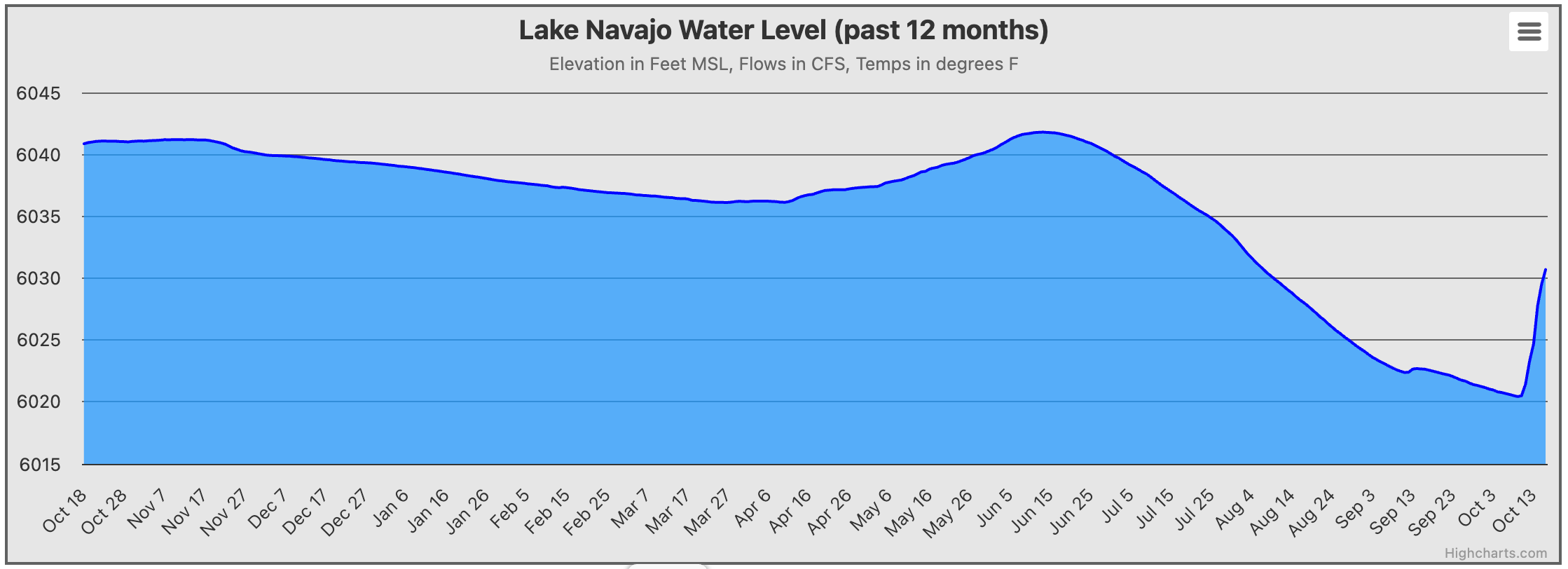
As one might expect, the recent rains and resulting flooding boosted reservoir levels. Navajo Reservoir saw its surface level jump considerably (rising about 10 feet) due to all that water in the San Juan River. However, it’s still lower than it was this time last year.
Lake Powell, which is much, much bigger, only added 1.28 feet to its surface level, and remains 32 feet below what it was on this date last year. But as the following graph shows, the big water is still making its way into the reservoir, so its level could keep climbing.

📸 Parting Shot 🎞️
I’m on the road right now, making my way from southern Oregon to southwestern Colorado via a circuitous route. And no, I’m not in the Silver Bullet (I’ll reveal the purpose of the trip later, along with more details about Land Desk transportation). I don’t have my good camera with me, but I’ve tried to get some snapshots anyway.