
Mrs. Gulch’s landscape October 21, 2025

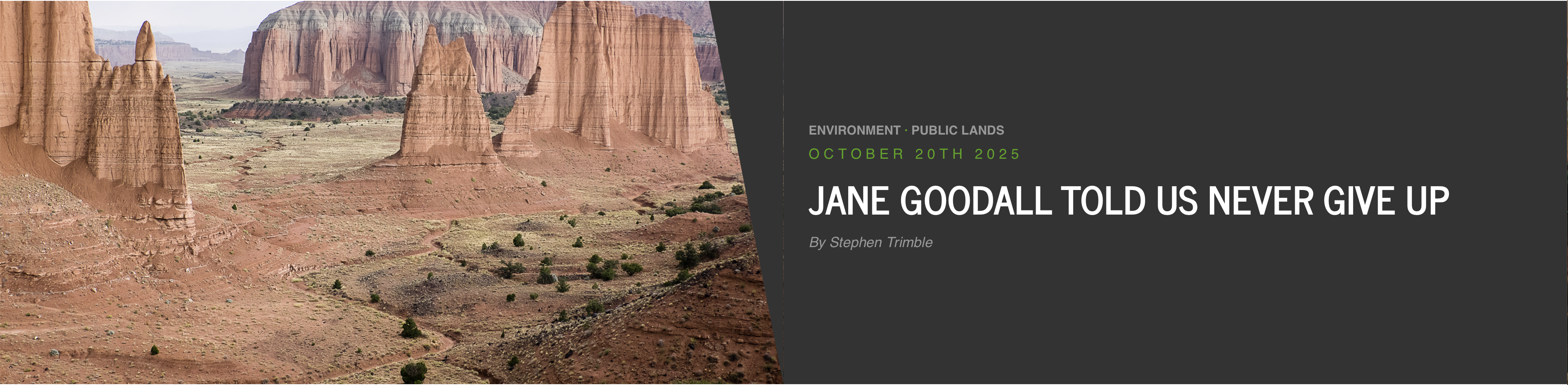
Click the link to read the article on the Writers on the Range website (Stephen Trimble):
October 20, 2025
In her “Last Words” interview that was broadcast after her death, Jane Goodall talked about her calm in the face of “the dark times we are living in now.” She devoted her life to battling for conservation but attributed this serenity to the time she spent in the forest with the chimps. All those weeks and months and years of quiet observation.
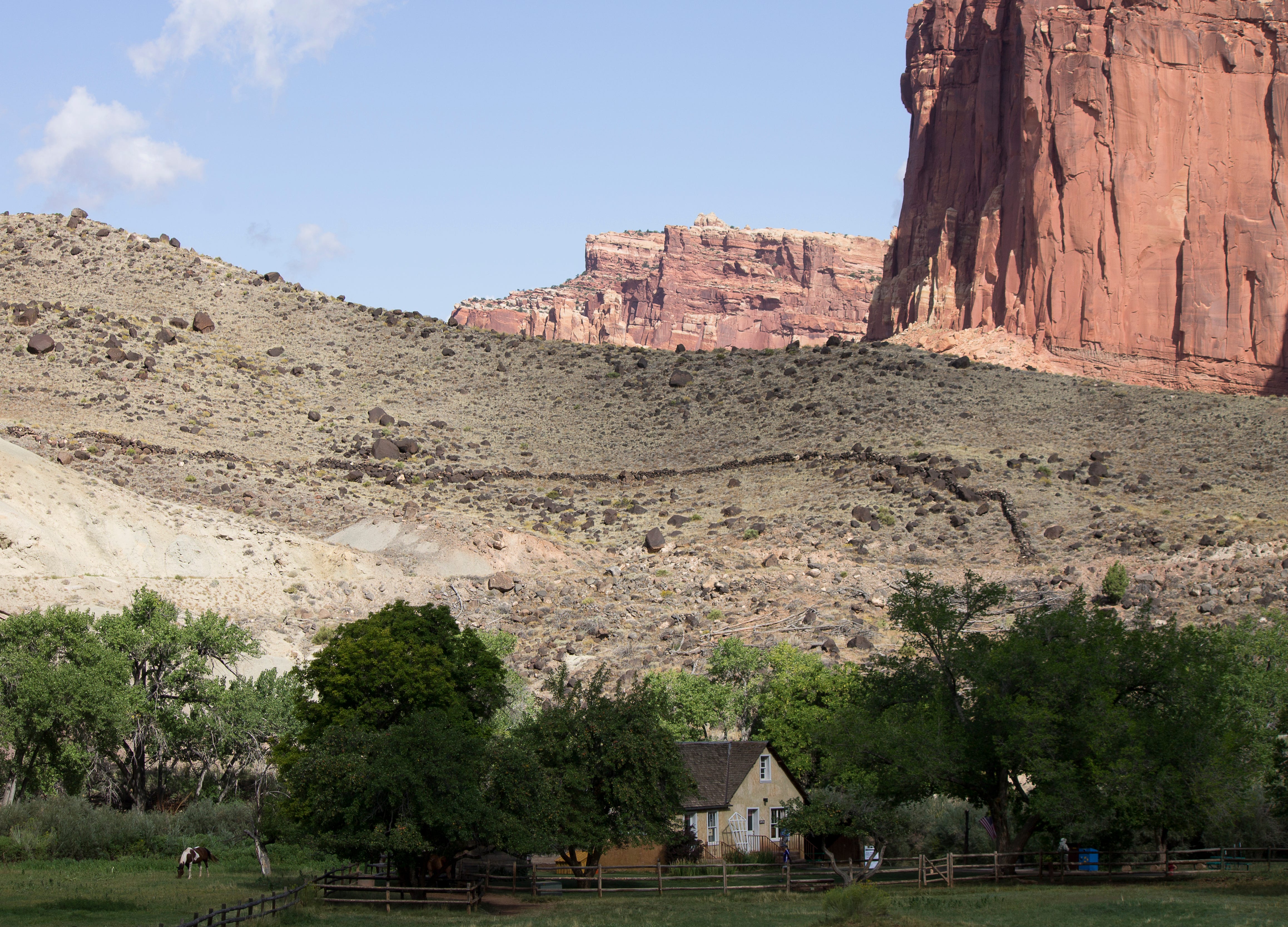
Such quiet is a rare gift. I haven’t been in Goodall’s Tanzanian rain forest, but recently shared Utah’s Capitol Reef National Park with a 25-year-old cousin visiting from urban America. Once in the canyons he kept pausing to say, “it’s so peaceful, so still.” He was astonished and renewed by that quiet.
This canyon country stillness is under attack. The assaults come in waves powered by motorized vehicles, engines revving.
First, the Trump administration proposes abandoning the 2023 Bureau of Land Management travel plan for Labyrinth Canyon. This 300,000-acre Utah wildland along the Green River just north of Canyonlands National Park is a gem—a fretwork of slickrock canyons along the river. Labyrinth preserves quiet for rafters, hikers, and bighorn sheep. No death-defying rapids here on this lazy, looping stretch easily paddled by families in canoes.
In a model compromise, the current Labyrinth plan maintains access to more than 800 miles of off-highway-vehicle (OHV) routes, closing only 317 miles to vehicles. In the surrounding Moab region, more than 4,000 miles of routes remain open. OHVs have plenty of room to roam.
But moderation is never enough for Utah politicians determined to motorize every inch of our public lands. They are pushing to reopen 141 miles of closed OHV routes at Labyrinth and hoping for even more. You can comment here before October 24.
In another backtrack on conservation in Utah, the administration has solicited bids for coal leasing on 48,000 acres of BLM land, much of it on and near the boundaries of national parks. The big views from Capitol Reef, Zion, and Bryce Canyon don’t stop at the park boundaries. Visitors, many from other countries, would be horrified by such industrialization of these world-class destinations. Rural Utah depends on these tourists to survive economically.
These are lands that even the conservative second Bush administration deemed unsuitable for mines. As Cory MacNulty, with the National Parks Conservation Association, said of the proposed leasing, “It’s absurd.”
Now the OHV battalions are threatening to overwhelm Capitol Reef National Park.
Utah Republican Senators Mike Lee and John Curtis introduced a bill on October 5 to open virtually every road in Capitol Reef to off-roaders. They claim that disabled Americans need this fundamental change to park policy, though even the park’s back roads are currently accessible by moderately high-clearance cars and trucks. There’s absolutely no need to permit noisy and destructive OHVs.
The senators’ second bill would potentially open other national parks to OHV use. Lee tried to pass nearly identical bills in 2021 and encountered a buzzsaw of resistance from national park advocates.
As retired Capitol Reef superintendent Sue Fritzke said, “OHVs would denigrate the very resources those sites have been set aside to protect, with increased dust and noise and impacts on wildlife, endangered species, and visitors.”
At each mile farther into remote corners of the park, off-highway vehicles become more problematic. Even though a majority of riders obey the rules, some will go off-road. They just will. Their vehicles are designed for this exact purpose. In Capitol Reef’s considerable backcountry—as in all underfunded national parks and monuments— staffing does not allow for constant patrolling to apprehend and ticket wrongdoers.
Capitol Reef is a place to slow down, not speed up. To revel in quiet, not reach for earplugs. To share the healing land with tenderness and restraint.
Lee disrespects national park values with these twin bills, and Curtis, who likes to tout his nature sensitivity on hikes with constituents, should know better. Their misguided proposals should be left to wither in committee and die. Those of us who love the restorative peace of national parks will just keep fighting such regressive bills.
In her last interview, Jane Goodall asked us to never give up: “Without hope, we fall into apathy and do nothing. If people don’t have hope, we’re doomed. Let’s fight to the very end.”
We will.
Stephen Trimble is a contributor to Writers on the Range, writersontherange.org, an independent nonprofit dedicated to spurring lively conversation about the West. He is a writer and photographer in Utah.

Click the link to read the article on the Circle of Blue website (Brett Walton):
The Rundown
- Democrats on budget committees tell EPA and Interior to halt potential staff cuts during the shutdown.
- White House budget office says $11 billion in Army Corps infrastructure projects will be paused.
- BLM will begin an environmental analysis of a proposed expansion of a Mojave Desert gold mine that will need more groundwater to operate.
And lastly, EPA prepares to permit abandoned hardrock mine cleanups under a new Good Samaritan law.
“If you were a nonprofit or a county with a serious water pollution issue coming out of an old set of mine tailings, you could not work on that problem. The moment you touched it, you accepted total liability for the pollution going downstream. So nobody would ever do anything about all these 140,000 abandoned mines. Almost every one of them having some environmental problem. Almost all of it connected to water.” – Sen. John Hickenlooper (D-CO) speaking with the Western Governors’ Association podcast about the problem of cleaning up abandoned mines in the western United States.
Last year the Good Samaritan Remediation of Abandoned Hardrock Mines Act was signed into law. It requires the EPA to permit 15 pilot cleanup projects to be completed within seven years. The projects can be located on private, federal, or state land.
David Hockey, acting director of the EPA Office of Mountains, Deserts, and Plains, said the agency will review project applications starting this fall. He hopes to have the first projects under construction next year and all 15 in progress by summer 2028.
By the Numbers
$11 Billion: Army Corps infrastructure projects that will be “paused,” Russell Vought, the director of the White House budget office, wrote on X. Vought blamed the government shutdown for the freeze. The targeted projects are mostly in states where Democrats are in power, E&E News reports.
News Briefs
Potential Shutdown Staff Cuts
Leading Democrats sent letters to the heads of EPA and Interior asking them to halt potential job cuts at their agencies during the shutdown.Sen. Jeff Merkeley and Rep. Chellie Pingree are the ranking Democrats on the budget committees that oversee spending by those agencies.
Their concern is over the administration’s use of “reduction in force” during the shutdown to pare the federal workforce closer to President Trump’s vision of a diminished bureaucracy, even though Congress is supposed to set funding levels.
“This coordinated, government-wide approach to implementing RIFs during a lapse in appropriations appears designed to circumvent the appropriations process,” they wrote in their letter to Lee Zeldin, EPA administrator.
Of particular concern, they wrote, are proposed changes and reductions to the EPA’s science assessment and research division.
Similar concerns were raised in the letter to Doug Burgum, the interior secretary.
Studies and Reports
State Revolving Fund Audits
The EPA Office of Inspector General reviewed the financial documents for the state revolving fund programs, the main federal vehicle for water infrastructure funding.The review found that 42 state drinking water programs and 43 clean water programs had an independent financial audit.
Audited financial statements help to identify wasteful and fraudulent spending.
On the Radar
Shutdown Continues
Nineteen days and counting, as of this writing.Proposed Mojave Mine Expansion
The Bureau of Land Management will do an environmental impact analysis for a proposed expansion of the Castle Mountain open-pit gold mine in California’s part of the Mojave Desert.The expansion would extend the mine’s life by 30 years and would entail construction of a 32-mile pipeline to supply 2,250 acre-feet of groundwater per year.
The mine is part of FAST-41, a federal program to accelerate project permitting and environmental reviews through close interagency coordination. The project dashboardsuggests that permitting for the Castle Mountain expansion will be completed by December 2026.
Public comments are being accepted through November 20. Submit them via the above link.
A virtual public meeting will be held on November 5 to outline the project and collect public input. Register here.
Federal Water Tap is a weekly digest spotting trends in U.S. government water policy. To get more water news, follow Circle of Blue on Twitter and sign up for our newsletter.