
Click the link to read the assessment on the NOAA website:
February 11, 2026
January Highlights:
- The global surface temperature was the fifth-warmest January on record—the smallest temperature departure since 2023.
- Snow cover extent was below average for North America and near average for Eurasia.
- Sea ice extent was near record low for the Arctic and below average for Antarctica.
- Global tropical cyclone activity was above normal with 11 named storms.

Temperature
January 2025 ranked as the fifth-warmest January in NOAA’s 177-year record, with a global surface temperature 2.02°F (1.12°C) higher than the 20th-century baseline. All 10 of the warmest Januarys on record have occurred since 2007, with the most recent five years (2022–26) among the top 10.
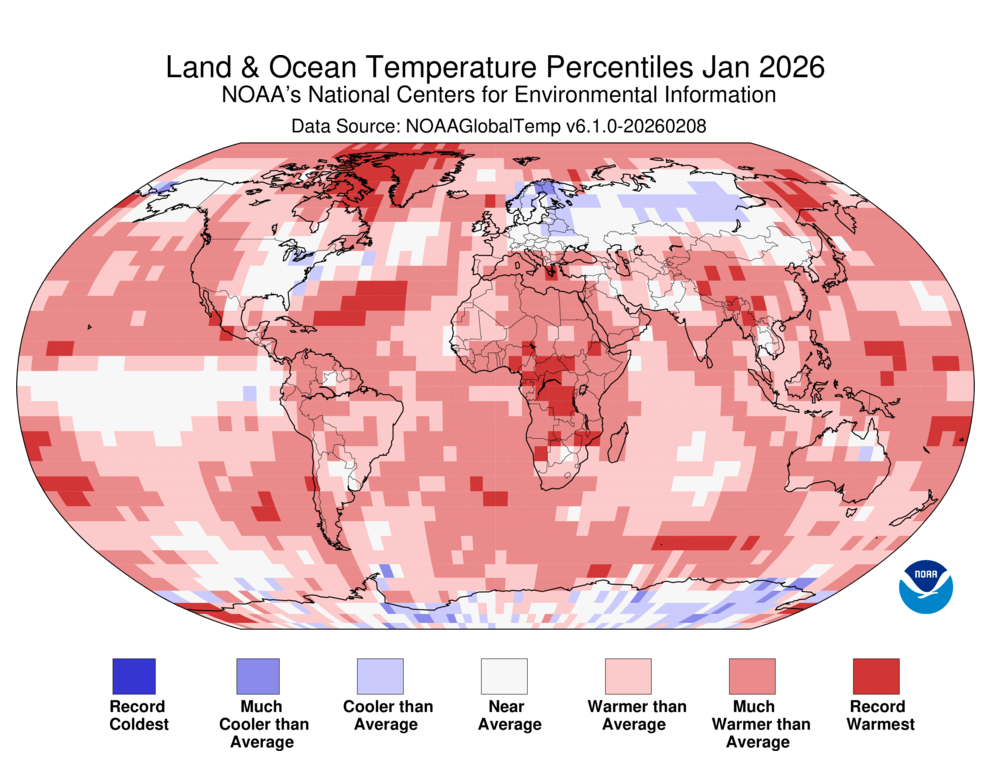
In January 2026, unusually high temperatures prevailed across much of the Earth’s surface. The most notable high temperature departures were observed across the Arctic, Greenland, the western U.S., Canada, Africa, southern and eastern Asia and parts of Australia, where temperature departures were at least 3.6°F (2.0°C) above average. Several regions across the globe experienced their warmest January on record, including parts of Greenland, Africa, Asia, the Atlantic and parts of the Pacific and Southern Oceans. Notably, Africa experienced its warmest January on record, while North America, South America and Oceania had a top 10 warm January.
In contrast, notable below-average temperatures were observed in Alaska, the eastern U.S., Europe, northern Asia and across parts of Antarctica and the central and eastern tropical Pacific Ocean. However, no land or ocean areas experienced record-cold January temperatures.
Snow Cover
In January 2026, snow cover extent across North America and Greenland was 150,000 square miles below average, tying with 2002 for the 12th-smallest January extent on record. Meanwhile, Eurasia saw near-average coverage at 11.48 million square miles. Overall, Northern Hemisphere snow cover for January was slightly below average at 18.12 million square miles.
Regionally, snow deficits were most pronounced across the western half of the contiguous U.S. and central Asia extending into China. In contrast, above-average snow cover was observed in the south-central U.S. extending towards the Northeast, central and eastern Europe, Japan and parts of northern and northeastern China.
Sea Ice
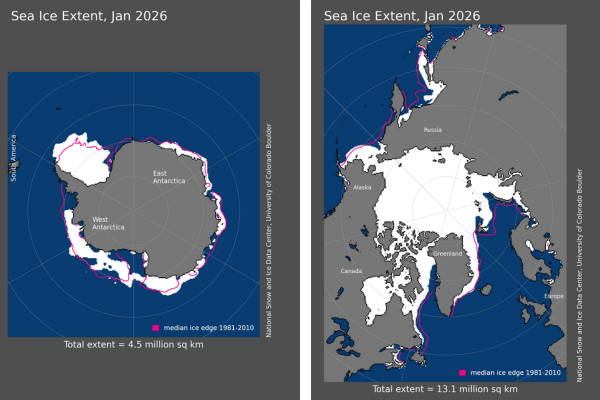
Global sea ice extent was the fifth smallest for January in the historical record at 550,000 square miles below the 1991–2020 average. The Arctic sea ice extent was below average by 340,000 square miles, tying with 2025 as the second-smallest January extent in the 48-year record. The Antarctic sea ice extent for January was the 13th smallest at 210,000 square miles below average.
Tropical Cyclones
Global tropical cyclone activity in January was above normal, producing 11 named storms. Four of these reached tropical cyclone strength, and two intensified into major tropical cyclones. Most of the activity occurred in the Southern Hemisphere (South Indian, Australian and Southwest Pacific basins), with one named storm in the West Pacific. No storms formed in the North Atlantic, East Pacific or North Indian basins, which is typical during January.
Notably, Tropical Cyclone Fytia, in the Southern Indian basin, made landfall in northern Madagascar at the end of the month as a strong cyclone, bringing heavy rainfall and widespread flooding. The storm caused at least 12 deaths, displaced thousands and damaged or destroyed thousands of homes.
For a more complete summary of climate conditions and events, see our January 2026 Global Climate Report or explore our Climate at a Glance Global Time Series.