
Water-intensive industries spring up in Maricopa County during the worst drought in 1200 years

by Robert Marcos, photojournalist

American consumers are well aware that their electric bills have been going up, in some areas dramatically.1 The construction of AI data centers have been widely blamed for this, even though (at present) they’re responsible for only a small part of the increase. In Phoenix and Chandler Arizona – two of the nation’s hottest and driest cities – enormous factories are being built to fabricate the semiconductors used in those data centers, and they’re widely expected to drive up costs that local residents pay for both electricity and water. Since the increased costs are shared by all rate payers, it can be said that residents of Maricopa County who pay for water and power are subsidizing the cost of water and power used by these new industries.7

Water Usage Concerns

TSMC’s Phoenix plant is projected to consume over 17 million gallons a day. Critics from groups like Chip Coalition United argue this adds pressure to local supplies, potentially raising municipal costs despite recycling pledges (e.g., TSMC’s near-zero discharge goal). Phoenix officials counter with investments like a 70,000 acre-foot recycling facility by 2030 to offset shortfalls.4

The new Intel semiconductor plant in Chandler, Arizona (part of expansions at the Ocotillo campus), obtains its water from the City of Chandler. This supply is drawn from the Colorado River, Verde River, Salt River, and some groundwater sources.8 Intel heavily recycles water at its Chandler facilities, treating up to 9.1 million gallons daily on-site and returning much of it to the city or aquifer via partnerships like the Ocotillo Brine Reduction Facility. The company achieves high reuse rates (over 90% in some reports), minimizing net freshwater demand.9

Power Demand Impact

TSMC’s facility alone could require electricity for 300,000 homes, straining Arizona’s grid and emitting gases rivaling 32,000 households. Intel’s Chandler expansions add further load, prompting calls for full environmental reviews. No sources confirm explicit resident bill hikes yet, but increased grid demand often leads to higher utility rates over time.5

Manufacturer’s commitment to recycling water

TSMC and Intel’s semiconductor plants in Arizona address their substantial ultra-pure water needs for chip fabrication—primarily wafer rinsing and cooling—through advanced on-site recycling facilities designed for Arizona’s arid conditions. TSMC Arizona currently recycles about 65% of its water for cooling towers and scrubbers via in-house systems, with a new 15-acre Industrial Reclamation Water Plant (IRWP), groundbreaking in 2025 and operational by 2028, set to treat industrial wastewater back to ultrapure standards, targeting 85-90%+ recycling rates to achieve near-zero liquid discharge and minimize fresh municipal water draws. Intel, operating multiple Chandler fabs, already recycles over 80% of water through on-site reclamation plants like its 12-acre Ocotillo facility, purifying used water for reuse in manufacturing, cooling, or aquifer recharge, while pursuing net-positive water goals by 2030 via conservation and restoration. These strategies sharply reduce net consumption, with TSMC’s first fab projected to drop from 4.75 to 1 million gallons daily post-recycling, supporting sustainable expansion amid regional scarcity.6

Sources

  1. Choose Energy: https://www.chooseenergy.com/electricity-rates-by-state/
  2. Bipartisan Policy Center: https://bipartisanpolicy.org/explainer/why-is-my-electric-bill-going-up-understanding-changes-in-electricity-bill-prices-over-time/
  3. InBusiness: https://inbusinessphx.com/technology-innovation/arizonas-semiconductor-boom-sparks-environmental-concerns
  4. Greater Phoenix Economic Council: https://www.gpec.org/blog/water-key-resource-in-greater-phoenix-and-the-semiconductor-industry/
  5. Stand: https://stand.earth/insights/the-climate-cost-of-bidens-semiconductor-buildout-in-arizona/
  6. Construction Owners: https://www.constructionowners.com/news/tsmc-arizona-breaks-ground-on-water-recycling-plant
  7. Bloomberg: https://www.bloomberg.com/graphics/2025-ai-data-centers-electricity-prices/?embedded-checkout=true
  8. UltraFacility: https://www.ultrafacilityportal.io/insights/end-user-insight:-water-strategy-at-intel’s-ocotillo-site
  9. Arizona Disital Free Press: https://arizonadigitalfreepress.com/intel-ocotillo-aws-water-certification/
How #Colorado sees the #ColoradoRiver stalemate — Allen Best (BigPivots.com) #COriver #aridification

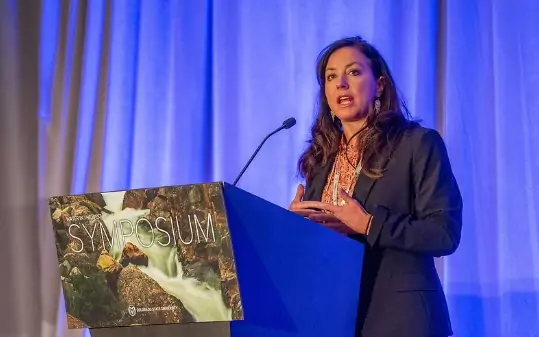
Becky Mitchell. Photo credit: Allen Best

Click the link to read the article on the Big Pivots website (Allen Best):

February 2, 2026

Snowpack realities must be recognized by all seven Colorado River Basin states, says Becky Mitchell, Colorado’s chief negotiator

Becky Mitchell was particularly busy during the last week of January. On Wednesday, Jan. 28, she opened the annual Colorado Water Congress conference with a 1,100-word speech (the prepared remarks are below) that reiterated Colorado’s position in the stalemated Colorado River discussions.

Lower-basin states, said Mitchell, Colorado’s chief negotiator in Colorado River affairs, must fully come to terms with the changed realities on the Colorado River. “This means releases from Lake Powell must reflect actual inflows, not political pressure,” she said. “If reductions aren’t real, reservoirs won’t recover.”

The next day, Mitchell was in Washington D.C. along with Colorado Gov. Jared Polis and the governors of five of the six other basin states. California Gov. Gavin Newsom, who cited pre-existing family commitments, was the only governor absent.

The New York Times on Saturday reported that the governors achieved “no breakthrough — and whether they made progress was unclear.” Mitchell was quoted in that story saying upper basin states “cannot and will not impose mandatory reductions on our water rights holders to send water downstream.”

In other words, as she had said Colorado water users must live with the hydrologic realities, including this one of almost no snow. Colorado does not have the giant reservoirs of Powell and Mead upstream.

Others, including Eric Kuhn, the former general manager of the Glenwood Springs-based Colorado River Water Conservation District, have urged a new model based on proportionate cutbacks, not absolute numbers. See: “Dancing With Deadpool on the Colorado River,” Big Pivots. Dec. 12, 2025.

That is how the four upper-basin states among themselves apportioned their share of the river flows in their 1948 compact. The 1922 compact used absolute numbers, i.e. 7.5 million acre-feet for each basin.

The Colorado River Compact of 1922 among the seven basin states uses some language that can be interpreted very differently about delivery obligations. That is a long, involved story — that may eventually be decided by the Supreme Court.

The Arizona Daily Star, however, reported a nuance of possible importance in statements made by Mitchell and Polis afterward. Mitchell emphasized “voluntary” conservation in the upper basin, while Polis said Colorado remained “committed to working collaboratively to find solutions that protect water for our state, while supporting the vitality of the Colorado River and everyone who depends on it.”

An Arizona source told the Daily Star’s Tony Davis that some Upper Basin governors appeared open to possible mandatory, as opposed to voluntary, conservation measures. “I think the other Upper Basin states expressed a willingness to put water on the table in a way that Colorado has not,” said the source, who asked for anonymity to protect continued participation in interstate river discussions.

But again, Colorado insists that it already has mandatory cutbacks — the ones imposed by Mother Nature. Using the prior appropriation doctrine to sort out priorities, Colorado restricts uses even in the more water-plentiful years. This year, the most “junior users” will most definitely not get water.

The black line in this chart represents snow-water equivalent in Colorado’s snowpack as of Feb. 1 relative to 1991-2020, a time frame of which about two-thirds consisted of drought and aridification. The map below shows the snow-water equivalent as of Jan. 31 by basin.  More can be found at the Natural REsources Conservation Service.

Amy Ostdiek, the Colorado Water Conservation Board’s chief for interstate, federal, and water information, made that point in remarks at the Water Congress the day after Mitchell’s speech.

“These reductions in the upper basin are mandatory. They’re uncompensated. They’re the job of each state engineer’s office to go out and shut off water rights holders when that water isn’t available. And what that means in practice is that many years you have pre-compact water rights dating back to the 1800s getting shut off.”

The complications of mandatory reduction of water uses also came up in a session with state legislators at the Water Congress.

Ken Neubecker, a long-time Colorado River observer affiliated with environmental groups, said mandatory cuts to Colorado River water use would require an amendment to Colorado’s state constitution and likely those of other upper-basin states.

Colorado’s constitution has been amended repeatedly since 1876, when Colorado achieved statehood, but the provision setting forth prior appropriation has not been touched.

“I don’t think you will get an amendment that will give the state any kind of authority to enact mandatory cutbacks beyond existing administrative cutbacks,” said Neubecker. “That’s just not in the cards.”

The upper-basin states also differ fundamentally with lower-basin states in that the lower basin states have just a few giant diversions, such as the Central Arizona Project and the Imperial Valley. The headwaters states have thousands of legal diverters. That also makes application of mandatory diversions more difficult.

These facts would together make mandatory costs a legal and logistical nightmare to administer.

The states have a deadline imposed by the federal government, as operator of the dams, to agree how to share a shrinking river.

Later this year, Mother Nature may impose an even harsher deadline if current thin snowpack continues to prevail. The statewide snowpack was 58% of average as of late January when the Water Congress conference was getting underway.

One barometer, if imperfect, of the snowpack is the snowpack on Vail Mountain. On Jan. 15, the Vail Daily’s John LaConte reported that the Snotel measuring site at the ski area showed the worst snowpack reading in 44 years of measurements.

The opening of Vail’s Back Bowls also testifies to dryness of the Colorado River headwaters. As recently as 2012, a notoriously dry year, that south-facing ski terrain was not opened until Jan. 19, according to David Williams of the Vail Daily. On Jan. 26, he reported another foot of snow was necessary to open it.

In June 2023, Polis appointed Mitchellto her current position, as Colorado’s first full-time commissioner to the Upper Colorado River Commission. She had previously overseen the Colorado Water Conservation Board.

“Mitchell will now navigate the deep challenges of the Colorado River in this upgraded position, supported by an interdisciplinary team within the Department of Natural Resources and support from the Colorado Attorney General’s Office,” said the announcement.

“The next few years are going to be incredibly intense as we shift the way that the seven basin states cooperate and operate Lakes Powell and Mead,” Mitchell said in that 2023 announcement. “Climate change coupled with Lower Basin overuse have changed the dynamic on the Colorado River and we have no choice but to do things differently than we have before.”

Becky Mitchell’s prepared remarks

#Colorado is gearing up to fight for water rights as the #ColoradoRiver stalemate continues — The Summit Daily #COriver #aridification

Colorado River “Beginnings”. Photo: Brent Gardner-Smith/Aspen Journalism

Click the link to read the article on the Summit Daily website (Ali Longwell). Here’s an excerpt:

January 27, 2026

As Colorado continues to negotiate with the seven Colorado River basin states on the post-2026 operations of Lake Powell and Lake Mead, the state’s attorney general and lead negotiator are ready for a legal battle if the states continue to clash.

“If it comes to a fight, we will be ready,” said Becky Mitchell, the Colorado River commissioner, who represents the state on the Upper Colorado River Commission, at the Jan. 23 SMART Act hearing for the Colorado Department of Natural Resources, where the agency provided its annual update on priorities and programs to lawmakers. 

After two years of back and forth, Colorado River basin states remain deadlocked, unable to agree on the guidelines for how Lake Powell and Lake Mead should operate beyond 2026. The operations of these two critical reservoirs have widespread implications for the approximately 40 million people, seven states, two counties and 30 tribal nations that rely on the river…In Colorado, the Colorado River and its tributaries provide water to around 60% of the state’s population. 

“We developed priorities that continue to serve as my north star as we negotiate these post-2026 operational guidelines,” Mitchell said. “The most important of these priorities is to protect Colorado water users. This means that our already struggling water users and reservoirs cannot be used to solve the problem of overuse in the lower basin.” 

[…]

Despite disagreements over how the reservoirs should operate in an uncertain future, reaching a consensus between the seven Colorado River basin states remains the objective for all involved, but time is ticking.  The U.S. Bureau of Reclamation — which manages Lake Powell and Lake Mead — has given the states until Feb. 14 to reach an agreement before the federal agency steps in and makes the decision itself.  Mitchell told lawmakers that she was still “optimistic” about reaching a consensus by the deadline, adding that she will “sit in the room with the full intent to negotiate,” as long as there are “willing parties.” 

“Folks should start worrying when I’m no longer in the room,” she said. “I will, 100%, be focused on a deal until there’s not a deal to be had.”

Map of the Colorado River drainage basin, created using USGS data. By Shannon1 Creative Commons Attribution-Share Alike 4.0