Primer on Stratospheric Aerosol Injection as one (very controversial) way to cool the planet

by Robert Marcos

Stratospheric aerosol injection, (SAI), is a theoretical solar geoengineering proposal that involves dispersing sulfate (or other reflective particles) into the stratosphere to reflect a portion of incoming sunlight back into space. Research into delivery methods focuses on platforms capable of reaching the stratosphere, which begins at varying altitudes depending on the latitude. Proposals range from spraying reflective particles, such as sulfur dioxides, finely powdered salt or calcium carbonate, from aircraft or high-flying balloons. None of these solar geo-engineering strategies address the underlying causes of climate change. Instead, they aim to control the amount of incoming solar radiation by emulating the sulfur-rich dust cloud that remains in the atmosphere after large volcanic eruptions.1

Proof of Concept provided by Mt. Pinatubo

The 1991 eruption of Mount Pinatubo injected approximately 17 million tons of sulfur dioxide into the stratosphere, creating a global layer of sulfuric acid haze that significantly increased the Earth’s albedo. This aerosol veil reflected incoming solar radiation back into space, resulting in a measurable drop in global mean temperatures of approximately 0.5°C (0.9°F) between 1992 and 1993. This transient cooling effect temporarily offset the trend of anthropogenic global warming and disrupted global precipitation patterns, demonstrating the profound impact that volcanic stratospheric aerosols can have on the Earth’s energy balance.2

According to one study, by sending specially designed high-altitude airplanes on roughly 4,000 total sulfate injection missions a year, humans could replicate this same level of cooling. This has the potential to offset half of the warming expected over the study’s 15-year period and counteract billions of metric tons of CO2 emissions each year. At a cost of around $2 billion annually, even medium-sized economies could afford such a program. This price tag would also be far less expensive than the potential impacts of climate change. Take the United States: the 2018 US National Climate Assessment Report estimates the impacts of climate change damages will amount to “hundreds of billions of dollars annually” by 2090, making atmospheric sulfate injection an appealing solution.3

Aerial platforms under consideration

Large commercial or military transport aircraft: These could potentially be retrofitted with specialized tanks and nozzle systems. However, most standard aircraft have flight ceilings that only reach the lower stratosphere, particularly near the poles.

Specialized Research Planes: Aircraft designed for high-altitude atmospheric research, such as those used by space agencies, can reach the higher altitudes (around 20 km) often cited as optimal for SAI. These generally have limited payload capacities.

Purpose-Built High-Altitude Jets: Many researchers suggest that a new class of specialized aircraft would be necessary for efficient, large-scale delivery. These designs would require high-lift wings and engines capable of sustained operation in thin air while carrying heavy payloads of aerosol precursors.

High-Altitude Balloons: Tethered or free-floating balloons have been proposed as a lower-cost method to loft materials into the stratosphere, though they face challenges related to stability and large-scale operational control.4

Potential benefits

Rapid Global Cooling: SAI can lower global average temperatures much faster than carbon removal methods. Historical volcanic eruptions, like Mount Pinatubo in 1991, have proven that atmospheric sulfur can cool the planet by roughly 0.5°C within a year.

Cost-Effectiveness: Compared to the trillions needed for a full green energy transition, SAI is estimated to cost between $18 billion and $27 billion per year using modified aircraft.

Life-Saving Potential: Some studies suggest SAI could save up to 400,000 lives annually by reducing heat-related mortality in the world’s hottest regions.

Glacial Preservation: By lowering surface temperatures, it could slow sea-level rise and prevent the melting of land-based glaciers and sea ice.

Reversibility: Unlike permanent carbon storage, SAI effects are temporary; if stopped, the aerosols naturally fall out of the atmosphere within 1–2 years.5

Potential risks

Termination Shock: If SAI is suddenly stopped (due to war, terrorism, or political collapse) while greenhouse gases are still high, the planet would experience a catastrophic and rapid temperature spike.

Ozone Depletion: Injecting sulfates can damage the stratospheric ozone layer, increasing harmful UV radiation and risks of skin cancer.

Disrupted Weather Patterns: Models indicate it could cause regional droughts, specifically by weakening the South Asian monsoon and reducing tropical rainfall.

Ocean Acidification: SAI only masks temperature; it does not reduce CO2 levels. The oceans would continue to absorb carbon, leading to acidification that destroys coral reefs and marine life.

Moral Hazard: The availability of a “quick fix” might reduce the political and corporate incentive to actually cut greenhouse gas emissions.

Geopolitical Conflict: There is no international governance for SAI. A single country could “control the thermostat,” potentially leading to global conflict if their actions cause weather disasters elsewhere.

Ecological Impacts: Reduced direct sunlight could decrease crop yields and interfere with solar power generation.6
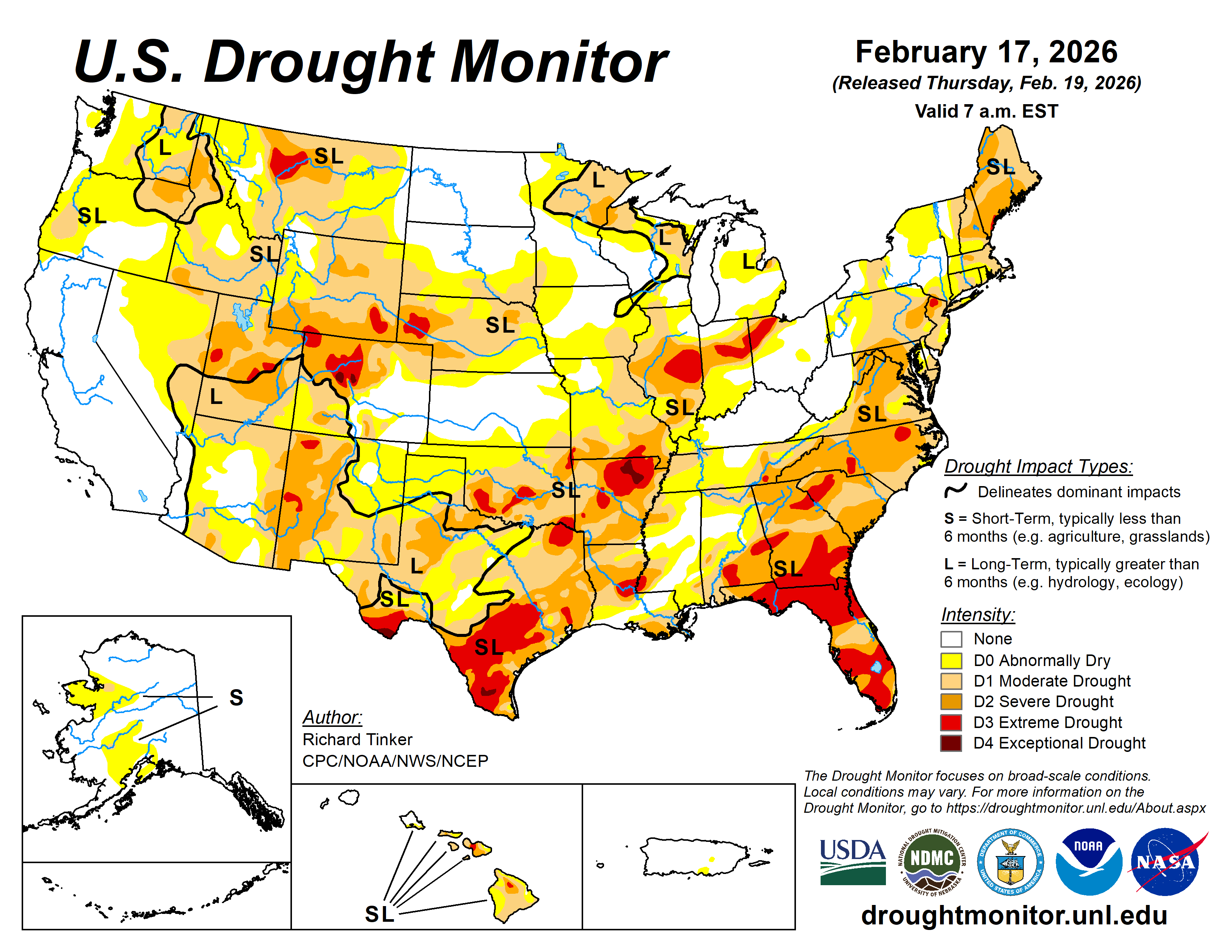
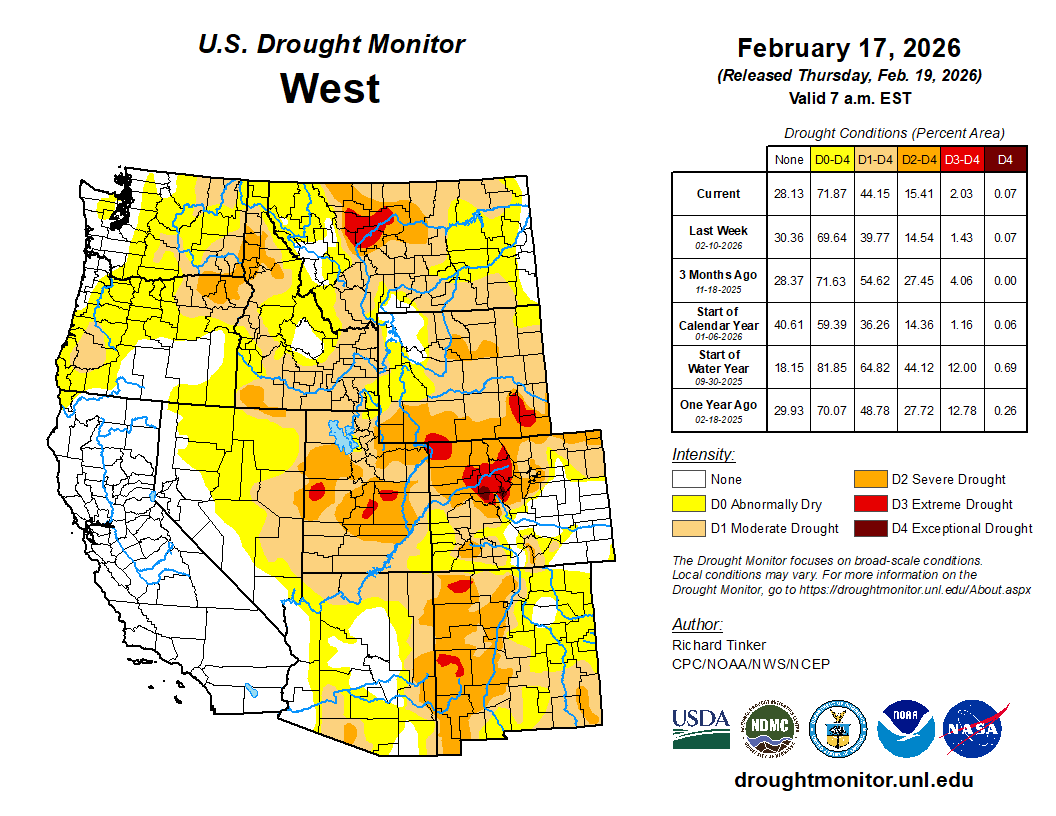
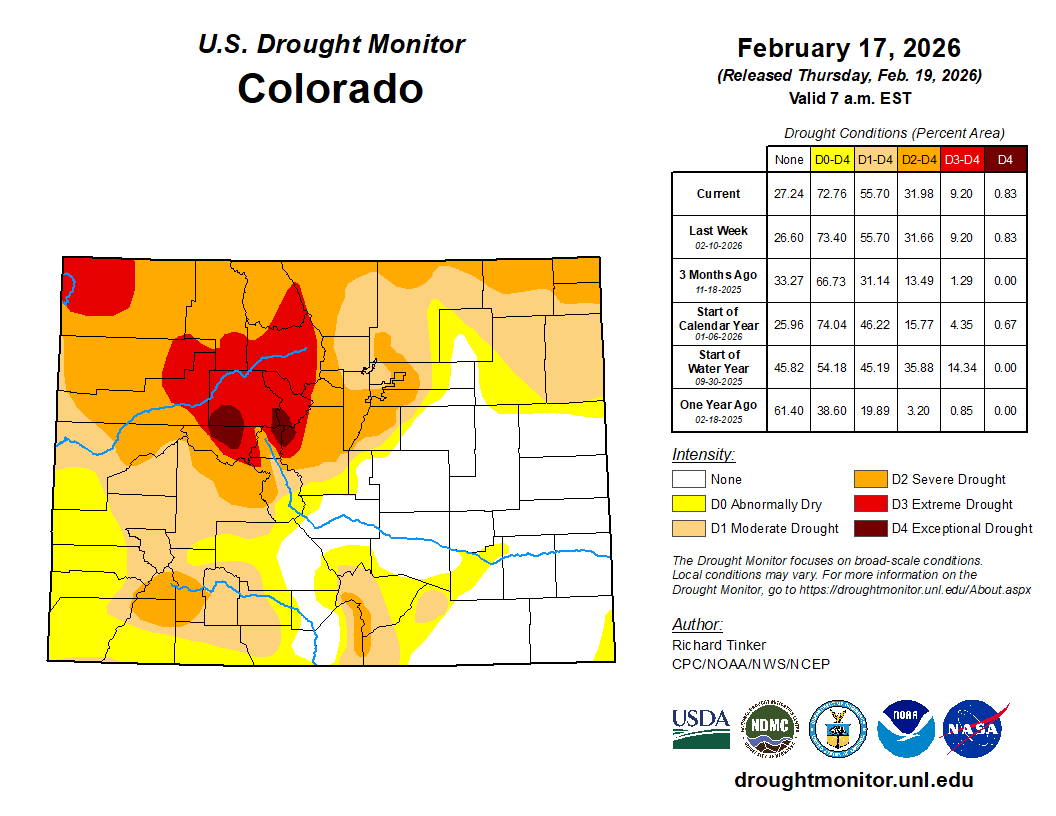
#Drought news February 19, 2026: Severe drought (D2) or worse is widespread from western #Nebraska across the southern tier of #Wyoming through northern and central parts of #Colorado

Click on a thumbnail graphic to view a gallery of drought data from the US Drought Monitor website,

Click the link to go to the US Drought Monitor website. Here’s an excerpt:

This Week’s Drought Summary

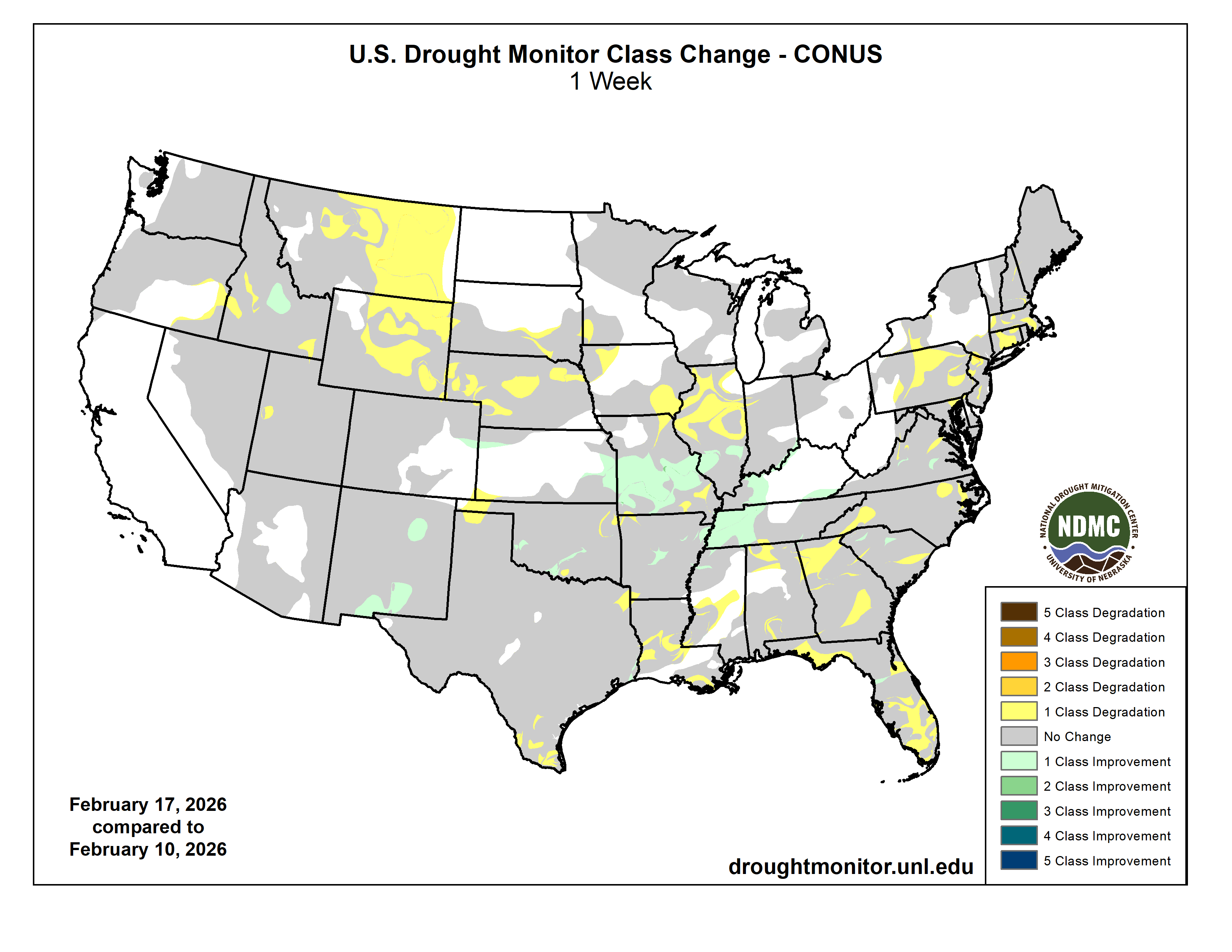
After a few warm and dry weeks, heavy precipitation returned to the West Coast States this past week; however, the heaviest amounts fell on California, which is almost completely free of dryness and drought. At least 1.5 inches fell on a large part of the state including much of the western tier, the higher elevations, and the northern Valleys. Much larger amounts fell on isolated higher-elevation and orographically-favored locations, with a few spots recording amounts approaching 10 inches (liquid-equivalent). Several feet of snow has piled up on a few spots across the Sierra Nevada, but overall the snowpack in this area remains significantly below normal. Other areas from northwestern California northward through the Cascades and points west also recorded significant amounts of precipitation, ranging from 0.5 to locally 3.0 inches. Similar amounts were more scattered across the rest of the interior West, with the largest totals confined to the highest elevations. As of early Tuesday Feb 17, this precipitation has not significantly boosted snowpack in some areas with less than normal amounts, specifically much of the Cascades, south-central Idaho, Scattered locations across western Wyoming, much of west-central and southwestern Colorado, central sections of Utah and Nevada, and the southernmost Rockies.

Farther east, moderate precipitation was fairly widespread over approximately the southeastern quarter of the contiguous states, east of the High Plains and from the central Great Plains, lower Ohio Valley, and mid-Atlantic region southward. Heavier amounts fell on scattered areas across the east-central and southeastern Great Plains, parts of the adjacent lower Mississippi Valley, and a few narrow swaths across the western Florida Panhandle and parts of the northern Peninsula. To the north, scattered light amounts with isolated moderate totals were recorded in upstate New York and parts of New England. Other areas across the High Plains and the northeastern quarter of the contiguous states reported little or no precipitation.

Some areas of improvement were introduced based either on this past week’s precipitation or a re-assessment of the effects from earlier storms. Specifically, improvements were introduced in central Idaho, the southwestern High Plains, and parts of the Tennessee, lower Ohio, and middle Mississippi Valleys. There was more deterioration than improvement overall, however, including areas scattered across the Eastern Seaboard, lower Mississippi Valley, Deep South, Upper Midwest, northern High Plains, and far southern Texas. Hawaii experienced areas of improvement for the second consecutive week while Alaska and most dry areas in Puerto Rico remained unchanged…

High Plains

Moderate to locally heavy precipitation fell on part of eastern Kansas, and scattered light to moderate amounts fell on the rest of the southern tier of the Region. Farther north, however, scant precipitation led to large areas of degradation across a large proportion of Wyoming and central through eastern Montana, with more limited deterioration introduced across parts of Nebraska and South Dakota. This resulted in moderate drought or worse covering a swath across most of Nebraska and adjacent areas westward through most of Wyoming and the northern, central, and western sections of Colorado. Severe drought (D2) or worse is widespread from western Nebraska across the southern tier of Wyoming through northern and central parts of Colorado…

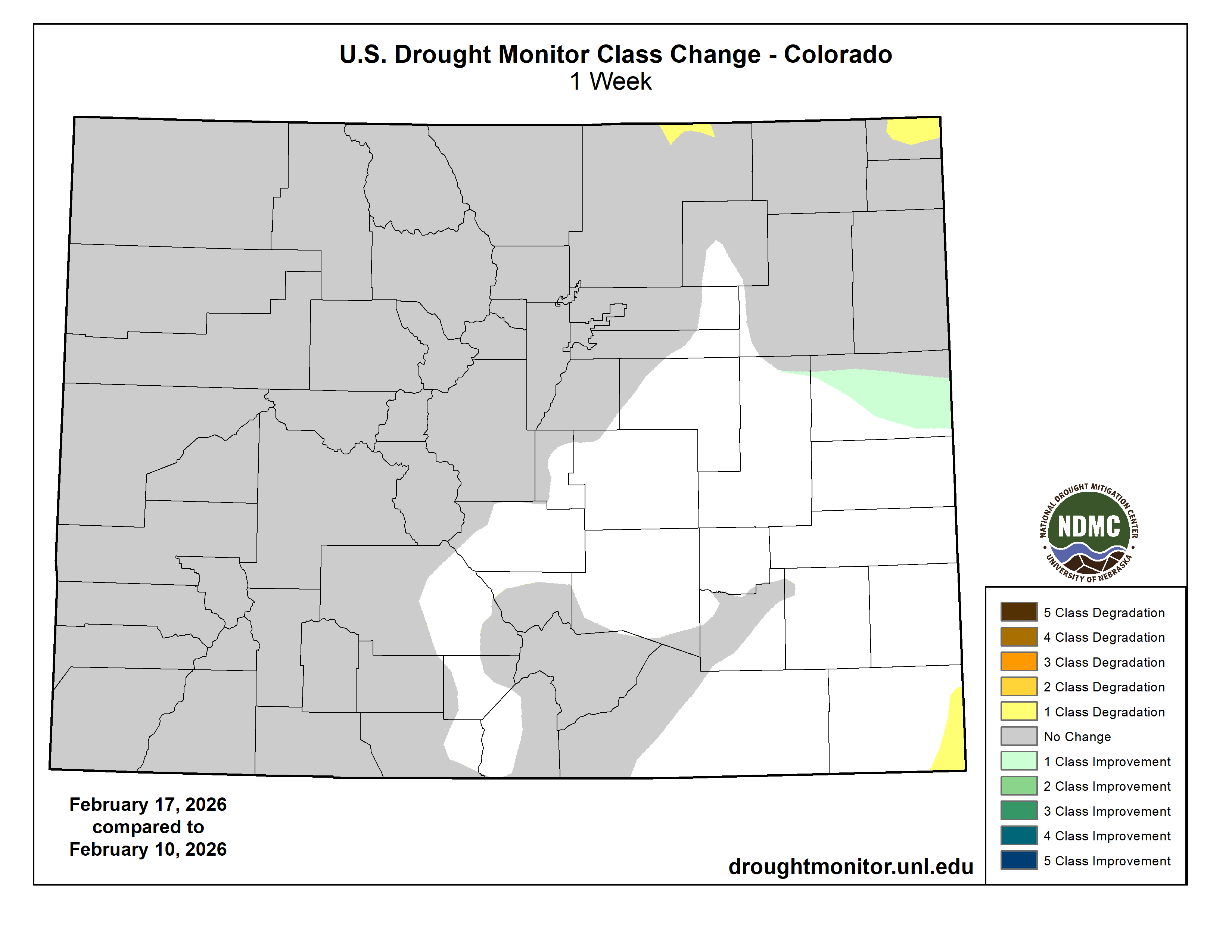
Colorado Drought Monitor one week change map ending February 17, 2026.

West

Heavy precipitation was fairly widespread across California, which is currently almost completely devoid of any degree of dryness or drought. Elsewhere, widespread deterioration was introduced across central and eastern Montana, leaving most of the state entrenched in abnormal dryness to severe drought (D0 to D2), with an area of extreme drought in parts of north-central Montana. Elsewhere, only minor adjustments were made as light to moderate precipitation fell on a large part of the areas of dryness and drought – enough to preclude widespread deterioration, but not sufficient to justify much improvement. Only a few parts of central and south-central New Mexico were improved, primarily from the effects of precipitation prior to last week. Severe to extree drought (D2-D3) now extends across most of the western half of New Mexico, adjacent4 Arizona, central and northern Utah, parts of northern and southwestern Idaho, and parts of Pacific Northwest east of the Cascades…

South

Heavy precipitation (3 to locally 5 inches) dropped on a swath through central Arkansas while 1.5 to locally 3.0 inches were recorded from the lower Red River (south) Valley through the central tier of Arkansas into much of western Tennessee. Moderate to locally heavy amounts were observed over much of the west side of the lower Mississippi Valley and portions of eastern Texas. Amounts of several tenths of an inch to locally around an inch were reported across a large part of central and north-central Texas, most of Oklahoma east of the Panhandle, much of Mississippi and western Alabama, and eastern sections of Tennessee. Little or no precipitation was reported across the Texas and Oklahoma Panhandles, western Texas, and Deep South Texas. This pattern supported improvement across the western half of Tennessee and smaller areas of Arkansas and northwestern Mississippi, along with scattered spots across southern Oklahoma. Deterioration was fairly common in areas that missed most of the week’s precipitation, primarily in the lower Mississippi Valley, the immediate ArkLaTex region, and Deep South Texas. Intensifying dryness in the latter area prompted the introduction of exceptional drought (D4) in parts of Jim Hogg and Brooks Counties. D4 already existed in part of interior northeastern Arkansas and the southernmost reaches of the Texas Big Bend. Meanwhile, extreme drought (D3) expanded to cover most of south-central and Deep South Texas, parts of east-central Louisiana and adjacent Mississippi, portions of southern Oklahoma and northeastern Texas, most of northeastern Arkansas, and a few smaller scattered areas in western Arkansas and northeastern Oklahoma. During the past 90 days, fewer than 2 inches of precipitation have fallen on western Oklahoma, the Texas Panhandle, and the southwestern tier of Texas from the Big Bend into much of Deep South Texas…

Looking Ahead

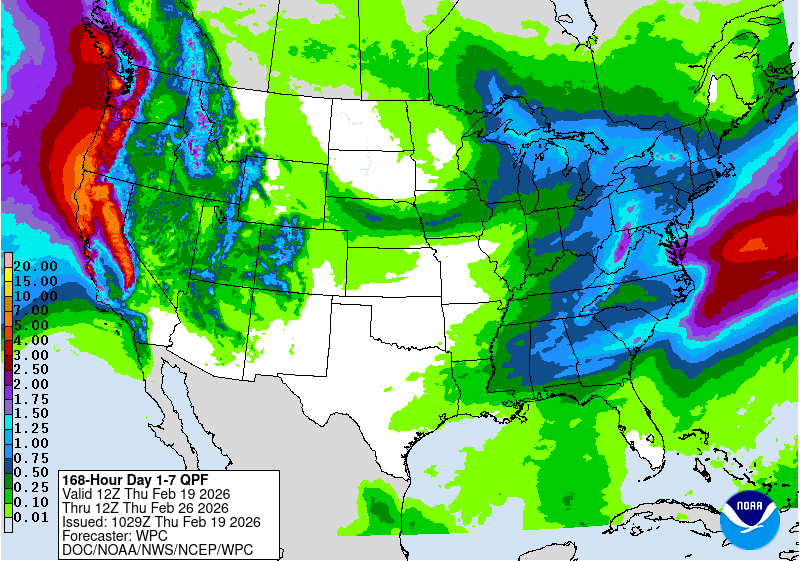
The heaviest precipitation over the next few days is forecast along and near part of the West Coast, with at least 2 inches expected across northwestern California, the southern Cascades, and the central and northern Sierra Nevada. Up to 7 inches may fall in isolated higher elevations, most or all of which would be snow. Meanwhile, moderate to heavy amounts (0.5 to 2.0 inches) are forecast across Washington and Oregon from the Cascades westward. Similar amounts are forecast for the northern Great Lakes, and most locations from the Deep South through central New England, with lesser amounts expected over much of the central and northern Carolinas. There is a lot of uncertainty in this area, depending on the development and track of an East Coast storm system that could affect the mid-Atlantic and lower Northeast over the weekend. Light to moderate totals are anticipated over a large part of the interior West, including the Great Basin, much of the northern Intermountain West, and the higher elevations across the Rockies. Several tenths of an inch are possible across the lower Great Lakes, middle and lower Ohio Valley, and the east side of the lower Mississippi Valley. Little or no precipitation is expected across the northern and southern Plains, southern Florida, and northern Maine. Above-normal temperatures are expected from the Southwest through most of the Plains, with many locations expected to average 5 to 11 deg. F above normal. In contrast, subnormal temperatures are forecast in the northernmost Plains, where daily highs could average as much as 9 deg. F below normal. Meanwhile, 5-day average anomalies are expected to range from -2 to -5 deg. F across northern California as well as the Ohio Valley and many locations farther east.

The 6- to 10-day outlook for February 24-28 depicts increased chances for below-normal precipitation across much of the southern tier of the contiguous U.S., from the extreme southern Rockies through the central Gulf Coast and most of Florida. Chances for abnormal dryness exceed 40 percent across most of Texas and some adjacent areas. Farther north, heavier than normal precipitation is at least nominally favored from the mid-Atlantic, southern Appalachians, central Plains, and Desert Southwest northward to the Canadian border. Chances for unusually unsettled weather exceed 60 percent across central and northern California, and top 50 percent central California northward across western Washington and Oregon, as well as the middle and lower Ohio Valley. In Alaska, drier than normal conditions are favored along western parts of the state while surplus amounts are more likely over eastern areas. Across Hawaii, above-normal amounts are marginally favored statewide. Meanwhile, warmer than normal weather is expected to dominate the contiguous 48 states from the Appalachians to the Intermountain West, with chances for significantly warmer than normal conditions topping 80 percent in western Texas. Areas somewhat favoring below-normal temperatures are restricted to the West Coast west of the Cascades, and over much of the Florida Peninsula. Considerably higher chances for unusually cold weather cover most of Alaska, reaching above 70 percent in southwestern parts of the state. In contrast, warmer than normal conditions are somewhat favored across Hawaii, especially across Kauai, Oahu, and the southern Big Island.

US Drought Monitor one week change map ending February 17, 2026.

The #ColoradoRiver Crisis is Here: States fail to reach a deal; #LakePowell Deadpool appears imminent — Jonathan P. Thompson (LandDesk.org) #COriver #aridification #megadrought

The Bureau of Reclamation’s latest forecast for the Colorado River predicts Lake Powell will “most probably” drop below the critical minimum power pool level before the end of this year, jeopardizing Glen Canyon Dam’s structural integrity. In the worst-case scenario, it would do so before summer’s end. This could force the feds to operate the dam as a “run-of-the-river” operation to preserve the dam’s infrastructure and hydropower output, which would significantly diminish downstream flows and threaten Lower Basin water supplies.

Click the link to read the article on The Land Desk website (Jonathan P. Thompson):

February 16, 2026

Valentines Day wasn’t so lovey-dovey on the Colorado River.

First, the Bureau of Reclamation (BoR) released a grimmer-than-ever spring runoff forecast for the Colorado River and its two big reservoirs. Then the seven Colorado River Basin states announced that they once again had failed to reach an agreement on a plan to bring demand into line with diminishing supplies by the Feb. 14 deadline. While the states have blown by other deadlines since negotiations began in 2022, this time was different in that it triggered the federal government to move forward to impose a post-2026 management plan of its own.

On paper, the states still have until the end of the water year, or Oct. 1, to come up with a deal or to implement an alternate plan. But that may be too little too late to keep Lake Powell’s surface level from dropping below minimum power pool — otherwise known as de facto dead pool — later this year. While the negotiations are over the Colorado River, or rather the water in the river, in many ways they pivot around the need to keep Lake Powell’s surface level above 3,500 feet in elevation. That can only be done by releasing less water out of Glen Canyon Dam, or increasing flows into the reservoir, or a bit of both.

The sticking point in the negotiations hinges upon whether the Upper Basin states will take mandatory and verifiable cuts in water use. The Lower Basin states have already taken cuts, and have agreed to take more, but only if the Upper Basin does the same.

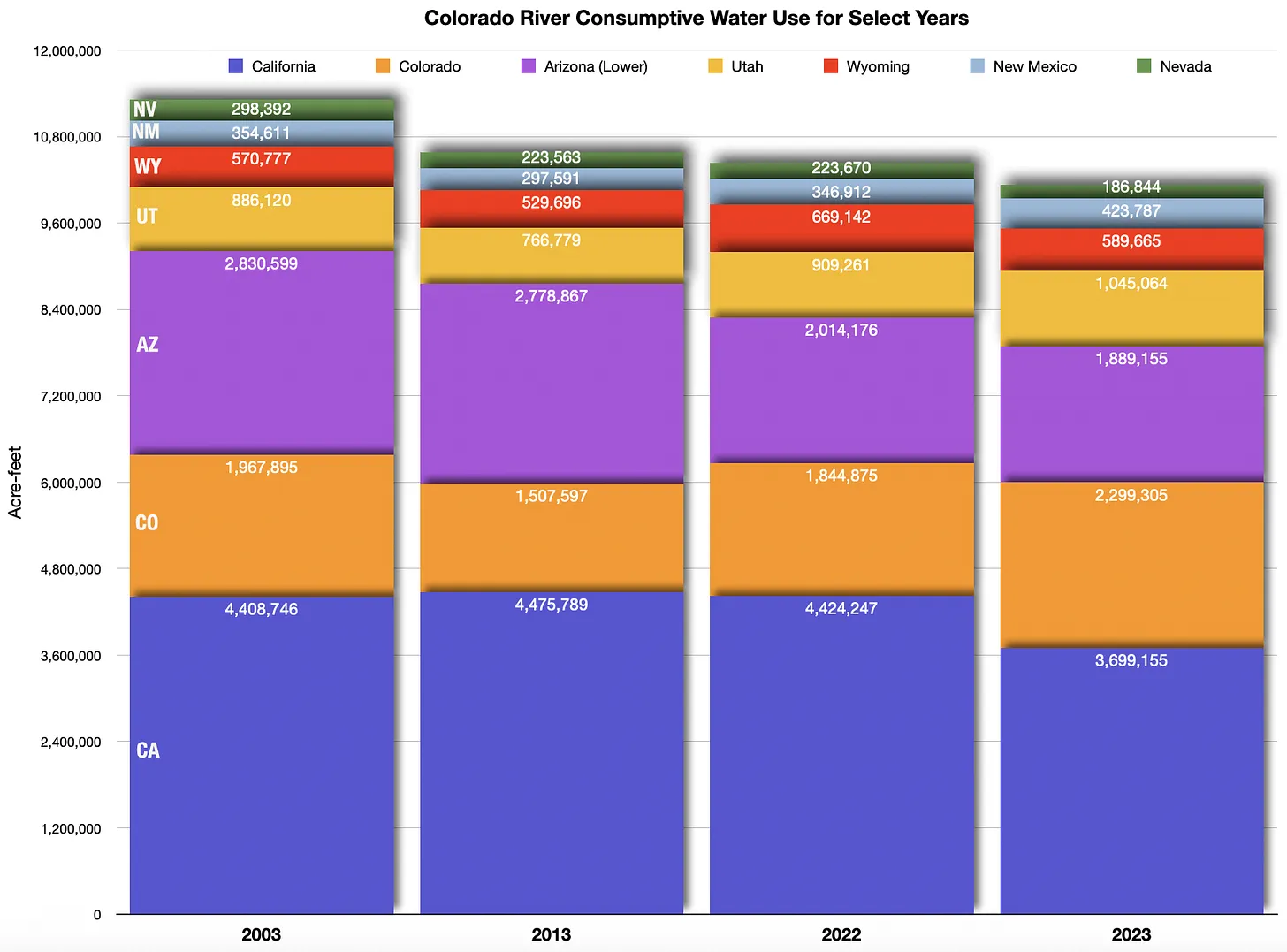
The Upper Basin (aka the Headwaters states) points out that while the Lower Basin has maxed out and even exceeded its Colorado River Compact allocation of 7.5 million acre-feet per year, the Upper Basin hasn’t even come close to using all of the water it’s entitled to. Furthermore, Upper Basin water users, especially those with more junior water rights, have grappled with drastic reductions during dry years because the Upper Basin lacks large reservoirs for storing water, meaning their water use is dictated in large part by the rivers’ flows. In 2021, for example, many southwestern Colorado farms had their ditches cut off as early as June, forcing them to sit the season out.

The Lower Basin states long used their entire 7.5 MAF allocation and then some, while the Upper Basin states use only about 4 MAF per year. In recent years, Arizona and California have cut consumptive use. Source: Bureau of Reclamation.

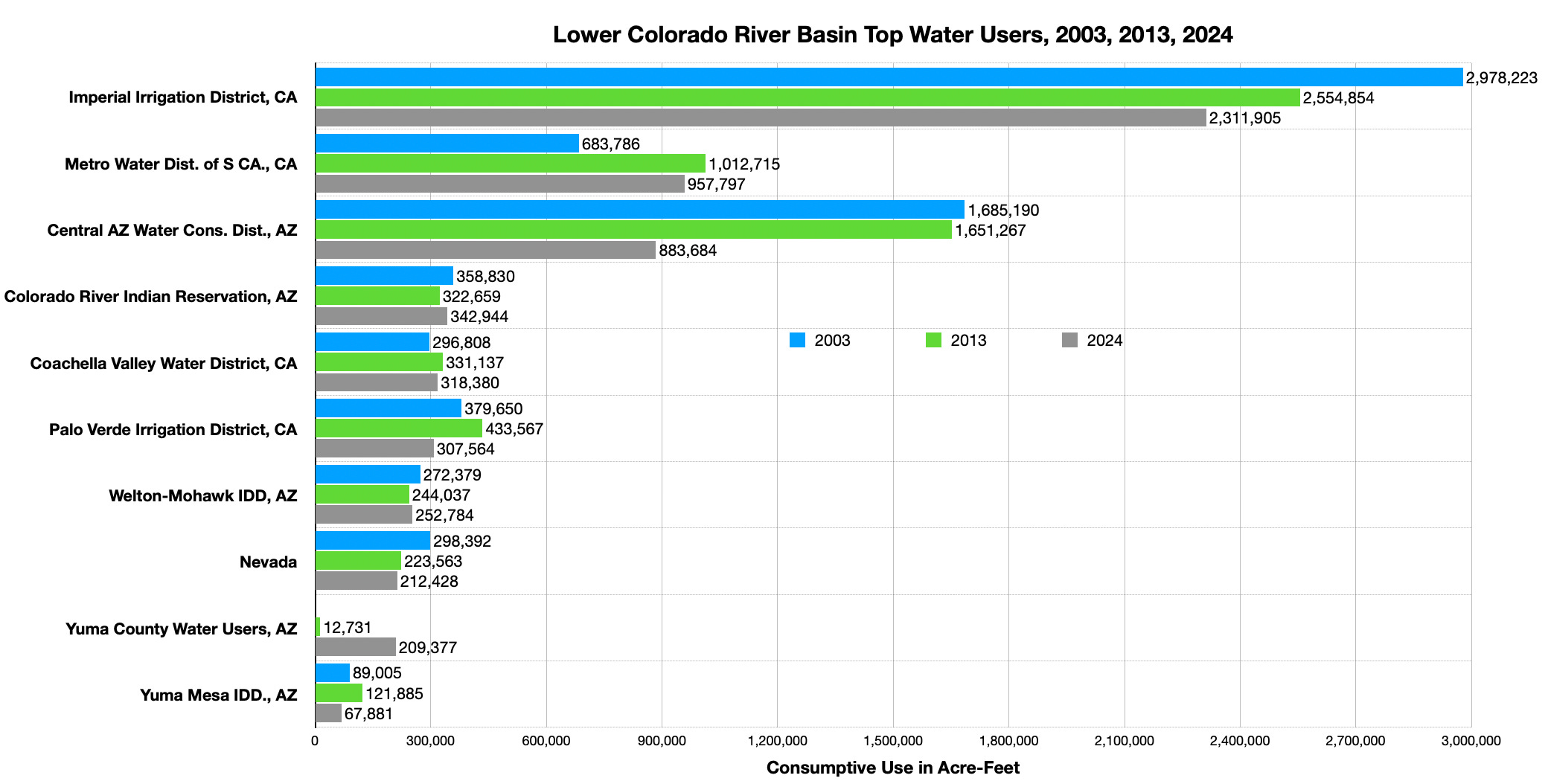
It’s also far simpler logistically to reduce consumption in the Lower Basin, where huge water users are served by a handful of very large diversions, such as the Central Arizona Project canal (which carries water to Phoenix and Tucson), the All-American Canal (serving the Imperial Irrigation District — the largest single water user on the entire river), and the California Aqueduct (serving Los Angeles and other cities), all of which are fed by Lake Mead and other reservoirs. Dialing back those three diversions alone could achieve the necessary water use reduction. The Upper Basin, on the other hand, pulls water from the river and its tributaries via hundreds of much smaller diversions; achieving meaningful cuts would require shutting off thousands of irrigation ditches to thousands of small water users under dubious authority. (ed. emphasis mine]

Also, proposals to divert and consume more of the Colorado River’s water — such as the Lake Powell pipeline — remain on the table, albeit tenuously. If that project were to be realized, which is a big if these days, it would further drain Lake Powell and result in even less water flowing down to the Lower Basin.

The Imperial Irrigation District is the largest single water user on the Colorado River by far. Most of that water goes to irrigating agriculture, including a fair amount of alfalfa and other forage crops. Las Vegas uses about one-tenth the amount of water as the IID. Source: Bureau of Reclamation.

Environmental groups tend to side with the Lower Basin on this issue. If the Upper Basin is forced to pull less water from the river, it would leave more water for the river, riparian ecosystems along the river, and aquatic critters. The Upper Basin’s proposal to release a percentage of the river’s “natural flow” from Glen Canyon Dam would leave less water in the Colorado River through the Grand Canyon, possibly imperiling endangered fish and rafting.

Meanwhile, the states’ lack of consensus pushes Glen Canyon Dam closer to the brink of deadpool.

The BoR’s “Post-2026 Operational Guidelines and Strategies for Lake Powell and Lake Mead” offers five alternative scenarios for how to run the river. While it doesn’t give a “preferred” alternative, officials have indicated that without all of the states’ approval or congressional action, they are only authorized to go with the Basic Coordination Alternative. That would include a minimum annual release of 7.0 million acre-feet from Glen Canyon Dam, with the largest mandatory cuts being borne by Arizona. But according to the BoR’s latest 24 month projection, that release level would lead to Lake Powell’s surface level dropping below minimum power pool by the end of this year, which is a really big problem.

The back of Glen Canyon Dam circa 1964, not long after the reservoir had begun filling up. Here the water level is above dead pool, meaning water can be released via the river outlets, but it is below minimum power pool, so water cannot yet enter the penstocks to generate electricity. Bureau of Reclamation photo. Annotations: Jonathan P. Thompson

Back in 2022, as climate change continued to diminish the Colorado River’s flows and Lake Powell shrunk to alarmingly low levels, the dam’s operators were faced with the prospect of having to shut down the penstocks, or water intakes for the hydroelectric turbines, and only release water from the river outlets lower on the dam. Not only would this zero out electricity production from the dam, along with nixing up to $200 million in revenue from selling that power, it might also compromise the dam itself. “Glen Canyon Dam was not envisioned to operate solely through the outworks for an extended period of time,” wrote Tanya Trujillo, then-Interior Department assistant secretary for water and science, in 2022, “and operating at this low lake level increases risks to water delivery and potential adverse impacts to downstream resources and infrastructure. … Glen Canyon Dam facilities face unprecedented operational reliability challenges.”

In March 2024, a BoR technical decision memorandum verified and clarified those risks, and recommended that dam operators “not rely on the river outlet works as the sole means for releasing water from Glen Canyon Dam.”

The only way to do that is to keep the water level above 3,490 feet in elevation, which could mean shifting Glen Canyon Dam to a run of the river operation — where releases equal Lake Powell inflows minus evaporation and seepage — as soon as this fall. That, most likely, will lead to annual releases far below 7 million acre-feet, which will then lead to Lake Mead’s level being drawn down considerably as the Lower Basin states rely on existing storage to meet their needs, thereby threatening Lower Basin supplies. Such a scenario is clearly not sustainable, would put the Upper Basin states in violation of the Colorado River Compact1, and would almost certainly lead to litigation.

An irony here is that Glen Canyon Dam’s primary purpose is to allow the Upper Basin to store water during wet years and release it during dry years, enabling it to meet its Compact obligations. Hydropower, silt control, and recreation were secondary purposes. Now the need to preserve the dam could cause the Upper Basin to run afoul of the Compact. Aridification is rendering the dam obsolete, at least as a water storage savings account. Meanwhile, low levels are diminishing hydropower and recreation. It seems that soon, the dam’s main purpose will be to prevent Lake Mead from filling up with silt. [ed. emphasis mine]

Mother Nature, or Mother Megadrought, if you prefer, has left few options for moving forward. The states still could come to an agreement, but it’s difficult to see how, given the long-running stalemate so far. The feds could reengineer Glen Canyon Dam to allow for sustained, low-water releases. That would only be a temporary fix, however, unless climatic trends reverse themselves and the West suddenly becomes much wetter and cooler. Somehow, that doesn’t seem too likely.

🥵 Aridification Watch 🐫


Is all of this Colorado River talk a bit confusing? Do you find yourself lost in the water-wonk weeds? Yeah, me too. That’s why I put together the Land Desk’s Colorado River glossary and primer. It’s not behind the paywall yet, so even you free-riders can take a look for the next few days. It’s worth looking at even if you already received the email edition last month, because it is now updated with new terms and more graphics (it didn’t all fit in the email version). I’ll keep updating it, too, as new questions about what it all means come up. And if you’re not already, you should consider becoming a paid subscriber and break down the archive paywall, allowing you to read the whole list of analysis, commentary, and data dumps I’ve done on the Colorado River over the last five years.

A Colorado River glossary and primer — Jonathan P. Thompson


1 The Upper Basin and Lower Basin generally disagree on how to interpret the Colorado River Compact’s provision dictating that the Upper Basin “not cause the flow of the river at Lee Ferry to be depleted below an aggregate of 75 million acre-feet” for any 10-year period. The Upper Basin sees it as a “non-depletion obligation,” meaning they can’t exceed their 7.5 MAF/year allocation if it causes the Lee Ferry flow to fall below a 7.5 MAF/year average. The Lower Basin believes it’s a “delivery obligation,” and that the Upper Basin must deliver 7.5 MAF/year no matter what. Which interpretation is correct determines whether run-of-the-river would violate the Compact or not.

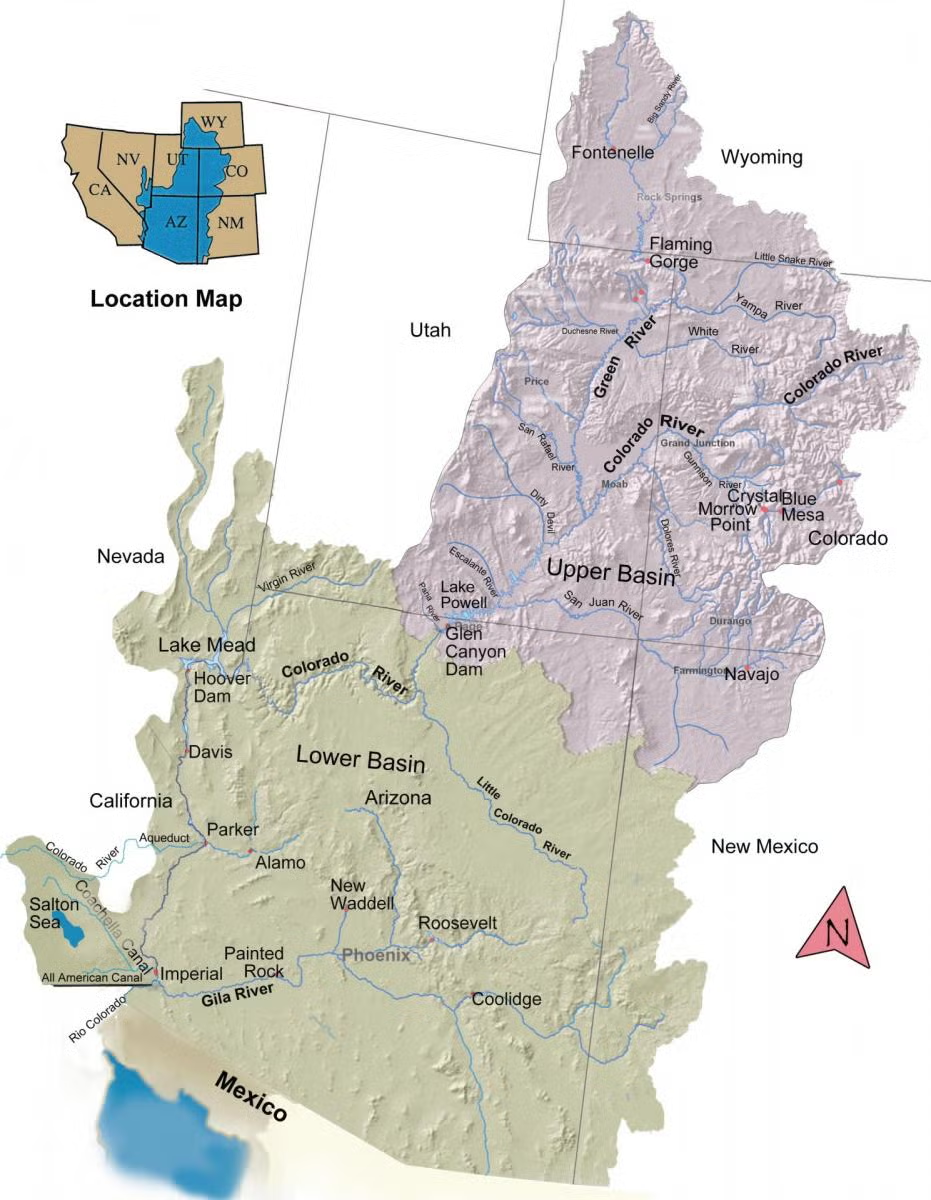
The Colorado River Basin spans seven U.S. states and part of Mexico. Lake Powell, upstream from the Grand Canyon, and Lake Mead, near Las Vegas, are the two principal reservoirs in the Colorado River water-supply system. (Bureau of Reclamation)

#ColoradoRiver states fail to meet another federal deadline for a deal as disastrous reservoir levels loom: #LakePowell could fall beneath level needed for hydropower as soon as July, new projections show — The #Denver Post #COriver #aridification

The Government Highline Canal, near Grand Junction, delivers water from the Colorado River, and is managed by the Grand Valley Water Users Association. Prompted by concerns about outside investors speculating on Grand Valley water, the state convened a work group to study the issue. CREDIT: BRENT GARDNER-SMITH/ASPEN JOURNALISM

Click the link to read the article on The Denver Post website (Elise Schmelzer). Here’s an excerpt:

February 17, 2026

Negotiators from the seven states along the Colorado River blew past yet another federal deadline over the weekend without reaching a compromise on how to share its water — even as this winter’s dismal snowpack could spell immediate disaster for the river system.

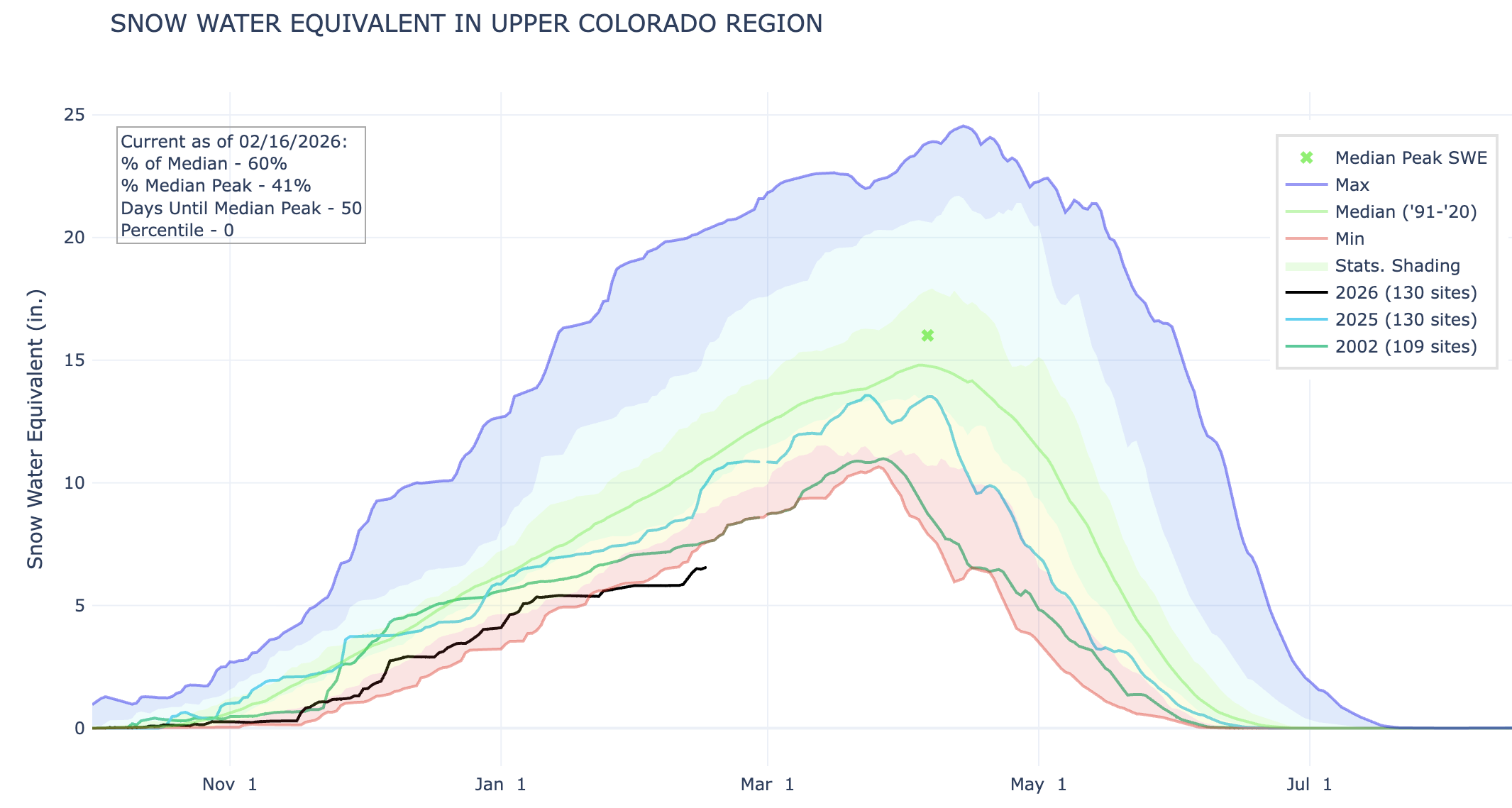
Westwide SNOTEL basin-filled map February 18, 2026.

Years-long discussions about how to split the river’s shrinking water supply, which is relied upon by 40 million people, remained deadlocked as the Saturday deadline for a final deal came and went. It was a deadline set by the U.S. Department of the Interior. The seven basin states are split into two factions that have not agreed on how to divvy up cuts to water supplies in dry years. The Lower Basin states of Arizona, California and Nevada lie downstream of Lakes Powell and Mead and rely on releases from those reservoirs for water. The Upper Basin states — Colorado, Wyoming, Utah and New Mexico — are upstream of the reservoirs and primarily depend on mountain snowpack for their water supplies. Leaders from each basin pointed fingers at the other as the deadline passed. Lower Basin negotiators have repeatedly said that Upper Basin states must “share the pain” and take mandatory cuts in dry years, which have become increasingly common in recent decades. But the Upper Basin states say their water users already take cuts every year because their supplies depend on the amount of water available and are not propped up by supplies in Lakes Powell and Mead. Repeated overuse in the Lower Basin has drained the two reservoirs, they’ve argued.

“We’re being asked to solve a problem we didn’t create with water we don’t have,” Colorado’s negotiator, Becky Mitchell, said in a statement Friday. “The Upper Division’s approach is aligned with hydrologic reality and we’re ready to move forward.”

The Bureau of Reclamation’s latest forecast for the Colorado River predicts Lake Powell will “most probably” drop below the critical minimum power pool level before the end of this year, jeopardizing Glen Canyon Dam’s structural integrity. In the worst-case scenario, it would do so before summer’s end. This could force the feds to operate the dam as a “run-of-the-river” operation to preserve the dam’s infrastructure and hydropower output, which would significantly diminish downstream flows and threaten Lower Basin water supplies.

As political leaders unleashed a series of pointed statements Friday, the Bureau of Reclamation released new projections that show one of the river system’s major reservoirs could be in peril as soon as this summer. The bureau’s new projections show that, if drought conditions remain dire, Lake Powell could fall so low by the end of July that water would no longer flow through Glen Canyon Dam’s hydropower system — a level called “dead pool.” Even if snow conditions improve, the reservoir could still reach dead pool in November — a scenario the bureau dubbed its most probable outcome. The Colorado River District, an agency created by the Colorado legislature that’s based in Glenwood Springs and advocates for Western Slope water needs, said it was disappointing that Lower Basin negotiators walked away from discussions on the day the projections were released.

“With Lake Powell now quickly approaching dead pool, that decision reflects a continued disconnect from hydrologic reality and a clear refusal to confront the core problem: longstanding Lower Basin overuse,” the district said Monday in a statement.

Snowpack across the mountains that feed the Colorado River remained dismal in early February. Above Lake Powell, snowpack on Feb. 1 sat at 47% of the median recorded for that time of year between 1991 and 2020. The water year — which began Oct. 1 — has so far featured record-setting warmth and limited precipitation, according to the National Weather Service’sColorado Basin River Forecast Center. That could translate to water supplies at 38% of normal, according to the center. Current projections show inflow into Lake Powell will total a meager 2.4 million acre-feet — far less than the 7.5 million acre-feet allocated to the Lower Basin in the 1922 Colorado River Compact.

Map of the Colorado River drainage basin, created using USGS data. By Shannon1 Creative Commons Attribution-Share Alike 4.0