Accelerated #GlobalWarming Could Lock #Earth Into a Hothouse Future: Scientists say warming is increasing faster than at any time in at least 3 million years. There is no guide for what comes next — Bob Berwyn (InsideClimateNews.com)

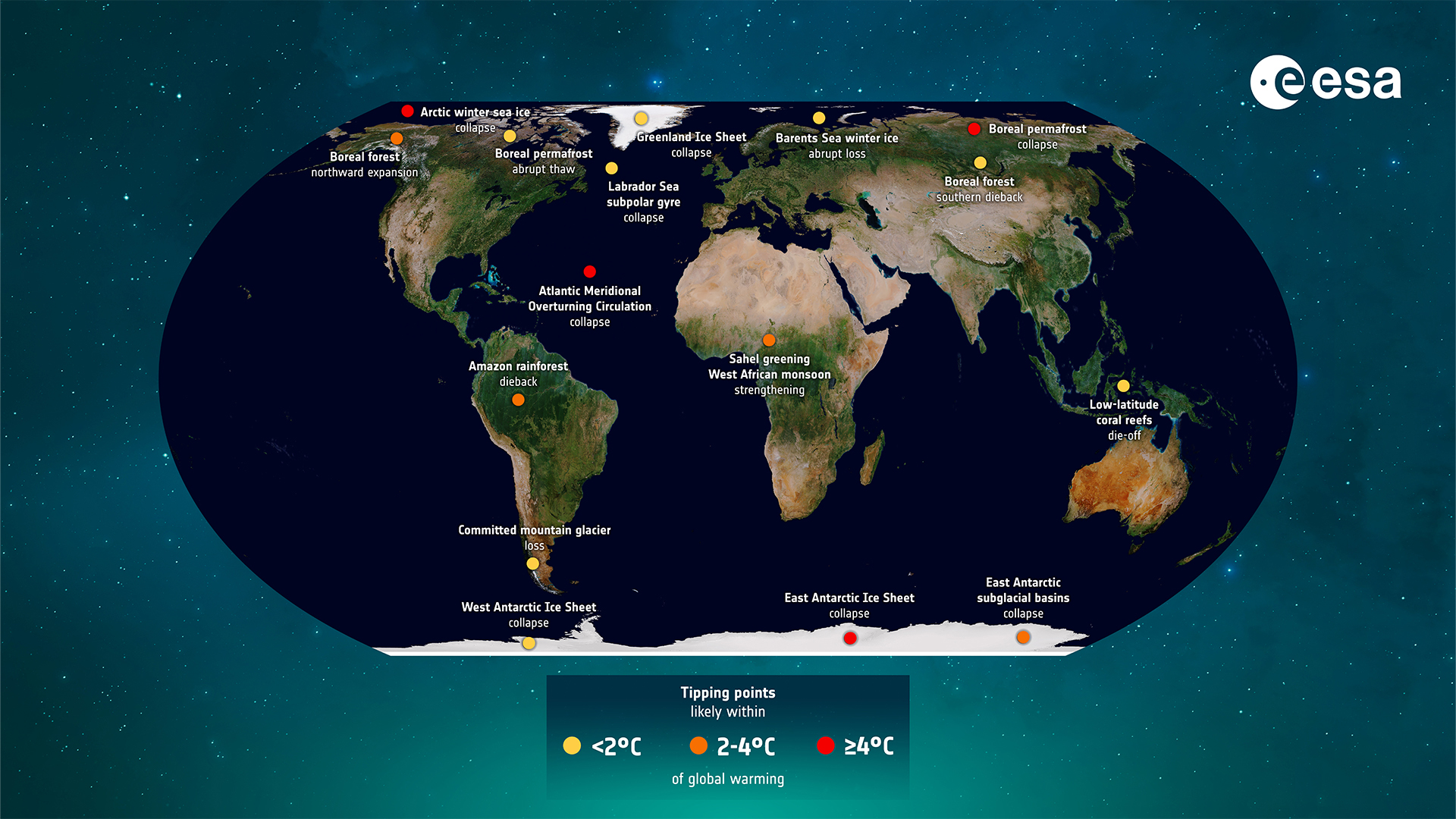
Climate tipping points are key thresholds in Earth systems like oceans, ice sheets, and forests, where warming can push the climate into a new state. Once crossed, these changes can be hard to reverse and can start a chain reaction that affects ecosystems, weather extremes and the global climate. Credit: ESA

Click the link to read the article on the Inside Climate News website (Bob Berwyn):

February 11, 2026

If you think of Earth’s climate system as a backyard swing that’s been gently swaying for millennia, then human-caused global warming is like a sudden shove strong enough to disrupt the usual arc and buckle the chains.

And if humans keep heating the planet with greenhouse gas pollution, the climate swing could lock Earth into a hothouse trajectory, as parts of the system feed on their own momentum, even if emissions are reduced later, an international team of scientists warned Wednesday in a new paperpublished in the journal One Earth. 

Their analysis covers 16 key Earth systems, including oceans, ice sheets and forests, that are likely to destabilize if the planet continues to warm. If large parts of the Amazon rainforest and tropical coral reefs die, they absorb less carbon dioxide, triggering a dangerous chain reaction of warming.

If Earth’s climate starts on a hothouse trajectory, it would represent a “global tipping point” as the heating sustains itself even if greenhouse gas emissions drop, said lead author William Ripple, a distinguished professor of ecology at Oregon State University and a leading researcher on climate tipping points.

In the backyard, that’s the moment when the push is so hard that the swing hesitates at the top, just long enough to show that the ride may not be under control anymore and the chains are being tested.

“What typically took thousands of years is now happening in decades,” Ripple said, adding that human-caused warming is already nudging the climate system out of 11,000 years of relative stability with good conditions for farming and societal development.

Earth could be entering a period of unprecedented climate change on a one-way trajectory, in which processes such as ice-sheet collapse can continue even if the average global temperature is stabilized, he said.

In a new paper, William Ripple, an ecologist and climate researcher at Oregon State University, warns that human-caused warming could put Earth on a hothouse trajectory. Credit: Courtesy of William Ripple

Recent observations suggest that the climate may be responding more strongly than some models predicted, Ripple added. “We are concerned that policymakers and the public may not yet be aware of these recent developments.”

In late January, another group of leading climate scientists urged policymakers to adopt a climate goal of limiting human-caused warming to 1 degree Celsius above the pre-fossil fuel era, which is more ambitious than the 1.5 to 2 degrees Celsius target set in the Paris Agreement. They’ve also recently reported that Earth is losing its reflective sheen, which amplifies warming, and that key ocean currents are changing in ways that destabilize the entire global climate system. 

But it’s not clear if the scientific warnings are making a difference in “a post-truth era in which too many people prefer pleasant lies over unpleasant truths,” said Reinhard Steurer, a professor of climate policy and governance at the University of Natural Resources and Life Sciences in Vienna who studies how climate science and policy interact. He said that new studies outlining disastrous scenarios are unlikely to have much impact in the current political climate, but that researchers should keep speaking out, and not surrender to “techno illusions or hopium.”

The authors of the new paper stressed that a self-sustaining hothouse trajectory is not the same as a Hothouse Earth state, which would be when the global climate rebalances at a much hotter average temperature.

No Good Analog Climates

Instead of offering a single new climate forecast, the paper synthesizes decades of research revealing how different parts of the climate system influence one another. When one part of the system is destabilized, they wrote, it can amplify stress in others, pushing the planet along a self-reinforcing warming pathway. 

Earth has had hothouse climates in the ancient geological past. But the authors of the new paper said there may not be a parallel to what’s happening now, at least not during the past 3 million years, co-author Johan Rockström, co-director of the Potsdam Institute for Climate Impact Research, said via email. 

That amount of warming goes beyond current expectations and would devastate ecosystems and communities globally. Many other current climate projections suggest that, under current policies, warming would level off somewhere between 2.7 and 3 degrees Celsius.

Human-caused warming is happening much faster than any other warming documented in the paleoclimate record, and it’s also unprecedented because it’s driven by a single dominant force, Rockström added: human greenhouse gas emissions. Under these conditions, research has documented that Earth is already losing some of the natural buffers that dampened climate swings in recent millennia.

“We now see worrying signs that the Earth system is losing resilience,” Rockström said. Recent extremes, he added, are a sign that the climate system “may respond more strongly to the same amount of warming than it did before.”

#ColoradoRiver states tell feds ‘no deal’ on water shortage plan — AZCentral.com #COriver #aridification

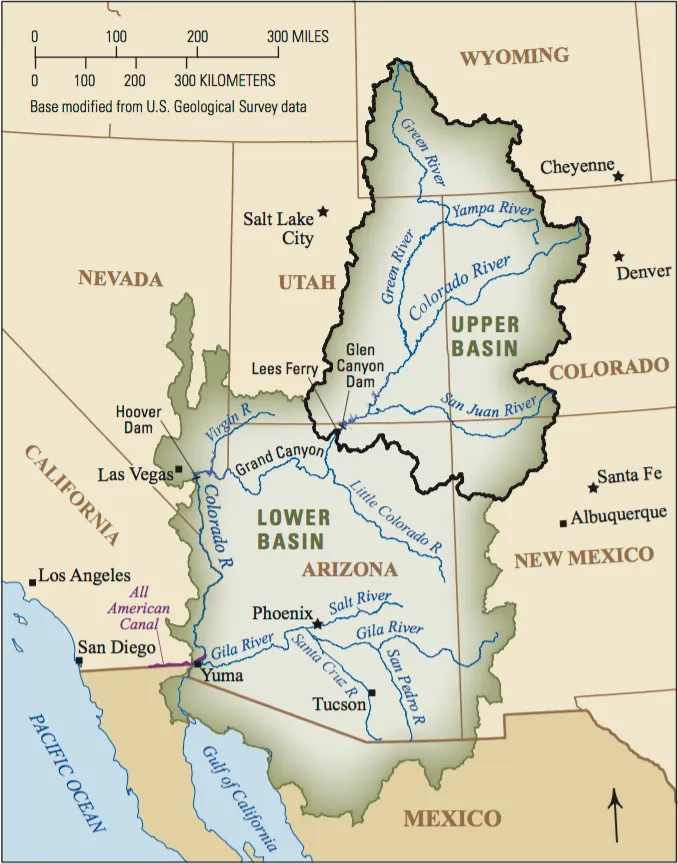
Map of the Colorado River drainage basin, created using USGS data. By Shannon1 Creative Commons Attribution-Share Alike 4.0

Click the link to read the article on the AZCentral.com website (Branson Loomis). Here’s an excerpt:

February 13, 2026

Key Points

  • The seven Colorado River Basins states failed to reach a shortage-sharing agreement in time for a Feb. 14 deadline set by the federal government.
  • State officials say negotiations have yielded “almost no headway” toward a compromise over who will give up water.
  • The Interior Department has said it will impose its own plan, but that prospect could trigger a lengthy legal battle as states move to protect their water allocations.

The prospect of a costly and prolonged interstate lawsuit over rights to the Colorado River looms now that the states using the water are blowing past a Valentine’s Day deadline with no water-sharing deal in hand. With no agreement among the states, Interior Secretary Doug Burgum said the federal government could no longer delay action and would move forward with work on a set of alternatives outlined late last year.

“Negotiation efforts have been productive,” Burgum said in a statement Feb. 14. “We have listened to every state’s perspective and have narrowed the discussion by identifying key elements and issues necessary for an agreement. We believe that a fair compromise with shared responsibility remains within reach.”

[…]

The dispute has largely hinged on whether states in the headwaters region would agree to mandatory cuts [ed. no one has the authority to order mandatory cuts in Colorado and likely in the entire upper basin] to their overall supply in especially dry years — a commitment they have so far rejected in part because they do not use their full allocation as the more developed Southwest does…

“As I talk with people throughout Southern Nevada, I hear their frustration that years of negotiations have yielded almost no headway in finding a path through these turbulent waters. As someone who has spent countless nights and weekends away from my family trying to craft a reasonable, mutually acceptable solution only to be confronted by the same tired rhetoric and entrenched positions,” [John] Entsminger said, “I share that frustration.”

Feds will finalize operating guidelines for #ColoradoRiver reservoirs: The seven compact states failed to meet a February 14th deadline for agreement on how to reduce their own usage of water to save the river — AlamosaCitizen.com #COriver #aridification

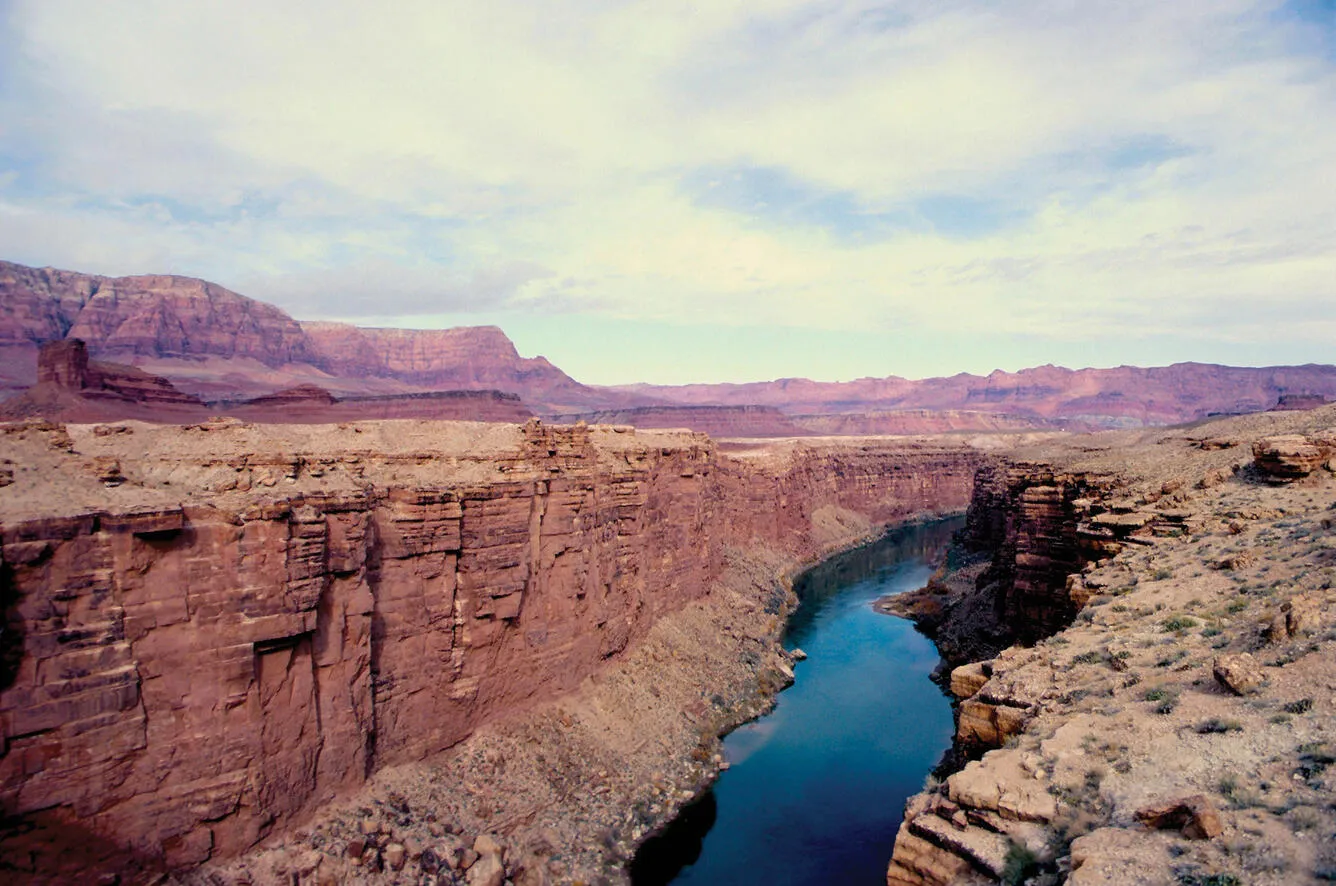
The Colorado River passes through the Grand Canyon in Arizona. Credit: USGS

Click the link to read the article on the Alamosa Citizen website:

February 15, 2026

The U.S. Bureau of Reclamation has released a February 24-month study showing inflow to Lake Powell declining by 1.5 million acre-feet since January as the federal agency highlights the worsening hydrologic conditions across the Colorado River Basin.

The study of the most probable forecast for the Colorado River under current conditions was released on Friday, just as the seven compact states remained at a stalemate and failed to meet a Feb. 14 deadline for agreement on how to reduce their own usage of water to save the river.

U.S. Interior Secretary Doug Burgum announced on Saturday, Feb. 14, that the federal government is moving forward with finalizing operating guidelines for the Colorado River reservoirs by Oct. 1. His announcement adds pressure to Colorado and the other compact states to find compromise or face guidelines forced onto them by the federal government. 

“While the seven Basin States have not reached full consensus on an operating framework, the Department cannot delay action,” the U.S. Bureau of Reclamation said in its announcement that the federal government was moving forward.

Colorado River Basin. Credit: USGS

The lack of agreement among the compact states and the idea of federal intervention raises the prospect of litigation that would be drawn out and ultimately end with the U.S. Supreme Court. The current Rio Grande Compact dispute between Texas and New Mexico that has taken 12 years to reach a proposed settlement, now filed with the U.S. Supreme Court, gives an indication to the slow-evolving nature of U.S. water law.

“I am disappointed that the seven Basin States could not reach a consensus agreement on the future management of the Colorado River by the U.S. Department of the Interior’s Feb. 14 deadline,” said Colorado Attorney General Phil Weiser, who added that Colorado is prepared for litigation to protect Colorado’s rights and interests.

“Colorado will continue to work with our fellow Upper Division States to provide comments on the federal government’s draft environmental impact statement, which sets forth a range of possible solutions. The Upper Division States will have to cut back their usage of water from the Colorado River — by 40 percent or more — in the face of an historic drought,” he said.

U.S. Sen. John Hickenlooper said the low snowpack this winter is adding an exclamation point to the dire conditions of the Colorado River Basin. “If we don’t address this problem together — head-on and fast — our communities, farms, and economies will suffer,” Hickenlooper said.

“The best path forward is the one we take together. Litigation won’t solve the problem of this long-term aridification. No one knows for sure how the courts could decide and the math will only get worse.”

BLM’s February 24-month study shows a loss of 1.5 million acre-feet is equivalent to approximately 50 feet in elevation in Lake Powell.

“The basin’s poor hydrologic outlook highlights the necessity for collaboration as the Basin States, in collaboration with Reclamation, work on developing the next set of operating guidelines for the Colorado River system,” said Acting BLM Commissioner Scott Cameron. “Available tools will be utilized and coordination with partners will be essential this year to manage the reservoirs and protect infrastructure.”

The water year inflow is now estimated at just 52 percent of average, and as a result, the February 24-Month Study projects, for the first time, that Lake Powell could decline (based on most probable projections) to:

“The basin’s poor hydrologic outlook highlights the necessity for collaboration as the Basin States, in collaboration with Reclamation, work on developing the next set of operating guidelines for the Colorado River system,” said Acting BLM Commissioner Scott Cameron. “Available tools will be utilized and coordination with partners will be essential this year to manage the reservoirs and protect infrastructure.”

The water year inflow is now estimated at just 52 percent of average, and as a result, the February 24-Month Study projects, for the first time, that Lake Powell could decline (based on most probable projections) to:

3,490 ft – minimum power pool in December 2026; below this level Glen Canyon Dam’s ability to release water is reduced and it can no longer produce hydropower.

3,476 ft – in March 2027; the lowest elevation on record since filling further constraining the ability to release water from Glen Canyon Dam.

Colorado River managers estimate that around 4 million acre-feet of cuts are needed to bring the basin back into balance – an amount equal to more than a quarter of the Colorado River’s annual average flow.

“There needs to be unbelievably harsh, unprecedented cuts,” Brad Udall, a senior water and climate research scientist at the Colorado Water Center, told The Guardian media outlet.

 “Mother Nature is not going to bail us out,” Udall said.

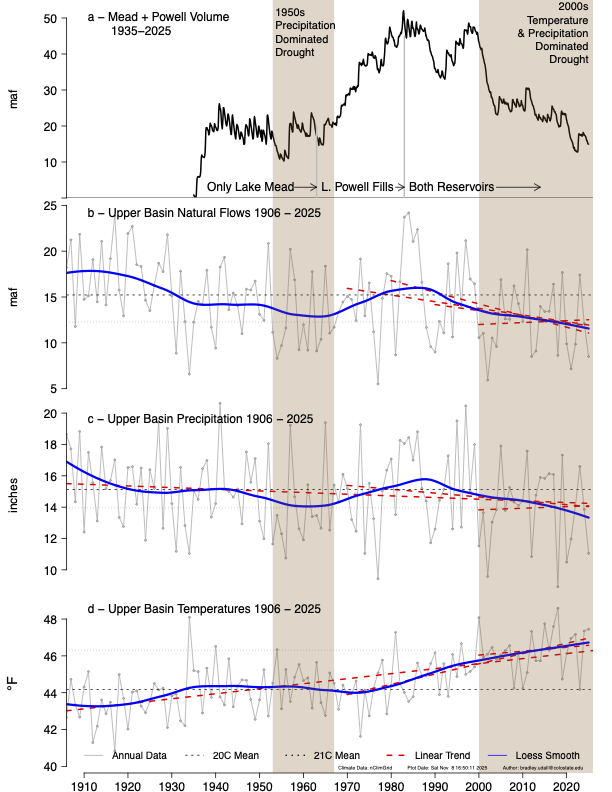
Udall/Overpeck 4-panel Figure Colorado River temperature/precipitation/natural flows with trend. Lake Mead and Lake Powell storage. Updated through Water Year 2025. Note the tiny points on the annual data so that you can flyspeck the individual years. Credit: Brad Udall

Flows in the Colorado River are down 20 percent over the last century and precipitation has shrunk by about 7 percent with rising temperatures as aridification takes hold across the southwest. 

“The chickens are coming home to roost,” Udall said. “Climate models have underestimated how much warming we are going to get, and humans are not stepping up.”

Jack Schmidt, director of the Center for Colorado River Studies at Utah State University, likened the negotiations among the seven compact states to the final scene in “Thelma and Louise.” “Seven people have their hands on the steering wheel driving toward the edge of a cliff — and no one is working the brakes,” he reportedly said.

Fossil Point | Metro-Goldwyn-Mayer