Snow drought is worsening wildfire risk and water storage concerns in #Colorado, according to experts: Gripped by #drought, northwest Colorado’s #snowpack has seen record lows that are likely to lead to reduced streamflows in the spring — Sky-Hi News

Click the link to read the article on the Sky-Hi News website (Ryan Spencer). Here’s an excerpt:

February 23, 2026

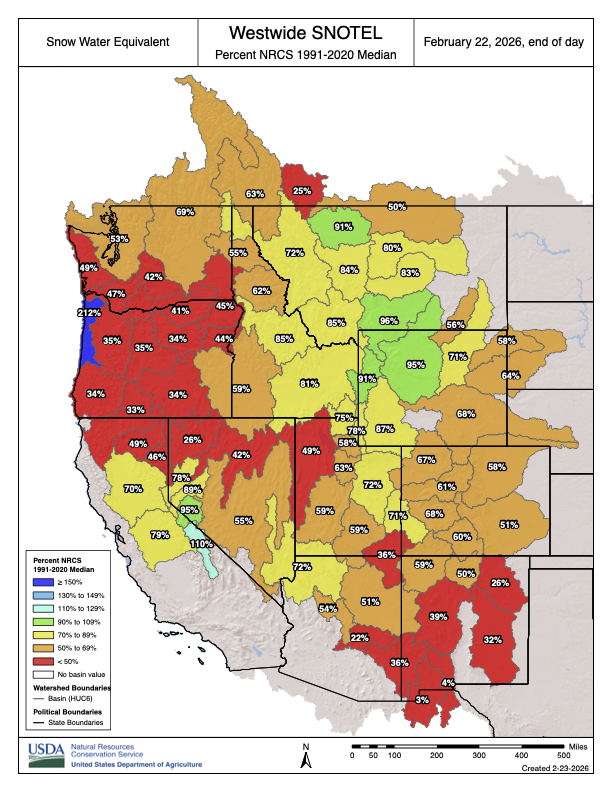
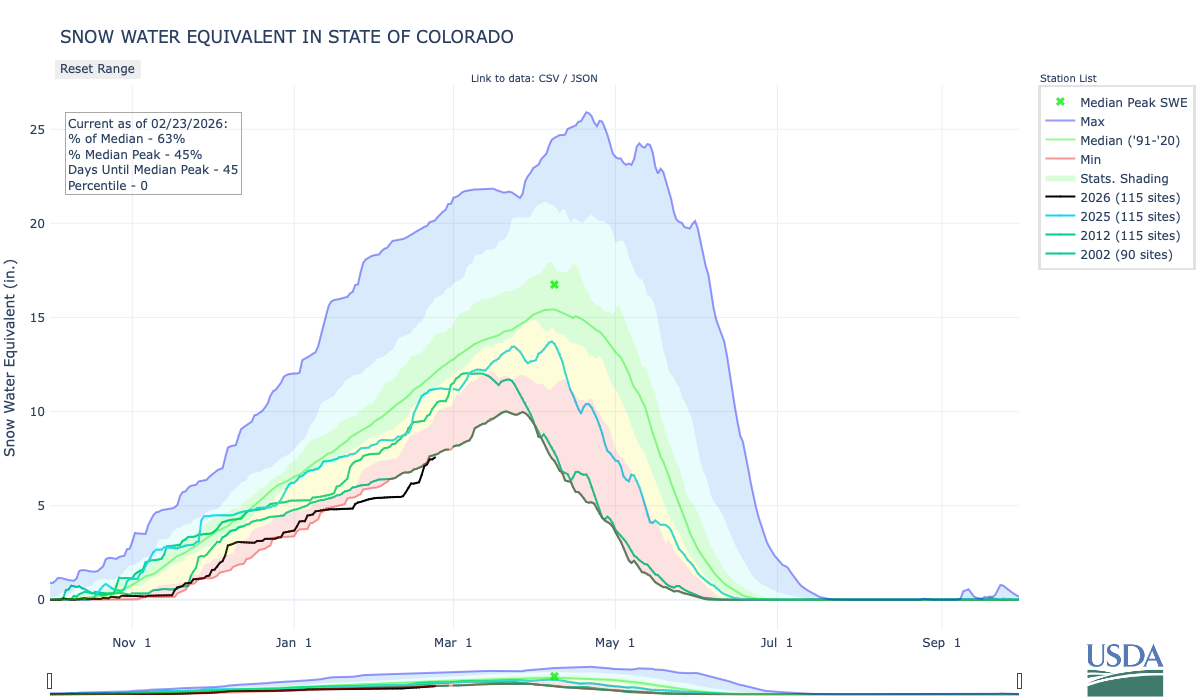
Colorado’s record-low snowpack is already raising concerns about increased wildfire risk and water shortages this summer, even as the mountains are still in the depths of winter. Statewide, the snowpack levels are just 61% of median for this time of year, and it would take consistent, record-breaking snowfall for the rest of the season to reach normal peak snowpack levels, according to the U.S. Department of Agriculture.

“We really should be bracing for an unusually early and potentially severe fire season,” Colorado Division of Fire Prevention and Control public information officer Tracy LeClair said. “Some of the conditions are worse than we saw in the big years, like 2012 and 2020, where we saw some of the largest fires and some of the most destructive fires in Colorado history.”

Those historic fire seasons were preceded by winters with well-below-average snowpacks, LeClair said. But this winter season, the snowpack is the worst Colorado has seen in decades. For weeks, the state’s snow telemetry network, which dates back to about 1987, has ranked the snowpack as the worst on record.

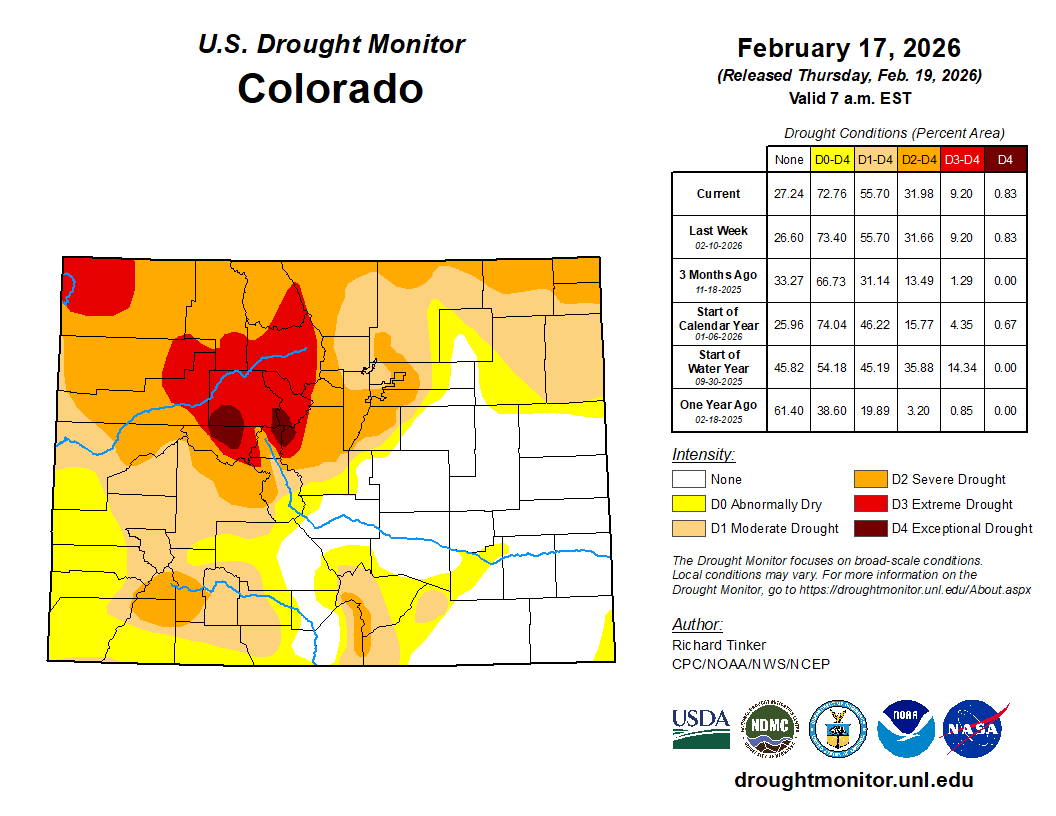
Colorado Drought Monitor map February 17, 2026.

In the latest report from the U.S. Drought Monitor, parts of Summit, Eagle, Pitkin, Lake and Park counties were experiencing exceptional drought — the most intense level of drought. Meanwhile, most of northwest Colorado is under extreme drought or severe drought status…The snow drought that has persisted through the season has shifted the fire risk “into the late winter months,” LeClair said. She noted that lack of snow has also led fire agencies across the state to delay or cancel prescribed burn projects, like pile burns, which require snow on the ground to burn safely.

#Denver Announces Moratorium on New Data Centers

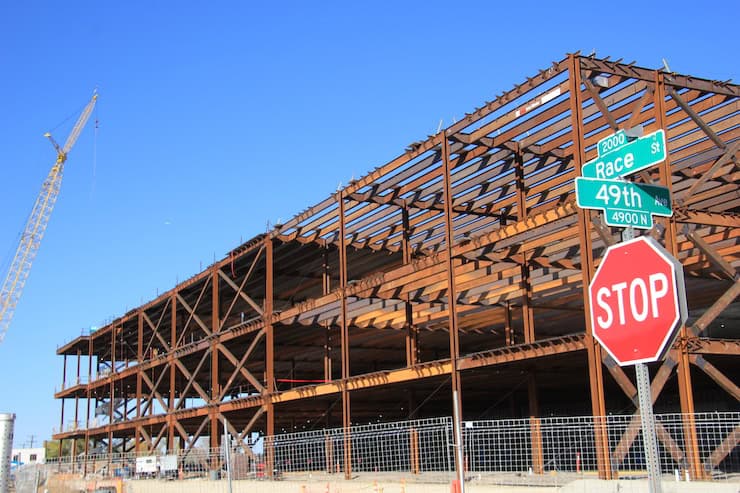
Data center construction at 49th & Race, Denver. Photo credit: Allen Best

Click the link to read the release on the City of Denver website:

February 23, 2026

Mayor Mike Johnston today joined members of City Council in announcing it intends to file a moratorium on new data centers in Denver. The process, which is expected to last several months, will allow the city to review and strengthen regulations around the sites.

“Data centers power the technology we depend upon and strengthen our economy,” said Mayor Mike Johnston. “But as this industry evolves, so must our policies. This pause allows us to put clear and consistent guardrails in place while protecting our most precious resources and preserving our quality of life. Denver is pro-business and pro-climate, and I’m proud to partner with City Council in keeping Denver one of the top tech sectors in the country and doing so in a way that is responsible to our residents and the industries who wish to invest here.”

An ordinance announcing the moratorium will be filed by Council. If approved, the city will conduct a review of additional, data-center specific regulations around responsible land, energy, and water use as well as zoning and affordability for ratepayers. The city will launch a process that collaborates with members of the community, climate experts, and industry leaders to clarify guidance and create a policy that is practical, predictable, and transparent.

“Data centers bring with them a unique series of environmental challenges and neighborhood impacts,” said Councilman Paul Kashmann. “My office has been looking into this topic in depth in recent months. I believe the complexity of the issues involved merits our city taking a pause to give them adequate consideration. While there remains distance between the Mayor’s view and mine – as well as some other Council colleagues – I look forward to working with the administration, the community at large and industry voices to see if regulations – as have been instituted in sister cities around the country – will or will not make additional data center development possible in the City and County of Denver.”

Data centers provide significant economic impact through high-paying jobs and property tax revenue. They are also a necessary component of many aspects of our daily lives, from operating major sectors like healthcare, automotive, retail, and shipping to everyday tasks like sending an email, streaming a movie, or using an app on your phone.  

“Denver is a city that embraces innovation. We are also committed to protecting our environment,” said Councilman Darrell Watson. “Data centers use significant energy and water. We have a responsibility to manage their growth in our communities wisely and sustainably. I will be introducing common sense legislation built on that premise. We can protect the health of Denver communities, strengthen our climate commitments, and continue to keep our city moving forward responsibly.”

Existing data centers and projects currently permitted or under construction are not impacted by this decision, though they may be expected to follow new guidelines once announced.

#ColoradoRiver plan could wipe #Arizona from the map, officials say — AZCentral.com #COriver #aridification

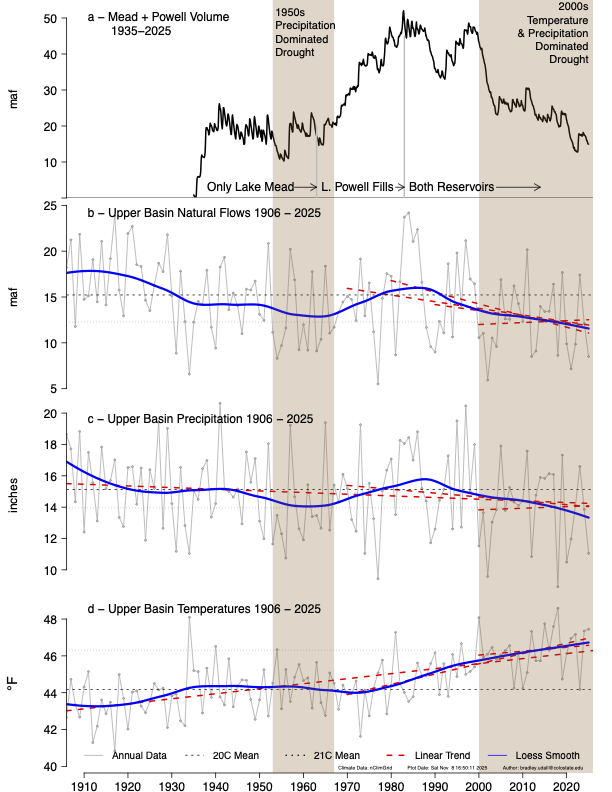
Udall/Overpeck 4-panel Figure Colorado River temperature/precipitation/natural flows with trend. Lake Mead and Lake Powell storage. Updated through Water Year 2025. Note the tiny points on the annual data so that you can flyspeck the individual years. Credit: Brad Udall

Click the link to read the article on the AZCentral website (Brandon Loomis). Here’s an excerpt:

February 23, 2026

Key Points

  • A coalition of cities and water providers, led by the Central Arizona Project, has launched a media campaign targeting proposed Colorado River cuts.
  • The campaign includes a TV ad that claims Arizona “is being unfairly targeted” by some water management alternatives outlined in a federal document.
  • After the seven Colorado River states failed to reach an agreement on shortage sharing, the federal government turned to its own set of proposals.

A Central Arizona Project-backed advocacy group called the Coalition for Protecting Arizona’s Lifeline has begun rolling out television ads and online videos defending the water supplier’s rights to a Colorado River that is under serious hydrological and political strain.

“Arizona is being unfairly targeted for reductions of Colorado River water that would cripple our state, flatten our economy and weaken our nation’s defense,” an ad aired by the coalition warns. It goes on to note that Arizona communities have done their part, committing more water for conservation in Lake Mead than those in other states, and that several options that the federal government is weighing for managing the river would fall hardest on the state.

One such alternative under review, CAP General Manager Brenda Burman recently said, would essentially dry up the agency’s canal from the river to Phoenix and Tucson…The alternatives Burman was referring to were never stated as the Trump administration’s preference, but rather as ideas from which the seven states that share the river water might draw from in writing an agreement for sharing in its worsening shortages. Now that the states have failed to reach such an agreement, though, the U.S. Bureau of Reclamation is faced with either enacting something like them or rapidly developing a new federal plan in time to replace river guidelines that expire this autumn…While the materials don’t directly state members’ intended method of securing water, some of the videos lean heavily on the so-called Law of the River and its guarantee of water from the four headwaters states to Arizona, California and Nevada. This theme reiterates a point that CAP and Arizona water officials have stressed over the last year or so, that if push comes to shove in a legal battle, they have the 1922 Colorado River Compact on their side.

“The Lower Basin has paper water, uses wet water, and wants the Upper Basin to deliver ghost water” — Kevin Pilgrim

#ColoradoRiver crisis fails to force deal from states: Dry conditions and federal deadlines not working like in the past — Heather Sackett (AspenJournalism.org) #COriver #aridification

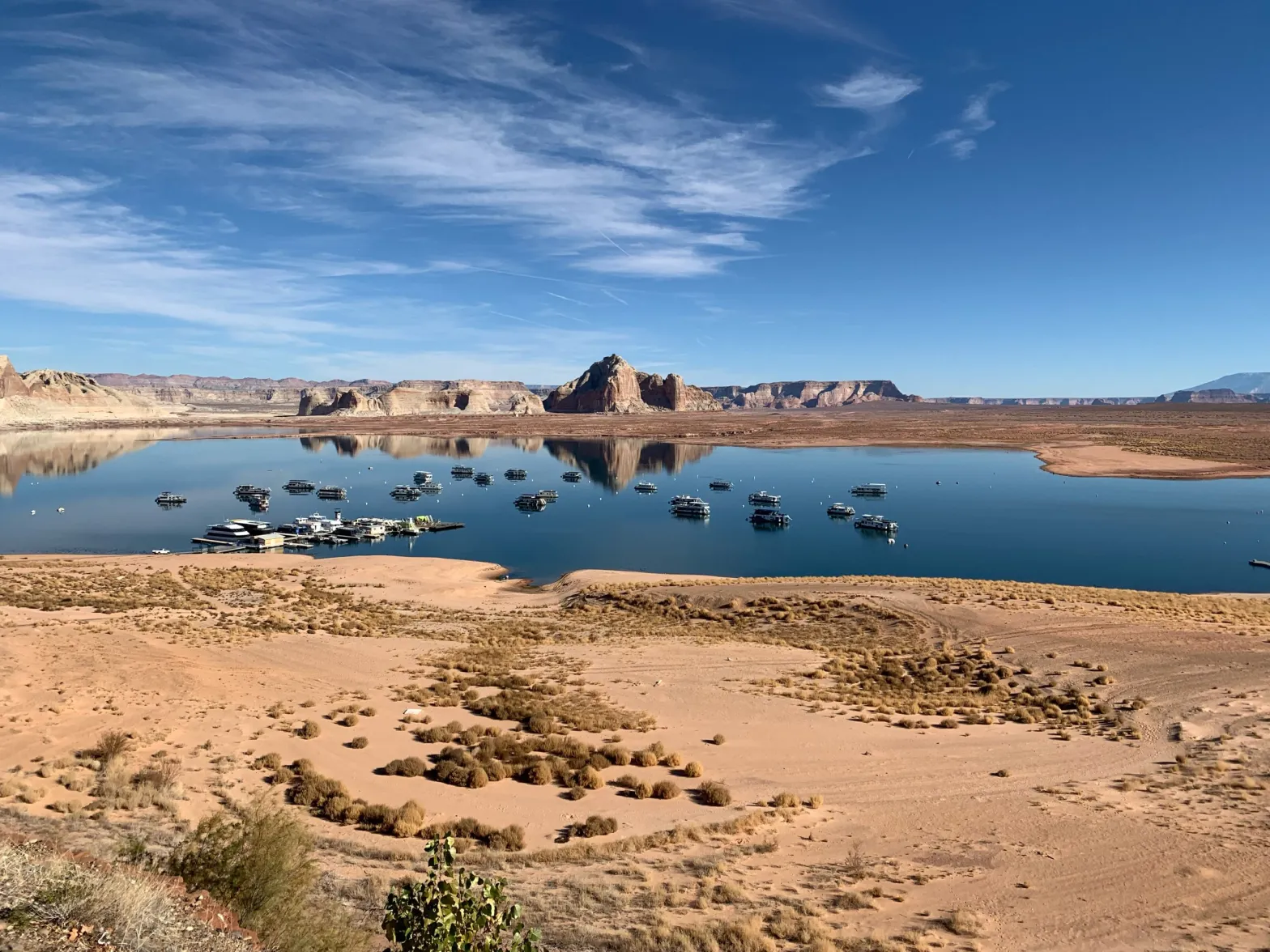
Water levels were low at Lake Powell’s Wahweep Marina in November 2021. Recent worst-case projections from the U.S. Bureau of Reclamation show the reservoir declining below power pool by July. CREDIT: HEATHER SACKETT/ASPEN JOURNALISM

Click the link to read the article on the Aspen Journalism website (Heather Sackett):

February 20, 2026

The Colorado River crisis is no longer part of some hypothetical future — it’s here. 

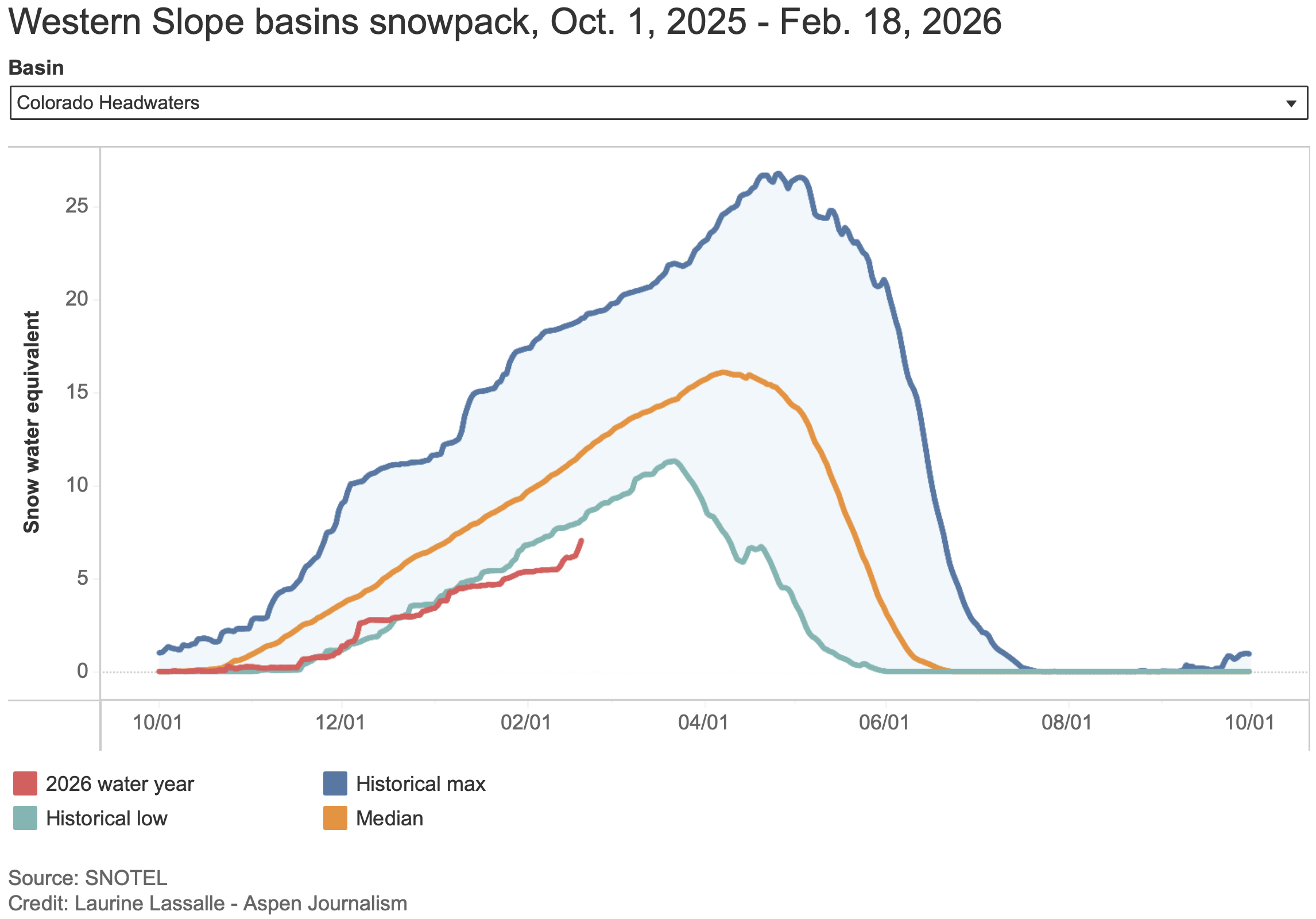
Fueled by one of the worst snowpacks on record, the “most probable” February projection from the U.S. Bureau of Reclamation estimates 5 million acre-feet flowing into Lake Powell this year, which is 52% of average. A more grim estimate puts that number at just 3.5 million acre-feet, or 37% of average. 

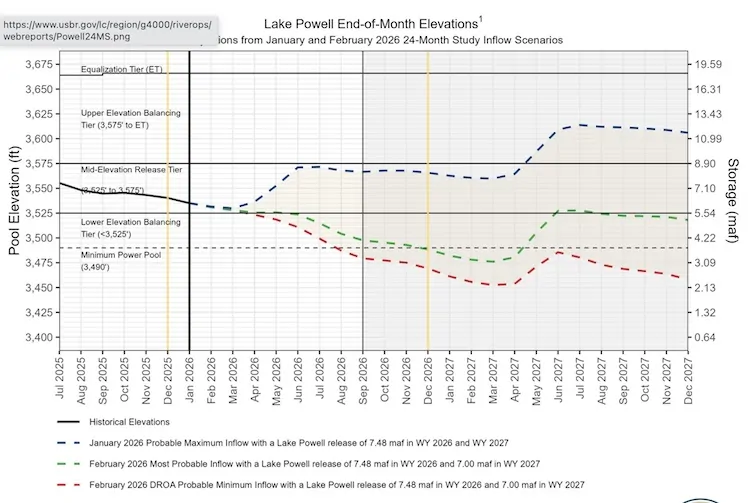
Forecasts show the nation’s second-largest reservoir could fall below the minimum level needed to make hydropower at Glen Canyon Dam as soon as July under the worst-case scenario, or by December under the “most probable” forecast. Reservoir levels are projected to fall to their lowest elevation on record in March 2027, threatening the water supply for millions in the Southwest. 

But the increasingly dire projections, this winter’s historically bad snowpack and the growing gap between supply and demand haven’t yet pushed the seven states that share the river to come to an agreement on its future management. 

Last week, state negotiators blew past a second federally set deadline to find a consensus plan on how to share shortages and manage Lake Powell and Lake Mead after the current guidelines expire at the end of the year. They have been stuck at an impasse for two years. 

The need for a new management paradigm that adapts to a shrinking water supply has never been more urgent. So why isn’t the crisis forcing a deal?

“We’re at a moment where we really need something different that responds to our current hydrology, our current demands, and we’re not seeing a development of that kind,” said Elizabeth Koebele, a professor of political science and associate director of the graduate program of hydrologic sciences at the University of Nevada, Reno. “You’d think that all of these signals would be pointing to the fact that we really need to do something different, but we’re not.”

Anne Castle, a former federal representative to the Upper Colorado River Commission and a Colorado River expert, co-authored a paper in 2021 that said successful negotiations of new Colorado River agreements tend to be triggered by very dry conditions, and that federal directives and deadlines also play an important role. But the current stalemate amid worsening drought throws those findings into question.

“Our premise was that a crisis in terms of water supply and reservoir levels and snowpack and expected runoff can prompt creative compromise,” Castle said. “But we have all those underlying conditions, and we don’t have a compromise.”

The scale of the problem could be part of what’s making consensus difficult between the Upper Basin (Colorado, New Mexico, Utah and Wyoming) and the Lower Basin (California, Arizona and Nevada). As a junior water user on the river, the Central Arizona Project, which supplies the metro Phoenix and Tucson areas, could face the deepest cuts. 

“I think if this had been a 2 million-acre-foot problem, the states probably could have solved it, but it’s potentially a 4 million-acre-foot problem,” said Kathryn Sorensen, a researcher and professor at Arizona State University’s Kyl Center for Water Policy. “There’s so little water to go around that positions have become hardened as a result. We’re not just talking about inconvenient cuts; we’re talking about severe pain to economies at this point.” 

Federal involvement

Some of the normal levers that have been pulled to force action in the past — such as directives and deadlines from the federal government — don’t seem to be effective in the current situation. There have been no apparent consequences for the states missing both the Feb. 14 deadline and an initial Nov. 11 deadline set by the feds for the states to present the outline of an agreement. 

The seven state negotiators and their governors were summoned to Washington, D.C., the last week of January for a meeting with Department of Interior officials. That, too, failed to result in a deal.

In a Feb. 14 news release, Interior Secretary Doug Burgum thanked the governors for their engagement and said a fair compromise with shared responsibility remains within reach.

Koebele said when the states were hashing out the 2007 guidelines, which currently govern the river and are just months from expiring, the threat of federal action was part of what spurred the states to come up with a plan. 

“There’s a little bit less of this idea of a single or central federal leader in the negotiation process,” Koebele said. “And they’re also still saying, ‘Hey, states, please come up with your own option too.’ I’m not really sure how credible threats are from the federal government when we’re in this sort of context.”

Reclamation has presented five options for managing the river, but although the federal government owns and operates the infrastructure such as dams and reservoirs, it doesn’t have the authority to implement all of the actions outlined in the options. The new, innovative and collaborative actions would need an agreement among the states. 

Absent that, federal officials believe the only tools at their disposal, which allocate cuts based on prior appropriation and existing water law, could see Arizona take up to 77% of total shortages, yet they “may not provide adequate protection of critical infrastructure or the system and may be viable only in the short term given current reservoir conditions,” according the bureau.

The federal management options are part of a draft environmental impact statement, which is required as part of the National Environmental Policy Act review for new guidelines. This process is moving forward on a separate, parallel track to negotiations among the states. If the states agree on a plan, it could be plugged into the EIS and become the “preferred alternative.”

“We’re sort of at a key moment for those two processes coming together,” Koebele said. “But the EIS and the state negotiations are not really intersecting in a way that we have seen them intersect in the past or that we hoped they would.”

Federal officials are accepting comments on the draft EIS until March 2.

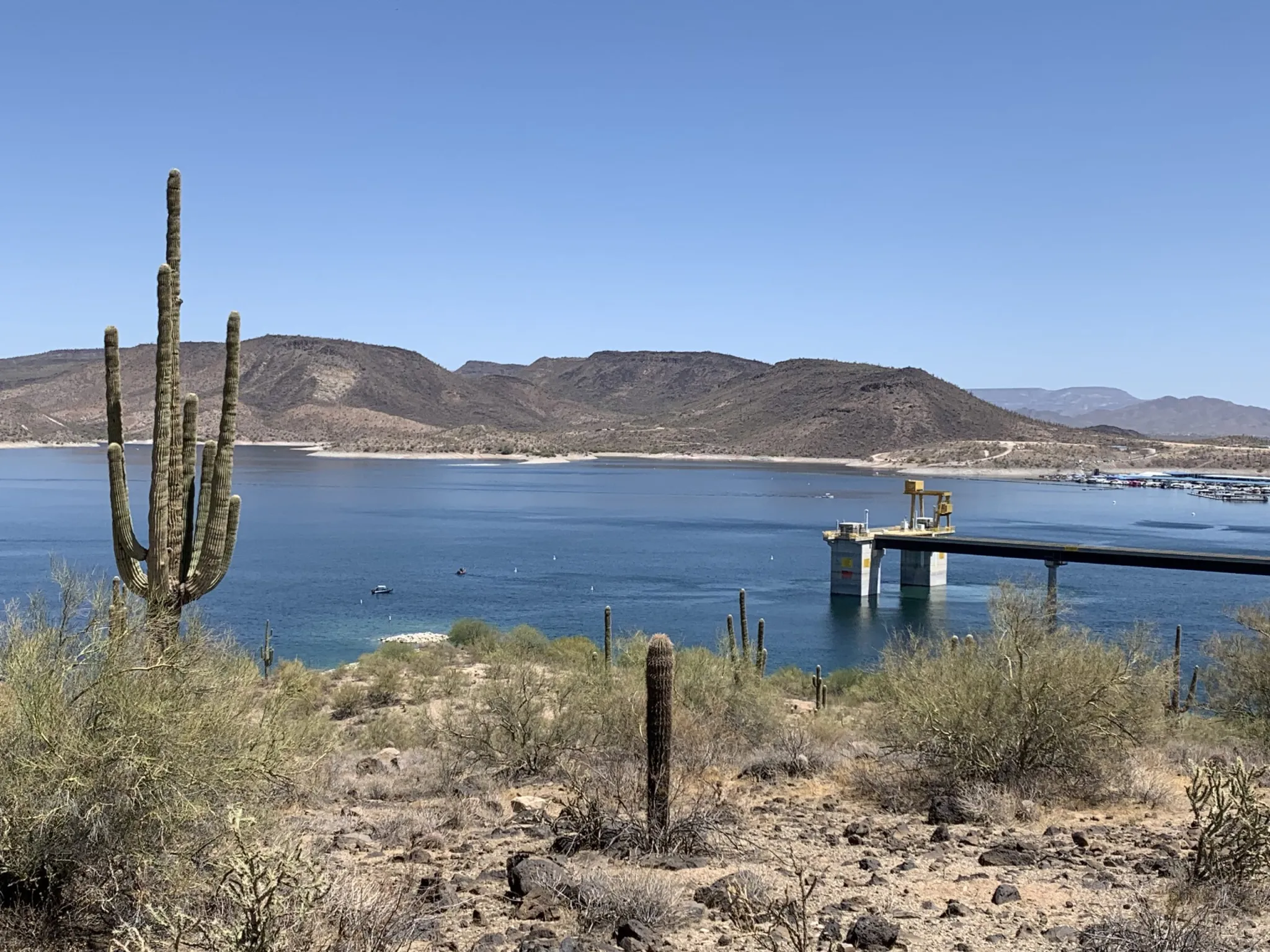
Lake Pleasant, seen in April 2025, is a storage bucket for Colorado River water and is part of the Central Arizona Project that delivers water to the Phoenix and Tucson areas. According to one river management option from the federal government, Arizona would take the majority of shortages in dry years. CREDIT: HEATHER SACKETT/ASPEN JOURNALISM

Blame to go around

In a series of news releases on February 13, 2026Upper Basin and Lower Basin officials blamed each other for the continuing standoff. 

“We’re being asked to solve a problem we didn’t create with water we don’t have,” Colorado’s representative, Becky Mitchell, said in a prepared statement. “The Upper Division’s approach is aligned with hydrologic reality, and we’re ready to move forward.” 

The crux of the issue is who should take shortages in drought years. The Lower Basin has committed to 1.5 million acre-feet of reductions annually and wants cuts beyond that to be shared by the Upper Basin. The Upper Basin says their water users already take cuts in some years because streams run dry by midsummer and any contributions they make through conservation must be voluntary.

Water managers upstream of Lee’s Ferry would note that they were promised an equal amount of water as the Lower Basin was in the 1922 Colorado River Compact, although they use about 4 million acre-feet a year, while the Lower Basin — whose flows are backed up by releases from the country’s two largest reservoirs — regularly uses all of the annual 7.5 million acre-feet to which it’s entitled. The Lower Basin’s position points to its larger population and economic output, and that their water users, already subject to mandatory cutbacks, tend to be more aggressive in their conservation measures.

“It’s the fundamental disagreement that we’ve had for the past many years,” Castle said. “The Upper Basin doesn’t want to agree to any enforceable reductions in use. And that is something that the Lower Basin, and Arizona in particular, don’t feel like they can live with.”

The states appeared to be on the verge of a breakthrough last summer, when representatives from both basins indicated a willingness to consider a supply-driven approach, where reservoir releases are more directly tied to the natural flow of the river. But hashing out the details is complicated, and a plan that all parties can agree to has yet to emerge. 

Note the dotted red line. If says that it’s possible that power production at Glen Canyon Dam could end by August.

A new management plan would need to be in place by the start of the new water year on Oct. 1. And if the states can’t reach an agreement by then, the federal government will impose its own management rules, doling out cutbacks that could trigger lawsuits from the states but would not go far enough to prevent the system from crashing. 

Even if the states come to an eleventh-hour agreement, federal action will be needed in the immediate future to protect levels at Lake Powell and the ability to produce hydropower. The dire projections showing Powell dropping below minimum power pool assume that the feds would release 7.48 million acre-feet from Powell this year, but under a short-term agreement that also expires at the end of the year, they could reduce releases down to as little as 6 million acre-feet. The Bureau of Reclamation is also holding back about 600,000 acre-feet in Lake Powell through April, which will be released later in the year.

The last time Lake Powell was projected to drop below system-critical thresholds after the 2021 spring runoff, Reclamation conducted emergency releases from upstream reservoirs. The chance that the bureau will again release additional water from those federally controlled reservoirs — Flaming Gorge, Blue Mesa and Navajo — to boost Powell in the coming months is “about 100%,” according to Colorado River expert and author Eric Kuhn.

“Just how much is going to be up in the air, but right now, it looks like they need a million to a million-and-a-half acre-feet based on the current projections,” Kuhn said. 

John Fleck, an author, writer and University of New Mexico professor, was the co-author with Castle on the 2021 paper, titled “Green Light for Adaptive Policies on the Colorado River.” He said that in previous negotiations, state representatives not only had a sense of responsibility to protect water for their own communities, but were also looking out for the health of the entire interconnected basin. 

“What we have seen in the last few years is a shift to a leadership that is made up of people who are solely looking out for the interests of their own community,” Fleck said.

Experts say the Colorado River needs a new and different management plan that responds to dwindling flows, rebuilds reservoir storage and creates a resilient system in the face of climate change. The current leadership is failing to provide that, Fleck said. The solution is a shift in mindset for water managers to start playing not for the Upper Basin or Lower Basin, but for Team Colorado River Basin, he said.

“There’s a moral question involving the obligations we have to one another in shared river basins,” Fleck said. “I would not be at all happy to win the litigation and see the Central Arizona Project shut down. I would see that as a failure even though my community’s water supply might be protected.”

Map of the Colorado River drainage basin, created using USGS data. By Shannon1 Creative Commons Attribution-Share Alike 4.0

#FossilFuel pollution’s effect on oceans comes with huge costs: A new study details the vast price society is paying for burning coal, oil, and gas — Dana Nuccitteli (YaleClimateConnections.org)

Corals can be attached to reefs piece by piece with cement, zip ties, and nails. Credit: Reef Resilience Network.

Click the link to read the article on the Yale Climate Connections website (Dana Nuccitteli):

February 23, 2026

Florida’s barrier reef is in trouble – and it’s costing us. 

The reef has been experiencing a severe outbreak of stony coral tissue loss diseaseover the past decade. The likely cause: stress from the warming climate and acidifying waters, both the result of burning fossil fuels. 

The financial stake of losing the reef is high. Florida’s coral reefs are estimated to draw in over $1 billion in tourism revenue each year, provide $650 million in flood protection benefits, and support over 70,000 jobs. What’s more, coral reefs protect people and property by dissipating up to 97% of wave energy, lessening storm surges.

A new study in Nature Climate Change looks at such costs worldwide, estimating the total price of climate-change-related damage to the world’s oceans. The study concludes that accounting for ocean impacts nearly doubles the estimated climate costs to society, known as the social cost of carbon

But as with most climate impacts, these costs are unequally borne, most heavily by people in poorer island nations and in other coastal regions like Florida. And as with all climate threats, they are being wholly ignored by the Trump administration.

‘A missing piece’ 

Earth’s oceans play a critical and often overlooked role in the health and well-being of people and cultures around the world. The average person consumes nearly one pound of seafood per week, which provides important dietary nutrients. Coastal ecosystems like mangrove forests and coral reefs also protect coastal communities against storm surges, a growing threat as a result of rising sea levels and climate-intensified storms. 

But these benefits, which are threatened by climate change, are difficult to quantify. And when they’re not quantified, they’re left out of experts’ estimates of the damages we incur by burning fossil fuels and releasing climate-warming carbon dioxide – the social cost of carbon. 

As a result, even when the U.S. Environmental Protection Agency updated the federal estimate of the social cost of carbon in 2023 to nearly four times its previous value, the agency noted that this was likely still an “underestimate [of] the damages associated with increased climate risk.”

Climate impacts in the oceans in particular have been “a big missing piece recognized by every major assessment” of the social cost of carbon, said Bernie Bastien-Olvera, a climate scientist at the National Autonomous University of Mexico, in an email. He is the lead author of the new Nature Climate Change study. 

Climate change’s one-two ocean punch

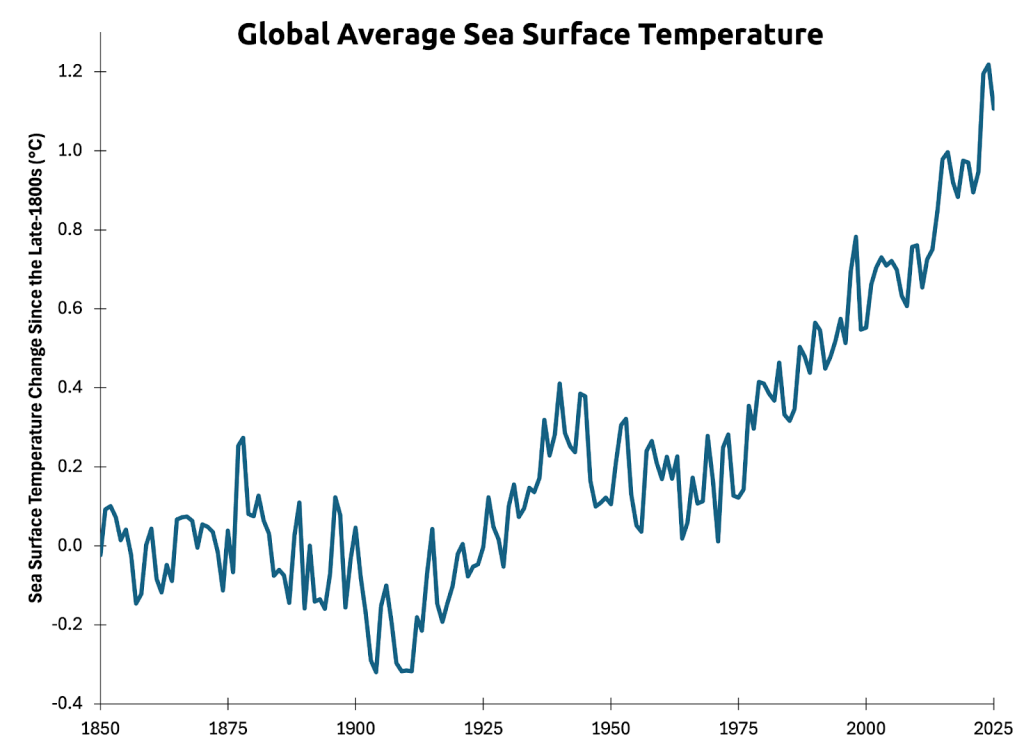
Human burning of fossil fuels affects Earth’s oceans via the one-two punch of warming and acidifying waters, which occurs as carbon dioxide is absorbed into the ocean. The oceans are about 40% more acidic today than they were before the Industrial Revolution.

1850–2025 global average sea surface temperature. (Data: UK Met Office Hadley Centre. Graphic: Dana Nuccitelli);
1985–2024 global average surface seawater pH. (Data: EU Copernicus Marine Service. Graphic: Dana Nuccitelli)

The falling pH of the oceans makes it more difficult for certain marine species, like shellfish and coral, to build their shells or skeletons. As a result of this combination of changing pH and heat, there have been four global mass coral bleaching events since 1998. These events indicate extreme stress and life-threatening conditions for coral reefs, upon which approximately one-quarter of all marine life relies for food, shelter, and breeding grounds.

Read: How climate change is making hurricanes more dangerous

Island nations ‘disproportionately threatened’

The new study found that island nations, whose very existence is often threatened by rising sea levels, are “disproportionately affected” by the impacts of climate change on the oceans. 

For example, about one-third of the world’s tuna catch comes from a group of 14 Pacific island nations. Fees associated with tuna fishing access account for about one-third of their government revenue, tuna fishing supports tens of thousands of jobs in the region, and tuna are an important dietary staple in these cultures. 

But a 2021 study led by Conservation International’s Senior Director of Tuna Fisheries Johann Bell estimated that as warming oceans cause tuna to migrate away from this region, catches could be reduced by as much as 20% by 2050. Some Pacific Island coastal communities already “have trouble catching enough coral reef fish for food security,” Bell wrote via email. That’s the result of a combination of ocean warming and acidification, as well as human population growth.

The new Nature Climate Change study found that the loss of omega-3 fatty acids, calcium, iron, and protein from seafood-depleted diets would have significant negative effects on the health of populations that rely on these dietary sources. For example, the authors note that “a full intake of omega-3 fatty acids reduces risk of cardiovascular diseases by 7% relative to a diet poor of omega-3 fatty acids.”

Overall, these health impacts account for about half the study’s new estimated social cost of carbon from ocean impacts. Most of the rest stems from the loss of corals and mangroves, and the benefits they provide in terms of protecting coastal communities like Florida’s from increasingly severe storm surges, for example.

The Trump EPA buries its head in the eroding sand

Despite the ever-improving understanding of the immense damages associated with unabated climate change, the EPA in 2026 has strayed even further from evidence-based reality. 

Although federal agencies are required by law to consider the costs and benefits of proposed regulations, the Trump EPA reportedly plans to stop assessing gains resulting from the health benefits of its air pollution rules. And the agency continues to move forward with its efforts to dismantle federal climate pollution regulations altogether, effectively treating the social cost of carbon as $0, compared to the nearly $400 per ton that would result from the combination of the EPA’s 2023 estimate and the new study’s estimated ocean damage costs to society.

Read: Trump just torched the basis for federal climate regulations. Here’s what it means.

But the new research still offers important value and insights. 

“The way I see it, there are many other countries in the world (or even state/local governments within the U.S.) that can benefit from having better estimates of the social cost of carbon that rely on our best science and economics recognizing the oceans,” Bastien-Olvera said. 

And a future administration and EPA could potentially reintroduce climate regulations and pollution cost-benefit analyses. Accounting for a nearly doubled social cost of carbon pollution could justify more stringent future climate rules.

“I hope that this metric proves useful for future U.S. governments,” Bastien-Olvera said. 

The fate of island nations and Florida’s coastline alike may depend on it.

2026 Conservation in the West Poll — State of the Rockies Project

Dark Skies Over Bears Ears, Valley of the Gods, Utah, This photo was taken late at night in the middle of the desert. Over the Fourth of July, I traveled to Southeast Utah to interview people and take some final light readings in Blanding and Monticello Utah while working for the State of the Rockies Project Dark Skies Team. The whole summer I had been trying to get a reading within the “no visible light” range. This night I was able to do so. It was so dark that my light meter didn’t even work, but once I switched out my lens to a fisheye, the whole sky appeared on my camera in front of me. For me, this image represents something I had been looking for all summer. I had heard people speak about the sky in Bears Ears and why it was so worth protecting, but to see the stars for myself was something else entirely. Photo by Megan O’Brien, ’25

Click the link to read the release on the Colorado College website:

February 18, 2026

Here’s the release:

Mountain West Voters Show Growing Concerns Over Public Land Protections Heading into 2026 Elections

State of the Rockies Project survey shows tension over direction of land management and energy priorities, and desire for conservation of scarce water resources and public lands.

COLORADO SPRINGS—Results from Colorado College’s 16th annual State of the Rockies Project Conservation in the West Poll released today show widespread concern among Western voters about rollbacks of protections for land, water, and wildlife and cuts to funding for public land management.

The poll, which surveyed voters in eight Mountain West states—Arizona, Colorado, Idaho, Montana, Nevada, New Mexico, Utah, and Wyoming—found that Western voters across party lines are prioritizing conservation, recreation, and renewables over fossil fuel development heading into this year’s midterm elections.

Highlights from the Poll

  • 84% of Western voters say that the rollback of laws that protect our land, water, and wildlife is a serious problem, a sharp increase from prior years.
  • 85% of respondents say issues involving public lands, waters, and wildlife are important in deciding whether to support a public official.
  • 86% of Western voters deem funding cuts to public lands a serious problem, including 76% of Republicans.
  • 70% of respondents oppose fast-tracking oil, gas and mining projects on national public lands by reducing environmental reviews and local public input.
  • 72% of Westerners prefer expanding renewable energy over drilling and mining for more fossil fuels.
  • 76% of Western voters—more Western voters than ever before—say they would prefer their member of Congress to place more emphasis on conservation and recreation on public lands over maximizing energy production.
  • 74% of Western voters oppose selling some national public lands for oil and gas development.
  • 91% of Western voters say existing national monument designations should be kept in place.

As policymakers look ahead to the upcoming midterm elections, 85% of voters in Mountain West states say issues involving public lands, waters, and wildlife are important in deciding whether to support a candidate.

“At a time of growing pressure on land and water in the West, the call to action from voters is clear and bipartisan: Westerners want funding and stewardship for public lands and natural resources, ” said Ian Johnson, Director of Strategic Initiatives & Sustainability at Colorado College.

Voters want to prioritize renewable energy sources. When asked to prioritize energy sources, voters across party lines selected solar as their top choice, while coal was the least desired, with only 7% of respondents listing coal as a first or second priority.

Funding cuts to public land management have proven unpopular with Western voters. Recent funding cuts have reduced the number of firefighters, park rangers, scientists, and other employees working to protect public lands, water, and wildlife over the last year. These cuts to public land management have 86% of voters across party lines concerned, including 75% of MAGA supporters.

Western voters also oppose the sale of public lands and the elimination of public land protections. Even with rising housing costs, 76% of Western voters oppose selling public lands for housing. Additionally, 74% of Western voters oppose selling public lands to private companies for oil, gas, and mining development.

Scarce water resources continue to be a concern for Westerners, particularly in states that have experienced droughts. Westerners consider scarce water resources a serious problem, with 87% of Western voters concerned about inadequate water supplies. Accordingly, 83% of voters in states along the Colorado River or its tributaries would support an agreement requiring all states to reduce their use of the Colorado River to preserve its health. This emphasis on water protection is particularly salient, as 80% of Westerners say data centers are a threat to water quality and supply in the West.

This is the sixteenth consecutive year Colorado College gauged the public’s sentiment on public lands and conservation issues. The 2026 Colorado College Conservation in the West Poll is a bipartisan survey conducted by Republican pollster Lori Weigel of New Bridge Strategy and Democratic pollster Miranda Everitt of Fairbank, Maslin, Maullin, Metz & Associates. The survey is funded by the William and Flora Hewlett Foundation.

The poll surveyed at least 400 registered voters in each of eight Western states (AZ, CO, ID, MT, NV, NM, UT, & WY) for a total 3,419-voter sample, which included an over-sample of Black and Native American voters. The survey was conducted between January 2-18, 2026 and the effective margin of error is +2.4% at the 95% confidence interval for the total sample; and at most +4.9% for each state. The full survey and individual state surveys are available on the State of the Rockies Project website.

About Colorado College

Colorado College is a nationally prominent four-year liberal arts college that was founded in Colorado Springs in 1874. The College operates on the innovative Block Plan, in which its 2,200 undergraduate students study one course at a time in intensive three and a half-week segments. For the past eighteen years, the college has sponsored the State of the Rockies Project, which encourages students to conduct interdisciplinary investigations around the region to build on and deepen what we know about the challenges we face living in the Rocky Mountain West, and what to do about them.

About Fairbank, Maslin, Maullin, Metz & Associates

Fairbank, Maslin, Maullin, Metz & Associates (FM3)—a national Democratic opinion research firm with offices in Oakland, Los Angeles and Portland, Oregon—has specialized in public policy oriented opinion research since 1981. The firm has assisted hundreds of political campaigns at every level of the ballot—from President to City Council—with opinion research and strategic guidance. FM3 also provides research and strategic consulting to public agencies, businesses and public interest organizations nationwide.

About New Bridge Strategy

New Bridge Strategy is a Colorado-based, woman-owned and operated opinion research company specializing in public policy and campaign research. As a Republican polling firm that has led the research for hundreds of successful political and public affairs campaigns, New Bridge has helped coalitions bridging the political spectrum in crafting winning ballot measure campaigns, public education campaigns, and legislative policy efforts.

About Hispanic Access Foundation

Hispanic Access Foundation, a 501(c)(3) non-profit organization, connects Latinos with partners and opportunities to improve lives and create an equitable society. Our vision is that one day every Hispanic individual in America will enjoy good physical health and a healthy natural environment, a quality education, economic success, and civic engagement in their communities with the sum of improving the future of America. For more information visit http://www.hispanicaccess.org.

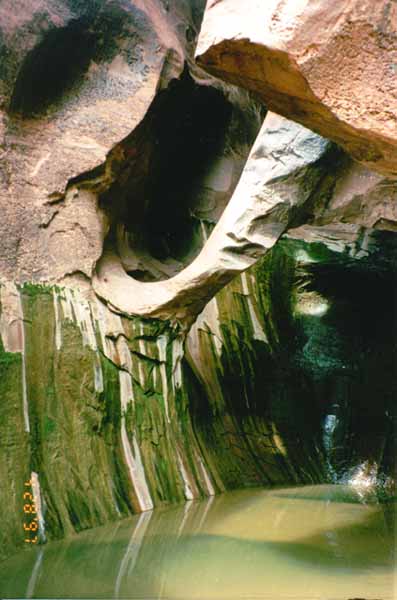
In Stevens Canyon. Photo credit: Joe Ruffert