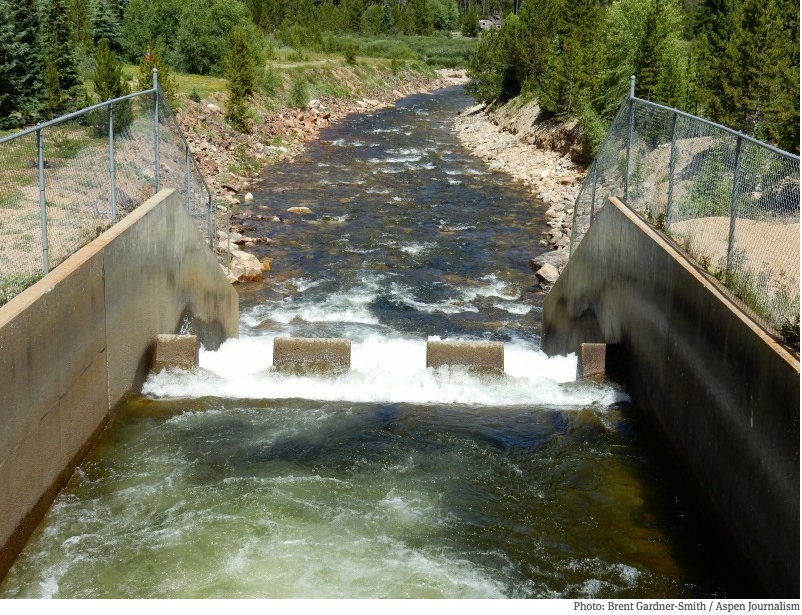
The Cascades, on the Roaring Fork River June 16, 2016. Photo: Brent Gardner-Smith/Aspen Journalism
From the Roaring Fork Conservancy via The Glenwood Springs Post Independent (Rick Lofaro):
Roaring Fork Conservancy is pleased to present yet another edition of the Voters’ Guide to Water Issues in the Roaring Fork Watershed. The importance of water in Colorado continues to grow as we plan for the future of our water resources. Roaring Fork Conservancy remains focused on water quality, water quantity and riparian health, addressing these issues via river science, water policy and educating citizens on current issues.
Knowledgeable elected officials help us protect vital water resources. With the upcoming election, we wanted to give citizens an opportunity to hear from candidates on local water issues and their proposed solutions.
Roaring Fork Conservancy asked candidates in local, state and federal races for their responses to two water-related questions. This pamphlet presents a non-biased forum for candidates to express their qualifications and platforms on water issues affecting the Roaring Fork Watershed and the state of Colorado. This Voters’ Guide can be found on our website at http://www.roaringfork.org/news and physical copies will be available in public places throughout the Roaring Fork Watershed.
Roaring Fork Conservancy does not endorse any candidates. Their unedited responses are presented as submitted.
We encourage you to vote, whether by mail or at a polling place on Tuesday, Nov. 6. Your voice is an important part of helping us bring people together to protect our rivers.
Homestake Reservoir on Homestake Creek in the Eagle River basin. Completed in 1967, it stores water destined for use Aurora and Colorado Springs. Photo credit: Brent Gardner-Smith/Aspen Journalism
During election years in Colorado, it’s routine for candidates for statewide office to address the summer convention of the politically powerful Colorado Water Congress.
After all, “it’s rare that a bill opposed by our membership is ever signed by a Colorado governor,” the group’s website claims.
And so the ritual was repeated last week as about 350 self-proclaimed “water buffaloes” gathered at the Hotel Talisa in Vail and heard from the Republican and Democratic candidates for the 3rd Congressional District, governor and attorney general.
And what the crowd — water managers and providers, engineers and water attorneys — wants to hear about most from candidates is their position on “storage,” “infrastructure” and “projects,” which are industry euphemism for dams and reservoirs.
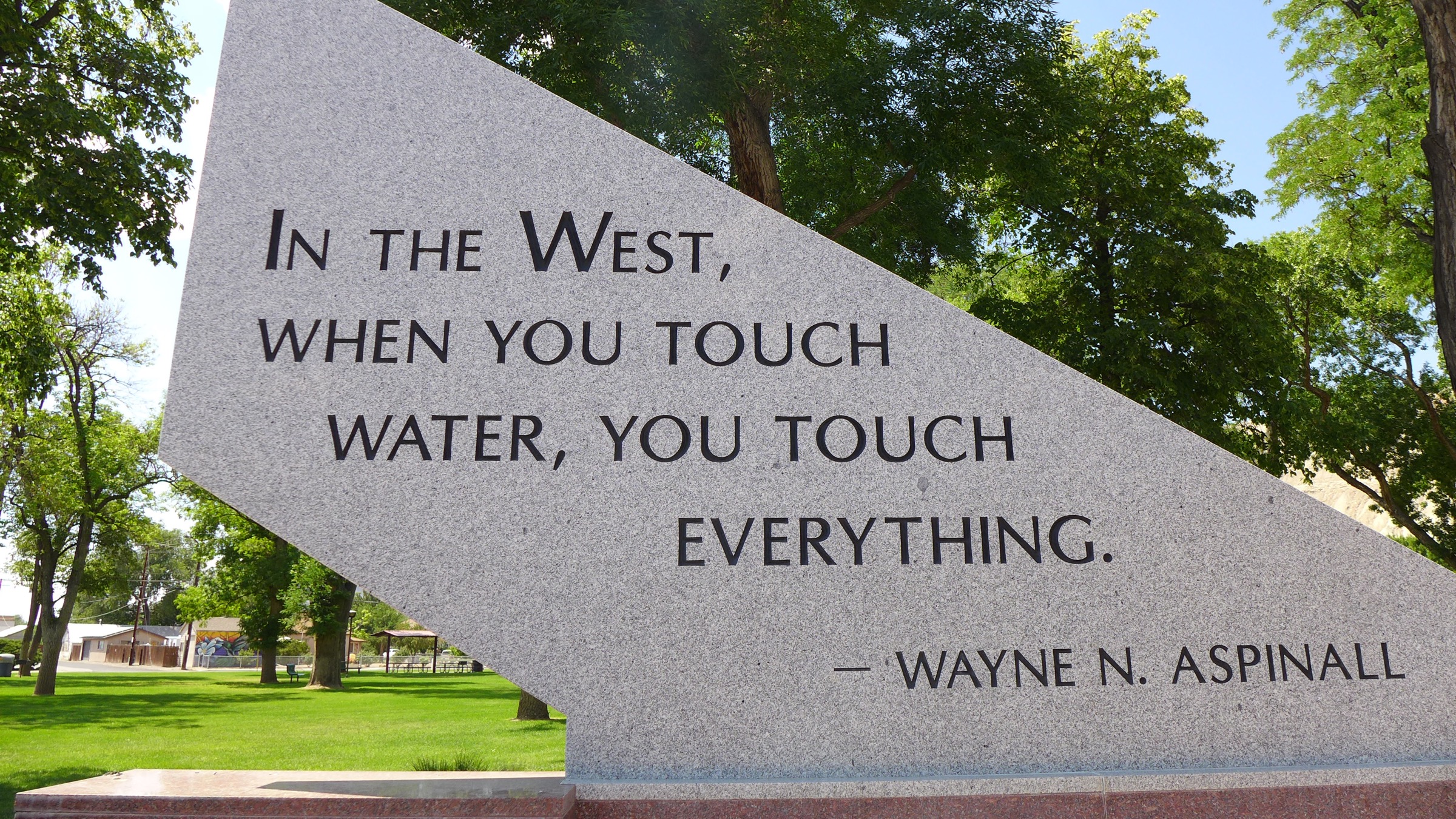
Part of the memorial to Wayne Aspinall in Palisade. Aspinall, a Democrat, is a legend in the water sector, and is the namesake of the annual award given by the Colorado Water Congress. Photo: Brent Gardner-Smith/Aspen Journalism
Storage box checked
“When it comes to water storage, we need to build more. And during my administration, we will build more,” Walker Stapleton, the Republican candidate for governor, told the Water Congress members on Wednesday, Aug. 22, in one of the more straightforward declarations heard last week on the subject.
“Some of this will be larger projects and larger reservoirs, but it will also be dynamic and medium-sized projects that help us store water in innovative ways and balance environmental protection with our needs to build out storage,” Stapleton said. (Read more on Stapleton’s water policies).
Scott Tipton, a Republican who has represented the 3rd Congressional District since 2010, is a familiar figure at Water Congress. Speaking at 8:30 a.m. Thursday morning, Aug. 23, Tipton began by paraphrasing Wayne Aspinall, the late Congressman from Palisade who is nationally recognized for his work on water issues.
Aspinall’s quote, “In the West, when you touch water, you touch everything,” is carved into stone in a park near the Colorado River in Palisade, but Tipton expressed it as “When you touch water in the West, it is really the lifeblood of what we are and who we are in our state.”
Tipton went on to say that Colorado’s population is expected to double by 2050.
“We need to be looking out the windshield in terms of water storage,” Tipton said, adding, “We’re going to have to be able to store more water.” (Read more on Tipton’s water policies).
Jared Polis, the Democratic candidate for governor, briefly mentioned storage in his prepared remarks, but in the context of expanding existing reservoirs and using technology to conserve more water.
The outflow of the Bousted Tunnel just above Turquoise Reservoir near Leadville. The tunnel moves water from tributaries of the Roaring Fork and Fryingpan rivers under the Continental Divide for use by Front Range cities, and Pitkin County officials have concerns that more water will someday be sent through it.
Transmountain diversions
Venturing out on a political limb, Polis shared his views of the prospect of additional transmountain diversions under the Continental Divide.
“To many Coloradans in the high country on the Western Slope — some communities that I represented for a decade in Congress — future transmountain diversions pose an existential threat to the health of our rivers and our agricultural economy,” Polis said.
“So I’ll be very clear: As a matter of principle, I will oppose transmountain diversions that are not developed through the collaborative principles that the interbasin compact committees have agreed on.”
He then doubled-down on his position, saying during a Q&A period that he “would oppose any transmountain diversions that have not been agreed upon by respective areas.”
On Friday, Aug. 24, Diane Mitsch Bush, a Democratic candidate for the 3rd Congressional District, spoke to the water buffaloes.
As a state legislator from Steamboat, she served for four years as a house member on the legislature’s “interim water committee” and chaired the house agricultural committee, where any bill having to do with water is scrutinized.
During a Q&A period, Mitsch Bush was asked flat out, “Will you be an advocate for new storage projects?”
“Small, efficient storage projects are certainly something that we will most likely need,” she replied. “Not on the scale that we’ve seen in the 20th century, (but) I think small and efficient off-channel projects may be very helpful in storing and delivering water.”
She also addressed the potential need for additional transmountain diversions.
“We really need to think of ways to not have new transmountain diversions, for many reasons,” she said. “The key one being that when, not if, when, there is a compact call on the Colorado, some of those transmountain diversions will be among the first called.”
Editor’s note: Aspen Journalism is covering water and rivers in the Colorado River basin in collaboration with the Vail Daily and The Aspen Times. The Vail Daily published this story on Aug. 26, 2018.
As rivers run dry and reservoirs run low, west-central Colorado district studies storage and leasing options
At the head of the Crystal Valley, automated sprinklers trundle across fields that hug Highway 133, scattering precious water over green sprouts. But on Brook Levan’s farm, one of those sprinklers sits idle. Due to low flows in the Crystal River, the irrigation system stopped operating. Levan had to purchase organic hay from out of state to feed his dairy cows.
“Some of that’s Montana water,” said Levan, pointing to a shed filled with bales of yellow hay.
Levan, director of Sustainable Settings, a nonprofit that promotes sustainable farming, said he remembers when there was snow year-round on Mount Sopris. This year, the mountain’s dry and gray. In the valley below, the Crystal River flows at a trickle, meandering through a rocky, dry riverbed as warm winds whip across the fields at either side.
For Coloradans in state Senate District 5, an area larger than New Hampshire stretching from the Vail mountains to the western plains, water is a constant worry. It helps grow fruit for markets and hay for livestock. It sustains recreational economies that rely on visitors who ski, raft and fish.
Some call water the state’s lifeblood, and that’s doubly true in water-dependent Crystal Valley. And as the rivers run dry and reservoirs run out, two candidates vying to represent this district in the Colorado Statehouse are proposing different paths forward for how to manage the state’s water supplies — and the public lands that encompass them more generally.
The incumbent wants farmers to be allowed to lease their water rights without fear of penalty, while her opponent believes building reservoirs to store water is the best answer.
Republican Olen Lund, a 59-year-old alfalfa farmer from Paonia, is running to unseat Democratic Sen. Kerry Donovan, a 39-year-old rancher from Vail. The winner will likely play a role in the contentious debate over water policy, especially as Colorado braces for increasing demands from other states on Colorado River water.
Rancher and former state Rep. Kathleen Curry of Gunnison, a Lund supporter, has long championed Western Slope water rights. “We need a really strong voice” in Denver, she said. “We do not want our water cut back so that Denver and the surrounding area can build another subdivision.”
For Dea Jacobson, a former regional campaign coordinator for the Democratic Party from Cedaredge, the environmental impact of oil and gas drilling is an even larger concern. “The region needs nursing and care,” she said, especially when it comes to proposed drilling in the North Fork Valley. “Putting the oil and gas industry in the same backyard as the water supply needed for organic farming” is dangerous, she said.
Water is paramount in this district. But this race is also about the balance of power under the Gold Dome. Democrats have a seven-seat hold on the House, and, this November, they want to flip three seats blue in the Senate, where Republicans hold a one-seat majority. The GOP views the District 5 seat as a pickup opportunity to bolster its majority, in part because Republicans outnumber Democrats here. In 2014, Donovan won by a relatively narrow 2.3 percent margin.
But midterm elections are considered a referendum on the president’s party — and Donald Trump isn’t that popular in this district; Hillary Clinton bested him in 2016 by 5.5 percentage points.
“It is an important race for us,” said Curry.
Olen Lund outside the Red Rock Diner in Carbondale on Sept. 18, 2018. Photo by John Herrick
Lund, a former Delta County commissioner and president of the Delta County Farm Bureau, is running on the motto that he will be a voice for rural Colorado. “We need a senator that knows our lands aren’t playgrounds for the Denver-Boulder types,” he told Republicans packed in a Denver hotel conference room at the state GOP nominating assembly last April. “This is our home. We will fight for our farms, our families and our values.”
Lund is a founding member of the Gunnison Basin Roundtable, which represents water users in the region. He also served on the Interbasin Compact Committee, a state advisory panel that discusses water compacts with states that share the Colorado River. He is cavalier about the drought in Colorado. He rattled off past dry years: 1935, 1977, 2002. “It’s been dry before,” Lund said during an interview at the Red Rock Diner in Carbondale last week.
Still, he said there is a looming collision between a growing population on the Front Range and demand from the thirsty Lower Basin states of Arizona, Nevada and California. The 1922 Colorado River Compact requires the Upper Basin states — Colorado, Wyoming, New Mexico and Utah — to send at least 7.5 million acre-feet per year to the Lower Basin.
Farmers and ranchers must be efficient with their water, Lund said. One tool, alternative transfer mechanisms, or ATMs, allow farmers to lease their water rights for purposes other than irrigation. Still, he cautioned, there are inherent problems with ATMs and they must be applied on a case-by-case basis.
The “most important tool,” Lund said, is storage. This often requires damming rivers and flooding reservoirs — projects that have historically run into opposition from environmentalists. Lund said the legislature may be able to help “grease the skids.”
As for new taxes to pay for conservation and efficiency projects, he scoffed.
“Increase taxes and increase taxes,” Lund said. “It’s getting more and more difficult for people to exist.”
As he drinks a cup of ice water and eats a hamburger, he recalls growing up helping his neighbors grow vegetables and inheriting his father’s pear orchard before turning it into alfalfa pasture.
“I’m a farmer serving as a politician. It’s not like this is something on my bucket list,” Lund said. “A lot of people asked me to do it.”
Kerry Donovan speaks at a candidate forum in Salida on Sept. 18, 2018. Photo by John Herrick
Across the Continental Divide, the Arkansas River spills into the Chaffee Valley. Intermittent rafting outfits mark the sides of State Highway 24. In Salida, a recreational tourism town which sits on the river, about 50 people gathered inside the A Church recently for a progressive candidate forum.
Sen. Donovan drove down from Vail, where she runs her family ranch raising Highland cattle, chickens, horses and mules. She also grows vegetables. One of the people at the forum asked her what she plans to do about water shortages.
Donovan said some farmers and ranchers fear they have to “use it or lose it,” referencing a Colorado water law clause that says if a farm uses less water than it’s entitled to, the owner’s allocation can be cut. She also said some farmers sell their water rights outright to municipalities, a process known as “buy and dry.” Farmers, she said, need more flexibility. She said she wants to look at new ideas for how farmers and ranchers can lease water rights to the Colorado Water Conservation Board to keep stream flows high for ecological purposes, like fish habitat, and recreational uses.
“How do we give the agricultural community more options with their water rights while not likely losing them? I know the realities on the ground and I know the pressures the West Slope is going to feel,” she said in an interview with The Colorado Independent.
Donovan opposes any new transmountain diversions. And damming more rivers requires more water, which there isn’t much of to begin with, she said. Besides, she said, it may be better to add capacity to existing reservoirs. She added there’s little the state legislature can do around this subject given that most dams require federal permits.
When it comes to passing new taxes to pay for water conservation and efficiency projects, she’s open to ideas.
In addition to water, audience members at the forum brought up the area’s lack of affordable housing. “My favorite barista told me he and his family are leaving because they can’t afford to live here,” said Anne Marie Holen, a resident of Salida.
The lawmaker says she wants to give tax credits to local businesses that invest in housing.
Spotty Internet service was another complaint. Donovan said a new law she co-sponsored will pump tens of millions of dollars into Internet infrastructure in rural Colorado.
People applauded when Donovan said, “It’s not acceptable that a health care bill is more than a mortgage bill,” adding that she wants legislation to increase transparency around drug companies’ supply chains, an effort that was shot down in the Republican-controlled Senate this session.
The Independent asked Lund for his thoughts on affordable housing, broadband and health care policy, but he was unable to respond in time for publication.
Donovan raised more than $163,000 so far this election cycle. Coloradans for Fairness, an independent expenditure committee supporting Democrats in the state Senate, spent more than $30,800 on digital ads supporting her. There are virtually no limits on how much money IECs can accept and spend on candidates.
Lund, by comparison, has raised only $14,000. But he has more generous support from several outside groups buying ads on his behalf, such as the Colorado Economic Leadership Fund, a 501(c)4 that does not have to disclose its donors or how much it’s spending on Lund’s campaign, and Americans for Prosperity, another dark money group backed by the Koch brothers.
Furthermore, the Senate Majority Fund, an IEC that aims to elect Republicans to the state Senate, spent more than $69,000 this year on mailers attacking Donovan on behalf of Lund’s candidacy.
Much of the Senate Majority Fund’s money comes from oil and gas companies. And Lund does not equivocate in his support for the industry.
He supports drilling in his backyard, the North Fork Valley, where the Bureau of Land Management, under the Trump Administration, is proposing to lease land to drillers. Gov. John Hickenlooper opposes the plan, saying it could impact greater sage grouse habitat and affect big game winter range and migration corridors.
Lund, who said he was planning to attend an oil and gas tour in Mesa County this week (a county not included in SD5), brushed off these concerns. He said ranchers provide good habitat for the sage grouse. And as for elk, he said, “They love the drilling sites. It is more of a plus than a minus for the elk.”
Lund said recreation probably has a greater impact on the environment than drilling, citing a recent trip to Eagle where he said there were mountain bike trails were all over the mountainside. “That has got to be an interruption of something,” he said.
Donovan not only sees things differently, she helped make the third Saturday in May “Public Lands Day.” Wilderness, wildlife and water are the reason people live in Colorado, she said.
“They’re the pictures we put up on Instagram. And they fuel the economies of many communities,” Donovan told those attending the candidate forum.
Donovan opposes drilling in the North Fork Valley. She said she sent letters to the BLM opposing the plan.
“Your role as a public servant is to be a voice for the local community. And the local community that will be most impacted by that drilling does not want it,” she said.
That community is Paonia, Lund’s hometown.
For farm residents in rural Senate District 5, there is a concern that lawmakers in distant Denver are not listening.
“We just don’t want them to forget about us,” said Paul Stockwell, executive director of the Delta Area Chamber of Commerce.
But right now, these voters mean everything to the candidates as they tour the state, knocking doors and asking for support. The district’s roughly 35,600 unaffiliated voters, the largest bloc, matter most. Overall, the district’s population has grown since 2010, totaling about 143,000 people as of 2016, according to the U.S. Census.
Donovan said her campaign has contacted over 17,000 people, either by phone or by knocking doors.
Lund said he’s been out campaigning, too.
“It’s a big district,” he said. “We’re on the second set of tires.”
Central’s Board places GMS bond measure on November 2018 ballot
The Board of Directors of the Central Colorado Water Conservancy District placed a bond question for the Groundwater Management Subdistrict on to the 2018 ballot. Central’s board and management stated this measure is important to start planning the next steps to secure water rights and build storage for the region. The projects in the bond include:
Construction of 5,000 acre-feet of additional reservoir storage—which will increase Central’s holdings by 25 percent—in the Fort Lupton and Greeley/Kersey areas.
Construction of the Robert W. Walker Recharge Project, a large project at the Weld and Morgan county lines that will divert water from the South Platte River and send those flows to groundwater recharge basins as far as 5 miles from the river. This will increase drought resiliency for water users in the District. Central was awarded $1.5 million in state and federal grants for the estimated $15 million project.
Purchase of several senior water rights that are becoming available for the District’s portfolio, including the purchase of water currently being leased by Central, which will ensure this water stays in the community to be used by local farms and businesses.
To review the ballot language, click here. Please contact Central’s office if you have any questions.
Randy Ray said every local water manager remembers years like 2002 and 2012.
“That’s one thing water managers don’t forget: the dry years. We always forget about the wet ones, except for the catastrophic floods,” said Ray, executive director of the Central Colorado Water Conservancy District. “How did their water supplies react to the dry years?”
Water officials try to answer when they look toward the future of their systems. That’s why the Central Colorado Water Conservancy District will place a $48.7 million bond question on the ballot this November in an effort to address priorities that, officials said, would help the district plan for droughts such as the ones that ravaged this part of the state in 2002 and 2012. Another drought currently bakes portions of the state this year, as well.
Central’s boundaries stretch through parts of Weld, Adams and Morgan counties and serve about 550 farmers who operate about 1,000 irrigation wells…
The recharge project, the biggest of the three, would claim an estimated $15 million of the funding in an effort to divert water from the South Platte River and send flows to groundwater basins about 5 miles away from the river. Officials said that would create storage to increase drought resiliency for the district’s water users.
For Ray, the recharge project is a solution to problems years in the making.
“It’s complicated, but then again, it’s simple,” he said. “If you want to pump groundwater, you’ve got to replace it. We’re just simply putting water in the aquifer to offset pumping and generate additional supplies that we can count on.”
Recharge projects, which have been in use for decades, exploded in the late 1990s, as strict regulations for well pumping required water users to replace the groundwater they pumped. They work by diverting water to a pond and allowing it to seep into the ground, and eventually, back to the river.
At the Walker Recharge Project, which is named after a former district president, officials plan to divert the water from the South Platte River when it’s flowing at a high level to ponds along a plateau as far as 5 miles away.
The district purchased the land for the project in 2015 after it became clear to Central officials that the district can’t rely on leasing reusable water from Thornton, Aurora, Longmont and Westminster sewer discharge plants the way it has in the past.
Because the population in those cities is growing, Ray said, city officials are more reluctant to give their extra water supplies away. Water managers in those cities remember dry years such as 2002 too.
Plus, Ray said, the district views the projects as better financial investments.
“It’s like renting a house,” Ray said. “The landowner is getting the equity, and you’re just basically paying their mortgage.”
Ray said the other main projects outlined in the ballot question — the reservoir storage and additional senior water rights — also will play a role in helping the district rely less on water leases from cities. The gravel pit reservoir storage, he said, would help the district divert water from the river quickly when water levels are high for additional storage.
But Ray said the biggest selling point for the bond issue is agriculture.
“That’s our big campaign, our big message to our constituents, preserving irrigated agriculture in the county,” Ray said.
By purchasing additional senior water rights, he said, the district could help slow a trend called “buy-and-dry,” in which cities buy water rights from farms.
“So, when one of those cities purchases those water rights, they retire the land, and it’s got to go back to a dry land setting, which has a lot of negative associations with that,” Ray said. “The economy dries up and the tax bases go away.”
If Central takes over that water right, Ray argued, farmers would still have access to groundwater to irrigate a portion of the farmland.
“If you’re 80 years old, 70 years old, that farm and its water rights are your 401(k),” Ray said. “We want to be an alternative to these beautiful senior water rights in Weld County being transferred to Denver, Arapahoe, Douglas counties and reside here under the management of the water conservancy district.”
If voters approve the proposed 0.25 percent countywide sales tax at the November general election, a portion of funds would be used to treat forest lands.
The U.S. Forest Service currently treats about 1,200 acres per year. With additional funding, that number would grow to 4,000 acres annually, nearly triple the number of acres that could see mitigation.
The sales tax would generate about $1 million per year and would be used to:
• Strengthen forest health;
• Conserve and support working ranches, farms and rural landscapes; and
• Manage impacts of growth in outdoor recreation.
Cindy Williams, co-lead with County Commissioner Greg Felt of Envision Chaffee County, the entity that is the impetus behind the proposal, said the goal would be to treat 2 percent of forested public lands, about 4,000 acres, in the county each year.
Responsibility for maintaining public lands in the county rests with the Forest Service, Bureau of Land Managment and state of Colorado. But, Felt said, the agencies do not have the budget or the staff to properly maintain lands under their jurisdiction.
An example of how funding would be used is the current project on Monarch Pass. In concert with the U.S. Forest Service, a number of entities have joined forces in an effort to remove beetle-killed dead standing trees to improve forest health, reduce the danger of wildfires and protect water supplies.
Williams said various entities, including the Upper Arkansas Water Conservancy District, Monarch Mountain, Southeastern Colorado Water Conservancy District and Pueblo and Colorado Springs water utilities, are supporting the project.
Monarch Pass is the headwaters of the South Arkansas River, which is a source of water for the city of Salida and dozens of irrigators.
Mitigation work, she said, would protect towns, water supplies, water infrastructure, the recreation economy, wildlife and wildlife habitat.
Felt said Chaffee County has contributed $48,000 from the Conservation Trust Fund to the program.
The idea behind this element of the sales tax, he said, “is to leverage interests of other water-related organizations” who have an interest in water quality and the resource.
If the county puts $500,000 from the proposed conservation tax toward forest mitigation work, Felt said the goal would be to generate an additional $5 million from other sources.
“The goal,” Felt said, “is not to spend a million dollars a year on conservation, but to leverage that into $5 million” to benefit the county.
He said if there is local interest, the county will be able to do more by drawing money from other organizations and agencies…
Williams said the net result of the tax would be to bring additional dollars through grants and participating partners into the county to be used to benefit county resources.
Williams said representatives of agencies and foundations she has talked to about the county conservation project have said they typically do not see communities coming together like this, including governments, businesses and citizens.
The Gates Family Foundation, she said, is monitoring the county as a possible development model with new tools for other Western states.
Felt said Envision has “blown out of the water” representatives of foundations and government agencies who have become aware of the project and now want to play a part in the program as it evolves.</blockquote.
Note: I will not be at the conference Tweeting away this year. I’m depending on all you other Tweeters to keep me informed.
The three-day conference, which starts Wednesday at the Hotel Talisa in Vail, is expected to draw more than 300 water policy experts as well as local, county and state officials who handle water issues…
Drought issues will be a key discussion topic this week, said Doug Kemper, the group’s executive director. Drought has hit the southern half of the state pretty hard, Kemper said.
“You’re looking at record low flows in some areas,” especially around Gunnison, he said. “We came into this year universally above average in every river basin, but will exit this water year in a different condition.”
Negotiations with the six other states that draw water from the Colorado River are at a critical point, Kemper said, even as a new governor and attorney general are coming to Colorado.
The conference will hear from the major candidates for both offices, marking the first time that many in the water community will meet them. They’ll likely be asked how they view the state water plan, whether the next governor will have a special water adviser, as Gov. John Hickenlooper has, and how they view the work of the basin roundtables, which carry much of the workload for the water plan.
Funding for the plan also is in question. Kemper said it’s still unclear whether funding will come from grants or loans and whether it will be spent on infrastructure, wastewater treatment or environmental protection.
The congress will meet Wednesday with Republican attorney general candidate George Brauchler, followed by Republican gubernatorial candidate Walker Stapleton.
Thursday, Democratic attorney general candidate Phil Weiser will speak to the congress.
U.S. Rep. Jared Polis, the Democratic gubernatorial candidate, is to address the group Friday.
Congressional candidates also will visit: Republican U.S. Rep. Scott Tipton will be at the congress Thursday, and Democratic opponent Diane Mitsch Bush will address the congress Friday.
Thursday, the Legislature’s interim water resources review committee will hold its August session at the congress. The committee is to review funding for the state water plan, the Colorado River compact and drought contingency plans for the Colorado River.
Thursday’s keynote address, “A New Culture of Certainty at EPA,” will be delivered by Doug Benevento, the EPA Region VIII administrator, and comes on the heels of a federal court order Thursday that the Trump administration reinstate the Obama administration’s “Waters of the USA” rule.
I’ve already cast my ballot for Amy Beatie, won’t you join me? The Colorado General Assembly will be well-served with a water attorney who knows how to work within the legal system and find environmental benefits. If you live on the Northside please cast your primary vote for Amy. If you know folks that live up here please let them know how important it is to vote for her.
I’m excited to endorse Amy, she has been a tireless champion for Colorado in her role at the Water Trust. Here’s the press release from Amy’s campaign:
Amy Beatie, Executive Director of the Colorado Water Trust since 2007, announces her endorsement by statewide and local leaders in the Democratic primary for State Representative in Denver’s House District 4. The endorsements come from Ruth Wright, second woman ever in Colorado to become the House Minority Leader, a role that she held from 1986-1992; Gail Schwartz, former State Senator from Crested Butte; and Jeni JAMES Arndt, current State Representative from Fort Collins.
Although she had been considering running for public office for some time, Beatie’s campaign began to truly take shape after her graduation from the Emerge triaining program of 2016, a program that trains progressive women to run for office. “Seasoned leadership matters now more than ever. I have dedicated my career to public service and working tirelessly for Colorado’s environment, but for years I had been feeling such a strong push to do more. I want to be part of helping create a cohesive, progressive, and strategic Democratic party in this state. This incredible northside community also wants someone who will improve our education system, our healthcare system, and our environment. Having been in leadership for most of my career, I’ll be ready to hit the ground running on day one.”
Sen. Schwartz endorsed Beatie saying that, “Amy has dedicated her career to the preservation of Colorado’s natural resources and public service to the people of Colorado. She has distinguished herself as the leader of one of Colorado’s most effective conservation organizations for over a decade. As a former State Senator, I know that Amy’s proven ability to work with diverse interests and communities, along with a deep background on statewide issues, will make her an excellent representative.”
Beatie successfully guided the Colorado Water Trust over the last decade to return over 7 billion gallons of water to over 375 miles of rivers and streams in the State of Colorado and Jeni Arndt, State Representative from Fort Collins, was impressed with Beatie’s knowledge of the state’s water issues. “Effectively managing our state’s water is critical to our shared future. Amy has been a leader on water conservation in Colorado for a decade and having her knowledge and experience in the legislature would be an invaluable contribution to our state’s efforts to plan for one of the most valuable resources in our state.”
Ruth Wright, second woman ever to become the House Minority Leader, a role that she held from 1986-1992, and former board member at the Colorado Water Trust spoke glowingly of Beatie’s ability to lead. “Amy has taken the Trust from an organization on the brink of closing and turned it into one of the most successful environmental organizations in the state. Amy infused the Trust with her vision and passion and I can see that same vision and passion in her run for the state house.”
Left: Fossil fuel emissions 1850 to 2010 and since 2000. Right: Amount of fossil fuel emissions to keep warming under 2 C, vs. potential emissions from proven reserves. Fossil fuel companies know that they cannot compete with renewable energy v. cost. The competitive cost advantage will be advanced if the fossil fuel companies are compelled to pay a cost for their pollution.
From The Fort Collins Coloradoan (Nick Coltrain):
Democrats
Cary Kennedy: Will “guarantee” all Colorado homes and businesses can choose 100 percent renewable energy and double the state renewable energy standard, which currently requires cooperative utilities to generate 20 percent of their electricity from renewables.
Jared Polis: Pledges to protect public lands from “Donald Trump and polluters.” Will create path to 100 percent renewable energy as way to protect the environment and create “good-paying green jobs that can’t be outsourced.” Says 100 percent renewable energy is achievable “by 2040 or sooner” (Colorado Independent).
Donna Lynne: Advocates for a “‘no slogans’ balanced approach to energy production” that includes local control on where and how energy production happens, property rights, and people who work in extraction industries. Says “health and safety of all Coloradans is our top priority when we are dealing with energy and the environment.”
Mike Johnston: Launched his campaign with the 100 percent renewable energy by 2040 pledge. Wants to increase setbacks for oil and gas wells, cap orphan wells and “avoid drilling in ecologically sensitive areas.”
Republicans
Walker Stapleton: Calls for a “stable business environment to ensure a low-cost energy supply that will attract and retain businesses in Colorado.” Says he won’t pursue “agenda-driven, burdensome, job-killing regulations.” Wants better state-federal communication on how federal lands are managed. Says he is running because he fears a Democratic governor would “end the energy industry” in Colorado (Colorado Independent).
Greg Lopez: Argues that the state coal industry “has been unfairly treated by bureaucrats” from out of state and reminds people that coal-fired plants are likely what’s charging their electric cars. Does not think 100 percent renewable energy is feasibly by 2040 and says diversification “remains the most prudent approach” to energy. (Colorado Independent)
Doug Robinson: Says the oil and gas industry “plays a vital role” in the state and can balance environmental protections “by supporting common sense regulations.” Supports all-of-the-above energy strategy and says “it is not the role of government to pick winners and losers,” in reference to a push for 100 percent renewable energy by 2040 (Colorado Independent).
Victor Mitchell: Says climate change “is likely real” and that the federal government should launch “moonshot” initiatives to reduce greenhouse gas emissions. Says government also should not choose “winners and losers,” either with subsidies or “excessive” taxes and regulations. Notes fossil fuels are currently most reliable and least expensive energy, but it could be different tomorrow. Calls preserving the environment, air quality and water supply “paramount to our future and quality of life.”
River shimmer, on the Yampa River. Photo: Brent Gardner-Smith/Aspen Journalism
If you are concerned with the lack of action on the environment make sure to put Mother Nature at the top of your list of issues in the primary election.
Mail-in ballots for the Colorado primary election are in the mail. (Mine arrived yesterday.) Please consider moving the environment to the top of the list of issues when you vote.
Fact: The Western U.S. is drying out and the more arid environment is exacerbating wildfires.
Fact: Action is required now to reduce global warming in the decades ahead.
CIRES-led team uncovers series of wildfire triggers that culminated in the big burn of 2017
Western wildfire seasons are worse when it’s dry and fuel-rich, and the chances of ignition are high—and all three factors were pushed to their limits last year, triggering one of the largest and costliest U.S. wildfire seasons in recent decades, according to a new paper. Climate change likely helped exacerbate fuels and dryness, the paper found, and people’s behavior contributed the sparks.
“Last year we saw a pile on of extreme events across large portions of the western U.S., the wettest winter, the hottest summer, and the driest fall—all helping to promote wildfires,” said Jennifer Balch, director of CIRES/CU Boulder’s Earth Lab and lead author on the study published today in Fire with INSTAAR, Columbia University, and University of Idaho coauthors.
The 2017 wildfire season cost the United States more than $18 billion in damages. That year, 71,000 wildfires scorched 10 million acres of land—destroying 12,000 homes, evacuating 200,000 people and claiming 66 lives. For comparison, 2016 saw only 5.4 million acres burned.
The research team sought to pinpoint the precursors that led to these fires, to support decision makers considering policies that might prevent or minimize future fire disasters. The study found that the three major “switches” affecting fire—fuel, aridity, and ignition—were either flipped on or kept on longer than expected last year.
It started with a wet winter. Increased precipitation early in 2017 fed the growth of fine grasses across the western United States—grasses that would later serve as fuel for fire. Summer and fall then swept in a wave of dry, arid conditions, baking the dense fields of grasses into dehydrated kindling.
With the fuel growth and aridity switches flipped on, the scene was set for the third switch: ignition. Nearly 90 percent of total wildfires last year were caused by people; previous work by Balch and her team has illuminated just how extensively humans exacerbate wildfire. Human activity triples the length of the average fire season.
Computer climate models project an increased risk of extreme wet winters in California, the paper notes, and a decrease in summer precipitation across the entire West Coast. Those models also tend to project a delay in the onset of fall rain and snow.
“We expect to see more fire seasons like we saw last year, and thus it is becoming increasingly critical that we strengthen our wildfire prediction and warning systems, support suppression and recovery efforts, and develop sustained policies that help us coexist with fire,” said Megan Cattau, Earth Lab researcher and a coauthor on the study.
Although naturally occurring climate variability influences environmental conditions that affect the wildfire season, that variation is superimposed on an anthropogenically warmer world, so climate change is magnifying the effects of heat and precipitation extremes, Balch says.
The authors conclude by noting many ways that policy makers have already taken action to build better and burn better in the face of increasingly flammable landscapes; and they urge continued attention to policies that address the challenge of wildfire.
“The 2018 wildfire season is already underway and here at home in the southern Rockies fuels are very dry,” said Balch. “It is forecasted that June will be a busy month in terms of wildfires due to severe drought and low snowpack.”
Mail-in ballots are in the mail for Colorado’s primary election.
Fact: To combat climate change humankind must end the burning of fossil fuels.
Fact: The means to replace fossil fuels are at hand, economic and effective.
Please consider voting for candidates that put the environment at the top or near the top of their list of issues. You can find their positions on the environment and in particular climate change on their websites.
The 2015 Paris Agreement on climate change was a landmark moment in human history. It crystallized decades of negotiations into a framework embraced by every country in the world to confront the existential threat of climate change and work together to solve the challenge.
President Trump’s announcement exactly one year ago that he intended to withdraw from the Paris Agreement raised global concerns that the agreement could weaken or unravel. Instead, Trump’s retreat has catalyzed leaders in America and around the world to stand shoulder to shoulder and press forward with climate solutions.
June 1 is not the anniversary of an end to one of the world’s greatest acts of consensus; it is a celebration of what Americans have done to fill the federal void. On the same day Trump abdicated climate leadership last year, we formed the U.S. Climate Alliance to uphold the Paris Agreement commitment in our states. In just one year, the alliance has grown into a bipartisan coalition of 17 governors representing 40% of the U.S. population and a $9 trillion economy — larger than that of every country in the world but the U.S. and China.
President Trump’s announcement last year centered on his allegation that the Paris Agreement hurts the U.S. economy. The fact that our collective economies are stronger than non-alliance states proves just the opposite. Alliance states are not only reducing emissions more rapidly than the rest of the country, but we are also expanding our per capita economic output twice as fast. Alliance states are attracting billions of dollars in climate and clean energy investments that have created 1.3 million clean energy jobs. The Alliance states are not alone: meeting the most ambitious goals of the Paris Agreement is projected to save the world $30 trillion in avoided economic damages.
While the Paris Agreement is one of the greatest tests in global collaboration, this interstate effort stands as one of the biggest and most important experiments in American policymaking. From modernizing power grids to scaling up renewable energy and reducing pollution, we are saving money and cleaning our air.
We will do everything in our power to defend and continue our climate actions. This includes continuing to oppose any federal proposal to cancel the Clean Power Plan, weaken clean car and appliance standards or expand offshore drilling. One year after President Trump’s abdication, the rapid economic growth of states within the U.S. Climate Alliance remain a beacon to all Americans and to every other nation that Americans are still in the Paris Agreement and will not retreat.
Despite President Trump’s Paris Agreement decision, the world continues to move forward and not backward on climate. One year after the president’s announcement, every other nation on earth has signed onto the Paris Agreement. China canceled plans for more than 100 coal-fired power plants in 2017, offshore wind energy is competing without subsidy in northern Europe, and several countries are making plans to shift cars from gas and diesel to electric, including China, France, India, the Netherlands, Norway and the United Kingdom.
We will work in lockstep with the nations of the world and continue our work to uphold the Paris Agreement. However, it is clear that we cannot meet the climate challenge alone. We need commitment from every U.S. state and we need the federal government to get back in the game. We invite others to join us and mark June 1 not as an anniversary of retreat, but as the moment when a bold, new movement of climate action took root in America.
Democratic Govs. Jerry Brown of California, Andrew Cuomo of New York and Jay Inslee of Washington are co-chairs of the U.S. Climate Alliance. Follow them on Twitter: @JerryBrownGov, @NYGovCuomo and @GovInslee.
The problems faced by the wastewater system have become more urgent, as the city is now non-compliant with its existing discharge permit. Failure to move forward with upgrades could result in stiff penalties from the Colorado Department of Public Health and Environment, to the tune of $10,000 a day assessed from the first date of the violation last November.
The Sterling City Council has long known about deficiencies in the system; two years ago, Rob Demis of engineering firm Mott MacDonald gave a preliminary overview of some of the problems presented by the aging infrastructure. In short, the system suffers from flooding and leakage issues, and also is incapable of meeting new environmental standards…
According to Demis, the system lacks the capacity to handle heavy rainfall events or river flooding, and also suffers from leaks at multiple points that allow groundwater to seep into the wastewater stream. That excess water damages equipment, overloads the system and can lead to costly permit violations, as well as disrupting the biological process that breaks down the organic material in the water.
The system also is incapable of meeting its existing compliance schedules or new regulations that are slated to be implemented by 2022. It suffers from a lack of redundancy, leaving the city vulnerable to failures that would be “catastrophic,” Demis said, and also uses obsolete and dangerous equipment and processes.
Demis explained that much of the system has reached, or exceeded, its useful life and the problems the city is facing will only get worse over time. As an example, he said the four clarifiers that are in place had been banned by the time they were installed in 1995, begging the question of how Sterling ended up with them in the first place, and one of the tanks has failed and can’t be used.
As part of the presentation, Demis went over the estimated costs, 80 percent of which was for construction and the other 20 percent for legal, administrative, engineering, permitting and other costs associated with such a project. The cost of installing a new force main and improvements to the treatment system itself make up about half of the $31 million price tag.
Demis also spoke about possible funding sources. Grants are not reliable, he said; they looked at six possible grant sources and one they identified as a possibility has not received the expected funding because of low oil prices. A review of potential loan sources showed that the State Revolving Fund would provide a lower total cost in the long run versus private loans, because of the reduced interest rate. Either way, the city charter requires voter approval for taking on debt.
The city’s existing sewer rates have not kept up with the rate of inflation, Demis said. Using simple math, he estimated that residential sewer users’ rates would increase by $23, but noted that the city would have to complete a rate study to look at the more complex issues involved in determining the revenue necessary to make the recommended improvements, operate the system and invest in other needed infrastructure. The council is awaiting a report on such a rate study that was funded in the city budget last year.
During his October 2016 presentation, Demis gave credit to the operators at the wastewater treatment plant, saying they were “willing to make their job a little bit harder to try to find the value for the city” by reusing existing equipment and infrastructure where possible. He estimated that the cost to completely start over with a new wastewater system would be between $45 and 50 million. “We think there’s very good value for the city of Sterling there.”
Sterling residents for the past two years have seen increases on both water and wastewater services in an attempt to build up the enterprise funds and address infrastructure needs. According to City Manager Don Saling, the rate hikes were intended to narrow the gap between where rates were and where they’ll need to be, pending the outcome of the rate study. One big change he expects to see from the study is a recommendation to base sewer rates on usage; the rate would be calculated from water usage in cooler months, when users are not watering outdoors. A variable rate would be more equitable — a family of four would presumably pay more than a single retiree on a fixed income — and could also encourage water conservation to lower both water and sewer bills.
Newly released documents show that locals had little voice in monument decisions.
In April 2017, Sen. Orrin Hatch, a Utah Republican, said of former President Barack Obama and the newly designated Bears Ears National Monument: “In making this unilateral decision, our former president either failed to heed the concerns of San Juan County residents, or ignored them completely.”
If Hatch were an honest man, he would say exactly the same about President Donald Trump’s drastic shrinkage of the monument late last year. Documents recently released by the Department of Interior show that when drawing the new boundaries, Trump and his Interior secretary, Ryan Zinke, ignored not only the pleas of five Native American tribal nations, but also proposals from local county commissioners and the state of Utah.
That’s just one of the takeaways from a trove of documents regarding the Trump administration’s multi-monument review that the Interior Department coughed up to the New York Times. Here are the top 8 nuggets HCN has gleaned so far from the tens of thousands of documents:
1. The shrinkage of Bears Ears hurt Utah schools more than it helped.
Hatch has argued that the monument took needed cash from Utah school children because it “captured” over 100,000 acres of Utah School and Institutional Trust Lands (SITLA), which are leased out or sold to help fund schools. But SITLA itself has never outright opposed the monument designation. Why? Because with designation came the promise of a lucrative land exchange with the feds.
When the monument was designated, SITLA officials said they were “disappointed” in the way it was done, but went on to ask Obama “to promptly address the issue by making Utah’s school children whole through an exchange of comparable lands.” In fact, some six months before Obama designated the monument, SITLA already had the details of a swap in mind. The state would give up the land within the proposed monument, most of which had only marginal potential for development, and it would receive oil- and gas-rich federal land, much of it in other counties, in exchange.
A decade earlier, after the designation of Grand Staircase Escalante National Monument, a similar swap proved quite profitable, according to an email in the document dump from SITLA Associate Director John Andrews. Andrews wrote that the exchange netted SITLA $135.2 million in mineral leases alone, plus $50 million in cash from the federal government as part of the deal. Adding in investment earnings and other lease revenues, Andrews concluded that a total haul of $500 million from the exchange would be a “conservative guesstimate.”
So, when Trump set out to shrink the monument, SITLA asked only that a sliver of the monument’s southeast corner be removed so as to keep a block of land near Bluff, Utah, in SITLA hands. A representative from Hatch’s office sent a map showing this change and a message to Interior: “The new boundary depicted on the map would resolve all known mineral conflicts for SITLA within the Bears Ears.”
In the end, Zinke granted this part of SITLA’s wish. Unfortunately for the state’s school children, he did a lot more than that, cutting most of the state lands out of the monument, thus shutting down any hopes for a large-scale land exchange. That leaves the state holding on to more than 80,000 acres of isolated parcels that are unlikely to generate much revenue.
2. Zinke ignored local county commissioners.
Trump ordered the monument review amid claims that local voices had been steamrolled by Obama’s unilateral designation. So when, in March 2017, the San Juan County Commission sent maps to Interior showing their proposed boundaries, they might have expected that it would influence Zinke’s recommended boundaries. It did not.
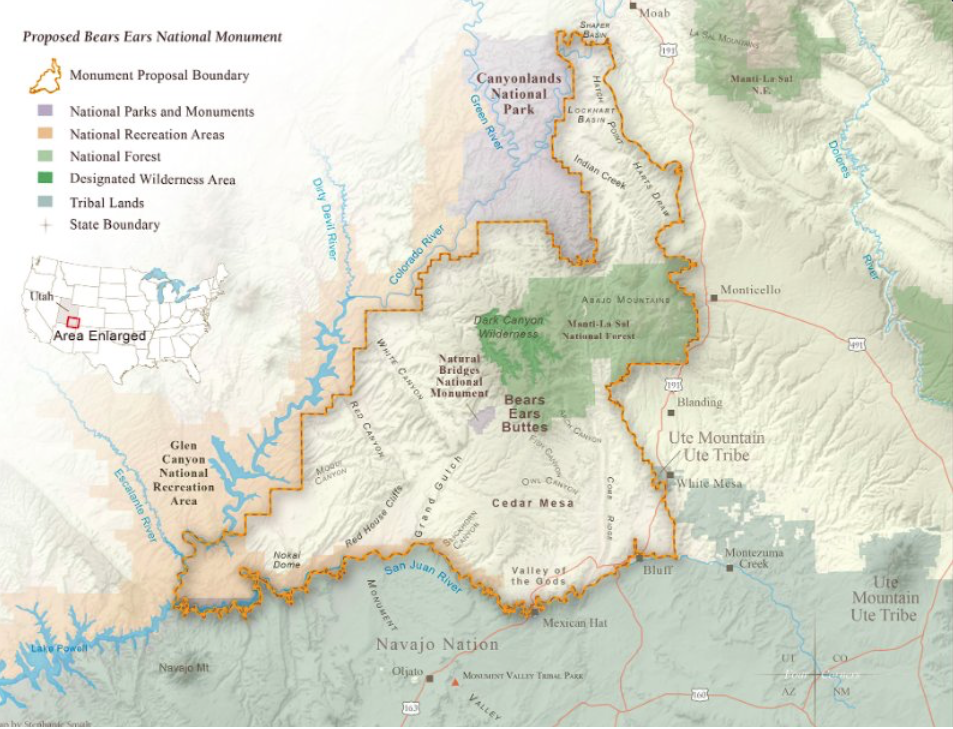
The commission’s proposed boundaries would have covered 422,600 acres across Cedar Mesa. Cut by spectacular canyons and with a high density of archaeological resources, Cedar Mesa was at the heart of Obama’s Bears Ears designation. Under the commissioners’ plans, the eastern boundary would have been Comb Wash, leaving out the sandstone wave known as Comb Ridge, as well as motorized route up Arch Canyon. Zinke’s boundaries contain only half as much land. They leave Cedar Mesa out entirely, unlike the county commissioners’ plans, but they include as part of the monument Comb Ridge and Arch Canyon. It’s almost as if the new boundaries were drawn in defiance of the county commission’s proposal. So much for local voices.
3. The voice of Energy Fuels, the most active uranium company in the Bears Ears region, appears to have been heard.
Representatives of the Canadian company met with Obama administration officials during the lead-up to designation, and the administration ultimately excluded Energy Fuels’ Daneros uranium mine from the monument. However, the company lamented the fact that seven miles of the mine’s one access road still fell within the boundaries, and that its White Mesa mill property abutted the eastern monument boundary.
Energy Fuels lobbyists, including former U.S. Rep. Mary Bono, R-Calif., met with Trump administration officials in July 2017, and the company’s official comment on the monument review stated: “There are also many other known uranium and vanadium deposits located within the newly created (Bears Ears National Monument) that could provide valuable energy and mineral resources in the future. … EFR respectfully requests that DOI reduce the size of the (Bears Ears National Monument) to only those specific resource areas or sites, if any, deemed to need additional protection beyond what is already available to Federal land management agencies.”
Trump’s shrinkage removed the entire White Canyon uranium district and other known deposits from the monument.
4. The new boundaries correlate closely with known oil, gas, uranium and potash deposits.
During his review last year, Zinke specifically asked for information on mineral extraction potential within the monuments. Uranium mining has long been dormant in the Bears Ears monument due to low prices, and only three of the 250 oil and gas wells drilled within the monument have yielded significant quantities of oil or gas. Nevertheless, industry has nominated some 63,657 acres within the national monument for oil and gas leases since 2014. With the new boundaries drawn to exclude even areas with only marginal potential for oil, gas or uranium, those leases could now go forward.
Proposed Bears Ears National Monument July 2016 via Elizabeth Shogren.
5. At Grand Staircase-Escalante, the new boundaries are mostly about coal.
When the monument was designated, Andalex, a Swiss company, was looking to mine a 23,800-acre swath of the Kaiparowits Plateau, which contains one of the biggest coal deposits in the United States. Clinton’s monument designation didn’t kill those plans, though it did make access and transportation to the deposits more difficult, so the feds used $19 million from the Land and Water Conservation Funds to buy out Andalex’s leases. Now, some 11 billion or more tons of coal are once again accessible. Also freed up with Trump’s monument shrinkage: Up to 10.5 trillion cubic feet of coalbed methane and 550 million barrels of oil from tar sands.
6. Visitation at Bears Ears area ratcheted up alongside the debate over designation.
Since there are no monument headquarters, the best indicator is the number of visitors at Kane Gulch Ranger Station on Cedar Mesa, which nearly doubled between 2013, when Bears Ears was little in the news, and 2017, when it became a signature issue for Trump as he attempted to dismantle many of Obama’s legacies.
Visits per year:
2013: 3,484
2014: 3,730
2015: 4,344
2016: 4,844
2017: 6,535
The jump in visitation in 2017 will be used by both anti- and pro-monument advocates. The former will argue that extra visitors mean extra impacts, the latter that more visitors add up to greater economic benefits for neighboring communities.
7. The designation of Grand Staircase-Escalante didn’t significantly impact grazing.
There were 77,400 active AUMs, or Animal Unit Months, the bureaucrat’s way of counting livestock on public lands, when the monument was designated in 1996. As of 2017, the number had only slightly dropped to 76,957 active AUMs. “Although grazing use levels have varied considerably from year to year due to factors like drought,” an Interior staff report says, “no reductions in permitted livestock grazing use have been made as a result of the Monument designation.” Claims to the contrary have long been used to argue for the monument’s reduction.
8. Obama’s staffers were in constant contact with Utah congressional staffers and other officials for months prior to monument designation.
And they often went out of their way to accommodate them. In fact, Interior Secretary Sally Jewell’s deputy chief of staff, Nicole Buffa, became quite chummy with Fred Ferguson, the chief of staff for Rep. Jason Chaffetz, and Cody Stewart, policy director for Gov. Gary Herbert.
After Jewell’s visit to southeastern Utah, Buffa wrote to Ferguson, Stewart and others: “I’m looking forward to many more conversations about Utah with each of you, but in far less pretty places.”
As the debate on the ground heated up, Ferguson wrote to Buffa: “I grow more and more frustrated by the day regarding the situation in San Juan County. You and I … have been thrust into this umpire-type-role where we are supposed to determine which group is most sincere, most legit, and most deserving of ‘winning’. We’re witnessing a race to the bottom by all involved as the monument threat heats up and groups are positioning themselves for success. My ultimate thoughts are to do nothing and force all of these players to work together and resolve these issues amongst themselves in the new year when there isn’t an arbitrary deadline driving action.”
Buffa responded: “We can’t get bogged down by the side-shows, and that is what some of this is.”
…Public Works Director George Good and two wastewater employees met with officials from the Colorado Department of Public Health and Environment regarding the wastewater treatment plant project and non-compliance issues with Sterling’s existing discharge permit. According to Saling, the city will be required to put a bond issue or a question approving city debt before voters for the treatment plant improvements; failure to do so would result in a $10,000 per day fine imposed dating back to last November…
The high-end estimate for the project is $36 million, but Saling said they are constantly looking at ways to save on costs. Wednesday, Saling said he expects that a presentation on the rate study for water and sewer rates will be given to the council in the next month.
Saling said the council will be asked in a coming meeting for permission to retain the services of a law firm to craft the ballot question language. He wants to put it on the November ballot to avoid the cost of having a special election. He is working on a voter education campaign, starting with inserts in city water bills to explain why the project is needed and what the plans are…
Council member Bob McCarty suggested the campaign should stress the age of the current system; the existing wastewater treatment plant began operations in 1978, Good told the council. Saling noted that the city has 82 miles of sewer lines, the oldest of which was placed in 1898. According to Saling, the life expectancy for the physical structures of a wastewater treatment facility is about 20 to 25 years.
Colorado Water Plan website screen shot November 1, 2013
FromThe Grand Junction Daily Sentinel (Floyd Ciruli):
Although Colorado has identified its water needs and has a state plan, 2018 will be a year of political transition. Will a new governor and legislature keep water at the top of the agenda or allow it to drop until the next water crisis? Many local agencies need financial help that can’t be met through local ratepayers alone. The state water plan identified $3 billion in unmet needs. And, as California has demonstrated, conservation must be a well-articulated state goal with significant resources dedicated to public education. California cut statewide use by 25 percent during the last drought through massive education coordinated with local agencies. But, leadership, both local and from the state, is needed.
Gov. John Hickenlooper accelerated the work of former governors Bill Owens and Bill Ritter to help address the state’s projected water shortage, but he only has one year left in office. Fortunately, besides Hickenlooper’s advancement of the scientific base behind the need for new projects, his use of a state planning process that involved all eight water basins in cooperation and decision-making and his issuing of a completed state water plan in December 2015, he has also seen real progress during his term on projects. He helped facilitate approval of Denver Water’s Gross Reservoir and Northern Water’s Windy Gap projects. Still, much remains to be done.
■ How will pressing water issues fare through the upcoming political transition?
■ Will the research, river basin collaboration and planning continue?
■ Will permitting of the water projects now underway continue to make progress?
■ Will the next wave of projects — many in rural and small towns — get permitted, funded and built?
■ Will the state initiate and fund a statewide conservation public education program?
■ Will the state continue its planning processes in order to lead a ballot issue funding effort? (The previous proposal, controversial in design and promotion, failed in 2003, but lessons were learned.)
The planning and development capabilities of Colorado’s water community have grown significantly, but the needs are growing faster still. Through the 2018 political transition, we must ensure that water remains a top priority and not become another state plan ignored in a government file.
“We want to make sure our great outdoor recreation opportunities are even better for Coloradans,” Polis said. “I think by focusing on it we can do that and create good jobs as well as in the outdoor recreation industry.”
One of the aspects of the plan includes the establishment of the Colorado conservation and recreation districts. By creating such regions, lesser-known locations in the state can be discovered by tourists, he noted.
“We can help get more people to some of our great sights in Colorado,” Polis said. “That way it can ease congestion in some of the most traveled to areas and it can highlight some of the other areas in our state that have great potential through conservation and recreation districts.
“I think a lot of local communities in western Colorado will take advantage of becoming conservation and recreation districts to really help put themselves on the map to create good jobs.”
It’s not just the sights that are crucial to visitors of the state, but also the recreational activities available in Colorado, he said. Polis noted his quality-of-life goal for residents is for people to continue with outdoor interests like biking, hiking, hunting and fishing.
“Those are all the reasons why we are so proud and excited to be Coloradans,” Polis said. “We really rely on having access to great wild areas in open spaces.”
Those considerable landscapes are also key features for people interested in discovering outdoor activities in Colorado, he added.
“It’s an important part of filling our restaurants, hotels and retail stores,” Polis said. “So, it’s an important job creator in our state as we can attract people from other areas of the country for skiing, hunting, fishing or hiking.”
He added to keep such pursuits viable means to improve funding for Colorado Parks and Wildlife. With 80 percent of CPW revenue coming from users fees, Polis said he does not desire to have outdoor enthusiasts pay for most of it.
“We want to make sure the full burden of maintaining trails and our public lands doesn’t fall on anglers and hunters,” Polis said.
A way to potentially work on that is by creating a commission filled with people from the recreation side, hunters and environmental experts, he noted.
Additionally, the representative said he means to make sure the CPW and the Conservation and Great Outdoors Colorado trust funds are financed. Polis said it’s vital for GOCO to remain intact as it’s been invaluable for creating work.
“It’s really important to secure funding for Great Outdoors Colorado,” Polis said, adding such grants support over 11,000 jobs and provide millions of dollars in economic activity for the state.
It also has helped with financing locally.
The Montrose Recreation District has received numerous grants from GOCO. One of the more recent ones came in September 2017 when the City of Montrose and MRD’s $2 million grant application for trail connections was approved by the organization.
Jason Ullmann, MRD Board vice president and current acting president, said if it wasn’t for one of those grants in the past the Community Recreation Center wouldn’t have its amenities outside of the facility.
“With many of those outdoor facilities, we wouldn’t have built Phase 2, which includes the trials and pickleball courts. We wouldn’t have those without GOCO,” Ullmann said. “So the rec center was made much better with those grant dollars.”
Part of Polis’ plan is to make sure the ecosystem is still intact. He explained many organisms are on the Endangered Species list, which can lead to a snowball effect if they become wiped out.
“With certain species that become extinct it’s not just them that are affected,” Polis said. “It can lead to overpopulation of other species, it can throw entire ecosystems out of whack, it can ruin the outdoor experience for hunters or anglers, so it’s very important to help maintain healthy ecosystems.”
He added going forward he wants to preserve the outdoor way of life for future generations of Coloradans.
“We need to make sure we are protecting our environment and that we leave a legacy for our kids and grandkids in the same great state we live in,” Polis said.
What about water?
Polis said he supports Gov. John Hickenlooper’s Colorado Water Plan, and if elected, he will implement it.
“We want to make sure we have a collaborative approach to transmountain diversion. That we can make sure that our Western Colorado communities aren’t forced to pay the price for Front Range growth,” Polis said. “We want to make sure people across our whole state have access to high-quality water for the quantities we need for agricultural, as well as residents.”
Coyote Albuquerque February 2015 photo by Roberto E. Rosales via the Albuquerque Journal.
I’ll be live-tweeting from the Colorado Water Congress Annual Convention today. Follow along on Twitter @CoyoteGulch or better yet, follow the conference hash tag #CWCAC2018.
When it comes to education, several candidates supported more vocational training.
Two candidates, Doug Robinson and Greg Lopez, said a four-year college may not be the right choice for everyone.
And candidate Tom Tancredo, who’s run twice for governor before, said any student who graduates from a public high school should also be able to pass a citizenship test.
The candidates also supported the oil and gas industry. However Steve Barlock, who worked on President Trump’s campaign, qualified his support saying the industry shouldn’t’t impact Colorado’s water.
Several candidates also mentioned transportation and the need for road improvements and called for more transparency with budgets.
Several candidates on Monday called for additional water storage in the state to help Colorado capture more of it and allow less of it to flow out of state. They said several large-scale reservoir projects need to move forward.
Here’s a report from Charles Ashby writing in The Grand Junction Daily Sentinel. Click through to read the whole article. Here’s an excerpt:
“The one issue that I did not anticipate, but appreciate more than any of the other (issues), is water,” [George] Brauchler said Friday shortly after meeting with the Grand Junction Economic Partnership about business issues. “On the Front Range, the water issue is when I turn on my tap, is it there? Getting around the state as much as I have over the past five months, water is a huge issue.” Brauchler said his lack of understanding about water issues prompted him to meet with numerous water experts, including those with the Colorado River District.
His main takeaway, which is still under development, is more storage and more conservation…
[Donna] Lynne was the only candidate for the Democratic Party nomination to make it to the Grand Valley for the Club 20 meeting, giving the keynote address at Saturday’s lunch.
For the past 18 months working as Hickenlooper’s chief operating officer, Lynne said she’s learned much about the workings of Colorado government.
As an expert in health care matters, Lynne said one of her main focuses will be on getting the cost down, which has been a particularly troublesome issue for rural parts of the state.
“We need to talk about having enough (health care) plans in the state, and providing statewide coverage,” Lynne said. “The increases in the individual market unfortunately are a function of people dropping in and out of coverage, and we need to figure out how to encourage them to stay in for the entire year. That’s what’s hurting a lot of the health plans.”
Water rights and public lands are two topics that both Republican Rep. Scott Tipton and Republican Sen. Cory Gardner from Colorado discussed in detail.
Relocating the Bureau of Land Management is a high priority for Gardner, “If your in Washington D.C. you’re a thousand miles removed from 99% of the acres managed by the Bureau of Land Management,”
Gardner says he has had great conversations with Secretary of the Interior Ryan Zinke to move this forward…
Along with public lands Tipton says protecting the state’s forest will save Colorado from having fires and says the House of Representatives recently passed the Resilient Federal Forest Act.
“To be able to go in and to treat those forests, to be able to bring them back to life, to be able to cut down that dead timber. Let’s look at the positives of what can happen when we are actively managing these forests in responsible way,” Tipton said.
Both lawmakers also find themselves on the same page about water rights.
“In Colorado water is a private property right,” Tipton said.
“The federal government should not be able to dictate to Colorado what a Colorado water law or permit is allowed to be,” Gardner said.
Both Gardner and Tipton feel legislation on Colorado water rights will soon pass.
“We’re able to pass that through the house of representatives and out of the committee with by partisan support. That is now over in the senate waiting for action. I’m pleased to be able to report to you that the committee that Cory sits on just dealt the first hearing on that legislation,” Tipton said.
Tipton says he is optimistic that Congress will pass a law to protect Colorado’s water rights and that it will soon be on the president’s desk for his signature.