Karen Budd-Falen, the No. 3 at the Interior Department, didn’t disclose a $3.5 million water-rights contract between her husband and the developers of a Nevada mine, records show.
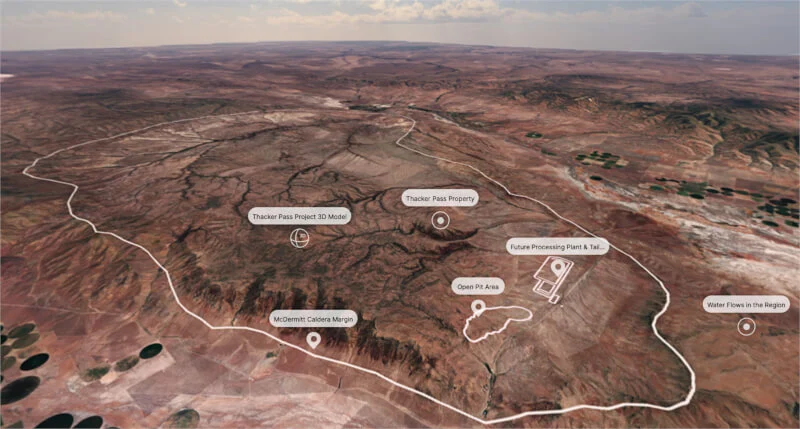
A high-ranking official in the Interior Department is drawing scrutiny from ethics experts because she failed to disclose her family’s financial interest in the nation’s largest lithium mine that had been approved by her agency, according to state and federal records. In 2018 Frank Falen sold water from a family ranch in northern Nevada to Lithium Nevada Corp., a subsidiary of Lithium Americas, for $3.5 million. The company was planning a $2.2 billion lithium mine nearby called Thacker Pass, and lithium mining requires significant amounts of water. The mine needed a permit from the Interior Department, where Mr. Falen’s wife, Karen Budd-Falen, worked as the deputy solicitor responsible for wildlife from 2018 until 2021. She returned to the agency last year and is now the associate deputy secretary, the third highest-ranking position. Mr. Falen’s sale of his water rights also depended on the mine getting a permit from the Interior Department. Without it, Lithium Nevada Corp. could have terminated its deal with him…In November 2019, about two years before the agency approved the mine, Ms. Budd-Falen met with Lithium Americas executives over lunch in the cafeteria at the Interior Department.
Tim Crowley, a spokesman for Lithium Americas, said executives did not discuss the mine or pending environmental reviews with Ms. Budd-Falen. “We haven’t worked directly with Karen Budd-Falen related to Lithium Americas,” he said in an email, “nor have we ever met with her in a formal capacity regarding our project.”
Ms. Budd-Falen did not respond to questions for this article. Her husband, who was not at the lunch, characterized it in a telephone interview as a social occasion, not a work meeting. He said his wife knew few details about the water contract and may not have known that the company was seeking approval from the Interior Department.
The Western United States just had its warmest December in recorded history, and likely the warmest in many thousands of years. pic.twitter.com/QrY4KKLsJ7
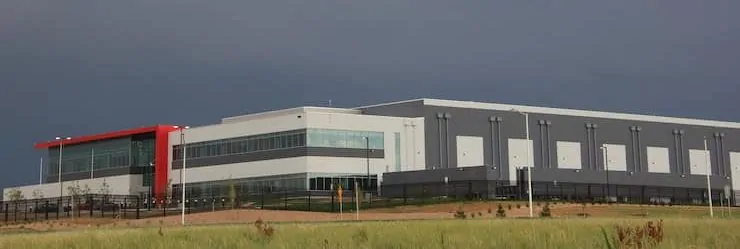
A Yale Climate Connections analysis of electricity prices has found that data centers and other commercial electricity users are consuming more kilowatts than ever, but the price they pay for that electricity has risen only a little. And industrial users of electricity are actually paying lower prices, on average, than they were two years ago.
But between 2020 and 2024, residential electricity prices in the U.S. increased by 25%. In other words, people using their toasters, laptops, and electric heating and cooking at home are paying ever-increasing prices, while the data centers that are driving rapid growth in electricity demand are scoring handsome discounts.
A word of warning: this analysis might make you mad, but hopefully in a productive way.
Since 2008, residential bills have been rising more than in other sectors
Electricity customers are sorted into use types: residential for homes, commercialfor businesses and data centers, and industrial for facilities like factories or refineries. The graph below shows how the prices paid by these three sectors have shifted over time.
Data analysis and image by Karin Kirk for Yale Climate Connections
From 1997 through 2007, electricity prices for all three categories of users rose and fell at a similar pace.
In 2008, that trend stopped. That year, electricity prices went up for residences but down for businesses and industries.
Over the next decade, home uses of electricity became more expensive, while electricity prices for businesses stayed nearly flat.
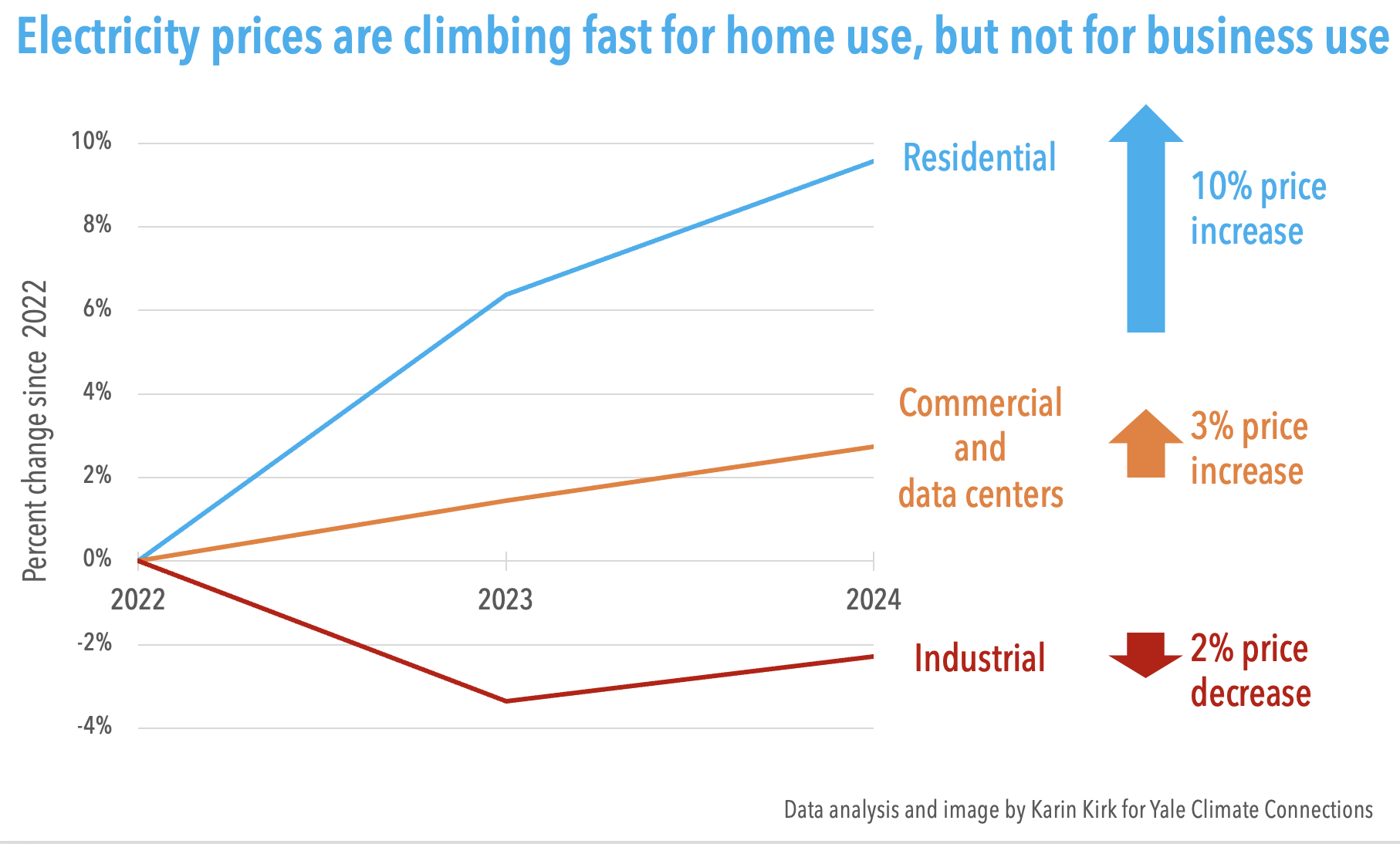
In 2021, the trend shifted again. Electricity prices for all three sectors began to rise steeply, but unequally. The gap between home energy use and business/industrial energy use became even larger. In the last two years, these differences became especially stark, as shown in the chart below.
Data analysis and image by Karin Kirk for Yale Climate Connections
In just two years, starting in 2022, residential electricity prices rose by 10%, while commercial prices increased by only 3%, and industrial electricity prices fell by 2%.
This is an example of the “K-shaped economy,” where things improve for some groups while getting worse for others. The lines on a K-shaped graph head off in different directions, illustrating an ever-larger gap between those benefiting and those left out.
Recent increases in electricity demand are mostly due to the commercial sector, which includes data centers
If any one sector is driving the growth in electricity usage, it would make sense for that sector to foot the bill for the power plants and power lines needed to serve their demand. So let’s look at how electricity use is growing in each sector.
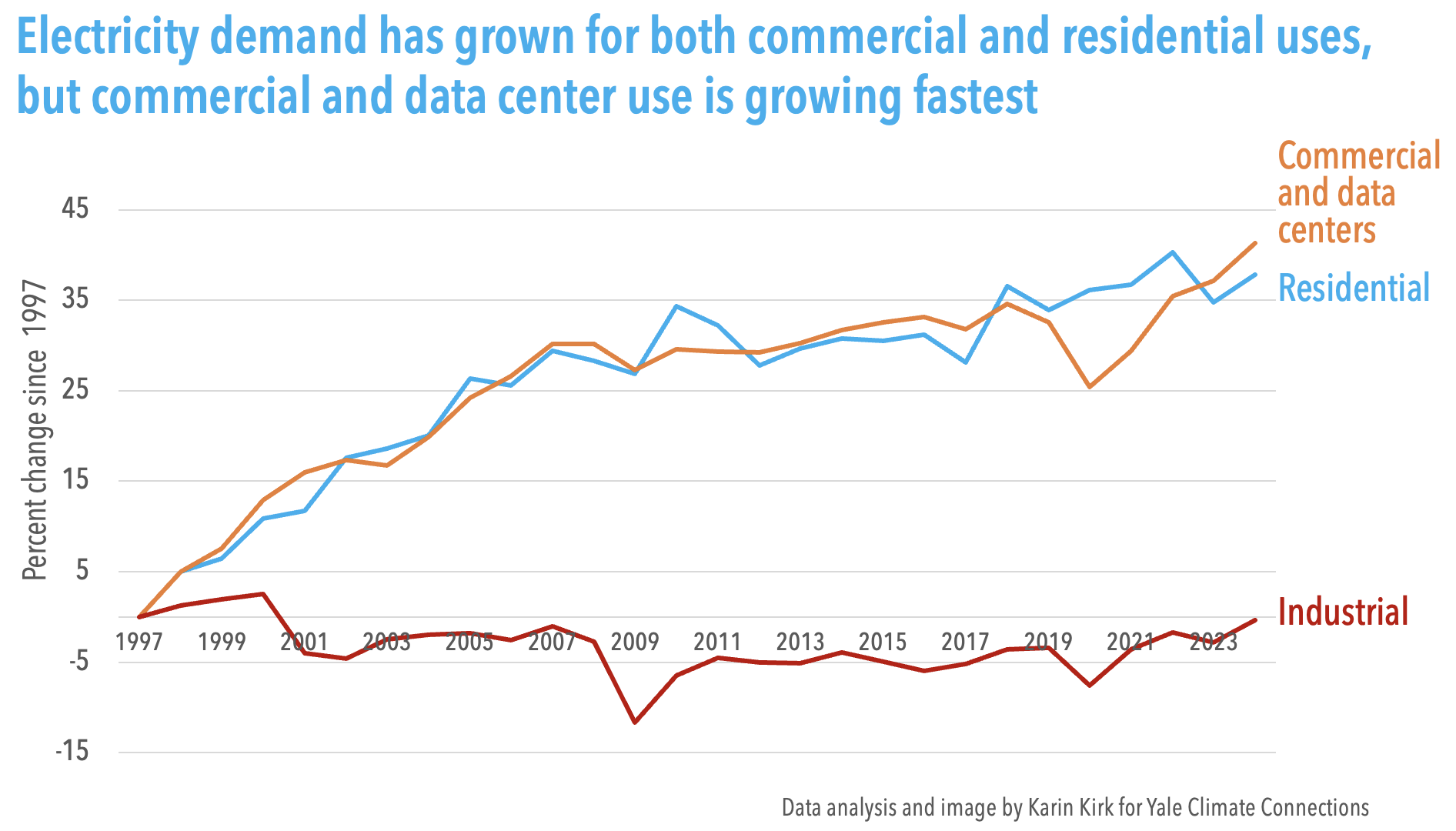
The chart below shows how the amount of electricity used by each sector has changed since 1997. Industrial use has stayed relatively flat, while commercial and residential use both grew at fairly similar rates and are now consuming about 40% more power than they were in 1997.
Data analysis and image by Karin Kirk for Yale Climate Connections
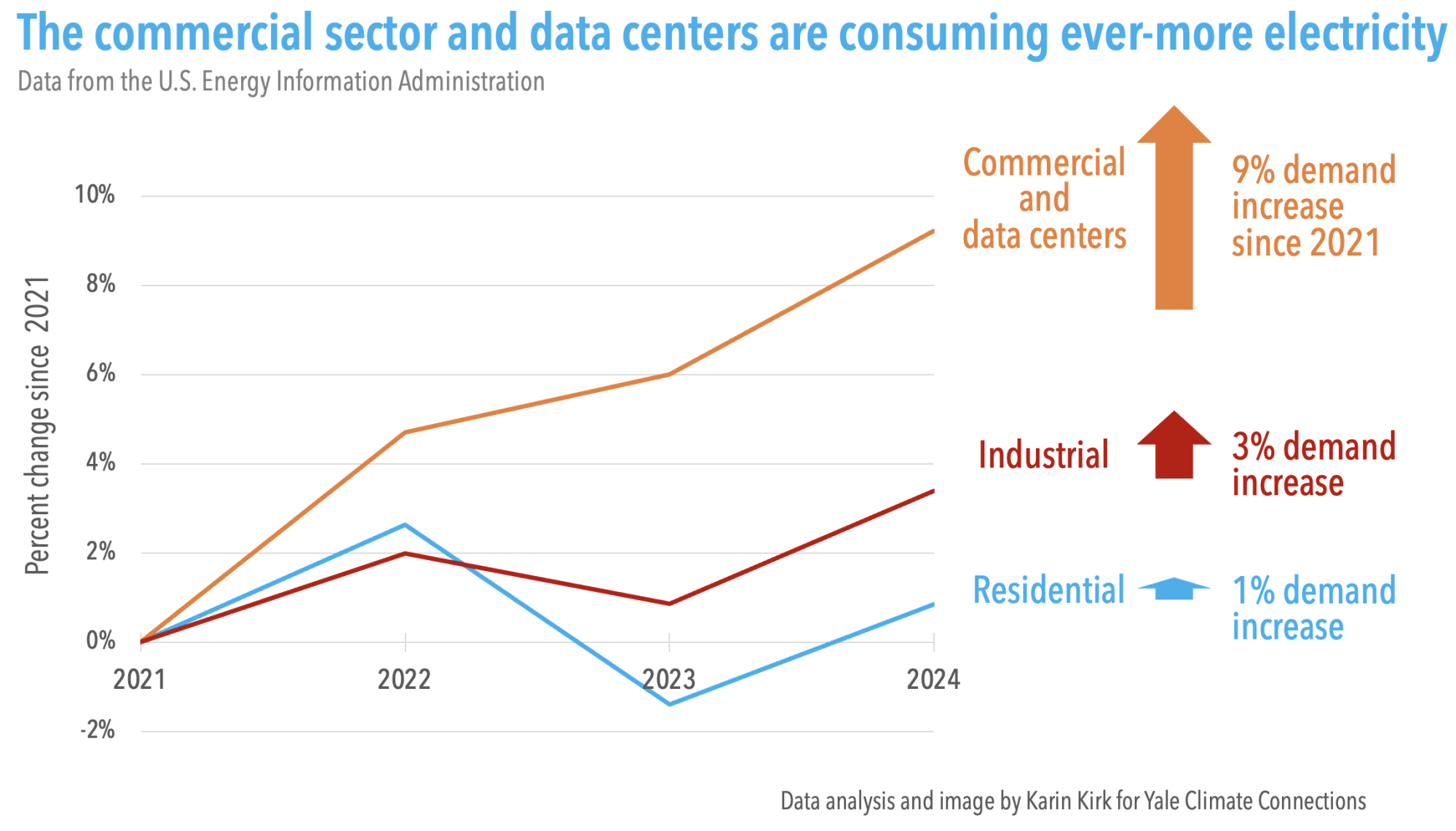
But a new pattern emerged in the last three years, as seen in the chart below. Commercial demand for electricity rose sharply and steadily, using 9% more power over just a three-year span.
Glenn McGrath, an electricity data analyst at the U.S. Energy Information Administration, wrote in an email that the growing energy needs of data centers “are likely a significant factor” behind increasing electricity use in the commercial sector.
Data analysis and image by Karin Kirk for Yale Climate Connections
To sum up the situation in recent years, household electricity use has grown the least of the three sectors, but that’s where prices have gone up the most.
The data illustrates how residential users are subsidizing the energy bills of A.I. and data centers, a perspective backed up by other recent analyses. A report by the Harvard Law School Environmental and Energy Law Program, Extracting Profits from the Public, lays out some of the reasons why Big Tech is able to off-load its costs onto the public and outlines specific steps policymakers can take to restore balance.
A big part of the problem is that the three sectors of electricity users are far from equal when it comes to their leverage. The report explains that companies that use large amounts of electricity can often negotiate lower pricing with energy suppliers, and in some cases, these contracts are secret. Complex rules and rate structures make it hard for the public – as well as regulators – to follow or engage with the process. Furthermore, policymakers have an incentive to attract new economic development in their state as technology companies shop around for the best pricing.
But for individual consumers, the situation is the opposite. In many states, people have no choice in their energy provider or their energy prices, and they can’t look elsewhere for a better deal. In the parlance of the energy industry, everyday people are often called “captive ratepayers” because we have little choice but to be the ever-faithful customers of a monopoly utility.
Expensive electricity can make life harder
Rising electricity bills can trigger a host of negative consequences. High energy costs may prevent people from adequately heating or cooling their homes, which can contribute to both physical and mental health problems. Expensive energy can also lead people to forego necessities in other areas of their lives in order to keep up with rising bills and avoid having their service shut off. These burdens fall disproportionately on low-income, Black, Hispanic, and disadvantaged households, who spend a large portion of their income on energy bills.
Higher electricity prices could also slow the adoption of modern, climate-friendly technology such as electric vehicles, heat pumps, and induction stoves that rely on electricity. That said, electric cars and appliances are more efficient than their fossil-fuel counterparts, so the trade-off is often still worth it.
And in some cases, expensive electricity can spur faster adoption of climate solutions. Home solar panels pay for themselves more quickly, and energy conservation measures make even more financial sense than before.
A stressed system that’s become fundamentally unfair
The electricity system in the U.S. is undergoing multiple stresses at once. Data centers seem to have an unquenchable thirst for energy, as extreme weather – often made worse by our warming climate – destabilizes the grid and causes spikes in electricity demand. At the same time, electricity generation is slowly transitioning from large, centralized power plants to numerous, distributed forms of electricity generation.
But at the root of it all, the data suggests that everyday people are footing the bill while companies that consume ever more power are paying less. At a time when corporations seem to enjoy many structural advantages over consumers, from lower tax rates to relaxed pollution requirements, the burden of rising energy bills can make one feel powerless. And yes, the pun was intentional.
Ratepayers do have a voice
Decisions about electricity rates are made by public utility commissions, which don’t usually get much attention – but that may be changing. In the November 2025 elections in Georgia, two incumbent public utility commissioners were resoundingly defeatedafter residential electricity prices climbed by 41% in just four years. Commissions are increasingly criticized for rubber-stamping price hikes and not protecting ratepayers who are caught inside a monopolistic system.
If you’re interested in learning more about the electricity decision-making process near you, here’s a directory of public utility commissions in every state, and Canary Media wrote a user-friendly guide to engaging with your electricity regulators. The deck may feel stacked against the common person, but that might just be all the more reason to get involved.
Click the link to read the article on the Sky-Hi News website (Ryan Spencer). Here’s an excerpt:
January 5, 2026
Across Colorado, this past December was among the hottest ever recorded. Both Denver and Grand Junction recorded their second-hottest December on record, according to the National Weather Service. Steamboat Springs, where the period of record dates to 1893, had its hottest December ever, averaging about 30 degrees through the month.
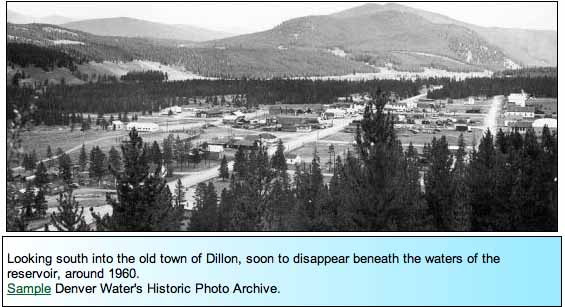
Dillon townsite prior to construction of Dillon Reservoir via Denver Water
In Dillon, where the period of record dates back to 1910, this past December was also the second-warmest on record, with a monthly average temperature about 28 degrees, about one degree cooler than 1980, which was the hottest December…At one weather station in Vail, temperatures averaged about 26 degrees Fahrenheit last month, making the hottest December recorded in the period of record that dates back to 1985. In Aspen, the average monthly temperature in December was 30 degrees, compared to the normal average monthly temperature of about 22 degrees for that month…
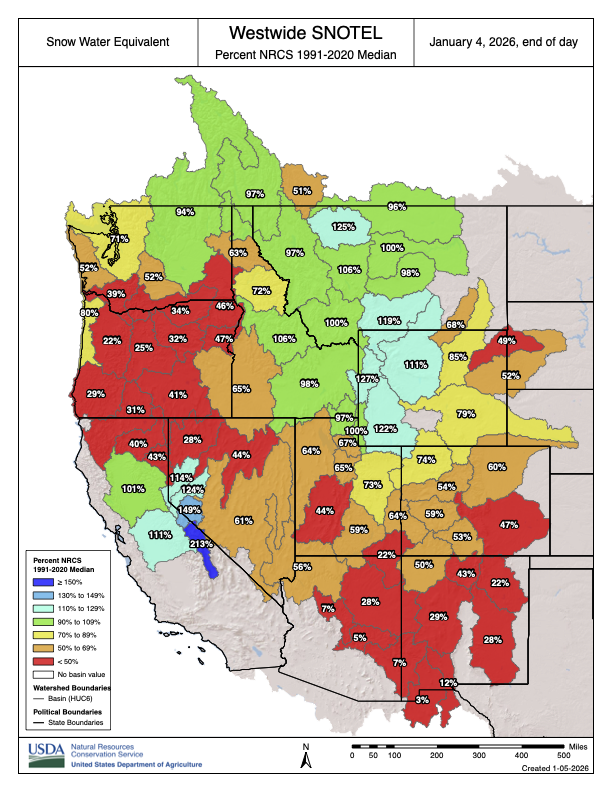
Westwide SNOTEL basin-filled map January 4, 2026.
Across the state, the snowpack was also at or near record lows in several river basins, including those where popular ski resorts are located. Statewide, the sat at 59% of the 30-year median as of Friday, ranking in at the 5th percentile, meaning that 95% of years on record had more snow at this time. The Roaring Fork Basin and the Yampa River Basin both ranked in at the 3rd percentile. Meanwhile, the Eagle River Basin and the Colorado-Kremmling to Glenwood Springs Basin both came in at the zeroth percentile, meaning that the snowpack is the worst on record.
Colorado Drought Monitor map December 30, 2025.
With low amounts of precipitation and hot weather, drought conditions continue to sweep over the Western Slope, according to the most recent U.S. Drought Monitor map. Substantial portions of Eagle and Pitkin counties are now facing exceptional and extreme drought. Extreme drought has also pushed into Grand County, while the rest of Northwestern Colorado is facing moderate to severe drought.