By now everybody’s sick and tired of the term “Dead Pool”. But what about reaches? Last summer as I was driving from Denver to Grand Junction I was horrified to see that the Mighty Colorado that had been flowing outside my left window had suddenly dried up, completely. This was nine miles east of Glenwood Springs. The view of the dessicated riverbed reminded me of a scene from a post-apocalyptic movie.
The culprit of course was the Shoshone Hydroelectric Generating Station which diverts 1250 cfs from a diversion at Hanging Lake, then returns that water 2-1/2 miles downstream after it’s been used to drive the plant’s hydroelectric turbines.
As the name implies Grand Junction’s “15 mile reach” is much longer. In the late summer a full 15-miles of dry river bottom can be seen along the I-70 beginning at the Cameo Diversion Dam and ending 15 miles downstream at the confluence of the Gunnison River. The Cameo Diversion Dam supplies 1.2 million acre feet of river water annually to irrigate Grand Valley farms, then returns about half of that water to the Colorado river at a variety of points downstream.
Not surprising these dry patches are hell for native fish, at least four of which are on the verge of extinction. The Bonytail – which has no wild populations left, the Colorado Pikeminnow, the Razorback Sucker, and the Humpback Chub, are all critically imperiled due to habitat loss from dams and competition from non- native species.
Gratefully one organization has ponied up to keep the water flowing. The Colorado Water Trust uses donations from people like me to buy water from sources that are upstream of these reaches in order to maintain a limited amount of water flow, year round. It may not be much but they’re hoping it’s enough to keep these fish, and many other aquatic species alive through the summer.
I can’t help but wonder whether those who are responsible for managing the river couldn’t do more to balance its many uses in order to ensure that the river’s ecological health isn’t left hanging by such a fragile thread.
Click the link to read the article on the USGS website:
Aqueducts move water
June 5, 2018
If you live in an area where ample rain falls all year, you won’t see many aqueducts like the ones pictured here. But there are many areas of the world, such as the western United States, where much less rainfall occurs and it may only occur during certain times of the year. Large cities and communities in the dry areas need lots of water, and nature doesn’t always supply it to them.
The California Aqueduct, San Joaquin Valley, California. Sources/Usage: Public Domain. View Media Details
Some parts of the western U.S. do have ample water supplies, though. So, some states have developed ways of moving water from the place of ample supply to the thirsty areas. Engineers have built aqueducts, or canals, to move water, sometimes many hundreds of miles. Actually, aqueducts aren’t a high-tech modern invention—the ancient Romans had aqueducts to bring water from the mountains above Rome, Italy to the city.
Can you see something about the aqueduct picture above that causes some water to be lost in transit? In all environments, but especially In places where the climate is hot and dry, a certain portion of the water flowing in the aqueduct is bound to evaporate. It would be more efficient to cover the aqueduct to stop loss by evaporation, but the cost of covering it must be weighed against the value of the evaporated water.
Aqueducts were popular in ancient Rome
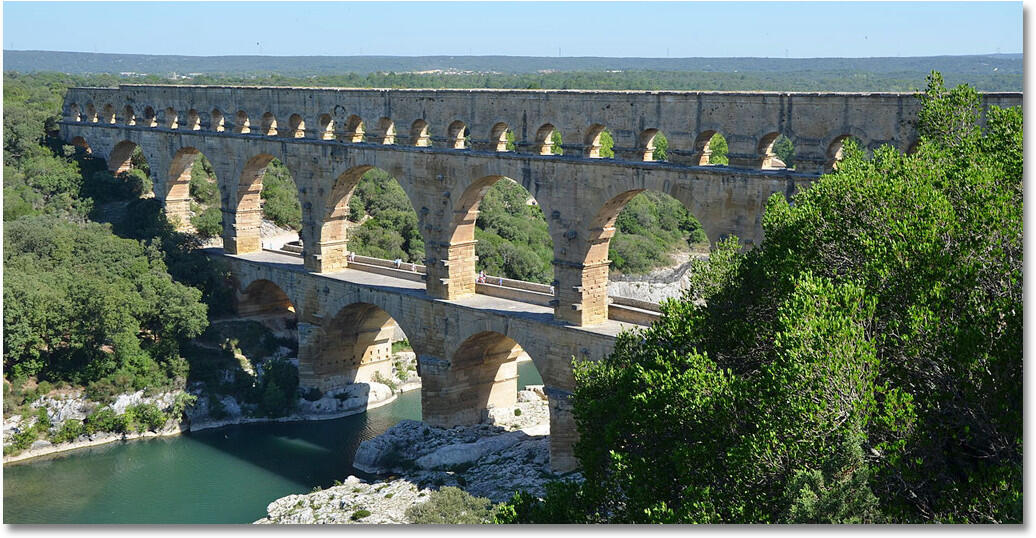
Below is a picture of the Roman aqueduct at Pont du Gard, crossing the Gard River in southern France. The aqueduct was used to supply water to the town on Nimes, which is about 30 miles from the Mediterranean Sea. Although the water ended up in the baths and homes in Nîmes, it originated about 12 miles away in higher elevations to the north. The total length of the aqueduct was about 31 miles, though, considering its winding journey.
There is even a Roman aqueduct that is still functioning and bringing water to some of Rome’s fountains. The Acqua Vergine, built in 19 B.C., has been restored several time, but lives on as a functioning aqueduct.
Roman aqueduct at Pont du Gard, crossing the Gard River in southern France. Credit: Carole Raddato, Creative Commons
Aqueducts were not the Roman’s choice for water-delivery systems, as they would use buried pipes when possible (much easier to bury a pipe than build an above-ground system). Although aqueducts use gravity to move water, the engineering feats of the Romans are shown in that the vertical drop from the highlands source to Nîmes is only 56 feet. Yet, that was enough to move water over 30 miles. And, if you think you can see the aqueduct in this picture “leaning” to one side, it is a illusion, as the vertical drop is only 1 inch for the 1,500 foot length. It is estimated that the aqueduct supplied the city with around 200,000,000 liters (44,000,000 imperial gallons) of water a day, and water took nearly 27 hours to flow from the source to the city. (Source: Wikipedia)
For the second straight time, Salt Lake City set a new record for its warmest year. That’s according to National Oceanic and Atmospheric Administration data that goes back to 1875. The city’s average temperature across 2025 was 57.7 degrees. That’s a full three degrees warmer than its historical average from the previous three decades. And it’s the culmination of several years of increasing warmth in Salt Lake City that has begun to top the record book.
“It looks like the past several years were in the top 15 or so,” National Weather Service Meteorologist Julie Cunningham said. “Kind of crazy to see that trend.”
Provo, Kanab, Bountiful and Boulder also set records for their warmest year in 2025. Several others, including Cedar City, St. George, Spanish Fork and Logan, saw temperatures that landed in their top 10…The summer of 2025 may not have had as many headline-grabbing heat waves as 2024 or 2023, Cunningham said, but it was consistently toastier than usual across the year as a whole. The fall was Utah’s warmest on record. The week of Christmas, cities from Kanab to Tooele broke daily records. On Dec. 22, the overnight low temperature in Salt Lake City was so warm, Cunningham said, it even surpassed that date’s record for a daytime high…Scientists say the record-breaking temperature events are another example of how global climate change — driven by fossil fuel emissions — is affecting life in places like Utah. That’s especially evident with the state’s precious water, said the University of Utah’s Paul Brooks.
“It’s really a dual threat,” the professor of hydrology and water management said. “One is just reducing the amount of water we have, and two is changing its timing, so it’s not as predictable as it once was.”
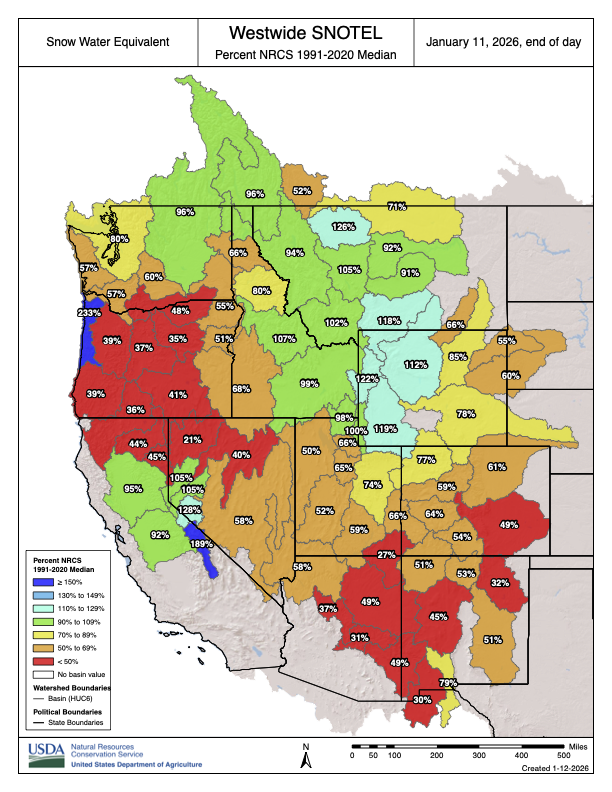
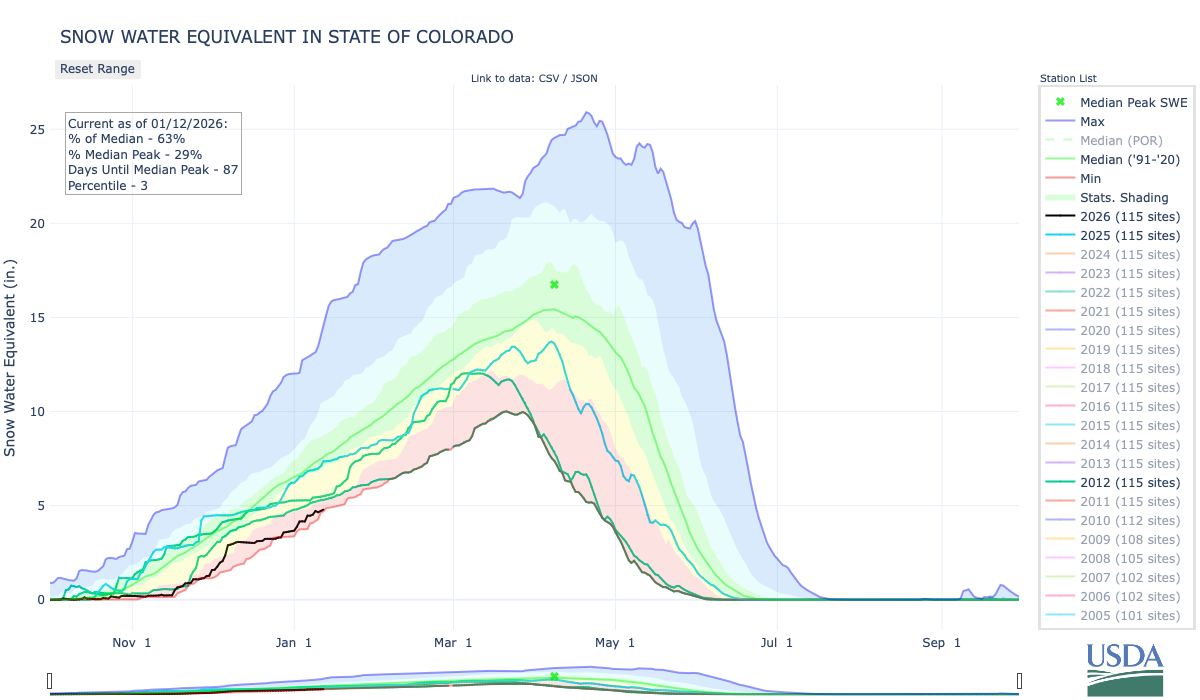
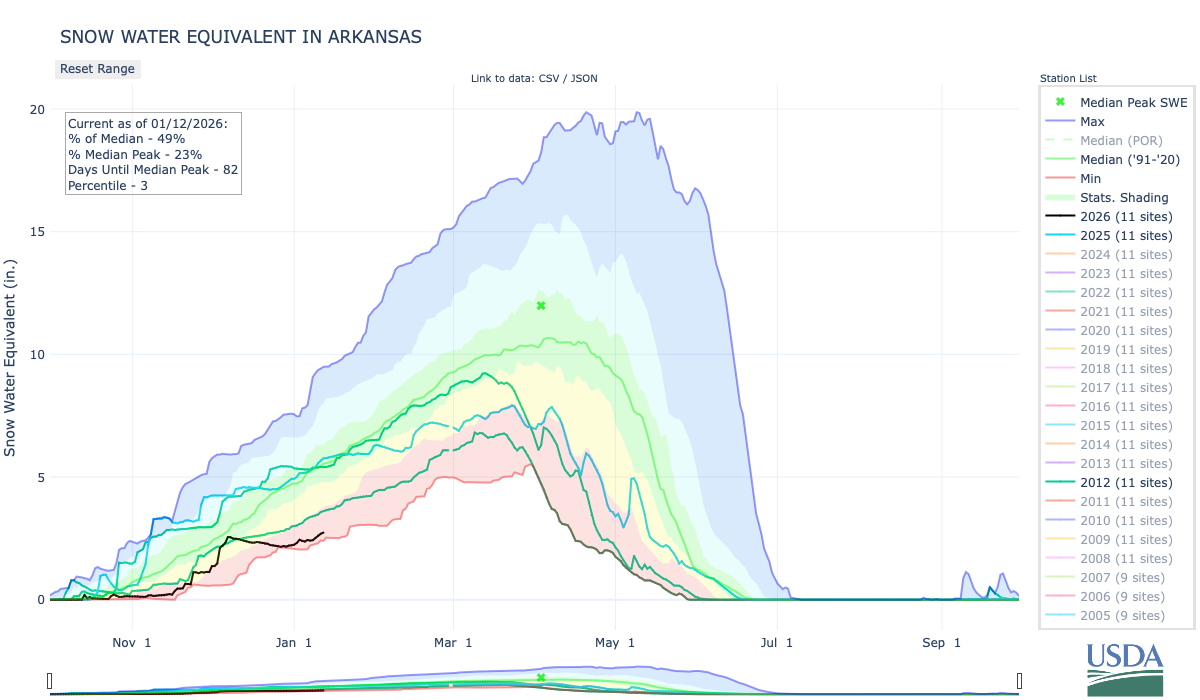
Higher temperatures fuel more evaporation. When temperatures increase across the year, it lengthens the season when evaporation occurs — essentially extending summer into parts of spring and fall. Warming also messes with the foundation of Utah’s water supply: snow. Snowpack provides 95% of the water used by Utahns. And Brooks said the state’s water management system is based on a predictable cycle of water becoming available when snow melts and flows downstream in the spring and early summer — just as demand for water starts to go up.
Bob Weir, a guitarist and songwriter who was a founding member of the Grateful Dead, which rose from jug band origins to become the kings of psychedelic rock, selling millions of records and inspiring a small nation of loyal fans, has died. He was 78.Bob Weir in 2010. By PAIRdoc – Own work, CC BY-SA 3.0, https://commons.wikimedia.org/w/index.php?curid=15998086
Bob Weir, a guitarist and songwriter who was a founding member of the Grateful Dead, which rose from jug band origins to become the kings of psychedelic rock, selling millions of records and inspiring a small nation of loyal fans, has died. He was 78…The band, which was founded in the San Francisco Bay Area in 1965, blended rock, folk, blues and country, with mellow ease and a gift for improvisation that became its trademark. In a rock milieu that was still based on short songs and catchy hooks, the Grateful Dead created a niche for meandering, exploratory performances that each seemed to have their own personalities…The band became the pied pipers of the wider hippie movement, providing the soundtrack for 1960s dropouts and LSD dabblers…Even after hippie culture faded, the band retained a gigantic fan base — called Deadheads, a term worn with pride and later adapted for numerous other fandoms — which followed the group wherever it played, traded recordings of its concerts and set up mini-encampments, complete with craft bazaars, oceans of tie-dye and no small amount of drugs.
It was one of rock’s original subcultures. “Our audience is like people who like licorice,” the band’s lead guitarist and singer, Jerry Garcia, once said. “Not everybody likes licorice, but the people who like licorice really like licorice.”
In the band, Mr. Weir — who, like Mr. Garcia, had an early fascination with folk music — stood alongside strong musical personalities. Mr. Garcia was a wizard of improvisation, and gave the group its aesthetic and conceptual direction. Phil Lesh, its bassist, had training as a composer. Mickey Hart, a percussionist, had eclectic tastes and played a major part in introducing Western audiences to world music…But Mr. Weir also developed a reputation for inventive timing on the rhythm guitar, his chords alternately grounding and contending with the melodic chaos of Mr. Lesh and Mr. Garcia’s instruments. Although Mr. Garcia and Robert Hunter, the group’s lyricist, were the Dead’s primary composers, Mr. Weir was also a contributor to the writing of key songs like “Playing in the Band” and “Sugar Magnolia.”
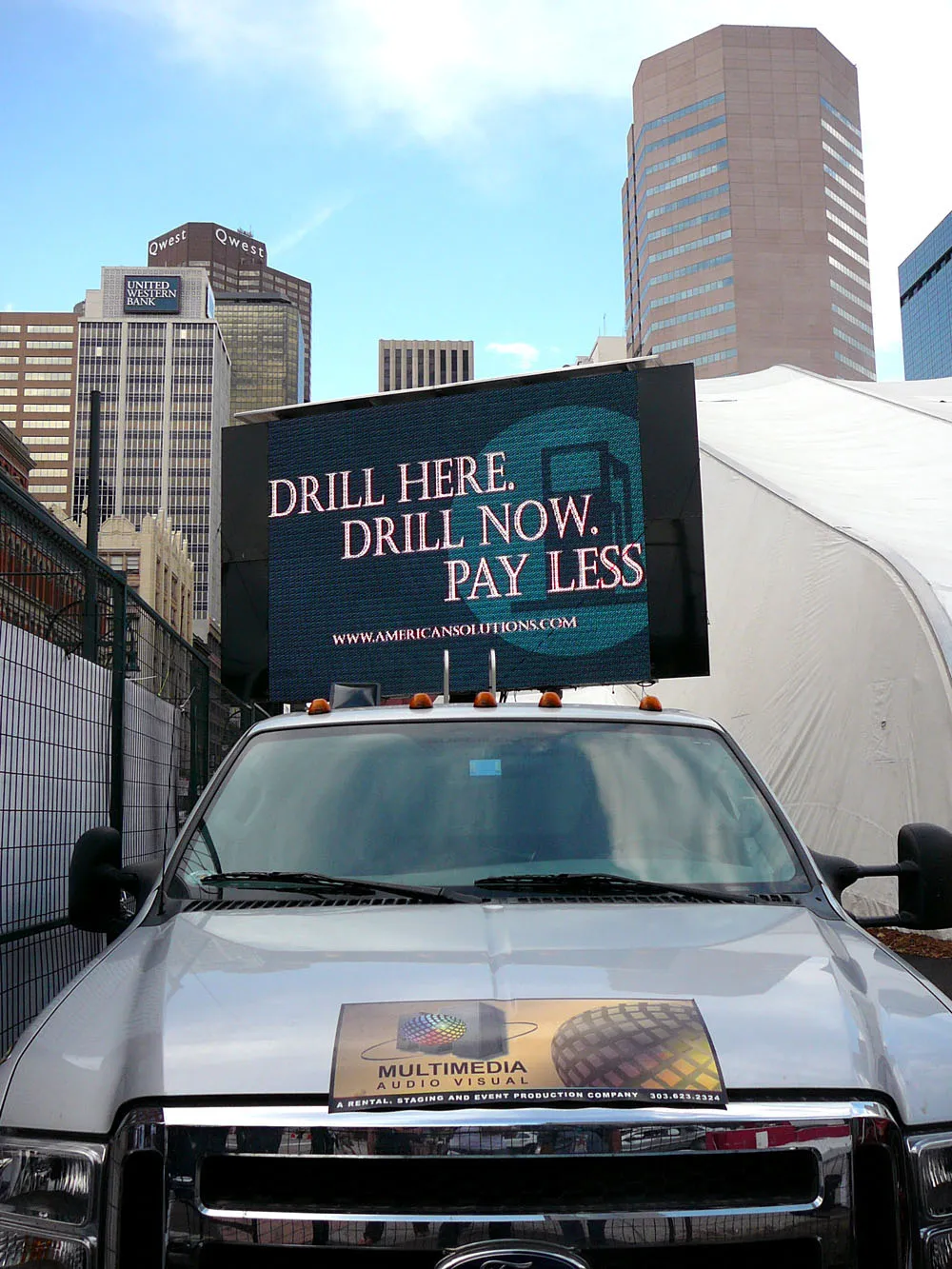
While Donald Trump seems to think he coined terms like “Drill, Baby, Drill,” the fact is, they’ve been around for a long, long time. This sign appeared at the 2008 Democratic National Convention in Denver. While Republican candidate John McCain and his VP candidate Sarah Palin were most vocally calling for increased drilling, the Democrats were also getting behind the nascent “fracking” revolution and touting natural gas as a cleaner bridge fuel from coal to solar and wind. And the so-called shale oil and gas drilling boom took off during the Obama administration. Jonathan P. Thompson photo.
Donald Trump made a lot of promises on the campaign trail: If elected, he would bring down the cost of groceries (a word that seemed new to him), he would secure the borders, he would end all of the wars on day one, and he would unleash the oil companies so they could “drill, baby, drill” and secure “energy dominance.”
Groceries are still expensive, “border security” is now MAGA-speak for federal agents gunning down innocent bystanders, and not only are the wars still raging, but the administration’s newly named “Department of War” has bombed Iran, Nigeria, and Venezuela, and is now threatening to invade Greenland and even Mexico.
In fact, the only war that Trump can take credit for ending was Biden’s “war” on energy. And that’s only because the “war” didn’t exist in the first place! It was and remains a figment of the GOP’s imagination.
Still, the administration did live up to at least one promise: It used a fabricated “energy emergency” to help increase extractive corporations’ profit margins by rolling back environmental protections, handing out drilling permits like candy at a parade, fast-tracking various mine and oil and gas infrastructure permits, and offering oodles of public land to energy companies.
But has it really achieve the stated goal, to establish “energy dominance” — i.e. boost production, bring down prices, and end oil imports?
Maybe the data will help us figure that one out …
Leasing
As I think we’ve established, the Biden administration did not wage a war on energy or even oil and gas. In fact, under Biden, the nation became the world’s largest oil producer, the largest exporter of liquefied natural gas, and so on, while also fast-tracking solar, wind, and transmission projects on federal lands.
Biden’s Interior Department did, however, put up some guardrails aimed at protecting some public lands. While it leased out parcels in the Permian Basin without restraint, it also refrained from putting some more sensitive parcels up for auction in more sensitive areas with limited oil and gas production.
The Trump administration has been far more friendly to oil and gas companies looking to bolster their land-holding portfolios, not only offering up hundreds of thousands of acres, but then putting them up for auction a second time if the first round didn’t attract enough bids.
328,000 acres: Amount of public land and minerals the BLM leased to oil and gas companies between Jan. 20 and Dec. 31, 2025. This brought in about $356 million in revenue.
$327 million: Amount a single oil and gas lease sale for 31 parcels, mostly in New Mexico’s Permian Basin, brought in this January, a record per-acre high average bid amount.
0: Number of bids received for 23 offered oil and gas lease parcels in Colorado in January. The sale was a “replacement” sale held after the initial auction failed to attract enough bids.
Drilling Permits
President Trump’s BLM issued an average of 909 permits to drill per month during the first year of his second term. This is almost triple the monthly average for Biden’s administration.
Environmentalists often attacked Biden for issuing more drilling permits for public lands than Trump did during his first administration. The comparison was dumb, but whatever. Trump apparently didn’t like Biden’s apparent energy dominance, so he struck back by issuing more than 5,000 drilling permits last year, far exceeding the Biden administration’s monthly and yearly averages.
1,124: Number of drilling permits the BLM issued to EOG Resources in 2025, mostly in the Permian Basin. That compares to 755 for XTO Permian and XTO Energy; 293 for Anschutz Exploration; 503 to Devon Energy; 338 to OXY USA; 241 to Matador Production; 119 to Chevron; 106 to Middle Fork Energy Uinta; and 80 to ConocoPhillips.
95: Number of drilling permits the BLM’s Farmington Field Office issued in 2025, to Hilcorp, Logos, SIMCOE, DJR Operating, and other companies. While this pales in comparison to the Permian Basin, it is a marked increase from recent years.
8: Number of drilling permits the BLM’s Moab Field Office issued in 2025.
100: Approximate number of drill rigs operating in all of New Mexico during any given week of 2025.
8,949: Number of approved federal drilling permits held by oil and gas companies that were available to drill as of Jan. 2, 2026. That is to say, they have the permits, but haven’t yet used them.
Production
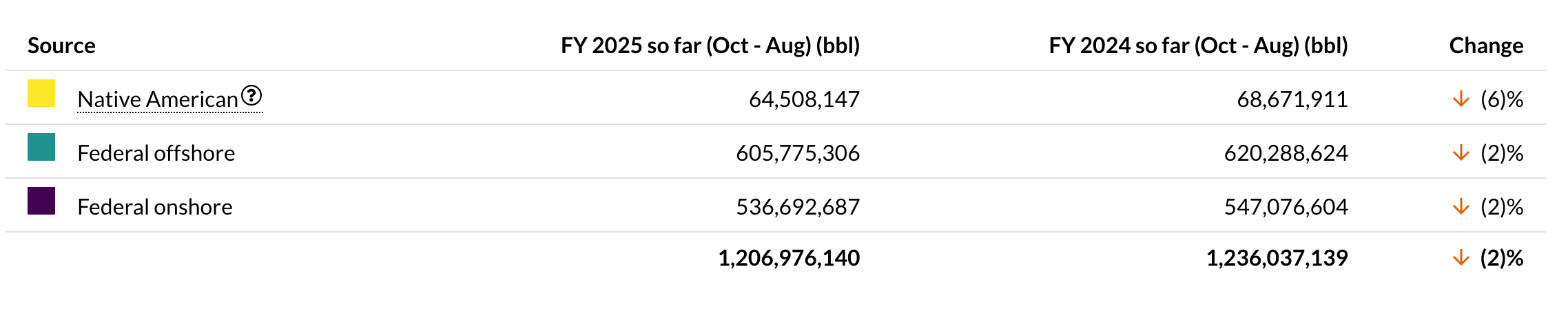
During the past year, domestic crude oil production continued to increase month-to-month, but at a slower rate than it had previously. Oil production on federal lands was down about 2% from fiscal year 2024. This is mostly due to industry’s lack of enthusiasm for more drilling, thanks to a combination of low oil prices and higher expenses due to inflation and tariffs on steel and other equipment. So much for drill, baby, drill.
Oil production from federal and tribal nation lands was down for fiscal year 2025 as of August. Source: U.S. Department of the Interior.
7.9 million: Barrels of crude oil per day the U.S. was importing from other countries in December 2025. That’s marginally less than a year earlier.
2.1 million barrels/day: Net crude oil imports (imports minus exports) to the U.S. in December 2025.
Idle Wells
*GSI/OSI: Gas or oil wells oil well that are capable of producing but have not produced during the production month.
I find this to be, perhaps, the most telling chart of all. It shows the number of idle wells on federal mineral leases (which includes public lands and split-estate private lands) by Western state. A lot of the wells have just been wrung dry and have been abandoned and need to be plugged and reclaimed, probably at the taxpayer’s expense.
Still others, the ones in the GSI (non-producing gas completion) and OSI (non-producing oil completion) columns, are officially capable of producing oil and gas, it’s just that for one reason or another they aren’t producing currently. Dozens of the GSI/OSI wells in Wyoming, for example, are owned by bankrupt companies that were unable to offload them to someone else.
This brings up a question: If we are indeed in an “energy emergency,” as the Trump administration has declared, shouldn’t we be pumping all of the oil and gas from existing wells that we possibly can before issuing thousands of new drilling permits, most of which aren’t even being used?
Let me answer that one: We’re not in an energy emergency.
🗺️ Messing with Maps 🧭
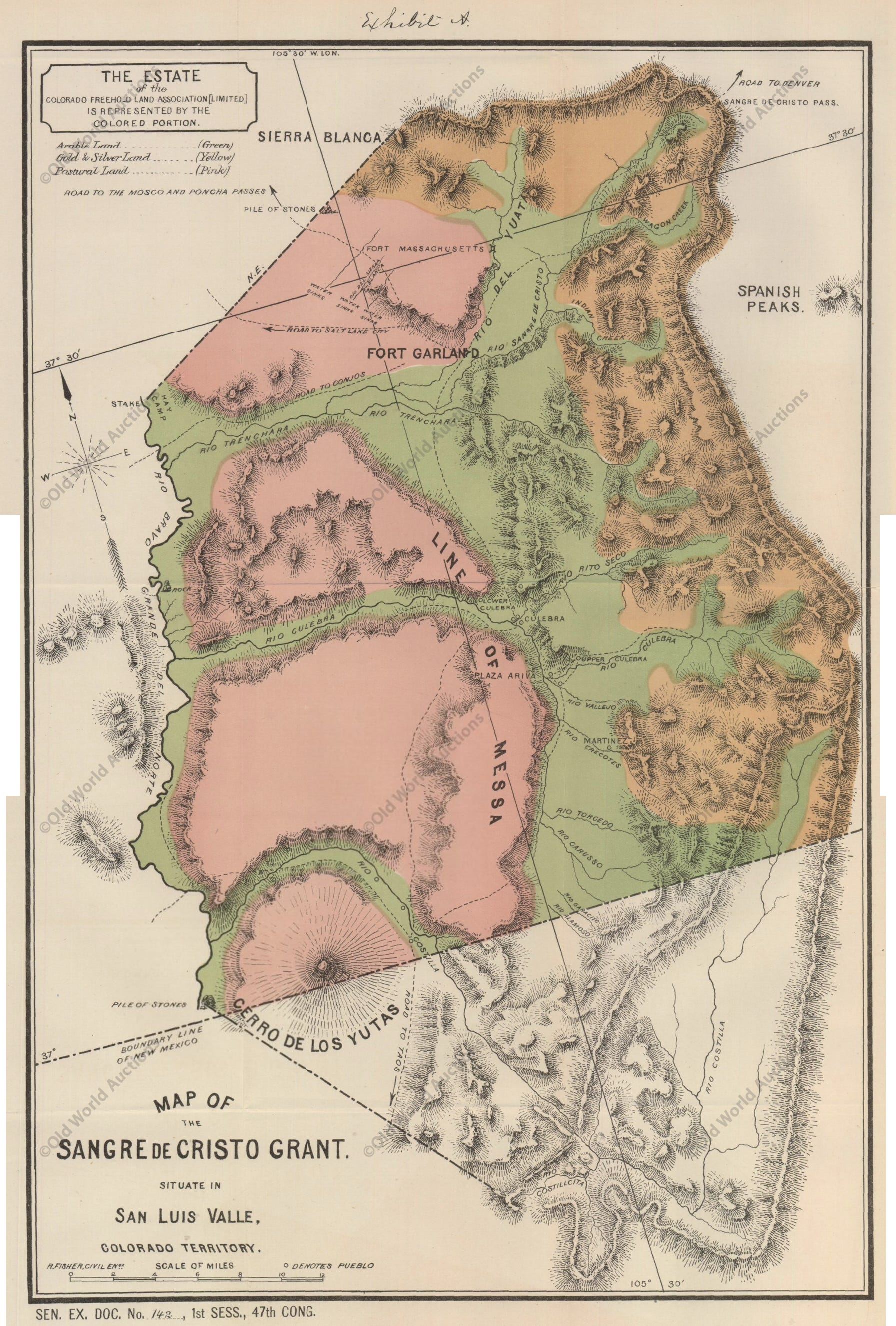
I came across this cool old map of the Sangre de Cristo land grant while perusing the Green Fire Times’ tribute to Malcolm Ebright, who was a land grant community advocate and historian. In order to get a high-res version I had to, um, copy this from an online auction site (thus the watermarks). I don’t have much to say about it, except it’s a pretty cool map of a very cool area.
The energy transition was not meant to be a main topic when world leaders and negotiators met at the 2025 United Nations climate summit, COP30, in November in Belém, Brazil. But it took center stage from the start to the very end, bringing attention to the real-world geopolitical energy debate underway and the stakes at hand.
Brazilian President Luiz Inácio Lula da Silva began the conference by calling for the creation of a formal road map, essentially a strategic process in which countries could participate to “overcome dependence on fossil fuels.” It would take the global decision to transition away from fossil fuels from words to action.
Brazilian President Luiz Inácio Lula da Silva speaks at COP30, where he promoted the idea of a road map to help the world speed up its transition from fossil fuels to clean energy. AP Photo/Andre Penner)
More than 80 countries said they supported the idea, ranging from vulnerable small island nations like Vanuatu that are losing land and lives from sea level rise and more intense storms, to countries like Kenya that see business opportunities in clean energy, to Australia, a large fossil-fuel-producing country.
I was in Belém for COP30, and I follow developments closely as former special climate envoy and head of delegation for Germany and senior fellow at the Fletcher School at Tufts University. The fight over whether there should even be a road map shows how much countries that depend on fossil fuels are working to slow down the transition, and how others are positioning themselves to benefit from the growth of renewables. And it is a key area to watch in 2026.
The battle between electro-states and petro-states
Brazilian diplomat and COP30 President André Aranha Corrêa do Lago has committed to lead an effort in 2026 to create two road maps: one on halting and reversing deforestation and another on transitioning away from fossil fuels in energy systems in a just, orderly and equitable manner.
What those road maps will look like is still unclear. They are likely to be centered on a process for countries to discuss and debate how to reverse deforestation and phase out fossil fuels.
Over the coming months, Corrêa plans to convene high-level meetings among global leaders, including fossil fuel producers and consumers, international organizations, industries, workers, scholars and advocacy groups.
For the road map to both be accepted and be useful, the process will need to address the global market issues of supply and demand, as well as equity. For example, in some fossil fuel-producing countries, oil, gas or coal revenues are the main source of income. What can the road ahead look like for those countries that will need to diversify their economies?
Nigeria’s Bodo community is suing Renaissance Africa Energy Company Limited, an oil consortium that acquired Shell’s Nigerian subsidiary, over two major oil spills in the Niger Delta in 2008. Shell admitted liability and settled with the community in 2014, committing to cleanup efforts. However, the Bodo community has been critical of the quality and transparency of Shell’s cleanup, and is seeking further damages and remediation. Here, activists protest the company’s actions. Leon Neal/Getty Images
Oil exports consistently provide the bulk of Nigeria’s revenue, accounting for around 80% to over 90% of total government revenue and foreign exchange earnings. At the same time, roughly 39% of Nigeria’s population has no access to electricity, which is the highest proportion of people without electricity of any nation. And Nigeria possesses abundant renewable energy resources across the country, which are largely untapped: solar, hydro, geothermal and wind, providing new opportunities.
What a road map might look like
In Belém, representatives talked about creating a road map that would be science-based and aligned with the Paris climate agreement, and would include various pathways to achieve a just transition for fossil-fuel-dependent regions.
Some inspiration for helping fossil-fuel-producing countries transition to cleaner energy could come from Brazil and Norway.
In Brazil, Lula asked his ministries to prepare guidelines for developing a road map for gradually reducing Brazil’s dependency on fossil fuels and find a way to financially support the changes.
His decree specifically mentions creating an energy transition fund, which could be supported by government revenues from oil and gas exploration. While Brazil supports moving away from fossil fuels, it is also still a large oil producer and recently approved new exploratory drilling near the mouth of the Amazon River.
Norway, a major oil and gas producer, is establishing a formal transition commission to study and plan its economy’s shift away from fossil fuels, particularly focusing on how the workforce and the natural resources of Norway can be used more effectively to create new and different jobs.
Both countries are just getting started, but their work could help point the way for other countries and inform a global road map process.
In the U.S., the Trump administration has made clear through its policymaking and diplomacy that it is pursuing the opposite approach: to keep fossil fuels as the main energy source for decades to come.
The International Energy Agency still expects to see renewable energy grow faster than any other major energy source in all scenarios going forward, as renewable energy’s lower costs make it an attractive option in many countries. Globally, the agency expects investment in renewable energy in 2025 to be twice that of fossil fuels.
At the same time, however, fossil fuel investments are also rising with fast-growing energy demand.
The IEA’s World Energy Outlook described a surge in new funding for liquefied natural gas, or LNG, projects in 2025. It now expects a 50% increase in global LNG supply by 2030, about half of that from the U.S. However, the World Energy Outlook notes that “questions still linger about where all the new LNG will go” once it’s produced.
What to watch for
The Belém road map dialogue and how it balances countries’ needs will reflect on the world’s ability to handle climate change.
Corrêa plans to report on its progress at the next annual U.N. climate conference, COP31, in late 2026. The conference will be hosted by Turkey, but Australia, which supported the call for a road map, will be leading the negotiations.
With more time to discuss and prepare, COP31 may just bring a transition away from fossil fuels back into the global negotiations.
Jennifer Morgan, Senior Fellow, Center for International Environment and Resource Policy and Climate Policy Lab, Tufts University