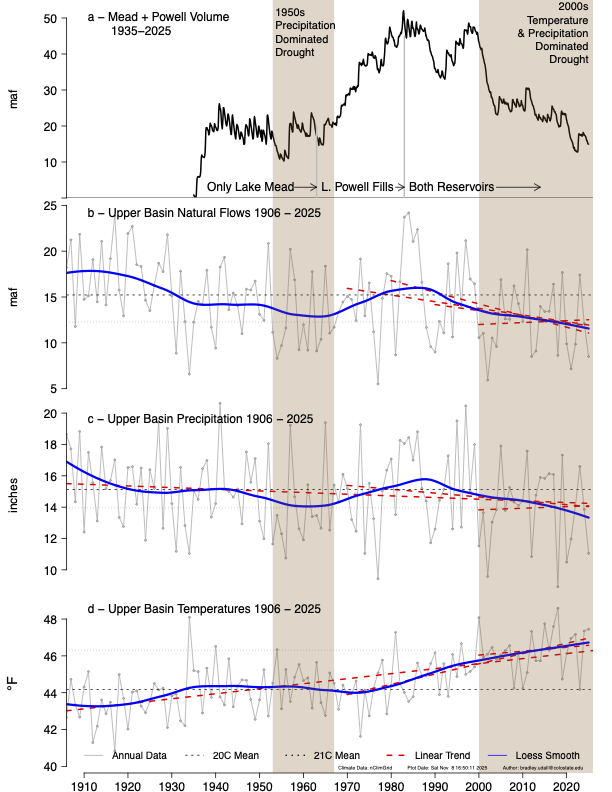
sUdall/Overpeck 4-panel Figure Colorado River temperature/precipitation/natural flows with trend. Lake Mead and Lake Powell storage. Updated through Water Year 2025. Note the tiny points on the annual data so that you can flyspeck the individual years. Credit: Brad Udall
This story was originally published by CalMatters. Sign up for their newsletters.
The clock is ticking down to a federal deadline Tuesday for California and six other Western states to reach the broad strokes of a deal portioning out supplies from the parched Colorado River.
Officials at the U.S. Bureau of Reclamation, the federal stewards for the river under the Department of the Interior, have threatened to impose their own plan if the states can’t agree how to manage the river after 2026, when the river’s current rulebook expires.
Dire projections that another dry year could send the basin’s major reservoirs plummeting to alarmingly low levels have ramped up the urgency, and the tensions.
But, after two years of fraught negotiations, the states remain at an impasse. Those in the river’s lower basin — California, Arizona, and Nevada — are clashing with Colorado, Wyoming, Utah and New Mexico upstream. A key point of contention is how much each basin must scale back their use of the overtapped river as climate change further squeezes supplies.
“We’ve been in a holding pattern, and we need to land this plane by Tuesday,” J.B. Hamby, California’s chief negotiator as chairman of the Colorado River Board of California, told CalMatters.
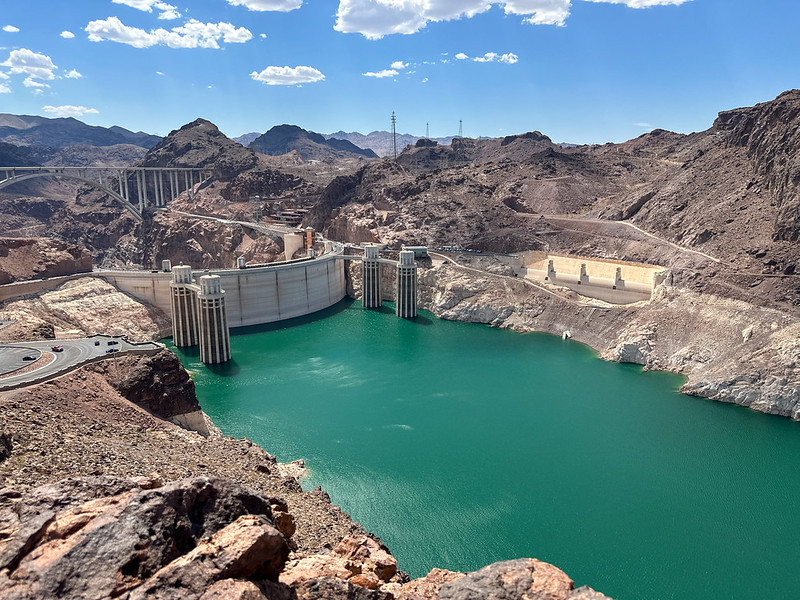
California’s dependence on the Colorado River raises the stakes. The state takes more than half of the power generated at Lake Mead’s Hoover Dam, and more water from the main stem than any other in the basin. Half a million acres of alfalfa, winter vegetables and other crops in the Imperial Valley all rely on the Colorado River, which also supplies urban Southern California via the Metropolitan Water District.
But California has also been relatively impervious to shortages on the river, with senior water rights long seen as bulletproof. Now, the questions hanging over the last days of negotiations are — how real is the threat of missing the deadline? And what exactly would the consequences be for California?
Blown deadlines on the Colorado River
For decades, federal officials have threatened to intervene if states in the Colorado River basin fail to reach agreement. The threat — and the inevitable lawsuits water suppliers fear would follow — have motivated major deals that now govern the river’s operations.
Actual federal intervention is far rarer — though the U.S. government has stepped in in the past, on a smaller scale.
In the early 2000s, Southern California was forced to stop using surplus Colorado River water when other states began clamoring for their fair share. The Interior Department set a deadline of December 31st, 2002 for California’s water agencies to cut a deal weaning themselves off the surplus water, or face immediate cutbacks.
The Imperial Irrigation District — by far the biggest user of Colorado River water in California — balked. So the Interior Secretary cut California’s supplies, leading to court battles and, ten months later, a deal.
But deadlines and threats seem to have lost their teeth in recent years, when states in the Colorado River basin have blown deadline after deadline, with little federal response.
Last week, Arizona Governor Katie Hobbs urged the Trump administration to be more assertive. “As we approach critical deadlines, we need the Trump administration to step in, exert leadership and broker a deal,” she said in remarks prepared for a water conference.
Elizabeth Koebele, a political science professor at the University of Nevada, Reno, said negotiations may have become too contentious for deadlines to matter. She attributed it to fracturing relationships between the basin states as devastatingly dry conditions on the river ratchet up the stakes.
“We have less water, and it’s caused more rippling problems,” Koebele said. “You’re cutting a smaller pie, for more people.”
A strike against storage
The Veteran’s Day deadline isn’t the final deadline; it’s an interim milestone as federal officials race to lock in a plan before the current rulebook expires.
Scott Cameron, now acting head of the Bureau of Reclamation, said at a conference in June that in the absence of a deal, Interior Secretary Doug Burgum was prepared to take charge as water master. The position gives him the power to declare the river in shortage and call for cutbacks in the lower basin.
But the Trump administration declined to specify what exactly it might do. “At this stage, all parties should remain focused on the difficult but necessary work required to reach a seven-state agreement,” an unidentified Interior Department spokesperson said, in an emailed statement.
If there is still no plan by late 2026, the rulebook could revert to one from the 1970s, according to an analysis by Arizona State University’s Kyl Center for Water Policy.
That worries Metropolitan Water District’s Bill Hasencamp, because it would upend Metropolitan’s ability to continue banking water in the Colorado River basin’s Lake Mead, the largest reservoir in the country, for dry spells.
The water giant imports water from Northern California and from the Colorado River to supply 19 million people in six Southern California counties.
Right now, Hasencamp, manager of Colorado River resources at Metropolitan, says that the district has socked away about 1.5 million acre-feet of water in the reservoir over the last 20 years. It’s enough to supply 4.5 million households for a year.
Metropolitan saves Colorado River water in Lake Mead when water from Northern California reservoirs is abundant, and draws on these stores when state supplies dry up. But, under the 1970s-era rules, suppliers would no longer be able to add water to this savings account. Metropolitan would need to use its banked stores over the next ten years, or risk losing the water.
Hasencamp estimates that banked water could disappear more quickly if California faces greater cuts.
“Under a new regime, the feds — if things get dry enough — could cut us back,” Hasencamp said. “We could access that storage, but we might need it to offset cuts on the river that could come to us. So it’s a very undesirable situation.”
Ultimately, experts agree that the most undesirable situations, and the greatest risks to the basin states, will likely come from nature itself.
The Colorado River is in the grips of a megadrought; Brad Udall, a senior water and climate research scientist at Colorado State University’s Colorado Water Institute, called August’s projections for reservoirs Lake Powell and Mead “beyond awful.”
Udall said the latest projections for the reservoirs remain dire. One scenario shows “both Powell and Mead entering uncharted territory by (the) end of Water Year 2026,” Udall said in an email.
“That’s the new reality,” Cameron, the acting head of Reclamation, said at a meeting in Arizona over the summer. “There are real risks to both the lower basin states and the upper basin states if we don’t collectively do something differently than we’ve done in the past.”
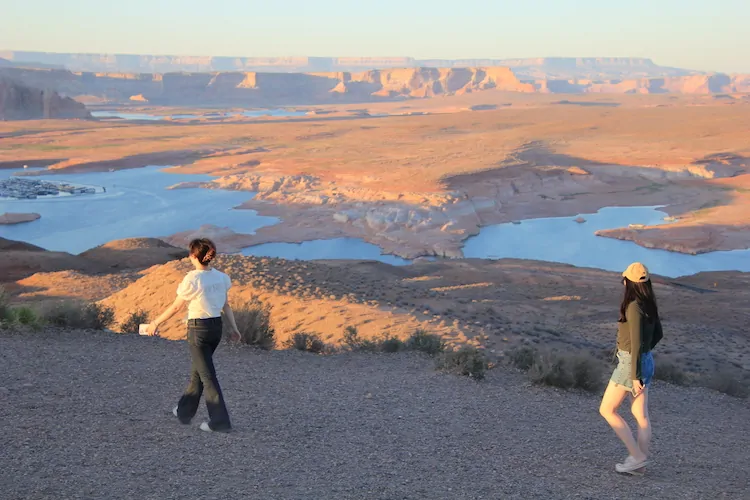
People at Lake Powell May 25, 2022. Photo credit: Allen Best/Big Pivots
Click the link to read the article on the Big Pivots website (James Eklund):
November 11, 2025
If the seven basin states can’t lead, Washington and the courts will. The West deserves better than to surrender its future out of inertia and pride.
The River at a Crossroads
Today, November 11, the seven states that share the Colorado River face a deadline they’re unlikely to meet. The Department of the Interior has asked them to agree on the bones of a post-2026 management plan — the rules that will decide who gets cut, when, and by how much as the river keeps shrinking.
If they fail, Washington will write the rules for them. And if Washington falters, unelected judges will. Either way, the West loses control of its own destiny. That’s not leadership; that’s abdication.
The Lower Basin is braced for federal action. The Upper Basin is bracing for blame. Both are right to be worried — and both are missing the point. The river doesn’t care about politics or priority dates. It only responds to snow, sun, and science.
Udall/Overpeck 4-panel Figure Colorado River temperature/precipitation/natural flows with trend. Lake Mead and Lake Powell storage. Updated through Water Year 2025. Note the tiny points on the annual data so that you can flyspeck the individual years. Credit: Brad Udall
Hydrology Has Changed; Leadership Hasn’t
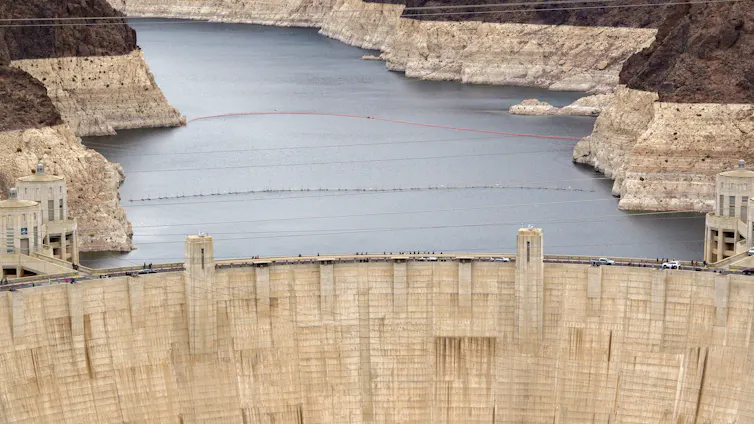
We built the Colorado River system for a climate that no longer exists. Reservoirs that once promised endless growth now sit half-empty — Lake Powell at roughly 29%, Lake Mead near 31%. The math is unforgiving: less water is coming in than going out.
Yet our governance still pretends otherwise. The Law of the River — that tangled mix of compacts, decrees, and deals — assumes a river of at least 16.5 million acre-feet. Nature is now giving us perhaps 12, maybe less. We’re overdrawn every year, and the overdraft is accelerating.
This isn’t a failure of hydrology; it’s a failure of adaptation. The West has always been proud of its self-reliance, but we’re behaving like a bureaucracy waiting for someone else to make the hard call. We need leaders, not hall monitors.
And if you want to know what failure of adaptation looks like, glance halfway around the world. Tehran, Iran, a city of more than eight million, is on the brink of evacuation. Its reservoirs are nearly dry, some below 10% capacity. Rainfall has fallen 40% below average. Iran’s president recently warned that if the skies don’t open, the capital may have to be moved. Moved. Imagine Washington, D.C. abandoned because the Potomac went dry. That’s not science fiction — that’s what happens when water governance waits too long to face reality. The Colorado River isn’t there yet, but the trajectory rhymes. Tehran is a mirror we should study before it shows our reflection.
The Blame Game vs. Shared Responsibility
At Arizona State University’s recent Law of the Colorado River: The View from the Lower Basin conference, one thing was clear: the Lower Basin has its legal arguments loaded and ready. So does the Upper Basin. Both are preparing for a fight neither side can win.
Arizona’s governor calls the Upper Basin’s stance extreme; the Upper Basin counters that it can’t conserve water that isn’t there. California points to its billions in saved water and asks why others won’t match it. Colorado replies that it’s already living within its snowpack. Every argument is technically correct — and collectively disastrous.
Finger-pointing won’t refill a reservoir. The real crisis isn’t between the basins; it’s between the past and the future. The river is shrinking faster than our imagination.
The Case for State-Led Solutions
We know how to do this. We’ve done it before. In 2019, when both Lakes Mead and Powell were circling the drain, the Basin States pulled together the Drought Contingency Plan. It wasn’t perfect, but it kept the system alive long enough for the recent recovery years to matter. That’s proof we can still ride together when it counts.
Utah and Wyoming are finally taking first steps toward real demand-management programs — voluntary, compensated conservation that could bank water in Powell. They’re six years too late, but they’re at least facing forward. The Lower Basin, to its credit, has cut deeply — usage there is down to about 5.9 million acre-feet, the lowest since 1983. The economies of Phoenix, Las Vegas, and Los Angeles didn’t collapse. They adapted. That’s the model.
A state-led deal is the only way to keep Western hands on the reins. Federal control would be blunt; court control, brutal. Every day we delay, we invite both. The West should never outsource its destiny to Washington or to a judge in black robes who’s never stood in an irrigation ditch with a shovel.
The Call of the Saddle
This river built the modern West. It carved our canyons, powered our farms and ranches, lit our cities, and defined our sense of possibility. But it can’t survive our paralysis.
The next agreement — whatever we call it — won’t be about dividing abundance. It will be about managing scarcity with grace and intelligence. That means each state giving up a little sovereignty to save the system that sustains us all. It means governors and commissioners finding the courage to sign something imperfect but real.
Our basin remembers how to ride — hell, we practically invented it. The horse is saddled. The trail is narrow. And the storm is moving in fast.
Either we climb back on together, or we’ll watch someone else take the reins.
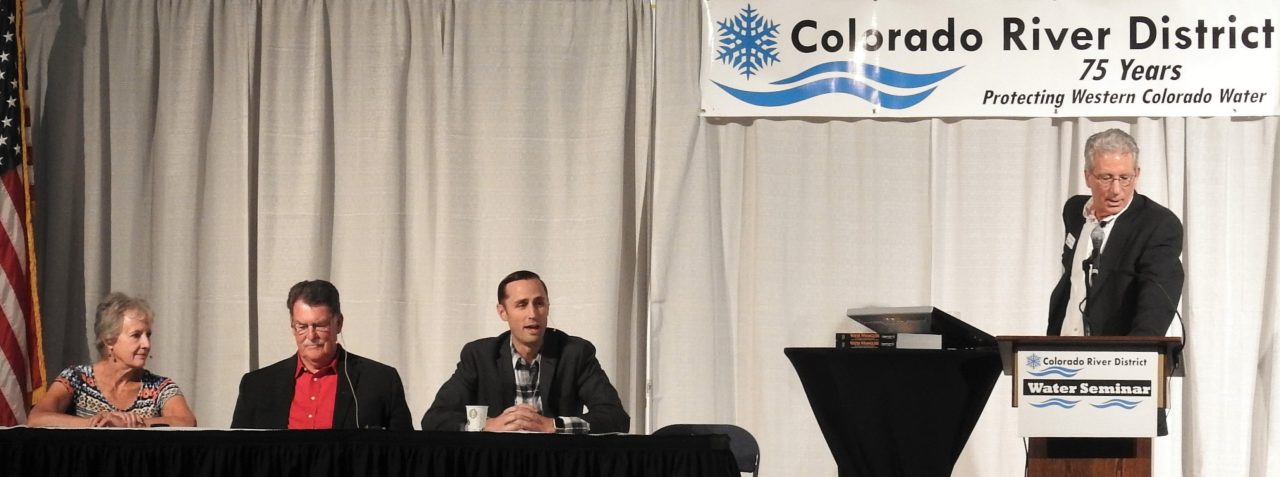
L to R, Anne Castle, Don Coram, James Eklund, and Jim Pokrandt
James Eklund is a Colorado water lawyer, rancher, former director of the Colorado Water Conservation Board, and formerly Colorado’s Colorado River principal. He advises public and private clients across the West on water, land, and natural-resources issues at Taft/ Sherman & Howard.
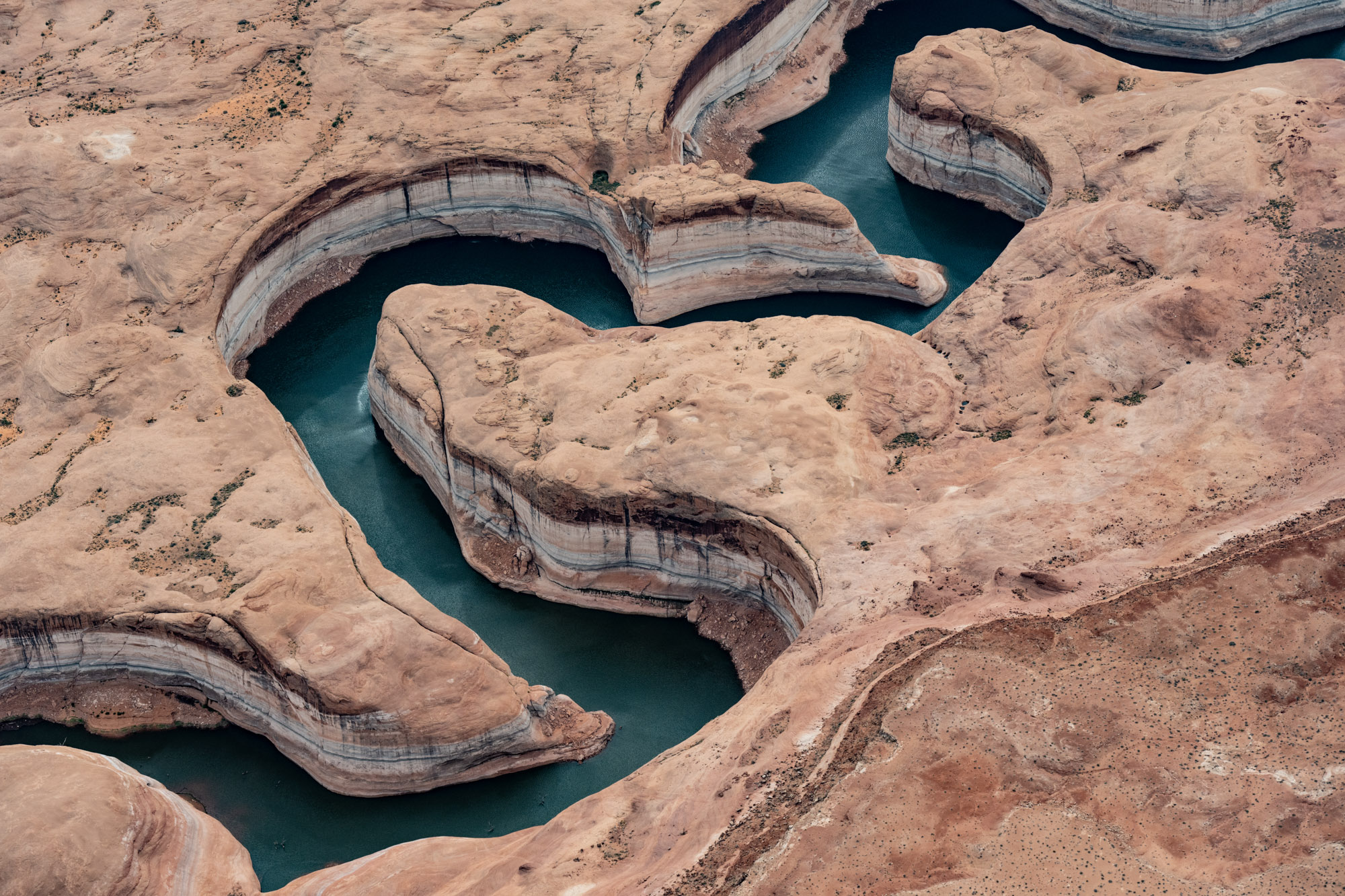
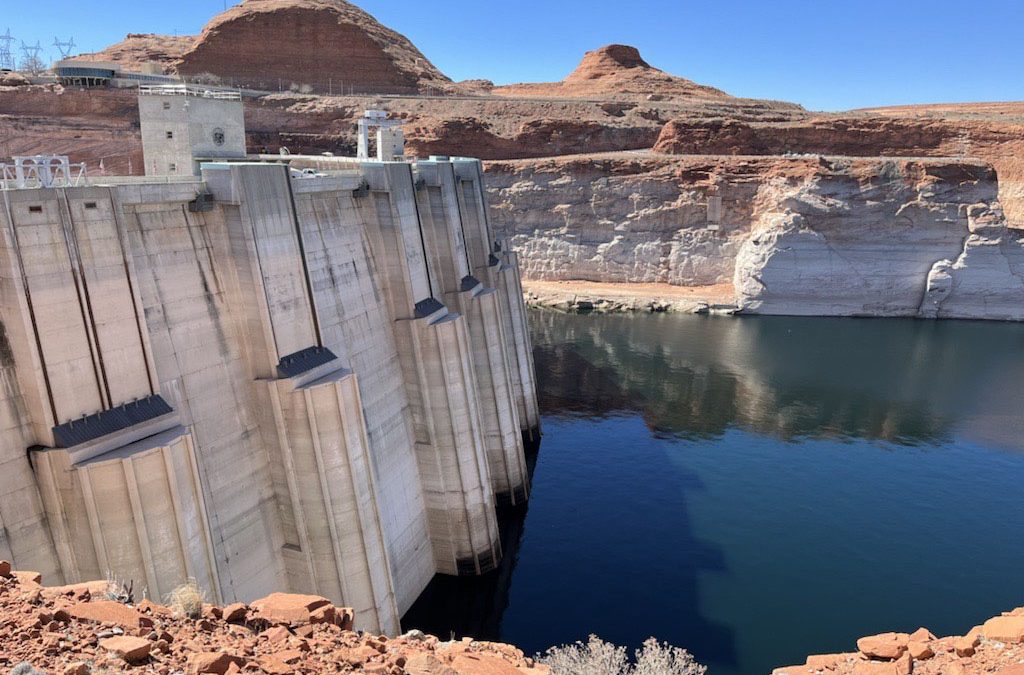
The Colorado River fills Glen Canyon, forming Lake Powell, the nation’s second-largest reservoir. The reservoir could drop to a new record low in 2026 if conditions remain dry in the Southwestern watershed. (Alexander Heilner/The Water Desk with aerial support from LightHawk)
This story is produced and distributed by The Water Desk at the University of Colorado Boulder’s Center for Environmental Journalism.
Heavy autumn rains brought relief to drought-plagued portions of the Southwest, but across the Colorado River basin ongoing water supply concerns still linger amid tense policy negotiations and near record-low reservoir storage.
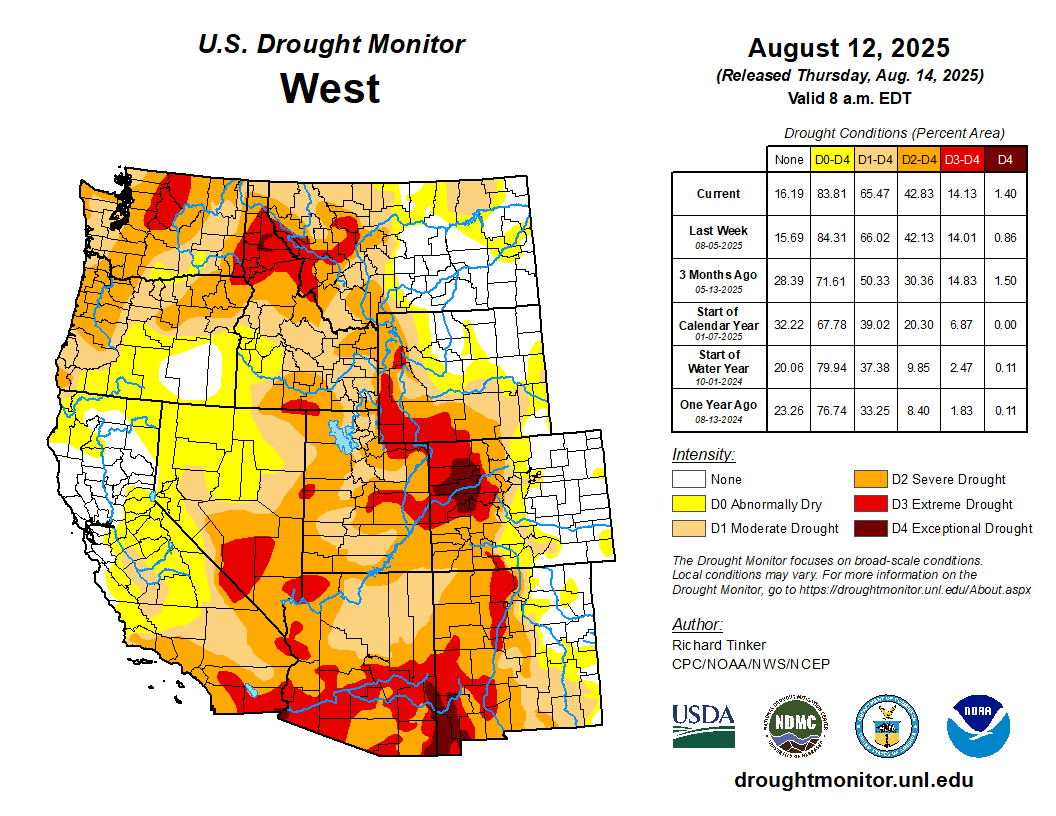
Even after accounting for the heavy rain, 57% of the Colorado River watershed remains in severe drought, according to the U.S. Drought Monitor. More than 11% of the basin is in extreme drought.
A less than average upcoming snow season combined with a dry spring or early summer in 2026 could create conditions for another low runoff year. The Colorado River’s headwaters saw a weak snowpack last winter, which contributed to one of the worst spring runoff seasons on record in 2025. Drought conditions spread and worsened into summer throughout the southern Rocky Mountains.
Peter Goble, Colorado’s assistant state climatologist, explained that the recent rainfall “certainly recharged soils,” in some watersheds.
Streamflow in the Animas River and Rio Grande increased significantly following the October rains and flooding. Rain in southwest Colorado, particularly around Pagosa Springs, brought flooding that damaged homes and downtown businesses. Rain gauges near the San Juan Mountains recorded 7 to 10 inches of precipitation from October 9-15.
“We would love to see this rain come over a more steady incremental period,” Goble said. “But oftentimes it is these flooding events that kind of put the kibosh on a drought more locally.”
The flooding erased drought designations on the Drought Monitor map in those localized areas, but basinwide drought conditions tell a different story. Dry soils, depleted reservoirs and winter weather forecasts continue to cause water managers to worry.
Even with the recent rain, soils in many parts of the Colorado River basin remain dry. Soil absorbs moisture almost like a sponge. When the soil moisture is low, spring runoff soaks into the soil, saturating the ground first. Soils that are more saturated lead to more water filtering into streams and reservoirs when runoff occurs, making the process more efficient.
“We’re still going to need a good snowpack in order to be set up nicely, but this (rain) improves our outlook for the efficiency of that snowpack,” Goble said.
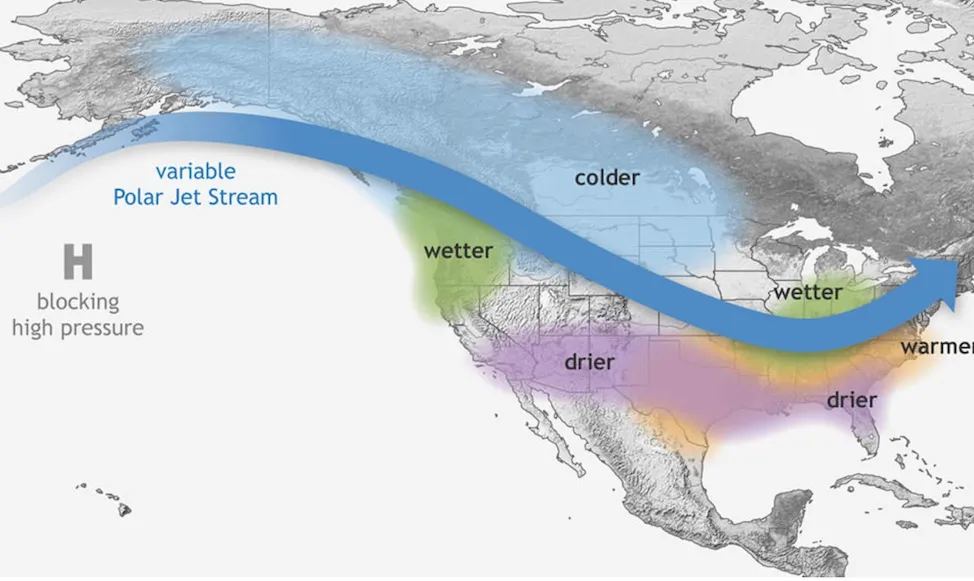
La Niña causes the jet stream to move northward and to weaken over the eastern Pacific. During La Niña winters, the Southwest tends to see warmer and drier conditions than usual. Since La Niña conditions are more common during the negative phase of the Pacific Decadal Oscillation, a negative PDO is likewise associated with warmer, drier conditions across the Southwest. (Image credit: NOAA)
Federal forecasts show the possibility of a mild La Niña through February. The climate pattern occurs when Pacific Ocean waters cool down and alter global weather conditions. La Niña patterns often impact the amount of snowpack accumulation in the coming year. The southern part of Colorado is often drier in a La Niña year while northern areas, around Steamboat Springs, typically see snowier conditions.
The stakes for an above average runoff next year are high. The two biggest reservoirs in the country, Lake Powell and Lake Mead have steadily declined over the last 25 years. Powell is currently at 29% of its capacity and Lake Mead is at 32%. A lessened runoff could push them dangerously low.
While the rain slightly alleviates local drought, it’s “only a drop in the bucket when it comes to refilling Lake Powell and Lake Mead,” Goble said. “We’re still going to see those regional water shortages persist.”
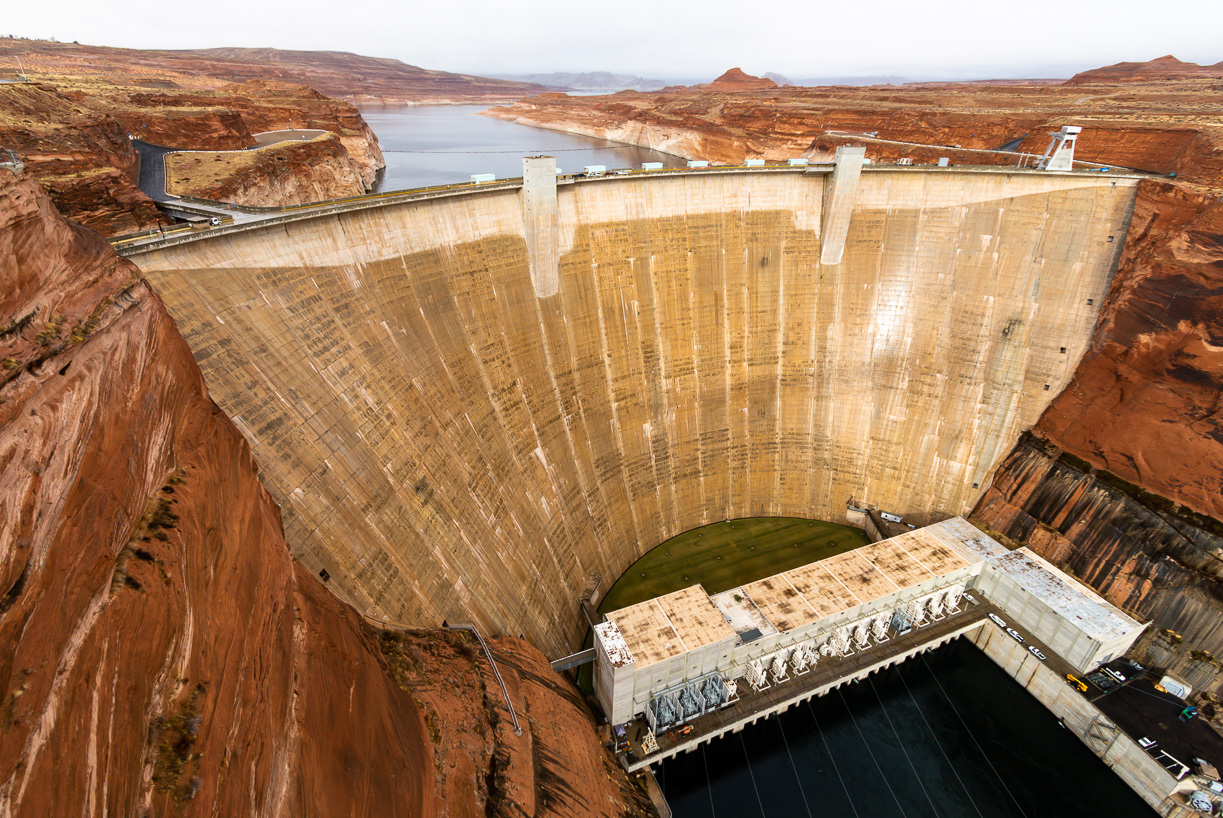
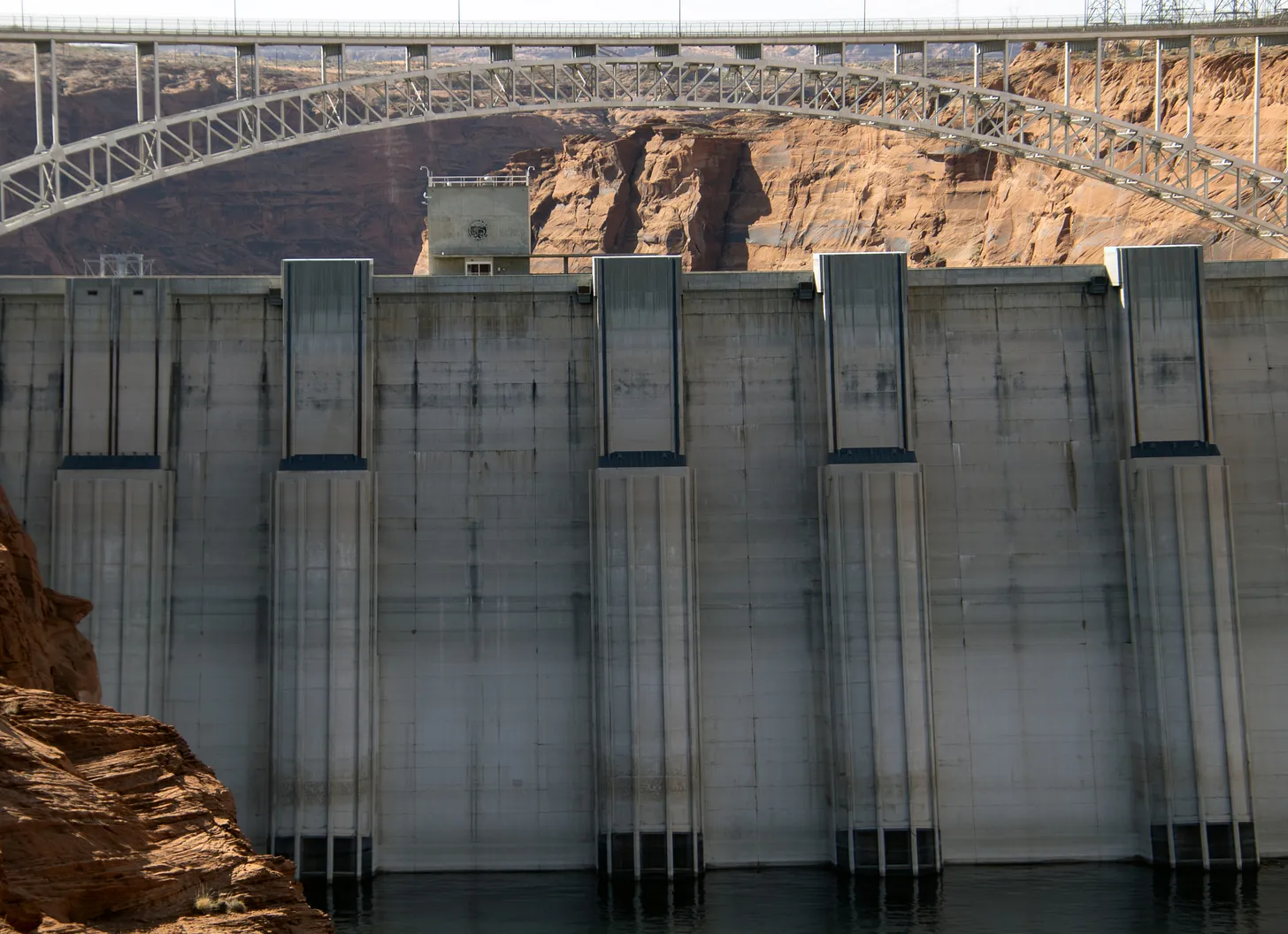
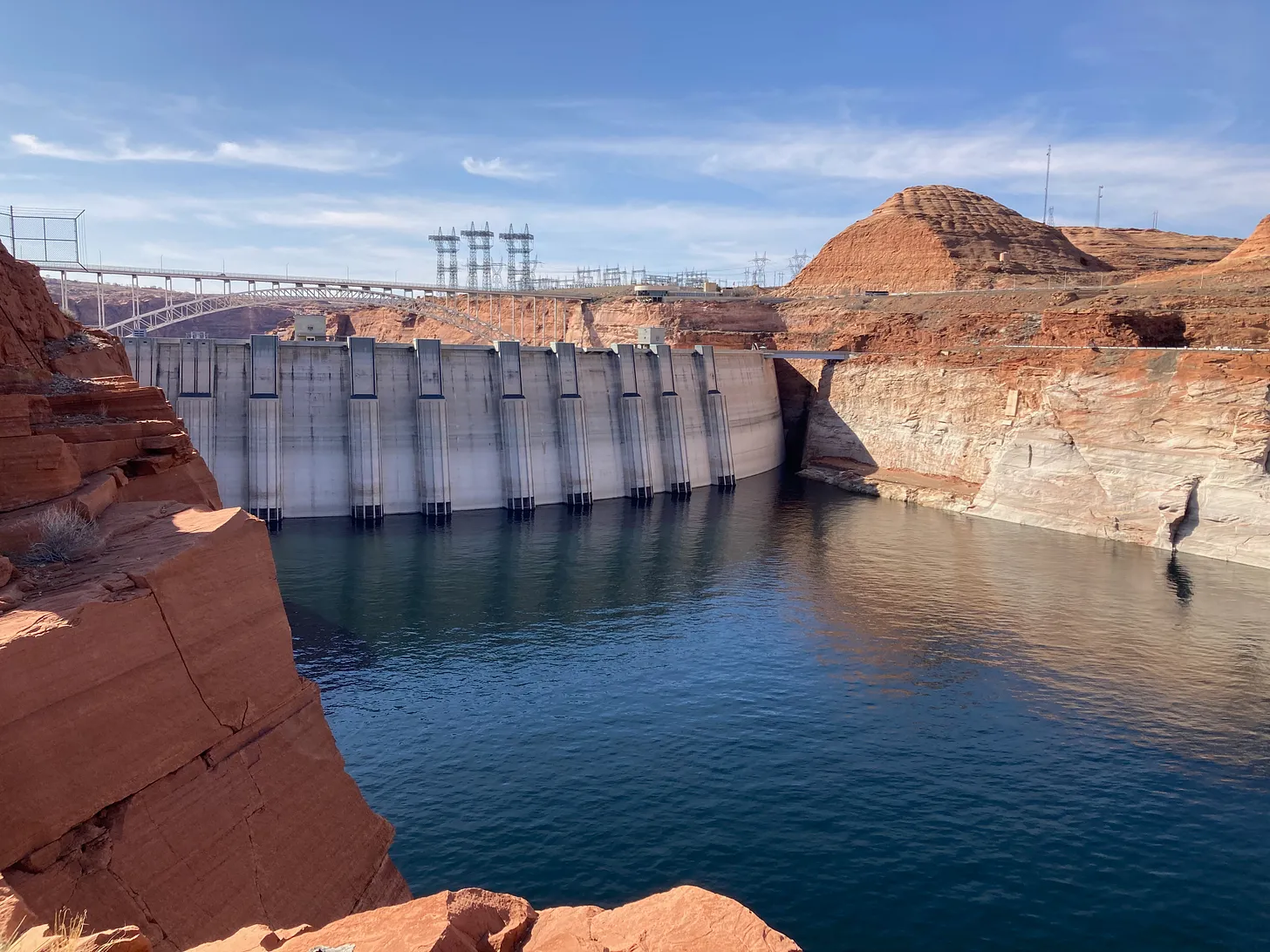
Glen Canyon Dam holds back the waters of Lake Powell, which has reached critically low levels in the last three years. The reservoir serves downstream water use in Arizona, California, Nevada and Mexico. (Mitch Tobin/The Water Desk)
If water levels continue to decline in these larger reservoirs, the dams’ infrastructure is threatened and the hydropower turbines can’t be used. Lake Powell, for example, has different outlets installed so water can be released in low conditions, however they are not designed to be the main outlet source. New federal projections show it’s possible Powell’s levels could drop low enough to cease hydropower production as early as October 2026, if conditions remain dry.
“They could reach levels they have never reached before and potentially reach catastrophic levels,” said John Berggren, regional policy manager for Western Resource Advocates.
In response to extremely low water conditions, it’s possible water from upstream reservoirs in Colorado, Wyoming and New Mexico could be released to support Powell’s hydropower turbines.
“We are seeing a new normal because of climate change, because of aridification,” Eric Kuhn said, former general manager of the Colorado River District, on the state’s Western Slope. In 2022, the basin saw similar drought conditions.
“We are back where we were just a few years later,” Kuhn said. “The system is slipping away.”
The basin states are also engaged in negotiations for new operating guidelines for the Colorado River, set to be in place by 2027. Given the ongoing drought conditions, water experts say the two reservoirs cannot wait for new guidelines.
“Don’t forget the short term problem while you are focused on a long-term agreement,” Kuhn said. A recent research paper, co-authored by Kuhn, highlights the need for urgent consumptive cuts basinwide. “We have got to figure out what’s going to happen next year if next year happens to be dry.”
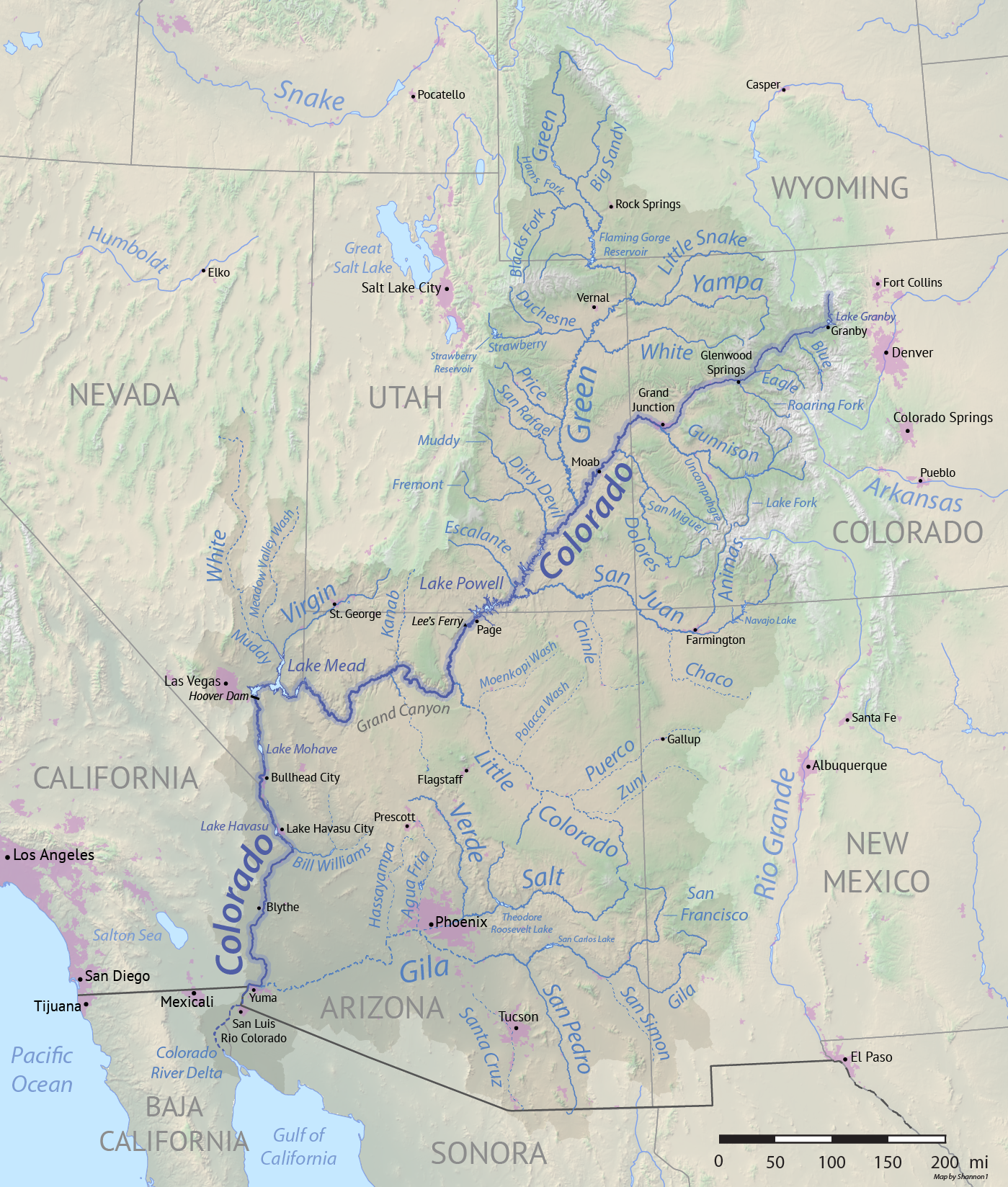
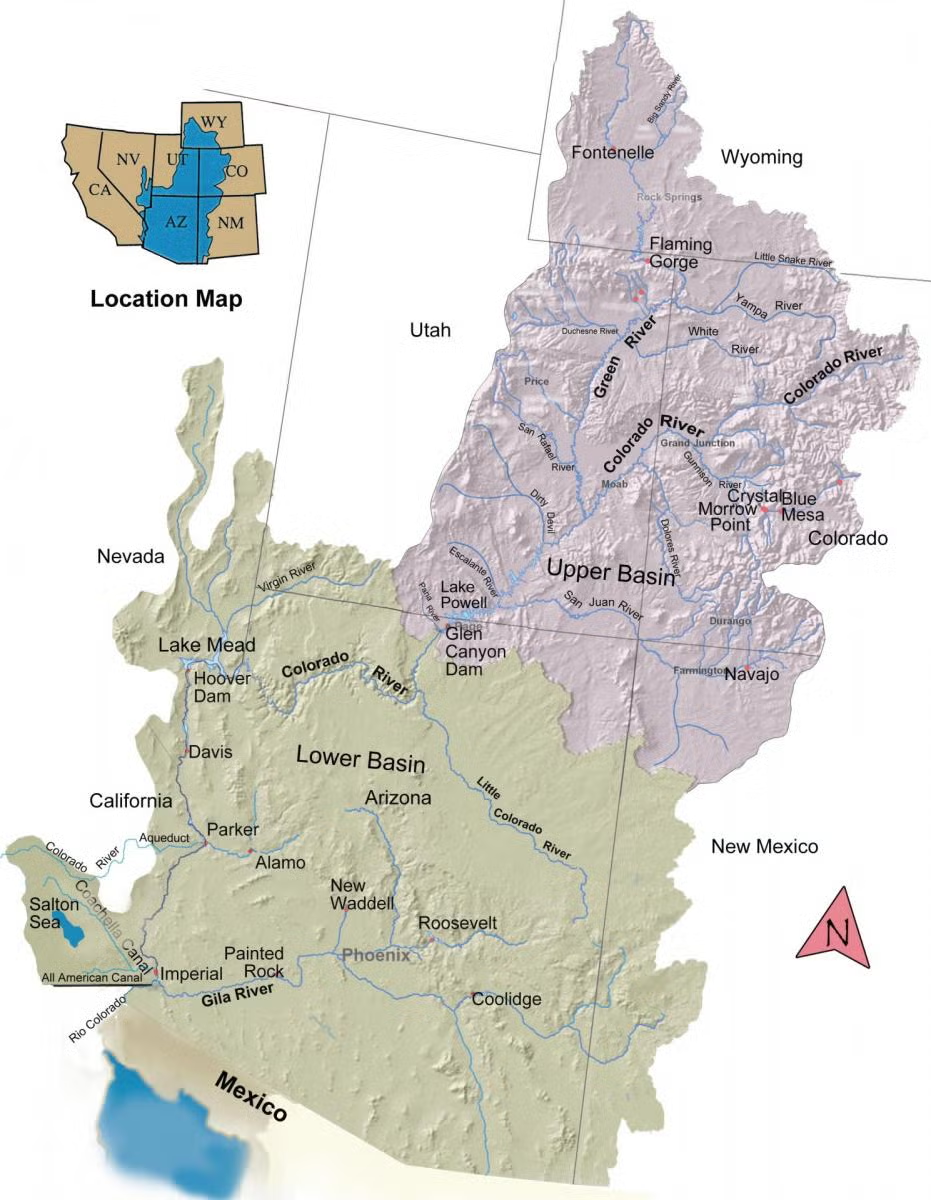
Map of the Colorado River drainage basin, created using USGS data. By Shannon1 Creative Commons Attribution-Share Alike 4.0
Udall/Overpeck 4-panel Figure Colorado River temperature/precipitation/natural flows with trend. Lake Mead and Lake Powell storage. Updated through Water Year 2024. Credit: Brad Udall
Click the link to read the article on the Tucson.com website (Tony Davis). Here’s an excerpt:
November 5, 2025
Gov. Katie Hobbs blasted officials of the four Upper Colorado River Basin states for what she called their “extreme negotiating position” in refusing to offer curbs on their water use to help save the depleted river.
“This river is shared by seven states, and it benefits seven states. Therefore there must be water conservation efforts in all seven states within the Colorado River Basin,” Hobbs said Wednesday in Tucson at a gathering of the National Water Resources Association Meeting Leadership Forum.
Arizona Governor Katie Hobbs. Photo credit: Arizona Office of the Govenor
“Yet as I stand before you today, after years of negotiations and meeting after meeting after meeting, and time running short to cut a deal, we have yet to see any offer or real, verifiable plan to conserve water from the four Upper Basin States who rely upon this shrinking river,” Hobbs said in a talk at Loew’s Ventana Canyon resort on the northeast side…
The seven states this century have been using far more river water for farms, homes and businesses than is provided by Mother Nature, with the overuse now reaching 3.6 million acre-feet a year, or more than one-fourth of the river’s annual average flow. Those annual flows have declined at least 20% since the turn of the century due to drought and human-caused climate change, many scientists have said. The Upper Basin states have so far not retreated from their position that they see no reason to conserve any additional water because they say many of their farmers, in particular, have already suffered many shortages in recent years when flows in the river and its tributaries aren’t enough to satisfy demand. The Upper Basin states also note that they use significantly less water than they have rights to use under the 1922 Colorado River Compact, while the Lower Basin states typically use more than their allocated rights, particularly when evaporation of water in the Lower Basin’s stretch of river and its tributaries is considered…In a brief interview Wednesday, Hobbs noted that Arizona has one of the fastest growing economies in the US and that could be undercut by an unfavorable CAP allotment. Hobbs went on to say the state maintaining a leadership role in the chip manufacturing industry is not only an economic issue, but also one of national security because some of the most advanced computer chips in the U.S. are being manufactured here. In her speech Hobbs said, “We see time and time again, Arizona, California and Nevada coming to the table, offering significant water cutbacks, and seeing nothing from the Upper Basin.
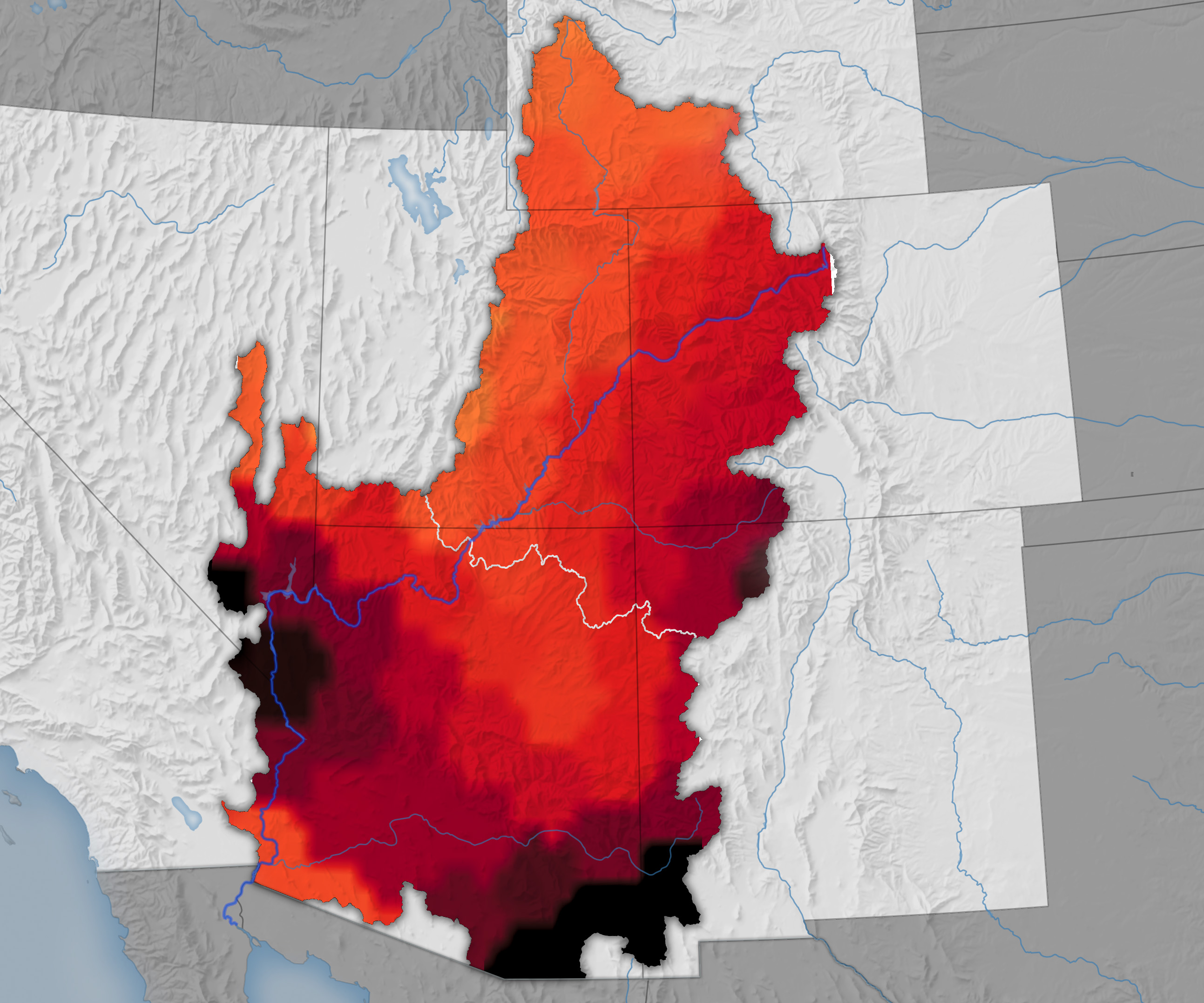
Fig. 1. The Colorado River Basin covers parts of seven U.S. states as well as part of Mexico. Credit: U.S. Geological Survey
Lower Basin water use since 1964. 2025 data provisional, based on USBR projections Oct. 29, 2015.
Click the link to read the article on the InkStain website (John Fleck):
October 31, 2025
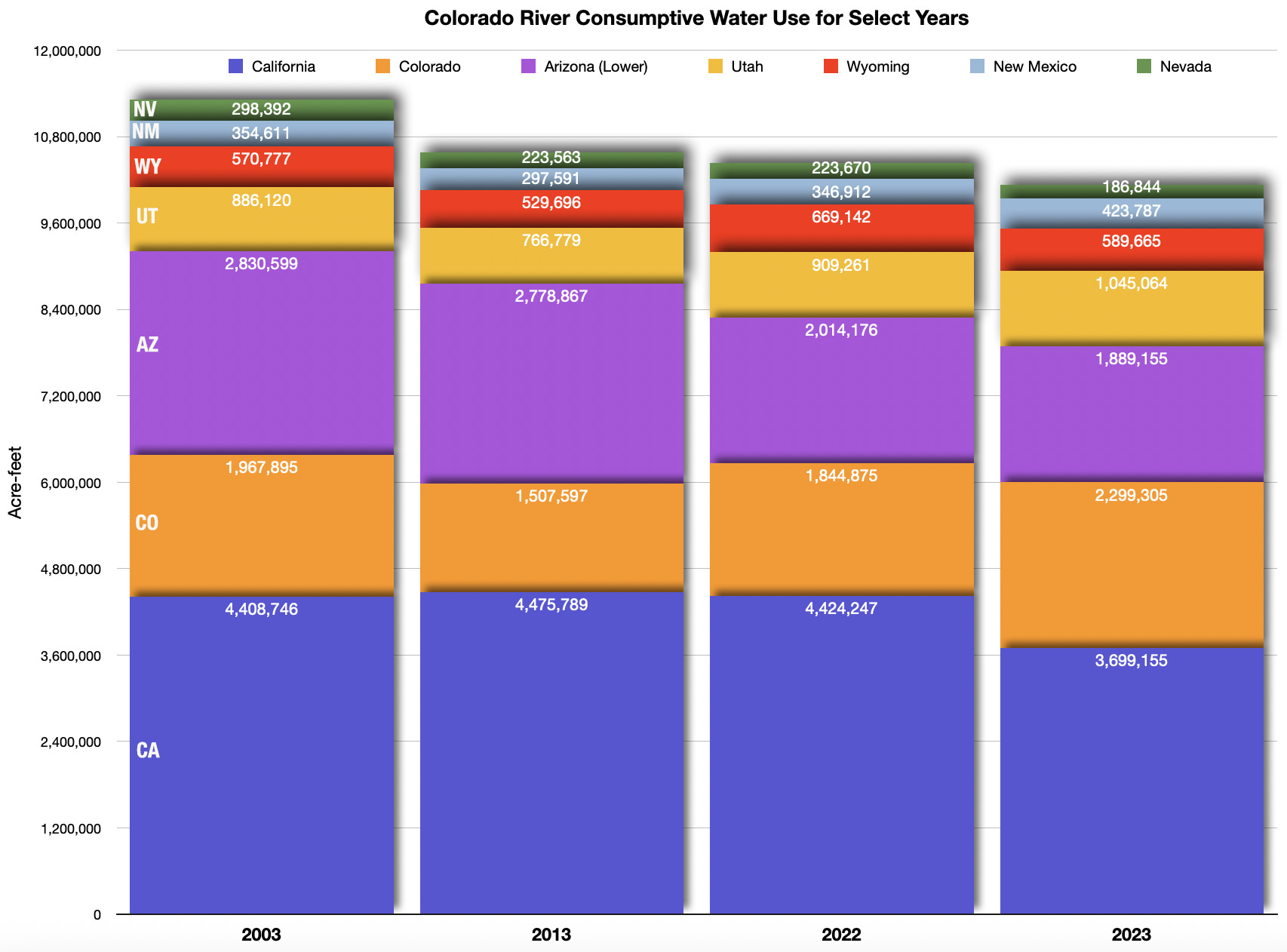
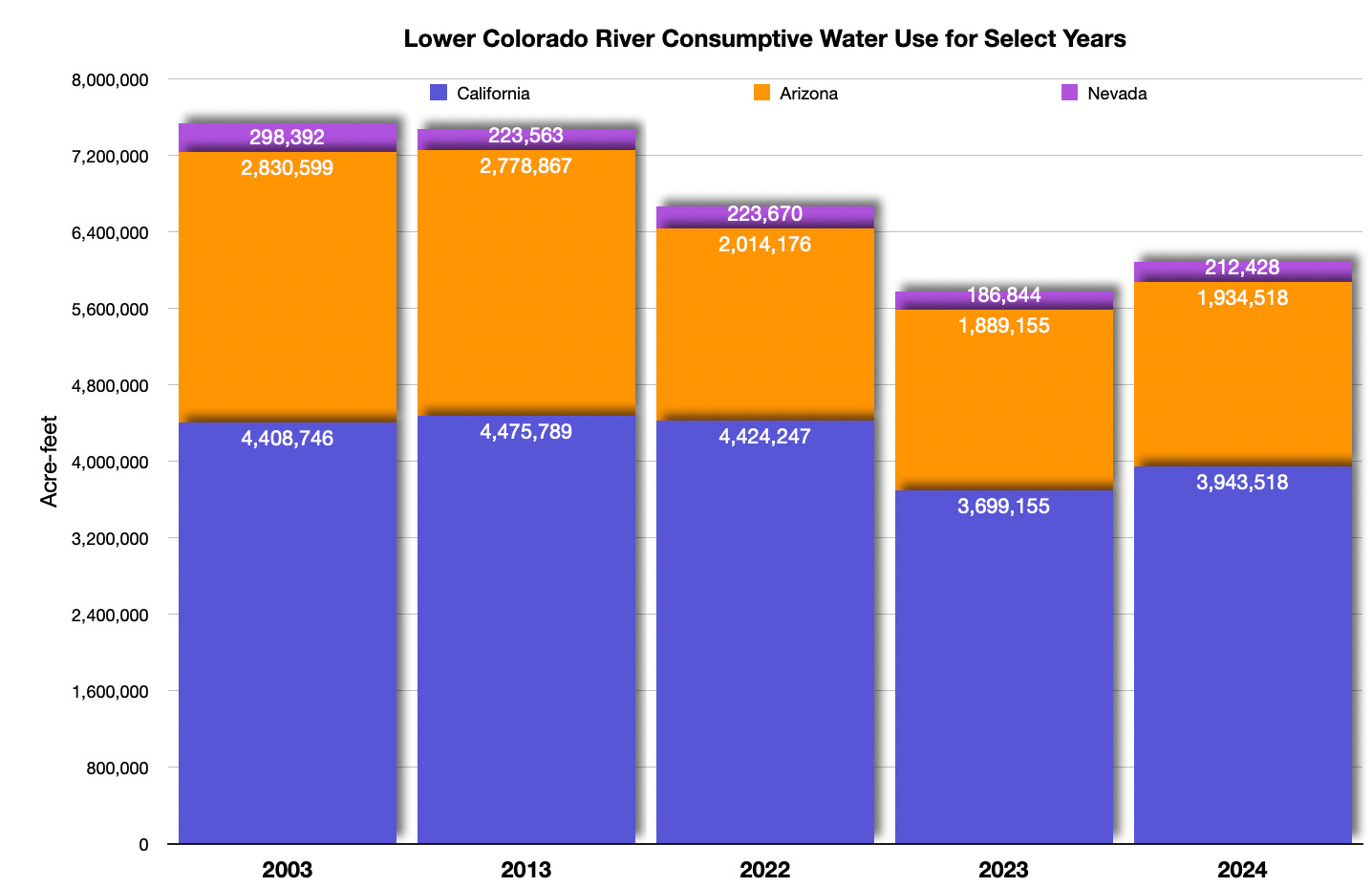
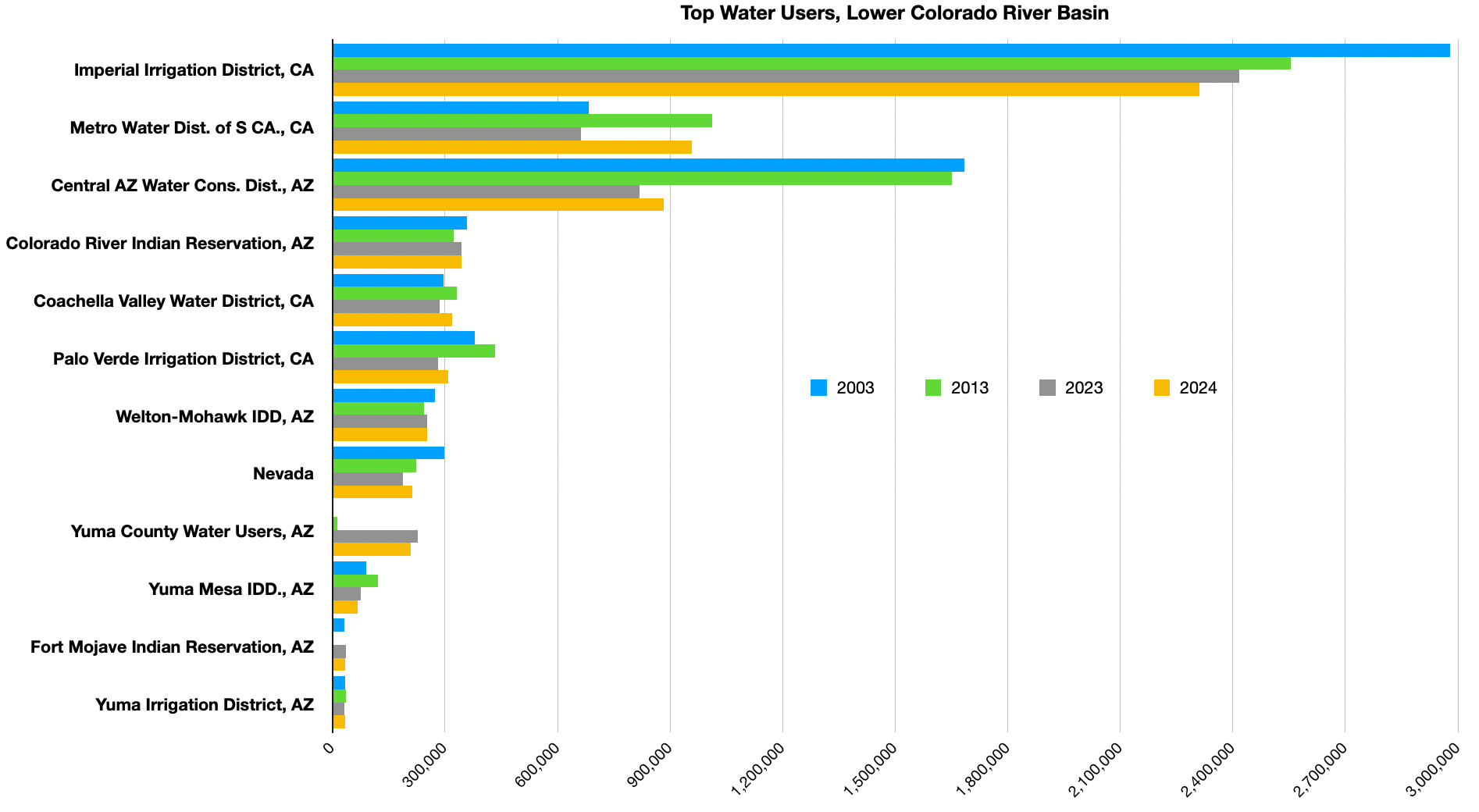
California’s projected use of Colorado River water this year, 3.76 million acre feet as of Reclamation’s Oct. 29 modeling runs, would be, as near as I can tell, the state’s lowest use since 1949.
Also notable:
Nevada’s 197,280 acre feet would be the lowest since 1992.
The two lowest years in Imperial Irrigation District’s history (my dataset goes back to 1941) were last year and this year.
This will be the third year in a row that Arizona’s main stem use has been below 2 million acre feet. The last time that happened (three consecutive years below 2maf) was in the 1980s.
Total take by the US Lower Basin states is projected to be 5.917 million acre feet, the lowest total US main stem use since 1983.
A few things to note.
First, the tenuous fabric of the Basin States negotiations is predicated right now, in part, on the Lower Basin cutting 1.5 million acre feet of annual use. They’ve already done that.
Second, the current cuts are enabled by significant federal payments to compensate the water agencies for their cuts. As my colleagues and I wrote back in September, counting on that money in the future would be unwise.
Third, the economies of Arizona, southern Nevada, and southern California are chugging along just fine right now. As I have written in the past, having less water does not mean scary doom. We can do this.
A note on the data:
The projection of total 2025 use by Lower Basin water users is based on model runs done by the Bureau of Reclamation every few days. It’s a rich source of data, with detailed accounting of the various conservation programs being run by the Lower Basin agencies. PDF here.
The comparison with prior years is based in part on the Lower Basin accounting reports, prepared each year since 1964. For prior years, I have a dataset I got years ago from the technical staff at the Metropolitan Water District of California, who had pieced together California numbers back to 1941. (Thanks, Met!)
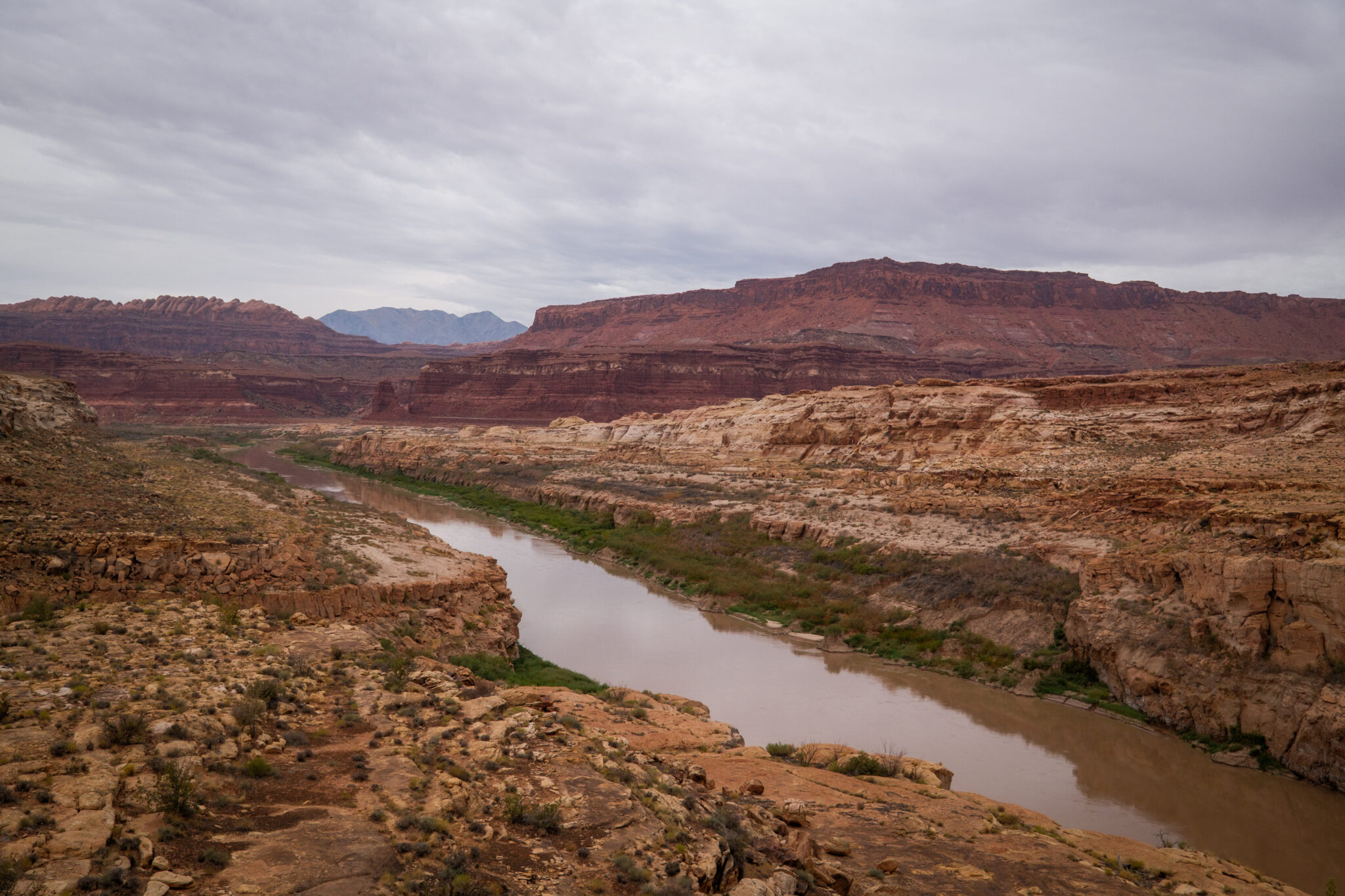
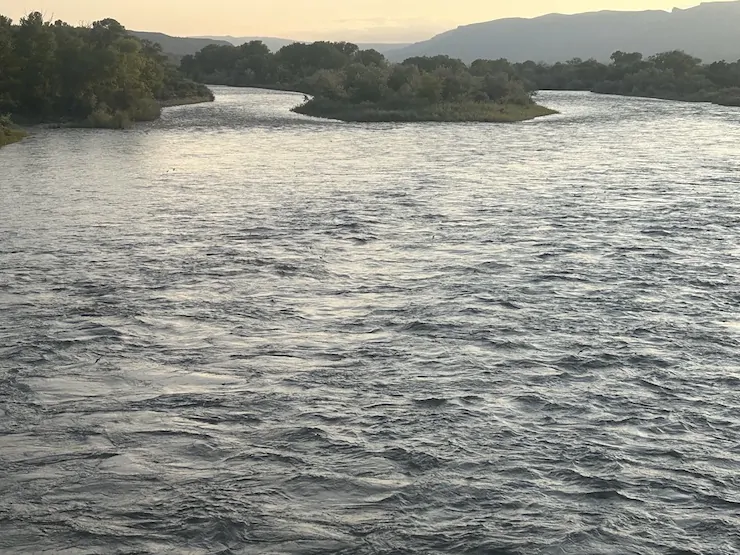
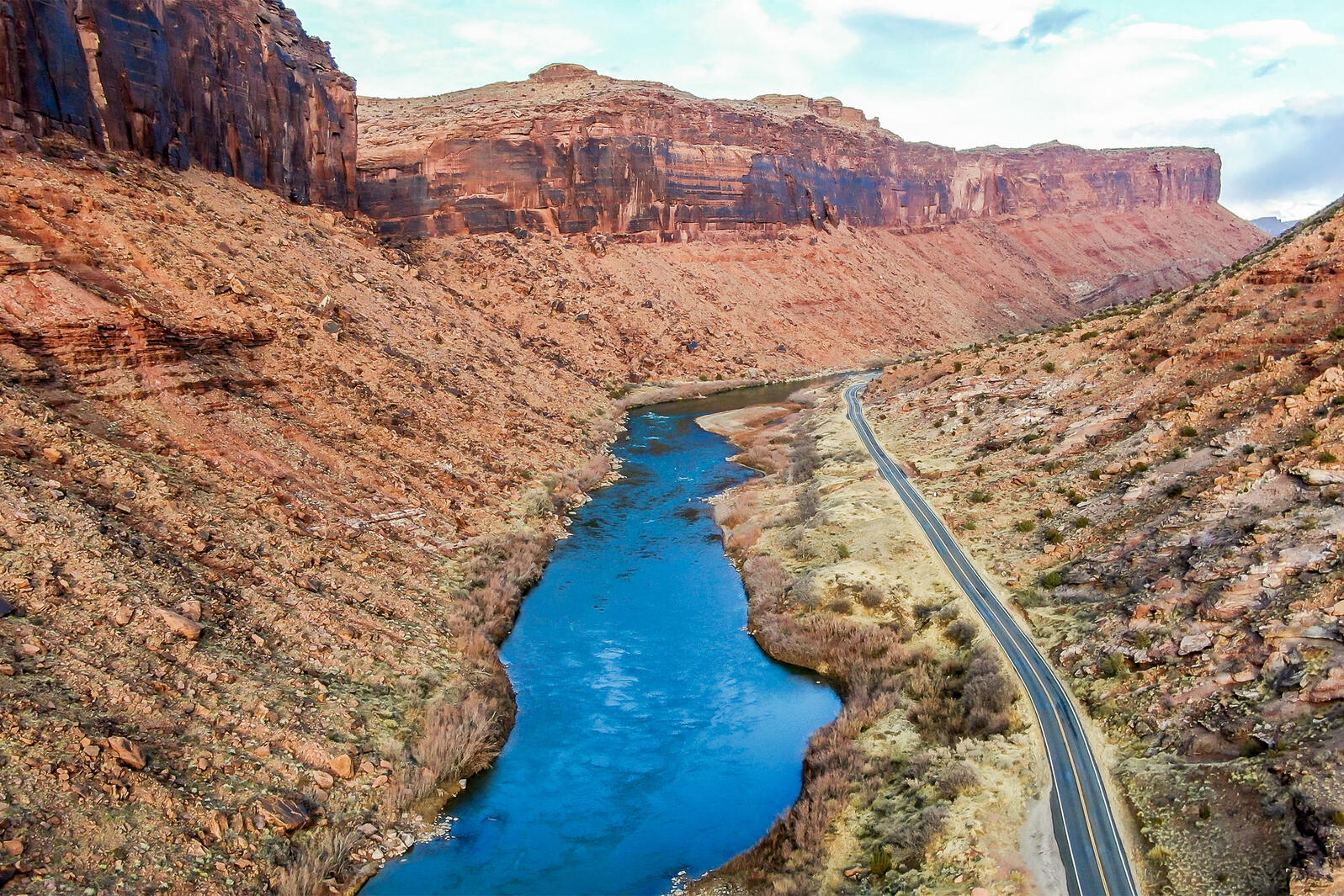
The Colorado River is pictured where if flows near Hite, just beyond the upper reaches of Lake Powell, on Friday, Sept. 19, 2025. (Photo by Spenser Heaps for Utah News Dispatch)
Utah and six other states along the Colorado River are pushing up against a deadline to figure out as a group how to manage the river and its reservoirs.
If they can’t reach an agreement by Nov. 11, the federal government is set to intervene and make its own plan. The existing agreement expires at the end of next year.
“There’s still hope,” Marc Stilson, principal engineer for the Colorado River Authority of Utah, said Thursday. “They’re working hard, and they’re close.”
The upstream Upper Basin states — Utah, Colorado, New Mexico, and Wyoming — and the Lower Basin states of Nevada, Arizona and California pitched competing plans to the federal government last year.
Now, in the home stretch of negotiations, the seven states are working through questions including which reservoirs would be managed under the new agreement, how they’ll measure water use and whether the plan will include mandatory cuts to water allocations, Stilson said.
The Upper Basin states have resisted the idea of mandatory cuts in dry years, saying they typically use much less than their yearly allocation.
Lower Basin states have said all seven should share water cuts during dry years under the new plan, warning if they don’t, downstream states could face cuts that aren’t feasible for them to absorb, the Nevada Current reported.
The river provides water to 40 million people across the U.S. and Mexico, and contributes 27 percent of Utah’s water supply. Hotter temperatures tied to climate change have mixed with drought and overuse to reduce its flow.
Utah isn’t waiting to prepare for potentially significant changes to how it manages water, said Michael Drake, deputy state engineer with the Utah Division of Water rights.
It’s been investing in expanding its use of tools to better measure and monitor water use since 2023, Drake told reporters Thursday.
That year, the Legislature poured $1 million into a Colorado River measurement infrastructure project and approved $650,000 in annual funding to monitor water use, according to the division.
Whether the state ends up facing cuts as part of the new plan or just working toward new targets, Drake said, it sees a need “to be able to manage water better, and you can’t regulate what you can’t measure.”
“As we get close here, I think reality is starting to hit and so we want to put out the messaging, you know, we can do this,” Drake told Utah News Dispatch.
He noted the possibility of forced cuts is troubling to many of the state’s farmers.
“What we’re going to be asking people to do is to see water running in a stream, and to not take it, to leave it there,” Drake said. “It’s a hard pill to swallow.”
Scott Thayn, who farms alfalfa and the grain sorghum in unincorporated Carbon County, agreed.
“If something happens with this new treaty and they drop it 10, 15, 20%,” Thayn said, “most of the years we’re going to be hurting.”
Seven states in the Colorado River Basin are days away from a Nov. 11 deadline to hash out a rough idea of how the water supply for 40 million people will be managed starting in fall 2026. And they’re still at loggerheads over what to do.
The rules that govern how key reservoirs store and release water supplies expire Dec. 31. They’ll guide reservoir operations until fall 2026, and federal and state officials plan to use the winter months to nail down a new set of replacement rules. But negotiating those new rules raises questions about everything from when the new agreement will expire to who has to cut back on water use in the basin’s driest years.
And those questions have stymied the seven state negotiators for months. In March 2024, four Upper Basin states — Colorado, New Mexico, Utah and Wyoming — shared their vision for what future management should look like. Three Lower Basin states — Arizona, California and Nevada — released a competing vision at the same time. The negotiators have suggested and shot down ideas in the time since, but they have made no firm decisions.
This shows that Colorado’s Western Slope is the biggest supplier of water to the Colorado River. Source: David F. Gold et al, Exploring the Spatially Compounding Multi‐Sectoral Drought Vulnerabilities in Colorado’s West Slope River Basins, Earth’s Future (2024). DOI: 10.1029/2024EF004841
As the clock ticks down, onlookers have been increasingly frustrated and critical of the lack of progress in the closed-door negotiations.
“They seem to have been stuck basically on the same stuff for the last two-plus years,” said Jim Lochhead, former CEO/manager for Denver Water, the state’s largest water provider. “Part of why it’s so frustrating is they keep circling around to the same conversations over and over again.”
The Department of the Interior is managing the process to replace the set of rules, established in 2007, that guide how key reservoirs — lakes Mead and Powell — store and release water.
The federal agency plans to release a draft of its plans in December and have a final decision signed by May or June. If the seven states can come to agreement by March, the Department of the Interior can parachute it into its planning process, said Scott Cameron, acting head of the Bureau of Reclamation, during a meeting in Arizona in June.
Colorado River Storage Project map. Credit: Reclmation
If they cannot agree, the feds will decide how the basin’s water is managed. The federal government already has significant authority in the Lower Basin. But federal officials have also said they could leverage their authority over federal water projects in the Upper Basin, like Blue Mesa and the Colorado River Storage Project, to manage water in coming years.
The states could also take the matter to court, which could take decades to resolve and would put water management in the hands of judges instead of Colorado River communities, experts say.
“I think, if the definition of failure is that they don’t come to an agreement, we’ll know on Nov. 11,” said Sarah Porter, director of the Kyl Center for Water Policy at Arizona State University. “My sense is that they’ve all tried really hard.”
So what exactly is holding up progress? [Shannon Mullane] reached out to nine water professionals, from state negotiators to water experts, to break down the sticking points.
Water cuts in the Upper Basin (yes, that includes Colorado)
One of the top sticking points in the negotiations is whether the four Upper Basin states will commit to making firm water cuts or conservation goals during the basin’s driest years, experts said.
Colorado, New Mexico, Utah and Wyoming officials say the states regularly do not use their full legal allocation of Colorado River water, about 7.5 million acre-feet per year. The four states’ usage usually hovers closer to 4.5 million acre-feet per year and can fall to 3 million acre-feet in drier years, according to Upper Basin accounting.
They’re already cutting off junior water users early in dry years, like 2022. Water sharing is based on “first in time, first in right,” which means more recent, or junior, water rights are cut off before older, senior rights.
The officials argue that they’re already cutting back, and using less than their share, so why commit to cutting more? Conserving more water is also dependent on how much water is flowing through rivers and streams in any given year, Commissioner Becky Mitchell, Colorado’s governor-appointed negotiator, said.
Rebecca Mitchell, John Entsminger, Estevan Lopez, Gene Shawcroft, JB Hamby, Tom Buschatzke at the Getches-Wilkinson Center/Water and Tribes Initiative Conference June 6, 2024. Photo credit: Rebecca Mitchell
“We cannot conserve water that is not there,” she said.
In March 2024, the states proposed voluntary, temporary cuts, but that doesn’t work for the Lower Basin officials.
The downstream states proposed in March 2024 that they could take the first cuts — up to 1.5 million of their 7.5 million-acre-foot legal allocation — if reservoir storage is 38% to 69% of its capacity. After that, the Upper Basin and Lower Basin could evenly split additional cuts, according to the Lower Basin proposal.
That was a nonstarter for the Upper Basin officials, who balked when the Lower Basin asked them to cut up to 1.2 million acre-feet, or about a quarter to a third of the typical water use in the upstream states. Some of the Upper Basin states also say they do not currently have the legal authority to impose mandatory water cuts within their states when it comes to interstate water sharing agreements. [ed. emphasis mine]
This is one of two major disagreements in the negotiations, according to California Commissioner JB Hamby. The other is how and when water is released from the Upper Basin at Glen Canyon Dam to the Lower Basin, he said.
“There’s been lots of proposals bandied about back and forth between the basins and the feds,” Hamby said. “We’re not any closer at this point in time because those are the two most critical sticking points.”
Arizona officials declined to comment for the story. Nevada’s representative did not respond to requests for comment.
The political sticking point
Each of the seven negotiators is accountable to their home state. They have to be able to sell a deal to their water users and state lawmakers in a way that feels like a win, Porter of Arizona State University said.
In Arizona, Commissioner Tom Buschatzke must strike a deal that water users and the state legislature can get behind.
“There may be a situation where no deal is better than trying to sell a deal to your water users that you know they will utterly hate,” Porter said.
There are certain nonstarters for Arizona: Everyone expects to see water cuts for communities, like Phoenix, that rely on the Central Arizona Project, a 336-mile federal system that supplies Colorado River water to the most populated regions in Arizona. But it’s hard to see a benefit for Arizona in a deal with no water, or not enough water, for the project, Porter said.
And water users can sue if they don’t like the seven-state deal or if senior water users are asked to cut back on water to help junior water users. That would run counter to how the legal priority system has worked for over a century. Such lawsuits would tie up Colorado River water management in court for years, Porter said. [ed. emphasis mine]
Udall/Overpeck 4-panel Figure Colorado River temperature/precipitation/natural flows with trend. Lake Mead and Lake Powell storage. Updated through Water Year 2024. Credit: Brad Udall
“We’re really on the precipice of significant new, bigger shortages, and so the likelihood of a water user bringing legal action because of cuts outside of the priority system … is much higher than it was in 2019,” Porter said.
In past meetings, Cameron of the Bureau of Reclamation has called on water users to be more flexible so their state commissioners have room to negotiate.
“I urge you to continue to work with Tom (Buschatzke), embrace his leadership and give him the freedom to maneuver to strike an appropriate deal with his six colleagues in the other states,” Cameron said during an Arizona Reconsultation Committee meeting in June.
In Colorado, Mitchell said she is still working closely with water users within the state.
“We have firmly sat in the negotiating room with the principles we have always had,” she said. “That is something I have promised Coloradans: The principles that we developed are still the principles that I am taking into the room with me. Those are factored in as we are negotiating.”
What experts want to see
Water experts and professionals have been stuck on the outside of the closed-door negotiations, waiting on updates with greater frustration as the deadline draws near.
Now the states have less than two weeks to agree, at a high-level, on how to manage the water supply for millions of people, two countries, 30 Native American tribes, key food supplies and multibillion-dollar industries.
“They have the most thankless task that anyone in the Colorado basin could have,” Porter said.
Lochhead, formerly of Denver Water, said it seems impossible to reach any kind of comprehensive agreement before Nov. 11. They might be able to reach a conceptual outline, he said. They might be able to find a way forward if they were less entrenched in the Upper Basin versus Lower Basin dynamic, he added.
Jennifer Pitt and Brad Udall at the Getches-Wilkinson Center/Water and Tribes Initiative conference June 5, 2025. Photo credit: Allen Best/Big Pivots
Jennifer Pitt, Colorado River Program Director for the National Audubon Society, suggested that states work toward making the most out of water supplies instead of legal questions that are tough to resolve.
“Once the rules of the game become clear, people are going to lean hard into those solutions,” she said. “And there are many of them.”
John Berggren, regional policy manager for Western Resource Advocates, said the basin needs to see compromise as a win, not a loss. Officials need to educate their constituents that compromising empowers people to choose their destiny, instead of having courts or the federal government dictate it for the basin.
“A compromise is not a bad thing,” Berggren said. “Coming to agreement, coming to the table is actually a good thing for us.”
10 sticking points
The Colorado River water experts and negotiators highlighted 10 key sticking points:
The term of the agreement: The negotiators have weighed different options for how long the new agreement should last and whether there should be a short-term period for states to ramp up conservation programs and water use reductions. This is a lower-level sticking point where states might be able to find consensus more easily.
Reservoir management: The states have also debated which reservoirs will be managed under the new agreement. The Lower Basin wants to include upstream reservoirs, including Blue Mesa Reservoir in Colorado. The Upper Basin only wants Lake Mead and Lake Powell involved and worries that including upstream reservoirs will change how water flows through the basin or encourage Lower Basin overuse.
Rebuilding reservoir storage: Commissioner Mitchell of Colorado was adamant that the new plan needs to prioritize rebuilding reservoir storage, since key reservoirs — Lake Mead and Lake Powell — are falling closer to critical levels. Commissioner Hamby of California said the states can figure out how to handle reservoir storage, and other issues, like water cuts, pose a greater challenge.
Operating Lake Mead and Lake Powell: The current operational rules are mainly based on reservoir levels and river forecasts. When Lake Mead reaches a certain water level, it triggers adjustments in Lake Powell. The state officials agree these rules did not work. Colorado wants to prioritize the health of Lake Powell and base operations on real water levels — not forecasts. The states almost came to an agreement on how to do this earlier in the summer, but the idea was re-shelved.
Cutting back on water: This is a particularly thorny issue. Would the Upper Basin commit to firm water conservation goals or mandatory cuts? Is the Lower Basin doing enough to address the Upper Basin’s concerns about overuse in the three downstream states? Officials in both basins say large cutbacks to their water supply would be an existential threat to their communities now and in the future.
Basic accounting: The states disagree on key numbers. How does each state count its water use, shortages and conservation efforts? How much water is the Upper Basin supposed to send down to Mexico, or is that the Lower Basin’s job? How do downstream states count water use from tributaries, like the Gila River?
100-year-old issues: The states are also bolstering their legal arguments when it comes to unclear language in the Colorado River Compact of 1922, which laid out how the two basins were supposed to share water. Does it say the four upstream states are required to deliver a certain amount of water to the three downstream states? Or does it say the upstream states aren’t supposed to cause the water deliveries to go below a certain level? Some Upper Basin lawyers say they can argue that climate change, not the states’ water use, is the cause.
Distrust: The basin states have thrown plenty of barbs at each other during the negotiations. Each has accused the other of gaming the system in some way. Lower Basin and Upper Basin officials have said other states could time reservoir releases from lakes Mead or Powell to benefit their state. The Lower Basin has questioned whether the Upper Basin has inflated shortage calculations. The Upper Basin has long complained about Arizona’s practice of taking Colorado River water out of Lake Mead and storing it underground.
Group dynamics: The basin has split into Team Lower Basin and Team Upper Basin. Could states make more progress if they operated more independently, threw out ideas, formed coalitions and convinced others to join?
In-state politics: Even if the state officials can work out the details of an agreement, they still have to take it home and convince their states it’s a good idea. That can be complicated. In Colorado alone, there are decades-old conflicts over water between the Western Slope and Front Range, farmers and cities, tribal and non-tribal water users.
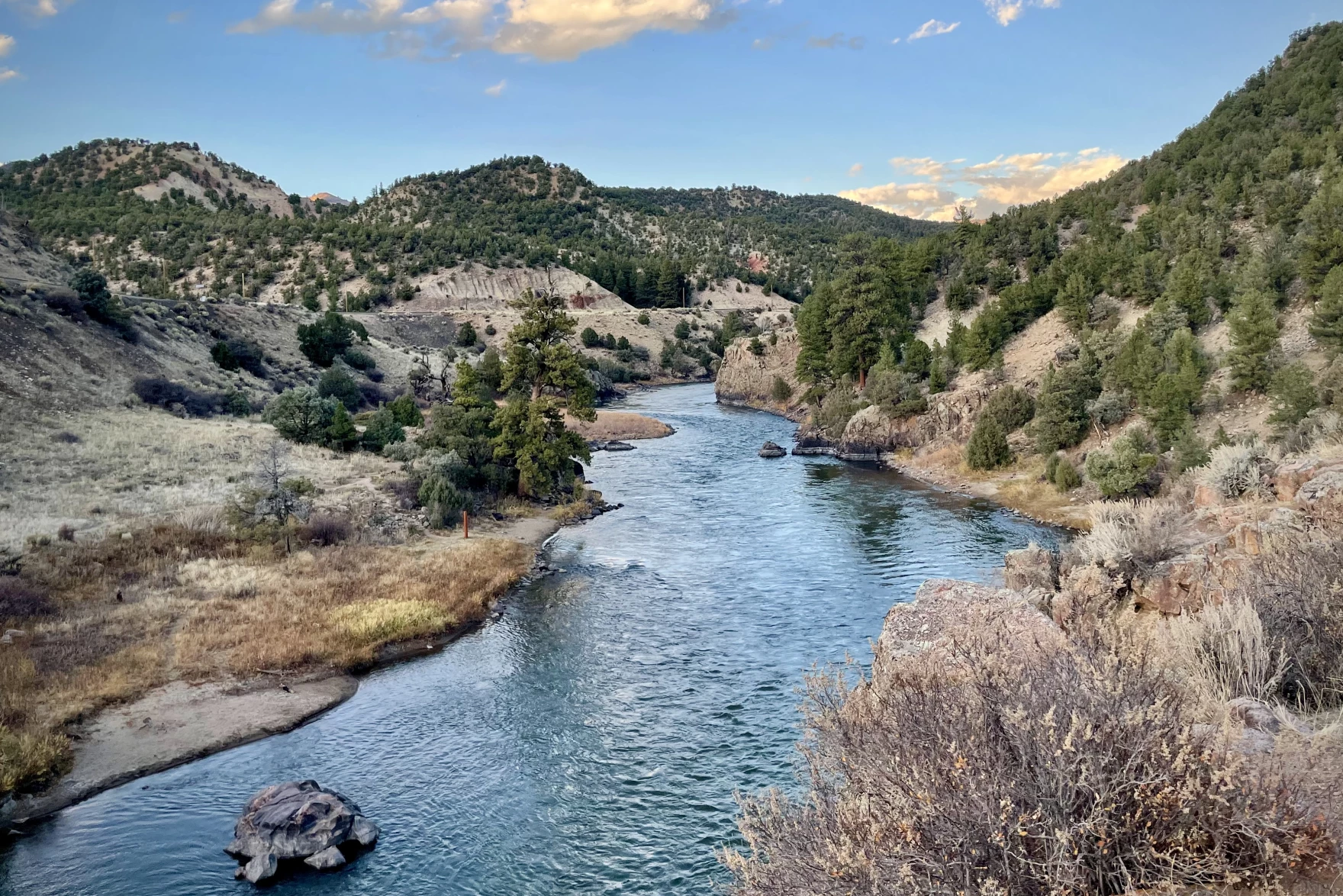
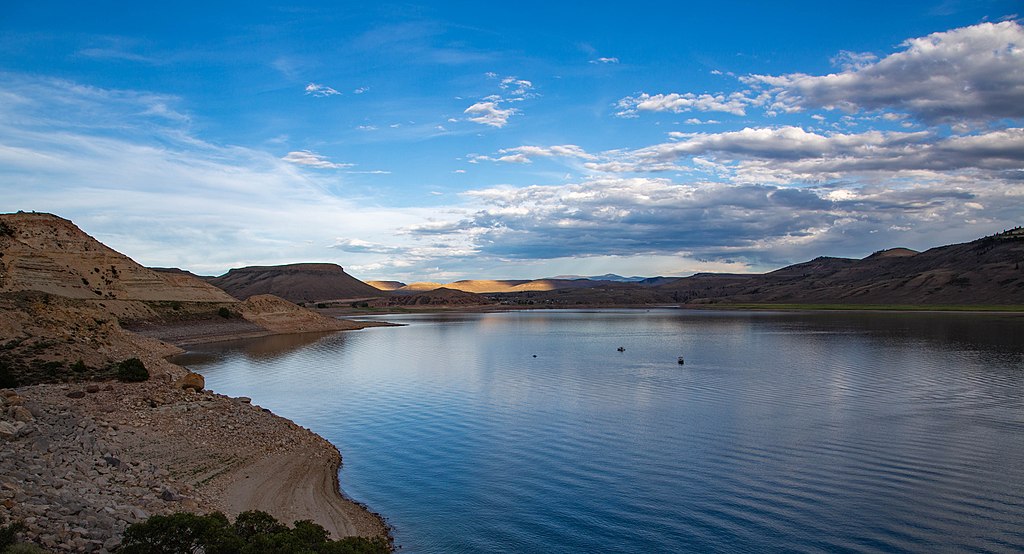
Colorado River “Beginnings”. Photo: Brent Gardner-Smith/Aspen Journalism
Click the link to read the article on The Aspen Times website (Ali Longwell). Here’s an excerpt:
October 8, 2025
The Shoshone water rights acquisition and negotiations on post-2026 Lake Powell and Mead operations dominate conversations at the Colorado River District’s annual water seminar
Western Slope elected officials, water managers, engineers, and conservationists met in Grand Junction on Friday, Oct. 3, all focused on one thing: the uncertain future of the Colorado River.
“Water users, as a lot, tend to crave certainty, and that certainty seems more and more elusive these days,” said Peter Fleming, general counsel for the Colorado River District, at this year’s annual seminar hosted by the River District.
While the seminar broached many of the challenges and opportunities facing those who rely on the Colorado River, most discussions came back to two looming decisions that will dictate how the future looks for the 40 million people, seven states, two counties, and 30 tribal nations that rely on the waterway. This includes the River District’s proposed $99 million acquisition of the Shoshone water rights and the interstate negotiations over the post-2026 operations of Lake Powell and Lake Mead. Both decisions will have ramifications for all Colorado River users — including agriculture, recreation, and municipal water — but are stalled by competing interests, be it political, geographic, or otherwise…The River District is currently working through a multi-year process to purchase the Shoshone water rights from Xcel Energy for $99 million. The rights — established in the early 1900s — are the oldest, non-consumptive water rights on the Colorado River…The Shoshone water right is currently tied to the hydroelectric power plant in Glenwood Canyon, which returns 100% of the water used to produce electricity to the river. However, he said that uncertainty surrounding the plant’s longevity, given its age and location — which he called an “area of great geohazard” — led the River District to seek acquisition of the rights. Under the proposed acquisition, Xcel would continue to operate the plant…The district intends to purchase the right and reach an instream flow agreement with the Colorado Water Conservation Board — the only entity that can hold an instream flow water right in Colorado. Doing so would maintain the status quo of the river, the River District claims. Defining what the status quo looks like, though, has led to disagreements between the West Slope entity and East Slope water providers…
Water allocation on the Colorado River dates back to the 1922 compact agreement, which divided the river between the upper and lower basins. Right now, it’s not the compact, but the 2007 operational guidelines for Lake Powell and Lake Mead that are being renegotiated. While the four Upper Basin states — Colorado, New Mexico, Utah, and Wyoming — rely predominantly on snowpack for water supply, the Lower Basin states — Arizona, Wyoming, and Nevada — rely on releases from Lake Powell and Lake Mead. The 2007 guidelines for the two reservoirs, which govern how they store and release water, are set to expire in 2026. The seven states have until Nov. 11 to try and reach a consensus on the reservoirs’ post-2026 operations; otherwise, the federal government will step in and impose its own plan.
Becky Mitchell, who has been negotiating on Colorado’s behalf, said on Friday that she is “hopeful” for this seven-state consensus “because the alternative is not great.” “I think we’ve kicked the can and we’re at the end of the road,” Mitchell said…Throughout the negotiations, the Lower Basin states have advocated for basin-wide water use reductions. The Upper Basin states, however, have pushed back on the idea, claiming they already face natural water shortages.
“In Western Colorado, it happens every year,” [Andy] Mueller said.
Wonk warning: I’ll be explicating the chart above. If this sort of thing bores you, or just gets you more, not less confused about what’s going on with the river today as the negotiators for post-2026 system management continue to negotiate with a November 11 deadline, then I’d say take a break until next post, when I’m going to try to explain why I call this stuff ‘Romancing the River.’
For those reading on here, remember my purpose from earlier posts: to show a reasonably equitable division of the consumptive use of the Colorado River waters among the seven states and Mexico, with no ‘temporary’ division into competitive Upper and Lower Basins – the Compact they really wanted to do in 1922. I present the table above as just a draft effort in that direction; there will be arguments about some of the specific figures, but the method to the madness might have some merit.
All the consumptive use information is from Bureau of Reclamation records accessible online, or from other cited historical documents going back to the 1922 Compact. The Bureau publishes consumptive use records every five years – eventually. (Figures for 2016-2020, for example, still have ‘Coming soon!’ where one would click to get them.) All quantities are expressed in millions of acre-feet (maf) or thousands (kaf).
To just jump into it, here’s a column-by-column explication of the chart. I suggest clicking on the image above to get an enlargable view of the table. If nothing else, this table is kind of a history-in-numbers of the Colorado River in the 20th century CE. (It is important to remember too that, thanks to the 1952 McCarran Amendment, all the Indian tribal rights are negotiated intrastate, although suits and appeals go to the federal courts – a separate set of challenges from what the seven states are trying to negotiate right now.)
Column 1, River Users: I make no reference to the Upper and Lower Basin, but it does make sense to distinguish between the ‘hot desert’ states below the canyon region, and the ‘cold (orographic) desert’ states above the canyons, due to the significant difference in system losses – evaporation, transpiration, bank and aquifer storage and other losses. We will start with some analysis of those lines in the table, one for each set of desert states (considerably higher for the subtropical ‘hot desert’ region than the higher and cooler ‘cold (or steppe) desert’ region.
System Losses, Structural Deficit and Surpluses: These constitute the river’s wild card. Natural system losses were listed in the paragraph above – all the natural things that happen to water mixed with sun, wind and thirsty ground. Storage reservoirs are built on snowmelt rivers to increase the amount of water available for use through a longer period of time, storing the two-month snowmelt flood for use through the rest of the year. But increasing in reservoirs the amount of water available for use does not increase the amount of water; in fact, it decreases that, as the stored water spreads out in reservoirs under a desert sun that can evaporate annually as much as six acre-feet per acre off of open water in the lower Colorado River.
This was completely ignored in the Colorado River Compact, despite the fact, that as Eric Kuhn and John Fleck pointed out in their book Science Be Dammed, there were scientists who tried to advise the commissioners. Today, with two huge reservoirs, another half dozen big reservoirs and a lot of little ones, along with around 600 miles of large open aqueducts meandering through the hot deserts, somewhere between 12 and 16 percent of the river is lost to the system under the sun and wind.
The compact commissioners, thinking they had an 18 maf river, believed that evaporation would be covered by the surplus they anticipated above and beyond the quantities consumed by the seven states and Mexico. That was actually the case, well into the 1980s. But as more users materialized in the states above the canyons, and the Central Arizona Project began to draw from the mainstem, the ‘structural deficit’ from ignoring the system losses began to draw down the big reservoirs. These natural system losses were estimated at around 800,000 af annually from the mainstem for the states below the canyons, and between 400,000 and 500,000 from Powell and the other Colorado River Storage Project reservoirs.
Another element in the structural deficit was consistent provision for Mexico’s treaty allotment of 1.5 maf per year. The compact made the Upper and Lower Basin each responsible for half of whatever portion of that allotment which was not covered by surplus flow (up to 750 kaf). Beginning in 1971, however, under a 1970 reservoir management agreement, the Bureau began releasing the Upper Basin’s full half of the 1.5 maf each year, whether it was a ‘surplus year’ or not. A similar arrangement was not made for the Lower Basin share of the Mexican allotment; the Bureau apparently has just continued to charge it to ‘surplus’ – along with the Lower Basin’s system losses – whether or not there was actually that much surplus. These ‘structural deficits’ were almost as responsible for the big 21st-century reservoir drawdown as was the ‘millennial drought.’ A figure of around 2 maf was established for these natural and cultural commitments: 1.5 maf for the ‘hot desert’ states, 1.2 maf for the ‘cold desert’ states – those states having consistently delivered their 750 kaf share for Mexico (leaving the 450 kaf in the table). The three states below the canyons have apparently agreed to accept responsibility for their 1.5 maf after 2026, although they are not saying much yet about how that consumption will be divided up.
Back now to the columns.Column 2, Authorized Allotments: These are based on the 18 million acre-feet (maf) river we all believed we were working with back in the 1920s. The Colorado River Compact allotted 7.5 maf to each of its Basins. The Boulder Canyon Project Act made the Bureau water-master for the Lower Basin states, and set their individual allotments, contested by Arizona but confirmed by the U.S. Supreme Court in the last Arizona v. California case (BCPA/SC). The Mexican allotment was set by the 1944 two-rivers treaty. And in 1948, the four Upper Basin states created the Upper Colorado River Compact. Knowing by then that it was not an 18 maf river, they gave themselves percentages ‘of whatever’s left’ (OWL) after compact obligations to the downriver states and their share of the Mexican treaty obligation were fulfilled. This column shows what that ‘% OWL’ would be if those states actually got 7.5 maf regularly. The cold-desert states have never even come close to those figures.
Column 3: This column shows the allotments for the 14.5 maf average of the river’s ‘natural’ flows for the 1930-2000 period, the period when all of the river’s major development took place. All of the ‘averaging’ fell on the states above the canyons. Allotments for Mexico and the three states below the canyons were legally and physically ‘set in concrete’ at 9 maf – legally by the Supreme Court affirmation of the BCPA allotments, and physically by the two big linked reservoirs, Mead and Powell. The four states above the canyons took their floating percentages from what nature provided, or didn’t – estimated natural flows for that period ranged between 5 and 24 maf. The average ‘of whatever’s left’ (OWL) after the obligatory quantity was sent to the states below the canyon and Mexico was assumed to range between 5 and 6 maf – if no attention was paid to the structural deficit and system losses. And for most of that period, there were no worries there; the states above the canyon were not using that much water until the substantial transmountain diversions (100 percent depletions) were completed. The table figures for those states (unlike the figures for the states below the canyons) amounted to wishful thinking for a future that will never happen.
Column 4 gets real: a compilation of three columns with five-year consumptive use averages for three periods, covering the time when the physical development of the river storage and delivery systems was being completed, and consumptive use of the river was approaching full development too – but just on the edge of the trauma of the ‘millennial drought’ (which may last for a millennium) and the near-collapse of the storage system. The attempt at normal distribution for the 2001-2005 period might be considered just beyond that edge – like the roadrunner cartoons, when Wiley Coyote runs a few yards into the air beyond a cliff – then looks down…. These dates are bookended by two ‘reservoir coordination’ elements in the ‘Law of the River’: the 1970 ‘Criteria for the Coordinated Long-range Operation of Colorado River Reservoirs’ and the 2007 ‘Interim Guidelines’ for coordinated operation of the Powell and Mead Reservoirs, set to expire next year.
The Bureau’s five-year compilation tables include, for the first time maybe, the system losses/structural deficit.
Something worth noting: California’s consumptive use during this 35-year period started well above the state’s 4.4 maf compact allotment, and then declined, while uses for all the other states were increasing. This is because California’s major users had decided, before Hoover Dam was even started, that they would ‘borrow’ 800,000 af of unused Upper Basin water until the Upper Basin needed it. They would, in other words, grow on borrowed water. The Bureau of Reclamation allowed this, because they assumed that the Colorado River would eventually be augmented by even greater public works from some larger river basin. Optimism is a sunny thing. On the strength of this, the Metropolitan Water District on the Southern California coast built its 250-mile aqueduct to carry twice the 500,000 af that was their share of California’s 4.4 maf allotment. They began decreasing their ‘borrowed’ usage during this 35-year period, in anticipation of the 2006 California Limitation Act – thanks mostly to the California State Water Project exporting water from Northern California.
Arizona’s jump in usage between 1971-75 and 1991-95 was due to the completion of the Central Arizona Project. To give a more accurate picture of ‘the completed river system,’ only its 1991-95 and 2001-2005 figures were used in compiling Column 5.
Column 5: A compiled average for the three five-year periods – resulting in the 14.5 maf river of 1930-2000.
Column 6: An attempt to divvy up the system losses/structural deficit (SLD) between the seven states and Mexico. My operating assumption is that the ‘hot desert’ states and the ‘cold desert’ states should share these losses proportionally to their consumptive use. This meant creating percentages of the 9.0 maf of decreed use for the four entities below the canyons; the four entities above the canyons were already operating on percentages.
I’m sure the state (guess which one) with a lot of pre-compact ‘senior’ water will object vehemently to this concept, wanting all the junior users to absorb those losses. This is a misapplication of the appropriation doctrine, in my estimation; it was set up for resolving differences among specific users, not for the resolution of major river management issues related to natural phenomena like evaporation and riparian storage, or natural and cultural changes like a warming climate. These issues fall equally on all users, everyone’s fault and responsibility. But such rational and moral arguments will probably not dent California’s resolve of seniority uber alles.
Column 7 just adds those proportionate shares of the system losses/structural deficit to the consumptive use averages for the seven states and Mexico in Column 5, leaving the system losses/structural deficit lines empty. This is not increasing the amount of water for each state; it is increasing the amount of consumption each has to manage. This column, I’m arguing, is the seven-way equitable division of consumptive use that the Compact commissioners wanted to create in 1922, but lacked the information about both the river and their futures to develop. Now, a century later, that future is here, like it or not, and we’re sadder but wiser in knowing the river.
There’s probably an error at the bottom of this column; instead of 0.00 in the ‘Surplus or Drain’ column, it should probably be ‘-2.00 maf’: the difference between the 14.5 maf 20th-century river and the 12.5 maf early 21st-century river. This was the frightening drawdown of the early 21st century decades.
Column 8 then uses the Column 7 figures to calculate what percentage of the 14.5 maf river each of the eight entities ‘owns.’
Column 9 then applies those percentages to the 12.5 maf Colorado River of the 21st century – and subtracts from each state’s total consumption its share of system losses and structural deficit – thus showing what each state will actually have with which to try to do what it is doing today with its presumed allotment for consumptive use of the 14.5 maf river of bygone days. Read it and weep. (Note that I’ve put the 1.5 and 0.45 maf system losses/structural deficit numbers back in Column 9 to remind you that they have not disappeared from the system; they’ve just been re-collated from those portions of the individual states’ total consumptive uses.)
I would welcome comments and criticisms of this work. I do believe it is the kind of pinning down of numbers we need to finally do for the Colorado River, if we are going to go into the post-2026 era with our eyes open. ‘Woke,’ you might say.
By my next post, there will probably either be a new management plan for the river in the messy agonies of birthing – or there won’t. If there is, I would wager a six-pack that they will drag along the old two-basin cold-war division. And I’d wager further that the ratio of total consumptive use for the four ‘states’ below the canyons to the four states above the canyons will be between within a few points either way of 70-30. Is that ‘equitable’? Given the amount and productivity of land under cultivation, and the number of people gathered in large metropolitan ganglia, and the location of most of the Indian nations, it probably is. But – it’ll probably be another point of discussion.
Map of the Colorado River drainage basin, created using USGS data. By Shannon1 Creative Commons Attribution-Share Alike 4.0
As the Upper Division States negotiate ways to equitably and sustainably manage the Colorado River’s future supplies, their water users face the harsh reality of living within the river’s 21st-century limits.
This year, in New Mexico, the San Juan Chama project received 31% of their normal Colorado River water supply, a 69% reduction, which is used by Albuquerque and Santa Fe, as well as for agricultural purposes.
“The San Juan-Chama Project contractors are absorbing unavoidable natural hydrologic shortages and have had to learn how to operate under constrained supplies, higher costs, and mounting climate pressures,” said Diane Agnew, the Albuquerque-Bernalillo County Water Utility Authority’s Water Rights Program Manager. “This ongoing uncertainty in water availability is placing significant strain on water users, challenging infrastructure investments, and disrupting water management strategies that are critical to our communities and economy.”
In Colorado, the Dolores Water Conservancy District’s water users faced cuts of up to 44%. Thousands of acres remain fallowed both on the Ute Farm & Ranch and north towards Dove Creek.
“Our farmers are left with year-by-year gambles with last-second planning going late into May and limiting farmers’ abilities to make long-term, successful crop rotation planning,” said Ken Curtis, GM of the Dolores Water Conservancy District. “The Dolores snowpack is disappearing, and the historic runoff has dropped by even greater magnitudes. Water is no longer reliably available.”
2025 marks the fifth year out of the last eight years with shortages impacting the Conservancy District. Many acres have remained fallow since 2021, when available project water supplies dropped to zero. Local farmers did not have the time and resources to bring fields back into production prior to this current shortage — all of their shortages are uncompensated and involuntary.
The District supplies water to the Ute Mountain Ute Tribe’s Farm and Ranch Enterprise. The Tribe was forced to turn off irrigation spigots to 60% of their land and lay off farm workers. The crop plan for 2025 only included the existing, high-value alfalfa needed to sustain the Farm & Ranch Enterprise [FRE].
“We [FRE] are merely surviving, not adapting,” said FRE irrigation manager Michael Vicente when responding to his view of the historic drought. Severe water shortages in Utah’s Uintah Basin, driven by Colorado River cuts, are forcing ranchers to reduce cattle herds, raising production costs and straining the local economy.
“Spring runoff was dismal at best. Early 1900s era water rights only received a week or two of natural flow delivery. Shortages were so severe that in some basins, they even affected senior 1861 water rights.
These shortages are directly impacting cattle production,” said Dan Larsen, Board Member at the Colorado River Authority of Utah. “Ranchers are being forced to cut back their herds, which not only raises costs for producers but also ripples through our entire local economy.”
Hydrologic shortage is also impacting Utah’s Demand Management Pilot Program, which is exploring voluntary, compensated water conservation in the Colorado River system in Utah. For example, the Central Utah Water Conservancy District enrolled 4,500 acre-feet of water in the program; however, the water rights held by the District were cut in priority on June 8, much earlier than the typical mid-summer cut, resulting in only around 900 acre-feet being delivered to the Program.
Agricultural producers are weighing potential impacts from hydrologic shortage on their operations as they consider participating in conservation-related pilot programs Nick Sampinos, a farmer along the Price River, said “Persistent drought conditions are a constant challenge, however, the Utah Demand Management Pilot Program has provided us with much needed assistance and set the stage for economic sustainability of our farming operation well into the future.”
In Wyoming, historic drought and Colorado River shortages have driven the Black’s Fork River down to a 1891 priority date, forcing the state to regulate off water rights to more than 52,000 irrigated acres in 2025 in that drainage alone.
“This year, more than 163,000 acres of irrigation were shut off in Wyoming’s portion of the Green River Basin,” said Kevin Payne, Division IV Superintendent of the Wyoming State Engineer’s Office. “This is an extraordinary reduction with serious impacts on producers and rural communities across southwest Wyoming.”
The Upper Basin has consistently used less than its legal entitlement through strict water administration. The four states of the Upper Basin remain committed to continued work in implementing and expanding water management initiatives, including accounting for conservation-related activities in 2026.
The Upper Basin’s sacrifices aren’t abstract; they carry real human and economic consequences. As Colorado River negotiations continue, Upper Basin leaders are clear: river operations must adapt to the actual supply and prioritize rebuilding storage to restore resiliency.
About the Upper Colorado River Commission (UCRC):
The UCRC is an interstate administrative agency made up of duly appointed representatives from the four Upper Division States of Colorado, New Mexico, Utah and Wyoming.
It’s the beginning of a new water year, and to mark the occasion, Great Basin Water Network and its partners, including the Glen Canyon Institute and Living Rivers, released a list of recommendations for how to “limit the Colorado River Conflict.”
The primary “conflict” in this case is the growing rift between supply and demand: The Colorado River’s collective users are pulling more water out of the system than the system can supply. That leads to other conflicts, most notably between the Upper and Lower Basins and between the states within each basin, over who should bear the brunt of the necessary cuts in consumption of at least 2 million to 4 million acre-feet per year. The states have until mid-November to come up with a post-2026 plan, though it’s not clear what will happen if they miss the deadline.
It may seem like a straightforward mathematical problem with a simple solution: Divide the necessary cuts up proportionally between all seven states. For example, if all seven states cut their 2022 consumptive use by 15%, it would add up to about 1.57 million acre-feet and seems equitable. But the history of consumption and diversion, along with the so-called Law of the River, made up of the 1922 Colorado River Compact and other subsequent compacts, agreements, and legal decisions, thoroughly muddy the water, so to speak.
Let’s go through the proposed solutions and I’ll elaborate a bit more there:
Recommendation 1: Forgo New Dams and Diversions
This is a no-brainer. Reality and nature are forcing the Colorado River’s users to pull less water out of the river, not more, and every dam and diversion built upstream of Lake Powell will result in less water reaching the reservoir, which is currently less than one-third full.1
And yet, there are myriad proposals for new dams and diversions in the Upper Basin, from the Lake Powell Pipeline to the Green River Pipeline. (Check out GBWN’s interactive map here). While some of these projects are, pardon the pun, mere pipe dreams, others are serious proposals.
The project’s proponents justify them by pointing out that the Colorado River Compact allocated the Upper Basin 7.5 million acre-feet of water from the river each year (or half of the presumed 15 MAF in the river2), yet together those states use only about 4.5 MAF annually, meaning, in theory, they have another 3 MAF at their disposal. Furthermore, the Upper Basin has complied with another Compact provision requiring them to “not cause the flow of the river at Lee Ferry to be depleted below an aggregate of 75,000,000 acre-feet for any period of ten consecutive years.”3
Thing is, there’s not 15 MAF of water in the river, nor was there even back when the Compact was signed, so the 7.5 MAF figure is essentially meaningless. Furthermore, the Upper Basin has met its downstream delivery obligations only by significantly draining Lake Powell, so it isn’t by any stretch of the imagination sustainable.
Rec. 2: All States Need Curtailment Plans
The Lower Basin has a curtailment schedule, or a plan for when cutbacks need to be made, by how much, and who needs to make them, all based on the Law of the River and water right priority dates. For example, when Lake Mead’s surface level falls below 1,050 feet, releases from the dam are reduced, and the Lower Basin goes to Tier 2a cutbacks, which includes Arizona giving up 400,000 acre-feet, Nevada forgoing 17,000 acre-feet, and so on. California’s cuts don’t kick in at this level because it has the most senior rights.
The Upper Basin doesn’t have this sort of curtailment schedule. Again, they can justify this by saying they aren’t using their legal allocation, and they are meeting downstream delivery obligations, so why bother with curtailment? In fact, current Upper Basin plans call for more consumption, not less. But again, consumption is exceeding supply, period, so everyone is going to need to cut back. Best to do it in an orderly fashion.
Rec. 3: The “Natural Flow” Plan Won’t Work Until There Are Better Data
Federal and state officials need to bolster data collection on the Colorado River and more precisely monitor consumption. Without that, there’s no way that the “Supply Driven” or “Natural Flow” plan will work.
What that proposal does, by the way, is divide the river up according to what’s actually in the river. The Upper Basin would release from Glen Canyon Dam a percentage of the rolling three-year average of the “natural flow” — an estimate of what flows would be without any upstream diversions — at Lee Ferry. While this plan has been deemed “revolutionary” and a major “breakthrough,” there are still a lot of sticking points, like what percentage would each basin receive, and whether there would be a minimum delivery obligation and what that might be.
But none of that matters without an accurate estimate of the natural flow.
One of the biggest data gaps concerns evaporation. While evaporation from Lake Powell and a handful of other reservoirs is estimated and factored into the Upper Basin’s consumptive use, the same is not true for the Lower Basin — or for many other sources of evaporation.
The report says:
Rec. 4: Alter Glen Canyon Dam to Protect the Water Supply of 25 Million People
Virtually all of the water released from Glen Canyon Dam currently goes through the penstocks and the hydroelectric turbines, thereby generating power for the Southwest’s grid. That becomes no longer possible when the reservoir’s surface level drops below 3,490 feet, or minimum power pool. In that event, water could only exit through the lower river outlets, which are not designed for long-term use, and could fail catastrophically.
The groups call on the feds to alter the dam to remedy the situation, and specifically suggest drilling bypass tunnels around the dam to release water, which effectively would turn the dam into a “run-of-the-river” facility, meaning reservoir outflows would equal inflows and there would be no storage capacity.
Other possibilities include operating the dam as a “run-of-the-river” facility when its surface drops to 3,500 in elevation (thus allowing the turbines to continue operating), or re-engineering the river outlets for long-term use and possibly to feed into the turbines.
Rec 5: Curtailing Junior Users to Serve Tribes
This is not a radical concept by any means. It simply is saying that the 30 some tribal nations in the Colorado River Basin should get the water to which they are entitled, just like any other senior water rights holders.
Rec. 6: Tackle Municipal Waste and Invest in Reuse Basinwide
Another pretty obvious one. The report recommends following Southern Nevada Water Authority’s lead on this, which makes sense, given that they’ve managed to cut overall consumptive use even as the Las Vegas-area population has boomed.
Native fish populations, including the humpback chub, Colorado River pikeminnow, and razorback sucker, have declined significantly in the age of large-scale dams and diversions and mass non-native fish stocking. They’ve avoided extinction, in part thanks to federal programs (funded in part by revenues from Glen Canyon Dam hydropower sales), thus far, but remain imperiled. The humpback chub, in particular, is threatened by smallmouth bass escaping from Lake Powell due to lower water levels; the non-natives prey on the native fish below the dam and in the Grand Canyon.
The report calls on federal agencies to consider abandoning storage in Lake Powell, drilling diversion tunnels, and going to a run-of-the-river scenario. Short of that, they urge management changes, including fish screens and sediment augmentation.
Rec. 8: Make Farms Resilient to New Realities
It might surprise some observers that this report never once mentions hay, alfalfa, livestock, or even golf courses, and does not suggest banning any specific crops. Rather, it calls for agricultural adaptation, economic diversification (including installing solar on some fields), and building more resilience and demand flexibility into operations.
The report recognizes the important role farms play in the Colorado River Basin. They are the largest consumers of water with some of the most senior water rights, meaning they will be “vital for stabilizing water supplies in times of drought and feeding the nation in the winter months for decades to come.” But also, wildlife and ecosystems such as the Salton Sea have come to depend on agricultural runoff and even leaky ditches. Shutting off irrigation altogether will have potentially dire environmental consequences.
Farmers’ adaptation must be supported by federal, state, and local governments, and, “these farmers must be able to choose how to adapt for the future themselves. They know their land and business models the best.”
This is a big one, but also a very difficult issue, because as Colorado River consumption is reduced, farmers and cities and other users tend to turn to groundwater pumping. And, since groundwater and surface water are intimately connected, this can lead to further declines in the Colorado River system (along with other impacts such as the earth actually sinking as aquifers are depleted). A study from earlier this year found that groundwater supplies in the Colorado River Basin are declining by about 1.3 million acre-feet per year.
The report urges state and federal governments to put a tighter leash on groundwater pumping — in parts of Arizona it goes unregulated and virtually unmonitored — and begin managing it “with the understanding that it is all one conjunctive source.”
I asked Glen Canyon Institute Executive Director Eric Balkan whether adopting these suggestions would require tossing the Colorado River Compact into the rubbish bin of history. “I don’t think this means throwing out the compact,” he replied. “But it does mean adapting to the river we have, not the one assumed in the compact.”
And that means changing or throwing out many of the terms of the compact. The 7.5 MAF division becomes obsolete, as does the 75 MAF-every-ten-years downstream delivery obligation. In fact, it’s hard to see how a fixed downstream delivery obligation is possible under the new reality; rather it would be a percentage of the natural flow. And without that sort of delivery obligation, Glen Canyon Dam loses one of its primary purposes.
“Glen Canyon Dam was built in the era of excess water to meet a specific accounting obligation,” Balkan said. “Today, there is no more excess water and the accounting obligation is going away. So let’s start the conversation about the post Lake Powell future.”
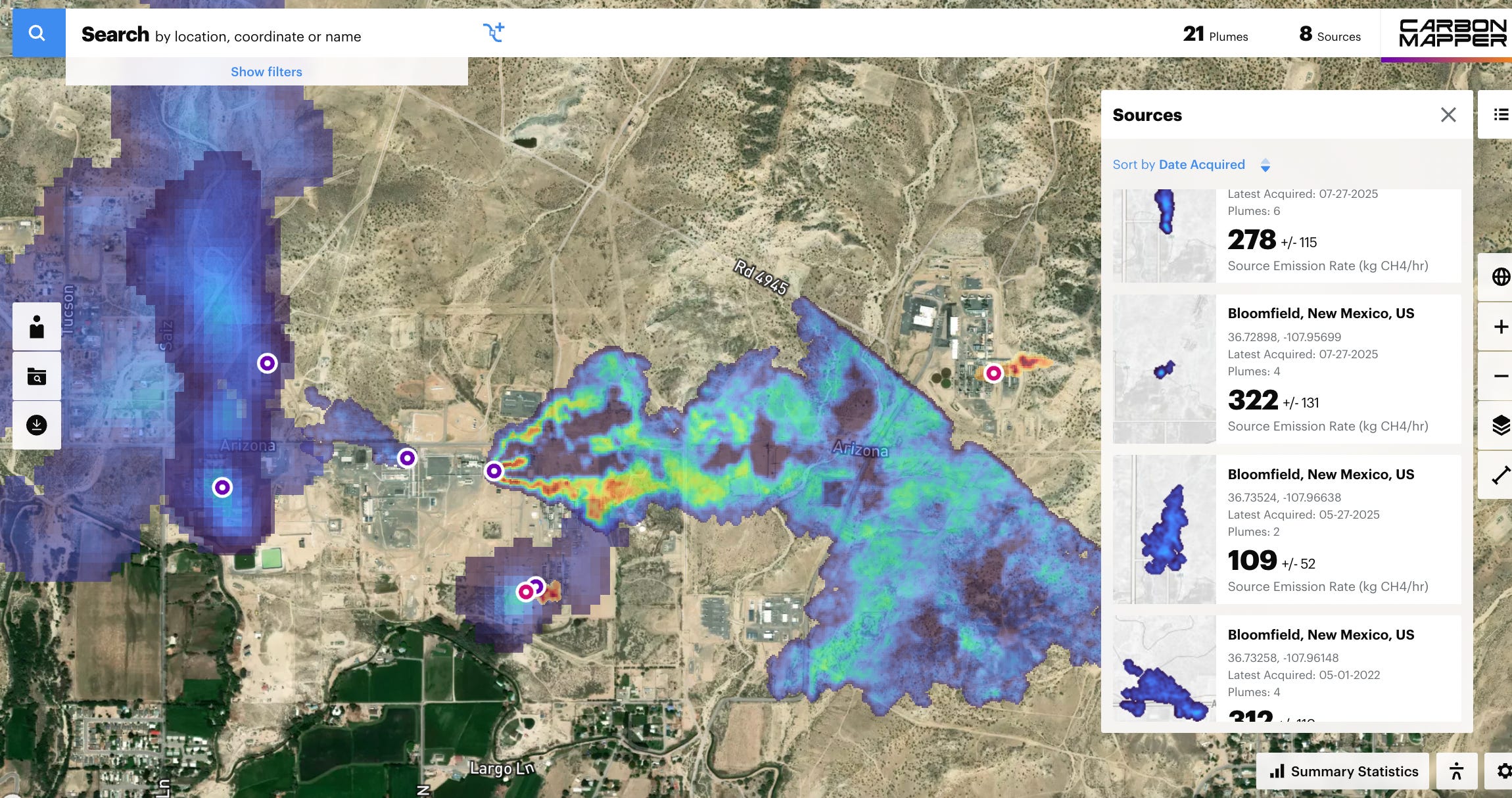
Screenshot from Carbon Mapper’s carbon dioxide and methane plume visualizer. This shows the north side of Bloomfield, New Mexico, and the methane plumes (blue) and carbon dioxide plumes (red) emanating from the Blanco Hub Complex, a major natural gas processing, refining, pipeline, and storage network.
🗺️ Messing with Maps 🧭
Today’s featured cartography is a fascinating and alarming interactive mapvisualizing methane and carbon dioxide emissions from oil and gas wells, coal power plants, coal mines, cattle feedlots, landfills, and, sometimes, from the bare ground.This one is unique because it shows the actual plumes, not just symbols representing emissions, which somehow makes it more real and scary.
It’s a bit frightening not only because it reveals so many sources of greenhouse gases, but also because we know that if a leaky oil and gas well is oozing methane, it’s also probably emitting volatile organic compounds and other nasty pollutants that can harm human health. The map includes the date(s) the images were made along with the rate of emissions.
Cattle feedlots and methane plumes in California’s Central Valley. Source: Carbon Mapper.
⛈️ Wacky Weather Watch⚡️
Last month, the skies opened up over Globe and Miami, Arizona, dumping nearly four inches of rain and triggering calamitous flash-flooding that killed three people, wrecked homes, and carried away cars and multiple propane tanks from an LP gas distribution facility.
Miami and Globe are dyed-in-the-wool mining towns. Miami’s little downtown seems on the brink of being swallowed up by Freeport-McMoran’s massive Miami copper mine, while Globe, with its stately brick and stone buildings, was clearly the more prosperous of the two sister communities. They’re both pretty gritty in an appealing (to me) way in that they defy the manicured suburban sprawl ubiquitous on the other side of the Superstitions. They sit down in drainages that are almost always dry, except when a lot of rain falls on the arroyo-etched, sparsely vegetated hills. In this case, the flooding was made worse by a nearby wildfire burn scar.
Pinal Creek, which runs through Globe, ballooned from a dusty trickle to a 5,670 cfs torrent on Sept. 27. The San Carlos River east of Globe did much the same thing after nearly a year of complete dryness. The big water wreaked havoc, destruction, and death. Adding to the tragedy: Many residents reportedly didn’t have flood insurance.
1 One might argue that dams merely store excess water from wet years so that it can be used in dry years and so they don’t really count as a diversion or an increase in consumption. The problem on the Colorado River, however, is not a lack of storage, it’s a lack of water. Even huge water years like 2023 failed to even get close to filling up the system’s two largest reservoirs: Lakes Powell and Mead. If you build more upstream dams, then even less water will reach those reservoirs.
2 The Colorado River Compact actually assumes that there is an average of 18 million acre-feet per year, and allocates 7.5 MAF to the Upper Basin and 7.5 MAF to the Lower Basin, but also adds the option of increasing the Lower Basin’s allocation to 8.5 MAF. This still leaves room, theoretically, up to 2 MAF for Mexico. Even back in 1922, however, the river didn’t actually deliver that much water.
3 During the 10-year period from 2015 to 2024, the Upper Basin delivered about 84 MAF to the Lower Basin, meaning they’ve lived up to their obligation and then some.
Water sits low behind Glen Canyon Dam near Page, Arizona, on November 2, 2022. A new report calls for urgent changes to Colorado River management, including modifications inside the dam. Alex Hager/KUNC
Click the link to read the article on the KUNC website (Alex Hager):
October 1, 2025
This story is part of ongoing coverage of the Colorado River, produced by KUNC in Colorado and supported by the Walton Family Foundation. KUNC is solely responsible for its editorial coverage.
A new report from a coalition of environmental nonprofits is calling for changes to Colorado River management and urging policymakers to act more quickly in their response to shrinking water supplies.
The report’s authors stress a need for urgent action to manage a river system that they say is “on the cusp of failure.”
“We are looking at serious, chronic shortages,” said Zach Frankel, executive director of the Utah Rivers Council. “And we don’t just mean one day in a couple of decades. We could see a crash on the Colorado River as soon as two years from now, or less.”
A crash, they said, could mean water levels so low in the nation’s largest reservoirs that major dams are rendered inoperable, leaving some cities and farms with less water than they are legally owed. To stave off that crash, the report includes nine recommendations, including calls for major cutbacks to water demand.
Its authors focused largely on three things: reducing water use, modifying the plumbing inside Glen Canyon Dam, and changing the process by which new rules for sharing water are decided.
State leaders throughout the Colorado River basin seem to agree that significant cutbacks are needed, but conversations about who exactly should make those cutbacks often devolve into finger pointing. The nonprofits behind this new report say each state needs to be more specific and come up with a “curtailment plan” about how it could use less water within its borders. They acknowledge that drawing up those cuts will likely be a complicated and painful process, but a necessary one.
“Yes, it’s bad, but there’s a path through it,” said Eric Balken, executive director of the Glen Canyon Institute. “The solution to this problem is actually simple. It’s not going to be easy, but it is simple. Don’t pull more water from the river.”
Their suggested approach also means hitting the brakes on new dams and diversions. The report tallied 30 proposals for new water development in the river’s Upper Basin states of Colorado, Utah, Wyoming and New Mexico. Now, its authors say, is not the time to stretch an already-strained river system even further.
The back of Glen Canyon Dam circa 1964, not long after the reservoir had begun filling up. Here the water level is above dead pool, meaning water can be released via the river outlets, but it is below minimum power pool, so water cannot yet enter the penstocks to generate electricity. Bureau of Reclamation photo. Annotations: Jonathan P. Thompson
The report’s second major proposal is to re-engineer Glen Canyon Dam, which holds back Lake Powell. The nation’s second-largest reservoir has dropped to record lows in recent years, and it’s currently about a quarter full. If water levels drop much further, they could fall below the intake for hydropower generators inside the dam. Further, they could drop below any pipes that allow water to pass through the dam. That could jeopardize the ability to send water to major cities downstream, like Los Angeles, Phoenix and Las Vegas.
In years when reservoir levels threaten to drop that low, federal water managers have shuffled water into Lake Powell from other upstream reservoirs. The new report says more permanent fixes, like the construction of new pipes inside the dam, are needed.
“Those reservoir levels are not a conspiracy,” Frankel said. “There’s not really any debate about whether there’s water in those reservoirs. A solution of, ‘Hey, let’s just keep the reservoirs higher and avoid having to deal with this epic plumbing challenge’ is absurd.”
The Colorado River flows through Grand County, Colorado on Oct. 23, 2023. A new report calls for states to plan for curtailments to water use as the river shrinks. Alex Hager/KUNC
The report’s authors did not mince words in their critiques of the current system for agreeing on new water management rules.
“We’re so far away from meeting the moment right now,” said Kyle Roerink, executive director of the Great Basin Water Network. “The moment might as well be on another planet.”
Negotiations about sharing the river are stuck. The current rules for managing Colorado River water expire in 2026, and the seven states that use it are on the hook to come up with new ones. Negotiators from those states have been meeting for years now, and don’t appear to be close to a deal despite mounting calls for new policies, a steadily shrinking river and a fast-approaching deadline.
“We’re so clearly not addressing the depth of challenge we’re facing,” Frankel said of the negotiators. “And what we’re asking is, is it because of the process?”
Under the current structure, the report’s authors say, those negotiations lack transparency. Environmental groups, farmers, city leaders, Native American tribes and others who will have to deal with the consequences of negotiators’ decisions have mostly been left on the outside looking in.
“What we want is honest debate and discussion,” Roerink said. “There’s not even a meaningful regulatory process going on where we can debate, scrutinize, vet, and provide meaningful ideas about how we’re going to manage the nation’s two largest reservoirs.”
The coalition of nonprofits that co-signed the report includes Glen Canyon Institute, Great Basin Water Network, Living Rivers, Utah Rivers Council and Save the Colorado.
Their work joins a number of similar calls for action that have been released in recent months. A September letter from former officials and academics said urgent changes are needed to protect Glen Canyon Dam. That same group released a memo in May calling for states to embrace some “shared pain” and agree on cutbacks.
Other outside groups – including a coalition of Native American tribes and a large collection of environmental nonprofits – have made their own suggestions for the next phase of river management. It is yet to be determined how or if their ideas will influence those closed-door negotiations.
Map of the Colorado River drainage basin, created using USGS data. By Shannon1 Creative Commons Attribution-Share Alike 4.0
The Colorado River District (CRD) hosted its annual Water Seminar on Friday [October 3, 2025], bringing together water leaders, politicians and city officials for a variety of discussions and activities. The seminar, titled “Across Divides”, was held at Colorado Mesa University, focusing on candid conversations and solution-focused dialogue to address water issues. The audience included agricultural producers, water providers, local and state government leaders, non-profit representatives, community members and CMU students.
“Over the course of today, we’ve leaned into the conference theme of ‘Across Divides.’ We’ve explored spaces where perspectives don’t always align, where there are divides in language, where there are divides in theory, where there are divides in practice,” said CRD Chief of Strategy Amy Moyer during her closing remarks…
The keynote address was given by CRD General Manager Andy Mueller, who discussed the challenges facing the Western Slope and Colorado River Basin as well as the work being done by the district and its local partners and the Shoshone water rights situation. He also discussed the impact of shrinking supplies and interstate pressures on Colorado…The “Lost in Translation: Interstate Divide” panel represented agriculture, drinking water, tribal nations and environmental interests from the Upper and Lower Basins, examining how the new supply-driven model proposal could shape the future of the Colorado River…
Moyer encouraged attendees to implement three actions in their lives to make sure the seminar leads to positive results.
“First, follow up with the contacts that you made with the people at your table, with the presenters here today…. Find somebody you haven’t had the chance to talk to,” she said. “The second thing is to apply one new idea that you learned from today, whether it’s in your personal life or your professional life…. Lastly, stay engaged with us at the Colorado River District. Look for the events and conversations that we hold throughout the year.”
A child amid the splish-splashes of water at Denver’s Union Station on June 21, 2025. Photo credit: Allen Best/Big Pivots
Click the link to read the article on the Big Pivots website (Allen Best):
October 2, 2025
New report says the story is not near as complicated as some would have you believe. It identifies nine areas of focus for using less water.
A few hours before I read a new Colorado River Basin report this week, I was at a neighborhood meeting in the metropolitan Denver municipality where I live. A sustainability plan is being worked up. The water component will encourage conservation.
I said that the messaging on this, unlike some other components of sustainability, should be relatively easy. After all, 75% of this municipality’s water arrives from the headwaters of the Colorado River through the Moffat Tunnel.
Udall/Overpeck 4-panel Figure Colorado River temperature/precipitation/natural flows with trend. Lake Mead and Lake Powell storage. Updated through Water Year 2024. Credit: Brad Udall
And most everybody at this point understands that the Colorado River is in trouble. For more than 20 years we have seen the photos of the bathtub rings of the reservoirs and the water levels far below. So many years have yielded below-average runoffs, a 20% reduction altogether in the 21st century. The number of broken hottest-ever temperature records have vastly dwarfed the coldest-ever records.
Understanding the intricate efforts to better align the political governance of the river with the physical reality is a far more difficult story to tell, but it has not been for absence of effort in Big Pivots and hundreds of other outlets. Scores of stories have been written in just the last month or more about the seeming inability of negotiators from the seven basin states to come to agreements in advance of a November deadline set by the federal government.
Now comes a new report, “There’s No Water Available,” from Great Basin Water Network and partners. It offers nine recommendations under the subtitle of “Commonsense Recommendations to Limit Colorado River Conflict.”
If longer-term drought is one component of the declined flows, the science is now firm that the warming climate is a reality that will remain and with it more erratic precipitation, surprising shifts in temperature, dry soils and many other factors. “It is clear that the future will be about adapting to hydrologic extremes. It is also clear that the water laws and hydraulic engineering developed in the 20th century did not foresee the realities we face today,” says the report.
Then there is this arresting statement:
“The supply-focused approaches during the last 120 years — i.e. encouraging use — has landed us in crisis. It’s time for a fresh, modernized approach. Nevertheless, we believe that the necessary change isn’t as complicated as people in power want us to believe.”
Simply put, say the authors from the Glen Canyon Institute, Sierra Club and other organizations, we must use less water. “We can do so in an equitable way that does not involve foot-dragging and finger-pointing.”
Who needs to budge? Well, almost everybody — the historically shorted Native Americans being the exception. “All parties currently using water must commit to using less water than they have in the past,” says the report.
The area around Yuma, Ariz., and California’s Imperial Valley provide roughly 95% of the vegetables available at grocery stores in the United States during winter months, February 2017, The report calls for more resilience built into agriculture. Photo credit: Allen Best/Big Pivots
Upper basin states — Colorado, New Mexico, Utah and Wyoming — come in for special mention. Perhaps it’s a negotiating tactic, but they have continued to maintain detailed estimates of how much more water they want to use. “Rather than planning on using more, we need states to plan on cutting,” says the report.
They call for all states to have curtailment plans. “Having a clear-cut understanding of what entities have to cut during shortages is something that’s already in place in the lower Basin. The upper basin must develop a similar system of cuts predicated on water availability and delivery obligations that consider downstream use and upper basin water availability.”
Andy Mueller, general manager of the Colorado River Water Conservation District, the lead water agency for much of Colorado’s Western Slope, made that call at the district’s annual meeting in 2024. Some agreed. See: “Heading for the Colorado River cliff.” Big Pivots, Oct. 20, 2024. However, Jim Lochhead, a former Western Slope resident and then Denver Water CEO, said he believed that the process of preparing for a compact curtailment was too difficult, too messy, until the clear need arrives. See: “Bone-dry winter in the San Juans,” Big Pivots, Jan. 28, 2025.
The upper basin states have argued that they never used the water allocated under the Colorado River Compact of 1922, while the lower-basin states did — and then some. Only lately have the lower-basin state tightened their belt. The upper basin states don’t want to be restricted — not, at least, to the same degree.
This position was explained in a forum during May by Becky Mitchell, Colorado’s representative in the negotiations. She talked about how the upper-basin had developed more slowly and still has not used its full allocation. See: “Sharing risk on the Colorado River,” Big Pivots, May 29, 2025.
“The main thing that we got from the compact was the principle of equity and the ability to develop at our own pace,” said Mitchell. “We shouldn’t be punished because we didn’t develop to a certain number.” The conversation, she added, is “what does equity look like right now?”
Upper-basin states want a willingness in this settlement for agreement that focuses on the water supply, not the demand, she said. “Common sense would tell you, maybe Mother Nature should drive how we operate the system.” That, she said, is the bedrock principle of the proposal from the upper division.
The Colorado River at Silt looked healthy in early June, and indeed runoff from the river’s headwaters in northern Colorado was near normal. The overall runoff, though, was far, far below average — what is becoming a new norm. Photo/ Allen Best
This new report rejects this “natural flow” plan. “Agencies do not yet have the means to quickly and accurately measure natural flow data, a measurement metric that tracks water as if there were no human usage and infrastructure. That’s because the basin at-large is missing key data points.”
The report also argues that any new dams and diversions need to be off the shelf, cities can do a better job of conservation, and Glen Canyon Dam needs work to allow it to be functional at lower water levels. The report also recommends making farms resilient to new realities.
Some elements of the Colorado River conversations have shifted dramatically. One of them is the new insistence of the last 10 years that the water rights of tribes be honored. Representatives of tribal nations now are almost always on the agenda at water conferences in Colorado. Twenty years ago? No, they were not. Lorelei Cloud, the chair of the Colorado Water Conservation Board since May, is a member of the Southern Ute Reservation.
Of the basin’s 30 tribes, 22 have recognized rights to 3.2 million acre-feet of Colorado River system water annually. That’s approximately 25% of the basin’s average annual water supply. Twelve tribes have still-unresolved claims. It is estimated that 65% of tribal water is unused by tribal communities (but in many cases consigned to other users). Junior users would be curtailed in order to honor those tribal rights, says the report.
The connection between declines in groundwater and surface flows is also part of a broader shift in the conversation. A May 2025 study that groundwater supplies in the Colorado River Basin are shrinking by nearly 1.3 million acre-feet per year. Excessive groundwater depletion had surfaced as a surrogate water supply to satisfy surface water deficits.
In the upper basin, half the water we see at the surface comes from groundwater, according to research from the U.S. Geological Survey. “This seminal USGS analysis underscores that as temperatures rise and evapotranspiration rates increase, there will be less groundwater entering surface water systems.”
There are obvious limitations to a short report, and I found the agriculture and municipal sections too shallow. The bibliography of sources, though, was quite valuable.
Will we see other reports of a similar nature in coming weeks and months? Quite likely. This conversation is far from over. In some ways, it’s just beginning.
Seven U.S. states and Mexico depend on the Colorado River, shown here in the Grand Canyon. But over the past century, the river’s flow has decreased by roughly 20 percent. (Bureau of Reclamation)
Click the link to read the article on the E&E News website (Jennifer Yachnin). Here’s an excerpt:
October 3, 2025
Scott Cameron will take over as acting head of the Bureau of Reclamation, shifting titles at the Interior Department while he maintains his role as the Trump administration’s lead official in negotiations over the future of the Colorado River. Interior Secretary Doug Burgum tapped Cameron for the role on Oct. 1, announcing the decision in a secretarial order that also updated other leadership roles recently confirmed by the Senate. The decision comes in the wake of President Donald Trump’s decision on Sept. 30 to withdraw his nomination of Ted Cooke, a former top official at the Central Arizona Project, to be Reclamation commissioner.
Colorado Governor Clarence J. Morley signing Colorado River compact and South Platte River compact bills, Delph Carpenter standing center. Unidentified photographer. Date 1925. Print from Denver Post. From the CSU Water Archives
Click the link to read the article on the InkStain website (Eric Kuhn, Anne Castle, John Fleck, Kathryn Sorensen, Jack Schmidt, and Katherine Tara):
October 6, 2025
As negotiators for the seven Colorado River Basin states rapidly approach Reclamation’s November deadline for providing a framework for a seven-state agreement for the Post-2026 Operating Guidelines for Lakes Powell and Mead, a larger threat looms. Reclamation’s recently released September 24-Month study minimum probable projection is consistent with our mass balance analysis of storage in the next year, solidifying the likelihood of critical conditions if the coming winter is dry. Reclamation’s latest analysis predicts that storage at Lake Powell would fall below the 3500-ft elevation as early August 2026 and might continue to be below this critical elevation until March 2028. As we noted in our recent white paper, Reclamation has committed to protecting Lake Powell from going below 3500 ft.
This projection of future conditions in the event of persistent dry conditions poses a conundrum—Reclamation could reduce releases from Powell to protect the 3500-ft reservoir elevation, but in doing so, low releases would most likely trigger the dreaded 1922 Colorado River Compact tripwire–the amount of water delivered from Lake Powell to Lake Mead during a 10-year period that is less than the threshold. The Lower Division states are likely to litigate if the 10-yr average wire is tripped. Under one prevailing interpretation of the Compact, Upper Basin states must not cause the 10-yr flow at Lee Ferry to be depleted to less than 82.5 MAF to deliver water to the Lower Basin and Mexico. As explained in a new white paper, there is a very real chance that the 10-yr running average will be 82.78 MAF, just a hair above the tripwire, one year from now. In alternate scenarios, the 10-yr running average would hit the tripwire in 2027 or 2028. If Reclamation exercises its authority to reduce Lake Powell deliveries to as low as 6 MAF, the tripwire is triggered even earlier. In the face of this imminent possibility, Basin States and the Federal Government must commit to an enforceable agreement to reduce their total consumptive Colorado River uses with an equitable sharing of the burden sufficient to justify a waiver of claims under the Compact for the duration of the agreement. The alternative is a deeply uncertain future for the Basin.
The Colorado National Monument and the Colorado River from the Colorado Riverfront trail October 3, 2025.
Click the link to read the article on the Aspen Daily News website (Austin Corona). Here’s an excerpt:
October 6, 2025
Three months after officials introduced a concept to revive stalled negotiations over the Colorado River, that concept has run into the same pitfalls that sank previous ideas, leaving the river on a course for federal intervention as reservoir levels plunge. Speakers at the Colorado River Water Conservation District’s annual water seminar in Grand Junction on Friday [October 3, 2025] said the new concept still falters because it would require Colorado and other upper basin states — New Mexico, Utah and Wyoming — to commit to some restrictions on their water use during dry years.
“(Lower Basin leaders) are insisting that the Upper Basin is the problem in getting to an agreement because we’re refusing to take mandatory cuts,” said Andy Mueller, general manager of the river district…Upper Basin states argue that their geography and infrastructure already require them to cut their use when the rivers run dry, while downstream states can rely on water stored in large reservoirs to keep themselves wet during droughts. The new concept’s failure to gain traction means negotiators are still wrangling as the river’s levels drop further…Becky Mitchell, Colorado’s negotiator on the river, said the states are still meeting once every other week, but she and other state officials remain mired in many of the same issues that have stalled negotiations for two years.
“We’re meeting. It is not enjoyable. I want to be perfectly honest,” Mitchell said.
The Upper Basin argues it should not have to take cuts because it relies on the natural flow of the river, not stored water in large reservoirs like Lake Mead and Lake Powell. That means the Upper Basin can’t use more than what is naturally available in the river and cuts back its use during dry times already. It also means the Upper Basin already feels “pain” during dry years…
“Every year, someone in western Colorado … has not had adequate water,” Mueller said…
…Mitchell said she was “hopeful” for the negotiations. She said the Upper Basin agrees with the general idea of a supply-driven concept, like the one the Lower Basin has proposed, even if the basins are struggling to work out central issues like cuts in the Upper Basin.
“We can’t give up … A supply-based proposal is the only way to move forward. We all have to be responding to supply,” Mitchell said.
Colorado River headwaters-marker. Photo credit: Allen Best/Big Pivots
Click the link to read the article on the Big Pivots website (Allen Best):
September 28, 2025
Everyone knows about the Colorado River troubles. Even in the 1990s, the last time the river had enough water to reach the sea, problems were looming. Then came the 21st century with its mixture of severe drought, rising temperatures, and plunging reservoir levels.
You’ve likely read a few of the hundreds (and perhaps thousands) of stories that have been written about these diminishing flows and difficulty of the seven states and 30 tribes who share the river (along with Mexico) in reaching agreement about reduced uses. With a deadline of Nov. 11 looming to reach some basic agreement, the parties have not publicly retreated from their rigid talking points.
An ad hoc group of six Colorado River experts began assembling reports in 2025. They have been dubbed the Traveling Wilburys of the Colorado River Basin. Although several have previously served in various government roles, they report to no specific constituencies now. All save one are affiliated with academic institutions. They have freedom to speak the truth as they see it. They have no direct authority but they do have credibility.
In these white papers, they have consistently argued for the need to recalibrate expectations, to align demands with the water delivered by the shrinking Colorado River. They have not necessarily defined exactly how that is to be done. They argue for a shared burden.
Their position conflicts, to an extent, with the position of the four upper-basin states, who have never fully developed the 7.5 million acre-feet allocated to them in the Colorado River Compact of 1922 and insist that this allocation must be honored. Similarly, lower-basin interests have also continued to assert their rights to river entitlements.
Is this group of six having impact? That is hard to gauge, but observers and participants in Colorado River matters point to at least some small evidence that their thoughts and observations are showing up in take-away messages from meetings.
Big Pivots convened a conversation with several of the report authors on Sept. 18, a week after their latest report had been issued. In that report, (“Analysis of Colorado River Basin Suggests Need for Immediate Action,” Sept. 11, 2025) they took stock of the 24-month report from the Bureau of Reclamation that was issued in late August. That report delivered the numbers that collectively showed dramatically increased risk during the upcoming two years of the dams on the Colorado River becoming dysfunctional.
For reasons of expedience, the conversation was limited to three of the six individuals:
Eric Kuhn, who in 2018 retired from the Glenwood Springs-based Colorado River Water Conservation District after 22 years as general manager.
Eric Kuhn, who in 2018 retired from the Glenwood Springs-based Colorado River Water Conservation District after 22 years as general manager.
Anne Castle, a senior fellow at the Getches-Wilkinson Center for Natural Resources, Energy and the Environment at the University of Colorado Law School, who was the assistant secretary for water and science at the U.S. Department of Interior from 2009 to 2014 and the U.S. commissioner and chair of the Upper Colorado River Commission from 2022 to 2025. She had practiced water law for many years with Denver-based Holland & Hart.
John Fleck, the writer in residence at the Utton Transboundary Resources Center in Albuquerque since 2002 and before that directed the University of New Mexico’s Water Resource Program for five years. He was a journalist in his younger life.
Also contributing to the reports have been:
Jack Schmidt, director of the Center for Colorado River Studies at Utah State University, and former chief of the Grand Canyon Monitoring and Research Center of the U.S. Geological Survey;
Katherine Sorensen, of the Kyl Center for Water Policy at Arizona State University and former director of Phoenix Water Services; and
Katherine Tara, staff attorney for Utton Transboundary Resources Center at the University of New Mexico.
The conversation reported below has been tightened considerably and modified slightly to enhance clarity.
The three of you were among six authors of a report issued on September 11 that asked, “How close to the cliff’s edge we are in the Colorado River Basin?” How do you get six people in agreement to an answer for that question? What process do you use to produce these reports?
Eric Kuhn: When you focus on the data, coming to a similar conclusion about the future is actually quite easy. The (Bureau of Reclamation’s) 24-month study from August was out. It suggests that we’re closing in on the cliff. Jack Schmidt was very much involved in the numbers, the technical aspects. The message was easy. Getting agreement on the exact wording requires a little more patience.
John Fleck: Something that makes a process like this work with this group of people is that we all begin with a deeply shared understanding of how the system works and what those numbers mean. We don’t need to spend time learning about reservoir levels and the relationship between Powell and Mead. This is a group of people who already have a shared knowledge. [ed. emphasis mine]
In late May 2022, Lake Powell was declining after another year of low snow and high temperatures. By August, it was 26% full, the lowest it had been since waters had begun backing up behind Glen Canyon Dam in 1967. Photo/Allen Best
Anne Castle: I think we also share an overall goal of seeing a sustainable river system. We think that changes need to be made in an equitable way to match supply and demand, and that’s not happening. We all bring slightly different skills to the table and different experiences, which has improved the end product (the reports).
Fleck: One of the challenges in Colorado River governance is that you have many people who have a great deal of expertise who operate as employees of and advocates for a particular geography, for a particular community, especially those representing community or state water supplies.
Our group acts as citizens of the basin as a whole. Other people also see their role that way, especially folks in the federal government. But we have some freedoms that other people might not have in terms of being able to speak out publicly.
This is a third report since April by the same set of six authors. How did you come together?
Kuhn: Jack (Schmidt) is with the Center for Colorado River Studies. Jack and I co-authored white papers four and six among Jack’s series. That was now five years ago. Those papers are still very, very good. Because the supply-and-demand issue hasn’t been addressed, they’re still relevant. Jack and Anne go back a long way to when Jack was the head of the Grand Canyon research effort out of Flagstaff and Anne was assistant secretary of Interior. We’ve known each other for a long time. The new one is Katherine Tara, who just graduated a couple years ago from New Mexico law school and is now helping out John. So it was actually a pretty easy get together.
Fleck: We’ve all worked together in sort of twos and threes on books and papers.
Castle: John, Eric, Jack and I were having periodic meetings just to sort of talk through what was going on with the river and what the issues were. We were each doing our independent writing things. Jack and Eric and John had all worked with Katherine (Sorensen, of the Kyl Center for Water Policy at Arizona State University), and we wanted that lower basin expertise that Katherine has in spades.
We started to talk as a six-person group. In the spring, we decided the time was right for us to write something about the next set of guidelines. And that was the instigation for the report that we put out in April. See “Essential Pillars for the Post-2026 Colorado River Guidelines,” April 25, 2025.
All but one of the six of authors of these recent reports live in the upper basin states. I know you say that you do not have affiliations that tie you to a particular point of view. Still, does this tilt toward the upper basin dull some of your effectiveness?
Castle: I think, on the contrary, that the upper basin state principals would say that we tilt toward the lower basin because we haven’t adopted the positions that the upper basin principals have been taking.
Fleck: I have long been criticized here in New Mexico and by folks in the upper basin in general for always taking the side of the lower basin. I was born in California. One of my books was really lower basin focused. So I have a lot of connections and interest in the lower basin. It’s certainly the critique that we’ve received.
Kuhn: I agree. I think John and I wanted to take a basin perspective when we started writing our book (“Science Be Dammed: How Ignoring Inconvenient Science Drained the Colorado River”), but I acknowledge that after working for the Colorado River District for almost 38 years, that I do have an upper basin perspective on many things. In the recent papers, not much. My focus has been the entire basin.
Your reports have been very action oriented, and that is particularly true of this last one, where you call for drastic and immediate action. Are you seeing evidence that your work is having impact?
Castle: It’s getting attention. I don’t know if it’s resulting in action.
Fleck: One of our goals is to move conversations into the public arena that should be held in the public arena rather than in the sort of cloistered spaces in which a lot of Colorado River decision making is conducted. Katherine Tara, the newest member or youngest member of our group, talks about the need for a Colorado River C-SPAN, the need for broader public forums. And I think our work has contributed to forcing some issues and discussions into public.
I want to go back to something that Eric said at the outset. You said that you are of like mind, because you’ve all studied the data, and the data take you to the same conclusions. If that is the case with you having studied the data, what does that say about the broader basin discussion? If everybody has studied the data, should that not take everybody to the same conclusion?
Kuhn: The problem is that all the principals work for a governor or a board or constituents. The six of us all have focused on the data, and I think many, many of the journalists and many of the experts in the basin acknowledge the data. There’s still a culture among the major agencies and the states that supports a system that is unsustainable. We must reduce our uses to match the supply. But they all have constituencies and probably lawyers that tell them this is why it’s everybody else’s responsibility, not mine or not ours. We have yet to crack that culture that the basin must reduce water use — but not me.
Fleck: One of the things important about the book Eric and I wrote is in the title, ignoring inconvenient science, because we have a history in this basin of doing things for political expediency. Looking away from the most unpleasant scientific conclusions about the available water supply makes it easier for political actors to deal with their local and state constituencies. Because it’s hard to go to a community and say, “I’m sorry, there really is less water.” So, the political incentives are not aligned with responding to the science the way we think they should be, which is why we have to say these things that are really hard for a governor or governor’s representative to say.
Castle: Because we’re independent and do not answer to political constituencies, we have the ability and, frankly, the luxury of pointing to wherever the data takes us. The political incentives are almost diametrically opposed to doing the hard things that need to be done to balance what nature is supplying with what we’re using. One of the goals we’re pursuing is to educate a broader community about what the data shows and what conclusions that leads us to. That enables people to advocate to their own representatives for sensible solutions.
Do you have a bigger game plan in mind? Are you being reactive to events or do you have a strategy that goes beyond into like what we do in 2026, for example.
Fleck: Speaking for myself, I believe it is possible for us to continue to have communities that not only survive but thrive with less water if we find reasonable and equitable ways of sharing the burden of the impact of climate change across the entire West. My personal concern is that sort of parochial advocacy creates a winner- loser situation. Some community might win and not have to cut at all; another community could have disastrous cuts. That violates my basic notions of the moral framework that I have for thinking about what I want the future to look like.
Kuhn: My goal in this goes back to what John said about our book, which is paying more attention to the data and the science. We no longer have the luxury of ignoring the data and the science. Doing so will lead to an outcome that our constituents won’t like. We have to get over that hurdle. That has been my goal all along. More reliance on good data-based decision making.
The Rio Grande in New Mexico between Taos and Espanola. Photo/Allen Best
Are there lessons for the seven states in the Colorado River Basin from the recent Rio Grande settlement?
Kuhn: I think so. Going out on a limb, I think the lesson here is that even if there’s litigation in the Colorado River Basin, the negotiations are going to continue. The mediation is going to continue.
My view of this Rio Grande agreement from 30,000 feet and from a long way away was that the court-appointed special master pretty much forced them to reach an agreement. He kept pushing them to reach an agreement. They failed initially (and) at last succeeded.
So I think the lesson is, even if there’s litigation, there’s going to be continued discussions and negotiations. I question whether, without the litigation, New Mexico would have been willing to enter into the agreement that they have entered into. I think that the additional risk of the court case brought New Mexico to the table on several issues, but that’s just my view of it from a long way away.
Castle: A legal lesson learned from the Rio Grande experience is don’t ignore the objections of the feds.
Fleck: A related lesson I have taken is that we have a history of litigation in the Colorado River Basin that was very, very much conflict-based for more than a decade. But the Rio Grande experience shows that, while extremely unpleasant and extremely expensive, it was possible to manage this river. It’s my river, right? I’m in Albuquerque. On the Rio Grande, we’re able to manage this river during the time of litigation. It did force the parties into collaboration and compromise, however ugly and unpleasant the process may have been.
It makes me think litigation on the Colorado River would be a terrible idea. A collaborative solution is much preferred. But I also think that litigation might very well push us toward the collaborative solution anyway. My argument is let’s just do it now (without the expense and the heartache) because ultimately we will end up with the same thing. That is the lesson we might draw from the litigation on the Rio Grande.
A hay meadow along the Colorado River in Middle Park, near Kremmling. Photo/Allen Best
What is the most hopeful thing that you’ve heard or seen in the last year or two in the Colorado River Basin?
Fleck: I have been really impressed with the continued push toward permanent, relatively deep reductions in the Lower Colorado River Basin. They’re consistently coming in well below their 7.5 million acre-feet. They’ve been learning important lessons about how to approach that since the early 2000s when California was using more than 5 (million acre-feet) and had to cut back to 4.4. There’s a lot of built-up experience about how to go about reducing your water use.
And the communities are still thriving. Las Vegas’s water use reductions are stunning. You’re seeing significant reductions in the water flowing down the Central Arizona Project canal and really successful adaptations in the Imperial Valley. Over and over again we are seeing that when people have less water, they use less water, and communities can still thrive.
One thing that bothers me — which I wrote about in my book (“Water is for Fighting Over: And Other Myths about Water in the West”) over a decade ago — is this sort of limbic fear that we get, that a reduction in our water supply means the death of our community. We can, in fact, get by with less water
The significant reductions you’ve seen in the lower basin are clearly not enough. The reservoirs are still dropping. But it shows what is possible.
Castle: The action that I found most surprising and hopeful or constructive was the lower basin’s willingness to own the structural deficit. The lower basin stepped up and said, “we’re not negotiating this. This is what we’re going to do.” I think that was huge and I think it shows that there can be movement that kind of goes against the political expediency.
Kuhn: Another example is that California basically accepted a portion of the shortages. This happened a while ago. This happened back in 2018 or 2019. Under the 1968 law (that authorized the Central Arizona Project), Arizona was to absorb the shortages and not California. They basically realized that that agreement that was made in the ’60s was tying up the lower basin from being able to move forward. California compromised on that, at least for the moment. And I think that this willingness of California to go along with what else has happened in the lower basin shows progress. Where we haven’t made any progress is what I would call the crossing of the Lee Ferry divide. That’s going to take more effort.
Editor’s note: The Colorado River Compact distinguished between the upper basin and the lower basin, creating an artificial dividing line at “Lee Ferry,” a point just below Glen Canyon Dam. George Sibley, a water writer from Gunnison, along with others. have maintained that this artifice creates unnecessary problems. See: “Why not create the Colorado River Compact they wanted in 1922?”Sept. 1, 2025.
Fleck: We’ve just contradicted ourselves here, or at least I’ve contradicted myself. We talked about the political incentives that make it difficult to accept the reality of what the numbers are showing us, but we have just described a situation where, in fact, the political leadership, especially in Arizona, but also in California, and for a long time in Nevada, has been willing to accept this reality.
Partly, it’s just through a lot of long, hard learning, the realization by these communities that we took these steps to use less water. And we’re still okay, you know, we still have water in the fountain at the Bellagio (hotel in Las Vegas). We still have hundreds of thousands of acre-feet of irrigated ag land in the Imperial Valley. There’s less than there used to be, but there’s still a lot. There’s still a robust agricultural economy there. So, in fact, this runs counter to the notion that political incentives always lead you to ignoring convenient science, because there’s clearly evidence to the contrary.
Denver Water gains supplies from tributaries to the Colorado River in Grand County for diversion to metropolitan Denver. Photo/Allen Best
In your papers, you have consistently said that the water rights of the tribal nations must be honored. Can their claims on the river actually be resolved at this juncture? Or is there an irreconcilable conflict?
Castle: There are several reasons we’ve called attention to the Tribal rights. One is historically, Tribal rights and interests haven’t been front and center. The tribes have historically been left out of these kinds of high-level negotiations. But the fundamental reason, in my mind is the tribal water rights are part of the bargain that our federal government made with individual tribes in exchange for the relinquishment of some of their ancestral lands. They were promised a livable homeland. Part of a livable homeland is the amount of water necessary to fulfill the purposes of that land, and that’s a promise of the federal government.
Many tribes have quantified their water rights, so we know exactly how much that promise meant in terms of the amount of water that goes along with their reservation land. And it’s a different animal than all the other kinds of Western water rights. It’s important that we keep that in mind, that it is a different kind of promise. It’s a different kind of property right. And we can’t solve this supply and demand imbalance on the backs of the tribes.
Fleck: Anne talked about a promise made by the federal government. But that’s us. This is our promise. We are the people of this country, the people of the federal government, right? The federal government is a creature of us. This is our promise to those people. It’s not something that we as individuals in this particular state should get in a fight with the federal government over. We made this promise to those people and that’s important. I describe it as a legal and a moral obligation. Respecting the legal obligation is critical to making the books balance. It’s also this moral obligation.
Eric, I have a question for you. I know you have followed climate science very closely over the years. We’ve talked about it from time to time, the current state of the science. How would you describe that? I mean, there’s a lot of uncertainty. What we really don’t know, we can’t know until it happens. Nonetheless, if you were to summarize, what should that tell us about the Colorado River going forward?
Udall/Overpeck 4-panel Figure Colorado River temperature/precipitation/natural flows with trend. Lake Mead and Lake Powell storage. Updated through Water Year 2024. Credit: Brad Udall
Kuhn: There is a lot of uncertainty, but with time, we’re seeing a narrowing of that uncertainty. We’re in some would say the 25 years of a drought, others would say it started in the late 80s. We’re seeing a very distinct stepwise reduction in flows, natural flows at Lee Ferry, and we’re seeing temperatures increase. We have documented both.
I still think there’s going to be a lot of uncertainty when it comes to what happens in those rare, odd years where we have a real wet winter and you have atmospheric rivers that run into the San Juans or the central Rockies. We could end up with a big year, and that’s all a part of climate science.
But I think the message is pretty clear that it’s unlikely that river flows will return to what we thought there was historically, which was around 14 to 14.5 million acre-feet per year. That’s unlikely. And I know no one in the basin, including the current administration, based on comments from Mr. Cameron (Scott Cameron, acting assistant secretary for water and science, Department of the Interior), who thinks that it’s likely. We’re dealing with the river that we have today, and that means that the uncertainty around the climate science has narrowed, and we sort of understand the future of this river. As long as temperatures keep going up, we’re going to see aridification of the basin.
A final question, if you will abide it, and it’s kind of a big, sweeping question. It strikes me that it’s a really interesting journey that all three of you have been on during this shift in attitudes in the Colorado River Basin. I remember going to the Colorado River Water Users Association conference in Las Vegas maybe 15 years ago, and there were people from Los Angeles or wherever who were kind of dubious. This was drought. This wasn’t climate change. We don’t have to have fundamental change. That (attitude) has clearly dissipated. My question has to do with what has not changed. How have attitudes NOT changed?
Kuhn: People are still going to be very reluctant to give up what they believe was their entitlement. They’ll compromise; they’ll reach agreements. But Colorado, which is among the leaders when it comes to the public’s acknowledgement of the issues related with climate change, has yet to say we’re going to sacrifice any portion of our theoretical entitlement. But we all have to give up some of those theoretical claims. So the culture is still “protect our entitlement,” even though that entitlement was based on data and science that are no longer valid. Just the word entitlement is indicative of the problem.
Castle: A component of that problem is the failure to recognize that while I have a perfectly good legal argument about why I have this entitlement, there are other perfectly good legal arguments about why I don’t, and we haven’t made huge steps toward acknowledging that. There are lots of legal arguments and lots of good ones, but they can’t all carry the day. Like John says, there’s not enough water for all the lawyers to be right.
What remains of the Colorado River as it enters Mexico is diverted to the farm fields near Mexicali. Farther south, near San Luis Rio Colorado, this is what the riverbed looked like in February 2017. Photo/Allen Best
Music video by The Traveling Wilburys performing Handle With Care. (C) 2007 T. Wilbury Limited. Exclusively Licensed to Concord Music Group, Inc. http://vevo.ly/LGLafI
Seven U.S. states and Mexico depend on the Colorado River, shown here in the Grand Canyon. But over the past century, the river’s flow has decreased by roughly 20 percent. (Bureau of Reclamation)
Western Water in-depth: After a thwarted quest to better predict the effects of drought and climate change, federal water managers are taking a radically different approach
After four years of contentious negotiations, the seven states that rely on water from the Colorado River are racing against the clock to reach agreement on a new long-term operating strategy for the river’s dams and reservoirs. They face a Nov. 11 deadline from U.S. Interior Department officials to signal whether they think a deal among them is likely.
This is a high-stakes moment on the Colorado: Some 40 million people, 5.5 million acres of farmland and a $1.4 trillion economy depend on water from the river. But the double whammy of climate change and a now-quarter-century-long drought has strained relationships between the seven states that share the dwindling river.
Over the past two decades, scientists, engineers and water managers have invested tremendous effort in trying to deduce what the future might bring. They have used reconstructions of climate patterns stretching more than 1,200 years into the past to understand natural variability, and turned to global models to better grasp the potential impacts of climate change.
A key player in the effort has been the federal Bureau of Reclamation, which is primarily responsible for operating the massive dam-and-reservoir system on the Colorado River. Its in-house research and computer modeling team has played a crucial role in bringing new science about climate variability and change to Colorado River water managers.
Even with that, though, water managers have been repeatedly blindsided after conditions on the river proved even worse than predicted. Two earlier rounds of negotiations, dating back to 2005, yielded a pair of “interim” operating agreements to help the states weather the drought. But the river’s flow has continued to deteriorate so rapidly that water managers have found themselves stuck in a perpetual scramble to buy themselves time before the river enters an all-out crisis.
“The policies weren’t robust enough, and we were in this Band-Aid mode,” says Carly Jerla, who heads Reclamation’s long-term planning process and was previously a leader on the research and modeling team. Everyone, she says, realized that “we need something else.”
As a result, Reclamation has quietly abandoned the effort to rely on best guesses about the river’s future via traditional modeling methods. Now, it’s bringing a radically different style of thinking to the negotiating table: Decision Making Under Deep Uncertainty, or DMDU.
The approach focuses on testing out operating strategies, with the help of artificial intelligence, that perform well against a far wider range of possible hydrologic scenarios than has ever been considered before — some of which no one on the river may anticipate or even be able to imagine. DMDU gives water managers a way to see how well their ideas fare, and to better understand how, and why, they might fail.
Scrambling to Stay Ahead of the Curve
Reclamation’s research and modeling team is based in Boulder, Colo., and works out of a nondescript University of Colorado building tucked between a city bus depot and an Audi dealership a mile from campus. The Reclamation team shares an office with the university’s Center for Advanced Decision Support for Water and Environmental Systems (CADSWES), which developed the software system used to model the Colorado.
The downstream face of Glen Canyon Dam, which forms Lake Powell, America’s second-largest water reservoir. Water is released from the reservoir through a hydropower generation system at the base of the dam. Photo by Brian Richter
Reclamation’s collaboration with CADSWES began in the mid-1990s, and was initially led by Terry Fulp, who would go on to serve as the agency’s regional director for the Lower Colorado River Basin. CADSWES provided modeling know-how, but it also served as a pipeline of talented grad students that its director, Professor Edie Zagona, would send Fulp’s way. Many of the most promising candidates wound up working for Fulp’s team, which operated with relative autonomy within Reclamation’s larger hierarchy.
“We kind of flew under the radar,” says Fulp, who retired in 2020. “We had a little bit of a notion that we were special. But we also didn’t want to be too special.”
As the team took shape, trouble was brewing on the river. The 1922 Colorado River Compact, which initially allocated the river’s water between the states, was based on an assumption that average annual flows on the river were 16.4 million acre-feet per year. Over the past century, however, that number has decreased by approximately 20 percent.
A dramatic wakeup call came in 2002, two years after the drought first took hold. Inflows to Lake Powell, one of the two main reservoirs on the river, were only about 25 percent of average, and water managers had the unnerving realization that the world might be changing in ways they couldn’t predict.
“We were walking into a complete unknown,” says Pat Mulroy, who at the time was the head of the Las Vegas-based Southern Nevada Water Authority. “You have to assume that a 2002 runoff is not an anomaly, but that it’s going to happen again, and it’s going to happen with greater frequency.”
In 2005, governors’ representatives from the seven states began to negotiate an operating strategy they hoped would give them a way to ride out the deepening drought. But they were treading into delicate territory.
Legal Minefields and Flawed Crystal Balls
The Colorado River is governed by a complex series of rules laid out not just by the Colorado River Compact, but by an amalgamation of subsequent laws, treaties, agreements and court decisions that are collectively known as the “law of the river.” That has set up fundamental tensions over how the river’s water is divided not just between individual states, but also — because of the Compact’s legal structure — between the Upper Basin states of Colorado, Utah, Wyoming and New Mexico and the Lower Basin states of California, Arizona and Nevada, as well as the U.S. and Mexico, which has its own share of the river’s water.
The Colorado River Basin spans seven U.S. states and part of Mexico. Lake Powell, upstream from the Grand Canyon, and Lake Mead, near Las Vegas, are the two principal reservoirs in the Colorado River water-supply system. (Bureau of Reclamation)
Numerous legal minefields lurk within the law of the river, ambiguous provisions about which various states deeply disagree. Among the thorniest are: What is the Upper Basin’s precise obligation to provide water to the Lower Basin downstream? What are the relative responsibilities of the Upper and Lower basins in ensuring that Mexico receives its legal entitlement to water? How does water that the Lower Basin uses from local tributaries factor into its Compact entitlement?
The negotiating effort that began in 2005 was an attempt to find creative ways to survive the drought while staying within the boundaries of the Compact. By avoiding those legal minefields, the states could capitalize on areas of mutual flexibility to meet everyone’s needs — or at least get as close as possible.
To figure out how to make it work, the states’ representatives and their technical support staff began relying on Reclamation’s research and modeling team in Boulder to calculate the probabilities of success or failure for various options they were considering. In 2007, the negotiating effort yielded a set of “interim guidelines” for Colorado River operations that would remain in effect until 2026.
During that process, Fulp and his colleagues had started using tree-ring based reconstructions of past climate history, together with computer projections of the possible impacts of climate change, to get a clearer sense of the future. But as the effort went on, the team’s members realized they had a problem: The results from the global climate models weren’t squaring with what they saw playing out in real time.
“The climate change projections in the Colorado didn’t map up with what we’ve been experiencing the last 10, 15, 20 years,” says Alan Butler, a research and modeling group chief on Reclamation’s Boulder team. “There was a disconnect.”
That disconnect only seemed to be getting worse. One set of climate projections, for instance, suggested that future flows on the Colorado could range from less than five million acre-feet a year to more than 45 million — twice as much water as came down the river in 1983 in a massive flood that nearly tore apart Glen Canyon Dam.
“That’s just a massive range,” says Nolie Templeton, a senior policy analyst for Central Arizona Project, which supplies water to cities like Phoenix and Tucson, as well as tribes. “If you get a five-million-acre-foot river, you’re going to be planning and adapting significantly differently than if the dam gets blown out because it’s 45.”
Jim Prairie, the other research and modeling group chief on Reclamation’s Boulder team, recalls a warning he got from a respected climate modeler in 2009: Global climate models are research, not decision-making tools. They were never intended to provide the kind of probability-based projections that water managers so desperately needed.
The team began to back off from its pursuit of long-term probabilities and search for a better approach.
Learning to Navigate Uncertainty
Humans are practically hardwired to look to past experience to anticipate what the future might hold. Yet the world is changing in ways that our lived experience is ill-suited to help us comprehend. Decision Making Under Deep Uncertainty is a broad conceptual approach to addressing that problem.
Robert Lempert is a principal researcher at the RAND Corporation, the Santa Monica-based think tank that made its name devising Cold War nuclear deterrence strategy for the military. He’s also one of the intellectual pioneers of DMDU, a concept that’s being increasingly applied to long-term policy and planning challenges where future conditions are tough to predict. DMDU has been used in fields ranging from infrastructure, energy and transportation planning to public health and global security, and has helped cut airlines’ fuel costs and carbon emissions, formulate pandemic responses and analyze the effectiveness of the federal government’s terrorism risk insurance program.
It is particularly suited to situations where decision makers cannot reach consensus about future conditions or when traditional forecasting methods prove inadequate — exactly the problem that Reclamation’s team found itself facing with the climate models.
“What the climate models really give us,” Lempert says, “is overwhelming scientific evidence that the stable planning environment we built the system on has disintegrated.”
Rather than trying to make a best guess about what’s probable, DMDU is laser focused on what’s possible. A DMDU analysis typically starts by generating a wide range of possible future scenarios — or, in the case of a river, future flows. Policy makers can then test potential operating strategies to see which perform reasonably well, or are most robust, against that range. Based on those results, the operating strategies can then be refined to make them even stronger.
Carly Jerla heads Reclamation’s long-term planning process for the Colorado River. (Water Education Foundation)
The process can also be used to identify vulnerabilities in the system and flag them with “signposts.” If system conditions begin approaching those danger zones, the people who depend on them can take up the challenge of devising contingency plans, or damage-control efforts, to stave off a descent into a full-blown water-supply crisis. Navigating those hazardous areas requires difficult choices, but flagging them up front — even if decision makers defer action on them to only when they absolutely have to be dealt with — allows for crucial wiggle room: They can still take some action in the face of uncertainty, even as they punt the really difficult questions to the future.
Lempert and other RAND researchers led much of DMDU’s conceptual development, and they occasionally crossed paths — and exchanged business cards — with members of Reclamation’s Boulder team. Then in 2009, when the team’s members began work on the Colorado River Basin Water Supply and Demand Study, a comprehensive look at the river’s next 50 years, they realized they needed help.
“We found ourselves buried in data,” says Jerla, who has headed the team since 2010. “And we were like, ‘Anyone got those RAND guys’ numbers to come dig us out of this mess?’”
A Brave New World
Even after the seven states reached agreement on the 2007 interim guidelines, the rapidly changing realities of the river forced them into a near-constant series of ongoing negotiations. In 2012, the Reclamation team brought RAND representatives to the meetings to familiarize the states’ technical staff with DMDU.
University of Colorado professors Edie Zagona and Joseph Kasprzyk have played a crucial role in Reclamation’s effort to bring advanced modeling and decision-making techniques to the Colorado River. (Water Education Foundation)
That effort — at least initially — wasn’t exactly a smashing success. The states’ water managers were flummoxed by RAND researchers expounding on abstract concepts from the world of decision science. And, Jerla says with a laugh, “I don’t know that any of usreally even understood what was happening.”
The partnership between Reclamation and RAND wound down after the Water Supply and Demand Study concluded. But the Reclamation team continued working to incorporate DMDU techniques into its research and modeling.
At Reclamation’s behest, Zagona, University of Colorado professor Joseph Kasprzyk and others on the CADSWES team took the Colorado River model and married it with an AI tool called a “multi-objective evolutionary algorithm” developed at Penn State. The algorithm — somewhat ominously named Borg — is a sort of computational supercharger that can create many potential operating strategies, test them out in the river model, and sort through them to find the ones that perform best.
Glen Canyon Dam has four bypass tubes, also referred to as river outlet works (ROWs) that can draw water from Lake Powell around elevation 3,370 feet, bypassing the powerplant and sending the water downstream.
In 2016, the Reclamation team began exploratory work with the Borg-enhanced software to see what it could do. The following year, Kasprzyk, Zagona and a graduate student named Elliot Alexander — who would quickly be hired on with the Reclamation team — used the augmented modeling package to find an operating strategy for Lake Mead, the other main reservoir on the Colorado, that outperformed the one the states had painstakingly negotiated for the 2007 interim guidelines.
But the operation of Lake Mead is just one, albeit very important, variable in the complex Colorado River system. The potential beauty of Borg was that it can combine many policy variables to identify strategies that perform well across multiple objectives in a wide range of hydrologic scenarios.
There’s a catch, however: Multi-objective strategies, practically by definition, demand constant compromise. Keeping the water level in Lake Powell as high as possible, for example, improves the odds of being able to continue generating hydropower at Glen Canyon Dam. But it simultaneously limits water deliveries to the downstream states of California, Arizona and Nevada, among other tradeoffs.
Still, Borg offered a little more. The “evolutionary” part of the algorithm gave it the ability to essentially breed well-performing operating strategies with each other — and even artificially induce mutations — to create new approaches that might perform even better.
Yet Borg sometimes showed a naughty streak.
“It would find a lot of mathematical solutions that maybe were optimal for a certain metric,” says Butler. “But then you’d look at them and you’d think: ‘That’s just absurd.’”
Rebecca Smith is Reclamation’s Lower Colorado Basin research and modeling team lead. (Photo courtesy of Rebecca Smith)
In one test, the team set Borg loose on a mission to minimize the frequency of water shortages over a 30-year model run. The algorithm diligently avoided implementing water-delivery cuts for as many years as possible, until Lake Mead dropped so low that water could not be released from the reservoir, resulting in a sudden, six-million-acre-foot cut to California, Arizona and Nevada — an amount roughly equal to those three states’ entire annual Colorado River water use.
Ultimately, both Reclamation and the state and local water managers would end up using Borg not to generate specific strategies for consideration, but to test strategies of their own devising. But the exploratory work with Borg helped create a virtual anvil on which they could hammer out their own strategies and see how they compared with the bigger world of possibilities — even though some of those might be absurd.
“Borg created this dartboard where, if we’re throwing darts, at least we know where they land,” says Rebecca Smith, Reclamation’s Lower Colorado Basin research and modeling team lead. “Without having that, we’re just saying: ‘I guess this is good’ — but we don’t know how much better we could do.”
Translating Science into Action
Meanwhile, the clock was ticking on the Colorado River. After six grueling years of negotiations, the states reached agreement in 2019 on a Drought Contingency Plan that added to the interim guidelines. But the entire package of agreements was set to expire in just another six years. And so, in 2021, the state negotiating teams started meeting informally again to develop what, after a decade and a half of workarounds, they hoped would be a longer-term operating strategy.
Nathan Bonham of Reclamation’s research and modeling team has played a key part in helping the agency refine its analyses of robustness and vulnerability on the Colorado River. (Water Education Foundation)
While that was happening, the Reclamation team tasked Nathan Bonham, a newly arrived University of Colorado doctoral student who would also eventually be hired by Reclamation, with refining the methods used to assess system vulnerabilities and the robustness of potential operating strategies. That work led to a public web tool, designed in collaboration with CADSWES and consulting firm Virga Labs, that would put the DMDU-inspired upgraded software package into the hands of the negotiating teams as well as water agencies and anyone else, like tribes and environmental groups, with an interest in the river’s future.
The effort to develop the web tool reached a blistering pace over six months in 2023. Smith and H.B. Zeff, another Reclamation engineer at the time, would upload massive numbers of simulations to Microsoft’s cloud of high-performance Azure computers and remotely babysit the models as they ran, only to discover that the computers were rebooting themselves to install updates in the middle of the night.
Despite such glitches, the upgraded software package went online in November 2023, just as the negotiating effort to develop a post-2026 operating strategy was kicking into high gear. Now, water users had a way to test the strategies they were considering against 8,400 possible hydrologic scenarios.
One of the biggest challenges is presenting such complex data in a way that allows negotiators to compare the tradeoffs between various operating strategies.
“I can crunch the numbers all day long,” says Bonham, “but there’s a whole other element of how do you present it visually?”
In the web tool, each strategy under consideration can be displayed on an interactive parallel-axis chart. To a first-time user, the charts look like twisted skeins of yarn on a loom gone haywire. But with familiarity over time, they become a window into possibility.
A web tool allows users to see tradeoffs between the “performance objectives” of various operational strategies, such as keeping water levels higher in Lake Mead and Lake Powell, minimizing water shortages to the Lower Basin states and maintaining conditions that will prevent invasive small mouth bass from entering the Grand Canyon. (Bureau of Reclamation)
Users of the web tool can adjust the relative importance of various “performance objectives”: water levels at lakes Mead and Powell; water releases from the Upper Basin downstream to the Lower Basin; potential water cuts to Lower Basin states; favorable conditions for native fish in the Grand Canyon. Then, at least theoretically, they can find strategies that help them meet the goals they most care about without adversely affecting the objectives of other users, whose buy-in they need for a real-world agreement.
The web tool’s vulnerability analyses also help identify the danger zones — like low river flows below which problems start to occur at particular points in the system — that would necessitate more extensive damage-control efforts.
“That puts some numerical context around it,” Prairie says, “to track not just a feeling, but actually a level of flow that the analysis shows is a point where you start to see failure.”
DMDU’s ability to accurately flag those hazards could also potentially help water managers better respond when conditions start getting really bad.
“If we can understand where (an operating strategy) falls short, and have also seen what is more effective if things get worse,” says Smith, “then we are more prepared to adapt.”
Crunch Time for a Deal
The governors’ representatives are now racing to meet the Nov. 11 deadline to notify the Interior Department whether they’re likely to reach agreement on a post-2026 operating strategy. Reclamation’s Boulder team has been busy helping them with on-the-spot modeling work.
The Central Arizona Project canal cuts through Phoenix. Photo credit: Ted Wood/The Water Desk
For water managers, DMDU is proving to be a mixed blessing — or a double-edged sword. It is helping illuminate and more quantitively delineate the hazardous areas in the river’s future. But it’s also pushing hard questions to the fore.
“It’s a totally different way to think about risk,” says Central Arizona’s Project’s Templeton. “Just by exploring all these potentials, we’re understanding that there are critical thresholds in our future that should prompt some decision-making. That definitely has resonated within our agency.”
The catch, she says, is that DMDU doesn’t provide an unequivocal path through those decisions; it only illuminates the tradeoffs.
“The DMDU approach doesn’t say ‘yes’ or ‘no’ to any of those,” she says. “It’s always: ‘It depends.’”
The algorithm is not going to find a super-strategy for the future — at least not one that all seven states can agree to.
“I think many people like the idea of being able to have a magic strategy. But on the ground, it’s not that simple,” says Laura Lamdin, a senior engineer with the Metropolitan Water District, which supplies urban Southern California. “Having the ability to quickly test a bunch of ideas as you try and incorporate some out-of-the-box thinking is valuable to creating those more handcrafted strategies.”
In the end, DMDU’s real utility may not lie in delivering miracle fixes, but simply in helping water managers better understand the ramifications of their decisions.
The negotiators for the states may be able to reach agreement on a less-than-perfect plan that still gives them the flexibility to deal with tougher questions as they arise. In fact, it seems likely that any operating strategy the states can agree on will follow the incremental approach they’ve taken so far. If that turns out to be true, DMDU could help bring a better-informed style of incrementalism to the effort to work through the problems on the river.
In that mode of problem-solving, the danger zones are critical. In one sense, they are the perilous realms where water gets really tight. Yet they also mark the legal minefields that the states have so carefully steered clear of throughout the negotiations since 2005.
“One of the big problems is there’s a lot of the Compact questions that have been put off for many, many, many years,” says J.B. Hamby, the California governor’s representative in the negotiations. “We’ve continued to dance around them — and (now) here we are dealing with them, but with really bad hydrology, which then puts these core questions to the test.”
Paradoxically, as punishing as the entire two-decade-long negotiating process has been, it has spurred an era of innovation on the river, opening the door to more flexible reservoir operations and what has grown to be a massive water banking and transfer program.
Viewed more optimistically, then, DMDU’s ability to mark the danger zones in a post-2026 operating strategy might also reveal places where there could be new opportunities for the states to cut even more of the incremental deals they’ve managed to make between themselves so far.
Tough Choices Lie Ahead
Still, nearly everyone at the negotiating table acknowledges that a hard reality lies behind all of this. Annual water use throughout the Colorado River Basin currently exceeds inflows by at least 3.6 million acre-feet. The only way to make the numbers work over the long term — to truly make the Colorado River system robust against a future in which the only certainty is that there will be far less water — is to reduce the total amount of water used throughout the entire basin.
The white “bathtub ring” behind Hoover Dam shows the decline in Lake Mead levels since the beginning of the Millennium Drought. (Bureau of Reclamation)
Depending on how big they are, water cuts could have enormous economic impacts. In fact, the biggest point of contention in the negotiation of the post-2026 operating guidelines is which states would take cuts, and how big they’d be. In 2024, California, Arizona and Nevada committed to collectively reducing their use by 1.25 million acre-feet a year — 20 percent of what they used that year — and proposed splitting additional cuts with the Upper Basin and Mexico up to a total of 3.9 million acre-feet.
For their part, Colorado, Utah, Wyoming and New Mexico have, at least publicly, been adamant about not taking any cuts. They argue that, without any large upstream reservoirs backstopping their water supplies, they’ve already been disproportionately affected by drought and climate change — and, because they’ve grown slower than their downstream counterparts, they’re still entitled to water under the Compact that they haven’t yet put to use.
Breaking through that stalemate is the key challenge negotiators now face, and by most accounts their prospects for doing so are dim. But regardless of whether they can resolve that impasse by November, the really hard questions may be coming sooner rather than later.
The research and modeling team’s analyses suggest that when the Colorado River’s 10-year average annual flow dips into the 12- to 13-million acre-foot range, a lot of things start going wrong. As it happens, the river’s flows over the past five years have fallen squarely within that range. And in September, an independent group of Colorado River experts released an analysisshowing that, without immediate reductions in water use, the amount of “realistically accessible storage” in Lake Powell and Lake Mead could essentially be exhausted by early 2027.
The 21st century Colorado River is a world of inescapable tradeoffs, and DMDU is, at root, a search for the least-bad strategy to which everyone can agree. But, Smith says, that kind of compromise comes with a big question: “Are we prepared to deal with the realities of whatever gets chosen?”
“That’s the thing about DMDU,” she adds. “It shifts when you have to make the call — but you do still have to make a call.”
The deadline is rapidly approaching for the Colorado River Basin states to come up with a plan for divvying up the river’s waters and operating its reservoirs and other plumbing infrastructure after 2026. But a team of experts1 warns that even if the states do make the November deadline — and it’s looking more and more likely they won’t — it won’t be soon enough to avert a crisis in the coming 12 months if the region experiences another dry winter.
Their analysis found that a repeat of the 2025 water year, which ends at the end of this month, will result in consumptive water use in the basin exceeding the Colorado River’s natural flow by at least 3.6 million acre-feet. That would potentially use up the remainder of the “realistically accessible storage” in Lake Mead and Lake Powell, constraining reservoir operations as early as next summer.
“Given the existing limitations of the river’s infrastructure,” they write, “avoiding this possible outcome requires immediate and substantial reductions in consumptive use across the Basin.”
The authors of the paper acknowledge that, despite a plethora of available data, it can be “difficult to see the water forest amid all the data trees.” Interpreting the data is rife with complexity, and translating snow water equivalents at hundreds of SNOTEL sites into streamflow forecasts is an uncertain science. However, it is abundantly clear that for the last quarter century, the collective users of the Colorado River have consumed more than the river offered, leading to a deep drawdown of the basin’s “saving accounts,” i.e. Lake Powell, Lake Mead, and a dozen smaller federal reservoirs.
As of Sept. 14, Lake Powell contained about 6.85 million acre-feet of water2, which is less than one-third of what was in the reservoir on the same date in 1999 (23.23 MAF). Lake Mead held about 8 MAF, or 32% of capacity. Equally striking is that in just the last year, Lake Powell has lost about 2.4 MAF of its water — or about 30 feet of surface elevation — to downstream releases and evaporation. The savings account is rapidly draining.
The authors assume that next year’s natural flow on the Colorado River will be the same as in 2025, or 9.3 MAF3, which they describe as a “realistic and conservative, but not overly alarmist, projection” based on the Bureau of Reclamation’s own forecasts. And, also based on Reclamation reports, they assume total Colorado River consumptive use in the U.S. and Mexico will be 12.9 MAF.
That makes for a deficit of 3.6 MAF that will have to come from the reservoirs’ dwindling storage, potentially putting the elevation of Lake Powell at 3,500 feet by this time next year. And, due to the infrastructure’s limitations and the Bureau of Reclamation’s desire to keep the reservoir from dropping below minimum power pool, Glen Canyon Dam would have to be operated as a “run of the river” (ROR) facility. That means it couldn’t release more water than is coming into the reservoir at any given time, severely reducing downstream flows in the Grand Canyon and causing an even more rapid drawdown of Lake Mead.
Crystal Rapid via HPS.com
Lava Falls: “This, I was told, is the biggest drop on the river in the GC. It’s 35 feet from top to bottom of the falls,” John Fowler. The photo was taken from the Toroweap overlook, 7 June 2010, via Wikimedia.
Lake Powell inflows this August totaled about 268,000 acre-feet, while releases were 761,000 acre-feet, meaning under the ROR scenario the monthly release volume would be cut by nearly 500,000 acre-feet. Even more alarming is that instead of sending between 9,000 and 12,000 cubic feet of water per second into the Grand Canyon, late summer streamflows below the dam could fall as low as 2,000 cfs, affecting aquatic life and making river running significantly less predictable (and more like the pre-dam days4, save for the amount of sediment in the water). I’d be curious to see Crystal rapid or Lava Falls at 2,000 cfs. Any insight on that one would be appreciated.
While this scenario could be delayed by essentially draining upstream reservoirs such as Flaming Gorge in Utah and Wyoming or Blue Mesa in Colorado, it would only offer a temporary reprieve. Two consecutive dry years would certainly render Glen Canyon Dam essentially useless, and leave Lower Basin users high and dry. Which leaves the folks relying on the river with a couple of choices: They can pray for a lot of snow and hope someone’s listening, or they can slash consumption significantly and rapidly.
Not just one, but two tornadoes hit San Juan County, Utah, over the weekend, and when I say tornadoes, I mean honest-to-god twisters of the kind you normally see in the Midwest, not in the Four Corners region. In fact, one of them wrecked three houses and damaged others in the Montezuma Creek area, according to a Navajo Timesreport, while another touched down south of Blanding and destroyed or damaged homes, trailers, and a hay barn. While there were no reports of human injuries, but an unknown number of pets and livestock went missing during the event.
The tornadoes were part of a series of late-season monsoonal storms that hit the region, bringing downpours, increasing streamflow, and leaving some mountain peaks white with a dusting of snow. The storms’ effects varied across the region. Flows in the San Juan River in Pagosa, for example, shot up from around 100 cfs to over 1,000 cfs in a matter of hours before falling back down again almost as rapidly, whereas the Animas River in Durango jumped up to almost 600 cfs and plateaued for a few days. It’s the latter, more sustained increase that could give Lake Powell a much-needed bump, although it won’t mean much without a lot of snow this coming winter.
It looks like AI generated this. It did not. That’s real life, as surreal as it may appear. Source: San Juan County Sheriff Facebook page.
***
Well this is a bummer: There’s no fruit in the Fruita Historic District orchards in Capitol Reef National Park this year.
The Gifford Homestead in Capitol Reef National Park. Jonathan P. Thompson photo.
The orchards sit in the lush valley of the Fremont River under the watch of desert varnished Wingate sandstone cliffs, and typically the trees produce cherries, plums, peaches, almonds, pears, apples, quince, walnuts, mulberries, nectarines, and apricotsthat are free for the picking. The folks at the Gifford Homestead store even make and sell outrageously good pies using said fruit (I think I may have eaten more than one pie last time I was there).
But this spring “an unusual warm spell began the bloom at the earliest time in 20 years,” according to Capitol Reef National Park’s climate webpage. “The warmth was interrupted twice by nights that plummeted below freezing. This temperature whiplash froze even the hardier blossoms, causing a loss of over 80% of the year’s fruit harvest. Climate change threatens this bountiful, interactive, and historical treasure.”
That sucks, but I have to say I’m pleasantly surprised that the National Park Service still has this sort of climate-related information on its website, and that it is even allowed to use the word “climate” these days.
😀 Good News Corner 😎
Yes, there are some bright spots in these dark times. One of them is shining out of California’s Central Valley, where the Turlock Irrigation District’s solar-over-canal installation is now online. The project is exactly what it sounds like: An array of photovoltaic panels spanning an irrigation canal. One portion is 20 feet wide, the other 110 feet, and the system has a capacity of 1.6 megawatts, which isn’t huge, but it’s enough to power pumps and other equipment.
A map of the Aqueduct route from the Colorado River to the Coastal Plain of Southern California and the thirteen cities via the Metropolitan Water District of Southern California.
The California installation follows a similar installation built by the Gila River Indian Community in Arizona last year. Both are scene as test cases that could open the door to much larger, utility-scale arrays.
The arrays not only generate power, but also shade the canals, reducing evaporation. Best of all, the canals are a low-conflict site for solar, and don’t require scraping any deserts of vegetation or messing up neighbors’ views, though it could restrict fishing — if looking to land a catfish or something from a cement-lined waterway is your sort of thing.
There’s really no reason all of the canals in California and Arizona couldn’t be covered with solar. Yes, there are transmission constraints, and some areas would have to remain uncovered for access and maintenance, but still. And while we’re at it, why not put the panels over parking lots and on top of big box stores and reclaimed coal mines and, well, you get the picture.
***
Also in the cool news department: Navajo entrepreneur Celesta Littleman’s Sunbeam Tours and Railway is working to convert the old electric railway that hauled coal from Black Mesa to the Navajo Generating Station into a track for zero-emissions electric rail vehicles for tourists, sightseers, and anyone else that wants to travel the scenic route.
1Analysis of Colorado River Basin Storage Suggests Need For Immediate Action, by: Jack Schmidt, Director of the Center for Colorado River Studies at Utah State University; Anne Castle of the Getches-Wilkinson Center at CU Boulder and former U.S. Commissioner of the Upper Colorado River Commission; John Fleck, Writer in Residence at the Utton Transboundary Resources Center at the University of New Mexico; Eric Kuhn, Retired General Manager of the Colorado River Water Conservation District; Kathryn Sorenson, of the Kyl Center for Water Policy at Arizona State University and former Director of the Phoenix Water Services; and Katherine Tara of the Utton Transboundary Resources Center.
2 This is the total amount of water backed up behind Glen Canyon Dam. But this is not all available for use due to the dam’s infrastructure and the need to keep the water level above minimum power pool so that water can continue to be released via the penstocks and hydroelectric turbines. There’s actually only about 2.7 million acre-feet of “realistically accessible storage” in Lake Powell and 3.6 MAF in Lake Mead (as of 9/1/2025).
3 This includes 8.5 MAF natural flow at Lees Ferry, plus about .8 MAF from springs and tributaries running into the river between Lees Ferry and Hoover Dam.
4 For months after the dam was first completed, managers released a relative trickle at times, with daily flows at Lees Ferry dropping as low as 700 cfs in 1963 and lower than 1,000 cfs on many occasions in the sixties. And prior to the Grand Canyon Protection Act of 1992, when minimum daily releases were implemented, managers sometimes released as little as 1,300 cfs from the dam at times to try to maintain reservoir levels.
Water from the Colorado River flows into the Central Arizona Project on August 5, 2025. Ted Cooke spent much of his career at the agency, and some water leaders worried that he would bring bias from that job into a new federal role. Alex Hager/KUNC
Click the link to read the article on the KUNC.org website (Alex Hager):
September 18, 2025
This story is part of ongoing coverage of the Colorado River, produced by KUNC in Colorado and supported by the Walton Family Foundation. KUNC is solely responsible for its editorial coverage.
The Trump Administration’s nominee to run the Bureau of Reclamation is withdrawing from the process. Ted Cooke, a longtime water manager in Arizona, said he was asked to step back by the White House.
Cooke had been nominated to serve as commissioner of the federal agency that oversees the Colorado River. He faced pushback from some politicians and water officials who worried that he might bring bias into the position.
“I was a political casualty,” Cooke told KUNC on Wednesday.
The seven states that use the Colorado River are stuck in tense talks about how to share its water in the future. They are split into two camps: the Upper Basin states of Colorado, Utah, Wyoming and New Mexico, and the Lower Basin states of Arizona, California and Nevada.
Negotiations ahead of a 2026 deadline appear to be making little progress, and federal water officials can help push states towards agreement. If they can’t reach a deal in time, the federal government can step in and make those decisions itself. After Cooke’s nomination in June, some policymakers in the Upper Basin quietly expressed concern that he might favor the Lower Basin during that process.
Top water officials in the Upper Basin were tight-lipped in their opposition, but multiple sources with knowledge of the situation told KUNC that Cooke would face a difficult path to confirmation.
In a June meeting, Utah’s top Colorado River negotiator, Gene Shawcroft, briefly touched on the Trump Administration’s pick to run Reclamation.
“I hesitate to use the word disturbing, but it is a little disturbing,” Shawcroft said. “That is concerning to us for a variety of reasons, and I’ll probably leave it at that.”
Water levels sit low in Lake Powell near Bullfrog, Utah on September 15, 2025. Negotiations to manage the shrinking reservoir and the rest of the Colorado River system may be more difficult without federal leadership. Alex Hager/KUNC
Cooke spent more than two decades working for the Central Arizona Project, which brings Colorado River water to the Phoenix and Tucson areas. Any new plan for managing the Colorado River is likely to include cuts to demand, and Cooke’s former employer is generally among the first entities to lose water under any plan for cutbacks.
Water experts around the region said he was a qualified expert, and Cooke himself denied that he would bring a bias to his new position.
A panel of officials from the lower basin states at the Colorado River Water Users Association in Las Vegas, on Dec. 13, 2018. From left, Thomas Buschatzke, director of the Arizona Department of Water Resources; Ted Cooke, General Manager, Central Arizona Project; Peter Nelson, chairman, Colorado River Board of California; and John Entsminger, General Manager, Southern Nevada Water Authority.
“I don’t really appreciate being pre-judged by folks saying, ‘oh he’s just going to be a Lower Basin or an Arizona partisan,’” Cooke told KUNC in June, shortly after his nomination. “I call that projection. If this is what someone else would do in my shoes, then I feel sorry for them. But it’s not necessarily where I’d be coming from.”
Cooke said he was recently contacted by a White House staffer who asked him to withdraw from the nomination process for a certain reason, but Cooke declined to share that reason.
“I’ve since learned from other folks that I know, and I know lots of people, that that reason was pretty much a BS reason to basically get me out of the running,” Cooke said. “Because there were certain objections that had been raised from some of the states with which I would be dealing.”
Cooke’s withdrawal means that the top federal Colorado River agency will remain without a permanent leader. The seat has already been vacant for eight months. That may make seven-state negotiations more challenging. State water leaders have saidthat the threat of federal action can make it easier to find agreement.
While the top Reclamation role goes unfilled, other federal water officials appear to be filling the gap. Scott Cameron, a longtime federal official who currently serves as the Department of the Interior’s acting Assistant Secretary for Water and Science, told a room of water experts in June that he was intimately involved with those seven-state talks.
As for Cooke, he said he plans to stay in the Colorado River space.
“If this door is shut, there’s lots of other open doors,” he said. “It’s disappointing, don’t get me wrong, but I’m not going to sulk or be mad or develop a resentment about it. Whatever happened, happened.”
Ted Cooke and Tom Buschatzke: Photo credit: Arizona Department of Water Resources
Click the link to read the article on the EENews.net website (Jennifer Yachnin). Here’s an excerpt:
September 17, 2025
The White House plans to pull back its nomination of a former a veteran Arizona water official to lead the Bureau of Reclamation, leaving the agency without permanent leadership nine months into President Donald Trump’s second term. Ted Cooke, a former top official at the Central Arizona Project, told POLITICO’s E&E News on Wednesday that he has been informed his nomination will be rescinded.
“This is not the outcome I sought, and I’ll leave it at that,” said Cooke in a message.
[President] Trump tapped Cooke to lead the agency in June, and the selection drew praise from both environmental advocates and some state officials who pointed to Cooke’s knowledge of the Colorado River Basin. The Senate Energy and Natural Resources had not yet considered Cooke’s nomination. Interior and Reclamation have been involved in negotiations for a new long-term operating plan among the seven states that share the Colorado River…Although it is not unusual for Reclamation to be without permanent leadership until late in the first year of a new president term, the Colorado River negotiations put more pressure on the White House to fill the post.
Cooke spent more than two decades at the Central Arizona Project before stepping down as its general manager in early 2023, which distributes Colorado River water to Maricopa, Pinal and Pima counties.
A new report finds that Lakes Mead and Powell, the nation’s largest reservoirs, could store just 9 percent of their combined capacity by the end of next summer.
Consumption of Colorado River water is outpacing nature’s ability to replenish it, with the basin’s reservoirs on the verge of being depleted to the point of exhaustion without urgent federal action to cut use, according to a new analysis from leading experts of the river.
The analysis, published Thursday [September 11, 2025], found that if the river’s water continues to be used at the same rate and the Southwest sees another winter as dry as the last one, Lakes Mead and Powell—the nation’s two largest reservoirs—would collectively hold 9 percent of the water they can store by the end of next summer. After enduring decades of overconsumption of the river’s water, the lakes would have just under 4 million acre feet of water in storage for emergencies and drier years when demand can’t be met. Every year, roughly 13 million acre feet is taken from the river for drinking water and human development across the region, with conservative forecasts estimating roughly 9.3 million acre feet of inflow next year.
The report is stark in its assessment of the situation: Current Colorado River levels require “immediate and substantial reductions in consumptive use across the Basin” or Lake Powell by 2027 would have no storage left and “would have to be operated as a ‘run of river” facility” in which only the inflow from the river could be released downstream.
“The River recognizes no human laws or governance structures and follows only physical ones,” the report’s authors wrote. “There is a declining amount of water available in the Colorado River system, primarily caused by the effects of a warming climate—longer growing seasons, drier soils, and less efficient conversion of the winter snowpack into stream flow. Although American society has developed infrastructure to store the spring snowmelt and make that water available in other seasons to more completely utilize the variable runoff, the Colorado River watershed produces only a finite volume of water, regardless of how many dams exist.”
The lifeblood of the American Southwest, the Colorado River’s water flows from Wyoming to Mexico, enabling the region’s population and economies to develop. The damming of the river has diverted water to booming metropolises like Los Angeles and Phoenix while also supporting the U.S.’s most productive agricultural areas and powering some of the its largest hydroelectric dams. In total, the river supplies seven states, 30 tribes and 40 million people with water.
The compact that divvied up the river’s water a century ago overestimated how much actually flowed through it, and climate change has diminished the supply even further. The melting snowpack that runs off mountains in the spring to feed the river has declined, shrinking the river and its storage reservoirs during decades of drought. The seven states that take Colorado River water are divided into two factions engaged in tense conversations about its future and how cutbacks should be distributed. Current guidelines for managing the river in times of drought are set to expire at the end of next year, and new ones are legally required to take their place, but negotiations between states, tribes and other stakeholders over the sharing of the necessary cuts in water usage are at an impasse.
But if current conditions persist, further cutbacks on the river won’t be able to wait until those negotiations are finished, the report’s authors find, and they urged the Department of the Interior “to take immediate action.”
“Let’s hope that we are all wrong and that it snows like hell all winter and runoff is wonderful and we buy ourselves some time and additional buffer,” said Kathryn Sorensen, director of research for Arizona State University’s Kyl Center for Water Policy and one of the report’s co-authors. “But of course, it never makes sense to plan as if it’s going to snow, and we have to deal with what is a realistic but not worst-case scenario and take responsible actions.”
Adding to the issue is the status of the infrastructure that enables the river to be diverted and stored for use. For example, the researchers write, it was thought that anything above what’s known as “dead pool”—a water level below the reservoirs’ lowest outlets that can pass water through the dams—was “active storage.” But testing last year from the Bureau of Reclamation, the federal agency overseeing the river and its dams, found that those outlets can only be safely used at water levels higher than previously thought and cannot be used for long durations.
Margaret Garcia, an associate professor at ASU’s School of Sustainable Engineering and the Built Environment, who was not a part of the study, said the analyses makes clear the “reality of dead pool is within sight” for the basin’s reservoirs, even without considering the possibility of having an extremely dry year.
She likened the reservoirs to having a savings account with a bank. “When you have a savings account, you have some time to scramble and figure things out,” Garcia said. “But if you’ve already drawn down your savings account and then [you’re laid off] and you never filled it back up at least a little bit, you’re in for a really tough situation.”
And just like a savings account, Garcia said, a reservoir isn’t much good if it can’t generate hydropower or store water.
Sorensen said the secretary of the Interior, Doug Burgum, has broad authority to act to protect critical infrastructure in both of the river’s basins. The question is what those actions should be.
“The solutions are there,” she said. “The solutions are known. They’re just extraordinarily painful to implement. “
State negotiators have worked this year to determine how to manage the river after 2026, Sorensen said, but the buffer of water stored in reservoirs “that we’re relying on to kind of get us through the negotiations and these difficult times is potentially much smaller than maybe was commonly understood.”
From left, Western States Ranches Agricultural Operations Manager Mike Higuera, Conscience Bay Research Program Officer Dan Waldvogle and Colorado State University researcher Perry Cabot. The three held a field day and ranch tour in August for other local ranchers to learn about water conservation and deficit irrigation. CREDIT: HEATHER SACKETT/ASPEN JOURNALISM
As reservoir levels continue to plummet at the end of another dismal water year, some agricultural water users are asking Colorado lawmakers to consider a bill next session that would make it easier for them to get credit for conserving water.
It would be the next step in creating a conservation pool in Lake Powell that the Upper Basin states could use to protect against water scarcity.
Over the past decade, Colorado, New Mexico, Utah and Wyoming have dabbled in programs that pay willing participants to use less water on a temporary basis. But so far, that saved water has flowed downstream unaccounted for. Changes to state laws would be needed to allow state officials to shepherd conserved water into a Lake Powell pool.
“Our message is simple: Protect Colorado agriculture by enabling voluntary, compensated water conservation without causing injury to other water users,” Dan Waldvogle told state legislators at an August meeting of the Water and Natural Resources Committee in Steamboat Springs. “Give us credit for the water we save and guarantee that conserved consumptive use is fairly and fully compensated … . The 2026 legislative session is our last best chance to take action and control our future.”
Waldvogle was speaking on behalf of the Colorado Farm Bureau and Rocky Mountain Farmers Union. He also works for Conscience Bay Co., a Boulder-based real estate investment firm that owns a cattle-ranching operation in Delta County known as Western States Ranches.
But allowing the state to shepherd conserved water resurrects old concerns for some on the Western Slope. They say it could open the state to speculators and interstate water markets, with Colorado water users selling their water to the highest bidder in the Lower Basin, which includes California, Arizona and Nevada.
“We’re saying you should not pass a standalone shepherding law or conserved consumptive use law that would allow and enable the state engineer to do that without having a thorough discussion with all stakeholders and encoding in legislation important sideboards and protections for our agricultural industry and our community,” Colorado River Water Conservation District General Manager Andy Mueller told lawmakers at the August meeting.
State Engineer Jason Ullmann said in an email that he does “not have authority to require water conserved through voluntary programs to bypass other Colorado water users’ headgates unless it is necessary to meet Colorado’s compact obligations.” The bypassing of other users’ headgate to deliver water to a point downstream is more commonly known as shepherding.
The General Assembly would need to pass legislation in order to give him that authority, many stakeholders believe.
Western States Ranches near Eckert enrolled some of its fields in the 2024 System Conservation Pilot Program. The ranch was paid about $278,000 to save about 550 acre-feet of water. CREDIT: HEATHER SACKETT/ASPEN JOURNALISM
The conservation conversation comes at a pivotal time for water users on the Colorado River, which remains wracked by drought and climate change. The most recent projections from the U.S. Bureau of Reclamation show water levels at Lake Powell potentially falling below the threshold needed to make hydropower by November 2026. The reservoir is currently about 28% full.
State Sen. Dylan Roberts, a Democrat who represents several Western Slope counties including Eagle, Garfield, Grand, Moffat, Rio Blanco, Routt and Summit and is the chair of the Water and Natural Resources Committee, told Aspen Journalism that as of now, no bill to address shepherding or future conservation programs is in the works in Colorado. But that may be because the seven states that share the Colorado River are still hashing out how reservoirs will be operated and how cuts will be shared when the current guidelines expire next year.
The potential path forward.
At the beginning of this summer, negotiators from the seven basin states agreed to a concept that would share water based on flows in the river and not on demands, but talks have since stalled. Federal officials have given the states a Nov. 11 deadline to come up with the outline of a deal.
“I remain fully committed to reaching consensus, but I want to be candid, especially with you all,” Becky Mitchell, Colorado’s lead negotiator, told lawmakers. “The discussions with my counterparts have been and continue to be challenging. I understand why this discussion is so challenging for our Lower Basin counterparts. They have developed a reliance on water that is above their apportionment that is simply not there.”
Colorado and the other Upper Basin states have been tiptoeing into voluntary conservation pilot programs since 2015, and the 2019 Drought Contingency Plan allowed for a 500,000-acre-foot conservation pool in Lake Powell. Late last year, Upper Basin officials offered up a 200,000-acre-foot pool in Powell as part of negotiations, and some type of future voluntary conservation program for the Upper Basin appears increasingly likely.
The System Conservation Pilot Program, which first ran from 2015 to 2018, was rebooted in 2023 and paid water users in the Upper Basin to cut back in 2023 and 2024. Over two years, the program doled out about $45 million to conserve just over 100,000 acre-feet of water across the four states.
A main criticism of the SCPP was that the conserved water was not tracked to Lake Powell, even though one of the program’s stated intents was to boost levels in the nation’s second-largest reservoir. In some cases, the water was probably picked up by a downstream water user, with no net gain to Lake Powell. This is the issue that new state legislation could remedy. Until now, the experimental conservation programs were allowed with temporary approvals from state officials.
“We want action,” Waldvogle said. “And I think the way I define action is for [lawmakers] to move forward in developing a program in order to really catalyze our communities into these discussions. To really develop all the sideboards necessary to have a program is going to take a longer time frame.”
Western States Ranches
Conscience Bay owns about 3,800 acres on parcels scattered throughout Delta County, 3,000 of which the company says are irrigated. About 3,200 of these total acres are clustered in Harts Basin near Eckert, making up the headquarters of the company’s reaching operation known as Western States Ranches. The ranch participated in the SCPP in 2024, with water to some fields shut off June 1 and others July 1. The ranch saved about 550 acre-feet, or 7% of its water, according to ranch managers.
Ranch representatives see participation in these early voluntary conservation programs as a way to have some control over their operations should water cuts become mandatory in the future. They say they are interested in innovative ways to adapt to water scarcity, and they partnered with Colorado State University scientists to study the effects on forage crops of taking irrigation off their fields that were enrolled in SCPP in 2024.
“We wanted to figure out how this is going to affect us, and if we are required to do this in the future, we want to have the knowledge to make good decisions,” said Mike Higuera, agricultural operations manager of Western States Ranches. “We assume that we are going to have to conserve water in this game.”
Western States Ranches in Delta County participated in the 2024 System Conservation Pilot Program. The ranch is working with Colorado State University researchers to learn what happens when water is removed from fields. CREDIT: HEATHER SACKETT/ASPEN JOURNALISM
Western States Ranches hosted an August field day in Eckert with the Western Landowners Alliance for other local farmers and ranchers to learn about drought-resilient ranching and share the findings from CSU researchers.
The ranch’s participation in SCPP has resurrected fears that the owners, who began purchasing the Delta County properties in 2017, are speculating — buying up land for its senior water rights and hoarding them for a future profit. With a water-conservation program in the Upper Basin all but guaranteed, some worry that Western States Ranches could be looking to profit off sending their water downstream.
The question came up at the August field day when a Paonia-area rancher said he had heard the ranch owners were speculators. Conscience Bay representatives have always denied that accusation.
“I can tell you there are a lot better ways to make money,” Higuera replied.
According to SCPP documents, the ranch was paid $278,372 for their water in 2024. Higuera said that amounted to about 10% of their revenue last year, with cattle sales making up the other 90%.
Colorado in recent years has tried to tackle the thorny issues of how to fairly roll out a conservation program while prohibiting speculation. Defining what speculation is and who is a speculator is slippery and hinges on determining the water rights purchaser’s intent — a nearly impossible thing to know or police with 100% certainty. The bottom line of the state’s existing anti-speculation policy is that water-rights owners must put that water to beneficial use.
Ultimately, a 2021 workgroup failed to find consensus about ways to strengthen protections against speculation and a drought task force failed to provide recommendations about conserved consumptive programs for lawmakers, underscoring the difficulty of protecting the state’s water without infringing on private property rights. Some agricultural producers balked at laws that could restrict their ability to make money by selling their land and associated water rights.
At the heart of speculation concerns is the fear of large-scale, permanent dry-up of agricultural lands. Mueller has long cautioned that conservation programs, if not done carefully, could disproportionately impact rural agricultural communities. Although SCPP was open to all water-use sectors, all of Colorado’s participants in SCPP in 2023 and 2024 were from Western Slope agriculture.
“Any program that we have must be designed for our state’s best ability to support the longevity of agriculture and the vitality of our communities, and we’ve got to be thoughtful and precise,” Mueller said.
This equipment in a field on Western States Ranches helps figure out how much water crops use. The ranch partnered with Colorado State University researchers to track what happens to a forage crop when water is removed mid-way through the irrigation season. CREDIT: HEATHER SACKETT/ASPEN JOURNALISM
Paying for programs
Another big question about Upper Basin conservation remains: How will it be paid for?
SCPP in 2023 and 2024 was funded with money from the federal Inflation Reduction Act. The bill that could have authorized SCPP again in 2025 is still stalled in the House. Over 2023 and 2024, the program doled out about $45 million to water users in the Upper Basin and saved about 101,000 acre-feet.
Without overhauling the West’s system of water rights, voluntary, temporary and compensated conservation programs are one of the only carrots to entice agricultural water users — who account for the majority of water use in the Colorado River Basin — to cut back. But they are expensive, and it’s unclear how future long-term conservation programs would be funded.
Colorado’s entire congressional delegation in early August sent a bipartisan letter to federal water managers, in an effort to shake loose $140 million in funding that was promised for projects addressing drought on the Western Slope in the final days of the Biden administration and then frozen by the Trump administration.
U.S. Sen. Michael Bennet, D-Colo., addressed the question at a Colorado Water Congress meeting in Steamboat Springs in August.
“We’re now not going to have a great federal partner for a while, I’m afraid, and we’re going to have to figure out how to rely on each other and do it in more imaginative ways than maybe we have in the past,” Bennet said.
Map of the Colorado River drainage basin, created using USGS data. By Shannon1 Creative Commons Attribution-Share Alike 4.0
From email from the Center for Colorado River Studies:
September 11, 2025
While Colorado River Basin attention is focused on negotiating post-2026 operating rules, a near term crisis is unfolding before our eyes. If no immediate action is taken to reduce water use, our already-thin buffer of storage in Lake Powell and Lake Mead could drop to just 9 percent of the levels with which we started the 21st century.
Water consumption in the Basin continues to outpace the natural supply, further drawing down reservoir levels. While Basin State representatives pursue the elusive goal of a workable and mutually acceptable set of post-2026 operating rules, our review of the latest Bureau of Reclamation data shows that the gap between ongoing water use and the reality of how much water actually flows in the Colorado River poses a serious near term threat. Another year like the one we just had on the Colorado River would nearly exhaust our dwindling reserves.
In a report issued today, we look at total mass balance in the system – reservoir storage, inflow, and water use – to help clarify how much water the Basin actually has to work with if next year’s snowmelt runoff is similar to 2025, and the risks if we do not take near term action to reduce our use. The findings are stark.
Jack Schmidt, Director, Center for Colorado River Studies, Utah State University, former Chief, Grand Canyon Monitoring and Research Center
Anne Castle, Getches-Wilkinson Center for Natural Resources, Energy and the Environment, University of Colorado Law School, former US Commissioner, Upper Colorado River Commission, former Assistant Secretary for Water and Science, US Dept. of the Interior
John Fleck, Writer in Residence, Utton Transboundary Resources Center, University of New Mexico
Eric Kuhn, Retired General Manager, Colorado River Water Conservation District
Kathryn Sorensen, Kyl Center for Water Policy, Arizona State University, former Director, Phoenix Water Services
Katherine Tara, Staff Attorney, Utton Transboundary Resources Center, University of New Mexico
Amid tense negotiations over the Colorado River’s future, Nevada leaders came together Thursday to focus on the state’s strategy to meet the climate and drought crisis threatening Lake Mead and the Hoover Dam.
Democratic Rep. Susie Lee, whose district falls within the boundaries of Lake Mead and half of the Hoover Dam, brought together regional water and hydropower leaders to highlight mounting needs the state faces during her third annual Southern Nevada Water Summit at the Springs Preserve.
Before water was piped from the Colorado River to Las Vegas, the burgeoning community relied entirely on groundwater from the Las Vegas Springs located on the site where the Springs Preserve now sits.
That water soon dried up after demand from the growing city depleted the aquifer. Now water managers are working to ensure Lake Mead – which provides nearly 90% of the city’s water – does not meet the same fate.
The summit comes at a critical time as states run against a mid-November deadline to reach a consensus on how the river and its reservoirs should be managed after current guidelines expire at the end of 2026. If states can’t reach a deal ahead of the deadline, the federal government will likely step in and make those decisions for them.
“The reality is it’s a really tough set of negotiations right now, so we’re meeting pretty regularly,” said Southern Nevada Water Authority Deputy General Manager Colby Pellegrino.
“There’s a lot of work that still needs to be done. We are nowhere close to agreement,” Pellegrino said.
Still, it’s an improvement from December when representatives from Lower Basin states — Nevada, Arizona, and California — and Upper Basin states — Colorado, New Mexico, Utah, and Wyoming — left a major water summit in Las Vegas without even speaking to each other.
Upper and Lower Basin states have largely quarreled over which portion of the basin should decrease its water use, and by how much.
States did come closer to a consensus after a breakthrough proposal in July to share the waterway based on the actual flow of the river, as opposed to projected flows and historical agreements. The proposal is still in play, said Pellegrino.
“I personally think it’s really good public policy for us to pursue something like that. It’s very responsive to current conditions. It does a decent job of creating some equity between the Upper Basin and Lower Basin,” Pellegrino said.
“But we’ve got a long way to go to see if we can agree on the details,” she continued.
Water flows in the Colorado River are shrinking due to climate change, and the reality of what that means for states reliant on the river is becoming more stark.
Earlier this month, federal officials announced they would continue water allocation cuts on the Colorado River for the fifth consecutive year following a persistent drought that’s drained Lake Mead.
Lake Mead’s elevation is currently at about 1,054 feet above sea level – 175 feet below what’s considered full. Based on water storage, the reservoir is at 31% of capacity.
Nevada is ahead of the game when it comes to preparing for those reductions, said Pellegrino.
Nevada receives less than 2% of Colorado River water each year, the smallest share of any state in the basin. Those limitations have forced Nevada to become a conservation pioneer.
Southern Nevada hasn’t used its full allocation of Colorado River water for years. Conservation efforts have helped Southern Nevada use 36% less water from Lake Mead than it did two decades ago, according to the Southern Nevada Water Authority (SNWA).
Even under the most severe water shortage, the Southern Nevada Water Authority would be able to access its share of the river thanks to major infrastructure projects, including Intake 3 — the ‘third straw’ — and the Low Lake Level Pumping Station.
“Our intake and our infrastructure allows us to deliver water to this valley even when water cannot be released from Hoover Dam,” Pellegrino said.
Other water infrastructure projects in Nevada have been funded by the Southern Nevada Public Land Management Act, which allocated 10% of revenue derived from land sales to the Southern Nevada Water Authority.
To date, SNPLMA has generated more than $368 million to fund Nevada’s water priorities and infrastructure needs. Pellegrino said SNWA will continue leveraging that funding to support water conservation, infrastructure upgrades, long-term drought planning, and environmental restoration.
Additional sources of federal funding have also been a major contributor to water conservation on the Colorado River, said Lee.
The congresswoman highlighted the Inflation Reduction Act, which included $4 billion in investments for drought mitigation along the Colorado River Basin. She also highlighted the Bipartisan Infrastructure Law which provided $141 million for water conservation projects in Southern Nevada, including funding for the Las Vegas Wash, which carries millions of gallons of treated wastewater to Lake Mead.
That funding allowed California, Arizona and Nevada to collectively reduce water use by at least 3 million acre-feet through the end of 2026, stabilizing Lake Mead for several years.
Another major issue created by lower water levels at Lake Mead is the loss of hydropower productivity. Hoover Dam generates half the power that it did in 2000 due to consistently lower water levels in Lake Mead.
If Lake Mead falls another 20 feet, Hoover Dam’s capacity to generate electricity would be slashed by 70% from its current level.
The break point for hydropower is 1,035 feet. At that level, 12 older turbines at Hoover that are not designed for low reservoir levels would be shut down. Only five newer turbines installed a decade ago would continue to generate power.
There is a way to fix the problem, said the Colorado River Commission of Nevada’s director of hydropower Gail Bates.
Replacing the 12 older turbines would maintain power generation even at low levels, however it would require significant investment.
“We’re really getting to the point where they’re urgently needed. Bad news is the cost. They cost about $8 million each to install. So it’s a very heavy investment,” Bates said.
During the summit, Lee and Sen. Catherine Cortez Masto said they are working together to advance the Help Hoover Dam Act, a bill that would unlock some $50 million in stranded funding for the dam from an orphaned federal account.
The funds had been set aside for pension benefits for federal employees, but advocates for the bill say Congress funds pension benefits through other means and that the funds could be spent on dam upgrades if the Bureau of Reclamation was given the authority to do so.
“The dam is turning 100 years old in 2035 and the Bureau of Reclamation is estimating that it will require about $200 million in upgrades. This is money that’s just sitting there stranded. It would be so good to free that up so we can make those investments,” Cortez Masto said.
Nevada Current is part of States Newsroom, a nonprofit news network supported by grants and a coalition of donors as a 501c(3) public charity. Nevada Current maintains editorial independence. Contact Editor Hugh Jackson for questions: info@nevadacurrent.com.
Map of the Colorado River drainage basin, created using USGS data. By Shannon1 Creative Commons Attribution-Share Alike 4.0
Lake Pleasant (pictured), located north of Phoenix, serves as the Central Arizona Project’s water storage reservoir, as well as being a popular recreational amenity. Water shortages are impacting Colorado River basin reservoirs such as Lake Mead in Nevada and Lake Powell, which stretches across northern Arizona and southern Utah. Environmental changes throughout the Southwest are presenting challenges to maintaining flows. Photo courtesy of Central Arizona Project
Arizona cities are joining together under one banner to advocate for Arizona in ongoing Colorado River talks…At a discussion on Wednesday, Phoenix Mayor Kate Gallego emphasized the need to get these negotiations right for the sake of Arizona’s future.
“For political reasons as well as drought, it [the river] is under threat, and we have to come together and tell the story of the really important work that we as the cities in the Central Arizona Project service territory are doing to protect our water,” Gallego said.
She is one of 23 Arizona mayors in the bipartisan coalition so far…The goal of the new Arizona coalition is to unite Colorado River water users and showcase the state’s ongoing water conservation efforts. Brenda Burman is the executive director of the CAP.
“I think when people have looked into our state from the outside, they haven’t seen us standing together. They’ve seen us making our own announcements, and that’s not how we feel, so we wanted to have a chance to be able to show it,” Burman said.
Burman said the coalition is only in its first phase and will expand to include other Arizona water users, like farms.
Extensive farmland receives irrigation water and 80 percent of the Arizona population receives municipal water through the Central Arizona Project, a massive distribution system in the state that Brad Udall’s father and uncle worked to establish. Accelerating evaporation in diversion systems such as this is a top concern resulting from climate change. Credit: Colorado State University
Rocky Mountain Community Radio’s Caroline Llanes spoke with Chris Winter to find out what the report says about the basin’s future. Winter is the executive director of the Getches-Wilkinson Center for Natural Resources, Energy, and the Environment at the University of Colorado, Boulder’s School of Law…
Llanes: Let’s start by talking a little bit about the Bureau of Reclamation’s 24-month study projections. What is the agency saying about the Colorado River Basin in this study?
Projected Lake Powell end-of-month physical elevations from the latest 24-Month Study inflow scenarios.
Projected Lake Mead end-of-month physical elevations from the latest 24-Month Study inflow scenarios.
Winter: Yeah, so the latest projections are quite dire, and it’s not good news. So the Bureau typically says, ‘here’s what the reservoir levels are.’ And then it says, ‘over the next 24 months, we’re going to do our best to guess or estimate what those levels might be over time.’ And so this year in particular has been a really bad year for runoff and the Colorado River Basin, and that’s because of course we had a low snow year, especially for lots of areas on the Western Slope of Colorado and other areas. So, because we had less snow this year, that’s generating less runoff into the Colorado River and into Lake Powell. And so as a result of that, the reservoir levels are going down, because we’re withdrawing using more water than is going into the system—so, a basic supply-demand problem. The Bureau’s report basically starts saying, ‘here’s the elevation of Lake Powell and Lake Mead based on the water year that we’ve had so far,’ and I think that’s something, you know, somewhere around 3,555 feet, which is quite low, that number doesn’t mean a lot to a lot of folks, but those of us who focus on the Colorado River all the time are like, ‘wow, that’s not a good number,’ and that’s quite low for the reservoir levels in Lake Powell.
Llanes: Did they make any policy recommendations or (provide) actions for the states in the basin to take?
Winter: Yeah, so the report itself doesn’t make recommendations on how to change management of the system in response to this. This is really just a technical report that estimates how much water will be in the system over the next 24 months, but there’s preexisting operating guidelines in place from 2007. The reservoir levels, and the predicted reservoir levels, trigger under those operating guidelines, certain restrictions. And those restrictions generally require reductions in releases of water to lower basin and water users, states like California and Arizona. And so I think we’ve all been assuming that those restrictions are gonna kick in any way. So this isn’t really a lot of really new information on that front, but this report certainly clarifies that. But I think what it really does now is it places a lot of importance on the negotiations that are taking place among the states with the federal government to figure out how to allocate water in the future and especially what’s at stake and what kind of timelines we’re working with.
Colorado River “Beginnings”. Photo: Brent Gardner-Smith/Aspen Journalism
From email from the Arizona Department of Water Resources (Doug Maceachern):
September 2, 2025
It’s time to set the record straight regarding the negotiations among Arizona, California, Nevada, Utah, Wyoming, New Mexico and Colorado regarding the post-2026 Colorado River operations.
Amid the backdrop of prolonged drought and declining flows of the Colorado River, the seven states have the unenviable task of balancing the amount of water Mother Nature provides and the stressors related to the use of that water for 40 million people and millions of acres of farmland.
Udall/Overpeck 4-panel Figure Colorado River temperature/precipitation/natural flows with trend. Lake Mead and Lake Powell storage. Updated through Water Year 2024. Credit: Brad Udall
Discussions among the seven basin states continue, but finding common ground has been extremely challenging. The United States has told the seven basin states that if an agreement is not reached by November 11, 2025, they will move forward with an alternative. The terms and conditions of that alternative have not been disclosed. There is still an opportunity to avoid the path of federally imposed operating guidelines and the legal entanglements that would likely follow. But the clock is ticking.
However, Arizona, California, Nevada, and our partners in Mexico have not been idle. Over the last decade, we have reduced our water use so that the elevation of Lake Mead, the primary storage reservoir supplying water to our three states and Mexico, is over 100 feet higher because of those water-use reductions. That is over two trillion gallons of water. Arizona’s contribution to that success story? Nearly a trillion gallons of that total entirely on our own.
Those reductions have been painful, but they have not been enough to sustain the river. Moving forward, all seven states must do more.
That outcome requires bold thinking, sacrifice, and a willingness to share in protecting the Colorado River by all seven states that benefit from its bounty. The tool to achieve that goal is simple: reduce water use.
Arizona, California, and Nevada have put forth a Post 2026 operational proposal that requires mandatory, certain and verifiable water-use reductions of additional billions of gallons of water by the three Lower Basin states.
To the contrary, Colorado, Wyoming, Utah, and New Mexico have not agreed, nor have they proposed, any mandatory, certain and verifiable reductions in their water use. Not. One. Single. Gallon. Instead, they propose that water-use reductions needed to save the Colorado River come solely from Arizona, California and Nevada.
Map of the Colorado River drainage basin, created using USGS data. By Shannon1 Creative Commons Attribution-Share Alike 4.0
Rio Grande and Pecos River basins. Map credit: By Kmusser – Own work, Elevation data from SRTM, drainage basin from GTOPO [1], U.S. stream from the National Atlas [2], all other features from Vector Map., CC BY-SA 3.0, https://commons.wikimedia.org/w/index.php?curid=11218868
EPA withdraws a proposed rule to reduce wastewater pollution from slaughterhouses.
EPA will seek to cut federal protections for wetlands.
USDA will prepare an environmental impact statement for repealing the Roadless Rule that shields national forests and grasslands from logging and road building.
New Mexico and Texas agree to Rio Grande lawsuit settlement.
CBO reports on U.S. agriculture’s greenhouse gas emissions.
EPA proposes allowing Wyoming to manage its own coal-waste program.
Interior Department completes work on soil burn severity assessment for a large fire north of the Grand Canyon.
And lastly, the Department of Energy supports a feasibility study for what would be one of the country’s largest pumped storage hydropower projects.
“The seven states need to recognize that there is pain and sacrifice all over the place and try and get past that visceral perception and figure out what they can do to work together to provide water reliability for the 40 million people who depend on the Colorado River.” – Scott Cameron, senior adviser to the interior secretary, speaking at a meeting of the Glen Canyon Dam Adaptive Management Work Group on August 20. Cameron, who said he is “cautiously optimistic” about a seven-state deal on managing the river before the current operating rules expire at the end of next year, said the basin needs to look for strategies to reduce consumption and “to facilitate transfers and exchanges.”
By the Numbers
10 Percent: Share of U.S. greenhouse gas emissions generated by agriculture, according to a Congressional Budget Office report. The main pollutants in this total are nitrous oxide, a byproduct of fertilizer, and methane, which comes from livestock manure and cow burps.
$21 Million: Research and development funding from the Department of Energy for hydropower projects. The largest portion ($7.1 million) is to investigate the feasibility of a massive pumped storage hydropower project proposed for Navajo Nation land. Pumped storage toggles water between a lower and upper reservoir, a system that functions like a battery. New Mexico State University is the co-investigator for Carrizo Four Corners, the 1,500-megawatt pumped storage project that could provide 70 hours of energy storage, far more than the several hours of storage provided by the largest lithium-ion batteries.
News Briefs
Slaughterhouse Waste The Environmental Protection Agency will not strengthen wastewater discharge rules for meat and poultry producers. The rules were proposed during the Biden administration.
To justify the action, the agency cited its desire to lower food prices and reduce industry operating costs.
The Biden-era rule intended to reduce the volume of pollutants that enter waterways from some 3,879 slaughterhouses nationally. Those pollutants include nitrogen, phosphorus, organic matter, fecal coliform, and grease. They contribute to harmful algal blooms and low-oxygen dead zones in rivers, lakes, and coastal ecosystems.
A Narrow Wetlands Definition The EPA is preparing to release a rule by the end of the year that would shrink the number of wetlands with federal protection under the Clean Water Act, E&E News reports.
According to a slide presentation seen by E&E, the agency “would regulate wetlands only if they meet a two-part test: They would need to contain surface water throughout the ‘wet season,’ and they would need to be abutting and touching a river, stream or other waterbody that also flows throughout the wet season.”
The changes are in response to a 2023 Supreme Court ruling that provided narrower, but undefined criteria for determining which water bodies have federal protection.
Rio Grande Settlement By signing a settlement agreement, New Mexico, Texas, and the Justice Department are closer to ending a long-running dispute over water rights from the Rio Grande and the groundwater pumping that affects river flows, Inside Climate News reports.
“The settlement package includes new formulas to calculate how much water each entity is owed; an agreement for New Mexico to reduce groundwater depletion, and changes to the operating manual for the Bureau of Reclamation’s Rio Grande Project.”
Roadless Rule The U.S. Department of Agriculture is pushing ahead with its attempt to undo a 24-year-old rule that prevents logging and road building in “roadless” areas of national forests and grasslands.
Rescinding the Roadless Rule, which was adopted in the last month of the Clinton administration, will affect more than 44 million acres, mostly in 10 western states.
The department will prepare an environmental impact statement for its intent to repeal the rule. It argues that more local control over land management decisions are needed.
Comments are due September 19. Submit them via http://www.regulations.gov using docket number FS-2025-0001.
Studies and Reports
Dragon Bravo Fire Burn Severity An Interior Department team completed an evaluation of the soil burn severity of the Dragon Bravo Fire, which has burned across more than 149,000 acres north of the Grand Canyon.
The fire severely burned the soils on just over 2 percent of the acres. Another 26 percent was moderately burned. The most severe burns cook the soil, which increases surface runoff after storms. Erosion and downstream floods can be the result.
Emergency Alert System Improvements The Federal Communication Commission is beginning the process to assess and potentially upgrade the nation’s emergency alert systems that local agencies use to inform residents about natural hazards like floods and fires.
The commission is taking public comments through September 25. Submit them hereusing docket number 25-224.
Wyoming Coal Waste The EPA wants to grant more states the authority to regulate waste products from burning coal for electricity. Wyoming is the latest state to seek this power, called primacy.
The agency is proposing to approve Wyoming’s bid to oversee its coal ash permitting program.
A public meeting will be held October 30. Public comments on the proposed approval are due November 3. Details are in the above link.
Three states currently have primacy. North Dakota’s application is being reviewed.
Federal Water Tap is a weekly digest spotting trends in U.S. government water policy. To get more water news, follow Circle of Blue on Twitter and sign up for our newsletter.
Under the 1922 Colorado Compact, the Upper Division states of Colorado, New Mexico, Utah and Wyoming share the river with the Lower Division states of Arizona, California and Nevada, with each Division apportioned 7,500,000 acre-feet of water annually. Over eighty percent of the water of the Colorado River originates as snowpack in the Upper Division, so sharing of the River’s flows is accomplished through Article 3.d of the Colorado Compact, which provides that the Upper Division States will not cause the flow of the river at Lee Ferry, which is in Arizona just below Lake Powell, to be depleted below an aggregate of 75,000,000 acre-feet for any period of ten consecutive years. Under a 1944 treaty, the Republic of Mexico is entitled to 1,500,000 acre-feet of Colorado River water each year. Lake Mead and Lake Powell, the largest reservoirs in the United States, hold Colorado River water for delivery to the states and Mexico and are operated under the authority of the Secretary of the Interior (Secretary) through the U.S. Bureau of Reclamation.
The U.S. Supreme Court’s ruling Arizona v. California, 373 U.S. 546 (1963) determined that Arizona entitled to divert 2.8 million acre-feet per year of Colorado River water in normal years. This is an important supply, constituting approximately 36% of Arizona’s total water use.
Glen Canyon Dam, which forms Lake Powell, was completed in 1963, and thereafter Lakes Powell and Mead were operated under guidelines finalized in 1970, called the Long Range Operating Criteria (LROC). In 2007, in response to several years of drought and declining reservoir levels, the Secretary, in collaboration with the Colorado River states and other stakeholders, adopted a new set of operating guidelines. The 2007 Guidelines were designed to help stabilize water levels in Lakes Powell and Mead, to provide certainty regarding shortage conditions and to incentivize conserving water in Lake Mead by providing flexibility in deliveries to certain entities through the creation of “assigned water” (also commonly known as “Intentionally Created Surplus”). The 2007 Guidelines expire on December 31, 2025 but its provisions generally remain in effect through the end of 2026. The 2007 Guidelines include three important aspects of Colorado River management that impact all who share the river. These are:
The amount of water the Secretary releases annually from Lake Powell into Lake Mead under different reservoir conditions.
Broadly speaking, the goal of these releases is to equalize the amount of water in Lakes Powell and Mead. Releases are based on water levels in Lake Powell relative to water levels in Lake Mead among other factors.1
2. The conditions under which the Secretary declares a shortage of Colorado River water in the Lower Division and of the amount of shortage assessed to each state.
A shortage is declared in the Lower Division when the U.S. Bureau of Reclamation annual August 24-Month Study projects that Lake Mead will be at or below elevation 1,075’ on the following January 1.
Arizona is shorted 320,000 acre-feet of water below Lake Mead elevation 1,075’ and above 1,050’ , 400,000 acre-feet of water below elevation 1,050’ and above 1,025’ and 480,000 acre-feet of water below elevation 1,025’. Nevada takes shortages at these levels proportional to its 300,000 acre-foot allocation and no shortages are defined at these reservoir levels for California’s allocation of 4.4 million acre-feet.
3. The terms under which entities can voluntarily create and hold volumes of assigned water in Lake Mead.
Assigned water is created and held in Lake Mead under the Secretary’s authority to allocate surplus water under Article II(B)(2) of the consolidated Supreme Court decree in Arizona vs California and via treaty with Mexico. It is assigned to and held by an individual entity separate from the priority system of water allocation to which all other water in Lake Mead available for delivery in the Lower Division is subject.2
As of 2024, the Central Arizona Water Conservation District, the Gila River Indian Community, the Colorado River Indian Tribes, the Metropolitan Water District of Southern California, the Imperial Irrigation District, the Southern Nevada Water Authority and the Republic of Mexico hold accounts of assigned water in Lake Mead.
Generally, water in Lake Mead available to but not ordered by one Colorado River contract entitlement holder can be ordered by another for delivery. Thus, for assigned water to be held in Lake Mead, several entities with contracts to Colorado River water must agree to forego their rights to order the same water over all of the years that the assigned water is held in Lake Mead. These entities signed a Forbearance Agreement in which they agreed not to order another entity’s assigned water under certain conditions. The Forbearance Agreement expires on December 31, 2025 but forbearance provisions for assigned water created through intentional conservation that exists as of that date continue through 2036 and through 2056 for assigned water created through other means.
Despite the efforts taken through the 2007 Guidelines, and due to chronic over-allocation of the river and continuing drought, water levels in Lakes Powell and Mead are at or near historic lows. To address continuing declines in water storage, various entities in Arizona, California and Nevada entered into several agreements including the 2019 Lower Basin Drought Contingency Plan, the 2021 500+ Agreement and the 2023 System Conservation Agreement. Through these agreements the states committed to:
Voluntarily leave specified volumes of water in Lake Mead as Drought Contingency Plan contributions 3 through the year 2026.
The voluntary contribution of water totals 192,000 acre-feet per year for Arizona between Lake Mead water levels below 1,090’ and above 1,045’ and totals 240,000 acre-feet per year below 1,045’.
The voluntary contribution of water totals 8,000 and 10,000 acre-feet per year for Nevada at these levels. California did not agree to voluntary contributions of water at Lake Mead water levels above 1,045’.
2. Through the year 2026, voluntarily leave some water in Lake Mead as unassigned water.
Unassigned water in Lake Mead belongs to no one entity and bolsters the supply of water available through the priority system to all Colorado River contract entitlement holders in the Lower Division (referred to as “System Conservation”).
The states agreed to leave approximately three million acre-feet of unassigned water in Lake Mead. The federal government paid various entities with entitlements to Colorado River water, such as municipal water providers, agricultural interests, Tribes and mining companies to leave this water in Lake Mead.
The Secretary agreed to take affirmative actions to create or conserve 100,000 acre-feet per annum or more of Colorado River system water to contribute to conservation of water supplies in Lake Mead.
For unassigned water to be left in Lake Mead, several entities with contracts to Colorado River water must agree to forego their rights to order the same water. However, in the case of System Conservation, the water is held in Lake Mead only in the year the conservation takes place and subsequently becomes available the next year for delivery through the priority system. A group of entities, including the Director of Water Resources on behalf of the State of Arizona, signed various forbearance agreements in which they agreed not to order another entity’s conserved water. In these cases, forbearance is only required in the same year in which the system conservation activity takes place. These agreements expire at the end of 2026.
If no new set of operational guidelines is in place, upon expiration of the 2007 Guidelines and the Forbearance Agreements:
Rules for annual releases of water from Lake Powell into Lake Mead revert to the guidelines set forth in the LROC.
Generally, annual releases from Lake Powell to Lake Mead are set at 8.23 million acre-feet as an objective subject to Secretarial discretion and other factors. Arguably the Secretary has more discretion under LROC to set annual releases than under the 2007 Guidelines, which more precisely define releases based on relative water levels in Lakes Powell and Mead.
2. The specified shortages assessed to Arizona and Nevada under the 2007 Guidelines become moot and shortage determinations revert to the Secretary’s authority, which has been broadly interpreted in times of shortage by the U.S. Supreme Court in its 1963 decision, Arizona v. California.
Under LROC, the Secretary has authority to “determine from time to time when insufficient mainstream water is available to satisfy annual consumptive use requirements of 7,500,000 acre-feet” after consideration of various factors.
• When insufficient water is available,
o Deliveries through the Central Arizona Project are cut to the extent necessary to meet the demands of more senior Colorado River rights or entitlement holders in Arizona, California and Nevada.
o If after these cuts there still remains insufficient water available to meet the demands of more senior Colorado River contract entitlement holders, the shortage provisions of Article II(B)(3) of the decree in Arizona v. California become effective, meaning that the rights of the Chemehuevi Indian, Cocopah Indian, Fort Yuma Indian, Colorado River Indian and Fort Mohave Indian Reservations are satisfied first, without regard to state lines, in order of their priority dates, and then present perfected rights are satisfied according to priority.
3. Some, but not all, forms of assigned water can no longer be created.
Creation of assigned water in Lake Mead through extraordinary conservation activities can no longer occur.
Creation of assigned water through importation of non-Colorado River system water and through certain tributary water into the Colorado River mainstem can continue to occur.
Creation of a special class of assigned water, called Developed Drought Supply, can continue to occur. Developed Drought Supply water can only be created during declared shortages and must be delivered in the same year it is created.
Rights to hold and deliver existing assigned water continue through 2036 for assigned water created through extraordinary conservation activities and through 2057 for assigned water used for Drought Contingency Plan contributions, and created through tributary water importation, non- Colorado River system water importation and Developed Drought Supply water.
Colorado River contract entitlement holders could theoretically continue to voluntarily leave water in Lake Mead as unassigned water, either compensated or not, but the expiration of the forbearance agreements means that another entity could simply order that same water for delivery.
Deliveries of Colorado River water to the Republic of Mexico are governed under a 1944 treaty and subsequent treaty minutes. Through various treaty minutes Mexico agreed to cuts to its deliveries under certain shortage conditions. These treaty minutes also allow Mexico to create assigned water in Lake Mead. The provisions regarding cuts to Mexican deliveries during shortage and the creation of Mexican assigned water expire at the end of 2026, though Mexico can continue to hold and request delivery of existing assigned water under generally the same terms and conditions that govern assigned water created by the Lower Division states through extraordinary conservation activities and used for Drought Contingency Plan contributions.
What Expiration of the 2007 Guidelines and the Forbearance Agreements Means for Arizona
Absent additional guidance from the Secretary or an agreement among the seven states that share the Colorado River, and assuming continued poor hydrology and runoff, water levels in Lakes Powell and Mead will continue to decline and Arizona can expect potentially very deep cuts to the Colorado River water imported into central Arizona via the Central Arizona Project. Eventually cuts could be deep enough to impact higher priority water users in Mohave, La Paz and Yuma Counties.
If less than 82,500,000 acre-feet of water is delivered to the Lower Division over any ten consecutive years, the United States and the Upper Division may have to contend with a legal demand from the Lower Division under Article 3.d of the Colorado Compact, which states that the Upper Division States “will not cause the flow of the river at Lee Ferry to be depleted below an aggregate of 75,000,000 acre-feet for any period of ten consecutive years.” The Lower Division asserts that the Upper Division is also responsible to deliver half of the obligation to Mexico, bringing the total ten-year obligation to 82,500,000 acre-feet. Under continued poor hydrology and runoff, it is likely that the ten-year consecutive total will fall below 82,500,000 in 2027. [ed. emphasis mine]
1 If Lake Powell were drawn down too far while Lake Mead remained relatively full, the risk that deliveries at Lee Ferry would be depleted below an aggregate of 75,000,000 acre-feet over ten consecutive years would increase, which would put the Upper Division at risk of failing to meet Colorado Compact requirements. At the same time, keeping Lake Mead relatively full avoids deep water shortages in the Lower Division. A goal of equalization between the reservoirs balances these risks.
2 Though, holders of Priority 1-3 entitlements would likely contest the Secretary’s authority to cut their deliveries while withholding assigned water from the priority system.
3 If assigned water is chosen as the form of DCP contribution, it remains recoverable above elevation 1,110 until 2057.
Udall/Overpeck 4-panel Figure Colorado River temperature/precipitation/natural flows with trend. Lake Mead and Lake Powell storage. Updated through Water Year 2024. Credit: Brad Udall
Hard times in the Colorado River region. A near-average snowpack dissipated into an inflow into Powell Reservoir of only 40 percent of average; dry soils in the headwaters and high deserts, and increased evaporation and plant transpiration in a warming world are taking big tolls. And the negotiators for the seven Basin states, trying to work out a river management plan to replace the failing current management strategies, with the 30 Indian nations and Mexico looking over their shoulders, are continuing to… negotiate. Trump’s Interior Department officials have given then until November to negotiate a draft plan for beyond 2026.
Projected Lake Powell end-of-month physical elevations from the latest 24-Month Study inflow scenarios.
Meanwhile the Bureau of Reclamation has issued its annual 24-month projection, and it has no good news. Its worst case scenario – the one everyone looks at – suggests that, barring a huge winter this year, Powell Reservoir might drop to the elevation at which it can no longer produce hydropower by late fall 2026 – at which point it cannot even make large deliveries downstream, because all the water would then have to go through four antique tubes never meant to carry that much water 24/7. This could undermine the best-laid plans of the negotiators, should they achieve a plan, with no ability to move sufficient water past Glen Canyon Dam until the reservoir filled back up to the power level. No plans have been announced for creating a Glen Canyon Dam bypass.
All the news dribbling out of the negotiations indicate that the negotiators persist in carrying forward the Colorado River Compact’s division of the river into Upper and Lower Basins. Do they not see that this is no longer necessary, or even desirable – nothing but a cause of conflict and contention?
When representatives from the seven Colorado River Basin states gathered in Washington in January 1922, six of the states knew what they wanted: they wanted a seven-way division of the consumptive use of the river’s waters that would transcend on the interstate level the appropriation doctrine all seven states adhered to intrastate.
They wanted this because southern California, the seventh state, was growing so fast, and already using so much of the river’s water, that the other six knew they would be losers in a seven-state horse race to appropriate the river’s water. The representatives all accepted the first-come first-served appropriation law as holy writ within their states, but saw its limits when looking at the whole river and the regional challenge of uneven development.
California sat down with the other six states because at that point, the other six states held a big card: California needed a interstate river to control floods and ‘rationalize’ the flow and distribution of the river’s water, rather than watching an uncontrolled flood of snowmelt ‘waste’ most of the water to the ocean. And California knew that Congress would provide for that big dam only if all seven states were sure they would have a share of the water, once the river was controlled. So California had to participate in setting long-term limits on itself in order to get what it needed in the short term.
But after several days of trying to work out that seven-way division, the compact negotiators gave up in frustration. Each negotiator had come with estimates of his state’s future water needs based on potentially arable land, mining-generated industry, possible urban development. Not really knowing what the future would bring did not dim their estimates at the turn of the 20th century, with the imperial impetus to ‘create our own reality’ just kicking into high gear. But by the time the seven negotiators had laid out their states’ envisioned water needs, the basin-wide total was half again even the Bureau of Reclamation’s rosiest estimates of Colorado River flows. And no one wanted to cut their estimates, go home to tell their governor and legislators he’d had to diminish the state’s envisioned future by a quarter or so.
Several of the frustrated negotiators thought they should abandon the whole idea of an interstate compact, but the federal representative and chairman, Herbert Hoover – himself an engineer eager to see the big dam built – persuaded them to stay with the idea for the rest of the year. They convened for some hearings around the west in the summer, and had a tour of the proposed big dam sites. But then Hoover and Colorado’s representative to the commission, Delph Carpenter, began circulating the idea of a two-basin division to break the impasse over the seven-way division, and Hoover was able to convene a November charrette to work until a compact was done.
Toward the end of an eleven-day marathon at a resort near Santa Fe, with 18 transcribed sessions and who knows how many informal barroom and hotel room caucuses, Chairman Hoover summarized their situation:
“We finally reached, in effect, this general conclusion as to the form of the compact, and that was that none of the figures and data in our possession, or within the possibility of possession at this time were sufficient upon which we could make an equitable division of the waters of the Colorado River [in perpetuity]…. [W]e make now, for lack of a better word, a temporary equitable division, reserving a certain portion of the flow of the river to the hands of those men who may come after us, possessed of a far greater fund of information; that they can make a further division of the river at such a time, and in the meantime we shall take such means at this moment to protect the rights of either basin as will assure the continued development of the river. (Text from the 12th of 18 transcribed November meetings, boldface added)“
That was the Colorado River Compact as seen in process by the commission chairman: ‘a temporary equitable division’ to be refined and finished when ‘a greater fund of information’ about both the river’s flows and the flow of the future was known. No one – with the probable exception of Delph Carpenter – was very happy with the Compact the commissioners took home to their states. Arizona refused to ratify it, and it took several years to get it through the other six state legislatures. But the U.S. Congress was actually somewhat eager to develop the river, making its desert lands available for development, and decided that six of the seven states on board was good enough. The Boulder Canyon Project Act was passed in 1928, and Hoover – then President – was able to launch construction of not just the huge Hoover Dam, but Parker Dam as the holding bay for the Metropolitan Water District’s 250-mile aqueduct, and the Imperial Dam and All-American Canal to carry water to the Imperial and Coachella Valleys – a major regional development that really set a course for the 20th century.
Enabling that, and what followed over the next four or five decades, did achieve the Compact goal to ‘secure the expeditious agricultural and industrial development of the Colorado River Basin,’ probably the major goal stated in its preamble (Article I) for most of those involved. But a century later we can say pretty definitely that its ‘temporary equitable division’ (still apparently regarded as permanent), has not achieved most of the other goals listed in the preamble. It did not ‘provide for the equitable division and apportionment of the use of the waters,’ either in the division between Basins explicit in Article III(a) nor in the relationship between the two Basins stated in Article III(d); it obviously did not ‘promote interstate comity’; and the two-basin division did not ‘remove causes of present and future controversies.’ If anything, the Compact created controversies with badly written sections like Article III(c) on the Mexican obligation, and Article III(d) on interbasin ‘obligations.’ (If you would like to review the Compact, you can find it here.)
More to the point – it is possible now to achieve what the 1922 commissioners originally wanted: an equitable seven-way division of the use of the river with a share for Mexico, which renders the two-basin ‘temporary division’ irrelevant and burdensome.
The seven-way division has been effected, not through interstate negotiation but through the ‘continued development of the river’; today, the seven states and Mexico all know, practically to the acre-foot, what has evolved as their share of the river as we have known it – the 14.6 million acre-foot average flow of the development period, the 1930s through the 1990s.
Allotments for the three Lower Basin states were set by the Boulder Canyon Project Act in 1929 as acre-foot portions of the Compact allotment of 7.5 maf, and confirmed by the Supreme Court in its 1963-4 Arizona v. California decision. Mexico received its share, 1.5 maf, in a 1944 treaty negotiated through the U.S. State Department. And the four Upper Basin states negotiated a compact for their share of the river in 1948 – by then known to be a variable quantity, usually less than the Compact’s allotment of 7.5 maf, so they divided their fluctuating share by percentages.
Native America in the Colorado River Basin. Credit: USBR
The ‘federal reserved rights’ of the Basin’s 30 Indian nations – barely given a ‘placeholder’ in the Compact – have been shoehorned in as state responsibilities through the 1952 ‘McCarran Amendment’ to a resource bill; this says that all federal reserved water rights, for all public lands as well as the Indian reservations, have to be adjudicated in the state water courts. The ‘equity’ of this is questionable; some states have only a few Indian nations; Arizona has 22 of them. Most of the Indian nations that have not already achieved some water rights are working on ‘settlements’ out of court, negotiating with those who have been using water for which the Indians had a prior claim (dating from the creation of their reservation) for water and money with which to develop the water they can get. The federal government puts up much of the money for the development of Indian water rights; there is still a long way to go in correcting this long-standing dereliction and shame, but there has been more activity in the past couple decades than in the previous century.
The point being – nearly everyone knows with some accuracy how much water they have had to use from the Colorado River – in the 20th century. Hardly anyone is happy with the resulting numbers, but we also all know that this is all the water there is – or was, in the 20th century. The river has been divided among the states and nations, de facto, if not yet de jure.
The structural deficit refers to the consumption by Lower Basin states of more water than enters Lake Mead each year. The deficit, which includes losses from evaporation, is estimated at 1.2 million acre-feet a year. (Image: Central Arizona Project circa 2019)
The alarming draw-down of the river’s major reservoirs in the early 21stcentury to date has been only partially caused by the ‘drought’ and permanent climate-related aridification. The bulk of the draw-down has been a ‘structural deficit’ stemming from the Lower Basin states’ blithe refusal to incorporate their ‘system losses’ – evaporation and transpiration, riparian losses, etc – and their portion of the Mexican share into their allotments, preferring to let the amenable Bureau release them as ‘surplus’ from Powell and Mead storage – a surplus that has not existed since the Central Arizona Project began to come on line after 1985, along with increased Upper Basin uses (still well below its ‘Compact allotment’). The Compact failed to include system loss provisions – probably around 12-14 percent of the water that flows from the headwaters snowpack.
The good news there is that, in the planning for river management beyond 2026, the Lower Basin states have agreed to absorb the ‘structural deficit’ and their share of the Mexican obligation into their river shares. The Upper Basin users have already absorbed their system losses by the time the Bureau moves Lower Basin water out of Powell.
It is not rocket science to lay out the seven-states-plus-Mexico division of the waters in a chart, a feat impossible in 1922, but largely accomplished de facto by the Compact’s century mark – a chart without any reference to the ‘temporary equitable division’ into two basins. If we were to eliminate the two-basin division form our future management plans, we would unload quite a lot of unnecessary baggage. We would be much closer to thinking of the Colorado again as one river, with one set of challenges for everyone, rather than this ‘Cold War’ between Upper and Lower.
The big challenge comes in trying to fit that division of the 14.6 maf river of 1930-2000 into the river we have today – ~12.5 maf, and dropping incrementally but steadily.
If we lived in a fair, just and moral universe, resolution of management guidelines for the future of the one river would just be a matter of applying basic high school math: if a state’s allotment (including a proportionate share of system losses) of a 14.6 maf river is X maf, what will be that state’s new allotment if the river’s volume drops to 12.5 maf? Or to 11.5 maf by 2050? Easy: you just convert the state’s allotment to a percentage of the 14.6 maf river, and multiply those percentages by 12.5 maf, or whatever the flow has dropped too. Do that for all users and, presto, there’s everyone’s new 21st-century allotment, learn how to live with it –
Wups. Uh-oh. One can already hear the ‘harrumphing’ firing up in the Imperial Valley: what about our senior water rights?! If you say we have to take the same cuts as everyone else, we’ll see you in court!
The Interior Department’s current acting assistant secretary for water and science, Scott Cameron, actually spoke to that eventuality or probability in a meeting of water mavens in Arizona: ‘Having senior water rights is a wonderful thing, but having senior water rights does not give you a free pass to ignore what’s happening in the greater community.’
What’s happening in the greater community is diminishing flows for everyone due to a warming, drying climate that is everyone’s and no one’s fault – a problem of a different order of magnitude from the issues the senior-junior appropriation doctrine developed to resolve. If Asst. Secretary Cameron’s perception (unusually perceptive from an official in the Trump administration) were to prevail as federal policy, it might facilitate a serious discussion in the arid West about how far and how high a body of law should be applied, that originated for working out squabbles between neighbors – with ‘first-come first-served’ the one-size-fits-all resolution. A resolution that is usually transcended locally in dry times with ‘gentlemen’s agreements’ to share the pain between neighbors who have also become friends.
Members of the Colorado River Commission, in Santa Fe in 1922, after signing the Colorado River Compact. From left, W. S. Norviel (Arizona), Delph E. Carpenter (Colorado), Herbert Hoover (Secretary of Commerce and Chairman of Commission), R. E. Caldwell (Utah), Clarence C. Stetson (Executive Secretary of Commission), Stephen B. Davis, Jr. (New Mexico), Frank C. Emerson (Wyoming), W. F. McClure (California), and James G. Scrugham (Nevada)
CREDIT: COLORADO STATE UNIVERSITY WATER RESOURCES ARCHIVE via Aspen Journalism
The westerners who convened for the 1922 compact commission wanted to suspend at the interstate level the appropriation doctrine they all adhered at home, for good reasons involving the uneven pace of regional development. We are now confronting a reduced volume of water for everyone, caused by a changing climate that is no one’s and everyone’s fault. Is this not a problem on a scale with the problem that convened a Compact commission a century ago to suspend – or more accurately, maybe, transcend – the appropriation doctrine at the interstate level?
Well – we keep getting news every day about the fairness, justice and morality of our small sector of the universe. Pray for rain; it’s more likely.
Map of the Colorado River drainage basin, created using USGS data. By Shannon1 Creative Commons Attribution-Share Alike 4.0
Colorado River “Beginnings”. Photo: Brent Gardner-Smith/Aspen Journalism
Click the link to read the article on the AZCentral.com website (Kate Gallego, Chad Franke, Tom Kiernan and Manuel Heart). Here’s an excerpt:
August 25, 2025
Key Points
The Colorado River, a vital resource for millions, has reached a critical tipping point, thanks to drought and overuse.
The river needs urgent, collaborative action and flexible solutions for long-term water security.
Failure to reach agreements risks costly litigation and uncertain outcomes.
Reservoirs like Lakes Mead and Powell are again approaching record lows, and every water user is being affected…Against this backdrop, we urgently need unified action. We must proactively adjust our plans given the Colorado River’s changing water supply. We must confront the crisis with urgency and collaboration to build a workable water future for the broad network of Colorado River interests. To succeed, comprehensive, forward-looking solutions must replace the current crisis-to-crisis management approach…
Solutions must be rooted in flexibility, innovation and cooperation — and acknowledge both the urgency of today’s water supply shortages and the need for long-term water reliability and resilience. Doing so will require the immediate development of durable agreements — not just between Upper and Lower Basin states, but also among the states, U.S. and tribes, and between the U.S. and Mexico — that re-balance water demands with the river’s shrinking supply…Creating comprehensive, forward-looking solutions also requires immediate engagement with tribes, water users and other stakeholders. Their input is needed to tailor flexible strategies that meet the needs of different water users across various basin geographies, including the mountain headwaters, the Colorado Plateau and the desert Southwest…Without such tools and agreements, the Colorado River’s future will be decided by the courts following litigation that inevitably breeds a failure of dialogue, delays progress and leads to costly, drawn-out battles. At the end of that road lies a loss of local control as well as uncertain and harmful outcomes to water users throughout the basin.
Glen Canyon Dam May 2022. Photo credit: Allen Best/Big Pivots
Click the link to read the article on the Big Pivots website (Allen Best):
August 18, 2025
The words “urgency” and “immediate action” were used by Trump administration officials on Aug. 15 in releasing the U.S. Bureau of Reclamation 24-month study for the Colorado River Basin.
The study sees a high probability of water levels of Lake Powell falling to within 48 feet of the minimum power pool by January. That elevation, 3,490 feet above sea level, is the reservoir’s lowest level at which hydroelectricity can be produced. That has not happened since soon after Powell began filling after completion of Glen Canyon Dam in 1966.
“This underscores the importance of immediate action to secure the future of the Colorado River,” said David Palumbo, acting commissioner for the agency.
Scott Cameron, the acting assistant secretary for water and science in the Department of Interior, had similar words of warning to the seven states that share use of the river.
“As the basin prepares for the transition to post-2026 operating guidelines, the urgency for the seven Colorado River Basin states to reach a consensus agreement has never been clearer,” said Cameron. “We cannot afford to delay.”
The announcement cited “unprecedented drought” but made no mention of climate change. This seems to be a theme. [ed. emphasis mine]
Cameron, at the Getches-Wilkinson Center’s annual water seminar in Boulder during June, talked for 24 minutes without once mentioning climate change. He even answered a question about climate change without using the phrase. He did seem to acknowledge it, saying that in the “real world” there is less water than before, “and that is probably not going to change a whole bunch.”
Might the situation be even worse than what Bureau of Reclamation has projected will be most likely?
A bias of optimism
On Aug. 14, a day before the bureau’s release of the 24-month study, John Fleck and others posted an analysis on Fleck’s Inkstain that warned the study would likely be overly optimistic.
The problem, explained Fleck and his co-authors, is that the “assumptions underlying the study do not fully capture the climate-change driven aridification of the Colorado River Basin.”
The precipitation received from October through July in the Colorado River Basin fits in with a theme that is best understood when coupled with rising temperatures, which produces greater evaporation and transpiration. Image/Western Water Assessment
The bureau uses a 30-year average in predicting what lies ahead. However, using the hydrology of the Colorado River Basin since the 1990s no longer provides the same usefulness in predicting what lies ahead during the next 24 months. The climate is changing too fast.
In that paper, Milley and his co-authors argued that human-induced climate changes were altering the means and extremes of precipitation, evapotranspiration, and the rates of runoff in rivers. As such, they contended, using the old models to guide water management no longer worked as well.
In their posting at Inkstain, Fleck and his coauthors — Anne Castle, Erick Kuhn, Jack Schmidt, Kathryn Sorensen and Katherine Tara — noted that the Bureau of Reclamation’s 24-month study a year ago found that the “most probable” level for Powell would be 3,593 at the end of July 2025.
It was 38 feet lower than the projection. It had been another so-so or worse winter and then an early, warm spring.
This, they said, illustrated the bias toward optimism in the models used by the agency. That bias had been detailed in a 2022 study of past projections by a team led by Jian Wang of the Utah State Center for Colorado River Studies.
“Most probable” in the Bureau of Reclamation projections occupied a band of 80% likelihood. The bureau also issues maximum and minimum probable scenarios.
Fleck and his team contend that the bureau’s “minimum probable scenario has become the most valuable in providing a reliable indicator of the future” for Colorado River flows.
This past winter was mediocre, near average snowfall in some basins but among the worst in the San Juans. Spring was warm or more in many places, and rains in July were almost entirely absent.
The preliminary estimated inflow into Powell for April through July was 41% of the average from 1991 through 2020, according to the bureau’s most-probable study. During July, runoff slipped to 12% of that 30-year average.
Might fortunes soon be reversed? Not likely in months ahead, said Fleck and his team. They noted this summer’s weak monsoon for most of the upper basin coupled with the seasonal outlook by the National Oceanic and Atmospheric Administration. Together, they point to a warmer and drier than average fall.
“It’s a good bet that this trend will continue at least through winter,” they wrote.
As it stands, levels in Lake Mead, downstream from Powell, will necessitate cuts in the lower-basin as required by several agreements reached between 2007 and 2019. Arizona is to see an 18% cut and Nevada a 7% cut in their annual apportionments. Mexico is to get 5% less than its annual allotment. In acre-feet, that’s 412,000 for Arizona, 21,000 for Nevada, and 80,000 for Mexico.
A new agreement
The big story continues to be what agreements the seven basin states can achieve in recognition of the inadequacy of past agreements given reduced flows.
Drought as conventionally understood is part of the story, but only a part. A 2017 study by Jonathan Overpeck and Brad Udall, “The 21st Century Hot Drought and Implications for the Future,”concluded that between a third and a half of reduced flows in the Colorado from 2000 to 2014 could be attributed to the rising greenhouse gas emissions. They spoke about “megadrought,” a word now common in Colorado River discussions, as is “aridification.”
This year has brought more studies that strengthen the evidence. Included is a study published just last week in Nature, that identifies new ways that the warming climate has altered the hydrology of Colorado and other southwestern states. See: “Why rain and snow skip the Southwest.”
In 2018, an agreement among the states was reached regarding how to deal with drought. It was universally recognized as an interim agreement, with a final agreement to be reached in advance of a 2026 deadline. That deadline is now close at hand.
That impending deadline was alluded to in the comments of the federal officials.
“Health of the Colorado River system and the livelihoods that depend on it are relying on our ability to collaborate effectively and craft forward-thinking solutions that prioritize conservation, efficiency, and resilience,” said Cameron, Interior’s undersecretary, in the Aug. 15 announcement.
In June, Cameron had called on the Colorado River Basin states to submit details of a preliminary operations agreement by mid-November and share a final seven-state proposal by mid-February 2026. The plan would be to reach a final decision in the summer of 2026 with implementation beginning in October 2026.
Non-government organizations issued statements also calling for the states to figure out a way forward.
“This is not just a crisis. It’s also a call to action to use remaining time wisely to replace our current, reactive, emergency-based management framework with new, long-term solutions,” said John Berggren, the regional policy manager for Western Resource Advocates. “We can’t litigate our way out — we must collaborate forward.”
For many months, all reports suggested that the four-upper basin states — who speak with one voice in these negotiations — and the three lower-basin states remained far apart. A story on June 27 in the Las Vegas Review Journal described the meetings as “tense” and “deadlocked.”
Wyoming, Utah and New Mexico along with Colorado constitute the upper basin. Arizona, Nevada and California make up the lower basin.
Becky Mitchell, Colorado’s representative in the negotiations, told a forum in Silverthorne covered by Big Pivots in May that hydrologic risk must be shared between the upper basin and the lower-basin states.
The Blue River flowing through Silverthorne just below Dillon Dam in May 2025. Photo/Allen Best
This sore spot has long festered. The Colorado River Compact of 1922 specified that the upper basin states “will not cause the flow of the river at Lee Ferry to be depleted” below an aggregate of 75 million acre-feet for any 10 consecutive years. The location is between Glen Canyon and the Grand Canyon.
But what if the river fails to deliver that much water? Upper basin states have delivered that volume so far, but that’s mostly because Wyoming, in particular, has not developed what was expected 100 yeas ago.
Those who had originally gathered in Santa Fe in 1922 to negotiate the compact had understood drought, but only as a temporary thing. They had no extensive long-term perspective — and chose to ignore what evidence was at hand, according to a 2019 book by Fleck and Kuhn, “Science be Dammed: How Ignoring Inconvenient Science Drained the Colorado River.”
Colorado’s beef and that of other upper-basin states has been that the two big dams on the river provided certainty for the lower-basin states to get water. However, the headwaters states have no certainty. They must live with what Mother Nature provides. They have balked at cutting water use to provide certainty for downstream states. They want the risk shared.
Natural flow proposal
In June came the first public word of what may have been a breakthrough. It is called the “natural flow proposal.” As explained by Tom Buschatzke, the director of Arizona Water Resources, to the Arizona Republic in a story on June 18, the idea is to focus less on who gets what and more on what the river can realistically provide.
“We do have to recognize what the hydrologic risks are to us,” he said after presenting the idea to a committee,” and we have to kind of find an equitable way to share those risks.”
That idea being discussed would employ a rolling three-year average of the natural flow of the river. Natural would be defined as the volume if there were no diversions and impoundments.
Buschatzke — a frequent visitor at the Colorado River forum sponsored by the University of Colorado’s Getches-Wilkinson Center each June — pointed out that the goal would be to spread the pain equitably, not equally. The lower basin would need more water than the upper basin, which has still to develop all the water allocated it in the 1922 compact.
“It is not 50-50,” he told represents at the June 17 meeting. “I won’t try to speculate on what the number might be.”
California uses the most water of any state in the Colorado River Basin, partly for its cities along the Pacific Coast but a substantial amount for agriculture in the Imperial Valley. Photo December 2015/Allen Best
A few weeks later, John Entsminger, Nevada’s representative in interstate talks, similarly was vague about details. “It’s not something where I can tell you what the score is in the third inning: the baseball game is still being played,” he told the Las Vegas Review-Journal. Details remain sparse, he added.
“Everybody’s pretty much accepted that we’ve got to come up with a new formula for dividing the river,” Mark Squillace, an environmental law professor at the University of Colorado, Boulder, told the Las Vegas newspaper. “The devil’s in the details about getting the numbers right.”
According to the best information that Big Pivots was able to obtain, there is still no agreement about what the percentage should be, although it is not 50-50.
Mitchell, Colorado’s representative on the Upper Colorado River Commission (and its acting chair), told the Review-Journal that the 2007 guidelines that provide the management map of the river’s operations “are not ustainable, because the water is just not there. It’s not in storage, and it’s not in the river.”
For a late-June story in Politico’s E&E, Mitchell described the natural flows idea as a math problem. “The concept under discussion is that Powell would release a certain percentage of volume of the average of the last few years of natural flows, as measured at Lee Ferry,” she said.
E&E described a more complex challenge.
“The theory — the premise of sharing the river based on how much water would travel downstream without dams or diversions or other human interventions — is actually a complex mathematical problem, rife with potential pitfalls and technical issues.”
This idea of basing releases from Lake Powell likely would take several years to implement. As such, it would not immediately impact levels in the reservoir.
As for the minimum power pool at Powell, that’s the level at which hydroelectricity can no longer be generated. Some 16 municipal and cooperative electrical utilities in Colorado get power from the dam. Those amounts tend to be smaller, about 5% or less, although important if the utilities are stretching to achieve decarbonization goals.
The greatest value of Glen Canyon is that if the Western grid has a blackout, the grid can be restarted with hydropower from the dam.
And too, the role of Congress
As administrator of the two big dams in the basin and several smaller ones, the federal government must figure out how to manage them consistently with the agreements among the states. It is also the formal administrator among the lower-basin states.
At the conference in Boulder, Cameron clearly said the federal government wants the states to figure out the solution. However, he also said that if the states cannot come to agreement, the federal government, as the administrator of the infrastructure, has authority to set policy, too.
And finally, he mentioned that the whole package may need to go to Congress, as was the case with the Colorado River Compact. It was approved in 1929. (Arizona had refused to endorse the compact until much later).
Map of the Colorado River drainage basin, created using USGS data. By Shannon1 Creative Commons Attribution-Share Alike 4.0
The Bureau of Reclamation recently released its August 24-month study of the Colorado River, its projected water supplies, and the effect on reservoir levels and water cutbacks. It’s a doozy that, according to the Bureau, reaffirms the “impacts of unprecedented drought,” and necessitates continued water-use reductions for Arizona, Nevada, and Mexico.
Thing is, it may actually be even worse than the feds predict.
Here’s the chart for Lake Powell, showing reservoir levels for July, and projected levels for the maximum, minimum, and most probable inflow scenarios. Check it out:
Projected Lake Powell end-of-month physical elevations from the latest 24-Month Study inflow scenarios.
A couple of details struck me right off the bat. The first is that in order for the maximum scenario to come to fruition, there would have to be a big surge of flow in the Colorado River upstream from Lake Powell in October, November, and December (see how the blue line departs from the others in October?), followed by a massively snowy winter. It’s possible, but seems pretty unlikely, given that inflows and water levels almost always drop in the fall and winter.
The second is that even in the minimum flow scenario, they are predicting that next year’s spring runoff will increase lake levels by about eight feet, whereas this year the runoff only boosted the level by four feet. So even the worst case scenario is better than the most recent reality. For the most probable scenario to work out, meanwhile, this coming winter would have to be far snowier than this past one — possible, but I wouldn’t bank on it.
Now, I don’t really know what I’m talking about here. But John Fleck, Anne Castle, Eric Kuhn, et al, most certainly do. And they wrote a piece warning that the Bureau of Reclamation’s forecasts historically tend toward the optimistic. “Whatever you see in Reclamation’s report of the ‘Most Probable’ reservoir levels for the next two years,” they write on Fleck’s Inkstain blog, “we must prepare for things to be much worse.”
They remind readers that last year, Reclamation predicted Lake Powell would most probably be up to 3,593 feet above sea level by the end of this July. In fact, it was at 3,555 feet (and has dropped another four feet since then). So, yeah, Rec was way the heck off, and it certainly wasn’t the first time. Fleck and company say this is because the study does not “fully capture the climate-change driven aridification of the Colorado River Basin.”
This all matters because Reclamation bases water deliveries and cuts on these studies. And if they have an “optimistic bias,” then it could affect planning, and may lead to Lake Powell’s levels dropping far faster than predicted, which could in turn lead to another “Challenge at Glen Canyon” a la 1983, albeit due to too little water rather than too much.
It has once again prompted the Utah Rivers Council, Glen Canyon Institute, and Save the Colorado to call for the feds to overhaul the river outlet tubes and provide a bypass outlet for Glen Canyon Dam that will allow water to be released safely when levels drop below the minimum power pool.
The back of Glen Canyon Dam circa 1964, not long after the reservoir had begun filling up. Here the water level is above dead pool, meaning water can be released via the river outlets, but it is below minimum power pool, so water cannot yet enter the penstocks to generate electricity. Bureau of Reclamation photo. Annotations: Jonathan P. Thompson
Thunderheads at sunset over the Four Corners Country. Jonathan P. Thompson photo.
It always began with a hot summer’s day in late July or early August. The sun beating down from a cloudless noontime sky, the high growl of lawnmowers harmonizing in the distance, the pungent smell of freshly cut grass. Stillness. Maybe a bit of loneliness, too, as the other neighborhood kids are off at their other parent’s house, or at summer camp, or whatever. Maybe my brother will take me fishing with him. Put the worm on the hook, toss it into the murky pool upstream from the bridge, grow impatient and decide to catch the little bullheads instead. Mottled sculpin, actually. The river’s low this time of year, low enough to drag an old log in and ride it downstream for a bit till it bucks us off and we scramble to stand up on the slippery rocks in the current, and that’s when we notice the sun is not so bright and look up to see towering thunderheads all billowy above Smelter Mountain and the breeze kicks up prickly sand and throws it at us and suddenly it’s not hot anymore and it’s time to get home before the rain and the lightning, even though our jeans and shirts and TG&Y sneakers are soaking wet already.
We jog through the park and up the hill and another block to the house and I stay out in the yard to await the storm. The wind bends the big maple and elm and ash trees, threatens to tear another branch off the old apricot, rushes through my hair. The sky, now, is dark grey, almost cobalt blue. A flash of lightning … one-one-thousand, two-one-thousand, three —- boom! It’s getting close. And then the first drop of rain hits my outstretched hand, big and cold, and I run onto the porch to revel in the petrichor and the tempest to come.
Butte and monsoon sky, Southeastern Utah. Jonathan P. Thompson photo.
It is the monsoon season in the Southwest, which, once upon a time, meant that a violent thunderstorm would arrive every afternoon, bringing huge amounts of precipitation in a short period of time, perhaps in the form of hail or sleet, leading to gully busters and flash floods and overflowing gutters and a spike in the river’s flow. Then the clouds would move on, the sun would return for the last hour or two of the day, and steam would rise from the pavement, giving the arid town a glimpse of sultriness.
It has always been my favorite time of year, especially in Durango and the Animas Valley. There’s just something about the combination of colors: The slate-blue sky against the desert-varnish-striped Entrada sandstone against the deep red Cutler and Chinle formation against the emerald green of irrigated hayfields. And the weird patterns the storms follow as they move through the valley. Downtown can be deluged, while just north or south of town stays bone dry.
Horses, sky, Ute Mountain. Jonathan P. Thompson photo.
But then, each part of the West is special during the monsoon: The mountains are downright frightening, especially when you’re rushing to summit a peak before the storm and you look over to see your companion’s hair standing on end. Canyon Country can be a blast, so long as you’re in an elevated area where you can watch the water spill off sandstone cliffs and race through sandy arroyos and you don’t have to drive back across that arroyo to get to work or something. And down in Tucson and Phoenix it often provides extra excitement in the form of dust clouds, then crazy lightning and thunder displays, followed by torrents that provide a bit of relief from the searing heat.
This year, however, the monsoon has so far failed to arrive. In fact, over the last decade or so, it seems to have been far less reliable generally than it was in my youth. Memory, however, is fallible, especially when it comes to recalling weather patterns from the distant and even not so distant past. So I checked the records, and they verify that I’m not totally fabricating things here.
Durango’s online records only go back to 2000, so they don’t do me much good. Instead, I relied on Mesa Verde National Park, which has records back to the 1920s (but tends to be drier than Durango). Based on a random sampling from each decade, it would appear that the monsoon nearly always delivers in parts of July and August, with normal monthly precipitation totals of 1.4” and 2.05” respectively. However, my memory of nearly daily storms was off: Even way back when I was a kid, it only rained every three days or so, sometimes less often. Meanwhile, the more recent past hasn’t been quite as bad as I thought. The July-August precipitation totals were below normal for six of the last ten years, and above normal during the other four. Not great, but not catastrophic.
Still, August is more than halfway over and the two month total so far is only .27” of precipitation, all of which fell in July.
Dark sky, road, ball. Jonathan P. Thompson photo.
***
The result, naturally, is lower-than-normal streamflows (which were already down due to the lack of snow last winter and above-normal temperatures). This isn’t only bad for us terrestrial water users, but also harms fish and other aquatic life, especially when accompanied by high water temperatures. The Yampa River in northwestern Colorado, for example, is running at just 56 cubic feet per second at the USGS’s Deerlodge Park gauge, which is not good. But more concerning is that the water temperature has been shooting up to 81° F during the day. Trout start to struggle at around 70°.
🫣 Correction 🙀
Remember the Monkeywrenching essay I wrote last week? I have been informed by a very reliable source, eyewitness, and possible accomplice — who will remain anonymous, of course — that I was wrong about my father and companions burning a single billboard near Silverton. Here’s how it really unfolded:
The Colorado River flows near Parker, Arizona on August 5, 2025. The Colorado River Indian Tribes want to give the river the same legal rights as a person, taking millennia of cultural values and putting them into law. Alex Hager/KUNC
Click the link to read the article on the KUNC website (Alex Hager):
August 20, 2025
This story is part of ongoing coverage of water in the West, produced by KUNC in Colorado and supported by the Walton Family Foundation. KUNC is solely responsible for its editorial coverage.
In far western Arizona, the dusty beige expanse of desert stretches as far as the eye can see. Under the baking summer sun, which regularly pushes temperatures above 110 degrees in the summer, even scrubby desert bushes can struggle to survive.
But in the middle of that desert, the Colorado River creates a striking strip of green.
The river winds through the valleys and deserts of the Southwest, carrying Rocky Mountain snowmelt hundreds of miles away, giving life to places like Parker, Arizona. It’s home to the Colorado River Indian Tribes – one of 30 federally recognized tribes in the Colorado River Basin, but one of the few whose land includes a stretch of the river itself.
“It’s our lifeblood,” said Dillon Esquerra, a member of the tribe who serves as its water resources director. “It’s who we are. It’s part of our identity.”
People in this community have deep cultural ties to the river that go back millennia. Many of those people, Esquerra said, have a close personal relationship with its life-giving water.
“We look at it as something that nurtures us,” he said, “So we have to protect it.”
Dillon Esquerra, water resources director for the Colorado River Indian Tribes, poses in the ‘Ahakhav Tribal Preserve near Parker, Arizona on August 6, 2025. “[The Colorado River] is our lifeblood,” he said. “It’s who we are. It’s part of our identity.” Alex Hager /KUNC
Now, the Colorado River Indian Tribes, often referred to as CRIT, is trying to take those long-held cultural ideas and put them into law. They are planning to establish legal personhood status for the Colorado River, giving it some of the same rights and protections a human could hold in court. No government, tribal or otherwise, has given these kinds of rights to the Colorado River before.
The effort comes at a critical juncture in the river’s future. Climate change means there’s less water in the river each year, and steady demand from cities and farms is stretching that supply thin. The region’s indigenous people have largely been shut outfrom decisions about its management, despite a long history of using — and living alongside — the river long before it was divided and allocated according to the laws of white settlers.
CRIT, in essence, is trying to work within those laws to get some representation for a river that it sees as a living, beleaguered individual.
People along the river
The people of CRIT are river people. It’s in their name. The traditional name of the Mohave, Hamakhav, means “people along the river.”
CRIT itself is a relatively modern construct, a reservation established by the U.S. government that puts four different ethnic groups under the umbrella of one tribal government. The tribe’s current reservation lands were originally occupied by the Mohave people, then the Chemehuevi. In the 1940s and 1950s, Hopi and Navajo people were relocated to the reservation from further north.
What many of those people share, especially those who grew up on CRIT’s riverside reservation, is a deep reverence for the Colorado River.
The Colorado River flows into Parker, Arizona on August 5, 2025. The river holds deep cultural importance to the people of the Colorado River Indian Tribes. “We’re supposed to be the stewards of these gifts from our creator,” said Anisa Patch, a tribal council member. Alex Hager/KUNC
In our culture, the river is precious,” said Anisa Patch, a member of the CRIT tribal council who is among those pushing for legal personhood status. “We’re supposed to be the stewards of these gifts from our creator. That’s what was taught to us by my grandmother, our aunts, our other relatives. It’s in the stories.”
Patch explained that personhood is a way to take those deeply-held cultural and spiritual values and put them into a lasting, enforceable code — one that will stay in writing across generations and changes in political leadership.
“We want to have a stake in the ground to stand firm on,” she said. “To say that you have to recognize this is something not just personal to us, but something of cultural significance, something of significance to life itself for a lot of people.”
A river at a crossroads
CRIT’s decision to declare personhood status for the Colorado River is a timely one.
The river is used by nearly 40 million people and a massive agriculture industry across seven states. That includes major cities like Denver and Los Angeles, as well as farms that send produce to grocery shelves across the nation. It has been cut and divided and redirected in ways that exemplify humanity’s attempts to defy the design of nature. The Colorado River is stored in reservoirs that represent historic feats of engineering. Its water is pumped hundreds of miles through tunnels and canals that carve through deserts and mountains.
With the river portioned out by a complicated web of physical and legal infrastructure, CRIT’s leadership worries that there isn’t much water left for the river itself, nor the plants and animals that rely on it.
“We’ve taken, we’ve taken, we’ve taken, we’ve taken from this river,” said Amelia Flores, CRIT’s chairwoman. “We’re not giving back. We’re not being reciprocal and giving back.”
The sun rises over a boat dock on the Colorado River near Parker, Arizona on August 6, 2025. Boaters visiting the Colorado River Indian Tribe’s land and riverside casino resort provide an economic benefit to the community. Alex Hager/KUNC
Right now, the Colorado River is at a crossroads. Policymakers are negotiating a new plan to share its water after the current rules expire in 2026, and they are facing calls to implement painful, permanent cuts to some areas’ water supplies.
A Supreme Court decree, Arizona v. California, recognized CRIT as having the most senior water rights on the lower Colorado River, and among the most senior in the entire basin. That means CRIT has some of the most legally untouchable water rights along the lower half of the Colorado River, making the tribe the last to face cutbacks in times of shortage.
Longstanding legal precedent means the fast-growing Phoenix area would likely be the first to face cutbacks. As that possibility settles in, cities and municipalities in the nation’s 10th-largest metro area are knocking on CRIT’s door, looking to lease some of the tribe’s water. The tribe’s land is about 130 miles west of Phoenix, straddling the Arizona-California border.
Tribal leaders said the new legal protections would serve two purposes: a symbolic one and a practical one. The first is about sending a message.
As those Phoenix-area cities come to do business with CRIT, those legal protections would force outside governments and water agencies to sign deals acknowledging the nuanced importance of the river.
“It’s not just going to be an economic transaction,” said John Bezdek, a water attorney employed by the tribe. “It’s going to be one that talks about the river, the needs of the community and how those are intertwined.”
Colorado River water flows through La Paz County, Arizona on August 6, 2025. The Central Arizona Project canal carries water from near the Colorado River Indian Tribes reservation to Phoenix and Tucson. Cities in the Phoenix area may look to the tribe in search of more water amid the threat of mandatory cutbacks to their existing Colorado River supplies. Alex Hager/KUNC
The second purpose, Bezdek said, is more practical.
Tribal council members are considering setting up a fund for the river, and anybody leasing water from the tribe would have to pay into it in order to do business. That money could be used for habitat restoration along the river, like improving wetlands, setting up ponds for migrating birds or expanding a nature preserve on the reservation. It could also boost tribal members’ access to the river by funding new parks or designated swimming areas.
The money could also be used to teach tribal youth about the importance of the Colorado River.
“We want to keep that essence alive as much as we can,” Flores said. “And if the essence is in this Western way of thinking, then so be it, because the next generation coming up may not have that cultural tie, that religious tie to the river.”
Beyond the Colorado River
While legal personhood for the Colorado River would be new, the idea of giving rights to an element of nature has been around for a while.
CRIT’s effort is part of the “rights of nature” movement, which has seen tribal and non-tribal governments around the world try to establish protections for the waters, lands and plants that are important to them.
Flores said the idea for Colorado River personhood came from a series of trips to New Zealand, where she canoed the Whanganui River with the indigenous Māori people. They achieved legal personhood for the river in 2017 after one of New Zealand’s longest-running court cases.
Cases like the Whanganui, and a handful of similar legal efforts in the United States, can provide some insights on what might happen with this historic rights of nature declaration on the Colorado River.
Amelia Flores, chairwoman of the Colorado River Indian Tribes, poses near the tribe’s government offices on August 6, 2025. Tribal leaders view legal personhood as a way to put their cultural values and reciprocal relationship with the river into law. Alex Hager/KUNC
Erin O’Donnell, a senior lecturer at the University of Melbourne in Australia, researches water law with a focus on the global rights of nature movement. O’Donnell said those rights can be a “powerful transformative process to shift human relationships with rivers,” but also a “sword that can cut both ways” by inciting legal backlash, especially in the U.S.
O’Donnell cited a 2019 case in which the city of Toledo, Ohio, established a “bill of rights” for Lake Erie, and was promptly sued by a farming corporation. Not long after, the bill of rights was struck down in court for being “unconstitutionally vague.”
“We have seen significant backlash in the United States,” O’Donnell said. “A real rejection of the idea that nature should have rights, and a kind of fear-based reaction that says, ‘I’m going to sue to dismantle these rights and make them invalid before they can be weaponized against me.’”
O’Donnell said that tribal rights of nature declarations are often perceived differently, though, because they are focused on humans’ relationship with nature, not just legal rights. In cases like CRIT’s, she said, granting legal personhood to a river can start to change the way that people outside the river think about its water and health.
“The most successful examples of rights of nature around the world have been the ones that are indigenous led,” O’Donnell said. “They tend to be the ones that get less backlash. Not necessarily no backlash, but certainly a lot less.”
New Zealand’s Whanganui River, which directly inspired CRIT’s legal push, O’Donnell said, is “an outstanding example of almost no backlash.”
Cars exit the Colorado River Indian Tribes reservation on August 5, 2025. Tribal leaders said they would use legal personhood rights to fund habitat improvements along the river and education programs for the community’s youth. Alex Hager/KUNC
The biggest questions about how CRIT’s declaration will play out have to do with how the river’s new rights will be deployed in court.
The Colorado River will only have legal personhood under CRIT tribal law, which only applies to the water that it has the legal right to use and lease.
So, if a faraway water user, outside of tribal land, does something to the river that impacts the stretch running through CRIT’s land, can they be sued? O’Donnell said that it depends a lot on how the new law is written.
Bezdek said CRIT does not plan to use legal personhood status to go after a person or entity that is harming the river outside of tribal lands, which would fall outside of tribal law.
But, O’Donnell said, creating legal personhood for the Colorado River could leave the door open to lawsuits. Another case in the U.S. gives us clues about how that might play out.
In 2018, the White Earth Band of Ojibwe in Minnesota recognized the rights of manoomin, or wild rice. Courts have mostly interpreted those protections narrowly and haven’t held faraway entities liable for harm to the water rice needs to grow. That example, O’Donnell said, shows it would be difficult for similar cases on the Colorado River to succeed.
New tools for an uncertain future
How CRIT’s plans will shape the broader debate over the future of the Colorado River remains to be seen. Tribes have largely been excluded from negotiations about sharing its water. Many of them have directly called for greater inclusion in today’s talks. For the most part, tribes still do not have a formal role in the state and federal discussions that will shape the river’s next chapter.
A personhood declaration may not directly change that, but one tribal law expert says it’s worth trying anyway.
”We have to recognize that what has happened to date hasn’t really worked, but the river is still in decline,” said Heather Tanana, a member of the Navajo Nation and a law professor at the University of Denver. “We’re still over-allocating and over-using, so turning to new ideas, new tools, definitely should be explored, and rights of nature is one of those.”
Tanana said rights of nature can change the way people think about the natural world at a time when the Colorado River faces complicated, unprecedented challenges.
d Dillon Esquerra, water resources director for the Colorado River Indian Tribes, watches water flow into an irrigation canal near Parker, Arizona on August 6, 2025. ““As far I’m concerned,” he said, “We’ve always looked at the river as a person.” Alex Hager/KUNC
Only one tribe in the U.S. has succeeded in giving rights of nature to a river. The Yurok tribe secured legal personhood for the Klamath River, which runs through Oregon and California. Amy Bowers Cordalis, a Yurok member and lawyer for the tribe, said it was a “100% good idea” for CRIT to pursue legal personhood.
“Tribal rights of nature is a really important step in bringing social, economic and environmental justice to tribes,” Cordalis said. “Because it is a declaration of the tribe’s relationships with the natural environment. It’s a critical step into bringing those values and rights into modern U.S. law.”
Cordalis said the Yurok Tribe’s personhood declaration has had impacts outside of the courtroom. Putting tribal wisdom and ecosystem health at the forefront of decision making gave people “tremendous hope.”
“However, CRIT decides to approach this,” Cordalis said. “If it’s consistent with their values, their sovereignty, the future they want to create, then it is a positive step in the right direction.”
While rights of nature may be a modern legal tool, the values they represent go back generations.
Dillon Esquerra, CRIT’s water resources director, stood amid the tall reeds and grasses of the ‘Ahakhav Tribal Preserve, a backwater of the Colorado River, where native plants and animals thrive across more than 1,200 acres of protected habitat. In the background, birds chirped and cooed. Under the water’s surface, fish flitted in and out of clustered aquatic plants.
“As far as I’m concerned we’ve always looked at the river as a person. It’s an entity,” said Esquerra. “It’s what we rely on to survive, you know. It is a person to us. It’s a living, breathing person.”
“It’s a really scary time to be living in the basin and trying to help with water management at a time where there’s so much fear and stress,” she said.
Directing the Colorado River Program, Hawkins will lead teams working within seven U.S. states, 30 tribal nations and Mexico. Programs range from on-the-ground conservation projects to basinwide policy issues and interstate negotiations.
Colorado water officials announced Wednesday a rough plan to figure out how the state would handle an unwelcome specter in the Colorado River Basin: forced water cuts.
Mandatory water cuts are possible under a 103-year-old Colorado River Compact in certain circumstances, mainly if the river’s 10-year flow falls too low. It’s a possibility that is one or two “bad years” away, some experts say.
Colorado, however, does not have a clearly defined plan, or regulations, for how exactly it would handle such forced water cuts. It’s time to start preparing, according to state engineer Jason Ullmann, Colorado’s top water cop.
Over the years, Coloradans on both sides of the Continental Divide have asked about these “compact administration regulations,” Ullmann told state lawmakers during the Water Resources and Agriculture Review Committee hearing Wednesday in Steamboat Springs.
“We’ve heard those questions,” Ullmann, director of the Division of Water Resources, said as hundreds of water professionals listened at the Colorado Water Congress Summer Meeting.
If the river’s flow falls below a 10-year rolling average of about 82.5 million acre-feet, the Lower Basin states — Arizona, California and Nevada — could demand that the Upper Basin send more water downstream based on the 1922 Colorado River Compact. In the water world, this is often called a “compact call.”
The Upper Basin states — Colorado, New Mexico, Utah and Wyoming — argue that the trigger is actually 75 million acre-feet because of a difference in legal opinions about how the basin states should meet their obligations to share Colorado River water with Mexico.
That 10-year average flow was forecast to be about 82.8 million acre-feet by September 2026. If the flow falls below the tripwire, it would cause a legal mire that could take years to sort out.
State officials said Colorado is in compliance and expects to remain so in the future. If a compact call ever happened, it would be a historic first for the Colorado River Basin.
Colorado officials would need to be able to send more water downstream. But the state doesn’t have regulations to say who cuts back, where the water comes from, when cuts happen or how it would track the water to make sure it would end up where it needed to go.
State officials have debated whether they should even have these discussions in light of larger basin negotiations over water use. Some people wanted to focus the state’s resources on the negotiations. Others feared that finding water supplies that could be cut would weaken the state’s stance that it has no extra water to spare.
Based on Ullmann’s remarks, the state is shifting its next course of action: many, many feedback meetings with communities.
This is pretty big news, said state Sen. Dylan Roberts, a Frisco Democrat, asking for more details about the timeline.
This winter and spring, state officials will reach out to key water user groups to host small listening sessions to hear their thoughts on the need for compact administration regulations, Ullmann said.
After that, the state will hold broader public meetings to get more input.
“It’s not something that we intend on doing in a vacuum,” Ullmann said. “It’s important for everybody in the state of Colorado that this would be a very transparent question.”
The state has already started on another key task when it comes to managing mandatory water cuts: improving how the Western Slope measures its water diversions.
“You can’t manage what you can’t measure,” Ullmann said.
Western Slope water users do already measure their use, but the measurements are not as advanced or consistent as in other river basins where Coloradans already curtail their use to meet interstate water sharing obligations, he said.
The state has already made progress on improving measurement rules and requirements in northwestern Colorado, southwestern Colorado and the Gunnison River area. Water diversions along the Colorado River in western Colorado are next up, a process that will wrap up in November.
Colorado could also adapt to the prospect of forced cuts by creating a “conservation pool,” like a savings account that could be tapped in the event of a compact call, according to other water experts who spoke to lawmakers.
Some pinned their hopes on the state’s Colorado River negotiators who have been charged with reaching a seven-state agreement for how to manage the basin’s major reservoirs after the current operating rules expire in 2026.
“We’re not going to have a compromise unless they [the Lower Basin] waive compact compliance threats. We just can’t enter into any agreement with that,” said Andy Mueller, general manager of the Colorado River District.
Those negotiations have been stalled over fundamental issues like how to cut back on water in the basin’s driest water years.
Colorado’s Colorado River Commissioner, Becky Mitchell, told lawmakers Wednesday that the discussions continue to be challenging. Negotiators have until November to share more information about a seven-state agreement with the federal government.
“Whether or not we reach a seven-state consensus, all of us will be forced to deal with this reality in one way or another,” Mitchell said. “But today, what we’re hearing from our counterparts is they may be unwilling to reduce their uses in some dry years. It appears they believe that this gap should somehow be filled by the Upper Basin water, using any means necessary.”
Click the link to read the article on the Colorado Politics website (Eugene Buchanan). Here’s an excerpt:
Tribal leaders are pushing for a seat at the negotiating table, where allocation and management of the Colorado River will be determined. The representatives from tribal nations joined a panel discussion called “Colorado River: The Emerging Role of Tribes in the 2026 Negotiations,” moderated by the Nature Conservancy’s Western Colorado Water Project Director Celene Hawkins, at the Colorado Water Congress in Steamboat Springs. During the panel, water executives from several of the 30 tribes relying on the Colorado River Basin’s water talked about their challenges and successes in managing the precious resource. While Native American Tribes hold significant water rights in the Colorado River Basin, their role in the system’s management is limited. Key hurdles, they said, include funding to implement water programs, infrastructure improvements, and water accountability…
“In the past, tribes have been treated as an afterthought when it comes to water issues and negotiations,” said Lisa Yellow Eagle. “But now we’re having open, honest dialogue.”
Native America in the Colorado River Basin. Credit: USBR
Colorado River water flows through La Paz County, Arizona on August 6, 2025. The Central Arizona Project is among the agencies facing cutbacks on water supply while the river is under shortage conditions. Alex Hager/KUNC
Click the link to read the article on the KUNC website (Alex Hager):
August 15, 2025
This story is part of ongoing coverage of water in the West, produced by KUNC in Colorado and supported by the Walton Family Foundation. KUNC is solely responsible for its editorial coverage.
The latest projections for the Colorado River are out, and they paint a picture of more dry conditions and dropping reservoirs.
The river supplies water to nearly 40 million people across the Southwest, and it’s stretched thin by climate change and steady demand. New data from the Bureau of Reclamation shows low inflows and dropping water levels at the nation’s two largest reservoirs – Lake Powell and Lake Mead. This is just the latest bad news in the midst of a megadrought going back more than two decades.
Projected Lake Mead end-of-month physical elevations from the latest 24-Month Study inflow scenarios.
Projected Lake Powell end-of-month physical elevations from the latest 24-Month Study inflow scenarios.
The river will enter 2026 in a “Tier 1 Shortage,” under which Arizona and Nevada will face mandatory cutbacks to their water supply. While they put some water users in an uncomfortable pinch, those cutbacks aren’t raising the same alarm bells they once did. Dry conditions and water reductions have become a sort of new normal. Shortage conditions for the lower Colorado River basin were first declared in 2021, and have been in place since.
On the ground, the agencies that have to deal with these cutbacks seem to be adapting. Major water users tout their conservation efforts. The towns and cities that are most likely to face permanent reductions to their water use are putting hundreds of millions of dollars into systems that will steel them against smaller water deliveries in the future.
This 2023 diagram shows the tubes through which Lake Powell’s fish can pass through to the section of the Colorado River that flows through the Grand Canyon. Credit: USGS and Reclamation 2023
Meanwhile, further upstream, dropping levels at Lake Powell are creating a near-term crisis. The new federal water data shows the reservoir ending this year only 27% full. If it drops much lower, the reservoir could fall below the pipes which allow water to flow through hydropower generators inside the dam – jeopardizing electricity generation for about five million people across seven states. The new data shows that could happen as soon as November 2026.
The back of Glen Canyon Dam circa 1964, not long after the reservoir had begun filling up. Here the water level is above dead pool, meaning water can be released via the river outlets, but it is below minimum power pool, so water cannot yet enter the penstocks to generate electricity. Bureau of Reclamation photo. Annotations: Jonathan P. Thompson
Policymakers who can shape the region’s long-term response to dry conditions have been facing mounting calls for action. They are under pressure to come up with new rules for managing the river in the long-term before the current guidelines expire in 2026.
Cynthia Campbell, who directs a water policy research center at Arizona State University, said instead of urgently working on a long-term plan, those policymakers seem to have spent the past few years “gambling” on the idea that water might come back and reverse the crisis at major reservoirs.
“If they were betting on that,” she said, “Then they’re losing, because it is continuing to march on. Mother Nature is continuing to march on, and we’re continuing to see declines in the system.”
While some small glimmers of hope have emerged from negotiations, water managers from the seven states that use the Colorado River seem stuck at an impasse.
“We have yet to see any courage in the sense of making choices that will bolster long-term system reliability,” said Campbell, who formerly served as a top water lawyer for the city of Phoenix. “There seems to be an unwillingness on the collected parties to do that, and that is not good news.”
Climate scientists say the river’s dry conditions are unlikely to turn around anytime soon. A warming, drying climate is sapping the region of its water at every turn, and significant reductions to demand are likely the only solution to that new reality.
The 24-Month Study projects future Colorado River system conditions using single-trace hydrologic scenarios simulated with the Colorado River Mid-term Modeling System (CRMMS) in 24-Month Study Mode. The Most Probable and Probable Minimum 24-Month Studies are released monthly, typically by the 15th day of the month. The Probable Maximum 24-Month Study is released alongside other 24-Month Studies in January, April, August, and October.
Initial Conditions: The 24-Month Study is initialized with previous end-of-month reservoir elevations.
Hydrology: In the Upper Basin, the first year of the Most Probable inflow trace is based on the 50th percentile of Colorado Basin River Forecast Center (CBRFC) forecasts and the second year is based on the 50th percentile of historical flows. To represent dry and wet future conditions, the Minimum Probable and Maximum Probable traces use the 10th and 90thforecast percentiles in the first year and the 25th and 75th percentiles of historical flows in the second year, respectively. The Lower Basin inflows are based only on historical intervening flows that align with the Upper Basin percentiles.
Water Demand: Upper Basin demands are estimated and incorporated in the unregulated inflow forecasts provided by the CBRFC; Lower Basin demands are developed in coordination with the Lower Basin States and Mexico.
Policy: 2007 Interim Guidelines, 2024 Supplement to the 2007 Interim Guidelines, Lower Basin Drought Contingency Plan, and Minute 323 are modeled reflecting Colorado River policies. For modeling purposes, simulated years beyond 2026 assume a continuation of the 2007 Interim Guidelines including the 2024 Supplement to the 2007 Interim Guidelines (no additional SEIS conservation is assumed to occur after 2026), the 2019 Colorado River Basin Drought Contingency Plans, and Minute 323 including the Binational Water Scarcity Contingency Plan. With the exception of certain provisions related to ICS recovery and Upper Basin demand management, operations under these agreements are in effect through 2026. Reclamation initiated the process to develop operations for post-2026 in June 2023, and the modeling assumptions described here are subject to change.
Reclamation will continue to carefully monitor hydrologic and operational conditions and assess the need for additional responsive actions and/or changes to operations. Reclamation will continue to consult with the Basin States, Basin Tribes, the Republic of Mexico and other partners on Colorado River operations to consider and determine whether additional measures should be taken to further enhance the preservation of these benefits, as well as recovery protocols, including those of future protective measures for both Lakes Powell and Mead.
For more detailed information about the approach to the 24-Month Study modeling, see the CRMMS 24-Month Study Modepage. All modeling assumptions and projections are subject to varying degrees of uncertainty. Please refer to this discussion of uncertainty for more information.
Projections
The latest 24-Month Study reports for each study can be found at the links below:
WASHINGTON — The Bureau of Reclamation released the August 2025 24-Month Study, reaffirming impacts of unprecedented drought in the Colorado River Basin and pressing the need for robust and forward-thinking guidelines for the future. The study provides an outlook on hydrologic conditions and projected operations for Colorado River reservoirs over the next two years and sets the 2026 operating conditions for Lake Powell and Lake Mead.
“This underscores the importance of immediate action to secure the future of the Colorado River,” said Reclamation’s Acting Commissioner David Palumbo. “We must develop new, sustainable operating guidelines that are robust enough to withstand ongoing drought and poor runoff conditions to ensure water security for more than 40 million people who rely on this vital resource.”
Lake Powell’s elevation on Jan. 1, 2026, is projected to be 3,538.47 feet—approximately 162 feet below full pool and 48 feet above minimum power pool. This places the reservoir in the Mid-Elevation Release Tier, with a planned release of 7.48 million acre-feet of water for water year 2026, October 1, 2025, through September 30, 2026. If hydrologic conditions worsen, the water year release volume may be reduced in accordance with the 2024 Record of Decision for the Supplement to the 2007 Interim Guidelines.
Lake Mead is projected to stay in a Level 1 Shortage Condition, with an expected elevation of 1,055.88 feet—20 feet below the Lower Basin shortage determination trigger. This condition necessitates significant water reductions as indicated by the 2007 Interim Guidelines and the Lower Basin Drought Contingency Plan in the United States and Minute 323 and the Binational Water Scarcity Contingency Plan in Mexico. This calls for Arizona to contribute 512,000 acre-feet, about 18% of its annual apportionment, Nevada to contribute 21,000 acre-feet or 7%of its annual apportionment, and Mexico to contribute 80,000 acre-feet or 5% of its annual allotment.
Current guidelines—including the 2007 Interim Guidelines, 2019 Drought Contingency Plans, and international agreements Minutes 323 and 330—are all set to expire at the end of 2026, leaving a critical void that must be filled with comprehensive strategies that address current and future challenges.
“As the basin prepares for the transition to post-2026 operating guidelines, the urgency for the seven Colorado River Basin states to reach a consensus agreement has never been clearer. We cannot afford to delay,” said Department of the Interior’s Acting Assistant Secretary for Water and Science Scott Cameron. “The health of the Colorado River system and the livelihoods that depend on it are relying on our ability to collaborate effectively and craft forward-thinking solutions that prioritize conservation, efficiency, and resilience.”
In June, Cameron called on the seven Colorado River Basin states to submit the details of a preliminary operations agreement by mid-November and share a final seven state agreement on that proposal by mid-February 2026, with the goal of reaching a final decision next summer to begin implementation in the 2027 operating year.
In the meantime, near-term operating guidelines approved last year provide additional strategies to reduce the risk of reaching critical elevations at Lake Powell and Lake Mead. These short-term tools, available through 2026, include conserving 3 million acre-feet or more of water in the Lower Basin and the potential to reduce release from Lake Powell. Under the Drought Contingency Plan, Upper Basin drought response operations could also include sending additional water to Lake Powell from upstream reservoirs.
“These short-term tools will only help us for so long,” Cameron emphasized. “The next set of guidelines need to be in place. We remain committed to this effort and will continue to invest in infrastructure improvements and system water reuse and conservation efforts as we move forward toward viable solutions.”
The Department and Reclamation continue meeting regularly with the basin states and Tribal Nations to collaborate on the Post-2026 Operating Guidelines as part of their continued commitment to ensuring water security and promoting long-term sustainability in the Colorado River Basin. For more information on the August 2025 24-Month Study, visit https://www.usbr.gov/lc/region/g4000/riverops/24ms-projections.html.
Udall/Overpeck 4-panel Figure Colorado River temperature/precipitation/natural flows with trend. Lake Mead and Lake Powell storage. Updated through Water Year 2024. Credit: Brad Udall
After weeks of hot, dry and windy weather across western Colorado, Gunnison County Commissioners received a water-issues update on Tuesday that was filled with “sobering” news. In addition to details about Gunnison County’s worsening drought conditions, commissioners heard from representatives of the Colorado Water Conservation Board (CWCB) that the U.S. Bureau of Reclamation is once again considering emergency releases from Blue Mesa Reservoir to bolster falling water levels in Lake Powell [in 2026, h/t Sue Serling].
West Drought Monitor map August 12, 2025.
According to drought.gov, approximately 50% of Gunnison County is in “extreme” drought, compared to just 5% one month ago. Conditions in most of the remainder of the county are rated as “severe.” Precipitation for most of the county has been between 25% and 50% of normal for the past 30 days, with little immediate relief in sight.
CWCB representative Amy Ostdiek told commissioners she believes emergency releases will come from elsewhere in the Upper Basin this year, but couldn’t rule out the possibility that Blue Mesa would be included…If current conditions persist, Lake Powell is projected to fall below the critical elevation of 3,525 feet above sea level in the spring of 2026. This would be the second time that has occurred since the reservoir filled in 1980. The other time happened in 2021, precipitating emergency releases from Blue Mesa Reservoir and Flaming Gorge and Navajo reservoirs totaling 180,000 acre-feet. An acre-foot is the volume of water that would cover one acre a foot deep.
As of Aug. 10, Blue Mesa was 61% full and is projected to end the year at 51% of its storage capacity — without any additional releases. Taylor Reservoir is forecasted to be at 65% of average capacity at the end of 2025. The threshold of 3,525 feet at Lake Powell was agreed to in the Upper Basin Drought Response Operations Agreement as the trigger point for possible releases. The purpose is to prevent Lake Powell from dropping below 3,490 feet, known as “dead pool” — the point at which the Glen Canyon Dam can no longer generate electricity. Up to 5 million people across six western states depend on hydroelectric power from the dam. Emergency releases in 2021 were controversial. Critics argued that federal authorities did not properly consult with Upper Basin water users prior to the decision and failed to account for impacts to local economies and communities. Further, many objected on the grounds that water managers had no way of measuring whether the extra water in fact reached Lake Powell.
Lake Pleasant (pictured), located north of Phoenix, serves as the Central Arizona Project’s water storage reservoir, as well as being a popular recreational amenity. Water shortages are impacting Colorado River basin reservoirs such as Lake Mead in Nevada and Lake Powell, which stretches across northern Arizona and southern Utah. Environmental changes throughout the Southwest are presenting challenges to maintaining flows. Photo courtesy of Central Arizona Project
Arizona is about to enter a new era when it comes to water rights and distribution.
The state’s main source of surface water — the Colorado River — has been dwindling as a result of climate change and increased water demand.
That means less water for approximately 40 million people in two countries, seven states and 30 Native American tribes. And the rules that govern how states face water cuts are set to expire on Dec. 31, 2026.
The seven states involved have struggled to reach an agreement regarding the future of these cuts. But whatever the outcome may be of negotiations or potential litigation between these seven states, experts say that Valley residents face significant water risks, including:
Arizona could lose up to 40% of its water supply.
The Central Arizona Water Project could be significantly cut and would deliver less water.
The reuse of water will become paramount to the state, including turning wastewater into drinking water.
One Arizona State University expert says not to panic but be prepared to open your wallet.
Rhett Larson, the Richard Morrison Professor of Water Law at ASU’s Sandra Day O’Connor College of Law, estimates water prices could significantly increase in some parts of the Valley if Arizona cannot come to an equitable and sustainable agreement with the other six states on how to share in decreased flows of the Colorado River.
“Arizona is not running out of water. We are running out of cheap water,” said Larson, who is also a senior research fellow with the Kyl Center for Water Policy at ASU’s Morrison Institute for Public Policy. “This means not just higher water rates, but also difficult choices on economic trade-offs — for example, higher food prices due to less water for agriculture but lower housing prices with more water for residential growth.”
ASU News spoke to several water policy scholars to get a behind-the-scenes look at how the seven states are working together on the new agreement, what are some viable options in case of a shortfall, and what Arizona’s future looks like when it comes to its most precious resource.
Udall/Overpeck 4-panel Figure Colorado River temperature/precipitation/natural flows with trend. Lake Mead and Lake Powell storage. Updated through Water Year 2024. Credit: Brad Udall
A ticking clock
Over the past century, the Colorado River’s flow has declined by about 20%. With rising temperatures and declining Rocky Mountain snowpack, scientists have predicted flow reductions of up to 30% by mid-century.
The seven states within the Colorado River basin are under increasing pressure to develop long-term management strategies, as the existing agreements are set to expire at the end of 2026. A significant challenge lies in managing the persistent drought while balancing the requirements of stakeholders, including agricultural interests, urban water consumers, environmental needs and Indigenous rights holders.
In response to a prolonged drought, diminishing storage capacities and increasing demands for Colorado River water, the secretary of the interior issued a directive in May 2005 for reclamation to formulate enhanced strategies aimed at optimizing the coordinated management of the reservoirs within the Colorado River system.
On April 23, 2007, all seven states signed an interim agreement that memorialized the consensus recommendation to the secretary. Those rules have remained in place for the last 18 years, but the flow of recent events demand dramatic action.
“There’s no way that this ends without lower water supplies in Arizona,” Larson said. “Even the best-case scenario means that Arizona will have to make do with less water.”
However, Larson said there’s been progress as of late. He said there is a proposal on the table where the upper basin states would shift the way the water is measured to align more closely with reality.
“There have been some promising breakthroughs, but it could also collapse into litigation,” said Larson, who is representing Arizona in the agreement.
“There’s a decent chance the states of the basin will sue each other in the United States Supreme Court, and who knows how that will play out?” he said.
Options on the table
If the seven Colorado River basin states can’t come to an agreement by the deadline, Arizona does have other water options. Some are legal, some are logistical and some are long shots. And they all come with a price tag.
“Trends are pointing to the fact that the Colorado River is becoming drier and I think it would be safe to say that the Central Arizona Project won’t be as large a provider of water as at present,” said Enrique Vivoni, ASU’s Fulton Professor of Hydrosystems Engineering in the School of Sustainable Engineering and the Built Environment and the director of the Center for Hydrologic Innovations. “So, if that’s the case, it means Arizona will have to start thinking about replacing that water supply. That would require investments.”
Vivoni, whose research focuses on hydrology and water resources, said Arizona has several water augmentation options at its disposal. They include groundwater extraction, water desalination, reservoir expansion, wastewater reclamation and interbasin transfers from other areas.
All these options require complex agreements and investments.
For example, Vivoni said groundwater extraction would require major investment in infrastructure, such as new wells and pipelines to bring water supplies to existing systems. The desalination option could involve paying to build a plant in Mexico in exchange for a portion of their Colorado River water. Expansion of Arizona’s Bartlett Reservoir capacity will require raising the dam to retain more Verde River water.
“All of these options require capital expenses and large operations and maintenance costs on an annual basis,” Vivoni said. “It’s going to require some hard choices. There will be some winners and some losers, and it’s going to require some behavioral changes by individuals, residents, communities, industry and cities.”
By measuring the gravitational pull of water for more than two decades, NASA satellites have peered beneath the surface and measured changes in the groundwater supplies of the Colorado River Basin for years 2015 to 2024. Credit: NASA
Pressure on groundwater
In addition to the costs of tapping groundwater, ASU researchers recently reported that the state’s unseen groundwater losses have been great as well.
Karem Abdelmohsen, Jay Famiglietti and colleagues used orbiting satellites to measure changes in groundwater from 2002 to 2024 in the Colorado River basin, in comparison to losses in streamflow and reservoir storage.
The satellite study found that groundwater depletion accounted for more than half of the total water storage loss in the upper Colorado River basin and more than two-thirds of losses in the lower Colorado River basin, which is greater than the losses in lakes Powell and Mead.
“The rate of depletion has actually accelerated over the last decade,” said Famiglietti, science director for ASU’s Arizona Water Innovation Initiative.
With less access to water from the Colorado River, demand for groundwater will grow. Famiglietti said that the effectiveness of groundwater management varies across the Colorado River basin states, leaving the resource open to overexploitation.
Cautious optimism abounds
If the seven states don’t come to an agreement soon, one possible scenario is that the secretary of the interior would make unilateral decisions on cuts and deliveries. Such actions would likely lead to lawsuits challenging the secretary’s authority to do so.
“Not having a consensus agreement in place means we could go from relative certainty about the conditions of shortage to total uncertainty,” said Kathryn Sorensen, who oversees the research efforts of the Kyl Center for Water Policy, serves as a professor of practice at the Watts College of Public Service and Community Solutions and contributes to the Global Futures Laboratory. “What we don’t want is someone making those decisions for us.”
That lack of certainty could lead to many drawbacks, according to Sarah Porter, director of the Kyl Center for Water Policy.
“Being in the dark about this situation could lead to higher (water) prices,” Porter said. “It could also lead to a disruption in economic development and the state’s prosperity. Not having clarity regarding how much water will be available over the long term could impact the state’s ability to attract industry. If there’s too much uncertainty about our long-term water supplies, then we’re not a good bet for investment.”
But water scarcity is not a new issue for Arizona. The state has a history of managing limited resources for collective benefit.
And that’s reason for hope as the state faces these current challenges.
“If you look at the history of water management in the Phoenix area, it’s a story of adaptation and overcoming obstacles and finding ways to be innovative,” Sorensen said. “We know how to do more with less, and we’re good at it.”
We’re also good at problem-solving and finding solutions, Porter said.
“I’m very optimistic about our water future because we’ve had over 100 years as a seven-state basin to figure out solutions,” Porter said. “I’m also optimistic because I’ve seen how creative and dedicated Arizona municipal water managers are — they’re resourceful, prepared and have their short- and long-term plans in place.
“I think there’s going to be water to help us enjoy a good quality of life and a thriving economy for central Arizona for a long time.”
ASU News reporter Joe Rojas-Burke contributed to this article.
Map of the Colorado River drainage basin, created using USGS data. By Shannon1 Creative Commons Attribution-Share Alike 4.0
The Colorado River is in trouble: Not as much water flows into the river as people are entitled to take out of it. A new idea might change that, but complicated political and practical negotiations stand in the way.
The river and its tributaries provide water for about 5 million acres of cropland and pasture, hydroelectric power for millions of people, recreation in the Grand Canyon, and critical habitat for fish and other wildlife. Thirty federally recognized Native American tribes assert rights to water from the Colorado River system. It is also an important source of drinking water for cities within the Colorado River Basin, including Phoenix, Tucson and Las Vegas, and cities outside the basin, such as Los Angeles, San Diego, Salt Lake City, Denver and Albuquerque.
The 1922 Colorado Compact divided the 250,000-square-mile Colorado River Basin into an Upper Basin – which includes parts of Colorado, New Mexico, Utah and Wyoming, as well as the northeastern corner of Arizona – and a Lower Basin, encompassing most of Arizona and parts of California and Nevada. The compact apportions each basin 7.5 million acre-feet of water from the river each year. An acre-foot of water is enough to cover 1 acre in water 1 foot deep, which amounts to approximately 326,000 gallons. According to a 2021 estimate from the Arizona Department of Water Resources, 1 acre-foot is sufficient to supply 3.5 single-family households in Arizona for one year.
Anticipating a future treaty with Mexico for sharing Colorado River water, the compact specified that Mexico should be supplied first with any surplus available and any additional amount needed “borne equally” by the two divisions. A 1944 water-sharing treaty between Mexico and the U.S. guarantees Mexico at least 1.5 million acre-feet of Colorado River water annually.
The compact also specified that the Upper Basin states of Colorado, New Mexico, Utah and Wyoming “will not cause the flow of the river … to be depleted below an aggregate of 75,000,000 acre-feet for any period of 10 consecutive years.”
The Lower Basin states of Arizona, California and Nevada contend that this provision is a “delivery obligation,” requiring the Upper Basin to ensure that over any 10-year period, a total of at least 75 million acre-feet flows to the Lower Basin.
By contrast, the Upper Basin states contend that the language merely creates a “non-depletion obligation” that caps their collective use at 7.5 million acre-feet per year in times when additional use by the Upper Basin would cause less than 75 million acre-feet to be delivered to the Lower Basin over a 10-year period.
This disagreement over the compact’s language is at the heart of the differences between the two basins.
Snowfall in Western mountains, including the Flatirons outside Boulder, Colo., is the primary source of water for the Colorado River Basin. AP Photo/Thomas Peipert
A small source area
Nearly all of the water in the Colorado River system comes from snow that falls in the Rocky Mountains in the Upper Basin. About 85% of the Colorado Basin’s flows come from just 15% of the basin’s surface area. Most of the rest of the basin’s lands are arid or semi-arid, receiving less than 20 inches of precipitation a year and contributing little to the flows of the Colorado River and its tributaries.
Rain and snowfall vary dramatically from year to year, so over the course of the 20th century, the Colorado Basin states – with the assistance of the U.S. Bureau of Reclamation, the agency of the Department of the Interior responsible for operating federal water and power projects in the U.S. West – developed a complex system of reservoirs to capture the extra water in wet years so it could be available in drier years. The most notable reservoirs in the system are Lake Mead, impounded by Hoover Dam, which was completed in 1936, and Lake Powell, impounded by Glen Canyon Dam, completed in 1966.
Over the past 25 years, the quantity of water stored in Lake Mead and Lake Powell has declined significantly. A primary driver of this decline is a lengthy drought likely amplified by climate change: One study estimated that the region may be suffering its driest spell in 1,200 years.
But human errors are also adding up. The Colorado Compact’s original negotiators made unrealistically optimistic assumptions about the river’s average annual flow – perhaps knowingly. In their book “Science be Dammed,” Colorado River experts Eric Kuhn and John Fleck document how compact negotiators willfully or wishfully ignored available data about the river’s actual flows. Kuhn and Fleck argue the negotiators knew it would be decades before demand would exceed the river’s water supply, and they wanted to sell a big vision of Southwestern development that would merit massive federal financing for reservoirs and other infrastructure.
In addition, the current Colorado River system accounting does not factor in the roughly 1.3 million acre-feet of water lost annually from Lake Mead due to evaporation into the air or seepage into the ground. This accounting gap means that under normal annual releases to satisfy the apportionments to the Lower Basin and Mexico, Lake Mead’s water level is steadily declining.
Stabilization efforts
The seven Colorado River states and Mexico have taken significant steps to stabilize the reservoirs. In 2007, they agreed to new guidelines to coordinate the operations of Lake Mead and Lake Powell to prevent either reservoir from reaching catastrophically low levels. They also agreed to reduce the amount of water available to Arizona and Nevada depending on how low Lake Mead’s levels go.
When the 2007 guidelines proved insufficient to keep the reservoir levels from declining, the Colorado Basin states and Mexico agreed in 2019 to additional measures, authorizing releases from Upper Basin reservoirs under certain conditions and additional cuts to water users in the Lower Basin and Mexico.
By 2022, projections for the reservoir levels looked so dire that the states started negotiating additional near-term measures to reduce the amount of water users withdrew from the river. The federal government helped out, too: $4 billion of Inflation Reduction Act funding has helped pay the costs of water-conservation measures, primarily by agricultural districts, cities and tribes.
These reductions are real. In 2023, Arizona, California and Nevada used only 5.8 million acre-feet of Colorado River water – their lowest combined annual consumption since 1983. The Lower Basin’s total consumption in 2024 was slightly higher, at 6.09 million acre-feet.
Lake Powell, a key Colorado River reservoir, holds only one-third as much water as it is designed to contain. Rebecca Noble/Getty Images
A new opportunity?
With the 2007 guidelines and additional measures expiring in 2026, the deadline for a new agreement looms. As the Colorado River states try to work out a new agreement, Arizona’s new proposal of a supply-driven approach offers hope, but the devil’s in the details. Critical components of that approach have not been ironed out – for instance, the percentage of the river’s flows that would be available to Arizona, California and Nevada.
If the states can’t agree, there is a chance that the secretary of the Interior, acting through the Bureau of Reclamation, may decide on his own how to balance the reservoirs and how much water to deliver out of them. That decision would almost certainly be taken to court by states or water users unhappy with the result.
And the Lower Basin states have said they are fully prepared to go to court to enforce what they believe to be the Upper Basin’s delivery obligation, which, the Upper Basin has responded, it is prepared to dispute.
In the meantime, farmers in Arizona’s Yuma County and California’s Imperial County cannot be sure that in the next few years they will have enough water to produce winter vegetables and melons for the nation. The Colorado River Basin’s municipal water providers are worried about how they will meet demands for tap water for homes and businesses. And tribal nations fear that they will not have the water they need for their farms, communities and economies.
We left the Colorado River a couple months ago to explore the Trumpsters’ effort to use the public lands in the river basin to ‘unleash American energy’ and return us to the glorious age of cheap petroleum – and why it’s not happening. At that time, the seven states in the river’s basin were in a stalemate over a management plan to replace the cobbled together ‘interim’ management guidelines that expire next year. The Trumpsters’ have not interceded noticeably in this situation, since it appears to require complex and sustained thought.
Unfortunately, the stalemate is still the basic situation. As a couple water mavens put it, we’re all still waiting for the black smoke coming out of the chimney to turn white. The Basin’s state representatives are meeting together regularly though, with input from the First People, and reports from the meetings suggest that the participants have all agreed to ‘work with the river we have, not the river we wish we (still) had’ (if we ever actually did have it) – the Colorado River Compact’s river. So a little review here today, to remind us where this puts us….
Members of the Colorado River Commission, in Santa Fe in 1922, after signing the Colorado River Compact. From left, W. S. Norviel (Arizona), Delph E. Carpenter (Colorado), Herbert Hoover (Secretary of Commerce and Chairman of Commission), R. E. Caldwell (Utah), Clarence C. Stetson (Executive Secretary of Commission), Stephen B. Davis, Jr. (New Mexico), Frank C. Emerson (Wyoming), W. F. McClure (California), and James G. Scrugham (Nevada)
CREDIT: COLORADO STATE UNIVERSITY WATER RESOURCES ARCHIVE via Aspen Journalism
The Colorado River Compact was created in 1922 for a river that had been, for a couple decades, running flows guesstimated to average 18 million acre-feet (maf) annually. The compact commissioners thought they were being conservative in only dividing 15 maf among themselves, and assumed that ‘those men who may come after us, possessed of a far greater fund of information’ would be dividing up even more water after resolving a share for Mexico and resolution of the Indian rights.
The river then played desert trickster and stopped running those big flows, shortly after Congress passed the Boulder Canyon Act to reconstruct the Colorado River through the subtropical deserts below the canyons. By the end of the 1930s drought that followed, the states’ water leaders knew the numbers in the Compact division might have been for a river that no longer existed, if it ever really had. But they persisted with the Compact, in the spirit of the unnamed quasi-mythical G.W. Bush administration official: ‘We are an empire now, and when we act, we create our own reality.’ The next half century was invested in creating our own imperial reality for the Colorado River – until we began to run into more ‘natural’ realities than we’d anticipated….
Udall/Overpeck 4-panel Figure Colorado River temperature/precipitation/natural flows with trend. Lake Mead and Lake Powell storage. Updated through Water Year 2024. Credit: Brad Udall
The unimperial reality today is a river whose annual flow since the turn of the century has dropped to an average around 12.5 million acre-feet (maf), two-thirds the size of the Compact’s river. That is ‘the river we have’ – and we are aware of the extent to which our superimposed imperial reality on the Colorado River region (and on the whole planet) has caused a lot of this unanticipated loss of water.
Exactly what it means when the basin-wide negotiators say they are working with that ‘river we have’ has not been revealed. One bad sign, however, viewing it from ‘outside the box,’ is their persistence in thinking of the river as divided into a four-state Upper Basin and a three-state Lower Basin, a construct destined by a competitive appropriation culture to devolve into chronic conflict – which it has.
Much of the conflict has revolved around the foggily written Article III(d) of the Compact, stating that the Upper Basin ‘will not cause the flow of the river at Lee Ferry to be depleted below an aggregate of 75,000,000 acre-feet for any period of ten consecutive years.’ This could be most rationally interpreted as a warning to the Upper Basin to just be careful to not develop to the point of using more than their 7.5 maf/year (which the four states have not even come close to doing) and cutting into the Lower Basin’s 7.5 maf in dry periods. Or it could be irrationally interpreted as a delivery obligation that the Upper Basin had to deliver regardless of the natural state of the river, even if an extended drought forced the upper states to short themselves in order to deliver the required 7.5 maf.
Looking upstream at the Boulder Dam (now called Hoover Dam) under construction. “Boulder Dam, looking upstream August 31, 1933 2345” is written at the bottom of the photo. Via UNLV
Given a history of tension among the states based on how fast California was growing, the obvious choice between those interpretations was to believe the worst. Their intent in convening the compact commission had been to prevent a ‘seven-state horse race’ to appropriate water for their futures; they wanted a seven-state division of the use of the river’s water that would override interstate appropriative competition. But they didn’t know enough about either the river or their own fantasy-infused futures to do that desired division. The two-basin division has come to be regarded as a stroke of genius, good for all time, when in fact it was just an expedient measure – one wouldn’t be wrong to call it a ‘desperate measure’ – to cobble together something that would persuade Congress that the states were enough on the same page so Congress could put up the money for a big control structure (Hoover Dam).
But in their haste in pasting together the two-basin compact, they appeared, through Article III(d), to make one basin ‘junior’ to the other, subject to a ‘compact call’ in an extended drought – or at least that is how everyone chose to interpret it. The 2007 ‘Interim Guidelines’ began to address that (perceived) inequity by imposing cuts on the Lower Basin states when Mead and Powell Reservoirs dropped to dangerous levels, but on not the Upper Basin (leaving their shortages up to the erratic river). But interstate ‘seniority’ played a big role in the size of cuts for each Lower Basin state, belying the notion that the Compact would protect states from interstate appropriative competition.
So what could today’s negotiators be doing instead? There is actually a constructive and useful way to divide a desert river into two ‘basins,’ based on the nature of the desert river. All rivers are surface water that is leaving – maybe reluctantly – the land it flows through; it is leaving the land because the land and its life were not able to put the water to use in support of life or to hold it as groundwater in an aquifer. Even much of the groundwater that doesn’t get used by the plants does not escape leaving the land with the river; isotopic analysis indicates that over the course of a year more than half of all the water in surface streams is groundwater trickling back in.
Ephemeral streams are streams that do not always flow. They are above the groundwater reservoir and appear after precipitation in the area. Via Socratic.org
This is not to say that a river is nothing but a drainage ditch – an earlier Army Corps of Engineers perspective that messed up a lot of rivers, trying to make the drainage more efficient by straightening channels. All rivers have a much more complex relationship with the land they are flowing through than just ‘drainage.’ Most rivers have their origins in highlands – mountains or other significant uplands – where steep slopes or fast snowmelts produce too much water to sink into whatever soil there might be; this generates surface flows that become small streams confluing to form larger streams and rivers. Through hyporheic exchange, surface streams either gain groundwater from the land they flow through when that land has a higher water table than the stream level (a gaining stream), or they lose water to the riparian areas along the river when the water table there is lower than the stream level (a losing stream – although, since the water it loses nurtures life in the riparian area, I think hydrologists should consider calling it a ‘giving stream’).
For rivers in humid regions, there is adequate precipitation throughout the river’s basin so the rivers will usually gain more from the land they pass through than they will lose (or ‘give’); they are gaining streams that grow from both surface and ground water until they discharge it all into the seas. But a desert river like the Colorado, on the other hand, is a dependable gaining stream only in its highland headwaters, where the Colorado River accumulates 85-90 percent of its entire water supply from the Southern Rockies, Wind River and Wasatch Mountains above ~8,000 feet elevation. This water-producing region is less than 15 percent of the whole basin. (That ‘division contour’ is more accurately an ‘ecotone,’ a blurry edge zone, in the 7,500-8,500 feet range.)
Below the ~8,000 foot elevation, the river’s tributaries flow first into the high orographic ‘cold deserts’ (steppes) of western Colorado, southwestern Wyoming and eastern Utah. Most of its tributaries have been ‘stepping down’ through the mountain region in a series of canyons alternating with floodplains, all of it the water’s work – and all of it the beautiful erosion and deposition that draws and holds us here. As they drop into the high desert, they get into a serious canyon-cutting project through the Colorado Plateau, up to a mile deep – a mystery story in itself that I’ve written about before. After more than five hundred miles of canyons winding through the Plateau, the river flows out into the subtropical Mojave and Sonora ‘hot deserts,’ and thence – only occasionally now – emptying what’s left into the Gulf of California.
Super Bloom along UT-128 during the last road trip with Mrs. Gulch May 2023.
But once they drop out of its headwaters highlands, desert streams and rivers like the Colorado and its tributaries become losing (giving) streams; they get little new precipitation below the ~8,000 foot contour. The occasional exception is the desert cloudburst that manages to penetrate the desert’s heat shield, dumping a huge rain that mostly runs off the desert land in a quick, destructive flood, filling dry arroyos and stream beds for a few dangerous hours. Or a rare winter snowfall that melts and sinks in, activating flora and small fauna that have lain inactive for long periods, instigating pilgrimages from hundreds of miles away just to see the desert in bloom.
The ‘natural’ Colorado River (the river before the 20th century CE) became a ‘big river’ for two or three months a year, in the May-July period when its mountain snowpack released the majority of the river’s water into its tributaries and ground storage. But once the snowpack was gone, the natural river became an increasingly modest flow, fed largely by groundwater, and as it wandered through the desert regions, it gave what water it had to riparian life (a process that intensified as humans began ‘broadening’ its riparian areas through irrigation systems), or into desert aquifers – and a lot of it just evaporated or transpired back into the atmosphere (losses that increased as humans spread more of it out in reservoirs and fields).
There were probably years (like our current water year) in which the last of the natural river’s water never made it through its lush delta to the sea in the autumn. It is not unusual for a desert stream to completely disappear in its desert; some 40 surface streams and rivers flow into the Great Basin, and most of them just disappear after spreading their limited beneficence en route.
The natural and logical ‘two-basin’ division for a desert river like the Colorado, then, would be into a ‘water production region’ and a ‘water consumption region.’ With the exception of mountain mining or resort towns, and the mountain flora and fauna, nearly all the users of Colorado River water live below that ~8,000 foot division. They are all in the same boat, trying to figure out how best to share a ‘losing river’ when its flows drop into the desert regions where they live.
Map of the Colorado River drainage basin, created using USGS data. By Shannon1 Creative Commons Attribution-Share Alike 4.0
The Colorado River Compact ignores this natural division of the river. The clumsy division into the four-state Upper Basin and three-state Lower Basin is done according to state boundaries, which have no geographic or hydrographic relevance to the Colorado River Basin. The state boundaries also include a lot of heavily developed land outside the natural river basin that can lay claim to Colorado River water as part of the state – and they have population and wealth concentrations that enable them to move that water out of the basin through tunnels. ‘We are an empire, and when we act’ et cetera et cetera.
The Compact division is especially problematic for the Upper Basin. A quarter to a third of the Upper Basin area is the river’s major water production area, scattered among the mountains of the four states above the ~8,000-foot contour, and the rest of the Compact’s Upper Basin is part of the river’s water consumption region. The Compact makes no such distinction, and all the water above the Upper-Lower division point near Lee’s Ferry is presumed to be the Upper Basin’s – minus the annual ‘delivery obligations’ of 7.5 maf for the Lower Basin and half of the 1.5 maf for Mexico. Given that the river’s annual flows vary between 5 and 20 maf, this makes the Upper Basin’s Compact allotment of 7.5 maf annually a fantasy.
Acknowledging the desert nature of the Colorado River suggests a rather radical, but common sense two-basin management strategy for the Colorado River, addressing two main challenges: first, to work out an equitable division among all users for the use of the water that flows into the ‘water consumption region’; and second, for all water consumption region users to collaborate on optimizing (not ‘maximizing’) the flow out of the ‘water production region’ and into the deserts.
And a third challenge (which should be first) would be to transcend (abandon) the Compact’s two-basin division, the artificiality of which just gets in the way of desert-river reality at best, and at worst fosters a competitive rather than collaborative attitude between the two basins.
And that’s enough for today. We will look more closely at those challenges next time – unless the negotiators have come up with a brilliant breakthrough to parse out. Don’t hold your breath….
Colorado River “Beginnings”. Photo: Brent Gardner-Smith/Aspen Journalism
Deadlocked for months in tense, closed-door meetings, Colorado River states may be one step closer to an agreement. Representatives from each of the seven Western states have agreed to discuss a new path forward — one that could more firmly ground Colorado River policy in hydrological reality as snowpack fails to deliver, reservoirs decline and fears mount…The proposal, presented for the first time publicly at a meeting in Arizona on June 17, would base the release of water from Lake Powell on a three-year average of the “natural flows” of the river. Water released from Lake Powell ends up in Lake Mead, the source of roughly 90 percent of Southern Nevada’s supply…The natural-flow proposal, while details remain sparse, would be a stunning departure from guidelines minted in 2007, which some argue don’t take into account declining water availability.
This 2023 diagram shows the tubes through which Lake Powell’s fish can pass through to the section of the Colorado River that flows through the Grand Canyon. Credit: USGS and Reclamation 2023
Federal officials reported Tuesday that the water level in Lake Powell, one of the main water storage reservoirs for the Colorado River Basin, could fall low enough to stop hydropower generation at the reservoir by December 2026.
The reservoir’s water levels have fallen as the Colorado River Basin, the water supply for 40 million people, has been overstressed by rising temperatures, prolonged drought and relentless demand. Upper Basin officials sounded the alarm in June, saying this year’s conditions echo the extreme conditions of 2021 and 2022, when Lake Powell and its sister reservoir, Lake Mead, dropped to historic lows.
The seven basin states, including Colorado, are in high-stakes negotiations over how to manage the basin’s water after 2026. One of the biggest impasses has been how to cut water use in the basin’s driest years.
“You can’t reduce what doesn’t come down the stream. And that’s the reality we’re faced with,” Commissioner Gene Shawcroft of Utah said in the statement. “The only way we’re going to achieve a successful outcome is if we’re willing to work together — and not just protect our own interests.”
Lake Powell is seen in a November 2019 aerial photo from the nonprofit EcoFlight. The Upper Basin states are proposing two pools of stored water in Lake Powell: A Lake Powell protection account and a Lake Powell conservation account. Credit: EcoFlight
Lake Powell, located on the Utah-Arizona border, collects water from Colorado, New Mexico, Utah, Wyoming, part of Arizona and tribal reservations in the Colorado River’s Upper Basin. Glen Canyon Dam releases the reservoir’s water downstream to Lake Mead, Native American tribes, Mexico, and Lower Basin states, including Arizona, California and Nevada.
Lake Powell and Lake Mead make up about 92% of the reservoir storage capacity in the entire Colorado River Basin.
The U.S. Bureau of Reclamation’s July report, called a 24-month study, shows the potential for Lake Powell to decline below two critical elevations: 3,525 feet and 3,490 feet.
It could drop below 3,525 feet in April 2026, which would prompt emergency drought response actions. That’s in the most probable scenario, but the federal agency also considers drier and wetter forecast scenarios. The dry forecast shows that the reservoir’s water levels would fall below this elevation as soon as January.
Lake Powell would have to fall below 3,490 feet in order to halt power generation.
Planning for emergency water releases
In 2021 and 2022, officials leapt into crisis management mode and released water from upstream reservoirs — including Blue Mesa, Colorado’s largest reservoir — to stabilize Lake Powell’s water levels.
The July 24-month study triggered planning for potential emergency releases, called drought response operations, at Lake Powell, and Flaming Gorge, Blue Mesa and Navajo reservoirs, said Chuck Cullom, executive director of the Upper Colorado River Commission.
“The Upper Division States and Reclamation have been monitoring the risks to Lake Powell since January 2025 due to the declining snowpack and runoff, and are prepared to take appropriate actions as conditions evolve through 2025 and spring of 2026,” he said in an email to The Colorado Sun.
The back of Glen Canyon Dam circa 1964, not long after the reservoir had begun filling up. Here the water level is above dead pool, meaning water can be released via the river outlets, but it is below minimum power pool, so water cannot yet enter the penstocks to generate electricity. Bureau of Reclamation photo. Annotations: Jonathan P. Thompson
At-risk hydropower
Hydroelectric power generation takes a hit with lower water levels at Lake Powell and Lake Mead.
Reclamation’s dry conditions forecast says Lake Powell could fall below 3,490 feet by December 2026, and Lake Mead’s water level could fall below a key elevation, 1,035 feet, by May 2027. At that point, Hoover Dam would have to turn off several turbines and its power production would be significantly reduced, said Eric Kuhn, a Colorado water expert.
In more typical or unusually wet forecasts, neither reservoir would fall below these critical elevations in the next two years, according to the report.
Lake Powell and other federal reservoirs provide a cheap and consistent source of renewable energy. Without that, electricity providers would have to look to other, more expensive sources of energy or nonrenewable supplies. Some of those costs can get handed down to customers in their monthly utility bills.
Output capacity of the dam’s turbines decreases in direct proportion to the reservoir’s surface elevation. As Lake Powell Shrinks, the dam generates less power. Source: Argonne National Laboratory.
Glen Canyon’s hydropower is normally pooled with other power sources to serve customers in Wyoming, Colorado, Arizona, New Mexico, Nevada, Texas and Utah. Its power generation has already been impacted: Fourteen of the lowest generation years at the dam have occurred since 2000.
A strong monsoon season this summer could help elevate the water levels in the major reservoirs, as could a heavy winter snowpack in the mountains this coming winter.
“If next year is below average, then we’re setting ourselves up for some very difficult decisions in the basin,” said Kuhn, former general manager of the Colorado River District and author of “Science Be Dammed,” a book about the perils of ignoring science in Western water management.
Arizona power house at Hoover Dam December 2019. Each of the 17 hydroelectric generators at Hoover Dam can produced electricity sufficient for 1,000 houses. Photo credit: Allen Best/The Mountain Town News
An interstate legal mire
Kuhn has also been tracking the releases from Lake Powell with big, interstate legal questions in mind.
If the river’s flow falls below a 10-year total of about 82.5 million acre-feet, it could trigger a legal mire. In that scenario, the Lower Basin could argue that the Upper Basin would be required to send more water downstream in compliance with the foundational agreement, the 1922 Colorado River Compact.
Some Upper Basin lawyers disagree about the terms of when states, like Colorado, would be required to send more water downstream. That’s a big concern for water users, including farmers and ranchers, who say they already don’t have enough water in dry years.
From 2017 to 2026, the 10-year cumulative flow is expected to be about 83 million acre-feet, Kuhn said.
“We’re OK through 2026,” Kuhn said. “But under the most probable and minimum probable [forecasts], it’s almost a certainty that the flow will drop below 82.5.”
Lake Powell’s ecosystems feel the strain
Bridget Deemer, a research ecologist for the U.S. Geological Survey, keeps her eye on how lower water levels impact ecosystems in Lake Powell.
In a recent study, she found that low dissolved oxygen zones grow larger as water levels fall and more sediment gets backed up in the reservoir over time. This sediment can spur more decomposition, which uses up oxygen in the water.
The zones can cut down on fish habitat. Fish don’t want to be in the warm surface waters of the lake, but as they search for their preferred temperature and food source, they can end up in an area with low oxygen, Deemer said.
The effect is greatest right below Glen Canyon Dam. In 2023, there were 116 days when the oxygen was below 5 milligrams per liter, which is the threshold for trout. At 2 to 3 milligrams per liter, the fish can die.
Deemer also studies how these zones are impacted by algae blooms.
Lake Powell researchers noted toxic algae blooms around the Fourth of July and last fall. They don’t know definitively what caused either bloom event, but research does show that warming water temperatures and increased nutrients are two leading causes of harmful algae blooms.
These blooms can impact fish, people, pets or anything that ingests the algae.
“In general, Lake Powell is doing well,” she said. “Its waters are really clear without a lot of nutrients and algal growth. These blooms are smaller scale and localized.”
In response to last week’s dispatch on a potential new Colorado River sharing deal, Save The World’s Rivers! tweeted this compelling — but, for some, potentially opaque — tweet:
I say “opaque” because at first glance it might seem strange that a 50/50 split of the river’s waters between the Upper Basin and the Lower Basin would lead to ecological disaster. But it could, if, during a period of extremely low flow years, the 50% sent downstream was so low that it reduced daily flows through the Grand Canyon to a level that could not support fish or the ecology.
I’ve written about the faulty math of the Colorado River Compact many times here. Yet the assumptions of the river’s flow and the math are hardly the only, or largest, problems with the document. Most egregious was the exclusion of tribal nations from the original negotiations and the compact, itself, even though they collectively are entitled to a significant portion of the river’s waters. Under the compact, the tribal nations’ water rights must come out of the respective states’ allotments — that reduces tribes to subdivisions of the states, which they are not. They are sovereign nations and their water rights are negotiated with the federal government.
The other very big problem is that the compact never once considers the river, or the ecology that depends upon it. Instead, it apportions all of the water in the river and then some to “beneficial use,” which does not include environmental or even recreational uses. The compact also states that “the use of its waters for purposes of navigation shall be subservient to the uses of such waters for domestic, agricultural, and power purposes.” If we consider river-running and Lake Powell boating to be navigation, then the compact also deprioritizes those uses, i.e. recreation.
Because all of the Lower Basin’s water must flow through the Grand Canyon, the Lower Basin’s water rights serve as sort of de facto instream water rights through the canyon. In other words, the more water the Imperial Irrigation District and other Lower Basin users demand for irrigating alfalfa, the more water there is for fish and other critters in the Grand Canyon (including river runners). So, if the states were to strike a deal that might allow the Upper Basin to send only a trickle to the Lower Basin, it would also result in a mere trickle flowing through the Grand Canyon.
The thing is, the fish and even the river runners don’t really care much about the annual volume of water in the river, they care more about the daily streamflow. And that is currently regulated by a separate set of rules aside from the Colorado River Compact that were implemented in the 1990s.
But first, let’s go back in time to the years before there was a Glen Canyon Dam. Back then, the Colorado River through Glen Canyon, Marble Gorge, and the Grand Canyon was truly wild. Seasonal streamflow fluctuations were extreme, swinging from as low as 3,000 cubic feet per second in late summer, fall, and winter, to 80,000 cfs or more during spring runoff and late summer monsoonal floods. The water was often laden with orange-red sediment, and in the summer its temperature might reach 80° F or higher, giving it a viscous, dirty-bathwater feel. It may not have been great for swimming in, but the native fish reveled in it.
The completion of Glen Canyon Dam in 1963 changed all of that. Annual flows were evened out to build up storage in Lake Powell while also meeting Colorado River Compact obligations. Seasonal fluctuations were also no more, and the silt-free, murky green water emanating from the dam was a near-constant 46° F. Daily fluctuations of streamflow, however, could be erratic and downright manic, depending on the power grid’s need for more juice.
Before there was a Glen Canyon Dam, the Colorado River ran wild and free, often topping out at Lees Ferry at or above 100,000 cubic feet per second, which is ginormous. After the dam was completed, managers withheld flows to fill up the reservoir. Then, in 1983, they withheld too much water, and a massive spring runoff threatened the dam itself, forcing managers to release nearly 100,000 cfs once again and providing a wild ride for Grand Canyon river runners. After the 1996 operations plan was implemented, occasional high-flow releases occurred to help move sediment through the Grand Canyon in an effort to benefit the riparian ecology and build new beaches. But they still pale in comparison with pre-dam high flows. Data source: USGS.
During the first few decades after the dam was completed, the hydropower plant operators had ample leeway to “follow the load” by modulating the flow of water through the turbines. This occasionally caused huge fluctuations in the flow of water through the Grand Canyon. On one July day in 1989, for example, about 3,471 cfs was running through the dam at 5 a.m., a meagre flow by the Colorado’s standards. By 3 p.m., it had jumped to 29,000 cfs—the maximum flow through the turbines—to generate juice to the burgeoning number of air-conditioners on the Southwest power grid. This must have wreaked havoc on river runners in the Grand Canyon, who might have tied up their boats during high flow, only to find them beached out several hours later (or vice versa, depending on how far downriver they were). It probably wasn’t so good for the fish, either.
In the early ‘80s, dam operators wanted to maximize the potential for following the load by also installing turbines in the river outlets so they could generate even more power by releasing more water, which likely would have exacerbated daily fluctuations. The proposal was shot down following intense opposition, and sparked an effort to develop a more river-friendly plan for managing the dam.
Congress passed the Grand Canyon Protection Act in 1992, and in 1996 Interior Secretary Bruce Babbitt signed off on the Glen Canyon Dam Operations plan, selecting the “Modified Low Fluctuating Flow” alternative — a compromise between environmental and power-generating interests — and creating an adaptive management working group. The annual releases would remain the same (8.2 million acre-feet), but it imposed minimum and maximum release rates and maximum fluctuation rates, along with adding in occasional high-flow events meant to simulate pre-dam seasonal fluctuations. This limited Glen Canyon Dam’s flexibility as a hydroelectric plant, but it was far better for the downstream river and its users.
A profile of the Colorado River with potential future dam and reservoir sites. From the 1916 USGS paper “Colorado River and its utilization,” by E.C. La Rue.
Yet in the ensuing three decades, power-generation has often taken precedent over downstream ecological health, and the Grand Canyon’s riparian environment remains imperiled. (As long as we’re talking about ironies: A portion of revenues from Glen Canyon Dam’s power sales fund endangered fish recovery efforts.)
Whether a new deal to share the Colorado River becomes an ecological disaster would seem to depend less on the annual volume released from Glen Canyon Dam than it does on the daily and seasonal operations of the dam. And I would add this to the above tweet: It would be the second ecological disaster for the Grand Canyon; the first was the construction of Glen Canyon Dam, itself.
The back of Glen Canyon Dam circa 1964, not long after the reservoir had begun filling up. Here the water level is above dead pool, meaning water can be released via the river outlets, but it is below minimum power pool, so water cannot yet enter the penstocks to generate electricity. Bureau of Reclamation photo.
As long as we’re talking streamflows … here’s a hydrograph of the Animas River in Durango for the last year (July 17, 2024-July 17, 2025) and for the same time period during the previous year. You can see that spring runoff this year was lower, and less drawn-out than in 2024, and that the current streamflow is about 25% lower than it was on this date last year. Hopefully the monsoon will arrive soon and boost flows, at least for a bit.
🤯 Trump Ticker 😱
While everyone is going bananas over the Trump/Jeff Epstein brouhaha, the Trump administration is putting its fossil fuel fetish on garish display. This includes:
Yesterday the Interior Department said it would subject proposed solar and wind developments on public lands to elevated scrutiny in an effort to end “preferential treatment for unreliable, subsidy-dependent wind and solar energy.” Meanwhile these guys have been eliminating environmental reviews for and public input on oil and gas and mining projects. So who’s getting preferential treatment now?
Meanwhile, the Environmental Protection Agency is trying to block the state of Colorado from pushing dirty coal plants to close as part of its effort to reduce air pollution and, well, comply with EPA air quality regulations. CPR’s Sam Brasch has the story, and reports that Colorado’s not about to take this one lying down.
And, the EPA continues to defy its name by extending the deadline for compliance with regulations for managing coal combustion waste, or CCW. Coal combustion waste is the solid stuff left over from coal burning, like ash, clinkers, and scrubber sludge, and it contains copious quantities of nasty stuff like mercury, arsenic, boron, cobalt, radium, and selenium. This is an enormous waste stream, and is piled up outside coal plants and in coal mines all over the West. Check out this map from Earthjustice to see where the coal waste depositories are near you!
And finally, U.S. Energy Secretary Chris Wright, in an Economist column, wrote that climate change is “not an existential crisis,” merely a pesky little “by-product of progress.” He said he was willing to take the “modest negative trade-off” of climate change—along, presumably, with the heat waves, wildfires, and devastating floods—”for this legacy of human advancement.” It’s almost as if they like pollution! It would be funny if it weren’t so tragic.
😀 Good News Corner 😎
Colorado has new wolf pups! Yes, Colorado Parks and Wildlife has confirmed three new wolf families have joined the Copper Creek Pack with new pups, though they have not released the number of pups in each family. This is good news, indeed.
“Like so many Coloradans, I’m thrilled to hear of new wolf families and puppy paws on the ground,” said Alli Henderson, southern Rockies director at the Center for Biological Diversity, in a written statement. “The howl of wolves rising once more in this iconic landscape signals real progress toward restoring balance in Colorado’s wild places.”
For more background and history on wolves, check out my essay from a little while back on wolves, wildness, and hope. But you’ll have to sign up as a paid subscriber to read it, since the archives are behind the paywall!
I’m a little slow getting to this one, thanks mostly to being consumed by the whole public land sale brouhaha, but better late than never.
After years of bickering, wrangling, fighting, and digging in their heels, representatives of the seven Colorado River Basin states may have finally agreed on a “revolutionary” way to split up the river’s waters: They’re going to base it on how much water is actually in the river at any given time.
So, apparently, in this world, “revolutionary” is a synonym for the most common sense, obvious, and, really, necessary way to do things.
More specifically, the Upper Basin would release a percentage of the rolling three-year average of the“natural flow”* at Lee Ferry from Glen Canyon Dam, making it available to the Lower Basin. That’s opposed to the current model, where the Upper Basin is required to release at least 75 million acre-feet every ten years (or 7.5 MAF per year on average)**
Let’s pause for a moment and use an analogy to reflect on how short-sighted and dumb that original approach was. [ed. emphasis mine] Say someone has a potato farm and they die, leaving the farm to their two children, Upper and Lower, who must determine how to divide the farm and its yield between them. They look back at their parent’s ledgers, and determine that the farm has produced at least 15 tons of potatoes annually during the previous few years.
So they agree to divide it in half, with 7.5 tons going to each of them each year. But Upper will actually live on the farm, and has the keys to the lock on the gate, so they add into their Potato Farm Compact a clause that requires Upper to not prevent Lower from taking 75 tons of potatoes from the farm during every 10 year period.
This works out fine as long as the farm produces 15 tons per year. But what happens if you signed the Compact during an abnormally productive period, and the long-term average yield was far lower than 15 tons? Or what happens as the soil becomes less fertile and the irrigation water becomes more scarce and production drops far below 15 tons per year? Under the agreement, Upper still has to allow Lower to take 7.5 tons annually, leaving Upper with far less, maybe even nothing during a string of bad years. Obviously, this is untenable. And, just as obviously, it would have made far more sense for Upper and Lower to simply divide each year’s harvest in half and each take 50% of whatever the total might be. Just as obviously, that would have been the smartest way to divide up the Colorado River in the first place. Of course, a river is not a potato crop.
To determine how much potatoes you have, you just put them on a scale. Determining the “natural flow” of the Colorado River is far more difficult, and requires inputting:
data from 29 upstream streamflow gauges/gages;
historic outflow and pool elevations from 12 main-stem and 12 off-stream reservoirs;
upstream consumptive uses and losses.
While that doesn’t sound so complicated, gathering all of these inputs — reservoir evaporation, for example, or the exact amount consumed by agriculture — can require separate calculations and guesswork of their own.
Note that the would-be signatory’s of this deal haven’t agreed on what the “fixed percentage” would be, and that there still would be an unspecified “lower limit” to the annual release from Lake Powell. Those could both be sticking points in finalizing this plan. Source: Arizona Reconsultation Committee June meeting.
But the states wouldn’t be coming up with this from scratch. The Bureau of Reclamation already calculates the river’s natural flow at Lees Ferry along with Lake Powell’s unregulated inflow. As you can see from the graph below, the river has not consistently delivered 15 million acre-feet per year, forcing the Upper Basin to deplete their savings account (Lake Powell) in order to meet its Colorado River Compact obligations.
This shows the estimated natural flow of the river — or what it would deliver without any upstream dams, diversions, or human-related consumptive use — at Lees Ferry, several miles downstream from Glen Canyon Dam. The natural flow is calculated using upstream streamflow gages, consumptive use, and calculated reservoir evaporation. Source: Bureau of Reclamation.
If the supply driven concept is implemented, it will base Glen Canyon Dam releases on a fixed percentage of the previous three-year moving average. For example, the average of water years 2022, 2023, and 2024 was 13 million acre-feet. If the Upper Basin and Lower Basin were to each take 50%, then the Glen Canyon release this year would be 6.5 million acre-feet (plus something for Mexico, presumably, although this isn’t clear. I highly doubt the Lower Basin will settle for just 50%, given that it has far more people, more agriculture, and is just thirstier, overall, but let’s go with that figure since it’s what’s in the Colorado River Compact, sort of.
The Lower Basin states use far less water now than they did a decade or so ago, thanks in part to forced cuts and in part to general conservation measures. The increase between 2023 and 2024 is probably due to the fact that 2023 was an unusually wet year in most of the Colorado River Basin, meaning farmers and other irrigators needed less water. Source: Colorado River Accounting and Water Usage Report, Lower Basin, Bureau of Reclamation.
That would actually work: The Lower Basin states’ consumptive use last calendar year was about 5.8 million acre-feet, so they’d have enough to use, and a little on top for evaporation from reservoirs (which is not included in the Lower Basin’s accounting). It would leave the Upper Basin enough for consumption and some extra for reservoir storage.
But if you go with the previous three years (‘20,’21,’22), you end up with an average of just 9 million acre-feet, 50% of which would be a measly 4.5 million acre-feet, forcing downstream users — namely the Central Arizona Project, since their rights are junior to California’s — to take deep cuts. And it would leave the Upper Basin just enough to meet their needs, meaning they’d have to draw down Lake Powell or other reservoirs to fulfill their obligations.
Another tricky scenario would be if three decent water years were followed by an extremely dry year. Releases from Lake Powell could significantly exceed inflows, which might deplete the reservoir enough to bring it down to minimum power pool, which is no bueno.
While this may be the closest the states have come to reaching some sort of consensus on how to run the River beyond 2026, it seems as if there is still many sticky details to work out. How are they going to agree on a fixed percentage? What will the minimum release be? And how will that fly with the Upper Basin during years such as 2002, when the natural flow at Lees Ferry was a mere 5.8 million acre-feet? Time’s running out.
Now for some more data for your pondering pleasure:
The Upper Basin states use far less water than the Lower Basin, but the Lower Basin has generally been reducing overall use, while the Upper Basin has remained steady or even increased consumption, with Colorado overtaking Arizona in 2023. Note: The Arizona figure only includes the Lower Basin. Arizona also consumes about 13,000 acre-feet of Upper Basin water each year, down significantly from pre-2019, when up to 40,000 acre-feet was withdrawn from Lake Powell for steam generation and cooling at the now shuttered Navajo Generating Station. Source: Bureau of Reclamation.
The Imperial Irrigation District in southern California remains the River’s largest single water user, and one of the most senior water rights holders, using most of the water for alfalfa and various food crops. However, it has cut its consumption considerably over the years, in part thanks to state and federal programs that pay farmers not to irrigate. It’s not clear how long these programs and the payments can last, however. Nevada is included on this list because nearly all of the state’s Colorado River allocation is drawn from Lake Mead and goes to the greater Las Vegas area. Also note that it is only number 8 on this list. Source: Bureau of Reclamation.
Agriculture has been and remains the biggest single user of Colorado River water, by far. Of that amount, alfalfa and other hay crops take up the lion’s share.
This passage, from David Starr Jordan’s Fish Commission Bulletin 1889: Report of Explorations in Colorado and Utah During the Summer of 1889, remains relevant today:
Uggh. Fire season is getting ugly. The Dragon Bravo Fire blew up and burned the historic Grand Canyon Lodge on the North Rim. The Deer Creek Fire, burning near Old La Sal, Utah, just west of the Colorado state line, has grown to almost 12,000 acres and exhibited some erratic behavior (see video above). Just northeast of there, the Wright Draw and Turner Gulch fires have forced the closure of Hwy. 141 and numerous evacuations in the Unaweep Canyon area outside Gateway (the community of Gateway is not yet threatened). The South Rim Fire at the Black Canyon of the Gunnison is now at 4,000 acres. The Laguna Fire west of Abiquiu Reservoir in New Mexico has reached 15,200 acres. And the air in the West is basically full of smoke.
Here’s hoping for rain and lots of it, sans lightning, please.
📸 Parting Shot 🎞️
This one’s from “A notice of the ancient ruins of southwestern Colorado, examined during the summer of 1875,” by W.H. Holmes. The text is the beginning of the description of the sketch.