Glenwood Springs: Much uncertainty about bids for new wastewater treatment plant in light of Davis-Bacon Act requirements

A picture named wastewatertreatmentwtext.jpg

From the Glenwood Springs Post Independent (John Gardner):

The current bids are due to expire before the end of the year. Without requiring a special meeting, Council will have to act on the current bids at its Dec. 17 meeting to avoid re-bidding the project, according to City Manager Jeff Hecksel. Hecksel said that he spoke with the Colorado Water Resources and Power Development Authority — the state entity issuing the bond service for the loan — last week and it was clear that the city will have to include the Davis-Bacon prevailing wage provision, if the city decides to use the authority for financing the loan. “We are in the process of deciding what we are going to do with the bids and the new requirements,” Hecksel said.

The project was halted, along with 22 other water improvement projects statewide, last month due to the passing of the 2010 Interior and Environmental Appropriations Bill on Oct. 30. The bill requires all Federal, State, and local projects, using state of federal funds, to include the Davis-Bacon prevailing wage requirement, which could potentially increase the overall cost of the project.

More wastewater coverage here.

CDPHE: Kickoff of new program designed to keep pharmaceuticals out of surface waters

A picture named genderbendingpollution.jpg

From The Denver Post (Bruce Finley):

Working with grocers [King Soopers and City Market], health officials said they will campaign for Colorado residents to clear out medicine cabinets and dispose of unwanted medications in these containers. Chief Medical Officer Ned Calonge will announce the initiative today, Colorado Department of Public Health and Environment spokesman Mark Salley said. Health officials planned to gather in the Stapleton King Soopers and demonstrate the safe disposal of appropriate medications using one of the containers.

More water pollution coverage here.

Bill McKibben: The physics of Copenhagen

A picture named meltwaterlake.jpg

Bill McKibben:

When it comes to global warming, however, [moving by increments] is precisely why we’re headed off a cliff, why the Copenhagen talks that open this week, almost no matter what happens, will be a disaster. Because climate change is not like any other issue we’ve ever dealt with. Because the adversary here is not Republicans, or socialists, or deficits, or taxes, or misogyny, or racism, or any of the problems we normally face — adversaries that can change over time, or be worn down, or disproved, or cast off. The adversary here is physics.

Physics has set an immutable bottom line on life as we know it on this planet. For two years now, we’ve been aware of just what that bottom line is: the NASA team headed by James Hansen gave it to us first. Any value for carbon dioxide (CO2) in the atmosphere greater than 350 parts per million is not compatible “with the planet on which civilization developed and to which life on earth is adapted.” That bottom line won’t change: above 350 and, sooner or later, the ice caps melt, sea levels rise, hydrological cycles are thrown off kilter, and so on.

And here’s the thing: physics doesn’t just impose a bottom line, it imposes a time limit. This is like no other challenge we face because every year we don’t deal with it, it gets much, much worse, and then, at a certain point, it becomes insoluble — because, for instance, thawing permafrost in the Arctic releases so much methane into the atmosphere that we’re never able to get back into the safe zone. Even if, at that point, the U.S. Congress and the Chinese Communist Party’s Central Committee were to ban all cars and power plants, it would be too late.

Oh, and the current level of CO2 in the atmosphere is already at 390 parts per million, even as the amount of methane in the atmosphere has been spiking in the last two years. In other words, we’re over the edge already. We’re no longer capable of “preventing” global warming, only (maybe) preventing it on such a large scale that it takes down all our civilizations.

So here’s the thing: When Barack Obama goes to Copenhagen, he will treat global warming as another political problem, offering a promise of something like a 17% cut in our greenhouse gas emissions from their 2005 levels by 2020. This works out to a 4% cut from 1990 levels, the standard baseline for measurement, and yet scientists have calculated that the major industrialized nations need to cut their emissions by 40% to have any hope of getting us on a path back towards safety.

More climate change coverage here and here.

South Platte River Basin: Fort Morgan farmer that pumped without an augmentation plan pays most of the fine

A picture named southplattealluvialaquifer.jpg

Bump and update: Here’s the lowdown from Mike Peters writing for The Greeley Tribune. From the article:

…even after he was ordered to “cease and desist” in 2005 by the courts, [Craig Kroskob] continued pumping for an estimated 500 days (100 days per well). To stop him, the water court ordered him to appear before Chief Judge James F. Hartmann in the Division 1 Water Court in Greeley. Judge Hartmann fined Kroskob $200 per day, or $100,000 total for the violations. When Kroskob still did not pay, in an August court hearing Judge Hartmann ordered that Kroskob was in contempt of court. Last Friday, the judge had a sheriff’s deputy escort Kroskob from court to the Weld County Jail, where he spent five days — until Tuesday — when he finally paid $100,000 of the fine.

More coverage from 9News.com (Jeffrey Wolf/ Eric Kahnert). From the article:

Wednesday night, Krokob was out of jail, and sat down with 9NEWS to give his side of the story. He says his water is located in an area that doesn’t supply water to the South Platte River…

When a lot of the water-use laws changed in 2003 [Enforcement was stepped and pumpers were required to file a permanent augmentation plan with the State Engineer], the state required well owners taking water from the South Platte to have a plan to replace the water. That protected people who have had water rights the longest. The new laws meant some farmers were not able to use water they had used in the past for their crops. “Since they changed it in ’03, it’s changed everybody’s life. You still got to make your land payments. The banks aren’t going to forgive because they took your water,” Kroskob said. Kroskob showed 9NEWS a document from the Kiowa Bijou Designated Groundwater District showing his wells were within their boundary and not part of the South Platte basin. While he was waiting for the state to make the final decision on the boundary, Kroskob says he kept pumping his wells…

Kroskob says other farmers have had it worse. “Some people haven’t been able to handle it. They’ve lost their farms. A few have committed suicide. They’ve lost their lives,” Kroskob said.

More coverage from The Greeley Tribune (Mike Peters):

Kroskob’s family, however, contends he does have a right to the water. Late Wednesday, Kroskob was ill and could not answer questions. His wife, Lisa, said the family has had engineering studies done that show the water Kroskob was using came from his own groundwater supply and not the South Platte Basin. “We bought this farm — it’s an irrigated farm — we bought the water with it, and the government doesn’t have the right … to take our water,” she said. She said they went to state water authorities with the information, but the authorities didn’t accept it. “They don’t care what we have to say,” she said. “They don’t care about farmers. That’s what we think.”[…]

“We have filed to the court about other parties who were doing the same thing, but they always resolved the complaint,” [District Water Engineer Jim Hall] said. “But Mr. Kroskob didn’t.”

From 9News.com (Jeffrey Wolf/ Eric Kahnert):

The state says this is the first time someone in Colorado has had to do jail time for taking water illegally. State water authorities say the owner of Kroskob Farms in Fort Morgan stole water from wells for about a year and a half. Craig Kroskob, 44, was sentenced to six months in the Weld County Jail. All but 20 days were suspended. Water division engineers say Kroskob used five wells on his property to steal water. After he was caught, the fines against him totaled $128,000.

“When he violated our order, I think he was trying to grow crops, and therefore he wanted to use the water even though it was creating injury to other water users,” Jim Hall with the Division of Water Resources said. “It’s the first time the court has ever put someone in jail for violating an order and continuing to violate. So it is unique in that way.”

More South Platte Basin coverage here.

Parker Water and Sanitation recall election Tuesday

A picture named rueter-hessplans.jpg

From the Parker Chronicle (Ashley Dieterle):

Three board positions are being targeted by the recall election. Board president Mary Spencer, and board members Sheppard Root and Mike Casey. Former member Jason Mumm’s position is also open as a vacant position after his resignation on Oct. 15. Other than the vacant position voters will decide whether or not the current board member should be recalled. If the voters choose yes, then they vote for a person running for that position.

Darcy Beard, Tracy Hutchins and Randall Huls are candidates running for the vacant position. Rick Coe is the candidate running to succeed Mary Spencer’s position, Arnie Reil is the candidate running to succeed Sheppard Root’s position and Bill Wasserman is the candidate running to succeed Mike Casey’s position.

For more information in the Parker Water and Sanitation District recall election visit www.douglascountyvotes.com.

More Parker coverage here.

Energy policy — oil shale: BLM looking for disposal site for 1940s research project Anvil Points waste material

A picture named anvilpoints.jpg

From the Grand Junction Daily Sentinel (Gary Harmon):

The Bureau of Land Management, which is in charge of cleaning up the Anvil Points Oil Shale Research Project located in Garfield County, already has shipped 90,000 cubic yards of material to the Denver-Arapahoe Disposal Site near the Lowry Landfill, bureau spokesman David Boyd said. Delta County officials had been advised that the material might be sent to a landfill there, but Boyd said that seems unlikely. “Right now, it’s not looking like it’s going to go to a Western Slope location,” Boyd said Monday. “It’s not economical.”

The material, which is what remained after oil shale was heated in a retort to release a petroleum-like substance, is known in the industry as “spent shale.” The cleanup of the research facility included a 175,000-cubic yard disposal cell on the site, but officials were aware that it would be too small to take in all the spent shale from the 1940s-era facility, Boyd said. About 85,000 cubic yards of spent shale remain, and officials believe they can deal with 65,000 cubic yards of it, Boyd said. That leaves the 20,000 cubic yards for which officials must find a disposal location. The cleanup is expected to be complete by the end of January, though there will be continued monitoring of the site, Boyd said. As of November, the cleanup cost $18.7 million.

More oil shale coverage here and here.

South Platte River Basin: Fort Morgan farmer that pumped without an augmentation plan now doing jail time

A picture named southplattealluvialaquifer.jpg

From 9News.com (Jeffrey Wolf/ Eric Kahnert):

The state says this is the first time someone in Colorado has had to do jail time for taking water illegally. State water authorities say the owner of Kroskob Farms in Fort Morgan stole water from wells for about a year and a half. Craig Kroskob, 44, was sentenced to six months in the Weld County Jail. All but 20 days were suspended. Water division engineers say Kroskob used five wells on his property to steal water. After he was caught, the fines against him totaled $128,000.

“When he violated our order, I think he was trying to grow crops, and therefore he wanted to use the water even though it was creating injury to other water users,” Jim Hall with the Division of Water Resources said. “It’s the first time the court has ever put someone in jail for violating an order and continuing to violate. So it is unique in that way.”

More South Platte Basin coverage here.

Fountain Creek Watershed Flood Control and Greenway District board meeting recap

A picture named fountaincreek.jpg

From The Pueblo Chieftain (Chris Woodka):

Colorado Springs Utilities and the Lower Ark already have committed $200,000 toward district expenses for the next two years. The district also will receive $300,000 over its first three years from Colorado Springs for a study of dams for flood control on Fountain Creek, a condition of the Pueblo County permit. Lower Ark and Colorado Springs also are spending $400,000 to complete the corridor study. Costs are shared equally. But the seed money has the potential to bring in other funding, including a possible $8 million legacy grant from Great Outdoors Colorado, Winner said. The master plan already has raised $1.5 million from other sources, said Carol Baker, Fountain Creek specialist for Colorado Springs Utilities.

More Fountain Creek coverage here and here.

Southeastern Colorado Water Conservancy District: 2010 budget comes in at 14.5 million

A picture named fryingpanarkansasproject.jpg

From The Pueblo Chieftain (Chris Woodka):

The Southeastern Colorado Water Conservancy District approved its $14.5 million 2010 budget Thursday. Most of the district’s revenues – $12 million – go toward repayment of the Fryingpan-Arkansas Project, including $5.3 million for the Fountain Valley Conduit.

More Arkansas River Basin coverage here.

Tata Chemicals launches ‘Tata Swach’

A picture named tataswach.jpg

Here’s the release from Tata Chemicals:

Pure water is one of the world’s most precious natural resources. With much of India’s population denied access to safe drinking water, the delivery of safe, convenient and affordable water purification is one of the biggest social and technological challenges in the country today.

Responding to this challenge, Tata Chemicals today unveils ‘Tata Swach’ – a unique and innovative water purifier. Requiring no energy or running water to operate, an early version of the product first saw the light of day as part of the Tsunami relief efforts. Today, the replaceable filter-based product, which is entirely portable and based on low-cost natural ingredients, delivers safe drinking water at a new market benchmark of Rs30 per month for a family of five.

Speaking at the launch, Ratan Tata, Chairman, Tata Sons, said: “Safe drinking water is the most basic of human needs. The social cost of water contamination is already enormous and increases every year. Although today’s announcement is about giving millions more people affordable access to safe water, it is an important step in the long-term strategy to find a solution to provide affordable access to safe water for all.”

Tata Swach is the result of years of collaboration between several Tata companies, including TCS, Tata Chemicals and Titan Industries. Based on an innovative concept developed by the TCS Innovation Labs – TRDDC, the Swach technology combines low-cost ingredients such as rice husk ash with superior nanotechnology. The efficiency of the product has been rigorously tested to meet internationally accepted water purification standards.

Water-borne disease is the single greatest threat to global health, with diarrhoea, jaundice, typhoid, cholera, polio, and gastroenteritis spread by contaminated water. According to a 2007 United Nations report, half of the world’s hospital beds are occupied by patients suffering from water-borne diseases. In India, such diseases cause more than 1.5 times the deaths caused by Aids and double the deaths caused by road accidents.

Built around a bulb-like water purifier made of natural elements like rice husk ash impregnated with nano-silver particles, Tata Swach is convenient to use. It produces clean and safe water without using electric power or running water, which is often not available in rural areas. The cartridge bulb is packed with a purification medium which has the capability to kill bacteria and disease-causing organisms. It can purify up to 3000 litres of water after which the cartridge stops water flow. The water purifier gives the user enough lead time for cartridge replacement. Fourteen patents have been filed for the technology and product.

Commenting on the launch, R Gopalakrishnan, vice chairman, Tata Chemicals, said, “Safe drinking water is a basic human right. Tata Swach combines technology, performance, convenience and above all affordability to serve this basic human right of millions of consumers. The company has made affordability an important part of its innovation efforts. Tata Swach can play its part in the national efforts to reduce water-borne diseases.”

S Ramadorai, vice chairman, TCS, said: “It was the pressing need of people trapped by the effects of natural disasters such as the Tsunami that saw the deployment of one of the earliest versions of this product. A key part was the insight that a natural material like rice husk can be processed to significantly reduce water-borne germs and odours when impure water is passed through it. At TCS, we are enormously proud to have played our part in originating this technology which TCL has made into a consumer-friendly offering.”

Speaking on the superior technology used in developing Tata Swach, Murali Sastry, chief scientific officer, Innovation Center and one of the topmost nano-scientists in the world said, “It is an enormous privilege to be a part of the development team on a project which has the potential of positively impacting the lives of millions of people globally.”

R Mukundan, managing director, Tata Chemicals, said, “With the launch of Tata Swach, we are taking a small step towards fulfilling our Chairman’s vision of making safe drinking water available for all at an affordable cost. Just as Tata Chemicals dedicated itself to the eradication of goitre with Tata Salt, so with the launch of this product we are committing ourselves to work towards wiping out the curse of water-borne diseases.”

Thanks to The Denver Post for the heads ups. More water treatment coverage here.

Recession puts U.S. halfway towards short-term greenhouse gas emissions goals

A picture named coalfiredpowerplant.jpg

From Reuters (Timothy Gardner) via The Scientific American:

The recession has slashed U.S. output of planet warming gases and puts the country on track to reach President Barack Obama’s short-term emissions goal, but cutting the pollution further will take more effort as the economy recovers.

“Losing weight by starving is different than shedding pounds through exercise,” said Kevin Book, an analyst at ClearView Energy Partners, LLC.

More climate change coverage here and here.

Fort Morgan: Council retreat participants talk water

A picture named waterfromtap.jpg

From The Forgan Morgan Times (John Brennan):

Current council members, as well senior city staff and two new members who will join the council next month, discussed the city’s water situation and a variety of other topics during a council retreat Saturday morning at Memories Restaurant. Other topics on the meeting agenda included discussion of the city’s financial reserves; a review of the council’s rules of procedure; and the goals for the city’s new director of marketing and economic development. The first matter of business, though, was water…

[Director of Water Resources Gary Dreessen] presented charts showing the city’s supply compared to current demand in three different scenarios: with only the C-BT shares the city actually owns; with both owned and leased C-BT shares; and with a new supply from another project proposed by NCWCD, the Northern Integrated Supply Project (NISP).

“With NISP, we’re OK almost to 2050,” Dreessen said. “With just C-BT and leased (water), were in trouble by 2025.” Dreessen also noted that cost of C-BT water fluctuates with demand. While the price per unit has ranged as high as $16,000 to $18,000, the city was able to buy some shares this year for between $7,500 and $8,000 a share. The supply of C-BT water, however, is finite, and NCWCD officials expect it to run out of shares in about 10 years, he said.

The council has already agreed to participate in NISP, but the project will be costly — the city’s portion is expected to cost nearly $40 million. Water rates will have to be increased to help pay for the new supply.

“You’re going to have to make some tough decisions soon,” said Mayor Jack Darnell, who will leave office on Jan. 12 when new mayor-elect Terry McAlister takes over the mayor’s post. “Are you going to go with NISP? Is the council going to decide, or are you going to put it to a vote?”

Although the city would likely issue bonds to finance its share of NISP, Darnell also suggested the council consider starting with smaller increases in water rates soon, rather than waiting until the city’s NISP payments are due and hitting residents with a large increase all at once.

Projections included in Dreessen’s presentation showed the city will need to impose rate increases of 10 percent in 2015 and again in 2016, and another 7 percent in 2023.

More Morgan County coverage here.

Energy policy — oil and gas: The frac’ing debate surfaces again

A picture named hydraulicfracturing.jpg

From The JH Weekly:

What the frack? Hydraulic fracturing – also known as ‘fracking’ or ‘frac’ing’ – is a process of extracting oil or gas trapped in the tiny bubbles of tight sands commonly called ‘shale,’ by use of fluids under high pressure. The exact ingredients of the fluid are shrouded in mystery; closely protected trade secrets. “Halliburton’s proprietary fluids are the result of years of extensive research, development testing,” said Diana Gabriel, a company spokeswoman. “We have gone to great lengths to ensure that we are able to protect the fruits of the company’s research.” Industry reps maintain that the drilling fluids are mostly made up of water and sand, which acts as a proppant – holding a crack open long enough to extract the gas or oil. Officials insist that when chemicals are used, they are just a tiny fraction of the overall mix, and releasing specific details would only frighten and confuse the public, and would come at great expense to the industry’s competitive business. Chesapeake Energy, the nation’s largest gas driller, also stated proprietary concerns when asked by New York State regulators to disclose the chemicals in its drilling brew.

When New York’s Department of Environmental Conservation (DEC) finally passed legislation forcing service companies to reveal the list of chemicals they use or cease drilling, they were shocked at the number: 260 chemicals. Of the 300 or so compounds the Bureau of Land Management suspects are being used by drillers in the Wind River Range and Pinedale Anticline, 65 are listed as hazardous by feds, including benzene, toluene, ethylbenzene and xylene. Many of the rest are unstudied and unregulated. Even more alarming, up to two-thirds of the fluids are never recovered through ‘flowback’ and remain underground … somewhere, according to Halliburton’s own records.

Meanwhile an Albuquerque company has patented new desalination technology for treating frac water at the wellhead, according to a report from Dohnia Dorman writing for Water and Wastewater.com. From the article:

The new water treatment unit, built by Altela, Inc. of Albuquerque, started purifying water last month at the BLX well head, and results show a complete success in the purification process. The mobile AltelaRain® system is 45 feet long and 8 feet wide – similar in size to a semi-tractor trailer. It is continuously converting the brackish frac water into water that is less than 50 mg/liter in salt concentration – about ten times cleaner than municipal drinking water.

“Altela’s new technology has created a unique opportunity for PA’s shale-gas industry to beneficially re-use and expand water supplies. The natural gas industry can now become a key element of environmental sustainability and stewardship here in the northeastern Unites States,” said [Stan Berdell, President of BLX, Inc., a natural gas producer in western Pennsylvania].

Altela has patented its new desalination process that economically removes all salts and other contaminants with a movable unit that sits directly at the gas wells. The innovation from Altela that allows the process to be so economical is centered around its non-pressurized technology, for which it can use inexpensive plastics, rather than corrodible metal, to purify these brackish waters. Its recent success in the Marcellus builds upon the company’s prior installations in the western United States and Canada, including receiving the first-ever water discharge regulatory permit to place clean treated oil-field water directly into the most pristine reach of the Colorado River.

“We don’t use pressure,” said CEO Ned Godshall, “so our product is much less expensive because it doesn’t have to have exotic metals to reduce their inherent corrosion. Our inexpensive plastic holds up to these brackish waters and that means our system provides clean water at a very economical price, from this 360-million-year-old Marcellus Shale brackish water. This is a real ‘win-win’ for both the environment and U.S. energy independence, since the water for the new wells being frac’d will be recycled water, rather than new water from Pennsylvania’s waterways.”

More oil and gas coverage here and here.

Denver Water: Corps Moffat Collection System Project Boulder public hearing recap

A picture named grossdam.jpg

From Colorado Trout Unlimited (David Nickum):

[One citizen, Derek Turner] also noted that the EIS indicates that Denver will completely divert 100% of the flow from eight different streams in Grand County, and called for at least SOME protection of those resources.

Numerous residents of the Magnolia and Coal Creek Canyon areas – which would be impacted by the proposed multi-year constructon of the enlarged dam for Gross Reservoir – raised concerns about effects on the community, including heavy construction traffic on small rural roads, noise, and development of numerous quarries.

Several individuals highlighted the need to look beyond large engineering solutions for water supply and to instead look at options for conservation and water marketing opportunities including further leases of agricultural water. One witness emphasized that the rationale for the project was not based on basic water supply needs, but rather was based on the reliability standard – in other words, how severe of a drought should supplies provide for without the need for customers to go under restrictions (such as those that were used in the 2002 drought)? He noted that Denver planned to have far more water (and rarer need for restrictions) than did the City of Boulder, and suggested that the entire project supply might be unnecessary if Denver simply adjusted its planning expectations on this point…

Overall, the evening included a wide range of concerns expressed by citizens coming from a variety of different perspectives. There were no major supporters/champions for the project who spoke during the public hearing.

More coverage from Bruce Finley writing for The Denver Post. From the article:

… the plan requires federal approval, and at public hearings, opponents concerned about environmental harm have argued that Denver must rely more on using less water — not pump more from the mountains. “We need a paradigm shift. We need to start living within our means,” said Steve Paul, president of a Grand Lake homeowners group on the Western Slope and one of dozens who have testified before federal engineers.

Denver Water officials counter that their 1.3 million customers already have been cutting consumption — currently 87 gallons a day per person — by about 18 percent a year since 2005. They say nearly half the annual water-supply shortfall they project by 2030 — 34,000 acre-feet — will be met through further cuts. “We’re doing everything we can with conservation,” supply project manager Travis Bray said…

The battle promises to intensify in coming months as the U.S. Army Corps of Engineers, a federal agency that oversees water projects, reviews public testimony and Denver’s submissions. Denver has not managed to push through a project on this scale since construction of Dillon Reservoir in 1963. The Environmental Protection Agency’s 1990 veto of Denver’s proposed $1 billion Two Forks Dam still looms in water-authority boardrooms. That project, backed by developers and opposed by environmentalists, also was aimed at preventing shortages.

Denver already owns rights to the water it would divert from the upper Colorado River basin — from the Blue River in Summit County and from the Fraser and Williams Fork rivers and dozens of streams in Grand County. But Trout Unlimited sportsmen’s advocates said that stream flows there already are dangerously low, threatening aquatic life, with algae increasing and once-clear Grand Lake turning cloudy. Boulder-area residents warned of harm to wildlife and lifestyle disruptions during construction to raise the dam and clear trees in expanding Gross Reservoir.

Some 350 advocates and community leaders have attended hearings in Boulder, Denver and Granby. The Army Corps of Engineers is now accepting public comments.

Learning how to live on less water “is a reality we’re going to have to face,” said Becky Long, water-caucus coordinator for the Colorado Environmental Coalition. “So why keep putting it off? . . . While Denver deserves credit for what they’ve done on conservation, we have a lot farther to go.”

More Moffat Collection System Project coverage here.

Deckers: Open house to discuss local watershed restoration efforts to mitigate effects of Hayman fire

A picture named haymanburnarea.jpg

From the Pikes Peak Courier View (Norma Engelberg):

The public is invited to an open house 4-7 p.m Dec. 15 at the Deckers Community Center to talk about ways to prevent damage to local streams.

More from the article:

Flood waters wash sediment into local creeks, and that sediment eventually ends up in Metro Denver reservoirs, decreasing holding capacity and causing the city millions of dollars in dredging costs. “Denver would love for us to restore the watershed but there are things we can do to help our local situation, as well,” Kot said. “Look at Trail Creek [Road], County Road 3. … That road is a lifeblood mechanism for all the hunters, fishers and tourists going into the backcountry, so Teller County does not want to abandon it. We’re looking at ways to restore it. We’ve been told in the past that sometimes the creek is the road and the road is the creek.” The three-year watershed restoration plan covers parts of Trail, Trout, West and Horse creeks in Teller and Douglas counties, all of which eventually drain into the South Platte River. Partners for this multimillion dollar project include the U.S. Forest Service, the National Forest Foundation, Vail Associates and other nonprofit organizations.

To restore the watershed, according to a letter from District Ranger J.R. Hickenbottom of the South Platte Ranger District, the plan includes:

Stabilization of eroded and sediment-filled stream channels.
Road or trail decommissioning, reconstruction, relocation or maintenance.
Planting of riparian and upland vegetation.
Treatment of noxious weeds.
Thinning of overstocked stands.
Monitoring of project effectiveness…

For information about the Hayman Fire watershed restoration project, attend the open house. For information on conservation district programs and opportunities, call the conservation district at 719-686-9405 or stop by the office at 800 Research Drive, Suite 100. The Natural Resources Conservation District office serving Douglas County is at 410 Fairgrounds Road, Unit B, Castle Rock, 303-688-3042.

More South Platte River Basin coverage here.

Denver Basin Aquifer System: State still issuing well permits despite falling water levels

A picture named denveraquifer.jpg

From The Denver Post (Bruce Finley):

The number of pumping permits sought, and issued, has been falling for years, but regulators say they are still required to issue permits without regard for conservation. In fact, a state permit application fee raised in 2003 for budgetary reasons from $60 to $480 was lowered in 2006 to $100. “We may worry about it, but we issue the permits according to statutes,” Assistant State Engineer Kevin Rein said. “The question of whether or not it makes sense is something that counties, or the General Assembly, may address.”

Metro area water suppliers say the number of wells being drilled is likely to continue to fall, a sign of how deep, difficult and expensive drilling has become. “You have to build more and more wells to get the same amount of water,” said Douglas County Commissioner Steve Boand, a hydrologist by training and longtime leader in high-growth suburbs. “The conundrum is: Do we want to invest in more wells to get the same water we had? Or do we want to invest in alternative water supplies? I favor the latter — that we make an investment in renewable resources.”

The Colorado Division of Water Resources’ 2009 report on groundwater indicates levels are falling by as much as 30 feet a year at heavily mined areas around Castle Rock. Decreases at various wells range widely from less than 10 feet a year to 450 feet at one Parker-area well.

Metro area water suppliers have been seeking fewer permits, and drilling fewer wells, state records show. The number of permits decreased from 1,707 issued in 2000 to 249 so far this year. The number of wells drilled decreased from 1,294 in 2000 to 231 last year. This year, the data show, 92 wells have been drilled…

“Even though there are declines in water levels regionally, there still is significant water available in the aquifer. The concern South Metro has is to become reliant on renewable water resources, rather than groundwater resources, and hold those groundwater resources in reserve for periods of drought,” said Rod Kuharich, executive director of the South Metro Water Supply Authority, which represents 13 Douglas and Arapahoe county communities using groundwater including Castle Rock, Parker and Centennial. “Our current mix between renewable and nonrenewable water is roughly 60-40, and our members are moving steadily towards our goal of 85 percent renewable” by 2030, Kuharich said.

More Denver Basin Aquifer System coverage here and here.

Southern Delivery System: Colorado Springs Utilities pledges not to back down from stormwater commitments for Fountain Creek

A picture named fountaincreek.jpg

From The Pueblo Chieftain (Chris Woodka):

McCormick said Colorado Springs’ commitments on stormwater do not depend on the enterprise. Those commitments are contained within both the conditions of Pueblo County’s 1041 permit and the Bureau of Reclamation’s environmental impact statement. “We clearly have a stormwater commitment to SDS and we will maintain that,” McCormick said. “The EIS requires us to annually evaluate flows in Fountain Creek. If they exceed historic flows, we have to sit down with Reclamation to address that.” At the same time, there are other benefits to Fountain Creek f r o m SDS, he said. Those include $50 million that will be paid directly to the district after SDS is complete in 2016 and $75 million in continued improvements to the wastewater system, including stream crossing susceptible to flooding. McCormick said dredging the channel in Pueblo and wetlands enhancement projects are planned for 2010. “Fountain Creek is better off with SDS than without it,” McCormick said.

In other Fountain Creek news the Fountain Creek Watershed Flood Control and Greenway District has chosen an interim manager, according to Chris Woodka writing for The Pueblo Chieftain. From the article:

Gary Barber, who worked on a grant to fund the Fountain Creek Vision Task Force and helped craft legislation to form a district, was chosen as interim director of the Fountain Creek Watershed Flood Control and Greenway District.

Meanwhile here’s a recap of a study of selenium in Fountain Creek by Colorado State University – Pueblo, from Chris Woodka writing for The Pueblo Chieftain. From the article:

“Selenium is definitely in the water. It is definitely taken in by plants, and it increases as you go downstream,” said Del Nimmo, a biology research associate leading the study. “What was a surprise to us was the relationship between selenium and the hardness of water.”

Selenium, an element essential to life but toxic at elevated levels, is being evaluated by the Environmental Protection Agency. The EPA finding on selenium levels could lead to new state standards. While the standards could mean higher compliance levels for sewage discharge permits in the area, including Pueblo’s and all those along Fountain Creek, there could also be consequences to wildlife. Selenium was listed as a cause of wildlife death and deformity in the Kesterson Wildlife Refuge in the San Joaquin Valley in California, largely due to agricultural sources. Selenium in Fountain Creek and the Arkansas River have been identified in past studies by the U.S. Geological Survey and Colorado State University-Fort Collins.

The CSU-Pueblo study, however, is the first to establish a link between selenium and living organisms, in this case bryophytes, mossy plants that are exceptionally good at absorbing minerals from water. That’s important because the EPA criteria most likely will be based on levels in fish or bird tissues, rather than concentrations in the water…

The clearest trend was the accumulation of selenium in the water as it moves downstream. “While we cannot detect an impact on Fountain Creek, the Arkansas River flowing into John Martin Reservoir may cause loading systems to become toxic,” Nimmo said. “If the EPA criterion is based on tissue levels, we should have levels all along the river to John Martin.” John Martin Reservoir is home to two threatened and endangered bird species, the piping plover and least tern, said Scott Herrmann, a CSU-Pueblo biology professor.

Another part of the Fountain Creek study is looking at concentrations of selenium in fish tissue, but has not yet been completed, Herrmann said. “If we can find the money to do the (Arkansas River) bryophytes study, we can collect fish at the same time,” Herrmann said…

The Fountain Creek study is important for several reasons. It could serve in future state water quality ratings for stream segments in the watershed. That affects the discharge permits for water treatment plants. The study also could provide a baseline for monitoring the environmental impacts of the Southern Delivery System, which will provide more water to Colorado Springs, Fountain and Security, and increase discharges into Fountain Creek.

The life span of Colorado Springs’ stormwater enterprise is getting shorter. Here’s a report from Daniel Chaćon writing for The Colorado Springs Gazette. From the article:

A majority of the City Council now favors immediately eliminating the controversial city-owned agency that levies a fee to pay for drainage projects. City Councilman Bernie Herpin announced Monday he no longer supports a two-year phase-out, indicating there are now five votes on the nine-member panel to get rid of the enterprise at the end of this year.

More Southern Delivery System coverage here and here. More Fountain Creek coverage here and here.

Energy policy — coalbed methane: Produced water rules for Colorado update

A picture named groundwater.jpg

From The Durango Herald (Joe Hanel):

State Engineer Dick Wolfe held hearings last week to develop a computer model that will tell him which gas wells need extra attention. The hearings will conclude Dec. 16 with a discussion of wells in the San Juan Basin…

Wolfe hopes to make a decision on the model by the end of the year, in order to get the rules on the books by Feb. 1. Last week’s debate concerned only Colorado’s 5,000 coalbed methane wells, which are more likely to interact with water claimed by senior water rights. A separate rulemaking in January will deal with noncoalbed methane wells, but it’s likely most of those do not affect surface water, Wolfe said. Under the bill the Legislature passed this year, all coalbed methane wells will have to get a permit from Wolfe’s office. But only the wells his model identifies as a problem will have to file substitute water-supply plans to make sure they don’t harm senior water rights.

More coalbed methane coverage here and here.

Colorado: Stimulus dough projects announced

A picture named summitvillemine.jpg

From The Pueblo Chieftain (Matt Hildner):

The six counties in the San Luis Valley stand to get $58.9 million from the federal stimulus bill signed into law at the beginning of the year…

The Summitville Superfund site in the mountains southwest of Del Norte will get $10 million to build a new water treatment plant…

The town of Blanca received $50,000 in loan forgiveness for a project to install water meters…

From The Pueblo Chieftain (Tracy Harmon):

Upper Arkansas Valley agencies have reaped the benefit of $29.8 million in President Barack Obama’s American Recovery and Reinvestment Act…

Other huge boons include $2 million to Fremont Sanitation District to extend sanitary sewer service to 178 homes in North Canon and $3 million in loans to Florence to upgrade its water treatment facility…

In addition, an 80-year-old water well that is showing signs of failing will be replaced by early 2010, thanks to American Recovery and Reinvestment Act funds received by the U.S. Bureau of Land Management. The artesian well is located on BLM land near Canon City and supplies water for 4,000 users in the Park Center Water District.

Colorado River Basin: What does the future hold?

A picture named glencanyondamconst.jpg

From the Summit Daily News (Alan Best):

The centuries are different, and so are the challenges. Looking back to when the water first began gushing into the Uncompaghre Valley from the 5.8-mile Gunnison Tunnel, it is amazing to think that only humans and horses were available to scrape those canals out from the hillsides. In a way, the achievement is only slightly less impressive than the building of the pyramids in Egypt. In 1909, President William Howard Taft blessed the opening of the Gunnison Tunnel with his voluminous presence. The new water he caused to flow expanded the irrigated acreage of the valley by 160 percent, enabling the community’s population to double in 10 years. This was among the first projects launched by the Bureau of Reclamation. The agency went on to build Hoover Dam — producing both electricity and a reliable water supply for burgeoning Los Angeles — as well as Grand Coulee on the Columbia River and then, in the 1960s, that sprawling reservoir on the Colorado River called “Lake” Powell. In all, BuRec built 180 projects in the 17 Western states. Water delivered by all of that plumbing grows 60 percent of the nation’s vegetables and 25 percent of its fruits and nuts.

But then, the dam building sputtered to a halt. President Jimmy Carter in 1977 issued what critics called a Hit List but what he contended were financially ridiculous projects. Indignant Westerners brayed that Carter, hailing from Georgia, couldn’t possibly understand the West’s problems. Yet Ronald Reagan, a Californian, did nothing to overturn Carter’s action. The Age of Dams had come to an end.

The challenges of our new era seem biblical in nature. At issue is whether this massive hydraulic system to deliver water to semi-arid lands will continue to work. Evidence from a millennia ago describes droughts far more prolonged than anything we’ve experienced in the last century. Global climate models concur that increasing greenhouse gas emissions will cause sharply rising temperatures in the American Southwest.

More Colorado River Basin coverage here.

Salida: Third international conference for professionals creating whitewater river parks May 24-27

A picture named hooliganrace.jpg

Here’s a release from the Paddle Sports Industry Association via PRWeb:

The third international conference for professionals creating whitewater river parks will convene in Salida, Colorado, USA May 24-27, 2010 to learn how over 100 projects similar to theirs around the world are improving rivers, offering new outdoor recreation opportunities and growing local economies. Projects range in size from a single river surfing wave with bank side access to large capacity stadiums that pump water through a self-contained system, and they are all showcasing paddling to the general public. Conference sponsors include the McLaughlin Whitewater Design Group and Recreation Engineering and Planning.

“Sharing whitewater course experiences will enlighten participants and should dismantle misconceptions about the whitewater park concept, sometimes discounted as expensive projects built for a few kayakers,” notes Risa Shimoda, of The Shimoda Group, LLC. “Paddlers catalyze whitewater park projects because they see opportunities before others might. However, cities realize their value from their use by bikers, walkers and runners; river-based events, new retail establishments and value enhanced real estate.”

Here’s the website for registration, etc.: http://www.whitewatercoursesandparks.com

More whitewater coverage here.

Long Draw Reservoir: Decision on reservoir’s future and greenback habitat restoration due January 2010

A picture named longdrawreservoir.jpg

From the Fort Collins Coloradoan (Bobby Magill):

Sitting between [Rocky Mountain National Park] and the [Roosevelt] national forest, Long Draw Reservoir, built in 1929 and enlarged in 1974, was up for a land-use permit renewal from the Forest Service in the early 1990s. After the agency issued the permit in 1994, Colorado Trout Unlimited sued because it included a plan that would keep La Poudre Pass Creek below the reservoir dry during the winter, damaging trout habitat. A decade later, a court sided with Trout Unlimited and threw out the permit, forcing the Forest Service to start the permitting process over again and to come up with a plan that would protect trout habitat.

Long Draw Reservoir, which sits below the Continental Divide on the northwest boundary of Rocky Mountain National Park, stores spring runoff and releases it during the summer and fall. The dam does not operate in the winter, drying up the stream below it. Forest Service officials said during a public involvement phase of planning for the project in 2008 that releasing water from the reservoir into La Poudre Pass Creek during the winter would be dangerous for workers having to operate the icy dam in the winter and might cause the dam to fail.

The new plan requires a compromise: Keep La Poudre Pass Creek dry during the winter, but restore more than 43 miles of trout habitat in the Poudre River Watershed, mostly in Rocky Mountain National Park. “It’s something scientists have been pushing for, for a long time,” said David Nickum, director of Colorado Trout Unlimited. “The chance to try to put that science in action and do what would be the largest native cutthroat trout restoration project ever in Colorado – we’re excited about that prospect.”

The restoration project, he said, would take more than a decade and requires poisoning existing brook trout fisheries and restocking them with cutthroats. Instead of restoring La Poudre Pass Creek, which has no trout habitat, “we’ll do something different with greater biological benefit,” Nickum said…

Rocky Mountain National Park is allowing public comment on the proposal through Dec. 31, with a decision expected to follow in early 2010.

More Long Draw Reservoir coverage here

Copenhagen: United Nations climate change policy conference underway

A picture named coalfiredpowerplant.jpg

The big United Nations climate change shindig kicked off today in Copenhagen. Around Coyote Gulch we’re pretty jaded as to whether there is enough political will to formulate policy or an action plan. Here’s a report on the University of Colorado connection to the conference from Laura Snider writing for the Boulder Daily Camera. From the article:

The researchers headed to the United Nations talks — which include scientists from the University of Colorado, the National Center for Atmospheric Research and the National Oceanic and Atmospheric Administration — are not strangers to international conferences. But the meeting in Copenhagen will be different. “It’s not like going to just any conference,” said Waleed Abdalati, director of CU’s Earth Science and Observation Center. “It’s a policy conference, and I’m not a prominent player. I’m there to deliver information that’s of use and provide context.”

Abdalati, whose center is housed at the Cooperative Institute for Research in Environmental Sciences, will present information at several side events on satellite data that illustrate how the Earth’s ice cover, including the ice sheets in Greenland and Antarctica and Arctic sea ice, has been affected by climate change. “We have tools from space that can look at the entire ice sheet now and observe how fast the ice is flowing, how much melt is occurring and where the mass is changing,” he said. “The satellites can really look at those facets collectively and provide and integrated picture.”

The work of climate scientists is often the target of intense scrutiny compared to their peers in other disciplines, since their research findings are informing political decisions about whether or how to wean the global economy off of its dependence on carbon-rich fossil fuels. But Abdalati said he welcomes the opportunity to share his research in Copenhagen, and he tries to divorce his personal views on climate change policies from his scientific results. “I’m very clear at these talks to say, ‘I’m not trying to win you over to one side or another,'” he said. “‘I’m going to lay out the information that scientists are seeing and explain what we think it means and explain why we think it means that. You can process that in your own way.'”

More Coyote Gulch Climate Change coverage here and here.

Sterling: Recap of recent briefing from Lower South Platte Water Conservancy District

A picture named southplattealluvialaquifer.jpg

LSPWCD board member Lou Rinaldo took time to brief the Sterling Rotary about operations recently. Here’s a report from Callie Jones writing for the Sterling Journal Advocate. From the article:</p.

Rinaldo also talked about irrigation wells and how there haven’t been any shut down from Prewitt Reservoir to the state line. Wells are protected because every ditch company has recharge projects, where they replace their consumptive use…

Some of the projects include, for instance, a bunch of places east of Fort Morgan where there has been water and there isn’t water. Rinaldo said you probably won’t see any water in those recharge ponds until the spring, because it may be only 60 days until the water gets back to the river. There are some projects that are 1,200 days before the water gets back to the river.

More South Platte River Basin coverage here.

Colorado State University named to United Nations’ first North American water resource center

A picture named spainsunflower.jpg

Here’s the release from Colorado State University (Emily Wilmsen):

Water-related issues facing the world

The agreement means that the roughly 120 professors conducting water-related research at Colorado State will help provide guidance on issues largely facing the world including:

• hydrologic and hydraulic engineering
• water planning and systems management
• water policy development and governance
• ecosystem sustainability
• socioeconomic analysis
• conflict resolution
• global change

“Colorado State University water engineering alumni are in key positions around the globe because of the reputation of our water engineering program and our persistence – and success – in solving environmental problems on a mass scale,” said Tony Frank, president of Colorado State. “It’s not a question of where our alumni are, it’s where aren’t they? We look forward to working with the U.N. on critical water-resource issues.”

Water security, challenges

The university’s College of Engineering last week formalized the agreement with the U.S. Army Corps of Engineers Institute for Water Resources, which is the lead institution in the new water center, known as the International Center for Integrated Water Resources Management. The center is based in Fort Belvoir, Va., and is part of the United Nations Educational, Scientific and Cultural Organization or UNESCO. The overall mission of the new center is “the advancement of the science and practice of integrated water resources management to address water security and other water-related challenges by regional and global action, through new knowledge, innovative technologies, collaborative interdisciplinary scientific research, networking, training and capacity development within the framework of UNESCO’s International Hydrological Programme.”

Host organization for UNESCO Centre

CSU’s International School for Water Resources in the Civil and Environmental Engineering Department will serve as the host organization for the UNESCO Centre along with the Colorado Water Institute and the Department of Sociology. The international school has provided training and guidance at Colorado State University for participants from more than 65 countries.

Evan Vlachos, professor of sociology and civil engineering and associate director of the International School for Water Resources, negotiated the agreement on behalf of CSU and acts as coordinator for this new initiative.

Address global challenges via integrated indisciplinary partnership

“This is the place that developed modern-day irrigated agriculture,” said Vlachos, a 40-year veteran for Colorado State. “Now we are addressing global challenges in an integrated interdisciplinary fashion in partnership with UNESCO.”

“Our faculty, in civil engineering and other departments across campus, has a worldwide reputation for excellence,” said Luis Garcia, chair of the Civil and Environmental Engineering department. “We take pride in having alumni around the world and continue to train students to become leaders in the water field, both in the United States and abroad.”

Other participating institutions in the new U.N. center include:

USAID
The Nature Conservancy
State Department
U.S. Geological Survey
University of Arizona
Oregon State University

Thanks to The Denver Post for the heads up. More Colorado water coverage here.

California Gulch: ASARCO dough due December 9

A picture named californiagulchleadville.jpg

From the Leadville Herald Democrat (Ann E. Wibbenmeyer):

The state of Colorado will be getting $42 million of the $1.7 billion settlement. A smelter site in Denver near the intersection of interstates 25 and 70 known as Globeville, will be getting $16 million. Twenty-two million of the settlement money will be shared between the California Gulch Superfund Site and four other sites such as the Summitville Mine Superfund Site and a site near Vasquez Boulevard and Interstate 70. The exact amount to be used in Leadville is unknown.

More California Gulch coverage here and here.

Idledale: Turning dirt for new storage tank project

A picture named orrmnwatertower.jpg

From the Canyon Courier (Vicky Gits):

The construction site is about 5 miles up Grapevine Road on the northeast corner of Grapevine and Sawmill Gulch roads, west of Morrison off Highway 74. All of the water is sourced from four surrounding underground wells. Bosco Constructors of Englewood won the assignment with a bid of $436,000 from about five submissions. Construction is expected to be finished by March. The district is also seeking to replace the cast-iron water pipe that runs from the water storage tank to the distribution system, once all the easements have been obtained. The district is budgeting an increase in water rates of about $10 a month, starting in 2010, to cover debt repayment. The average water bill currently is about $75 a month. The upgrade is being financed with a 30-year, $920,000 loan supplied by U.S. Bank.

More infrastructure coverage here.

Energy policy — nuclear: Aquifer protection the issue in Powertech’s plans for in situ uranium operation

A picture named uraniuminsitu.jpg

Protection of present and future groundwater sources is at the heart of the struggle for Powertech to get their proposed Centennial operation underway up in Weld County. The company is hoping to shape the rules to be implemented as authorized by recent legislation (H.B. 08-1161). The uranium exploration and production company would be essentially required to put the aquifer back to original condition after active mining ends. Here’s a report from Bobby Magill writing for the Fort Collins Coloradoan. From the article:

“We can’t anticipate everything we’re going to come across,” [Powertech attorney John D. Fognani] said, adding that it is possible uranium extraction could move to a part of the mine site that hasn’t been developed yet. But the law requires Powertech to test the water across the entire site before it begins mining, said Assistant Colorado Attorney General Cheryl Linden, who was conducting the meeting. “Maybe I’m missing something here,” she said, wondering how Powertech could call its tests “baseline” if mining had already begun there.

David Berry, Mined Land Reclamation Office director, said it’s going to be a challenge for Powertech’s proposed mine to “mesh” with the law. “We’re going to have to make sure that 1161’s integrity remains,” he said. “I understand the operational sequence you’re describing. It’s going to be difficult.”[…]

Neither Fognani nor the Colorado Mining Association defended their previous claims that public comments on uranium prospecting and the baseline study are illegal. Powertech, through Fognani, claimed in its response to a recent version of the proposed rules that such public involvement would be financially unsustainable for the mining industry. Linden said state law clearly allows for public comment on those issues.

More nuclear coverage here and here.

Fort Morgan: Rate hike?

A picture named waterfromtap.jpg

From The Fort Morgan Times (John Brennan):

The utility enterprise funds are essentially in good shape, City Manager Pat Merrill told the council, but the water fund currently shows revenue falling short of expenses by about $622,000 for 2009.
Water Resources Director Gary Dreessen pointed out that the weather this year has played a large role in that shortfall. “The reason the water fund is in the shape it’s in is that we didn’t sell any water,” Dreessen said, referring to the fact that consumption was down significantly because, for example, people did not water lawns nearly as much as usual last summer. He said he has been told by water consultants that “every water fund in the state is in basically the same situation.”

More Morgan County coverage here and here.

Moffat Collection System Project: Granby EIS hearing well attended by opponents

A picture named grandcountycollection.jpg

In recent years the conflict between Grand County residents and Denver Water has been held in check by continued open communication and the water utility’s being sensitive to riparian and instream flow needs. The old animosity didn’t take much provocation to bubble back up to the surface however. Here’s a report about Wednesday’s U.S. Army Corps of Engineers public hearing at Silver Creek, from Tonya Bina writing for the Sky-Hi Daily News. From the article:

[Fraser resident Kirk Klancke] took the podium Wednesday night at the Inn at SilverCreek in Granby where official comments on the draft EIS were being taken and outlined the dire need for flushing flows for first-aid treatment of the Fraser River and a plea for more time to review the 2000-page draft “environmental impact statement” document…

“If we don’t draw the line here, where are we going to draw it?” asked Mara Kohler of Kremmling. “How can we protect the rivers that sustain us, if we don’t sustain them?”

“There needs to be a massive education campaign in the Front Range and Denver,” said Randy Piper of Fraser during his three minutes, “educating them as to the dire circumstances we have. Tourism is a tremendous revenue-generator in this state. The people who come here don’t come to Denver to take long hot showers and run barefoot through the lawns. They come here to the mountains. The bottom line is: We need to conserve, not take more.”

Comments were directed to the meeting facilitator, Scott Franklin of the Denver division of the U.S. Army Corps of Engineers, the federal agency checking the methodology and modeling of Denver’s draft environmental impact statement in conformance with National Environmental Protection Agency protocol. The Corps’ objective, according to Franklin’s statements, is to keep in check “the national concern and protection of limited resources balanced against detriments.”[…]

“This project makes no mention of the horrendous degradation of the William’s Fork River,” commented Ray Miller of Grand Lake, a 30-year resident and former ranger. “And the Colorado River is over-allocated. This profound alteration of this watershed has been institutionalized so long, East Slope interests have come to (view) it as a given. It’s been going on so long, they’ve lost sight of how ecologically viable this watershed is in its natural state … The benefits of diversion pale in comparison to the benefits of sustaining this ecological system.”

More Moffat Collection System Project coverage here.

Frederick: Northern Integrated Supply Project update

A picture named nisppreferredalternative.jpg

From the Carbon Valley Farmer & Miner (Emily Dougherty):

NISP, in which Frederick has 2,600 shares, is a regional water supply project coordinated by the Northern Colorado Water Conservancy District on behalf of 15 Front Range communities. Their goal is to provide participating water providers with approximately 40,000 acre-feet of new, reliable water supply, which is enough water for about 400,000 people per year.

The town’s current sole source of water for potable water system is the Colorado Big Thompson project, which Frederick has outgrown, especially considering the projection that few CB-T units will be available on the open market beyond 2015. The water source would be Glade Reservoir, located northwest of Fort Collins and north of Horsetooth Reservoir. To fill the reservoir, water would be diverted from the Poudre River using the existing Poudre Valley Canal. On its Web site, Frederick’s participation in NISP is estimated to cost approximately $10,000 per acre-foot of yield, which would amount to about $26 million…

Recently, Save The Poudre printed a press release calling the NISP/Glade proposal a “Ponzi scheme,” saying, “the analogy refers to the idea that the entire project is predicated on rapid population growth – if the growth doesn’t come, or doesn’t come fast enough, then the financing scheme falls apart.” In a response to the comments from STP, Carl Brouwer, NISP project manager, said, “The NISP financing has never been predicated on growth alone …if the project is phased as growth occurs, this will only enhance the financial feasibility of the project.”

More Northern Integrated Supply Project coverage here.

Colorado River Basin Salinity Control Program ditch company grants presentation

A picture named orchardmesa1911.jpg

From the Delta County Independent (Kathy Browning):

The presentation will be given at Memorial Hall in Hotchkiss on Thursday, Dec. 10 at 7 p.m. Members of local ditch companies, irrigation canal organizations and anyone else with an interest in salinity programs are invited to attend. Federal grant opportunities are available to ditch companies that qualify for the Colorado River Basin Salinity Control Program. The Bureau of Reclamation accepts proposals to reduce salinity. Funding is available depending on the ditch company’s ability to reduce salinity from their area…

“I will be presenting background information on the program and also how to apply for funding to pipe and/or line irrigation canals and ditches. Up to 100 percent of the project can be federally funded,” Mike Baker explained. “The Bureau of Reclamation is anticipating requesting proposals under a ‘Funding Opportunity Announcement’ (FOA) in 2010. In 2009, we entered into a $5 million contract to fund the Grandview Canal Company (near Crawford) to pipe about 10 miles of their canal and laterals. Additionally, a brief introduction will be given on the Gunnison Basin Selenium Management Program.” For more information, call Mike Baker in the Grand Junction office of the Bureau of Reclamation at 248-0637.

More water pollution coverage here.

Surface Creek sourcewater protection meeting recap

A picture named grandmesa.gif

From the Delta County Independent (Hank Lohmeyer):

The project is conceived as an effort on the part of local water providers, including the U.S. Forest Service which administers lands where water supplies originate, to identify threats to source water quality and cooperate on a plan to protect those sources from contamination threats. The water providers involved in the initiative are the Towns of Orchard City and Cedaredge, Coalby Domestic Water Company, and Upper Surface Creek Domestic Water Association.

According to Colleen Williams of the Colorado Rural Water Association, a government-funded 501(c)3 that is leading the planning effort, the communities of Collbran, Rangely, and Paonia are all at various stages of developing their own source water protection plans. Williams is the “facilitator” of the effort to develop a localized plan which hopefully in the initial stages will attract grant money for things like fencing and signage to help protect local water sheds.

The committee is at the stage of developing management strategies for dealing with a range of source water quality issues including the following ones: Oil and gas development, roads and dust, livestock grazing, wildland fires and forest health decline, noxious weeds, septic systems, and a half-dozen or more other factors.

More Surface Creek watershed coverage here.

Uncompahgre River: ‘Examining Abandoned Mine Lands in the Uncompahgre Watershed’ December 11

A picture named big5tunnel.jpg

From The Telluride Watch (Gus Jarvis):

The Uncompahgre Watershed Planning Partnership will be hosting a daylong workshop titled “Examining Abandoned Mine Lands in the Uncompahgre Watershed” on Friday, Dec. 11 from 9:30 a.m. to 3:30 p.m. at the Ouray Community Center. Various representatives from state and local organizations will be attending the workshop, which will focus on reclamation activities and abandoned mine lands in the upper Uncompahgre watershed. The workshop’s organizer, Andrew Madison, who is an AmeriCorps VISTA (Volunteers in Service to America) volunteer working in Ridgway to develop a mine reclamation strategy for abandoned mine lands in the watershed, said that while there has already been a lot of mine reclamation work completed in the area, the work has just begun…

The Uncompahgre Watershed Planning Partnership is a volunteer group seeking to involve citizens and organizations in the Uncompahgre watershed. Its mission is to protect and restore water quality in the Uncompahgre River through coordinated community and agency efforts. “I am really looking forward to the workshop,” Madison said. “I have had a great response so far and I am looking forward to getting people to talk to each other on these issues.” For more information about “Examining Abandoned Mine Lands in the Uncompahgre Watershed” contact Madison at 413/297-7232 or at ridgway.vista@gmail.com.

More Uncompahgre River watershed coverage here and here.

Moffat Collection System Project: Corps Denver hearing recap

A picture named eisenhowerfishing.jpg

The Fraser River of the 21st century is much different from the river that former President Eisenhower used to fish back in the day. Low flows due to transmountain diversions have diminished the fishery there.

The U.S. Army Corps of Engineers held a hearing last night in Denver for Denver Water’s Moffat Collection System Project which would divert additional water from the Fraser watershed. Residents, planners and politicians (many from Grand County) showed up to be heard. A majority of the speakers asked for the comment period to be extended 45 days.

Speakers for the most part voiced opposition to the proposed Denver Water expansion of Gross Reservoir and the increased diversions to fill the new space. The hope is to raise the dam 125 feet or so to get another 18,000 acre-feet of firm yield on the north side of their service area. They also hope to build a new reservoir on Leyden Creek.

“It breaks my heart to see a natural environment disappear while the east slope creates an environment that belongs east of the Mississippi River,” said Fraser resident Kirk Klanke during the hearing.

He also voiced support for an extension of the comment period. The EIS is a couple of thousand pages and many of the speakers said that they’ve not had enough time to probe the proposed workings.

Canton O’Donnell wants the Corps to evaluate the Moffat project in conjunction with the proposed Windy Gap Firming Project. Windy Gap is the Northern Colorado Water Conservancy District’s plan to increase municipal supply for the Front Range using the Colorado-Big Thompson project to transport water stored downstream of Granby Reservoir. One speaker asked the Corps to hold off on issuing permits for either the Windy Gap Firming Project or the Moffat Collection System Project until Denver Water and the Northern Colorado Water Conservancy District come up with their plan to coordinate the two projects to minimize impacts to the headwaters area.

“If your house is on fire and you have two bedrooms you’d want the fire department to take care of both,” said 4th generation Grand County rancher and county commissioner Gary Bumgarner in support of consolidating the environmental impact statements for both projects.

“This is a very bad project for many reasons,” said Grand Lake Mayor, Judy Burke, while reminding the Corps that pumping warmer water upstream to Grand Lake is causing algae blooms in the lake.

The Colorado-Big Thompson project moves water from Granby Reservoir, through Shadow Mountain Reservoir and into Grand Lake for transport under the Continental Divide through the Adams Tunnel. The Windy Gap Firming Project would increase the volume of water pumped up to the Adams tunnel so presumably the lake clarity problem will increase along with lowered water quality.

Whitewater enthusiasts oppose the drowning of the reach of South Boulder Creek just above Gross Reservoir. One commenter called it a, “Premier whitewater run.”

Interested parties have one more chance to speak publicly on the project next week in Keystone. Here’s the release from Denver Water with details about the hearings.

More Moffat Collection System Project coverage here.

Colorado River District grant program

A picture named coloradoriverbasincgs.jpg

From email from the Colorado River District (Martha Moore):

Beginning December 1, 2009, the Colorado River District will be accepting grant applications for projects that protect, enhance or develop water resources in their 15-county area within the Colorado River Basin; this includes all tributary watershed areas in Colorado, except the San Juan River basin.

Water resource projects eligible for grant funding should meet one or more of the following objectives:

Development of a new water supply;
Improvement of an existing system;
Improvement of instream water quality;
Increased water use efficiency;
Sediment reduction;
Implementation of watershed management actions; and/or
Tamarisk control

Past successful projects have included the construction of new storage, the enlargement of existing facilities, the rehabilitation of non-functioning or restricted structures, both small and large-scale water efficiency measures, tamarisk removal and other watershed actions. In addition, proposals that enable water to be supplied to areas previously short are eligible and encouraged. Projects that utilize pre-1922 water rights will be given ranking priority.

Eligible applicants can receive up to a maximum of $150,000 (or 25% of the total project cost whichever is less) for their water supply projects. The total grant pool for 2010 is $250,000. The application deadline is Jan. 29, 2010.

More Colorado River Basin coverage here.

Climate change and instream flows in Colorado

A picture named doloresrivercanyon.jpg

From KUNC (Kirk Siegler):

Researchers looked at average global climate models for the year 2070 and applied them to various rivers in western Colorado, where water levels are already stressed. “This is a unique study because we’ve taken these predictions that just focus on the reduction or the increase in temperature,” said Ray Alvarado, of the Colorado Water Conservation Board, “And superimposed those on the local level to see what is the impact on supplies. It hasn’t been done before.” And researchers found climate change would rear its ugly head differently across western Colorado. They found that more precipitation would fall in the winter by 2070, but far less in the summer. The rub is that precipitation may fall in the form of rain, not snow. Not good for storing water that cities, farmers and others depend on.

The study also shows that water levels on the Colorado River would drop by about 23 percent, 35 percent on the Gunnison, and 70 percent on the Dolores in southwest Colorado…

Some parts of the state could see more moisture in a warmer world. State officials say northwest Colorado’s Yampa River could drop by only 2 percent by 2070. That’s also the river that’s being most closely eyed by thirsty cities and the oil shale industry.

More climate change coverage here.

Greeley: EPA fines Bucklen Equipment for Clean Water Act violations

A picture named cachelapoudre.jpg

Here’s a release from the EPA via The Greeley Tribune:

The U.S. Environmental Protection Agency has reached an agreement with Bucklen Equipment Company to resolve alleged violations of the Clean Water Act in Weld County. Under the agreement, the company will pay a penalty of $16,000 and remove any remaining gravel piles from wetlands along the Cache la Poudre River within the city of Greeley.

The EPA, in a release Tuesday, said Bucklen Equipment introduced sediment and altered the condition of the river and nearby wetlands. The investigation began in August 2008 when the U.S. Army Corps of Engineers received information that the company was doing excavation along the river, including the removal of islands and grading the river’s floodplain, according to the EPA release.

The EPA will inspect the area next summer to determine if it has properly recovered.

Clean Water Act permits are required before performing any work that results in material being placed into rivers, lakes, streams and wetlands. Any person planning work affecting waters and wetlands should contact the U.S. Army Corps of Engineers’ Office at 9307 S. Wadsworth Ave., Littleton, CO, 80128-6901 or call (303) 979-4120 to determine if they need a permit.

More Cache la Poudre coverage here.

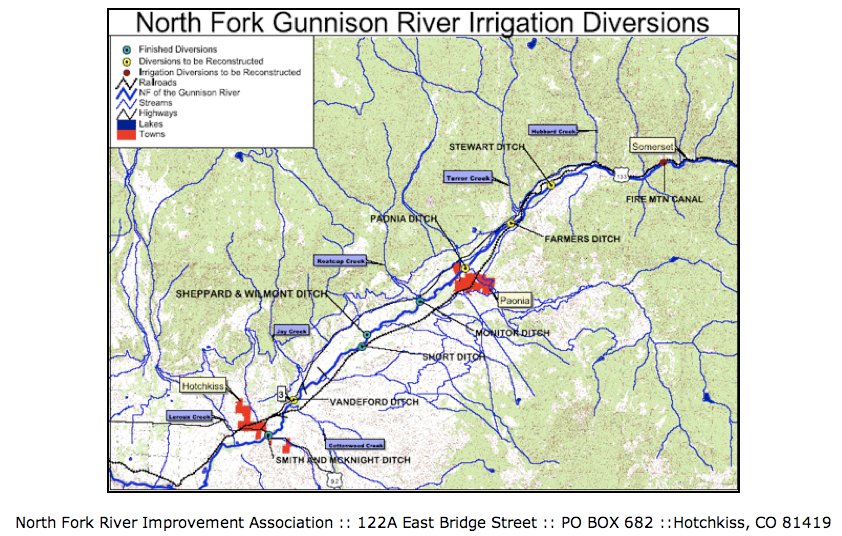
Gunnison River Basin: North Fork River Improvement Association watershed meeting December 9

A picture named northforkgunnisonriverirrigationdiversions.jpg

From email from the Colorado Watershed Assembly:

The North Fork River Improvement Association (NFRIA) is continuing the process to update the original 2000 Watershed Action Plan for the North Fork of the Gunnison. This is a chance for you to take action in addressing the foremost issues concerning your river. A public meeting is scheduled for Wednesday, December 9, 2009, at the Paonia Public Library in Paonia, CO from 4:00 to 6:00pm.

NFRIA wants to assess how the public perception of the watershed has changed during the last nine years. Participation in this meeting will prove valuable for our organization in pursuing the goals of all stakeholders in the watershed. We hope to come away with an inclusive list of public concerns allowing us to optimize our efforts. NFRIA has completed many projects since the original Watershed Plan was released, including the Short and Sheppard-Wilmot Ditch diversions and the Chipeta Dam removal. In order to better serve all stakeholders, NFRIA welcomes critique of how well we have executed the initial action plan and suggested elements to focus on in the coming years.

This meeting is the second of two public meetings that constitute the first task in updating the watershed plan. The update process will review the science, the state of the watershed, sources of water quality impairment, and public concerns, and will set goals for the next 10 years. The Colorado Water Conservation Board is funding this project.

The original 2000 Watershed Action Plan can be found at www.nfria.org. Please feel free to contact the NFRIA office with any questions at 970.872.4614.

More Gunnison River Basin coverage here.

Denver Water: Moffat Collection System Project may benefit streamflows in South Boulder Creek

A picture named grossdam.jpg

From The Denver Post (Charlie Meyers):

The South Boulder Creek situation involves a similar difficulty to maintain flows below the reservoir during those cold months when water generation is diminished and fish mortality occurs. Again, flow control by Denver Water is at the heart of the issue. The water provider currently agrees to maintain flows at seven cubic feet per second — provided this small watershed can produce even that minuscule amount. Help may be on the way in a Denver Water plan to boost West Slope diversion through the Moffat Tunnel, boosting storage in Gross Reservoir. A companion arrangement would allow the water suppliers for the cities of Boulder and Lafayette to utilize storage in the reservoir.

The potential to use this to enhance winter flows has caught the attention of Trout Unlimited, which long has sought a solution to the South Boulder Creek puzzle. “If we can use this increased storage to boost flows in the creek,” this would be something we could support,” said Drew Peternell, director of TU’s Western Water Project. But Peternell’s concern also extends to a larger matter, which is a Denver Water push to acquire more water from the upper Fraser River basin, then deliver it through the Continental Divide via its Moffat Tunnel complex.

More Moffat Collection System Project coverage here.

Southern Delivery System: Colorado Springs Utilities requests Reclamation move forward on contract talks

A picture named sdspreferredalternative.jpg

From The Pueblo Chieftain (Chris Woodka):

“To maintain our current schedule to begin construction on the Pueblo Dam connection in early 2010, we have requested that Reclamation move forward with the contracting process as soon as possible,” said John Fredell, project director…

The contract negotiations will provide an additional opportunity for public comment on SDS, a $1 billion-plus pipeline project on track to be completed by 2016…

Colorado Springs Utilities also is seeking permits in El Paso County, and expects to present its case to the El Paso County Planning Commission in February, Fredell said. The city also has scheduled meetings with the Fountain Creek Watershed Flood Control and Greenway District, its technical advisory committee and its citizens advisory group during December and January.

More Southern Delivery System coverage here and here.

CWCB: San Miguel River — Special meeting of the San Miguel County Commissioners regarding instream flow right for the river

A picture named sanmiguelriver1109

From email from the Colorado Water Conservation Board (Rob Viehl):

The Stream and Lake Protection Section of the Colorado Water Conservation Board will be participating in a special meeting of the San Miguel County Board of County Commissioners to discuss the potential appropriation of a new instream flow water right on the San Miguel River in 2010.

The meeting will start at 6:00 p.m. on Thursday December 10, 2009, and will be held in the Norwood Community Center, 1670 Naturita Street, Norwood, Colorado. Questions may be directed to Jeff Baessler at 303-866-3441, ext. 3202 or Jeffrey.Baessler@state.co.us

Detailed information concerning the proposed instream flow water right on the San Miguel River can be found at: http://cwcb.state.co.us/NR/rdonlyres/5FF2A272-6629-47F0-9E54-ECF7A2DAB3F5/0/SanMiguelRiver.pdf (pdf)

Here’s the link to the Colorado Foundation for Water Education’s fall 2009 issue (pdf) which covers the Colorado Water Conservation Board.

More San Miguel watershed coverage here and here.

Denver Water: Moffat Collection System Project public hearing tonight in Granby

A picture named fraservalleycollection.jpg

Here’s an editorial call to arms from the Sky-Hi Daily News asking residents on the rainy side of Colorado to help stop the proposed project from Denver Water. From the piece:

So, we’d like to suggest a resounding “no” from this side of the Continental Divide, as in “no” to more transmountain diversions from the already-depleted Upper Colorado River. Surely that will elicit gasps from the other side of the hill in particular, as it would likely entail deviation from more than a century of Colorado water law. Then again, perhaps it’s high time for the sake of the greater state we did deviate from certain anachronistic practices, transbasin diversions being a prime example.

No one can honestly argue that in 1890, when the Grand Ditch first deprived the Colorado River of its very headwaters, that anyone was, in a legal sense, adequately representing the interests of the West Slope, much less interests that prevail today. Ditto when the Colorado-Big Thompson Project, which was supposed to help Front Range irrigators, not municipalities, began sending water to Northern Colorado. As for Denver Water’s catch-all canal in the Fraser River drainage and pipeline through the Moffat Tunnel, it is nothing short of an environmental tragedy on this side of the Divide.

Conditional water rights, such as those proposed for “firming” in Denver Water’s Moffat Project and Northern’s Windy Gap Firming Project, are particularly suspect in light of current realities in the Colorado River drainage. More than 60 percent of the native flows in this region already have been sent packing to the other side of the Continental Divide. As if that weren’t sufficiently disturbing, projects on the board would raise that ante to 72 percent of the Fraser River. Moreover, both these projects anticipate diverting water to the Front Range for storage in reservoirs there, thus depriving the West Slope not only of its natural heritage, but also of any chance to benefit from flat-water recreation that could be developed…

At the very least, Denver Water should be forced to mitigate the impacts of any further diversions from the Fraser Valley, where a seriously depleted river already represents the ultimate limit to development, and a once-world class fishery teeters on the brink. In addition, Denver’s project and the Windy Gap Project are being considered as though they are in a vacuum, which of course they are not. If the interests of this region are to be represented once and for all, these projects must be considered in concert, just as their impacts will be felt in concert from Lake Granby to the Utah border.

More Moffat Collection System Project coverage here.

2009 Ag Water Summit recap

A picture named irrigation.jpg

From The Greeley Tribune (Bill Jackson):

“How are we going to do that [produce 70% more food] without water?” Pat O’Toole asked a crowd of more than 100 Tuesday at the 2009 Ag Water Summit conducted at the Jefferson County Fairgrounds. O’Toole, a southwest Wyoming rancher and farmer, is president of the Family Farm Alliance, an organization that represents farmers and ranchers in 17 western states. He set the tone for this year’s summit which also covered legislative and budgetary issues, optimizing irrigation water, updates on new water projects being planned and discussions on other ag and water issues. The annual event is presented by the Colorado Ag Water Alliance and the Colorado Ag Council.

O’Toole and his family have a cattle, sheep and hay operation along the Little Snake River north of Steamboat Springs and has served in the Wyoming House of Representatives. He is the fourth generation on the ranch where the family has had a long association with Colorado State University.

The Family Farm Alliance, he said, presents issues, many of them involving water, from the grassroots level all the way to Congress. Every state in the alliance, he said, has water issues and a major problem facing all those states is not just a population explosion in the future, but more of how much population growth can be absorbed.

More Colorado water coverage here.

Center for Biological Diversity files lawsuit to gain protection for the Colorado River cutthroat

A picture named greenbackvscorivercutthroat.jpg

From the Courthouse News Service (Sonya Angelica Diehn):

The Center for Biological Diversity challenges a Bush-era policy under which the government considers only the current range in consideration of endangered status, which the Center calls “effectively chopping protection off at the knees.” It claims the Interior Department and the U.S. Fish and Wildlife Service also dismissed the threats of non-native trout; persistence of only small, isolated cutthroat populations; and the cutthroat’s particular susceptibility to a parasitic disease, to deny it protection.

The Colorado cutthroat trout needs clean, cool mountain streams to survive. But 87 percent of this habitat has been lost to livestock grazing, logging, water diversion and dams, among other factors, the Center says. Steady introduction of non-native trout allows the sport fish to compete with local species for resources, eats the native young and threatens local trout by interbreeding, weakening the native population’s highly adapted ability to survive, the plaintiffs say. The species used to flourish in parts of Wyoming, Colorado, Utah, and extreme northern New Mexico and Arizona. With 58 percent of the remaining range degraded, the cutthroat now survives only in small, fragmented populations. The species is particular susceptible to whirling disease, a transmittable parasite that causes nerve and bone damage and deformation, making infected fish swim in an erratic, corkscrew-like pattern…

[Plaintiff Noah Greenwald], who has a master’s degree in riparian ecology and submitted the petition to the Fish and Wildlife Service after studying the Colorado cutthroat trout for a year, added, “We hope the Obama administration will revoke the damaging Bush policy on ‘significant portion of range’ language, which misinterpreted the law in order to hobble protection, and reconsider listing the trout.” Lead counsel for the Center is James Dougherty of Washington, D.C.

More endangered species coverage here.