
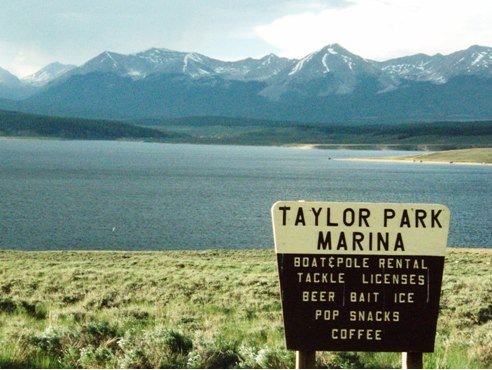
From The Crested Butte News (Mike Horn):
…the Taylor Dam is once again being looked at as a source of power. This time around, the Upper Gunnison River Water Conservancy District (UGRWCD), Gunnison County Electric Association (GCEA), and the Uncompahgre Valley Water Users Association are collectively examining the dam’s power potential. A recent “flyover” feasibility study on the project yielded some positive results…
Frank Kugel is general manager for the UGRWCD. “From its inception Taylor Park Dam has always been envisioned to produce power,” said Kugel. “Our district is very supportive of the concept of constructing a hydropower installation at Taylor Park Dam. We feel that it could provide a source of green power while utilizing the water resources in our basin.” Getting power from the dam to Highway 135 using the existing single-phase cable was deemed economically unfeasible in the past. But according to Kugel, “With today’s interest in green energy and the funding assistance that is available, we felt it was worth a fresh look at generating hydropower.”
Mike Wells, Chief Executive Officer for the GCEA, described the first study as a “20,000-foot flyover on the project.” Half the $30,000 study was paid for with a grant, and the other three entities split the remainder. “It did come back feasible, but what it does is take us to the next level where we get into it more in depth,” Wells said. “The next step is a higher reconnaissance feasibility study, more of the design phase, to see what it would look like and how it would work.” Wells said that next phase would assess operational needs and concerns, and possibly take a look at the regulatory agencies that would be required for permitting. “There would be other players such as the Bureau of Recreation since it’s their dam,” added Wells. “There would have to be an agreement about liabilities, who owns the structure, what sort of lease agreement, compensation and ownership, but these kind of details weren’t looked at during this first step.”
The next level study would cost in the range of $90,000 to $120,000, according to Kugel. “We are currently in the process of seeking sources for that money and we will decide whether to move forward in the next couple months based on [the availability of] those funding sources.” As far as the price of the project itself is concerned, there is a wide gap between the two main options. Wells said, “An initial estimate—just rough numbers—it’s a $14 million project if we make it into three-phase, or $6.5 million if we size it for the single-phase line. Either would provide a rate of return if we are using average water conditions. If you have a wet year or average year it makes the project feasible. In dry years it’s a losing proposition.”[…]
The proposed hydropower generation would not damage fisheries or river hydrology either, according to Wells. “Since that water is so critical to farming operations and fishing, there would be no changes in the river flow. We would not want to mess with any change in streamflows. Our other partners would be very resistant with changing that, it’s just not practical. The stream releases would be as regularly scheduled.