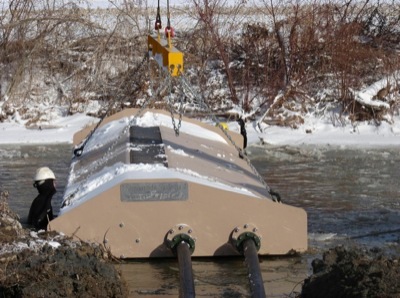
Fountain Creek: ‘Dirt-A-Tracter’ sediment collector is working as planned so far, Colorado Springs plans more installations if evaluation project is successful

sedimentcollector.jpg

From the Colorado Springs Independent (Pam Zubeck):

Located just above the confluence of Fountain Creek and the Arkansas River, the collector is designed not only to remove clogs that contribute to flooding, but also to improve conditions for aquatic life. The 400 cubic yards a day of sandy material it removes will be used to extend the Palo Verde Trail and expand levees in Pueblo.

If it’s successful during its one-year test period, others could be installed along the creek, says Larry Small, former Springs City Councilman and executive director of the Fountain Creek Watershed, Flood Control and Greenway District, which spearheaded the project. And it might help to improve relations between Pueblo and Colorado Springs…

The collector, dubbed the “Dirt-A-Tracter,” is the Watershed District’s first tangible project. The second is a detention pond in northeast Pueblo, funded with $700,000 in state and federal grants, that’s to become operational in September. But the district faces $200 million worth of projects, as outlined in a soon-to-be-released long-range master plan.

“There’s a lot of work that needs to be done,” Small says. “That 44-mile corridor is in pretty bad shape.”

He notes the district has authority to levy up to 5 mills in property tax, with approval of voters in both El Paso and Pueblo counties, but any ballot measure would be years away. The district also can impose fees, but there’s no talk of doing so within the 692-square-mile watershed. As Small says: “You know how successful the stormwater fee was in Colorado Springs.” (The city’s Stormwater Enterprise was dismantled following a 2009 ballot measure.)[…]

Small says Colorado State University-Pueblo will monitor the collector system’s impact on sediment and aquatic life over the next year.

More Fountain Creek coverage here and here.

Colorado-Big Thompson Project update: Granby is releasing about 420 cfs

coloradobigthompsonmap.jpg

Just a quick note to update you all on our facilities across the Colorado-Big Thompson Project. I’ve also updated our webpages. Once on our main page, be sure to check out the menu on the left hand side to see information on our other facilities.

Meanwhile, Granby is releasing about 420 cfs.

Willow Creek is releasing about 77 cfs.

Olympus Dam on Lake Estes is releasing about 125 cfs.

All reservoirs are basically full, with the exception of Lake Estes, Pinewood and Flatiron. These three fluctuate often due to hydro-power generation. Pinewood and Flatiron, in particular, might drop significantly over the course of one day, then rise back up again.

More Colorado-Big Thompson Project coverage here.

Pueblo and Glenwood Springs: Reclamation Hosts Public Session on Revenues

fryingpanarkansasproject.jpg

Here’s the release from Reclamation (Kara Lamb):

Reclamation is hosting two public listening sessions on the crediting of revenues related to the Fryingpan-Arkansas Project. The first session will be held in Pueblo at the Pueblo Shrine Club on August 10 at 11 a.m. The second session will be held in Glenwood Springs at the Hotel Colorado on August 11 at 9 a.m.

The purpose of the sessions is to gain public feedback on how revenues from excess capacity contracting should be applied to repayment of Fryingpan-Arkansas Project facilities.

The Pueblo Shrine Club is located at 1501 W. McCulloch Blvd., Pueblo West, Colo. The Hotel Colorado is located at 526 Pine Street, Glenwood Springs, Colo.

The Bureau of Reclamation constructed, owns and operates the Fryingpan-Arkansas Project.

For more information, please contact Kara Lamb at either (970) 962-4326 or klamb@usbr.gov.

More coverage from Chris Woodka writing for The Pueblo Chieftain. From the article:

The meetings will be Wednesday at Pueblo Shrine Club, 1501 W. McCulloch Blvd., Pueblo West. The meeting on the 2009 federal law that requires revenue from excess-capacity contracts to be applied to unpaid debt from the Fryingpan-Arkansas Project will be at 11 a.m. The market-rate discussion will be from 3-5 p.m.

More Fryingpan-Arkansas Project coverage here.

Albuquerque — ‘Resolana: Dr. JosĆ© Rivera – Acequia Culture International: From Al-Andaluz to the Americas Saturday’, September 24, 2011

sanluispeoplesditch.jpg

From the National Hispanic Cultural Center website.

A presentation on the role of acequia systems (irrigation ditches) on the Iberian Peninsula, in the Americas and in the Philippines. Over centuries and across continents, irrigation systems have been central to advanced civilization. Many of the characteristics and many of the rituals associated with these irrigation systems find similarities across time and space. In New Mexico more than anywhere else in the U.S., acequias have remained a part of both economic and cultural life of its inhabitants. At a time when sustainable agriculture and life styles are being promoted it is instructive to learn what has come before. Dr. Rivera has studied acequias on several continents and published important works in several languages on the subject.

More Rio Grande basin coverage here.

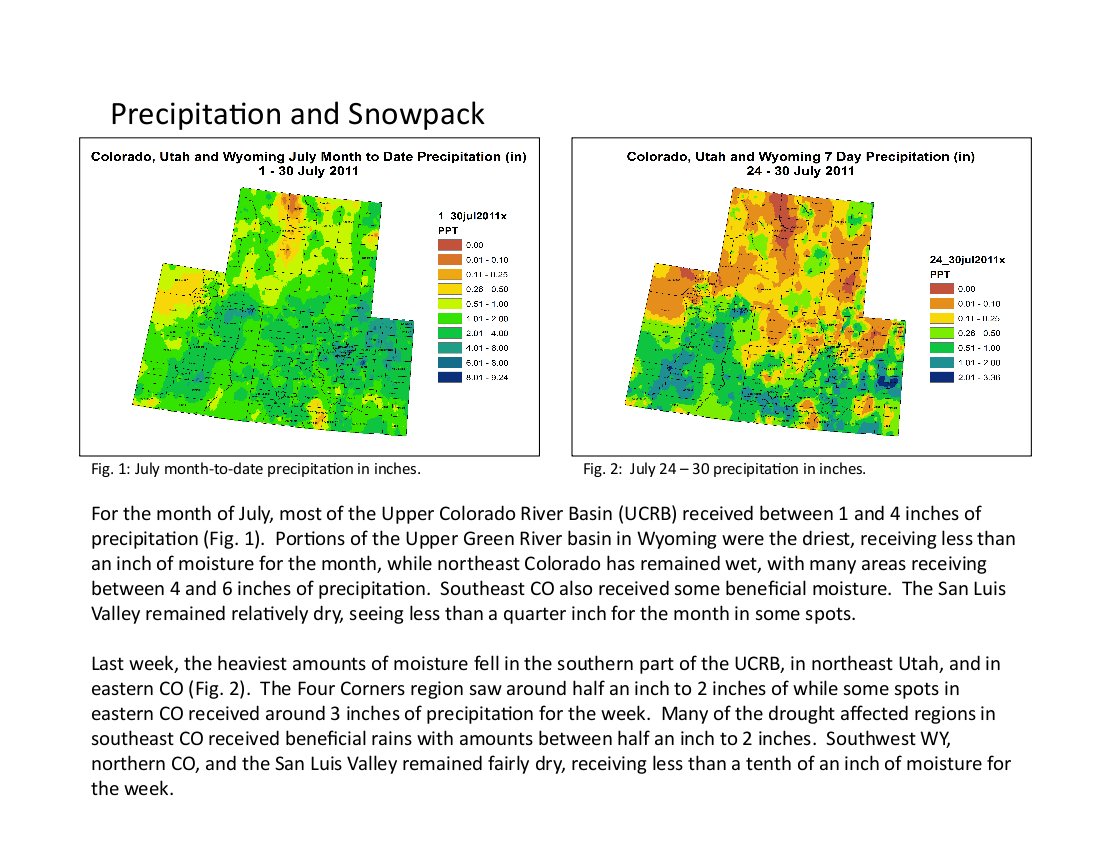
‘NIDIS Weekly Climate, Water and Drought Assessment Summary of the Upper Colorado River Basin’ and Colorado Drought Status Briefing

wyutcoprecipitationjuly2011coloradoclimatecenter.jpg

Here’s the link to the presentations from yesterday’s webinar.

Colorado Public Radio series — ‘Thirsty Cities, Dry Farms’

smithsditchwashingtonparkdenver.jpg

Here’s the link to the transcript Part 1: Buy and Dry of Megan Verlee’s series. Here’s an excerpt:

REPORTER: [Orville] Tomky still mourns the changes to his county. But John Stulp, the governor’s water advisor, and a farmer himself, says it would be a mistake to see the farmers as victims in this story; for many, being able to sell their water rights is a godsend.

JOHN STULP: “If you do not have sons or daughters who are willing to come back to the farming operation, oftentimes a farmer’s irrigated water rights become their 401K, their retirement fund.”

REPORTER: We’re talking about some big money here. Rights to the most desirable agricultural water can go for more than $10,000 dollars an acre-foot, and farmers often own hundreds of those. Cities are always looking to buy. It’s hard to pin down exactly how much of the state has gone back to grass, or is on its way. because of urban water buys. But best guesses put the number at hundreds of square miles. State Supreme Court Justice Gregory Hobbs is an expert in Colorado water law. He says what happened in places like Crowley county made Colorado officials more cautious about water deals between cities and farmers.

HOBBS: “People realized that the tax base was being affected by these transfers. So the legislature basically adopted what I’m going to call mitigation.”

REPORTER: Now the cities can’t just buy the water and walk away, they’ve got a lot to do before they ever see a drop of it.

HOBBS: “The legislature has provided there must be re-vegetation when water is permanently removed. There are in leiu taxes that must be paid to support the local library and fire district and town, for thirty years.”

Here’s the link to Part 2: Super Ditch of Megan Verlee’s series. Here’s an excerpt:

[John] SCHWEIZER: “I always got tickled at my mother. She didn’t think you should ever gamble. But she and my father farmed all their married life, and if that’s not a gamble, I don’t know what is.”

REPORTER: It’s not farming’s perpetual gamble but its potential one-time payout that has Schweizer worried these days. Over the past few decades, a lot of his neighbors have cashed in their water rights, selling to cities and retiring, along with their farms. We’re not on the road long before we see the effects of that transfer. The land changes from green to brown, weedy fields crisscrossed with the remains of old irrigation systems.

SCHWEIZER: “See, there’s an irrigation canal right there, that indentation.”

REPORTER: Schweizer doesn’t want to see any more farmland dry up around here, so he and other farmers here are working on a different way to meet cities’ water needs. He’s president of what’s called the Arkansas Valley Super Ditch.

SCHWEIZER: “The Superditch is a not a ditch at all. It’s just a combination of the ditches in the valley. I just like the idea of it: leasing part of your water and continuing to own it.”

REPORTER: So instead of individual farmers selling off water rights, irrigators in the valley band together to lease up to a quarter of their total water to cities. The farmers take turns leaving some of their fields bare for a few years, but they all get to stay in business. Schweizer says it might even make it easier for people like his son to continue the family farm.

SCHWEIZER: “If the water’s sold, it’s impossible to ever pursue and fulfil that dream. And with the Superditch concept, and if it becomes a reality, then most of the water stays on the land and they continue to do what they’ve dreamed about doing for generations to come.”

More Arkansas Valley Super Ditch coverage here.

Interbasin Compact Committee: Statewide ‘non-consumptive needs’ meeting to be held on October 13

arkansasdarter.jpg

From email from the IBCC (Jacob Bornstein):

The IBCC nonconsumptive subcommittee requested meeting with members of the roundtable interested in nonconsumptive issues. The meeting is scheduled for October 13th, 2011 from 10 am to 3 pm. We are still working on a location, but please hold the date and time. The goal of the meeting is to understand how to use the available tools, needs assessment, and data to move towards implementation of nonconsumptive projects and methods.

More IBCC — basin roundtables coverage here.

Energy policy — oil and gas: Governor Hickenlooper announces joint before and after hydraulic fracturing water-sampling effort by the state and producers, the hope is to build trust

hydraulicfracturing.jpg

From Platts (Eunice Bridges):

Governor John Hickenlooper, a Democrat, said the effort was the first of its kind and was needed to build trust with the public and fight doubts and “paranoia” about the effects of hydraulic fracturing operations. “The best way to fight back on that kind of misinformation is to be transparent … to clearly demonstrate beyond any possible doubt that this doesn’t happen,” he told the Colorado Oil & Gas Association’s Energy Epicenter conference in Denver…

The water sampling effort will be a statewide, voluntary (ed. emphasis mine) program where groundwater samples would be collected by a third-party, with oversight and monitoring by the Colorado Department of Public Health and Environment. The department would also hold onto all the sampling data, which would allow it to evaluate trends and water quality, Hickenlooper said. Hickenlooper also said many larger drillers, representing 90% of all the wells set to be drilled in 2011, have already signed up for the program. He said he is hoping for near 100% participation.

COGA initially approached the governor with the idea and has been instrumental in getting companies on board, the governor added. The governor also said such water sampling has been taking place in the San Juan Basin for some time because of the number of shallow wells there and concerns of possible water contamination.

Hickenlooper said news reports on fracking — including recent articles in The New York Times — were full of misinformation and distortions of facts, causing a public mistrust and paranoia about the industry. “This is all hyperbole and anxiety being expressed … and no science here,” he said.

More coverage from The Denver Post (Mark Jaffe):

Hickenlooper, speaking at the Colorado Oil and Gas Association annual conference, said the goal was to have a rule in place by year’s end for disclosing hydrofracturing fluids. The regulation would help “restore public confidence” in the industry, he said. Eight states — from Pennsylvania to California — have adopted disclosure rules or are considering proposals. The key issue will be whether Colorado ends up with a strong rule, like Wyoming’s, or a weaker one, like Texas’, said Gwen Lachelt, director of the Durango-based Oil and Gas Accountability Project…

State agencies and the Oil and Gas Association announced on Tuesday a voluntary program to test water quality before and after drilling and fracking.
The program is another response to the criticism that fracking may contaminate water, said Tisha Schuller, president of the association. Under the program, water wells of two neighboring property owners will be tested before and after drilling and fracking. Twenty of the largest drillers in the state — who have accounted for 90 percent of the wells drilled this year — have agreed to participate. Tests will be paid for by oil companies, and results will be kept in a database by the Colorado Oil and Gas Commission. The program will start in the fall, and [David Neslin, the director of the Colorado Oil and Gas Commission] estimated that it will add about 4,000 wells to the state’s groundwater monitoring efforts — almost doubling the number of wells.

In initial talks with the industry, the governor said some companies, particularly smaller ones, saw the proposed rule as “an intrusion in their businesses…We’ve gone a long way to convincing them,” he said. “More and more of the industry sees this as a good thing.” Industry representatives and environmental advocates cautiously endorsed the Hickenlooper administration move. “We are willing to work with the governor on disclosure,” said the [Colorado Oil and Gas Association president Tisha Schuller].

More coverage from Joe Hanel writing for The Durango Herald. From the article:

The Colorado Oil and Gas Conservation Commission already requires companies to disclose their fracking formulas to state regulators and doctors if there is an emergency, but the information is not public…

“Everybody in this room understands that hydraulic fracturing doesn’t connect to the groundwater,” said the Democrat and former petroleum geologist. “It’s almost inconceivable that we would ever contaminate, through the fracking process, the groundwater.” He blamed inaccuracies and misinformation in the media – he named The New York Times three times – for public anxiety about fracking…

Colorado Oil and Gas Association President Tisha Conoly Schuller said she will urge that the new rule build on Frac Focus, a voluntary website that many companies are using to publicly report the content of their fracking fluids. Texas, which has one of the country’s strongest public disclosure laws, requires participation in Frac Focus or a similar website.

More coverage from Ryan Grenoble writing for the Huffington Post. From the article:

Colorado passed regulations in 2008 requiring companies maintain a list of chemicals used in their drilling processes. The list must be presented to healthcare workers and state regulators if requested after a workplace incident…

The HuffPost reported on leaked EPA documents in February which indicated high levels of radioactivity in fracking byproducts. These carcinogens then entered water supplies via sewage treatment plants ill-equipped to remove the chemicals.

More coverage from David O. Williams writing for the Colorado Independent. From the article:

Colorado conservation groups were buoyed by the governor’s announcement at an industry event, although at least one group said it will ā€œreserve its enthusiasmā€ until a formal rulemaking process is announced. ā€œWe appreciate the governor’s interest in this very serious matter and applaud his fortitude,ā€ Frank Smith of Western Colorado Congress said in an email. ā€œIt’s about time. Colorado has over 43,000 active oil and gas wells, with thousands more being planned close to communities and water supplies. As drilling encroaches upon more communities and enters more watershed boundaries, it is encouraging to have the governor state such interest.ā€

More oil and gas coverage here and here.

Flaming Gorge pipeline: 7,400 Coloradans took part in last Wednesday’s ā€˜telephone town hall’ event

flaminggorgepipelinemillion.jpg

From the Summit County Citizens Voice (Bob Berwyn):

Conservation groups last week also formally announced their opposition to the proposal, calling it a waste of resources and explaining that there are better ways — including conservation and re-use — to address the constantly growing demand for water. ā€œWe held this town hall because Coloradans need to know about this boondoggle,ā€ said Elise Jones, director of Colorado Environmental Coalition. ā€œThe cost to Coloradans is immense, from the cost of construction to the negative impact on our recreation economy to the irreversible environmental damage it would cause.ā€

The diversions from the Green River could potentially affect flows and ecosystems in Dinosaur National Monument and impact ongoing recovery efforts for native fish in the Colorado River. A federal environmental study that would disclose those impacts is under way, but the project proponent recently asked to have the review done by a different agency. Click here to listen to audio from the tele-town hall discussing impacts to fish.

On the state level, the Colorado Water Conservation Board is considering a $150,000 grant request by the pipeline’s proponents that would set up a special task force to consider the pipeline. The Board will make a decision on the grant at a September meeting, and the coalition of conservation groups and outdoor recreation business owners is asking that this request be denied.

More Flaming Gorge pipeline coverage here and here.

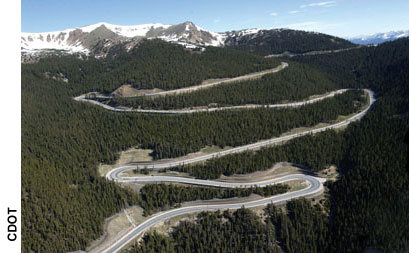
Fraser River: Work to begin August 15 for reconstruction of the Fraser River settling pond near Winter Park

berthoudpass.jpg

Here’s the release from Grand County via the Sky-Hi Daily News. Here’s an excerpt:

The project is located in the Arapaho National Forest and involves collaboration between the Colorado Department of Transportation, Denver Water, the Town of Winter Park and Grand County as well as the East Grand Water Quality Board, the Army Corps of Engineers and the Colorado Division of Wildlife.

The 15-year-old pond will be rebuilt to better trap and collect sediment that washes down the road. Improved engineering will allow CDOT to easily remove excess sediment from the pond without impacting wetlands or infrastructure. The sediment will be hauled to a Grand County gravel pit for reuse. The sediment has been tested to make sure there are no environmental concerns.

In rivers, trout need cold, clear water with a loose, rocky bottom. Traction cinders used on Berthoud Pass in the winter end up in the Fraser River, choking spawning beds and other aquatic habitat and undermining overall stream health.

In addition, the excess sediment clogs Winter Park Water and Sanitation District drinking water intake pipes and Winter Park Resort’s diversion pumps. By collecting and removing the excess sediment, project partners hope to improve water quality and the functioning of the Fraser River ecosystem.

More Fraser River coverage here and here.

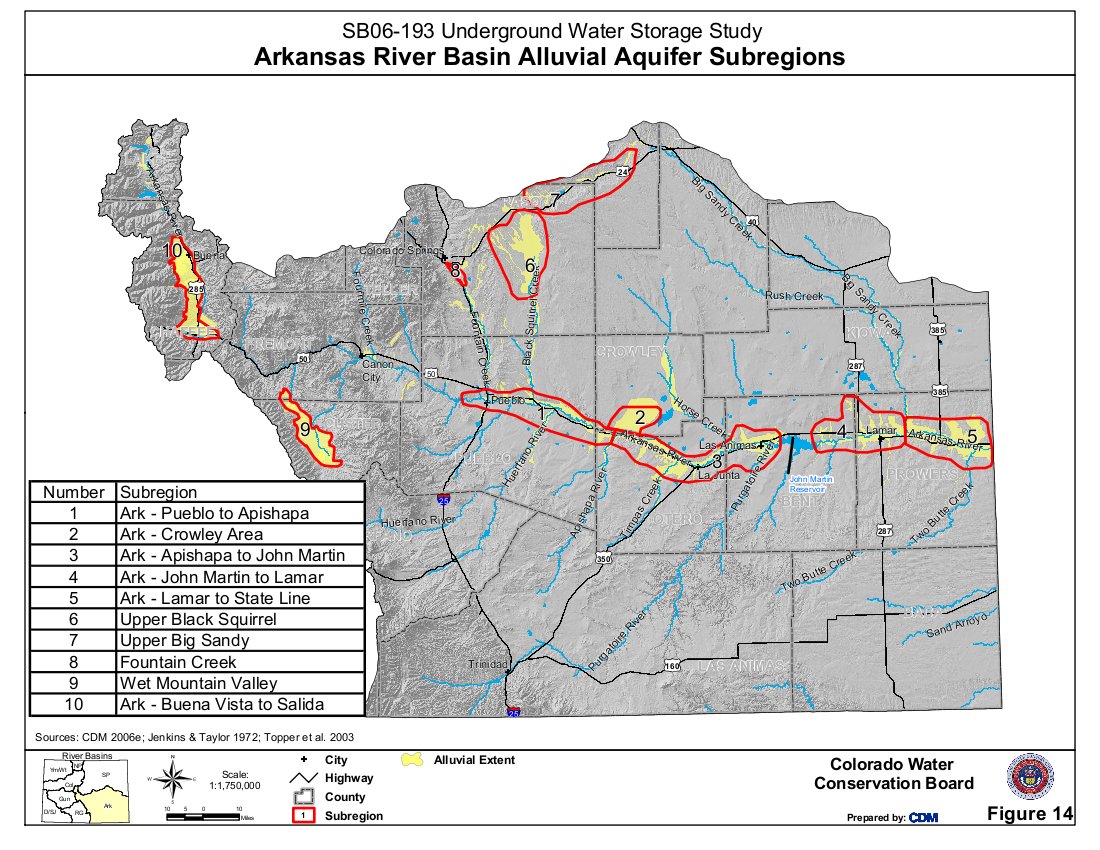
Pueblo: Fryingpan-Arkansas Project ‘listening-session’ August 10

arkansasbasinalluvialaquifersubregions.jpg

Here’s the release from Reclamation (Kara Lamb):

Reclamation is hosting a public listening session on determining the criteria for market rate pricing for the Fryingpan-Arkansas Project Wed., Aug. 10 at the Pueblo Shrine Club from 3-5 p.m.

The purpose of the meeting is to collect perspectives on developing market rate pricing criteria for excess capacity contracts utilizing Fryingpan-Arkansas Project facilities. A court reporter will be present to record comments.

The Pueblo Shrine Club is located at 1501 W. McCulloch Blvd., Pueblo West, Colo. 81007. The Bureau of Reclamation constructed, owns and operates the Fryingpan-Arkansas Project…

Media Contact: Kara Lamb, klamb@usbr.gov, (970) 962-4326

Lower Arkansas Valley: Aurora leases nearly 5,000 acre-feet of water to the Holbrook and Highline canals along with allocating 713 acre-feet to the Colorado Canal for revegetation efforts in Crowley County

arkbasinditchsystem.jpg

From the La Junta Tribune-Democrat:

Since March, Aurora has been providing what will amount to almost 5,000 acre- feet (af) to both Holbrook and Highline Canals, systems with which the city has payment agreements. The exchange of water for normal cash payments from Aurora resulted in an extremely favorable exchange rate for the farmers of $15 per af. The city also provided the Colorado Canal with 713 af at no cost to help with continuing revegetation efforts in Crowley County.

Bob Barnhart, Superintendant of the Holbrook Mutual Ditch Company, as well as a farmer on the Holbrook ditch, welcomed this opportunity. ā€œThis water comes at a time when we were in great need for supplemental water for irrigation,ā€ Barnhart stated. ā€œWith the drought the way that it is in southeastern Colorado this has been a great help to us to keep our corn and alfalfa growing and healthy. This water will keep our yields high and increase our net profit for this year. Before we got Aurora water this year we were hurting and scrambling trying to find some source of water to keep our crops alive.ā€

More Aurora coverage here and here.

Northern Colorado Water Conservancy District tour attracts nearly 100 taxpayers, city officials, water district employees and students

coloradobigthompsonmap.jpg

From the Carbon Valley Miner and Farmer (Gene Sears):

Nearly 100 participants attended the tour, a mix of taxpayers, city officials, water district employees and students, split between two buses hired by the district for the trip. Starting at NCWCD headquarters in Berthoud, the tour headed northeast up Big Thompson Canyon, through Estes Park and onto Trail Ridge Road in Rocky Mountain National Park, headwaters for much of the district’s supply…

Built at a cost of $162 million, the project began full water deliveries in 1957. As it stands now, the Colorado-Big Thompson system consists of 12 reservoirs, 35 miles of tunnels, 95 miles of canals and 700 miles of power transmission lines. Spanning 150 miles east to west and 65 miles north to south, C-BT provides water to almost 700, 000 irrigated acres and more than 750,000 people in the South Platte River Basin.

More Northern Colorado Water Conservancy District coverage here.

Energy policy — oil and gas: Today Governor Hickenlooper told attendees at the Colorado Oil and Gas Association annual meeting to expect a rule requiring fracking rule disclosures by the end of the year

marcellushydraulicfracturing.jpg

From the Denver Business Journal (Cathy Proctor):

ā€œEveryone in this room understands that hydraulic fracturing doesn’t connect to groundwater, that it’s almost inconceivable that groundwater will be contaminated,ā€ said Hickenlooper, who worked as a petroleum geologist in Colorado in the 1980s. ā€œBut the industry needs to be transparent. It needs to demonstrate, beyond a doubt, that this doesn’t happen. [Transparency] creates a tremendous show of good faith and shows that the industry cares,ā€ he said…

Many oil and gas companies voluntarily have disclosed the contents of frack fluid via http://www.fracfocus.org, a website sponsored by the Ground Water Protection Council and the Interstate Oil & Gas Compact Commission. The website, which allows companies to redact information deemed proprietary, went live on April 11. As of Tuesday, the website listed information on 500 Colorado wells drilled since Jan. 1…

But Hickenlooper said he envisions a new Colorado rule similar to those in Texas and Wyoming.

• Texas’s law, passed in June, requires companies to post lists of chemicals used in fracking for all wells drilled in the state via the fracfocus.org website. The law allows exemptions from the list for chemicals deemed ā€œtrade secrets,ā€ but the landowner where the well is drilled, an adjacent landowner or a state agency can appeal the exemption.

• Wyoming’s law, passed in 2010, requires companies to disclose the contents of fracking fluid, and that the information be made available to the public, with some exemptions for proprietary information.

ā€œWe need to make it easier for the broad population to trust us,ā€ Hickenlooper told oil and gas executives, adding that ā€œhopefully, we’ll have a disclosure ruled worked out through the COGCC by the end of the year.ā€

More coverage from the Associated Press via Fuel Fix:

Hickenlooper also proposed a voluntary program to test groundwater around oil and gas wells before and after drilling to check for signs of contamination. He said that testing would be paid for by the industry but performed by a third party. Results would be recorded by the state health department.

More oil and gas coverage here and here.
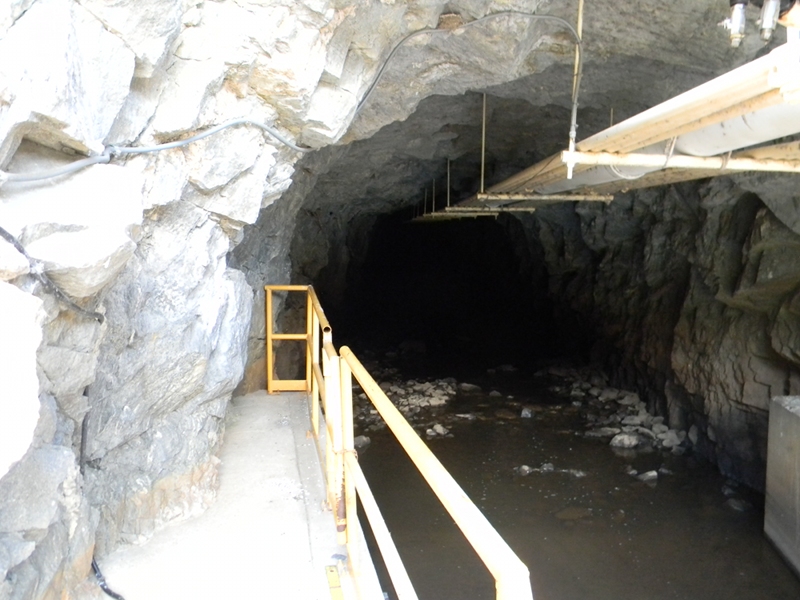
Greeley: Annual water and sewer facilities tour August 25

miltonseamanreservoiroutlettunnel07252011.jpg

From Greeley Water via The Greeley Tribune:

The city of Greeley is offering residents the chance to tour the city’s water and sewer facilities with the city’s Water and Sewer Board. The tour is set for 7:30 a.m. to 4 p.m. Aug. 25. Residents interested in attending are asked to reserve seating by Aug. 19 to (970) 350-9812. The purpose of this annual tour is to visit water and sewer facilities to learn about new and developing projects, according to a city news release.

More Greeley coverage here.

Drought news: Five San Luis Valley counties get drought disaster designation

usdroughtmonitor07262011.jpg

From The Pueblo Chieftain (Matt Hildner):

[U.S. Secretary of Agriculture Tom Vilsack] notified Gov. John Hickenlooper Friday of the designations, which also included the naming of nine other counties as contiguous disaster areas and also eligible for aid. The declaration makes producers eligible to apply for Farm Service Agency emergency loans and for the Supplemental Revenue Assistance Payments Program.

The five valley counties include Alamosa, Conejos, Costilla, Rio Grande and Saguache. According to the U.S. Drought Monitor, sections of Alamosa, Conejos, Costilla and Rio Grande are in exceptional drought, a listing that’s only matched in Colorado by Baca County.

Douglas County: Developers pull application for the proposed Penley Reservoir

penleydamoptiona.jpg

From The Denver Post (Carlos Illescas):

Douglas County attorney Lance Ingalls said the withdrawal of the application ends the process completely. If the developers decide to resume work toward approval of the project, it would require a completely new application, Ingalls said. It was not clear why Penley Water pulled the plug. Officials for Penley Water could not immediately be reached today for comment.

More Penley Dam Project coverage here.

Runoff news: Dillon Reservoir fills and spills for the 2011 water year

morninggloryspillwaydillonreservoir.jpg

From the Summit County Citizens Voice (Bob Berwyn):

After weeks of carefully juggling inflows, releases through the outlet works and diversions through the Roberts Tunnel, Denver Water officials said Dillon Reservoir filled completely July 27 and started spilling through the overflow drain, known as the glory hole. It may be the latest the reservoir has ever filled, said Bob Steger, the Denver Water engineer who leads a team that computes the inflow forecasts and other information used to adjust the valves on the outlet works, sometimes on a daily basis…

The general idea is to fill the reservoir, which maximizes Denver’s water supply from the key reservoir, helping to maintain adequate supplies downstream in other storage buckets in the South Platte drainage. At the same time, Denver Water considers recreation needs in the reservoir (water levels at local marinas) and downstream in the Blue River (fishing and rafting) and the potential for flooding in Silverthorne neighborhoods. On top of all that, the water provider needs to anticipate downstream calls for water, from ranchers and fruit growers around Grand Junction and from hydropower providers.

This year was especially tricky. A near-record snowpack led to predictions of record runoff, but unseasonably cool weather lasted until late into the spring, delaying the runoff and setting up conditions for an almost unmanageable surge of runoff that, in the end, didn’t materialize.

To prepare, Denver Water drained Dillon Reservoir to levels not seen since the spring of 2003, following a historic drought, then slowly started to fill it again, all the while warily watching flows in the Lower Blue and in the key tributaries feeding the reservoir, where flows at times surged well above 2,000 cubic feet per second. Despite the drawdown, flows in the river below the dam ran perilously close to flood levels for several weeks, prompting warnings to boaters and even restrictions on river access through Silverthorne.

More Denver Water coverage here.

Aspinall Unit 2011 operations meeting August 18

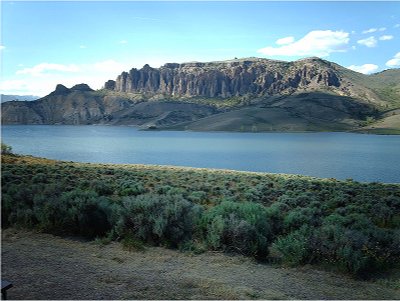
curecantibluemesa.jpg

From email from Reclamation (Dan Crabtree):

As a reminder, the 2011 August Aspinall Operation meeting will be held starting at 1:00 p.m. on August 18th at the Elk Creek Visitors Center located on the balmy banks of beautiful Blue Mesa Reservoir. The meeting will last 2 – 3 hours depending on the depth of discussions and questions. We will be reviewing operations from this past spring and summer along with projected operations for the coming fall. The meeting is open to the public and we look forward to your questions and reports regarding activities related to operations of the Aspinall Unit.

More Aspinall Unit coverage here.

The Daily Mail online is running a photo essay of the Marble Cathedral in Chile

lakecarrerachile.jpg

Not a Colorado water story but a great series of photographs of a beautiful lake and cave system in Chile. From the article:

To reach this remote place located in the far southern tip of Chile visitors must fly from the capital, Santiago, 800 miles to the next nearest large city, Coyhaique, and then drive on challenging dirt roads 200 miles south to the lake. Yet photography students have travelled the world to learn from Ms Waidehofer about light in what could be the world’s most astonishing classroom. ‘Since 2003 I have taken many photography students into the caverns and it is always the highlight of their South American voyage,’ [landscape photographer and environmentalist, Linde Waidehofer, 67, from Colorado, USA] said.

Denver Post book review — ‘The Ripple Effect: The Fate of Fresh Water in the Twenty-First Century’

therippleeffectcover

From The Denver Post (Hank Lamport):

From the premise that water’s abundance is now waning on a planet with 7 billion people, [Alex Prud’homme], a writer for The New Yorker and Vanity Fair, plumbs the intricacies of its ebbs and flows.

He worries that the energy behind the Clean Water and Safe Drinking Water Acts of the 1970s has dissipated, allowing unregulated chemical runoff from agricultural, industrial and mining uses to poison wells and aquifers. Prud’homme revisits mid- decade European studies that found traces of cocaine in Italian water and analyzes “chemical cocktails” in U.S. supplies that impact the reproduction of fish species in Chesapeake Bay. We meet water managers of desiccated desert cities and read of the lengths they must go to assure supplies for their communities.

With all parties attempting to maximize their access to the resource, prognosis for a balanced response to these myriad challenges is not rosy. Big-project engineering maintains we need all possible solutions in our arsenal to combat the bottlenecks ahead. “Flipping the Mississippi” envisions extravagantly pumping excess floodwaters from the Mississippi drainage to the Front Range or the Ogallala Aquifer, leaving more of the runoff from the Western Slope in the Colorado Basin for residents of Arizona and California. Massive desalination efforts still appear to be prohibitively expensive and politically untenable.

A countervailing approach is provided by Peter Gleick of the Pacific Institute, who offers the environmentalist’s “tread lightly” view. Gleick promotes mechanical innovations such as low-flush toilets, drip irrigation and other proven conservation methods to forestall the crunch ahead. One wonders, though, if we are already past the point where even those measures can stop a dystopic water future where decayed infrastructure and corporate profits are the critical factors.

Here’s the link to the book on the Tattered Cover website.

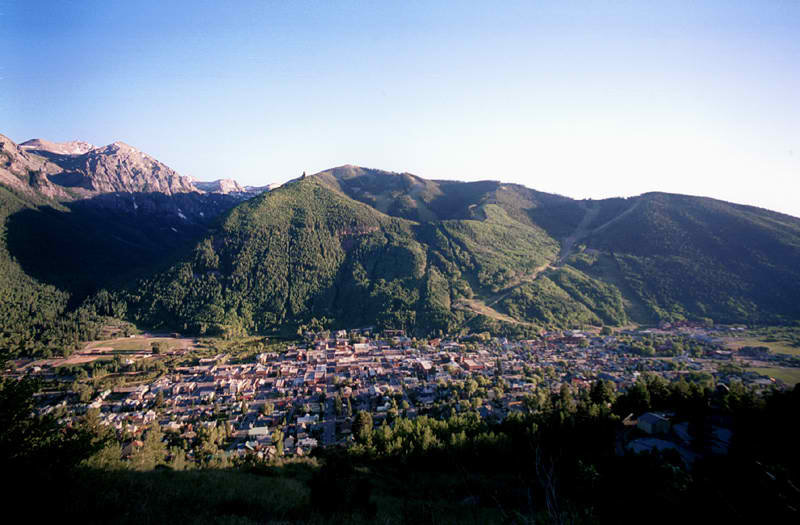
Energy policy — nuclear: The DOE is reviewing the cumulative effects of uranium mining in western Colorado, public meeting August 9 in Telluride

telluride

From The Telluride Daily Planet (Matthew Beaudin):

Until now, the DOE reviewed the mining operations piecemeal rather than addressing the cumulative impacts of increased production in the region, which it made possible in 2008 with the renewal of its leasing program in the Uravan Mineral Belt, awarding or renewing 31 leases for mining-related activities over 25,000 acres between Naturita and Moab, Utah.

In a pending lawsuit, the conservation groups — including Telluride’s Sheep Mountain Alliance — challenged the Department’s current leasing program for not complying with the National Environmental Policy Act and Endangered Species Act.

The study will examine the effects of the DOE’s uranium-leasing program on 42 square miles of public land near the Dolores and San Miguel rivers. The DOE will host a public meeting in Telluride on Tuesday, Aug. 9 at the Sheridan Opera House from 6:30 to 9 p.m.

ā€œCombined with the activities in the DOE leasing tracts, the impacts of new mining on unpatented claims in the area and the proposed PiƱon Ridge Uranium Mill in Paradox Valley all add up to serious new concerns for water quality,ā€ said Hilary White of the Sheep Mountain Alliance. ā€œWe have to understand and mitigate existing contamination problems in the area before the government allows new mining to ramp up.ā€[…]

Gary Steele, Energy Fuels’ vice president, said the move by the DOE would put the brakes on any exploration the company hoped to conduct on any of its seven federal leases but that other endeavors, such as increased production at two existing mines on private claims, would persist.

ā€œWe’re kind of disappointed at that, to say the least,ā€ Steele said, but also added that the study was a thoughtful endeavor in the longer run. ā€œAs far as the long term, it’s probably a good idea to have this regional development looked at in its entirety.ā€ The mill would not be affected, Steele said…

The DOE will take public comment on its new environmental impact statement until Sept. 9. Comments will also be accepted at public meetings Aug. 8-11 in Telluride, Naturita, Monticello, Utah, and Montrose.

More nuclear coverage here and here.

Parker conservation program: Evapotranspiration based irrigation controllers limit water use by 20-50%

weathermaticsmartlineirrigationcontroller

From YourHub.com (Clayton Woullard) via The Denver Post:

ā€œWhat we’ve found is by getting that message out and continually beating that message home with our users, people are starting to get it,ā€ said [Craig Miller water efficiency expert for Parker Water and Sanitation], who added that he can walk down the average Parker street and see that three out of four of the houses are following the water restrictions.

He also holds about 30-40 educational programs a year at the Parker Library and at Tagawa Gardens teaching about wise water use and xeriscape gardens. That thirst for education has also resulted in the agency being overbooked on water audits, he said.

ā€œSo they’re realizing that the power of a water audit is to be able to understand how to set my sprinkler controller correctly, how often should I be watering, what kind of equipment should I be retrofitting to and word of mouth gets around,ā€ he said.

To help them realize those savings they might discover on a water audit, Parker Water and Sanitation offers rebates on ET-based irrigation controllers. The controllers have sensors, which measure solar radiation, wind, temperature and other weather information and generate a precise watering schedule for each user based on their soil composition. Miller said that can result in 20-50 percent in savings.

More conservation coverage here.

Poudre River: CSU professor is urging the Fort Collins to take part in a proposal to create a network of real-time water-monitoring instruments along the river

cachelapoudre

From the Northern Colorado Business Report (Steve Porter):

Mazdak Arabi, associate professor in Colorado State University’s Department of Civil and Environmental Engineering, is proposing the city take part in a pilot project to reduce water utility costs by having a better picture of what’s coming downstream.

“The goal is to understand the hydraulics regime of the water so utilities can adjust their operations on a daily basis so they don’t treat more than they need to,” Arabi said.

It’s a prospect that’s appealing to Kevin Gertig, the city’s water resources manager.

“We want to put some of these instruments in the field and monitor conditions all the way to the river’s headwaters up to Cameron (Pass),” he said. “We could have almost real-time data and monitor subtle changes never before realized in the watershed.”

Arabi notes that the Poudre River, with its relatively nearby headwaters above Fort Collins, is a good laboratory for studying river flows and pinpointing sources of mostly naturally occurring pollutants, such as phosphorous and nitrogen.

Gertig said the city now does “grab sample” testing of the river with field technicians collecting samples. But a system of monitoring equipment along the river to continuously sample the water quality would be a much more sophisticated approach, he noted…

Gertig said wastewater treatment is one of the city’s highest energy consumers – about 70 percent of the city’s electricity needs – and lowering energy use and reducing the city’s carbon footprint is a city priority…

Arabi said the pilot project is part of the Water Innovation Network, a partnership he’s developing with CSU, local government and the water cluster. WIN’s goal is to create a “truly integrated collaboration” that would seek to “advance the development, demonstration and commercialization of clean water technologies,” he said.

More wastewater coverage here.

Colorado Water Congress annual summer meeting: ‘Water & Energy — Meeting Today’s Challenges & Tomorrow’s Opportunities’ August 23-25

hayden1942

Here’s the information from the Colorado Water Congress’ website:

People, water and energy supply are inextricably linked. In coming years, our ability to provide clean, affordable, and reliable energy and water will be further challenged by issues such as population and demand growth, a changing regulatory environment, climate change, and financial limitations.

This year the Colorado Water Congress is pleased to partner with Colorado Coal and Power Generation to offer a combined conference full of opportunities for new dialogue and information sharing.

The first two days of the joint conference (August 23-24) focus on current issues in water supply and protection, including population growth, financing issues and political dynamics. The Water and Energy Reception Wednesday night, marks the transition into Thursday’s conference sessions focused on energy and its relationship to water and economic development.

Registration for the full conference through the Colorado Water Congress web site provides access to the entire three-day conference program, including the Thursday afternoon tours of the Trapper Mine and Craig Power Plant. Registration for the Colorado Coal and Power Generation Conference (August 25) via their web site, includes the Water and Energy Reception on Wednesday night, the Thursday conference program and tours of the Trapper Mine and Craig Power Plant.

There is an additional charge of $35 for all participants to the attend the Feel the Energy BBQ with steak dinner and live music on Thursday evening.

The Colorado Coal and Power Generation group represents a cooperative effort by major coal producers, power-suppliers, local governments, and related businesses to provide relevant information and a practical perspective on current and future energy requirements, options, and economics, as well as associated challenges and opportunities.

The Conference Program is now available.

Click here for Registration and Lodging.

More Colorado water coverage here and here.

Pipeline from the Mississippi: Pat Mulroy (Southern Nevada Water Authority) would drop the instate project from Nevada’s Snake Valley if the U.S. were to build a Missouri-Mississippi flood project

mississippibasin

From Vegas, Inc (Richard N. Velotta):

If innovative thinking is the key to solving Southern Nevada’s complex water puzzle, then Mulroy has a doozy of an idea. She suggests a massive public works project that not only could help relieve Colorado River Basin users but help solve the recurring problem of flooding in the Midwest.

ā€œTo me, it’s just counterintuitive,ā€ she says. ā€œOne man’s flood-control project is another man’s water supply. You’ve got to remember that Hoover Dam was built as a flood-control project. That was its fundamental purpose: To prevent further flooding of the Imperial Valley down in Southern California.ā€

The idea is to build diversion dams for flood control and move the water to aquifers beneath the farmlands of Iowa, Nebraska, Kansas and Colorado. If Colorado farmers don’t have to use Colorado River Basin water for their crops, it makes more water available to downstream users, like us.

ā€œIt makes no difference to the corn and the alfalfa whether it gets Colorado River water or Mississippi water or Missouri water,ā€ she says.

ā€œYou could improve the transportation and cargo transports on the Mississippi River, which have been severely impaired this year by flood conditions, and at the same time provide some security for those communities that have lost everything by pulling some of that water off and moving it. My friends in New Orleans say, ā€˜Take it tomorrow, please!’ Their wetlands are being destroyed. It’s more water than the system down there can handle. Let’s use it. Let’s recharge the Ogalala aquifer, let’s replace some Colorado River users. Let them use some of this and leave the other water in the Colorado River for those states that are west of the Colorado. Let’s start thinking about this the way we thought about our national highway system.ā€

If a Missouri-Mississippi flood control project were implemented, Mulroy says she’d stop pressing the Snake Valley project. After this year’s floods in North Dakota, she says, people are starting to talk about it again.

ā€œEvery flood makes people start thinking about it,ā€ she says. ā€œAnd from an economic standpoint… building the national highway network was an enormous economic boon to the country, post-Depression. You build this kind of network and you could effectuate a number of jobs in the short term and provide economic opportunities.

ā€œThe instate project wouldn’t be needed because at that point what you’ve done is securitize the Colorado River. You’ve made the Colorado River much more resilient and you’ve augmented the entire river system to the benefit of seven states and two countries.ā€

Here’s a short Q&A with Ms. Mulroy from Richard N. Velott writing for Vegas, Inc..

More pipeline from the Mississippi River coverage here and here.