From the Colorado Independent (Troy Hooper):
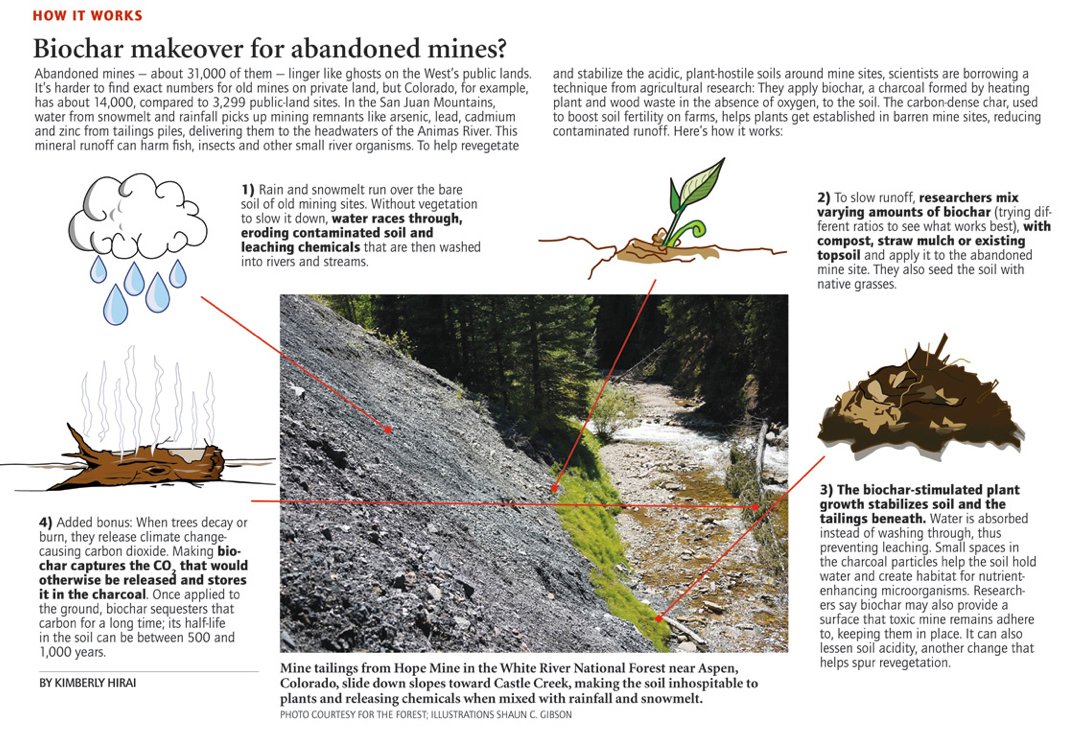
What was once a wasteland of arsenic, cadmium, lead and zinc on a steep mountainside that abuts Castle Creek is now a haven for natural grasses and wildflowers that have stabilized the slope and drastically reduced the risk of the heavy metals crashing into the city’s main water supply.
The striking change of scenery around Hope Mine is the result of the first whole-scale reclamation project ever attempted in the United States, and possibly the world, using biochar — a type of charcoal produced through the thermal treatment of organic material in an oxygen-limited environment.
how aggressive the regrowth was,” said John Bennett, executive director of For The Forest, which teamed up with Carbondale-based Flux Farm Foundation at the request of the U.S. Forest Service, which is exploring new ways to partner with private groups to reclaim landscapes. “We did not expect waist-high grass in the very first summer. We thought it would take longer.”
Not only is biochar restoring the ecology and containing the mine tailings that fan down toward Castle Creek but experts say it is also immobilizing the heavy metals long enough so that they naturally degrade and it is sequestering carbon that would otherwise escape into the earth’s atmosphere.
Click through for the rest of the article and the cool before and after photos.
More coverage from Chadwick Bowman writing for The Aspen Times. From the article:
“This project is going better than I would have dared hoped,” John Bennett, executive director of For the Forest, an Aspen-based nonprofit focused on forest health, said Thursday during a press conference at the site.
The reclamation of the slope, south of Aspen in the Castle Creek Valley, became more pressing when it was discovered that very low levels if toxic metals had been sliding into the creek, a source of Aspen’s drinking water.
Even though the levels of toxins were minute, the reclamation plan was intended to prevent a potential landslide on a mine tailings pile — debris left from mineral extraction — that could add poisons into the creek.
“The Forest Service turned us on to the project because it’s their land,” said Kate Holstein, program director of For the Forest. “They told us there is a situation where this big slope is continually eroding into Castle Creek. … If a large erosion were to occur where the whole slope slid into the creek, it could be catastrophic.”
Holstein said such a landslide could shut down the Castle Creek water source potentially for years…
Forty-two test plots were laid out at the site; each contains different variations of biochar mixed with soil and seeds, as well as control plots that contain no biochar. Williams said there are significant differences between the plots, and that biochar is making growth happen.
More restoration coverage here.