
From The Pueblo Chieftain (Chris Woodka):
“If we are going to have a meaningful plan, it has to have the respect of everyone in the state,” John Stulp, the governor’s water adviser, told the Arkansas Basin Roundtable last week.
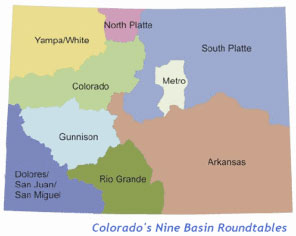
The roundtables and the Interbasin Compact Committee, created by state law in 2005, have been the vehicle moving toward a statewide water plan by 2016.
“What’s going to keep it from getting push-back like every other water plan proposed by previous governors?” asked Jeris Danielson, a water consultant and former state engineer.
“Those were top-down approaches,” Stulp said.
Here’s a guest column written by Lane Wyatt that’s running in the Summit Daily News. Here’s an excerpt:
Like most of the others, the Colorado Basin Roundtable created a list of environmental and recreational attributes for its basin’s waterways and maps that show where they occur. However, due largely to experience with transmountain diversions that take water from the Colorado’s headwaters to the Front Range, the members of the Colorado Basin Roundtable also decided they wanted to better understand how much water was needed to maintain those attributes. To achieve this understanding, the Roundtable participated in the development of the Watershed Flow Evaluation Tool, a cost-effective approach to assess the flow-related status of environmental and recreational attributes across the watershed.
The Colorado Basin Roundtable obtained funds from a pool of state grant moneys set aside for roundtable projects to develop the Watershed Flow Evaluation Tool and to apply it throughout the Colorado River Basin within Colorado. The tool evaluated the flow needs of certain environmental attributes that serve as indicators of the larger ecosystem needs. For example, flow needs for warm- or cold-water fish species indicate aquatic species flow needs, and flows necessary for the abundance and recruitment of cottonwoods indicate riparian flow needs. A key assumption embedded in the tool is that aquatic and riparian ecosystems rely on a variable flow regime: low flows are needed to maintain aquatic habitat; seasonal high flows are often needed to flush fine sediment and cue spawning of certain types of fish; and flood flows are needed to sustain riparian ecosystems, scour the channel, and to maintain alluvial water storage.
More IBCC — basin roundtables coverage here.