January 13, 2026
Colorado Springs Utilities stands alone among the electrical utilities in Colorado in saying that it cannot meet its 2030 greenhouse gas reduction targets.
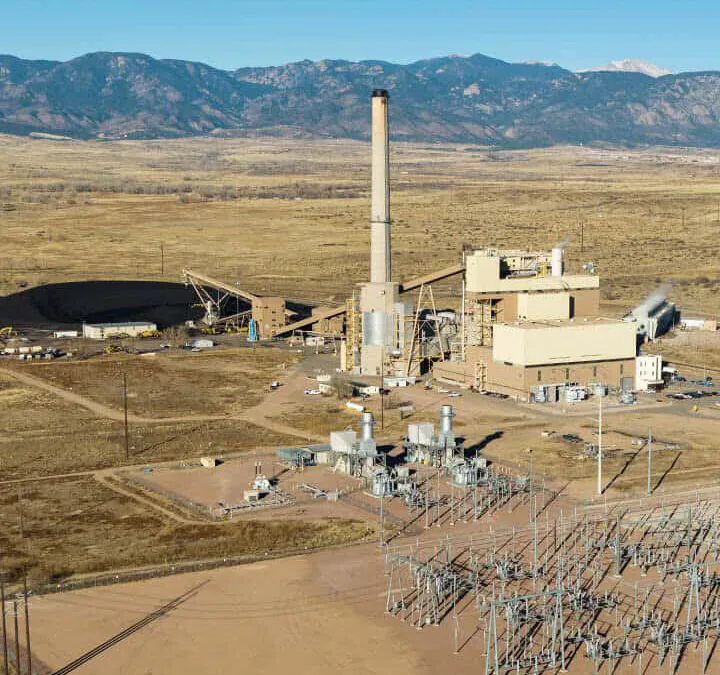
CSU wants to keep the coal-burning unit at the Ray Nixon Plant operating beyond its 2029 scheduled retirement. Four state legislators, two of them Democrats, say they will introduce a bill in the legislative session that begins on Wednesday to do just that.
This proposed bill, according to the draft dated Jan. 5, would require CSU, other municipal utilities and electrical cooperatives to potentially delay meeting the target until 2040, a decade later. They must currently reduce emissions 80% by 2030 as compared to 2005 levels. See 2030 Emission Reduction Goal Challenges (Draft 1-6)
The existing state deadlines would have all but one coal-burning unit in Colorado retired by the end of 2029, leaving only Comanche 3 in Pueblo to operate until the end of 2030. That unit is operated by Xcel Energy and owned by Xcel with two electrical cooperatives as minority owners. It is currently down for repairs.
Colorado Springs began saying almost a year ago that it could not secure enough renewable generation at acceptable prices to meet the carbon-reduction goal. Bids on renewable projects had come in 30% to 50% higher than expected.
Travas Deal, the chief executive of CSU, reiterated his argument at a press conference on Monday. Achieving the deadline of 80% greenhouse gas reductions by 2030 without risking reliability and affordability for the homes, businesses, hospitals and military installations that rely upon electricity from CSU has become increasingly challenging.
He called for a “measured approach.”
A major theme is that renewables cost more money, and the cost is being borne by people who cannot afford rising electricity bills. The draft bill hammers this point from several directions.
The bill being readied for introduction would allow CSU to notify the state’s Air Pollution Control Division by the end of May that it expects to be unable to hit the 2030 goal and why. It would then have until the end of 2026 to come up with a new plan for achieving the goal no later than 2040.
This timeline, said Deal, would “us more time to secure reliable and affordable replacement power for the coal-powered unit at the Nixon power plant currently mandated to retire in 2029.”
But why is Colorado Springs alone among Colorado utilities in wanting a legislative extension? Deal was asked that question twice during a press conference on Monday afternoon, once by this correspondent. After all, United Power left Tri-State less than two years ago and has managed to add both renewable generation and a gas-fired power plant. United has robust growth in electrical demand. And, if not as large as Colorado Springs, United has113,000 members — many of them industrial users with healthy electrical appetites.
Deal answered that United has the capacity to get electricity from Tri-State Generation and Transmission Association, of which it was formerly a member.
That was not a satisfying answer, although it’s possible that transmission constraints might preclude CSU from buying power from Tri-State as United is now doing.
Might Tri-State or other electrical cooperatives quietly be supporting this move to soften the deadlines for closing coal plants? Big Pivots did reach out to Tri-State to request an interview, but did not get a response on Monday.
As for Xcel, this bill would not apply to it or to Black Hills Energy, Colorado’s other privately owned electrical utility.
Standing out in this proposal is the bipartisan support, two Republicans and two Democrats. All but one of them are from El Paso County. One of the two Republicans, Sen. Cleave Simpson, of Alamosa, is the Senate minority leader.
Most striking was a statement made by Sen. Marc Snyder, a Democrat from Manitou Springs. He pointed out that in a “lifetime ago,” when he was mayor of Manitou, the city — which is supplied by CSU — was able to achieve 100% renewables. He said it was Colorado’s first home-rule municipality to do so.
(Aspen, which is also home rule, did so in 2015; when Manitou Springs did it Snyder did not say. In both cases, they presumably did so with the artifice of renewable energy credits.)
Rep. Amy Paschall, also a Democrat, proclaimed her environmental actions. “I recycle, I drive an electric vehicle and I have solar panels on my roof,” she said. She added that she suffers from asthma and has a child who has asthma. As such, she said, attaining ozone reduction “isn’t just an abstract policy discussion. It directly affects our health and our quality of life.”
So why is she adding her name to this bill?
“Because it aims to strike the delicate balance between affordability, reliability and clean energy in Colorado Springs,” she answered. This bill will seek to achieve the “right balance.”
State Rep. Jarvis Caldwell, a Republican (and House minority leader), did not disown the need for an energy transition from fuels that produce emissions, but did characterize current goals as unrealistic.
“What you are seeing now is a growing gap between intention and reality,” said Caldwell. “Over the last several years, the Legislature has set aggressive energy mandates without fully grappling with what those mandates mean for the people who are expected to pay the bill.”
For many households, he said, energy costs are not an abstract policy debate. They are a monthly decision between paying the power bill or cutting back somewhere else.
The energy transition, he said, is “being rushed” and called the timelines “unrealistic.” And Caldwell further charged that reliability is treated as an afterthought.
“The result is higher prices and a more fragile system. That is not responsible governance.”
Caldwell said that both he and Paschal had meet with the Democratic majority leadership. “We didn’t get any commitments necessarily from them, but they heard our concerns and they heard our reasoning, and they were receptive to it,” he said. He also said there had been discussions with Gov. Jared Polis.
Sounds like a compelling argument. Does the rhetoric overlook subtleties?
All or nearly all utilities have or propose to raise their electric rates, and for a complicated stew of reasons. In some cases, they need to reinvest in delivery infrastructure. It’s not all investment in renewable energy to replace fossil fuel generation. In fact, in most cases, renewables reduce costs to consumers, because the fuel in renewables is free. But yes, rates are rising.
Renewables do need transmission — and more of it. And transmission is difficult and expensive.
Colorado Springs has high-voltage transmission lines for its fossil fuel plants. Deal said the best wind lies in Wyoming and hence CSU would be best served by transmission lines along the Front Range — a challenge, as is witnessed by the problems Xcel Energy is having in getting electricity from El Paso County to Aurora. As always, though, that is a more complicated story than this simple sentence. See “Highways of Electricity,” Big Pivots, Jan. 4, 2026).
And Deal’s answer overlooks the fact that Colorado’s best wind resources lie in southeastern Colorado.
Big Pivots asked Deal if CSU would be struggling less if it had better transmission. “Transmission may not have alleviated everything on day one, but it would give us a lot more options,” he replied.
He added that joining the Southwest Power Pool, an organization formed to facilitate energy sharing within a region, will provide a “big tool” for CSU to connect to renewable resources. But again, that will require transmission, although the precise needs remain uncertain.
As for data centers, what part are they of this Colorado Springs story? Is CSU expecting to miss its greenhouse gas reduction deadline because it doesn’t want to miss out on the economic development potential in artificial intelligence centers.
Hard to say, although perhaps tellingly, the video event in Colorado Springs included Johnna Reeder Kleymeyer, from the Colorado Springs Chamber and Economic Development Commission. “This proposed legislation recognizes one simple truth,” she said. “Economic growth and sustainability have to work in concert, not in conflict.”
A reporter from Colorado Public Radio, however, did ask a decent question: Would CSU consider requiring agreements with large-load users, including data centers, to be on hold until the utility could get closer to the current clean energy goal?
“We would never want to close the door on any opportunity there, but I think that’s something that the legislation has to look at, as for us to continue to support growth in our communities, have jobs, and look at those revenue streams come in,” Deal answer.
As for data centers, they do require a lot of electricity without generating a large number of jobs, he added, as compared to another large-level manufacturer. “So we try not to get into what the (electric) load is as much as what the community benefit is and how we can best serve them.”
Colorado Springs, perhaps not incidentally, in December announced that it would become home to a Coca-Cola bottling plant that will require $475 million in capital investment and generate 170 new jobs.
Snyder, the legislator from Manitou Springs, said the bill was being drawn up after consultation with stakeholders. The Sierra Club said it was not among those consulted.
“CSU is the only utility in Colorado to ask for a special exemption from Colorado’s environmental standards that protect public health and our climate,” said Margaret Kran-Annexstein, director of the Colorado Chapter of the Sierra Club.
Conservation Colorado, in a statement, said CSU should not be rewarded for “broken promises and poor planning.”
“After years of failing to plan for replacement resources, Colorado Springs Utilities (CSU) wants to break its promise and remain one of Colorado’s largest polluters,” said Paul Sherman, the organization’s climate campaign manager.
Unlike the Sierra Club, Conservation Colorado had participated in discussions with CSU. Sherman said his organization had communicated its concerns. “None of the substantive concerns we raised were addressed in the draft that CSU and bill sponsors released this afternoon,” Sherman said. “As currently drafted, Conservation Colorado will be opposing this legislation.”